Archive | 2015

Lost Advertisements-1922 World Series, Lord and Taylor

13 Nov

1922ws

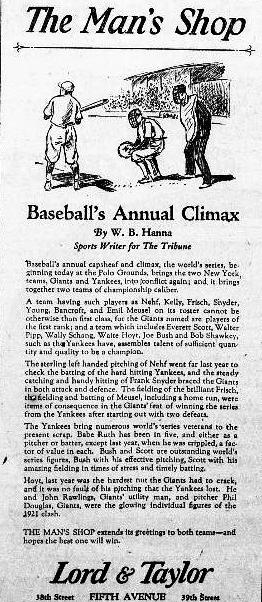
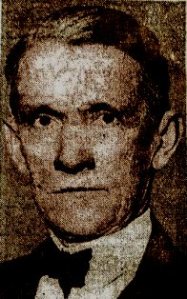
An October 1922 Advertisement for The Men’s Shop at Lord & Taylor.  The ad featured a preview of the World Series–a rematch of the 1921 series–written by William Blythe Hanna of The New York Tribune:

William Blythe Hanna

William Blythe Hanna

“Baseball’s annual capsheaf and climax, the world’s series, beginning today at the Polo Grounds, brings the two New York teams, Giants and Yankees, into conflict again; and it brings together two teams of championship caliber.

“A team having such players and (Art) Nehf, (George “High Pockets”) Kelly, (Frankie) Frisch, (Frank) Snyder, Young (Dave) Bancroft, and Emil (“Irish”) Meusel on its roster cannot be otherwise than first class, for the Giants named are players of the first rank; and a team which includes Everett Scott, Walter Pipp, Wally Schang, Waite Hoyt, Joe Bush and Bob Shawkey, such as the Yankees have, assembles talent of sufficient quantity and quality to be a champion.

“The sterling left-handed pitching of Nehf went far last year to check the hard-hitting Yankees, and the steady catching and handy hitting of Frank Snyder braced the Giants in both attack and defense.  The fielding of the brilliant Frisch, the fielding and batting of Meusel, including a home run, were items of consequence in the Giants’ feat of winning the series from the Yankees after starting out with two defeats.

“The Yankees bring numerous world’s series veterans to the present scrap.  Babe Ruth has been in five, and either as a pitcher or a batter, except last year when he was crippled, a factor of value in each.  Bush and Scott are outstanding world’s series figures, Bush with his effective pitching, Scott with his amazing fielding in times of stress and timely batting.

“Hoyt, last year was the hardest nut the Giants had to crack, and it was no fault of his pitching that the Yankees lost.  He and John Rawlings, Giants’ utility man, and pitcher Phil Douglas, Giants, were the glowing individual figures of the 1921 clash.

“The Man’s Shop extends its greetings to both teams–and hopes the best one will win.”

The Giants repeated, beating the Yankees four games to one–there was also a controversial tie in game 2.

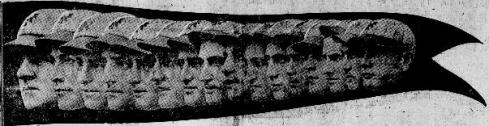
22giants

The Giants

Veteran’s Day—The 1917 “Smokes for Soldiers Game”

11 Nov

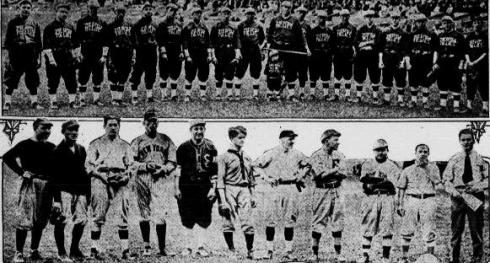
In August of 1917, a benefit game was played in New York to raise money to send cigarettes to US soldiers fighting in Europe.  The New York Sun said:

“The crowd that turned out at the Polo Grounds yesterday afternoon to see the Ziegfeld Follies high diving ball tossers play the Friars Club for the benefit of The Sun’s Tobacco Fund for our soldiers in France that even Fatty Arbuckle was inconspicuous.”

The Follies (top) and the Friars

The Follies (top) and the Friars

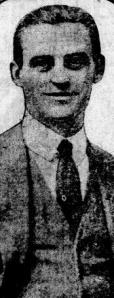
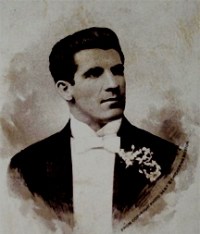
New York Giants’ outfielder turned actor, Mike Donlin and boxer Jim Jeffries served as umpires and drawing cards:

“Donlin, mightiest ball slugger…batted for someone or other and knocked a pop fly and was promptly knocked by 7,000 fans, and Jim Corbett oiled up the old biceps machinery by rapping fungoes before the game.”

Donlin

The Sun said the game drew nearly 7,000 fans and raised $937.60—other new York paper put the attendance closer to 5,000—but told readers that many of them were “(S)mall boys or Harlem youths at the voice cracking age whose contributions amounted to dimes and even pennies—gifts that measured the extent of their bankroll and therefore doubly welcome and all going far toward swelling the total for smokes and makin’s for our soldiers.”

Tobacco, said the paper, was critical to the war effort:

“Do you realize what a notable and beneficial part tobacco has played in the wars of the last century, from the Battle of Waterloo; say to the great conflict now raging?  Probably its solacing and inspiring qualities were never more strongly manifested that in the Franco-Prussian War of 1870.  It might be said, indeed, that the defeat inflicted on the French was due largely to the soldiers’ lack of tobacco, added, as it was, to the breakdown of the commissariat, whereas on the other side the Germans did all they could to ensure a plentiful supply to their troops. “

As for the game:

“(O)ne might say that a baseball game was but incidental to the baseball game…what with wild applause the minute Jim Corbett stalked onto the field., bat in hand, to oil the upper cutting wings before settling down to umping, and then the three deafening cheers  when Mike Donlin strode out toward the spot where he used to stamp down the right field grass in the old days, and the ‘Aaaahs’ and  ‘Oooohs’ from ecstatically admiring thousands as (actresses and donation collectors) Miss (Ann) Pennington, Miss Frances White…and all their friends piled on the field.”

Corbett

Corbett

The Follies defeated the Friars 7 to 5.

Lost Advertisements–Walter Johnson Car Ads

9 Nov

johnsoncolecar

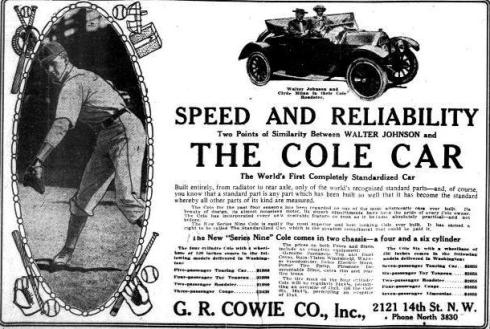
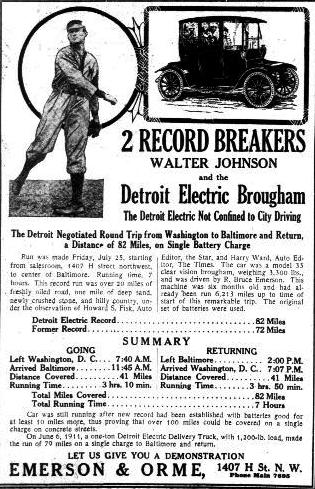
Two 1913 advertisements for automobiles featuring Walter Johnson.

Above, an ad for a Washington D.C. Cole dealership–the picture at the top is of Johnson and outfielder Clyde Milan “In their Cole Roadster”:

Speed and Reliability

Two points of similarity between Walter Johnson and 

The Cole Car

The world’s first completely standardized car

The second ad, below, is for the local Detroit Electric dealership:

2 Record Breakers

Walter Johnson 

and the

Detroit Electric Brougham

johnsondetroitelectric

Johnson remained on the mound longer than Cole stayed in business; the car maker closed in 1925.  Detroit Electric continued building cars until 1939 and the company was revived in 2008.

Connie Mack vs Herman W. Souse

6 Nov

In his autobiography “My 66 Years in the Big leagues,Connie Mack said, “My first great disappointment came in 1912.”

Connie Mack

                          Connie Mack

After two straight World Series victories, Mack’s Athletics stumbled to a disappointing third-place finish.  With his team 15 ½ games out of first on September 6, Mack suspended pitcher Charles “Chief” Bender and Reuben “Rube” Oldring for, as The Philadelphia Inquirer  put it:

 “(T)heir failure to live up to the training requirements, as demanded by Mack and all common sense baseball managers.”

Chief Bender

                                Chief Bender

The Inquirer said “Mack refused to discuss this matter further,” but just days later in Detroit he gave what The New York World called “a sermon” on the reason for the suspensions:

“Booze and baseball don’t mix; never did, and never will. A pitcher who thinks he can fan Herman W. Souse is simply pitching to the greatest home run hitter he ever faced.

“Once in awhile you hear of some marvel who can stay out all night, drink all the breweries dry, wreck a few taxi cabs and otherwise enjoy himself, and then step in the box and pitch a wonderful game of ball.  Players who haven’t any more sense point to Rube Waddell, Bugs Raymond and that brand and say: ‘Ah, those were the good old days.  None of these high-priced managers and their red tape then.  And what wonderful players we produced in those days.’

“Well, look at Waddell—one of the most remarkable pitchers nature ever produced.  But Waddell, with all his talent, couldn’t stay in the major leagues.  Why?  Because he stood there and pitched himself to Old Man Barleycorn, and finally every one he threw was slammed over the fence.  And that’s the way all go.  Is it so wonderful, after all?

“No, sir, the day of the stewed ballplayer has gone and it won’t come back.  If the members of my team want to drink, all right.  But they can’t drink and play ball at the same time.  That’s settled.  They can do whatever they prefer, but they can’t do both.

“There are no exceptions to my rule, either.  Any manager will tell you the same.  A short life and a merry one—that’s it.  And the merrier it is the shorter it will be in the big leagues.”

In December of 1912, The Philadelphia Record said Bender had written a letter to Mack asking his manager “to please forgive him.”

According to The Inquirer, he was forgiven and set to return to the Athletics in 1913:

“This winter Bender has spent nearly all the daylight hours automobiling and hunting in the South.  He looks stronger than ever.”

The “stronger,” sober Bender appeared in 48 games, 21 as a starter, and posted a 21-10 record with a 2.21 ERA, and helped lead the Athletics to their third championship in four seasons.

In “My 66 Years in the Big leagues” Mack said of him:

“Let me say here that I consider Chief Bender the greatest one-game pitcher, the greatest money pitcher baseball ever has known.”

Moose Baxter’s Play

4 Nov

Jimmy Ryan played 18 seasons in the major leagues from 1885 through 1903, and appeared in more than 2000 big league games and nearly 500 in the minor leagues.  But he said the greatest play he ever witnessed took place in 1908—his final year in organized ball–when he was player-manager of the Montgomery Senators in the Southern Association.

He claimed the play was made by John “Moose” Baxter, who he released later in the season for allegedly placing bets against his own team.

1908 Montgomery Senators.  Ryan is sitting center of middle row, Baxter is standing second from right.

1908 Montgomery Senators. Ryan is sitting center of middle row, Baxter is standing second from right.

Ryan told the story to Hugh Fullerton of The Chicago Herald.  He said it happened during a game against the Atlanta Crackers:

“(T)he bases were full and no one was out…I think it was (Louis “Lou”) Castro at bat, and he hit the first ball pitched, a line drive about twenty feet inside of first base.  I was playing right field and I sprinted forward, fully expecting to catch the ball on the line and throw home.  But I never got a chance.

“Moose took a running jump at the ball; he hadn’t a chance to catch it.  Instead he flew up into the air, and striking at the ball with his mitt, hit it and knocked it forty feet as straight as if he had thrown it, and right into the hands of the second baseman (Clay Perry)…Baxter, when he hit the ball (with his glove) turned half over and fell heavily, but without waiting to get up started and rolled back toward first.

“(Perry) tossed the ball up there, and with one hand stretched out to touch the base, Baxter stuck up the other, caught the ball and completed the double play.  The runner on third, seeing what was coming off, started home at top speed, and Baxter, sitting near first base, threw from that position to the plate and caught the runner.”

Moose Baxter

    Moose Baxter

Despite executing “the greatest play” Ryan said he ever saw, Baxter quickly became more trouble than he was worth.  In May, he was suspended for a week.  The Montgomery News said, after he had “engaged in a tussle” with an umpire named O’Brien.  “Baxter threw the umpire to the ground and pummeled his face.”

Baxter was released on May 17.  Ryan said only that it was “for the good of the team.”  Later in the week, The News said:

“The reasons assigned by the management are that Baxter has incurred displeasure of the spectators and has bred dissention among the players.

“Reasons given on the street are that Baxter has been betting against his own team in one of the recent games.”

Whether Baxter ever placed a bet against his team is unknown, but no action was ever taken by the league and he signed with the New Orleans Pelicans within a week.

Baxter was never far from trouble during his career.  While playing, and operating an illegal business in Canada in 1910, Baxter ran afoul of the law and was escorted to the border.

“Out of the Game”

2 Nov

ripley

A September 1920 cartoon in The New York Globe, “Cleaning Up” by Robert Ripley–later famous for “Ripley’s Believe it or Not” which he began drawing two years earlier–calling on organized baseball to banish  Hal Chase, Heinie Zimmerman, and six members of the Chicago White Sox: Swede Risberg, Joe Jackson, Eddie Cicotte, Buck Weaver. Happy Felsh [sic, Felsch] and Lefty Williams–Ripley left out Chick Gandil and Fred McMullin.

Ripley continued to draw baseball cartoons as “Believe it or Not” gained popularity, including the one below from 1921 winter meetings featuring Kenesaw Mountain Landis, Ban Johnson, Kid Gleason, Hooks Wiltse, Charles Ebbets, John McGraw, and Wilbert Robinson.  After The Globe folded in 1923, Ripley moved to The New York Evening News.

ripley2


Lost Advertisements–“Fireball” Johnson

30 Oct

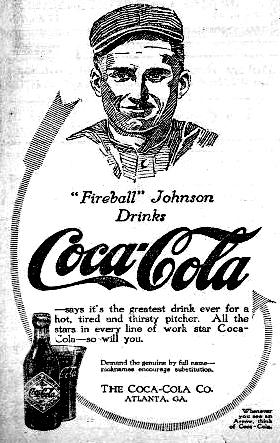
walterjonsoncoke1915

“‘Fireball’  Johnson Drinks Coca-Cola–Says it’s the greatest drink ever for a hot, tired, and thirsty pitcher. All the stars in every  line of work star Coca-Cola–so will you.”

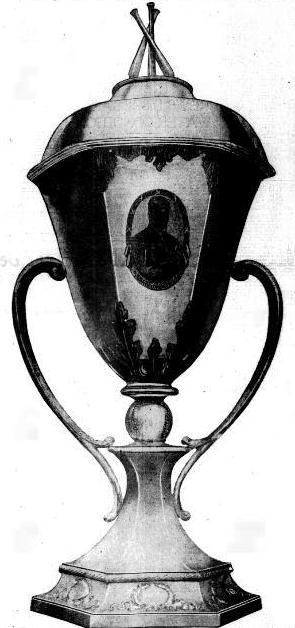
In 1913, The Washington Times presented Walter Johnson with a cup honoring him as “Greatest Pitcher in the World,” and published a special section including quotes from his contemporaries:

Cup presented to Johnson by The Washington Times

Cup presented to Johnson by The Washington Times

Napoleon Lajoie:

“I like to bat against Johnson.  There’s some satisfaction hitting against a hurler of such pronounced class.  When I make a hit off Johnson I know it’s well-earned, and the sound of a good, solid swat made off one of Walter’s curves is the most welcome music I hear during the season.”

George Stovall:

“I consider Walter Johnson the greatest pitcher in the game today and one of the finest fellows on and off the ball field.”

Nixey Callahan:

“You may say anything good for me regarding Walter Johnson that you care to. I consider him one of the greatest pitchers that the game has ever known and an ornament to the profession in every way.”

Russ Ford:

“He is the King Pin of them all, and yet remains just the same quiet, good fellow who broke in six years ago.”

Joe Birmingham

“May your curve always break and your speed never diminish.”

“Pace is what decides Pennant Races”

28 Oct

Joseph B. Bowles ran a newspaper syndication service in Chicago during the first two decades of the 20th Century.  His content was mostly religion and baseball.  One series of articles he published asked players and managers to explain “How I Win.”

Hugh Duffy, the new manager of the Chicago White Sox was the subject of a 1910 article:

“There is an element in baseball which is not on the surface, and which players, spectators, lovers of the game and often managers themselves do not realize or understand.  This element is pace.
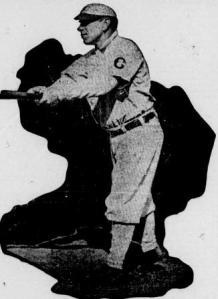
Hugh Duffy

                            Hugh Duffy

“Pace is what decides pennant races.  The team that is fast enough, well conditioned enough and smart enough to set the pace, and force the other clubs to play at top speed all the time to hold in the race, is the pennant-winning team unless it cuts out too fast a pace and breaks itself.  In races where all the clubs start slowly and are a long time rounding into true playing condition, some flash in the pan club may win by a spurt of speed, but in most races the conditioned, fast team plays steadily and forcing the pace against its closest competitors, wins.

“Ability to hold the pace is the test of the gameness and the fighting spirit of a club and no club can win a pennant, or be a consistent winner unless it is courageous enough to stand the strain and fight every step of the way.

“Pennants usually are won by the gamest club, rather than by the fastest ones or the best ones.  Before a season starts each manager calculates the strength, the speed, and the hitting and fielding ability of the men under him and calculates what sort of pace is best suited to his team.  If he thinks his club is strong enough he may force the speed from the start, trying to spread eagle the other clubs and win away by himself.  Sometimes this is the best policy, for often an inferior club, if permitted to gain a big lead on the others, will get so full of confidence that nothing can stop it.  There have been such cases but they are seldom, and the manager who strains his pitching staff and risks damaging his team in order to gain an early lead is likely to find himself in mid-season with a crippled and broken club.  On the other hand, the manager who strives to hold back and save the strength of his team for a hard finish is liable to have a discouraged and beaten club on his hands just at the time he is ready to make his spurt towards the lead.

“The manager must strive to strike the happy medium, to reserve the strength of his team, especially of pitchers, without falling completely out of the race.  Above all, he must keep the spirit and the condition of his men to a high standard.  The well-conditioned club, composed of players working in unity, and with brains enough to keep themselves in condition all the time, will beat much better ball clubs in a bruising race.

“As for individual standards, I want brains on my ball club.  The smart ballplayer, who keeps thinking all the time, who is looking for an opening, and out thinking his opponents, is a much better player than the men who can out bat, outrun and outfield him.  Speed and hitting ability are the main essentials of a team.  I do not claim that twenty reporters, who probably know the game better than any twenty ballplayers do, could win a pennant, but the brains must direct intelligently the actions of trained hands and feet and if, combined with brains, hands and feet, a player has the quality known as aggressiveness, he is a winning ballplayer.  The manager cannot think for twelve men.  He can correct their mistakes, or tell them about their blunders, may order their plays and discipline them, but there are a hundred times in each game when the men must think for themselves and if they do not, then defeat is to be expected.”

Duffy was unable to find the “pace” with his White Sox, who finished in sixth place with a 66-85 record. Late in the season, The Chicago Daily News placed the blame on the manager, saying it was:

“(A) generally recognized fact that President Charles A. Comiskey’s 1910 White Sox are a dismal failure…Lack of teamwork and the inability of Hugh Duffy to manage the team properly are the real causes of the disgraceful showing.”

In eight seasons as a major league manager he never finished better than fourth place—he did win two championships in the minor leagues, with the Milwaukee Creams in the Western League in 1903 and the Portland Duffs in the New England League in 1915.

“There’s one thing you mustn’t do when you get to New York”

26 Oct

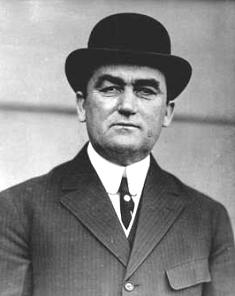
“Sinister Dick” Kinsella is primarily known as John McGraw’s equally pugnacious right-hand man and scout.  He was at McGraw’s side for one of the manager’s most famous brawls; a battle with Giants catcher Larry McLean in the lobby of the Buckingham Hotel in St. Louis, he also boasted an impressive list of “finds” including Carl Hubbell, Chief Meyers, Hack Wilson and Larry Doyle.

"Sinister Dick" Kinsella

              “Sinister Dick” Kinsella

Kinsella credited a career minor league player and manager for his discovery of Doyle, who he sold to the New York Giants in July of 1907.  After Doyle hit .310 in 1911, a syndicated Newspaper Enterprise Association told the story of how he acquired Doyle after the 1906 season from the Mattoon Canaries of the Kitty League, having never seen him play:

“Mattoon was in need of a pitcher and appealed to President Dick Kinsella of the Springfield Three-Eye League team for aid…Kinsella saw a chance to make a bargain when Mattoon hoisted the distress sign and struck one.  ‘I’ll let you have a pitcher for the pick of your team at the end of the season,’ Kinsella told the Mattoon people.  His offer was accepted and pitcher (John) Jokerst was sent  to the Kitty League team by Springfield.

“Doyle didn’t do well with Mattoon (.225 in 91 games) that season.  Kinsella had not even considered him in deciding what player to pick.  He had almost made up his mind to take a veteran pitcher.”

Fate intervened when Kinsella mentioned the Mattoon deal to Frank Belt, manager of the Kitty League’s Jacksonville Jacks.  Belt asked Kinsella if he had ever seen Doyle:

“’No,’ answered Kinsella.

‘”Well, don’t pick anyone until you do, and then pick him.  He’s the coming ballplayer of that club.  He hasn’t looked good in the box scores, but he’s ‘there’ any way you take him.  He’ll bring you more money inside of a year than you ever got for a player.”

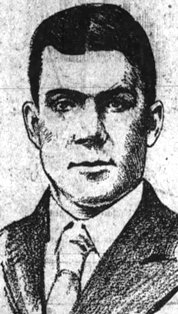
Larry Doyle

                  Larry Doyle

Sight unseen, Kinsella took Belt’s advice.  Doyle played third base and hit .290 in 66 games for Kinsella’s Springfield Senators.  He became the subject of a bidding war with the Giants winning out over the Detroit Tigers and Washington Senators for his services on July 16.

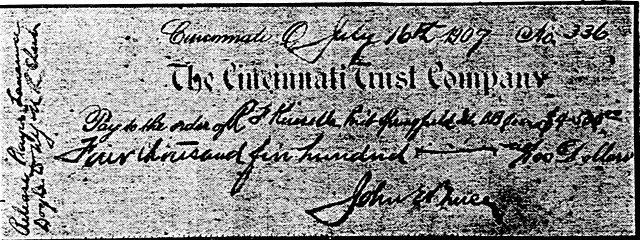
Kinsella was paid a then-record $4500 for Doyle—a record eclipsed the following year when Kinsella sold Rube Marquard to the Giants for $11,000.

The $4500 check to Kinsella for the sale of Doyle

                              The $4500 check to Kinsella for the sale of Doyle

According to The Springfield Journal Kinsella sent Doyle off to New York with just one piece of advice:

“There’s one thing you mustn’t do when you get to New York.  You must quit sliding to bases on your head.  If you don’t, they will think you’re from the brush.”

Doyle was moved to second base, hit .290 over a 14-year big league career, and presumably took Kinsella’s advice about sliding head first.

“The Fair Sex” at American Giants Park

23 Oct

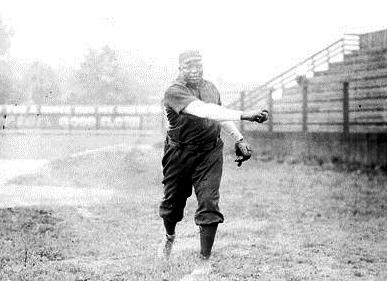
The Chicago Defender loved Rube Foster:

Rube Foster

                                       Rube Foster

“Chicago generally leads all cities in America in producing foremost men in the world of business, letters, professions, and arts, and in athletics she boasts of her champions, crowned and uncrowned.  Perhaps no sport in America has a greater following than baseball, and of the many colored teams who sign up here the American Giants under Rube Foster’s management is unquestionably the best.  Rube Foster is to baseball what Jack Johnson is to the pugilistic world and as a manager and player he has few equals in the major leagues.”

But during the 1914 season, the paper said there was one area where Foster had been negligent.  It involved “The fair sex” at American Giants Park at 39th and Wentworth:

“Sport to be good must be clean sport…The thousands of ladies who attend the games should be given every courtesy, and complaint has been generally made that their costumes have been soiled by unclean seats.  It isn’t such a great task to turn the hose on the seats two or three hours before each game, so the ladies may attend without having to send their dresses to the cleaners after each game.  There is no doubt that it is simply an oversight on the part of the management and will immediately be remedied.”