Archive | 2015

Cuban X-Giants In Washington D.C., 1901

7 Dec

xgiants

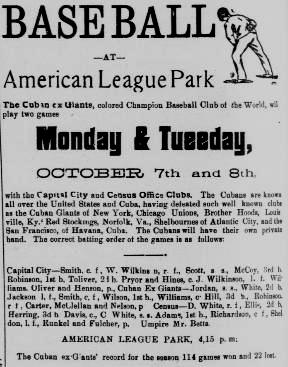
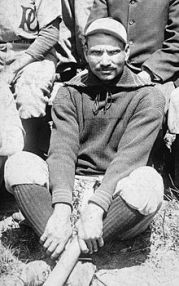
A 1901 advertisement for the Cuban X-Giants, managed by Soloman “Sol” White, in Washington D.C.  The team played the Capital City–described by The Washington Times as “a contingent of colored ball players of this city,” and the team representing the United States Census Bureau at American League Park.

Sol White

Sol White


According to the ad:

“The Cubans are known all over the United States and Cuba, having defeated such well-known clubs as the Cuban Giants of New York, Chicago Unions, Brother Hoods, Louisville, KY. Red Stockings, Norfolk, VA., Shelbournes of Atlantic City, and the San Francisco, of Havana Cuba.  The Cubans will have their own private band.”

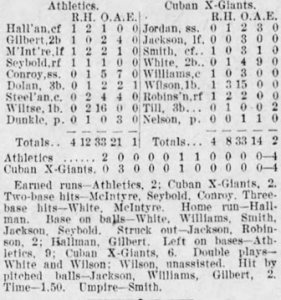
The previous week, the X-Giants played an 11-inning tie with the Philadelphia Athletics at Columbia Park–although the Athletics three biggest stars, Napoleon Lajoie, Harry Davis and Lave Cross did not participate, The Philadelphia Inquirer said, “Both teams put up a splendid article of ball and the game resulted in one of the best that has been played on the grounds this season.”

The Philadelphia Times was even more enthusiastic:

“The game itself was beyond all doubt one of the greatest ever witnessed upon the local diamond.”

The 11-inning tie against the Athletics

The 11-inning tie against the Athletics

The ad said the club had won 114 games and lost just 22 in 1901, and described them as the “Colored Champion Baseball Club of the World.”  In both 1900 and 1901 the X-Giants and the Cuban Giants each claimed to be “Colored Champion.”

In addition to Sol White, the roster included, Robert Jordan, Ray Wilson, Clarence Williams, John Nelson, Danny McClellan, Will Jackson, Johnny Hill, Robert “Ginney” Robinson, and Charles “Kid” Carter.

The X-Giants won both of the advertised games.  The victory over the Capital City club was of such little note that no newspaper mentioned the score.  The Washington Colored American simply said the X-Giants “Played stars and circles around the Capital Cities.”

They also beat the Census Department 8 to 0.  The Washington Times said:

“The visitors had things their own way throughout the game, and at no time were they in danger of being defeated.  They had a twirler (McClellan) in the box that knew the fine points of the game.  He struck out nine of the localities and allowed but two of them to get the slightest semblance of a safe hit off his cannon ball delivery.”

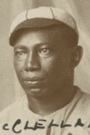
Danny McClellan

Danny McClellan

The X-Giants beat one more local team, the Eastern Athletic Club, on October 9, and left the nation’s capital 117-22.


Lost Pictures–The Best Eyes in Baseball

4 Dec

eyeszimmerman

eyesdaubert

eysspeaker

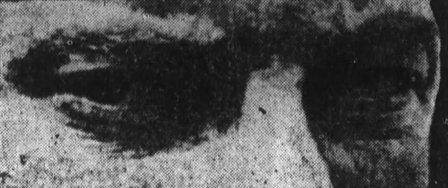
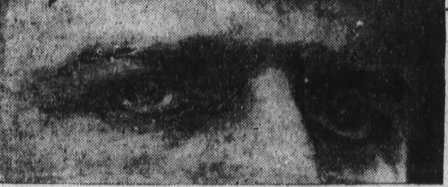
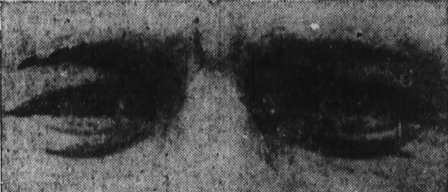
Above, three sets of eyes, 1916.

Harold “Speed” Johnson of The Chicago Herald said:

“It’s the eye and not the wallop that counts in the national Pastime.  Some eyes are more durable than others.  Larry Lajoie possesses such a pair; so does Hans Wagner, Terry Turner, Tris Speaker, Jake Daubert, Frank Schulte, Larry Doyle, Heine Zimmerman, Tyrus Cobb, Joe Jackson and Bill Hinchman.”

Johnson informed his readers that “Most of these birds refrain from reading during the offseason, thereby sparing their eyes.”

As for the three sets pictured above, Jonson said:

“Heine Zimmerman is another notable example of the batter who possesses the keen optics.  He eccentric third sacker of the Chicago Cubs, when at peace with the world, is one the greatest natural sluggers of all time.  His eyes never have troubled him but his temperament frequently has caused him to slump, swinging frantically at any old pitch.  Right now Heinie is seeing in exceptionally good form as witness his average of .336 for 48 combats.”

[…]

“There is nothing wrong with Jake Daubert’s glims as a slant at the latest averages will indicate…His heavy cannonading has been a principal factor in the upward climb of the Robins…For a pair of eyes that have been in use as long as Jake’s in the big set they’re holding out famously.”

[…]

 “Nine seasons of big league milling haven’ dulled the lamps of Tristram Speaker who right now is going better than he did in his banner years with the Boston Red Sox.  Not only is the big Texan rattling fences  at Dunn Field, Cleveland, where for seven years he averaged .381 on visits with the Bostonese, but he is keeping up his terrific pace abroad.”

Zimmerman’s temperament caught up with him again.  He wore out his welcome in Chicago in August of 1916, was traded to the New York Giants and finished the season with a .286 average.

Daubert’s eyes held out.  He hit .316 and led Brooklyn to the National League pennant.

Speaker kept hitting at Dunn Field and everywhere else, finishing the season with a major league-leading .386 average.

“Loved Baseball More than He Feared Death”

2 Dec

Robert William “Bob” Osgood was told by doctors that he couldn’t play high school baseball because of a heart ailment.  He was also told he wouldn’t live long.

According to The Associated Press, he begged his parents for a chance to play and “(T)he youth’s parents thought it better that Bob’s playing be supervised and permission was granted.”  By his senior year in 1946, was named to several Massachusetts All-State teams.

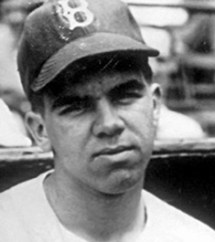
After graduation, Osgood signed with the Chicago Cubs.  His older brother Charles was then playing in the Cubs organization after appearing in one game as a pitcher for the Brooklyn Dodgers in 1944 as a 17-year-old.

Charles Osgood

Charles Osgood


Bob hit .280 in 25 at-bats split between the Cubs’ North Carolina and Appalachian League teams.

No official records exist for Bob Osgood after that, but he was a member of the Visalia Cubs in 1947.

He was assigned to the Springfield Cubs in the New England League in 1948 but missed most of spring training when he was hospitalized with the flu.  On May 7, 1948, Bob Osgood became a member of the Marion Cubs in the Ohio-Indiana League; he was sent to Marion from Springfield after the club’s manager/catcher Lew “Zeke” Bekeza broke a bone in his hand.

Osgood appeared in two games behind the plate; he hit .500 with five singles in ten at-bats.

On May 11, 1948, Osgood was sitting on the bench with teammates during a rain delay in Richmond, Indiana.  The Marion Star said:

“Osgood, a catcher who played his first game for the Cubs last Sunday, collapsed and died in the Cubs’ dugout…The heart attack came as the Cubs team took shelter from a rain storm…At 8:03 p.m. after more than an hour of artificial respiration (two doctors) declared the boy dead.”

His manager, Bezeka told the paper “Osgood had not looked well in his few days with the Cubs and had a blue coloring to his face.”

A postscript:

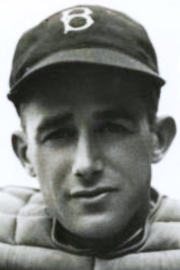
 According to Jack Durant of The Associated Press,  former Reds and Dodgers catcher Clyde Sukeforth, a Dodger scout,  was in the stands and “Seeing the commotion around the bench, rushed out the stands to the dugout,” upon arriving “He knelt beside the boy who loved baseball more than he feared death and when he looked into the stilled features, well he knew who it was—Bobby Osgood, his own nephew.”

Clyde Sukeforth

A shorter version of this post appeared on August 17, 2012.

“Ty Cobb, You Acted like a Quitter”

30 Nov

During his nearly two months on the West Coast in the fall of 1920, Ty Cobb was almost universally greeted by large, enthusiastic, and adoring crowds.

Cobb

Cobb

The one exception was late in the tour, on Thanksgiving Day, at Sodality Park in San Jose, where he was roundly booed.  The San Jose Evening News said:

“Of  Ty Cobb let it be written in the chronicles of San Jose: He came and saw and acted like a big baby.”

In the fifth inning, Frank Juney, the San Jose pitcher, struck Cobb out.  In the eighth inning, with his All-Stars losing, Cobb, according to The Oakland Tribune “(R)efused to leave the bench” to take his turn at bat.  The paper said:

“At the start of the game, stated local players, Cobb was informed that Juney was an emery ball pitcher and was asked if the ball should be barred.  ‘Anything would be alright’ he stated with a smile.  The first time up he got a two-base hit but in his next effort he fanned and was panned by the crowd.”

During the game, he also drew jeers from the crowd when he misplayed a single into a four-base error in the sixth inning.

Cobb left the ballpark before the game was over.  His All-Stars lost 7 to 2.

The Evening News wasn’t through:

“Your true hero must, after brief sulking, step out and slay hector and drag him around the walls of Troy two or three times. But Cobb didn’t have it in him to do it…(He) stuck out his under lip, was very properly booed by the fans, and then stalked out of the arena with the jeering fans standing up to watch the baby walk out of the nursery.”

[…]

“He saw that our local bushers were in grave danger of beating his team and he wanted to seize a chance to get out from under…The fans were cheated after Cobb did the baby rattle stunt, too.  Instead of making a stand-up fight against our bushers and showing us what live wires could do, the Cobb aggregation put a comedian in the box and let the locals run away with the game. (Nick) Altrock, the comedian, was all right, too.  He at least didn’t act like a sour prune left out to spoil after the historic rain that drenched the crop a couple of years ago.  But the fans wanted to see a little baseball, and they were entitled to it.

Altrock, the Comiedian

Altrock, the Comedian

“Ty Cobb, you acted like a quitter, like a bum sport, like a big baby, or like a commercial-minded calculator who couldn’t stand up and take a licking.  Whichever thing it was, or all four, it’s too bad.  The fans were out to enjoy you and admire you, and they couldn’t help hissing and booing you before you finished your performance.  Try to do better next time, and be at least as full of sand and grit as some little Sunday school teacher who sticks to the job of teaching about loaves and fishes even though she has a splitting headache.

“You see, Ty Cobb, we Americans don’t mind if you commit murder or eat snails or commit little crimes like that; but we simply can’t tolerate a who doesn’t know how to be a good sport.  The fans will still admire you, and will try to forgive you.  But don’t do such a childish thing again.”

Not to be outdone, The San Jose Mercury suggested crookedness on top of cowardice:

“It is whispered that Ty’s manager had requested Juney to lay the ball down the center for the Detroit player in order to make the big fellow look good, but Juney could not see it that way, and was out to win for San Jose and was working all players, Ty Cobb included…(Cobb) is looked upon as the peer of all ball players and is termed the Georgia Peach…down in Georgia they don’t know the difference between peaches and lemons.”

Three days after the San Jose game, Cobb’s tour came to its scheduled end.

Lost Advertisements–Ty Cobb in San Francisco

27 Nov

cobbad

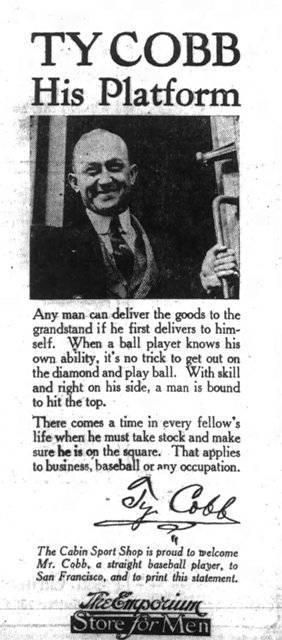
A 1920 advertisement that appeared in The San Francisco Call for The Emporium, a local department store, welcoming Ty Cobb.  He was on a nearly two-month barnstorming tour of the West Coast.

The ad included a quote from Cobb:

“Any man can deliver the goods to the grandstand if he first delivers to himself.  When a ballplayer knows his own ability, it’s no trick to get out on the diamond and play ball.  With skill and right on his side, a man is bound to hit the top.

“There comes a time in every fellow’s life when he must take stock and make sure he is on the square.  That applies to business, baseball or any occupation.”

The ad said Cobb was “A straight ballplayer.”  The integrity of the game and Cobb’s personal integrity were discussed regularly during his tour; he arrived in San Francisco on October 16, six days before a Cook County, Illinois grand jury handed down indictments against eight members of the Chicago White Sox.

In welcoming Cobb to the city, San Francisco Mayor James “Sunny Jim” Rolph said:

“You are welcome, Mr. Cobb because you typify the best in baseball.  This fight to clean baseball started in San Francisco, and I want you to know we in the West are in the fight to the finish.

“There will always be a welcome for you and all clean ballplayers, and for the other kind, no place in America should want them.”

Cobb’s “All-Stars,” a team that included Nick Altrock and Willie Kamm and other major leaguers and well-known Coast players,  drew large crowds and Cobb also appeared in front of school groups and civic organizations.

During a speech to the Press Club of San Francisco, Cobb told the crowd that the former player he had been told was the best ever was in the audience:

“I have always been told that San Francisco is the home of the best ballplayer ever in the game.  I refer to Bill Lange who is here today.”

He remained on the West Coast until November 28.

On his final day in California, a wet afternoon in Oakland,  the 33-year-old Cobb competed against 23-year-old Francis “Lefty” O’Doul in the days “field events.”  The San Francisco Chronicle said:

“O’Doul beat Cobb in the bunt and run contest.  Lefty went around the bases in 14 4/5 seconds while Cobb took 15 seconds to make the trip. The time was fast considering the heavy track.”

Cobb was nearly universally cheered during his West Coast tour.  The one exception, on Monday.

More Hard Luck for Harry

25 Nov

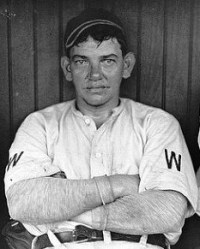
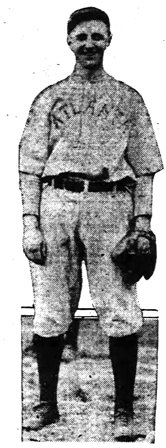
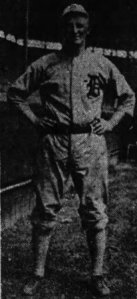
“Hard Luck” Harry Welchonce had his share of bad luck on and off the field. He may have also been a member of the only professional baseball team that was on a train while it was being robbed.

Harry Welchonce

           Harry Welchonce

The robbery took place when the Atlanta Crackers were traveling home from New Orleans on the Louisville & Nashville train in July of 1914.  Welchonce, the Crackers captain told the story to The Atlanta Georgian:

“All the bunch were busy playing cards when the train stopped abruptly.  We paid no attention to this, but a moment later there was a command of ‘Hands up!’ and a small man with two large guns came in our car, with the train crew and the porters ahead of him.  All hands went up and he went through the car, taking (Henry ‘Hack’) Eibel and (David) Mutt Williams ahead of him.  They were standing in the aisle and he took them right along in their night clothes.  He found nothing in the baggage car, and then turned Williams loose, robbing the conductor and taking the mail clerk and baggage man off the train.

hackeibel

                  Hack Eibel

“There were apparently three robbers (various reports said there were two, three or five).  Two of them remained on the rear of the train and started through, robbing the passengers.”

The robbers shot the train’s flagman who was attempting to send an alert a following train.  After shooting the man, who later died:

“They seemed to get scared then and jumped off the train.  They either made a mistake in the train or got mixed up, and the fact they killed the flagman probably saved all of us as they quickly ordered the train crew to proceed…Some of the boys gathered around the dying flagman and his last words were, ‘For God’s sake, someone go back and flag that train.’  A train was following twenty minutes in the rear.

“Talk about a scared bunch. There was little if any sleep on the car all night, everyone remaining up…We were all congratulating ourselves on our narrow escape and the fact that we saved out valuables, which, no doubt, they would have got had they not become scared after shooting the flagman.”

The robbers got away with $20.25.

The Crackers returned to Atlanta the following day; they finished the season in fourth place.

“Hard Luck” Harry Welchonce, who had already been ill for part of the season, was diagnosed with Tuberculosis the following month.

In the days following the robbery, news reports described armed posses and bloodhounds on the trail of the robbers. There is no record of their capture.

“Hard Luck” Harry Welchonce

23 Nov

In January of 1913, as Harry Monroe Welchonce was preparing for his fourth attempt to stick with a major league club, The Washington Herald said:

“Welchonce is one of the most unfortunate young men that ever tried to get a steady job in the majors.”

He did not make his professional debut until he was 25-years-old.  He worked as a telegraph operator for the Bessemer and Lake Erie Railroad while playing amateur ball in Pennsylvania until 1909 when he signed to play with the Steubenville Stubs in the Ohio-Pennsylvania League.

Harry Welchonce

Harry Welchonce

A .321 hitter over seven minor league seasons, Welchonce was purchased by three major league teams—The Phillies, Dodgers, and Senators—and went to spring training at least five times with big league teams, but earned just one 26-game trial with Phillies in 1911. He hit just .212 and made two errors in 17 games.

After failing to make the Senators in 1912, he hit a Southern Association leading .333 for the Nashville Volunteers, earning himself another spring trial with Washington.  The Washington Times said of him:

“(Welchonce) is said to have the abilities of a major leaguer without the inside adornment. In other words, he is easily disheartened. This is said to have caused his failure with the Phillies three years ago.”

While under the headline “Welchonce is Hard Luck Guy,” The Herald attempted to explain his big league failures:

“Welchonce is one of the most unfortunate young men that ever tried to get a steady job in the majors. He has always batted for more than .300 in the minor leagues, and he has the natural speed and ability to make good in the majors.

“Welchonce is a telegraph operator, and his hard luck really dates from several summers ago.  He was seated at his key at Indiana, PA, one afternoon, when a thunderstorm came up. A bolt of lightning shattered a tree outside his office and he was a long time recovering from the shock…He joined the Phillies (in 1910), and his dashy work made a big hit in the training camp at Southern Pines (North Carolina)

“The team had been there only about a week when lightning struck the hotel and a ball of fire ran down into a room in which Johnny Bates, Welchonce, (Lou) Schettler, and (Jim) Moroney were sleeping. The players were all badly scared, and the shock was such that Welchonce did not get over it.”

A contemporary account of the incident in The Philadelphia Inquirer said all four players were badly shaken and that “Welchonce was the first to recover his speech.”  The Associated Press said all four players “were covered with plaster and debris from the ceiling,” and that Schettler “could not talk for two hours.”

Adding to Welchonce’s woes in 1910 was an injured shoulder, or as The Philadelphia North American put it: “(He) still plays with a wrenched shoulder and it affects the fleet youngster’s batting. He can only get a very ladylike swing at the sphere.”

The Phillies sent Welchonce to the South Bend Bronchos in the Central League.  He hit .315, leading South Bend to the pennant.

The Times picked up the story:

“(In 1911) he took the training trip to Birmingham, Alabama (with the Phillies).Again it looked as if Harry would give (John) Titus a hard battle for right field honors.  Then came more hard luck. One of Earl Moore’s cross-fire slants struck Welchonce in the head, and Harry went to a hospital in Birmingham for several days. “

The contemporary account in The Inquirer said that he did not lose consciousness, but “was sick to his stomach,” and quoted a doctor saying he suffered from “nervous shock.”  When he was released from the hospital three days later, the paper said, “He looks weak and colorless.”

He failed to make the Senators again in 1913 and was released to the Atlanta Crackers in the Southern Association again and led the league with a .338.

Welchonce returned to Atlanta in 1914, and so did his “hard luck.”

He was hospitalized at the end of the April with pneumonia and was out for much of May.  By late June, The Atlanta Constitution said he was “Back in Stride,” and he was again hitting above .300.  But his season came to end in August when he was diagnosed with Tuberculosis.  The Atlanta Journal said he “Went to Ashville, North Carolina for the mountain air,” and treatment.

Atlanta held a benefit game and various other fundraisers and presented Welchonce with a check for $883.10.

Welchonce recovered, but not enough to rejoin the Crackers the following season.  He returned to his job with the Bessemer and Lake Erie Railroad and managed the company’s baseball team.

He returned to pro ball in 1915, accepting an offer from the  to be player-manager of the Texas League club.

welchoncedallas

Welchonce, 1915

He played fairly well, hitting .297, but the Giants were a last place club and Welchonce became ill again in August and retired from professional baseball.

He again returned to the railroad and management of the company baseball team until 1920, when poor health necessitated a move to the West.  He settled first in Denver where he was employed as an accountant, and later Arcadia, California where “Hard Luck” Harry lived to age 93.  He died in 1977.

“The Duke of Minneapolis”

20 Nov

Martin F. Duck was born in Zanesville, Ohio in 1867.  He played under the name Martin Duke.   As he was becoming a well-known pitcher The Kansas City Times told a story which purported to explain why he changed his name:

 “The real name of the (Minneapolis) Millers’ best pitcher is not Duke, but Duck…Martin was pitching in a game up in Michigan and in the ninth his club led the opposing team by one run. (With two runners on base) a man up in the grandstand began imitating the quack of a duck…as the ‘quack, quack, quack continued his face became lobster-colored.  He shouted to his taunter that he would fix him after the game, but the fiend…went on with his ‘quack, quack, quack’”

At this point, Duck allegedly threw the ball into the stands at his tormentor, allowing both runs to score, “After that he dropped the name Duck entirely.”

By the time that story appeared Martin Duke seemed headed for a productive career.  He went 14-12 with the Zanesville Kickapoos in the Ohio State League in 1887.  In 1888, he again pitched for Zanesville, now in the Tri-State League and for The Toledo Maumees in the same league—no  records survive for that season.

The five-foot, five-inch Duke made a name for himself the following year.  While pitching for the Millers in the Western Association, he posted a 24-16 record and struck out 347 batters in 355 innings, earning the nickname “Duke of Minneapolis.”

In February of 1890, The Chicago Inter Ocean said Chicago’s Players League team was after the pitcher:  “Captain Comiskey of the Chicago Brotherhood has been on Duke’s trail for weeks, with the result that although Duke has not yet signed a contract we will play with the Chicago Brotherhood club this season.”

If Comiskey was, in fact, on Duke’s trail he never got his man.  Duke returned to Minneapolis, and while statistics for 1890 no longer survive, but the press routinely called him the Millers’ best pitcher.

In 1891, he slipped to 10-11, and in May he was suspended for being, as The Sporting Life said, “Out of condition” (a euphemism for his problem drinking), but earned an August trial with the Washington Statesmen in the American Association.  The Saint Paul Globe said of his departure:

“Martin Duke–the one, the only, the statuesque Duke–has bidden good-bye to the ozone of Minnesota and beer of Minneapolis…Last night he boarded the train, moved his hand in adieu, cocked his hat to one side, closed an eye, uttered a certain familiar expression peculiar to Dukes and disappeared forever.”
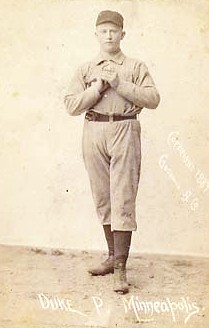
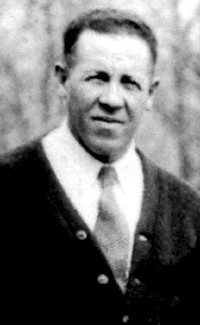
Martin Duke

Duke failed his Major league trial.  In four games, he posted a 0-3 record and walked 19 batters in 23 innings.

Despite his poor debut, he received another opportunity, this one with the Chicago Colts in 1892. When he was signed in January, The Chicago Tribune said:

“Duke’s last season, owing to lax discipline, was not a success, but this season he promises to regain his old form, as he is bound by an ironclad contract to abstain from intoxicating drinks.  By his contract half his salary reverts to the club if he breaks the pledge.  This should keep him straight.”

He received a big buildup in The Chicago Daily News:

“(He) is one of Captain Anson’s new colts, and he not only puts the ball over the home plate with almost the speed of a cannon shot, but he also seems to have a head studded with eyes, for stealing second base when he is in the box is always most hazardous business.  His pitching arm is so strong and shapely and so well equipped with powerful muscles that it would win admiration from a blacksmith.”

Despite the accolades he was released before the beginning of the season, The Tribune said:

“Martin Duke is also down for release. He has shown up poorly so far, and the club cannot use five pitchers anyhow.”

He signed with the New Orleans Pelicans in the Southern Association and seemed to regain his old form posting a 13-3 record.  It was his last successful season.

After getting off to a 2-5 start in 1893 Duke was released by New Orleans, and initially there were no takers for his services.  The Milwaukee Journal said why:

“Martin was always a good pitcher, but his mouth and his temper were too great a load for any team to carry any length of time.”

Duke bounced around the minor leagues after that with short stints for teams in the Eastern League, Southern Association and Western League until 1895, when he returned again to Minneapolis.  But after 13 games with the Millers, he injured his arm and was released in June.  According to The St. Paul Globe, he injured the arm again in August; rupturing a tendon while pitching for a semi-pro team in Rosemount, Minnesota.

In 1897, The Sporting Life reported that Duke, employed in a Minneapolis tavern, was “Trying to get in shape” in order to return to the diamond that season, but he never played professional ball again.

Duke died from pneumonia on December 31, 1898, in Minneapolis.  The Sporting Life said:

“He possessed great ability as a pitcher, but never lasted long with any club, as he was a hard man to control, and was given to dissipation, which ultimately led to enforced retirement from the profession and untimely death.”

Duke was 31 years-old.

A shorter version of this post appeared in October 2012

Cum Posey’s “All-Americans”

18 Nov

In 1937, Homestead Grays owner Cumberland Willis “Cum” Posey Jr. set out to name the all-time Negro League all-stars–his “All-Americans”– in The Pittsburgh Courier; six years later he expanded his “All-American” team and conceded that picking an all-time Negro League team was a nearly impossible task:

“Due to the changes in umpiring, parks, baseballs, ownership, in the last three decades, it is merely a guess when any of us attempt to pick an all-time All-American club.  Under any system we would hesitate to put ourselves on record as picking the club without placing some of the boys from the islands on the team.  We know some star players from Cuba, who played Negro baseball in the US and they cannot be ignored.”

Cum Posey

Cum Posey

Posey said no team would be complete without considering pitchers Jose Mendez, Eustaquio “Bombin” Pedroso, and Juan Padron, shortstop Pelayo Chacon, outfielders Cristobal Torriente and Esteban Montalvo and “(Martin) Dihigo, probably the greatest all-around player of any decade.”

Cristóbal Torriente

Cristóbal Torriente

“If one could be a spectator at an argument between those closely associated with baseball—fans, players, owners—he would be surprise at the differences of opinions.

Ted Page, who is now manager of Hillvue Bowling Alley (in Pittsburgh), and was formerly one of the star players of Negro baseball was mentioning one of the players of former years.  Ted contends (Chester) Brooks, one of the few West Indian (Brooks was said to hae been born in Nassau, Bahamas, but several sources, including his WWII Draft Registration and death certificate list his place of birth as Key West, Florida) players ever on the roster of an American baseball club was one of the real stars of all time.  Brooks, formerly of the Brooklyn Royal Giants, was probably the most consistent right hand hitter in the history of Negro baseball.  When the Homestead Grays were at odds with everyone connected with Negro Organized Baseball we tried to get Brooks on the Grays club.”

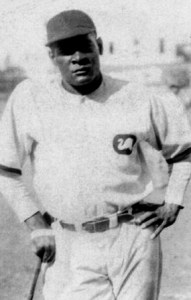
Chester Brooks

Chester Brooks

In his 1937 picks, Posey placed Brooks on his all-time all-star team as “utility” outfielder.

The 1937 team:

Manager:  C. I. Taylor

Coaches:  Rube Foster, Sam Crawford, and Chappie Johnson

Catchers:  Josh Gibson and Biz Mackey

Pitchers: Smokey Joe Williams, Dick Redding, Pedroso, Bullet Rogan, Satchel Paige, Dave Brown and Willie Foster

First Base:  Ben Taylor and Buck Leonard

Second Base: Sammy Hughes

Third Base: Jud Wilson

judwilson

Shortstop: John Henry Lloyd

Left Field:  Torriente

Center Field: Oscar Charleston

Right Field: Pete Hill

Utility:  Infield: Dick Lundy; Outfield: Brooks

Posey added several players for consideration in 1943, many who were largely forgotten by then:

Pitchers: Mendez, Padron

Catcher:  Bruce Petway, Wabishaw “Doc” Wiley

First Base: Leroy Grant, George Carr, Eddie Douglas

Second Base:  Frank Warfield, Bingo DeMoss, George Scales, John Henry Russell, Frank Grant

Bingo DeMoss

Bingo DeMoss

Third Base: Connie Day, Judy Johnson, Ray Dandridge, Dave Malarcher, Henry Blackmon, Walter Cannady, Billy Francis, Bill Monroe

Shortstop:  Willie Wells

Posey concluded:

“Too many outfielders to mention.  You have Dihigo, (Pee Wee) Butts, (Sam) Bankhead, Cannady (and) Monte Irvin to play in any position and nine hundred ninety-nine others.  Our personal preference for manager is C.I. Taylor, but what about Rube Foster?”

Tug Arundel

16 Nov

Twenty-one years before catcher Gabby Street caught a baseball dropped. From the Washington Monument, another catcher attempted it with less success.

When news of Street’s feat was reported in 1908, Oliver Romeo Johnson, who had been a sportswriter for The Indianapolis News in 1887, recalled the circumstances:

“On one of our eastern trips we followed the Chicagos in Washington, and while there the catching of a ball dropped from the monument was much talked of, because one of the Chicago players was said to have done it a few days before.  My impression is that it was (Cap) Anson himself, although it might have been Silver Flint.

“One of our team, John Thomas ‘Tug’ Arundel, a catcher, said it was ‘dead easy’ to catch a ball dropped from the monument, and a bet was made on it.  A crowd of us went out to see the attempt.  Arundel wore catcher’s gloves—which were not so thick as they now are—on both hands and put layers of cotton under them. He tried eight or ten times to catch the ball…but failed every time, and after he had battered up his hands so he could not play for some days he gave it up.”

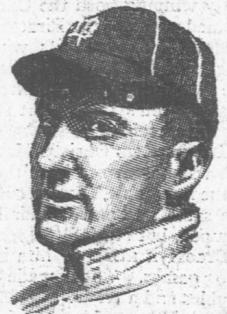
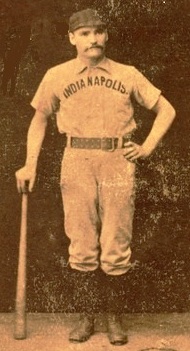
Tug Arundel

Tug Arundel

Several days after Johnson’s recollection appeared in The News, Horace Fogel, who had been Arundel’s manager with the Hoosiers and dropped the balls from the monument, weighed in.  Fogel, then sports editor of The Philadelphia Telegraph, disputed the claim that Anson or Flint had caught a ball and said of his catcher’s attempt:

“Arundel, if I remember alright, only succeeded in getting his hands on one ball and it almost tore them off at the wrists. Tug explained afterward that he had not figured on ‘A ball weighing a ton coming from that distance.’ The other balls, a dozen or more, I tossed out to him, Arundel missed, some by fifty feet, he misjudged them that badly.”

Horace Fogel

Horace Fogel

Bad judgment was a staple of Arundel’s career which was marred by arrests for drinking and fighting.    He appeared in just 76 major league games over four seasons from 1882 to 1888 and played for at least 16 different professional clubs during his 10 seasons in professional ball, often quickly wearing out his welcome.

The Memphis Appeal said he was:

“(T)he handsomest player in the profession, who would sooner fight than eat.”

The Washington Critic summed up the opinion many had of Arundel when he was acquired by the Nationals in 1888:

“’Tug’ Arundel has been secured by the Washington management, as last week’s reports indicated he would be.  He is not popular here.  However, it is to be hoped that Manager (Ted) Sullivan can keep him muzzled.”

After his release, when it was rumored he might join the Detroit wolverines, The Detroit Free Press told readers:

“Detroit wouldn’t have Tug Arundel under any circumstances.”

After every incident, Arundel pledged to change his ways.

After an 1887 drunken melee in Indianapolis, which resulted in the arrests of Arundel along with teammates Jerry Denny and John (Patsy) Cahill, he told The Indianapolis News he took “a total abstinence pledge for six months.”

In the spring of 1889, he was arrested in his hometown, Auburn, New York twice. First for assaulting a police officer and then for a bar fight with another former major leaguer, and Auburn native, Mike MansellThe Auburn Bulletin said Arundel “Got the worst of it.” A month after the fight, The Sporting Life said Arundel “writes he is in fine shape and looking for an engagement.”

In 1890, the 28-year-old Arundel was nearing the end of the line.  He signed with the Saginaw-Bay City (Michigan) club in the International Association and told The Detroit Free Press that he was serious about sobriety this time:

“I lost splendid situations and almost ruined my reputation through liquor, but, sir, I realize the baneful effects of over-indulgence in intoxicating liquors and I have resolved never to touch another drop.  I have kept aloof from it for the past three months and am now in as good condition as I ever was in my life.”

It is unclear whether, or for how long, Arundel kept his last public pledge.  He appeared to have played fairly well behind the plate for Saginaw-Bay City.  Although he hit just .152, The Free Press, which three years earlier assured readers that Arundel was not wanted on the city’s National League club, was pleased when he signed with the Detroit Wolverines of the Northwestern League:

“(Arundel) has faced the greatest pitchers on the field and held them all.  Arundel is a good trainer for young ones, and did good work while with the Hyphens in 1890.”

Whether because of drinking or injuries (The Free Press and The Detroit News said he suffered from “Split fingers” several times throughout the season) Arundel was finished after the 1891 season, at age 29.

Arundel returned to Auburn and was eventually committed to the Willard State Hospital for the Chronic Insane in New York where he died in 1912.