Archive | Uncategorized RSS feed for this section

The Baseball Bandit

28 Jun
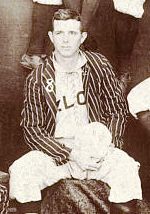
Frank Quigg hit .313 and went 1-0 as a left-handed pitcher for the Topeka Capitals in the Western Association in 1893; no statistics exist for the remainder of his career which included stops in the Southern Association and Texas League.

After he was done playing, Quigg became a pioneering figure in Oklahoma, organizing professional ball in the state with the creation of the Southwestern Association in 1901.  Quigg managed the Oklahoma City team in that league until 1903.  He also spent some time as an umpire in the California League.

An article in The Wichita Eagle in 1901 about the Southwestern Association provides interesting insight into the finances of turn of the century minor league baseball:

  “The salary limit of the league is to $450 per month and room and board for the Players…home teams paying the visiting club $25 per scheduled game, rain or shine.”

“The umpires are to receive $2.50 a game plus transportation.”

Later Quigg became an umpire in several leagues.

Bobby Eager, a former Pacific Coast League catcher, claimed he was the instigator in an incident that led to Quigg quitting his job as an umpire. Writing in The San Jose Evening News, Eager said the incident took place in Los Angeles during a game with the Oakland Oaks:

“Quigg was umpiring and he seemed to have an off day. I kept after him about not calling (strikes) and (Bill) Red Devereaux happened to be at the bat when (Quigg) missed one that was squarely over the middle.”

Eager said the pitch should have been the third strike and “hollered” at the umpire:

Bobby Eager

Bobby Eager

“And Devereaux immediately took up the umpire’s part by saying ‘What’s the idea? Are you going to let Eager run the game and do the umpiring too?  Throw him out of the game and take some of his money, he’s trying to make a bum out of you.’”

Devereaux singled on the next pitch, driving in a run. Eger said he “put up a holler” and was ejected and fined $10.

The next day Eager sought to pay Devereaux back:

“I kept telling Quigg that all that Devereaux did was try and bull the umpires and that he boasted downtown that he got him, meaning Quigg, to chase me out and that he knew that he was out on the third strike.  This statement made Quigg pretty sore and about the fifth inning he called bill out on third on a close decision. Red Dog sure told him a few things and the result was he ran Bill out of the game and fined him $10.”

Devereaux
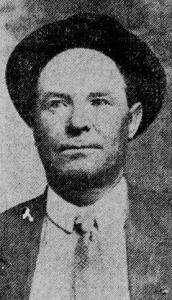
Devereaux

Devereaux attempted to attack Quigg and police were called to escort him from the field and the fine was raised to $25.

Devereaux, now in the stands, began to heckle Quigg to an extent that the game was again halted and the police officer escorted Devereaux to the clubhouse.  According to Eager, and contemporary accounts, Devereaux was just getting started.

“He was on the roof waving a red flannel shirt and running up and down like a monkey; everybody laughed and enjoyed it more than the bad game.  Somebody went over and slipped Bill a pair of false whiskers and about the eighth inning he came back to the bench and sat there, and when the umpire wasn’t looking he went over to third base and was getting ready to play, when Quigg saw him.  Of course Bill wouldn’t be allowed to play, but it was some minutes before the umpire got wise as to who he was.  I never saw such a demonstration in my life, and people just went wild.”

The day after the incident, The Los Angeles Examiner said Devereaux was suspended “for his abuse of Quigg” and:

“Umpire Quigg resigned his position.”

The paper said his decision was the culmination of the events the previous day, and an incident two weeks earlier when San Francisco Seals pitcher Clarence “Cack” Henley threw a baseball at Quigg during an altercation.

The umpire joined the Texas League the following season.

Throughout his career, Quigg had an excellent reputation in baseball circles. His father was a Civil War veteran, and according to The Associated Press, his brother George served under Theodore Roosevelt with the Rough Riders during the Spanish-American War.  Contemporaneous newspaper accounts described the family as being extremely wealthy—already well off; Quigg’s mother married another wealthy man after the death of her first husband.

All of which made what happened next so unusual.

On December 31, 1909, Quigg and four other men attempted to rob the bank and post office at Harrah, Oklahoma.  Newspaper accounts said the robbery was well planned but that one of Quigg’s associates had discussed it with a friend who reported the plan to postal authorities.

John Reeves “Catch-‘em-alive” Abernathy, who was appointed as Oklahoma’s first US Marshall by his good friend, and Quigg’s brother’s former commanding officer, President Theodore Roosevelt, staked out the post office and attempted to the apprehend the robbers as they entered through a back door. Abernathy didn’t “Catch-‘em alive” that day.

abernathy

Abernathy

As the robbers attempted to escape Abernathy and his men shot three members of the gang. Quigg, who was living under the alias Barney and an associate named Frank Carpenter were killed.  One robber was wounded and captured while two escaped.

In the aftermath of Quigg’s death, it was reported by several newspapers, including The Abilene Daily Reflector, his hometown paper, that the gang had recently pulled off successful post office robberies in Trinidad and Golden, Colorado.

Most newspapers continued to paint Quigg as a good man gone wrong for no apparent reason, other than a vague observation about his mother’s remarriage:

“The match did not please the son.”

But one paper, The Arkansas City (KS) Traveler saw it differently:

“(Quigg) worked this town for several hundred dollars a few years ago, got the money, organized a club, went to Enid (OK) and that was the last ever seen of him by his backers.  He was a booze-fighter by the full meaning of the word and if there was any good in him it never came to the surface so the public could catch a glimpse of it.

Whatever the reason for his descent into a life of crime, it appeared Quigg hadn’t completely given up on baseball at the time of his death.  According to The Fort Wayne Sentinel he “Had an application in (to work as) an umpire in the Central League” for the 1910 season.

I published a  shorter version of this post was published in September of 2012.
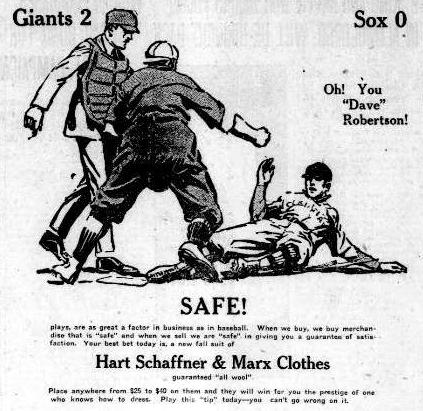
Lost Advertisements–“Oh! You ‘Dave’ Robertson!”

24 Jun

1917ws

An advertisement for Hart, Schaffner & Marx which appeared after game three of the 1917 World Series.  After losing two games in Chicago, the New York Giants won 2 to 0; the Giants scored both runs in the fourth inning of Eddie Cicotte; Dave Robertson tripled and scored on Walter Holke‘s double, Holke scored on a single by George Burns.

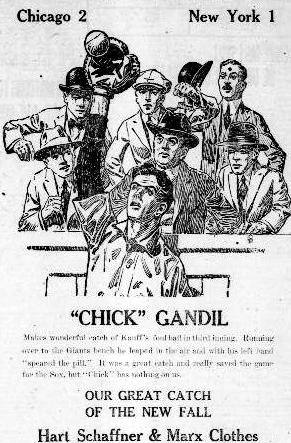
The advertisement after game two, a 7 to 2 White Sox victory, featured Chicago first baseman Chick Gandil, who:

“Makes a wonderful catch on (Bennie) Kauff‘s foul ball in (the) third inning.  Running over to the Giants bench he leaped in the air and with his left hand ‘speared the pill.'”

1917ws2

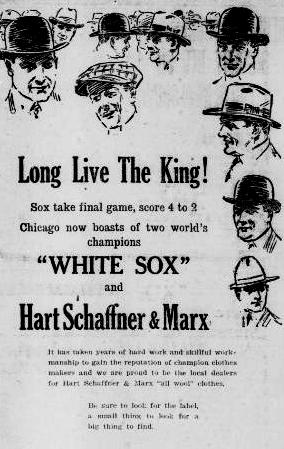
And, one more after game six, won by Urban “Red” Faber and the White Sox:

Long Live The King!

“Sox take final game, score 4 to 2.  Chicago now boasts two world’s champions ‘White Sox.'”

1917ws3


“Playing the Third Base is Pretty much of a Gamble”

22 Jun

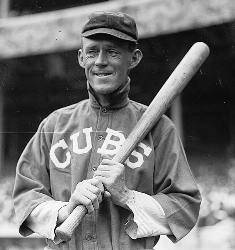
In May of 1911, Chicago Cubs second baseman Johnny Evers suffered a mental breakdown—The Chicago Daily News said that in a letter to club President Charles Webb Murphy:

“Evers complains that his nerves are completely gone.  He is unable to remain on his feet for 10 minutes at a time and the attack is so severe that it has caused large swellings about his face.”

Evers rejoined the team in June, but his condition required another five-week absence from the team in July and August, resulting in him being limited to just 46 games, including 11 at third base—he had previously played the position just three times during his career.

Johnny Evers

Johnny Evers

Late in the season he talked to a reporter from The Chicago Evening Post about playing third:

“Right now it strikes me that there is more luck in playing third base.  You get them or you don’t.  I mean by that the hot shots. When one of those line drives or swift bounders comes at you the isn’t time to play the ball.  You leap and knock the ball down if you can.  If it isn’t right at you it is past you so quickly that you can’t get a square crack at it.”

“Playing the third base is pretty much of a gamble.  If the ball happens to be hit right at you then you get it.  Otherwise, there is nothing doing.”

Evers compared it to his usual position at second base:

“Down on second, it is different.  There you have to play the ball, come in or go back.  That’s one condition which makes the play at third more difficult than at second.

“There is a whole lot more inside baseball at second then there is at third. You play in for a bunt or you play deep.  There is no moving to right or to left.  When you are at second you have more opportunities. You study the batter and you play him accordingly.  Maybe you take a step or two nearer second or a step or two nearer first.

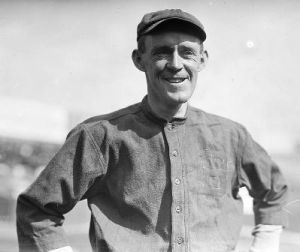
Johnny Evers,

Evers

“Nothing like that at third.  You play in for a bunt or you play back for a clout.

“When it comes to throwing, third base is by far more difficult than second…And the difficulty is not in making the throw so much as it is that a man scarcely has enough to do to keep his arm in shape.  It is this which makes it so much easier for a man to injure his arm playing third.  We’ll say that he goes six or seven innings without a ball being hit to him.  In the eighth or ninth he grabs the ball and checks it to first.  The chances of injuring his arm on a play like that are greater…Down at second base, a man probably handled the ball 20 times.”

In the end, he was not ready for a permanent switch:

“After playing both positions it is my opinion that second base overshadows third as a place for inside baseball.  There is where a man has opportunities of applying his knowledge of batters.  It is the position where he can play the ball as well as the batter.  At third a man attempts to stab a fierce drive.  If he succeeds all well and good, and if he doesn’t, he can turn and watch the outfielder chase it.  It’s hit or miss.”

Evers never mastered third base; he made three errors in 31 chances during those 11 games in 1911—and committed eight errors in 61 total chances in the 21 games he played at third throughout his career, an .869 fielding percentage at the position.

In 1912, fully recovered–he told reports he “felt nothing from his breakdown,” Evers appeared in 143 games, and had his best season at the plate, hitting .341.


Lost Advertisements–Spalding’s 1908

20 Jun

asspaldingguide1908

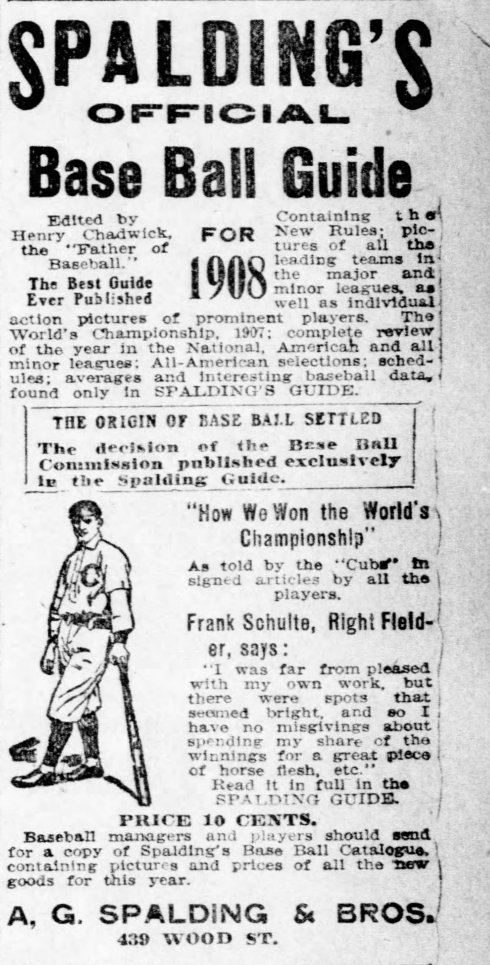
“Spalding’s Official Base Ball Guide,” 1908 advertisement.

“Edited by Henry Chadwick, the ‘Father of Baseball.’

“The best Guide Ever Published

“Containing the New Rules; pictures of all the leading teams in the major and minor leagues, as well as individual action pictures of prominent players.  The World’s Championship, 1907; complete review of the year in the National, American and all minor leagues.  All-American selections;  schedules; averages and interesting baseball data, found only in Spalding’s Guide.”

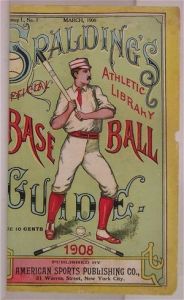
The 1908 Spalding Guide

The 1908 Spalding Guide

The 1908 edition also promised:

“The origin of base ball settled” with the guide’s “exclusive” publication of the Mills Commission report.

The guide also included interviews with the members of the 1907 Chicago Cubs, on “How we Won the World’s Championship.”

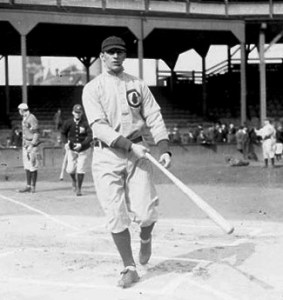
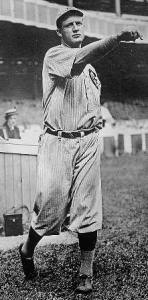
The ad featured part of the interview with right fielder Frank Schulte, who used his World Series money to buy a racehorse:

“I was far from pleased with my own work, but there were spots that seemed bright, and so I have no misgivings about spending my share of the winnings for a great piece of horse-flesh…”

Frank Schulte

Frank Schulte

Other comments from members of the Cubs that appeared in the guide included:

Joe Tinker—“We failed to see that brilliancy that the American League boasted of, and when the good old West side machine got under way, it seldom failed.”

Orval Overall—“I expected a harder time with the Tigers.”

Orville Overall

Orville Overall

Mordecai  Brown—“Never more confident of victory in my life.  I almost made a hit in my three times at bat.

Jack Pfiester (who won game two 3 to 1 while giving up 10 hits)—“After the two base hits in the first inning, I knew by some overpowering sense that I could not explain that I would be successful.”

“In Baseball Words, ‘I Wised up’”

17 Jun

Charles “Babe” Adams was on his way to an 18-9 season with a 2.24 ERA (on the heels of 12-3, 1.11) in his second full season in the major leagues.  The 28-year-old was asked by Chicago journalist Joseph B. Bowles to tell readers “How I Win,” for a series of syndicated articles.

Babe Adams

Babe Adams

Adams was initially reluctant:

“I have been asked to tell how I win, and it may sound immodest for a new man to try to tell such things.  You say it is for the benefit of young players, so I’ll tell some of the things I learned after coming to Pittsburgh.  The first thing I found out was that (Fred) Clarke was boss, and that he knew more about the game than I ever thought was in it. After a few bumpings, I learned that (catcher George) Gibson knew a lot more about what to pitch to batters than I did.  I think I began to improve as soon as I found out these things.  The next was that I had to have confidence in the team to make them have confidence in me.  In baseball words, ‘I wised up.’”

George Gibson

George Gibson

Adams’ view of what made a good pitcher was the same in 1910 as it would be nearly a decade later after he had been released by the Pirates and worked his way back to the team and reestablishing himself as an effective pitcher in his late 30s:

“Now a pitcher can have all the speed and curves and control in the world and still not be a good pitcher until he gets wise.  This Pittsburgh crowd plays the game to win, and it is because they work together, hit together, and because each man relies on the others, that they win.  At first, I thought Gibson made some mistakes in telling me what to pitch.  In fact, I was wrong most of the time.  He taught me what to do with a curve ball, and when my control was good enough to pitch where he wanted the ball pitched, things went right.   Sometimes I laughed at myself remembering the mistakes I used to make—some of them I still make…The pitcher must remember that the chances are the batter is as smart and experienced as he is, and keep thinking all the time;  trying to guess what the batter is thinking, and then pitching something else.”

Adams

Adams

Adams continued to credit his teammates for his success:

“It is a big help tp a pitcher to look around in a tight situation and see where Clarke, or (Tommy) Leach, or (Honus) Wagner are playing.  A fellow can learn a lot and get a lot of help by taking his cue from them and pitching the ball where they seem to want it pitched.  It gives a man confidence, too, to know he can make that batter hit the ball, and that back of him are a crowd of men who will come to the rescue and save him when he needs it.

“I think Gibson did more to make me a winner than anyone else.  He is a great catcher, and he rather inspires a pitcher, and makes him do better.”

Adams credited Gibson with his success in the 1909 World Series—when he won three games:

“In the World Series against Detroit, I made a lot of bad breaks in the first game.  Gibson steadied me up and coached me all the way.  He had a theory the Detroit team would not hit low curves , and after we began to study them and see how they hit, we fed them low curves , fast and slow, just inside the outside of the plate, but always low, and we beat them with that kind of pitching.”

Adams also shared a view of strikeouts that would be repeated by Hall of Famer Addie Joss during Joss’ final interview, two days before his death in 1911:

“I found out striking out batters is not the way to win, and that a pitcher must depend rather on making them hit bad balls or balls where the batter does not expect them to be, than in pitching himself out early in a game trying to strike out hitter.”

Addie Joss

Addie Joss

Adams, who won 194 games (losing 140) with a career 2.76 ERA, struck out  just 1036 batters in 2995.1 innings over 19 seasons.

Lost Advertisements–Home Run Baker, Ide Silver Collars

15 Jun

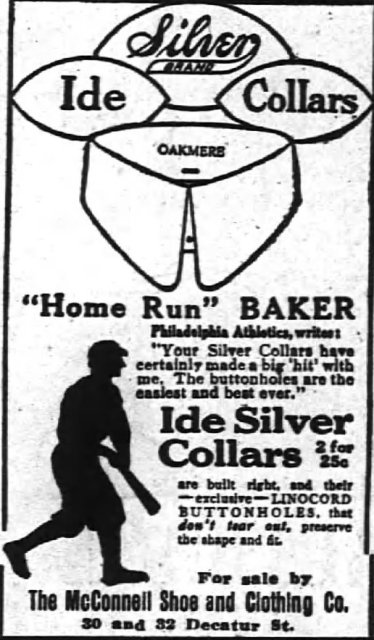
hrbakeradAn advertisement for Ide Silver Collars, featuring John Franklin “Home Run” Baker:”

“Your silver collars have certainly made a big ‘hit’ with me.  The buttonholes are the easiest and best ever.”

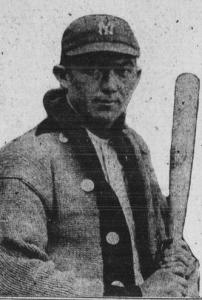
bakerpix

After Baker returned to baseball with the New York Yankees in 1916, he “wrote” a very short syndicated newspaper piece, part of a series which asked some of the game’s best hitters to name “The Six Hardest Pitchers I ever Faced.”

Baker said:

“In naming my six hardest and best pitchers, I must invade my old club for three of them, though I never batted against them in championship games.  From my standpoint, the six best during my career were:

“Walter Johnson–Washington Americans.

“Edward Walsh–Chicago Americans.

“‘Dutch’ Leonard–Boston Americans

“Eddie Plank–Philadelphia Americans

“Albert Bender–Philadelphia Americans

“John Coombs–Philadelphia Americans.

“Johnson is the present-day wonder; Walsh was the king in his prime, and young Leonard is a puzzle among present left-handers, but I must award the plum to my three great old pals.”

Baker 1916

Baker 1916

Grover Hartley

13 Jun

Willis Eldon Johnson returned to The St. Louis Globe-Democrat after serving as the traveling secretary for the Federal League St. Louis Terriers during the 1914 and 1915 seasons.

Upon his return, he told a story about the Terriers popular catcher Grover Hartley—what Johnson called the “small incident” that led him to a career in baseball:

“Grover first saw the light of day in Osgood, a nice, quiet town in Indiana.  Hartley was educated in one of those dear little country schools…After graduation, Mr. Hartley put Grover to work on the big farm and there Grover plugged and plowed for quite some time-saving every cent he could.”

Grover Hartley

Grover Hartley

According to Johnson, Hartley used the money he earned on his father’s farm to buy a small barber shop.

“Grover (stuck) to the barber shop for one whole year…In small towns, deaths are few and far between.  Generally, the residents of the country live to a ripe old age, not having to worry about being killed by automobiles, street cars, late hours, etc…All of which explains the reason for Grover sticking to the barber shop for one whole year…until one day he was asked to shave a dead man.  No sooner had Grover been requested to perform upon the face of the corpse then he decided it was time to quit the business”

That, said Johnson, caused Hartley, already a member of the local amateur club, to focus on baseball:

“(Hartley) was considered a good shortstop.  Just think of that.  A ballplayer who admits that he began the game not as a pitcher but a shortstop.  It is really difficult to believe.  Most every American boy who has ever picked up a baseball was fully possessed of the idea that he was a pitcher and would someday become a great hurler.”

Johnson said in July of 1909,a barnstorming club, the Chickasaw Indians came to Osgood “to pay the town boys,” and “The manager of the Indians, after watching Hartley work, offered him a job at $40 per month.  Hartley accepted and departed with the Indians on a tour of the little towns in Ohio, Indiana, and Kentucky.”

His transformation from barber to professional ballplayer was complete, said Johnson, when the Indians regular catcher “had his finger broken” and “Ever since that day Hartley has been playing behind the bat.”

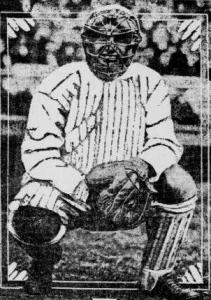
Hartley behind the plate

Hartley behind the plate

Not comfortable shaving the dead, Hartley did attempt to sell life insurance during the offseason when he was in St. Louis—with no more success than barbering.  He told The Globe:

“Say, I’d rather see a guy diving at me feet first with his bright, sharp spikes gleaming than try to open up a possible policy buyer…I’ve gone into a dozen offices to see fellows I’d been tipped off to. I walk into the office, see a bunch of men and girls banging away at typewriters, and away I go.  Me for the door.  I get excited and feel myself getting red in the face.”

The paper said Hartley needed to sell $50,000 worth of policies, “If he does, he will get an automobile.  He sold $32,000 worth to friends and now he thinks he will see street cars the rest of his life.”

His failure as a barber and an insurance man helped keep Hartley in professional baseball as a player, coach, and manager until 1949.

Lost Advertisements–“Come on, Boys!”

10 Jun

holmes

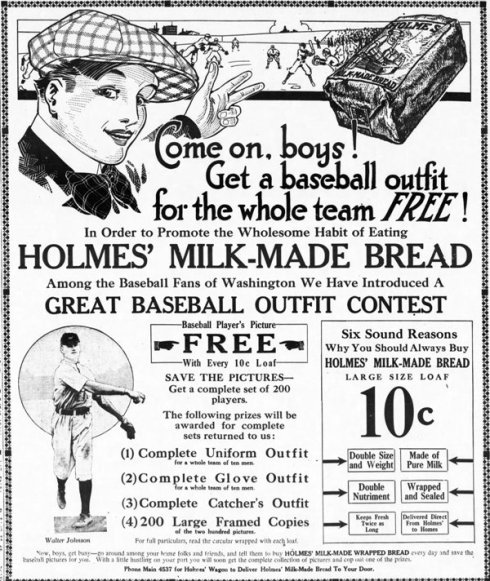
A 1916 advertisement for Holmes’ Milk-Made Bread featuring Walter Johnson.

“Come on, Boys!

“Get a Baseball Outfit for the whole team, Free!

“In order to promote the wholesome habit of eating Holmes’ Milk-Made Bread among the baseball Fans of Washington we have introduced a Great Baseball Outfit Contest.”

In order to win the contest, all 200 of the cards (one in each 10 cent loaf) would have to be collected and returned to the company.

The first prize was a complete set of 10 uniforms, second prize was 10 gloves, third prize was a complete set of catcher’s gear, and fourth prize was a framed sheet of the 200 cards.

The company encouraged kids to:

“Get busy–go around your home folks and friends, and tell them to buy Holmes’ Milk-Made Wrapped Bread every day and save the baseball pictures for you .  With a little hustling on your part, you will soon get the complete collection of pictures and cop out one of the prizes.”

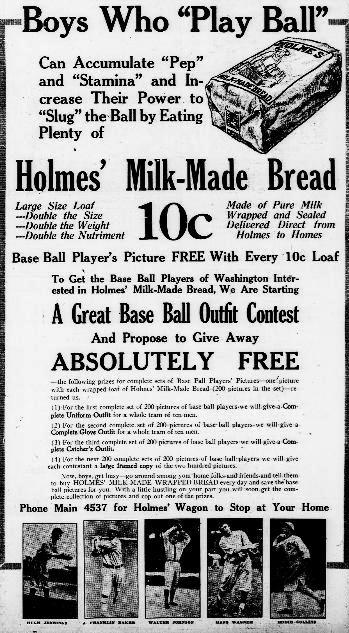
Another ad included pictures of some of the cards–Hughie Jennings, Frank Baker, Johnson, Honus Wagner and Eddie Collins:

holmes'bread

There is no evidence that anyone actually collected 200 cards and won any of the prizes.

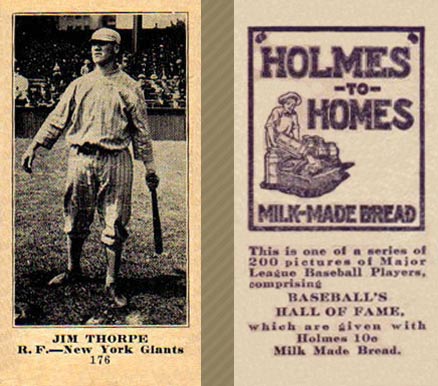
The Jim Thorpe card from the set

The Jim Thorpe card from the set

“In Chicago, the Baseball Slump is what the Crank would call Disgusting”

8 Jun

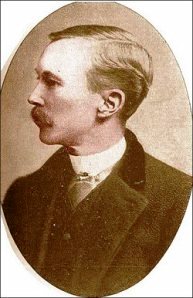
Oliver Perry (OP) Caylor of The New York Herald came to a conclusion in August of 1892 that many have shared before and since:  baseball‘s best days were behind it.

O.P. Caylor

O.P. Caylor

Earlier,  National League President Nick Young had declared 1892—featuring an expanded twelve team circuit after the collapse of the American Association and just weeks into the only scheduled split-season in major league history—an unqualified success.

But now, into what Caylor called “A Dog Days Depression,” reality had set in.

“Much has been said since the League’s second championship season opened (the second half began July 15) about the renewed interest which was alleged to have sprung up and was keeping pace with the new season.  It has taken no more than a month to prove that this so-called revival was an illusion.”

Caylor noted that there was brief uptick in attendance in games played in Eastern cities during the first three weeks of the second half:

“(B)ut before the teams started west the same old rut of passing indifference seemed to be struck.  And nowhere in the west thus far has there been a sign of a promising revival.”

Caylor pointed to two cities as evidence of baseball’s bleak state;

“In Chicago, the baseball slump is what the crank would call disgusting.  People of that progressive center have use for nothing but the best, and Uncle (Cap) Anson this year has not succeeded in giving them such an article in baseball.  The great general has done the best possible, handicapped as he was in the beginning of the season by the poor allotment of players from the Indianapolis (Hoosiers, the defunct American Association franchise) consolidation pool.”

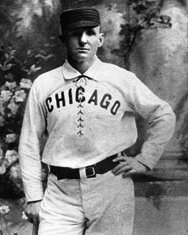
Cap Anson, 50 errors in 1876

Cap Anson

Caylor blamed most of Anson’s problems on a weak middle infield:

“(Jimmy) Cooney, his shortstop, turned out a sudden complete failure and he has never been able to successfully fill (Fred) Pfeffer’s vacant shoes on the nine.  Any team which is weak at short field and second base is bound to be weak all over, and that is the condition of the Chicagos.

“The old man has been experimenting on new material with more or less success and less success than more.  But by the time he gets his men into what he is pleased to consider championship form, the season will be so far spent that he will have no chance to arouse the chilled pride of the army of Chicago baseball ‘rooters.’”

Caylor said Anson had some optimism for “next season.”

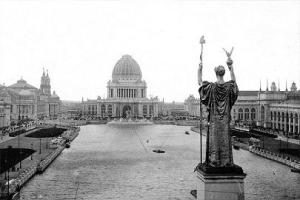
“Maybe the Chicago club can well afford to waste this year whipping together a winning team for 1893.  For next year, the World’s Fair (The World Columbian Exhibition) should be bring a small fortune to the treasury of the Chicago club if they can get a winning team together by that time.  Yet there are those who will argue that the World’s Fair is bound to be a financial injury than a benefit to the Chicago club under any circumstance, and the argument is based upon baseball experience in Philadelphia during the year of the Centennial (1876).”

World's Colombian Exhibition

World’s Colombian Exhibition


Caylor said even, A. G. Spalding, former White Stockings president, felt the fair “will be a financial burden” on the team.

Spalding believed:

“(T)hat for every visiting stranger who will be attracted to the ball grounds three resident patrons will be kept away by the unusual demand upon their time by excessive business.”

But Caylor said, his former home was in even more distress than Chicago:

 “Cincinnati, the best-paying city of the circuit during the first half of the year, has become financially alarming.”

Cincinnati had suffered as a result of the National League’s cost cutting measure agreed upon in late June, which resulted in rosters being reduced from 15 to 13 players and across-the-board pay cuts of 30-40 percent for all players.  The Reds best pitcher, Tony Mullane, quit as a result of the cuts.

Tony Mullane

Tony Mullane

“The sorry slump in baseball interest at Cincinnati is another exemplification of that old moral taught by the fable of the ‘Hen Which Laid the Golden Egg.’ I know it is modern usage to speak of the golden egg producer as a goose, but my Latin book called it a hen.  As applied to the Cincinnati case it makes little difference whether we call it a hen or a goose…The Cincinnati club’s hen was laying golden eggs regularly through the first season.  The newspapers put the club down as a sure winner financially.  Then came the greed mentioned in the fable.  The officials thought they saw a way to squeeze  the old hen into more active and valuable work, and on the squeezing they killed her.”

As a result of the pay cuts:

“Cincinnati patrons became disgusted.  For the sake of saving a few thousand dollars in salaries while working at a profit, this club had thrown away its chances to win the second championship.  Nobody who understands human nature need wonder the result.”

Cleveland, home of the second half champion Spiders, was the only town where Caylor said the “national game is appreciated.”   But even that, he said was temporary and favorable financial conditions were “a question of considerable doubt.”

The 1892 season was a disaster for Chicago—on and off the field—they finished 70-76, in seventh place, and attendance dropped by more than 72,000 from the previous season.

While Cincinnati led the National League in attendance, the club lost money.

But, contrary to Caylor’s gloomy outlook, the league—after dropping the spilt-season format—bounced back well in 1893.

In Chicago, where Anson put an even worse product on the field—the Colts were 56-71—predictions that the Columbian Exhibition would destroy attendance were wrong.  Aided by the opening of a new ballpark in May, the club drew the fourth-largest attendance in the league—223,500—more than doubling their 1892 numbers.

Cincinnati’s attendance dropped by just 2200 fans despite a disappointing season where the team hovered near .500 all year and finished sixth.

National league attendance increased by nearly half a million from 1892 to 1893.

While baseball was not on a long-term decline, Tony Mullane was.

He returned to the Reds in 1893, but the 34-year-old was never the same–259-187 with a career ERA below 3.00 before his departure, he was 25-33 with a 5.74 ERA after.

A Cricketer on Baseball

6 Jun

Spencer Thomas Oldham was born in Sutton-in-Ashfield, Nottinghamshire, England—what the “The American Cricketer” called “that famous nursery of cricketers.”  By 1883 he had been playing professionally in the United States for a decade, and The Associated Press called him “One of the best-known cricket players in the country.”

cricket

Cricket Match, 1800s

That year, The Baltimore Sun, which said of Oldham, “(H)is accent is strong, his views are decided and he comes from a village where seventy-two professional bowlers may be found, ” asked him for his opinion of baseball.  He had just seen his first game in August when the St. Louis Browns played the Orioles.

“It was a sight, such throwing and catching and fielding, I never saw the like before.  The tall fellow on the first base of the St. Louis (Charles Comiskey) could catch anything.  We can’t work together that way in cricket.  The ball is too big, hard and heavy.”

Charles Comiskey

Charles Comiskey

And, he was asked, if he noticed the curveball thrown by Baltimore pitcher Bob Emslie:

“’Aye, did I?’ was the reply. ‘I was sitting just in line with the pitcher and catcher.  That fellow Emslie was a terror.  I saw the balls break in the air without touching the ground.  They just curved around and fooled the batters that funny.’”

Bob Emslie

Bob Emslie

So impressed was Oldham, he claimed he saw a pitch “start straight, shoot down and then up again.”   And he was unsure how anyone was able to hit “with the broomstick handles they use.”

But asked to compare the two games, Oldham refused.

“It’s different altogether.”

Oldham said most people didn’t understand the scientific nature of his sport:

“The feature of cricket is batting.  Fielding, of course, is necessary, but a good batter is of more use than a good fielder.  A bowler’s object is to get your wicket down.  You try to keep him from doing it.  The balls you see coming on your wicket you block by bringing your bat down to the ground. The balls that you know are off your wicket you must hit for all you are worth…The power of attack is smaller than the power of defense, and therefore runs are plentiful.  Now in baseball, it seems just the other way.  A man who makes two runs is doing good business.  Errors are therefore more costly and good hits more praiseworthy.”

He also implied that Americans were too impatient to appreciate cricket:

“It takes all day to play a game of cricket.  Two hours and a half suffice for a game of baseball.”

Oldham thought some professional baseball players might be able to play cricket, but it wouldn’t be easy to make the transition:

“Well, the fielding is the same, but when he goes to the bat he must unlearn all his baseball tactics and learn how to cut, drive, stop, hit to leg or off to side…I wish some of those (baseball) players would devote the time and study they give to baseball to cricket.”

While never conceding that baseball was superior, or even equal to his game, Oldham concluded:

“Baseball—well, baseball is a splendid game.  I’d like to see some more of it.  I would learn some points from it.”