Archive | Uncategorized RSS feed for this section

“Even when he Wins he Loses”

18 Apr

During his most successful season as a major leaguer, Bobby Byrne had some advice for the children who wished to follow in his footsteps:

“If they asked me I would tell them everything I could to keep them from starting.  Not that I knock the profession, but I think it is a poor one to choose, not because of the life itself, but because of its temptation and hardships, and worse than that, the small chances of being successful.”

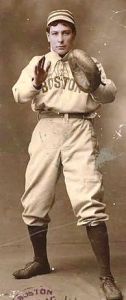
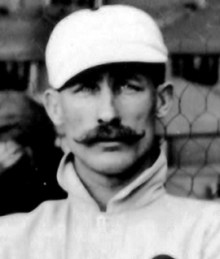
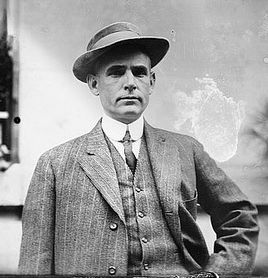
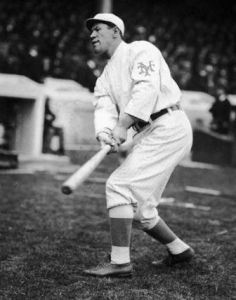
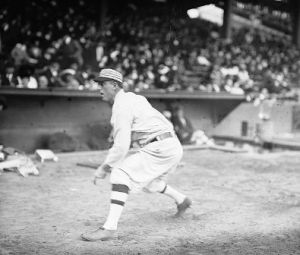
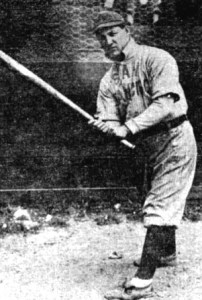
Bobby Byrne
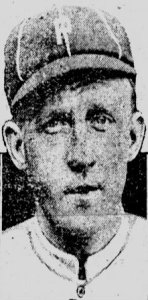
Bobby Byrne

That answer was given to syndicated journalist Joseph B. Bowles during the 1910 season when he asked Byrne questions about how he started in baseball “in order to help young and aspiring players.”

Despite being the starting third basemen for the defending World Champion Pittsburgh Pirates, and on his way to leading the National League in hits (tied with Honus Wagner) and doubles (178, 43), while hitting a personal-best .296 in 1910, he told Bowles:

“If I had it to do over again I do not think I ever would become a professional ballplayer, in spite of the fact that I love the game and love to play it.  I think a young fellow would do better to devote himself to some other line than to take the chances of success in the national game, for even when he wins he loses.”

He talked about how he started, and offered a theory about where the best players come from:

“I wanted to be a ballplayer and was educated at the game in a good school, on the lots around St. Louis.  I think that ballplayers develop faster when they are in the neighborhood of some major league team.  One or two of the players on a ‘prairie’ team are at every game the big league (team) plays.  They see how the game is played, and being at that age as imitative as monkeys, they work the same things on their own teams and teach all the other boys.  I have noticed when any city has a pennant winning club the quality of baseball played by the boys and the amateurs in that vicinity are much improved.”

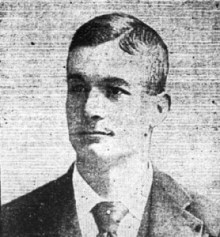
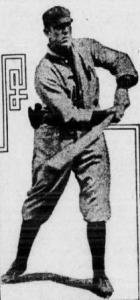
Byrne

Byrne

Byrne said because of his time playing on the sandlots of St. Louis, he “picked up the game rapidly,” but said it wasn’t until he began to play professionally, first in Fort Scott, Arkansas, then in Springfield, MO, that he corrected the biggest flaw in his game:

“The hardest thing I had to learn was when to throw.   I think I must have thrown away half the games we played before I learned not to throw when there was no chance to get the runner. I think that is one of the first things a young player should learn; to look before he throws and only throw when he has a chance to make a play.  The next thing, it seems to me, is to learn to handle one’s feet and to keep in the game all the time, and be in position to move when the ball is hit.”

Even at the pinnacle of his career, the man who discouraged children from following in his path, was also somewhat cynical about his own experience:

“The biggest thing I had learned was that, no matter how far a fellow gets up in the business, there still is a lot he does not know, and by dint of watching and learning I held on, and still am learning and willing to learn.  When I know it all I’ll quit, or be released.”

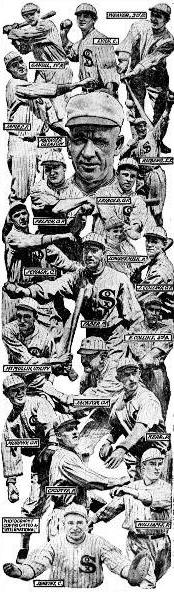
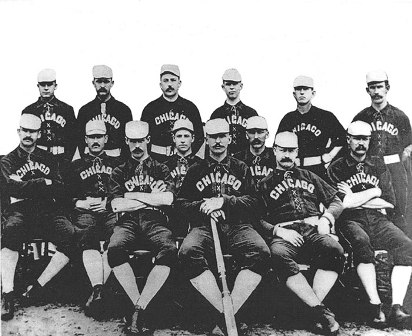
Byrne continued “learning” for seven more seasons, and the end of his career was fitting for someone who warned that a young man should steer clear of baseball because “even when he wins he loses.” After being acquired on waivers by the Chicago White Sox in September of 1917, he appeared in just one game, on September 4.  He was with the team when they clinched the pennant 20 days later; and was released the day after he appeared in the team photo commemorating their American League Championship.
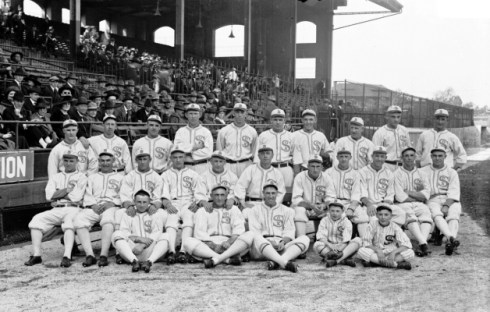
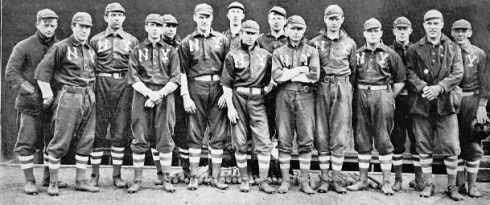
Group portrait of American League's Chicago White Sox baseball team posing in front of a section of the grandstands on the field at Comiskey Park, Chicago, Illinois, 1917.

White Sox team photo after clinching 1917 pennant, Byrne is fourth from right in second row–he was released the following day.

While the Sox were beating the Giants in the World Series, Byrne was back in St. Louis operating a bowling alley.   After three years away from baseball, he managed minor league teams—the Miami (OK) Indians and Saginaw (MI) Aces—in 1921 and ’22 before returning again to the bowling business.

His admonition against professional baseball didn’t stop his two sons from having their own brief minor league careers; Bobby played for several clubs between 1939 and 1941, and Bernie (listed as “Byrnes” on Baseball Reference) played for the Paragould (AK) Browns in the Northeast Arkansas League in 1940.  Both had their careers interrupted by WWII, Bernie was an airforce fighter pilot in Asia, while Bobby was awarded the Distinguished Flying Cross, Air Medal and Purple Heart while flying for the airforce in the Mediterranean Theater.
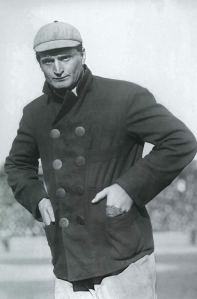
“The Rube was ever a Friendly Spirit”

15 Apr

Four years after Rube Waddell played his final game for the Athletics, The Philadelphia Bulletin told a story that, like much of the Waddell canon, may or may not be apocryphal:

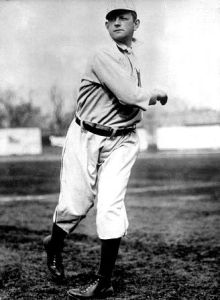
Rube

Rube

“To those who know the steady, staid (Connie) Mack, the following may appeal:

“A ‘cub’ reporter in Chicago strayed into the clutches of the Rube one afternoon and impressed the great pitcher with the fact that he must have something startling in the way of news or be apt to lose his position.

“The Rube was ever a friendly spirit, sympathetic with the weak, even if he had to tap the strong to reimburse the fallen.”

So, said The Bulletin, Waddell was determined to provide the young reporter with a “Startling” scoop:

“I’d take you to see Connie,’ opened the Rube, ‘but he and (Michael) ‘Doc’ Powers are playing poker and ‘doc’ hates to be disturbed when they are gambling.”

Mack

Mack

He then told the reporter that Lave Cross was:

 “Off somewhere and I guess he is tending bar for a friend somewhere on State Street. (and) I don’t know any news to give you except that all this stuff about Ossee Schreck (Schrecongost) is a ‘kid,’ he never fools with the firewater and every time that Monte Cross gets off the wagon why they blame it on me or Schreck.”

Ossee Schrecongost

Schreck

The reporter hurried back to his paper:

“(T)uring over in his mind the thought that Mack was gambling with his players, Lave Cross was the wild man and that Monte Cross was the real culprit when it came to tapping the paint.  He whirled off a story on the machine and handed it to the sporting editor.  That dignitary looked at the cub, scratched his head and kindly asked the youth where he secured his information.

“’Why, it’s big news and ‘Rube’ Waddell gave it to me,’ answered that unsophisticated party.  ‘Well, young man,’ continued the sporting editor, ‘Connie Mack never wagers, drinks or smokes; Lave Cross is the quietest man in the world and does not tend bar, and Monte Cross is a white ribboner.”

Monte

Monte

The editor of the Chicago paper went to Mack and informed him about Waddell’s conversation with the young reporter:

“Connie, Lave and Monte had a quiet laugh and derived considerable interest watching Waddell load up with a bundle of newspapers each day to catch his red-hot interview.”

Lave

Lave

“It’s the Noodle that Throws the Ball, not the Wing”

13 Apr

Charles Benjamin “Babe” Adams appeared washed up at age 34.  After posting a 2-9 record and 5.72 ERA in 1916, the Pittsburgh Pirates released him.  But, Adams wasn’t done.

He won 20 games in the Western League in 1917 and was 14-3 with a 1.67 ERA for Kansas City Blues in the American Association when the Pirates reacquired Adams in July of 1918.

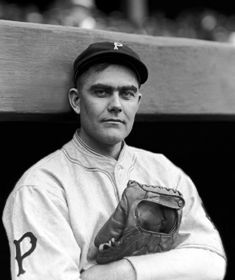
Babe Adams

Babe Adams

Adams was 49-29 with a 2.17 ERA from his return through the 1921 season, and now turning 40, talked about his success with Roy Grove, a cartoonist, and writer for The Cleveland Press:

“A ballplayer has lots of time in which he can do himself harm.

“A fellow can’t disregard nature and get away with it.  He can kid himself along for a while but finally, he’ll snap…A fellow my years has to dig some to get by the young chaps.”

But, said Adams, baseball had changed a lot since his debut in 1906,and most younger pitchers could never approach his longevity:

“The pitching game isn’t what it used to be.  In my day, I used to have to sit down and figure out the different things that go to make pitching and then go out and practice them hard.  The young pitcher today can pick the game up in a few weeks.  He has two or three coaches, with modern methods of tricks and systems and so forth that have been accumulated through years of experience.  That‘s the reason I think they crack so fast.  They don’t get the right seasoning during youth to stand the grinds of the years.”

But in the end, Adams said he was just smarter than most:

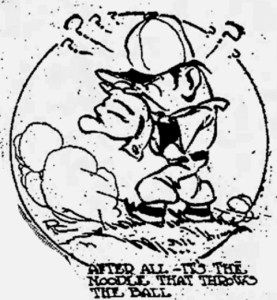
“It’s not so much the old pitching arm these Twentieth Century days as it is the pitching head.  After all, it’s the noodle that throws the ball, not the wing.  There are some fellows I can throw a high inside ball to and they won’t touch it, and then let some other pitcher come up and do the same thing and that same player will knock it outa the lot.

“If a fellow were to stop thinking out there in the box and resort to strength, he’d darn soon find out he was losing all his friends.”

babeadams1

A Roy Grove cartoon that accompanied the article.

Adams’ “Noodle” and excellent control (18th all-time lowest walks per nine innings) kept him in the National League for five more seasons, until he was 44.

“Those $8 Diamond cuff buttons cost us the Championship”

11 Apr

Clark Griffith never got over losing the pennant to the Boston Americans by 1 ½ games in the American League’s first great pennant race in 1904.

Clark Griffith

Clark Griffith

Over the years, he wasn’t even able to decide which of his New York Highlanders’ three straight losses to Boston in October was the most “hard luck” game, and just who he blamed for letting the season slip away.

In 1914, Griffith told Stanley Milliken of The Washington Post that second baseman Jimmy Williams, who failed to heed his instructions at the plate during the game that gave the pennant to Boston on October 10—Griffith barely mentioned the wild pitch Jack Chesbro threw which allowed Boston to score the winning run.

But two years earlier, he told a different story to Hugh Fullerton of The Chicago Examiner –in in this one he put the blame on himself and Chesbro, but not for the October 10 game:

“There never was any hard luck except mine.  Whenever I hear them tell hard luck stories I think to myself that they don’t know what it is.”

[…]

“The race had narrowed down to New York and Boston.  We both came east from our last Western trip with (a half game) separating us.”

Griffith said his club returned to New York believing all five games would be played in New York as scheduled, but discovered that New York owner Frank Farrell “not thinking we would be in the race at all, had in the middle of the season leased the Highlanders park to the Columbia University team for football on Saturday.”

As a result, the two Saturday games were moved to Boston.

“We beat Boston on Friday 3 to 2, and that put us where we only had to break even in the next four games to win.  Chesbro had pitched the Friday game.  I did my planning and decided to pitch Jack Powell the two games in Boston on Saturday, and to leave Chesbro at home to get a good rest over Sunday and to be ready to pitch the two games on Monday if it became necessary, knowing that with two days of good rest he could do it.”

chesbro2

Jack Chesbro

Griffith said his pitcher had other plans:

“When I got down to the depot that night there was Chesbro begging to go with us to Boston.  Some fool friends of his had notified him that they intended to present him with diamond cuff buttons in Boston, and he was wild to go.  I could not refuse him under the circumstances but those $8 diamond cuff buttons cost us the championship.

“(Once in Boston) Chesbro was crazy to pitch, and he warmed up in Boston and declared he felt better than at any time during his life.  I was angry because I wanted him to rest, and refused him.   He almost cried and said he had repeated numerous times during the season and always had won.  I said ‘no’ that we couldn’t take the chance.”

But Griffith said his team pressured him:

“Chesbro got (Wee Willie) Keeler, (Kid) Elberfeld and all the boys to come to me and beg me to let him pitch.  (Jack) Powell came to me and said he would keep warmed up and ready to relieve Chesbro in the first game.  I fell for it, seeing Chesbro had already warmed up and my plan for resting him was spoiled. He was good for (three innings), but before anyone could relieve him in the next Boston made six runs and the game was lost (13-2)…Powell  and Cy Young met in the second game and Boston won 1 to 0.”

And Griffith was quick to blame that loss on his “hard luck” as well:

Griffith's "Hard Luck" Highlanders

Griffith’s “Hard Luck” Highlanders

“The one run was scored on the rankest kind of luck.  A ball thrown (by John Anderson) from the outfield to (third baseman Wid) Conroy got by him…allowing the run to score.  The ball would not have rolled five feet from Conroy, but the crowd had pushed up to within three feet of third base.

This made it necessary for us to win both games on Monday.  And in the first game, in the ninth inning, with two out and two strikes on (Freddy) Parent, Chesbro let his spitball slip for a wild pitch and gave Boston the game.  We won the next 1 to 0 but the pennant was done.

“If there ever was harder luck than that, I don’t want to hear of it.”

Lost Advertisements–“A Pennant Winning Nine!!

8 Apr

1910reds

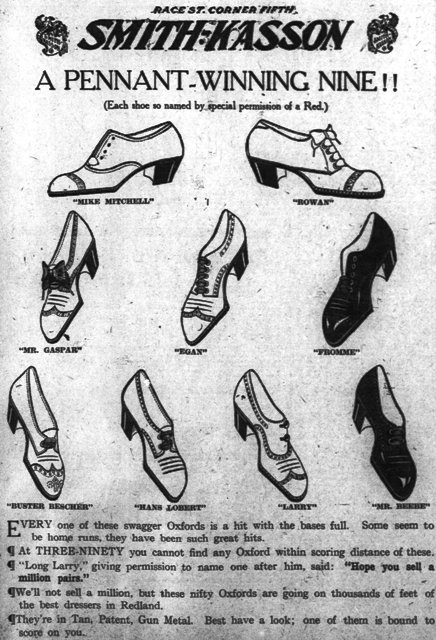
A 1910 advertisement for Smith-Kasson Shoes in Cincinnati.

“Each shoe so named by special permission of a Red”

The shoe lineup included the “Mike Mitchell,” the “Rowan,” for pitcher Jack Rowan, the “Mr. Gaspar,” “Mr. Beebe,” and “Fromme” for pitchers Harry Gaspar and Art Fromme.  The “Egan,” for 2nd baseman Dick Egan, outfielder Bob Bescher was immortalized with the “Buster Bescher,” the “Hans Lobert” for third baseman Hans Lobert, and simply “Larry” for catcher Larry McLean.

"Buster Bescher"

“Buster Bescher”

“Every one of these swagger Oxfords is a hit with the bases full.  Some seem to be home runs they have been such great hits.

“At Three-Ninety, you cannot find any Oxford within scoring distance of these.

“Long Larry (McLean), giving permission to name one after him said, ‘Hope you sell a million pairs.’

Long Larry

Long Larry

“We’ll not sell a million, but these nifty Oxfords are going on thousands of feet of the best dressers in Redland.

“They’re in Tan, Patent, (and)  Gun Metal.  Best have a look, one of them is bound to score on you.”

It’s unknown how well the line of shoes fared;  their namesakes, stylish Oxfords and all, limped to a 75-79, fifth place finish.

“Never a Backstop ever Lived could touch Frank Flint.”

6 Apr

George Gore spent 14 seasons in the major leagues, hitting .301—most notably, he led the National League with a .360 average in 1880 as a member of the Chicago White Stockings.

George Gore

George Gore

After his retirement, Gore was a regular attendee of baseball’s winter meetings.  In 1910, he spoke to a reporter from The Washington Evening Star at the 1910 gathering at New York’s Hotel Breslin.  The paper called him “one of the finest fielders, heaviest hitters, and finest ballplayers,” of his era.

Gore, however, didn’t want to talk about his abilities, but instead was making the case for one of his former teammates, Silver Flint:

Silver Flint

Silver Flint

“Frank Flint of our team was the greatest catcher who ever lived.  He knew more than any other man with the mask.  He had the greatest head of any man in the business.  Nobody before or since could touch Flint.

“Every pitcher he ever handled he made a star.  Look at Fred Goldsmith and Larry Corcoran.”

Fred Goldsmith

Fred Goldsmith

Gore noted that neither pitcher “ever showed much” before or after playing with Flint; although he did leave out that both were still teammates of Flint when they began their steep declines in 1884 and 1885.

“Once Frank took them in hand, they all developed into stars.  He could make cracks out of every pitcher who ever towed the slab.  Show me the backstop today who can take any pitcher and make a marvel out of him.”

Larry Corcoran

Larry Corcoran

Of Flint’s role in both pitchers’ success, Gore said:

“Goldsmith was able to pitch for us for several years after his arm was like a plate of ice cream because he had Flint behind the bat.  Corcoran, you know, was a slightly built man (5’ 3” 125-130 pounds) and as cranky as the dickens.

“The White Stockings were out in California at the time that (William) Hulbert was president of the club.  Corcoran had been heard about by our team, but his sour disposition had queered him with a number of them.  Hulbert was a trifle loath to take him.  However, he talked with ‘Silver’.”  ‘Get him,’ said Frank, ‘and I’ll do the rest.’  So Hulbert took Larry.’”

Gore, who likely exaggerated concerns about the highly prized 20-year-old Corcoran, said of Hulbert’s first meeting with the pitcher:

“The boss called Corcoran to him ‘Look here’ said the president, pointing to Flint:  ‘That fellow is your boss.  You do everything that he asks you, and don’t you disobey, or I’ll fire you right off the reel.’

“Corcoran started.  He obeyed implicitly, and everything went along finely.  Larry was soon one of the best twirlers in the league.  One day, though, he got one of his cranky fits on.  He wouldn’t obey the signals and crossed ‘Silver’ several times.”

Gore said Flint went out to speak to his ‘cranky’ pitcher:

“’Larry,’ he said quietly, but his eyes were snapping, ‘you either do what I say or you  go straight into the clubhouse—I don’t care a d— which you do. Now get busy.’”

Gore said Corcoran complied:

“After the game, Hulbert was sitting in the grandstand.  Corcoran came out of the clubhouse dressed, and the boss was waiting for him.  He called the pitcher to him.  ‘Look here Lawrence,’ sa id the old man, ‘didn’t I tell you that Frank was your boss?  Now if you let another yip out of you like you did today you’ll be fired so quick that your head will swim.’”

Gore said Corcoran again complied, and from that point on Flint had him “trained to the minute.”  Corcoran was 175-85 with a 2.26 ERA from 1880 until the White Stockings released him in 1885—his arm dead.  Despite the numbers, Gore called Corcoran “only a fair twirler” but for Flint.

Goldsmith, a claimant to the invention of the curveball, had a similar fate. He was 98 and 52 with a 2.57 ERA from 1880 through 1883 with Chicago; in 1884, he began to struggle and was 9-11 with a 4.26 ERA when the White Stockings sold him to the Baltimore Orioles in August.  His career was over at the end of that season.

Corcoran’s big league career was over at age 27, Goldsmith was 28.

Whether Flint deserved as much credit as Gore gave him for their brief, incredible success, is open to debate, but in 1910, the former outfielder was certain in his praise for his former teammate, who had died in 1892:

“Yes, there was never a backstop ever lived  could touch Frank Flint.”

Lost Advertisements–“Play Ball!”

4 Apr

openingday19191

Opening Day at Comiskey Park, 1919, the first opener after the end of World War I:

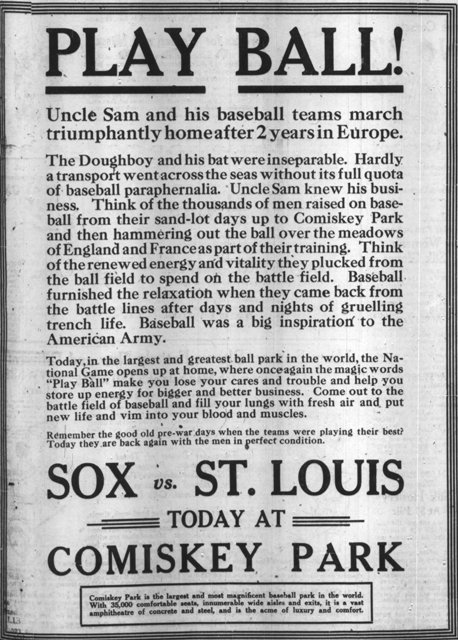
The ad above appeared in Chicago Newspapers on May 1, 1919, and appealed to the patriotism of fans:

“Uncle Sam and his baseball teams march triumphantly home after 2 years in Europe.

“The Doughboy and his bat were inseparable.  Hardly a transport went across the seas without its full quota of baseball paraphernalia.  Uncle Sam knew his business.  Think of the thousands of men raised on baseball from their sandlot days up to Comiskey Park and then hammering out the ball over the meadows of England and France as part of their training.  Think of the renewed energy and vitality they plucked from the ball field to spend on the battlefield.  Baseball furnished the relaxation when they came back from the battle lines after days and nights of gruelling trench life.  Baseball was a big inspiration to the American Army.

“Today, in the largest and greatest ballpark in the world, the National Game opens up at home, where once again the magic words ‘Play Ball’ make you lose your cares and troubles and help you store up energy for bigger and better business.  Come out to the battlefield of baseball and fill your lungs with fresh air and put new life and vim into your blood and muscles.

“Remember the good old pre-war days when the teams were playing their best.  Today they are back again with the men in perfect condition.”

As for the “greatest ballpark in the world,” the ad said:

“Comiskey Park is the largest and most magnificent baseball park in the world.  With 35,000 comfortable seats, innumerable wide aisles and exits, it is a vast amphitheatre of concrete and steel, and is the acme of luxury and comfort.”

Patriotic fervor and “men in perfect condition” were no match for the weather, or perhaps as a metaphor for what was to come, dark clouds brought rain and postponed the game between the White Sox and the St. Louis Browns.

The 1919 White Sox

The 1919 White Sox


“You can’t Rattle Him”

1 Apr

luderuscoke

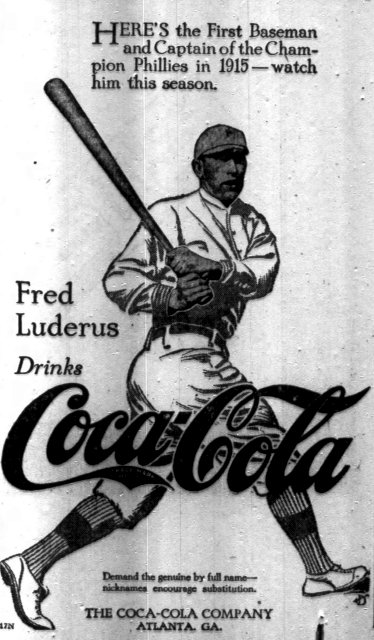
A 1916 advertisement for Coca-Cola featuring Fred Luderus:

“Here’s the First Baseman and Captain of the Champion Phillies in 1915–watch him this season.

“Fred Luderus drinks Coca-Cola.”

Christy Mathewson told Harold Dekalb “Speed” Johnson of The Chicago Record Herald a story about an attempt by Giants Manager John McGraw to rattle Luderus at the plate:

“‘I hear you can kid Luderus along,’ said the Little Napoleon to (catcher John) Chief Meyers.’

“‘Josh him a little when he comes to bat.’

“‘Ludie lumbered to the pan in the second round toting a heavy bludgeon and an innocent smile.  Meyers was ‘set’ for him.  He fixed his fingers in a fake signal and then addressed Ludie.’

“‘Look down into my glove,’ invited the noble redman.  ‘The best hitters steal the signs, you know.’

“‘Luderus didn’t answer.  The pitcher wound up and buzzed one over the outside corner.  Fred’s mace swung around with a crash and he meandered nonchalantly around the circuit for a homer.’

“‘I don’t need to steal the signs to hit that pitcher,’ he told Meyers as he crossed the plate.  ‘Besides, they pulled that gag on me in the bushes long ago.’

“‘I don’t want you to talk to that fellow anymore,’ ordered McGraw when the Chief finally got back to the bench.  ‘You can’t rattle him.”

Luderus

Luderus

Incidentally, in a case of plagiarism or great minds thinking alike, the lede of Johnson’s story read:

“He’s no Chase on the defense, nor a  Daubert in batting, nor a Merkle on the basepaths, but he’s the most underrated star in baseball today.”

Nearly a year earlier, John “J.C.” Kofoed of The Philadelphia Record wrote in “Baseball Magazine:”

“He is not a McInnes on the defense, nor a Daubert in batting, nor a Merkle on the basepaths…He is the most under-rated man in baseball today.”


“Many say he was so Modest he Hated to have his Picture Taken”

30 Mar

In the winter of 1918 Malcolm MacLean of The Chicago Evening Post wrote about the peculiar reactions of a few players to photographers:

“It may happen that a pitcher does a phenomenal streak of work and his photo should run.  It may be the only one of him in stock that has been used time and again—so often, in fact, that it is all but worn out.

“Hence it is necessary for a photographer to snap said fellow’s photo on the ball field.  Ninety-nine times out of a hundred this is a pipe. Yet there are exceptions.”

MacLean said he recalled a handful if examples of players refusing:

“In practically every case it was that uncanny thing known as ‘baseball superstition’ that made it difficult, almost impossible, to get them to pose.

(Urban) Red Faber, of the White Sox, on two occasions (during the 1917 season) lost ball games after he had been snapped.  So he announced his intention of refusing to pose again until the White Sox won the American League championship.  Another member of the Sox, Charles (Swede) Risberg, joined him in the declaration. And they stuck to it.

Red Faber

Red Faber

“The day after the title was clinched both Faber and Risberg were among the easiest fellows on the squad to photograph.  In their case it was ‘superstition’ and we don’t know they could be blamed.  If a player keeps winning, only to have the streak smashed the day his photo is taken, well we have an idea we’d do the same thing.”

MacLean said during Rube Marquard’s 19-game winning streak the Giants’ pitcher refused to allow a Chicago photographer to take his picture.  MacLean said he and a cameraman approached the pitcher on July 8, 1912:

 “’Nothing doing,’ he said.  ‘Come around any time you want after I’ve lost a game and you’re welcome to all you want.’  It so happened that Rube lost that day, Jimmy Lavender hanging the bee on him, and the following afternoon Rube posed and posed and posed.”

MacLean said Jim Thorpe was a particularly difficult subject to photograph when he began his major league career, but not due to superstition:

“When Thorpe first came to Chicago with the Giants, he was the most widely advertised athlete in the world.  He was fresh from his triumphs in Sweden on the track field and from the gridiron at Carlisle.

“Many say he was so modest he hated to have his picture taken.  At any rate, many a film and plate was wasted on him because he would turn his face away, throw up his arm in front of him, or do something also to ruin the exposure.”

Jim Thorpe--Airedale fan

Jim Thorpe

Another difficult member of the Giants was catcher John “Chief” Meyers, who MacLean said would brush past photographers, saying:

“’Aw, you’ve got all of me you want,’ It was decidedly exasperating, especially when publicity is what helps keep major leaguers in the majors.”

Two other oft-photographed pitchers had their own particular quirks.

MacLean said:

“It will surprise many to learn that Ed Walsh, of the White Sox…refused to pose on the day he was expected to pitch…Few men were snapped so frequently as Ed when he was in his prime, yet we venture to say no man ever got a photo of him—when Ed knew it—on the day he was to work.

Eddie Plank, of the Athletics…was one of the easiest of all men to photograph, but it was exceedingly difficult to get a good one of him.  The reason was he kept tossing stones at the camera or twisting up his face in some farcical fashion.  And when other players were being taken Ed would throw peddles at them, trying to have them distort their faces.”

Eddie Plank

Eddie Plank

“Everyone seemed to be trying to pull off the Greatest Stunts of his Life”

28 Mar

Great plays are in the eye of the beholder.

Jack Lelivelt said the greatest play he ever saw came in the greatest game he ever witnessed; the first game of a doubleheader played during the dog days of August by fourth and seventh place clubs hopelessly out of the American League pennant race.

Jack Lelivelt

Jack Lelivelt

Lelivelt watched from the bench on August 4, 1911, as his Washington Senators played the  Chicago White Sox.  Months later, he told Hugh Fullerton of The Chicago Examiner the game included “(S)ix plays in it that might any one be called the greatest according to the way a man looks at it.”

The game was a 1-0, 11-inning victory for the Senators; Walter Johnson getting the complete game victory over Doc White.  And Lelivelt was not alone in his assessment.

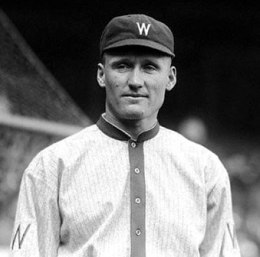
One Star Pitcher

Walter Johnson

William Peet of The Washington Herald said:

“An old-time fan in the grandstand correctly described the curtain raiser when he slapped his neighbor on the back and cried: ‘That was the best game of ball I ever saw in my life.”

Joe S. Jackson of The Washington Post said:

“No more freakish game than the opener has ever been played at the Florida Avenue field (Griffith Stadium).”

Lelivelt told Fullerton:

“First, (Ping) Bodie caught a home run while running straight out nearly to the center field fence; then (Clarence “Tillie”) Walker caught a fly off one ear while turning a back somersault.”

Bodie’s play robbed Walter Johnson of at least extra bases, with a runner on first in the third inning—and Walker robbed Ambrose “Amby” McConnell of the White Sox in the eighth; The Herald said he “spared it with his bare hand.”

Ping Bodie

Ping Bodie

Lelivelt continued:

(Harry) Lord made two stops on the line back of third, and (Lee) Tannehill grabbed two line drives and started double plays.”

While noting Lord’s “two stops,” Lelivelt failed to mention his most notable play during the game; when he fell into the Chicago dugout to catch a George McBride foul pop out, a play The Herald called “one of the best catches ever seen here.”

Lelivelt said:

“Everyone seemed to be trying to pull off the greatest stunts of his life in that game…with White and Johnson pitching magnificent ball.  It is as if you took a dozen great games of ball and crowded the most sensational parts of each into 11 innings.”

As for the best play, Lelivelt said it came in the third inning after Johnson walked McConnell and Lord sacrificed him to second:

(Jimmy “Nixey”) Callahan whipped a fast hit right down between third and short, a hit that seemed certain to go through to left field without being touched.  The ball was hit hard and was bounding rapidly when McBride went back and out as hard as he could, shoved down his glove hand, scooped the ball and snapped it straight into (William Wid) Conroy’s hands on top of third base.  The play was so quickly made that McConnell saw he was out, and by a quick stop tried to delay being touched and jockeyed around between the bases to let Callahan reach second. He played it beautifully, but he never had a chance.  McBride jumped back into the line and before McConnell could even get a good start back Conroy whipped the ball to McBride and McConnell was touched out before he had moved five feet.

Wid Conroy

Wid Conroy

“So rapidly was the play made that as soon as McBride touched McConnell he shot down to second so far ahead of Callahan that Cal was able to turn and get back to first…If Callahan had reached second on the play Chicago would have won, as (Matty) McIntyre followed up with a base hit that would have scored the runner from second easily.”

Curiously, the play Lelivelt said was the greatest in a game of great plays, the greatest play he said he ever saw, received no notice the next day’s coverage of the game in either Washington or Chicago.

The Herald ran a column listing fourteen key plays in the game but failed to mention Lelivelt’s “greatest play” at all. The Post said only that McConnell was out “McBride to Conroy, on Callahan’s grounder.”  It received no mention in the Chicago papers.

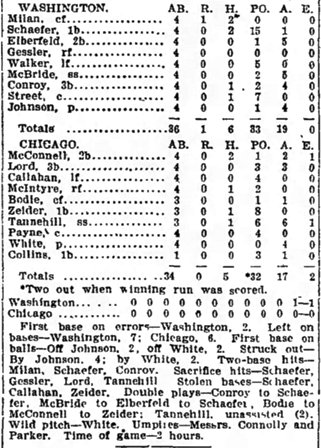
The Box Score

The Box Score