Archive | Uncategorized RSS feed for this section

Lost Pictures: Dode Paskert Plays Ice Baseball

20 Feb

dode

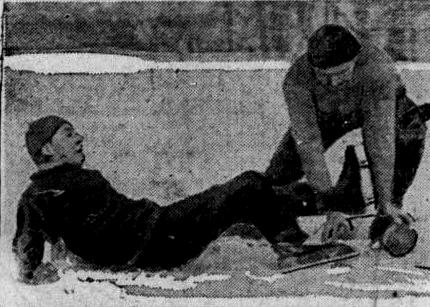
Ice Baseball made its first appearance in the winter of 1866 when the Athletic Baseball Club of Philadelphia played a game on ice against a “picked nine’ comprised of other local baseball teams.  Games were played occasionally over the next 50 years, but the game never caught on.

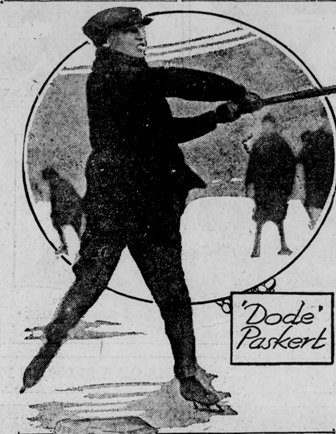
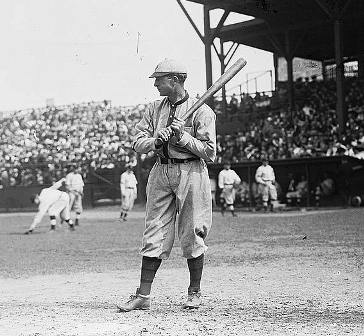
That changed briefly the winter following the 1919 season when the game, along with Ice Boxing, became a sensation in Cleveland.  The Cleveland Press said the biggest star among the “many ice baseball clubs” was Chicago Cubs centerfielder, and Cleveland native,  George “Dode” Paskert “an expert skater (who) says the exercise he is getting is going to put him about a month ahead” of his teammates.

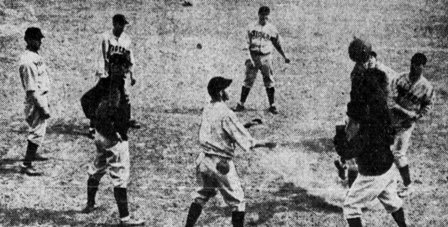
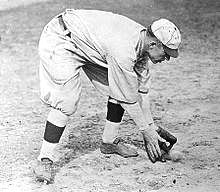
Unidentified Ice Baseball players in 1920 photo.

Unidentified Ice Baseball players in 1920 photo.

The paper said Cleveland Indians players Bill Wambsganss and Jack Graney played, and that Ray Chapman, the Indians second baseman,  and William “Pickles” Dillhoefer, catcher for St. Louis Cardinals would be joining teams.

Indians Manager Tris Speaker umpired at least one game.

Like every other short-term Ice Baseball craze, the game quickly faded in Cleveland.

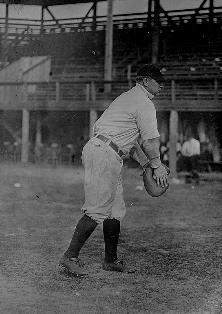
Dode Paskert

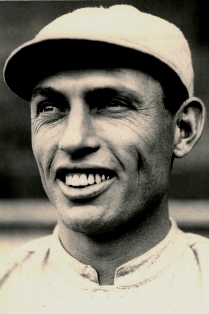
Dode Paskert

As for Paskert, after a horrible 1919 season–.196 in 88 games–the 38-year-old seems to have benefitted from his “extra exercise.”  He hit .279 in 139 games in his final full season in the major leagues.


“Why not bring one of the Big League Teams to Phoenix for Spring Training?”

18 Feb

Grover Cleveland Land was a visionary.

In 1921 The Arizona Republican asked the question the former catcher had put to several major league clubs:

“Why not bring one of the big league teams to Phoenix for spring training?”

Land, a Kentucky native who spent the last 40 years of his life as a Phoenix resident,  was encouraged by a report that Connie Mack had announced that his Philadelphia Athletics would no longer train in Lake Charles, Louisiana;  according to The Associated Press Mack said “certain things happened at the Louisiana resort last March that handicapped” the team.

Grover Land

Grover Land

Land, the former catcher for the Cleveland Naps and the Brooklyn Tip-Tops, said:

“I have played ball in every section of the country, and I have yet to find a climate more suited for baseball training than I find right here in Phoenix…Major league managers have been sending their players to Texas and other southern states for many years and I can safely state that there is not one manager entirely satisfied with the present training camp sites.  Fully one-third of the training period is hampered by rain and storms and by the time the training season is ended the players are just beginning to round into shape.”

He said he understood that “local boosters” had made some effort to bring teams to Arizona in the past—the Chicago White Sox, Cubs, and Pittsburgh Pirates had played spring exhibition games in the state several times since 1909—but Land said he would “make an effort to induce one of my manager friends to come down here…I am certain that if one of the managers could be induced to come here for a few weeks Phoenix would have no difficulty getting on the sport pages.”

He said the local chamber of commerce was getting behind the push, and that he had “already written to one of the major league managers and I have been corresponding with several sports writers in the east,’ to make the case for Phoenix.

“If the local fans get behind the move and convince Connie Mack that they want his team here next spring I have every confidence that the Philadelphia Athletics will do their 1922 training in Phoenix.”

Land was a bit overconfident in regard to Philadelphia; Mack chose to take the Athletics to Eagle Pass, Texas in the spring of 1922.

No team would train in Arizona until 1929—the Detroit Tigers came to the state for one season—but chose California the following year.

The Detroit Tigers in Arizona, 1929

The Detroit Tigers in Arizona, 1929

But Land, who died in 1958, lived long enough to see his adopted home become the spring training location for four clubs.

“Base-ball Established as a Business calls upon us to revise our Notions of its Usefulness”

16 Feb

Concern over the post-Civil War baseball boom was not isolated to obscure, financially troubled newspapers.  Shortly after The Harrisburg Topic editorialized on the “silly, even foolish” attention to baseball, The New York Times weighed in on the subject.

While not as staunchly against the game as their Pennsylvania counterparts, The Times had serious concerns:

“The game of baseball is, in many respects, worthy of encouragement.  In a community by far too much given to sedentary occupations and dyspepsia, it furnishes and incentive to open-air exercise, and we should be glad to see it even more resorted to than it is, among the class who would profit most by its benefits.”

Yes, said The Times, baseball was a fine outlet for “our merchants and lawyers and over-worked clerks, after their day of harassing mental labor,” but what loomed on the horizon was the cause for grave concern:

“It is one of the defects of our national character, however, that no sooner do we get hold of a good thing of this sort, than we proceed to make it hurtful by excess.  Base-ball as a recreation was well enough, but base-ball established as a business calls upon us to revise our notions of its usefulness.”

The new, professional game, said The Times, even lacked the one benefit the paper supported—a healthy outlet for players:

“On the contrary, it is so dangerous to life and limb, that in insurance language it would be labeled extra hazardous.  Fatal accidents on the ball-filed have been so common of late as hardly to excite remark, and maiming is the rule and not the exception among members of first-class clubs.  One of the best players of the Red Stockings was so injured in a recent match that he is unable to walk without crutches. (George Wright injured his right leg in an August game in Cincinnati against the Troy Haymakers).  In fact a veteran base-ball player, whose teeth have not been knocked out, or whose bones have not been repeatedly broken, is a lucky rarity.”

George Wright

George Wright

And, like many of the other voices against the growing popularity of the game, The Times said the “moral aspect of our national game” was the most troubling issue:

“At its best, it is an excuse for gambling; at its worst, a device for viler ‘jockeying’ and swindling than ever disgraced the turf.”

The professional game was a scourge that needed to be dealt with:

“It seems time, therefore, that we should ask ourselves what is to be gained by giving to the business of ball-tossing the consideration and importance which seem ludicrously disproportionate to the subject, and are well calculated to seduce the unthinking into profitless pursuit.  Perhaps we may set down to the score of journalistic hyperbole the assertion of one Western paper that the dissolution of the Red Stocking Club would be a national calamity.; but nonsense hardly less preposterous is hourly talked and telegraphed over the country on the same topic.  The spectacle of grave merchants calling a public meeting and subscribing thousands of dollars to establish a club which shall be able to beat another club is sufficiently diverting.  But when we come to have printed in our telegraphic column, side by side, with the war dispatches, and scarcely yielding to them in importance, the various interesting announcements, first, that John Smith has been expelled from the Pipkinsville B.B. Club for getting drunk, and then, next day, that he has been restored, apparently for the same reason, and that the fact has been a matter for public rejoicing, amusement in tinctured with disgust.  We are tempted to suspect that we have been worshipping a very senseless idol and that a young man of health and energy may find many ways of earning a livelihood more creditable to himself and more profitable to his country than by playing in baseball matches.”

Despite the concern about the press “worshipping a very senseless idol,” The Times continued to dutifully report baseball stories at the same rate as the paper had before the editorial; including the November announcement that the Red Stockings were disbanding.

“Men who Never did an Honest day’s Labor”

13 Feb

In June of 1870, The Harrisburg Topic editorialized that Americans were the “least practical” people in the world.

Why? Because they are the “easiest led away in admiration of affairs that have ‘nothing in them,’ that are meretricious, silly, even foolish.“

What was leading them away was baseball.

“We are led to these remarks by the returning of base ball fever…If a number of genteel idlers organize a base ball club, and engage with other clubs in rivalries which have no meaning, it is expected that business should be at once suspended, that the telegraph and the newspapers should yield all their facilities to spread before the public a result which does not prove anything.

“The best baseball players in the world are men who never did an honest day’s labor in their lives, yet such fellows will fry what little brains they have, in the heat of a summer solstice, competing with bat and ball for a superiority which does not add a feature to society’s good, physical powers of usefulness or moral dignity. But it is fashionable. That’s enough.

”The men or man who does an honest day’s work, where genius and art and mechanism contribute to the wealth and glory of the land, are not made half as reputable by the telegraph and the press as is a baseball club.”

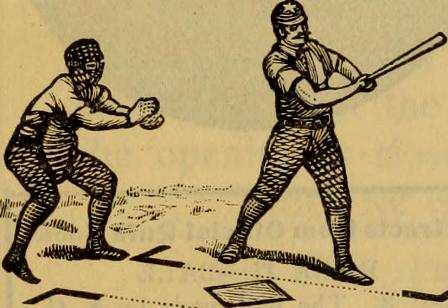
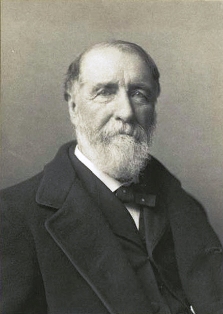
(Image from 1877 Spalding Guide)

“Men who never did an honest day’s labor…”(Image from 1877 Spalding Guide)

The Topic did acknowledge that there was one thing as bad as baseball—the playing of croquet.

“We frequently see young ladies displaying great muscular force in a game of croquet, who would swoon at the base invitation to sweep a parlor carpet or prepare the vegetables for dinner.”

Croquet

Croquet, like baseball, “meretricious, silly, even foolish.”

Not only was the interest in baseball “a ridiculous display of petty vanities” on the part of the public, but it was enabled by the nation’s newspapers who the paper said should be focused on “intelligence of a more useful character than that of reports of baseball contests.”

And, said the paper, the greatest evil was the “criminal features” of baseball.

“Whenever a great game is played, the sporting men and gamblers make it the means of plying their trade, until base ball clubs are used by gamblers to rob the public, one club allowing the other to be victorious, that the gamblers may be enabled to fleece their victims. Part of the money goes for paying expenses of the clubs in drinking and gluttony.

‘It is also a fact that sometimes those who are called expert players are the mere hirelings of rich men, who use them to win or lose a game as their interests may demand. From this, it will at once be seen that what is called our national sport is only a degradation—a gamester’s pursuit—outraging athletic exercise and insulting to the good manners of intelligent people.”

The Harrisburg Topic went out of business two months after the anti-baseball diatribe.

“The Longest Three-bagger on Record”

11 Feb

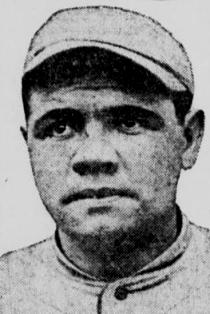
Babe Ruth was the reason American League Umpire Billy Evans called for a rule change after the 1918 season.

Billy Evans

Billy Evans

Ruth tied Philadelphia Athletics outfielder Clarence “Tillie” Walker for the league lead with 11 home runs, but Ruth was not given credit for what would have been number 12 on July 8.

Ruth’s Red Sox were in a scoreless tie with the Cleveland Indians in the tenth innings of the first game of a doubleheader.  Stan Coveleski gave up a single to Amos Strunk with one out, and Ruth came to the plate.

The Boston Post said:

“Coveleski will probably hear the crash of Ruth’s bat for many a day.  The ball sped like a bullet far into the right field bleachers almost to the top.”

The Boston Globe said:

“It is getting so now that Ruth is the man of the hour every day.  His mighty crash into the right field bleachers in the 10th inning drove Strunk home.”

Ruth’s blast landed more than half way up into the right field bleachers, and The Boston Herald said a ball had never been hit further at Fenway Park, but noted, because Strunk had crossed the plate with the winning run “The best the scorers could give Ruth was a triple;” or, as The Post called it “The longest three-bagger on record.”

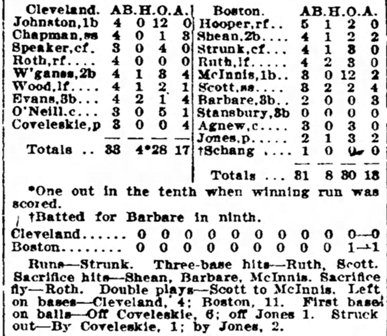
The box score

The box score

That winter, in his nationally syndicated column, Evans called Ruth’s “triple:”

“(O)ne of the longest drives I have ever seen.

“If there was a real, genuine, sure-enough home run, that wallop was the last word.  It was the longest drive Ruth made for the season, yet in the records he is credited with only a three-base hit.”

Ruth hit

Ruth hit “The longest three-bagger on record.”

To Evans, the solution was simple:

“I believe a more just scoring would have had the final result 2 to 0 in favor of Boston.  I believe a rule should be made which said that when a ball was knocked over the fence, or into the bleachers in an extra-inning game, all runners on the bases, as well as the batsman, should be entitles to score.”

For any present day fan, Evans’ suggestion sounds like common sense.  But, in 1918 it was criticized in many quarters.  One of the biggest critics of the potential rule change was William Blythe Hanna of The New York Herald.  Hanna said the rule change would go against everything the game stood for:

“Nothing could smack more of sophism than such advocacy.  Ball games end when the winning run crosses the plate, and any juggling with the rules to give a man a home run under the circumstances noted would be making the game subordinate to individual feats, which, of course, would be contrary to all the well-founded tenets of sport, discipline and organization.  It is surprising that a man of Evans’ intelligence could take so specious, so fallacious a view.”

Evans suggested his proposed rule change again in a column the following year, and sportswriter Fred Lieb of The New York Sun—a non-voting member of the rules committee—introduced the proposal.  The final roadblock was committee member and National League umpire Hank O‘Day, who according to Lieb insisted “I’m telling you, it is illegal.  You can’t score runs after the game is over!”

Despite O’Day’s objection the rule change was officially enacted by the Rules Committee on February 9, 1920 in Chicago.  Hanna had his final word on the rule the following day in The Herald:

 “This is a radical departure, and it is by no means a sure thing that is was based on sound reasoning.”

Nick Maddox

9 Feb

Nicholas “Nick” Maddox burst on the National League scene in 1907. Born in Maryland on November 9, 1886, Maddox’ was born Nicholas Duffy, but adopted his stepfather’s name Maddox.

In 1906 the 19-year-old was given a trial in the spring with the providence Grays in the Eastern league.  He was released before the season began and signed with the Cumberland Rooters in the Pennsylvania-Ohio-Maryland League (POM).  Maddox had played in 1905 for the Piedmont team in the semi-pro Cumberland and Georges Creek League.

He was the best pitcher in the POM; The Sporting Life said Maddox was 22-3 for the Rooters who finished the season in fourth place with a 50-45 record, and was “the fastest pitcher in the league.”
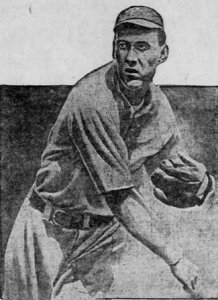
Nick Maddox

Nick Maddox

Maddox spent most of 1907 with the Wheeling Stogies of the Central League.  He posted a 13-10 record and no-hit the Terre Haute Hottentots on August 22.  Maddox was purchased by the Pirates the following month and made his big league debut on against the St. Louis Cardinals.

The Cumberland Times noted that he faced a “double-jointed hoodoo of commencing his National League career on Friday, September the 13th.”

The Pittsburgh Press said:

“Nick was ‘on the job’ yesterday from start to finish, and acted more like a man with many years’ major league experience than like a minor leaguer who has been in the business but a few seasons.”

Maddox shut the Cardinals out on just five hits, struck out 11 and got his first hit, a single in his first at bat.

Eight days later Maddox threw the first no-hitter in Pirates’ history, beating the Brooklyn Superbas 2 to 1—Brooklyn scored on two fourth-inning errors.   Years later, Maddox said of his own throwing error that put Emil Batch on base:

 “They scored me with an error, but hell man, I threw it straight to the first baseman (Harry) Swacina.  Sure it went over his head but he should have jumped for it.”

Batch scored on an error by shortstop Honus Wagner.  Maddox said:

“I don’t hold that against Honus, he saved my no-hitter in the ninth.  A ball was hit right over my head and ‘pfft’ Wagner was over there to get it.  I don’t think he ever held the ball, he just swooped it over to first.”

The rookie started six games Pittsburgh, won his first four, and finished with a 5-1 record with a 0.83 ERA.

The Pittsburgh Leader said Pirates’ President Barney Dreyfuss claimed Maddox would be “the sensation” of 1908.  He wasn’t far off.

The 21-year-old was an impressive 23-8 with a 2.28 ERA with five shutouts.  Despite his success there was concern about control—he walked 90 batters while striking out just 70 in 260 innings, and hit 11 batters.

After three second and one third-place finish the four previous seasons, Pittsburgh, and Maddox, came into 1909 with high expectations.  The Pittsburgh Press said:

“Nick Maddox is facing a very successful summer, and with an even break and barring accidents he ought to push any other twirler in the National League for first honors.  He has everything a pitcher needs, and youth with it.”

The Press also said he would “start out with good control” based on his performance in March games in Hot Springs, Arkansas.

The Pirates lived up to expectations, taking over first place on May 5 and cruising to the pennant; Maddox did not.

The 22-year-old struggled for the first half of the season.  The Leader said he was having “a hard time getting into condition,” and was wild as a March Hare.”  Maddox got on track in July pitching a 2-hit shout against the Cincinnati Reds on the 6th, and four-hit shutouts against the Brooklyn Superbas and Boston Doves on the 14th and 23rd.

He ended the season 13-8 with a 2.21 ERA—overshadowed by teammates Howie Camnitz (25-6), Vic Willis (22-11), Albert “Lefty” Leifield (19-8) and rookie Charles “Babe” Adams (13-3 as a reliever and spot starter).
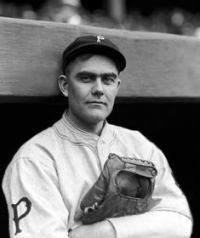
Babe Adams

Babe Adams

Despite going into the World Series against the Detroit Tigers with such a strong pitching staff, Manager Fred Clarke opted for the rookie Adams in game one and he responded with a 4 to 1 victory.

The Tigers beat Camnitz 7 to 2 in game 2.

Three years later, Fred Clarke spoke to James Jerpe of The Pittsburgh Gazette-Times about his decision on a pitcher for game three:

“I was in an awful predicament.  Adams had been used up.  It was had been raining, and it was very cold.  The chilly drizzle was something frightful.  The ball would get wet and water-logged and the problem was to get a pitcher who could handle the wet ball.  I looked the gang over.  Adams was out of the question.  He had been used up.

“I was figuring on the others, and I asked ‘Who can go out there today and handle a wet ball and win?’  Poor Maddox, sitting in a corner of the bench all bundled up with sweaters and other stuff, shed his extra clothes and jumped up.  Grabbing a ball, he said: ‘Gimme a catcher till I warm up.  I’ll handle this wet ball and beat them or break a leg.’  His confidence gave me a hunch, and I acted on it.”

Ring Lardner said of the game:

“Detroit’s record crowd, 18,277, saw the Tigers beaten by the Pirates 8 to 6, today in one of the most exciting and most poorly played world’s series games in baseball history.”

The Pirates scored five runs in the first inning off Detroit’s Ed Summers, and Maddox shut the Tigers down for the first six innings.  Detroit scored four runs in the seventh, aided by two Pirate errors.  Clarke said:

“Maddox wouldn’t have been in so much trouble if we had played ball behind him.”

The Pirates took a 8 to 4 lead into the ninth–Detroit scored two more runs, helped by another error—but Maddox held on and picked up the win.

He did not appear in another game during the series.  The Pirates won in seven; with Adams picking up complete game wins in games five and seven.
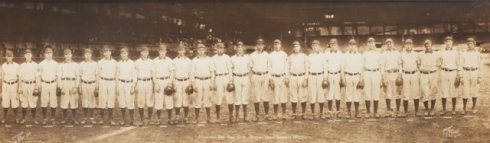
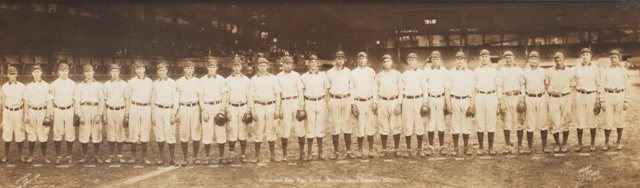
09pirates

1909 World Series Champion Pirates, Maddox is ninth from left.


The defending champions got off to a quick start again, but Maddox again started slow.  By July, The Leader said:

“Nick Maddox should have rounded into form..He is big and strong this year, but does not seem able to pitch good ball for nine rounds.”

He never “rounded into form.”  Maddox struggled all season.  He started just seven games, pitched in relief in 13 others, and was 2-3 with 3.40 ERA.

By August, with the Pirates in second place, six games behind the Chicago Cubs, The Pittsburgh Gazette asked “what was the matter?” with Maddox and why the Pirates had not cut him loose.

He made his last appearance on September 12, giving up a run, a hit and walking two batters in two innings of relief during a 4-0 loss to the Reds.  He was sold to the Kansas City Blues in the American Association 10 days later.

Maddox won 22 games for the Blues the following season, but continued to be plagued by wildness and arm trouble.  His major league career was over, and he was finished professionally in July of 1914 at 27-years-old when he was released as manager and pitcher for the Wichita club in the Western League after posting a 3-13 record.

Fred Clarke was convinced Maddox’ career really came to an end on that rainy day in Detroit.  James Jerpe of The Pittsburgh Gazette-Times said that in 1910 Dreyfuss asked Clarke to release Maddox long before he sold the pitcher to Kansas City:

“’Why don’t you let Maddox go? You aren’t pitching him.’

“’No,’ replied the Pirate Chief sadly.  “I’m not pitching him.  He ruined his arm helping Adams win the world’s series.’

“And Fred narrated (to Dreyfuss) more of Nick’s gameness on that bleak and drizzly October day in Detroit when he gave his arm for a championship.  Nick was carried for a whole year and the club has been interested in his welfare ever since.”
Fred Clarke

Fred Clarke

Maddox, who lived in Pittsburgh, and worked for the Fort Pitt Brewing Company, after his retirement, lived long enough to listen on the radio to the last two innings of the next no-hitter thrown by a Pirate pitcher—Cliff Chambers defeated the Boston Braves 3-0 on May 6, 1951.

Nick Maddox died in 1954 at age 68.

Life on the Road, 1914

6 Feb

In 1914, before beginning his second season as manager of the San Francisco Seals, George “Del” Howard gave the readers of The San Francisco Call a rare look behind the scenes of a baseball team.

Del Howard

Del Howard

“One of the many difficulties which beset a ballplayer is ‘killing’ time while playing away from home…Del Howard was telling only yesterday how the various members of the Seal squad act while on the road.  All the boys are quartered at the same hotel and they usually pass the time in each other’s company.  Card playing for the most part is the favorite pastime, with theater-going running a close second..  There are a few of the San Francisco players who like to hide behind a book, others frequent billiard parlors for a game with the cue, but the majority sit around a table and do their best to deal out pairs.”

Howard even shared the team’s rules for road trips:

“Don’t stay out later than midnight.

Don’t fail to answer 8 A.M. call.

Don’t fail to be down to breakfast by 8:15.

Don’t run around to dances

Don’t play ‘craps’ at any time.

Don’t go over 25 cent limit at cards.

Don’t drink to excess.

Otherwise the players are free to do as they please.”

He said of his “don’ts”:

“We haven’t many rules but the ones we have must be observed.  We don’t tell a player he mustn’t drink nor smoke but we do take action when the privileges are abused.  A player knows best what is good for him and free rein is given him.  A player is allowed to remain up until midnight, if he is in good company, and he is required to be up at 8 in the morning.   There is nothing to do but it is healthy for him to be out of bed.  We breakfast at 8:15.  Very few players eat any lunch and at 6 we go to dinner.  Then there is a long evening to be faced and t is certainly a problem putting in time.”

Howard then described how some of the Seals’ most popular players were “putting in time:”

Howard Mundorff is the life of the club.  ‘Mundy’ is full of fun and the players gather around him and listen for hours while he tells stories and amuses them.  Howard is also one of the card sharks.

Mundorff

Howard Mundorff

Jimmy Johnston is an enthusiastic pool player and he usually can be found at night trying for the 15-ball in the side pocket.  Pete Standridge is also handy with the cue.

Walter Schmidt is quiet and keeps to himself a deal of the time.  He delights in taking strolls and Walter Cartwright, another quiet chap, occasionally accompanies him.

(Jay) Nig Clarke seems to lose himself on every trip and Manager Howard declares that for the life of him he cannot tell just how Nig passes the time.

(Roy) Corhan plays cards pretty regularly, but he spends a lot of his time writing, for he keeps up a continuous line of communication with his better half, when he is on the road, writing consistently every day.

Roy Corhan

Roy Corhan

Charlie Fanning is a bug with the camera and takes pretty good pictures of all the places of interest.  “Skeeter” also knows when to lay down two pair.

“(Albert “Lefty”) Leifield is a very interesting talker and he was a running-mate with Mundorff in amusing the gang.”

Howard said shortstop Harry McArdle was the “most popular player he ever encountered.  Mac has admirers in every town and was kept pretty busy keeping engagements.”

Harry McArdle (sliding)

Harry McArdle (sliding)

As for his time on the road, Howard said, “I walk around and look over things.  I was fortunate in having a well-behaved club last season and did not have any trouble keeping them in line…A busher has the time of his life in a strange town, but a veteran only figures to do something to keep busy.”

After a 104-104 fourth-place finish in 1913, Howard’s Seals—minus Johnston, who drafted by the Chicago Cubs and McArdle, who was traded to the Venice Tigers–behaved themselves well enough to finish third with a 115-96 record in 1914.  The following season he was replaced by Harry Wolverton who led the seals to a 188-89 season, and the Pacific Coast League championship.

Things I Learned on the Way to Looking up other Things–Sunday Baseball Edition

4 Feb

What type of Sunday Ball? 1863

In 1863, The Brooklyn Eagle—there was no byline on the story, but it was likely written by Henry Chadwick—wanted the police department to make a clarification:

“We see by the police records that a party of forty or fifty persons was arrested for playing ball in Sunday, at the ‘ball alley’ corner of Green Lane and York Street.”

Henry Chadwick

Henry Chadwick

The paper’s complaint was that the notice from the police lacked “any description…of the character of ball playing indulged in,” which left a mistaken impression.

“We beg to state, for the benefit of ignorant outsiders, that any base ball club belonging to the National Association is yet to be disgraced by the stigma of playing base ball on the Sabbath.  Not a club in the community can be charged with such a things and this fact should be understood.

“The game the parties were engaged in who were arrested is that known as ‘house ball,’ where the players knock the ball up against the side of a wall with their hands.  No responsible base ball player engages in a game on Sunday, and we trust the police reporters will in future bear this fact in mind and state the kind of game those arrested were engaged in.”

John L. Sullivan and Sunday Baseball, 1885

Heavyweight Champion John L. Sullivan, arrived in Cleveland, Ohio on Friday, September 11, 1885.  The Cleveland Press said he would be pitching on Sunday for a local semi-pro club, the Forest Cities—the Western League team of the same name had folded in June–in an exhibition game against a team from Sandusky.  The scheduling of a game on Sunday had raised the ire of the local “Law and Order League,” who the paper said “were up in arms,’ and attempted to get the game canceled.

John L. Sullivan

John L. Sullivan

Despite the protests, the game, at Cleveland’s Brooklyn Park, went ahead as scheduled.  Sullivan was paid $900 for his appearance and pitched well—he gave up just five hits in nine innings, a fifth inning error allowed Sandusky to score two runs, and Sullivan and the Forest Cities lost 2 to 0.

The Press said as soon as the game ended Sullivan was placed under arrest by “a meek constable” named Jones, who “feared to arrest (him) during the game.”

The move was roundly criticized as simply a publicity stunt, given that the Law and Order League failed to swear out warrants against the other seventeen players or the game’s organizers.

Bond was posted for Sullivan and the fighter left town that evening.  The following day an attorney pleaded guilty on Sullivan’s behalf that he had “engaged in a game of ball on Sunday.”

The attorney for the “Law and Order League” asked the judge to “uphold the sacred day of rest by assessing a fine of such proportions as would teach the law-breakers and Sabbath-desecrators a wholesome lesson.”

The judge fined Sullivan $1 plus costs “amounting in all to $15.90”

Sunday Baseball in Chicago, 1894

During the spring of 1894 a man named William W. Clark met with Chicago Mayor John Patrick Hopkins.

The Chicago Inter Ocean said Clark was “Secretary of the International Sunday Observance League,” The Chicago Eagle called him as “a blue-nosed individual in clerical garb.”

Chicago Mayor John P. Hopkins

Chicago Mayor John P. Hopkins

Clark presented the mayor with a resolution requesting a ban on Sunday games in Chicago.

The Eagle described the meeting:

“He was accorded a courteous hearing, in the course of which the clerical gentleman expatiated upon the enormity of ‘catching men out,’ of making ‘home runs’ on Sunday.  Such practices he said were wrong and highly immoral.  Mayor Hopkins listened in mild surprise.  When the gentleman got through His Honor announced that he used to play ball on Sunday’s himself, and sometimes attended a game even yet, and saw nothing immoral about it.

“The cleric was unable to specify any particular enormities growing out of the game, but proceeded to hold out threats.  Then Mayor Hopkins announced that he had been elected by the liberal-minded people of Chicago, and as they appeared to be in the majority here, he, Mr. Hopkins, intended to be governed by their wishes.”

The Eagle editorialized that the mayor had “made another of his famous home run strikes on the particular occasion.”  And, “As for the clerical visitor, the poor man struck out.”

The International Sunday Observance League abandoned their effort to make Sunday baseball illegal in Chicago.

Jennings “Hurled an Unmentionable Epithet at him”

2 Feb

In April of 1896, the reigning National League Champion Baltimore Orioles traveled to Petersburg, Virginia for a pair of exhibition games with the Petersburg Farmers of the Virginia League.

The Baltimore Sun noted that it had been a tough spring for the Orioles.  Third baseman John McGraw “the brainiest and pluckiest little infielder that ever trod a diamond,” was in an Atlanta hospital suffering from typhoid fever; he would miss most of the season.

Additionally, catcher William “Boileryard” Clarke was sent back to Baltimore with a sprained ankle, pitchers John “Sadie” McMahon and Arlie Pond had injured hands and both would be out for at least a week,  and shortstop Hughie Jennings was also slowed by a hand injury.

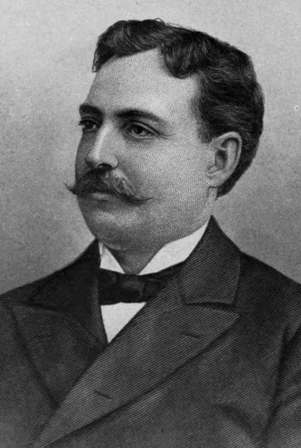
Hughie Jennings

Hughie Jennings

A light rain fell as the hobbled team arrived in Petersburg on the morning of April 6, the day of the first game—which ended in a 7 to 7 tie.  The Baltimore American said:

“Why the team did not trounce the Petersburgs is an open question, but whether it was because of the game on Saturday (in Richmond) or the rain, or the umpire, the Champions walked out of the gates with the humiliation of having made eight errors and feeling the added sting of having just escaped being beaten by a minor league team.”

Third-string catcher Frank Bowerman made two of Baltimore’s errors and had a passed ball.  He would be relegated to umpiring duties in the second game, scheduled for April 8.  On the seventh the Orioles defeated another Virginia League team, the Richmond Bluebirds, 4 to 3.

The American said the morning of April 8 “had been a pleasant one,” with local officials taking the Orioles for a tour of the Petersburg Civil War battlefield.  And, with the rain gone, “The warm sun put life into each club, and a pretty, snappy game was being put up by each side.”  Bowerman and Petersburg player Michael “Doc” Powers alternated as umpires for the game.

Doc Powers

Doc Powers

Petersburg was leading 1 to 0 in the seventh inning when Powers called Orioles third baseman Jim Donnelly out on strikes.  What happened next, and who was responsible, depended on whether you read the accounts in the Baltimore papers or those in Petersburg and the surrounding Virginia towns.

The Sun said:

“Several promising runs had been cut off by similar umpiring and the birds were getting very ‘sore’ at such outrages.  Donnelly objected and (Hugh) Jennings went up to Powers, who was standing behind the pitcher, and said something to him.  Just then (Charles) Sholta, who had also run up, struck Jennings a stinging blow on the side of the head without warning.  The blow drew blood.”

The American said:

“While Hughey was expostulating rather forcibly with Powers, Sholta struck him on the cheek.”

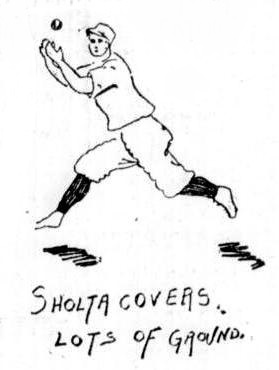
Charles Sholta--drawing from Richmond newspaper

Charles Sholta–drawing from Richmond newspaper

The Baltimore papers agreed that the punch Sholta threw was unprovoked.  Every Virginia newspaper disagreed.

The Petersburg Index-Appeal said, “Jennings resented Sholta’s interference by very foul and abusive language and was promptly struck in the face.”

Papers in Richmond, Roanoke and Norfolk agreed that Jennings provoked Sholta—The Virginia League correspondent for The Sporting Life said Jennings “hurled an unmentionable epithet at him—an epithet which does not go here.”

Everyone generally agreed with what happened next.  Orioles’ first baseman Jack Doyle punched Sholta, knocking him to the ground and Petersburg fans poured on the field and began attacking Doyle and other members of the Baltimore club.

At this point, there was more disagreement.  The Baltimore papers said Doyle was struck in the head from behind, knocked down and kicked by multiple fans.  While “Wee Willie” Keeler was allegedly “choked and beaten,” five other Orioles, Joe Kelley, Wilbert Robinson, Steve Brodie, Bowerman, and Jennings “were more or less beaten.”

The Orioles, according to The American were forced to flee the ballpark.

The Richmond Dispatch called the Baltimore accounts of the incident:

 “(S)o greatly exaggerated and so grotesquely inaccurate as to cause amazement, not to say indignation, here.  Not a man of the Baltimore team was hurt, and the grossly obscene language uttered by one of the Orioles on the park during the game, caused all of the trouble.”

After the Orioles returned to Petersburg’s Appomattox Hotel, another fight broke out between several members of the Orioles—including Brodie and Kelley—and local fans, one of whom was thrown through a glass door.   After the second fight, the Orioles were accompanied by police to the train depot and departed for Norfolk.

Arrest warrants were issued for Doyle, Kelley, and Brodie, but the three “left their team in Norfolk and (went) beyond the jurisdiction of the state courts.”  Only ten Orioles were available for the final exhibition game in Virginia, a 7 to 5 victory over the Norfolk Braves.

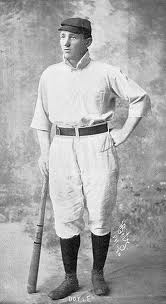
Jack Doyle

Jack Doyle

Sholta appeared in Petersburg’s “Mayor’s Court” along with two fans who said to have assaulted members of the Orioles.  All were released with no charges filed as a result of Doyle, Brodie and Kelley failing to appear—they were sought both as suspects and witnesses against the local defendants.

At the hearing, Petersburg’s Mayor Charles Fenton Collier said Sholta “had only acted as any other gentleman would have,” by hitting Jennings, and the mayor said he would have done the same “under similar circumstances.”

The Washington Times said the only thing unusual about the Orioles’ battle in Virginia was that it happened so early in the season:

“The Orioles are starting their rowdy tactics early.  Perhaps the champs think it just as necessary to train for ruffianly conduct as other points.  And to think that ‘college-bred’ Hughey Jennings started the riot.”

McGraw remained out of the lineup for most of the season—he did not return until August 25.  The fighting Orioles hit .328 as team—Jennings hit .401, Keeler .386 and Kelley .364—and went 90-39 cruising to their third straight National League Pennant.

Jackie Robinson’s “Proudest Moment”

31 Jan

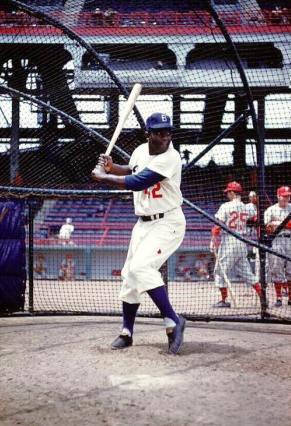
Profiles in Courage: Jackie Robinson faced nearly as much prejudice when he was named vice president of the Chock Full O’ Nuts coffee and restaurant company in 1958 as he had when he broke baseball’s color barrier.  In a 1959 syndicated newspaper column Robinson said:  “My proudest moment of all,” was a statement issued by company president  William Black:

“I cannot speak for all the stockholders of Chock Full O’ Nuts, because I now own only one-third of the company.  Speaking for my third, if anyone wants to boycott ‘Chock’ because I hired Jackie Robinson, I recommend Martinson’s Coffee, it’s just as good. As for our restaurants, there are Nedick’s, Bickford’s, and Horn and Hardart in our price range.  Try them, you may even like them better than ours.”

jackie