“Some People Think I’m Eccentric, and Maybe I am”

10 Jul

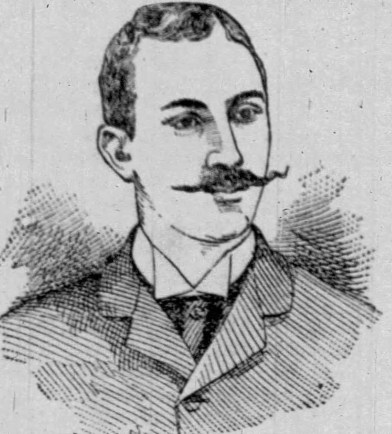
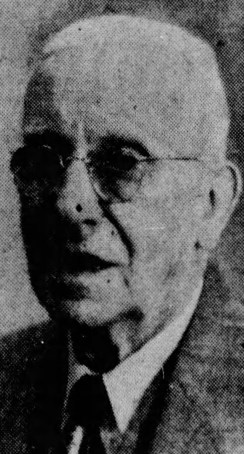
In March of 1920, Hal Chase provided a short, sometimes self-serving, eulogy for his major league career to a United Press reporter “while attending a dinner at the Ritz Carlton” in New York:

“I wanted to quit big league baseball before it quit me, I realize that I would lose out in two or three years, and I’d rather quit while I’m top of my baseball career than wait for the career to leave me flat. That is the principal reason why I am not with the Giants on their training trip.”

Chase told the reporter he was heading West:

“I want work that is more regular. I’d like to work my eight hours daily and be free after that. It must be work in which I can advance. I can’t get any higher in baseball. My old parents live in San Jose and I haven’t seen them in four years. They want to see me and I’m going out.”
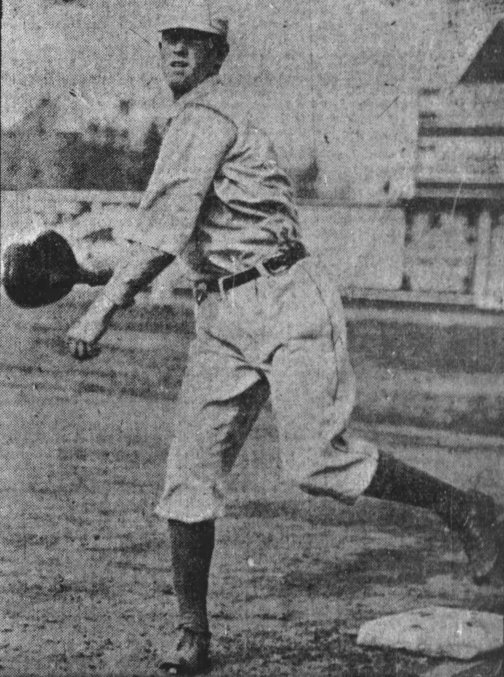
princehal.jpg

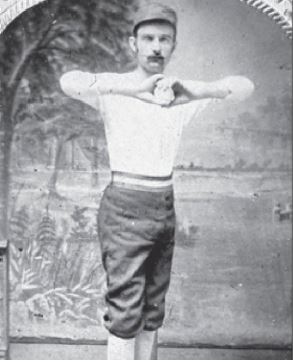
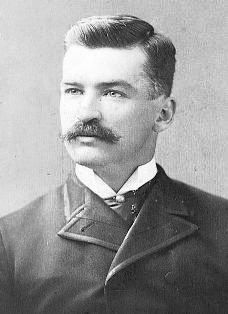
Hal Chase

Chase believed he had a future in Hollywood:

“If the film business offers me an opportunity for money-making, I’ll go into it.”

The report suggested to Chase that he might have the same impact as another recent arrival to films:

“Look how well Will Rogers, cowboy, has done.

“’That’s right,’ said Chase. ‘Say, I’d like to join hands with Rogers and put on a film comedy based on Ban Johnson. It would be a scream. I’ll bet.”

As for his baseball career coming to an end, Chase said:

“Some people think I’m eccentric, and maybe I am. However, I have no sore spots. McGraw is a fine fellow and my friend. I understand he is to put (George “High Pockets”) Kelly in my place at first base. Kelly in a regular baseball player and should make good.”

Within days of giving that interview, The New York Daily News reported that Chase was working with a theatrical agent named Thaddee Letendre–who represented several actors, including French silent film star Max Linder–and had signed a contract for Chase’s “exclusive appearance in films.”

The paper said:

“In a short while Hal probably will be the screen idol of the small boy, Letendre intends to fit Chase into the role of Frank Merriwell, whose episodes have been chronicled in novels by Burt L. Standish (pen name for author Gilbert Patton). The role of Merriwell probably will fit Chase like a glove, inasmuch as he is a versatile athlete.”

The irony of Chase playing a character Patten said he created to embody “truth, faith, justice, the triumph of right, mother, home (and) friendship,” was not mentioned in the article.

Whether it was an unsubstantiated rumor, or whether the deal fell through is unknown. But by the time Chase reached California on April 13, there was no talk of a movie contract and The Los Angeles Examiner said Chase “would like to play ball in the Pacific Coast League (PCL).”

The Seattle Star reported the next day that the Seattle Rainiers “puts in bid for services” of Chase. Team president William Klepper telegraphed the Giants offering to but Chase’s contract.

That never materialized either—The Examiner said, “apparently a hitch in the proposed deal developed;” the “hitch” was likely when revelations made by Lee Magee went public just as Chase was traveling West, that they had conspired to throw games in 1918.

The Seattle option gone; Chase joined the San Jose Bears in the Mission League He made his Mission League debut on May 2—Chase was 1 for 4 with a double and drove in both San Jose runs in a 10 to 2 loss to Monterey.

In mid-May, with San Jose 1 and 4, despite having “Prince Hal” in the lineup, Mission League officials met and attempted to ban Chase; A.J. O’Connor, director of the San Jose club told The San Jose in June, The San Jose Evening News:

“The effort is going to be made to bar Chase, but it’s not going to get anywhere. We simply will not stand for it. We are going to keep Chase for we know the fans want him.”

O’Connor told the paper the team would withdraw from the league if Chase was ruled ineligible.

On May 24, The Evening News reported:

“The (Mission League) board voted (May 23) in favor of allowing Hal Chase to continue his playing with the local club, which brought joy to the hearts of the fans all over the circuit.”

Chase celebrated the decision by hitting an RBI double—his third hit of the game–in the tenth inning to give San Jose a 4 to 3 victory over Watsonville.

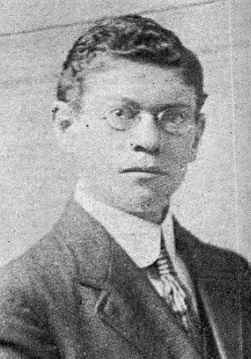
As Chase was settling into his role as Mission League drawing card, he was again making headlines in the East; Lee Magee’s case against the Chicago Cubs went to trial and Chase’s alleged role in fixing games was a key feature.
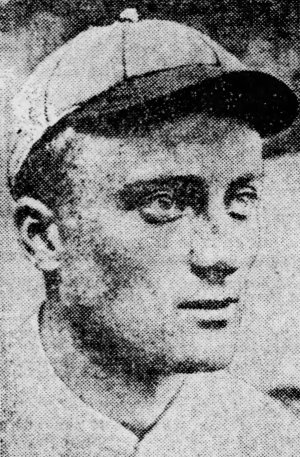
leemagee.jpg

Lee Magee

Chase told The San Jose Mercury-Herald:

“There is absolutely no truth in this statement made by Magee. I was exonerated of all charges by the national commission after it made a full investigation. I do not know what Magee did at the time of the game he mentions, but I do know that I did not place any bets and the statement is untrue from start to finish.”

Days after Magee lost his suit against the Cubs, The Mercury Herald reported “the greatest stir in baseball circles;” Chase had purchased a one-third interest in the San Jose club:

“This announcement will no doubt please the local fans as it shows what an active interest Hal has taken in baseball here and that he is out to do his share in giving San Jose real baseball and a winning team.”

Both San Jose papers reported a rumor that Chase had been in contact with former Giants teammate Heinie Zimmerman to join the San Jose team–Zimmerman never came West,

Chase made several trips to Southern California in search of players and to watch PCL games—primarily a pitcher—for San Jose. Failing to secure one, Chase took the mound for the club. On July 24, he pitched a complete game shutout against King City; he pitched again a week later, losing 4 to 1 to Watsonville.

Never far from trouble, two days after he pitched against Watsonville, Chase was in the news again. William H. McCarthy, President of the PCL barred him from all league parks after a sworn statement from Charles “Spider” Baum of the Salt Lake City Bees that Chase had approached him at the Hotel Lankersham in Los Angeles with an offer to throw a game; Baum told Chase he would likely not pitch in the series.

In response, Mission League President James J. Nealon, who had backed San Jose in its earlier effort to keep Chase, issued a statement:

“The Mission League has stood for all that is clean and wholesome and doesn’t intend to have its name smeared by such an incident as Baum relates of Chase.

“The directors of the league unite with me in declaring that Chase is barred. Whatever interest he may have in the San Jose ball club must be forfeited.”
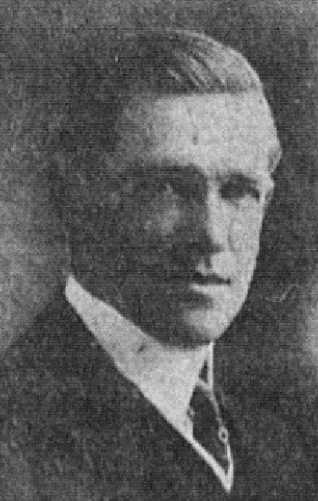
halchase

Chase, 1920

The San Jose papers which had been among his biggest cheerleaders, were split on the quick action of the Mission League. The Evening News said:

“There is no room on the San Jose club for Hal Chase. He is finished. If the club attempts to play Chase the baseball fans should absent themselves from the game. Chase wired yesterday (from the Clark Hotel in Los Angeles) that the latest charges against him were ridiculous. If these charges had been made by some player whose reputation for honesty, decency, and truthfulness was less known than Spider Baum’s we might withhold judgment for a minute.”

The Mercury-Herald countered:

“The latest accusation—that Chase actually approached a pitcher with the view of inducing him to ‘throw’ the game—is the most serious of any yet revealed, and if true should at once and forever eliminate him from the baseball field. But it should be proved, not hinted at; it should be made so clear that none shall say hereafter that the player was ‘railroaded’ out of the game, or that jealous managers anxious to get him on their teams fought over him and finally decided to put him out of the way…Otherwise the ‘fans’ will continue to idolize the player and regard him as a martyr rather than as a ‘short sport,’ which we trust he is not.”

On August 8, Chase was in uniform and on the bench when San Jose took the field against Hollister. In the third inning, San Jose was down 5 to 0, with two runners on base, when Chase was brought in in relief. Umpire Al Erle forfeited the game Hollister. The remainder of the contest was played as an exhibition game; Chase pitched the rest of the way in the 14-9 loss.

Three days later, the league directors voted 10-2 to uphold Chase’s banishment from the Mission League. Four days later, Chase was on the field—along with Harl Maggert who had been banned by the PCL—with the Madera team in the Northern San Joaquin Valley League and led Madera to an 11-0 victory over Chowchilla. The San Francisco Chronicle said:

“Chase thrilled spectators with two headlong slides to second.”

Chase and Maggert were banned from playing in the Northern San Joaquin Valley League two days later by league president J. C. Lesher who also announced that the game they participated in would be thrown out.

Chase spent the remainder of the 1920s playing semi-ball in California, Arizona, Texas, and anywhere that would have him.
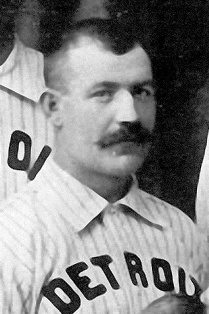
“A Perfect Infield Machine”

8 Jul

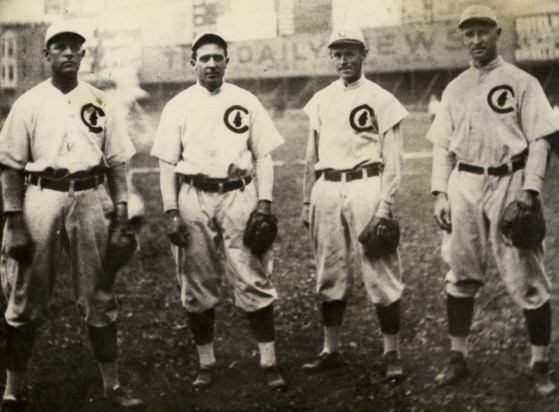
In his column in Collier’s Magazine, Grantland Rice said their was a “heated argument” among experts as to whether the current infield of the Philadelphia Athletics—Stuffy McInnes, Eddie Collins, Jack Barry, and Frank Baker—or the recently broken up infield of the Chicago Cubs—Frank Chance, Johnny Evers, Joe Tinker, and Harry Steinfeldt—was  “the greatest infield that ever played.”

Rice took the question to Dan Brouthers, who:

“(H)as been a good bit closer to ringside and who should know.

“Daniel has been on some fair infields himself…He has played on the best and has seen the others pass in parade before him year after year.”

brouthers

Brouthers

Brouthers told Rice:

“Why, a choice between Cubs and Athletics for greatest infield? They were both good and the Athletics are still in business. But neither ranks as the best—not for me when I think of that Boston infield of 1897, with Fred Tenney at first, Bobby Lowe at second, Herman Long at short, and Jimmy Collins at third.”

Brouthers said the Beaneaters infield was:

“(T)he best combination of batting and fielding power, brains, speed, and smoothness. It has them all beaten, and I doubt if its equal will ever be gathered together again. There wasn’t an angle of the game at which they were not stars. They may have no more power than the Athletics four and but little more smoothness than the Cubs, but in the combination of all things that go to make up a perfect infield machine they must be set out in front of the others with something to spare.”

Brouthers said of the question of whether the Chicago or Philadelphia infield was better:

tecs.jpg

Steinfeldt, Tinker, Evers, and Chance

“As between the old Cub infield, now scattered to the eternal winds, and the Athletics quartet, the former was a smoother-running machine, but it lacked the crushing wallop which has always graced the Mackian avalanche. One had the edge in alertness, the other leads with the punch. Between these rival qualities the competition in the way of supremacy is still a matter for open debate.”


Lost Advertisements: An Interview with Lajoie

5 Jul

nap.jpg

“This superb ball player was almost lost to the game. He tells the public how he saved himself this spring.”

A 1903 advertisement for Father John’s Medicine. The ad said that Lajoie, “the best paid and greatest ball player in the world,” had been thrown “into an illness which lasted all winter and spring, after the 1902 season. Lajoie said:

“During my illness I did not begin to improve till I took Father John’s Medicine. It quickly built up my body to its former strength and made me active as at any time in my career. Now I carry a bottle of the medicine with me on the trips with my club and it keeps me well all the time.”

Lajoie, a popular endorser of patent medicines, and back to his “former strength” won his third consecutive batting title in 1903.


“I was Pretty Fast in Those Days”

3 Jul

“We did everything 30 years ago they do today, with the possible exception of sacrificing. Little of that was done, and I consider the game was better.”

So said “The hero of the first unassisted triple play in baseball,” to a reporter for The Pittsburgh Press in 1913:

“Holding a good position in the department of agriculture, Washington D.C., is a blonde individual of comfortable corpulence who answers to the name Paul A. Hines.”

Later, The Associated Press would say he got the government position because he, “became a favorite of Rep. William McKinley, who later became president, and when Hines retired from Baseball McKinley found a government job for him.”

The Press described Hines, who would turn 58 that year, as:

“Well preserved, genial a comfortable looking businessman (who) little resembles the dashing outfielder of three decades ago.”

He told the paper that Charlie Buffinton, Tim Keefe, and Old Hoss Radbourn where the greatest pitchers he saw. He said Ned Williamson was the greatest player he witnessed, and that Silver Flint was “the most banged up and best catcher that ever lived.”

Hines also gave the paper a first-hand account of his most famous moment:

“It was made May 8, 1878. I was playing a deep center field and there were runners on second and third when a short fly was hit over the second base.

“I ran in after the ball, believing I had the speed to reach it, for I was pretty fast in those days. Both base runners thought the ball would fall safe and ran for the plate.

“I got the ball off my instep, near second, touched the base and then ran to third, reaching that base before the runner who had occupied it could return, thus completing the play.

“The play has been questioned, but I see that Umpire (Charles F.) Daniels, who worked that day vouched for it recently.”

Daniels’ version of the play differed from Hines’ however, as did the contemporary accounts of the play; even Hines told a different version that year in the October issue of “Baseball Magazine”—none of those versions included the part where Hines claimed to have touched second base before going to third base.

The other versions said he threw to second baseman Charlie Sweasy, but that the throw was unneeded because both runners had rounded third and had been retired. The only version that matched Hines’ The Pittsburgh Press recollection was William Wrothe Aulick’s description of the play that appeared in a syndicated article that eventually became part of the book “The National Game,” published in 1912

grays.jpg

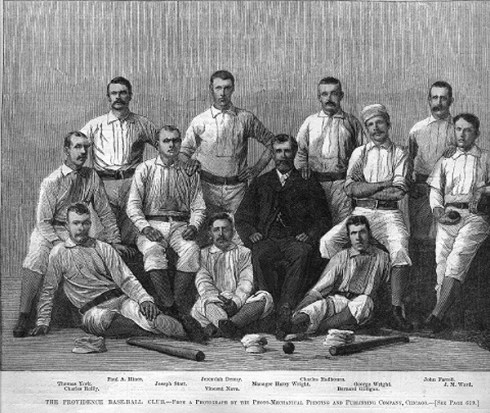
Hines, standing at left, with Providence Grays, 1882

In Hines’ “Baseball Magazine” version–in addition to getting the date wrong, he said May 15, rather than May 8–he claimed he went to second and stepped on the bag after stepping on third, then:

“Sweeney [sic], our second baseman, took the ball and danced around with it, cutting up monkey shines.”

Hines told the The Press that after he completed the play:

“Of course, I remember distinctly how the crowd, when it realized what had happened, went wild. It was one of the proudest moments in the life of Paul Hines, I tell you.”

Hines likely had one of his worst moment years later; he was arrested when caught stealing a pocketbook from a policewoman at the corner of Ninth Street and New York Avenue.

hines.jpg

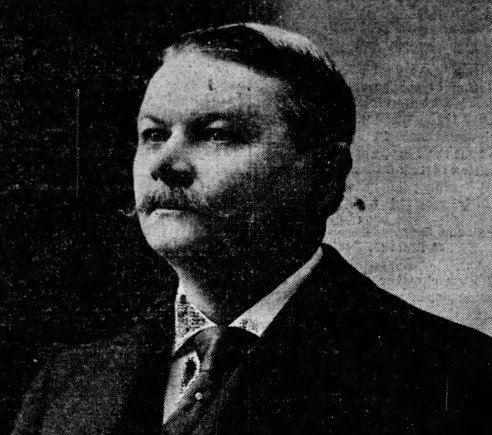
Hines circa 1900

The Washington Evening Times said:

“The gray-haired man has been under surveillance for some time. When his room was searched at 233 Rhode Island Avenue, a number of purses and pocketbooks were found in it, as well as twenty-five pairs of eyeglasses and spectacles.”

The Washington Star said Hines was released on $1000 bond, and:

“According to the police, Hines, who is 69 years old, when confronted with the charge broke down and said: ‘I have played my last game and lost.’”

Hines, almost completely deaf—his longest obituary, written by Guy M. Smith, who wrote for The Sporting News, and knew Hines, said the deafness was the result of a beaning by Grasshopper Jim Whitney in 1886—and destitute spent the last years of his life at the Sacred Heart Home in Hyattsville, Maryland, he died there in 1935.

Things I Learned on the way to Looking up Other Things #35

1 Jul

Comiskey versus Anson

In 1888, Ren Mulford, writing in the Cincinnati Times-Star compared Charlie Comiskey to Cap Anson:

Charles Comiskey

Charles Comiskey

“Charlie Comiskey, who for several years has successfully piloted the St. Louis Browns to victory, possesses many of the characteristics which made Anson famous. He teaches his men to sacrifice everything in order to advance the interests of the club, but unlike Anson he never humiliates his men on the field. When it is necessary to reprimand any of them for an error or misconduct, he does it quietly. He uses good judgment in picking up players but lacks patience in developing the men.”

Latham on Comiskey

Arlie Latham and Charles Comiskey were together with the St. Louis Brown from 1883-1889, and Latham jumped the Browns to join the Players League with Comiskey in 1890, helping to form the Chicago Pirates–“The greatest team ever organized.” But from the beginning the team was beset with discipline issues and struggled.

lathampix

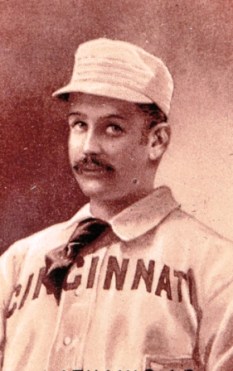
 Latham

Comiskey benched Latham, who was hitting just .229, in July.  The Chicago Tribune said several attempts were made to trade Latham, and when nothing materialized, he requested to be released and he was on July 29.

Latham returned to the National League, joining the Cincinnati Reds, then aired out his grievances with his former boss and friend when he was with the Reds in Boston in August. The Boston Globe’s Time Murnane said Latham was at the United States Hotel talking to members of the Pittsburgh Burghers who were in town playing Boston’s Brotherhood club:

“Some of Pittsburgh’s Players League boys were anxious to know why Latham was released from Chicago.

“’Comiskey did it,’ was his answer. ‘He has been after me for some time, and said I was playing crooked ball. I was laid off in St. Louis last season for the same thing, but this year Commie was cross and ugly all the time.’

“’You see, he has plenty of money and can afford to be stiff. I dropped three short fly balls in the last game I played in Chicago and Comiskey came and told me that he was on to me and would stand it no longer.’

“’I asked for my release and got it that night. My arm was very sore, but the other men would not believe it. I wanted to stay in the Players’ League and sent word to Al Johnson (owner of the Cleveland Infants) saying I was open for engagement.’”

Latham alleged that Comiskey or someone connected with the Chicago club had a role in blackballing him from the league:

“’I heard from (Johnson) once and then he stopped. I suppose the Chicago people interfered.’”

The Chicago Tribune said Latham actually received an offer from Cleveland but joined the Reds when they offered more money.

Murnane said when Latham arrived in Cincinnati, in an attempt to “get some good work out of the ‘Dude,’” that Reds manager Tom Loftus made him captain:

“(Latham) has been known for years as one who could keep the boys all on the smile while he shirked fast grounders.”

But Murnane claimed he had already worn out his welcome with some of the Reds:

“Since Latham’s release by Chicago he has taken pains to run down the Players’ League until the members of that organization have soured on him (two days earlier) he went out of his way to abuse the Brotherhood, and the result is that he is already getting himself disliked by several level-headed members of his own team.”

Latham stayed with the Reds with five seasons, and Comiskey again became his manager from 1892-1894.

Blame it on Hulbert

After winning the inaugural National League pennant in 1876 with a 52-14 record, expectations were high for the Chicago White Stockings in 1877.

hulbert

Hulbert

After a 26-33 fifth place finish, The Chicago Evening Post said the blame rested in one place:

“There are a great many men in America who do not know how to run a ball club, and Mr. (William) Hulbert, President of the Chicago club, appears to be one of the most conspicuous. The public is familiar with the fact that this year’s White Stocking Nine was more of a disgrace to the city than a credit and there was a considerable wonderment as to why a nine that in 1876 swept everything before it, was in 1877, obliged to content itself with the last place in the championship struggle [sic, Chicago finished fifth in the six-team league).

“From all that can be learned, it would seem that part of the season’s ill success should be attributed to the manner in which the men have been treated by Mr. Hulbert. There are complaints that he was continually finding fault, until the men became discouraged and lost heart in their work. Just how true this is The Post does not propose to determine, but simply gives publicity to a letter from Mr. Hulbert to Paul Hines, in which he distinctly charges Hines with not trying to play.”

According to The Chicago Tribune, the letter, sent in July, suggested that Hines was not “playing half as well,” in 1877 as he had the previous season—Hines’ average dropped from .331 to .280.

The Post said the letter showed how little Hulbert knew:

“To those who have attended the games this season this charge will bring a smile, as Hines is notoriously one of the hardest working and most reliable ballplayers in the country.”

The White Stockings finished fourth the following two seasons, but won back-to back pennants in 1880 and ’81, the final two before Hulbert’s death in April of 1882—the White Stockings won their third straight pennant that year.

Lost Pictures: Griffith Dedicates Radbourn Memorial

28 Jun


griffithpadbourn41.jpg

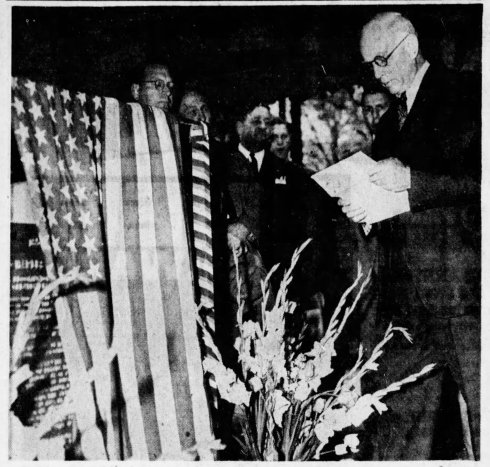
Clark Griffith dedicating the Charles “Old Hoss” Radbourn plaque at Bloomington (IL) Cemetery, May 1, 1941.

Griffith told a reporter for The Associated Press:

“It’s been 20 years since I’ve been back where I spent part of my boyhood. I lived in Normal (the town separated by only a street from Bloomington from my seventeenth to twenty-first year and it was Ol’ Hoss who taught me the first rules of pitching.”

Griffith said of Radbourn:

“He was a husky, durable fellow, but to watch him was to be impressed by his keen pitching brain rather than by his strength. I pitched against him in several town games and was always amazed with the way he worked on tough hitters seldom giving them the kind of pitch they liked.”

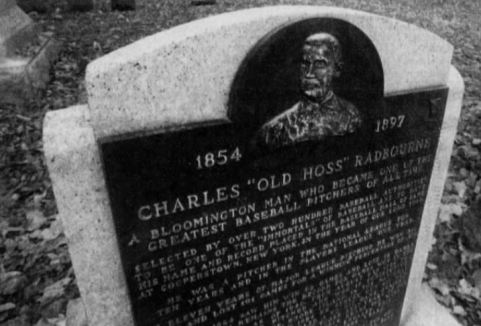
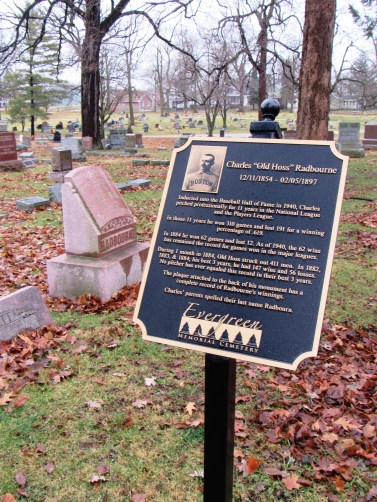
The plaque, which like Radbourn’s grave and Hall of Fame plaque, spells his name with an “e” at the end. The one  dedicated by Griffith was apparently replaced–either because the original was damaged or stolen–by a nearly identical version. When Griffith died in 1955, The Bloomington Pantagraph said the original plaque was still place–however, several articles in the paper after the Bloomington City Cemetery and the Evergreen Cemetery were combined in 1963 said the plaque was “put there by Pontiac Correctional Center inmates” sometime after 1955. None of the 1941 stories mentioned the origin of the plaque.

radbournplaque

The plaque 


rad.jpg

The current grave site photographed before the dedication of the new wood carving made from the trunk of a dead 150 year-old tree adjacent to Radbourn’s grave.

Weyhing’s “Malicious Mischief”

26 Jun

In 1900, The Brooklyn Eagle used the example of pitcher Gus Weyhing running afoul of a New York brewery by vandalizing the ceiling fresco as an example of how in the “old days” when baseball was “in its prime,” such incidents were covered up.

The incident was actually covered quite extensively in the press and resulted in an elaborate practical joke played on Weyhing—which received extensive coverage as well—and the prank caused Weyhing more trouble.

weyhing1890s.jpg

Weyhing

Shortly after the end of the 1890 season—on October 10–Weyhing, who led Wards Wonders to a second-place finish in the Players League—winning 30 games—was with several friends at the Piel Brothers Brewery on Sheffield Avenue in Brooklyn.

The Brooklyn Times said Weyhing engaged in “malicious mischief,” at the brewery.

The Pittsburgh Post described the “mischief,” after Weyhing and his party:

“(W)ere served with numerous sandwiches and plenty of beer. In the course of time they became very frolicsome. Weyhing took several slices of bread, which he plastered over with thick coatings of butter and mustard. Then he bet that he could make them stick to the ceiling.”

According to the paper, Weyhing was successful and:

“One slice covered the nose of a frescoes figure of King Gambrinus. Another covered over his glass of foaming beer, and another hit his Schuetzen Corps medal. Weyhing and his friends laughed boisterously at the joke, and then departed.”

The Times said Piel’s Brewery had become “a favorite resort for Captain Johnny Ward’s ball players ever since the opening on the Players’ League ballpark.”

Weyhing had been there that day with “a half dozen of his brother leaguers” and “a well-known official under the local government.”

The Brooklyn Eagle said Brooklyn catcher Tom Kinslow had been present “and thought it a huge joke.”

And, said The Eagle, it was Kinslow who was behind a prank played on Weyhing:

Kinslow, accompanied by a detective friend, approached Weyhing at another bar. Weyhing was “served” by the detective with the fake subpoena and Kinslow and the other members of the party told him they had been served as well:

“’You’ve got us all in a nice box,’ said Kinslow.”

The detective told Weyhing he was being placed under arrest. Weyhing said he could not go to jail and his friends suggested he go see a friend at a bar “on the corner of Atlantic and Alabama Avenues” in Brooklyn to borrow bail money.

The pitcher, accompanied by the detective and Kinslow went to the bar; there all the other members of the original party were gathered and suggested that they summon a former judge to help Weyhing—he appeared along with another friend of the group who worked for the district attorney:

“The (attorney) began to score the pitcher for the trouble he had got them into and talked to him for fully half an hour.

“Poor Weyhing sat at a table, with his head in his hands, and said not a word while the (attorney) was talking. Then he raised his face and said in a husky voice:

“’I’ll pay whatever damage was done, for heaven’s sake, let up.’” But he wouldn’t let up. He took particular pains to let Mr. Weyhing know that the punishment for his crime was a year’s imprisonment in the penitentiary.”

The Eagle said “the fun continued” until Weyhing “was about $10 poorer” buying drinks to calm everyone’s nerves—at that point he was told it was joke:

“Unfortunately for Mr. Weyhing some outsider enjoyed the joke and quietly related the proceedings to Mr. Piel. Thus it was that the warrant was procured for Weyhing’s arrest.”

With a real warrant issued, he left town and spent the winter at home in Louisville.

Weyhing had jumped the Philadelphia Athletics to join Brooklyn in 1890 and was returned to the American Association club for the 1891 season.

On April 22, he was on board the New Haven Railroad traveling from Boston to Washington. A New York police officer:

“Received word that the train on which Weyhing was a passenger would reach the New Haven depot, on the Harlem.”

He was taken into custody and “occupied a cell” in the tenth precinct jail for several hours.

The Eagle said, Weyhing appeared before judge, “refused to make a statement,” and a “well known sporting man” posted $500 bail.

At this point, it appears the dispute was settled with no further legal action. The Citizen said the case was being presented to a grand jury, but there is no record of an indictment or any further legal proceeding in the case, so The Eagle’s statement, ten years later, was partially true it appears. The incident itself was not swept under the rug and received extensive coverage, but once he posted bail, there were no public consequences for Weyhing.

He had one more bizarre brush with the law the following season. Weyhing, along with his former teammate Lave Cross, collected and bred pigeons. The Boston Post said:

“(They) are pigeon fanciers. They have great collections of fantails, carriers, and pouters, and exhibit at many shows.”

The Louisville Courier-Journal said Weyhing was attending a pigeon show when he was found to have in his possession “two very fine Blondinottes, valued at $50 each.” The paper said Weyhing had the birds in a basket with his other pigeons as he was leaving the show.

Weyhing was taken to a jail in Louisville where he initially “gave his name as William Joyce,” and was charged with grand larceny.

The Philadelphia Times said of Weyhing, who won 31 games for the Athletics in the final season of the American Association, and would pitch for the Phillies in the National League in 1892, said of the arrest:

“Weyhing has a weakness for fine pigeons…It does not however, seem possible that a man in Weyhing’s position, and with such an income as he enjoys, would be guilty of such a deed over a couple of birds. Weyhing has in the past been in trouble through indiscretion, but nothing more serious than conviviality, and consequent excess, was ever charged against him.”

The Philadelphia paper said it would be “a hard blow” to to the Phillies if he were found guilty, but if he was “the club, of course, could not afford to keep him.”

He was held for trial and appeared in court on January 30. The Courier-Journal said:

“Weyhing was acquitted of the pigeon-stealing charge in the City Court. The prosecuting witness was absent, but judge Thompson heard other witnesses and honorably discharged Weyhing.”

Weyhing won 32 games for the Phillies in 1892, and appears to have stayed out of trouble for the remainder of his life.

He worked as a doorman at a theater and night watchman at the Louisville Water Company. He died in 1955.

weyhing2

Weyhing 1950s

The Courier-Journal said in his obituary:

“He had never known a sore arm during his 15 years of top-flight pitching.”

“Low ebb of Baseball”

24 Jun

Shortly before the American League’s inaugural season in 1901, The Brooklyn Eagle—likely long-time sports editor Abe Yager–asked:

“What has been the cause for the current low ebb of baseball?”

yager

Abe Yager

The paper said some suggested the “squabbling and bickering” among team owners and “the efforts of the National League to keep the game to itself,” as possible reasons.

No, said The Eagle, it was clear who was responsible for the latest concern that baseball would no longer maintain its popularity:

“The players themselves, however, are the principal offenders.”

The paper reasoned that during “the halcyon days of the 80s, when baseball was in its prime” players were spoiled.

“In those days the hired man was a popular idol, the public looking up at him as a little god to be worshipped. He was wined and dined, all his peccadillos were looked upon as the eccentricities of the great, and when he got into trouble with the minions of the law everybody hastened to help him, and the matter was hushed up as much as possible.”

The paper cited examples of how players had been treated in the past:

“Gus Weyhing, ten years ago, threw a sandwich against a valuable ceiling in an East New York brewery, causing damage to the extent of several hundred dollars. The proprietor of the place brought suit against Weyhing, but the case was hushed up and the player was set free.”

weyhing.JPG

Gus Weyhing

Then there was Mike “King” Kelly:

“When Boston paid $10,000 to the Chicago club for his release (in 1887), the world stood aghast that such a price be paid for a ball player, and the Bostonians fell on their knees and worshipped him…the adulation showered upon him stopped only at the presentation of a house and lot and a carriage and pair.”

kingkelly

 “King” Kelly

And in Brooklyn the was the case of Bob Caruthers. When his contract was purchased from the St. Louis Browns before the 1888 season:

“(Caruthers) was the observed of all observers when he arrived here. Brooklynites jostled each other in their efforts to form his acquaintance. He was introduced into many clubs and everything was done to make his stay here pleasant. Bobby had an ungovernable temper when things failed to go his way. This was especially the case when he was playing cards, and he was known frequently to tear up entire decks and throw them about the room. But this was taken as a peculiarity of a great man and nothing was said.”

caruthers

Bob Caruthers

The deal whereby players were put on a pedestal; their bad acts were covered up, and in turn didn’t agitate about how they were treated were this version of “the good old days” when baseball was not in decline. But now:

“Since the ‘brotherhood’ war…The players have gradually but fully fallen from the pedestals and are no longer idols in the in the eyes of the public. Their objections to being bought and sold on the plea that they are slaves, their rowdyism on and off the ballfield, frequent barroom fights and cases of intoxication which are now made much of.”

And the fault was only with the players:

“(T)he squabbling over salaries, their rush to the public print whenever they have real or fancied grievances.”

Complaining about salaries, fighting over the reserve clause, it was reasoned, had “pulled the scales from the eyes of the baseball loving people.”

Not the magnates, the players, were responsible for the inevitable demise of the game, and for baseball being eclipsed by sports that:

“(H)ave not he appearance of being business enterprises. And the players wonder why they play before empty benches.”

Despite the latest prediction that baseball’s best days were in the past, the benches filled up at a higher rate in 1901 than 1900; even with attendance declines in National League cities with new American League competition, league-wide the attendance increased by nearly 100,000. Brooklyn attendance jumped from 183,000 to 198,200.

Lost Advertisements: Lil Stoner for Mail Pouch

21 Jun

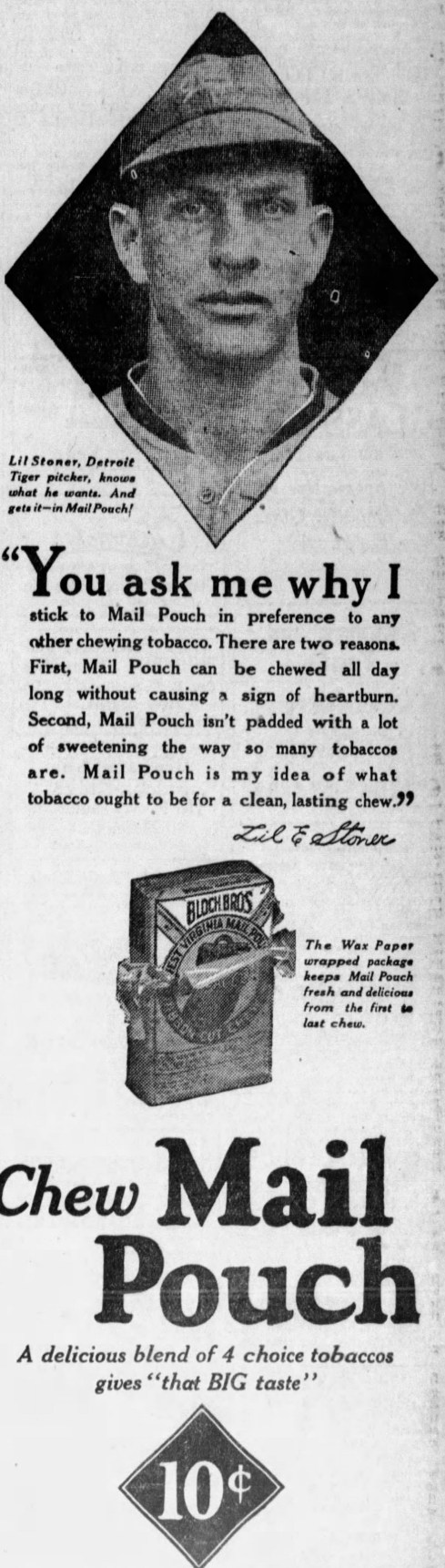
stoner

A 1928 advertisement for Mail Pouch Tobacco featuring Detroit Tigers pitcher Ulysses Simpson Grant “Lil” Stoner:

“Mail Pouch can be chewed all day long without causing a sign of heartburn.”

The following season–Stoner’s final with the Tigers–The Detroit Free Press determined that the pitcher was “jinx” for certain teammates:

“It shall be the fate of those who room with Lil Stoner to trek back over the trail of the minors.”

The paper said “nothing can save,” the players fated to have roomed with Stoner during his time with Detroit:

“King ‘Jinx’ speaks and his word is law. To be a ‘roomie’ of Stoner voluntarily is the next thing to suicide.”

The Free Press said the most recent victim of the  “jinx” was Al “Red” Wingo, who was sold to the San Francisco Seals after rooming with Stoner in 1928:

“Before ‘Red’ were (Johnny) Bassler, (Josh) Billings, (Jess) Doyle, (Clyde) Barfoot, (Les) Burke, and Rufus Clark.”

Bassler was released and joined the Hollywood Stars in the Pacific Coast League (PCL) after rooming with Stoner in 1927. Billings was sent to Reading Keytones in the American Association while rooming with Stoner in 1927. Stoner and Doyle were also roommates in 1927 when the latter was sent to the Toronto Maple Leafs in the International League, Barfoot suffered the same fate in 1926–he was released by the Tigers while rooming with Stoner and joined the Mission Bells in the PCL; Stoner’s final roommate in 1926 was Burke, who was released after the season and went to Toronto.  Clark roomed with Stoner in 1924 before being released to the Birmingham Barons in the Southern Association.

The paper suggested:

“Were Babe Ruth a roommate of Stoner he would contrive some way to break his neck. The jinx is more certain than death and taxes, and the only way to stop it is to shoot Stoner or lose him in the desert.”

The solution, according to The Free Press was to room Stoner with coach George McBride for the 1929 season because “George is going to remain.”

It was Stoner who finally succumbed to the “jinx” in 1929, after posting a 3-3 record and 5.29 ERA and finished the season with the Fort Worth Panthers in the Texas League

“Several Thousands of Dollars Were Staked”

19 Jun

After the first game of the 1887 post season series between the American Association champion Browns and the National League champion Detroit Wolverines—won by St. Louis 6 to 1–The St. Louis Post-Dispatch found that the various options to bet on game two and the series “at the local pool rooms” was “exciting, and some of it was quite humorous.

The paper said before game one the “betting was 100 to 65 that Detroit would win the series and now the betting s even.”

The betting odds on game two were “10 to 9 on the Browns,” and said the paper “several thousands of dollars were staked.”

Most interesting, said the paper were the “peculiar bets” offered:

(Ten to win 30) that Bob Caruthers makes most hits in the game today

10—50 that Bill Gleason makes most hits

1-1 that Caruthers, Tip O’Neill, and Arlie Latham make more hits than Sam Thompson, Fred Dunlap, and Hardy Richardson

1—1 that O’Neill makes more hits than Thompson

4—1 that Thompson does not make the most hits

10—5 that Richardson does not make the most hits in game

10—5 that Dunlap does not make the most hits

10—5 that Latham does not

1—1 that Curt Welch, Charles Comiskey, and Latham steal at least one base

The paper also said the odds on that day’s game were “10—9 against Detroit.”

The Wolverines won game two, 5 to 3, and won the series 10 games to 5.

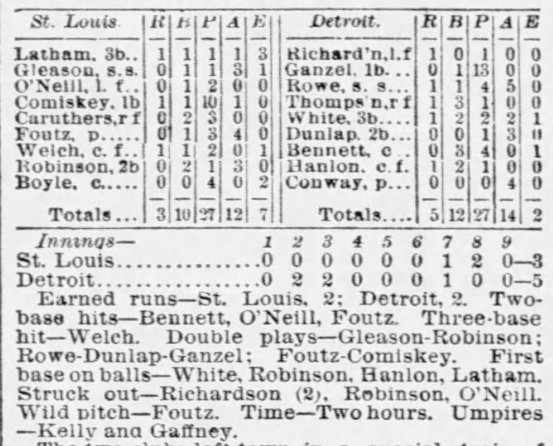
1887game2

The game two box score

As for the “peculiar bets” on game two: Detroit’s Charlie Bennett and Sam Thompson each led with three hits.  Latham, O’Neill, and Carruthers had four hits, Thompson, Dunlap, and Richardson had three.

thompson

Sam Thompson

Thompson had three hits to O’Neill’s one, and while Comiskey and Latham each stole a base, Welch did not.