Things I Learned on the way to Looking up Other Things–Quote Edition

12 Oct

When you spend hours pouring over microfilm and web based newspaper archives you find something every day that is interesting but not enough for a standalone post—these are random quotes and observations that follow no theme or thread, I just think they should not be lost to the mists of time.

Cy Young was asked by The Cleveland News in 1909 if there would ever be a successful ambidextrous pitcher in the major leagues:

“Elton Chamberlain, who was with Cleveland in the early 90s, essayed to perform this feat occasionally, but about all he had with his left arm was a small amount of speed and a straight ball. The way pitchers have to work nowadays a man who can use one rm and use it effectively is quite a man as pitching goes.”

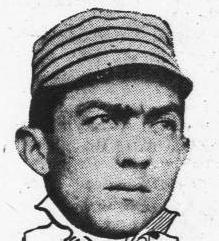
chamb

Elton Chamberlain

In 1909, Time Murnane noted in The Boston Globe that Billy Sunday, as an evangelist was earning more than 10 times what the “highest-paid men” in baseball were making. Of Sunday’s ability he said:

“No doubt Mr. Sunday is a very good evangelist, much better it is hoped than he ever was as a ballplayer. Mr. Sunday was a fast runner. That marked his limit as a baseball star. He could not hit or field or throw well enough to make it worthwhile talking about.”

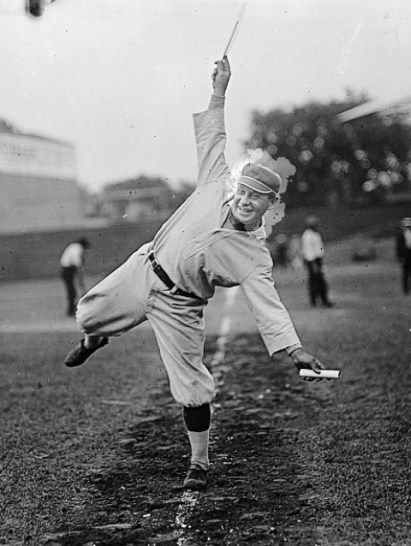
billysunday2

Billy Sunday, evangelist

In 1946, Grantland Rice of The New York Herald Tribune asked Connie Mack during a discussion of Bob Feller which pitcher he felt had the “greatest combination of speed and curves,” of all time:

“He hesitated less than two seconds. ‘Rube Waddell,’ he said. ‘The Rube was about as fast as Feller, not quite as fast as (Walter) Johnson. But the Rube had one of the deepest, fastest-breaking curves I’ve ever seen. Johnson’s curve ball was unimportant. Feller isn’t as fast as Johnson but he has a far better curve ball.’”

Mack did, however, concede:

“’Feller and Johnson were far more dependable than the Rube who now and then was off fishing or tending bar when I needed him badly.’”

rube

Rube

In 1916, in his nationally syndicated American League umpire Billy Evans asked Napoleon Lajoie about the best pitchers he faced:

“I never faced a wiser twirler than Chief Bender…he made a study of the art. If a batter had a weakness, the Chief soon discovered it, and from that time he made life miserable for that particular batsman. His almost uncanny control made it possible for him to put into execution the knowledge he would gain of the batter’s weakness. I know of a certain big league player, and he was a good one, who would request that he be taken out of the game any time Bender worked…Best of all, he had the heart of an oak and in a pinch always seemed to do his best work.”

chiefbender

Chief Bender

In 1907, the Washington Senators hired Pongo Joe Cantillon to manage the team, Ted Sullivan, “the man who discovered Comiskey,” was never shy about taking credit for an idea, and told The Washington Star:

“As I was instrumental in enticing Cantillon to come to Washington I know the salary that was offered, and I saw the contract. It was nearly twice the salary of a United States Senator, and there is not a bench manager today in the eastern country that is getting one-half the salary of Cantillon. The Washington management has corrected all the errors of the past in getting a baseball pilot who knows all the bends and shallows in the baseball river.”

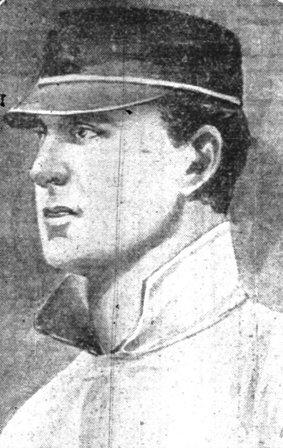
pongo

Pongo Joe

Despite the money, and Cantillon’s knowledge of the “bends and shallows,” the Senators finished 8th twice and 7th once during Cantillon’s three seasons in Washington, he had a 158-297 record during his only stint as a big league manager.

Home Field Advantage

10 Oct

William Lape had a brief minor league career; in 1911 he spent his first season in pro baseball playing in the Southwest Texas League, a “D”  league with clubs in Bay City, Beeville, Brownsville, Corpus Christi, Laredo, and Victoria—Lape split the season between Victoria and Brownsville.

Texas was a bit of a culture shock for Lape, who was born in Irvin, Pennsylvania on June 11, 1888, and raised in Ohio.

When he returned to Ohio in the fall—the league, formed in 1910, folded after the 1911 season—Lape explained to The Dayton Herald that all of the umpires in Texas were “homers,” and why:

“They have to be or some of the ranchers who tote six-shooters around with them all the time would take a crack at them.  It comes a little hard to the northern players when they first go down there because they are looking for an even break on the road.  They soon get over that idea, however.  Every close play goes to the home team.

“The ranchers line up along the bleacher fence when the game gets close and every once in awhile some of them will waive their gun at the umpire just as a warning as to what might follow if he handed the home team the worst of it.  I’ve seen several games stopped for 15 or 20 minutes while the ranchers swarmed on the diamond and argued with the umpire”

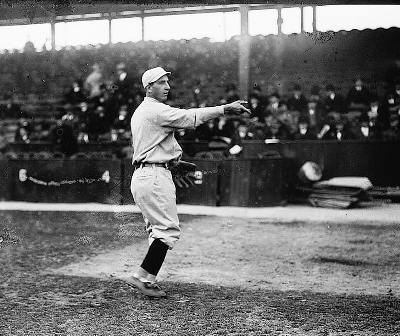
lape.jpg

William Lape

The league, which played two-half seasons, with a championship series at the end, was in such poor financial straights at the close of the second half that first half champions Bay City declined to participate in a playoff.

Lape said during the 1910 playoff series between Brownsville and Victoria:

 “(T)here was a riot at every game.  Men fought each other in the grand stand and women cried and wrung their hands like an awful calamity was being enacted. I understand quite a few Texans are carrying lead around in their systems yet as a result of that series.”

While Lape said he enjoyed playing in Texas and that it could be lucrative, “I got $16 once for pulling off a steal of second and third that put us in the way of scoring the winning run,” he spent the rest of his career playing with professional and semi-pro clubs in Michigan and Ohio.

He died in Miami, Florida, July 28, 1973.

“O’Brien…Felt Like Dropping Dead”

8 Oct

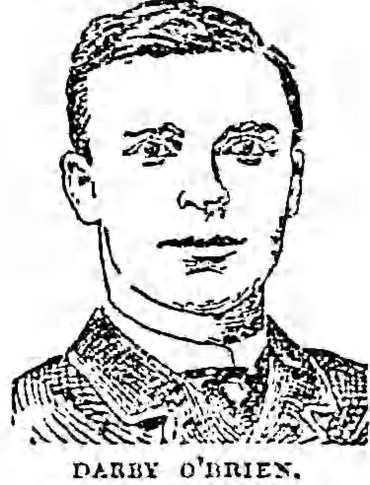
Darby O’Brien was a rookie and Charley Jones was near the end of his 12-year career  when the two were teammates with the New York Metropolitans in 1887; his friendship with Jones gone sideways made O’Brien a brief sensation on the police blotter.

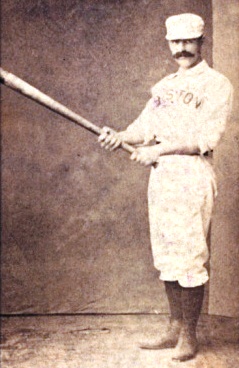
darby.jpg

O’Brien was playing for the Brooklyn Bridegrooms the following season when, on July 21 he was arrested along with teammate Jack Burdock were arrested when leaving Brooklyn’s Washington Park after a game.

The troubled Burdock, who battled alcoholism, was arrested for assault for attempting to kiss a 17-year-old stationary store employee the previous year, while, as The New York Sun said he “was under the influence of liquor,”  Burdock was acquitted later that year when the victim failed to appear to testify against him.

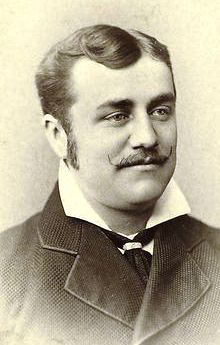
burdock

Jack Burdock

Burdock being in trouble was not news, but said The Sun:

“(O’Brien) is one of the steadiest men in the ball business and, consequently felt like dropping dead when (New York Detective)  McGrath told him he was wanted for larceny.”

O’Brien’s alleged crime?  The Brooklyn Eagle said:

“The charge against O’Brien is made by Mrs. Louisa Jones, wife of Charles W. Jones, formerly left fielder of the Kansas City nine, and is that he stole her dog.”

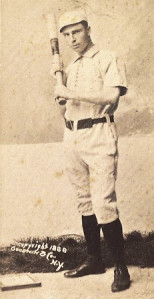
charleyjonespix

Charley Jones

According to Mrs. Jones, O’Brien had given her the dog, “a small pug,” to take care of after the 1887 season and subsequently “presented the dog to her.”  Mrs. Jones said O’Brien later returned to the Staten Island hotel where the Jones’ lived and stole the dog.  The New York World said he “snatched the dog out of her lap,” at the hotel and ran to a train to escape.

After O’Brien was released on “the promise of (Brooklyn owner Charlie) Byrne” that O’Brien would appear in court on July 23, he spoke to a reporter from The Eagle:

“Mrs. Jones story is untrue.  I did not give her the dog nor did I snatch it from her lap, as was reported in a morning paper.  I was stopping at the Nautilus Hotel when she and Jones came there to live.  I got the dog from (catcher Bill) Holbert.  She was a beauty and is Beauty by name.  Mr. Holbert raised her from a pup and I was too fond of her to part with her.  Mrs. Jones admired her very much.  I declined to give her Beauty, but did promise her one the next litter.  That was only to keep her quiet.  She annoyed me very much.  She got square, however, for when I was preparing to go West (after the 1887 season) she and Jones bolted and took the dog with them.  I got Beauty back.”

O’Brien failed to say how he “got Beauty back.”  The Eagle said Holbert backed up his statement.

The World described the scene when O’Brien returned to face the charges:

“Justice Massey, of Brooklyn, was a half hour tardy in his arrival at the courtroom this morning and he found the chamber packed full of people  .

“There were baseball players, baseball enthusiasts and patrons of the national game.  There were a couple of hundred of the youth of the City of Churches, and there as many of the pretty girls for which Brooklyn is famous.”

Both O’Brien and Burdock were in court that morning, but the paper said:

“Darby received most attention, for he is one of the Brooklyn boys who doesn’t pose as a bridegroom.”

In addition to Byrne and Holbert, the New York papers said O’Brien’s Brooklyn teammates Al Mays and Bill McClellan were there for support.

The case was continued and the potential baseball/dog trial of the century was scheduled for September 5, 1888, but ended with a whimper.  The Evening World said:

“Not only is the Brooklyn baseball team in third place in the Association today, but it’s members are at last all out of court.

“Darby O’Brien’s dog case came before Justice Massey this morning and the popular left fielder was promptly on hand to show that he didn’t steal Mrs. Jones’ canine.  He was spared the pains, however, for a note came from the Staten Island complainant in which she declared that she would not press the complaint

“Darby was therefore discharged.”

Unfortunately, the dog did not make it to the trial, O’Brien told The Eagle that in July “(Beauty) had a fit on Sixth Avenue and died.”

O’Brien played with Brooklyn through 1892, became ill with tuberculosis and died in his hometown of Peoria, Illinois in 1893, he was 29.

dob (1).jpg

O’Brien

When word reached Byrne that O’Brien had died, he told The Eagle:

“Darby was a typical, humorous, quick witted young Irishman, handsome and clever.  He was like a good sailor.  He had a sweetheart in every city the team visited.  He was generous to a fault.  His purse was open to everyone and he never called for an accounting.  He was, without exception, in the full sense of the word, the most popular ballplayer in the country—not for his phenomenal ability or his brilliant work, but for his happy go lucky manner.”

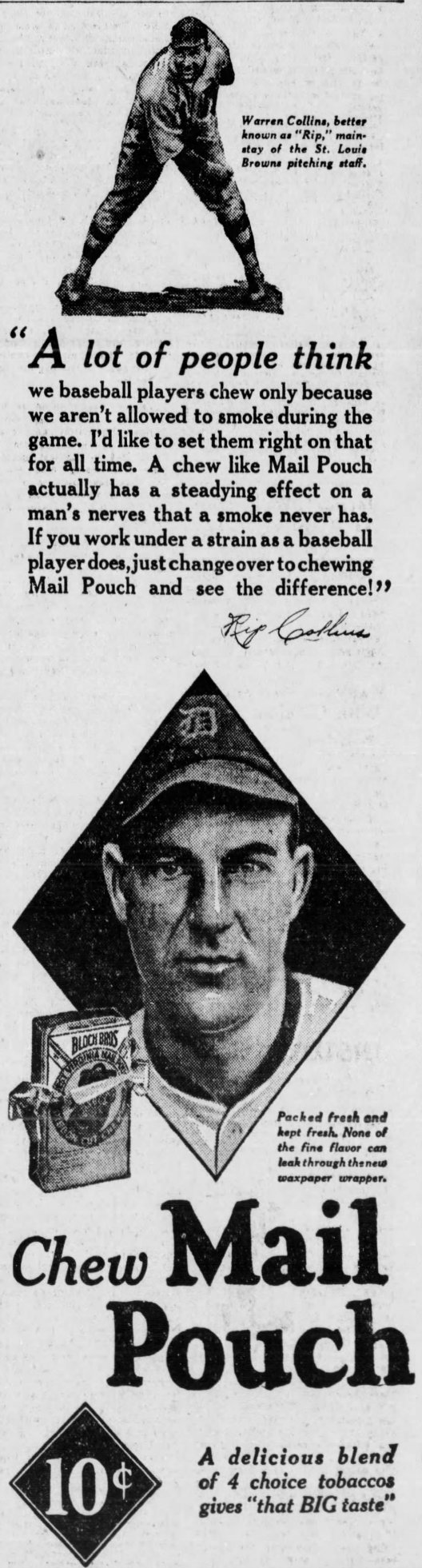
Lost Advertisements: Rip Collins for Mail Pouch Tobacco

5 Oct

ripmailpouch

A 1930 Mail Pouch Tobacco ad featuring Harry Warren ‘Rip’ Collins of the st. Louis Browns.

“A Chew like Mail Pouch actually has a steadying effect on a man’s nerves.”

Collins’ nerves were good for a 108-82 record over 11 major league seasons and for a career as a Texas Ranger.

In November 1926, “Baseball Magazine” declared his career a bit of a disappointment–but for a reason– Collins was simply “Born a hundred years too late.”

The magazine said:

“Collins came to the big leagues an unbranded maverick, wild as a Brahma steer from his own beloved Texas cattle land. Nature, with a lush prodigally, had endowed him with athletic skill of the highest order.  Six feet one he stood with muscles like tempered steel, 205 pounds of raw, crude strength.  He had blinding speed, more sheer stuff, perhaps, than any pitcher has shown since Walter Johnson came out of the mountains of Idaho to create one of the great pitching records in history.”

The magazine said while:

“He might have been a marvelous hurler.  He has been merely good.”

The reason he never reached his potential:

“Rip has been guided through life, for good or ill, by the untamed spirit of the wilderness.  He chafed under irksome restraint.  He hated big cities, crowds, the luxuries of an old and possibly decadent civilization.  He abominated the petty jealousies and the bickerings and the small politics on a big league ball club.”

Collins said:

“When I have finished the baseball season, I can’t be cooped up any longer.  I take my rattle trap Ford and go down to the wild country of the Rio Grande where you can go days with out seeing anybody.  I’m homesick for the call of the coyote.”

Collins said he was better suited “for the pioneer days” than the baseball diamond.

He said he joined the Texas Rangers because he was turned down by the United States Army when he first attempted to enlist, because of two bad knees–one injured during the a football game with the Haskell Indian School when he was at Texas A &M, and the other he hurt playing basketball. The Ranger accepted him he said, caring only that he could ride a horse and shoot.

Of his time with the Rangers, and how it differed from the army in which he later served:

“In the Regular Army a soldier’ll say to the corporal, ‘shall I shoot?’ The corporal will ask the captain and the captain will wire the War Department for instructions  The Rangers don’t believe in asking unnecessary questions.”

The magazine said Collins’ “people were strongly opposed to the professional game.” And he said they still were not completely accepting:

“Even now, they look at it with a little suspicion, though they always get the papers and look up the box scores.”

Collins, who told “Baseball Magazine” he learned how to pitch “throwing rocks at jack rabbits,” admitted he didn’t have a great commitment to the game:

“Baseball to me, has been only a simple way to make a living.  I like the game, but I’d rather pitch in the Texas League where I could go fishing the next day, than to be a star in the majors.”

In the end, Collins said he was “condemned, at present” to a life staying in “swell hotels” instead the life he desired.

Collins remained “condemned” in the major leagues through the 1931 season–he reappeared in the Texas League for 10 games in 1933.

“It was Hard for me to get Used to Some of the Boneheads”

4 Oct

Most baseball writers and dozens of baseball figures caught the twenty greatest “fever” during 1911 and 1912.

After Frank Baker hit .375 with two home runs and five RBIs, leading the Philadelphia Athletics to their 1911 World Series victory over the New York Giants, Grantland Rice opined in The New York Mail:

baker2

Frank Baker

“The twenty greatest ballplayers, picked exclusively for this column by John McGraw and the Giants—John Franklin Baker.”

The Washington Times said Germany Schaefer was asked to put his twenty greatest list together shortly after the end of his best season in 1911:

“Write ‘em out and send ‘em to me,’ the newspaperman suggested.

“Germany did.  The list read as follows: ‘Germany Schaefer, Germany Schaefer, Germany Schaefer, Germany Schaefer, Germany Schaefer, Germany Schaefer, Germany Schaefer, Germany Schaefer, Germany Schaefer, Germany Schaefer, Germany Schaefer, Germany Schaefer, Germany Schaefer, Germany Schaefer, Germany Schaefer, Germany Schaefer, Germany Schaefer, Germany Schaefer, Germany Schaefer, and Germany Schaefer.’”

Germany Schaefer

Schaefer

The Philadelphia Record asked Connie Mack for his twenty greatest list, Mack refused but told the paper “if his life depended on any game of ball,” he would start Chief Bender:

“Do you know, Bender has never yet failed me in a crisis?  Whenever there is a game that the fortunes of our club hinge on I’ve sent in the Chief and he has delivered every time.”

Billy Hamilton, who made a couple of the lists that circulated during 1911 and 1912, told The Boston Globe he was upset no one had named his former teammate Marty Bergen:

“Why, I can’t see how you can possibly leave him out…He and Buck Ewing were in a class by themselves among the men I have seen behind the bat.  I have never seen anything like that snap throw of Martin’s, with the ball always on the runner.”

Wild Bill Donovan then put Bergen on the list he chose for The Detroit News:

  • Ed Walsh
  • Jim Hughes
  • Christy Mathewson
  • Duke Farrell
  • Marty Bergen
  • Hal Chase
  • Fred Tenney
  • Napoleon Lajoie
  • Eddie Collins
  • Jimmy Collins
  • John McGraw
  • Hughie Jennings
  • Herman Long
  • Ty Cobb
  • Bill Lange
  • Ed Delahanty
  • Willie Keeler
  •  Fielder Jones
  • Fred Clarke
  • Bobby Wallace

Donovan told the paper of Ed Walsh:

“If Walsh were worked about once in four days, instead of being asked to go in three times a week as often is the case now, I believe that he would be unbeatable.”

edwalsh

Ed Walsh

In lauding Farrell, his teammate in Brooklyn, Donovan took a swipe at many of the catchers he worked with during his career:

“The big Duke was a wonderfully heady man, and the only catcher who ever lived on whom it was impossible to work the hit and run game.  Any time Duke called for a waste ball, you could bet your next paycheck that the runner was going to go down.  After pitching to man of his intelligence it was hard for me to get used to some of the boneheads that I encountered later.”

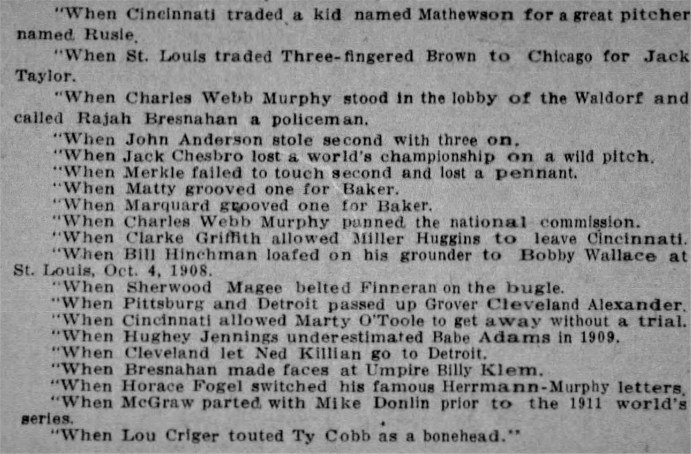
One more list—attributed to several papers and sportswriters at the time—appeared first in The Pittsburgh Gazette-Times, and chronicled the “Twenty greatest blunders in baseball:”

20blunders

As the craze was dying down, The Chicago Tribune said Ted Sullivan, the man who I credited with discovering Charles Comiskey—and Comiskey’s favorite scout, would put together “a list of the twenty greatest baseball actuaries of all time were he not a bit doubtful about the other nineteen.”

“The Twenty Greatest Fever”

2 Oct

In November of 1911, an interviewer asked industrialist Andrew Carnegie to name the 20 greatest men of all time.  Within days, Carnegie’s list was parsed and picked apart, and led to what The Chicago Daily News called “The twenty greatest fever.”

Lists of the twenty greatest everything appeared in papers across the country for the next year.  Of course, the question was put to many baseball figures and led to a number of interesting lists and quotes.

One of the first to weigh in was Chicago White Sox owner Charles Comiskey, in The Daily News:

  • Buck Ewing
  • King Kelly
  • Cap Anson
  • Charlie Ferguson
  • Fred Pfeffer
  • Eddie Collins
  • Honus Wagner
  • Jack Glasscock
  • Harry Lord
  • Ty Cobb
  • Fred Clarke
  • Willie Keeler
  • Tom McCarthy
  • Napoleon Lajoie
  • Charles Radbourn
  • Bobby Caruthers
  • Christy Mathewson
  •  Clark Griffith
  • Ed Walsh
comiskeypix

Charles Comiskey

Comiskey said Eddie Collins, who would acquire for $50,000 three years later, was the best current player:

“He’s got it on all the others in the game today.  I don’t know that a good lawyer went to waste, but do know that a mighty good ballplayer was found when Eddie decided to give up the technicalities of Blackstone for the intricacies of baseball.   There isn’t much use saying anything about Connie Mack’s star, everybody knows he is a wonder as well as I do.”

Cy Young was asked by The Cleveland News to name his 20 greatest:

“I guess we’d have to make a place for old Amos Rusie, ‘Kid’ Nichols should be placed on the list too, ‘Kid’ forgot more baseball than 90 percent of us ever knew.  And there was Bill Hutchinson, just about one of the greatest that ever lived.  You can’t overlook Walter Johnson, and, by all means Ed Walsh must be there.  The same applies to Mathewson.  Then comes my old side partner, Bill Dinneen.  Bill never was given half enough credit.”

amosrusie

Amos Rusie

Young rounded out the battery:

“I’d pick old Lou Criger first of all the catchers.  George Gibson of the Pittsburgh team, to my way of thinking, stands with the leaders.  Give the third place to Oscar Stanage of Detroit, and I feel safe in saying that I have chosen a really great catcher.”

Young said:

“Doping out the infields is comparatively easy.  Without hesitation I would name Hal Chase, Eddie Collins, Nap Lajoie, Hans Wagner, Bobby Wallace, Jimmy Collins, Herman Long, and Charlie Wagner.”

Young said of his infield choices:

“You can’t get away from Bobby Wallace for a general all round gentlemanly player, he has never had a superior at shortstop unless that man was Honus Wagner.  Maybe Johnny Evers is entitles to consideration, but I never say him play.”

As for his outfielders, Young said:

“Ty Cobb’s equal never lived, according to my way of thinking, and I doubt if we will ever have his superior.  Say what they will about Cobb, but one who is true to himself must acknowledge his right to rank above all other players.

“I chose Cobb, Fred Clarke of Pittsburgh, Tris Speaker of Boston and Bill Lange for the outfield, and regret that the limitations prevent me from choosing Jim McAleer.  McAleer was the best fielder I have ever seen.  I say that with all due respect to Cobb and other competitors.

“Tris Speaker is a marvel, and only because of his playing at the same time as Cobb is he deprived of the honor of being the greatest outfielder…Many fans of today probably don’t remember Bill Lange.  Take my word for it, he was a marvel.  He could field, bat, and run bases with wonderful skill.  No man ever had the fade-away slide better than Lange.”

The reporter from The News noticed that Young had, “chosen his twenty greatest players without mentioning his own great deeds,” and asked Young whether her felt he belonged on the list.  Young said:

“Oh, I’ve heard a whole lot of stuff about myself as a player, but I was but ordinary when compared to the men I name as the greatest in the game.”

cy

Cy Young

When Ty Cobb presented his list of the 20 greatest current American League players to The Detroit News, the paper noted his “Very becoming modesty” in leaving himself off of his list.  Cobb’s picks were:

  • Ed Walsh
  • Bill Donovan
  • Walter Johnson
  • Jack Coombs
  • Vean Gregg
  • George Mullin
  • Billy Sullivan
  • Oscar Stanage
  • Ira Thomas
  • Hal Chase
  • Napoleon Lajoie
  • Eddie Collins
  • Jack Berry
  • Owen Bush
  • Frank Baker
  • Harry Lord
  • Sam Crawford
  • Clyde Milan
  • Joe Jackson
  • Tris Speaker
cobb

Ty Cobb

Cobb included Bobby Wallace, Russ Ford, and Heinie Wagner as honorable mentions.

More of the lists and quotes from “The twenty greatest fever,” on Thursday

“Baseball has Kept me so Happy”

27 Sep

Like every ballplayer of his era, Jim O’Rourke spent a lot of time in his 1910 interviews with Tip Wright of The United Press comparing the current game to his days on the diamond:

o'r

Jim O’Rourke

“They talk about their speed and curves these days, but the raise ball little (Candy) Cummings—he weighed only 115 pounds—used to throw is a lost art.

“The present day men can’t do it.  The nearest thing is a little upshot, which (Joe) McGinnity of Newark through last year.  You simply couldn’t hit Cummings’ raise ball squarely.  It was bound to climb the face of the bat, and the best you could get was a little pop-up.”

O’Rourke told Wright, “The greatest catcher I ever knew was ‘Buck’ Ewing,” of his former Giants teammate, he said:

“He led in batting, running, catching, fielding and base-stealing, and he could think quicker than any other man I ever saw in a game.”

As for pitchers:

Amos Rusie leads them all, and he promised to make  a record no pitcher in baseball, unless he were a genius could outdo; but poor old Amos disappeared!  I think Tim Keefe was a great curve pitcher, but for endurance I have to hand the laurels to Charles Radbourn, of the Providence Nationals.  In 1883, when his team was after the pennant, Radbourn pitched 72 games [sic 76] 37 of which were consecutive, and of the 37 games 28 were victories (Radbourn was 48-25, Providence finished third).

“If you ask me the difference between the pitchers of today and the pitchers of former days, I would say that the pitchers today have the cunningness not to go into a box oftener than once or twice a week, while the old timers used to think nothing of pitching six or seven games a week.”

radbourn

“Old Hoss” Radbourn

O’Rourke saved his greatest praise for his Boston Red Stockings teammate Ross Barnes.  He told Wright:

“Before telling you about Ross Barnes as a batter, I want to tell something about his work at second base…Barnes had long arms that he could snap like a whip.  His throws from second to the plate were the most beautiful I have ever seen.

“His speed was so tremendous that the ball did not seem to have any trajectory at all and it landed in the catcher’s hands at the same height it started from.”

O’Rourke said, Barnes was “even more wonderful,” at the plate:

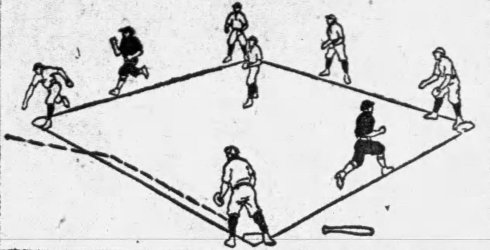
“It was Barnes’ wonderful third base hits that caused the rule to be made that a ball, even if it struck within the diamond, must be declared a foul if it rolled outside the baseline…He had a trick of hitting the ball so it would smash on the ground near the plate just inside of the third base line, and then would mow the grass over the line (in foul territory)…No third baseman could get away from his position quickly enough to stop one of Barnes’ hits.”

barnestbhit

Barnes’ “third base hit”

O’Rourke mentioned two other “wonderful hitters” he saw “when a mere boy;” Dickey Pearce and Tom Barlow:

“I have seen these men with little short bats, which I believe were later ruled out of the game, make the wonderful bunt hits which we have taken to calling a modern institution.”

O’Rourke said both became “ordinary players” after they were no longer able to use the shorter bats, “not realizing that a bunt could be made with a long bat.”

And, like all old-timers, O’Rourke knew how to “fix” the modern game:

“The one big question in baseball today is how to make the game more interesting.”

O’Rourke advocated for removing the foul strike rule to increase hitting and wanted to “place the pitcher farther away from the plate.”

O’Rourke summed up his forty plus years in the game to Wright:

“Baseball has kept me so happy and healthy that there is not a minute of my past life I would not willingly live over.”


“The Brutality of Baseball During the Constructive Period”

24 Sep

In 1910, after close to 40 years in baseball, Jim O’Rourke talked to Tip Wright, a former Cleveland baseball and boxing writer, then with The United Press, about his life in baseball:

“As I like back to the day before we wore gloves I can scarcely understand how we went through the ordeal of a game. Before gloves were used, the catcher suffered unbelievable torture. On a hot day, when the blood circulated freely, the catcher’s hands would swell about the third inning. When the swelling started, the pain caused by the impact with the ball decreased, because the swollen flesh made sort of a cushion.

“But on a cold day, when the blood did not course freely, and the hands would not swell, the pain was intense. I have seen catchers hold a piece of soft rubber in their mouths, and whenever the ball was pitched they would screw up their faces and bite on the rubber as hard as they could to offset the pain.”

orourke

Jim O’Rourke

O’Rourke said that when the weather was warm it was sometimes said by catchers:

“Oh, I am getting along fine—my hands are swelling up in great shape.”

In addition to the scars carried by catchers, O’Rourke told Wright about the many players he saw “knocked senseless many times,” and that he still suffered from the effects of those early days:

“Talk about the roughness of football in these days, and the hopelessness of trying to stop it, but it is nothing compared to the brutality of baseball during the constructive period .

“My head has been so sore from being hit that I could not think and my hands so sore from catching that I could not hold an orange tossed from a distance of six feet.”

O’Rourke told Wright about joining the Boston Red Stockings as a 22 year-old in 1873, and his relationship with another Wright—Boston manager Harry:

“They called me ‘Harry Wright’s boy.’ He took me to live with his family, and, had I been spoilable, I would have been spoiled in a short time. But the things my mother taught me kept me straight. I never touched liquor or tobacco in my life. I never dodged temptations; in fact I exposed myself to them. When the boys went out they asked me to go along, knowing I would care for them when they got into difficulty.

“Had I headed wrong at this time my bright future would have been ruined…I advise young ballplayers that if they leave liquor alone they can dodge the other evil—late hours and loose living—that have ruined so many bright players.”

Of his brief stint as an umpire in 1894, O’Rourke said:

“I couldn’t stand it—I wouldn’t be an umpire for anything, so I went to Bridgeport, and because I could not keep out of the game, I played that year with the St. Joseph’s Temperance team.”

As for young players, O’Rourke said most didn’t compare with his son—James “Queenie” O’Rourke was in 1910, a 26-year-old infielder and outfielder for the Columbus Senators in the American Association:

queenie.jpg

Queenie O’Rourke

“I think James is as steady as I was. Every year when he leaves home, I say to him, ‘Now, James, if you will just leave stimulants alone, no harm can come to you. You can’t help but being a good man.’ And up to this time he has not touched either liquor or tobacco, and I know he won’t.

He kisses his mother goodbye each year, just as I used to kiss mine. I often look at the young fellows and wonder why they do not behave.

“Maybe one reason is they have too easy a time, compared with we old veterans, as many of the hardships of baseball have been removed by appliances and safeguards.”

More from O’Rourke on Thursday.

“I knew but Little, but Schaefer Taught me.”

19 Sep

Ty Cobb had a dilemma in the fall of 1910.  After being presented with a new Chalmers automobile (along with Napoleon Lajoie) for leading the league in batting.  Ed Grillo of The Washington Evening Star said he found a solution:

cobbchalmers

Cobb in his Chalmers

“Ty Cobb has presented Herman Schaefer with his old automobile.  The car which he has been using will be of no further use now that he has received the one offered for the best major league batsman.

“In giving Schaefer the machine Cobb is repaying ‘Germany’ for the many kindly turns he did for Cobb.”

Cobb told Grillo:

“If it were not for Schaefer’s interest in me I would not have made myself the ballplayer I am…When I joined the Detroit club (in 1905) I knew but little, but Schaefer taught me.  The very first day he got after me because I did not pick my feet up and run as he thought I should.  Then he told me to turn toward second when going to first so that if anything happened to the ball I could take another base.”

Schaefer told Grillo his most difficult task was teaching the 18-year-old Cobb to slide—Cobb agreed:

germany

Schaefer

“I thought it was too dangerous in those days and would not try.  But one day in an exhibition game at Indianapolis I saw Schaefer slide away from the baseman holding the ball, and I made up my mind that I would learn the trick.  I asked Schaefer to teach me, and for the next two weeks we would go to the park every morning and he would go through the motion of catching and touching me with the ball.  He would tell me just when and how to slide, and if I made a mistake he would change places and he would do the sliding.

“In that way I learned everything I know about base running, and I owe it all to Schaefer, and I gave him my machine in appreciation of the many kindnesses he has shown me.”

“This Player has More Honor Than 99 Business men out of 100”

17 Sep

James Palmer O’Neill was the President of the 1890 Pittsburgh Alleghenys—one of baseball’s worst teams of all-time.  With mass defections to the Pittsburgh Burghers of the Players League, the club won four of their first six games, then began a free-fall that ended with the team in eight place with 23-113 record.

O’Neill, who held an interest in the club, but bought controlling interest from Owner William Nimick before the 1891, kept the team afloat during that disastrous 1890 season, and according to The Pittsburgh Dispatch, never lost his faith in the prospects of National League baseball in the city right through the final road trip:

“(The team) landed at Jersey City, bound to play the last series of the disastrous season…They had great difficulty in raising the  money to pay ferryboat fares to Brooklyn and things were awfully blue.  It was raining hard when I met Mr. O’Neill later that morning at Spalding’s Broadway store, and the prospects of taking the $150 guarantee at the game in the afternoon were very slim…(reporters) asked Mr. O’Neill about his club and the outlook for the League.

‘”Never better!  Never Better! We shall come out on top sir, sure.  We’ve got the winning cards and we mean to play them.’”

The paper said O’Neill’s luck changed that day as “he wore his largest and most confident smile, and used the most rosy words in his vocabulary…such pluck compelled the fates to relent.”

The rain stopped and O’Neill was able to leave Brooklyn “with $2000 or more in his clothes,” to meet expenses.

Before the 1891 season, O’Neill told Tim Murnane of The Boston Globe, just how difficult it was to run a National League club during the year of the Brotherhood:

“I think I could write a very interesting book on my experience in baseball that would be worth reading.  How well I remember the opening game in Pittsburgh last spring, and how casually President Nimick was knocked out—and O’Neill laughed heartily at the thought of Nimick’s weakening

“After witnessing the immense crowd of nearly 10,000 people wending their way to the brotherhood grounds, Nimick and I went to the league park.  As we reached the grounds, Nimick walked up to the right field  fence and looked through a knot hole. ‘My God,’ said he, and he nearly fell in a heap at my feet,  ‘Can it be that I have spent my time for 10 years trying to build baseball up in this city and the public have gone entirely back on me?’”
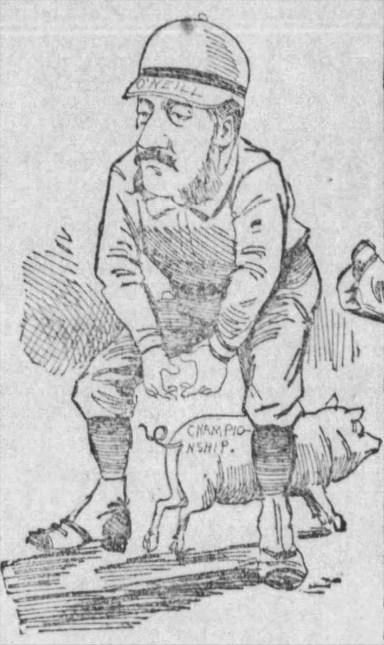
oneillpix

O’Neill trying to catch a championship, 1891

O’Neill said:

“I looked and could see about two dozen people in the bleachers, and not many more in the grand stand (contemporary reports put the attendance at 1000).  Nimick and I then went inside the grounds, and when the bell rang to call play we started up the stairs to our box, carrying the balls to be used in the game.  When about half way up, the president staggered and handed me the balls.  I went up to throw one out for the game.  Nimick turned back, went home without seeing the game, and was not in humor to talk base ball for several weeks.”

O’Neill then told how he managed to keep the team going for the entire season while Nimick planned to fold the team:

“When he came around about four weeks later it was to disband the club, throw up the franchise and quit the business.  I talked him into giving me an option on the franchise for 30 days.  When the time was up I put Nimick off from time to time, and as I didn’t bother him for money he commenced to brace up a little.  I cut down expenses and pulled the club through the season, and now have the game on fair basis in Pittsburgh, with all the old interests pulling together.”

Despite the near collapse of the franchise—or maybe because the near collapse allowed him to get control of the team—O’Neill had good things to say about the players who formed the Brotherhood:

“I have great admiration for the boys who went with the Players’ League as a matter of principle, and will tell you one instance where I felt rather mad.  About the middle of the season, Captain Anson was in Pittsburgh and asked me if I couldn’t get some of my players to jump their contracts (to return to the National League).  “All we want,’ said Anson, ‘is someone to make the start, and then (Buck) Ewing, (King) Kelly, (Jimmy) Ryan, (Jim) Fogarty and other will follow.’

“I told Anson that I had not tried to get any of my old players back since the season started in, but that Jimmy Galvin was at home laid off without pay, and we might go over and see how he would take it.  The Pittsburgh PL team was away at the time.

“We went over to Allegheny  , where Galvin lived, and saw his wife and about eight children.  They said we could find him at the engine house a few blocks away, and we did.  Anson took him to one side and had a long talk, picturing the full downfall of the Players’ League and the duty he owed his family.  Galvin listened with such attention that it encouraged me.  So I said: ‘Now, Mr. Galvin, I am ready to give you $1000 in your hand and a three year contract to return and play with the League.  You are now being laid off without pay and can’t afford it.’

“Galvin answered that his arm would be all right in a few days, and that if (Ned) Hanlon would give him his release he might do business with me, but would do no business until he saw Manager Hanlon.  Do what we would, this ball player, about broke, and a big family to look out for, would not consent to go back on the brotherhood.”
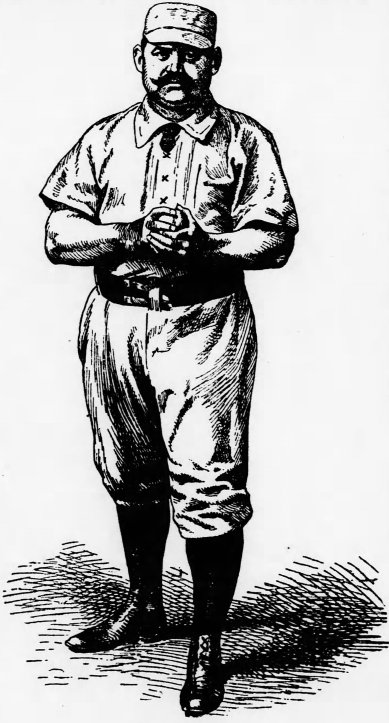
galvin

Galvin

O’Neill said he told Anson after the two left Galvin:

“’I am ashamed of myself.  This player has more honor than 99 business men out of 100, and I don’t propose any more of this kind of business.’ I admire Galvin for his stand, and told Anson so, but the Chicago man was anxious to see some of the stars make a break so the anxious ones could follow.”

O’Neill, after he “lit a fresh cigar,” told how Murnane how he negotiated with his players:

“At the close of (the 1890) season (George “Doggie”) Miller came to me and wanted to sign for next year, as he had some use for advance money.  I asked him how much he thought he was worth, and he said $4000 would catch him.

‘”My goodness son, do you what you are talking about?’ said I, and handing him a good cigar asked him to do me a favor by going home, and while he smoked that cigar to think how much money was made in base ball last season by the Pittsburgh club.  I met Miller the next day at 3 o’clock by appointment, and he had knocked off $800, saying he thought the matter over and would sign for $3200.

“’Now you are getting down to business,’ said I.”

O’Neill sent Miller home two more times, and after he “smoked just for of my favorite brand,” Miller returned and signed a three year contract at $2100 a season.

O’Neill said:

“You see that it always pays to leave negotiations open until you have played your last card.”

Murnane concluded:

“For his good work for the league and always courteous treatment of the players’ league, Mr. O’Neill has the support of not only his league stockholders, but such men as Hanlon, John M. Ward, and the entire Pittsburgh press.  He has the confidence of A.G. Spalding, and is sure to give Pittsburgh baseball a superior quality next season.”

Reborn as the Pirates under O’Neill, the club improved slightly in 1891.  O’Neill, who according to The Pittsburgh Press, lost as much as $40,000 during the 1890-91 season “a blow from which he never recovered financially,”  left Pittsburgh to start the Chamberlain Cartridge Company in Cleveland; he returned to Pittsburgh and served as president of the Pittsburgh Athletic club—which operated the Pirates—from 1895-1898.

He died on January 6, 1908.  The Associated Press said in his obituary:

 “(He was) known from coast to coast as the man who saved the National League from downfall in 1890, ‘the brotherhood year.’”

.