“The Brown Stockings, A Gloomy Title”

14 Sep

Shortly before the 1875 National Association season, the St. Louis Brown Stockings visited Louisville to play an exhibition against the semi-pro Olympics.

The Louisville Courier-Journal wrote with admiration about the building of a professional club in St. Louis:

“The signs of the times indicate a far livelier season of base ball than has ever been enjoyed in America by lovers of the great national pastime.  Especially will this be the case in the west, to which part of our country the great baseball wave has been slowly moving for several years.”

The paper said St. Louis was acting to eclipse Chicago as the “capital” of baseball in the west:

“In order to be honorably represented in the base ball arena, the Mound City folks formed a stock company; gathered in $20,000 from wealthy merchants and millionaires, procured twelve experts in the national game, and now the city smiles while she thinks how her club will walk forward to the pinnacle of fame this year.”

Recruited from “Eastern states,” The Courier-Journal said of the St. Louis team:

“The Brown Stockings, a gloomy title for so gay a set of fellows, though it is rather the fault of St. Louis papers than the base ballists, that they are forced to wear it.  All in all, the St. Louis club is composed of as handsome a set of fellows as ever handled the willow or tossed the ball.  We refer to face as well as form.  Since their engagement by a St. Louis stock company the base-ballists have been under gymnastic training…The members have perfect understanding of each other’s movements, and act accordingly.”

Noting that many of the players had spent the previous season in Brooklyn, the paper said they chose to “come west, like all good people ought to do.”

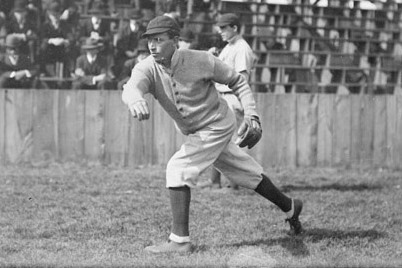
The Courier-Journal reporter interviewed outfielder Jack “Death to Flying Things” Chapman, who offered a wealth of information on the 19th Century ballplayer:
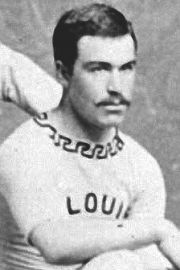
chapman

Jack Chapman

“(He) is six feet high, and splendidly built, being a ‘man as is a man.’  He only weighs one hundred and seventy-seven and isn’t married, though he contemplates taking a partner someday.”

Chapman, the “best looking man on the team,” who “is much liked by his associates,” was designated the “team scholar” to talk to the press in the absence of manager Dickey Pearce who was ill.  He said:

“St. Louis is bound to be the greatest place on the continent for base ball this season.  Her stock company offered big inducements, and we accepted.”

As for the people who had built the club, Chapman said, they were:

“Very rich and nice people…(the club’s) officers are mostly millionaires, who desire their city ably represented in base ball.  The people ‘turn out’ there in the thousands, and are all agog with base ball excitement.  Five thousand people witnessed our practice game last week.”

Chapman was asked about salaries:

“Substitutes get from $900 to $1200.  Regulars receive $1000 to $2500.  Bob Ferguson (the other “Death to Flying Things), of our old club, gets $2500 this year for captaining the Hartfords.”

Asked what players did in the off-season, Chapman said:

“A good many loaf, and others work at different jobs.  Generally whatever they hit upon that suits.”

As for the St. Louis club’s prospects to overtake the Boston Red Stockings as the nation’s dominant team:

“We hope to do it, and I believe we shall.  The Reds are a good team, made excellent by having stuck together so long.  I consider the (Philadelphia) Athletics the stronger nine this year.  Harry Wright is the best captain in America.  The (New York) Mutuals were the best club last season, and but for the bad feeling among the members would now be champions.”

Finally, Chapman was asked whether he thought Louisville could support a professional team:

“I do, indeed, and am surprised she hasn’t one.”

Chapman was hit and miss on his predictions.  The Brown Stockings were the best club in the west, finishing the season 39-29, but no where close to playing at the caliber of Wright’s Red Stockings (71-8) , the Hartford Dark Blues (54-28), or the Athletics (53-20).

He was correct about Louisville’s chances to get a professional club, The Grays, with Chapman as manager finished fifth in the inaugural season of the National League.

“I’m the Only Michael”

12 Sep

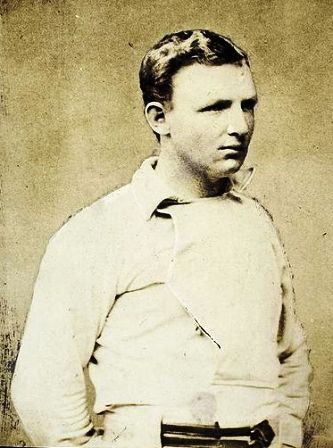
The Chicago press treated Michael “King” Kelly’s return to Chicago like a coronation.  Kelly was sold by the White Stockings for a then record $10,000 in February of 1887, and arrived for his first series in Chicago on June 24.

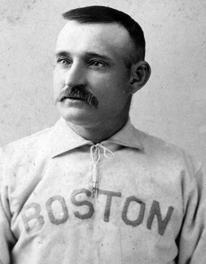
kingkelly

Mike “King” Kelly


The Chicago Tribune said he was greeted at the Leland Hotel on Michigan Avenue with a brass band, a crowd estimated at 5000, and a song:

“Michael Kelly, he came down to sing a little chanson; says he, ‘I’ve come from Boston Town to do up Baby Anson.  I love Chicago, but you know the Hub spondulicks bought me—I hated like the deuce to go, but $10,000 caught me.  I’ve come to lay Chicago flat and knock you all to blazes, for I’m a corker don’t forget—the daisy of the daisies.  Away with every Bill and Jim that’s in the baseball cycle—the dickens take the whole of thim!  Sure, I’m the only Michael.’”

The Chicago Inter Ocean described the “King” as “terribly bored…fast losing his good nature by this ovation business.”  Despite his boredom, The Chicago Daily News said:

“Kelly was taken to the grounds in a four-horse carriage, escorted by a band and all the players.”

There were more than 12,000 fans in the stands when the procession arrived

The Tribune described the arrival at the ballpark:

“(Fans) kept on yelling as the procession wended its way past third base, back of the home plate and over towards Anson’s territory.  When the carriage with its four proud horses stopped in front of the grand stand and the Hon. Mr. Kelly stretched his red-hosed legs and hopped out to the ground the volume of yelling was doubled.  The Hon. Mike took off his grey cap and smiled.  The crowd howled some more.  Then the Bostons scattered themselves over the field and began practice.  Every play, good, bad, or indifferent of the ex-member of the home team was applauded.”

The game itself was interrupted on at least three occasions, according to The Inter Ocean “to allow presentations of flowers,” to Kelly, and at another point to present Cap Anson “a pillow in white roses with the words ‘Old Man’ in red with roses therein.”  The paper noted that the “interruptions wasted several moments of the playing time.”

The Tribune said Kelly was also presented with “a gay satin jockey cap of red, white, and blue, which the Hon. Mr. Kelly was induced to wear during a part of the first inning.”

The game, and Kelly’s performance, according to The Inter Ocean were anti climatic after the buildup.

Chicago and John Clarkson, beat Boston and Old Hoss Radbourn 15-13, the paper said:

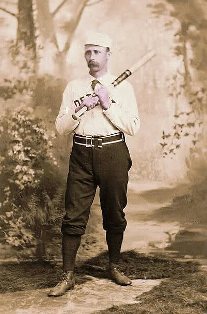
radbourn

“Old Hoss” Radbourn

“Strange to say, however, the expected Kelly tactics in base running was not made manifest during the course if the game.  He did not play with the vim that used to make him the great man when he played here.  Kelly misses his place, and all the flowers and gold watches in the country will never make him the same ‘Old Kel’ of yore.  Kelly with the Chicagos may be worth $10,000, but Kelly with any other team would not bring $2000.”

Kelly was 3 for 6 and made two errors at second base.

Chicago took three of four games  from Boston , Kelly 6 for 11 with six errors in the first three games, and sat out the final game, a 19 to 6 Chicago victory.

The Tribune noted that Kelly’s return brought 34,000 fans out for the series:

“Fully 17,000 represented 75 cents each and the others 50 cents each.  This gives a total in the neighborhood of $21,000.  They got $10,000 for Kelly and the club is still playing winning ball.  This is some evidence of good business management on President (A.G.) Spalding’s part.”

The Kelly-less White Stockings finished in third place.  Boston ended the season in fifth.  Kelly, who led the league with a .388 average in 1886, hit .322 for Boston in 1887.

“A Weird and Wonderful Thing.”

10 Sep

Although the paper never said how he obtained them, The Buffalo Times said in 1905 that Chicago Cubs pitcher Herbert “Buttons” Briggs “is the possessor of some valuable old bombast documents in the way of contracts of the Chicago club players back in 1884…He also has a contract between the Chicago Baseball Association and Oscar Bielaski for the season of 1875.”

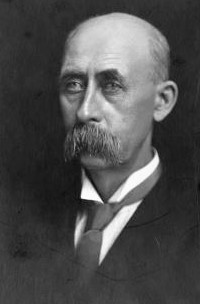
buttons

Buttons Briggs

The paper said of the 1875 contract:

“This contract is a simple one, and calls for the service of Bielaski for eight months, from March 15th to November 15th, at a salary of $1400.  The player agrees to play for the Chicago club only and to obey all rules and regulations and “to refrain from any dissipation which may impair his physical condition.’”

Briggs also had the 1884 contract of Cap Anson, which the paper called:

anson

Anson

“(A) weird and wonderful thing compared with the present day player’s contract.  It consists of seven pages and twenty-three sections, and a ballplayer was forced to almost sign his life away in those days…Anson’s contract calls for $2500 for seven months services and is payable monthly…Nowadays the greenest youngster breaking in from the minor leagues wants, and usually gets, that much per season, while players of the present day who rank with Anson in his day get twice and three times that amount.”

The paper outlined other features of the contracts:

“In the 1884 contracts the team is never referred to as the club, but always as the ‘nine.’ Different sections of the contract provide for expulsion of the player if he be guilty of drunkenness, gambling in any form, insubordination, conspiring to lose and game, or be interested in any pool or wager on a game.  This expulsion could be given without any notice.  This section regarding injuries and illness reads as follows:

“It is understood and agreed that the said party of the second part (the player) assumes all risk of accident in play or otherwise, and of illness from whatever cause, and of the effects of all accidents, injuries, or illness occurring to him during the period of his employment.

“It is also required that when requested by the club a player must submit to an examination at the hands of the club’s physician, the player to pay for such examination.”

In addition to paying for their own medical examination, The Enquirer said:

“It was required that each player furnish himself at his own expense with a uniform designated by the club, the uniform to consist of two pairs of flannel pants, two flannel shirts, two pairs stockings, one pair leather shoes with spikes, one cap, one belt and one neck tie, ‘all of which during the whole of his term of employment, he is to keep in thorough repair and replenish as required, at his own expense; and he agrees to appear on the field at the beginning of each and every game in which he is to play in an entirely clean uniform, all cleaning of the same to be paid for by himself.’”

Finally, the paper said the “funniest” portion of the 1884 contract was the section that addressed road expenses:

“It reads as follows: ‘It is further agreed that while absent from Chicago with the ‘nine’ in other cities and while traveling with the ‘nine,’ the sum of fifty cents per day shall be deducted from the player’s wages on account of his board.’

“What a howl would go up from most of the present day players if they were asked to pay any part of their living expenses while on the road.”

“The ‘Deacon’ Seemed to Have Been Entirely Overlooked”

6 Sep

Deacon White died on July 7, 1939, just after being snubbed for inclusion in the Hall of Fame—a move that The Sporting News, among others, had campaigned for.

The Associated Press said, “By strange coincidence,” they had sent a reporter to interview the 91-year-old on “the eve of his death.”

deaconwhite

Deacon White

White was living on his daughter’s summer home, 45 miles west of Chicago:

“The gentle tapping of a cane on the stairs became more distinct.

“In the living room doorway, presently, appeared a bent, aging figure—James ‘Deacon’ White, 92 years old [sic], and the oldest living player of baseball, which this year is celebrating its centennial.  The ‘Deacon’ seemed to have been entirely overlooked in the hullabaloo.

“Slowly, the bespectacled old gentleman lowered himself into his favorite chair.  Almost as old as the game itself, the ‘Deacon’ was hard of hearing, his memory was uncertain, but he loved to talk about the game he learned from a union soldier, just returned from the Civil War.”

The reporter, Charles Dunkley, said, “White’s gnarled fingers—he was a barehanded catcher—bore trademarks of the game.”

White, who appeared in his final game in 1890, said:

“’Batters of my day would have little success with present day pitching, but by golly, you haven’t got any better fielders now than we had in the first days of the game.  We fielded bare handed and that took a lot more skill than the present day fielders need with their gloves.’

“’The science of batting and pitching have advanced a long way in 70 years.  When the game was first originated, we never had fast ball pitching as the pitchers do today, when they wind up or throw overhand or sidearm.’”

White also weighed in on the origins of the curve ball:

“’(Arthur “Candy” Cummings) was one of our first great pitchers and I know that he used to curve a ball as early as 1868, but not in regulation games because the rules prohibited them.’”

White dismissed the suggestion that Fred Goldsmith introduced the curve ball:

“’I knew Goldsmith as an infielder and later as a pitcher,’ recalled the old-timer, ‘and if he threw curves before Cummings, he must have kept it a secret.  But in my day, all the young pitchers were learning to throw curves two years before the rules permitted them.”’ (and presumably before Goldsmith demonstrated the pitch to Henry Chadwick in 1870).

White, who said he hadn’t attended a major league game “in several years,” was scheduled to attend a “a celebration in his honor and in honor of other old time stars,” in Aurora, Illinois.  But died just two days before the event.

white.jpg

White

White closed his final interview attributing “his longevity to the fact he never smoke or drank,” and:

“(White) always practiced clean, simple living.

“To the present crop of young players, he gave this advice.

“’Live a clean life and keep in condition.  You’ll never regret it.”


“The Foxes of Balldom are Listed”

4 Sep

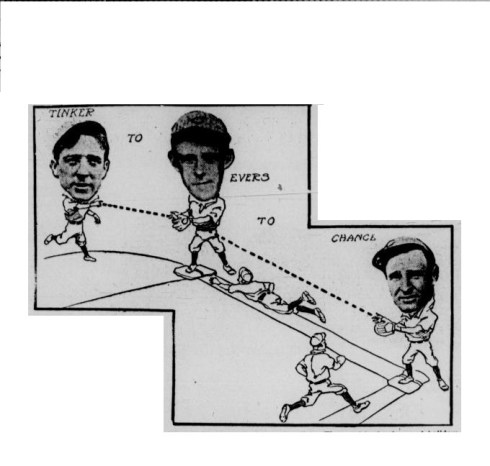
After the publication of Franklin Pierce Adams’ “Baseball’s Sad Lexicon” in The New York Evening Mail in 1910, two poems were written three years later to mark the end of the double play combination and relationships that had devolved into public feuding.

James P. Sinnott, Adams’ colleague at The Evening Mail, penned “Said Tinker to Evers to Chance,” lamenting the fate of the three—all three now managers, Johnny Evers’ Cubs finished third, Frank Chance’s Yankees and Joe Tinker’s Reds finished seventh.

Then there was a poem commissioned by The Day Book, the Chicago-based Scripp’s-McRae owned free daily paper and written by poet Berton Braley, called “Ballads of Past Glories.” Which ended with the line:

“Fans, we may rightly be blue, over the land’s vast expense;

Busted this trio—boo hoo! ‘Tinker to Evers to Chance.”


tecpix

But they were not the only two poems to pay homage to Adams.  One poem appeared about a month after the publication of “Baseball’s Sad Lexicon.”   First, in The Chicago Daily News, then later printed in papers across the country, attributed only  to “some other near poets:

“Piteous in Gotham’s the oft written phrase,

‘Tinker to Evers to Chance.’

This is the dope that has Grif in a daze,

‘Tinker to Evers to Chance.’

Cardinals, Dodgers and Doves, Phillies

fairish

All know the play that is neat if not

garish

Know how their ambitious rallies can

perish

‘Tinker to Evers to Chance.’

Get down your coin on the double-play

kids

‘Tinker to Evers to Chance.’

Under the Pirates they’ve slickered the

skids

‘Tinker to Evers to Chance,’

Not of the boneheads whose noodles get

twisted,

These with the foxes of balldom are

listed—

Grabbing a pennant almost unassisted,

‘Tinker to Evers to Chance.’

Aye, there is a dolor in Smoketown at

this:

‘Tinker to Evers to Chance.’

But in Chicago it’s pretty fine biz,

‘Tinker to Evers to Chance.’

Here are the regular Wind City

queries:

Hunting a pennant pole, ain’t they the

Pearys?

Think they will cop the post-season series.

‘Tinker to Evers to Chance.’”

Lost Pictures: Cap Anson, Politician

31 Aug


cap1903.jpg

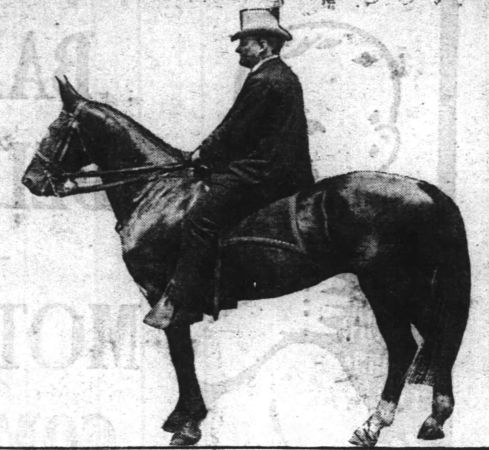
A 1903 photo of Cap Anson on horseback which was printed with stories announcing his new foray into politics.

The Chicago Inter Ocean said:

Adrian Constantine Anson, who was captain of the Colts in the good old days when the National League pennant floated over the West Side ball grounds, has signed with another club , and will make his first appearance next Saturday when he will assume charge of the Chicago Democratic Club at its annual picnic.”

Among Anson’s duties were promoting Chicago Mayor Carter Harrison Jr. as a potential nominee for the presidency in 1904, and leading uniformed marchers at club events; at Anson’s first event, the group welcomed William Jennings Bryan, the Democratic candidate for president in the two previous elections.  Anson led a procession of more than 500 members of the club to meet Bryan at Chicago’s Northwestern Station and accompany him to the picnic.

The Chicago Evening Post said, “Harrison feels under much obligation to Anson for bringing all the baseball men over to him,”  during his first campaign in 1897.

Harrison fell short in his bid for the Democratic nomination in 1904, partly as a result of the negative national press he received after 602 people died in Chicago’s Iroquois Theater fire in December of 1903.

Anson’s role with the Democratic Club led to the party slating him as a candidate for city clerk in 1905.  According to The Chicago Tribune, Anson told the crowd when he received the nomination:

“I believe the baseball boys will roll up a big score for the captain of the ticket and the rest of us.  Now, I hope you’ll excuse me–I have the inclination to go on, and if I had the vocabulary I’m not sure I’d ever stop.”

He was elected clerk and served one term.  Two years later Anson was defeated in his campaign for Cook County Sheriff, ending his political career.


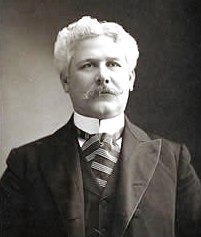
Murnane’s Plan to Save Baseball

29 Aug

For as long as there has been a game, there have been plans intended to “save” it.

Tim Murnane considered himself a diet expert, and a baseball expert.

murnane

Tim Murnane

The baseball player and pioneer turned sportswriter proposed his plan to save baseball in the fall of 1895 in the pages of The Boston Globe.

Murnane said:

“Many lovers of baseball claim that the sport is degenerating, owing to leading clubs engaging players from all parts of the country.

“How can a man, they ask, born and brought up in New York city, join the Boston club and be as anxious to defeat the Giants as would a man hailing from the East?”

Murnane used Cincinnati Reds catcher Morgan Murphy “the great Boston favorite” as an example:

“Year after year he is forced to go out to Cincinnati from his home in Rhode Island when the Boston public would be delighted to see him in a Boston uniform.”

In addition to Murphy, said Murnane, there was Boston infielder and Chicago native Herman Long:

“Now wouldn’t he look more in place in a Chicago uniform.”

In order to give the game “more local coloring” Murnane proposed:

“The National League to be composed of eight clubs, representing Boston, New York, Philadelphia, and Baltimore in the east, Pittsburgh, Chicago Cleveland and Cincinnati in the west.”

Murnane then set up a series of territories, for example, all Chicago players would have to come from Illinois, Iowa, or Minnesota—New York could only sign players From Connecticut, New York, and New Jersey. Each team could only sign players from their territory.

Players from all western states except California would be eligible to play for any of the “western” teams, and California players would be able to sign with any club.

Next, Murnane proposed reestablishing the American Association as a feeder league with franchises in in Providence, Brooklyn, Washington D.C., Buffalo, Louisville, St. Louis, Indianapolis, and Columbus. These teams could sign players from anywhere and the entire rosters would be eligible to be drafted by the National League clubs at the close of each season.

Part of Murnane’s plan also addressed one of his personal crusades:

”Abolish Sunday ball playing by league clubs and make it optional with the clubs of the association.”

The Globe published a list of every current major leaguer, and showed which team they would be with under the plan.

Murnane was convinced his proposal:

“Would give baseball a grand boom from Maine to California, as it would revive the interest among the amateur players and give each section of the country something special to work for.”

The Globe’s larger rival, The Boston Post, couldn’t wait to tell readers how horrible Murnane’s plan was.

Never mentioning the rival paper’s writer by name, The Post said:

“The recent scheme of how to enliven baseball in the East and give the game more local tinge has given the gossiper a chance to assert himself.”

The “scheme” said The Post had already been “exploded by many of the enthusiasts, ball players, and ex-ball players in this vicinity.”

One local businessman and “greatest enthusiasts of the game in this city,” noted that the champion Baltimore Orioles did not have a single player from their “territory,” and “There would be a great deal of kicking,” from Orioles fans.

Beaneaters president Arthur Soden told the paper he was against the plan despite the fact that:

“We might, of course, have a winning team, as we have such a lot of men to pick from, but it looks to me that the other teams in consequence would be handicapped for good men.”

An Eastern League umpire named John Bannon, noted that the geographical restrictions would be a boon for owners as players would “be forced to sign for any amount the magnates offered them, “ and pronounced the plan “ridiculous.”

James “Doc” Casey, a Massachusetts native then with the Toronto Canucks in the Eastern League, who would later play 10 major league seasons—none in Boston—was also against the plan:

“If directors were forced to make up their teams from a certain territory, then the extremes would be reached. One club would have all of the cracks and another would be forced to go through the season with a crowd of men who be incompetent.”

With that, Murnane’s plan to “save” baseball died a quiet death.

“80 Percent of the Good Ballplayers now Before the Public are Drinking men”

22 Aug

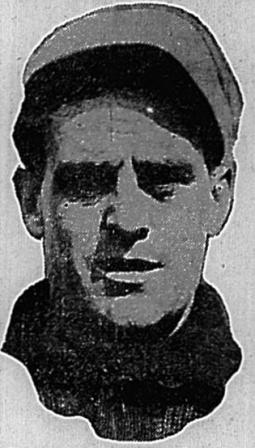
Mike Donlin had, arguably, his best season in 1905.  The next season did not go so well. Donlin was suspended on March 15 by John McGraw while the team trained in Memphis.

The New York Times said Donlin was forced to move from the team hotel while he served the indefinite suspension:

donlin

Mike Donlin

“McGraw gives out a statement in which he says he warned the entire team at a formal conference against unnecessary violations of training methods.  He says this conference was called at a time when Donlin was thought to be the one in need of advice.  Today he was accused of again straying from the patch of sobriety and the ban was placed on him.”

A week later, with Donlin having apologized and been reinstated, The Buffalo Enquirer said:

“Several times this winter the statement has been made that Donlin would be barred from the professional ranks because of his habits.  This severe comment however always emanates from other cities, where the critics would be happy if the Giants, for any reason whatever, were deprived of the services of the greatest slugger on the team.”

After all said the paper:

“Whether it is right or wrong, fully 80 percent of the good ballplayers now before the public are drinking men, and this applies to those who have seen more than 10 years of service as well as the younger players.”

The paper said that “One of the leading managers,” told his players:

‘”I would rather have on my team a ‘rummy’ who can bat .350 than a Father Mathew who hits around the .100 mark.’ The same manager made reference to Abraham Lincoln’s famous remark when told that General Grant was a whiskey drinker.”

According to the paper, a manager of a “Western” club:

 “Wise in his generation, recently framed a rule for his players the effect that any man caught drinking before a game would be fined $5 for each drink.  The astute manager said nothing about after a game.”

The Enquirer quoted John Montgomery Ward, “one of the most intelligent men that ever played the game,” on the subject:

johnmward

John Montgomery Ward

‘Baseball makes such demands on the nervous energies that most men really need something quieting after a hard-fought struggle.  There is always more or less said and written about what is called dissipation among players, but it is principally commented on in connection with losing teams.  As a matter of fact, there is very little real dissipation among professionals.”

The paper concluded:

“What was so in Ward’s day is doubly so today. And further, experienced managers will tell you that as many young players have killed their chances in fast company through overeating as through dissipation.”

Donlin married actress Mabel Hite less than a month after his suspension and it was assumed that she would have a positive influence on his habits; a month later he broke his ankle while sliding and missed the remainder of the season.

“That Night the Butte Gamblers bet Their Heads off”

20 Aug

Clark Griffith repeated the story about how in 1892 he ended up in Missoula, Montana many times.  After the American Association disbanded, Griffith went west to join the Tacoma franchise in the Northern Pacific League.  The team struggled financially, and after receiving an offer from a mining company, the entire team relocated to Missoula and joined the Montana State League.

griffith

Clark Griffith

Griffith appears to have only once told a story about gambling, guns, and baseball in the mining towns of Montana that season.

Shortly after he bought 10 percent of the Washington Senators—he raised the money by mortgaging his Montana ranch—he told William Peet of The Washington Herald about his time in Missoula.  Peet said:

“When there is no real news to hand out, Griff sits back in his chair and between puffs of a cigar tells a lot of interesting baseball stories.”

Griffith told Peet:

“The day before we arrived in Missoula the management there released every man on its payroll, and the day we opened up the ballpark was packed.  Missoula had been the joke of the league.”

Griffith said the club started winning immediately and that the only two pitchers Missoula carried where him and George “Lem” Cross:

“’George Cross and myself did all the twirling, and we worked every other day…our first out-of-town series was in Butte, Montana.  When we hit that town they were waiting for us with open arms.’

“’Our manager Billy Works [sic Work] was told to get all the money he could scrape together, as the Butte gamblers would bet their last cent of the home club.  Works dug up $5000, and the night before the opening game waited for somebody to cover his coin.’

Griffith said the gamblers laid off the first game and did not cover Work’s bet; Cross was “batted all over the lot” and Missoula lost 15 to 4:

“’That night the Butte gamblers bet their heads off, covering our manager’s $5000 in jig time.  I was slated to pitch the next day and the game was a tight one from the start.’

“’Butte tied the score in the ninth, when a ball got away from my catcher.  The ball rolled to the stand, and as he was chasing after it one bug poked his arm over the grandstand rail, extending in his hand a six-shooter: ‘Let that ball alone,’ he cried.  The catcher stopped in his tracks, and the runner scored from third.’”

Missoula won the game in the tenth, and according to Griffith, Work immediately bet his winnings on the next day’s game:

“’Cross confided to me that he wasn’t going to take any chances with such a bunch of roughnecks.  ‘I don’t like the looks of those guns,’ he said.  I believe that if I had not stuck close to him all night he would have jumped town.’

“’We had nobody else to put in, and Cross simply had to pitch the game.  We had an awful time getting him into a uniform, but with a lot of jollying we finally induced him to come along.  He was scared stiff when he entered the box.’

Griffith said Cross “got his nerve back” and beat the Butte team 6 to 1; the easy win seemed to nullify the effects of the armed Butte fans.  Griffith said:

“’It was a grand clean-up all right, and our manager gave me $200 for winning my game.”

Note: This was not Griffith’s only experience with mining, and with guns at the ballpark—he threatened to skip out on his contract before the 1900 to become a gold miner, and during that same spring he was on the mound when “a Southern gentleman opened up with a .44.


Things I Learned on the Way to Looking up Other Things #25

15 Aug

“Used to Come Upon Field Staggeringly Drunk”

Arthur Irwin was a scout for the New York Highlanders in 1912 when he declared to William A. Phelon of The Cincinnati Times-Star that, “Players who are hard drinkers in the big leagues are scarce now.”

irwin

Arthur Irwin

Irwin said a combination of “the improvement in morals” of players, and more so the fact that current players were “money mad” were the reason:

“Long ago the hail fellow and the good fellow, who believed that drinking was the jolliest part of life, were numerous in the big leagues, and there were surely some wonderful soaks in the profession.  Stars whose names will shine forever used to come upon the field staggering drunk, and other stars who had sense enough not to exhibit their follies in public would wait till the game was over and then tank up till dawn.”

Irwin told Phelon about King Kelly’s American Association team:

“The club that tried to play ball under King Kel in 1891 at Cincinnati was about the limit.  They made their headquarters at a saloon across the street from the ball park and some of them could be found asleep there at almost all hours when not actually in the game.  Some of the champion Chicago White Stockings and some of the old St. Louis Browns were likewise marvels on the jag, and it has become a baseball legend that the Browns defeated Anson’s men for the world’s championship (in 1886) because (John) Clarkson, Kelly and two or three others were beautifully corned.”

Clarkson won his first two starts of the series, but lost his next two.  Kelly hit just .208 in the series and St. Louis won four games to two.

Jennings’ Six Best

In 1916, Hughie Jennings “wrote” a short piece for the Wheeler syndicate that appeared in several papers across the country, about the six best pitchers he faced:

hughiejennings

Hughie Jennings

Jack Taylor and Nig Cuppy had fair speed and a fine curve ball, with the added advantage of a slow ball, and good control.  The latter, I contend is the most important asset a pitcher can possess.  My six greatest pitchers are:

Amos Rusie

Jack Taylor

Cy Seymour

Denton (Cy) Young

Charles “Kid” Nichols

Nig Cuppy

“Rusie, Nichols and Young had wonderful speed and fast breaking curves.  Cy Seymour also belonged to this case.”

“Batters Might as Well Hang up Their Sticks”

Add Ned Hanlon to the long list of prognosticators who were sure a rule change would be the death of the game—in this case, the decision in 1887 that abolished the rule allowing batters to call for high or low pitches.

hanlon

Ned Hanlon


According to The St. Louis Post-Dispatch:

 “Hanlon of the Detroits says the abolition of the high and low ball was a fatal mistake, and the batters might as well hang up their sticks.  Ned argues that as the pitcher has the space between the knee and the shoulder in which to throw the ball, all he has got to do is vary the height of his delivery with every ball he pitches, and thus completely delude the batter.  He claims that pitchers capable of doing head work will have a picnic, and that Baldwin will be particularly successful.”