Lost Advertisements–Ed Sweeney for Sweet Caporal

15 Jan

sweeneyad

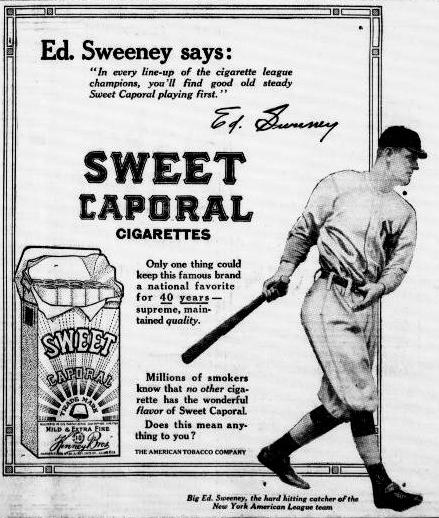
A 1914 advertisement for Sweet Caporal Cigarettes featuring New York Yankee catcher Ed “Jeff” Sweeney:

“In every line-up of the cigarette league champions, you’ll find good old steady sweet Caporal playing first.”

Three years later, while playing for the Toledo Iron Men in the American Association, Sweeney told a reporter about his former teammate Russell Ford, and the development of the Emery Ball.

Sweeney and Ford were teammates with the Atlanta Crackers in the Southern Association in 1907:

“One day while Sweeney was catching Ford in a warm up stunt before a game Russ made a wild peg and the ball bounded into a concrete pillar.

“‘I didn’t know anything about it,’ explains Sweeney, “but after that, I noticed the ball breaking in a peculiar way.  I remarked about it to Ford, but he didn’t appear interested.  I never saw (Ford throw it) again that season.

“‘I was purchased that summer by the Yankees (he joined the team in 1908).  Owner (Frank) Farrell came to me one day and asked who was the best pitcher in the Southern Association.  I told him Ford.  And Russ was drafted.'”

After an unsuccessful one-game trial with Yankees in 1909, Ford spent the remainder of the 1909 season with the Jersey City Skeeters in the Eastern League.  When Sweeney and Ford were reunited the next spring with the Yankees, Ford told the catcher he “‘(H)ad a ball no catcher in the world could receive.  I laughed at him but he persisted.'”

Sweeney said Ford “‘took me into his confidence'” and explained his new pitch, Ford told Sweeney that day in Atlanta he noticed the effect the damage caused by the ball hitting the concrete post had on his ability to make it curve, and he continued experimenting:

“‘Russ showed me a little leather ring that he slipped over a finger of his left hand…All he had to do was to scratch the ball with the emery, that was pasted to the leather…The bigger the scratch the greater the freak jumps the ball would take…He would fake a spitter, and nobody ever got wise.  When he pitched he always requested that I catch him.’

“‘When Russ threw the ball with runners on or in pinches, no batter in the world could hit it.  Once in while somebody did, but it was by accident…I’ve seen batter after batter miss the ball a foot.'”


“Everyone Knows the Human Insect”

13 Jan

Arthur “Bugs” Raymond, obtained by New York Giants at the end of 1908 in the trade that sent Roger Bresnahan to St. Louis, was a great talent but long considered second only to Rube Waddell as baseball’s most eccentric pitcher.

Manager John McGraw was convinced he could succeed with Raymond where other managers had failed.  James Hopper, college football coach, turned novelist and journalist, wrote about Raymond’s first spring with the Giants in “Everybody’s Magazine:”

“’Bugs’ Raymond belongs to the old type of professional baseball player. He is a big child, thoughtless, improvident, a wonder of efficiency at his craft, but totally irresponsible outside of it.  He has been pitching for several years on ‘tail-ender’ clubs—indifferently, in spite of natural gifts, because always out of condition… (McGraw) thinks he can ‘handle’ him.  And he is doing so, thus wise;

“He does not let him have any money. ‘Bugs’ is married and his wife is an invalid.  The contract between (The Giants) and ‘Bugs’ provides that the latter’s salary each month shall go in toto to Mrs. Raymond…Result, a perpetually penniless ‘Bugs’ living an enforced simple life.”

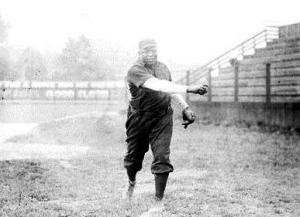
Bugs Raymond

Bugs Raymond

As a result, Hopper said Raymond had behaved and “gradually regained the lithe lines of an athlete,” during the spring in Marlin Texas.

And, six weeks into the 1909 season, it appeared McGraw’s strategy was working.  Raymond won five of his first seven decisions for a team that was 17-17 at the end of May.

Most of what was written about Raymond that season was superficial; many of the stories apocryphal, nearly all of them portrayed him as a simple-minded clown.  One exception was a profile written in May by Sid Mercer of The New York Globe—it remains one of the only articles about Raymond that doesn’t reduce him to a caricature:

“It isn’t necessary to introduce Mr. Arthur Raymond.  Everybody knows the Human Insect.  He’s the easiest fellow to get acquainted with that you ever met.  Just at present, he is the leading pitcher of the Giants, although that is not much of an honor, considering the position of the team.  However, the Chicago citizen is delivering the goods in large packages…Raymond is one of the great pitchers of the country, yet he does not take baseball seriously.

Bugs

Bugs

“He never has got over being a boy, although he is close to 30-years old.  He gets lots of amusement out of the ordinary things of life and of course, his escapades are usually exaggerated.  But do not take the eccentric twirler for a simple fellow.  Raymond has no use for money except to spend it, but he is nevertheless fairly well educated, and when his mind turns to serious thoughts he is quite a different person than the fans imagine he is.

“’I may be crazy,’ he once remarked.  ‘but I ain’t as crazy as Rube Waddell, and I’m no fool.’

“While it cannot be said on good authority that Raymond is a total abstainer, yet he seldom pitches a bad game.  Whatever his faults or weaknesses he earns the salary that is paid to him. His rollicking disposition long ago developed in him a distaste for the accumulation of wealth, so the most of his salary goes to Mrs. Raymond and three children ([sic] Raymond had just one child) in Chicago, while Bugs gets along on a little and has just as good a time as if he handled it all.

“Raymond was originally a pressman on a Chicago newspaper and he has already visited the press rooms of most of the New York papers.  There is nothing of uppish about him and the pressmen are all strong for him…With the bleacherites Raymond is a big favorite.  He is one player who likes to talk baseball to the fans, and his disposition is one that makes friends.  The big fellow is big hearted and generous and there isn’t a mean streak in him.”

Raymond did not finish the 1909 season with the Giants.  He was 18-12 with a 2.47 ERA in mid-September when he left the club, or was asked to leave, or left by mutual agreement, depending on the source.

He was said to be tending bar in New York in late September—but that story is questionable as most contemporary accounts say he was with the Giants when they arrived in Pittsburgh on September 27 and returned to his home in Chicago on September 29.  He told The Chicago Daily News:

“I was fined again and again and suspended until I couldn’t stand it any longer.  My salary for the year was $4500 but McGraw fined me $1700 on one pretext or another, so I’ve got only $2800 for my work this year.

“I was unjustly suspended a short time ago, and this was the last straw.  McGraw didn’t seem inclined to give me a chance to work, and so I quit the team and came home to Chicago.  I may pitch a few games here for some local teams.”

McGraw tried and failed two more times with Raymond—he was 10-15 in 1910 and ’11 with the Giants.  He was dead 15 months after his final game with New York.

“I am going to Drown this Insect of a Manager”

11 Jan

Louis Wilber “Louie” Heilbroner was one of the most unlikely managers in history; no one knew that better than he did.

heilbroner

Louie Heilbroner

In August of 1900, the St. Louis Cardinals—with five future Hall of Famers on the roster—were 42-50 and in seventh place when Manager Oliver “Patsy” Tebeau resigned.  He told The St. Louis Republic:

“My reason?  Simply that I could not make the team play the ball it seemed capable of playing.  I tried every trick I knew and found myself unable to get proper results.”

The Cardinals spent more time fighting—one another, umpires, other teams—than winning.

A cartoon in The Philadelphia North American about the fighting reputation of the 1900 Cardinals

A cartoon in The Philadelphia North American about the fighting reputation of the 1900 Cardinals

It appeared to be a foregone conclusion that Captain John McGraw would be the new manager.  McGraw had other ideas.

He told The Republic he had “refused the position.”  But the paper noted:

“Yet, he admits that, at Mr. (Frank DeHass) Robison’s request, he assumed full duties of the office laid down by Mr. Tebeau…according to his own admission then, McGraw is manager of the St. Louis team.”

While McGraw accepted Tebeau’s duties, the title of manager went to Heilbroner, the 4’ 9” business manager of the club.  The Republic called him a “straw man,” and “scapegoat.”

“(Heilbroner is) all dressed up for use in case (McGraw) fails to make the team win…McGraw is evidently a bit leery of his job of trying to make a silk purse out of a sow’s leg…Though the team is strong enough to win, it is badly disorganized and full of cliques.”

The paper said Heilbroner “makes no pretensions of baseball knowledge.  He does not know a base hit from a foul flag.”

With Heilbroner as “manager,” the team limped to a 23-25-2 finish.

Later, while he was serving as president of the Central League, Heilbroner told Billy Murphy of The St. Louis Star about the moment he claimed he realized he wanted nothing to do with managing a big league club—it involved the then 22-year-old “Turkey Mike” Donlin.

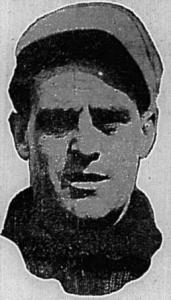
Mike Donlin

Mike Donlin

“(Donlin) was known as a bad actor.  So much so that his frequent clashes with umpires caused Mike to adorn the bench most of the time.”

Murphy said McGraw had gone to Heilbroner and asked him to help stop Donlin from fighting with umpires.  Heilbroner said:

“I’ll stop him.  I’ll fine him the next time he is put out by an umpire.”

Heilbroner said the next time Donlin was ejected, he told him:

“’That will cost you $100, Donlin.’

“With that (Donlin) reached over and. Grabbing Heilbroner with one hand lifted him off the ground.

“’Take the cover off the water bucket, Mac,’ he said to McGraw.  ‘I am going to drown this insect of a manager.’

“’And I think he would have done it, said Heilbroner, ‘if I had not remitted the fine and resigned my job as manager.”

Heilbroner made his greatest contribution to the game in 1908 when he founded the Heilbroner Baseball Bureau, and the following year when he began publishing the Baseball Blue Book.

The Decline of Baseball, 1899

8 Jan

Late in the 1899 season, The Chicago Tribune editorialized on the state of the game.  The paper was convinced that baseball’s best days were behind it:

“Once upon a time this city put on mourning when its ball club lost a game and when the club returned from a victorious tour it had a Dewey welcome.  Men left stores and offices to go to the ball field.  They knew the players on the home team and exulted in their powers.  There is no more of that.  There is no longer any civic pride in the local team.  Business men no longer attend the games.  In this city and in other cities baseball has ceased to be a high-class sport.  It has become a low-grade pastime.  It is patronized by the class of people who are interested in bicycle races, long-distance pedestrian contests, gamblers, horse races and poolrooms.  Baseball, once the sport of men and women of taste, is now the diversion of hoodlums.”

As for why the game was no longer of interest to “men and women of taste,” The Tribune said:

“There is no room for doubt as to what has pulled it down from its former high state.  Commercialism in part has done it.  The players have become chattels.  Teams are bought and sold and are transferred from city to city as if they were livestock.  The men who are playing in Chicago this year may be playing in Cleveland or New York the next.  That cuts up all sense of local pride in a club…There have been teams which really belonged to Chicago.  Of late years, there have simply been organizations of hirelings whose owners instructed them to hail from here.

“Professional baseball is in the hands of a few men whose sole object is to make all they can out of a sport they have ruined.  There is no competition among them.  That championship, in the winning of which cities took so much pride once, has become a farce.”

The actions of Frank DeHass and Martin Stanford “Stanley” Robison was a particular source of the paper’s ire. The Robison brothers, owners of the Cleveland Spiders, purchased the bankrupt St. Louis Browns and transferred Cleveland’s best players, including Cy Young, Nig Cuppy, and Jesse Burkett to the St. Louis club, now called the Perfectos.  What was left of the Spiders finished with a 20-134 record.

 “Sometimes one man owns two clubs and makes draft on one to help out the other. If it becomes evident that Cleveland must be at the tail of the procession, its best men are shifted over to the St. Louis organization, both being under one ownership.  Requisitions are made on Baltimore for the benefit of Brooklyn and on New York for that of Boston.  No city can have any feeling of city proprietorship in a club under such circumstances.”

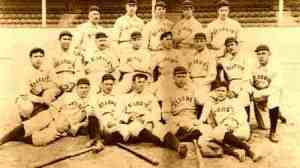
The 1899 St. Louis Perfectos

The 1899 St. Louis Perfectos

The behavior of fans was of equal concern:

“Rowdyism has come in along with commercialism and has finished what interest was left in the game. Quiet, decent people can no longer go to baseball games because of the vulgarity and ruffianism displayed there.”

The Tribune felt current players were of lower moral character than those of the previous generation:

The morals of the players have deteriorated.  They used to try to behave like sportsmen.  They act now like foul-tongued bullies.  When a question comes up for the umpire to settle, the players surround him and blackguard and threaten him.  He is fortunate if he escapes without bruises.  Fair decisions cannot be expected from a man in danger of being mobbed.  Occasionally the contending players come to blows and the spectators, who went to see a game of ball, have to witness a game of slugging, garnished with profanity.”

How low had the game gone?

“Baseball has fallen so low that gamblers do not think it is worth paying any attention to.  They have not dropped it because they fancy it is not ‘on the square,’ but because it has become an uninteresting, second-class sport.  It does not interest them now any more than a race between professional bicyclists does.  Baseball has become a recreation of the people whom commercialism, vulgarity, and Rowdyism do not displease.”

The Tribune continued their crusade against the “uninteresting” sport a month later, with an “account of the more disgraceful of the many rows witnessed by spectators of baseball games.”

“Who Cares about Color, when the Scores are Tied?”

6 Jan

Beauregard Fitzhugh Moseley was one of the primary financial backers of the Leland Giants and after the dispute which led to the departure of Frank Leland, he partnered with Rube Foster and served as business manager for the club when he and Foster won the right in court to continue using that name.

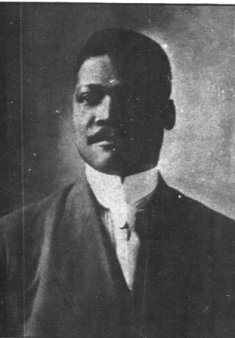
Beauregard Fitzhugh Moseley

Beauregard Fitzhugh Moseley

In January of 1911, he wrote an open letter to the readers of The Broad Axe, what the paper called “A baseball appeal of a worthy undertaking by a worthy man to worthy men:”

“We are undertaking to organize a Negro National League of America, an enterprise that that needs no prospectus to convince one of its necessity to our people, who are already forced out of the game from a national standpoint, with the closing in and narrowing each year our opportunity to play with the white semi-pro teams, because of the organization of these teams into minor state and city leagues.

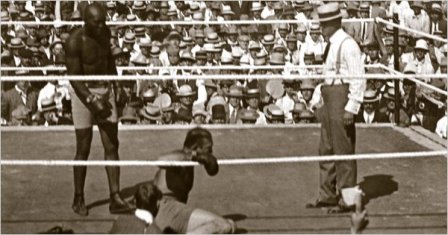
“Here in Chicago, the City League has barred all but possibly one colored club; this fact alone presages the day when there will be none, (unless) the Negro comes to his own rescue by organizing and patronizing the game successfully which would itself force recognition from minor white leagues to play us and share in the receipts; for with six or eight National Negro clubs playing clean, scientific baseball the public would soon ask itself the question which of the National Leagues are the stronger; just as it is queried about the world’s pugilistic championship until the promoters of the game were compelled to answer at Reno (Nevada), July 4th last (The Jack Johnson/Jim Jeffries fight).

Johnson and Jeffries in Reno

Johnson and Jeffries in Reno

“In that contest, just as in the coming contest of the world’s best ball clubs the Negro will be prepared, if he acts wise to take care of himself and be heralded again Champion of the World, so let these who serve the Race and assist it in holding its own back up and encourage the national  movement for with it goes the hope of the Race in more than one direction, for be it known that there are no greater leveler of men than manly sport such as baseball which is admired by white and black alike, appeals to their pride as athletes and to their senses as the best test of physical and mental superiority and here on the diamond before the frenzied anxious populace the Negro has the best opportunity of his present day advantage to display ability, that taken the ball player in Pennsylvania, and California to the Gubernatorial chair.”

John Kinley Tener, a major league player, had just been elected governor of Pennsylvania and George Cooper Pardee, who had made a name for himself as a college and amateur ballplayer served as California’s governor from 1903-1907.

Moseley then asked the most important question:

“Who care(s) about color, when the scores are tied and the home team is at bat in the ninth inning, with two gone and two on base?

“What is wasted is a man that can hit, be he blue, black, yellow, grizzle or gray, a hit that scores (runners) from 2nd and 3rd and the batter is thereafter a hero; hence, the importance of being a ‘hitter’ is a great asset, greater perhaps than any other I can now recall.

“So I appeal to all Race loving men in the cities in which it has been agreed to place a National League club to organize an effort to secure not only the franchise but the best club of ball players possible to the end, that nothing should retard the entire success of the national undertaking.  Hesitancy means ruin.  Procrastination has almost drove the talent from the fold and stagnation will surely set in if a business turn is not thrown over and around the game, $300 is a mere bagatelle for cities like St. Louis, Kansas City, Louisville, Memphis, New Orleans, Mobile and Columbus to raise, it is just $10 each for 30 men and yet this is sufficient to secure a franchise and guarantee the making of the circuit by each club, besides it should be the best investment  now apparent and make those who invest it proud by the returns due them at the end of the season.”

Mosley predicted that each team in an eight-team league could turn enough of profit to repay investors and create operating capital for the following season.

He made a final pitch:

“(O)rganize, get 1o of your Race men together and write at once for your franchise, hustle, the time is short.  The Schedule Committee must report on February 27th next and the organization must be complete and ready to play ball by Easter Sunday.  Men of the Race this appeal is to you for you and yours.  It is in vain or shall we have a Negro National Baseball League?”

His plea for an enduring league was in vain.

Rube Foster deserted Moseley before the 1911 season to form the Chicago American Giants; the failure to form a league has been posited as one of the reasons for the split.  Without Foster, the Leland Giants quickly faded from prominence.

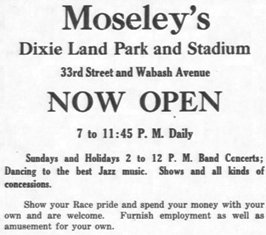
Moseley’s brief tenure as a baseball executive was over after the 1911 season.  He returned to his many business interests, including land holdings in “The Black Eden,” Idlewild, Michigan.  He also owned the Idlewild Hotel and Dixie Land Park at 33rd and Wabash in Chicago–The Chicago Defender said of the Idlewild “It is one of the most pretentious hotels conducted for Colored people in the United States.”  And he continued to practice law–The Defender noted that upwards of “90 percent” of his clients were white–and remained a political force in Chicago’s Black Belt; Moseley also served as a presidential elector for Theodore Roosevelt’s Bull Moose Party in 1912.

Ad for Moseley's Dixie Land Park

Ad for Moseley’s Dixie Land Park

It would be nearly a decade until the formation of a league, and Moseley would not live to see it.

Just two months before his former business partner, Foster and other team owners met at the Paseo YMCA in Kansas City in February of 1912 to form the Negro National League, Moseley died of Influenza.  He was 54.

Rube Foster

Rube Foster

Frank Schulte, “How I Win”

4 Jan

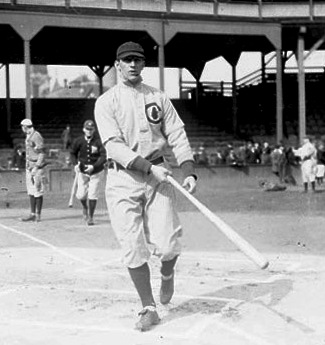
Chicago Cubs outfielder Frank Schulte told journalist Joseph B. Bowles “How I Win,” as part of a syndicated series of articles in the spring of 1910. Schulte, who owned and raced standardbred horses, compared baseball to harness racing:

“First, you have to have the horse, and next the driver that can get the best out of him, and is the best judge of speed and pace.  I try to lay back and let them trot their heads off then go to the whip down the stretch and finish strong.  Of course, I get set down for a bad ride in one or two heats each season.

“I don’t get excited about these ball games.  If they beat me today, I know there’ll be another game tomorrow, and if a fellow can keep up the old confidence he’ll come along somewhere. Every horse is allowed one break in a heat, if it isn’t too long, and still can win. In a race a fellow oughtn’t go to the whip too soon, and it’s the same in baseball.”

Frank Schulte

Frank Schulte

Schulte addressed criticisms about his low-key demeanor on the field, which led some to question his dedication:

“Lots of people think I don’t like this game because I don’t get excited, but the fact is I want to win just as much as anyone does, only it affects me differently. I try to keep thinking and waiting until some of the excitable fellows swing wide from the rail, then I make a drive for the pole and come through on the inside…A team out there in the front running their heads off and working themselves out oughtn’t to discourage a team that is trailing along and doing pretty well.  I just say: ‘Old boy, we may never get up where you are, but you’ll come back to where we are,’ and keep plugging along.”

[…]

“The only way I know how to win a game is to get the hit when it is needed and to make the throw when you have to, wasting as little effort as possible and saving up strength for the time when it is necessary.  I try not to wear myself down early in the season, and to come strong toward the finish, when games count more, and to drive harder in games that are important than in others, and to ease  up and save myself after a game is safely won;  that is not to take the chances in easy games I would take in hard ones.”

Schulte said “a fellow ought to be able to take a philosophical view,” of the game:

“Keeping cool and thinking helps a lot…If I strike out three times, I come back to the bench and say: ‘Old boy, you keep pitching that way to me and I’ll claw one pretty soon.’  And then maybe I get hold of the ball good just when it helps the most, instead of getting discouraged or worried.  And when one of those fellows who want to run themselves to death and tire out before a game is over, and reduce to shadow before the season ends, yells: ‘I got it, I got it!’ I say, ‘Take it, I’ll trot back. Then when I have to be I’m fresh.”

Lost Advertisements–The $30,000 Battery

30 Dec

otoolead

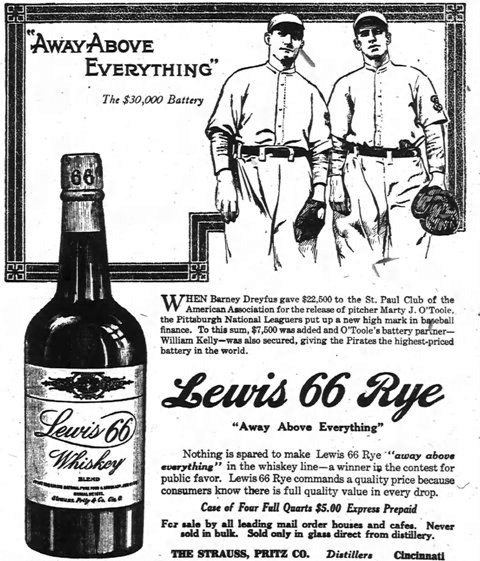
An advertisement from the spring of 1914 for Lewis 66 Rye from The Strauss, Pritz Co., of Cincinnati:

“When Barney Dreyfus gave $22,500 to the St. Paul Club of the American Association for the release of pitcher Marty J. O’Toole, the Pittsburgh National Leaguers up a new high mark in baseball finance.  To this sum, 7,500 was added and O’Toole’s battery partner–William Kelly–was also secured, giving the Pirates the highest priced battery in the world.”

The price paid for Kelly remains a matter of dispute.  The New York Times said he was acquired “for less than $5,000.”  The Washington Post put the price at $10,000 while The Pittsburgh Gazette Times, The Pittsburgh Press and The Associated Press said it was $12,500.


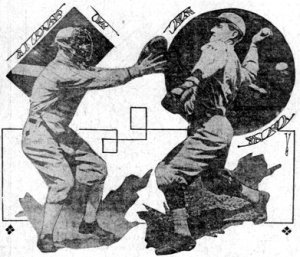
Kelly and O'Toole

Kelly and O’Toole

O’Toole posted a 24-27 record from 1911-1913.  He struggled in 1914, and with a 1-8 and record and 4.68 ERA in August, he was sold to the Giants, in 10 appearances with new York he was 1-1 with a 4.24 ERA.  Dreyfus’ “$22,500 Beauty,” was done as a major leaguer at 25 years old, seven months after the ad appeared.  He played four more seasons in the American Association and Western League; his professional career was over before his 30th birthday.

Kelly’s big league career was over before the ad came out.  In three seasons with Pittsburgh, he appeared in 104 games and batted .290, but was sold to the Toronto Maple Leafs of the International League at the end of 1913 season.  The Pittsburgh Press said the sale came as no surprise:

“Kelly came here from St. Paul with Marty O’Toole, but he has not developed as was expected of him, and has long been rated as considerable of a disappointment. It looks very much as if he were just a trifle shy of major league calibre.”

Kelly played four years in Toronto, hitting .227 in 280 games; his professional career was over at age 31.


“Frysinger Hated in the Paper City”

28 Dec

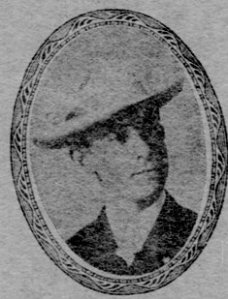
It took less than two weeks for Jesse “Jess” M. Frysinger to go from being the most popular man in Holyoke, Massachusetts to becoming not just the most unpopular man in town, but a man reviled by the entire Connecticut State League.

His arrival in Holyoke in the winter of 1904 to take over the reins of the Holyoke Paperweights was met with great fanfare.
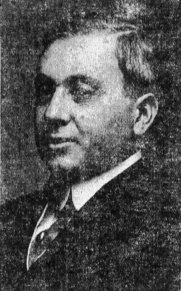
Frysinger

Frysinger

Born in 1873 in Chester, Pennsylvania, the son of a newspaper publisher, Frysinger was a well-known ballplayer around his hometown until his mid-20s when he became a manager.  He managed a local club in Chester from 1899 to 1901.  The 1901 team was a member of the Pennsylvania State League, and the following season Frysinger moved the team and most of the players to Wilmington, Delaware to join the “outlaw” Tri-State League.

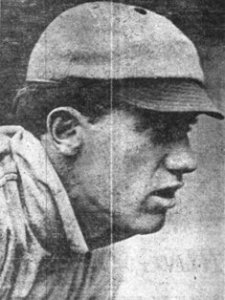
When in 1903 Frysinger took over as manager of an independent team in Harrisburg, Pennsylvania, which would eventually join the Tri-State, he signed a young shortstop he knew in Chester named Joe Cassidy.  No statistics survive for the 1903 Harrisburg club, but Cassidy played well enough to be signed by the Washington Senators at the close of the season.  The 23-year-old was a promising prospect and rare bright spot with the horrible 1904 and ’05 Senator teams but passed away from either typhoid or malaria (depending on the report) in 1906 before he could realize his potential.
Cassidy

Cassidy

Frysinger managed the Tri-State League Wilmington Peaches in 1904, then left to manage Holyoke, making the bold prediction that he would bring a winning team to the paper producing capital of the world.  Frysinger brought with him several players from Pennsylvania who would make up the core of his ballclub, including Snake Deal, Chick Hartley and Butch Rementer.

The Paperweights quickly became the powerhouse of the Connecticut State League, in one stretch, beginning in late June the team won 20 of 23 games, and easily won the league championship.

Frysinger was given a $300 bonus on top of his $1200 salary and on September 12 signed a contract to manage the Paperweights in 1906 at a salary of $1400.  He was the town hero and was presented a diamond watch fob by the team’s directors.

Things changed quickly.

On September 29, while Frysinger and the Holyoke team were playing a series of exhibition games against local teams in Pennsylvania, he informed the Holyoke management that he had accepted an offer to manage the Lancaster Red Roses in the Tri-State League for $1800.  Holyoke refused to let Frysinger out of his contract so he simply jumped.  At the same time, Frysinger did exactly what he did when arriving in Holyoke; he took many Holyoke and Connecticut State League players with him.  In addition to Deal, Hartley and Rementer, Frysinger signed Fred Crolius, Pop Foster and Dave Altizer away from the league.

Holyoke was in an uproar.

“Frysinger Hated in the Paper City,” said the headline in The (New London, CT) Day, the story called Frysinger a”

“Traitor to Holyoke ideals and baseball ethics.”

The Bridgeport Herald said Frysinger “Is determined to take away from Holyoke all its best.”

No one in Holyoke or anywhere in the Connecticut State League seemed to care about the contract status of the players when they arrived with Frysinger, but their departure became the main focus of the league meeting in January of 1906.

There were demands to have Frysinger blacklisted, but the manager, recovering from appendicitis in Wilmington, Delaware told The Meriden Daily Journal “I brought them to Holyoke…why shouldn’t I try to bring them to Lancaster as well?”

Frysinger’s status would never be resolved.  The 33-year-old manager developed an infection from the surgery and died on February 5, 1906. The Philadelphia Inquirer said most of the Lancaster club and Philadelphia Athletics Manager Connie Mack were present at the funeral in Wilmington.

The Lancaster New Era reported that there was some concern in the city about whether the players signed by Frysinger would play for the team:

“(Q)uite a number of players affixed their signatures to local contacts for the only reason that they were to play under Frysinger, who had the reputation for being one of the squarest managers in the business….The deceased wife (Madge), who acted as the manager’s stenographer through his final illness is thoroughly conversant with the affairs concerning the local baseball situation, and she promises to retain the players already signed.”

She was true to her word; all of the players who were mentioned to have committed to Frysinger were members of the 1906 team which finished in third place in the Tri-State League

Lost Advertisements–An Excellent Christmas Gift

25 Dec

???????????????????????????????

A 1916 advertisement for the World’s Series Baseball Game from the United Games Company:

“Every play known to baseball can be made on this game.  Pitch a Straight or Curved Ball, Bunt or Hit ‘Em Out, and Steal Bases as you think best.  Don’t matter whether you know real baseball or not–you’ll soon like this game…”

An Excellent Christmas Gift

“Read this letter from a ‘World’s Series’ Fan:  ‘I am sending to you for another of your World’s Series Baseball Games.  I bought one of these games last summer and was delighted with it.  My father, who was never a baseball enthusiast became a rabid fan at this game, as did the whole family to such an extent that I was unable to get the game when I wished it.'”

“The Man who Lives in the Santa Claus House””

23 Dec

Walter Sydney Woods earned his nickname “Sunday School Pitcher” because he never played a game on Sunday throughout his 20-year professional career.

Woods also played lacrosse, football, basketball and tennis and was considered one of the best athletes in New Hampshire when he chose to enter professional baseball with Portland in the New England League in 1895.

In 1897, he won 17 games for the Springfield Ponies in the Eastern League and was drafted by the Chicago Orphans.

When Woods arrived in Chicago, it was assumed he’d give up his pledge not to play on Sunday, but he quickly made it clear that he would quit first.  The Sporting Life said:

“Walter Woods, Chicago’s model man, will not play Sunday ball either at home or on the road.  The conscientious youngster who neither smokes, drinks nor swears, also has scruples against participating in games on the Sabbath. He will thus be a standing reproach to all the other members of the Chicago Club”

Woods pitched and played infield and outfield for Chicago, going 9-13 and hitting only .175.  He was traded to the Louisville Colonels the following season and posted an identical pitching record, although The Sporting Life said in July:

“Walter Woods is an unlucky pitcher.  Though pitching finely he has won but two games out of his last eight.”

Woods went to the Pittsburgh Pirates in 1900 but was released in April.  He spent the next 14 season playing for a variety of teams in the Eastern and New York State Leagues, exclusively as a position player after 1902.

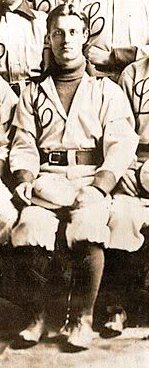
Walter Woods, 1899 Louisville Colonels

Walter Woods, 1899 Louisville Colonels

Woods also coached baseball at the University of New Hampshire from 1897-99 and at Dartmouth from 1912-1915 and played semi-pro football during the winter.  After baseball, he went to work for the US Postal Service.

But to a generation of kids in Portsmouth, New Hampshire, none of that mattered.  At Christmas every year, he was known as “Jolly Wally Woods-the man who lives in the Santa Claus house.”

For about 15 years until his death, kids would line up in front of Woods’ house one day about a week before Christmas and wait for him to appear in an attic window dressed as Santa Claus.  Woods would lower baskets of candy and toys down to the children with a rope, and then on Christmas morning, he was back in the suit with presents for all the neighborhood kids.

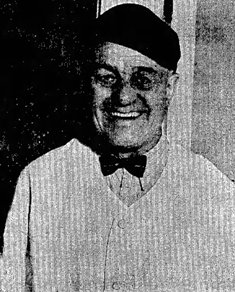
Wally Woods

Wally Woods

The “Sunday School Pitcher” died in Portsmouth in 1951.