“Frank Chance Stands Forth as the Biggest Individual Failure”

21 Dec

It was widely assumed that American League President “Ban” Johnson had a hand in the transactions that resulted in Frank Chance coming to New York to manage the Yankees in 1913—Chance was claimed off waivers by the Cincinnati Reds in November of 1912, then waived again and claimed by the Yankees a month later.
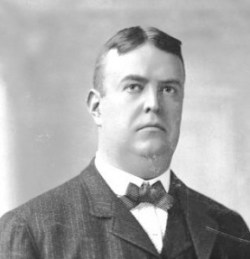
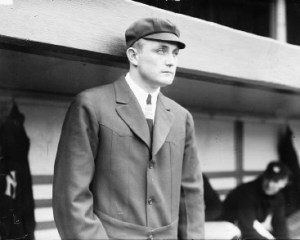
Ban Johnson

Ban Johnson

William A. Phelon, the sports editor at The Cincinnati Times-Star noted “(T)he strange fact that all the clubs in the older league permitted him to depart without putting in a claim,” as evidence of the fix being in.  And, in “Ban Johnson: Czar of Baseball,” author Eugene Murdock said “Johnson masterminded a series of intricate maneuvers,” to bring “The Peerless leader” to New York.

Chance’s arrival in New York was heralded as a turning point for the franchise, and he made no effort to downplay his confidence.  On January 9, 1913, The Associated Press reported that chance told Yankees owner Frank Farrell:

“I will win the pennant for you before I get through in New York. That may sound like a bold statement to make at this time, but I ask you to remember my promise.”

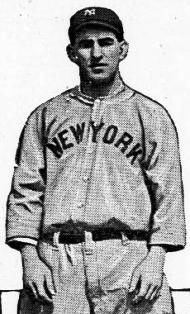
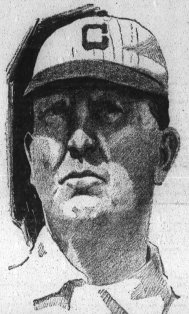
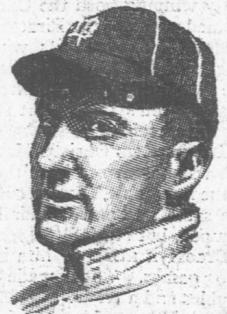
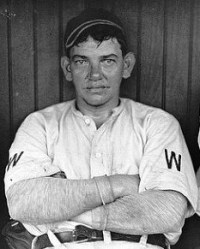
Frank Chance

Frank Chance

Despite the maneuvers on Chance’s behalf and Chance’s own confidence, he failed miserably in New York. The club finished seventh with a 57-94 record in 1913. The following season, the team was 60-74 when Chance resigned.   The resignation came after a tumultuous season which included charges by Chance that the team’s failures were largely the result of scout Arthur Irwin’s failure to sign decent players.  He also secured a guarantee of his 1915 salary from Farrell before he resigned.

Two months after Chance’s exit, the man who “masterminded” the moves that brought him to New York, unleashed his wrath on the former manager to Ed Bang of The Cleveland News:

“You can say for me that Frank Chance stands forth as the biggest individual failure in the history of the American League.  That’s the sum and substance of what B. B. Johnson, president of the American League said a short time since when “The Peerless Leader” came up for discussion, ‘and what’s more, you can write a story to that effect and quote me as strong as you’d like,’ Ban continued.

“President Johnson had great hopes of Chance molding a winner in New York, and when, after almost two years as the leader of the Yankees, he quit a dismal failure, the blow all but floored Ban for the count.  The American League has always played second fiddle to the Giants in New York, and Ban and other American Leaguers figured that Chance was the man to bring about a change in the condition of affairs.”

Bang said Johnson took Chance’s failure “to heart,” because he believed he “made a ten-strike” for the league when Chance came to New York.  Johnson told him:

“’Chance had the material in New York and I think any other man would have made a success og the venture,’ said Ban.  ‘Surely no one could have done any worse.  Of all the players that were on the New York roster in 1913 and 1914, and there were any number of likely looking recruits, Chance failed to develop even one man of class.  Why, it was an outrage.’

“’And then when he made up his mind that he was a failure, or at least when he was ready to step down and out he had the unmitigated nerve to ask for pay for services that he had not performed.  That surely was gall, to say the least.”

Johnson finished by comparing Chance unfavorably with the Yankees’ 23-year-old captain who replaced him and guided the team to a 10-10 finish:

“’Why, Roger Peckinpaugh, youth though he is, displayed far more class as manager of the Yankees in the short time he was at the helm than Frank Chance ever did.”

peckinpaugh2

Roger Peckinpaugh

Irwin left the Yankees in January of 1915 when Farrell and his partner William Devery sold the team to Jacob Rupert and Cap Huston.  Peckinpaugh remained captain but was replaced as manager by Bill Donovan, who guided the Yankees for three seasons–a fifth, a fourth and a sixth-place finish with an overall record of 220-239.
Lost Advertisements–Cubs, White Sox and Whales Endorse Steele’s Game of Baseball

18 Dec

steeles

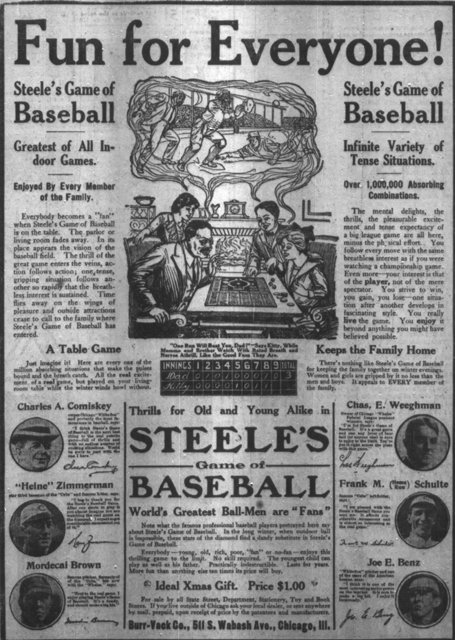
A 1915 advertisement for Steele’s Game of Baseball, a table-top game which claimed to have “Over 1,000,000 absorbing combinations,” and promised that the player would “enjoy it beyond anything you might have believed possible:”

Greatest of All Indoor Games

“Everybody becomes a ‘fan’ when Steele’s Game of Baseball in on the table.  The parlor or living room fades away.  In its place appears the vision of the baseball field.  The thrill of the great game enters the veins, action follows action; one tense, gripping situation follows another so rapidly that the breathless interest is sustained.  Time flies away on the wings of pleasure and outside attractions cease to call to the family where Steele’s Game of Baseball has entered.”

The game was produced by the Burr-Vack Company, a Chicago-based office supply dealer, and received glowing endorsements from members of the city’s three teams:

World’s Greatest Ball-Men are “Fans

Charles A. Comiskey owner Chicago ‘White Sox’ and probably the most famous man in baseball, says: ‘I think Steele’s Game of Baseball is the next best thing to the real outside game–full of thrills and with an endless number of exciting situations.  Would be sorry to part with the one I have.’

“‘Heine’ Zimmerman third baseman of the ‘Cubs’ and famous hitter says: ‘I  beg to thank you for the Steele’s Baseball Game.  After one starts to play it you almost imagine you are watching the real game on the diamond.  I expect to get considerable amusement out of it.’

Mordecai Brown famous pitcher, formerly of the ‘Cubs’ but now with the ‘Whales’ says: ‘Next to the real game, I enjoy playing Steele’s Game of Baseball.It’s a dandy and should make a big hit.’

Chas. E. Weeghman owner of Chicago ‘Whales’ Federal League pennant winners says, ‘I’m for Steele’s Game of Baseball.  It’s a great game and one any lover of baseball (or anyone else) is sure to enjoy to the limit.  You’ve put it right across the plate with this game.’

Frank M. (Home Run) Schulte famous ‘Cubs’ left fielder says: ‘I am pleased with the Steele’s Baseball Game you sent me.  It affords considerable amusement and is almost as interesting as the real game.”

Joe Benz ‘White Sox’ pitcher and one of the stars of the American League, says, ‘I think it is one of the most interesting parlor games on the market.  It is sure to make a big hit. I enjoy it immensely.'”

[…]

“Note what the famous professional baseball players portrayed here say about Steele’s Game of Baseball.  In the long winter, when outdoor ball is impossible, these stars of the diamond find a dandy substitute in Steele’s Game of Baseball.”

Despite the endorsements, the “Ideal Xmas Gift,” which cost one dollar and was “For sale by all State Street, Department, Stationary, Toy, and Book stores,” appears to have quickly disappeared–there are no mentions of the game in newspapers after 1915.

“Those Freak Balls have no Place in the Game”

16 Dec

Billy Evans, “The Boy Umpire,” was a newspaper reporter in Youngstown, Ohio before he worked his first game as an umpire and continued writing about baseball in syndicated articles throughout his nearly 50-year career as an umpire and front office executive.

Billy Evans

Billy Evans

In January of 1917 he wrote about a conversation he had the previous summer with Cy Young, the 49-year-old former pitcher, out of baseball for five seasons:

“I met him in the lobby of a Cleveland hotel.  Jokingly, I asked him how his arm felt and if he would be able to pitch that afternoon.  He looked as well as ever.  His waist line alone showed the effects of not being in constant training. At the mention of his arm and the chances of him pitching, Cy’s eyes flashed with the old spirit.”

Young told Evans he was “ready and willing:”

Cy Young

Cy Young

“’Honestly Bill, the old arm feels as good as ever,’ was his reply to my query.  ‘Never hurt me in my life, don’t know what it is to have a pain in that good old right arm.  When I quit I had more speed and a better curve than a lot of fellows who are still big leaguers, and I didn’t develop that curve until I had been a big league pitcher many years.  You know, it was excess weight, and not a glass arm, that made me quit pitching. My fielding failed me long before my arm showed signs of weakening, and when I was in my prime I was hardly (Napoleon) Lajoie on ground balls, bunted ones in particular.  During my last two or three years as a big leaguer the boys were wise to my inability to field, even as well as I once did, and they made life miserable for me in many a game.  You might say I was practically bunted out of baseball.”

Young said control “more than any other feature” was the key to his longevity:

“I saw many a pitcher come and go and it was lack of control that started most of them on their way to retirement or to the bushes.  Wasted effort ruins man a pitcher’s arm.  I never used any more energy than was necessary.  I have known a lot of pitchers who invariably did enough pitching for three games every time they were called.  It seemed as though they would have three balls and two strikes on every batter. “

Young said early in his career he learned to warm up differently than most pitchers:

“In the old days pitchers when warming up prior to pitching used to do so at random.  They would hurl the ball to the catcher without any definite purpose.  The sole aim was to get the muscles of the pitching arm loosened.  When I warmed up I always had the catcher take off his cap and set it on the ground for an imaginary home plate.  I figured this scheme would not only loosen up the muscles but help my control, for instead of throwing every ball aimlessly to the catcher, I made an effort to get every ball over the plate…Many pitchers used to warm up from any old distance.  They might pitch from forty to sixty feet.  I always insisted on warming up from the regulation pitching distance.”

[…]

“That I was right in many of my theories has been proven by the methods now used by every major league club.  Practically all have regular places for the pitchers to do their preliminary work.  I mean they have the distance carefully measured to conform to the rules, and have regular pitching rubbers and home plates.”

Evans asked Young what he felt about “new fangled” pitches like the spitball and emery ball:

“’I don’t think about them,’ answered Young.  ‘I just laugh.  We didn’t have to resort to that stuff in the old days, and there were some pretty good pitchers serving them up then.  Speed, curves and a change of pace ought to be enough for any pitcher.  Those freak balls have no place in the game, but it is a pretty hard matter to legislate them out.”

Honus Wagner, “How I Win”

14 Dec

As part of a series of syndicated articles which asked some of baseball’s biggest stars to talk about “How I Win,” Joseph B. Bowles, a Chicago journalist, interviewed Honus Wagner before the 1910 season.

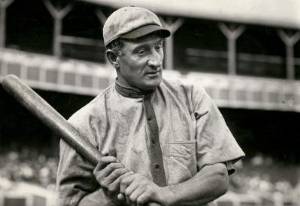
Honus Wagner

Honus Wagner

Wagner said it was simple:

“The secret of winning at baseball is to be found in the first order given to a new ballplayer.  it is ‘Keep your eye on the ball.’  I believe there is such a thing as the instinct for playing the game, but the greatest success comes from quick eyesight and from never taking the eye off the ball for a moment, whether batting fielding or running bases.”

But, he admitted he hadn’t given the subject much thought:

“I never have written anything about baseball, and never have thought much about why a team wins or why a player is a winning player (until now).  It is hard for a player to explain how he wins than it is to win.  I think, however after thinking it over, that the eyesight has more to do with it than anything else.  It is the quick eye and the steady one that makes a man a winner.”

Wagner said this was especially true at bat:

“The batter who faces a clever pitcher is certain to be outguessed by him the majority of times. There is no way to overcome the pitcher’s advantage except to have an eye quick enough to see either from the way the pitcher wings or from the way the ball comes, what is pitched, and then have an eye quick enough to enable him to follow the course of the ball.”

As for his approach at the plate:

“In batting a player should stand firmly on both feet.  It does not matter what his position at bat is, and he ought to take his most natural position, but he must stand on the balls of both feet to get the force of his body, arms and shoulders into the swing of the bat.  Every batter has a different style, but the good ones swing with a steady drive, backed up by the whole body.  I think there is a lot in the way a man holds his bat.  It is impossible to tell a young player how to hold his bat.  He must use his own motion and grip.  He can, however, learnt o shift his feet in hitting.”

On defense, Wagner said:

“(T)he quick eye saves many hits…Perhaps one in five ground balls hit to an infielder bound crooked or shoot in unexpected directions, and a quick eye and a good pair of hands will save the team.”

Wagner was also quick to credit his teammates:

“I think the big reason for Pittsburgh’s success has been first that we’ve played together a long time and know each other and second, and greater, that every man is there to win for the team, no matter what he may do himself.  Last year (George) Gibson caught the greatest ball of any catcher living, and he enabled all the rest of us to play team ball all the time because he was in the team work every minute.  Besides (Fred) Clarke is the greatest manager in the business and a great leader.  No one knows how good Clarke is until he has played with him.”

Bowles spoke with one other Pirate player for his series.   Second baseman John “Dots” Miller was the 22-year-old rookie second baseman who played alongside Wagner on the 1909 World Champions.  His answer to “How I Win:”

“I win by watching Wagner.

“When asked to tell how I won I was going to refuse because it does sound ‘swelled’ for a young fellow to tell such things or claim to win until I remembered how it was.

Dots Miller

Dots Miller

“I win because Honus Wagner taught me the game, showed me how to play it something after his own style, so in telling how I win I am only praising the teacher and the man I think is the greatest ballplayer of them all.”

Lost Advertisements–Ty Cobb, Lewis 66 Rye

11 Dec

cobblewis66

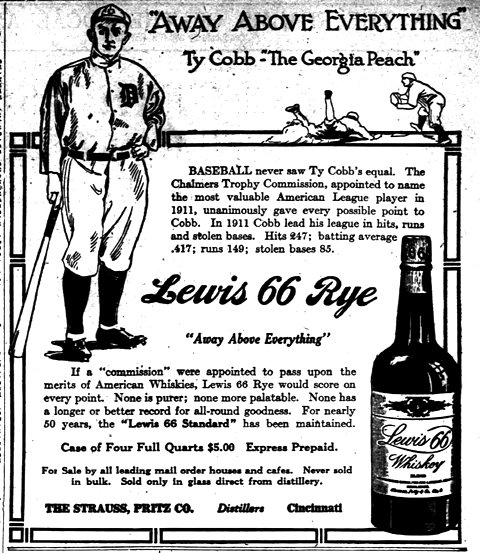
A 1912 advertisement for Lewis 66 Rye Whiskey from The Strauss, Pritz Company, a Cincinnati-based distiller:

“Away Above Everything”

Ty Cobb–‘The Georgia Peach’

“Baseball never saw Ty Cobb‘s equal.  The Chalmers Trophy Commission, appointed to name the most valuable American League player in 1911, unanimously gave every possible point to Cobb (he received all eight first-place votes–the commission consisted on one sportswriter from each league city).  In 1911, Cobb led his league in hits, runs, and stolen bases.  Hits 247; batting average .417; runs 149, stolen bases 85 [sic 248; .420; 147, 83].”

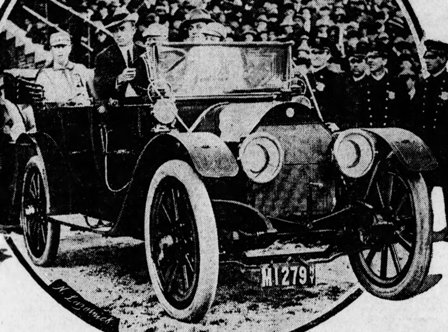
Cobb was presented with a Chalmers “36” at Shibe Park in Philadelphia on October 24, 1911, before game four of the World Series. Jack Ryder, covering the series for The Cincinnati Enquirer said of the presentation:

“President (John T.) Brush of the Giants declined to allow this ceremony at the Polo Grounds, so it was pulled off very quietly here this afternoon…The event took place 10 minutes before the game and was coldly ignored by the Giants though the Athletics took a keen interest in it and several of them had their pictures taken with Cobb. Ty now has three cars, but he says this one is much the best of the lot, and he expects to drive it to his home in Georgia as soon as the series is over.”

Cobb in his Chalmers at Shibe Park

Cobb in his Chalmers at Shibe Park

While Cobb was the unanimous choice of the eight-man commission, the second place finisher in the American League received a more valuable car.

The Chicago Inter Ocean said Chicago White Sox fans, unhappy that pitcher “Big Ed” Walsh finished second to Cobb, “Undertook to raise a fund to purchase an automobile,” for him.

But, said the paper, the fans:

“(F)ound themselves confronted with a dilemma–they had too much money in the fund to buy a duplicate of the Chalmers touring cars presented to Ty Cobb and (National League winner, Chicago Cubs outfielder) Frank Schulte.”

Two days before Cobb received his Chalmers in Philadelphia, Walsh was presented with his car before a charity game at Comiskey Park.

Ed Walsh

Ed Walsh

No Chicago newspaper reported the make and model.  The Daily News called it “A handsome automobile.”  The Inter Ocean said it was “A $4,000 automobile,” and The Tribune said simply that he had received an “(A)utomobile subscribed for by the fandom of the city.”  The Examiner also failed to mention the type of car Walsh received but said the Cubs’ Schulte “gave $25” to the fund.

According to The Tribune, Walsh promised to “‘(L)earn how to run it before spring,’ and the stands cheered loyally.”

Rube Waddell, “How I Win”

9 Dec

Joseph B. Bowles, a Chicago journalist, produced a series of syndicated interviews with baseball stars in 1910.  Among them, Rube Waddell on “How I Win:”

“Curve them when they think they’re coming straight, straighten them out when they are expecting a curve, lob them when they are set for fast ones; and come on with the speed in a pinch.”

Waddell said his fastball and curve were effective but gave just as much credit to having “outguessed about as many batters who were trying to outguess me,” as any other pitcher.

Waddell

Waddell

The interview suggests Waddell was very aware of his reputation and used it to his benefit:

“There are a lot of fellows who think the ‘Rube,’ as they have called me ever since I was a rube, isn’t doing much thinking, but they keep taking three healthies and sitting down just the same…I know all the batters and where to pitch to them—or where not to pitch, rather—but in a game I watch them closely to see what they are trying to do, and then ‘cross’ them with something else”

Control said Waddell was critical:

“Control has been the great trouble with all left-handed pitchers, and very few of them can put the call where they want it to go.  I always have had pretty fair control and sometimes perfect control for months at a time.  A fellow cannot say honestly he always has it for there are times when the ball won’t go anywhere he wants it to go.”

He also credited his motion for his success:

“A good motion is necessary, not only to keep the batters from getting on to what a fellow is pitching, but also to save the strain on the pitching arm and back, and to add to the speed.  The only thing it hurts is control, and if you notice when a left-hander is wild it is mainly because he is swinging himself off his stride.  Then he has to shorten up the swing to regain control, and if he has not the speed with the shorter swing—bing bing—and to the bench for him.”

Rube

Rube

Like many pitchers, Waddell said he preferred taking the mound on overcast days:

“The easiest games for me are on dark days when I can just cut loose the speed and curve and mow them down,  On days like that a pitcher with speed does not need to strain his head thinking.  He can just pitch.”

Cuban X-Giants In Washington D.C., 1901

7 Dec

xgiants

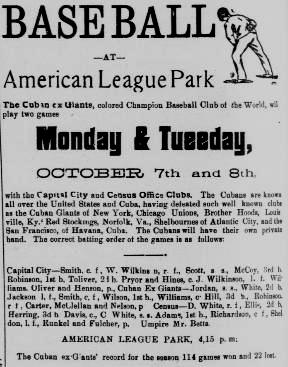
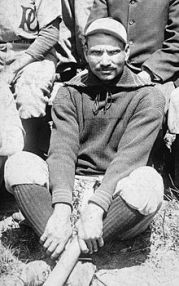
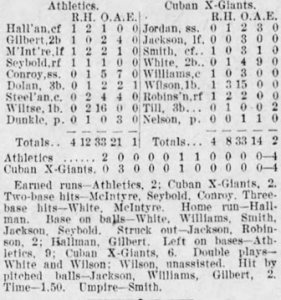
A 1901 advertisement for the Cuban X-Giants, managed by Soloman “Sol” White, in Washington D.C.  The team played the Capital City–described by The Washington Times as “a contingent of colored ball players of this city,” and the team representing the United States Census Bureau at American League Park.

Sol White

Sol White


According to the ad:

“The Cubans are known all over the United States and Cuba, having defeated such well-known clubs as the Cuban Giants of New York, Chicago Unions, Brother Hoods, Louisville, KY. Red Stockings, Norfolk, VA., Shelbournes of Atlantic City, and the San Francisco, of Havana Cuba.  The Cubans will have their own private band.”

The previous week, the X-Giants played an 11-inning tie with the Philadelphia Athletics at Columbia Park–although the Athletics three biggest stars, Napoleon Lajoie, Harry Davis and Lave Cross did not participate, The Philadelphia Inquirer said, “Both teams put up a splendid article of ball and the game resulted in one of the best that has been played on the grounds this season.”

The Philadelphia Times was even more enthusiastic:

“The game itself was beyond all doubt one of the greatest ever witnessed upon the local diamond.”

The 11-inning tie against the Athletics

The 11-inning tie against the Athletics

The ad said the club had won 114 games and lost just 22 in 1901, and described them as the “Colored Champion Baseball Club of the World.”  In both 1900 and 1901 the X-Giants and the Cuban Giants each claimed to be “Colored Champion.”

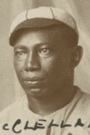
In addition to Sol White, the roster included, Robert Jordan, Ray Wilson, Clarence Williams, John Nelson, Danny McClellan, Will Jackson, Johnny Hill, Robert “Ginney” Robinson, and Charles “Kid” Carter.

The X-Giants won both of the advertised games.  The victory over the Capital City club was of such little note that no newspaper mentioned the score.  The Washington Colored American simply said the X-Giants “Played stars and circles around the Capital Cities.”

They also beat the Census Department 8 to 0.  The Washington Times said:

“The visitors had things their own way throughout the game, and at no time were they in danger of being defeated.  They had a twirler (McClellan) in the box that knew the fine points of the game.  He struck out nine of the localities and allowed but two of them to get the slightest semblance of a safe hit off his cannon ball delivery.”

Danny McClellan

Danny McClellan

The X-Giants beat one more local team, the Eastern Athletic Club, on October 9, and left the nation’s capital 117-22.


Lost Pictures–The Best Eyes in Baseball

4 Dec

eyeszimmerman

eyesdaubert

eysspeaker

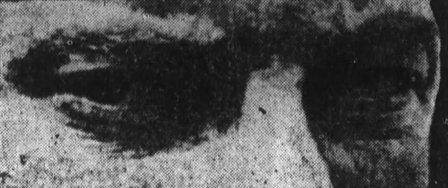
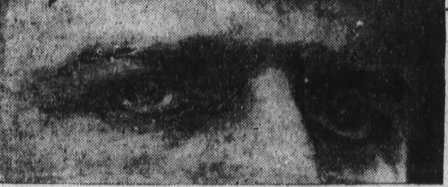
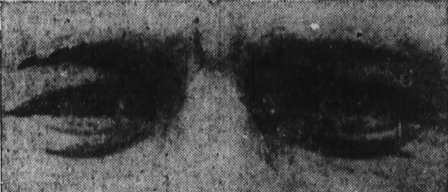
Above, three sets of eyes, 1916.

Harold “Speed” Johnson of The Chicago Herald said:

“It’s the eye and not the wallop that counts in the national Pastime.  Some eyes are more durable than others.  Larry Lajoie possesses such a pair; so does Hans Wagner, Terry Turner, Tris Speaker, Jake Daubert, Frank Schulte, Larry Doyle, Heine Zimmerman, Tyrus Cobb, Joe Jackson and Bill Hinchman.”

Johnson informed his readers that “Most of these birds refrain from reading during the offseason, thereby sparing their eyes.”

As for the three sets pictured above, Jonson said:

“Heine Zimmerman is another notable example of the batter who possesses the keen optics.  He eccentric third sacker of the Chicago Cubs, when at peace with the world, is one the greatest natural sluggers of all time.  His eyes never have troubled him but his temperament frequently has caused him to slump, swinging frantically at any old pitch.  Right now Heinie is seeing in exceptionally good form as witness his average of .336 for 48 combats.”

[…]

“There is nothing wrong with Jake Daubert’s glims as a slant at the latest averages will indicate…His heavy cannonading has been a principal factor in the upward climb of the Robins…For a pair of eyes that have been in use as long as Jake’s in the big set they’re holding out famously.”

[…]

 “Nine seasons of big league milling haven’ dulled the lamps of Tristram Speaker who right now is going better than he did in his banner years with the Boston Red Sox.  Not only is the big Texan rattling fences  at Dunn Field, Cleveland, where for seven years he averaged .381 on visits with the Bostonese, but he is keeping up his terrific pace abroad.”

Zimmerman’s temperament caught up with him again.  He wore out his welcome in Chicago in August of 1916, was traded to the New York Giants and finished the season with a .286 average.

Daubert’s eyes held out.  He hit .316 and led Brooklyn to the National League pennant.

Speaker kept hitting at Dunn Field and everywhere else, finishing the season with a major league-leading .386 average.

“Loved Baseball More than He Feared Death”

2 Dec

Robert William “Bob” Osgood was told by doctors that he couldn’t play high school baseball because of a heart ailment.  He was also told he wouldn’t live long.

According to The Associated Press, he begged his parents for a chance to play and “(T)he youth’s parents thought it better that Bob’s playing be supervised and permission was granted.”  By his senior year in 1946, was named to several Massachusetts All-State teams.

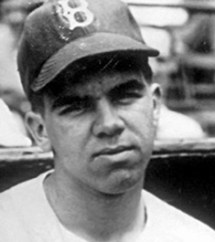
After graduation, Osgood signed with the Chicago Cubs.  His older brother Charles was then playing in the Cubs organization after appearing in one game as a pitcher for the Brooklyn Dodgers in 1944 as a 17-year-old.

Charles Osgood

Charles Osgood


Bob hit .280 in 25 at-bats split between the Cubs’ North Carolina and Appalachian League teams.

No official records exist for Bob Osgood after that, but he was a member of the Visalia Cubs in 1947.

He was assigned to the Springfield Cubs in the New England League in 1948 but missed most of spring training when he was hospitalized with the flu.  On May 7, 1948, Bob Osgood became a member of the Marion Cubs in the Ohio-Indiana League; he was sent to Marion from Springfield after the club’s manager/catcher Lew “Zeke” Bekeza broke a bone in his hand.

Osgood appeared in two games behind the plate; he hit .500 with five singles in ten at-bats.

On May 11, 1948, Osgood was sitting on the bench with teammates during a rain delay in Richmond, Indiana.  The Marion Star said:

“Osgood, a catcher who played his first game for the Cubs last Sunday, collapsed and died in the Cubs’ dugout…The heart attack came as the Cubs team took shelter from a rain storm…At 8:03 p.m. after more than an hour of artificial respiration (two doctors) declared the boy dead.”

His manager, Bezeka told the paper “Osgood had not looked well in his few days with the Cubs and had a blue coloring to his face.”

A postscript:

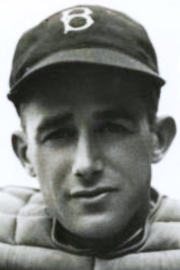
 According to Jack Durant of The Associated Press,  former Reds and Dodgers catcher Clyde Sukeforth, a Dodger scout,  was in the stands and “Seeing the commotion around the bench, rushed out the stands to the dugout,” upon arriving “He knelt beside the boy who loved baseball more than he feared death and when he looked into the stilled features, well he knew who it was—Bobby Osgood, his own nephew.”

Clyde Sukeforth

A shorter version of this post appeared on August 17, 2012.

“Ty Cobb, You Acted like a Quitter”

30 Nov

During his nearly two months on the West Coast in the fall of 1920, Ty Cobb was almost universally greeted by large, enthusiastic, and adoring crowds.

Cobb

Cobb

The one exception was late in the tour, on Thanksgiving Day, at Sodality Park in San Jose, where he was roundly booed.  The San Jose Evening News said:

“Of  Ty Cobb let it be written in the chronicles of San Jose: He came and saw and acted like a big baby.”

In the fifth inning, Frank Juney, the San Jose pitcher, struck Cobb out.  In the eighth inning, with his All-Stars losing, Cobb, according to The Oakland Tribune “(R)efused to leave the bench” to take his turn at bat.  The paper said:

“At the start of the game, stated local players, Cobb was informed that Juney was an emery ball pitcher and was asked if the ball should be barred.  ‘Anything would be alright’ he stated with a smile.  The first time up he got a two-base hit but in his next effort he fanned and was panned by the crowd.”

During the game, he also drew jeers from the crowd when he misplayed a single into a four-base error in the sixth inning.

Cobb left the ballpark before the game was over.  His All-Stars lost 7 to 2.

The Evening News wasn’t through:

“Your true hero must, after brief sulking, step out and slay hector and drag him around the walls of Troy two or three times. But Cobb didn’t have it in him to do it…(He) stuck out his under lip, was very properly booed by the fans, and then stalked out of the arena with the jeering fans standing up to watch the baby walk out of the nursery.”

[…]

“He saw that our local bushers were in grave danger of beating his team and he wanted to seize a chance to get out from under…The fans were cheated after Cobb did the baby rattle stunt, too.  Instead of making a stand-up fight against our bushers and showing us what live wires could do, the Cobb aggregation put a comedian in the box and let the locals run away with the game. (Nick) Altrock, the comedian, was all right, too.  He at least didn’t act like a sour prune left out to spoil after the historic rain that drenched the crop a couple of years ago.  But the fans wanted to see a little baseball, and they were entitled to it.

Altrock, the Comiedian

Altrock, the Comedian

“Ty Cobb, you acted like a quitter, like a bum sport, like a big baby, or like a commercial-minded calculator who couldn’t stand up and take a licking.  Whichever thing it was, or all four, it’s too bad.  The fans were out to enjoy you and admire you, and they couldn’t help hissing and booing you before you finished your performance.  Try to do better next time, and be at least as full of sand and grit as some little Sunday school teacher who sticks to the job of teaching about loaves and fishes even though she has a splitting headache.

“You see, Ty Cobb, we Americans don’t mind if you commit murder or eat snails or commit little crimes like that; but we simply can’t tolerate a who doesn’t know how to be a good sport.  The fans will still admire you, and will try to forgive you.  But don’t do such a childish thing again.”

Not to be outdone, The San Jose Mercury suggested crookedness on top of cowardice:

“It is whispered that Ty’s manager had requested Juney to lay the ball down the center for the Detroit player in order to make the big fellow look good, but Juney could not see it that way, and was out to win for San Jose and was working all players, Ty Cobb included…(Cobb) is looked upon as the peer of all ball players and is termed the Georgia Peach…down in Georgia they don’t know the difference between peaches and lemons.”

Three days after the San Jose game, Cobb’s tour came to its scheduled end.