Tag Archives: American Association

“Never a Backstop ever Lived could touch Frank Flint.”

6 Apr

George Gore spent 14 seasons in the major leagues, hitting .301—most notably, he led the National League with a .360 average in 1880 as a member of the Chicago White Stockings.
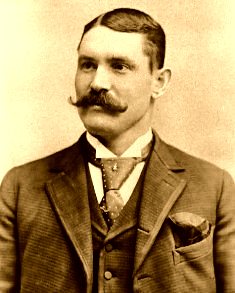
George Gore

George Gore

After his retirement, Gore was a regular attendee of baseball’s winter meetings.  In 1910, he spoke to a reporter from The Washington Evening Star at the 1910 gathering at New York’s Hotel Breslin.  The paper called him “one of the finest fielders, heaviest hitters, and finest ballplayers,” of his era.

Gore, however, didn’t want to talk about his abilities, but instead was making the case for one of his former teammates, Silver Flint:
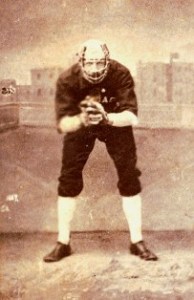
Silver Flint

Silver Flint

“Frank Flint of our team was the greatest catcher who ever lived.  He knew more than any other man with the mask.  He had the greatest head of any man in the business.  Nobody before or since could touch Flint.

“Every pitcher he ever handled he made a star.  Look at Fred Goldsmith and Larry Corcoran.”

Fred Goldsmith
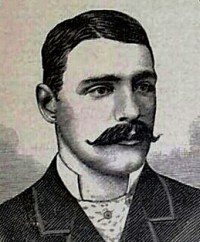
Fred Goldsmith

Gore noted that neither pitcher “ever showed much” before or after playing with Flint; although he did leave out that both were still teammates of Flint when they began their steep declines in 1884 and 1885.

“Once Frank took them in hand, they all developed into stars.  He could make cracks out of every pitcher who ever towed the slab.  Show me the backstop today who can take any pitcher and make a marvel out of him.”

Larry Corcoran
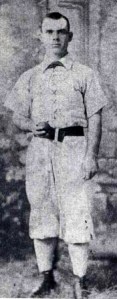
Larry Corcoran

Of Flint’s role in both pitchers’ success, Gore said:

“Goldsmith was able to pitch for us for several years after his arm was like a plate of ice cream because he had Flint behind the bat.  Corcoran, you know, was a slightly built man (5’ 3” 125-130 pounds) and as cranky as the dickens.

“The White Stockings were out in California at the time that (William) Hulbert was president of the club.  Corcoran had been heard about by our team, but his sour disposition had queered him with a number of them.  Hulbert was a trifle loath to take him.  However, he talked with ‘Silver’.”  ‘Get him,’ said Frank, ‘and I’ll do the rest.’  So Hulbert took Larry.’”

Gore, who likely exaggerated concerns about the highly prized 20-year-old Corcoran, said of Hulbert’s first meeting with the pitcher:

“The boss called Corcoran to him ‘Look here’ said the president, pointing to Flint:  ‘That fellow is your boss.  You do everything that he asks you, and don’t you disobey, or I’ll fire you right off the reel.’

“Corcoran started.  He obeyed implicitly, and everything went along finely.  Larry was soon one of the best twirlers in the league.  One day, though, he got one of his cranky fits on.  He wouldn’t obey the signals and crossed ‘Silver’ several times.”

Gore said Flint went out to speak to his ‘cranky’ pitcher:

“’Larry,’ he said quietly, but his eyes were snapping, ‘you either do what I say or you  go straight into the clubhouse—I don’t care a d— which you do. Now get busy.’”

Gore said Corcoran complied:

“After the game, Hulbert was sitting in the grandstand.  Corcoran came out of the clubhouse dressed, and the boss was waiting for him.  He called the pitcher to him.  ‘Look here Lawrence,’ sa id the old man, ‘didn’t I tell you that Frank was your boss?  Now if you let another yip out of you like you did today you’ll be fired so quick that your head will swim.’”

Gore said Corcoran again complied, and from that point on Flint had him “trained to the minute.”  Corcoran was 175-85 with a 2.26 ERA from 1880 until the White Stockings released him in 1885—his arm dead.  Despite the numbers, Gore called Corcoran “only a fair twirler” but for Flint.

Goldsmith, a claimant to the invention of the curveball, had a similar fate. He was 98 and 52 with a 2.57 ERA from 1880 through 1883 with Chicago; in 1884, he began to struggle and was 9-11 with a 4.26 ERA when the White Stockings sold him to the Baltimore Orioles in August.  His career was over at the end of that season.

Corcoran’s big league career was over at age 27, Goldsmith was 28.

Whether Flint deserved as much credit as Gore gave him for their brief, incredible success, is open to debate, but in 1910, the former outfielder was certain in his praise for his former teammate, who had died in 1892:

“Yes, there was never a backstop ever lived  could touch Frank Flint.”
“The Moment he got a Glove on his Hand he was Another Man”

3 Feb

In 1911, 66-year old John Curtis “Jack” Chapman, “Death to Flying Things,” wrote an article in “Baseball Magazine” about his “discovery” of Hughie Jennings 20 years earlier:

Jack Chapman

Jack Chapman

“I had taken my Louisville team of the American Association to Philadelphia when Jack Ryan of our club was hurt and had to be taken from behind the bat.  We were hard up for a substitute and had pressed into service Tommy Cahill.  I was put to it for a catcher and began skirmishing around for a man who would fit into place.

“Casually reading the paper the evening of my trouble I noticed an account of a game between the Lehightons and some other team, in which a young man named Jennings, who caught, seemed to be the whole show.”

Jennings had played with a local semi-pro team in Lehighton, Pennsylvania in 1889, and returned to the town to play for a semi-pro club in 1891, after playing in the Atlantic Association and Eastern Interstate League in 1890.

Hughie Jennings

Hughie Jennings

Chapman said of Jennings’ performance for Lehighton:

“He had fifteen putouts and four or five base hits, a home run among them.  I rushed to a telegraph office and sent a hurry-up call to his home in Moosic, a little mining town six miles from Scranton, asking him if he would not join my Louisville team.

“It did not take long for his affirmative to get back.

“I wired him in return that I would give him $175 a month if he proved satisfactory, and directed him to answer me at Boston and for him to report at Louisville.  When we got back to Louisville this young man reported to me at the Fifth Avenue Hotel.

“I will have to admit that I was disappointed with his looks, for his general appearance was somewhat verdant.  It was with fear and trembling that I watched him at his first tryout, for I had begun to think that I had invested in a salted mine.

“But the moment he got a glove on his hand he was another man.  A simple mitt worked wonders with him.  I had no chance to work him out behind the bat…First baseman (Harry) Taylor was injured.  Here was an opportunity for my new man to show the stuff he was made of.

“’Jennings,’ I said to him, ‘you will have to go out to first, as there is no one else who can play the bag.’

“’Mr. Chapman,’ he answered, ‘I have never played the position in my life, and fear that I cannot fill the bill.’

Chapman said, despite Jennings’ protestations, he told him again “I have no one else at all,” and installed him at first base:

“’All right; I’ll do the best I can.’

“Things began to happen.  He tickled the crowd by the way he pulled down high sailers, reached for wild ones, and dug balls out of the dirt.  His best was amply good.  I might add that I was tickled, too.

“He covered the base for a week.  When Taylor recovered, though, Jennings had to be relegated to the bench.”

At that point, Chapman said, Tommy Cahill, who had been pressed into duty behind the plate, but was the club’s best shortstop, became ill.  Although he played at least one game at the position the previous season in the minor leagues, Chapman claimed Jennings told him he had never played there when he was asked to fill in at shortstop:

“’Do what you can.’ I urged.

“’I’ll do my best,’ replied he.

“Again the crowd was tickled.  He covered more ground than any man I ever saw in my life.  He went after everything; errors never troubled him; he seemed born for the place…From the very first leap he has been a topnotcher. “

After Chapman left Louisville in 1892, Jennings struggled and was hitting just .136 in June of 1893 when he was traded to the Baltimore Orioles.  After finishing the 1893 season with a .255 average in Baltimore, Jennings hit .335, .386, .401, .355, and .328, the next five seasons, and the Orioles won three National League championships.

Lost Advertisements–Ed Sweeney for Sweet Caporal

15 Jan

sweeneyad

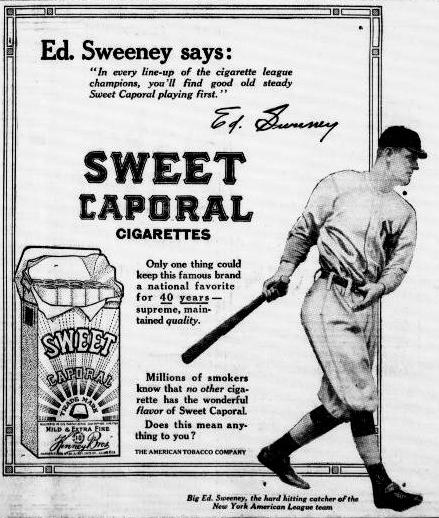
A 1914 advertisement for Sweet Caporal Cigarettes featuring New York Yankee catcher Ed “Jeff” Sweeney:

“In every line-up of the cigarette league champions, you’ll find good old steady sweet Caporal playing first.”

Three years later, while playing for the Toledo Iron Men in the American Association, Sweeney told a reporter about his former teammate Russell Ford, and the development of the Emery Ball.

Sweeney and Ford were teammates with the Atlanta Crackers in the Southern Association in 1907:

“One day while Sweeney was catching Ford in a warm up stunt before a game Russ made a wild peg and the ball bounded into a concrete pillar.

“‘I didn’t know anything about it,’ explains Sweeney, “but after that, I noticed the ball breaking in a peculiar way.  I remarked about it to Ford, but he didn’t appear interested.  I never saw (Ford throw it) again that season.

“‘I was purchased that summer by the Yankees (he joined the team in 1908).  Owner (Frank) Farrell came to me one day and asked who was the best pitcher in the Southern Association.  I told him Ford.  And Russ was drafted.'”

After an unsuccessful one-game trial with Yankees in 1909, Ford spent the remainder of the 1909 season with the Jersey City Skeeters in the Eastern League.  When Sweeney and Ford were reunited the next spring with the Yankees, Ford told the catcher he “‘(H)ad a ball no catcher in the world could receive.  I laughed at him but he persisted.'”

Sweeney said Ford “‘took me into his confidence'” and explained his new pitch, Ford told Sweeney that day in Atlanta he noticed the effect the damage caused by the ball hitting the concrete post had on his ability to make it curve, and he continued experimenting:

“‘Russ showed me a little leather ring that he slipped over a finger of his left hand…All he had to do was to scratch the ball with the emery, that was pasted to the leather…The bigger the scratch the greater the freak jumps the ball would take…He would fake a spitter, and nobody ever got wise.  When he pitched he always requested that I catch him.’

“‘When Russ threw the ball with runners on or in pinches, no batter in the world could hit it.  Once in while somebody did, but it was by accident…I’ve seen batter after batter miss the ball a foot.'”


Lost Advertisements–The $30,000 Battery

30 Dec

otoolead

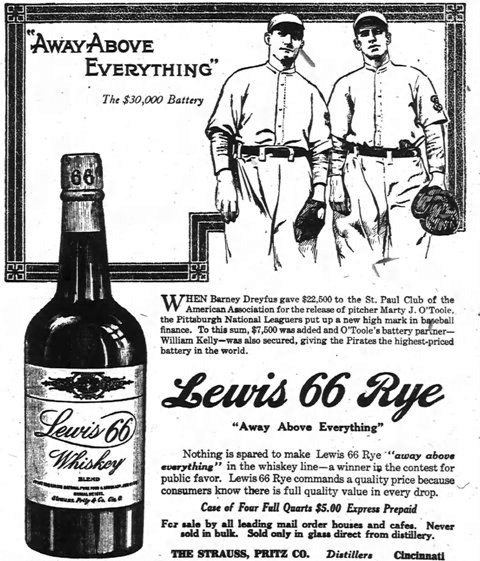
An advertisement from the spring of 1914 for Lewis 66 Rye from The Strauss, Pritz Co., of Cincinnati:

“When Barney Dreyfus gave $22,500 to the St. Paul Club of the American Association for the release of pitcher Marty J. O’Toole, the Pittsburgh National Leaguers up a new high mark in baseball finance.  To this sum, 7,500 was added and O’Toole’s battery partner–William Kelly–was also secured, giving the Pirates the highest priced battery in the world.”

The price paid for Kelly remains a matter of dispute.  The New York Times said he was acquired “for less than $5,000.”  The Washington Post put the price at $10,000 while The Pittsburgh Gazette Times, The Pittsburgh Press and The Associated Press said it was $12,500.


Kelly and O'Toole

Kelly and O’Toole

O’Toole posted a 24-27 record from 1911-1913.  He struggled in 1914, and with a 1-8 and record and 4.68 ERA in August, he was sold to the Giants, in 10 appearances with new York he was 1-1 with a 4.24 ERA.  Dreyfus’ “$22,500 Beauty,” was done as a major leaguer at 25 years old, seven months after the ad appeared.  He played four more seasons in the American Association and Western League; his professional career was over before his 30th birthday.

Kelly’s big league career was over before the ad came out.  In three seasons with Pittsburgh, he appeared in 104 games and batted .290, but was sold to the Toronto Maple Leafs of the International League at the end of 1913 season.  The Pittsburgh Press said the sale came as no surprise:

“Kelly came here from St. Paul with Marty O’Toole, but he has not developed as was expected of him, and has long been rated as considerable of a disappointment. It looks very much as if he were just a trifle shy of major league calibre.”

Kelly played four years in Toronto, hitting .227 in 280 games; his professional career was over at age 31.


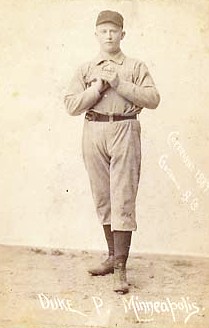
“The Duke of Minneapolis”

20 Nov

Martin F. Duck was born in Zanesville, Ohio in 1867.  He played under the name Martin Duke.   As he was becoming a well-known pitcher The Kansas City Times told a story which purported to explain why he changed his name:

 “The real name of the (Minneapolis) Millers’ best pitcher is not Duke, but Duck…Martin was pitching in a game up in Michigan and in the ninth his club led the opposing team by one run. (With two runners on base) a man up in the grandstand began imitating the quack of a duck…as the ‘quack, quack, quack continued his face became lobster-colored.  He shouted to his taunter that he would fix him after the game, but the fiend…went on with his ‘quack, quack, quack’”

At this point, Duck allegedly threw the ball into the stands at his tormentor, allowing both runs to score, “After that he dropped the name Duck entirely.”

By the time that story appeared Martin Duke seemed headed for a productive career.  He went 14-12 with the Zanesville Kickapoos in the Ohio State League in 1887.  In 1888, he again pitched for Zanesville, now in the Tri-State League and for The Toledo Maumees in the same league—no  records survive for that season.

The five-foot, five-inch Duke made a name for himself the following year.  While pitching for the Millers in the Western Association, he posted a 24-16 record and struck out 347 batters in 355 innings, earning the nickname “Duke of Minneapolis.”

In February of 1890, The Chicago Inter Ocean said Chicago’s Players League team was after the pitcher:  “Captain Comiskey of the Chicago Brotherhood has been on Duke’s trail for weeks, with the result that although Duke has not yet signed a contract we will play with the Chicago Brotherhood club this season.”

If Comiskey was, in fact, on Duke’s trail he never got his man.  Duke returned to Minneapolis, and while statistics for 1890 no longer survive, but the press routinely called him the Millers’ best pitcher.

In 1891, he slipped to 10-11, and in May he was suspended for being, as The Sporting Life said, “Out of condition” (a euphemism for his problem drinking), but earned an August trial with the Washington Statesmen in the American Association.  The Saint Paul Globe said of his departure:

“Martin Duke–the one, the only, the statuesque Duke–has bidden good-bye to the ozone of Minnesota and beer of Minneapolis…Last night he boarded the train, moved his hand in adieu, cocked his hat to one side, closed an eye, uttered a certain familiar expression peculiar to Dukes and disappeared forever.”

Martin Duke

Duke failed his Major league trial.  In four games, he posted a 0-3 record and walked 19 batters in 23 innings.

Despite his poor debut, he received another opportunity, this one with the Chicago Colts in 1892. When he was signed in January, The Chicago Tribune said:

“Duke’s last season, owing to lax discipline, was not a success, but this season he promises to regain his old form, as he is bound by an ironclad contract to abstain from intoxicating drinks.  By his contract half his salary reverts to the club if he breaks the pledge.  This should keep him straight.”

He received a big buildup in The Chicago Daily News:

“(He) is one of Captain Anson’s new colts, and he not only puts the ball over the home plate with almost the speed of a cannon shot, but he also seems to have a head studded with eyes, for stealing second base when he is in the box is always most hazardous business.  His pitching arm is so strong and shapely and so well equipped with powerful muscles that it would win admiration from a blacksmith.”

Despite the accolades he was released before the beginning of the season, The Tribune said:

“Martin Duke is also down for release. He has shown up poorly so far, and the club cannot use five pitchers anyhow.”

He signed with the New Orleans Pelicans in the Southern Association and seemed to regain his old form posting a 13-3 record.  It was his last successful season.

After getting off to a 2-5 start in 1893 Duke was released by New Orleans, and initially there were no takers for his services.  The Milwaukee Journal said why:

“Martin was always a good pitcher, but his mouth and his temper were too great a load for any team to carry any length of time.”

Duke bounced around the minor leagues after that with short stints for teams in the Eastern League, Southern Association and Western League until 1895, when he returned again to Minneapolis.  But after 13 games with the Millers, he injured his arm and was released in June.  According to The St. Paul Globe, he injured the arm again in August; rupturing a tendon while pitching for a semi-pro team in Rosemount, Minnesota.

In 1897, The Sporting Life reported that Duke, employed in a Minneapolis tavern, was “Trying to get in shape” in order to return to the diamond that season, but he never played professional ball again.

Duke died from pneumonia on December 31, 1898, in Minneapolis.  The Sporting Life said:

“He possessed great ability as a pitcher, but never lasted long with any club, as he was a hard man to control, and was given to dissipation, which ultimately led to enforced retirement from the profession and untimely death.”

Duke was 31 years-old.

A shorter version of this post appeared in October 2012

“The Phillies were Somewhat Crippled by the absence of Roy Thomas”

14 Sep

Charles “Chief” Zimmer was acquired by the Philadelphia Phillies to play for and manage the team in 1903; it was assumed he couldn’t do worse than Bill Shettsline who led the team to a 56-81 record the previous season.  He did.

Unlike nearly every other “Chief” in 19th Century baseball, Zimmer had no Native American blood and various stories have circulated as to the origin of the nickname.  His 1949 obituary said:

“In 1886 he joined Poughkeepsie as captain and manager…”since we were fleet of foot we were called Indians.  As I was the head man of the Indians somebody began to call me “Chief.”  It stuck.”

The Pittsburgh Press said in 1904:

“Zimmer received his sobriquet as ‘Chief’ because of his facial resemblance to an Indian, although he is a German.”

Zimmer was one of the best catchers in baseball for more than a decade.  He had brief trials in the National League with the Detroit Wolverines and American Association with the New York Metropolitans from 1884 and 1886, and was playing for the Rochester Maroons in the International Association in 1887 when his contract was purchased for $500 by the Cleveland Blues of the American Association.

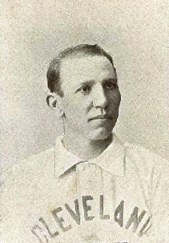
zimmer

Chief Zimmer

Zimmer was the starting catcher for the Blues when the team moved to the National League and became the Cleveland Spiders in 1889, and remained in Cleveland until 1899.  In 1890, he caught 111 straight games; which was the Major League record for 19 years.

By January of 1903 the 43-year-old’s best days were behind when Philadelphia acquired him on waivers from the Pittsburgh Pirates and named Zimmer manager.

After a 2-2 start, the Phillies never saw .500 again and Zimmer quickly lost control of his team.

The team went into June with an 11-26 record.  Things got worse that month in Cincinnati when Zimmer put the team’s captain,  centerfielder and leadoff man Roy Thomas into the lineup–Thomas was  a devout Christian who did not want to play on Sundays.  The Philadelphia Record said:

“Manager Zimmer had some trouble getting Roy Thomas to play in the Sunday game, he claiming that he had not contracted to play on Sunday, and that he had no desire to break the Sabbath.  In the end, however, Zimmer prevailed and Thomas went into the game.”

The Philadelphia Times said Zimmer talked to the team’s new owner, James Potter, who was reported to have said:

“So he won’t play today, eh?  Well, then place him on the bench today, tomorrow and for the remainder of the season, without pay.”

Thomas relented, but told reporters before the game::

“I’m playing under protest.  There’s nothing in my contract that exempts me from playing on Sunday, but when I signed it I had no idea that the Philadelphia Club would change hands and abandon old precepts.”

The following Sunday, with the Phillies in Chicago, The Associated Press (AP) said:

“Thomas made his protest doubly strong and backed it up by staying out of uniform that day.”

After Philadelphia’s 4 to 2 loss, The Chicago Tribune said:

“The Phillies were somewhat crippled by the absence of Roy Thomas who does not like the new ownership of the club, because it believes in Sunday games. which Roy does not.”

As a result The AP said,  other players on the slumping team suddenly found religion.

“Now several other members of the team declare that they are as much opposed to playing baseball on Sunday as is Thomas and that their religious scruples are just as strong as his.”

The article quoted an unnamed member of the Phillies:

“(I)f the club insists on showing partiality to Thomas the others who also object to playing on Sunday, but who are willing to help out the club, will insist on the same privileges.”

Zimmer faced a full-blown revolt as they prepared to embark on a 19 game road trip:

“All of which portends a pleasant trip in the West for Zimmer when he starts out again.”

The Philadelphia papers did not continue to pursue the story during the Phillies’ 4-15  road trip, but it seems that for the remainder of 1903 Thomas backed off of his demand as he appears in box scores for several Sunday games in the final three months of the season.

Roy Thomas

Roy Thomas

The Phillies limped to a 49-86 seventh place finish, seven less victories than the previous season under Shettsline.  Zimmer was dismissed at the end of the season and was replaced by Hugh Duffy.

Thomas’ Sunday request was granted the following season, with manager Duffy making most of his appearances as a player in 1904 on Sundays when his centerfielder took the day off.  There is no record of teammates complaining about Thomas’ Sunday schedule under Duffy’s management.

Regardless of the team’s new-found harmony, the Phillies under Duffy finished 52-100.  Potter sold the team after the 1904 season to Bill Shettsline.

A shorter version of this story was posted 12-18-2012.


The Pursuit of Elmer Foster

9 Sep

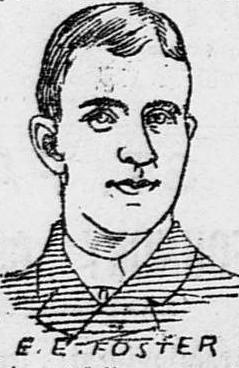
Elmer Ellsworth Foster was the talk of the Northwestern League in 1887.

His career as a pitcher had lasted just one season; in 1884, while pitching for the St. Paul Apostles, he snapped a bone in his arm while throwing a pitch.

Elmer Foster, 1887

            Elmer Foster, 1887

After he recovered, he returned the following year as an outfielder and second baseman with Haverhill in the Eastern New England League and hit .309.

The following spring, The Sporting Life’s Haverhill correspondent said the New York Metropolitans “have taken Elmer Foster from us.”

Hitting just .184 and, as The Sporting Life put it “reckless at the bat,” Foster went back to Haverhill in August.

In 1887, he returned to Minnesota, this time as centerfielder for the Minneapolis Millers.  The club was owned by his brother Robert Owen Foster, a successful dealer of musical instruments, who with his partner J. E. Whitcomb, had taken over operations of the Millers in January.

The Northwestern League of 1887 was a hitter’s paradise owing mostly to the single-season experiments with the four-strike rule and walks counted as hits—nineteen players with at least 350 at-bats hit better than .350—and Foster led with a .415 average and 17 home runs.   While his performance with the bat was noted, he received an equal amount of publicity for his great fielding.

Throughout the season, Minnesota newspapers reported that Foster’s contract would be sold to a major league team—the Indianapolis Hoosiers were the most frequently mentioned—but the deal never materialized.

When the season ended, The Philadelphia Times said Foster was in high demand:

“During the past week agents from nearly every League and Association (club) have been to Minneapolis to secure (Foster) for next season.  (Horace) Phillips of Pittsburgh; (Gus) Schmelz of Cincinnati; Ted Sullivan, agent for Washington; (Emery “Moxie”) Hengel agent for Detroit; (Charlie Hazen) Morton, agent for (A.G.) Spalding, and agents for the Brooklyn, Metropolitan, and Baltimore Clubs have tried to get him.

(John) Day, of New York, sent him this message:  ‘Multrie on the way to Minneapolis.  Make no promise until you see him.’  Boston also wired him for his terms.  (Horace) Fogel of Indianapolis arrived one night and had Foster in tow all the next day.  The bidding of all these clubs has been going on briskly, until now he is offered exorbitant figures by all the clubs.”

Foster called the fight for services a “circus;” it also turned into a controversy, with two teams claiming to have signed him.  The Saint Paul Globe said:

“The circus he speaks of is a curious one, but he is sublimely unmindful of the part he took in it.  The rules of the baseball covenant prohibit the signing of players until Oct. 20…Manager Fogel of Indianapolis approached Foster before that time and made a verbal contract with him, but Manager (Jim) Mutrie, of New York, took him out to Delano (Minnesota), and after midnight  (on the 20th) got his signature.”

Jim Mutrie

                       Jim Mutrie

Years later, Ted Sullivan, who was perusing Foster on behalf of his Washington Nationals, described Mutrie’s method to sign Foster as a kidnapping:

“Jim Mutrie of New York (Giants) grabbed the great fielder Foster on the streets of Minneapolis…bound and gagged him, threw him into a cab and brought him ten minutes out of the city, held him there and dined and wined him until midnight…then compelled him to take $1000 advance money and a contract of $4500 (various other sources put Foster’s salary at $2400, and $4000).”

Foster, it turned out, didn’t simply have a “verbal contract” with Fogel and Indianapolis when he disappeared with Mutrie, but had, as The Sporting News said, accepted “a draft for $100,” from Fogel at the time the two agreed to terms.  Fogel and Indianapolis owner John T. Brush told The Indianapolis News and The Indianapolis Times that there was “a written agreement” between Foster and the club.

Foster’s wife gave birth to a daughter during the height of the controversy.  He told The Globe:

“If she had been a boy I would have named him Mutrie Fogel, in memory of the baseball managers I have been having a circus with.”

In the end, Indianapolis acknowledged that the agreement with Foster, whether written or verbal, was entered into three days before the legal signing date of October 20 and National League President Nick Young awarded Foster to the Giants.

Foster never had success at the plate during his brief major league career; he hit just .187 in 386 at-bats over parts of five seasons.  But Mutrie called him “(O)ne of the best fielders in the country,” and Sullivan said of Foster’s time in the National League, “(H)e was a wonderful fielder in that league.”

Elmer Foster

      Elmer Foster

After he was released by the Giants, he played 31 games with the Chicago Colts in 1890 and ’91, but his brief stay with the club allowed his name to live on with fans long after his career ended.  One of the favorite subjects of Chicago sportswriter Hugh Fullerton, who called him “The rowdy of the rowdies,” Foster’s name was a staple of Fullerton’s stories for three decades after his career ended.

The First Jackie Robinson All-Stars

31 Aug

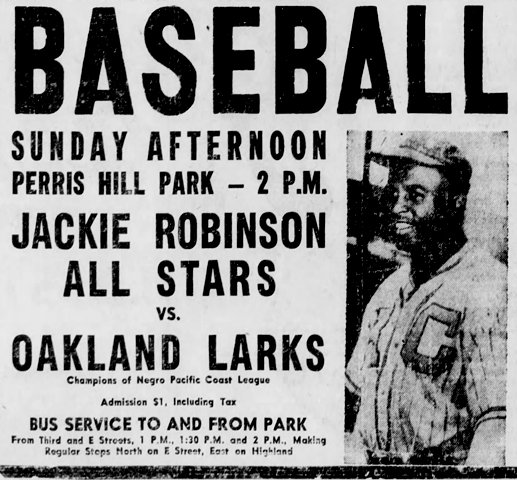
jackierobinsonas

The above advertisement is from the first, and least successful, of Jackie Robinson’s post season barnstorming tours.

In August of 1946, The Pittsburgh Courier said, “Jackie Robinson’s All-Stars” would play in several Eastern and Midwest cities after the Montreal Royals’ season ended.

The tour got off to bad start because the promoters—said to be from Pittsburgh, but never named in newspaper accounts—scheduled games to begin at the close of the International League season, failing to take into account that Robinson and Montreal would be playing in the Little World Series against the Louisville Colonels, the American Association champions.  East Coast games, including one at the Polo Grounds and one in Harrisburg, Pennsylvania were cancelled as a result.

After Robinson’s season ended, his “All-Stars” made up the game in Harrisburg and then played a handful of games in the Midwest before heading to California.

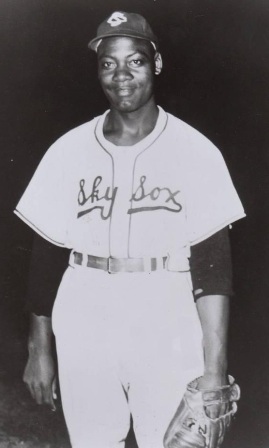
The All-Stars included Artie Wilson of the Birmingham Black Barons, John Scott of the Kansas City Monarchs. Ernie Smith, a one-time member of the Chicago American Giants, who played in 1946 with the Boston Blues in Branch Rickey’s U.S. Baseball League, and Bill “Wee Willie” Pope of the Pittsburgh Crawfords.

williepope

              Wee Willie Pope

Robinson’s All-Stars did not win a game in California.  They lost three games to Bob Feller‘s All-Stars—a team which included Bob Lemon, Stan Musial, Charlie Keller, Ken Keltner and Phil Rizzuto.  Feller’s club won 6 to 0 in San Francisco, 4 to 2 in San Diego, and 4 to 3 in Los Angeles.  Feller pitched five innings each in the San Diego and Los Angeles games—striking out 11 in the first game, and 10 in the second (he left that game having not allowed a hit through five innings).

One of those games was the impetus of the long-term animosity between Robinson and Feller that came to a head before the 1969 All-Star game.  At a press luncheon, Robinson noted the lack of black managers and front office personnel in major league baseball.  Feller criticized Robinson saying “The trouble with Jackie is that he thinks baseball owes him something.”  Feller told The Associated Press (AP) the bad feelings between the two started during the San Diego game on the 1946 tour:

“Jackie was getting a lot of publicity at the time since it was known he was being groomed to be the first Negro in big league baseball (and) threatened not to go on the field unless he got more money.”

Robinson told The AP Feller’s charge was “A damned lie.”

In 1975, Feller told The AP they “buried the hatchet,” before Robinson died in 1972:

“We discovered that out arguments were petty.  Both of us admitted our errors.  When Jackie died, we were good friends.”

Others claimed Feller never let the feud go.

The advertisement above is for the final game Robinson’s All-Stars played.  They faced the Oakland Larks, the champions of Abe Saperstein’s short-lived West Coast Negro Baseball Association (Negro Pacific Coast League) who posted a 14-3 record—the team barnstormed after the league folded and claimed a 56-12 record for all games played that season.

The teams played at San Bernardino’s Perris Hill Park; Robinson played center field.  The San Bernardino County Sun said he made “two stellar catches,” and was 3 for 4 with a double.  Despite Robinson’s efforts, the Larks won 8 to 5.

After Robinson’s final game with the All-Stars, he wasn’t quite finished for the year.  He joined the Los Angeles Red Devils, an integrated professional basketball team –three other well-known baseball players were members of the Red Devils: George Crowe, Irv Noren, and Everett “Ziggy” Marcel (the son of Oliver Marcelle).

Robinson’s brief professional basketball career ended in January of 1947.

“He fell off the Face of the Earth”

28 Aug

Charles Hazen Morton could run.  When he was playing shortstop and managing the Akron Independents in 1881 The Louisville Courier-Journal said:

“Morton, shortstop with the Akrons, can run like a deer.  It is probably that no one in the country can beat him for fifty yards.”

Morton’s major league career in the National League and American Association was unspectacular; he hit less than .200 with the Pittsburgh Alleghenys and St. Louis Brown Stockings in 1882, and the Toledo Blue Stockings and Detroit Wolverines in 1884 and ’85, he also managed Toledo and Detroit–Moses Fleetwood Walker and his brother Welday Wilberforce Walker played for Morton with the Blue Stockings.  He also managed the 1890 Toledo Maumees; Toledo’s only other season as a major league city.

Morton continued to manage minor league and independent teams through 1899.

After five years away from baseball he was the driving force in organizing several independent teams in Ohio and Pennsylvania into the eight-team Ohio-Pennsylvania League.  He was named president.

For two seasons, the league ran smoothly.  So smoothly that, according to The Akron Beacon Journal he was being aggressively pursued by owners in the Central League to assume the presidency of that league during the summer of 1906.  Morton chose to stay put.

As smoothly as things ran for two seasons, the tide turned badly in 1907.  Attendance was down all season and several franchises were on the verge of bankruptcy, and four teams wanted to leave the league entirely.  The Cleveland Plain Dealer said:

“Four O and P League clubs want a new league; four do not.  Four assert they will retire from baseball rather than be associated with the other four.  The league is deadlocked.  Neither side will give in.”

The Youngstown Vindicator said, “There seems to be no question that President Charles H. Morton will have strong opposition.”  Despite efforts to unseat Morton, he was narrowly reelected president of the league.

Ultimately, four teams did leave to form the Ohio State League.  But Morton told Sporting Life at the beginning of 1908 that he had managed to bring in four new clubs and was confident for the future of the O and P despite rumors that the league was in financial disarray:

“No, I do not think this is going to be a disastrous campaign.  The money stringency may hurt the crowds to a certain extent, yet people in this section of Ohio differ little from their brothers in other parts of the country. The germ of baseball Is not sporadic.”

He predicted that attendance would increase.

It didn’t, and things never got better for Morton.  After the 1908 season, it appeared all but certain he would be removed as president.

In December, two days before the league meeting was to begin in Pittsburgh, Morton abruptly canceled it.  A new meeting was scheduled for January in Cleveland and Morton’s fate seemed to be sealed.

On January 12 he traveled to Cleveland with representatives from the Canton Watchmakers and Akron Champs, likely his last two supporters.  But when the meeting was called to order Morton was nowhere to be found.  Samuel Wright, who had managed the Youngstown Champs the previous season, was elected president.

The Youngstown Vindicator said:

“He fell off the face of the earth so far as anybody knows.”

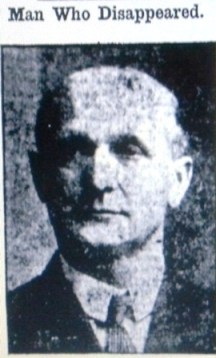
Charles Hazen Morton

Charles Hazen Morton

Some speculated he had run.

He disappeared with $2500 of the league’s money.  As days dragged into weeks there was no sign of Morton.

The Chicago Tribune said his friends were concerned that he had “done away with himself,” despondent over his pending removal as president.

The Marion Star said, “It is feared he has been thugged.”

The Pittsburgh Press advanced a conspiracy theory.  Under the headline “See Deep Plot in Morton’s Absence.”  The paper claimed  the Canton and Akron clubs realizing that he would be ousted had conspired with the president to have him disappear so, “Wright while really elected is far from president (of the league).”

But there was no conspiracy, Morton had really disappeared and remained missing for more than two months.

On March 16 he resurfaced.  Morton was found “wandering aimlessly” on Wabash Avenue in Chicago, near his brother’s home.  The Akron Beacon Journal said he was diagnosed with “Acute dementia (and) his mind is now a blank.”

The only clues where Morton had been for more than two months, were papers in his pockets which indicated he had been in Mexico and Texas and, The Beacon Journal said, “He mutters incoherently about Corpus Christi.”

He recovered enough to return to Akron by August of 1909.  His brother reimbursed the league $1500 that was not recovered after he was found.

Morton faded into obscurity after his return to Akron.  There was no follow-up to his story.  None of the many questions about his disappearance were ever answered.  And whatever happened in Corpus Christi died with him in 1921.


“Negro Baseball is Here to Stay”

24 Jul

At the close of the first Negro National League season in 1920, The Kansas City Sun declared “Negro baseball is here to stay.”

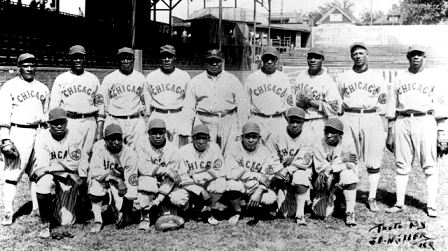
The paper made several observations about the state of the league and its future and picked the league’s first all-star team.  Beginning with a bit of bragging, the paper said that in spite of the Chicago American Giants winning the pennant, “Kansas City proved to be the best Negro baseball city.”

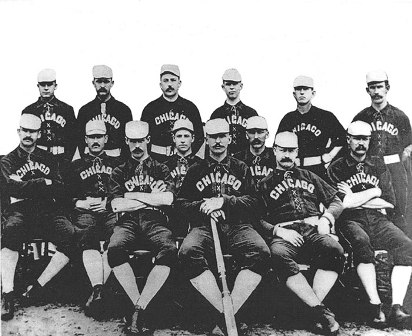
The Chicago American Giants

The Chicago American Giants

As evidence of Kansas City’s dominance, The Sun said:

“One hundred thousand White and Negro fans attended the Monarch games at Association Park the past season without the least bit of friction…(and) played to more local fans than the Kansas City Blues (of the American Association)…Negro teams used to play for a keg of beer, but now they play for $5,000 gates.”

The league as a whole, according to the paper, drew “more than 700,000 fans.”

but, it was not all a glowing review, The Sun did acknowledge one of the league’s biggest difficulties in the inaugural season, “(They) did not discover any real Negro umpires the past season;” inconsistent umpiring would remain an issue in subsequent years.

Perhaps most importantly, The Sun said the current season “Made baseball a safe investment,” and “Made baseball contracts legal.”

The final point was overly optimistic, as contract jumping and player raids were a serious detriment to the league throughout its 11-year run.

The Sun also picked the league’s first all-star team:

Pitchers:  Charles“Bullet” Rogan, Monarchs, Bill Drake, St. Louis Giants

Bullet Rogan

Bullet Rogan

Catchers:  George “Tubby” Dixon, Chicago American Giants and John Beckwith, Chicago Giants

First Base: Ben Taylor, Indianapolis ABC’s

Second Base: Bingo DeMoss, Chicago American Giants

Third Base: Bartolo Portuondo, Kansas City Monarchs

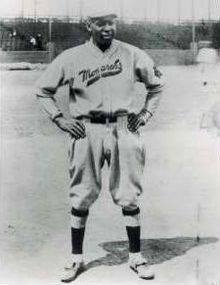
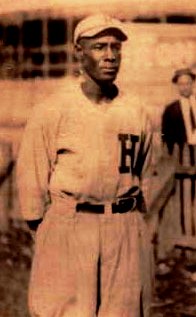
Portuondo

Bartolo Portuondo, all-star third baseman

Outfield: Jimmie Lyons, Detroit Stars, Cristobal Torriente, Chicago American Giants, and Hurley McNair, Kansas City Monarchs

Utility:  John Donaldson and Tank Carr, Kansas City Monarchs.