Tag Archives: American Association

Lost Advertisements–“The World’s Best Pitchers Recommend…”

8 Jul

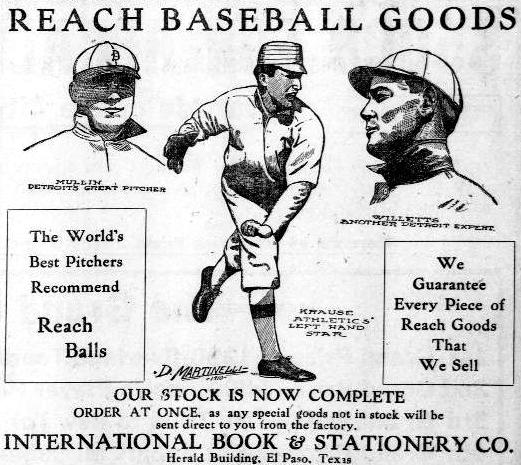
adreach

A 1910 advertisement for Reach Baseball Goods  “The World’s Best Pitchers Recommend Reach Balls”–from International Book & Stationary Co. in El Paso, Texas.  The ad features “Detroit’s Great Pitcher,” George Mullin, “Another Detroit Expert,” Ed Willett (Misspelled Willetts in the ad), and “Athletics’ Left Hand Star,” Harry Krause.

In 1909, the 20-year-old Krause, who had been 1-1 in four appearances with the Athletics in 1908, became the talk of baseball when he opened the season with 10 straight victories–including six shutouts.  A San Francisco native who played under Hal Chase and was a teammate of Hall of Famer Harry Hooper at St. Mary’s College, Krause was asked by The Oakland Tribune what led to success:

“That’s easy.  A capable manager in Connie Mack, one of the best pitching tutors in the world in Ed Plank, fairly good control on my part and lots of luck.”

The Tribune‘s scouting report on Krause:

“He has a good curve, but many pitchers in the league have a better one.  He has speed, but any number of American League twirlers have more smoke than he.  However, there are very few twirlers, whether right or left-handers, who can equal him in control of the ball.

“He doesn’t appear to have much to the opposing batters when they first face him, but when the game is over they wonder how it came to pass that he let them down with three or four hits and no runs.”

Harry Krause

Harry Krause

On July 18 his luck ran out, Krause dropped his first game of the season, an 11-inning, 5 to 4 loss to the St. Louis Browns.

He went just 8-7 (with one shutout) the rest of the season, but led the league with a 1.39 ERA.

He appeared in only 55 more games over three seasons, winning 17 and losing 20, before a sore arm ended his major league career at age 23.

He finished the 1912 season in the American Association with the Toledo Mud Hens, then returned to California and pitched for 15 seasons in the Pacific Coast League (with a one-season detour to the western League), where he won 230 games.

The Milwaukee First Base Jinx

20 May

In January of 1911, the Milwaukee Brewers of the American Association were in search of a first baseman.

Newspapers across the country began to speculate that getting someone to play the position might be a problem.

They began to talk about the “Milwaukee First Base Jinx.”

Dan McGann, who had been Milwaukee’s first baseman in 1909 and 1910 committed suicide a month earlier at Besler’s Hotel in Louisville, Kentucky (Although McGann’s sisters claimed he was murdered because an expensive ring was missing, there was a history of depression and suicide in the family and other expensive items were found on his body).

Dan McGann

The regular first baseman before McGann, Arthur Brown, as mentioned in an earlier post, was killed in 1911 by an actor whose wife had left him for the first baseman

 The man Brown replaced at first in 1908 was Quait Bateman, who also had a brush with violence.  He had been stabbed by Charlie Dexter.  Initial reports said the stabbing happened as a result of what The Milwaukee News called “A drunken row,” later Bateman said it was an accident and refused to press charges.

Unlike the others, Bateman did not die–although he was said to be close to death twice– and actually returned to Milwaukee for three more seasons.

Quait Bateman

But that fact didn’t get in the way of a good jinx story.

Shortly after the jinx stories appeared, Milwaukee signed 34-year-old former American League first baseman Tom Jones.  As the club’s first baseman for four seasons–and part of a fifth–Jones temporarily put the talk to rest.

Tom Jones

But it was revised again in 1913.

Newspapers brought up the jinx again when another former  Milwaukee first baseman Jiggs Donahue–who played for the club in 1902 and ’03– died in July.  Donahue died in the Ohio State Hospital in Columbus.  It was widely assumed his mental illness the result of advanced syphilis.

Jiggs Donahue

Articles in a number of papers speculated on what fate awaited Jones.  The Day in New London Connecticut said:

“Tom Jones, first baseman at Milwaukee, wonders what’ll become of him.  Murder, suicide, stabbing, shooting and insanity have been the fates former Milwaukee first basemen have met.”

Jones, at least in the short term, dodged the jinx.  His career with the Brewers ended during the 1915 season with no stabbings, shootings or other mayhem.  He died in 1923 at age 46.

The “jinx” was put to rest for good by Milwaukee’s next two first basemen; Clarence Craft and Mal Barry lived to 70 and 68 respectively.  Craft died in 1958, Barry in 1960.

A shorter version of this post appeared on August 20, 1912.

Lost Advertisements–“Spark plug of Huggins’ Machine”

17 Apr

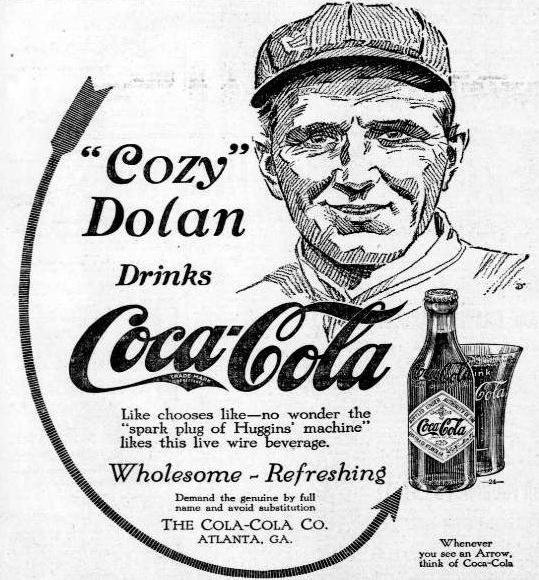
cozydolanA 1915 Coca-Cola ad featuring Albert “Cozy” Dolan of the St. Louis Cardinals.

“Like chooses like–no wonder the ‘spark plug of (Manager Miller) Huggins‘ machine’  likes this live wire beverage.”

Dolan, a 32-year-old utility infielder and outfielder who had never appeared in more than 100 games in a season before 1914, was an unlikely spokesman, given that most Coca-Cola ads of the period featured the game’s biggest stars.

He stole 42 bases for the Cardinals in 1914, but he hit just .240. In 1915, he hit .280 and stole 17 bases in 111 games.

While hardly great numbers, Dolan’s time in St. Louis was a huge success when compared with his disastrous 35-game tenure with the Pittsburgh Pirates.

Dolan was traded to the Pirates by the Philadelphia Phillies for third baseman Bobby Byrne and pitcher Howie Camnitz in August of 1913 and became the team’s starting third baseman but hit .203, had a fielding percentage of .937 and became the target of angry fans.

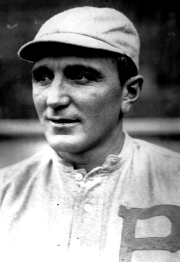
Cozy Dolan

Cozy Dolan

Richard Guy of The Pittsburgh Post-Gazette described his time with the Pirates:

“He looked bad and he was object of revile by those who criticize, and he failed.”

Joe Kelly of The Pittsburgh Chronicle said:

“No player ever was ridden harder by players and fans than was the former International League speed boy when he performed at Forbes Field.  Perhaps few who held down a berth regularly ever deserved more criticism, for his performances were on the awful order.  But it’s a hard job to make good when hoots and howls follow every poor play, and the few successful ones are greeted with ironical applause.  Dolan got off wrong at Forbes Field and he seemed to be sensitive, too sensitive, to the crowd’s attitude.  There comes to mind a scene last summer when the Pirates were leaving their club house.  They came out in twos and threes, laughing and joking, but among the first was Dolan, all alone.  His face was strained and drawn and worried.  He had failed that day, and he knew it…The fans poured their criticism on his head, and he sat tight and took it without a whimper.  There is something in a guy like that, or the major league managers wouldn’t keep him sticking around.”

Dolan stopped “sticking around” after 1915.  Huggins released his “spark plug” at the end of the season.  He returned to the minor leagues, playing three seasons in the American Association, then became a coach for the New York Giants in 1922.

In 1924, received a lifetime ban from Commissioner Kenesaw Mountain Landis for his role in an attempt to fix a game.


Tragic Exits 3

23 Mar

Eddie Meade

Edward “Eddie” Meade appeared headed to the big leagues.  After beginning the 1926 season with the Kinston Eagles in the Virginia League, the 24-year-old left-hander was acquired at midseason by the St. Paul Saints of the American Association and posted a 12-7 record with a 3.40 ERA in 22 games.

Meade began the 1927 season with a 6-0 shutout of the Louisville Colonels on April 17.  The same week he recorded his first victory, The Associated Press said he was about to become a member of the defending American League champions:

“The Yankees talked of possible reinforcements in the shape of Eddie Meade, of St. Paul, called the best young pitcher in the American Association.”

Eddie Meade

Eddie Meade

During the same week, Meade became ill; although the nature of the illness was never disclosed.  Eight days later he started a game with the Columbus Senators but was pulled after giving up six runs in the fifth inning of 9 to 8 loss.  Five days later he pitched in relief against Louisville, but The Minneapolis Journal said he lasted less than an inning due to his “impaired physical condition.”

When the Saints left Minnesota for a series in Kansas City on May 16, Meade stayed behind.  The following evening Meade checked into St. Paul’s Boardman Hotel and shot himself to death.

The day after his suicide, The Journal said, “it was learned today that Meade was slated to go to the New York Yankees in the fall.”

St. Paul Manager Nick Allen told The Associated Press:

“He was one of the hardest working youngsters we ever had on the club and the outlook for his future was bright, as he had only two years in baseball.  The only motive he could have had for such action would be mental depression.  He was not married.  The nature of his illness was no cause for alarm, but he apparently believed it otherwise.”

Tommy Coates

Thomas A. “Tommy” Coates was born in Omro, Wisconsin on February 18, 1886 (Baseball Reference lists his middle initial as “O” but birth and death records  list it as “A”).

After starring, along with his older brother Hiram, on Omro High School’s undefeated baseball team in 1901—The Omro Herald called the team “possibly the best in the state”—Coates played industrial league and semi-pro ball in Central and Northern Wisconsin.

After playing in Rhinelander, Wisconsin in 1908, The Oshkosh Northwestern said:

“Coates had lots of confidence in himself, and during the winter months the Omro boy came to the city one day and sought out “Pink” Hawley. Hawley agreed to give him a trial.”

Emerson Pink Hawley, a Wisconsin native who pitched in the major leagues for a decade, was the manager of the Oshkosh Indians in the Wisconsin-Illinois League.

Tommy Coates

Tommy Coates

 “Coates came to this city from his home at Omro (for his tryout).  He donned baseball togs and he ‘made good’ from the start.”

Coates, who The Northwestern said  was “tall (and) built something like the great Ty Cobb,” became the Indians starting left fielder one week into the season and went on to lead  the team with a .299 batting average (he hit .002 better than his 19-year-old teammate Heinie Groh).

In September, The Sporting News reported that with just one season of professional experience, Coates “Looks good to Connie Mack,” and was drafted by the Philadelphia Athletics. He was the only member of the Indians drafted by a big league club in 1909.

At season’s end in September, Coates, with an invitation to train with Mack’s club in the spring, spent most of his time hunting.

On October 11 Coates was in a row-boat with a friend, hunting in a marsh near Omro.  The friend told The Omro Herald:

“Tom saw a mud hen rise up on the right hand side.  He turned about quickly and took hold of his gun which was at his left side and pulled it toward him…I turned about as soon as I heard the shot, and to my horror saw Tom lunge forward.”

Coates accidentally discharged his gun, shooting himself in the left eye.

Twelve days after the Oshkosh Indians received a $300 check from Connie Mack—his draft price—Coates was dead.

The Northwestern said:

“He was quiet and unassuming. After making a sensational play in the field or batting out the hit that won the game…the Oshkosh fans could not induce Coates to doff his hat.  He would return to the bench with face covered with blushes.”

[…]

“His more ardent admirers were confident he would make good in the American League, and one of their first thoughts upon hearing of the unfortunate accident, was the promising career he had before him.”

Nick Maddox

9 Feb

Nicholas “Nick” Maddox burst on the National League scene in 1907. Born in Maryland on November 9, 1886, Maddox’ was born Nicholas Duffy, but adopted his stepfather’s name Maddox.

In 1906 the 19-year-old was given a trial in the spring with the providence Grays in the Eastern league.  He was released before the season began and signed with the Cumberland Rooters in the Pennsylvania-Ohio-Maryland League (POM).  Maddox had played in 1905 for the Piedmont team in the semi-pro Cumberland and Georges Creek League.

He was the best pitcher in the POM; The Sporting Life said Maddox was 22-3 for the Rooters who finished the season in fourth place with a 50-45 record, and was “the fastest pitcher in the league.”
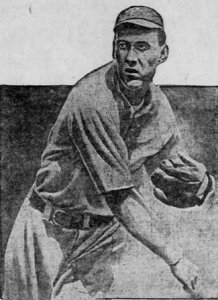
Nick Maddox

Nick Maddox

Maddox spent most of 1907 with the Wheeling Stogies of the Central League.  He posted a 13-10 record and no-hit the Terre Haute Hottentots on August 22.  Maddox was purchased by the Pirates the following month and made his big league debut on against the St. Louis Cardinals.

The Cumberland Times noted that he faced a “double-jointed hoodoo of commencing his National League career on Friday, September the 13th.”

The Pittsburgh Press said:

“Nick was ‘on the job’ yesterday from start to finish, and acted more like a man with many years’ major league experience than like a minor leaguer who has been in the business but a few seasons.”

Maddox shut the Cardinals out on just five hits, struck out 11 and got his first hit, a single in his first at bat.

Eight days later Maddox threw the first no-hitter in Pirates’ history, beating the Brooklyn Superbas 2 to 1—Brooklyn scored on two fourth-inning errors.   Years later, Maddox said of his own throwing error that put Emil Batch on base:

 “They scored me with an error, but hell man, I threw it straight to the first baseman (Harry) Swacina.  Sure it went over his head but he should have jumped for it.”

Batch scored on an error by shortstop Honus Wagner.  Maddox said:

“I don’t hold that against Honus, he saved my no-hitter in the ninth.  A ball was hit right over my head and ‘pfft’ Wagner was over there to get it.  I don’t think he ever held the ball, he just swooped it over to first.”

The rookie started six games Pittsburgh, won his first four, and finished with a 5-1 record with a 0.83 ERA.

The Pittsburgh Leader said Pirates’ President Barney Dreyfuss claimed Maddox would be “the sensation” of 1908.  He wasn’t far off.

The 21-year-old was an impressive 23-8 with a 2.28 ERA with five shutouts.  Despite his success there was concern about control—he walked 90 batters while striking out just 70 in 260 innings, and hit 11 batters.

After three second and one third-place finish the four previous seasons, Pittsburgh, and Maddox, came into 1909 with high expectations.  The Pittsburgh Press said:

“Nick Maddox is facing a very successful summer, and with an even break and barring accidents he ought to push any other twirler in the National League for first honors.  He has everything a pitcher needs, and youth with it.”

The Press also said he would “start out with good control” based on his performance in March games in Hot Springs, Arkansas.

The Pirates lived up to expectations, taking over first place on May 5 and cruising to the pennant; Maddox did not.

The 22-year-old struggled for the first half of the season.  The Leader said he was having “a hard time getting into condition,” and was wild as a March Hare.”  Maddox got on track in July pitching a 2-hit shout against the Cincinnati Reds on the 6th, and four-hit shutouts against the Brooklyn Superbas and Boston Doves on the 14th and 23rd.

He ended the season 13-8 with a 2.21 ERA—overshadowed by teammates Howie Camnitz (25-6), Vic Willis (22-11), Albert “Lefty” Leifield (19-8) and rookie Charles “Babe” Adams (13-3 as a reliever and spot starter).
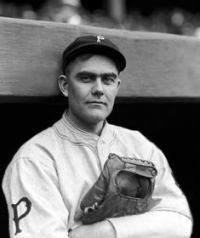
Babe Adams

Babe Adams

Despite going into the World Series against the Detroit Tigers with such a strong pitching staff, Manager Fred Clarke opted for the rookie Adams in game one and he responded with a 4 to 1 victory.

The Tigers beat Camnitz 7 to 2 in game 2.

Three years later, Fred Clarke spoke to James Jerpe of The Pittsburgh Gazette-Times about his decision on a pitcher for game three:

“I was in an awful predicament.  Adams had been used up.  It was had been raining, and it was very cold.  The chilly drizzle was something frightful.  The ball would get wet and water-logged and the problem was to get a pitcher who could handle the wet ball.  I looked the gang over.  Adams was out of the question.  He had been used up.

“I was figuring on the others, and I asked ‘Who can go out there today and handle a wet ball and win?’  Poor Maddox, sitting in a corner of the bench all bundled up with sweaters and other stuff, shed his extra clothes and jumped up.  Grabbing a ball, he said: ‘Gimme a catcher till I warm up.  I’ll handle this wet ball and beat them or break a leg.’  His confidence gave me a hunch, and I acted on it.”

Ring Lardner said of the game:

“Detroit’s record crowd, 18,277, saw the Tigers beaten by the Pirates 8 to 6, today in one of the most exciting and most poorly played world’s series games in baseball history.”

The Pirates scored five runs in the first inning off Detroit’s Ed Summers, and Maddox shut the Tigers down for the first six innings.  Detroit scored four runs in the seventh, aided by two Pirate errors.  Clarke said:

“Maddox wouldn’t have been in so much trouble if we had played ball behind him.”

The Pirates took a 8 to 4 lead into the ninth–Detroit scored two more runs, helped by another error—but Maddox held on and picked up the win.

He did not appear in another game during the series.  The Pirates won in seven; with Adams picking up complete game wins in games five and seven.
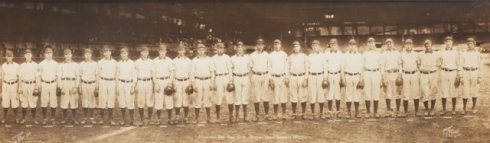
09pirates

1909 World Series Champion Pirates, Maddox is ninth from left.


The defending champions got off to a quick start again, but Maddox again started slow.  By July, The Leader said:

“Nick Maddox should have rounded into form..He is big and strong this year, but does not seem able to pitch good ball for nine rounds.”

He never “rounded into form.”  Maddox struggled all season.  He started just seven games, pitched in relief in 13 others, and was 2-3 with 3.40 ERA.

By August, with the Pirates in second place, six games behind the Chicago Cubs, The Pittsburgh Gazette asked “what was the matter?” with Maddox and why the Pirates had not cut him loose.

He made his last appearance on September 12, giving up a run, a hit and walking two batters in two innings of relief during a 4-0 loss to the Reds.  He was sold to the Kansas City Blues in the American Association 10 days later.

Maddox won 22 games for the Blues the following season, but continued to be plagued by wildness and arm trouble.  His major league career was over, and he was finished professionally in July of 1914 at 27-years-old when he was released as manager and pitcher for the Wichita club in the Western League after posting a 3-13 record.

Fred Clarke was convinced Maddox’ career really came to an end on that rainy day in Detroit.  James Jerpe of The Pittsburgh Gazette-Times said that in 1910 Dreyfuss asked Clarke to release Maddox long before he sold the pitcher to Kansas City:

“’Why don’t you let Maddox go? You aren’t pitching him.’

“’No,’ replied the Pirate Chief sadly.  “I’m not pitching him.  He ruined his arm helping Adams win the world’s series.’

“And Fred narrated (to Dreyfuss) more of Nick’s gameness on that bleak and drizzly October day in Detroit when he gave his arm for a championship.  Nick was carried for a whole year and the club has been interested in his welfare ever since.”
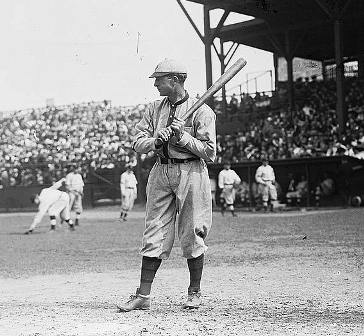
Fred Clarke

Fred Clarke

Maddox, who lived in Pittsburgh, and worked for the Fort Pitt Brewing Company, after his retirement, lived long enough to listen on the radio to the last two innings of the next no-hitter thrown by a Pirate pitcher—Cliff Chambers defeated the Boston Braves 3-0 on May 6, 1951.

Nick Maddox died in 1954 at age 68.

Hughie Jennings’ “Doctor”

10 Dec

On October 6, 1898, Hughie Jennings, who, for the fifth straight season was the National League’s leading hits batsman, faced Jouett Meekin, the New York Giants’ notoriously wild pitcher —Meekin hit 89 batters in nine major league seasons and walked 1056 while striking out 901.

Hughie Jennings

Hughie Jennings

The New York Times said:

“Meekin began the game by hitting (John) McGraw on the head.  It was only a glancing blow, however.  Jennings followed McGraw, and the first ball pitched struck him on the nose, breaking it.  Jennings, after he was hit, staggered and then fell.  It was a swift in-curve, and the players on both teams rushed to the plate thinking he had been fatally injured”

The concern was warranted.  In June of 1897 Jennings was hit in the head with a pitch thrown by Meekin’s’ teammate Amos Rusie during the first inning of a game.  While the Rusie beaning was serious, it was likely not as serious as some sources claim–it has been said he was unconscious for three or four days, and near death.  These claims are belied by contemporary news reports, as early as the next day that said, while serious, the injury was neither life-threatening nor caused a days-long coma.

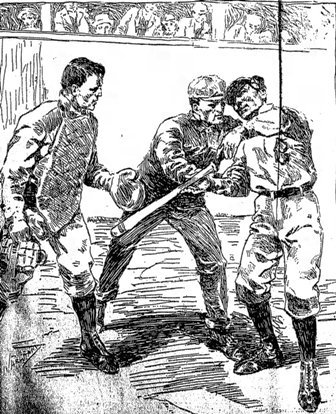
A newspaper rendering of Jennings' beaning by Rusie. The catcher is Jack Warner, Hank O'Day is the umpire.

A newspaper rendering of Jennings’ beaning by Rusie. The catcher is Jack Warner, Hank O’Day is the umpire.

The New York Sun:

“Last night the doctor said he was suffering from a slight concussion of the brain and a temporary paralysis of the right arm, but he declared his injuries would not prove serious and that Jennings would be able to play again in a few days.”

Jennings was back in the Orioles lineup in a week.

Still, there was reason for concern, Jennings had been hit by nearly 200 pitches since 1894, and according to The Sun, “his face was covered in blood.”  The previous season he had “pluckily continued in the game” after the Rusie beaning, until the second inning; this time he was immediately taken to the clubhouse.

It was there that his broken nose was attended to in an unusual way.

Enter John Joseph “Dasher” Troy, a major league infielder in 1880s, a member of the 1884 American Association champion New York Metropolitans.

Dasher Troy

Dasher Troy

In 1891, Troy had been granted a liquor concession, “running the bar under the grandstand” at the Polo Grounds.  Three years later The Sun said Giants owner Edward Talcott “quietly ousted Troy,” after the former player’s “attack on a grandstand gatekeeper and his threatened attack on Mr. Talcott.”

Despite being ousted from the business, Troy remained a fixture at Giants games—and would eventually reclaim the business after Talcott sold his interest in the Giants to Andrew Friedman, running it until 1900.

The New York Telegraph picks up the story:

“(Troy) was at the Polo Grounds when Jennings, of the Baltimores, had his nose broken by a pitched ball. Jennings was assisted to the clubhouse and a physician summoned.  The ‘Dasher’ followed in after the doctor, and pushing the latter aside, said to Jennings:

“‘Hughie, will you let me fix that for you?’

“Hughie looked embarrassed and said:

‘Yes, Dash, but here’s the doctor.’

“’Oh, to hell with him,’ answered Johnny, with his usual impetuosity.  “I can fix that nose in two minutes.  I have fixed noses before, and broken ‘em too,’ said Troy as he threw out his chest and glanced severely at the doctor.

“’Here boy, go out and get me a couple of pebbles.’

“The (doctor) brought back two small stones, and Troy put one on each side of Jennings’ injured nasal organ, and began to press.  The damaged nose was one sided, the cartilage being badly out of place.  Jennings said he could feel the grating as Troy gradually pressed on the stones and, sure enough, when the pebbles were removed the nose was as straight as it ever was.

“’There,’ said Troy, looking again fiercely at the doctor, ‘could you do better that that?  You doctors make me tired.’

“The doctor, however, when he had collected himself, said Jennings had better go to a hospital for further treatment, apparently not being fully satisfied with Troy’s treatment, or possibly his winning ways.

“Jennings did not follow the doctor’s advice that night, but (the following day) he went to Mt. Sinai Hospital.  A physician then examined the injured nose, felt of it carefully and said:

“’There is nothing out of place there.  Who set it for you?’

“’Oh, some doctor up at the Polo grounds,’ answered Jennings.

“’Well, said the hospital physician, ‘I never saw a cleaner or better piece of work in my life.”

Regardless of having his nose successfully fixed by Troy, Jennings’ all-time record for being by pitches 287 times took a toll.  He had turned 30 years-old just a month before the 1888 broken nose, but only played more than 100 games  once more—in 1900—and was, essentially finished as a player by 1902.

Another story about Jennings’ “doctor” Dasher Troy on Friday

Bad Bill Eagan

6 Oct

William “Bad Bill” Eagan was just 35-years-old when he died from tuberculosis in 1905, but many people didn’t believe it when the news was first reported. The hard-living Eagan’s demise had been predicted and reported several times. In 1901, the year after his professional career ended, The Fort Wayne Sentinel said:

“’Bad Bill’ Eagan who died two or three times last year, is running a poker room in Detroit. Eagan dies on the average of three times a year and is about due for the first of this year’s series. Eagan captained and played first base for Youngstown before his second demise last season.”

Bad Bill

Bad Bill

In 1899 Connie Mack told The Philadelphia North American:

“Eagan would be one of the best second basemen in the business if he would keep in condition.”

He quickly wore out his welcome during all three of his brief stints in the big leagues. The first, with the St. Louis Browns in the American Association in 1891, ended, according to The Syracuse Standard after an incident with team owner Chris von der Ahe:

“(Eagan) was a jolly fellow and not afraid of discipline. The Browns got on a train at St. Louis to come East…von der Ahe’s nasal organ was rather large and red for its age and ‘Bad Bill’ determined to have some sport.

“Walking up to his employer, he caught the nose between his fingers, and said: ‘Say, Chris, how much did it cost to color that?’

“The owner of the cerise nose was furious with rage. He released Eagan at once. The train was ninety miles east of St. Louis, and at von der Ahe’s order the conductor put the nose twirler off the train.”

Two years later Eagan joined ‘Cap’ Anson’s Chicago Colts. Hugh Fullerton told the story of how he wore out his welcome there after just six games:

“Anson was a quick thinker on the ball field, but once he released the best second baseman that ever wore a suit for thinking a little quicker than anybody else on the nine.

“The second baseman in question was “Bad Bill’ Eagan. Everybody who remembers ‘Bad Bill’ will admit his supremacy on the second bag. When the play we celebrate came up there was a base runner on second. Chicago was one run to the good, and it was in the last half of the ninth inning.

(Bill) Dahlen was playing third base for Chicago. The man hit a sharp liner down to second. ‘Bad Bill’ started for it and at the same instant the man started for third base.

Bill Dahlen

Bill Dahlen

“The liner was a clipper and the ball struck ‘Bad Bill’s’ hands and bounded out. It struck the ground ten feet away, with ‘Bill’ right after it. Once he got his hands on it and without stopping to look where he was throwing. ‘Bill’ let the ball fly to third base.

“Most ball players after fumbling the ball would have tossed it to the pitcher or thrown it home if, after looking around, they saw that the base runner had started to try to score.

“In this case the base runner, after touching third, went on for twenty feet and then stopped for an instant to see what had become of the ball. He saw it coming straight as a die for third base, and went back there like a flash. But the ball beat him by ten feet. Unfortunately for the game, and also for “Bad Bill,’ Dahlen had taken it for granted that Eagan would throw the ball to the home plate, and was not looking for it to be thrown to him. Consequently the ball went by him, going within four inches of his nose, and striking the grand stand far behind.

“The result was that both base runners got safely home before Dahlen recovered himself and the ball, and the game was lost to Chicago.

“Anson was furious and immediately after the game gave ‘Bad Bill’ his release for making that throw. As a matter of fact, it was the best possible play under the circumstances, and Dahlen, rather than “Bad Bill’ was to blame for it not coming out as planned. If ‘Dal’ had thought as quickly as ‘Bill’ the game might have been settled right then and there.”

Eagan received one more trial with a major league team in 1898. He started the season on the bench for the Pittsburgh Pirates, but was given the opportunity to start when regular second baseman Dick Padden left the team over a dispute with Manager Bill Watkins in May.

Eagan hit .328, but committed 10 errors in 19 games. He was sold to Louisville Colonels on June 5. The Louisville Courier-Journal said:

“He is a clever fielder, a fair batsman, extremely aggressive and absolutely fearless (and will) certainly strengthen the team in one of its weakest spots.”

But he never appeared in a game for Colonels. The following day The Courier-Journal said the deal was off, and Manager Fred Clarke would only say, via telegram:

“Called deal for Eagan off for good reasons.”

The Colonels passed on Eagan despite being a team badly in need of a regular second baseman—Clarke tried nine different men there during the season, and his primary second baseman, Heine Smith hit .190 and committed 16 errors in 26 games.

Eagan finished the 1898 season with the Eastern League’s Syracuse Stars, where he had played from 1894 to 1897. He finished the year of 1898 in jail in his native Camden New Jersey.

That story Wednesday

Things I Learned on the Way to Looking up other Things #11

22 Sep

Floto on Baseball’s Most Powerful Men

Otto Clement Floto was one of the more colorful sportswriters of the late nineteenth and early twentieth century’s.  The Denver Post’s Woody Paige said of the man who was once worked for that paper:

“In the early 1900s Floto was The Denver Post’s sports editor and a drunk, barely literate, loud-mouthed columnist–sounds like a description of that guy in my mirror–who didn’t believe in punctuation marks, wrote about fights he secretly promoted on the side, got into shouting matches with legendary Wild West gunman–turned Denver sportswriter–Bat Masterson.”

Otto Floto

Otto Floto

Floto, in 1910, provided readers of The Post with his unvarnished opinion of baseball’s most powerful figures:

John T. Brush—The smartest man in baseball, but vindictive.

Garry Herrmann—Smart, but no backbone; the last man to him has him.

Ban Johnson—Bluffs a great deal and makes it stick.  Likes to talk.

Charles Comiskey—Shrewd as can be.

Connie Mack—Shrewd and clever; knows the game better than anyone.

Charles Murphy—A hard fighter, but backs up at times.

George Tebeau—More nerve than any other man in baseball, very shrewd.

Barney Dreyfus—Smart, but always following, never leading.

As for John McGraw, Floto allowed that the Giants’ manager was “Pretty wise,” but attributed his success to the fact that he “has lots of money to work worth.”

Too Much Money for Players, 1884

The Cleveland Herald was not happy when pitcher Jim McCormick jumped his contract with the Cleveland Blues in the National League to the Union Association’s Cincinnati franchise.  Although teammates Jack Glasscock and Charles “Fatty” Briody also jumped to Cincinnati, the paper saved most their anger for the first big leaguer to have been born in Scotland.

Jim McCormick

Jim McCormick

The paper noted that McCormick, who was paid $2500 by the Blues, had received a $1,000 bonus to jump:

“(A) total of $3,500 for joining the Cincinnati Unions to play the remainder of the season.  This is equal to $1750 a month, which again divided makes $437.50 a week.  Now McCormick will not play oftener than three times a week which makes his wages $145.83 per day for working days.  The game will average about two hours each, so that he receives for his actual work no less than $72.91 an hour, or over $1.21 a minute for work done.  If he was not playing ball he would probably be tending bar in some saloon at $12 a week.”

McCormick was 21-3 with a 1.54 ERA in 24 games and helped pitch the “Outlaw Reds” to a second place finish in the struggling Union Association.  After the Association collapsed was assigned to the Providence Grays, then was sold to the Chicago White Stockings.  From July of 1885 through the 1886 season McCormick was teamed with his boyhood friend Mike “King” Kelly—the two grew up together in Paterson, New Jersey and were dubbed “the Jersey Battery” by the Chicago press—and posted a 51-15 record during the season and a half in Chicago, including a run of 16 straight wins in ‘86.

He ended his career with a 265-214 record and returned home to run his bar.  In 1912 John McGraw was quoted in The Sporting Life calling McCormick “the greatest pitcher of his day.”

The pitcher who The Herald said would otherwise be a $12 a week bartender also used some of the money he made jumping from Cleveland in 1884 the following year to purchase a tavern in Paterson.

Not Enough Money for Owners, 1885

In 1885 J. Edward “Ned” Allen was president of the defending National League Champions –and winners of baseball’s first World Series—the Providence Grays.  He told The New York Sun that baseball was no longer a profitable proposition:

“The time was when a man who put his money into a club was quite sure of coming out more or less ahead, but that is past.  When the National League had control of all the best players in the country a few years ago, and had no opposition, salaries were low, and a player who received $1,500 for his season’s work did well.  In 1881, when the American Association was organized in opposition to the league, the players’ salaries at once began to go up, as each side tried to outbid the other.  When the two organizations formed what is known as the National Agreement the clubs retained their players at the same salaries.

“Several other associations were then organized in different parts of the country and were admitted under the protection of the National Agreement.   This served to make good ball-players, especially pitchers, scarce, and forced salaries up still higher, until at the present time a first-class pitcher will not look at a manager for less than $3,500 for a season.  (“Old Hoss”) Radbourn of last year’s Providence Club received the largest amount of money that has ever been paid to a ball-player.  His wonderful pitching, which won the championship for the club, cost about $5,000 (Baseball Reference says Radbourn earned between $2,800 and $3,000 in 1884), as did the work of two pitchers and received the pay of two.

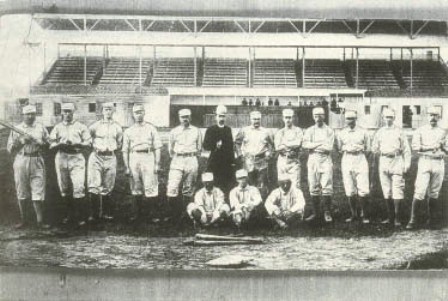
The Providence Grays--Champions and unprofitable

The Providence Grays–Champions and unprofitable

“Some of the salaries which base-ball players will get next season are; (Jim) O’Rourke, (Joe) Gerhardt, (Buck) Ewing and (John Montgomery) Ward of the New York Club, $3,000 each.  (Tony) Mullane was to have played for the Cincinnati Club for $4,000 (Mullane was suspended for signing with Cincinnati after first agreeing to a contract with the St. Louis Browns).  (Fred) Dunlap has a contract with the new League club in St. Louis for $3,400.  These are only a few of the higher prices paid, while the number of men who get from $2,000 to $3,000 is large.  At these prices a club with a team costing only from $15,000 to $20,000 is lucky, but it has not much chance of winning a championship.  To this expense must be added the ground rent, the salaries of gate-keepers, and the traveling expenses, which will be as much more.

“As a high-priced club the New York Gothams leads, while the (New York) Metropolitans are nearly as expensive.  The income of these two clubs last year was nearly $130,000, yet the Metropolitans lost money and the New York Club (Gothams) was only a little ahead.  The first year the Metropolitans were in the field(1883) their salary list was light, as were their traveling expenses, and at the end of the season they were $50,000 ahead.”

The Grays disbanded after the 1885 season.

“Sweeney was Drunk, but I didn’t Know it”

22 Aug

In 1884 Frank Bancroft’s Providence Grays won the National League pennant and defeated the American Association’s New York Metropolitans in the World Series—the first post-season exhibition to be called the World Series.  Late in 1896 he told a reporter for The Boston Post his version of the story of the turning point in that season:

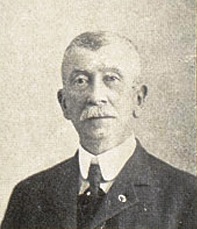
Frank Bancroft

Frank Bancroft


“We were leading the championship race (the Grays were in 2nd place at the time of the game in question).  Both (Charles) Sweeney and (Charles “Old Hoss”) Radbourne were pitching in grand style.  In those days you couldn’t take a player out of the game and put another one in his place unless he was sick.  I wanted to save my pitchers all I could.  One day we were playing the Bostons (Bancroft was incorrect; the game was against the Philadelphia Quakers on July 22).  I had (Joseph) Cyclone Miller in right field and Sweeney in the box.  I told Joe Start, who was captain of the team that if we got far enough ahead in the game to take Sweeney out of the box and bring in Miller.  I did this to save Sweeney’s arm.  In the sixth inning we had a lead of 7 to 2 (the score was 6 to 2).  I told Start to make the change.  He asked Sweeney to go out in the field.  Sweeney was drunk, but I didn’t know it.  Start’s request made Sweeney mad.  He didn’t take it in the way it was meant.  He walked off the field.  I went after him, but couldn’t get him to come back.

“He called me a vile name.  The president of the club (J. Edward “Ned” Allen) went to him and asked him what he meant, and he called him everything vile on the calendar.  Sweeney was very drunk.  We had to finish the game with eight men, and the Bostons [sic] beat us out (Providence lost 10 to 6).  The directors of the club had a meeting that night, expelled Sweeney and came within an ace of breaking up.  In fact, they did vote to disband.”

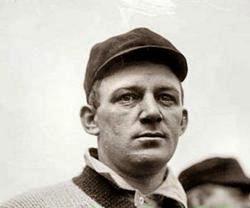
Charlie Sweeney

Charlie Sweeney

With Sweeney gone, the team was left without their two top pitchers.  Bancroft had suspended Radbourn earlier in the month, and he was still sitting out at the time—Radbourne was unhappy sharing the pitching duties and was rumored to be heading to the St. Louis Maroons in the Union Association–The Providence Evening Press in describing Sweeney’s July 22 outburst said he had “caught Radbourn’s complaint.”

Picking up the story in The Post, Bancroft said:

“They said there was no use of going on with one pitcher.  I said to President Allen: ‘If you will give me authority to tell Radbourne that you will not reserve him at the end of the season, I can get him to pitch all the rest of the games this year.’  ‘All right,’ said Allen, ‘you have that authority.’  I found old Rad at his boarding house.  I told him about the proposition.  ‘It’s a go,’ said Rad.  ‘I’ll get rid of reservation if I lose my arm.  I’ll pitch all the other championship games this season.”

Radbourn did not pitch “all the other” games that season but did pitch 75—with 73 complete games, 678 2/3 innings.  Bancroft said of his pitcher:

“It was the greatest feat of endurance I ever witnessed.  Rad was in awful shape before it was all over…Why, (his arm) hurt him so bad when he would get up in the morning that he couldn’t get it up high enough to fasten his collar button.  He had to comb his hair with his left hand.  It used to make me shudder to look at him, but he was gritty.  He would go out in the afternoon before the game, and instead of loosening up by easy pitching, as pitchers do nowadays, he would go in the field and throw the ball just as far as he could.  He would throw for ten or fifteen minutes, until he got wound up, and then he would go in to pitch a winning game.”

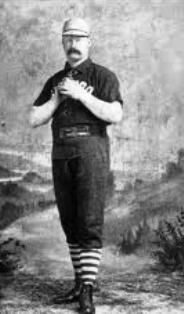
"Old Hoss" Radbourn

“Old Hoss” Radbourn

Bancroft said the pitcher “could split the plate any time he wanted to,” and that during “morning practice, to show what he could do, Radbourn would set a pop bottle on the home plate and knock it down three out of four times.”

The release of Sweeney had an immediate positive effect on the Grays.  On the day of the incident, The Evening Press said: “The pennant is no doubt out of the reach of Providence this year.”

The following day, after Radbourn pitched the team to an 11 to 5 over the New York Gothams, the paper’s outlook brightened:

“The summary expulsion of Sweeney for crookedness seemed to have a salutary effect, on Wednesday, for the purging of the club of such a bad egg resulted in a better class of patrons on the grand stand than for many weeks.  The attendance throughout was better than the management had looked for after the airing of Sweeney’s revolt, about 700 being present. “(There were just 450 in the stands the day before for “Sweeney’s revolt”)

Sweeney had not yet left for St. Louis and the paper took the opportunity to take one final shot at the pitcher:

“Sweeney is still about town, and wherever he goes the women whom he escorted to the ball game on Tuesday are seen with him.  The conduct of this fellow is shameful, and he will regret it when he fully wakes up to its enormity.”

The twenty-one-year-old Sweeney pitched the Maroons to the Union Association championship with a 24-7 record and 1.83 ERA.  Whether his arm couldn’t handle the strain, or as a result of his off-field habits, he would only win 16 more games (losing 30), and was out of the major leagues at age 24.

He returned to his home in California and played for teams in the California, Central California Leagues, after his retirement he worked for a short time as a police officer and later worked in saloons around San Francisco.

By the time Bancroft shared his reminiscences of 1884 with The Post, Sweeney was incarcerated in California, and Radbourne was dying in Illinois.

In July of 1894, Sweeney shot a man named Cornelius McManus during an altercation in a bar.  The San Francisco Chronicle said when he was informed the following day that the victim was dead “he broke down and wept bitterly.”  Sweeney was convicted of manslaughter four months later and sentenced to eight years.

The Chronicle said he was released after serving “a little over three years of his sentence,” after which “his health broke down.”  Sweeney died of Tuberculosis in 1902—most sources say he died on April 4—The Call and The Chronicle both said he died on April 3.

Radbourn pitched 1311 innings in 1883 and ’84, and started and won all three games in the 1884 World Series.  Bancroft said that after the Grays won the championship:

“President Allen kept his word, and gave him his release; but Rad didn’t take it.  The club offered him just twice as much salary for the next year.”

Radbourn pitched seven more seasons and finished his career with a 309-194 record.  After being accidentally shot in a hunting accident, and suffering from a variety of ailments, he died in February of 1897.

Bancroft remained in baseball until January of 1921 when he retired a business manager of the Cincinnati Reds. He died two months later at age 74.

Stewart Strader

11 Aug

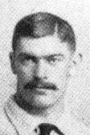
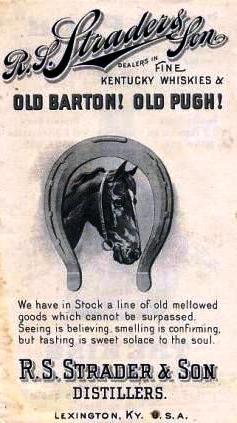
Stewart W. Strader was the son of a prominent business leader in two of Kentucky’s signature businesses.  His father, Colonel Robert Stuart Strader operated a distillery and was a prominent breeder of Standardbred Trotters.  In 1875, the elder Strader moved the family from Boone County, Kentucky to Lexington where he was involved in the founding and management of The Red Mile—the world’s second oldest harness racing track.

Advertisement for R.S. Strader and Son Distillery. The "Son" was Stewart's older brother Wilson.

Advertisement for R.S. Strader and Son Distillery. The “Son” was Stewart’s older brother Wilson.

Stewart Strader was born in Lexington in 1882, one of seven sons.  By the age of 20 he had become an important figure in baseball circles in and around Lexington, as owner, manager and one of the best players on Lexington’s local semi-pro team.

Before the 1903 season The Lexington Leader said Strader was attempting to get his team accepted into the Central League and “Lexington’s application for a franchise is looked upon quite favorably,” but days later The Lexington Herald said Strader “decided most of the cities composing the Central League were too far to enable his club to play them with profit.”  He instead entered his team in Cincinnati’s Sunday League and played against other independent teams during the week.

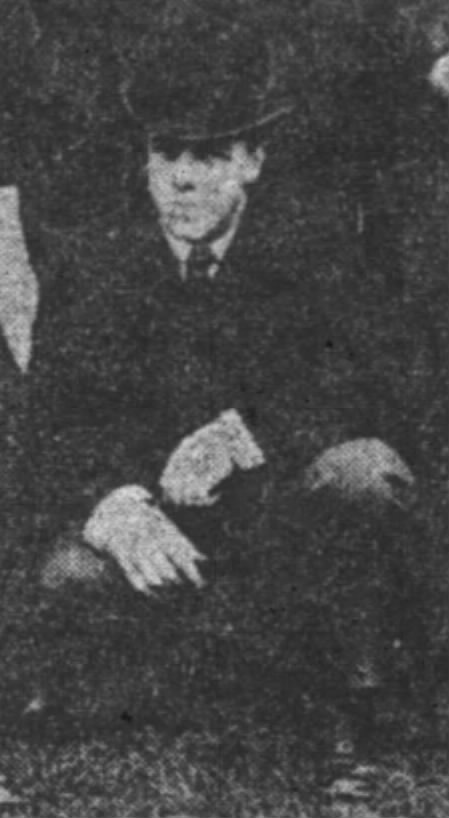
Stewart Strader 1903

Stewart Strader 1903

His reputation quickly spread, and while there were rumors in the press that he would be signed by the Cincinnati Reds, they did not materialize, but he did receive a letter from William Henry “Bill” Watkins, president and manager of the Indianapolis Indians of the American Association.  Watkins wrote:

“I thought I would write you and see if you had any idea of going into the professional end of the game next season.  If you will consider a trial with us, I would like to hear from you.”

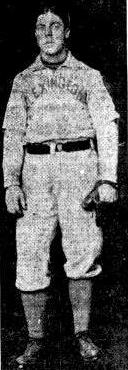
Strader accepted the offer, but by the time he reported to Indianapolis in late March, Watkins had left Indianapolis to manage the Minneapolis Millers.  In his first game with the Hoosiers, an exhibition against Purdue University, Strader played right field and was 3 for 3 with a triple.  The Indianapolis News said, “Strader is a hitter of merit and with a little more work should develop into a strong fielder.”

Two days before the beginning of the regular season Indianapolis purchased left fielder Ed “Pinky” Swander from the St. Louis Browns, and right fielder George Hogriever, who had refused to sign after hitting .330 the previous season, agreed to terms with the Hoosiers.   Strader was released to the Greenville Cotton Pickers in the Cotton States League.  His hometown paper, The Herald, said he “had been holding down right field with due credit,” but Indianapolis Manager Bill Phillips felt “he was too young for the fast company.”

Strader 1904

Strader 1904

After hitting .309 for Greenville in 81 at bats, he was sold to the Macon Highlanders in the South Atlantic League where he hit just .200 in 130 at bats.

Strader spent the next five years making brief stops with seven different minor league teams, buying and selling the independent Lexington club at least twice, and tending a saloon he opened in 1905.


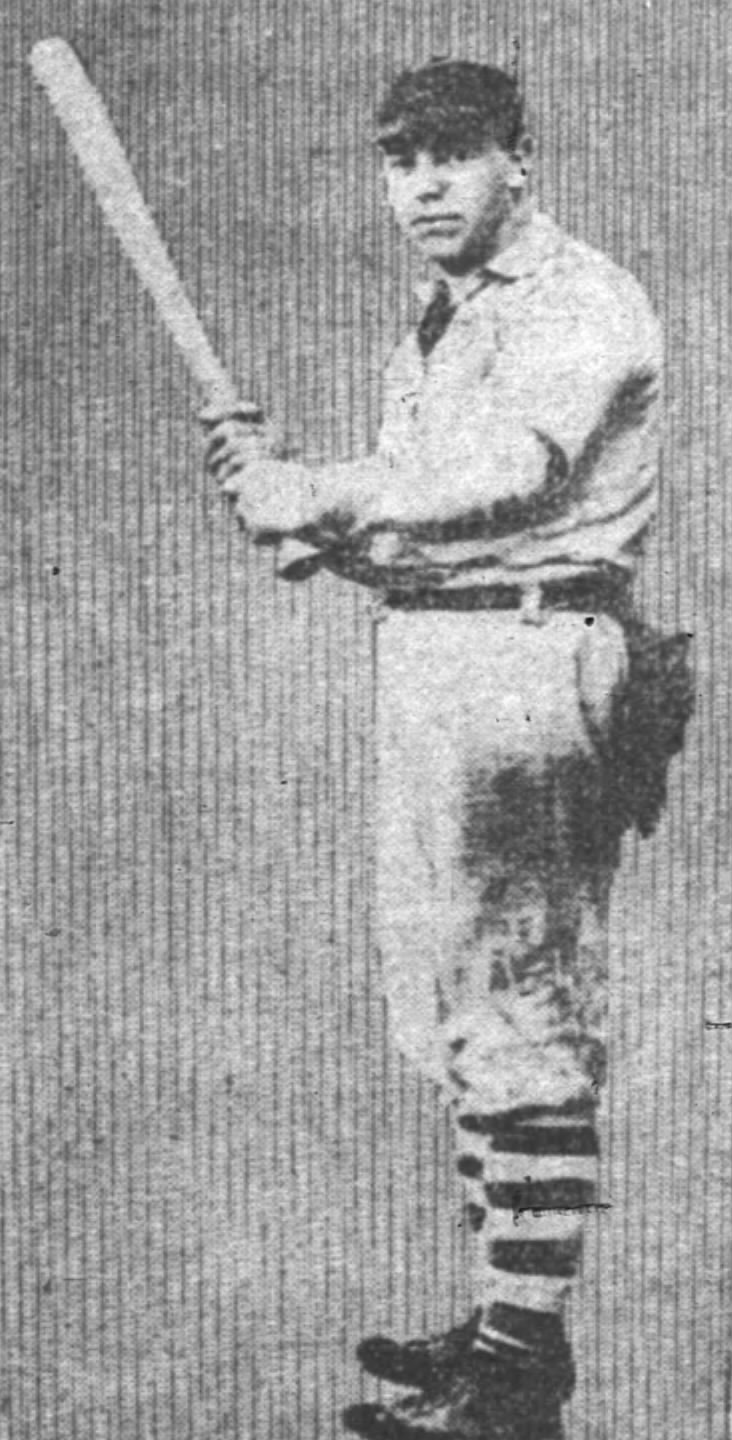
Stewart Srader

Stewart Srader

In 1908, Lexington became part of the newly formed Blue Grass League.  It was the city’s first team in organized ball in more than a decade, and Strader may, or may not, have been involved in an attempt to wrest control of the team from owner and manager Thomas Sheets.

Strader opened the season in the Virginia State League, where he appeared in 10 games for the Richmond Colts and Danville Red Sox.  In late May, he returned to Kentucky and signed a contract with Sheets’ Lexington Colts.  On May 31 he played center field for the Colts and was 0 for 3.  The following day he was released.

The Herald speculated that another player, Warren Fieber (who had purchased the independent Lexington team from Strader two years earlier and later sold it back to him) would also be released:

“Sheets admitted that an effort had been made to undermine him in the last two days, but would make no further statement.”

Fieber, who was hitting .320 on June 1, remained with the team, but his batting average plummeted to .222 by the season’s end.  Strader stayed in the Bluegrass League and signed with the Shelbyville Grays; he had the best season of his pro career, hitting .324.

Strader played his final season of pro ball the next year with the Frankfort Statesmen.  In June The Herald said:

 “Lexington fans have noted with considerable satisfaction that Stewart Strader a Lexington boy now with Frankfort is leading the Blue Grass League in batting.”

Strader was hitting .410 as late as June 23, but slumped badly in the second half of the season and finished with a .264 average.  At the end of the 1909 season Strader and Patrick Downing, a former minor league player, were appointed deputies by the Fayette County Sheriff.  The Leader said the two deputies they replaced “apparently would not play ball.”

Strader signed with the Davenport Prodigals in the Three-I League in the spring of 1910 but was released before the season began.

During the last several years of career, and the first decade after he left the diamond, the Strader family was regularly mentioned in the local press for things other than baseball.

Two brothers died tragically, one, according to The Leader, by his own hand after shooting a woman in Lexington’s “Tenderloin District.” The other was murdered during a dispute while hunting.

Strader began operating taverns and restaurants in Lexington in 1905, and the family spent the better part of a decade bringing various lawsuits against each other involving the failure of the distillery after their father’s death and other business disputes.  During one dispute Strader’s older brother W.P. had him arrested claiming Stewart Strader “would do bodily harm or injury to him.”

Despite the family drama, Strader remained a successful businessman and prominent member of Lexington society.  He owned the Berlin Café—which he originally purchased with one of his brothers in 1905–until 1940 and for seven years in the 1920s operated Third Avenue Motor Company in Louisville, which sold the Anderson Six—produced by the Anderson Motor Car Company in South Carolina.

Strader died in Lexington on August 9, 1948.