Tag Archives: American Association

“Foster you are Released”

17 Mar

Elmer Ellsworth Foster’s career as a pitcher ended on August 26, 1884.  He had been out for three weeks with “an injury to the tendon in his right arm,” when he took the mound for the St. Paul Apostles in a Northwestern League game against the Milwaukee Brewers.  The 22-year-old was 17-19 with 1.18 ERA when he took the mound at St. Paul’s West Seventh Street Grounds.

The St. Paul Daily Globe said:

“When the popular favorite took his position in the box in the last half of the first inning the audience received him with an ovation of cheers, to which he responded by raising his cap.  A moment later he pitched the first ball, a sharp crack was heard distinctly all over the ground and the sphere went spinning ten feet to the right of the batter.  Foster turned pale, but stood in his position until the players in the vicinity reached him.”

He had “snapped the bone of the right arm just above the elbow,” and after Foster left the field a collection was taken up among the fans “A few minutes later it was announced that $172 had been collected.”

He made it to the major leagues two years later as an outfielder with the New York Metropolitans in the American Association, and played parts of five seasons in the American Association and National League.  A consistent .300 hitter in the minors, Foster hit just .187 in 386 big league at bats.

According to The Sporting Life, his manager with the New York Giants in 1888 and ‘89, Jim Mutrie considered him “one of the best fielders in the country, and the only reason New York ever let him go was because he didn’t show up well with the stick in fast company.”

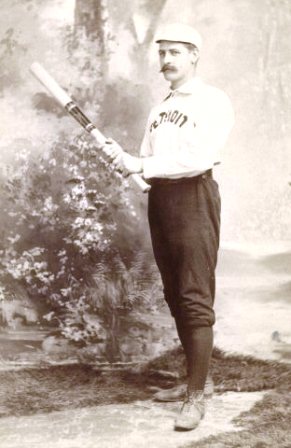
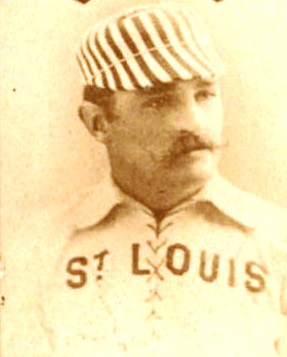
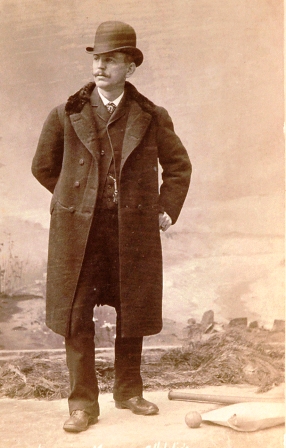
Elmer Foster

Elmer Foster

Sportswriter Hugh Fullerton said he excelled at other things as well:

“The rowdy of the rowdies was Elmer Foster.  Handsome, well bred, clean cut and with it all, well educated and something of an actor.  Foster was in baseball for the fun of it.”

From the time Fullerton joined The Chicago Tribune in 1897 until he left Chicago for New York in 1919 Bill Lange was probably the only 19th Century player he wrote about more often Foster.

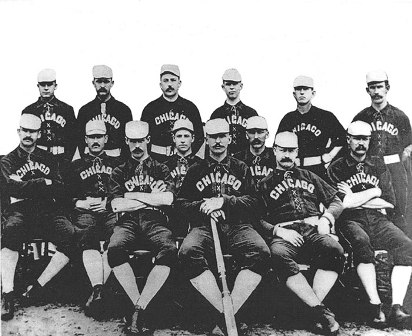
Foster’s  best season was 1890 (.248 in 105 at bats and 5 home runs) with Cap Anson’s second place Chicago Colts after being acquired in late August.

Foster started the season with his hometown Minneapolis Millers in the Western Association (he hit .388 in his first twelve games), but fell out of favor with Manager Sam Morton after he and a teammate named Henry O’Day were arrested and fined in Milwaukee for public intoxication in May.

Foster was benched, but the team refused to release him, and by mid-July he was ready to take the Millers to court.  The St. Paul Daily Globe said:

“(Foster) threatens to bring suit against the management to compel its members to give him his release.  His claim will be that they are unjustly preventing him from earning a livelihood.  There is a possibility that the threat may be only a bluff, but should such a trial be put on, it will be of much interest in Western baseball circles, as it will be the first of its kind in this section.”

The Millers finally chose to release Foster rather than fight a lawsuit.  Foster was rumored to be headed to several different teams, but finally signed with the Colts on August 27.

After his strong September in 1890 Foster began the ’91 season as the Colts center fielder, but it didn’t last.

Fullerton said Foster sealed his fate with Anson during the opening series:

“We were going to Pittsburgh, and just before we arrived in town on the unearthly jump from Chicago to Pittsburgh, via Cleveland, Anson came along and sat facing us.

“’Foster,’ He said ‘The next time you take a drink, or anyone on the club takes a drink with you, I’ll release you.’

“’All right, Cap,’ said Foster, cheerfully.

“We arrived in Pittsburgh, and while Anson was registering the club at the desk Foster said: ‘Let’s go have a cocktail.’

“’Better be careful, Elmer, the old man is sore,’ I remarked.

“But we went.  The mixologist had just strained the cocktails into the glasses when Foster, looking into the mirror, spied Anson in the doorway.  He turned and, bowing low, said sweetly “Captain anson, will you join us for a drink?’

“’No,’ thundered Anson.  “Foster you are released.

“And now that I am released, Captain Anson,’ said Foster, ‘will you join us in a drink?”

Unlike many of Fullerton’s story, the basic facts (if not the part where he included himself in the story) are confirmed by contemporaneous accounts.  The Chicago Tribune said on April 26 after the Colts four-game series with the Pirates:

“Elmer Foster is not with the club and he has probably played his last game with it.  He and (Pat) Luby last night at Pittsburgh were drinking and Anson fined each $25 and ordered them to go to bed.  They paid no attention to the order and the fine was increased to $50.  This morning when the team was ready to go to Cincinnati Anson gave foster a ticket to Chicago and sent him home.”

Luby was not sent home and lost to the Reds 1 to 0 the following day.  He was fined several times for drinking during the 1891 season, and after a promising 20-9 rookie season in 1890 he slipped to 8-11, and followed it up with an 11-16 season in 1892 before Chicago let him go.

Foster was suspended without pay and finally released on May 11.  He was immediately signed by the Kansas City Blues.

Foster played well in Kansas City, hitting .300 in 70 games for the second place Blues, but was released in August.  The Kansas City Star said:

“One of the sensations of today is the unconditional release of Elmer Foster whose behavior on the present trip has been disgraceful”

The paper said Manager Jim Manning was forced to make the move, not just because of Foster’s drinking, but because he “has been largely instrumental in leading other members of the team astray.”

His replacement, Joseph Katz, acquired from the Grand Rapids Shamrocks in the Northwestern league hit just .225 in the final 25 games.

In December of 1891 The Minneapolis Times said:

“Elmer Foster, the ballplayer, yesterday secured $25,000 through the will of his dead mother, and today announced his permanent retirement from the diamond. “

With the exception of one game in 1895 (he went 1 for 2) with the Millers, Foster was true to his word and quit baseball at the age of 29.

Foster retired to Minneapolis where he operated a piano and organ store with his brother, did some acting and occasionally said he was considering running for the Minneapolis City Council or the Minnesota State Legislature, although there is no record of his ever officially filing to run for office.  He also worked as a scout for the Pittsburgh, and signed Ralph Capron out of the University of Minnesota for the Pirates.

After Fullerton moved to New York and stopped writing about Foster the “The rowdy of the rowdies” faded into comfortable obscurity in Minnesota.  He died in 1946 at age 84.

Some of Fullerton’s less reliable stories about Foster on Wednesday.

“Radbourn would only Accept the Money on Condition that the Money be bet on him”

28 Feb

Like most 19th-Century players, Arthur Irwin was convinced the game didn’t get any better after he played.  He talked to a reporter from The Buffalo Times in 1906 and said there still had never been a pitcher who was better than one of his former teammates.

Arthur Irwin

Arthur Irwin

Irwin said:

“In my opinion (Charles “Old Hoss”) Radbourn was the greatest pitcher the world ever saw and I doubt if his equal will appear.  He had a spit ball and worked it to perfection, only it was not known under that name.”

Irwin’s recollections of Radbourn highlight how open gambling was in 19th Century baseball:

“I remember on one occasion when we (the Providence Grays) were playing the Boston team one of our stockholders came to the hotel the night before the game and said he had wagered $6,000 on the Providence club.  Then he told Rad that he would give him $500 if he would pitch.  Radbourn would only accept the money on condition that the money be bet on him and the $500 was so placed.  The afternoon of the game found Radbourn in grand form and he made the Boston players look like a bunch of minor leaguers, not one of them scoring.”

If the story is not apocryphal, it could refer to Radbourn’s 4-0 shutout of the Beaneaters on August 12, 1884 in Boston—it was his only shutout there while he and Irwin were teammates.

"Old Hoss" Radbourn

“Old Hoss” Radbourn

Irwin also told the reporter about an exhibition game in 1884 against the Toledo Blue Stocking in the American Association:

“When we arrived the night before the game we found that they were betting $10 to $7 against us.  That same evening the mayor of a small town some few miles away drifted into the hotel and during the conversation remarked that he guessed we were not very anxious to win the game.  Naturally, we asked why he said that and he said the odds were against us, with no Providence money in sight, but he was willing to bet $2,500 on us if Radbourn pitched.  It was not Radbourn’s turn, but when the mayor supplemented his remarks by offering to give Rad $100 if he went into the box, the offer was snapped up.  Toledo had such stars as Curt Welch and (Tony) Mullane.  Welch, who was the first man up, got to first base.  After that there was nothing to it and not another man reached first during the entire game.”

Not only were no current pitchers as good as Radbourn, Irwin said no current catcher was nearly as tough as another of his teammates with the Worcester Ruby Legs in 1880:

“One of the most remarkable exhibitions of catching I ever saw was performed by Charles Bennett…As you know, we did not use gloves in those days and the pitcher was allowed to take a hop and step before throwing the ball from the box, which was only 45 feet from the batter.  On three successive days Bennett caught 14, 15 and 16-inning games without any protection.  The following day we were booked to play New York and Bennett went in to catch.  After half a dozen balls had been pitched , Charley suddenly dropped his hands and walked away from the plate.  I at once ran over to him and a glance at his hands told me all I wanted to know.  Both hands were black and blue from the base of the fingers almost to the wrist and the bruises went clear through the hands.  Of course it was impossible for him to continue, but imagine the torture he must have suffered before he was forced to quit.  I don’t believe you could find a catcher today who would go through that experience.”

Charlie Bennett

Charlie Bennett

Irwin also didn’t have much use for the belief that the game had progressed in terms of strategy since his playing days:

“It is amusing to hear (John) McGraw and other talk about the wonderful progress made in playing scientific baseball.  I am sure we put up just as clever a game in the 80s as they do today, but we did not have fancy names for our plays.  We worked the squeeze, hit and run and other tricks.  When I first came to the Philadelphia club (1886) I worked the trap play and got away with it.  There were men on first and second and the ball was hit into short left field.  I yelled for (George) Wood to let me have it, although it was his ball.  Then I let it drop through my hands and the bleachers let out an unearthly holler.  I picked up the ball; shot it to second in time to tag the man there and then the other man was easy.  We had taken our places on the bench before the crowd got wise to the play and then the cheers more than made up for their hisses.”

“What Earnest, Active and Capable Team Workers those Cuban Giants are”

19 Feb

The Middle States League lasted just one season, 1889.  Not part of the National Agreement, and intended as an eight-team league, the circuit included, at various times, thirteen teams representing cities in Pennsylvania, Delaware, Connecticut, and New Jersey.

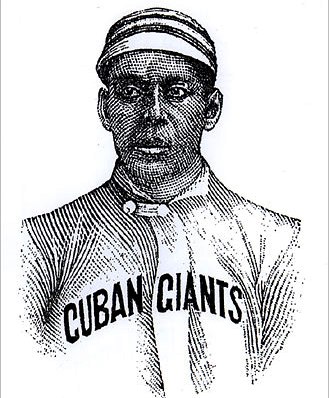
The league became integrated with the inclusion of the Cuban Giants of Trenton, who had become the first salaried African-American team four years earlier, and later their biggest rivals, the New York Gorhams (the Gorhams joined the league late, and were expelled in August—they played their home games in Easton, Pennsylvania and Hoboken, New Jersey).

Despite their membership in the league, and the Gorhams’ calling Easton their part-time “home,” both black teams were refused hotel accommodations in Easton during the season.

The relationship between the Cuban Giants and the rest of the league was contentious.  In May, The Philadelphia Inquirer said the league’s board of directors charged Cuban Giants’ Manager Stanislaus Kostka (variously nicknamed Cos, S.K., Siki) Govern with violating the league’s $75 a month salary cap by using “players who have not signed regular contracts,” and not using league’s official ball in games.  The Inquirer said:

“It appears that the colored club has been running things to suit its own sweet will.”

The paper said after a two-hour meeting Govern promised “to do better in the future.”

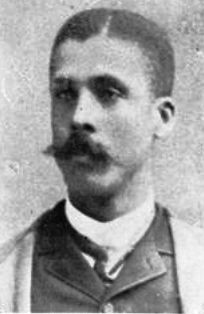
govern

S. K. Govern

The following month the league denied rumors in The Inquirer that “the Cuban Giants were to be forced out on account of their color.”  The paper said the August league meeting “was long and mainly occupied by debates between Harrisburg and the Cuban Giants.”

Most of the teams were financially troubled from the outset—at one point  a York, Pennsylvania hotel proprietor confiscated the uniforms of the Shenandoah club after the team failed to pay their bill—Shenandoah lasted just 15 games, joining the league in mid July and disbanding August 6.

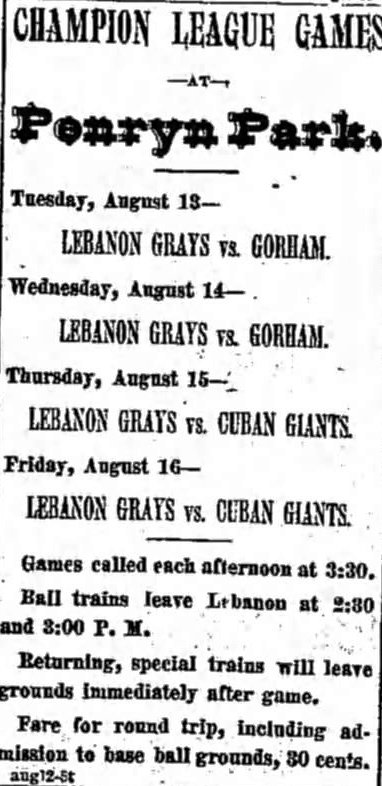
1889middlestates

Advertisement for August, 1889 games between the Lebanon Grays and the Cuban Giants, and Gorhams. The Gorhams were expelled from the league several days after these games were played.

The Harrisburg Ponies were the only team in the league that made money—the Gorhams, according to The Philadelphia Inquirer, had “few paying crowds” in Easton.  On August 21 The Inquirer said their “receipts did not amount to more than $20.”  The following day they were unable to pay the Hazelton team the guarantee for a scheduled game and were expelled from the league.  The Gorhams took to the road and barnstormed for the remainder of the year.

The Cuban Giants didn’t fare much better financially.  Owner John Bright, according to The Harrisburg Telegraph, needed to schedule his team for more than 60 exhibition games in addition to the 74 league games in order to turn a profit.

No one who followed the league, including Henry Chadwick, who watched the Cubans Giants play in August, had any doubt which team was the best in the Middle States League.  In The Brooklyn Eagle, Chadwick, “The Father of Baseball,” wrote:

“What earnest, active and capable team workers those Cuban Giants are.  In fact, I would rather see them play in a game where they had work to do to win than see half the (National) League or American Association teams play.  They are well up in the points and they play with a spirit and vigor, and with a good nature withal which makes their field work very attractive.  They have very intelligent and gentlemanly young official (manager) in Mr. McGovern [sic].  That catcher of theirs—(Arthur) Thomas—is a character, and they have an excellent strategic pitcher in (William) Seldon, and as for (Frank) Grant, he is at least a second (Fred) Dunlap on the field.  In fact, did not see a weak spot in the team in this game.”

Frank Grant

Frank Grant

Despite playing more than 60 extra games over the course of the season, the Cuban Giants managed to stay neck-and-neck with the Harrisburg Ponies all year.   In mid-September, with just four games remaining on the schedule, and with the league’s future in serious doubt, the Cuban Giants, just .001 behind the Ponies chose to cancel their last four games.  The Chambersburg Repository said the cancellations allowed “the colored club an opportunity to make a trip through New York State.”

The championship was awarded to the Ponies (who added two more victories after the Cuban Giants departed for New York).

The final official standings:

Harrisburg Ponies 64-19 .771

Cuban Giants 55-17 .764

Cuban Giants owner John Bright protested the final standings and took his case to the press.  In a long letter, published in The New York Sun, and other papers, Bright said his team “justly and honestly won” the pennant.  He claimed that Harrisburg was incorrectly awarded three victories for forfeited games–one against the Gorhams, when neither team showed up for the game, and two games against Wilmington after that team had disbanded.

Bright also charged that Harrisburg also lost a September game to Lebanon, and after the fact “Harrisburg turns it in as an exhibition game.”  He said his team was stripped of two victories in games where the official league ball was not used, while there were two games  they lost while playing with the wrong ball “but much to our amazement, only one game was not counted.”  Additionally, Bright claimed the league failed to award the Cuban Giants two games won against the Hazelton team.

Bright said the league standings should have been:

Cuban Giants 57-16 .780

Harrisburg Ponies 61-20 .753

Bright concluded:

“So any fair-minded person can see at a glance that the Cuban Giants are the real champions.”

The Philadelphia Inquirer initially seemed to side with the Cuban Giants.  They printed Bright’s charges and quoted an unnamed “prominent manager of the Middle States League” who said:

“The Giants are right in a number of their claims.  I never could see upon what grounds the Harrisburg club could claim a number of the games complained of, more than by the bulldogging tactics that they always employed throughout the season.”

The Philadelphia Press was squarely in the Harrisburg camp.  The paper referred to Bright’s “several foolish claims for the pennant,” and provided a forum for league president William Voltz-who was also the paper’s baseball editor–to respond.  Voltz called Bright’s charges “unwarranted and untrue.”  The league president/baseball editor also claimed the Cuban Giants still owed the league money and that the proper time for bright to protest the championship would be at the league meeting in December.

Newspaper reports of the December meeting make no mention of any representative of the Cuban Giants appealing the championship.

Harrisburg remains the official champion of the 1889 Middle States League

The league was reconstituted as the Eastern Interstate League for 1890.  The nucleus of the Cuban Giants jumped from Bright’s club and joined the league as the York Colored Monarchs—Frank Grant and Clarence Williams joined the previously all white Harrisburg Ponies.  The six-team league struggled, quickly became a four-team league, and folded all together in July.

Clarence Williams

Clarence Williams

York was leading the Eastern Interstate League when it disbanded.

“Show yourself a man, Borchers, and Leave Boozing to the Weak Fools”

10 Feb

After defeating the Boston Beaneaters and “Old Hoss” Radbourn in his major league debut, George Borchers returned to the mound five days later in Chicago and beat the Philadelphia Quakers and William “Kid” Gleason 7 to 4.

With two wins in two starts the 19-year-old Borchers was, according to The New York Evening World, one of the most sought after players in the National League:

“There are several league clubs who would like to get hold of Borchers, the latest Chicago wonder, the only thing in the way of his acquisition is the $10,000 (the White Stockings were asking).”

Chicago probably should have sold Borchers while there was interest.  He injured his arm sometime in June, missed most of July, and according to White Stockings Manager “Cap” Anson “lacks the heart to stand heavy punishment.”

George Borchers

George Borchers

After his fast start, Borchers was just 4-4 in 10 starts when Chicago released him and Chicago’s other 19-year-old “phenom” Willard “Grasshopper” Mains (1-1 in 2 games) on September 6.

The Chicago Tribune said Borchers was on his way to Cincinnati to play for the Red Stockings, “he has plenty on speed and good curves, and it will not be surprising if he makes a success in the American Association.”

After the Cincinnati deal failed to materialize, Borchers accepted $100 in advance money to join the Stockton franchise in the California League.  After receiving the money he never showed up in Stockton.

No less a figure than the “Father of Baseball,” Henry Chadwick held out hope that Borchers would eventually be a successful pitcher:

“There is a chance that a first-class pitcher, who played in the Chicago team last season, is going to reform the bad habits which led to his release by Captain Anson in August (sic) last. I refer to Borchers.   (John Montgomery) Ward told me that Borchers was a very promising pitcher, and had he kept himself straight be would undoubtedly have made his mark. I learn that be is going to try and recover his lost ground, and if be shows the possession of the moral courage to reform, and the intelligence to keep temperate, he will yet find his way to fame and fortune. Show yourself a man, Borchers, and leave boozing to the weak fools of the fraternity who indulge in it at the cost of a fair name and of pecuniary independence.”

Borchers didn’t appear ready to “reform.”  Between the 1888 and ’89 season, according to The San Francisco Chronicle, he signed a contract to play for the Canton Nadjys in the Tri-State League, receiving $100 in advance money and also signed a contract with that Kansas City Cowboys in the American Association, receiving a $300 advance.

In February of ’89 Borchers was awarded to Canton.  Kansas City offered to purchase his contract.  Canton Manager William Harrington said in The Sporting Life that “Borchers will play in Canton or not at all.”

Borchers left for California.

Upon arriving in Sacramento Borchers was arrested as a result of the Stockton contract.  The Los Angeles Herald said:

“George Borchers, the well-known baseball player, was arrested this afternoon on a warrant from Stockton, charging him with having received money by false pretenses.”

Borchers pleaded guilty and paid a fine in March.  In April he attempted to sign with the Sacramento Altas.  The San Jose Evening News said:

“Sacramento being in need of a pitcher, induced Borchers to agree to play there and asked the Stockton Club to allow him to do so.  This President Campbell (of Stockton) refused and the league directors have sustained the action.”

The California League ruled Borchers ineligible for the season.

With too much time on his hands, Borchers couldn’t stay out of trouble.  The Associated Press reported on June 27:

“Shortly after 11 o’clock tonight a barn belonging to Mrs. Borchers, mother of George Borchers, the well-known baseball pitcher, was destroyed by fire, causing a loss of nearly $1000.  When the Fire Department arrived on the scene George Borchers tried to prevent the firemen from fighting the flames.  He was drunk and very boisterous.  Finally Chief Engineer O’Meara ordered his arrest.  When two officers took him in custody he fought desperately, and had to be handcuffed and placed in a wagon before he could be got to prison.”

The story said Borchers, who “has been loafing about town (Sacramento) for several months, drinking heavily” had made threats that he’d burn down the barn because his mother would not give him any more money.  Mrs. Borchers had “recently expended a large sum of money to get him out of trouble at Stockton.”

Whether his mother paid his way out of this or not is unknown, but the charges against Borchers went away, and he spent the remainder of the 1889 baseball season pitching for a semi-pro team in Merced, California.

He returned to the California League on March 23, 1890 when he pitched for Stockton in the season opener against the Haverlys at San Francisco’s Haight Street Grounds.  Borchers and Stockton lost 11 to 5.

His time in the league would be short.

In Early May he began complaining of a sore arm; The San Francisco Call said that “Borchers is known to have received an offer from the New York Brotherhood (Players League) Club and the Stockton directors think he’s playing for his release.”

On May 11 Borchers, according to The Sacramento Bee arrived at the ballpark in Stockton, on horseback and “extremely drunk.”  Catcher/Manager Mike DePangher sent Borchers home.  Borchers instead went on a bender that ended the following evening in a Stockton restaurant where he was arrested for being drunk and disorderly.

The Call said:

“If he took this means to sever his connection with the Stockton Club and join the Brotherhood, he not only brought disgrace in more sense than one upon himself, but has probably ruined his chance of an Eastern engagement.”

Borchers was fined $10 in court, the Stockton club fined him $100 and suspended him for the remainder of the season and sold his contract to Portland in the Pacific Northwest League–but not before the Sacramento Senators attempted to use him in a game.  The Call said Stockton protested:

“(Sacramento) Manager (George) Ziegler thought it best not to play him.  When George was informed that he was not to play he good-naturedly said:  ‘All right, old man,’ and then added, ‘One suspension, one release, all in two weeks.’”

George Ziegler

George Ziegler

On June 1 he won his first start for Portland, beating Spokane 7 to 6.  The Oregonian said “Borchers pitched a splendid game for the Portlands.”

Borchers split the remainder of the season between Portland and Spokane, compiling a 14-14 record with a 1.44 ERA.  When the Pacific Northwest League season ended Borchers returned home to play in the California League again; The Sacramento Record-Union printed a letter from his manager at Spokane, William “Kid” Peeples:

“Borchers has been pitching ball out of sight, and has not tasted a drop of liquor while up north.  He says he is going to stay straight, and finish the season with the Sacramentos.  He will have all the California boys guessing, as he did here.”

The San Francisco Call said Borchers was “a dismal disappointment” after he lost his first two starts for the second place Senators—both losses were against the league-leading San Francisco Haverlys.  San Francisco Manager Mike Finn filed a protest with the league, claiming Borchers should be declared ineligible because he was still on the reserve list of the Spokane club.

Mike Finn, manager, San Francisco Haverlys

Mike Finn, manager, San Francisco Haverlys

In his third start Borchers allowed Stockton to score three runs in the first inning on five walks and a wild pitch, but settled down and won 7 to 6. He beat Stockton again three days later, 15 to 10. The Record-Union criticized all four of his performances and said he had reverted to “his old ways.”

The 21-year-old finished the 1890 season with a 2-2 record for the second place Senators; San Francisco won the championship.  At the end of the season the California League upheld Finn’s protest over Borchers and fined Sacramento $500.

The rest of the George Borchers story on Wednesday.

Em Gross

5 Feb

Emil Michael “Em” Gross was one of the best hitting (.295) and worst fielding (233 errors) catchers of the 19th Century during five major league seasons between 1879 and 1884.  The Chicago Tribune’s Hugh Fullerton, no stranger to hyperbole, called Gross “perhaps the heaviest hitting catcher that ever donned a glove.”

Em Gross

Em Gross

Gross, a Chicago native, didn’t need baseball in order to earn a living.  In 1884, when he played with his hometown team, the Browns,  in the Union Association (the team relocated to Pittsburgh in August), The Chicago Daily News said he “owns $50,000 worth of real estate in Chicago.”

Gross’ professional career came to an end after the 1884 season, but he played one more year for a Chicago semi-pro team called the Heavyweights.  The Tribune said of the team:

“While they do not count a man who weighs less than 200 pounds, they have some great baseball talent.”

Fullerton is responsible for the story that was most often told about Gross’ career in the years before his death in 1921.

Like many of Fullerton’s stories, the first telling appeared more than a decade after the fact and contained vague details,  little corroboration and was likely apocryphal.

This one made its first appearance in a Fullerton column in 1907.  He said Gross’ biggest weakness “was in catching foul flies.  He tried for everything in sight, ran circles around the ball and sometimes speared it, but he never felt at ease when one of those tall, twisting fouls went up.”

The columnist claimed the story was “vouched for by two old ballplayers who watched it come off:”

“(Gross) was catching in Providence one day when a Philadelphia batter poked up a fly that looked 50 feet high.  There was a wind blowing and the ball began to twist around in circles, with Em doing a merry-go-rounder under it.  Finally, seeing that it was escaping he made a desperate effort to turn quickly and fell flat on his back.  To his amazement he discovered that, for perhaps the first time in his career, he was under the ball which was descending like a shot straight toward his nose.

“Instinctively he threw up his feet and hands to protect his face.  The ball struck the sole of his shoe, bounded up into the air, and, as it fell again, Em reached out and caught it.

“And the next morning the Providence papers had the nerve to say he did it on purpose.”

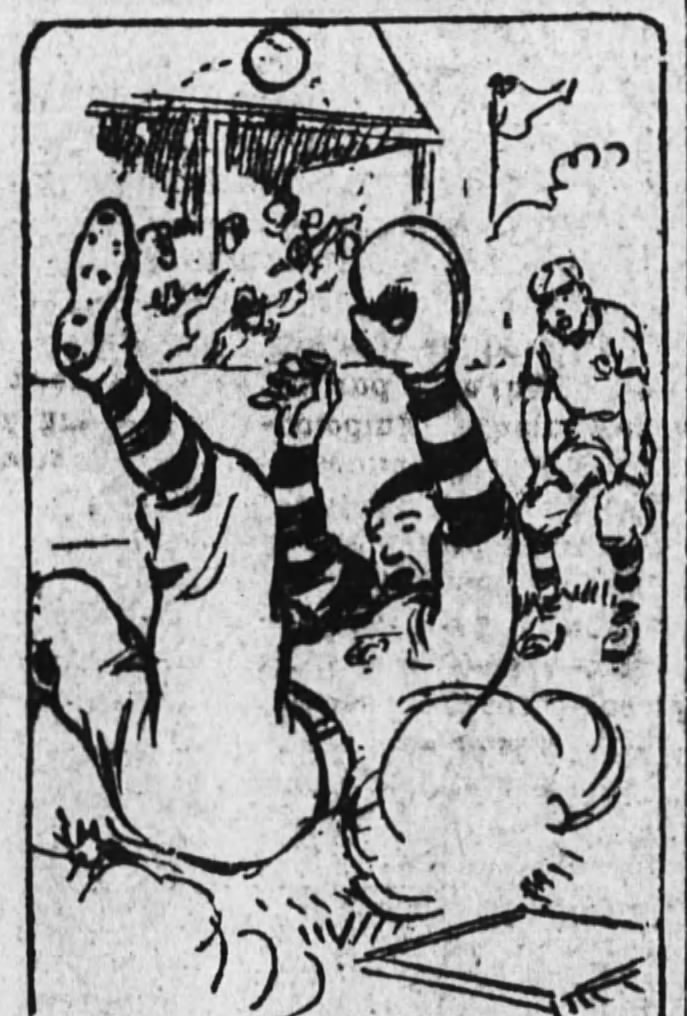
A cartoon which appeared with the 1914 retelling of the Gross story

A cartoon which appeared with the 1914 retelling of the Gross story

Fullerton continued to retell the story, with minor alterations, after he left The Tribune to join The Chicago Record-Herald, then The Chicago Examiner and The Tribune repeated the story several times over the years, with no byline, as well.

Gross was an important man in Chicago during the years Fullerton’s story circulated.  He owned several properties in the city, including two hotels, and his nephew, Fred A. Busse, was mayor of Chicago from 1907-1911.

Mayor Fred Busse

Mayor Fred Busse

Gross was known to help former baseball players in need; The Examiner called him “a refuge in time of trouble for all the old timers.”  When it was reported in 1907 that Joe Quest, a former National League, and American Association infielder, was “near death” from  tuberculosis in Georgia, he was living on, and managing a plantation owned by Gross—Quest survived and lived until 1924.

Joe Quest

Joe Quest

Gross told a story to Fullerton, then at The Examiner, about his attempt to help another player, William Henry “Bollicky Bill” Taylor during the 1890s.

“Taylor made an entre into Chicago without cash or credit and immediately swarmed upon Em and renewed old friendships. That was in November and along about midnight Em made the discovery that his friend had no money nor any place to sleep.  So he wrote a note to the manager of his hotels saying, ‘Take care of my friend Mr. Taylor, and give him what he needs.’  Em didn’t see ‘Bollicky’ again, but early in March his manager called him in the phone and inquired; ‘Say, how long do you want me to take care of your friend?’

“’What friend ‘inquired Em, who had forgotten all about it.

“Why the fellow you sent here with a note.’

“’Bollicky’ had wintered there and kept out of the path of his host, and when Em got through laughing, he ‘phoned back:

“Keep him as long as he has the nerve to stay.”

Gross never confirmed whether or not he made the catch Fullerton claimed he did.  He died in Eagle River, Wisconsin in 1921.

Irwin Howe

3 Feb

irwinhowebb


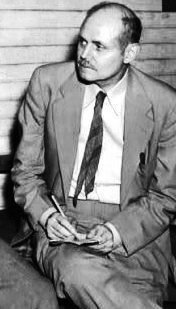
Irwin M. Howe founded Howe News Service in Chicago in 1910, published an annual record book and served as the primary statistician for several minor leagues, including the Western and the Three-I leagues.

After the 1911 season American League Secretary Robert McRoy, who was responsible for compiling statistics, left the league office to become an executive with the Boston Red Sox.  President Ban Johnson named Howe the league’s statistician; he served in that capacity until his death in 1934.

Irwin Howe

Irwin Howe

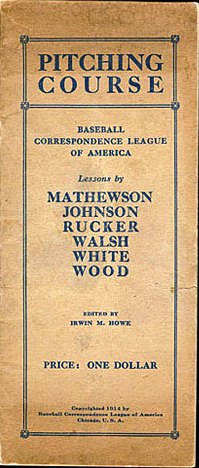
Howe leveraged his position with the American League.  He became the official statistician of several more leagues, including the American Association and the Federal League, wrote a nationally syndicated column called “Pennant Winning Plays,” became editor of the annual “Wilson Baseball Record and Rule Book,” and published an instructional pamphlet for kids.

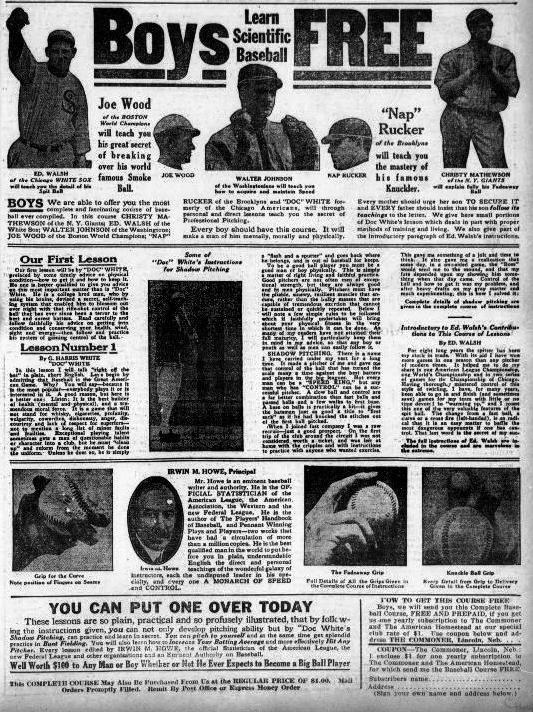
The ad from 1914 pictured above is for Howe’s 48-page “Pitching Course,” which he called “A correspondence school for baseball.” The pamphlets sold for one dollar, but were also offered by many small newspapers across the country for free to children who signed up subscribers (the pictured ad is from The Commoner, the Lincoln, Nebraska newspaper published by William Jennings Bryan).

Boys Learn Scientific Baseball Free

Ed Walsh of the Chicago White Sox will teach you the detail of his Spit Ball

Joe Wood of the Boston World Champions (1912) will teach you his great secret of breaking over his world famous Smoke Ball

Walter Johnson of the Washingtonians will teach you how to acquire and maintain speed

“Nap” Rucker of the Brooklyns will teach you the mastery of his famous knuckler

Christy Mathewson of the N.Y. Giants will explain fully his Fadeawy Ball

These lessons are so plain, practical and so profusely illustrated, that by following the instructions given, you can not only develop pitching ability…You will also learn to Increase Your Batting Average and more effectively Hit Any Pitcher.  Every lesson edited by Irwin M. Howe, the official statistician of the American League, the new Federal League and there organizations and an Eminent Authority on Baseball.

The pamphlet also included a lesson from Guy Harris “Doc” White of the Chicago White Sox “which deals in part with proper methods of training and living.”

Howe claimed his one dollar pamphlet was “Well worth $100 to any man or boy whether or not he ever expects to become a big ball player.”

Howe's pamphlet

Howe’s pamphlet

Perhaps Howe’s most famous contribution to baseball was certifying Ty Cobb as a .400 hitter in 1922.

On a rainy day in New York (years later in his book “Baseball as I Have Known It,” Fred Lieb said the game took place in August—contemporary newspaper accounts say it was May 15), Cobb beat out a ground ball hit to Yankee shortstop Everett Scott.  John Kieran of The New York Tribune (he was later a columnist with The New York Times) was the official scorer.  He charged Scott with an error.

Fred Lieb of The New York Telegram, who was compiling The Associated Press (AP) box score for the game, credited Cobb with a hit.  Lieb said “Considering the soggy field and Cobb’s speed, I gave it a hit.”

Fred Lieb

Fred Lieb

Howe’s habit was to rely upon The AP box score that appeared in the Chicago newspapers while awaiting the arrival of the “official” box score by mail.

When compiling the final averages at the end of the season Howe chose to accept Lieb’s scoring of the game rather than Kieran’s, and released a statement with the season’s final statistics:

 “I noted that the averages reached from my official scoring sheets had Cobb hitting .3995 (actually .3992).  With the unofficial averages giving him .401, I felt how can we deprive this great player of a third .400 average over a fractional point.”

Ban Johnson approved Howe’s decision.  Lieb, as president of the Baseball Writers Association of America’s (BBWAA) New York chapter was put in the uncomfortable position of attempting to repudiate his own scoring judgment.  He argued that the Kieran’s “official” score should be accepted, and said in a statement:

“Obviously, when there was a difference of opinion between the two scorers, the official and not the unofficial decision, should have been accepted.  There would be no further need for members of the Baseball Writers Association serving as official scorers if they were regulated to a secondary position.”

In a letter to Lieb, Ban Johnson said the “official” box score “was plainly in error in one other particular” besides the Cobb “hit” and “I requested a report of the official score of the game of May 15.  Mr. Howe had previously made a careful investigation of all facts surrounding the scoring.”  Johnson also chided Lieb asking “Are we to believe that you reversed your judgment at this late date?”

The 1923 “Wilson Record and Rule Book”–edited by Howe–contained an asterisk next to Cobb’s .401 average and noted that it was “not recognized” by the BBWAA—Howe was secretary of the association’s Chicago chapter.

The asterisk eventually disappeared, and Ty Cobb, thanks to Howe’s decision,  remains a .400 hitter for the 1922 season.

“Perhaps the most Superstitious Class of People”

31 Jan

In 1886 The San Francisco Chronicle said of contemporary baseball players:

“With all the enlightenment of civilization superstition still holds potent sway.  Perhaps the most superstitious class of people to be met today in the United States, aside from gamblers and actors, are baseball players and worshipers of the game, whose faith in “mascots” and jonahs” as influences for good or bad luck is almost if not fully as strong as their belief in religion itself.”

Jim Hart, in San Francisco with his Louisville Colonels, told the paper about some of the specific superstitions which influenced the 19th Century ballplayer:

“The St. Louis Browns have their club house at home just off from right field, and whenever the bell rings for the practice preceding each game the whole nine form into line in front of their house and then walk abreast to first base, where they disperse and take their positions.  This is invariably done under the belief that it insures good luck.  Bill Gleason too, the famous shortstop, always walks astride of the foul chalk line to third base before going to his place on the diamond.  He has never once failed to do it in the whole five years he has been playing baseball.”

Bill Gleason

Bill Gleason

“Why there’s (Albert “Doc”) Bushong, the catcher of the St. Louis Browns.  He’s got a pair of gloves that are so dilapidated that even the patches are patched.  He wouldn’t part with those gloves, though, for a ten-acre lot.  He thinks as mascots they are infallible.  (Walter Henry) Porter, the pitcher of the Brooklyns , also has a red sleeveless jacket  or shirt which he has worn regularly for more than two years.  It doesn’t match the uniform of the club, but he wears it anyhow, for he sincerely believes that if he laid the shirt aside the game would be lost.

“(Pete) Browning, our center fielder and the crack batter in the league, is the greatest fanatic on mascots, I reckon, of anybody in the business.  He did not come out with us this time.  He got out of whack during the summer and I sent him to the springs to recuperate.  He returned home before we came out here, but I thought it best to leave him behind.  Well, Browning has a practice of always walking over and touching one foot on third bag when going from field to bat, or vice versa.  A stack of twenties as high as that house wouldn’t be inducement enough for Browning to refrain from carrying out this program every time he plays, he’s got so much faith in it, you know.  To show you how earnest he is in this respect, I’ll relate a short anecdote about him which occurred last summer.  It may amuse you.  Browning has a pretty good idea of himself as a ballplayer, and it rather hurt him to be sent off from us, even if it was to the springs” (Browning was in such poor physical condition in July of 1886—The Cincinnati Enquirer said “it is doubtful if he appears on the diamond again.”– that he was sent to the springs in French Lick, Indiana for a month).

Hart said the rest of the Louisville team let Browning know they did just fine without him in the lineup, including their best road trip of the season, when they won 8 of 12 games:

“The rest of the boys naturally joshed him a good deal about it, and gleefully referred to their splendid record while he was away. ’Yes,’ replied Browning, driven to desperation, ‘but I was touching third bag every day, or you couldn’t have done it.’  It seems ridiculous, doesn’t it?  It’s true, nevertheless, for I found out afterwards that he had marked out a diamond just back of the hotel at the springs, and on the days that we were booked to play he would go out to his field and soberly go through his regular ceremony of touching third bag.”

Pete Browning

Pete Browning

Hart claimed he was an exception, “I’m not very superstitious,” he said, but he conceded “I hear and see so much of these things that hang me if I don’t almost believe in them myself sometimes.”   As an example, he told the story of arriving at the ballpark during a losing streak:

“I went into the club-room with a new white plug hat on my head.  Everybody jumped up at once and shouted, ‘A mascot! A mascot! Our luck will change now, sure.’ We did meet with rather better success after that, and the hat naturally got the credit for it.  Four or five weeks later I exchanged my white hat for a black mackinaw, and, my Lord! You should have heard those fellows kick.  They said I was a jonah and we’d lose the next game, and by thunder, we did, too.”

Lost Advertisements–Do You Want To Know The Baseball Scores?

2 Jan

baseballscores

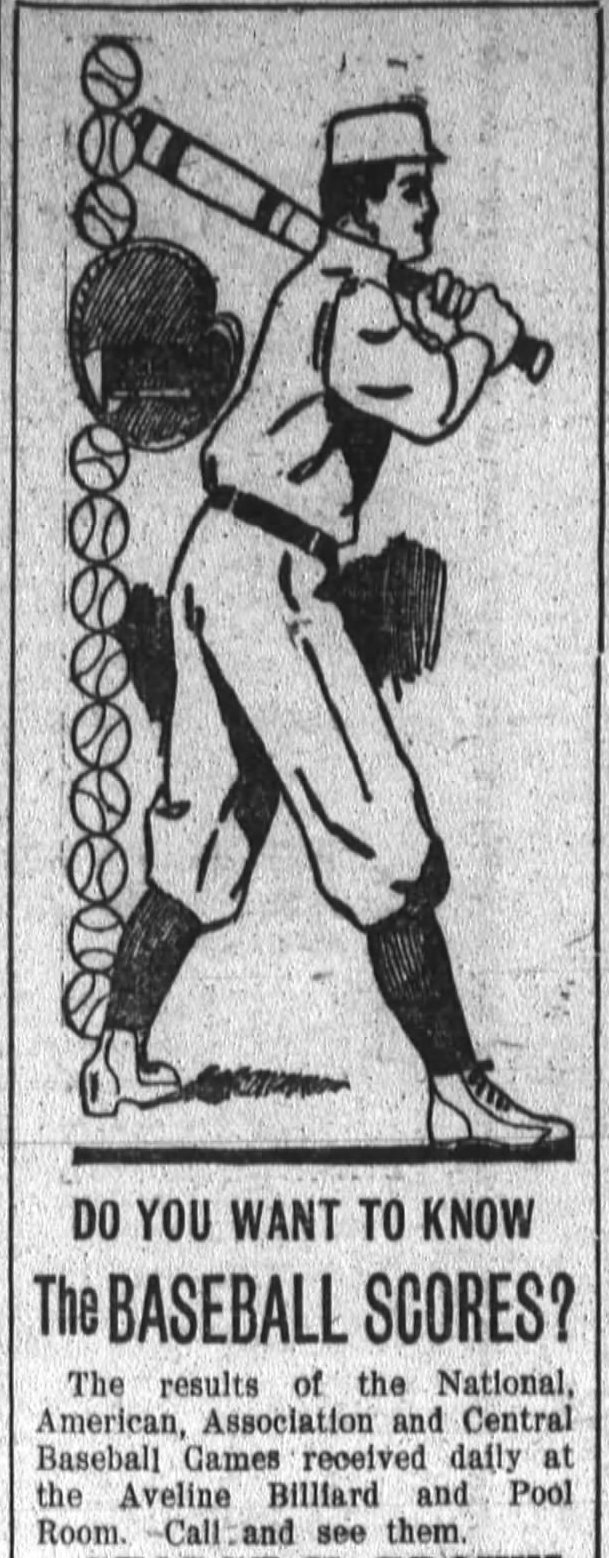
A 1908 advertisement for the Aveline Billiard and Pool Room in Fort Wayne, Indiana: “The results of the National, American, Association and Central Baseball Games received daily.”

Al Reach

12 Dec

Alfred James “Al” Reach opened his first sporting goods store in Philadelphia in 1874 while playing for the Athletics in the National Association.  Within a decade he had built a hugely successfully business, began publishing “Reach’s Official Baseball Guide,” and established a National league franchise in Philadelphia.

In May of 1886 Reach talked to The Philadelphia Times about “one of the great industries of Philadelphia in the sporting line.”

“Men, women and children are employed in making base balls.  The cheaper ones are made by a press with leather shavings on the inside.  The body is wrapped with cotton and covered with leather.  The covering is done by hand.  The best balls—the ones in use by the American Base Ball Association—are a solid piece of Para rubber on the inside, covered with worsted yarn and then with an outside covering of horse-hide.  Men do this covering.  They are mostly harness-makers, yet they have to broken into the work, for even a good harness-maker may be a poor hand at covering and sewing a ball properly.”

Al Reach

Al Reach

Reach said the company had orders for “five hundred dozen, or six million, balls already for this season,” and the company was “two hundred thousand dozen behind” filling the orders:

“We have had the factory running until ten o’clock at night all winter.  Base balls sell from 5 cents to $1.25 apiece…Three-fifths of all the balls used in the country are made in Philadelphia.”

—–

“Base ball bats are made of willow, spruce and first and second-growth ash.  The latter wood makes the best bet.  They are sold at fifty, sixty and seventy-five cents each.  There are about sixty thousand bats used every season.  Our orders already indicate that we will dispose of at least fifteen thousand of the best quality.”

Reach said the company employed “upwards of five hundred persons.”

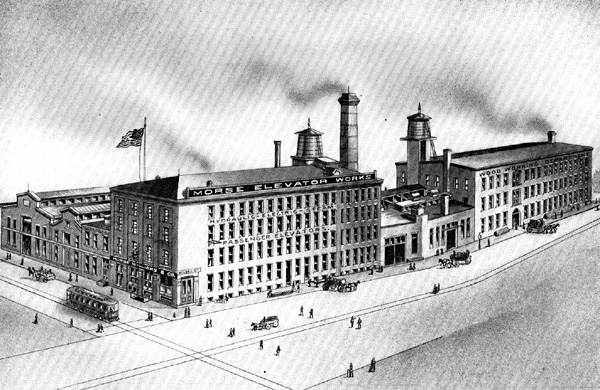
Reach's main factory in 1886 at Frankford Avenue and Wildey Street in Philadelphia---The Martin Landenberger Hosiery Mill Complex/Morse Elevator Works Building

Reach’s main factory in 1886 at Frankford Avenue and Wildey Street in Philadelphia–The Martin Landenberger Hosiery Mill Complex/Morse Elevator Works Building

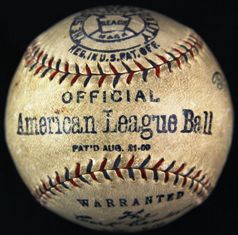
By the end of the decade Reach’s company was purchased by A.G. Spalding, with Reach staying on as an executive and the company continued to produce equipment with the Reach name, including the official American League baseball, which was used through the 1976 season.

Reach maintained controlling interest in the Phillies until 1899 and died in 1928.  He left an estate worth more than $1 million.

Reach Official American League ball 1920s

Reach Official American League ball 1920s

“Hilariously and Shockingly Drunk”

11 Dec

The Philadelphia Athletics were in second place, two games behind the St. Louis Browns in the American association pennant race in June of 1889; but The Philadelphia Times said the team was underachieving, and blamed it on drinking:

“Watch your men, Manager (Bill) Sharsig.

“It is a matter of notorious publicity that a portion of the best players on the Athletic Base Ball Club are not living up to their contracts.  They drink, carouse and make exhibitions of drunkenness that are disgusting the people who so liberally contribute to the support of the national game, and unless the management put an immediate stop to such proceedings the club will be certain to finish the season with a balance on the wrong side of the ledger.”

The paper said because it was “unjust to criticize the club as a whole” they would name the guilty parties:

“It is an open secret that (Denny) Lyons, (Curt) Welch, (Mike) Mattimore, (Henry) Larkin, (Harry) Stovey and sometimes (Frank) Fennelly and (Lou) Bierbauer are frequently in a beastly state of intoxication, and it is easy to prove when and where they have recently been seen so in public places.”

The Times singled out Welch, who was out of the lineup because Sharsig said he was ill:

“Sick he may be, and those who saw him in company with Lyons last Tuesday morning at the early hour of 3 O’clock wonder that he is not laid up.  That model pair were sitting on the curbstone on the South Penn Square side of the City Hall, hilariously and shockingly drunk.

“Saloon-keeper Irwin, who keeps on Juniper Street, told a friend that Welch and another ballplayer became so vulgarly and obscenely boisterous in his place on Monday night that he had to order them out.”

Curt Welch

Curt Welch

The Times said the Athletics loss on June 16—they were defeated 9 to 5 by the Browns—“was largely due to errors made by Welch, Stovey, Larkin and Lyons, all of whom showed traces of their Saturday night’s outing.”

The team’s activities were not limited to Philadelphia, from “every city on the circuit came stories of debauches and sprees,” involving the Athletics:

Chris von der Ahe, of the champion Browns, is responsible for the statement that on the last trip made by the Athletics to St. Louis six of the players became so drunk and noisy in the big Anheuser-Busch saloon that the proprietor had to have then ejected, and a ballplayer on another club that chanced to meet the Athletics in East St. Louis said yesterday that he never saw so many drunken men on one team and that their unseemly conduct was the subject of general talk around the depot.  From Baltimore and Brooklyn come well authenticated stories of boisterous sprees and hilarious conduct in public places.”

The Times said even the most famous umpire of the era, “Honest John” Gaffney, “whom a ballplayer has no truer friend,” commented on the state of the Athletics:

“He says that he has repeatedly seen some of them come up to bat so drunk that they could hardly stand.”

John Gaffney

John Gaffney

The paper said Sharsig, “an exceedingly clever gentleman,” had completely lost control of the team:

“The ballplayers all like him and avow their willingness to do for him whatever he asks, but he is apparently unable to keep them sober even at home and when away they are absolutely beyond his control.  He does not believe in imposing fines…Stovey, Welch and Larkin know that it would be hard to fill their places and laugh at threatened dismissal.”

The Athletics lost six straight games after the story appeared, and 16 of their next 22.  They ended the season in third place with a record of 75-58.

Manager Bill Sharsig

Manager Bill Sharsig

Mattimore was released in August.  Larkin, Bierbauer and Stovey jumped to the Players League after the season ended, and Fennelly was sold to the Brooklyn Gladiators.

Sharsig’s 1890 team led the American Association until July 17, then faded badly and finished in eighth place.  There was no mention in the Philadelphia press about whether drunkenness contributed to the 1890 collapse.