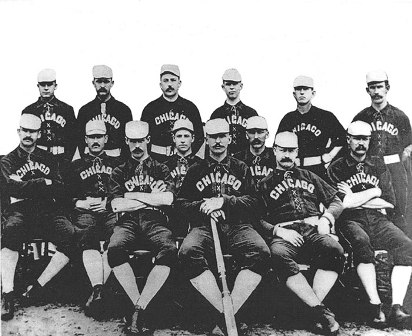
Tag Archives: Cap Anson

Clark Griffith “Convinced me of the Knuckle Ball’s Effectiveness”

7 Nov

As with most 19th Century players, Bill Lange had had several criticisms of players who came later, particularly the “batsmen of the present time,” when he spoke to a reporter from The Chicago Inter Ocean in 1909;  but unlike many of his contemporaries he thought some aspects of the game were better.  He said players were better behaved and were in better condition; he also believed pitching had improved:

“We old timers were a long time in believing there was anything in the so-called spit ball.  But results have forced us to admit its existence and its power to deceive.  Now they are talking about the knuckle or finger nail ball.  For a long time I supposed that was a joke.  But just this morning I had a letter from Clark Griffith, telling about a discussion he had with (Cap) Anson during the schedule meeting at Chicago over the knuckle ball.  Griff ought to know what he is talking about, and he convinced me of the knuckle ball’s effectiveness but his argument with Anse must have been funny.

“You know Anse has to be shown on every proposition.  Griffith told him that (Ed) Summers of the Detroit team had the best command of the knuckle ball and that it came up to the plate in such a peculiar manner that it fooled not only the batsmen, but the catchers too.

“’That’s all rot,’ Anson said to Griffith, but Griff came back with the willingness to bet Anson $100 that Anse couldn’t catch three out of five knuckle balls as thrown by Summers.  Anson jumped at the chance and took the wager, and it will be decided sometime this year, if Summers, Anson and Griffith happen to be in the same city at the same time.

“I guess Griff will win the money, for he told me in his letter that he couldn’t catch half the balls Summers had thrown to him in practice.  I can hardly believe any pitcher has such a funny delivery as that.  Of course, if the knuckle ball worked all the time, there wouldn’t be any hitting at all.”

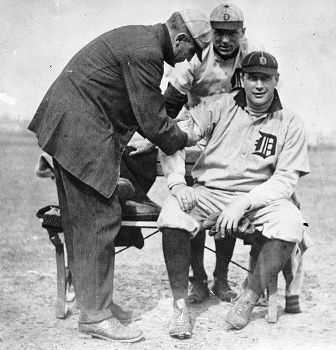
Al Summers has his arm worked on by Tiger trainer Harry Tuthill, first baseman Del Gainer looks on.

Al Summers has his arm worked on by Tiger trainer Harry Tuthill, first baseman Del Gainer looks on.

There’s no record that the wager was ever decided.

Clark Griffith

Clark Griffith

“In the ‘90s Nobody ever Thought Anything of telling the Manager to go Chase Himself”

6 Nov

Bill Lange played only seven seasons in the National League—all with Chicago–but his reputation lived on long after he walked away from the game in 1899 at 28 years-old.  Two of his biggest supporters, Connie Mack and Clark Griffith, remained influential until their deaths in the mid 1950s, and both helped to keep Lange’s legend alive until his death in 1950.

Long after his retirement to enter the insurance and real estate business in his native San Francisco, Lange remained extremely popular in Chicago;  he was frequently quoted by Chicago sportswriters (most often his friend Hugh Fullerton), and was even retained The Chicago Examiner’s  “World Series expert” in the early and mid teens.

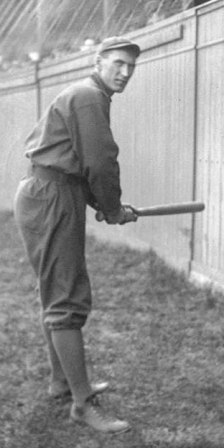
Bill Lange

Bill Lange

In 1909, when the White Sox were training in San Francisco, Lange told a reporter for The Chicago Inter Ocean that “the batsmen of the present time had not advanced in any way” over the hitters of his day—and Lange felt they took too many pitches:

“I have noticed that the habit nowadays is to be altogether too scientific.  And that science is ruining the batters.  There used to be such things as .400 hitters in the big leagues and now the managers are spending fortunes in the hopes of finding a .250 hitter.  The reason they are so hard to find is because the batsmen don’t follow their natural inclinations to wallop the ball, but stall around at the plate in the artificial hope of drawing a pass instead of breaking a board in the back fence.

“No batter, who has any eye at all, ought ever to wait when he has three balls and one strike on him, unless the pitcher is uncommonly wild.  Think of the advantage of hitting when three balls have been called.  You are dead sure that the next one will be over the plate if the pitcher can get it there.  If he doesn’t, let it go and take your base.  But if you let a good one go then you are up against another proposition.

“Then the batsman is in a worse hole than the pitcher and his chances of making a safe hit are at least 4 to 1 against him, for a nervy pitcher will take a chance on a curve or a high one in the hope of making the batsman bite.  He wouldn’t dare do that very often when the count was only three and one.  The batsman who waits too long is just giving himself the worst of the deal.”

Unlike many players of his generation, Lange did note that some aspects of the game had improved since he played:

“We didn’t hustle like the players of the today do.  We would shirk morning practice all the time, so we could sleep late.  And take it from me, a lot of us needed the sleep, for most all of the boys belonged to the Ancient Order of Owls.

“The teams of today report at the grounds at 9:30 in the morning and work to beat the band for two hours. In the old days, after we had stalled the manager off as long as possible, we would finally show up for morning practice.  I don’t know all the systems the players on other teams had for dodging morning work, but with the old Chicago bunch we left it up to (Bill) Dahlen to break up the practice after about ten minutes of hustling.

“Dahlen could turn the trick might easily.  All he had to do was whiz four or five low throws at Anson’s shins.  ‘Pop’ used to bawl Dahlen out for a few minutes, but Bill would keep up the bum throwing until Anse would say ‘Enough.’  Nothing like that goes in the big or small leagues now.  It is a question of work and buckle down to business.  In the ‘90s nobody ever thought anything of telling the manager to go chase himself.  I haven’t heard of anybody doing anything like that in late years, and getting away with it.”

Bill Dahlen

Bill Dahlen

Lange on pitching, tomorrow.

“He Used to Knock Down Infielders”

4 Nov

William Alexander “Bill” Lange is best known for a play that likely never happened.  The legend was that he had made a spectacular catch that culminated with the Chicago Colts’ outfielder crashing through the left-field fence in Washington in an 1897 game with the Senators.  It is most likely another in a long line of exaggerations and apocryphal stories from Lange’s friend, Chicago sportswriter Hugh Fullerton—a story that first appeared in that paper with no byline in 1903, but was repeated by Fullerton many times in later years.   A nice analysis of that story appears here.

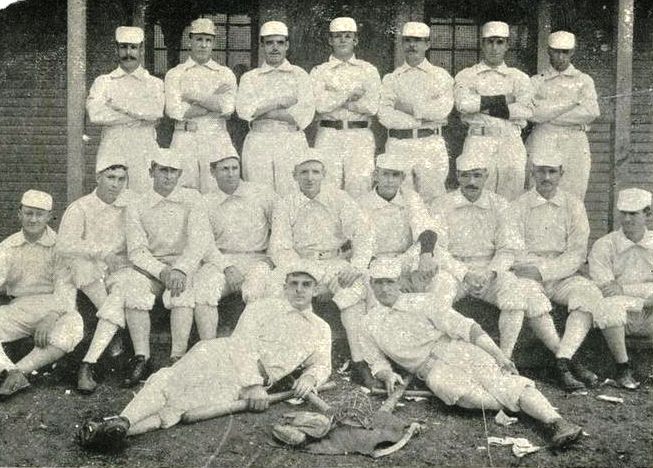
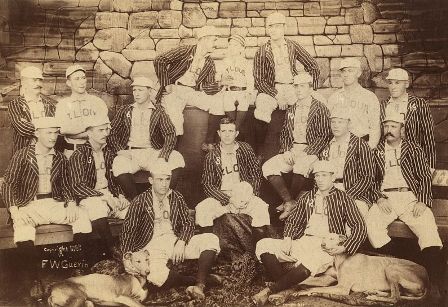
Bill Lang, seated fourth from left, with 1896 Chicago Colts

Bill Lang, seated fourth from left, with 1896 Chicago Colts

Lange played just seven seasons, retiring after the 1899 season at age 28 to join his father-in-law in the insurance and real estate business in San Francisco.

During the spring of 1900, The Chicago Daily News said “The wise ones in the baseball business” were certain he’d be back, including Chicago’s manager Tom Loftus and President James Hart, and Charlie Comiskey, “’When the season opens and the sun warms up he can’t stay away,’ remarks Comiskey, with a knowing wink.”

Despite the certainty that he would, Lange never returned.

Lange, who stole 400 career bases, was called “Little Eva” because of his gracefulness.  In 1909 Billy Sunday called him “the greatest outfielder in baseball history.”  Connie Mack called him the best base-runner he ever saw.  In fact,  Mack and Clark Griffith considered Lange so good that they petitioned the Hall of Fame in 1940 to change the “rules (which) restrict membership to players of the twentieth century” in order to allow for Lange’s induction.

Griffith said Lange was “the best outfielder that ever played behind me:”

“Lange here was rougher base-stealer than (Billy) Hamilton.  He used to knock down infielders.  Once I saw him hit a grounder to third base.  He should have been out, but he knocked down the first baseman.

“Then he knocked down the second and third baseman and scored.  Connie Mack was the catcher.  No he didn’t knock Connie down because he didn’t have to.”

Mack told the same story over the years.

Lange never made the Hall of Fame.  He died in 1950.

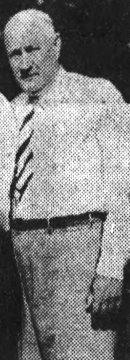
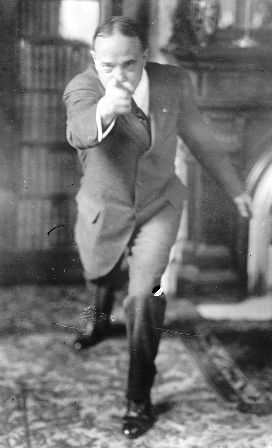
Bill Lange 1931

Bill Lange 1931

In his final years the story about the “catch” had become so ingrained in the legend of Bill Lange that other players told essentially the same story Fullerton did (the most widely disseminated versions appeared in “The American Magazine” in 1909 and in Johnny Evers‘ book “Touching Second,” coauthored by Fullerton), but inserted themselves into the story.  In 1946 Griffith told reporters:

“It happened right here in Washington, I was pitching for Chicago.  Bill missed the train from New York, and arrived in the fourth inning.  We were then with the Chicago Colts and Cap Anson fined Lange $100 before he put him in the game.

“I had a one-run lead when Al (“Kip”) Selbach of Washington hit a terrific drive.  Lange ran back hard, and when he crashed into the wooden fence his 210 pounds took him right through the planks.

“He caught the ball at the same time and held it.  All we could see were his feet sticking through the fence and Bill’s arm holding the ball.  When he came back to the bench, he handed the ball to Anson and said:

‘This ought to cancel that $100 fine.’ It did too.”

When Lange died Griffith said:

“I have seen all the other great outfielders—Speaker, Cobb, DiMaggio –in action and I consider Bill Lange the equal of, if not better than, all outfielders of all time.  There wasn’t anything he couldn’t do.”

“A Game before the Kings and Many Nobles”

24 Oct

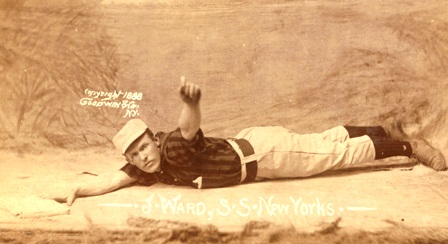
While traveling around the world as a member of A. G. Spalding’s 1888-1889 world tour, John Montgomery Ward wrote a series of dispatches for The New York World.  On February 23, 1889 the team played in Rome:

“In the picturesque Piazzi di Siena of the grounds of the Villa Borghese today the American baseball teams played a highly exciting game.  This is one of the favorite resorts of Roman citizens.  Never before in all my experience on the diamond have I seen so many distinguished persons among the crowd of baseball spectators as were in attendance here this afternoon.  The nobility was out in all its glory, and in there center stood his Majesty King Humbert.  He was dressed in a civilian’s suit and apparently enjoyed the sport. “

King Humbert "enjoyed the sport"

King Humbert “apparently enjoyed the sport”

Ward listed every member of the royal party and other “Roman princely families” who were present at the game.

“Nearly all the local literary and artistic celebrities were in the unprecedented royal and papal assemblage, and the applause at times would have stirred the heart of the most enthusiastic admirer of the American national game.  The last time the Piazzi di Siena was used was on the occasion of the marriage of the King’s brother, when the celebration was held on these magnificent grounds.

“The day was beautiful and the players were in fine condition.  During the preliminary practice the crowd of 5000 people was simply amazed at the skill displayed by the boys in batting, throwing and catching the ball.  The game itself was extremely well played, and resulted 3 to 2 in favor of Chicago.   The batting was lively, but nothing could pass the fielders, who played with remarkable energy.”

John Montgomery Ward

John Montgomery Ward

On the day of the game in Rome Ward said the players received word that National league owners were instituting the Brush Salary Classification Plan; a system developed by Indianapolis Hoosiers owner John Tomlinson Brush,  which rated players and placed them into five categories, each with a capped salary.  The Brush Plan, along with the Reserve Clause, would be the major impetus for the formation of the Players League:

“I interviewed every one of the men on the subject.  The scheme, as it is now understood by us, is regarded as a great mistake.  President Spalding, Captain Anson and Ned Hanlon concur in this opinion and say the plan is impossible and will not last long.”

Another issue that rankled players in Rome was the news that National League owners were demanding that the players return to the states by April 1 to prepare for the 1889 season; Ward said of the demands:

“From letter received by various members of the All-American team it is evident that certain managers are endeavoring to force the players to report for duty by April 1st.  For the information of these magnanimous gentlemen I will say that every player in the party will play the trip out.”

The All-Americans returned on April 6.

“Who told you you were a Ladies’ man, Mr. Viau?’

3 Oct

Leon A. “Lee” Viau (pronounced vee-o) was the first player from Dartmouth College to make it to the major leagues.

Listed at only 5’ 4” and 160 pounds Viau was 83-77 in five big league seasons.  The Cleveland Leader said of his time pitching for the Spiders:

“(Viau) with comparatively little speed but with curves well mixed with gray matter, got out of lots of tight places where an ordinary twirler would have been knocked out of the box.”

In addition to having attended an Ivy League school, he was best known for his looks, and for being one of the best-dressed players in baseball.

The Philadelphia Inquirer called him “The Adonis of the diamond.”  When he played for the Patterson Silk Weavers in the Atlantic League The Patterson Weekly Press called him “the Beau Brummell of the club.”

Lee Viau

Lee Viau

A story, perhaps apocryphal, made the rounds in several newspapers during the first decade of the 20th Century about how “the grandstand was filled with ladies…when the handsome Viau was in the box.”

On this particular occasion, as recounted in The Kansas City Star, Viau was pitching for the Spiders against “Cap” Anson and his Chicago Colts in Cleveland:

“The score stood 4 to 2 in the last half of the ninth inning, and in Cleveland’s favor.  There was a Chicago man on second and one on third, while Anson was at the bat.

“He was madly anxious to bring in those runs, and he swung viciously at the first ball pitched. ‘Strike one!’ yelled umpire (Thomas) Lynch.

“Anson gritted his teeth and waited for the next one.  Lee sent up one of those slow, deceptive drop balls for which he was noted, and again Anson swung wildly.  ‘Strike two!’ cried Lynch.

“At this there was a veritable uproar among the female occupants of the grandstand.

“’Strike him out Lee! Oh, do strike him out!’ they shrieked in chorus.

“Hearing these cries, the grim old Anson, with a sneer on his face, sardonically inquired: ‘Who told you you were a ladies’ man, Mr. Viau?’

“Lee maintained a haughty silence, wound his arm slowly about his head and then, taking a wide swing, shot the ball up to the plate, and Anson took the third swipe at it and missed.

“’Now’ remarked Lee, as he advanced toward Anson, ‘I will answer your question.  The same person who told you you could bat.’”

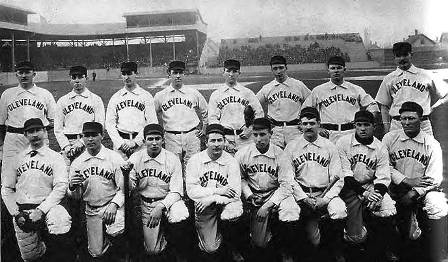
Lee Viau, front row third from right, with 1892 Cleveland Spiders

Lee Viau, front row third from right, with 1892 Cleveland Spiders

“Anson, the Baseballist, would like to see some Changes”

26 Sep

Some of baseball’s pioneer’s had ideas for rule changes that would have if adopted, dramatically changed the game.  In 1896 Adrian Constantine “Cap” Anson proposed two such changes.

Anson’s Colts had not finished better than fourth place in the National League in the previous five seasons, and the manager apparently thought two radical changes would improve his team’s chances and simplify the game.

"Cap" Anson

“Cap” Anson

The Chicago Record said:

“Anson, the baseballist, would like to see some changes in the present system of playing ball.”

Anson said he wanted to make a change to the 1893 rule that established the distance from the pitcher’s mound to home plate and replaced the pitcher’s box with the rubber:

“He is in favor of putting the pitcher’s slab in front of the pitcher, instead of having it behind him.  He wants this done in order to stop the interminable bickering that is going on in almost every game as to whether the pitcher was in position.  It is much easier to see whether the rule is conformed to when the slab is in front of the pitcher, and he dare not stop over it.”

Anson’s other rule change would have led to complete chaos, and would have made it an adventure to fill out a scorecard:

“Another radical change that Anson is in favor of allowing the captain to put players back into the game after they have been taken out…(Anson)  wants all restrictions removed, the manager being allowed to play his men just as he sees fit, taking them out and putting them back just when he wants to.”

The issue of introducing free substitution into baseball has occasionally been raised in the years since Anson advocated for it.

Montreal Canadians coach Dick Irvin suggested it to Kennesaw Mountain Landis as a solution to player shortages when the baseball commissioner attended an NHL game during World War II.   Lew Fonseca made a pitch for the rule in the 1950s, and Walter “Red” Barber, long-time Dodger and Yankee broadcaster suggested in the 1960’s that the rule would help keep baseball from being “as exciting as watching paint dry.”

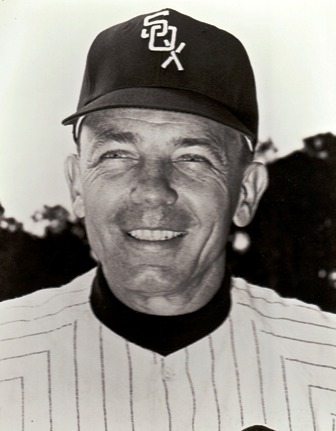
In 1967, Eddie Stanky of the Chicago White Sox was given permission from the American League to experiment with a crude form of what would become the designated hitter rule six years later.  The convoluted rule, according to The Milwaukee Sentinel, said:

“(T)he Sox and their spring opponents will be allowed to call on a pinch hitter twice provided that he is designated before the game is not used twice in the same inning.”

Eddie Stanky

Eddie Stanky


“He was Greater than Ty Cobb ever dared to be.”

15 Aug

Hall of Famer Jake “Eagle Eye” Beckley still holds the all-time record for putouts and total chances for first baseman, more than 100 years after his career ended.  He also hit .308 for his career and his 244 triples rank fourth on the all-time list.

However, it appears he wasn’t a great source on who was the greatest player ever.

Jake "Eagle Eye" Beckley

Jake “Eagle Eye” Beckley

In 1915 Beckley told a Kansas City reporter that he had played with the greatest player ever.  Over the next year the quotes appeared in many newspapers including The Washington Post and The Pittsburgh Press:

“You can have your Ty Cobbs and your Benny Kauffs, I’ll take Billy Sunday for my ball club right now, and I said the same thing back in the nineties.”

Beckley said the ballplayer turned evangelist was as good as any player he’d seen:

“He’s fifty-two years old today, but he’s running bases and sliding every day in that pulpit just as he did back in the old days.  If he’d stayed in the game Cobb never would have been famous.

“He was greater than Ty Cobb ever dared to be in three departments of the game.

“Everybody thinks Cobb can run bases.  I’d spot him a second against Billy Sunday and then watch Bill score first.”

Sunday was the first player to circle the bases in 14 seconds.

“They think Cobb covers outfield territory.  They should have seen Sunday in his prime.

“And throw—say he could throw from center field just as easily as Tris Speaker.”

Beckley had several excuses for Sunday’s weaknesses as a hitter:

“Batting was where Sunday was weak, but in another year or so he would have overcome that weakness.  E was just that kind.

“He had more fight in his heart than any man I ever saw.  He was learning more about the art and science of batting every day.

“You see, Billy Sunday broke in under a handicap.  Pop Anson picked him up because of his speed and not because of his baseball ability.  He was fast, but when he started in a bat was strange to him.

“He fanned so many times his first year (18 in 55 plate appearances) he must have been busy when the season ended.  But when he came to our ball club (Pittsburgh Alleghenys 1888) he was improving and improving fast.”

Sunday’s “fast” improvement resulted in .236, .240 and .258 batting averages from 1888-1890.

Beckley concluded that Sunday’s “calling” was the real reason he never became a good hitter:

“But he didn’t give enough attention to his batting.  He used to spend a lot of time before the game in the clubhouse always reading the bible or studying.”

Sunday walked away from baseball after the 1890 season to accept the position of assistant secretary with the YMCA in Chicago; he became one of the nation’s most popular evangelists and died in 1935.

Billy Sunday

Billy Sunday

Beckley played until 1907, collecting 2934 hits during his 20-year career.  He was elected to the Hall of Fame in 1971, more than 50 years after he died in Kansas City at age 50.

“The Sudden Reappearance of ‘Silver’ King”

27 Jun

Oliver Perry “O.P.” Caylor wrote in June of 1896 in The New York Herald:

“One of the baseball surprises of the season is the apparently successful reappearance of ‘Silver’ King upon the National League diamond.  Without any warning the Washington club sent him in against the Pittsburgh team, and he not only won his game, but held the latter down to six hits, Of course all this caused a great deal of gossip wherever baseball is a subject of interest.”

When Charles Frederick “Silver” King (born Koenig), took the mound for the Washington Senators and beat the Pittsburgh Pirates 8 to 1 in the second game of a May 30 doubleheader, it was his first appearance in professional baseball in nearly three years.

King had been one of baseball’s best pitchers of the 1880s, with a 142-70 record from 1887-1890 while playing for Charlie Comiskey, first with the St. Louis Browns in the American Association and then following Comiskey to the  Chicago Pirates in the Players League.

Comiskey (8) and pitcher Silver King (14) with the 1888 St. Louis Browns, King would follow Comiskey to the Chicago Pirates in the Players League in 1890

Comiskey, seated center(8) and Silver King standing second from right (14) with the 1888 St. Louis Browns, King would follow Comiskey to the Chicago Pirates in the Players League in 1890

Caylor said that during Flint’s heyday:

“His most successful delivery was what is known as ‘the cross fire,’ first used effectively, I believe, by (Charles “Old Hoss”) Radbourne and at present the prominent stock in trade of (Wilfred “Kid”) Carsey of the Philadelphias (Phillies).  It consists of standing on the extreme end of the pitcher’s plate, stepping away still farther from the direct line towards the batsman and sending the ball across the home base at an angle, which, although small, is very bothersome to the man with the bat.”

Silver King

Silver King

Caylor said King was “put out of the business” in 1893 when “the pitcher’s box was set back five feet,” (to the current 60’ 6”).  While King’s record slipped during the last two seasons the distance was 55 feet to a combined 36-53 while pitching for the Pirates and New York Giants, he had respectable ERAs of 3.11 and 3.29.  After the rule change King went 8-10 with a 6.08 ERA pitching for the Giants and Comiskey’s Cincinnati Reds in 1893, and then disappeared.

Caylor thought there was “a great deal of significance to King’s return to the diamond,” and predicted a trend:

“It means managers, having exhausted the new crop and finding nothing before them worth a trial, are forced to look behind and try to rekindle some of the half burned out embers. Washington not only took up King, but they gave (Les) German a trial after the New York club let him go.  (Cap) Anson (Chicago Colts) went back to (Fred) Pfeffer after finding (Algernon “Algie”) McBride, (Josh) Reilly and (George) Flynn wanting and was even forced to put himself into his nine to fill out the weak spots.”

Caylor said it was “astonishing  to look over the list of new material which was brought into the National League last spring and notice how small a part of it has been able to keep ‘in the swim.’  Every day one hears that some younger player has been released or that another has been loaned or farmed to a minor league club.”

Caylor’s prediction of success for the “trend,” and the players named was a mixed bag.  Anson, who had never really gone away, hit .331 in 108 games, for the Colts, but Pfeffer hit just .244 in 94 games. German fared the worst, he was 2-20 in 1896 and 3-5 the following season before being released in August.

King managed to post a 16-16 record for the Senators in 1896 and ’97 but never found his early career form.  After the 1897 season, he returned to St. Louis where he died in 1938.

Caylor would become ill the following season, and died in October of 1897.

The Curve and The Spitter

26 Jun

Hugh A. “Hughey” Reid only appeared in one professional game; he went 0-4 and played right field in a game for the American Association’s Baltimore Canaries against the White Stockings in Chicago in August of 1874,  as was the practice at the time, Baltimore recruited Reid, a local semi-pro player to fill in for the injured Oscar Bielaski.

Reid wasn’t known in the amateur and semi-pro leagues in Chicago as an outfielder.  He was considered one of the best pitchers in town, and played for the Chicago Aetnas, one of the premier teams in the city, and according to The Chicago Tribune “The champion amateur team of 1869.”
Hugh Reid

Hugh Reid

Among Reid’s teammates with the Aetnas were future big leaguers Jimmy Hallinan and Reid’s brother-in-law and catcher Paddy Quinn.

Reid worked as a stereotyper (made metal printing plates), for The Chicago Evening Post after his career ended.

In 1920, Reid was interviewed by Alfred Henry “Al” Spink, founder of The Sporting News.  By 1920, Spink, who had played amateur baseball in Chicago against Reid with a team called the Mutuals (named for the more famous aggregation in New York), had relocated to Chicago and was writing for The Evening Post.
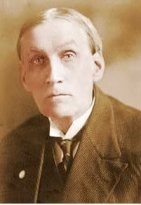
Al Spink

Al Spink

The occasion was “field day exercises of the old timers” at Pyott Park at the corner of Lake Street and Kilpatrick Avenue in Chicago; the days events were followed by a banquet.  “Cap” Anson, Charles Comiskey, Hugh Nicol, and Fred Pfeffer were among the dozens of former pro, semi-pro, and amateur players who attended.

Spink described the 70-year-old Reid; “same old smile, same old swagger, same old don’t care a tinker’s, same old Hughey.”

Nine years earlier Spink had credited William Arthur “Candy” Cummings with originating the curveball in his book “The National Game,” but by 1920 others were making the case for different candidates.  Spink asked Reid his opinion:

“Without a doubt Cummings was the first pitcher to put the curve on the ball.

“As Cummings was using the outcurve as early as 1867, and Bobby Matthews only broke into the game at Baltimore in 1869, there is very little doubt as to who discovered the art of curving.

“In fact, it was not until years later, when the rules allowed the pitchers to raise their arm above the waist, that Matthews became master of the curve.”
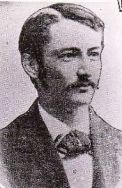
Candy Cummings

Candy Cummings

Reid also talked about the pitch Mathews did introduce:

“I am quite sure that Mathews was the first to work the delivery mow bearing the insanitary name

“Before delivering the ball he would rub it hard on his trousers, always on the same spot, where the seams are the farthest apart…he would draw his two fingers across his lips, take the ball with two fingers and a thumb and send it in with only fair speed.  He had perfect control and usually sent the ball about waist-high for a player calling for a low ball.  The break came just in front of the plate and the ball usually went into the ground or very high in the air.  Few line drives were made off of Mathews.”
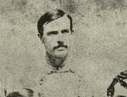
Bobby Mathews

Bobby Mathews

Reid also talked about Alphonse Case “Phonney” Martin.  At the same time that Spink was making the case for Cummings in “The National Game,” Martin told William Aulick of The New York Globe that he developed the pitch. Aulick concluded:

“Some people say this was the first cousin of the curve ball, but they don’t say this when old Alphonse Martin is around.  He insists it wasn’t anyone’s cousin–it was Mister Curve himself.”

Reid disagreed, he described Martin’s pitch as a “freak ball,” and said:

“I first saw Martin pitch down on the old lake front grounds in Chicago against the original White Stocking team.  He simply threw a slow lob ball that came so slow you had to nearly break your back to hit it.  But, at that, his delivery was a success, and most of the balls hit from it went high in the air and came down in some fielder’s hands…He threw a slow teaser that reached the plate about shoulder-high and dropped while still spinning.”
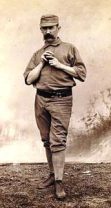
Alphonse "Phonney" Martin

Alphonse “Phonney” Martin

Reid insisted Martin’s pitch was not a curve:

“Cummings and Cummins alone was the originator of the curve.”

Chicago’s Lakefront Park 1878–The First Game

23 May

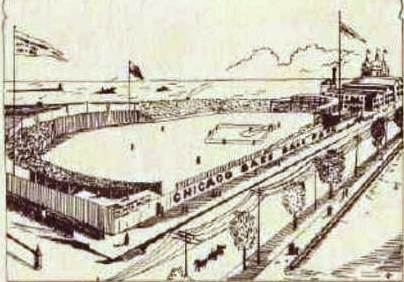
The Chicago White Stockings left Twenty-Third Street Park and relocated to Lake Front Park near the corner of Michigan Avenue and Randolph Street.  The old Union Baseball Grounds had stood at the same spot, but was destroyed in the Great Fire of 1871.

Lakefront Park

Lakefront Park

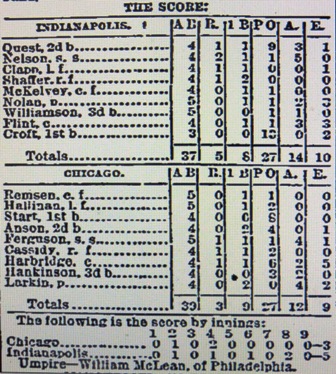
The ballpark opened on May 14, 1878 with a 3:45 pm “game between the Indianapolis nine (Blues) and the home nine.”  The Chicago Inter Ocean said:

“Although the day was very chilly and exceedingly unpleasant for out-door sports, fully 2,500 people assembled to witness the game and listen to a very ‘queer’ band, provided by President (William) Hulbert to officiate at the opening and funeral services of his white-hosed boys.”

——

“The game was not particularly interesting except from the fact that from the first inning until the twenty-seventh man had been retired it was extremely doubtful which club would win.  The play of (Joe) Quest of the Indianapolis (sic) was by far the most brilliant of the game.  He covered the position of second base with greater ease and accuracy than any player that has been seen for many a day.  He won the game for his club by a very clever double play in the ninth inning.  The game stood 3 to 5 in favor of Indianapolis with one man out and all the bases full.  (Jimmy) Hallinan came to the bat and hit a high ball to the right of second base which Quest succeeded in catching, and by very fast running reached the base before (Terry) Larkin

Edward “The Only” Nolan got the victory for Indianapolis but “did not particularly distinguish himself in the field,” making three errors.

Of the White Stockings, The Inter Ocean said:

(Frank) Hankinson played third without an error, and received very (sic) deserved applause for a number of excellent plays.  Hallinan was brilliant in the left field, and (Cap) Anson was remarkably stupid at second.”

None of the newspaper accounts of the game elaborated on Anson’s play at second.

The Inter Ocean did elaborate on Hulbert’s band:

“(T)he dismal music furnished by the band appeared to affect almost to tears the Chicago ball-players.  Another game will be played tomorrow afternoon at the same hour, and a far different result is expected.  There will be no band.”

The Box Score

The Box Score

The White Stockings would go on to win three straight National League Championships 1880-82) at Lakefront Park (sometimes referred to as Lakeshore Park).  The ballpark was expanded after the 1882 season and remained the White Stockings’ home until they moved to West Side Park in 1885.