Tag Archives: Chicago Cubs

“Daily Chats with Famous Ballplayers”

18 Sep

In 1916, a series of two to three paragraph items called “Daily Chats with Famous Ballplayers” (some papers called the feature different names) appeared in several smaller West Coast and Midwest newspapers.

Some highlights:

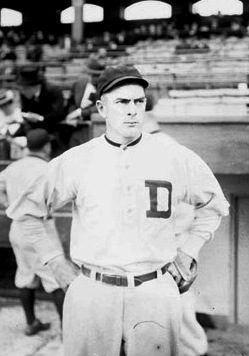
Oscar “Ossie” Vitt, third baseman for the Detroit Tigers, who survived a beaning from Walter Johnson of the Washington Senators on August 10, 1915:

“The world stopped moving when the ball nicked my bean.  Johnson thought I was killed and I guess I thought so myself for awhile, so far as I was able to think at all.

Ossie Vitt

Ossie Vitt

“My head proved to be the goods alright and wasn’t worse for wear.  But it upset Johnson so much that he couldn’t locate the plate and we pounded him all over the lot (Vitt was hit leading off the first inning—Johnson gave up eight runs after that in six innings and lost 8 to 2 to Detroit).”

St. Louis Cardinals pitcher Henry “Hi” Jasper on the superstition of teammate Harry “Slim” Sallee:

“Sal’s pet superstition is that it’s bad luck for him to warm up with any catcher but the one who is to work in the game with him.

“If the playing backstop has batted last and has to put on his shin guards and armour before warming up, Sal will never throw a ball to the plate to any man who may come out of the dugout with a mitt.  He will throw either to the first or third baseman.”

Pittsburgh Pirates pitcher Al Mamaux on a lesson learned during a loss to the Chicago Cubs in September of 1914:

“Smart old timers can always make it tough for youngsters just breaking in.  I remember one day when I was the goat for a trick pulled by Roger Bresnahan.”

Mamaux

Al Mamaux

Mamaux said Chicago had two runners on base and Bresnahan was coaching third.

“(He was) talking real friendly like to me (then) hailed me suddenly as the ball was returned to me.  ‘Say Al, toss me that ball I want to look at it,’ said Roger.  I didn’t give it a second thought…tossed it towards him and I’ll be darned if he didn’t step to one side and yell to the runners to beat it home.  Each advanced a base and would have scored if Jimmy Viox hadn’t run his head off to recover the ball.  Believe me that one cured me.”

George Stallings, on suspensions and how badly the Boston Braves needed George Stallings:

“You don’t have to call an umpire all the names in the calendar to draw a suspension.  I got three days off for just remarking to (Charles “Cy”) Rigler that he ought to go to jail for umpiring a game like he did the other day.

George Stallings

George Stallings

“Nothing that I could say or do would make any difference.  What I can say though right now is that the action of (National League) President (John) Tener, coming as it does, with the race so close, appears peculiar to say the least (Tener said the suspension was for a series of altercations that Stallings and his players had with umpires during the two months before the August suspension was announced).

“Without any braggadocio I can say that my suspension will cripple my club considerably.  I know what my presence means to the club and so does President Tener.”

Boston won all three games during Stallings’ suspension and regained second place, but finished the season in third, five and half games behind the Brooklyn Robins.

“He is a Model for the Young Ballplayer to Emulate”

21 Aug

March of 1916 was a bad month for “Prince Hal” Chase.

According to The International News Service, Chase, who spent the winter in San Jose, California playing for the Maxwells—a team sponsored by the automobile company–was “the last of the stars” of the defunct Federal League who had still not signed with a professional team.
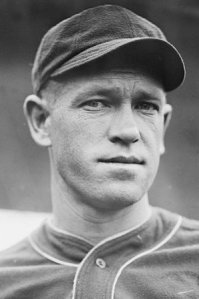
Hal Chase

                          Hal Chase

It got worse when he was arrested for failure to pay alimony and support to his ex-wife Nellie and their son Hal Jr.

He was released on $2000 bond, and it is unclear whether the case was ever fully adjudicated. After his release, Chase continued playing with the Maxwells and working out with Harry Wolverton‘s San Francisco Seals while rumors of who he would play for during the regular season were advanced on a daily basis.

The strongest rumors were that Chase would go to the New York Giants in a deal which would include Fred Merkle, who would be displaced at first base, going to the Chicago White Sox, the team Chase jumped to join the Federal League.

The Pittsburgh Post-Gazette said the deal was eventually foiled by Pirates Manager Jimmy “Nixey” Callahan, who “refuse(d) to waive.”

At the same time the papers in Cincinnati said Chase would be joining the Reds while West Coast papers said he might stay in California and join the Seals.

The Cincinnati Enquirer said Reds’ Manager Charles “Buck” Herzog “vigorously denied,” that Chase would join his club and said he would stick with Frederick “Fritz” Mollwitz at first base.
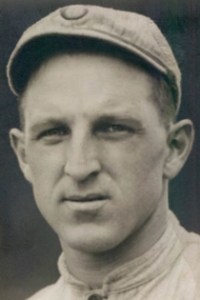
Buck Herzog

                     Buck Herzog

Herzog was even more forceful in his denial in The Cincinnati Times-Star:

“I wouldn’t have Chase at the camp.  Mollwitz is a very much better player, and he won’t jump when he is most needed.”

An even stronger indictment of Chase came from Detroit Tigers Manager Hugh Jennings, who told The Detroit News:

“As a player, there is nobody who can touch Chase for holding down first base.”

Jennings went on to note Chase’s intelligence, speed, and “superb” fielding:

“Yet for all his ability I would not have him on my club, and I do not believe any other major league manager will take a chance on him.  He will not heed training rules and has a demoralizing influence on the younger players.”
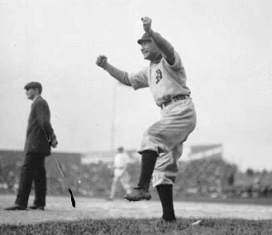
Tiger Manager Hugh Jennings

Tiger Manager Hugh Jennings

Jennings said while Chase managed the New York Highlanders in 1910 and ’11, led his team “astray,” instead of “trying to keep his players straight.”

Perhaps most damaging, Jennings said Chase was a source of dissent on the clubs he played for:

“One of his favorite stunts is to go around telling on man what another is supposed to have said about him, with the result that in a very short time he has the fellows pulling in all directions  instead of working together.  He is apt to take a dislike to the manager and work against him with the players until the whole squad is sore and will not give the sort of work that it is paid for.”

Jennings, whose team finished second in 1915 with George Burns at first base, said:

“The Tigers would win the pennant beyond question with a player of Hal’s ability on first this season, but I wouldn’t risk introducing a man who had such a bad disposition.  I believe that we can accomplish better results by having harmony on the squad, even if we have to get along with a first baseman with less talent.”

Despite the negative press, and over the objection of Herzog, the Reds purchased Chase’s contract from the defunct Buffalo Blues on April 6.

The New York Times lauded the move and defended Chase against his detractors.  The paper said “His failure with the New York Americans was due to petty controversies and rebellion against the club’s discipline,” and “(W)hen he is at his best there is not a player in the major leagues who is more spectacular than ‘Prince Hal.’”

Chase initially balked at reporting to Cincinnati, telling The San Francisco Chronicle “I haven’t made up my mind…it is possible that I would prefer to remain in California, even if there is no chance to play ball.”

Six days later, while his new team opened the season, Chase was on a train to Cincinnati.  The Associated Press said he agreed to join the Reds after receiving “word from Cincinnati that his entire contract with the Federal League, which calls for a salary of $8,000 a year, has been taken over,” by the Reds.

When Chase arrived in Cincinnati on April 15, the Reds had won three straight after losing their opener, and Mollwitz had played well at first base with five hits in 13 at-bats and just one error.

According to Frederick Bushnell “Jack” Ryder–college football star and Ohio State football coach turned sportswriter–of The Enquirer, Herzog had no intention of putting Chase in the game April 16:

“Herzog had little thought of playing him, as Fritz Mollwitz was putting up a bang-up game and hitting better than any member of the club,” until “Mollwitz made a bad mental mistake in the third inning.”

After Umpire Hank O’Day called a strike on Mollwitz, “the youngster allowed his tongue to slip,” and was ejected.
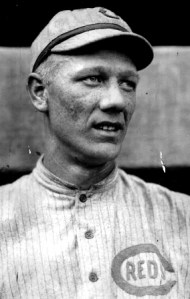
Fritz Mollwitz

                 Fritz Mollwitz

Chase came to bat with an 0-2 count and doubled off of Pirates pitcher Frank Miller, stole third, and after catcher Tommy Clark walked “(Chase) caused an upheaval in the stands by scoring on (a) double steal with Clark.”

Chase also wowed the crowd in the ninth.  After making “a nice stop” on Max Carey’s hard ground ball over first base and with pitcher Fred Toney unable to cover first in time, Chase dove “headforemost to first base to make a putout on the fleet Carey.”

In all, he played 98 games at first base, 25 in the outfield, and 16 at second base, he also hit a league-leading and career-high .329.

While the Reds struggled, Chase was wildly popular in Cincinnati.  The Enquirer’s Ryder was possibly his biggest fan—the writer raved about Chase’s performance in the outfield, his adjustment to playing second base, and his consistent bat.

While Chase thrived, Herzog, who had a contentious relationship with Reds’ owner August Herrmann, exacerbated by the signing of Chase against his wishes, began to unravel as the season progressed.  On May 30, he was hit in the head and knocked unconscious, by a throw from catcher Ivey Wingo during pregame warm-ups.  While he recovered physically, he became increasingly frustrated by the club’s performance.  On July 5—with a 29-40 record– he announced that he would retire at the end of the season when his contract expired.  He told The Times-Star:

“It would be a great blow to my pride to continue as a player, after being a manager for three years.”

The following day it was reported that the Chicago Cubs and New York Giants were interested in acquiring Herzog.  Within a week, it was reported that Herzog was heading to New York in a trade that would bring Christy Mathewson to Cincinnati to manage.  The negotiations continued over several days but floundered.  The Cubs reentered the picture—Owner Charles Weeghman told The Chicago Daily News “I brought the bankroll along…and I’ll get Herzog so quick I’ll make (the Reds) eyes pop.”  He later told the paper he offered “$25,000 and an outfielder” for Herzog.

At the same time The Brooklyn Daily Eagle said the Dodgers were after Herzog, and The Pittsburgh Post said the Pirates were in pursuit as well.

The pressure got to Herzog who held himself out of the lineup of July 17, The Enquirer said:

“The managerial situation is worrying Herzie, who had expected by this time to be cavorting at the third corner for the giddy Giants.  With the deal held off for various reasons, the Red leader is naturally a bit anxious.”

Herzog’s destination was unclear, but it was clear he would be gone.  With Mathewson seeming to be out of the picture, rumors persisted—fueled by Ryder of The Enquirer and William A. Phelon in The Times-Star—that Chase would be the new manager.

On July 20, Ivey Wingo managed the team to a doubleheader split with the Philadelphia Phillies, and the papers reported on Herzog’s successor:

The Enquirer ran Chase’s picture under the headline “Reds’ New Manager,” although they hedged in another headline which said he would “probably” be named.

The Times-Star said “Hermann has decided to allow Hal Chase to manage the team for the remainder of the season, and for this reason he does not want Mathewson.”

They were both wrong.

Within hours of the papers hitting the streets, a trade involving three future Hall of Famers was agreed to.  Herzog, along with catcher Wade “Red” Killefer went to New York for Mathewson, Edd Roush, and Bill McKechnie.  Mathewson was immediately named manager.
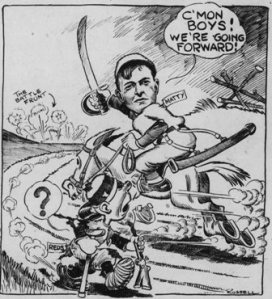
Cartoon accompanying the announcement of Mathewson's appointment.

          Cartoon which accompanied the announcement of Mathewson’s appointment.

Ryder said in The Enquirer that “Chase was greeted with a great round of applause” when he stepped to the plate for the first time on July 20:

“The fans at that time did not know of President Herrmann’s change of mind with regard to Matty, and they thought Chase was the new leader of the team.  The universal and hearty applause showed how popular the star third-sacker has become in this town.”

The Chase story is well-known; two years later Mathewson would suspend him, charge him with “indifferent playing.”  With Mathewson in Europe when the charges were heard by National League President John Heydler that winter, three Reds teammates, and Giants Manager Pol Perritt testified Chase had thrown games.

But in October of 1916 Chase appeared to have repaired his reputation, and his difficult March appeared to be far behind him.  In a season wrap-up, The Enquirer–there was no byline on the article, but it was likely the work of Ryder–published a glowing profile of the National League’s leading hitter and the man who nearly became the Reds’ manager:

“What has become of all the talk about Chase being a bad actor, a disorganizer, a former of cliques and a knocker of managers?  All gone to the discard.  Chase has not only played brilliant ball for the reds all season, but he has been loyal to the club and the managers.  He worked hard for Herzog and equally hard for Matty.  He has been a wonderful fellow on the club.  Chase is modest and does not seek notoriety or approbation…He played game after game in midseason when he was so badly crippled with a Charley horse that he could scarcely walk.  When Manager Herzog wanted to make an outfielder out of him he went to the garden and played sensational ball…Later in the season he filled in for several games at second base, a difficult position for a left-hand thrower, but he put up great ball there.  He is a natural ballplayer of the highest class, and with it all a perfect gentleman, both on and off the field.”

The profile concluded with this assessment of the man who would become synonymous with the baseball’s greatest sins:

“Chase has been a great man for the Reds, and there is many a manager of today who wishes that he had got in ahead of the Cincinnati club in signing him.  He is the smartest ballplayer and the quickest thinker in the National League today.  He is a model for the young ballplayer to emulate, because he is a real artist in his profession.”

“Baseball is full of Authenticated instances of Woman’s Influence over it”

27 Jul

In 1905, The Washington Evening Star said:

“The unwritten history of baseball is full of authenticated instances of woman’s influence over it…Not infrequently a sweetheart’s or a wife’s objections to the game cause a star to forsake the diamond for work for which he is not fitted in the least degree, and at which he makes only a living at best.

Bill Lange is a case in point.  Up to (1899) he was one of the best ground coverers in the profession, and as a batsman had a high average.  From the day of his wedding, his wife kept at him to leave the game, urging him to take the step on the grounds of personal safety.  Bill reasoned with her and told her time and again that he knew of no other job for which he could make $4,500 in six months.  But Mrs. Lange was obdurate, and so, when his last season closed Bill ruefully announced to his manager that the diamond would never know him again.  And it has not, though he has annually been tempted by numerous flattering offers. ‘I have given my word to my wife,’ he says simply, ‘and so long as she feels as she does about the game I shall not take up the bat.’”


Bill Lange

Bill Lange

Lange never played another professional game

The Evening Star said that occasionally a wife would change her mind, and allow her husband to play professional ball; George “Del” Howard was one such player.

Howard—under his middle name Elmer—was a member of the Mattoon, Illinois team in the Indiana-Illinois League in 1899.

“Howard took as his wife the daughter of a prominent citizen of a central western town.  They had scarcely settled down after their honeymoon when Mrs. Howard began pleading with her husband to give up the game, naming as a reason that she had a strong dislike for it.  She was so insistent that finally Howard reluctantly severed connections with the game, and secured employment selling agricultural implements.

“But he did not give up all hope of returning to the diamond.  During the months that he was engaged in telling farmers of the merits of his particular make of wheat drills and mowers he spent his spare time endeavoring to get his wife interested in baseball. At first it was hard and slow work, and had to be accomplished diplomatically, but little by little he progressed to the point where Mrs. Howard would accompany him to games.  Then Howard explained every play made, told her about the players, introduced them to her, and made her acquainted with the woman folk of the players who were in the grandstand.

“At the end of four tedious years his work of education bore fruit.  Mrs. Howard came to him one day, confessed that she had changed her mind about baseball, declared that she would rather have him on the diamond than an agent for farm implements, and further caused him great joy by appending that he couldn’t get their quickly enough to suit her.“

After a five-year absence from baseball, Howard signed with the Omaha Rangers in the Western League in 1904.  He hit .316 in 144 games (finishing second to William “Bunk” Congalton of the Colorado Springs Millionaires for the batting title) and was purchased by the Philadelphia Phillies.

Del Howard

Del Howard

Traded to Pittsburgh for three players, the 27-year-old Howard made his major league debut for the Pirates on April 15, 1905, in Cincinnati with his wife Jessie in the stands.

Howard’s rookie season was his best; he hit .292 in 123 games with the Pirates.  He played in the major leagues for five seasons and was a member of the 1907 and ’08 World Series Champion Chicago Cubs.

Howard played and managed in the minor leagues through 1922. His wife Jesse died in California in 1933.  He died on his 79th birthday on December 24, 1956.

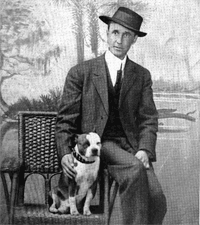
Lost Pictures–Roger Bresnahan and Toy

19 Jun

bresnahanandtoy


The Chicago Cubs were 14 games over .500 and in second place, just two a half games behind the New York Giants on July 25, 1914.  The team lost 14 of their next 17 and wound up in fourth place.  (the Giants finished second to the Boston Braves).  At the end of the season, first-year Manager Hank O’Day was let go by the Cubs and returned to umpiring.  Catcher Roger Bresnahan was named as O’Day’s replacement.

Later in the off-season, there was another drama taking place off the field.  It involved Clara Maduro:

In December, The Chicago Daily News said:

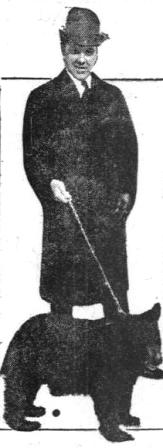
“Because the female of the species is more deadly than the male, Clara Maduro, the brown bear mascot of the Cubs, must die.  The wee cub, which fans saw drinking milk from a bottle or eating ice cream cones at the West Side park last summer, has grown to giant proportions, and while of a pleasant disposition is inclined to break loose at times. Hence, Clara will be executed New Year’s Day.”

A month earlier, The Chicago Tribune reported:

“‘There’s a woman being strangled at Wood and Taylor Streets,’ was the message received by Desk Sergeant Comstock of the Warren Avenue station last night.  ‘Send a lot of policemen.’

“The patrol wagon with a number of detectives was sent to the location, which proved to be on the west side of the National League ballpark.

“A loud howling was heard from the inside, and upon investigation it was found the bear mascot of the Cub team, which had been locked in a cage in the team’s quarters had broken its chains and was roaming about.”

After an outpouring of outrage and concern from Chicagoans, The Daily News reported that Clara Maduro “has been saved through the protest that followed the announcement.”  The bear was initially placed with a local saloon owner named Joe Biggio; later reports said the bear went to the Lincoln Park Zoo.

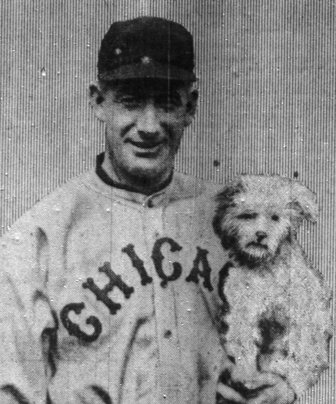
With Clara out, it was determined that a bear cub mascot was not the best idea for 1915.  So in March, the team introduced their new mascot, Toy.

The Tribune said:

“‘Toy,’ the 1915 Cub mascot is a canine of high degree and more likely to become a permanent fixture than the baby bear which grew so big and developed such a crabbed disposition that he [sic] had to be discarded last fall.  ‘Toy’ used to be the mascot and assistant caddie of a feminine golf expert who was a visitor at Tampa during the Cubs stay there and who became such an ardent baseball fan that she bestowed her pet on the team when the Cubs departed for the north.”

The Cubs started the season strong and led the National League until mid-July, but the team faltered badly and ended the season in fourth place with a 71-82 record.

Toy did not “become a permanent fixture;” when Charles Weeghman bought the team after the 1915 season he replaced both Bresnahan and Toy.

Weeghman did not learn from the past and introduced the Cubs new mascot in November.  A bear cub whose mother was killed during a Wisconsin hunting trip, was presented to the team by the hunter, either a state senator named Albert J. Olson or Cubs stockholder J. Ogden Armour–newspapers reported both, but the bear’s name, Joa, would suggest the latter.

It is unknown what became of Toy.

Weeghman introduces Toy's replacement

Weeghman introduces Toy’s replacement


Things I Learned on the Way to Looking up other Things #15

17 Jun

Fullerton’s Prediction

Seven years before he watched the events of the 1919 World Series unfold from the press box, Hugh Fullerton warned readers of The Chicago Record-Herald:

“Baseball as a great national sport is in greater peril today than ever before.  Not until the present week did I realize this fact.  The gamblers, bookmakers and handbook men, who ruined horse racing…and who made fighting a noisome scandal, have attached themselves to baseball this year as never before”

Hugh Fullerton

Hugh Fullerton

“The King of them all for Superstitiousness”

In 1916, Napoleon Lajoie, then a member of the Philadelphia Athletics, told The Cleveland Press:

“I have known many a ballplayer who collected hairpins, held his breath if he saw a circus horse, but Bill Armour was the king of them all for superstitiousness.

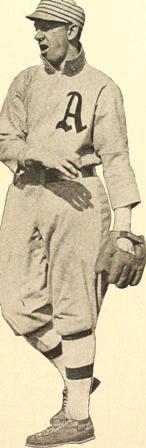
Bill Armour

Bill Armour

“If you put a ladder in front of the door to his room Bill would have jumped out of the window sooner than have come under that ladder.  I think he would have stayed in there and starved to death rather than let the ‘jinx’ take him overboard because he went under a step-ladder.   Me?  No, I am not superstitious, it’s all nonsense.

“Going to fetch me a black cat?  Don’t bring it up here; we have enough bad luck as it is without any black cat hanging around the clubhouse.”

Napoleon Lajoie

Napoleon Lajoie

Black cat or not, Lajoie was correct about the Athletics “bad luck.”  The team finished in eighth place with a 36-117 record.  The forty-one-year-old Lajoie hit just .246; 92 points below his career average.  He retired at the end of the season.

“Any old Manager can run a Team of real Baseball Players”

Bill Dinneen pitched in the major leagues for 12 seasons, and a month after his playing career ended he began his 28-year tenure as an American League umpire

Bill Dinneen

Bill Dinneen

In 1910, he told Joseph Samuel “Joe” Jackson, sports editor of The Washington Post, how major league clubs should allocate money:

“’If I were a club owner, I would invest $15,000 in a scout and $5,00 in a manger  And old manager can run a team of real baseball players  But the best leader in the world can’t make bad material good  Every major league team needs a thoroughbred judge of raw material more than a teacher of baseball tricks’’’

Jackson said Dinneen’s observation confirmed what he thought while watching the Philadelphia Athletics beat the Chicago Cubs four games to one in that year’s World Series

“His remarks come merely to emphasize what the world’s series showed—that a club that is hitting the ball over the lot, and giving its pitchers support, will set at naught all schemes to beat it by carefully thought out plans that might be applicable if the other fellows would stop making so many base hits”

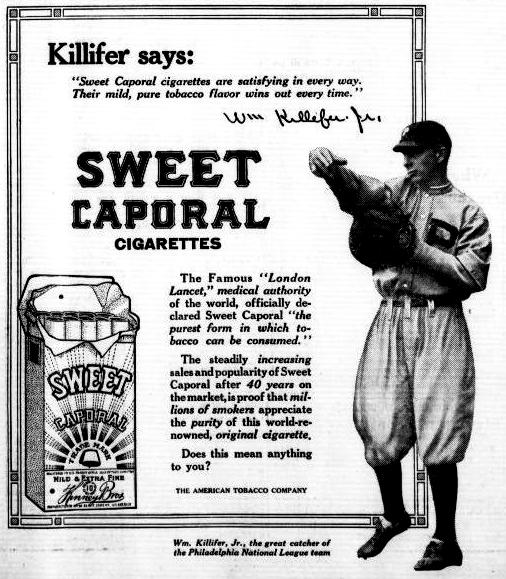
Lost Advertisements: Bill Killifer [sic] for Sweet Caporal Cigarettes

5 Jun

killifersweetcaporal

A 1914 advertisement for Sweet Caporal Cigarettes.  While spelling Killefer‘s name wrong, the ad calls him “(T)he great catcher of the Philadelphia National League Team.”

Killefer says:

“Sweet Caporal cigarettes are satisfying in every way.  Their mild, pure tobacco flavor wins out every time.”

In 1918, Killefer was traded to the Chicago Cubs, along with Grover Cleveland Alexander.  After the Cubs won the National League pennant, The Chicago Daily News reported that Killefer would be getting a bonus beyond his World Series share:

“A bet of a ten-cent cigar against $1000, made as the result of a joke while the Cubs were training at Pasadena, California, last spring has been won by Bill Killefer, it was revealed today.  The loser, William Wrigley, one of the club’s stockholders, wagered the $1000 that the team would not win the National League pennant.  Killefer, who accepted it in jest, had forgotten about the bet until he was reminded of it by Wrigley.”


“Baseball is far behind Golf in its Self-analysis”

1 Jun

During the Chicago Cubs disappointing fifth place finish, with a 67-89 record in 1916, the team hit just .239.

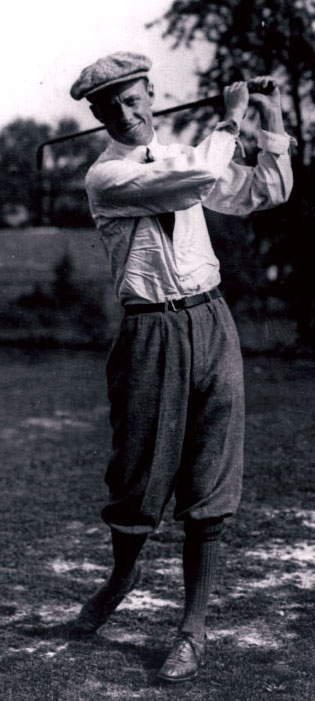
When Manager Joe Tinker was replaced by Fred Mitchell, team owner Charles Weeghman announced that golfer Charles “Chick” Evans, who in 1916 became the first to win the U.S. Amateur and U.S. Open in the same year, would be accompanying the team on their spring training trip to Pasadena, California.

Chick Evans

Chick Evans

Weeghman told The Chicago Day Book’s Mark Shields that Evans would teach the hitters “a golf follow through” intended “to increase the batting of the regulars.  Shields said Weeghman “Points to (Frank) Schulte, (Heine) Zimmerman and (Tris) Speaker as strong hitters who use a golf style.”

Weeghman told The Associated Press (AP):

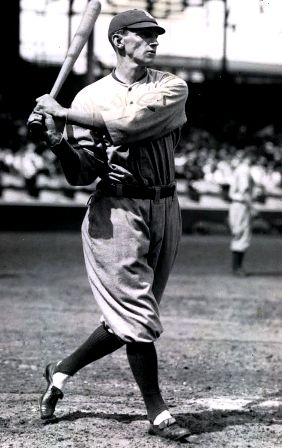
“There is form in the driving of a golf ball, but there is none in driving a baseball.  Applying the form of golf to baseball was responsible for the wonderful driving power of Frank Schulte and Heine Zimmerman.”

The Cubs’ owner allowed that Schulte knew nothing about golf, but said “(H)e unconsciously used the same swing.”

Frank Schulte's swing

Frank Schulte’s swing

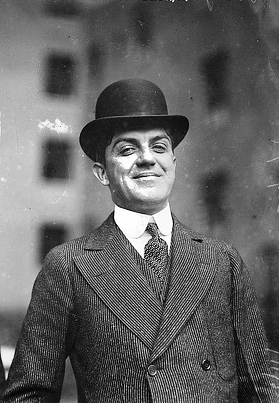
Weeghman said the golfer would not be paid for services in order to maintain his amateur standing.

Evans told The Chicago Daily News that “the batsmen don’t have the knowledge of stance, grip and manner of swinging that the more successful golfers possess. “

He told The International News Service that he had considered a career in baseball:

“Chick says that he might have become a baseball player after having pitched a no-hit game for his high school (Evanston Academy).”

Evans claimed “a torn ligament at the shoulder” derailed his plans.

The response to the Cubs’ plan was immediate.

The Daily News said:

“Chick Evans is going to teach the Cubs how to bat, thereby accomplishing something no one else even considered possible.”

Rabbit Maranville told The AP the story was “a funny one,” and that he was sure that the decision to bring in Evans was strictly Weeghman’s, and likely not endorsed by the Cubs’ new manager:

“Doesn’t seem to me as if (Fred) Mitchell is responsible for that stunt.  I guess it’s being wished on him.

“In baseball the batter needs courage.  He does not know when the pitcher is going to slip a notch in his control…Courage is the big asset in batting, and with all the respect in the world to golf, where is there any great courage needed in driving the golf ball?”

While John Brinsley “J.B.”  Sheridan, the sports editor of The St. Louis Globe-Democrat, said ballplayers may derive some benefit from a golfer’s advice:

“Baseball is far behind golf in its self-analysis.  The keen minds of many generations of Scotch students have been devoted to the science of golf.  So far, no keen analytical mind has been given to baseball.  Men who do know the game are usually inarticulate and cannot tell what they know.”

Sheridan outlined how golf in general, and Evans in particular, could help:

“Drawing back the club or the bat slowly is most important.  If the striking implement is drawn back too quickly or with a jerk, the player is thrown off balance and his eye is put out of focus.

“It is notable that the great hitters, Speaker, Joe Jackson, Eddie Collins and others carry their bats well behind them and do not draw back quickly.”

Additionally, Sheridan said other “golf maxims will help” hitters, including:

“Hit off the (front) foot.  Keep your eye on the ball.  Do not hit too hard.  Follow through.”

Weeghman’s plan was finally shelved shortly before the team departed for the West Coast.  The Daily News said the United States Golf Association (USGA) could strip Evans of his amateur standing:

“If Evans uses his ability as a golfer to aid him in attempting to instruct ballplayers how to swing their bats, it appears that he will take a long chance.”

Charles Weeghman

Charles Weeghman

Evans was in California at the same time as the Cubs in March, and although newspapers had announced he would accompany the team “over the Sante Fe” railroad on the trip, it is unclear whether he actually traveled with the team.  The AP said he “stayed far away” from the Cubs’ practices in order to not run afoul of the USGA, but one paragraph in The  Chicago Tribune the day after the club’s first practice in Pasadena was rained out, likely exposed the Cubs’ owner’s real intention for wanting Evans in California:

“(The rain) did not keep Prexy Weeghman from tackling Chick Evans in a golf match.  They had played only twelve of the eighteen holes when the mist became so active it stopped the contest.  At the finish, the score stood $11 to $1 in favor of the national amateur champion.”

The Cubs posted a slightly improved 74-80 record, but once again finished in fifth place.  Whether the lack of instruction from Chick Evans was a factor or not, the team’s batting average was .239; identical to their 1916 average.

Lost Advertisements–Pat Moran for Sloan’s Liniment

22 May

patmoran

An advertisement that appeared late in the 1919 season featuring Cincinnati Reds Manager Pat Moran:

“‘When my players get sore, I don’t rub them the wrong way;  I use Sloan’s Liniment–it penetrates.’

“Moran knows how to keep his men fit for the pennant scramble–keeps Sloan’s handy for emergency.  ‘Glass arm,’ ‘Charley horse,’ stiffness, soreness, bruises, rheumatic aches, are quickly and comfortably relieved.  Penetrates without rubbing, keeping the boys ready for the winning game.”

The 1919 World Series was the fourth for Moran.  He played in two with the Chicago Cubs (1906 and ’07) and managed two, (the other was with the Philadelphia Phillies in 1915).

Moran replaced Charles “Red” Dooin as Phillies manager after the team finished in sixth place in 1914.  Under Moran, the team won 10 of their first 11 games and won the National League with a 90-62 record.

In September, Frank Menke of The International New Service said:

“Moran deserves ranking among the greatest managers the game has ever known.  It is the wonderful leadership of the red-faced, gray-haired Irishman that has put the misfit Phillies where they are today.”

Moran

Moran

Menke said Moran was saddled with a team consisting primarily of “castoffs,’ and “one wonderful pitcher (Grover Cleveland Alexander).”

Moran followed up the 1915 pennant with two second-place finishes, with teams Grantland Rice of The New York Tribune said the manager had little to work with beyond pitcher Alexander:

“(T)hose astounding Phillies, piloted by a leader who has never received anywhere near his due recognition for extraordinary ability to lead a ball club.  need it be said that we refer to Pat Moran?  It needn’t.”

As was his habit, Rice memorialized Moran’s abilities with a poem:

Pat Moran’s no Miracle Man

Nor anything like that;

Nobody ever stands and cheers

The while he tips his hat.


Pat doesn’t draw the headline space

Nor yet the picture frames;

Pat Moran’s no Miracle Man–

Buthe’shellatwinninggames”

During his nine-year managerial career in Philadelphia and Cincinnati, Moran compiled a 748-586 record, which included a total of four second-place finishes to go with his two pennants.

During spring training of what would have been his sixth season with the Reds, Moran, who had a history of excessive drinking, became ill in Orlando, Florida.

His former Cubs teammate Johnny Evers came to his bedside.  According to The Associated Press, he said:

“‘Hello John, take me out of here.’ He then lost consciousness.”

He died later that day.  The official cause was Bright’s Disease.

“I mentioned Satchel and Josh and Cool Papa, I told Him he was Missing the boat”

18 May

After Heywood Broun’s remarks at the 1933 Baseball Writers Association dinner about integrating the game, The Pittsburgh Courier initiated a campaign to push the issue.  Despite some support inside baseball and from well-known newspapermen, the effort fell flat by opening day.

That summer, after the first East-West Game—won by the West All-Stars 11 to 7—at Comiskey Park, Henry L. Farrell of The Chicago Daily News suggested several “(M)ajor league club owners who are now on their knees might have their prayers answered,” by signing some the Negro League stars.

In the fall, The Chicago Defender briefly picked up the mantle from The Courier.  The paper asked their readers:

“How would you like to see the great baseball players of the Race performing in the major leagues? Wouldn’t you like to see Willie Foster, Satchel Paige and (Sam) Streeter pitch to Babe Ruth?”

If so:

“Sit down and write K.M. Landis commissioner of baseball, 333 N. Michigan Ave., Chicago.”

The following week, the paper reported that Landis’ office had refused to comment.  When baseball’s winter meetings commenced in Chicago in December, The Defender promised readers that the letters they had sent:

“(A)re not being passed on lightly as many suggested would be the case.  On the contrary, the club owners are downright concerned and from the inside word leaked out that some action would be taken.”

The optimism was tempered later that week when their reporter was barred from covering a meeting where he was told “vital points were discussed.”  The Defender reporter was told no newspapermen would be admitted, but:

“That sinister moves were being made against your author’s admission became a certainty when a well-known writer from one of the downtown papers came along, gave the high sign and was admitted.”

When 1933 came to a close, integration was no closer to being a reality than it was 11 months earlier as Broun stood to deliver his remarks to the baseball writers.

Four years later, Sam Lacy from The Baltimore Afro-American met with Washington Senators owner Clark Griffith in an attempt to revive the subject:

“I mentioned Satchel and Josh and Cool Papa, I told him he was missing the boat.”

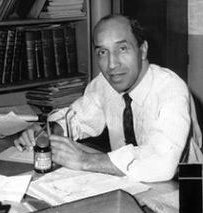
Sam Lacy

Sam Lacy

Griffith, he said, told him the timing was wrong, and that Southern-born players would not accept integration.

The next major effort came in 1939.

Political support had generally been limited to socialist and communist organizations—the Young Communist League spent the summer of ’39 gathering signatures to present to Commissioner Landis.  But, in July of that year, the Illinois House of Representatives adopted a resolution which read in part:

“Resolved, by the House of Representatives of the Sixty-first General Assembly.  That the owners of all professional baseball teams in the United States, both in the major and minor leagues be strongly urged to give baseball players of the colored race the same opportunity of becoming players on their respective teams as is accorded to such players of the white race.”

Another push came from Pittsburgh as well.

Wendell Smith, who was playing baseball at West Virginia State College when Broun made his speech in 1933, was now a reporter for The Courier. In July, he promised readers:

“The most exclusive, startling and revealing expose, of the attitude of the major league players and managers themselves, ever written.”

Wendell Smith

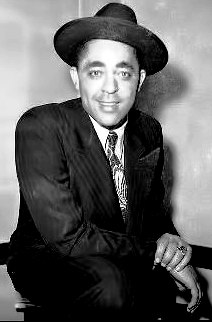
Wendell Smith

Over the course of several weeks Smith asked 40 players and eight managers as they passed through Pittsburgh, “Are Negro ballplayers good enough to ‘crash’ the majors?”

The Courier’s Chester Washington said in a column to introduce the series of articles:

“One of the major reasons why Mr. Smith’s discovery is so revolutionary is that the club owners, in trying to pass the buck, have blamed the ban on the players themselves.  They claimed that the injection of colored stars into the clubs would bring about friction and dissention… (Smith) practically disproves this contention.

“Fearlessly buttonholing the managers and outstanding players of all the National League clubs, Mr. Smith received scores of testimonials which should be a revelation to the owners.”

A sampling of the statements collected by Smith:

Ernie Lombardi, Cincinnati Reds:  “(Satchel) Paige is as good as (Dizzy) Dean.”

Johnny Vander Meer, Cincinnati Reds:  “I wouldn’t object.”

James “Doc” Prothro, Philadelphia Phillies: “If given permission I would jump at the opportunity to sign up a good Negro ballplayer.”

Leo Durocher, Brooklyn Dodgers:  “(Satchel) Paige, (Bill “Cy”) Perkins, (Mule) Suttles and (Josh) Gibson are good enough to be in the majors right now…I certainly would use a Negro ballplayer if the bosses said it was all right.”

Gabby Hartnett, Chicago Cubs:  “I am sure that if we were given permission to use them, there would be a mad scramble between managers to sign them.”

Gabby Hartnett

Gabby Hartnett

Dizzy Dean, Chicago Cubs: “If some of the colored players I’ve played against were given a chance to play in the majors they’d be stars as soon as they joined up.”

Pepper Martin, St. Louis Cardinals: “Some of the big league players would object, but on the whole I think they would be accepted.”

Pie Traynor, Pittsburgh Pirates: “believe me when I say I have seen countless numbers of Negro ball players who could have made the grade in the majors.  Only their color kept them out.  If given permission, I would certainly use a Negro player who had the ability.”

Honus Wagner, Pittsburgh Pirates:  “Yes, down through the years I have seen any number of Negro players who should have been in big league baseball.”

Over the next five years, Smith would interview more than 150 additional major leaguers, who would echo the sentiments of his original 40, keeping the pressure on professional baseball to desegregate.

“Babe Ruth has a Locker full of Charms”

13 May

Eddie Collins had spent 25 years in the major leagues as a player, coach and manager by 1930 when he spoke to a writer for “Every Week Magazine” about superstitions.

Eddie Collins

Eddie Collins

The article noted:

“Collins, by the way, has been credited with being one of the most superstitious players in the national game.  His habit of sticking a piece of chewing gum on the button of his cap has almost become a tradition.  If the pitcher had two strikes on him, Eddie would jerk off the cap, yank the gum from the bottom, stick it in his mouth and chew violently.”

But, Collins, a graduate of Columbia University, didn’t consider himself superstitious and told the magazine:

 “The average man playing professional baseball today is too well-educated actually to believe you can make home runs by picking up hairpins or adopting any of the other numerous superstitions which have come to be so much part of the game. “

As for the obvious superstitions he and many other players, educated or not, subscribed to, Collins said they were merely “eccentricities,” and that “Having them gives confidence.”

That said:

“The late George Stallings was one of the most sensible men baseball has produced.  He was the personification of common sense and one of the last persons in the world you would credit with being superstitious.  Nevertheless, a single scrap of paper tossed on the ground in front of the dugout meant all sorts of bad things to George. It upset him completely and his managerial skill seemed to fade.”

George Stallings

George Stallings

Joe Sewell of the Cleveland Indians was another “college man,” someone who “generally loses any belief in omens.”  But, Sewell “after his last crack at the bat during practice” insisted on running towards third and touching the bag before anyone else did.  One day in Cleveland, the too educated to be superstitious Sewell started towards third, only to see Collins, also too educated to believe in superstitions, had:

“(D)ashed out of the Athletics’ dugout and touched the sack ahead of Joe and Joe didn’t get a hit during the afternoon.”

Joe Sewell

Joe Sewell

Next was Urban Shocker, who insisted no one touched his glove during a game.  Despite being “too wise a man to believe” such a thing, Collins told how during a game against the Athletics, “Eddie Rommel spotted the glove and knowing Shocker’s eccentric regard for it, walked over and picked it up, examined it and then tossed it back on the turf.”  The “too wise” Shocker:

“(S)aw red.  He became visibly unsettled.  He blew up the next inning.”

As for the game’s biggest star:

Babe Ruth has a locker full of charms, fetishes and tokens; fastened to the door is a wooden horseshoe with a four-leaf clover carved on it, and on top stands a totem pole and other curious objects guaranteed by enthusiastic donors to bring luck.”

Babe Ruth

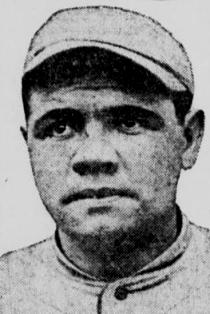
Babe Ruth

Collins said the previous season when the Athletics were on their way to Chicago for game 3 of the World Series with the Cubs:

“(T)here was a fan on the train with us  who had a great fondness for canned pineapple.  He insisted the players eat some the morning of the game predicting we’d win if we did.  Well, we did, and we won.”

Collins said he, and the rest of the Athletics, too smart for superstition:

“Had pineapple every morning the rest of the series.”