Tag Archives: Chicago White Sox

Things I Learned on the Way to Looking Up Other Things #22

24 Apr

Ty Cobb Rates American League Fans

In 1907, The Washington Evening Star asked Ty Cobb was asked how he was treated by fans in all of the American League cities:

“All ballplayers coming in sometimes for a little guying, but that is what makes the game.  If the fans did not do this it would show they had lost interest and baseball would soon die.  The fact that I am a Southern man has never made any difference in the way I have been treated by the public in the North.  The fans all over the American League have always been kind to me.”
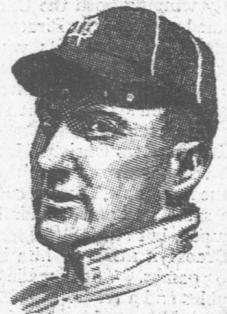
cobb

Cobb

However, Cobb said, fans in some cities were tougher on visiting players:

“Take Philadelphia, for instance, old Philly is sometimes rough with the visiting clubs, and we have been treated to a little warm reception once or twice.

“Chicago is not as kind to visiting players as some of the other cities. They are so loyal to their city and their clubs that sometimes a go too far with the guying.

“In New York the people are fair and clever, and so is Cleveland, Pittsburgh, and Boston.  St. Louis is somewhat like Chicago.

“I am sure that the fact that I am from the South has never influenced the fans in the slightest.  If it has, it has been in my favor.”

The not as Smart Coveleski

Billy Murray managed Harry Coveleski during the pitcher’s three years with the Philadelphia Phillies from 1907-1909.  Years later, he told Bozeman Bulger of The New York World, that Harry was not as bright as his brother, Hall of Famer Stan Coveleski, who was “Smart as a whip” according to Bulger.
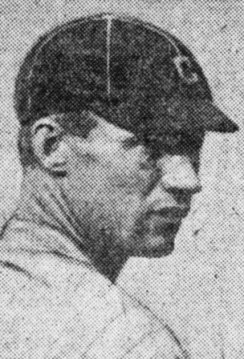
harrycoveleski

Harry Coveleski

“Coveleski got out of a tight predicament mostly by luck and came back to the bench to face an enrages Murray.

“’What do you mean by taking that wind up with men on bases, especially on first and second?’

“’I didn’t know there were any men on the bases. Nobody told me,’ Coveleski replied

“’Now listen men,’ Murray turned to the players on the bench, don’t let this happen again.  When there are runners on the bases you go out and tell ‘Covvie’—you hear me?  We’ll have no more secrets on this club.’

“’That’s right, Billy,’ agreed the unperturbed Coveleski, oblivious to Murray’s biting sarcasm.  ‘Keeping secrets always hurts a ballclub.’”

An Umpire’s dilemma

The Associated Press reported in 1912 about an umpire’s dilemma during a game played in an unincorporated town near Boulder, Colorado called Canfield:

“Albert Billings kicked his cork leg across the home plate yesterday afternoon in the ninth inning, the score a 5 to 5 tie, the umpire called the runner safe.  Then the last baseball game of the season broke up in a row.  However, umpire Jerry Carter consulted the rule book, declared that there was no precedent, and held to his decision.

“Billings had knocked a beautiful two-bagger.  He stole third and started home when the batter tapped one to the infield.  The ball was thrown to the catcher in time to get Billings out by at least ten feet.  Billings cork leg flew off, however, and hit the plate.  The catcher tagged Billings as he lay on the ground ten feet from the plate.  The umpire ruled that the foot at the end of the cork leg touched the home base first.  Billings was therefore called safe with the winning run.”
Segregation and Spring Training, 1961

11 Apr

Will Grimsley was a New York based sportswriter for The Associated Press for nearly forty years; he covered 35 World Series and at least that many spring training’s.

Before teams opened their camps in 1961, he reported on segregated living arrangement.

Grimsley introduced readers to the woman who housed the Milwaukee Braves

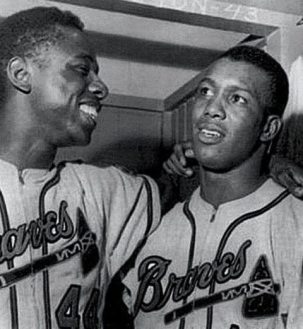
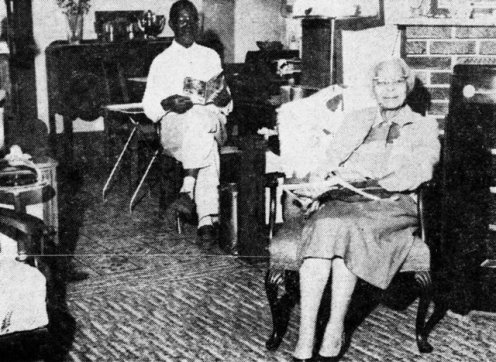
“Mrs. K. W. Gibson’s boarding house at 211 Ninth Avenue is a modest, spotlessly clean two-story dwelling which stands out in the dilapidated Negro section of Bradenton.

“Mrs. Gibson prides herself on “setting the best table in town.”

“The tiny, gray-haired matron for years has been house mother for Negro members of the Milwaukee Braves baseball team.  ‘I’ve treated them like my own sons,’ she said.

“At Mrs. Gibson’s place, the Negro players have basic comfort and ‘eat high on the hog’ as the saying goes.  Yet, they sleep two to a room; queue up for use of the two bathrooms and sometime bicker over the choice of a television program on the single set in the living room.”

Hank Aaron said:

“Sometimes the place is so crowded they have two guys sleeping in the hall.  You wake up in the morning and rush for the bathroom and if you’re the last one all the hot water is gone.”

mrskwgibson

Mr. and Mrs. K.W. Gibson in their Bradenton home.

Grimsley said of their teammates’ accommodations:

“The white members of the team meanwhile have headquartered in a Bradenton motel. This year they move into a new motel in the center of town—glistening glass and stone, wall-to-wall carpeting, private baths, television sets and a modern central dining area”

“Aaron, Wes Covington and Andre Rodgers have been most outspoken in criticism of Jim Crow treatment.”

aaroncovington

Aaron and Covington

Duffy Lewis, traveling secretary of the Braves, expressed shock that Aaron and some of his teammates were not thrilled with the situation:

“Why, we thought they had an ideal setup and we’ve never heard a fuss.  That Mrs. Gibson sets the best table I’ve ever seen.  I’ve eaten there myself.”

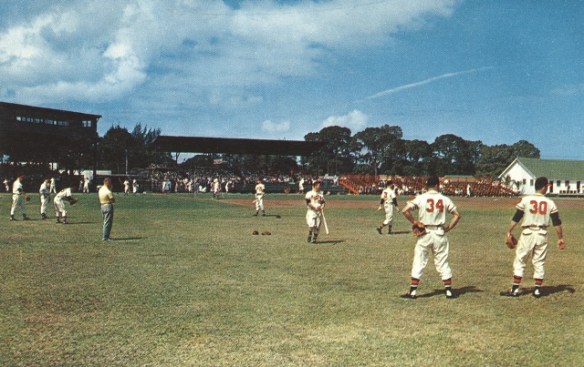
bravesbradenton

Braves in Bradenton

Grimsley conducted “A reporter’s survey” of each team’s spring training quarters with details provided by the teams and/or their spring training hotels. He said hotel managers were, “generally jumpy and gun-shy on the issue but many (were) ready to acknowledge that the problem soon must be met head on—maybe next year.”

Some highlights:

Yankees:  “Have trained at St. Petersburg for years.  The Soreno, a resort hotel, has politely said ‘no’ to Yankee owner Dan Topping’s request that all players…be housed ‘under one roof.”

Tigers: “Local ordinance in Lakeland, FL forbids four Negro players to stay at club headquarters, New Florida Hotel.

Athletics:  General Manager Frank Lane told Grimsley “We are not spearheading any political movements,” when asked why Bob Boyd, the only African-American with the club would not be staying with the rest of the team at the George Washington Hotel in West Palm Beach, FL.

Reds:  “Eight Negros on roster to be housed and fed in private homes, not at team headquarters at Floridian Hotel, Tampa.  Both club and hotel said they never had difficulty and not rocking the boat.”

Pirates:  “Headquarters at Bradford Hotel, Fort Myers, FL.  ‘We don’t anticipate any trouble,’ said the hotel’s resident manager, Howard Green.  ‘The colored players will get excellent accommodations in private homes.”

Phillies:  “Again will stay at Fort Harrison Hotel in Clearwater.  General Manager John Quinn wants all players in same hotel, but no immediate prospect.”

Twins:  “Five Negro players to be housed in new motel, while headquarters will be Cheery Plaza in Orlando, FL”

Senators:  “(T)o train at Pompano Beach, FL. The chamber of commerce is working on housing which will be segregated.”

White Sox: “Bill Veeck, president, is negotiating with Sarasota, FL., civic leaders to have six Negro players…stay with rest of team at Sarasota Terrace.  Negroes likely will wind up at motel.”

Orioles: “McAlister Hotel in Miami…says there has been no correspondence on the matter.”

According to Grimsley, the Cubs, Giants, Dodgers, Indians, Angels, and Red Sox all had integrated accommodations—the Dodgers—who housed all players “together at old air base in Vero Beach,” were the only team in Florida with such an arrangement.  The other five trained in Arizona and California.

Grimsley concluded:

“Next year or the year later perhaps, but not now—the baseball clubs must abide by the traditions of the people whose land they have invaded for a couple of months of each year.”

Bill Nunn Jr., sports editor of The Pittsburgh Courier, interviewed Aaron a week after the original story:

“’I’ve said it before and I’ll keep repeating that I don’t like the situation the way it now stands,’ Aaron disclosed here.  ‘I think it’s wrong for us to have to live apart from the rest of the team.’

“At the same time Aaron went out of his way to emphasize that he didn’t want the numerous Negro friends he has made in Bradenton to be offended by his stand on this matter.

“Aaron was speaking specifically of Mr. and Mrs. K. W. Gibson, the people in whose home he and members of the Braves stay while in Florida.

“’Mrs. Gibson was hurt over all the things she heard concerning our statements about Bradenton.  She thought we were being critical of her and her home.’

“’Actually that wasn’t the case at all.  We were trying to get over the point that we didn’t like being segregated against our will.  I explained all this to Mrs. Gibson.  I told her about the moral issues concerned.  I think she’s on our side now.'”

United Press International (UPI) reported the following spring that, “The Braves switched their Bradenton hotel headquarters to nearby Palmetto this spring to permit integration of their athletes.”

UPI said six clubs “still have the integration problem:” the Orioles, Tigers, Athletics, Twins, Senators, and Pirates.

One Minute Talk: Joe Jackson

12 Oct

In 1916, The Newspaper Enterprise Association ran a series of brief articles called “One Minute Talks with Ballplayers.”

Joe Jackson of the Chicago White Sox, on his way to hitting .341—third in the American League behind Tris Speaker and Ty Cobb—had some advice for pitchers about saving their arms:

joejack

Jackson

“If you want to put your arm on the blink just start fooling with the fadeaway ball.

“I’ve had one experience and it cured me. After pitching four or five fadeaways I developed a kink in my elbow and decided to quit experimenting.

“Some fellows have studied the thing and got it down to a fine art. They tell me it doesn’t affect their arms, but if they pitched it as steadily as some fellows throw the spitter they wouldn’t last long in any league.”

“A little thing like a Presidential Campaign…is Ridiculous to Contemplate”

3 Oct

Frederick R. Toombs wrote and edited books about hockey, wrestling, and the origins of “court games, and was also a novelist who spent the first decade of the 20th Century writing syndicated articles about sports and politics.

Less than a month before the 1908 presidential election, he wrote:

“When a wave of baseball frenzy sweeps over the United States, the most momentous affairs of life and state speedily are thrusted aside. Nothing must stand in the way of the American citizen who hungers to hear the resounding crack of a home run hit. A little thing like a presidential campaign in this greatest of all baseball years is ridiculous to contemplate. Many a big league game in this record breaking year has been attended by upward of 35,000 people. Who ever heard of a presidential candidate drawing such an audience?”

Toombs noted that on the day John W. Kern was selected as the Democratic nominee; the same day his running mate, William Jennings Bryan “delivered a much-heralded speech on trusts,” the Chicago Cubs, Pittsburgh Pirates,and New York Giants were locked in a three-team battle for the National League pennant:

“The big dailies spread the baseball story across the front page, and Mr. Kern and Mr. Bryan were pushed back among the advertisements. Mr. (William Howard) Taft and Mr. (James S.) Sherman have suffered in much the same way. Their lengthy communications in the public are frequently shoved back in juxtaposition to the ‘Help Wanted’ column, and in the choice spots of the papers appear stories relating (to every aspect of the baseball season.”

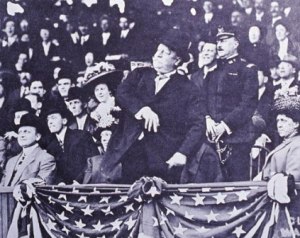
William Howard Taft

William Howard Taft

As for the election, he said:

“In fact, whoever is elected to the presidency the defeated man will be fully justified in laying his downfall to the nerve racking races in the National and American Leagues.

William Jennings Bryan in baseball uniform 1884.

William Jennings Bryan in baseball uniform 1884.

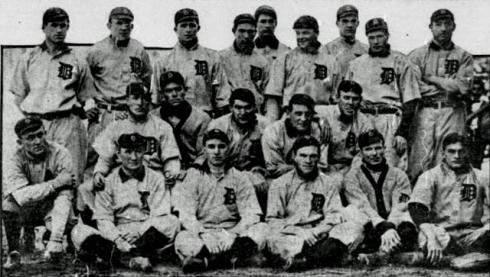
“A season like that now drawing to a close has never occurred before. The National League (three-team) race…and the American, with Detroit, Cleveland St. Louis and Chicago hacking at each other’s throat (Detroit won the pennant—Cleveland finished ½ game back, Chicago 1 ½, and St. Louis 6 ½) have carried the game to heights of popularity hitherto undreamed of. The New York National team, for instance, will close the season with almost $500,000 in profits.”

1908 Detroit Tigers

1908 Detroit Tigers

Baseball, said Toombs, had become more than the nation’s most popular sport:

“When the Duke of Wellington (Arthur Wellesley) said, ‘The Battle of Waterloo was won on the fields of Eton,’ he conveyed an authoritative opinion of the tremendous influence which may be exerted on a nation, a hemisphere, or a world by a form of sport, a mere pastime. Inferentially one may well say, that according to ‘The Iron Duke’,’ had it not been for the strength giving qualities of cricket, Napoleon would have won at Waterloo and become, without question the arbitrary dictator of all Europe. Baseball in America holds the position that cricket has in England, and the influence of the game on the American people is of even greater importance and significance than ever known of cricket in England…Not only is baseball the national game; it is the national craze. It is the only and original, pure and undefiled, blown in the bottle brand of Dementia Americana.”

Toombs concluded:

“Campaign managers may fume and fret, but baseball is a necessity; politics is a luxury.”

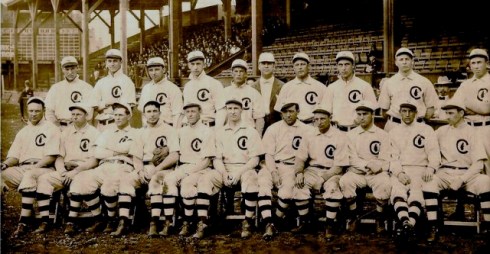
The Cubs beat the Tigers four games to one in the World Series; Taft beat Bryan by more than a million votes on November 3.

1908 Chicago Cubs

1908 Chicago Cubs

Note: The phrase “Dementia Americana” had entered the lexicon one year earlier during the trial of Harry Kendall Thaw, who in 1906 killed a man who was having an affair with his wife. His defense attorney, Delphin Michael Delmas, said Thaw suffered from “Dementia Americana—the sort that makes Americans defend the sacredness of their homes and their wives and children. “ The 1907 trial–the first “trial of the Century”of the 20th Century–resulted in a hung jury. Thaw was found not guilty by reason of insanity in 1908.

One Minute Talk–Lefty Williams

19 Sep

In 1916, The Newspaper Enterprise Association ran a series of brief articles called “One Minute Talks with Ballplayers.”

Claude “Lefty” Williams, on his way to winning 13 games for the Chicago White Sox during his first full season as a major league pitcher, after two brief trials with the Detroit Tigers:

“The boy who enters baseball will never be a success until he takes the profession seriously.  I learned my lesson (in 1913 and 1914) when I had my first chance in the majors.  I had always regarded baseball as a game just for fun but Manager (Hughie) Jennings of the Detroit Tigers  soon showed me the error of my way, by shipping me to the Salt Lake club of the Pacific  Coast (League).  Once in the minors I got wise to myself and determined to regain a big league job.

Lefty Williams

Lefty Williams

“I started in baseball as a pitcher for the school team at Springfield, MO., and though I was only a kid I was a pretty successful southpaw.  Now that I am back in the majors I’m certainly going to work my head off to remain here.”

Williams won 33 games for the Salt Lake City Bees in 1915 which earned him his return to the major leagues.  Williams, who vowed to “work my head off to remain here,” won 81 games over five seasons with the White Sox before being banned for his role in the Black Sox scandal.

One Minute Talk: Braggo Roth

15 Sep

In 1916, The Newspaper Enterprise Association ran a series of brief articles called “One Minute Talks with Ballplayers.”

Robert “Braggo” Roth, in the midst of a .286 season for the Cleveland Indians:

“I certainly feel as if I owe Leslie Nunamaker of the Yankees a vote of thanks for consenting to trade bats with me earlier in the season.

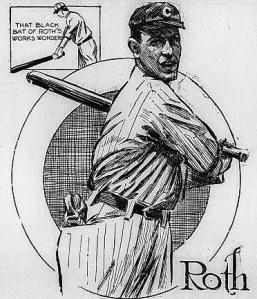
“At the start of the season I was using a bat I had obtained from Joe Jackson (Roth was one of three players traded by the Chicago White Sox for Jackson in 1915) in a trade but one afternoon during preliminary practice I borrowed a big black bat from Nunamaker who had been hitting to beat the band.  I thought I might change my luck.  Sure enough, I started to hit ‘em on the nose with my new ‘Betsy’ and have been going good ever since.

Roth and his "Betsy"

Roth and his “Betsy”

“I suppose I’ll hit a slump the minute I lose that stick.”

Nunamaker appears to have done OK with the “trade” as well; he hit .296 in 260 at bats that season.  Jackson hit .341 for the White Sox.

One Minute Talk: Ray Schalk

13 Sep

In 1916, The Newspaper Enterprise Association ran a series of brief articles called “One Minute Talks with Ballplayers.”

Ray Schalk:

“I would rather have runners come into the plate spikes first than standing up.  When you see those gleaming spikes coming, you have something to work on.  When a runner comes in standing up at the time the ball arrives you never know where he is going to hit you.

Ray Schalk

Ray Schalk

“I have had men come in that way and give me bumpings from which I did not recover for several days.  The spikes every time for mine.  All you have to watch then is the runner’s feet.

“When I first broke into baseball I made the mistake of waiting for the runner, then trying to tag him after the manner of an infielder but I soon quit doing that and have since kept my eyes on the spikes.”

“When I first tried the sunfield I looked like a big boob”

12 Sep

Harold “Speed” Johnson of The Chicago Herald asked:

“Does playing the sun field effect a ballplayer’s batting eye?

“’Yes,’ comes the answer in chorus!

Speed Johnson

Speed Johnson

“Diamond greats who have played the sunfield year after year…say the fellows who must go and get ‘em while looking Old Sol squarely in the face are bound to be handicapped in batting.

“The players who stand in the sun pasture then have to go to the plate immediately are especially handicapped gauging pitched balls.

“Sunfielders who hit .265 would clout 25 points higher each year if assigned to other fields, veterans declare…“The American League’s most difficult sunfields are in the parks at Chicago, Boston, St. Louis, Detroit and Philadelphia.  How Sam Crawford, playing the garden in Detroit for ages, has managed to keep above the .300 mark is one of the wonders of the national pastime.”

Harry Hooper of the Red Sox agreed, and told Johnson:

“’When I first tried the sunfield in 1909 I looked like a big boob.  I missed the first fly ball batted my way by 20 feet.  Fred Lake, our manager, decided I wouldn’t do and put me in left field.’

“’Later, I mastered the sunfield job, but about four years ago my eyes troubled me.  An oculist said I had strained both eyes by looking into the sun…I wore glasses for a year…My eyes haven’t troubled me, however, since I adopted the sunglasses invented by Fred Clarke.  Before I donned them I had to ‘take’ the first ball pitched whether I wanted to or not, after stepping directly from the outfield to the plate.’”

Hooper

Hooper

Hooper continued playing for the next decade for two clubs, the Red Sox and Chicago White Sox, with two of the most “difficult sunfields” in the American League.  He hit .300 or better four times and ended his career with a .281 average;  by Johnson’s estimation, the Hall of Famer would have hit around .306 if he spent his career in left field.

Lost Pictures–Frank Leet Caricatures

31 Aug

leetjohnson

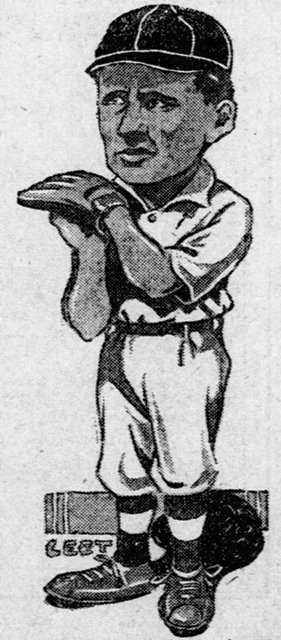
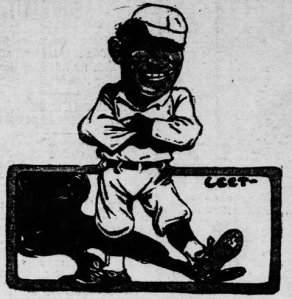
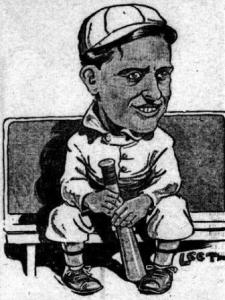
Walter Johnson of the Washington Senators, as depicted by Frank Rutledge Leet, a cartoonist for The Newspaper Enterprise Association, as well as the author of a number of children’s books, including one called, “When Santa was Late.

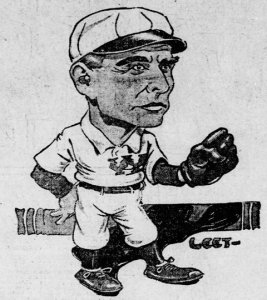
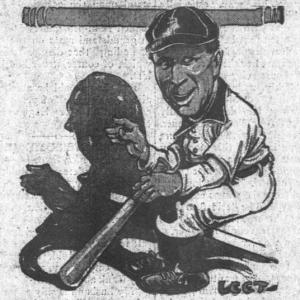
In 1912 and 1913 he provided caricatures for a number of articles featuring players telling their favorite baseball stories.  In addition to Johnson, Leet created images of Johnson’s teammate Germany Schaefer:

leetschaefer

Chicago White Sox pitcher Big Ed Walsh:

bigedwalsh

Johnson and Schaefer’s manager Clark Griffith:

leetgriffith

And, Detroit Tigers manager Hughie Jennings:

leethugh

Lost Pictures–An Off Day

10 Aug

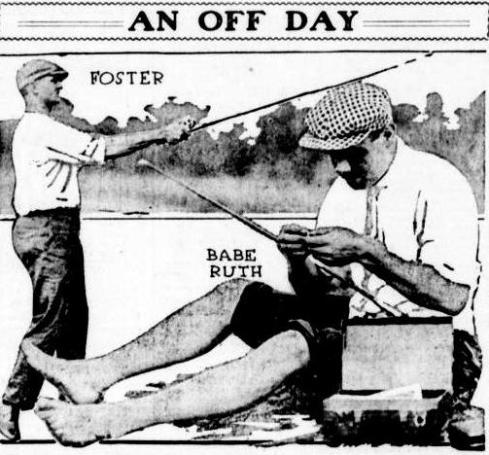
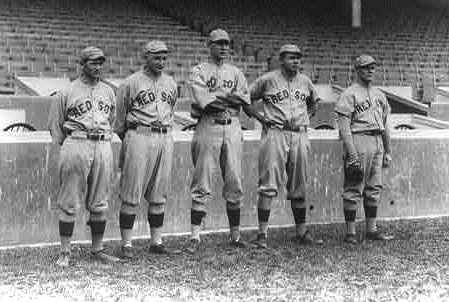
ruthfosterIn August of 1917, the Boston Red Sox were in the midst of a pennant race;  they battled the Chicago White Sox all season long and the race remained tight through August.  But there was always time for fishing, wrote Paul Purman, of The Newspaper Enterprise Association;

“An off day sounds just as good to a big league ballplayer as to anyone else, especially if the off day isn’t rainy, for on rainy days they generally have to hang around the hotel lobbies, which isn’t very good sport anytime.

“A number of the Red Sox are ardent fishermen and on off days you may usually find them at some lake pursuing the elusive bass.

“old clothes, and in some cases, almost no clothes are in order on those Izaak Walton excursionists, but the day is a big rest and the players are usually ready for a strenuous time on the ball field the next day.

“Babe Ruth is one of the club’s most enthusiastic sportsmen.  In the summer he fishes at every opportunity, although he doesn’t forget to report on the days he is to pitch as that other southpaw, Rube Waddell used to do.  Rube Foster and Harry Hooper are other members of the team who prefer fishing to other recreations.”

bosstaff

Foster, left, with Red Sox pitchers Carl Mays, Ernie Shore, Ruth, and Dutch Leonard.

The Red Sox finished in second place, nine games behind the White Sox.