Tag Archives: Cincinnati Reds

“Why don’t you make Latham keep still?”

2 May

After winning the first three games of the 1894 season, the Cincinnati Reds dropped six of their next seven.  The Cincinnati Enquirer’s Harry Weldon said most of the players weren’t “fighters.”

“To be a ‘fighter’ in the sense that this term is applied in baseball does not necessarily mean that you must be a leg breaker, a rib crusher or indulge in billingsgate or profanity to your opponent.  It simply means that your mind must be on the game every minute and every second while it is in progress.  It means that you must watch every movement and point and be alert for any opening, however small.

“The Reds are as gentlemanly a team as there is in the league, and it is to their credit that they are so; but there is such a thing as carrying the matter too far.  There is an old adage about ‘fighting the devil with fire’ that some of our local players would do well to follow.  This advice is apparent.  There are times when ‘Excuse me please,’ and ‘I beg your pardon,’ won’t do.  The men to whom they are addressed don’t know what that sort of language means.  In other words, when you are in Rome do as Romans do.”

Weldon said some players were critical of the behavior of Reds third baseman Arlie Latham.  Latham was a Weldon favorite; the two had been friends since Weldon served as secretary for St. Browns President Chris Von der Ahe while Latham played there:

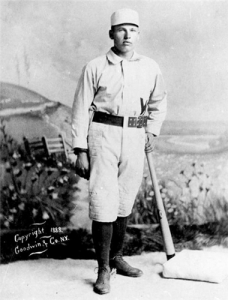
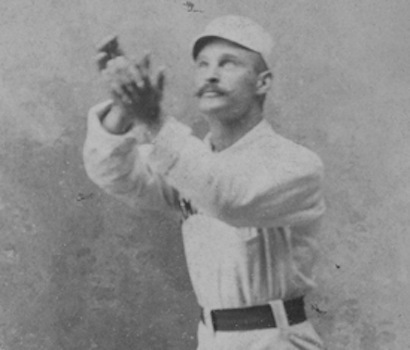
Arlie Latham

Arlie Latham

“There are a few growlers and soreheads who find fault with Latham for talking too much.  I cannot sympathize with such criticism.  Latham does not coach because he likes it or to be ‘funny’ and ‘work the grand stand,’ as many of his detractors would have people believe it.  I once heard one of the soreheads say to Captain (Charlie) Comiskey: ‘Why don’t you make Latham keep still?’

“’Do you want me to put him out of the game?’ replied the Reds’ captain.

“’No, I only want you to make him stop talking.’

“’Well, if I did that, he might as well be out of the game, for he would lose his interest.’

“Every word of this is true.  Latham is too much interested to keep still.  Hardly a ball is pitched in the game by the Reds’ pitchers that Latham from third base doesn’t have something to say.  Scarcely a movement is made at the bat, on the bases or the coaching lines that Latham doesn’t deliver some wordy instructions.

“He is in the game from start to finish.  He couldn’t be funny ‘to order’ to save his life.  The ludicrous and witty sallies he makes from the coaching lines just bubble out of him.  He doesn’t ‘day dream’ or ‘build air castles’ while a play is in progress as some players do.

“His mind is right on the business on hand.  He is a fighter all over.  There are others on the Cincinnati team who would do well to follow his example.  The Pittsburghs and Clevelands are examples of what fighters can do.  Every member of those teams was in the game all the way through when they were here.  Not a play occurred that they were not on their feet hustling and shouting.  The Reds should fall in beside (Latham) from now on and back him up with spirit and noise.

“Nothing pleases a crowd of local enthusiasts more than a scrappy game.  If you have got to go down, boys, do it with all your banners flying.  Fight it to the last-ditch, and then if you are whipped you’ll know how it occurred.”

Harry Weldon

Harry Weldon

The Reds never started fighting in 1894, and finished in tenth place with a 55-75 record; it was Comiskey’s final season as a major league manager, and his least successful.  The following year he purchased the Sioux City franchise in the Western league, and moved the team to St. Paul.

Latham, who hit .313 in 1894, had his final productive season the following year, hitting .313 for an improved Reds club (66-64) managed by William “Buck” Ewing.

Weldon was sports editor of The Enquirer until he suffered a stroke in February of 1900 at age 45, he died two years later.  Ren Mulford Jr., who succeeded Weldon as editor said:

“No more forceful writer on sports topics ever played upon the keys of a typewriter.”

“There is a Constant fear that Someday the Men will Decline to go on the field.”

31 Mar

The St. Louis Maroons were a big league franchise for just three seasons.  After winning the inaugural (and only) Union Association championship in 1884, the team was absorbed into the National League and was a dismal 36-72 in 1885, and 43-79 in 1886.

The club disbanded after the ’86 season and throughout the winter there was speculation about whether the franchise would end up in Kansas City (where local businessmen were looking to replace the Cowboys, who also went broke after the ’86 season) and Indianapolis.

The deal was finalized on March 8 when the franchise and nine players were sold to Indianapolis.  The Indianapolis News announced on the front page:

The Base Ball Deal

It Is Finally Completed

The story said:

“There is general rejoicing about the city over the certainty of having a league baseball club here.”

The team would be called the Hoosiers, and play at the Seventh Street Grounds, a ballpark owned by local businessman John Tomlinson Brush.
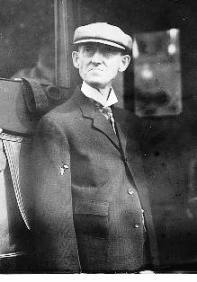
John T. Brush

John T. Brush

Brush was the driving financial force behind the deal and had been involved in local baseball in Indianapolis for several years, first having financed and organized a local amateur league in the city in order to promote his business—the When Store, and later the When Clothing Company—he was also an investor in the short-lived 1884 incarnation of the Hoosiers who struggled through one twelfth-place (29-78) season in the American Association.

The Hoosiers first year was unsuccessful and chaotic.

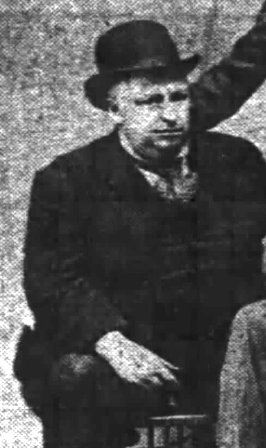
The first manager was George Walter “Watch” Burnham, who had been a National League umpire for 41 games in 1883 and one in 1886.  His role in the effort to acquire the franchise, his selection as manager, and the manner in which he acquired his nickname, gave some pause about the seriousness of the Indianapolis operation.
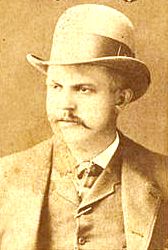
"Watch" Burnham

“Watch” Burnham

The Chicago Tribune said:

“The promoter of the Indianapolis movement is George W. Burnham, known as “Watch” Burnham.  At Cleveland, in 1883, while acting as a league umpire, he endeavored to establish himself in the public esteem by buying a watch, having ‘Presented to George W. Burnham by his friend and admirers’ inscribed on it, then having it sent out to him on the field during the progress of the game.  It is not surprising that some of the league people are suspicious of the Hoosier effort.”

Brush was not the team’s original president, that duty fell to a local attorney named Louis Newberger who spent his entire two-month tenure in the position complaining that he had no time to run the team; Brush took over as president in late May.

The Hoosiers limped to a 6-22 start—no doubt aided by 22 straight road games from May 5 through May 30.  Burnham resigned once, just five games into the season, but returned a few days later.  By mid May, as the team struggled through their endless road trip, The Chicago Tribune said a mutiny was expected:

“The dissatisfaction on the part of the players with Burnham, the manager, amounts almost to insubordination and there is a constant fear that someday the men will decline to go on the field.”

The Tribune said Burnham had fined “the entire team,” and Captain Jack Glasscock “said he would be black-listed before he would play again under the management of Burnham, but was finally prevailed upon to do so.”
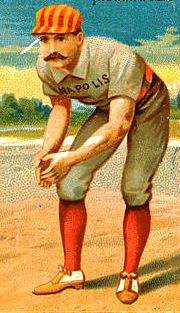
Jack Glasscock

Jack Glasscock

Upon the team’s return to Indianapolis Burnham was replaced with team secretary Fred Thomas.  Thomas, like Burnham, had no professional experience as a player or manager, and his tenure was not much more successful.  The club lost 18 of 29 games with him at the helm.

The team’s third manager also had no previous professional experience.  Horace Fogel was a sportswriter for The Philadelphia Press when he was tapped to be the third manager.  The Indianapolis News said hopefully:

“Mr. Horace Fogel, the new manager, is a good-looking young man, and makes a favorable impression on a stranger.  He is evidently very anxious to make the club a winner.”

The same July day The News opined on Fogel the paper also noted that maintenance of the ballpark had also angered some fans:

“Very unwisely the management had the chairs in the gallery varnished recently and yesterday several ladies had their dresses ruined.”

Things were no better under Fogel.  The Hoosiers went 20-49 under their third manager, and finished their inaugural season in eighth place with a 37-89 record.

The News said:

“Staring out under unfavorable circumstances…with inefficient management throughout the season, and many more defeats than victories, the club nevertheless, was accorded a generous support.”

The 1888 season became a matter of civic pride for the team’s ownership, local businesses and the newspaper.

In January it was announced that the Hoosiers would have a manager with at least some experience.  Harrison “Harry” Spence had played and managed in, among others, the Eastern, Northwestern and New England Leagues.  The News said of the new manager:

“A number of ball players of various clubs, who know Harry Spence…speak very highly of him.  Sam Thompson says he is a thorough gentleman, well liked by the players, and a fine manager.”

The News said the success of the Hoosiers was necessary for the future Indianapolis:

“Business and professional men are all interested in it, for, aside from the pleasure they derive from witnessing the games, they recognize the fact that the club is of great benefit in advertising the enterprise and prosperity of the city.”

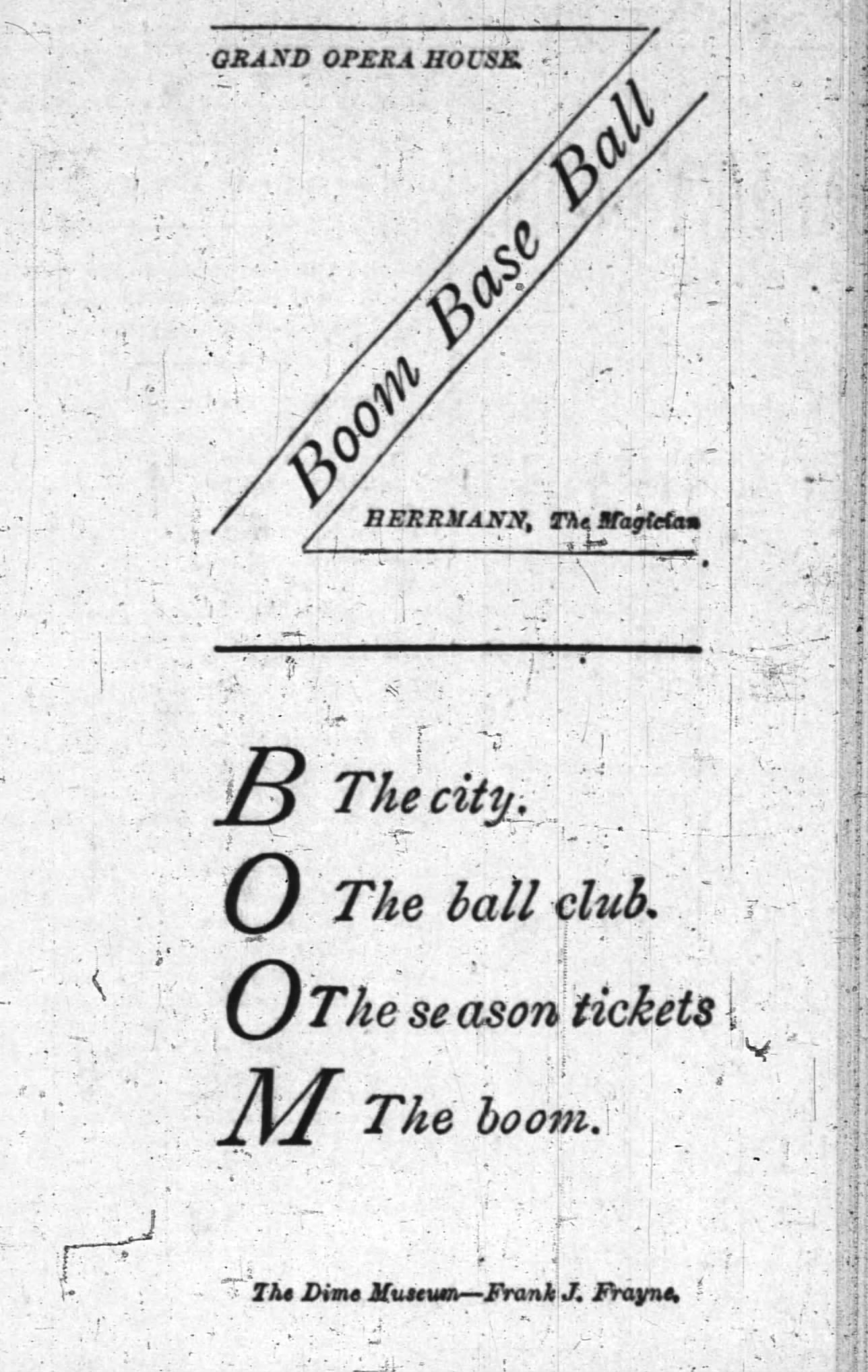
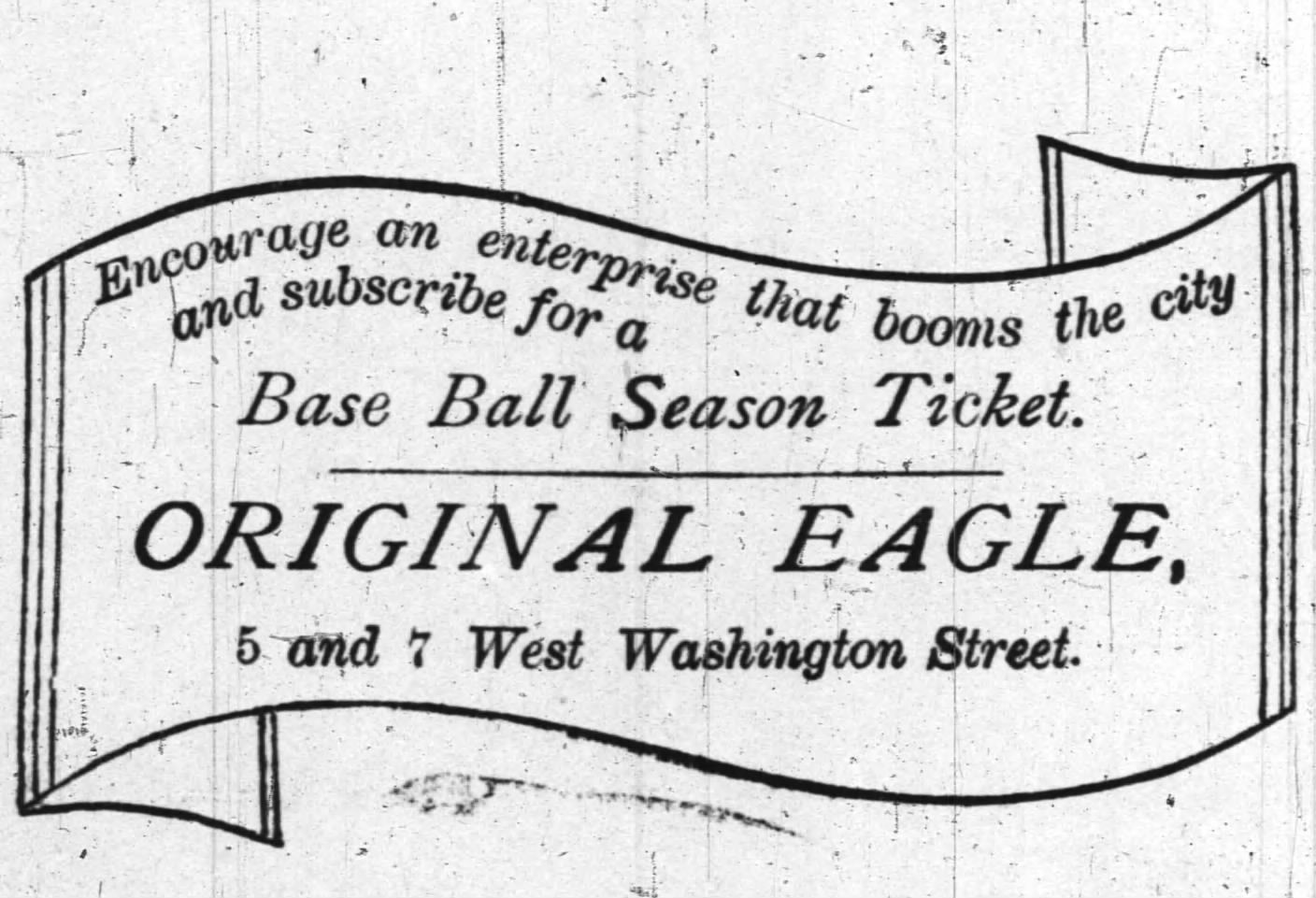
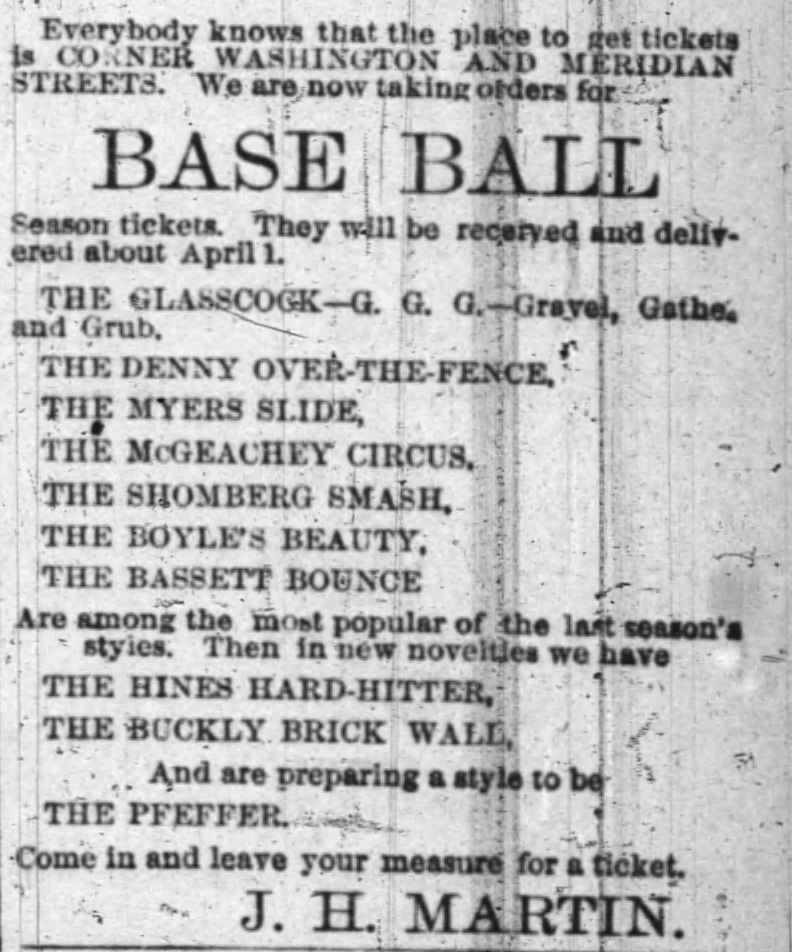
The paper organized a campaign called “Boom for Baseball.”  Sixty-eight local businessmen “representing the leading establishments in the city,” donated their advertising space back to the newspaper “for the purpose of setting forth the advantages that will accrue to the city, from the maintenance of a National League Baseball Club here.”

Brush told the paper:

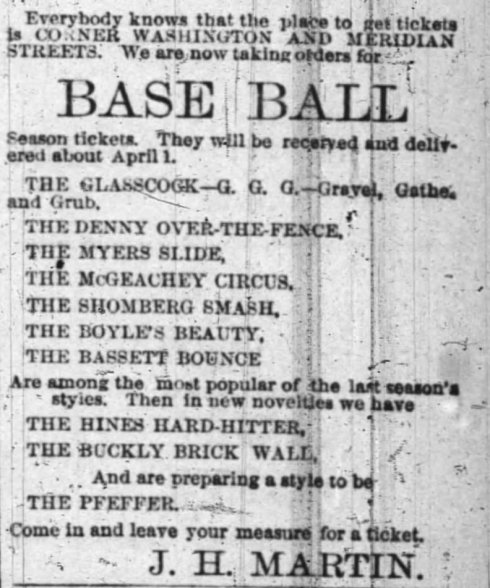
“We want at least five hundred subscribers for season tickets, and with this as a guarantee, we can get the money we want.  If any such player as (Fred) Pfeffer or (Larry) Twitchell can be bought we can and will buy him, and we can get the club in first-class shape for opening the season.”

Season tickets were sold for $25 each, and Brush said “We will have a grandstand that will be a beauty, with all the latest improvements, so that there will not be one uncomfortable seat in it.  Then we will have a space set aside for carriages and a special department for ladies and their escorts.”

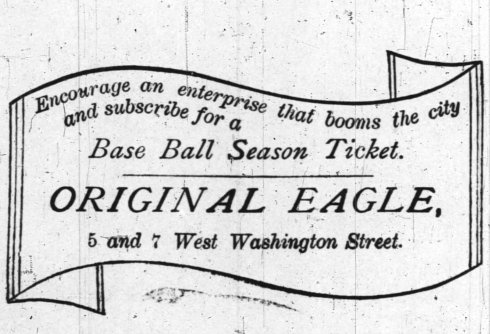
88indy4 88indy2

Some of the advertisements from Indianapolis' "Baseball Boom"  campaign

Some of the advertisements from The Indianapolis’ News’ “Baseball Boom” campaign

Most importantly, Brush assured the people of Indianapolis that they “would have a ballclub here that nobody would be ashamed of.”

He was wrong.

While not as bad as 1887, the Hoosiers got off to a 2-11 start, and struggled to a 50-85 seventh place finish, 36 games behind the champion New York Giants.

By 1889 Indianapolis had all but given up.  The team nearly went under before the season started.  In January a headline in The News said:

The Ball Club Gone

With debts of more than $5,000, the paper said Brush would “surrender the franchise” to the league.  Brush was able to raise enough capital to keep the club operating for one more sub .500 season (59-75), and another seventh place finish.  The only highlights for Indianapolis in 1889 was the arrival of 18-year-old Indiana native Amos Rusie, who posted a 12-10 record, and Jack Glasscock who hit .352, for the Hoosiers.

The team was dropped after the 1889 season, but not because of money.  The National League bought out Brush’s Hoosiers and the Washington Nationals.  Brush received a reported $67,000 for the team, he also received stock in the New York Giants as payment for former Hoosier players.  One year earlier when The News reported that Brush was on the verge of losing the team, the paper claimed “the franchise is now worth $15,500 cash.”  While that figure might have been low there was no doubt that Brush did well on the deal.  A year later he was president and majority stock holder of the Cincinnati Reds.

Indianapolis would only be a major league city one more time; in 1914 the Hoosiers were champions of the Federal League, but were relocated the following season, becoming the Newark Peppers.

Things I Learned on the Way to Looking up other Things #6

12 Mar

Umpiring “Revolutionized”

The Chicago Inter Ocean reported that an “innovation in baseball” would be introduced during the second game of a September 9 double header at Chicago’s South Side Park between the White Sox and the Boston Americans.

“The astonishing feat, an apparent impossibility, will be accomplished by the use of colors, and the inventor, George W. Hancock, expects the umpiring business to be almost revolutionized.”

hancock

George W. Hancock

Hancock was the inventor of indoor baseball in 1887; the game that evolved into softball.

“(Umpire) Jack Sheridan will wear a red sleeve on his right arm and a white one on his left claw.  For a strike he will wave the right arm, and for a ball the left one and the flash of the colors can be seen by people seated so far away that the voice even of Sheridan, the human bullfrog, would be inaudible.”

The “innovation” would likely have benefited one player, the popular center fielder of the White Sox, William Ellsworth “Dummy” Hoy, who was deaf.  But no mention was made of Hoy in the description of Hancock’s plan.

Hoy

Hoy

The “astonishing feat” turned out to be so insignificant that The Inter Ocean failed to even mention it in the summary of the double-header which the Sox swept.  Hoy did not appear in either game.  George W. Hancock’s plan was never mentioned again.

Luminous Ball

Another innovation that promised to revolutionize the game that never came to be was the luminous ball.  The Reading Times reported on the process in 1885:

“Charles Shelton, the leading druggist of Bridgeport, has discovered a compound which, when applied to a baseball, renders that object luminous.  One of the drawbacks of playing baseball at night under the electric light is the inability to see the ball when thrown or batted into the air with the black night background of sky behind it.  By saturating it with Mr. Shelton’s compound the ball while in motion is luminous.  At rest it does not retain any light.  The illuminating ball retains its meteoric irritation for 45 minutes.”

There is no record of Mr. Shelton’s invention ever being used in a professional game.

What’s a Dog Worth?

As part of the Federal League’s antitrust lawsuit against the American and National League’s affidavits were submitted from players detailing how organized baseball controlled the destiny and salary of player.  Mordecai “Three Finger” Brown, who jumped from the Cincinnati Reds to sign with the Federal League’s St. Louis Terriers, swore in his filing that players, on at least two occasions, had been traded for dogs.

William A. Phelon, of The Cincinnati Times-Star and “Baseball Magazine,” said:

“This thing of trading dogs for ball players—as outlined in the Federal affidavits—should be put upon a sane and sensible basis.”

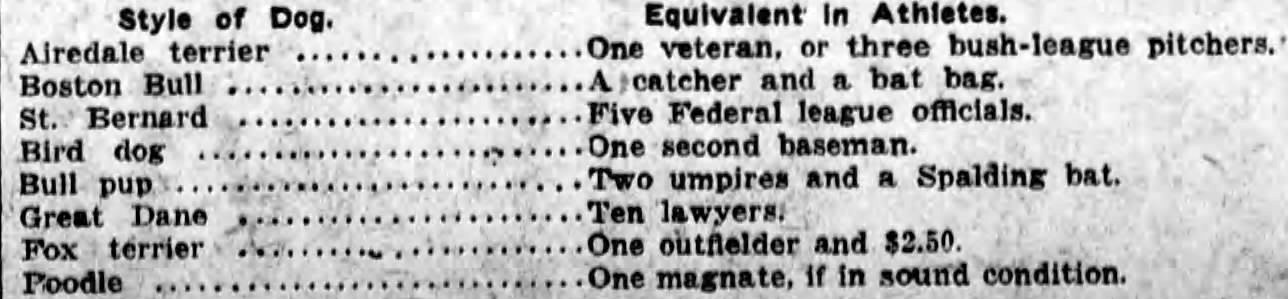
Phelon provided a “definite standard and a set of unit values” for baseball to follow:

phelondogs

McMullin’s Long Route to the Plate

Before Fred McMullin became the least famous of the eight members of 1919 Chicago White Sox who were banned from organized ball for life, he was a popular player on the West Coast.

Fred McMullin

Fred McMullin

The (Portland) Oregonian told a story that was purported to have taken place when McMullin was a member of the Tacoma Tigers in the Northwestern League in a game with the Seattle Giants:

“He came in from third on a dead run and made a slide for the plate.  McMullin knew he didn’t touch it, but he was afraid to slide back, as the catcher had the ball in his hand.  The umpire also knew he didn’t score, but he said nothing, for that was none of his business.

“Fred dusted off his uniform and stalked nonchalantly to the bench.  A couple of Seattle players yelled for a decision.

“‘He wasn’t safe, was he?’ demanded (Walt) Cadman, who was catching for Seattle.

“The umpire shook his head no.  At that Cadman, holding the ball in his hand, dashed over to the Tacoma bench to tag McMullin.  Fred waited until he almost reached him and then slid to the other end of the bench.

“Cadman followed him, and as he did s slipped in some mud and fell to his knees.  McMullin leaped up from the bench, dashed for the plate and touched it.  The umpire called him safe.”


Alternate Realities

26 Feb

Philip “Leather Fisted Phil” Powers went from respected major league catcher to one of the National League’s most controversial and disliked umpires.

Phil Powers

Phil Powers

One of his most explosive episodes of his umpiring career involved a run in with Reds pitcher Tony Mullane in Cincinnati. The incident took place at the end of a 7 to 4 loss to the Chicago White Stockings on April 30, 1891; Mullane walked ten batters.

The Cincinnati Enquirer saw it this way:

 “Phil Powers’ Very Yellow Umpiring “

The Chicago Tribune:

“Mullane’s Cowardly Assault”

The Tribune said Cincinnati had turned on a local hero:

“That either baseball cranks are devoid of memory or that gratitude does not enter into their composition was amply demonstrated today at the Cincinnati ball park.  Back in 1882 a sallow-complexioned youth wore a Queen City uniform, and by his clever work behind the bat aided in no small way to bringing the only championship banner that ever waved over the Queen City.  That youth was Phil Powers.  Today that same man, grown gray in active service on the ball field in various capacities, was assaulted by Tony Mullane on the ball field after the game and 700 brutes in the stands urged the curly-headed twirler on in his dastardly work, and all because of fancied wrongs at Powers’ hand in today’s game.”

The Enquirer said Mullane was the aggrieved party:

“Phil Powers’ umpiring was something awful.  Mistakes were not the exception; they were the rule.  He gave Tony Mullane a terrible roast.  His miserable work was enough to rob any pitcher of his nerve, but it did not rattle Tony.  He stood up like a hero under Powers’ Jesse James tactics, and pitched ball that would have been a winner under ordinary circumstances.  The Chicagos owe their victory to Mr. Powers, not their own efforts.”

Tony Mullane

Tony Mullane

The papers couldn’t even agree on how much Mullane was fined during the game The Tribune said $75, The Enquirer said $150; the  altercation after was also given a local spin.

The Tribune version:

“After the game was over Powers started across the field with Mullane at his heels pouring out a tirade of abuse which made the air in the vicinity assume a sulfurous odor.  Powers with an expression of scorn on his face walked on towards the clubhouse.

“Mullane, like a tiger lashing itself into a fury, grew more and more angry, until finally he lost all self-control, and drawing back struck Powers in the face with a clenched fist.  The latter immediately increased Mullane’s fine to $250…The scene attracted the attention of the crowd, which, be it said to the shame of Cincinnati, encouraged Mullane’s ruffianly conduct.”

The Enquirer saw it differently:

“Tony Mullane and Umpire Powers had some trouble near the clubhouse.  Powers was to blame for the controversy.  He gave Mullane an awful deal while the game was in progress and then soaked him $150 in fines simply because Tony grumbled and asked him to come closer to the bat and pay more attention to his delivery.  On the way down to the clubhouse Powers said to Mullane in a sort of apologetic manner:  “I couldn’t rob the Chicagos to please you.’

“’Oh, get out,’ said Mullane.  ‘No one asked you to rob them.  I only wanted what belonged to me, and you robbed me bald-headed.’

“Powers said something in return and Mullane replied angrily.  Then Powers put on another fine of $100.  This so incensed Mullane that he drew back as if to assault Powers.  The latter in a most exasperating way put his face right up against Tony and said: ‘I dare you to strike me.’  It was a cowardly act on the part of Powers, for he well knew that if Mullane hit him it would mean disgrace…Mullane almost forgot himself.  It was all he could do to restrain himself.  He simply pushed Powers’ face away.  Then other players separated them.”

The papers did agree on the final total of Mullane’s fines: $250.  Mullane beat the Cleveland Spiders 7 to 4 two days later with Powers as umpire.  The game went off without incident.

Such Clanging of Bells and Blowing of Horns has never been Equaled in Athletic Park”

24 Feb

From the formation of the Cuban Giants as the first professional black team in 1885 until the establishment of the Negro National League in 1920 there were many attempts to form an organized league; and numerous advocates for the idea.

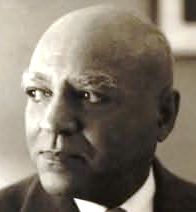
Lester Aglar Walton, editor of The New York Age, believed the color line was borne solely out of “the white man’s fear in open competition,” but also understood that the situation was not likely to change.

Lester Aglar Watson

Lester Aglar Watson

In 1911, Walton thought the conditions for starting a league were right, were right based on a three-game series in June—the Chicago Leland Giants traveled to St. Louis for a three-game series with Charles Alexander Mills’ St. Louis Giants:

“The figures, giving the attendance at the three games played, are interesting and furnish those who have been agitating the organization of a colored baseball league much cause for jubilation.  They are now enthusiastically pointing to figures to back up the assertion they have been making all along that a colored baseball league would pay;  also that the fans would give it their loyal support.”

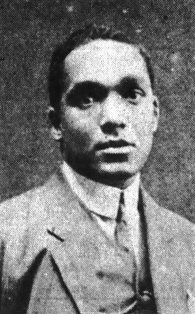
Charles Alexander Mills,

Charles Alexander Mills

The Freeman described the atmosphere at the first game:

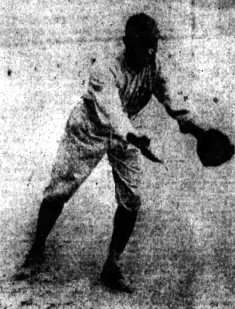
“The Chicago Giants entered from the south entrance, headed by Captain Pettis (William “Bill” “Zack” Pettus), and followed closely by the entire squad, clad in blue caps and white uniforms.  The contrast was rich.  At the site of the Chicago boys the fans cut loose, and such cheerings in respect would be fit for a king.  Ten minutes later Captain (Richard Felix (Dick) Wallace and his squad emerged from the club house, all in a quick step, and when they came in view of the vast throng such clanging of bells and blowing of horns has never been equaled in Athletic Park.”

Bill Pettus

Bill Pettus

Walton noted that the opening game, played on June 21, drew 2,200 fans.  On the same day in Cincinnati, just 700 attended a Reds game against the St. Louis Cardinals.  The following day 2,500 hundred watched the two teams play, and about 2,600 attended on Friday.  The St. Louis Browns, playing the Chicago White Sox on Wednesday and Thursday at Sportsman’s Park, drew smaller crowds both days:

“It should not be overlooked that the fans turned out in goodly numbers to see the St. Louis Giants and the Chicago Giants on week days.  On Sundays it is not unusual for the St. Louis Giants to play before 5,000 people.  It is, however, generally admitted that strong colored teams are good Sunday attractions, but the difference of opinion has invariably come up over the question of whether the fans would put in their appearance in sufficient numbers on week days.

“What is also considered significant by those who favor the formation of a colored baseball league is that with few exceptions the crowds were composed of colored people, which proves conclusively that members of the race will support colored clubs when they put up a good article of ball.  The same can be said of white fans, and quite often, for instance, in greater New York, more whites attend baseball matches between colored clubs than colored.”

Walton said it was always understood that New York and Chicago could support a member club in an organized league, but there was “doubt as to whether devotees of the national game in St. Louis, Cincinnati, and Louisville etc…would turn out in sufficient numbers to ensure the players a nice check when payday rolled around.”  The series, he said, erased some of those doubts:

“Cincinnati, Louisville, Baltimore and other cities considered can make as good a showing as St. Louis.  Furthermore…these cities have but one big league team, while St. Louis has two, a condition which it is claimed, would argue in favor of the respective colored teams securing a larger white patronage.”

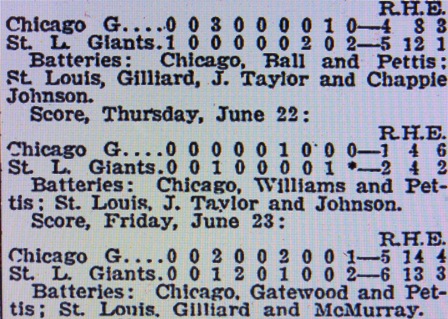
The St. Louis Giants swept the three-game series—winning all three in the bottom of the ninth inning; including a 2 to 1 victory behind “Steel Arm” Johnny Taylor over “Smokey Joe” Williams in game two—Taylor also won game one in relief.

The line scores from the three games

The line scores from the three games

Despite the enthusiasm, three excellent, well–attended games, and the resulting optimism as a result of the attendance in St. Louis during three days in June of 1911, an organized black league was still nearly a decade away.

Lost Advertisements–Mike Martin’s Liniment

27 Dec

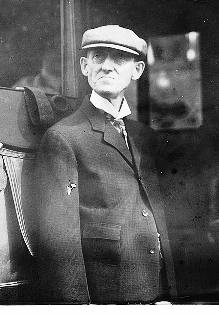
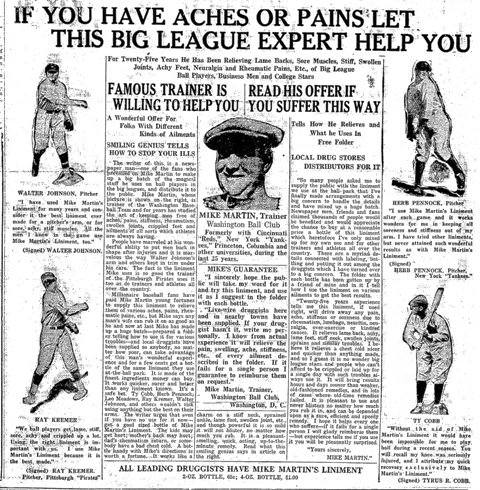
martinlinMike Martin spent 40 years with the Washington Senators as a trainer and scout; he was one of baseball’s first full-time trainers.  Martin was working as the athletic trainer at Columbia University when Clark Griffith hired him to work with the New York Highlanders, he followed Griffith to Cincinnati and then finally to Washington.

Martin began marketing the liniment he used on Walter Johnson and the rest of the Senators staff in the 1920s.  This 1925 ad featured testimonials from his good friend, Senator pitcher Walter Johnson, Herb Pennock of the Yankees, Ray Kremer of the Pirates and Ty Cobb (who rarely met a “cure” he couldn’t endorse):

“I have used mike Martin’s Liniment for many years and consider it the best liniment ever made for a pitcher’s arm, or for sore, achy, stiff muscles.  All the men i know in the game use Mike Martin’s Liniment too.”

(Signed) Walter Johnson

“I use Mike Martin’s Liniment after each game and it works wonders for me in keeping all soreness and stiffness out of my arm.  I have tried other liniments, but never attained such wonderful results as with Mike Martin’s Liniment.”

(Signed) Herb Pennock 

“We ball players get lame, stiff, sore, achy and crippled a lot.  Using the right liniment is important with us.  I use Mike Martin’s Liniment because it is the best made.”

(Signed) Ray Kremer

“Without the aid of Mike Martin’s Liniment it would have been impossible for me to play ball during the recent season.  You will recall my knee was seriously injured, and I attribute my quick recovery exclusively to Mike Martin’s Liniment.”

(Signed) Tyrus R. Cobb

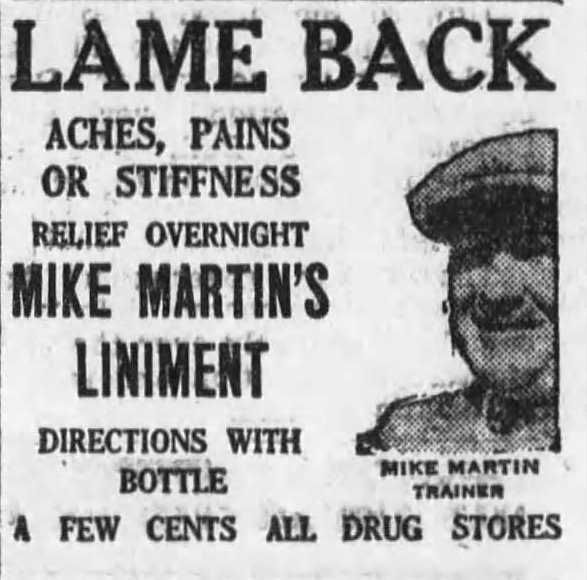
mikemartin1930

1930 advertisement

Martin remained the Washington trainer until 1946 when Griffith made him a scout.  He was still working for the Senators, and his liniment was still a popular product, in June of 1952 when the 67-year-old Martin was killed in a traffic accident near his Maryland home while driving to Griffith Stadium.


Harry Wright Returns to Cincinnati

17 Dec

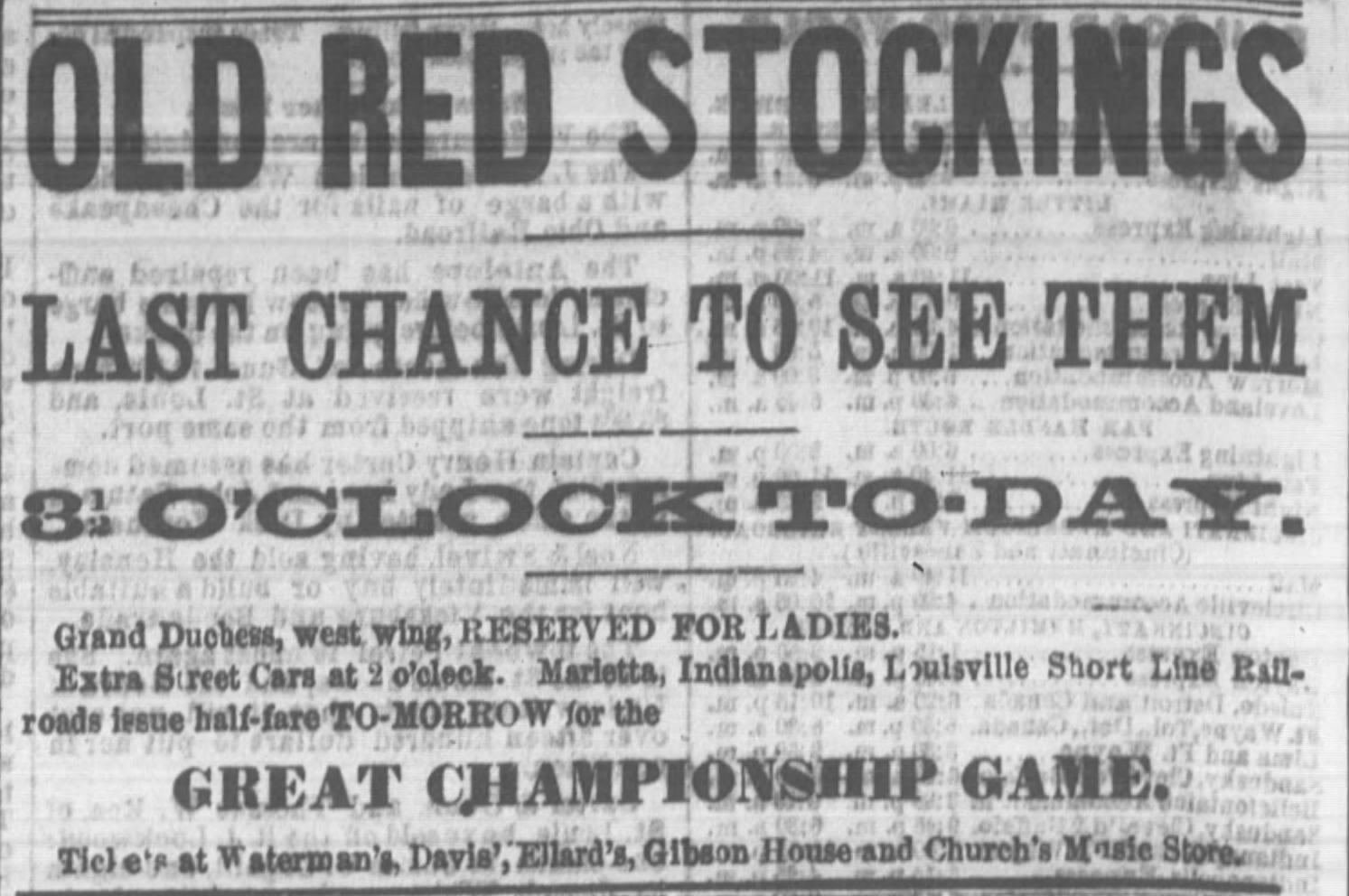
In 1871, Harry Wright took several of his Red Stockings players, as well as the team name, moved to Boston and joined the newly formed National Association.  Wright’s exit from Cincinnati was contentious, but despite that he was invited back for an exhibition game in July between his former team and a “picked nine” consisting of the members of Wright’s current team and the Washington Olympics.

Advertisement for the July 3, 1871 game

Advertisement for the July 3, 1871, game

The Cincinnati Enquirer said the two thousand people in attendance indicated “that the interest in base-ball is not dead in this city, but only needs the stimulus of first-class games to awaken it to renewed life.”

The paper said:

“The old Reds did not have the services of George Wright (who was injured), and did not play with the skill characteristic of them in 1868-’69, which may have been due to fact that there was nothing at stake than gate money.”

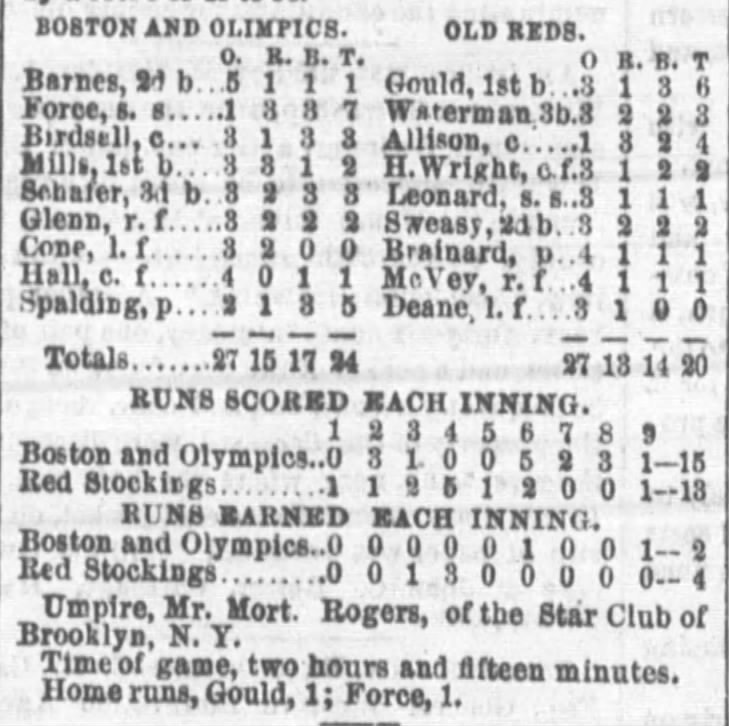
Albert Spalding pitched for the “picked nine” and beat Wright’s club, with Asa Brainard pitching, 15-13. The Enquirer said former Cincinnati players Cal McVey and Charlie Gould, who both joined Wright in Boston, “have improved in their batting powers.”

Wright’s team led 10 to 4 through five innings, but the opponents posted a five-run sixth which included a home run by Davy Force and added two in the seventh and three in the eighth.

The box score

The box score

One sign that all might not have yet been forgiven in Cincinnati:  while Harry Wright was listed in the box score and the inning-by-inning recap of the game, The Enquirer didn’t use his full name in any of the game advertisements or articles.

Professional baseball returned to Cincinnati in 1876 when the reds became an inaugural member of the National league.

“The Cleverest bit of Quick Thinking I ever Witnessed”

26 Nov

Hugh Fullerton was one of baseball’s most influential writers; his career began in 1889 and he was active into the 1930s.  Widely credited as the first writer to directly quote players and managers, he is the source of hundreds of stories. Some, like the story the story of Bill Lange’s fence-crashing catch, are likely untrue.  Others may be apocryphal, or exaggerated.

Hugh Fullerton

Hugh Fullerton

This one is about Hall of Famer John Alexander “Bid” McPhee:

“The cleverest bit of quick thinking I ever witnessed was years ago in Cincinnati, and Bid McPhee, the ‘King,’ pulled it off.  How fast he thought only can be guessed.  It must have been instantaneous.  Bid was on first base with nobody out, when somebody drove a ball straight at ‘Wild’ Bill Everitt who was playing first for Chicago.  Bill dug up the ball, touched first, and made one of his copyrighted throws to second to catch Bid, having plenty of time for the double play.

Bid McPhee

Bid McPhee

“The ball disappeared.  (Bill) Dahlen, who was on second, never saw it.  He thought the ball had hit Bid.  The umpire, crouching to see the play at the base, lost the ball.  Bid hesitated at second, glanced around, saw the entire Chicago infield running around wildly and tore for third.  At third, after turning the base, he hesitated again, looked back, and then tore for home.  From his actions both at second and third any spectator would have sworn Bid was as ignorant of the whereabouts of the ball as were the Chicago players.

“The Chicago team was wild with excitement and the crowd was mystified.  No one knew where the ball was.  The only clue was a yell of amusement from the Cincinnati bench.

“The ball had disappeared utterly and the umpire threw out a new one.  After the game we learned what had become of the ball.  Everitt hit Bid with it.  The ball had struck him under the arm, and holding it tight against his body Bid carried it entirely around the bases and to the bench while acting as if he didn’t know where it was.”

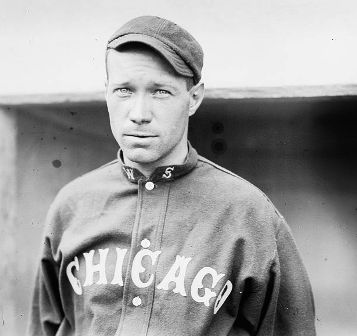
Morrie Rath

25 Nov

In August of 1913, the Chicago White Sox sold second baseman Morris “Morrie” Rath to the Kansas City Blues of the American Association.

Morrie Rath

Morrie Rath

The Chicago Eagle said the sale wasn’t the result of Rath’s .200 batting average, or 16 errors, but because of his performance coaching first base during a game in Philadelphia earlier in the month:

“Morris was coaching at first base and (Manager Nixey) Callahan was at third.  (Harry) Lord was at bat.  He hit a bounder to one of the infielders and as it was a slow hit he figured he could beat it out.  He ran with every ounce of speed and strength that he possessed.  The play was mighty close.

Harry Lord

Harry Lord

“’Out,’ cried the umpire.

“Lord figuratively hit the ceiling.  He threw his cap down and jumped upon it.  He picked it up and threw it down again.  He howled and he scowled.  He allowed that if there ever was a blind umpire that he was working on the bases that day.  He assured the ump that in all his experience as a ball player it was the worst decision he ever saw.  Then up spoke Rath.  His voice was as gentle as could be:

“’Yes, you were out Harry.’

“And Lord collapsed.  That beat the other thing.  Never in his experience as a ball player had he heard another player agree with the umpire when it meant that one of his pals was out instead of safe.  That was beyond the comprehension of Lord.  He just wilted and staggered to the bench.

“By this time Callahan was over there.  There was fire in his eye, and he was fighting mad.  ‘Of all the—‘ he started in and then stopped.  For the umpire was laughing.

‘What’s the matter?’ howled Cal.

‘Why Rath here agrees that he was out,’ laughed the ump.

“What did Cal do?  What could he do?  He also was dazed.  It was a new one on him.  He had been around ball fields for many years, but never before had a member of his team taken sides with the ump against a teammate.”

It was a long road back to the big leagues for Rath.  He played for Kansas City until June of 1915 when he was sold to the Toronto Maple Leafs.  In 1916, He joined the Salt Lake City Bees in the Pacific Coast League, after hitting .300 and .341 he was drafted by the Cincinnati Reds after the 1917 season in the Rule 5 Draft.

After spending 1918 in the United States Navy where he was captain of the baseball team at the Philadelphia Navy Yard, Rath finally joined the Reds for the 1919 season.  He was Cincinnati’s regular third baseman in 1919 and 1920 and appeared in all eight games of the 1919 World Series against his former team.

Rath finished his career with the San Francisco Seals in the Pacific Coast League in 1921.

After his career, he operated a sporting goods store in Upper Darby, Pennsylvania.  In 1945, suffering from ill-health, he committed suicide.

Hence his Careless, Indifferent air when he goes to the Plate to Bat.”

18 Nov

In 1911 Reds manager Clark Griffith told The Cincinnati Times-Star that pitchers no longer hit like they did when he played:

“Give me pitchers who can hit the ball instead of fanning out weakly, I wish there were a few more pitchers available like the top notchers of twenty years ago.  In those days a pitcher believed that he was hired to soak the ball as well as curve it, and he always did his best to get a hit.

(Tim) Keefe (career .187), (Mickey) Welch (.224), (Thomas “Toad”) Ramsey (.204), and (James “Pud”) Galvin  (.201) were among the old-time pitchers who could not bat, but they tried all the time, and if one of them got a hit he was as proud as a kid just breaking into the big league.”

Clark Griffith

Clark Griffith

The problem, said Griffith, was that “The pitcher seems to think that when he is delivering the goods in the box nothing more is required of him.  Hence his careless, indifferent air when he goes to the plate to bat.”

Griffith said Cap Anson, “wouldn’t hire a pitcher who couldn’t hit,” and said former Chicago pitchers Pat Luby (.235), Ad Gumbert (.274),  Walter Thornton (.312) and  George Van Haltren (.316, but was primarily an outfielder appearing in 93 games as a pitcher over a 17-year career), “were bear cats with the stick.”

Griffith said of his ability with the bat:

“The old guide-book will show that even your humble servant hit over .300 for Anson.”

Griffith hit .319 for Anson in 1895, and .233 for his career.

The 1911 Reds had only one starting pitcher who hit better than .214, (George Suggs. 256).  He was also the only starter with a winning record (15-13) for Griffith’s sixth place Reds.

George Suggs

George Suggs