Tag Archives: Clark Griffith

Lost Team Photos–1903 New York Highlanders

3 Jan

1903NY

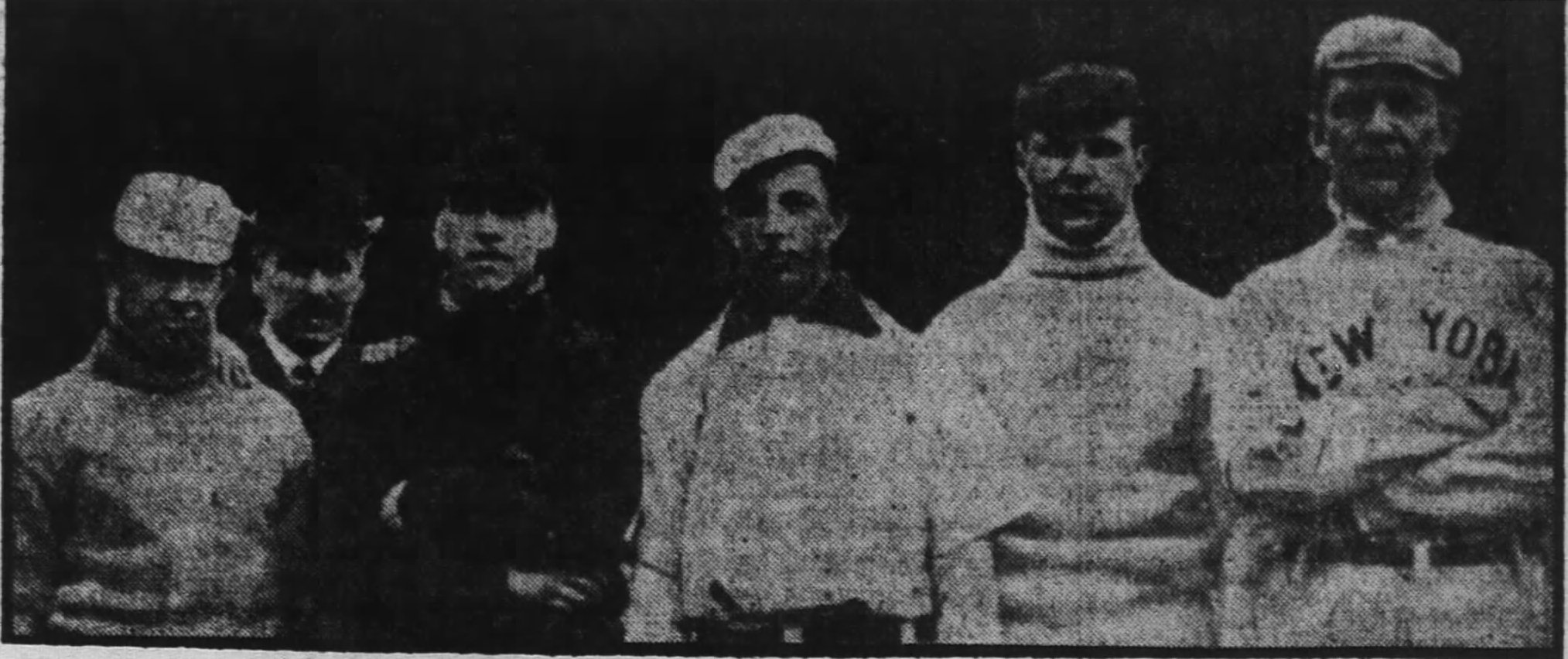
Five members of the first New York Highlanders team and a New York sportswriter photographed at Atlanta’s Piedmont Park in March of 1903. The financially failing Baltimore Orioles franchise was transferred to New York for the 1903 season.

From left: William “Wee Willie” Keeler (RF), James “Gym” Bagley of The New York Evening Mail, Harry Howell (P), William “Wid” Conroy (3B), Monte Beville (C), and John Ganzel (1B).

Atlanta Was thrilled to host the team.  The Atlanta Constitution said on the morning the team was due to arrive:

“The hearts of the local fans will be made glad today by the arrival of the New York American baseball team, for this afternoon on there will be something doing at the park.

“Manager Clark Griffith will have charge of the team, and will bring them in with him this afternoon on the Southern’s No. 27 from Washington, which is due in the city at 3:55 o’clock.

“The aggregation is nothing less than a bunch of stars.”

Large crowds came out to Piedmont Park for the team’s morning and afternoon practices and for the Highlanders first spring game on March 26 against the Atlanta Crackers.

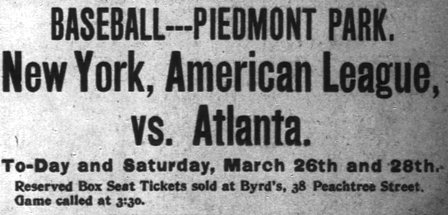
advertisement for the 1903 New York Highlanders spring games with the Atlanta Crackers

Advertisement for the 1903 New York Highlanders spring games with the Atlanta Crackers


Griffith’s team finished fourth in the American League with a record of 72-62.

Lost Advertisements–Mike Martin’s Liniment

27 Dec

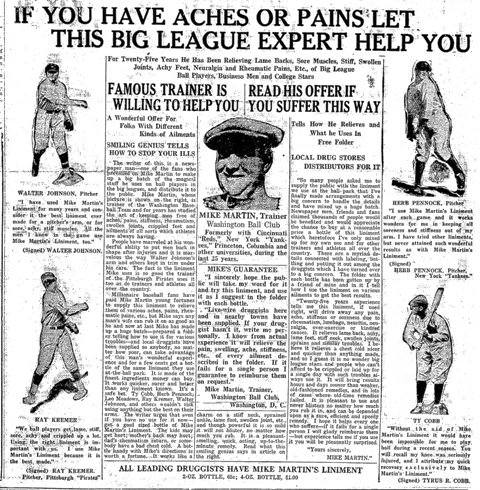
martinlinMike Martin spent 40 years with the Washington Senators as a trainer and scout; he was one of baseball’s first full-time trainers.  Martin was working as the athletic trainer at Columbia University when Clark Griffith hired him to work with the New York Highlanders, he followed Griffith to Cincinnati and then finally to Washington.

Martin began marketing the liniment he used on Walter Johnson and the rest of the Senators staff in the 1920s.  This 1925 ad featured testimonials from his good friend, Senator pitcher Walter Johnson, Herb Pennock of the Yankees, Ray Kremer of the Pirates and Ty Cobb (who rarely met a “cure” he couldn’t endorse):

“I have used mike Martin’s Liniment for many years and consider it the best liniment ever made for a pitcher’s arm, or for sore, achy, stiff muscles.  All the men i know in the game use Mike Martin’s Liniment too.”

(Signed) Walter Johnson

“I use Mike Martin’s Liniment after each game and it works wonders for me in keeping all soreness and stiffness out of my arm.  I have tried other liniments, but never attained such wonderful results as with Mike Martin’s Liniment.”

(Signed) Herb Pennock 

“We ball players get lame, stiff, sore, achy and crippled a lot.  Using the right liniment is important with us.  I use Mike Martin’s Liniment because it is the best made.”

(Signed) Ray Kremer

“Without the aid of Mike Martin’s Liniment it would have been impossible for me to play ball during the recent season.  You will recall my knee was seriously injured, and I attribute my quick recovery exclusively to Mike Martin’s Liniment.”

(Signed) Tyrus R. Cobb

mikemartin1930

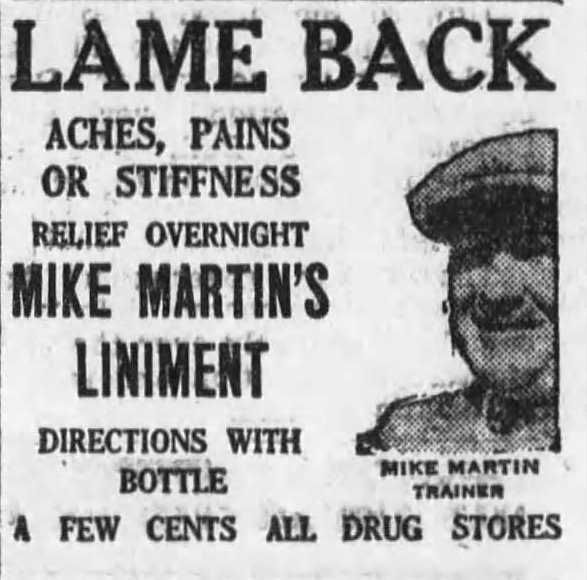
1930 advertisement

Martin remained the Washington trainer until 1946 when Griffith made him a scout.  He was still working for the Senators, and his liniment was still a popular product, in June of 1952 when the 67-year-old Martin was killed in a traffic accident near his Maryland home while driving to Griffith Stadium.


Burns “Put the Punishment on Phyle”

20 Nov

After holding out over a temperance clause the Chicago Orphans added to his contract, Bill Phyle finally signed in late March of 1899.  He reported to spring training in New Mexico anywhere from 10 to 30 pounds overweight (depending on the source) and struggled all season to regain the form he showed the previous season.

On April 17 he was beaten 8-0 by the Louisville Colonels in first start.

On April 25 he lost 3-2 to the St. Louis Perfectos.  The Chicago Tribune said “Phyle gave away the game by distributing bases on balls in just the spots where timely hits followed and transformed the favors into tallies that gave the victory.”

William Phelon, The Chicago Daily News baseball writer, disagreed.  He said Phyle’s “work was of sterling quality.”

Regardless, Chicago Manager Tom Burns didn’t give Phyle another opportunity to pitch for more than a month.

Phelon said it was a mistake for Burns to not use Phyle.  The Chicago Inter Ocean said after the team lost seven of nine games in May “it is passing strange that young Phyle is not given a chance.  On last year’s form Phyle is as good as, if not better than (Jack) Taylor.  The paper called Phyle’s performance in the St. Louis game “gilt-edged” and blamed the loss on “comrades that gave the victory to the enemy.”

Finally, on May 28 Phyle pitched again.   He lost 4 to 3 to the Washington Senators; he gave up three runs on five straight hits with two outs in the ninth.

He lost again on June 1, 7-1 to the Philadelphia Phillies.  Phelon’s opinion of the pitcher was unchanged, and said the losses were simply bad luck:

“Phyle has now lost four straight games.  It is Phyle’s luck to be stuck in whenever the other pitchers have won about three straight, and the team is just about unavoidably due to lose.”

On June 5 Phyle did his best pitching of the season–a victory he is not credited with in the record books.

With the Orphans trailing the Baltimore Orioles 3 to 2 in the third inning, pitcher Clark Griffith was ejected for arguing a called ball.  The Chicago Tribune said:

“It was a queer game.  Phyle pitched after Griffith had been benched…holding the Orioles helpless.”

Chicago won 9 to 4.  And while the Chicago newspapers credited the victory to Phyle, the record books do not.
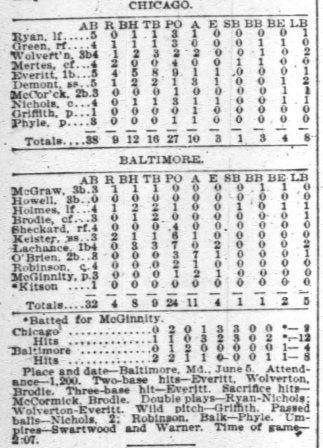
Box score for June 5 game.  Phyle relieved Clark Griffith in the 3rd inning.

Box score for June 5 game. Phyle relieved Clark Griffith in the 3rd inning.

Phyle became ill later the same week, (some sources said it was recurring malaria), a week later he fell off a bicycle and missed two more weeks.  When he returned to the team on June 22, the Boston Beaneaters beat him 5 to 1.

He was credited with his first “official” win on July 1—a game The Inter Ocean called “a comedy of errors,” and a “depressing exhibition.”   He beat the New York Giants 10 to 9, allowing 10 hits and giving up seven runs in the first two innings.  Each team committed seven errors.
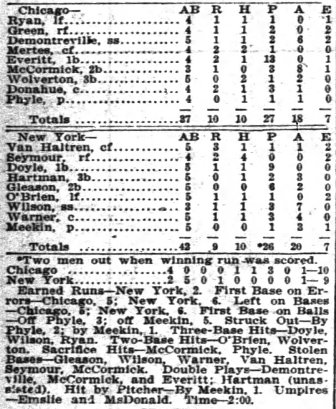
Box score of Bill Phyle's only "official" victory of 1899.

Box score of Bill Phyle’s only “official” victory of 1899.

Chicago went into a slump that would last for the rest of the season; after Phyle’s July 1 win the team was 38-24, in third place, and went 37-49 the rest of the way finishing eighth.

Phyle lost again on July 9 and July 24, and rumors began to circulate that he would be released or traded back to Charlie Comiskey’s St. Paul Saints.

On August 6 Phyle lost 10 to 9 to the Cleveland Spiders.  One week later while the team was on the road, The Inter Ocean reported that he “was sent home by manager Burns.”

The Tribune called Phyle “the scapegoat” and said he and three unnamed teammates  “celebrated after beating a horse race at Washington and Manager Burns, to call a halt, put the punishment on Phyle.

Phelon wrote in The Daily News:

“When the club started for Philadelphia he was told to go home ‘You are through young man, go back to Chicago,’ said Burns, and Phyle went back.  He went back in a rage too, and says he will tell (team president) Jim Hart a lot of things. He says that he has been held up to public derision as a drunkard, all season, and that Burns plays favorites, allowing his friends to jag up as much as they wish and turning all the trouble on others.”

Phelon remained supportive of the pitcher in The Daily News, but in The Sporting Life he reported that Phyle, a former boxer, had deserted the team in early August to go to “St. Louis to see a prize fight, and was not on hand when sorely needed.”

While the relationship between Hart and Burns was strained, and Burns would be replaced at season’s end, Phyle’s complaints went nowhere with the team president and he was suspended without pay.

Ten days after Phyle was suspended Phelon reported that the Baltimore Orioles had offered to trade for or buy Phyle,” (John) McGraw has taken quite a fancy to the young pitcher.”  Hart refused to make a deal.

Phyle never pitched for Chicago again, he is credited with a 1-8 record and 4.20 ERA.

The last Bill Phyle chapter—tomorrow.

“Clark Griffith nearly Ended the Life of William Phyle”

19 Nov

Bill Phyle was expelled from baseball after failing to back up his allegations that the 1903 Southern Association pennant race was fixed—four years earlier he had an even more eventful season.

Phyle started his career as a pitcher; he was 18-9 in 1897, and 21-21 in 1898 for the St. Paul Saints when he was traded to the Chicago Orphans for Frank Isbell.

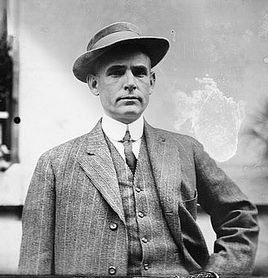
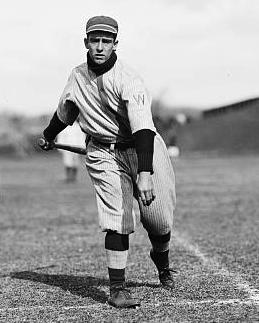
Bill Phyle

Bill Phyle

He appeared in three September games, winning two with a 0.78 ERA, and was expected to contribute the following season.

In March of 1899 Phyle failed to report to Hudson Hot Springs, New Mexico to join manager Tom Burns and Orphans for spring training.

The Chicago Tribune said the pitcher had refused to sign his contract:

“It is asserted on good authority that pitcher Phyle has refused so far to sign a Chicago contract owing to the insertion of a temperance clause in the document…Phyle objects strenuously to the temperance contract which has been offered to him.  He has asserted positively within the last three weeks that he would never sign such an agreement.”

The Tribune said the contract clause wasn’t the only issue that might keep Phyle from playing in Chicago in 1899; the pitcher had, inadvertently, alienated Burns and team president James Hart the previous September:

“Phyle was unfortunate in his entry into the major league in incurring the displeasure of the Chicago president and manager.  There is a peculiar story connected with the affair.  Last year some members of the Chicago team believed that someone was carrying reports to Hart and Burns regarding the conversations of the players concerning their opinions of the heads of the club.  One night in Washington some of the men put up a job on the man they suspected in order to find out if their suspicions were correct.    In the presence of the man in question they made unflattering remarks regarding the president and manager of the club, and Phyle, being an innocent party to the plot, listened, approved some of the statements quoted as facts, and also took up the discussion.  It is asserted the conversation was carried to President Hart and Manager Burns.  At any rate, Phyle has been in disfavor since that time.”

The Tribune said Phyle was the only player who was given a contract that included a temperance clause.

With the situation at an impasse, Charlie Comiskey, Phyle’s manager in St. Paul, intervened.  The Chicago Inter Ocean said Comiskey, who called Phyle “one of the most promising youngsters” in baseball, sent a “tersely worded” telegram to the pitcher who “decided to sign the Chicago contract temperance clause and all.”

Phyle reported to Hudson Hot Springs ten pounds overweight on March 21.

Three days later he went duck hunting with teammates Clark Griffith, Bill Lange, Jack Taylor and Jimmy Callahan at A.G. Spalding’s New Mexico ranch.  The Inter Ocean said of the trip:

“A bullet from a Winchester rifle in the hands of Clark Griffith nearly ended the life of William Phyle, the promising young pitcher of the Chicago ball team.”

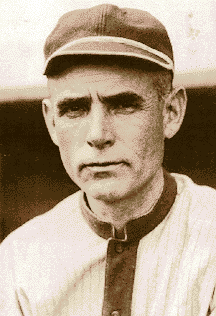
Clark Griffith

Clark Griffith

Phyle, unbeknownst to Griffith, remained in the group’s boat while Griffith fired on a flock of ducks flying near the boat:

“Griffith pulled the trigger and a ball tore its way through the stem of the boat…The ball carried in a direct line over the young pitcher’s head, and could not have missed him by more than six inches.”

Phyle was shaken, but unhurt, while “Griffith’s nerves received such a shock that he was weak and almost prostrated for some time after.”

Things didn’t get much better for Phyle after his near-death experience—tomorrow.

Hence his Careless, Indifferent air when he goes to the Plate to Bat.”

18 Nov

In 1911 Reds manager Clark Griffith told The Cincinnati Times-Star that pitchers no longer hit like they did when he played:

“Give me pitchers who can hit the ball instead of fanning out weakly, I wish there were a few more pitchers available like the top notchers of twenty years ago.  In those days a pitcher believed that he was hired to soak the ball as well as curve it, and he always did his best to get a hit.

(Tim) Keefe (career .187), (Mickey) Welch (.224), (Thomas “Toad”) Ramsey (.204), and (James “Pud”) Galvin  (.201) were among the old-time pitchers who could not bat, but they tried all the time, and if one of them got a hit he was as proud as a kid just breaking into the big league.”

Clark Griffith

Clark Griffith

The problem, said Griffith, was that “The pitcher seems to think that when he is delivering the goods in the box nothing more is required of him.  Hence his careless, indifferent air when he goes to the plate to bat.”

Griffith said Cap Anson, “wouldn’t hire a pitcher who couldn’t hit,” and said former Chicago pitchers Pat Luby (.235), Ad Gumbert (.274),  Walter Thornton (.312) and  George Van Haltren (.316, but was primarily an outfielder appearing in 93 games as a pitcher over a 17-year career), “were bear cats with the stick.”

Griffith said of his ability with the bat:

“The old guide-book will show that even your humble servant hit over .300 for Anson.”

Griffith hit .319 for Anson in 1895, and .233 for his career.

The 1911 Reds had only one starting pitcher who hit better than .214, (George Suggs. 256).  He was also the only starter with a winning record (15-13) for Griffith’s sixth place Reds.

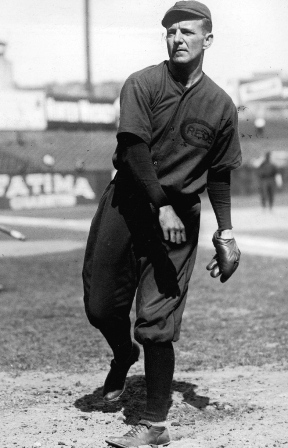
George Suggs

George Suggs

“I Consider him a Weak, Foolish Talker”

13 Nov

Bill Phyle was a no-show.  He failed to appear before Southern Association President William Kavanaugh at the league’s hearing regarding his charges that the end of the 1903 season was fixed.  After the league suspended him he failed to appear in St. Louis to defend his charges in front of the National Association of Professional Baseball Leagues (NAPBL).  He claimed he was too ill to attend either meeting.

As a result he was expelled from organized baseball in October of 1903.  His appeal was denied in December.

Phyle had very few supporters by the time his fate was settled by the NAPBL, but he still had at least one—kind of:  Milwaukee Brewers Manager “Pongo” Joe Cantillon, the man who sold Phyle’s contract to the Memphis Egyptians.

Joe Cantillon

Joe Cantillon

Cantillon told William A. Phelon of The Chicago Daily News that his former player wasn’t too bright, but that he also wasn’t wrong:

“I consider him a weak, foolish talker, who opened his head when it did not do him any good.  Just the same, Billy Phyle had cause for the charges which he made, and I got it good and straight that there was work done in the Southern league last season which was on the scandalous pattern.”

Cantillon stopped short of saying the season was fixed—but not very far short:

“Understand I do not say, neither does Phyle charge, that any games were sold, or that either manager or club owners were in on any such deals.   Even though there are thousands who say—apparently with mighty good reason—that the league is crooked, always has been crooked since it started, and always will be crooked—I do not accuse anyone of selling out.”

Cantillon then came pretty close to accusing Atlanta of selling out:

“This is the way the thing was done—and if anybody wants to howl I’ll show the goods and produce the names.  When Memphis was playing Atlanta it was a case of anything to beat out Little Rock.  The Atlanta players, knowing that their only chances had gone glimmering, were anxious to help their friend’s to beat Mike Finn’s gang (Little Rock).  There was no sell out and there were no intentional errors—nothing so gross and coarse as that.  But a couple of the best regulars on the Atlanta team were laid off; a couple of substitutes were put in their places; a raw, unseasoned amateur was sent in to pitch, and then, to make assurances doubly sure, the Atlanta catcher told each Memphis batsman just what to expect as he came to the plate.”

Cantillon also said the Birmingham Barons were “trying to help (Little Rock) along,” and:

“Every player in the league was dead wise to the whole situation, but Billy Phyle was the only man who was foolish enough to open his face, and he got soaked proper.”

Cantillon claimed to “positively know” that Phyle had been sick, and that was the only reason he failed to appear to substantiate his claims in front the league and the NAPBL.  Regardless, he said Phyle would have had a difficult time:

“Even if he had been able to attend, what show would he have had, with every manager determined to clear his own skirts and swat Bill for the squeal he made?”

Cantillon challenged anyone in the Southern Association to refute his allegations.

In February of 1904 Cantillon cancelled a scheduled spring tour of the South and Phelon said in The Daily News that Southern Association teams had refused to play against Brewers.

The following month Clark Griffith, who was in the South with the New York Highlanders, told The Atlanta Constitution that Cantillon was “ a nice fellow,” who “had been misquoted and had not authorized the interview, and in fact knew nothing of it until it appeared in the press.”

Cantillon himself never directly denied his statement, but The Constitution, content to keep the focus of Southern wrath on Phyle was happy to give the Milwaukee manager a pass:

“(Griffith’s claim) puts a new light on the question and it is very probable that he has been judged too harshly in the south…Phyle as a baseball issue is now dead.  Any effort to revive him and bring him forward on the stage either as a hero suffering persecution or a sick man worrying his life out by the blacklist hanging over him, will meet with the opposition of every paper in the south.”

Phyle went to Toledo and spent the spring and summer wiring Southern Association President Kavanaugh asking for reinstatement so his contract could be assigned to the Mud Hens.  After his application was rejected in May, and again in July, Phyle joined the independent Youngstown Ohio Works team.  The team played exhibition games that summer with the Brooklyn Superbas and Pittsburgh Pirates—both National League clubs were fined $100 for playing against the blacklisted Phyle.

(Some sources list Phyle as a member of the 1904 Johnstown Johnnies in the independent Pennsylvania League, but several Pennsylvania newspapers, including The Williamsport Gazette and The Scranton  Republican said in August “Phyle turned down a $225 per month offer from Johnstown.”)

Phyle became part of another scandal in 1905.

Bill Phyle

Bill Phyle

Youngstown joined the newly formed Ohio-Pennsylvania League, and needed to submit a roster to the NAPBL for approval.  Phyle’s name did not appear on the submitted list, but he played third base for the club all season, including an exhibition with the Cincinnati Reds on August 31. Youngstown was fined $500 in mid September and ordered to release Phyle.  Cincinnati was fined $100.

Phyle was finally reinstated in February of 1906, after he submitted a letter to the directors of the Southern Association retracting all of his 1903 allegations.

His contract was assigned to the Nashville Volunteers who sold him to the Kansas City Blues in the American Association.  After hitting .295 in 72 games, Phyle got one last trip to the National League.  He was traded to the St. Louis; he hit just .178 for the Cardinals.  He retired after playing three years in the Eastern League with the Toronto Maple Leafs from 1907-1909.

More than twenty years later Joe Cantillon was apparently forgiven in the South.  He managed the Little Rock Travelers to back-to-back eighth place finishes in 1926 and 1927.

The rest of Bill Phyle’s story next week.

Clark Griffith “Convinced me of the Knuckle Ball’s Effectiveness”

7 Nov

As with most 19th Century players, Bill Lange had had several criticisms of players who came later, particularly the “batsmen of the present time,” when he spoke to a reporter from The Chicago Inter Ocean in 1909;  but unlike many of his contemporaries he thought some aspects of the game were better.  He said players were better behaved and were in better condition; he also believed pitching had improved:

“We old timers were a long time in believing there was anything in the so-called spit ball.  But results have forced us to admit its existence and its power to deceive.  Now they are talking about the knuckle or finger nail ball.  For a long time I supposed that was a joke.  But just this morning I had a letter from Clark Griffith, telling about a discussion he had with (Cap) Anson during the schedule meeting at Chicago over the knuckle ball.  Griff ought to know what he is talking about, and he convinced me of the knuckle ball’s effectiveness but his argument with Anse must have been funny.

“You know Anse has to be shown on every proposition.  Griffith told him that (Ed) Summers of the Detroit team had the best command of the knuckle ball and that it came up to the plate in such a peculiar manner that it fooled not only the batsmen, but the catchers too.

“’That’s all rot,’ Anson said to Griffith, but Griff came back with the willingness to bet Anson $100 that Anse couldn’t catch three out of five knuckle balls as thrown by Summers.  Anson jumped at the chance and took the wager, and it will be decided sometime this year, if Summers, Anson and Griffith happen to be in the same city at the same time.

“I guess Griff will win the money, for he told me in his letter that he couldn’t catch half the balls Summers had thrown to him in practice.  I can hardly believe any pitcher has such a funny delivery as that.  Of course, if the knuckle ball worked all the time, there wouldn’t be any hitting at all.”

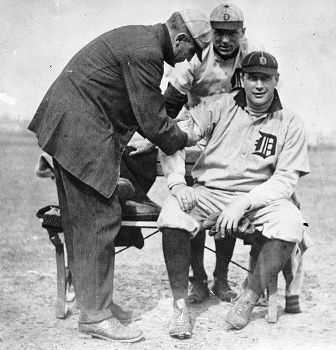
Al Summers has his arm worked on by Tiger trainer Harry Tuthill, first baseman Del Gainer looks on.

Al Summers has his arm worked on by Tiger trainer Harry Tuthill, first baseman Del Gainer looks on.

There’s no record that the wager was ever decided.

Clark Griffith

Clark Griffith

“In the ‘90s Nobody ever Thought Anything of telling the Manager to go Chase Himself”

6 Nov

Bill Lange played only seven seasons in the National League—all with Chicago–but his reputation lived on long after he walked away from the game in 1899 at 28 years-old.  Two of his biggest supporters, Connie Mack and Clark Griffith, remained influential until their deaths in the mid 1950s, and both helped to keep Lange’s legend alive until his death in 1950.

Long after his retirement to enter the insurance and real estate business in his native San Francisco, Lange remained extremely popular in Chicago;  he was frequently quoted by Chicago sportswriters (most often his friend Hugh Fullerton), and was even retained The Chicago Examiner’s  “World Series expert” in the early and mid teens.

Bill Lange

Bill Lange

In 1909, when the White Sox were training in San Francisco, Lange told a reporter for The Chicago Inter Ocean that “the batsmen of the present time had not advanced in any way” over the hitters of his day—and Lange felt they took too many pitches:

“I have noticed that the habit nowadays is to be altogether too scientific.  And that science is ruining the batters.  There used to be such things as .400 hitters in the big leagues and now the managers are spending fortunes in the hopes of finding a .250 hitter.  The reason they are so hard to find is because the batsmen don’t follow their natural inclinations to wallop the ball, but stall around at the plate in the artificial hope of drawing a pass instead of breaking a board in the back fence.

“No batter, who has any eye at all, ought ever to wait when he has three balls and one strike on him, unless the pitcher is uncommonly wild.  Think of the advantage of hitting when three balls have been called.  You are dead sure that the next one will be over the plate if the pitcher can get it there.  If he doesn’t, let it go and take your base.  But if you let a good one go then you are up against another proposition.

“Then the batsman is in a worse hole than the pitcher and his chances of making a safe hit are at least 4 to 1 against him, for a nervy pitcher will take a chance on a curve or a high one in the hope of making the batsman bite.  He wouldn’t dare do that very often when the count was only three and one.  The batsman who waits too long is just giving himself the worst of the deal.”

Unlike many players of his generation, Lange did note that some aspects of the game had improved since he played:

“We didn’t hustle like the players of the today do.  We would shirk morning practice all the time, so we could sleep late.  And take it from me, a lot of us needed the sleep, for most all of the boys belonged to the Ancient Order of Owls.

“The teams of today report at the grounds at 9:30 in the morning and work to beat the band for two hours. In the old days, after we had stalled the manager off as long as possible, we would finally show up for morning practice.  I don’t know all the systems the players on other teams had for dodging morning work, but with the old Chicago bunch we left it up to (Bill) Dahlen to break up the practice after about ten minutes of hustling.

“Dahlen could turn the trick might easily.  All he had to do was whiz four or five low throws at Anson’s shins.  ‘Pop’ used to bawl Dahlen out for a few minutes, but Bill would keep up the bum throwing until Anse would say ‘Enough.’  Nothing like that goes in the big or small leagues now.  It is a question of work and buckle down to business.  In the ‘90s nobody ever thought anything of telling the manager to go chase himself.  I haven’t heard of anybody doing anything like that in late years, and getting away with it.”

Bill Dahlen

Bill Dahlen

Lange on pitching, tomorrow.

“He Used to Knock Down Infielders”

4 Nov

William Alexander “Bill” Lange is best known for a play that likely never happened.  The legend was that he had made a spectacular catch that culminated with the Chicago Colts’ outfielder crashing through the left-field fence in Washington in an 1897 game with the Senators.  It is most likely another in a long line of exaggerations and apocryphal stories from Lange’s friend, Chicago sportswriter Hugh Fullerton—a story that first appeared in that paper with no byline in 1903, but was repeated by Fullerton many times in later years.   A nice analysis of that story appears here.

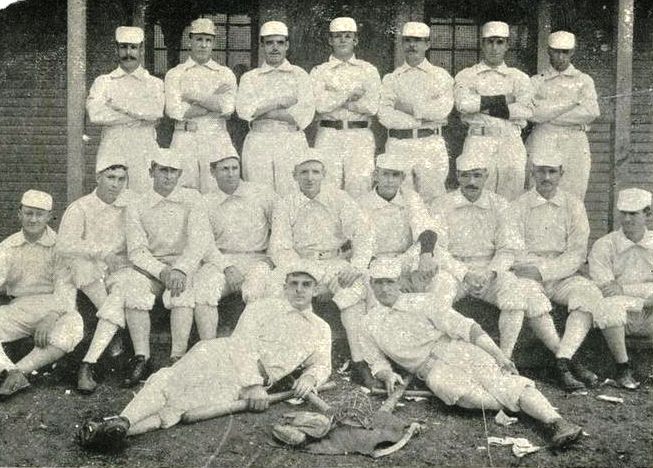
Bill Lang, seated fourth from left, with 1896 Chicago Colts

Bill Lang, seated fourth from left, with 1896 Chicago Colts

Lange played just seven seasons, retiring after the 1899 season at age 28 to join his father-in-law in the insurance and real estate business in San Francisco.

During the spring of 1900, The Chicago Daily News said “The wise ones in the baseball business” were certain he’d be back, including Chicago’s manager Tom Loftus and President James Hart, and Charlie Comiskey, “’When the season opens and the sun warms up he can’t stay away,’ remarks Comiskey, with a knowing wink.”

Despite the certainty that he would, Lange never returned.

Lange, who stole 400 career bases, was called “Little Eva” because of his gracefulness.  In 1909 Billy Sunday called him “the greatest outfielder in baseball history.”  Connie Mack called him the best base-runner he ever saw.  In fact,  Mack and Clark Griffith considered Lange so good that they petitioned the Hall of Fame in 1940 to change the “rules (which) restrict membership to players of the twentieth century” in order to allow for Lange’s induction.

Griffith said Lange was “the best outfielder that ever played behind me:”

“Lange here was rougher base-stealer than (Billy) Hamilton.  He used to knock down infielders.  Once I saw him hit a grounder to third base.  He should have been out, but he knocked down the first baseman.

“Then he knocked down the second and third baseman and scored.  Connie Mack was the catcher.  No he didn’t knock Connie down because he didn’t have to.”

Mack told the same story over the years.

Lange never made the Hall of Fame.  He died in 1950.

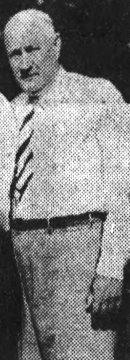
Bill Lange 1931

Bill Lange 1931

In his final years the story about the “catch” had become so ingrained in the legend of Bill Lange that other players told essentially the same story Fullerton did (the most widely disseminated versions appeared in “The American Magazine” in 1909 and in Johnny Evers‘ book “Touching Second,” coauthored by Fullerton), but inserted themselves into the story.  In 1946 Griffith told reporters:

“It happened right here in Washington, I was pitching for Chicago.  Bill missed the train from New York, and arrived in the fourth inning.  We were then with the Chicago Colts and Cap Anson fined Lange $100 before he put him in the game.

“I had a one-run lead when Al (“Kip”) Selbach of Washington hit a terrific drive.  Lange ran back hard, and when he crashed into the wooden fence his 210 pounds took him right through the planks.

“He caught the ball at the same time and held it.  All we could see were his feet sticking through the fence and Bill’s arm holding the ball.  When he came back to the bench, he handed the ball to Anson and said:

‘This ought to cancel that $100 fine.’ It did too.”

When Lange died Griffith said:

“I have seen all the other great outfielders—Speaker, Cobb, DiMaggio –in action and I consider Bill Lange the equal of, if not better than, all outfielders of all time.  There wasn’t anything he couldn’t do.”

“Calvo May Come Out But No One Cares”

5 Jun

Jacinto Calvo and San Francisco Seals owner Charlie Graham were unable to come to terms on a contract for 1918, and the local press quickly turned on the outfielder.

The San Francisco Chronicle said:

“(Calvo) is a simple-minded Cuban boy…When he is hitting he can go around the bases in nothing flat.  When he has a batting slump, he develops water on the knee and can hardly limp up to the plate.”

He remained in Cuba and served as a police officer in Havana.

It was rumored again in 1919 that Calvo might return to the Seals, but The Chronicle, under the headline “Calvo May Come Out But No One Cares,” made it clear that twelve months had not softened opinions about the holdout outfielder:

“Calvo has written friends that he wants to come back, but if he stays in that dear old Havana until Charlie Graham coaxes him back, he will grow whiskers a foot long.  Graham really tried to get Calvo last year, for he was in a bad way for lack of outfielders, but if there is any coaxing to be done this year, Calvo will do it.”

Calvo

Calvo

Terms were not reached for 1919, and Calvo remained in Havana for another year.

In February of 1920 The Chronicle said Calvo, “Who bobs up every year about this time,” had written Graham saying he wanted to return to the Seals, then in March the paper reported that “The Havana World” said that Calvo “has joined the Franklin, PA independent team together with (Manuel) Cueto.”

Neither report proved true; instead, Calvo was signed by Clark Griffith for a second tour of duty with the Washington Senators.  In 17 games he had only one hit, a triple, in 23 at-bats before being sent to the Little Rock Travelers in the Southern Association in July.

Calvo could not hit American League pitching, but no one questioned his throwing arm; except teammate Stanley “Bucky” Harris.  The future Hall of Famer wrote in 1925, in a series of articles he wrote for The North American Newspaper Alliance, that his doubts about Calvo’s arm almost cost him his career:

“I thought I could hurl a baseball farther than anyone on the club and entered into a contest with Jack Calvo, an outfielder.  The Cuban has a reputation for having a great arm.  I had won a long-distance throwing contest…while with the Buffalo club.  That convinced me I could hold my own.”

Despite being warned against taking on Calvo by teammate Clyde Milan, Harris went ahead with the contest, the two stood in the infield:

“(Calvo) cut loose.  He threw the ball over the right field bleacher wall.  I realized it was a truly wonderful peg.”

Harris said he was concerned about being caught by manager Clark Griffith and rushed his throw:

“My elbow cracked as the ball left my hand.  It sounded to me as if a board had been broken across a fence…The ball dropped yards inside the park.”

Harris said for three weeks he “wondered if I ever would be able to throw a ball again.”  By the time Harris returned to the lineup, Calvo was on his way to Little Rock where he hit .306.

From 1921 through 1926 Calvo spent his summers playing baseball in the states; most notably in Fort Worth, where he helped lead the Texas league Panthers to two Dixie Series victories over the Southern Association champions in 1923 and ’24.  His winters were spent working as a lieutenant in Havana’s Harbor police and playing baseball in the Cuban League.

Calvo’s career ended abruptly in September of 1926.  The San Antonio Light reported that the former Fort Worth outfielder, then with the Memphis Chickasaws in the Southern Association “must forego baseball…and return to his job, his leave of absence was about to expire, and he packed up and beat it for a boat.”

Calvo played briefly in Cuba that winter but never played professionally again.  He was elected to the Cuban Baseball Hall of Fame in 1948 and died in Miami in 1965.