Tag Archives: Detroit Tigers

“I am, I Believe, more Inclined to fear the Jinx”

12 Apr

In 1910, Johnny Evers “wrote” an article in “Baseball Magazine” about superstitions:

“’On the Cubs’ team, for instance, I am, I believe, more inclined to fear the jinx than any other member of the club.  In batting practice before the game the general belief is that if you are not hitting the ball hard or up in the air you will bat well in the game ofttimes as a result. In many cases I have seen a player hit two or three balls hard and on the line and then go to the bench and refuse to bat anymore, saying, ‘I’m saving mine for the game.’”

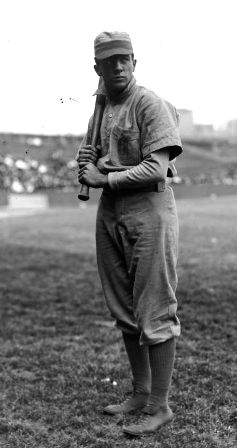
Johnny Evers

Johnny Evers

Some of Evers’ other superstitions:

“Going to the different parks in the cars the sight of a funeral along the road is regarded as an ill omen.  The same applies to a (handicapped person) unless you toss him a coin.  A wagon load of barrels is a good sing.  Frequently a man, having gone a mile out of the way to purchase something on a day when his club happened to win, will continue to travel the roundabout pathway so long as the club is in that particular city or until his teammates lose.”

As for superstitions during a game:

“Watch a man when the inning is over.  If the inning previous was favorable to a player, observe him go over and be particular to locate the same spot to lay down his glove.  You doubtless have often seen a player attired in a soiled and far from presentable uniform.  Beneath all that lurks our old friend the jinx.  The player will stick to the dirty garments so long as his team is winning.  When the streak is broken the laundryman gets a chance at his clothing, but not before.”

[…]

“Not for the world could you induce the average major league pitcher to resume work with a new shoe lace.  He will tie up the remnants and go ahead, hoping to make the laces last throughout the session.  The players don’t want the bat boys to hand them their clubs either.  On our home grounds of course, Red Gallagher, the bat boy, has a sort of standing job swinging the sticks, but he always tries hard to drive away the hoodoo.  Watch him salivate the handle of every bat before it goes in the hands of its owner.”

In addition to bat boy spit, Evers said there were other superstitions among the Cubs:

“Keep your eyes glued on Tinker when he goes to bat.  Joe has a habit of walking straight from the bench to the plate to the plate for the first time up.  If he gets a clean hit that time he’ll repeat in the second trip, but if he fans or fouls out or is tossed o death on an infield drive Tinker certainly will waltz out in a circle, going back to the plate.  This is the way he hopes to break the hoodoo.”

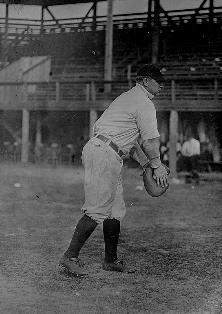
Joe Tinker

Joe Tinker

[…]

“Recall how Manager (Frank) Chance refused to have the Cubs pose for a team picture during the closing days of the League race in 1908.  He was especially fearful that the photographer might work a jinx on the players and jeopardize our chances of beating Detroit.    (Ed) Reulbach is a mighty superstitious chap.  I remember how one of Ed’s friends approached him when the big pitcher was mowing them down for his record of fourteen straight victories (In 1909 Reulbach tied the record set in 1904 by Joe McGinnity and Jack Chesbro). He wanted Reulbach’s cap, the one he had worn during all those games, but Ed refused to part with the headgear.

Yes, the ballplayer is to be listed only with the actor or the sailor when it comes to the superstitious phase of life.”

“Why not bring one of the Big League Teams to Phoenix for Spring Training?”

18 Feb

Grover Cleveland Land was a visionary.

In 1921 The Arizona Republican asked the question the former catcher had put to several major league clubs:

“Why not bring one of the big league teams to Phoenix for spring training?”

Land, a Kentucky native who spent the last 40 years of his life as a Phoenix resident,  was encouraged by a report that Connie Mack had announced that his Philadelphia Athletics would no longer train in Lake Charles, Louisiana;  according to The Associated Press Mack said “certain things happened at the Louisiana resort last March that handicapped” the team.

Grover Land

Grover Land

Land, the former catcher for the Cleveland Naps and the Brooklyn Tip-Tops, said:

“I have played ball in every section of the country, and I have yet to find a climate more suited for baseball training than I find right here in Phoenix…Major league managers have been sending their players to Texas and other southern states for many years and I can safely state that there is not one manager entirely satisfied with the present training camp sites.  Fully one-third of the training period is hampered by rain and storms and by the time the training season is ended the players are just beginning to round into shape.”

He said he understood that “local boosters” had made some effort to bring teams to Arizona in the past—the Chicago White Sox, Cubs, and Pittsburgh Pirates had played spring exhibition games in the state several times since 1909—but Land said he would “make an effort to induce one of my manager friends to come down here…I am certain that if one of the managers could be induced to come here for a few weeks Phoenix would have no difficulty getting on the sport pages.”

He said the local chamber of commerce was getting behind the push, and that he had “already written to one of the major league managers and I have been corresponding with several sports writers in the east,’ to make the case for Phoenix.

“If the local fans get behind the move and convince Connie Mack that they want his team here next spring I have every confidence that the Philadelphia Athletics will do their 1922 training in Phoenix.”

Land was a bit overconfident in regard to Philadelphia; Mack chose to take the Athletics to Eagle Pass, Texas in the spring of 1922.

No team would train in Arizona until 1929—the Detroit Tigers came to the state for one season—but chose California the following year.

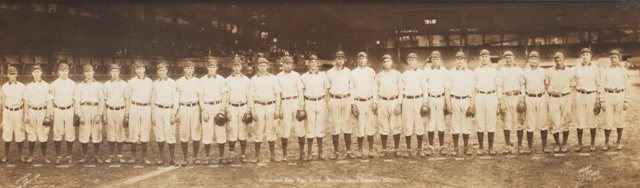
The Detroit Tigers in Arizona, 1929

The Detroit Tigers in Arizona, 1929

But Land, who died in 1958, lived long enough to see his adopted home become the spring training location for four clubs.

Nick Maddox

9 Feb

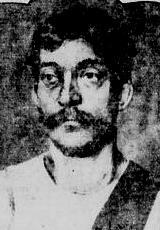
Nicholas “Nick” Maddox burst on the National League scene in 1907. Born in Maryland on November 9, 1886, Maddox’ was born Nicholas Duffy, but adopted his stepfather’s name Maddox.

In 1906 the 19-year-old was given a trial in the spring with the providence Grays in the Eastern league.  He was released before the season began and signed with the Cumberland Rooters in the Pennsylvania-Ohio-Maryland League (POM).  Maddox had played in 1905 for the Piedmont team in the semi-pro Cumberland and Georges Creek League.

He was the best pitcher in the POM; The Sporting Life said Maddox was 22-3 for the Rooters who finished the season in fourth place with a 50-45 record, and was “the fastest pitcher in the league.”
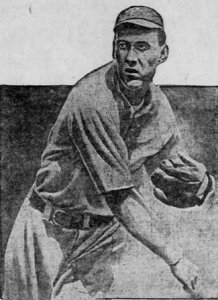
Nick Maddox

Nick Maddox

Maddox spent most of 1907 with the Wheeling Stogies of the Central League.  He posted a 13-10 record and no-hit the Terre Haute Hottentots on August 22.  Maddox was purchased by the Pirates the following month and made his big league debut on against the St. Louis Cardinals.

The Cumberland Times noted that he faced a “double-jointed hoodoo of commencing his National League career on Friday, September the 13th.”

The Pittsburgh Press said:

“Nick was ‘on the job’ yesterday from start to finish, and acted more like a man with many years’ major league experience than like a minor leaguer who has been in the business but a few seasons.”

Maddox shut the Cardinals out on just five hits, struck out 11 and got his first hit, a single in his first at bat.

Eight days later Maddox threw the first no-hitter in Pirates’ history, beating the Brooklyn Superbas 2 to 1—Brooklyn scored on two fourth-inning errors.   Years later, Maddox said of his own throwing error that put Emil Batch on base:

 “They scored me with an error, but hell man, I threw it straight to the first baseman (Harry) Swacina.  Sure it went over his head but he should have jumped for it.”

Batch scored on an error by shortstop Honus Wagner.  Maddox said:

“I don’t hold that against Honus, he saved my no-hitter in the ninth.  A ball was hit right over my head and ‘pfft’ Wagner was over there to get it.  I don’t think he ever held the ball, he just swooped it over to first.”

The rookie started six games Pittsburgh, won his first four, and finished with a 5-1 record with a 0.83 ERA.

The Pittsburgh Leader said Pirates’ President Barney Dreyfuss claimed Maddox would be “the sensation” of 1908.  He wasn’t far off.

The 21-year-old was an impressive 23-8 with a 2.28 ERA with five shutouts.  Despite his success there was concern about control—he walked 90 batters while striking out just 70 in 260 innings, and hit 11 batters.

After three second and one third-place finish the four previous seasons, Pittsburgh, and Maddox, came into 1909 with high expectations.  The Pittsburgh Press said:

“Nick Maddox is facing a very successful summer, and with an even break and barring accidents he ought to push any other twirler in the National League for first honors.  He has everything a pitcher needs, and youth with it.”

The Press also said he would “start out with good control” based on his performance in March games in Hot Springs, Arkansas.

The Pirates lived up to expectations, taking over first place on May 5 and cruising to the pennant; Maddox did not.

The 22-year-old struggled for the first half of the season.  The Leader said he was having “a hard time getting into condition,” and was wild as a March Hare.”  Maddox got on track in July pitching a 2-hit shout against the Cincinnati Reds on the 6th, and four-hit shutouts against the Brooklyn Superbas and Boston Doves on the 14th and 23rd.

He ended the season 13-8 with a 2.21 ERA—overshadowed by teammates Howie Camnitz (25-6), Vic Willis (22-11), Albert “Lefty” Leifield (19-8) and rookie Charles “Babe” Adams (13-3 as a reliever and spot starter).
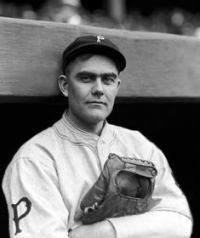
Babe Adams

Babe Adams

Despite going into the World Series against the Detroit Tigers with such a strong pitching staff, Manager Fred Clarke opted for the rookie Adams in game one and he responded with a 4 to 1 victory.

The Tigers beat Camnitz 7 to 2 in game 2.

Three years later, Fred Clarke spoke to James Jerpe of The Pittsburgh Gazette-Times about his decision on a pitcher for game three:

“I was in an awful predicament.  Adams had been used up.  It was had been raining, and it was very cold.  The chilly drizzle was something frightful.  The ball would get wet and water-logged and the problem was to get a pitcher who could handle the wet ball.  I looked the gang over.  Adams was out of the question.  He had been used up.

“I was figuring on the others, and I asked ‘Who can go out there today and handle a wet ball and win?’  Poor Maddox, sitting in a corner of the bench all bundled up with sweaters and other stuff, shed his extra clothes and jumped up.  Grabbing a ball, he said: ‘Gimme a catcher till I warm up.  I’ll handle this wet ball and beat them or break a leg.’  His confidence gave me a hunch, and I acted on it.”

Ring Lardner said of the game:

“Detroit’s record crowd, 18,277, saw the Tigers beaten by the Pirates 8 to 6, today in one of the most exciting and most poorly played world’s series games in baseball history.”

The Pirates scored five runs in the first inning off Detroit’s Ed Summers, and Maddox shut the Tigers down for the first six innings.  Detroit scored four runs in the seventh, aided by two Pirate errors.  Clarke said:

“Maddox wouldn’t have been in so much trouble if we had played ball behind him.”

The Pirates took a 8 to 4 lead into the ninth–Detroit scored two more runs, helped by another error—but Maddox held on and picked up the win.

He did not appear in another game during the series.  The Pirates won in seven; with Adams picking up complete game wins in games five and seven.
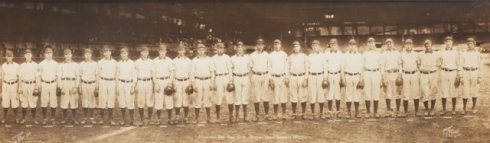
09pirates

1909 World Series Champion Pirates, Maddox is ninth from left.


The defending champions got off to a quick start again, but Maddox again started slow.  By July, The Leader said:

“Nick Maddox should have rounded into form..He is big and strong this year, but does not seem able to pitch good ball for nine rounds.”

He never “rounded into form.”  Maddox struggled all season.  He started just seven games, pitched in relief in 13 others, and was 2-3 with 3.40 ERA.

By August, with the Pirates in second place, six games behind the Chicago Cubs, The Pittsburgh Gazette asked “what was the matter?” with Maddox and why the Pirates had not cut him loose.

He made his last appearance on September 12, giving up a run, a hit and walking two batters in two innings of relief during a 4-0 loss to the Reds.  He was sold to the Kansas City Blues in the American Association 10 days later.

Maddox won 22 games for the Blues the following season, but continued to be plagued by wildness and arm trouble.  His major league career was over, and he was finished professionally in July of 1914 at 27-years-old when he was released as manager and pitcher for the Wichita club in the Western League after posting a 3-13 record.

Fred Clarke was convinced Maddox’ career really came to an end on that rainy day in Detroit.  James Jerpe of The Pittsburgh Gazette-Times said that in 1910 Dreyfuss asked Clarke to release Maddox long before he sold the pitcher to Kansas City:

“’Why don’t you let Maddox go? You aren’t pitching him.’

“’No,’ replied the Pirate Chief sadly.  “I’m not pitching him.  He ruined his arm helping Adams win the world’s series.’

“And Fred narrated (to Dreyfuss) more of Nick’s gameness on that bleak and drizzly October day in Detroit when he gave his arm for a championship.  Nick was carried for a whole year and the club has been interested in his welfare ever since.”
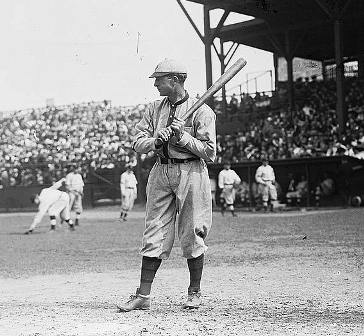
Fred Clarke

Fred Clarke

Maddox, who lived in Pittsburgh, and worked for the Fort Pitt Brewing Company, after his retirement, lived long enough to listen on the radio to the last two innings of the next no-hitter thrown by a Pirate pitcher—Cliff Chambers defeated the Boston Braves 3-0 on May 6, 1951.

Nick Maddox died in 1954 at age 68.

McGraw’s “Rubber”

2 Jan

In 1903 and ’04 the Boston Beaneaters finished sixth, and seventh, while the New York Giants followed a second place finish in 1903 by winning the pennant in ’04.

Jacob Charles “Jake” Morse of The Boston Herald said he it wasn’t just talent that made the Giants more successful:

“It is astonishing that so little attention is paid to the care of baseball players during the training season and the playing campaign, especially the former.  It is in the spring that arms need the most careful cultivation and a first-class expert is almost indispensable.

“A first-class ‘rubber’ ought to be taken by every club that goes South, and if this were done sore arms and muscles would be reduced to a minimum.

“Here in Boston neither club has what is called a trainer or a ‘rubber.’ The New York National League club has had the services of the well-known ‘rubber’ Gus Guerrero, for several seasons, and he has given satisfaction.”

Before coming to the Giants as the team “Rubber,” Guerrero had made a name for himself as a competitive walker and runner.  The San Francisco Call said of him:

“Back in the late (eighteen) seventies Guerrero was the one best bet when it came to a foot race, whether for one or for 500 miles, six-day match, or even if the proposition called for a jaunt from the Pacific to the Atlantic coast.  Anything went with Guerrero; he ran for 48 hours, making 300 miles flat in that time, and once in 1884 he trundled a wheelbarrow from San Francisco to New York City.”

Gus Guerrero

Gus Guerrero

Guerrero, often billed as “The Mexican,” and “The best athlete Mexico ever produced,” was actually born in Northern California.  He became an athletic trainer in New York in the 1890s and began working for the Giants in 1900.

John McGraw inherited Guerrero when he came to New York in 1902, and swore by his “Rubber.”

The Associated Press said, in 1904 when McGraw, trying to rehabilitate his injured knee, took Guerrero on the spring training trip south:

“Last year (McGraw) depended on local massage men to rub and bandage the bad knee, but they did not understand the job.  Guerrero, a professional, has been spending several hours per day solely on McGraw’s weak muscles and has succeeded in hardening them so that the joint is fairly protected and does not spring at a critical moment.”

The New York Press said of Guerrero:

“(He) wears a baseball shirt labeled ‘New York’ all the time.  McGraw says he believes Gus sleeps in it. As the men come in he looks them over, particularly the pitchers.  If a box man complains of a stiff arm the trainer attends to it as carefully as a physician looks after the throat of an operatic prima donna.  He makes the player strip, steams him, puts him on a slab, massages him, and then rubs in a liniment of his own concoction which he declares would take the stiffness out of a telephone pole.  It is equal parts of witch hazel and alcohol to a quart; with half a teaspoon of oil of wintergreen and a dash of something else that Guerrero says is his secret.”

While McGraw seemed impressed with Guerrero, it appears some of his players were not.

When the team was training in Birmingham, Alabama during the spring of 1904, The New York Globe’s Allen Sangree, who was traveling with the Giants, wrote about an exchange between Guerrero and Christy Mathewson:

“Mathewson, in particular, was feeling grouchy yesterday.  ‘How’s your arm?’ asked Gus Guerrero, the rubber, as he put the finishing touches on him…’Arm alright,’ said Matty, ‘but I don’t feel good.’

“’Well, what’s the matter?’ pursued the rubber.

“’Nothing, didn’t I tell you!’ yelled the big fellow, in exasperated tones.  ‘Just nothing, only I don’t feel good; and don’t bother me either.’”

Just after Jake Morse wrote about the advantage McGraw’s “Rubber” had given the Giants, it was announced that he would no longer be the team’s trainer.

The New York Herald said:

“Gus and the players could not get along well, so he resigned.”

McGraw, who remained “a strong believer in massage treatment for pitcher’s arms before and after the game,” and replaced Guerrero with Harry Tuthill—Tuthill had trained several fighters, including William “Young Corbett II” Rothwell, and “Mysterious” Billy Smith.   Tuthill was with New York until 1908 when he joined the Detroit Tigers.

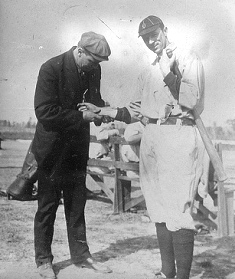
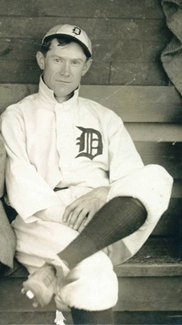
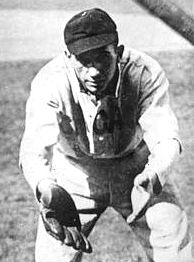
Harry Tuthill, with Tigers pitcher Del Gainer

Harry Tuthill, with Tigers pitcher Del Gainer

Guerrero never worked for another major league club. He continued to participate in races, and eventually returned to California where he died in 1914.

Lost Advertisements–Jimmy Austin for Farmers and Merchants Bank

7 Nov

austin


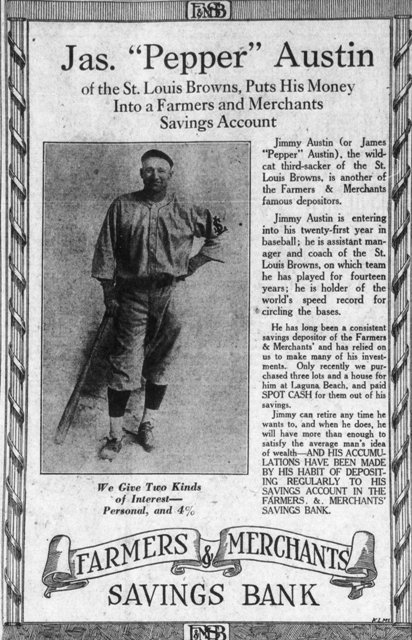
A 1924 advertisement for Southern California-based Farmers & Merchants Bank featuring Jimmy Austin:

Jimmy Austin (or James “Pepper” Austin), the wild-cat third-sacker of the St. Louis Browns, is another of Farmers & Merchants famous depositors.

Jimmy Austin is entering into his twenty-first year in baseball; he is assistant manager and coach of the St. Louis Browns, on which team he has played for fourteen years; he is holder of the world’s speed record for circling the bases.

He has long been a consistent savings depositor of the Farmers & Merchants’ and has relied on us to make many of his investments.  Only recently we purchased three lots and a house for him at Laguna Beach and paid Spot Cash for them out of his savings.

Jimmy can retire anytime he wants to, and when he does, he will have more than enough to satisfy the average man’s idea of wealth–And his accumulations have been made by his habit of depositing regularly to his savings account in the Farmers  Merchants Bank

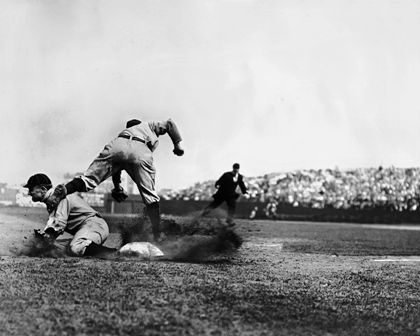
Austin is probably best known for being the third baseman in the famous 1909 Charles Conlon photograph of Ty Cobb sliding.

Conlon's 1909 photograph

Conlon’s 1909 photograph

In 1930 Conlon–then a proofreader for The New York Telegram–told  the story of how he came to capture what the paper called “the greatest baseball action picture ever taken.”

“Cobb was running wild on the bases that year, and the Tigers were fighting for a pennant.  I used to spend a lot of time down near third base chatting with Jimmy Austin who was a good friend of mine.

“Ty had worked his way down to second that day and the batter was trying to bunt.  As the pitcher’s arm went back to throw the ball Cobb sped for third.  Austin backed into the bag for the throw and Cobb hurled himself into the dirt, spikes flying.

“My first thought was that my friend Austin was going to be cut down by the Georgian.  I stood there motionless with my box in my hand.  I saw a blur of arms and legs through a screen of flying dirt It was a bright day and I could see Cobb’s lips grimly parted and the sun glinting off his clenched teeth.

“Austin never got his hands on the catcher’s throw.  He was knocked over.  He wasn’t hurt, however, and I was relieved because we were pretty good friends.

“Then I began to wonder if by any chance I had snapped the play.  I couldn’t remember, but I decided to change plates anyway.  It was lucky that I did, because when I printed up my stuff that night, there was the whole thing, as plain as day.”


Jim Delahanty’s Idea

10 Oct

Before the 1911 season, Hugh Fullerton, in The Chicago Examiner, told the story about Jim Delahanty’s plan to improve his hitting.  The Detroit Tigers second baseman was having a conversation with teammates:

Jim Delahanty

Jim Delahanty

“’I think,’ said Delahanty, ‘that if someone would kick me between the eyes real hard, I’d lead the league in hitting.’

“’What’s the angle of that remark?’ Asked Sam Crawford.

“’If I were you,’ said Davy Jones, ‘I’d hire a mule to kick me three of four times, and maybe I’d hit 1000 per cent.

“’I’ll tell you what I mean,’ said Del.  ‘When I went to the Atlantic League I was just a fair hitter—fair, bordering on rotten.  If I hit .225 I felt pretty good, and if I fell below that I wasn’t much surprised.

‘”Well, I had been going along fairly well for a few weeks, when one day I started stealing second.  I intended at first to slide behind the bag, but the baseman changed position, and I tried to switch and slide in front.’

“’The result was I slid awkwardly, and as he touched me out and blocked me his knee hit me bang between the eyes.  I saw forty million stars, and got up dizzy and feeling funny.’

“’Everything seemed changed, and I seemed to be looking through a veil all the time.  Everything on mu right side looked uphill and everything on the left downhill.  For about ten days I was the worst hitter in the world, not excepting Jack Pfiester.  It worried me.’

Jack Pfiester

Jack Pfiester

“’I think in three weeks I got two base hits, and what seemed funny to me was that I made both these hits off curve balls that fooled me.  The fact is my eyes had been banged out of gear and I was swinging about four inches below where the ball really was, and the only times I hit it was when it fooled me.’

“I was all upset and ready to quit when one day I drew a base on balls and tried to steal.  The shortstop was coming to cover the bag, and as I slid his knee caught me right between the eyes and knocked me cold.

“’When I batted the next time I saw the ball perfectly, or thought I did, and up I went into the .250 class.  A year later I got another crack between the eyes—and immediately improved still further in hitting.  Now I’m waiting for the kick that will put me in the .350 class.’

“Crawford was silent for some time.  Then he said:

‘”Say, did (Napoleon) Lajoie ever mention being hit between the eyes with a pile driver?’”

A .283 lifetime hitter, Delahanty had his best season at the plate in 1911, with career bests in nearly every offensive category, including average (.339) and RBI (94).

There is no record of him having received the desired blow to the head before the season began.

“Stories of his Badness are told all over the League”

8 Oct

After “Bad Bill” Eagan finished the 1898 season with the Syracuse Stars –he hit just .227, his lowest recorded minor league season average—then returned to his native Camden, NJ–Eagan started his amateur baseball career in Camden as a pitcher, his catcher was another Camden native, William “Kid” Gleason.

Bad Bill Eagan

Bad Bill Eagan

The Harrisburg Telegraph—Eagan had spent two seasons playing in the Pennsylvania city—told the story:

“Bill Eagan the once great second baseman of the Harrisburg Club, in a fair example of what rum will do when it gets the upper hand of a man.  Eagan would have been one of the leading players of the profession if he had left strong drink alone.  He was a sure fielder, hard batter and quick baserunner and ought to be in his prime as a player by this time, but he has drained too many mugs and now winds up in a police court at his home in Camden, NJ, on a charge of attempted murder.

“Eagan was intoxicated yesterday and displaying a 48-caliber revolver, placed it to his temple and remarked: ‘I am going to kill my wife and blow my brains out.’ He paid Barber Riceman fifty cents which he owed him, and also paid a nearby saloon keeper $1 for drinks that he had bought.  Then he returned to the barber shop, said good-bye to his friends, and exclaiming; “Now I am free from debt and am ready to do the job,’ he started for his home and put the threat into execution.

When he arrived home Eagan fired two shots at—and missed–his wife, and then attempted to shoot one of the responding police officers, but because of “a quick blow from (another police officer’s) club the murderous weapon was knocked from the crazed man’s hand.”

The Chicago Tribune said:

“William Eagan, or, as he is known in the baseball profession, ‘Bad Bill’ Eagan, is a player of national reputation.  He is an ignorant man, and stories of his badness are told all over the league.  He was considered one of the best ball players in the profession.”

The Tribune said about Eagan’s brief stay with Pittsburgh earlier in 1898:

“He failed to behave himself, and drunkenness was the charge which let him out as a Pirate.”

Eagan was held in the Camden jail from October of 1898 until March of 1899; it is unclear what he was formally charged with, and he was never tried.

In spite of his reputation, baseball wasn’t done with “Bad Bill” yet.  Shortly after his release from jail, Syracuse sold Eagan’s contract to the Western League’s Detroit Tigers.  His statistics for the season don’t survive, but Eagan seems to have gone back to his old habits.  After he sat out both games of a double-header with the Kansas City Blues in July, The Kansas City Journal said:

“’Bad Bill’ Eagan acquired a jag yesterday and succeeded in making a holy show of himself.  Such creatures and ‘Bad Bill’ should be out of the game.”

Eagan was also seriously injured the same month when, according to The Associated Press, during a game with the Columbus Buckeyes, while trying to stretch a double into a triple:

“Eagan threw himself, feet foremost toward the bag.  His spike caught in the base sack and his right leg was given a terrible wrench.  ‘Bad Bill’ screamed with pain and in an instant was surrounded by members of both teams… (He) had thrown out his kneecap.  (A doctor) pushed the cap back and then the injured player was carried to the bench.”

Whether the injury contributed or not is unknown, but by August The Sporting Life reported that he had again worn out his welcome:

“Bad Bill” Eagan has worn a Detroit uniform for the last time. Eagan has not behaved at all and (George) Stallings has got through for good and all with him.”

George Stallings

George Stallings

One more team was willing to take a chance on Eagan; he was signed for 1900 by the Youngstown Little Giants in the Interstate League.  After appearing in just 26 games The Sporting Life reported that:

“Eagan has been playing ball in Youngstown, OH, but he said he needed a rest.  He came to Detroit for that purpose Saturday morning, and he paid $5 in the police court this morning for the first installment. “Bad Bill” said he was so glad to get back and he met so many friends that he rather lost track of the proceedings. He had fallen Into a Rip Van Winkle sleep when the policeman picked him up. “Bad Bill” paid his fine and went out for the “rest.” Bill doesn’t think much of Youngstown, he says. “

The Youngstown Vindicator said Eagan was released by the Little Giants before he left for Detroit

In either case, he had finally run out of chances, and never played another professional game.

The Indianapolis News said, in late August of 1900, that Eagan was:

 “(P)icked up on the streets of Detroit) insane.  He was removed to the emergency hospital, where he became violent and it took a number of men to overpower him and take him to the station and confine him in a padded cell.  Drink caused Eagan’s downfall. Sober he was a hard working ambitious ball player; if a drink or two were given to him he became a dangerous maniac.”

He was released after several days, and the the many premature rumors of his death began at that point, while Eagan continued to tend bar in Detroit. In April of 1904 w he became ill and was sent to a tuberculosis sanitarium in Denver.  Ten months later “Bad Bill” was dead at age 35.

Despite having played just six games with Chicago in 1893 Eagan made such an William A. Phelon that more than 20 years later he wrote in “Baseball Magazine:”

 “Although the poor fellow had few chances given him in the big league, I always thought there never yet was a second baseman who mixed and mingled in the furtherance of infield plays like Bad Bill Eagan. Possibly I can best symbolize Eagan’s style of second-basing, for the present generation, by stating that he played second just about as (Fred) Tenney played first. (Eddie) Collins doesn’t go so far from second as Eagan did, nor does he carry out nearly so many plays—but it’s quite likely he could if he had to—if he didn’t have, through the past few years, the marvelous (Jack) Barry cutting in and taking his half of the proceedings.

Eagan, though, was almost uncanny at times. I saw him working with (Cap) Anson on first and (Bill) Dahlen at short. It might be taken for granted that Eagan would have to move round considerably on the side toward first, with the ponderous and fast-aging Anson on station one, but Dahlen was then in the flush of his youth and a moving streak at short—when he wanted to be. Yet I saw Eagan bewildering Dahlen as well as Anson by the phantom-like rapidity of his movements, and the way in which he suddenly appeared at the spot where the play should be kept going, arriving on the ground before Dahlen could even draw back his arm to throw.”

“Then the Harder I threw the Harder they hit them”

3 Oct

Walter Newton Justis–often misspelled “Justus” during his career– performed an incredible feat in 1908.  While posting a 25-17 record for the Lancaster Links in the Ohio State League, he pitched four no-hit games between July 19 and September 13.

Walter Justis

Walter Justis

The performance earned him his second shot to make the big leagues.  The first consisted of two relief appearances (8.10 ERA in 3.1 innings) with the Detroit Tigers in 1905 when he was 21.  He said later that he wasn’t ready:

“All I knew was to burn them over.  And the harder they hit them the harder I threw.  Then the Harder I threw the harder they hit them.  Most of the time in the three months that I was there I lugged the big bat bag, and I guess I earned my salary then about as much as at any time I know of.”

Justis’ bizarre behavior often made as big an impression as his pitching.  Roy Castleton was pitching for the Youngstown Ohio Works in 1906 when Justis joined Lancaster (the team was in the Ohio-Pennsylvania League in 1906 and ’07, and joined the Ohio State League in 1908).

Castleton, while playing for the Atlanta Crackers two years later told The Atlanta Constitution  he thought “Rube Waddell and Bugs Raymond, two players well-known for their eccentricities…will have to take off their top pieces,” to Justis.  Castleton was staying in the same hotel as the Lancaster team:

“Early one morning he heard someone raising a disturbance in the hotel hallway and taking a look to see what was doing, he observed pitcher Justis…running down the hallway.

“’At the end of the hall Justice placed a pillow against the wall.  He would get a good start down the hall and after the fashion of a man on the paths would take a running slide at the pillow.  When he arrived at his destination he would hold out his hand as umpires do and yell ‘safe!’  Justis would keep this up for hours at a time playing base runner and umpire out in the hall at daybreak.’

“’Sometimes he would stop the double existence of umps and runner and would (just) be the judge of the play.  Standing over the pillow he would hold out his hand and yell ‘safe’ so loudly that he could be heard a block off.’”

The Constitution also said that Justis was superstitious:

“He never goes into a game without wearing a pair of ladies’ silk hose supported in the usual manner.  Regular baseball stockings would never do for him, as he believes his career as a pitcher would be cut short if he were to wear them in a game.”

He was signed by the St. Louis Browns, and Manager Jimmy McAleer told The St. Louis Globe-Democrat the pitcher’s eccentricities were a positive:

“McAleer says that the reason he signed pitcher Justis of Lancaster was because Justis bears the reputation of being a baseball ‘bug.’  ‘Bugs,’ says McAleer, ‘make good in St. Louis.  We have Waddell, while the Cardinals have ‘Bugs’ Raymond.’”

Justis joined the Browns in Dallas in the spring of 1909.

The Globe-Democrat said after he had a poor outing in an exhibition against the Houston Buffaloes of the Texas League:

“Justis pitched two innings for the Browns Saturday and the Houston team got six runs.  Until this bombardment he was tagged for the regular club, and the label hasn’t been removed yet, though slightly loosened.”

And Justis appeared to have made the team when they broke camp in Texas and returned to St, Louis in early April, but The Associated Press reported on April 6:

“Walter Justus, a pitcher recruit of the St. Louis Browns, is confined to his room by a severe nervous collapse, and the nurse in charge says he may be able to leave for his home in Indiana in a few days.  Justis lost his power of speech at the end of a wrestling bout with Arthur Griggs in Sportsman’s Park today.  It is claimed Justus fell to the floor, striking his head, and reopened an old wound received when a boy.”

Justis suffered similar attacks at least four other times during his career; in June of 1907, twice in 1908, and August of 1909.  In July, 1908 after a double-header with the Lima Cigarmakers, The Marion (Ohio) Daily Mirror said “(Justis) suffered a sudden brain stroke akin to apoplexy.  He fell in a dead faint at the close of the second contest.  He was removed to his hotel in an unconscious condition.”   In September, after another attack left Justis hospitalized, The Sporting Life said prematurely “physicians say he will never twirl another game.”   It is likely that he suffered from epilepsy.

Within days of returning to Indiana from St. Louis Justis fully recovered.  The Associated Press said “His recovery is one of the most remarkable in the history of athletes.”  But, despite his recovery, Justis was returned to Lancaster by the Browns, and lost his opportunity to return to a major league team.

He threw another no-hitter for Lancaster in 1909, on May 18 against the Marion Diggers, and went 19-16 for the season.  Justis continued pitching until 1913, finishing with the Covington Blue Sox in the Federal League—where he played with the equally eccentric, enigmatic Fred “Humpy” Badel.

Justis shut out the St. Louis Terriers 4 to 0 on the opening day of the Federal League season, but no complete records remain for the season.  By late September of 1913 he was back home in Greendale, Indiana pitching for a local team.  He remained in Greendale until his death in 1941.

“It’s Strange how these Stars of Balldom have such Beliefs”

27 Aug

Throughout his career as an American League umpire, Billy Evans, who had covered baseball for The Youngstown Vindicator continued to write syndicated newspaper articles.  He was fascinated by the superstitions that controlled the actions of so many players.

Billy Evans

Billy Evans

He followed a 1907 article about the subject, with more stories the following year:

“Of all professions, that of baseball player is the most superstitious…Of course, there are many superstitions in common, yet most of the players have pet ideas of their own on which they place much reliance.  The data of origin of many of the superstitions is a deep, dark mystery.”

Evans said:

“There is certainly nothing out of the ordinary to be seen in a load of hay, yet most players welcome the sight of one during the playing season.  In the dictionary of baseball a load of hay signifies two hits that afternoon for the discoverer, and history tells us there is nothing dearer to a player’s heart than base hits…While its supposed strange magic often fails, still the players retain faith in it.  On the other hand, the sight of a load of empty barrels is always dreaded, for some it means a shutout, to others merely defeat.”

Of one popular superstition of the time, Evans said there was “no greater believer in shaking up the bats when a rally is on” than Cleveland Naps pitcher Charles “Heinie” Berger:

“Ordinarily a team keeps its bats lined up in front of the bench in a fairly tidy manner.  According to Heinie’s code that is all well and good when everything is moving along smoothly, but when a rally appears to be in the air, the proper way to encourage it, according to Berger, is to scatter the bats in every direction.”

Heinie Berger

Heinie Berger

Evans told the story of the Naps’ August 21, 1908, game, although some of the details regarding the scoring wrong, he got most of the facts correct:

“One day last summer during an important game at Philadelphia, the Athletics got away with a seven-run lead in the first two innings.  When they added another in the third, it certainly looked as if things were all off so far as Cleveland was concerned.  Until the seventh inning the Naps bench was not unlike a funeral.  Two runs in the seventh stirred up a little hope, and caused Heinie to heave a few big sticks in different directions.  His actions caused Umpire Jack Sheridan (Sheridan and Evans both worked the game, Sheridan was behind the plate) was to offer a mild rebuke and incidentally warn Heinie that he wanted nothing but silence during the rest of the afternoon.”

Cleveland scored two runs the following inning, and had the tying run on base:

“Heinie proceeded to scatter the two dozen or more bats in all directions.  That was too much for the veteran Sheridan, and after he had made Berger replace all the bats back in a straight line, he tied a can on the Teuton and chased him from the lot.

“Berger viewed the remainder of the game from the bleachers, failing to carry out completely the edict of the umpire.  When the Naps scored the two men on the sacks and tied up the game he was happy.  Heinie was confident that the bat superstition had aided in the victory that he was sure would result, now that the score was tied.  When the Athletics scored a run in the eighth that proved to be the winner his confidence in the theory was not shaken in the least. He blamed the defeat on Sheridan, claiming that as soon as the umpire ejected him from the game the spell was broken.”

Evans also wrote about his favorite superstitious player, “Wild Bill” Donovan, pitcher for the Detroit Tigers.  Evans had previously mentioned Donovan’s fear of throwing a shutout during his first start of each season, and his actions in one game in particular, but now gave a more detailed account:

“It all seems rather foolish, yet I have worked back of Donovan on two such occasions and have every reason to believe that Bill makes it possible for his opponents to score.  In one of the games Detroit had the affair clinched 8 to 0 in the eighth.  With one down and a man on second Charley Hickman stepped to the plate.  A straight fast one is the most delicious kind of dessert for Charley, although he likes almost any old thing in the shape of curves and slants.

“There is no more strategic pitcher in the league than Donovan, yet he started off the reel to hand them up to Hick’s liking.  After fouling off three, Hick met a fast one on the nose and was blowing hard at third by the time the ball was relayed back to the infield.  He scored a moment later, but Detroit too the game easily, 8 to 2.  Bill had escaped the much despised shutout.  By the way that year was the most successful of Donovan’s career, and, of course, merely served to strengthen his belief.”

Bill Donovan

Bill Donovan

Again, Evans got nearly all the details correct—except the final score was 9 to 2.  The May 24, 1907, game was Donovan’s first start of his best season in baseball (25-4, 2.19 ERA for the American League Pennant winners), and he did lose a shutout to Washington in the eighth inning on a Hickman triple.

Evans said a superstition often attributed to Cy Young, was not a superstition at all:

“The veteran Cy Young, the grand old man of them all, is one of the few players who doesn’t take much stock in omens of good or bad luck.  Cy, however, has one big hobby.  He always prefers to pitch on dark days…The dark day idea is no superstition with Cy.  No one except the batters perhaps realizes how hard it is to hit his fast ball when the light is dim.  It is really a pleasure for him to work out of turn on such days, for he knows what a big handicap he has over his opponents.”

Evans said another Hall of Fame pitcher had a bizarre habit, that while perhaps not a superstition, bears mentioning:

Jack Chesbro, the famous spitter, is always of the opinion that someone is slipping a doctored ball over on him, and quite often asks for a new one when the cover doesn’t taste just right.”

The umpire concluded:

“It’s strange how these stars of balldom have such beliefs and stick to them, but they do.  The ball player lives in a world of his own, more than any other profession with the possible exception of the actors.”

“It is Feared that the Cares of his Office are making an old man out of Tim”

18 Aug

Timothy Carroll “Tim” Hurst had an eventful season in 1906.

He had been an umpire since 1891—with the exception of one awful season managing the St. Louis Browns to a 39-111 last place finish in 1898.  In 1904 Hurst retired from the National League, but months later joined the umpire staff of the Central League, and took a job in the American League in 1905.

Tim Hurst

Tim Hurst

The Kansas City Journal described the 5’ 5” umpire who was also a boxing referee::

“Hurst is a pudgy little fellow, below medium height, with sandy hair, twinkling blue eyes and a ruddy complexion.”

He was often called “pugnacious” for his on field, and off, altercations, and once told a reporter for The New York Herald how he dealt with argumentative catchers:

“Never put a catcher out of the game.  If the man back of the bat is sassy and objects to your calling of balls and strikes, keep close behind him while doing your work and kick him every time he reaches out a catch a ball.  After about the third kick he’ll shut up.”

The incident that earned him the most attention in 1906 happened during a May 7 game in New York between the Highlanders and the Washington Nationals.   The New York Times said during the fifth inning:

(Frank) LaPorte was declared out at first base on a close decision.  Manager (Clark) Griffith rushed over to the base line, and, throwing his cap in the air, protested against the decision.  He wildly gesticulated, and Hurst ordered him away.  Griffith, instead of following Hurst’s instructions, stepped up to the latter, protesting all the time.  In his excitement he stepped upon Hurst’s foot.”

Hurst “drew back” to punch Griffith but was held back by players from both teams.

“Hurst then took hold of the lapel of Griffith’s coat and started to lead the player-manager to the bench.  The latter angrily resented this action and pushed Hurst’s hand away.  Lave Cross and the Washingtons tried to pacify Griffith, and succeeded in getting him to the players’ bench.”

Hurst followed Griffith to the New York bench and again attempted to punch the manager, while Griffith “rushed at the umpire.”

Clark Griffith

Clark Griffith

According to The Associated Press Griffith claimed “’Hurst didn’t hit me.’ Then pointing to his swollen mouth he added, ‘I had this swollen lip before the game.’”

Hurst and Griffith were both suspended for five games.

The following year Henry Pierrepoint Edwards of The Cleveland Plain Dealer said Hurst had given him an explanation to “clear up the mystery” of why he reacted so violently:

“Now, it isn’t customary for Tim to wear baseball shoes on the diamond.  Usually Tim appears for the fray clad in the same suit he would wear at a pink tea.  His real uniform is just a cap.

“On the afternoon in question Tim purchased a new pair of patent leather shoes.  The shoes glistened in the sun like a diamond and gave Tim great pleasure.  Griffith forgot all about the shoes and in his rage over losing a close decision spiked and spoiled the new kicks.  Great was Tim’s rage.  Even greater was the clash.  That’s all.”

Two months after the incident with Griffith, Hurst made what might have been the worst call of his career.

On July 7 in Washington, he was working the game between the Nationals and the Detroit Tigers.  The score was tied 3 to 3 in the seventh inning, the Tigers had the bases loaded with two out and Sam “Wahoo” Crawford at the plate, facing Nationals pitcher Frank KitsonThe Washington Post said:

“’Wahoo’ lifted one a thousand miles directly over the pan.  Kitson came tearing in,  (Catcher Howard) Wakefield hesitated.  Manager (Jake) Stahl stood still at first base.  The pellet whirled in the air and finally dropped just inside the line and bounded back to the stands.  (Charley) O’Leary and (John) Eubank romped home.  Crawford went to second, carrying the funniest two-base hit on record.  Kitson and Wakefield stood admiring each other until Hurst again yelled ‘Fair ball!’ when the boy catcher went after the bulb.”

Sam Crawford

Sam Crawford

While the Nationals argued the call, and Hurst refused to reverse his decision, The Post said “The spectators were forced to listen to the dillydallying for fully fifteen minutes, then many of them got up and left the belligerents wrangling over the decision.”

Kitson threw a wild pitch to the next batter, Matty McIntyre scoring Herman “Germany” Schaefer and Crawford.  The Tigers went on to win 9 to 3.  Jake Stahl filed a protest with American league President Ban Johnson.

The Washington Evening Star said:

“The only excuse that Umpire Hurst can have is that the play was an unusual one.  Lave Cross admitting that he never saw its like in his experience on the diamond.  Hurst was palpably rattled, and the Tigers when taking their places on the field chaffed the locals with the remark that ‘Tim certainly handed us one that time.’”

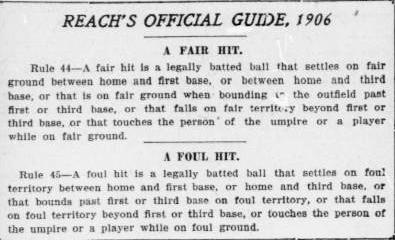
The Washington Times said it was “one of the most remarkable plays ever seen on a diamond,“ and printed for their readers rule number’s 44 and 45 from the 1906 “Reach Guide” Reach describing “A Fair Hit,” and “A Foul Hit.”

The Washington Times used "The Reach Guide" to illustrate how Hurst blew the call.

The Washington Times used “The Reach Guide” to illustrate how Hurst blew the call.

The Times said:

“(T)here seemed no possible way of calling it fair, but Hurst was obdurate, and the only explanation he would give was that the ball ‘was hit too high.”  What the heighth of the hit had to do with the fact that it eventually bounded foul is still another mystery.”

Hurst’s story evolved over the next several days.  The Post said his original explanation regarding the ball’s height was “to the effect that the ball was it so high it ‘settled’ inside, constituting the hit a fair one. “  This was quickly replaced by Hurst’s claim that the ball had touched Wakefield, the Washington catcher, before bounding into foul territory.

The Times’ baseball reporter Thomas Stevens Rice said of Hurst’s new story:

“This explanation is all right if it presents the facts in the case.  In the press box there was not a single man who thought the ball was touched by Wakefield or anybody else.”

The Post conceded that the protest would be rejected, saying “It is almost certain that Ban Johnson will sustain his scrappy umpire, no matter what interpretation he puts on the rules,” but the paper did not let up on Hurst.

The following week when Sam Crawford brought his average up to .300, The Post said:

“Hurst last week decided that Crawford’s high rap which hit inside the base line and bounded back to the stands was fair…am would have faced the pitcher 271 times and got away with 81 hits which would have made his average .299, as it was Sam got and extra hit which brought the total to .303.  He owes Tim a hat.”

Hurst was still young, just forty-one in 1906, but The Sporting Life said something had changed during that year, and by the end of the season that the umpire lacked the “Aggressiveness and enthusiasm” he had previously exhibited:

“It is feared that the cares of his office are making an old man out of Tim, who once was noted for having the finest brand of keen-cutting, kill-at-a-thousand-yards sarcasm of any umpire in captivity.  Sit Timothy is very tame, and the players, even the bush leaguers who have just broken in, can tell him what they think of him and his calling.”

Hurst’s old “aggressiveness” came out in 1909.  He was suspended in May for a fight with Norman “Kid” Elberfeld of the Highlanders, then on August 3 during a game between the Athletics and White Sox.  The Brooklyn Eagle said:

“At Philadelphia Tim Hurst came in for considerable trouble.  Hurst called Eddie Collins out at second and the Columbia youngster put up a kick.

“Whether it was with malice aforethought or quite an accident, it is a fact that the umpire distributed a mouthful of moistened union-made tobacco in the direction of the youthful Eddie, who immediately called Tim’s attention to the board of health ordinance which prohibited expectorating in public places.”

After the game Hurst had to be escorted from the field by Philadelphia police.  Ban Johnson suspended Hurst, beginning two weeks of rumor and speculation about the umpire’s fate.  Finally, on August 18 it was announced that Hurst had been let go by the American League.

Hurst, in poor health since 1912, died in 1915.  Hugh Fullerton of The Chicago Examiner said of his passing at age 49:

“The saddest part of it is that ‘Timothy’ did not die in the blue uniform, and that during the last few years of his life he was practically blacklisted in baseball for refusing to answer or deny charges made against him for his actions during a clash with Eddie Collins…President Johnson declared that if Hurst even had replied to his telegrams of inquiry he would have kept him—but Tim, knowing he had done wrong, refused, and went out of the game.”