Tag Archives: Grantland Rice

Kid Nichols

25 Jun

Add Hall of Famer Charles “Kid” Nichols to the list of those who were convinced that players from an earlier era were of better quality than those “of today,” even if the earlier era was less than a decade before.
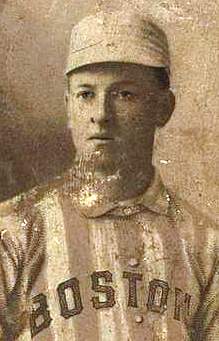
Kid Nichols

Kid Nichols

While pitching for the Kansas City Blue Stockings in the Western League in 1903, the 33-year-old pitcher told a group which included a reporter for The Associated Press:

“I am not so sure that the ball players of today are much superior to those of ten years ago in general utility.  It seems to me there was more life and spirit in the games of a decade ago than in those of the present regime.  They weren’t so mercenary in those days and there was much more sportsmanlike spirit.  Nowadays the paramount question with the average player is salary.  He doesn’t care so much about the record of the team he plays with makes as opportunities offered him to make himself individually famous and thus increase the value of his services.  In many clubs teamwork is lacking on account of the intense desire of some of the men to make an impressive showing by individual work.  In the old days one didn’t hear so much of the individual as the playing of the team as a whole an in my opinion baseball would stand on much firmer foundation if the same spirit prevailed nowadays.”

Among the best:

“Take old (Tommy) McCarthy for instance.  As an outfielder none of them had him beaten, and in my opinion there is not an outfielder his equal now.  It was McCarthy who originated the trap ball which he worked so effectively.

“He was absolutely the headiest man in the outfield I ever saw.  You have seen outfielders throw men out at first on line drives, but you haven’t seen it done often.  I’ve seen McCarthy spoil many a legitimate one-base hit by that same play.  Another favorite play of his was this:  A man would be on first and second.  The man at bat would drive to left.  McCarthy would snap it up on a short bound and flip it to second as quick as a flash in time to catch the man who had run off first.  In turn the second baseman would throw the ball to third in time to head off the man who had started from second.  Thus a really legitimate one-base hit was turned into a double play.

“But, speaking of outfielders, Willie Keeler was about as good as any of them for all around ability.  He was like lightning on his feet and was no slouch at hitting.  He certainly did things to me one day in Baltimore.  He faced me four times and this is what he did:  Made four hits to four different parts of the field off of four different kinds of curves.  Keeler was the hardest man to fool I ever pitched to.”

Nichols said Herman “Germany” Long, his teammate for 12 years was:

“(O)ne of the greatest shortstops in the business.  He played with Boston while I was a Beaneater, and of course I had good opportunities to watch him work.  He could cover a world of territory and was a sure and accurate fielder.  You hear many people say that Hughie Jennings in his palmy days was the best infielder ever developed.  In my opinion Long could cover a foot more territory than Jennings.

“When it comes to catchers my preference is, and always has been, Charlie Bennett, whose legs were cut off in a railroad accident at Wellsville, Kansas.  Charlie was always consistent and knew what his brain was given to him for.  He was also an accurate, quick thrower…Martin Bergen was another good catcher.  He was the one who went crazy, you know, and murdered his wife and children.  Bergen always was ‘a little bit off of the top,’ but when he took a notion to do his best, his playing was beyond criticism.  Ed McFarland and (Billy) Sullivan are two right good men, and then there was reliable old Jim McGuire and Charles Zimmer, both of whom were cracker jack.”
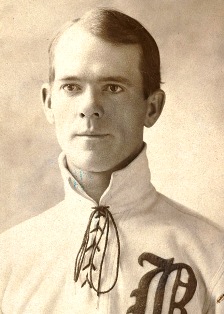
bergen

Martin “Marty” Bergen–” always was ‘a little bit off of the top,’

Nichols said as a pitcher “I can hardly be considered a competent judge” of fellow “slabsters,” but continued:

“Personally, I admire the old war-horse, Cy Young, more than any of the others.  He is certainly a remarkable man.  Of the left-handers there a few better than (Frank “Noodles”) Hahn, of Cincinnati; (Christy) Mathewson and (Joe) McGinnity are undoubtedly valuable men.  Clark Griffith is, I think, the headiest pitcher that ever stepped on a rubber.  Among the other great ones are Jack Taylor, Joe Corbett, (Bill) Bernhard, of Cleveland and our own Jake Weimer.

Nichols was largely forgotten as one of baseball’s great pitchers by the time the Baseball Hall of Fame’s inaugural class was selected in 1936.  In the late 1940s, a push for his inclusion was led by sportswriter Grantland Rice.  Rice frequently mentioned the pitcher in his columns and in the summer of 1948 quoted two Hall of Famers regarding Nichols’ prowess:

“A few decades ago I asked Christy Mathewson to name the best pitcher he ever faced.  ‘That’s easy,’ Matty answered.  ‘His name is Charles Kid Nichols of Boston.  Nichols isn’t a good pitcher.  He is a great one.’

“I recalled this talk when the mail brought a letter from Ty Cobb at Menlo Park, California.

“‘I think everyone has overlooked one of the greatest pitchers of all time,’ Cobb Writes.  ‘His name is Kid Nichols.  Here are just a few of his records from 1890 to 1906:

“1.  Won three consecutive games on three consecutive days, all pitched in different cities.

“2.  Won 20 or more games for 10 consecutive years.  He won 360 and lost 202. (Nichols’ record was 361-208)

“3.  Won 28 or more games for eight consecutive seasons.  (Nichols won more than 28 games seven times, and not consecutively).”

Despite the inaccuracies in the letter, Cobb and Rice continued to campaign for Nichols and the push to honor him worked.  He was elected to the Hall of Fame in 1949.

Nichols, right, with Pie Traynor, left, and Branch Rickey at the Hall of Fame in 1949. Traynor was elected in 1948, but his plaque was not presented until 1949
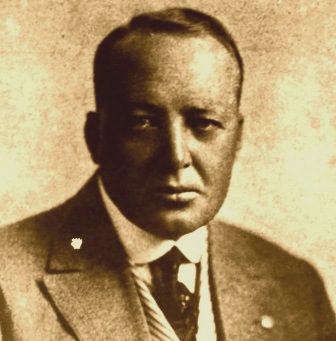
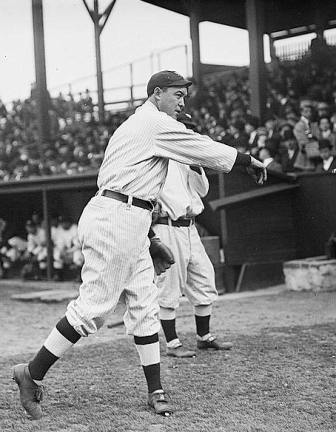
Nichols, right, with Pie Traynor, left, and Branch Rickey at the Hall of Fame in 1949. Traynor was elected in 1948, but his plaque was not presented until 1949
Bugs Versus Rube

9 Jun

Charles Emmett Van Loan is largely forgotten today, but from 1904 until his death in 1919 at age 42, he was considered one of the best, and most prolific, baseball writers in the country.

Grantland Rice said:

“Van Loan was not only a great story-teller.  He was the first writer of his time to see the romance and the glamour of the game, mingled with its amazing fund of humor.”

In addition to his newspaper work, which included stints in New York, Los Angeles, San Francisco and Denver, Van Loan wrote some of the most popular fictional baseball stories of his era—he published four collections of baseball stories, as well as anthologies of  boxing, horse racing and golf stories.

Hugh Fullerton said of his death:

“Van is dead and sports in America have lost their greatest interpreter, and fighters, ball players and athletes of all grades have lost their best friend.”

Charles Emmett Van Loan

Charles Emmett Van Loan

As sports editor for The New York American in 1910 Van Loan weighed in on the two most interesting pitchers of the day:

“In the race for distinction as the most erratic, eccentric and daffy pitcher of the big leagues “Bugs” Raymond is leading by an elbow over our old friend, G. Edward Waddell, known to fame and a portion of Missouri as the ‘Rube.’

“The battle between G. Edward and the ‘Bug’ has been a close one.  For many moons Waddell held the belt for eccentricity.  If he had not been a wonderful baseball player, he would have been chucked to the minors years ago, but pitchers like Waddell are so rare that they must be preserved to the game.

Bugs Raymond

Bugs

“We all remember the sorrows of Oscar Hammerstein and the many tribulations forced upon him by his singers, particularly the women.  A woman with a wonderful voice can get away with anything short of murder in the first degree by blaming it upon her artistic temperament—which is an ornamental means for plain unadorned meanness, selfishness or petty spite.  If a soprano got jealous of another woman and tore up her contract, refused to sing her roles and played smash generally, she could blame it upon her artistic temperament, and all was forgiven.  What a shame the ‘Rube’ never heard about that artistic temperament thing!  It would have been such a handy alibi for him.

“Waddell stuck in the limelight by virtue of his ability to throw a ball like a streak of lightning and throw it twice or three times in the same place…In between his marvelous performances the ‘rube’ established himself as a bartender, a side-show barker, an actor, a sidewalk comedian, a rough and tumble battler and a very competent vessel for mixed liquors.  He enjoyed the proud eminence of supreme bug of the major leagues and everything was lovely until ‘Bugs’ Raymond happened along.  ‘Bugs’ went the ‘Rube’ one better.  Waddell in his balmiest days never had a special keeper engaged, by the management to take him gently but firmly by the elbow and steer him away from temptation.

Rube

Rube

“You never heard of a chorus girl with an overdose of the artistic temperament.  A chorus girl who develops tantrums is fired immediately.  You never heard of an eccentric ballplayer who was not a good one, a bad player would be sent  back to herd the cows and coax the potatoes out of the ground with a hoe.

“’Rube’ and ‘Bugs’ are good players.  Raymond almost drove (John) McGraw to despair last season, for the chubby manager realized what an excellent pitcher ‘Bugs’ really was and tried to save him for the hard finish of the season.  McGraw even went so far as to try physical persuasion upon his big, but erratic southpaw, upon the ground that a swift wallop on the nose is sometimes better than a ream of argument.

“McGraw tried to keep money out of Raymond’s hands, figuring that if he never had a cent he would be forced to keep his nose dry.  No use.  ‘Bugs’ had too many friends.  His admirers were always ready to purchase even if ‘Bugs’ had to look up in the air when it came his turn to deliver orders to the gent in the apron.

“’Turn him loose on a desert isle’ said one of the players, referring to Raymond, ‘and inside of an hour he will turn up with a flask on his hip.  How he does that I don’t know.  I guess he just charms that liquor.

“Unfortunately George Edward must retire from the competition.  Boston is his hoodoo town,  By reason of matrimonial troubles ‘Rube’ was forced to cut Boston off the pitching list, and just as the clouds cleared away, bing! On the elbow with a red hot liner, and out goes the ‘Rube’ with a broken bone.

“At the end of last season nobody believed that McGraw would make another effort to reform the thirsty Raymond.  It was thought that in spite of the fact that ‘Bugs’ won 600 percent of his games, he would get the gate, but McGraw decided to try it again on the ground that a pitcher of Raymond’s class is worth saving at any cost.  McGraw is willing to gamble.  Should he fail to straighten out the big spitballist everybody will say:  ‘I told you there wasn’t any use.’  On the other hand, should the private keeper keep ‘Bugs’ away from the disturbance water and his pitching be up to his usual standard, everyone will say that McGraw showed excellent judgment in hanging on to his souse paw through thick and thin.

“An erratic pitcher is a hard strain on a team.  The men behind him never know when he is going to blow up and they are kept on a strain whenever the eccentric one works.

“When ‘Bugs’ goes into the box in good condition, his head clear and his muscles hardened by work, he pitches good enough baseball for any man’s club.  His keeper has been steering him away from the gin mills for some time—touch wood everybody—and at last accounts McGraw was hopeful that the problem had been solved.

“They say the ever loving ‘Rube’ is consumed with jealousy because ‘Bugs’ has a keeper.  A man with a broken wing doesn’t really need a keeper.”

McGraw was unable “to straighten out the big spitballist,” Raymond’s big league career was over by June of 1911, and he was dead just more than a year after that.  Waddell’s major league days were over within weeks of Van Loan’s observations, and he was dead less than four years later.

Lost Advertisements–Ready! Lajoie Baseball Guide

25 Oct

lajoieguide

Above is a 1906 advertisement for an Atlanta hardware store offering the inaugural edition of “Napoleon Lajoie‘s Baseball Guide.”  The Lajoie Guide was intended to compete with the well established Spalding and Reach Guides, and sold for 10 cents, but despite Lajoie’s popularity the guide failed to catch on and was only published for three years.

In addition to the standard recap of professional baseball leagues across the country, and many photos, the Lajoie guide included a significant amount of information specific to its name sake.  An advertisement for the Cincinnati-based Queen City Tobacco Company said:

Lajoie Chews Red Devil Tobacco

Ask him if he don’t

reddevil

Grantland Rice wrote for the guide, and the first edition included a Rice-penned poem called “For Lajoie’s in Town:”

We’ve gazed on Mr. Roosevelt,

Who rules this whole wide land.

We’ve looked at Carrie Nation, 

And shook Jim Corbett’s hand

We’ve eaten bread with Robert Fitz

And chummed with George Tebeau.

We’ve drank out beer with Mr. Schlitz.

Great notable we know.

We’ve interviewed Friend Morgan,

Thrown talk at old John D.

We’ve opened wine with Sullivan

And seen Prince Hennery.

King Edward is a bosom pal,

Langtry our school-day girl.

Dick Croker smiles in our face,

We’ll give Boss Fame a whirl

*     *     *     *     *     *     *     *

Around the shrine of heroes

There’s little we’ve not seen.

We’ve talked to all, both great and small,

Of high and lowly mien.

But this group pales beneath the looks

Of one of far renown.

Hats off!The greatest comes today,

For Lajoie’s in town.

T. Roosevelt’s backed off the boards,

A plater is king Ed.

Langtry a chorus lady now,

The others are all dead.

For Lajoie, pride of several leagues!

Lajoie, the mighty man!

Lajoie, his bat and fielding glove

Knocks out the wholes blamed clan.

The 1906 Lajoie Guide

The 1906 Lajoie Guide

Butcher Boy Schmidt

25 Jul

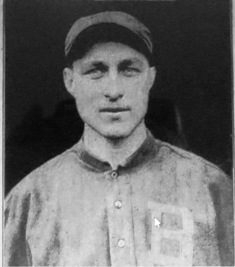
Charles John “Butch” “Butcher Boy” Schmidt was credited by Connie Mack with being the catalyst for the Boston Braves World Series upset of Mack’s Philadelphia Athletics in 1914; one year later Schmidt walked away from baseball in his prime.

Butch Schmidt

Butch Schmidt

He was born in Baltimore in 1886, and played amateur ball while working in the family meat market, which earned him his nickname.

Schmidt signed as a pitcher with the Baltimore Orioles  in the Eastern League and assigned to the Holyoke Papermakers in the Connecticut State League, where he posted a 10-9 record.  In late August the Orioles recalled him, and he went 5-1 in 11 games with Baltimore.

The New York Highlanders drafted Schmidt and the 22-year-old pitcher started the 1909 season in New York.  He appeared in only one game, on May 11, giving up 10 hits and eight runs, four earned, in five innings.  Early in June he was returned to the Orioles.

After appearing in eight games on the mound with the Orioles, Schmidt was moved to first base.  After hitting .244 for the remainder of ’09, he hit .292, .291, and .274 the next three seasons, and was sold to the Rochester Hustlers in the International League, where he hit .321; he was purchased by the Boston Braves on August 22, and hit .308 in 22 games playing in place of Ralph “Hap” Myers.

At the end of the 1913 season Boston sold Myers’ contract to Rochester; The Boston Post reported that Braves manager George Stallings simply didn’t like Myers.  (Myers had a different theory for his release—that story next week)

Schmidt was installed as the Braves first baseman in 1914, and as Boston made their improbable run to the National league pennant Schmidt   hit .285 with 71 RBI and .990 fielding percentage, and finished 16th in the voting for the Chalmers Award, for the most valuable player in the National League; teammates Johnny Evers and Rabbit Maranville finished first and second in the voting.

Grantland Rice said in The New York Tribune:

“There are few greater first basemen in baseball and none who is steadier or a better fighter.  For Schmidt is also of the aggressive type and a hustler every second.”

The New York Times didn’t think quite as highly of Schmidt and on the eve of the World Series said the “advantage favors the Athletics” at first base:

(John “Stuffy”) McInnis makes exceptionally brilliant plays…has been through Worlds Series fire and proved just as cool as if he were playing an exhibition game in the springtime.  Schmidt has yet to face the strain and tension of the big baseball classic…While Schmidt is not a scientific batsman, he is a free swinger and hits the ball hard, but he doesn’t hit it often.”

The pressure of the series didn’t seem to bother Schmidt, the Braves first baseman hit .294 with five hits, two runs and two RBIs in the four game sweep of the Athletics; McInnis hit just .143.

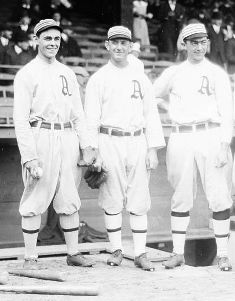
In game one he made a play in the first inning that Connie Mack said set the tone for the series and “sparked the Braves.”  With runners on first and second with one out, Athletics third baseman Frank “Home Run” Baker hit a foul pop-up into short right field.  Athletics outfielder Eddie Murphy tagged up and attempted to go to third; The Associated Press said Schmidt made a “great throw…from a difficult angle,” to third baseman Charlie Deal to retire Murphy.

Stuffy McInnis, Eddie Murphy and "Home Run" Baker,

Stuffy McInnis, Eddie Murphy and “Home Run” Baker,

Early in the 1915 season Braves manager George Stallings called Schmidt “The best first baseman in the game,” but his performance at the plate slipped.  Schmidt hit just .251 with 60 RBIs.  The Braves again found themselves in 8th place in July, and while they made another strong run, finished 2nd, seven games behind the Philadelphia Phillies.

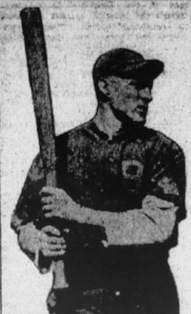
Despite the mediocre season at the plate, it was assumed the 28-year-old Schmidt would remain the Braves first baseman.  Schmidt shocked Stallings, Boston fans, and all of baseball when he announced in January of 1916 that he was retiring from baseball.

Butch Schmidt at bat

Butch Schmidt at bat

The Associated Press said Schmidt was leaving “to devote his entire time to his private business.”

Grantland Rice said Schmidt’s business included “six meat markets in Baltimore,” and that he earned $8000 a year from his stores.

The Sporting Life said it was just as likely that Schmidt, listed at 200 pounds, retired because:

Hard work in that old rubber shirt to get down to weight, especially when the extra weight comes off slowly, more slowly each succeeding season, is a trial that anyone would like to sidestep if he could. “

Boston manager George Stallings filled the void left by Schmidt by purchasing Ed Konetchy from the Pittsburgh Rebels from the newly defunct Federal League.

The Boston Post said the change at first base would not hurt the Braves:

“Konetchy, a heavier hitter than Schmidt, is just about as capable in other ways.”

Despite the confidence of The Post, Stallings was not convinced and continued to try to induce Schmidt to return; his efforts were unsuccessful.

After Konetchy hit .260 for the third place Braves in 1916 it was reported that Schmidt would return to the team.  After several weeks of speculation, Schmidt told The Boston Globe “no offer” could induce him to return to Boston.

Konetchy hit .272 and .236 the next two seasons, and each off season it was rumored Schmidt would return, and every year he stayed home where he continued to run his business and play semi-pro ball in Baltimore’s Inter-City League.

Before the 1919 season Konetchy was traded to the Brooklyn Robins and the Braves acquired Walter Holke from the Cincinnati Reds.  Holke hit .292 for the Braves in 1919, but rumors continued that Schmidt, out of organized baseball for four years, would be returning to Boston.  The Associated Press said:

“George Stallings of the Boston Braves is trying to get Charlie “Butch” Schmidt, the Baltimore butcher boy who played first base for the world’s champions of 1914, to return to the Boston Braves.  Schmidt is reported to be in wonderful condition as he has kept in practice since his retirement.”

Schmidt never returned to professional ball, and was finally removed from Boston’s reserve list in 1922.

Butch Schmidt walked away from professional baseball and never looked back; he died in 1952 of a heart attack while inspecting cattle at the Baltimore Union Stock Yards.

A Thousand Words–Lost Advertisements, Christy Mathewson

24 Jan

mattyad

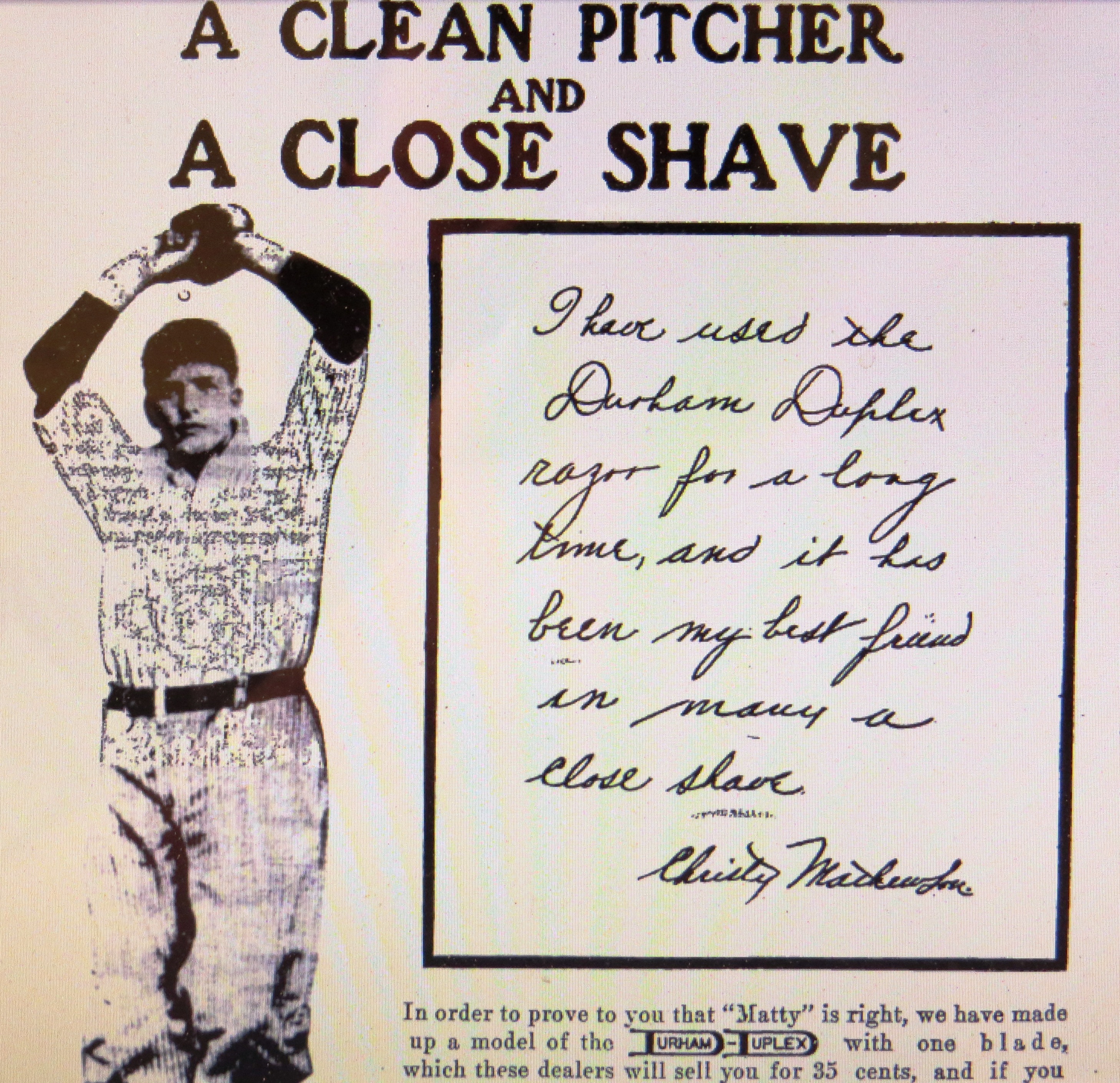
“A Clean Pitcher and a Close Shave.”  Hall of Fame pitcher Christy Mathewson for the Durham Duplex razor.  “Big Six” says:

“I have used the Durham Duplex Razor for a long time, and it has been my best friend in many a close shave.”

Mathewson won 372 games for The New York Giants and one for the Cincinnati Reds from 1900-1916, including four 30-win seasons, and was a member of the first Hall of Fame induction class.

“Christy Mathewson brought something to baseball no one else had ever given the game. He handed the game a certain touch of class, an indefinable lift in culture, brains, and personality.’”
— Grantland Rice

“Bugs” and Trains

28 Dec

Arthur “Bugs” Raymond was one of the most talented pitchers to end his career with a sub .500 (45-57) record.  Known more for his drinking problems and erratic behavior, Raymond was dead by 30.

John McGraw, the only manager who even for a short time, managed to get the best out Raymond, told sportswriter Grantland Rice that he had the best motion he’d ever seen and “Even half sober Raymond would have been one of the greatest.”

Rube Waddell, whose eccentricities were the standard by which all players of his era were judged, weighed in about Raymond, saying about Bugs something he could have said about himself:

“It’s a shame that fellow doesn’t take care of himself.  He would be a wonder if he would just keep in condition and pay strict attention to business.”

Bugs Raymond

Bugs Raymond

While Waddell was fascinated with fire and on many occasions assisted fire fighters (although there is no evidence supporting the long-held myth that Waddell left the mound during a game to follow a fire wagon), Raymond was enamored of trains.

According to the Hall of Fame sportswriter Hugh Fullerton III Raymond loved trains:

“The moment he enters a sleeping car he begins to take possession of the train and it isn’t long until he’s captured it.  Usually he begins by borrowing a blue coat with brass buttons and a uniform cap from some trainman or porter who admires baseball players, and arrayed in these he saunters through the train trying to collect fares, issuing orders and generally enjoying himself.”

Fullerton wrote about a 1907 road trip:

“(R)ushing through the darkness in two sections.   The St. Louis Cardinals were traveling in the rear car of the first section and the other section was following five minutes behind.  Suddenly there was a jarring of the brakes, the shrilling of air, the jar of sudden stoppage, and the second section jolted to a sudden standstill shaking sleepers out of their berths and awaking everybody.”

According to Fullerton the sudden stoppage and near accident of the following train was explained in the report issued several days later by the railroad:

“Raymond, who was looking for amusement, had stationed himself on the rear platform of the first section and amused himself touching off the red flare which is carried for use as a warning s and danger signals…the second section saw the warning and stopped.”

Hugh Fullerton

Hugh Fullerton