Tag Archives: Joe Tinker

Matty and the Federal League

3 Sep

Despite the controversy during 1913 over ghost-written articles appearing under the bylines of major league players, Christy Mathewson continued to  “write” articles that were distributed to newspapers by the “Wheeler Syndicate.”  The Wheeler Syndicate was the creation of John Neville Wheeler, a reporter for The New York Herald, and widely known to be the writer of Mathewson’s articles.
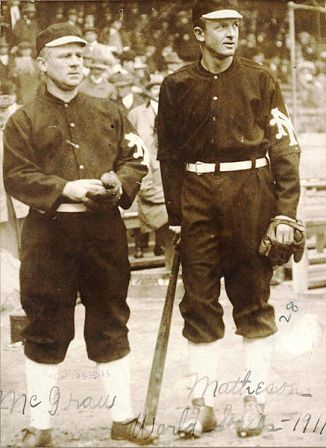
Christy Mathewson with John McGraw

Christy Mathewson with John McGraw

Shortly before the beginning of the 1914 season, Mathewson “wrote’ a story about the outlaw Federal League, and the attempt the nascent league’s president made to secure his services:

“Until I had definitely signed with the Giants again, I made no comment on the Federal League or the offer of that organization to me.  In fact, there was nothing definite in the way of an offer until I received a telegram from President (James A.) Gilmore a few hours after putting my signature to a National league contract…The proposition came out of a clear sky and was unexpected.  I have learned since that the Federals believed I was signed up all winter and that it was not until a New York newspaperman happened to mention the fact to Gilmore.”

James A. Gilmore
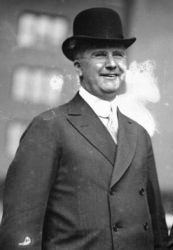
James A. Gilmore

A New York reporter (likely Wheeler) told Mathewson how Gilmore came to find out he wasn’t yet signed:

“’We were sitting around the Waldorf late one night, fanning and discussing the Federal League, when one of the boys said to Gilmore: “’Why don’t you make Matty an offer and get some publicity out of it anyway?

“’He’s signed isn’t he?’ asked Mr. Gilmore.

“’No more than I am.  His contract expired last season, and he has not signed the new one yet.’

“’Gilmore at once left the party and sent a telegram to you.  Then he announced his action to us newspaper men, and the story appeared in the papers the next day.’”

At the time of the offer, Mathewson was asked by a reporter from The Los Angeles Examiner whether he would consider joining the Federal League, and said, “he would consider the offer.”  He now claimed, “all the time I knew I would not desert the New York club which had practically made me in baseball.”

Mathewson also took the opportunity to deny another rumor; that he was in California working on behalf of National and American League franchises to help them protect their players from the Federal League said:

“I saw several reports in the newspapers during the winter and early spring months that I was the agent of organized baseball on the Coast and that I had been busy counterbalancing the bids of the Federal League agents for the players spending the winter there.  As a matter of fact, I kept clear of both baseball on the diamond and the politics of baseball last winter because I did not care to have it on my mind.   Was having too much fun playing golf, and it is not in my province as merely a player to try to influence others to take certain steps which some day they might regret and then blame me for their mistakes”

Mathewson used his former teammate, catcher Art Wilson, as an example of how he had not given any players advice about accepting Federal League offers—Wilson had jumped from the Giants to the Chicago Feds during the winter:

“(Wilson) received a big offer to go with the Federals with the promise of a large piece of advance money.  Wilson has been pining for the chance to work regularly with a big league club for two or three years now and was weary of sitting on the bench, absorbing information in this position about how it is done in the majors.  As I said in a previous article, Wilson even asked (Manager John) McGraw to transfer him to a minor league team this season so that he could have an opportunity to work daily.  Now, if the Federal League turns out to be a big success, and if I had advised Wilson to refuse its offer and stick with the Giants, he might have said to me some day:

“’Well, I took your advice and am still sitting on the bench.  If I had gone with the Feds, I might have been a star now.’”

Art Wilson
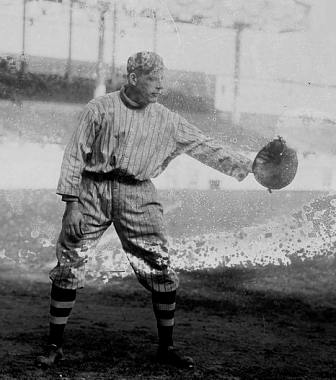
Art Wilson

The move did result in additional playing time for Wilson.  From the time he joined the Giants in 1908 until he jumped to the Feds, he had appeared in just 231 games over six seasons.  In 1914 and ’15 he appeared in 233 Federal League games, hitting .291 and .305.

Mathewson, who had been paid $9,000 by the Giants in 1913, would not reveal how much he was paid by the Giants for 1914: “It is at the request of the New York club that I do not state the terms.”  He did, however, say exactly what he was offered by Gilmore to jump.  He said after not responding to the initial telegram from the Federal League president—a telegram that did not mention terms–he received a second:

“’Newspaper reports state you do not take Federal League offer seriously.  Get acquainted with the Federal League officials and be convinced we are not four flushing.  I will give you $65,000 for three years service as manager of a Federal League club–$15,000 advance money.  If satisfactory, meet me at the Waldorf Thursday, at my expense.  Wire answer Chicago.’”

Mathewson said he “was torn with regret” for refusing the offer that would have more than doubled his salary.

“It would be like leaving home if I were to pass up the Giants now.  I don’t think I would feel right in any other uniform.”

Mathewson said “the Federals have been spending money very liberally,” but placed the credit for the success the league had in inducing players to jump with Joe Tinker.  Tinker had jumped the Cincinnati Reds to join the Chicago Feds as player-manager.  Mathewson said:

“At first there was little confidence in the backers of the new organization until Joe Tinker jumped…The ball players had faith in Tinker because he is rated as one of the shrewdest in the business.  If the Federal League lives and goes through, Joe should get credit for it, because he is the man who has collected practically all the players for it.”

Joe Tinker
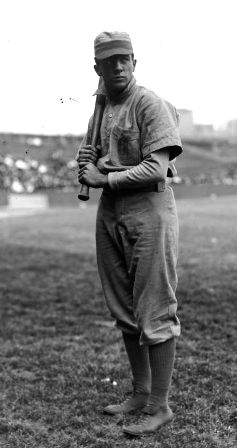
Joe Tinker

Both 33-years-old Mathewson (24-13 3.00 ERA) and Tinker (hit .256 in 126 games and led the Chi-Feds to a second place finish) had their last productive seasons in 1914.

Mathewson continued to “write” articles for the Wheeler Syndicate until 1916 when Wheeler sold the operation to the McClure newspapers.  Almost immediately after the sale, Wheeler formed the Bell Syndicate, and occasional articles under Mathewson’s byline were distributed by Bell through 1919.
Tragic Exits

28 Apr

George Frazee

George Donald Frazee, listed on Baseball Reference as “G. Frazee” with the Shreveport Sports in the Texas League in 1928, was a three-sport star at Texas Christian University.

Born November 21, 1904 in Fort Worth, Texas, Frazee played outfield for the baseball team, halfback and fullback with the football team, and was a guard on the basketball team from 1923-1925.  After graduation he played basketball with a team representing the Fort Worth, Texas YMCA which played throughout the Southwest and Mexico.

It’s unclear where Frazee played baseball in 1926 and ’27, but in 1928 he started the season with the San Angelo Red Snappers in the West Texas League, there are no surviving statistics for his time there, but after being transferred to Shreveport he hit .301 in 32 games. Frazee signed with Shreveport for the following season.

On January 24, 1929 Frazee was flying from Ft. Worth with World War I flyer Willoughby Alvous “Al” Henley and another Fort Worth man, to attend the opening celebration for San Angelo’s new airport.  The United Press wire story said:

 “Tragedy marred the formal opening of the municipal airport today, claiming the life of Al Henley…one of the nation’s most skilled pilots.  Henley, Donald Frazee, professional baseball player, and W.E. Shytles…were killed when their cabin monoplane crashed in an attempted landing.”

The Brownsville Herald said:

 “He was an outfielder, fast, big and aggressive.  Shreveport lost an outfielder who was certain to make good this year.”


Chief Wano

William “Chief” Wano was born on Oklahoma’s Pottawatomie reservation on May 12, 1896.  He played semi-pro ball in Oklahoma City and in the army while serving with the 79th Infantry, 15th Division at Camp Logan, Texas.  After his discharge in early 1919 the twenty-three-year-old began his professional career with the Tulsa Oilers in the Western League.

Wano struggled during his first season, hitting just .195, but joined the Little Rock Travelers in the Southern Association the following season—and along with fellow Oklahoman, and former classmate and teammate at the Chilocco Indian School– Moses “Chief” Yellow Horse; he helped lead Little Rock to the pennant.

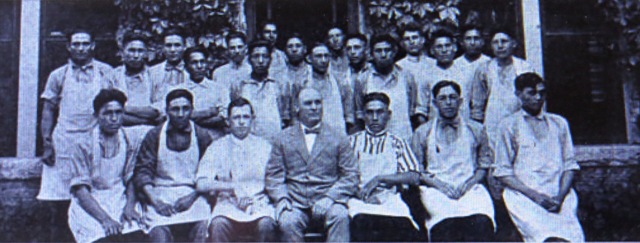
William Wano,

William Wano, back, fourth from right, at Chilocco Indian School

Wano was a consistent hitter throughout the 1920s (.317 in 11 seasons in class-A leagues), but was an erratic fielder and never made it to the major leagues.

After hitting .331 for the St. Joseph Saints in the Western League in 1930 Wano left organized baseball, first playing semi-pro then he accepted a position managing Ben Harjo’s All-Indian Baseball Club—Harjo was a millionaire and full-blooded Creek.   The team, based in Harjo’s hometown Holdenville, Oklahoma, barnstormed the Midwest and Southwest, and with Wano as player-manager won the Denver Post Tournament in July 1932.

Chief Wano

Chief Wano

Wano quit two months later after a dispute over two players Wano signed.  Harjo hired Jim Thorpe to manage the club the following season.

Wano moved to Dallas after his career.  According to The United Press he spent World War II working at the North American Aircraft plant in Dallas, and living at the home of Kal Hill Segrist Sr., his former Dallas Steers teammate (and father of Kal Segrist, who played with the New York Yankees in 1952 and the Baltimore Orioles in 1955).

On July 30, 1945 Wano was in the Dallas City Jail (reports varied on why he was there), when according to The Dallas Times-Herald another prisoner “slugged Wano on the chin, Wano fell, striking his head on the concrete floor.”  Other reports said Wano was trying to break up a fight when he was hit.

William “Chief” Wano died that night in Dallas’ Parkland Hospital.  A month later a grand jury chose not to indict the man who threw the punch.


Gene Gaffney

Eugene “Gene” Gaffney was one of the better hitters in the Florida State League during his brief career (1920-23), he was also a manager’s nightmare.

Gaffney hit .335 in 60 games for the league champion Orlando Tigers in 1921, but was suspended for several days in July by Manager Joe Tinker.

The following season he joined the Jacksonville Indians, managed by former major leaguer George Stovall.  The team struggled, and Gaffney, had his only sub .300 season, hitting just .277.  And, according to The St. Petersburg Evening Independent, a car caused a major riff between the outfielder and his manager:

“Has a baseball player a right to ride to and from the park in his own automobile?  George Stovall says no.  He suspended Gene Gaffney because Gaffney had bought an automobile and insisted on being his own bus.

“Stovall insisted he should parade to the park in the team bus.  Gaffney told Stovall to go jump; that if the team would win enough games so that he wouldn’t be ashamed to wear the uniform on parade it might be different.  At last accounts Gaffney was off the ballclub, but riding his automobile to his own intents and purposes, while Stovall still was trying to get the rest of the Jacksonville team somewhere on the field.”

Gaffney played just one more season; he hit .357 for the Daytona Beach Islanders in 1923.

After baseball, Gaffney tended bar in Orlando until August 12, 1937—The Associated Press said:

“Gene Gaffney, about 43, local bartender who once led the old Florida State League in batting, was believed today to have been the victim of foul play.

“His automobile, its windshield shattered and other windows broken, was found mired in mud on the shores of an almost inaccessible lake just across the Orange County line in Seminole County, with evidence of a struggle having taken place.

“His eye glasses were found in the mud about 20 feet from the car.”

Gaffney’s body was found the following day.  His death was ruled a homicide.

“Father isn’t Disappointed because I took up Dancing”

4 Apr

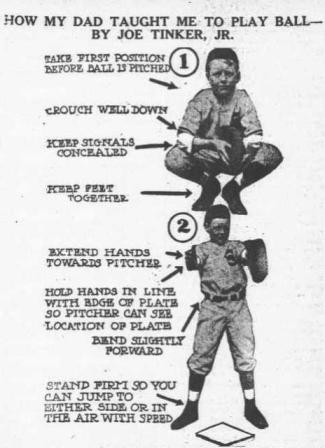
In the spring of 1916 Joe Tinker Jr., ten-year-old son of Chicago Cubs Manager Joe Tinker “wrote” a series of articles that appeared in newspapers across the country.  Tinker’s articles provided tips for playing each position:

“To be a winning pitcher you must have control…The best way to gain control is to get another boy to get in position as a batter then pitch to him.  Don’t throw at a stationary target.”

“(Catchers) Stand up close to the batter and don’t lose your head if the pitcher becomes wild.  Try to steady him with a cheerful line of talk.  Practice every spare moment.”

“Stand close to the plate when batting.  Don’t lose your nerve if the pitcher tries to bean you. Some fellows like to choke their bats or grip the handles about four inches from the end.  My father don’t approve of the style…Don’t argue with the umpire.  If you are hot-headed you hurt your chances to connect with cool-headed pitching.”

“Learn to start in a jiffy.  That is the first point emphasized by my dad in teaching me to run bases.”

“Playing short offers many chances for individual star plays and the work of a good man will have a great effect on the score card.”

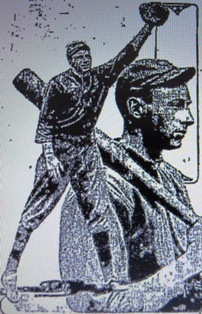
Photos of Joe Tinker Jr. demonstrating what his dad taught him

Photos of Joe Tinker Jr. demonstrating what his dad taught him

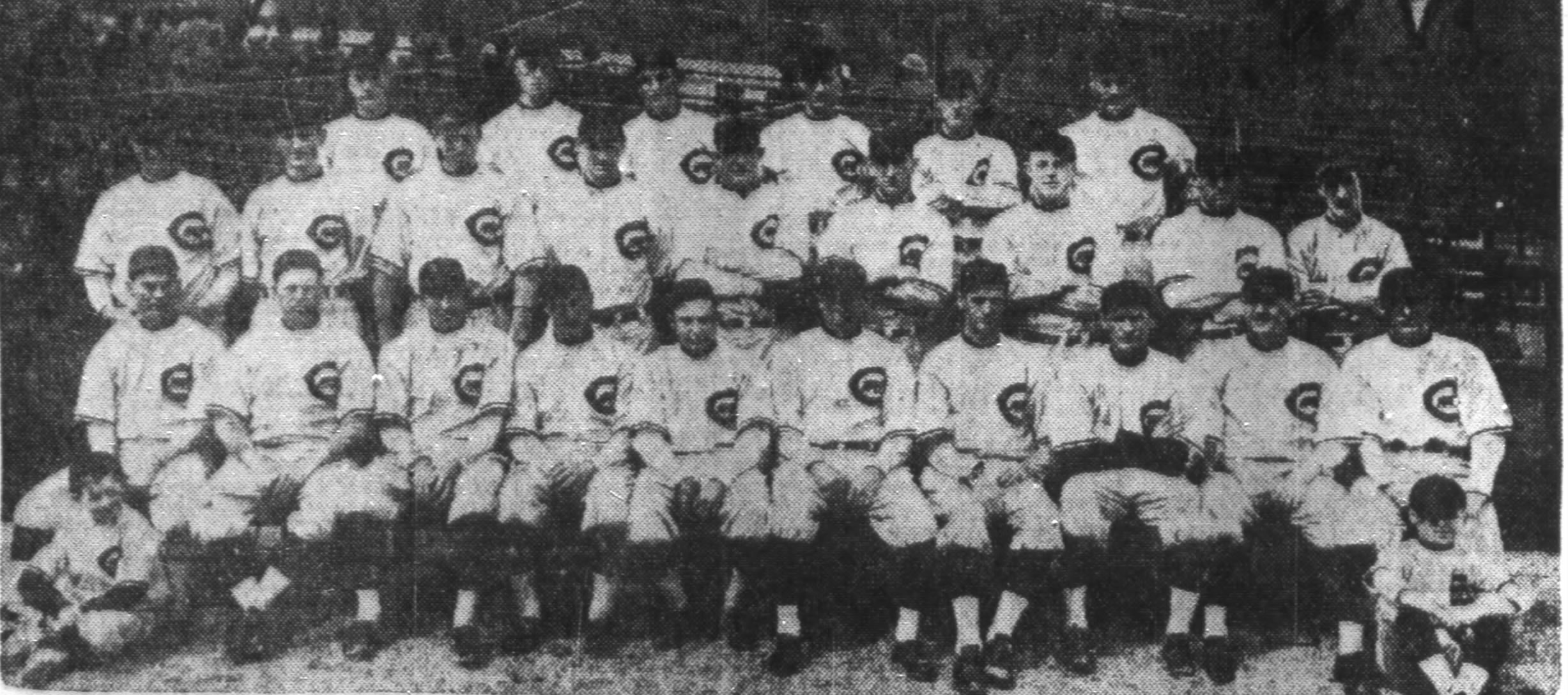
Joe Tinker Jr. and his younger brother Roland were the Cubs mascots during their father’s season as manager in 1916.  In 1924 Chicago newspapers reported that Tinker Jr. was headed to the University of Illinois to play baseball for Coach Carl Lundgren, the former Cub pitcher.  There is no record of Tinker ever playing at the school.

1916 Chicago Cubs.  Joe Tinker Jr. seated right, Roland Tinker seated left.

1916 Chicago Cubs. Joe Tinker Jr. seated right, Roland Tinker seated left.

Younger brother Roland played for two seasons in the Florida State League.

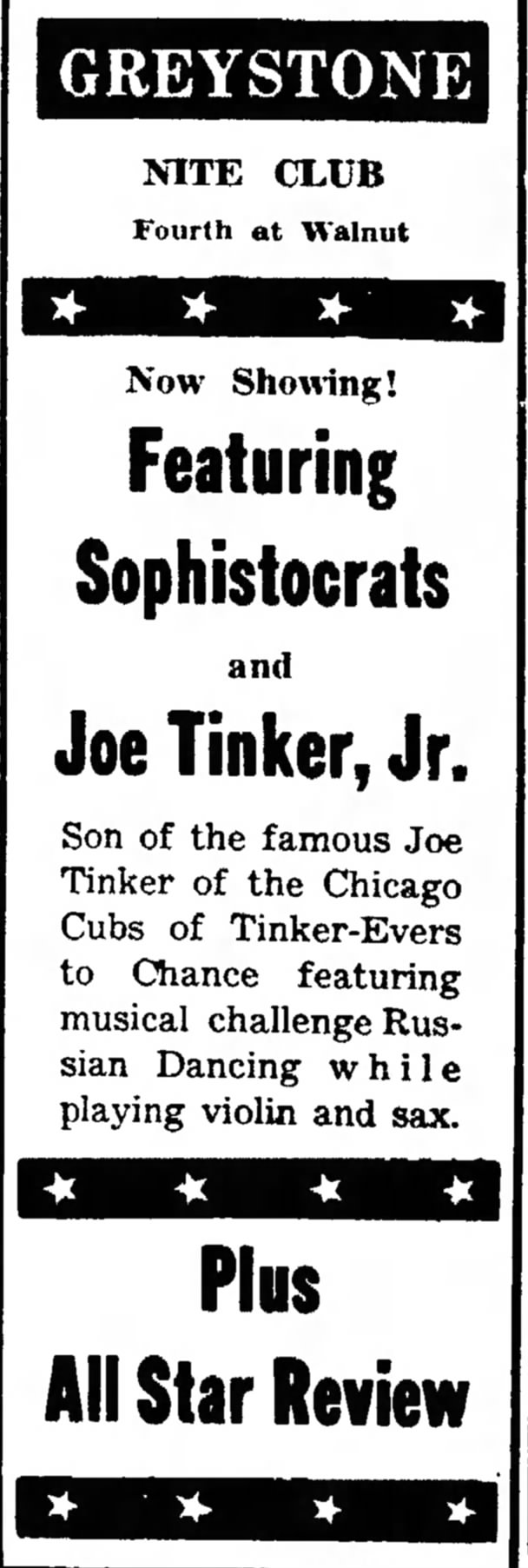
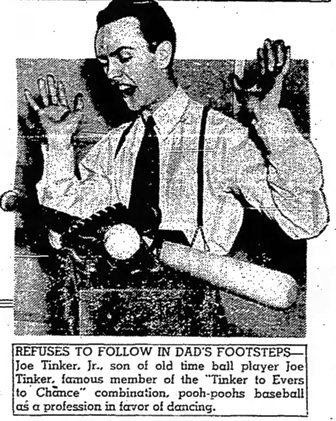
In 1938 newspapers reported that Joe Tinker Jr. had become a dancer with a vaudeville group called the Sophistocrats.  Tinker Jr. told reporters:

“Father isn’t disappointed because I took up dancing.  In fact he approves.”

It’s unclear whether “Joe Tinker Jr.” was actually Joe Tinker Jr.  The newspaper articles all said he was 22-years-old.  Joe Tinker Jr. would have been in his thirties; however his brother William Jay Tinker would have been 22 in 1938.


joetinkerjrdance


joetinkerjr1938

When Joe Tinker was elected to the Hall of Fame he compiled his all-time team for Ernest Lanigan, then curator of the Hall:

Pitchers: Mordecai Brown, Grover Cleveland Alexander, Christy Mathewson and Ed Walsh

Catchers: Johnny Kling and Roger Bresnahan

First Base: Frank Chance

Second Base: Eddie Collins

Third Base: Harry Steinfeldt

Shortstop: Honus Wagner

Outfield: Artie “Solly’ Hofman, Ty Cobb, Fred Clarke, and Sam Crawford.

Though he named several Cubs, Tinker did not include his former teammate Johnny Evers.  In 1914 Evers had famously slighted Tinker, with whom he was engaged with in a long-term feud, after Evers and his Boston Braves teammates won the World Series. William Peet wrote in The Boston Post :

“(Walter “Rabbit” Maranville’s) the best shortstop the game has ever known.

“Better than Joe Tinker; your old side partner?

“Yes, he’s better than Tinker.”

While the two finally broke their silence at Frank Chance’s deathbed in 1924, they never reconciled.

Evers died in 1947, Tinker in 1948.

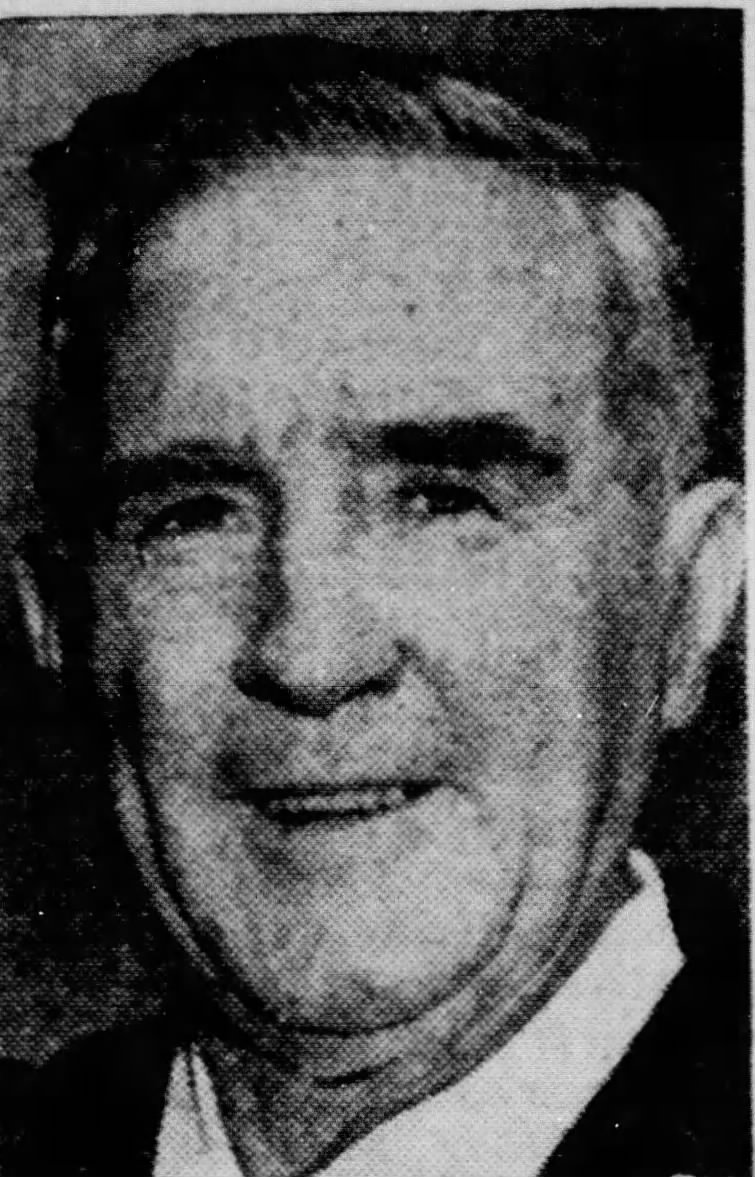
Joe Tinker circa 1946

Joe Tinker circa 1946

Joe Tinker Jr. died in 1981, Roland “Rollie” Tinker died in 1980, and William Tinker died in 1996.


“Good day—Double Crosser”

30 Jul

Hap Myers’ abrupt exit from the Boston Braves was never fully explained; the Boston press said he simply didn’t get along with manager George Stallings, Myers said it was because of his activities as one of the leaders of baseball’s most recent labor movement.

"Hap" Myers

“Hap” Myers

Two articles from The Associated Press about George Stallings that appeared after the braves won the World Series might have shed some light on the relationship between the two—one mentioned an incident that took place during a game, and the other had to do with Stallings’ well-known and strange superstitions.

The first article was about “a game played in Boston in the summer of 1913,” (box scores indicate it was most likely, the second game of a double-header with the Cincinnati Reds on July 22).

“Two men were out and the Braves had a man on first and another on second…A long hit would either tie the score or win the game.  ‘Hap’ let the first one pass—and bunted the second.  He was thrown out by at least 10 feet and the game was over.  The Braves had lost.

“’Hap’ in terror over a possible rebuke…escaped into the clubhouse.  Stallings was there, enshrouded in deepest gloom.  Baseball never knew a harder loser that Stallings.  But Stallings never said a word to Myers then, and Myers ducked out.

“The next morning found Stallings at Myers’ home.  Myers had just gotten up.”

When Myers answered the door, Stallings asked him why he had bunted with two on and two out.  Myers told his manager that he thought he’s “double-cross the other fellows…catch ‘em asleep.”

Stalling blew up at the first baseman:

“Well, let me tell you this Myers, if you ever again try any of that ‘double-crossing’ stuff there’ll be a funeral in this particular neighborhood.  Good day—double crosser.”

The second article said that during a losing streak in June of 1913 the superstitious Stallings blamed the “jinx” on a colorful necktie Myers wore—the only tie the first baseman owned.  According to the article, Stallings told his equally superstitious owner James Gaffney:

“That necktie of his—that horrible looking sight, that drapes down from his collar.  No wonder we can’t win.  No wonder we are jinxed.  That necktie would hoodoo anybody.”

The story said Stallings stole the tie from Myers, and after the Braves won the following day told Gaffney:

 “Told you so, didn’t I?”

The Boston Globe told a slightly different version of the story in 1931 in an article about Stallings.

By the time these stories were published, Myers was in his second season with the Brooklyn Tip-Tops in the Federal League.  He hit a disappointing .220 in 1914, but stole 43 bases.  In 1915 he hit .287 and was suspended for several days in June after he and Chicago Whales player-manager Joe Tinker “exchanged blows.”

"Hap" Myers Brooklyn Tip-Tops

“Hap” Myers Brooklyn Tip-Tops

When the Federal League folded Myers returned home to California and signed a contract with the San Francisco Seals, who already had veteran William “Chick” Autry at first.  When Myers arrived in San Francisco, The San Jose Mercury News said:

“The fight for the job will be a battle which will be watched with more than passing interest by San Jose fans, for most of them remember Myers as an elongated youngster who wielded a ferocious bat when he first broke into professional ball in this city.”

Myers hurt his arm and the battle never took place; he only appeared in three games, and was hitless in two at bats.  He would never play organized baseball again.

Where Myers spent the remainder of the 1916 season is unknown; The Mercury-News said he went to Ray, Arizona to join the Tri-Copper League, but no reference to Myers can be found in league statistics—whether he played in Arizona or not, he did spend time in the Southwest that year.

In November of 1916 Myers and two other men were arrested in Los Angeles on a warrant from El Paso, Texas.  The Associated Press said Myers was “wanted by the El Paso Police on a charge of highway robbery…one resident (was robbed of) a $1500 diamond ring and $48 in cash, and another resident, a diamond ring valued at $325,”

In January of 1917, when the trial took place, highway robbery was punishable by death in Texas.

On January 23 Myers and his co-defendants were acquitted.

Myers, now a free man, remained in the Southwest and went to work as a metallurgist with a copper mining company in Grant County, New Mexico.

In 1918 the 31-year-old Myers enlisted in the military; joining Company B of the Field Signal Battalion at Camp Lewis, Washington.   He played baseball at Camp Lewis and in France with the United States Army—among Myers teammates were professional players Ten Million, “Coaster Joe” Connolly, Howard Mundorff and Charlie Schmutz.

After returning from France Myers worked as an insurance adjuster in Seattle and later in automobile financing back in his hometown of San Francisco.

“The elongated first baseman” died in San Francisco in 1967 at age 80.

“Is the Best the Game has Known”

23 Jul

Joining the Boston Braves for the 1914 season provided second baseman Johnny Evers with the opportunity to appear in one more World Series, and gave him the chance to take a very public swipe at one of his most famous former teammates, shortstop Joe Tinker.

In December of 1912 the Chicago Cubs traded Tinker to the Cincinnati Reds, and depending on which version of the story was to believed, Tinker and Evers had not spoken a word to one another for either five or six years.

Johnny Evers

Johnny Evers

Tinker said the two stopped talking in 1908 after Evers jumped in a horse-drawn cab leaving Tinker and other teammates behind before an exhibition game in Indiana leading to an on-field fight between the two later that day; Evers said a year earlier Tinker initiated the bad blood between the two by throwing a ball so hard to the second baseman on a force play that it injured his finger.

Evers said years later:

“I yelled to him, you so-and-so. He laughed. That’s the last word we had for-well, I just don’t know how long.”

The 1914 Braves got off to a horrible 4-18 start, and were still in eighth place on July 18, but surged to second place by August 10, winning 18 of 21 games.  By September 2 the Braves had first place to themselves, and ended up running away with the pennant, beating the second place New York Giants by 10 ½ games, and sweeping Connie Mack’s Philadelphia Athletics in the World Series.

Evers, named Boston’s captain by manager George Stallings, led National League second basemen in fielding; hit .279 for the season, and .438 in the World Series.  Evers received baseball’s last “Chalmers Award,” a forerunner of the Most Valuable Player Award, which was presented from 1911-1914.  The award was sponsored by the Chalmers Motor Car Company and was presented to Evers along with a new car.

The runner-up for the Chalmers Award was Evers’ teammate, shortstop Walter James Vincent “Rabbit” Maranville.  Maranville, Evers and first baseman Charles “Butch” Schmidt were an excellent double-play combination throughout the season; Evers participated in a career-high 73 twin killings, more than he’s ever turned in a season with Tinker and Frank Chance.

Years later Maranville said of Evers:

“It was just Death Valley, whoever hit a ball down our way.  Evers with his brains taught me more baseball than I ever dreamed about.  He was psychic.  He could sense where a player was going to hit if the pitcher threw the ball where he was supposed to.”

Two days after the Braves won the World Series; Evers took the opportunity to take a swipe at his former teammate Tinker.  Evers told William Peet, sportswriter for The Boston Post that:

“(Maranville’s) the best shortstop the game has ever known.

“Better than Joe Tinker; your old side partner?

“Yes, he’s better than Tinker.”

Joe Tinker

Joe Tinker

Peet sad:

“Evers has been given credit for making Maranville the great player he has shown himself to be this season, but Johnny declares this s untrue, stating that Maranville learned the game and all its fine points unaided.”

Peet said Evers’ claim that Maranville “is a greater shortstop than Tinker is about the highest praise anyone can shower on the peppery little chap who was such a prominent factor n the Braves’ victory.”

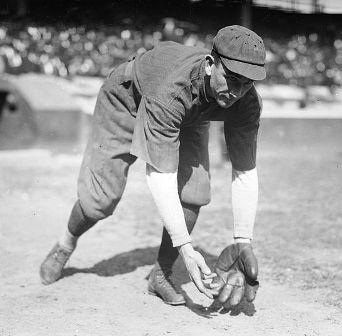
Rabbit Maranville

Rabbit Maranville

Evers and Peet failed to mention where Honus Wagner would be ranked if Maranville was, in fact, “the best shortstop the game has ever known.”

No response from Tinker was recorded.

Evers and Tinker would not speak again for another decade.  In 1924, the two finally spoke when they were summoned to California by Chance, their former teammate and manager, who was dying.

Tinker, Evers and Chance

Tinker, Evers and Chance

Tinker, Evers and Chance were inducted into the Hall of Fame together in 1946 by the veterans committee; Maranville was elected by the Baseball Writers Association of America in 1954.

“Said–Tinker to Evers to Chance”

5 Jul

???????????????????????????????

Franklin Pierce Adams’ famous poem “Baseball’s Sad Lexicon” appeared in The New York Evening Mail in 1910 and immortalized Chicago Cubs shortstop Joe Tinker, second baseman Johnny Evers and first baseman Frank Chance—within three years, the above cartoon appeared in newspapers along with a new, less well-known, poem written by Adams’ colleague at The Evening Mail, James P. Sinnott.

By 1913, baseball fans became aware that Tinker and Evers had barely spoken to each other since 1905, and the rivalry among the three exploded in public.  The former teammates, now all managers, Tinker with the Cincinnati Reds, Evers with the Cubs, and Chance, the recently deposed Cubs manager, with the New York Yankees.

In February Chance told reporters that Tinker was a better player than Evers; Evers responded and accused Tinker of trying to “tamper” with pitcher Larry Cheney and other members of the Cubs, as for Chance he said:

“I do not know whether Chance is jealous of my getting the position of leader, and I do not like to think so, but from the remarks he is making, I am forced to.”

By March, Hugh Fullerton said in The Chicago Examiner that Evers was unable to control his players; he said “Chance could whip any man on (the) team—Evers can’t,” and predicted a fourth place finish for the Cubs (they finished third).  Tinker’s Reds finished seventh in the National League; Chance’s Yankees were seventh in the American.

Sinnott’s poem appeared at the end of September:

“A Manager’s life is tough!

Said Tinker to Evers to Chance—

‘A manager’s road is rough!’

Said Tinker to Evers to Chance—

‘Here are we three, a lookin’ on

The big world’s series game,

In which we once were principals,

In which we gained our fame’

‘A manager’s life is no cinch!’

Said Tinker to Evers to Chance—

I’d almost as soon be Lynch!’

Said Tinker to Evers to Chance.”

“Lynch” was Thomas Lynch, who was about to be replaced as president of the National League.

It would not be until 1924, shortly before Chance’s death that the three reconciled.  Chance had been hired to manage the Chicago White Sox, but became too ill and returned home to California; he was replaced by Evers.

Chance summoned his former teammates to California that spring, where the three spent several days together.  Chance died in September.  Tinker, Evers and Chance, were inducted into the Hall of Fame together in 1946.

Tinker, Evers and Chance

Tinker, Evers and Chance

A Thousand Words–Joe Tinker

1 Jul

Quick hits Monday through Friday this week for the holiday–regular items will return next week.

joetinkerkids

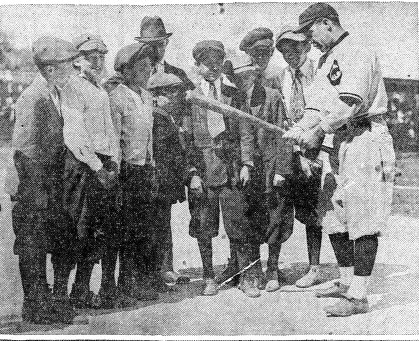
Joe Tinker, manager of the Chicago Cubs shows boys from the Chicago Schools Baseball League the finer of points of hitting before a July 1916 game with the Boston Braves.

Tinker returned to the Cubs in 1916 after having managed the Chicago Whales to the Federal League pennant the year before.  Whales owner Charles Weeghman purchased the Cubs after the Federal League folded and installed Tinker as manager.  Chicago fans had high expectation for Tinker’s team, because in addition to the manager, Weeghman brought most of the key players from the Federal champions to the Cubs.  But after a 9-17 record in July.  Rumors began to swirl that Weeghman would replace Tinker as manager after the Cubs owner traded for catcher Art Wilson on July 29; Wilson had been a Weeghman favorite when he caught for the Whales.

In August, Tinker blamed the Cubs disappointing season on third baseman Heinie  Zimmerman, telling The Chicago Daily News:

“Zimmerman is no good to the ball team.  he does not take any interest in his work and does not care whether the club wins or loses.  He did not report for practice yesterday and on other days is always the last one out for work.  Most of the players feel he does not belong on the team.  He is killing the harmony we had and that is why I would prefer to dispose of him.  He won’t play ball and does not use any judgment and with a man like that a flag cannot be won.”

Tinker survived the season, Zimmerman did not.  He was traded to the New York Giants on July 28.

The Cubs finished in 5th place, 67-86.  Tinker was let go after the season, he was not replaced by Wilson, as rumored, but instead by Fred Mitchell, who after a fifth place in 1917 led the Cubs to the National League pennant in 1918.

Tinker managed, and was a part owner, of  the Columbus Senators in the American Association in 1917 and ’18.

Larry McLean

8 Jan

At 6’ 5” John Bannerman “Larry” McLean is still the tallest catcher to have played in the Major Leagues nearly a century after his final game.  Born in New Brunswick, Canada, McLean’s ability was mostly overshadowed by his frequent off-field troubles during his career.

McLean bounced between the minor leagues, semi-pro teams, and trials with the Boston Americans, Chicago Cubs and Saint Louis Cardinals from 1901-1904.  McLean joined the Portland Beavers in the Pacific Coast League in 1905 and it was here that he developed into a good ballplayer and a first-rate baseball character.

Larry McLean

Larry McLean

McLean hit .285 in 182 games with Portland in 1905, but also started to show signs of the troubles that would plague him for the remainder of his career; Portland added a “temperance clause” to his contract and McLean, who had originally planned on a boxing career, loved to fight.

In 1906, while hitting .355 for Portland, and catching the eye of the Cincinnati Reds who would purchase his contract in August; McLean announced that he was going to become a professional fighter.

The wire report which ran in The Bakersfield Daily Californian said:

“McLean the giant catcher of the Portland team…He is so big that umpires walk out behind the pitcher so they judge balls and strikes…announces that he will fight any man in the world, Big Jeff (Jim Jeffries) not barred.”

The story said McLean was training with Tom Corbett (older brother of “Gentleman Jim” Corbett) and Corbett said he “has a ‘sure ‘nuff’ champion in the big catcher.”

Talk of a ring career temporarily ended when McLean joined the Reds, but McLean’s legend grew.  In November of 1906, he caught a murderer while in a subway station with his wife.  The Boston Post said the suspect:

“Was seen to pull a gun and pump five bullets (into the victim)…Larry started after him and collard him just outside the entrance.  (McLean had the suspect) pinioned so he could not move.  The police soon arrived and took charge of McLean’s prisoner.”

McLean was a huge hit with Havana fans the following winter when the Reds touring Cuba; The Sporting Life said:

“Larry McLean was the favorite and every time he caught a ball the crowd applauded. McLean has been dubbed by the baseball fans ‘Chiquito.’”

McLean and Chicago White Sox pitcher Frank Smith were mentioned at various times as possible opponents for heavyweight champion Jack Johnson; boxing writer Tommy Clark said in 1910 that McLean “Thinks he has a good chance of lowering Johnson’s colors.”

But while McLean was a fan favorite he regularly ran afoul of Cincinnati management and none of the managers he played for was able to keep him out of trouble.

While with the Reds McLean was arrested at least four times–for disorderly conduct, passing a bad check and two assaults.  In one case, at the Savoy Hotel in Cincinnati, McLean knocked a newspaper man from Toledo unconscious after the man “Reproved McLean for using a vile name.”

While serving a suspension for breaking team rules in 1910 McLean Said:

“When I get back to Cincinnati there will be 25,000 fans at the depot waiting to shake hands with me.”

Frank Bancroft, Reds secretary and former manager said in response:

“Twenty-five thousand, why, they’ve not that many barkeepers in Cincinnati”

McLean had worn out his welcome by 1910, but Cincinnati was not able to find any takers for the catcher.  Pittsburgh Pirates owner Barney Dreyfuss said, “I wouldn’t give 30 cents for Larry McLean.”

McLean stayed with the Reds for two more seasons, but when Joe Tinker took over the team one of his first moves was to sell McLean to the Saint Louis Cardinals in January of 1913.  McLean said he had finally learned his lesson and promised to behave with the Cardinals:

“They didn’t want me around because they said I was a bum. Now I’m going to fool Tinker.”

McLean did behave himself in Saint Louis and seemed to appreciate the opportunity he was given by his former Reds teammate, manager Miller Huggins, even earning a “good behavior” incentive in his contract, and was hitting .270 for the Cardinals, but the cash-strapped team went with the younger, cheaper Ivey Wingo behind the plate and traded McLean to the New York Giants for Pitcher Doc Crandall.

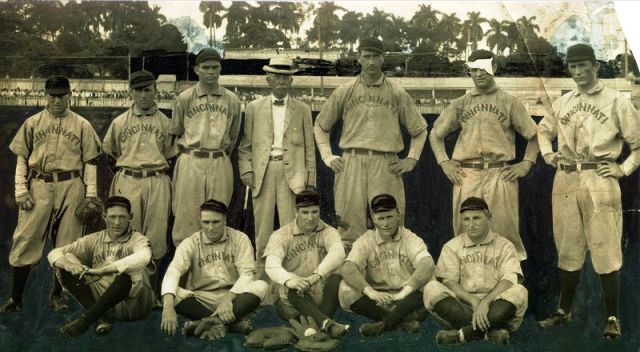
Larry McLean, standing end right, Miller Huggins, standing end left, and Frank Bancroft, standing middle (in suit) on the 1908 Cuban tour.

Larry McLean, standing 5th from left, Miller Huggins, standing end left, and Frank Bancroft, standing middle (in suit) on the 1908 Cuban tour.

The rest of the McLean story tomorrow.

Lost Team Photos

19 Nov

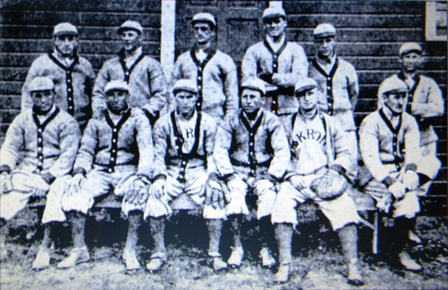
Another photo I’ve never seen published before, the 1908 Akron Champs, Ohio-Pennsylvania League Pennant Winners.

Top left to right:

Dick Breen—a minor leaguer for 12 seasons, his career overlapped with another career minor leaguer named Dick Breen—this Breen’s career came to an end in 1917, when while playing for the Reading Pretzels in the New York State League he got in a fight with Wilkes-Barre Barons  manager Jack “Red” Calhoun.  Both men were suspended indefinitely; Breen was released several days later, neither ever appeared in organized ball after that season.

Bill Speas—longtime minor league player and manager, Speas hit.284 in 22 seasons and won three Mississippi Valley League pennants as a player/manager with the Cedar Rapids Bunnies and Dubuque Dubs.

John Brackenridge—appeared in seven games for the Philadelphia Phillies in 1904, Brackenridge pitched in the Pacific Coast League from 1909-1913.

Fred “Buff” Ehman—a 6’ 4” (some sources list him an inch shorter) right-handed pitcher, the enigmatic Ehman was 81-36 for Akron from 1906-08, but according to The Akron Beacon Journal, was known for disappearing for days at a time and “sulking.” He had multiple trials with Major League clubs; according The Mansfield (OH) Daily Shield he never stuck with a team because of “his refusal to exert himself.”  Through 11 minor league seasons he won 214 games.

Wilbur Good—spent parts of 11 seasons in the Major Leagues: Joe Tinker said of him, “He is one of the fastest runners in the National League and still one of the poorest base runners.”

Edward Murphy—a light hitting catcher, Murphy played five seasons in the Ohio-Pennsylvania League.

Bottom left to right:

Bill Kommer—there is no listing for Kommer on any minor league data base.  He was left-handed pitcher who played for many amateur and semi-pro teams in Ohio during the first decade of the 20th Century;  he was released by Akron in July, there is no record of his statistics for the ’08 season.

William Hille—“Silent Bill” was a shortstop who played until 1917 primarily in the Texas and South Atlantic League.

Jim Callahan—his Major League career consisted of one game with the 1902 New York Giants; played three seasons for Akron (1906-08), was reported to have played in the Western League in 1909, but no records exist.

Matt BroderickThe Reading Eagle called him “one of the best shortstops who ever played on a minor league field,” Broderick played two games in the Major Leagues with Brooklyn in 1903—played minor league and amateur baseball for the remainder of the decade while working for Carpenter Steel Works in Reading, PA.

George Texter—one of the first players to sign with the Federal League in 1913, Texter played for the Indianapolis Hoosiers/New Jersey Pepper during the Fed’s two seasons as a Major League (1913-14).  Managed teams throughout the 1920s in the Ohio-Pennsylvania League (no longer recognized by the National Association, the OPL was nonetheless a strong semi-pro/industrial league during that period).

Cecil Armstrong—a dominant right-handed pitcher, first with the Youngstown Ohio Works team in 1905 during his three seasons with Akron (64-33 from 1906-08), Armstrong spent 1909 and 1910 with New Bedford Whalers in the New England League. Armstrong retired to Akron after the 1910 season.

Murphy Calls Out an Umpire

12 Oct

Three years before Chicago Cubs President Charles Murphy ousted legendary manager Frank Chance, he picked a fight with the most powerful and respected umpire in baseball.

In September of 1909 the second place Cubs had just taken three of five games from the league-leading Pirates in Pittsburgh.

On September 9 Murphy filed a formal protest with the league over the fourth game of the series (won by the Pirates 6-2) charging that umpire Bill Klem “(D)eliberately acted as a conspirator, robbing the Cubs of any reasonable chance for victory.”

The Cubs had argued several calls by Klem during the game and Manager Frank Chance and Cubs’ infielders Joe Tinker and Harry Steinfeldt were fined for comments made to the umpire.

Murphy questioned Klem’s honesty and demanded that he not be allowed to serve as umpire in any games played by his team and that the game be replayed.

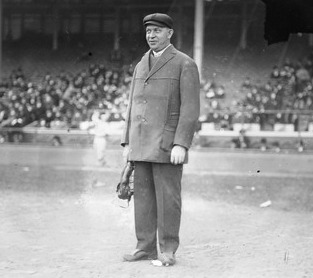
Klem was an unlikely person to have his integrity questioned.  Generally credited with professionalizing umpiring, he had come forward with fellow umpire Jim Johnstone the previous season to report they had been offered a bribe to help determine the outcome of the October 8 Cubs game with the New York Giants to decide the pennant (the make-up game for the September 23 “Merkle’s Boner” game).

While the league never released specific details of the bribe attempt, the allegations made by the umpires were found to be true and barred the “unnamed conspirators” from any Major League ballpark. Both umpires were commended by the league for demonstrating to the “American public the honesty and integrity of our national game.”

League President John Heydler (appointed after the suicide of Harry Pulliam) immediately announced his support for Klem in the dispute.  Murphy responded by announcing he would ensure Heydler would not be reappointed president of the league that winter—Murphy would be successful spearheading the effort to replace Heydler.

Murphy was never able to cite any specific reasons for his charges and was pressured to drop the protest, which he eventually did, but Klem remained indignant and asked to have his name cleared.  According to newspaper reports:

“The umpire does not propose to let the matter rest.  He considers that his reputation has been attacked, and he therefore will ask the league to investigate him.”

There’s no record that the investigation was ever conducted.

Klem attended that year’s winter meetings in order to be on hand when Murphy was pressured to make a formal, public apology.

Chicago Cubs President Charles Murphy

More on Murphy and his feuds in the coming weeks.