
Tag Archives: Lost Advertisements

Lost Advertisements–Frank Frisch, “Dr. Eliot’s Five-Foot Shelf”

12 Feb


frischad

In 1923, P.F. Collier & Son Co. used New York Giants second baseman Frank Frisch in advertisements for the 51-volumes of great world literature, now known as The Harvard Classics, then called “Dr. Eliot’s Five Foot Shelf.”

The collection first appeared in 1909.  Harvard University President Charles William Eliot claimed that anyone could receive a liberal education by spending 15 minutes a day reading from a collection of books that could fit on a five-foot shelf.
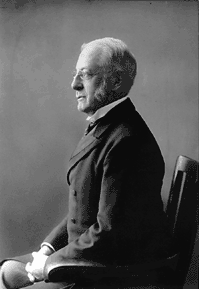
Charles William Eliot

Charles William Eliot

The anthology was borne out of that claim:

“When Frank Frisch first appeared at the Polo Grounds in 1920, he was hailed as the smartest young college player who ever broke into baseball.  He is still smart and still studying.  This column tells how.”


Brain’s are Frank Frisch’s main asset as a Champion ball-player

“When John J. McGraw started in 1920 to rebuild the Giants he looked about for young, smart, teachable players.

“From Fordham College, he took young Frank Frisch–and Frisch made good in the first game he played and is still making good.  His main asset is his brain; he thinks faster and further ahead than do most other players.

“But ballgames are short and so is a professional player’s active career.  What does Frisch do in the rest of his time? You will find him, not scattering his time and thought, but curled up somewhere with a good book in his hand.

“In his private library, for instance, is Dr. Eliot’s Five Foot Shelf of Books. He bought it with his earnings as a ballplayer, and now studies it to make his mind still faster and so to increase his earnings–both on the diamond and in later life.”

Frisch
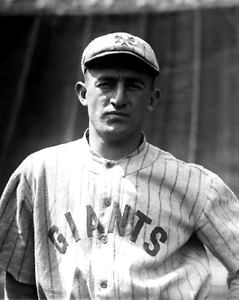
Frisch

The use of a professional athlete, even one with a college education like Frisch, would likely have not pleased Eliot, who had a general contempt for sports.  He attempted, unsuccessfully, to abolish football at Harvard in 1905, and is often quoted having said about baseball:

  “Well, this year I’m told the team did well because one pitcher had a fine curve ball. I understand that a curve ball is thrown with a deliberate attempt to deceive. Surely this is not an ability we should want to foster at Harvard.”
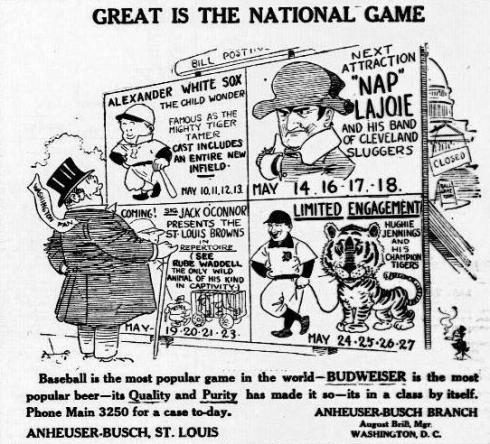
Lost Advertisements–Anheuser-Busch, Washington Senators

5 Feb


ab1910sox

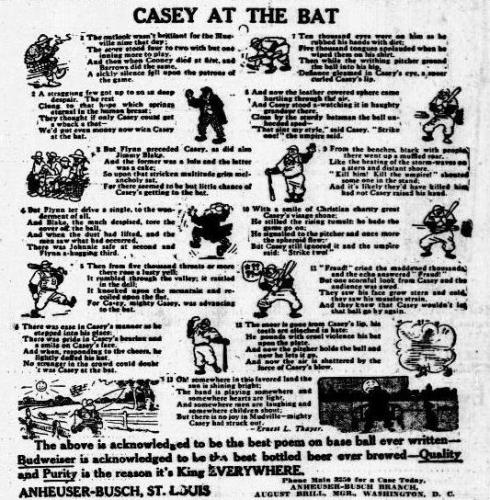
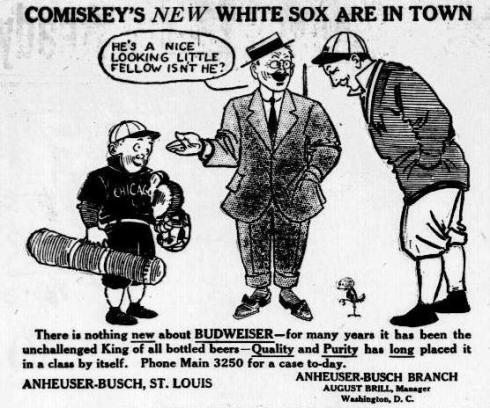
In 1910, a series of Anheuser-Busch ads  appeared in several Washington D.C. papers. The ad above appeared when the Chicago White Sox faced the Senators in early May:

Comiskey’s New White Sox are in Town

The headline referred to Charles Comiskey‘s shakeup of his team, which included the appointment of Hugh Duffy as manager, and a new starting infield; first baseman Chick Gandil, second baseman Rollie Zeider, and shortstop Lena Blackburne, and Billy Purtell at third.

An advertisement later that week featured caricatures of Napoleon Lajoie and Hughie Jennings, and described Rube Waddell as “The only wild animal of his kind in captivity:”

ab1910nap

The ads were similar in style and content to those for Old Underoof Whiskey that appeared in Chicago papers during the same period–all advertised upcoming games, commented on the behavior of fans and players, and chronicled the year’s pennant races–with one exception.

A July ad featured the full text, with illustrations, of Ernest Thayer’s “Casey at the Bat:”

ab1910casey

They only appeared for one season.


Lost Advertisements–1912 World Series, Hanley’s Peerless

22 Jan

1912serieshanleys

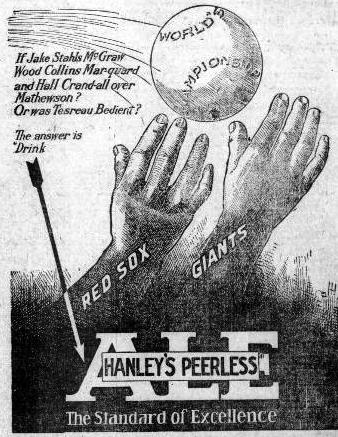
An advertisement for Hanley’s Peerless Ale, from the James Hanley Brewing Company in Providence, Rhode Island, which appeared on the eve of the 1912 World Series:

“If Jake Stahls McGraw

Wood Collins Marquard

and Hall Crand-all over

Mathewson?

Or was Tesreau Bedient?

The answer is

Drink.”

Jake Stahl’s Boston Red Sox defeated John McGraw and the New York Giants four games to three in an eight-game series that included an 11-inning 2-2 tie in game two.

Hugh Bedient was 1-0 for Boston with a 0.50 ERA in 18 innings

Hugh Bedient was 1-0 for Boston with a 0.50 ERA in 18 innings


Jeff Tesreau 1-2 with a 3.13 ERA in 23 innings for the Giants

Jeff Tesreau 1-2 with a 3.13 ERA in 23 innings for the Giants

Lost Advertisements–Ed Sweeney for Sweet Caporal

15 Jan

sweeneyad

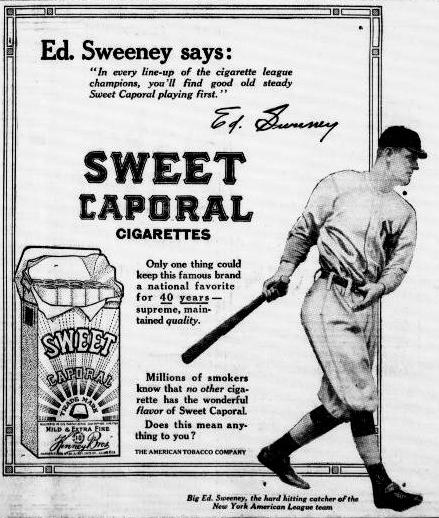
A 1914 advertisement for Sweet Caporal Cigarettes featuring New York Yankee catcher Ed “Jeff” Sweeney:

“In every line-up of the cigarette league champions, you’ll find good old steady sweet Caporal playing first.”

Three years later, while playing for the Toledo Iron Men in the American Association, Sweeney told a reporter about his former teammate Russell Ford, and the development of the Emery Ball.

Sweeney and Ford were teammates with the Atlanta Crackers in the Southern Association in 1907:

“One day while Sweeney was catching Ford in a warm up stunt before a game Russ made a wild peg and the ball bounded into a concrete pillar.

“‘I didn’t know anything about it,’ explains Sweeney, “but after that, I noticed the ball breaking in a peculiar way.  I remarked about it to Ford, but he didn’t appear interested.  I never saw (Ford throw it) again that season.

“‘I was purchased that summer by the Yankees (he joined the team in 1908).  Owner (Frank) Farrell came to me one day and asked who was the best pitcher in the Southern Association.  I told him Ford.  And Russ was drafted.'”

After an unsuccessful one-game trial with Yankees in 1909, Ford spent the remainder of the 1909 season with the Jersey City Skeeters in the Eastern League.  When Sweeney and Ford were reunited the next spring with the Yankees, Ford told the catcher he “‘(H)ad a ball no catcher in the world could receive.  I laughed at him but he persisted.'”

Sweeney said Ford “‘took me into his confidence'” and explained his new pitch, Ford told Sweeney that day in Atlanta he noticed the effect the damage caused by the ball hitting the concrete post had on his ability to make it curve, and he continued experimenting:

“‘Russ showed me a little leather ring that he slipped over a finger of his left hand…All he had to do was to scratch the ball with the emery, that was pasted to the leather…The bigger the scratch the greater the freak jumps the ball would take…He would fake a spitter, and nobody ever got wise.  When he pitched he always requested that I catch him.’

“‘When Russ threw the ball with runners on or in pinches, no batter in the world could hit it.  Once in while somebody did, but it was by accident…I’ve seen batter after batter miss the ball a foot.'”


Lost Advertisements–The $30,000 Battery

30 Dec

otoolead

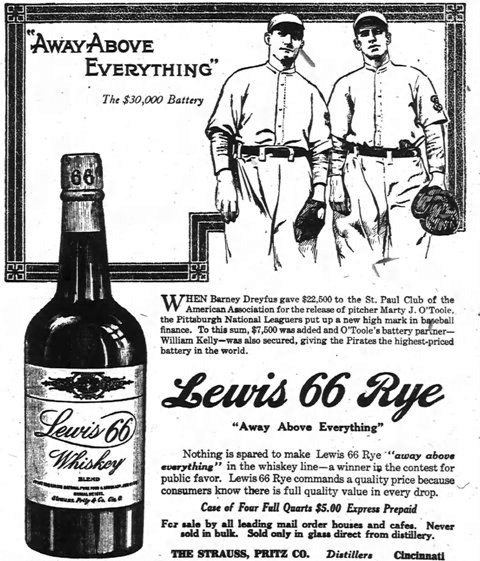
An advertisement from the spring of 1914 for Lewis 66 Rye from The Strauss, Pritz Co., of Cincinnati:

“When Barney Dreyfus gave $22,500 to the St. Paul Club of the American Association for the release of pitcher Marty J. O’Toole, the Pittsburgh National Leaguers up a new high mark in baseball finance.  To this sum, 7,500 was added and O’Toole’s battery partner–William Kelly–was also secured, giving the Pirates the highest priced battery in the world.”

The price paid for Kelly remains a matter of dispute.  The New York Times said he was acquired “for less than $5,000.”  The Washington Post put the price at $10,000 while The Pittsburgh Gazette Times, The Pittsburgh Press and The Associated Press said it was $12,500.


Kelly and O'Toole

Kelly and O’Toole

O’Toole posted a 24-27 record from 1911-1913.  He struggled in 1914, and with a 1-8 and record and 4.68 ERA in August, he was sold to the Giants, in 10 appearances with new York he was 1-1 with a 4.24 ERA.  Dreyfus’ “$22,500 Beauty,” was done as a major leaguer at 25 years old, seven months after the ad appeared.  He played four more seasons in the American Association and Western League; his professional career was over before his 30th birthday.

Kelly’s big league career was over before the ad came out.  In three seasons with Pittsburgh, he appeared in 104 games and batted .290, but was sold to the Toronto Maple Leafs of the International League at the end of 1913 season.  The Pittsburgh Press said the sale came as no surprise:

“Kelly came here from St. Paul with Marty O’Toole, but he has not developed as was expected of him, and has long been rated as considerable of a disappointment. It looks very much as if he were just a trifle shy of major league calibre.”

Kelly played four years in Toronto, hitting .227 in 280 games; his professional career was over at age 31.


Lost Advertisements–An Excellent Christmas Gift

25 Dec

???????????????????????????????

A 1916 advertisement for the World’s Series Baseball Game from the United Games Company:

“Every play known to baseball can be made on this game.  Pitch a Straight or Curved Ball, Bunt or Hit ‘Em Out, and Steal Bases as you think best.  Don’t matter whether you know real baseball or not–you’ll soon like this game…”

An Excellent Christmas Gift

“Read this letter from a ‘World’s Series’ Fan:  ‘I am sending to you for another of your World’s Series Baseball Games.  I bought one of these games last summer and was delighted with it.  My father, who was never a baseball enthusiast became a rabid fan at this game, as did the whole family to such an extent that I was unable to get the game when I wished it.'”

Lost Advertisements–Cubs, White Sox and Whales Endorse Steele’s Game of Baseball

18 Dec

steeles

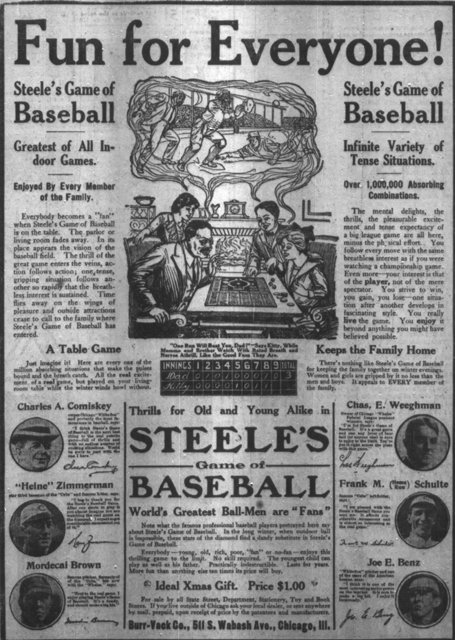
A 1915 advertisement for Steele’s Game of Baseball, a table-top game which claimed to have “Over 1,000,000 absorbing combinations,” and promised that the player would “enjoy it beyond anything you might have believed possible:”

Greatest of All Indoor Games

“Everybody becomes a ‘fan’ when Steele’s Game of Baseball in on the table.  The parlor or living room fades away.  In its place appears the vision of the baseball field.  The thrill of the great game enters the veins, action follows action; one tense, gripping situation follows another so rapidly that the breathless interest is sustained.  Time flies away on the wings of pleasure and outside attractions cease to call to the family where Steele’s Game of Baseball has entered.”

The game was produced by the Burr-Vack Company, a Chicago-based office supply dealer, and received glowing endorsements from members of the city’s three teams:

World’s Greatest Ball-Men are “Fans

Charles A. Comiskey owner Chicago ‘White Sox’ and probably the most famous man in baseball, says: ‘I think Steele’s Game of Baseball is the next best thing to the real outside game–full of thrills and with an endless number of exciting situations.  Would be sorry to part with the one I have.’

“‘Heine’ Zimmerman third baseman of the ‘Cubs’ and famous hitter says: ‘I  beg to thank you for the Steele’s Baseball Game.  After one starts to play it you almost imagine you are watching the real game on the diamond.  I expect to get considerable amusement out of it.’

Mordecai Brown famous pitcher, formerly of the ‘Cubs’ but now with the ‘Whales’ says: ‘Next to the real game, I enjoy playing Steele’s Game of Baseball.It’s a dandy and should make a big hit.’

Chas. E. Weeghman owner of Chicago ‘Whales’ Federal League pennant winners says, ‘I’m for Steele’s Game of Baseball.  It’s a great game and one any lover of baseball (or anyone else) is sure to enjoy to the limit.  You’ve put it right across the plate with this game.’

Frank M. (Home Run) Schulte famous ‘Cubs’ left fielder says: ‘I am pleased with the Steele’s Baseball Game you sent me.  It affords considerable amusement and is almost as interesting as the real game.”

Joe Benz ‘White Sox’ pitcher and one of the stars of the American League, says, ‘I think it is one of the most interesting parlor games on the market.  It is sure to make a big hit. I enjoy it immensely.'”

[…]

“Note what the famous professional baseball players portrayed here say about Steele’s Game of Baseball.  In the long winter, when outdoor ball is impossible, these stars of the diamond find a dandy substitute in Steele’s Game of Baseball.”

Despite the endorsements, the “Ideal Xmas Gift,” which cost one dollar and was “For sale by all State Street, Department, Stationary, Toy, and Book stores,” appears to have quickly disappeared–there are no mentions of the game in newspapers after 1915.

Cuban X-Giants In Washington D.C., 1901

7 Dec

xgiants

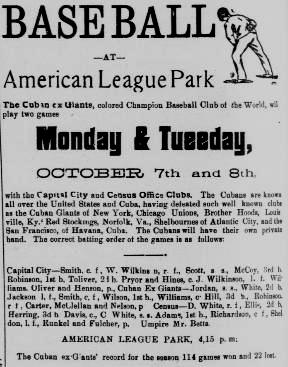
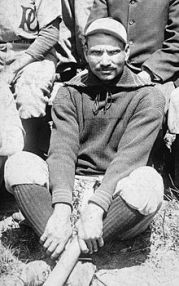
A 1901 advertisement for the Cuban X-Giants, managed by Soloman “Sol” White, in Washington D.C.  The team played the Capital City–described by The Washington Times as “a contingent of colored ball players of this city,” and the team representing the United States Census Bureau at American League Park.

Sol White

Sol White


According to the ad:

“The Cubans are known all over the United States and Cuba, having defeated such well-known clubs as the Cuban Giants of New York, Chicago Unions, Brother Hoods, Louisville, KY. Red Stockings, Norfolk, VA., Shelbournes of Atlantic City, and the San Francisco, of Havana Cuba.  The Cubans will have their own private band.”

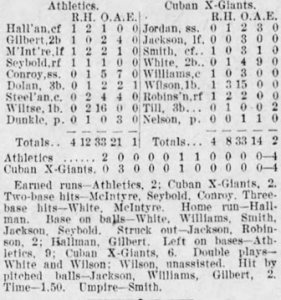
The previous week, the X-Giants played an 11-inning tie with the Philadelphia Athletics at Columbia Park–although the Athletics three biggest stars, Napoleon Lajoie, Harry Davis and Lave Cross did not participate, The Philadelphia Inquirer said, “Both teams put up a splendid article of ball and the game resulted in one of the best that has been played on the grounds this season.”

The Philadelphia Times was even more enthusiastic:

“The game itself was beyond all doubt one of the greatest ever witnessed upon the local diamond.”

The 11-inning tie against the Athletics

The 11-inning tie against the Athletics

The ad said the club had won 114 games and lost just 22 in 1901, and described them as the “Colored Champion Baseball Club of the World.”  In both 1900 and 1901 the X-Giants and the Cuban Giants each claimed to be “Colored Champion.”

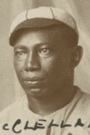
In addition to Sol White, the roster included, Robert Jordan, Ray Wilson, Clarence Williams, John Nelson, Danny McClellan, Will Jackson, Johnny Hill, Robert “Ginney” Robinson, and Charles “Kid” Carter.

The X-Giants won both of the advertised games.  The victory over the Capital City club was of such little note that no newspaper mentioned the score.  The Washington Colored American simply said the X-Giants “Played stars and circles around the Capital Cities.”

They also beat the Census Department 8 to 0.  The Washington Times said:

“The visitors had things their own way throughout the game, and at no time were they in danger of being defeated.  They had a twirler (McClellan) in the box that knew the fine points of the game.  He struck out nine of the localities and allowed but two of them to get the slightest semblance of a safe hit off his cannon ball delivery.”

Danny McClellan

Danny McClellan

The X-Giants beat one more local team, the Eastern Athletic Club, on October 9, and left the nation’s capital 117-22.


Lost Advertisements–Walter Johnson Car Ads

9 Nov

johnsoncolecar

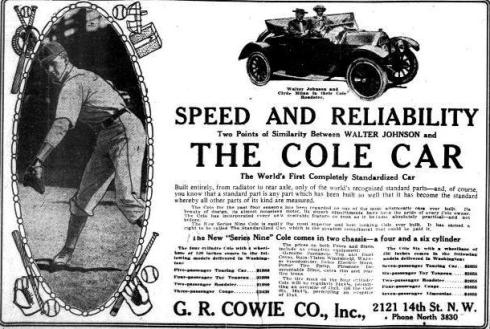
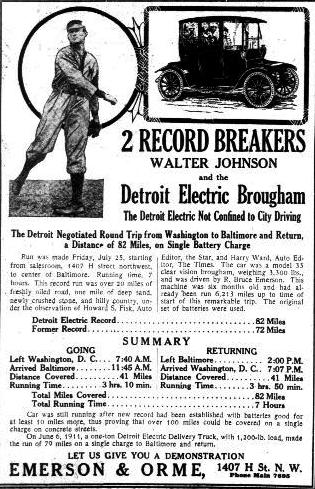
Two 1913 advertisements for automobiles featuring Walter Johnson.

Above, an ad for a Washington D.C. Cole dealership–the picture at the top is of Johnson and outfielder Clyde Milan “In their Cole Roadster”:

Speed and Reliability

Two points of similarity between Walter Johnson and 

The Cole Car

The world’s first completely standardized car

The second ad, below, is for the local Detroit Electric dealership:

2 Record Breakers

Walter Johnson 

and the

Detroit Electric Brougham

johnsondetroitelectric

Johnson remained on the mound longer than Cole stayed in business; the car maker closed in 1925.  Detroit Electric continued building cars until 1939 and the company was revived in 2008.

Lost Advertisements–“Fireball” Johnson

30 Oct

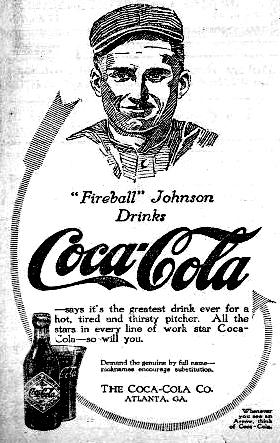
walterjonsoncoke1915

“‘Fireball’  Johnson Drinks Coca-Cola–Says it’s the greatest drink ever for a hot, tired, and thirsty pitcher. All the stars in every  line of work star Coca-Cola–so will you.”

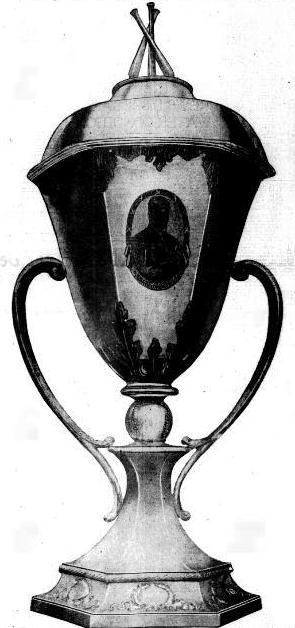
In 1913, The Washington Times presented Walter Johnson with a cup honoring him as “Greatest Pitcher in the World,” and published a special section including quotes from his contemporaries:

Cup presented to Johnson by The Washington Times

Cup presented to Johnson by The Washington Times

Napoleon Lajoie:

“I like to bat against Johnson.  There’s some satisfaction hitting against a hurler of such pronounced class.  When I make a hit off Johnson I know it’s well-earned, and the sound of a good, solid swat made off one of Walter’s curves is the most welcome music I hear during the season.”

George Stovall:

“I consider Walter Johnson the greatest pitcher in the game today and one of the finest fellows on and off the ball field.”

Nixey Callahan:

“You may say anything good for me regarding Walter Johnson that you care to. I consider him one of the greatest pitchers that the game has ever known and an ornament to the profession in every way.”

Russ Ford:

“He is the King Pin of them all, and yet remains just the same quiet, good fellow who broke in six years ago.”

Joe Birmingham

“May your curve always break and your speed never diminish.”