Tag Archives: Lost Advertisements

Lost Advertisements–American Giants in Nashville

16 Oct

1913amgiants

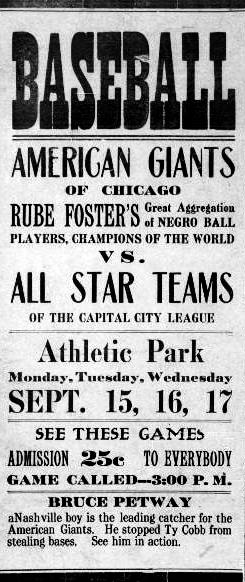
A 1913 advertisement for a three-game series in Nashville between the Chicago American Giants and “all-star teams” comprised of players from the city’s semi-pro league:

Rube Foster‘s Great Aggregation of Negro Ball Players, Champions of the World vs.  All Star Teams of the Capital City League

The games were scheduled for Nashville’s Athletic Park (Sulphur Dell), on September 15, 16, and 17.

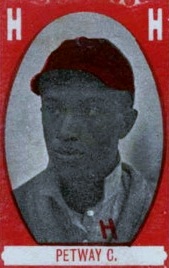
In addition to Foster, the primary drawing card was Bruce Petway:

“A Nashville boy is the leading catcher for the American Giants.  He stopped Ty Cobb from stealing bases.  See him in action.”

The Cobb reference is from the 1910 tour of Cuba by the Detroit Tigers–depending on the source, Petway playing for the Havana Reds threw Cobb out attempting to steal between one and three times.

petway

The American Giants with “Big Bill” Gatewood on the mound won the first game of the series 12 to 1.

The next two games were rained out and were rescheduled as a September 19 doubleheader.  Bill Lindsey beat the locals 6 to 5 in the first game and Foster shut them out 4 to 0 in the second.


Lost Advertisements–Mike Donlin, Sweet Caporal

9 Oct

donlincaporal

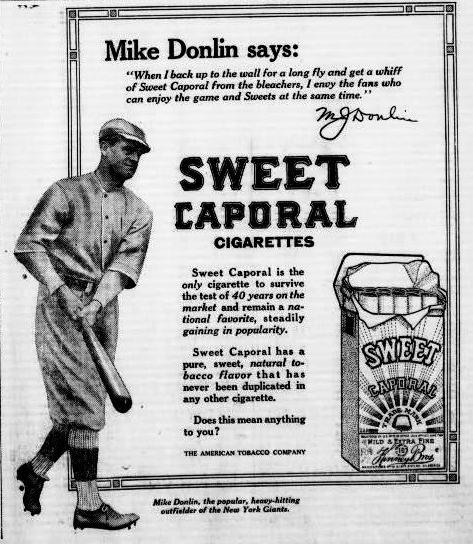
A 1914 advertisement for Sweet Caporal Cigarettes featuring Mike Donlin:

“When I back up to the wall for a long fly and get a whiff of Sweet Caporal from the bleachers, I envy the fans who can enjoy the game and Sweets at the same time.”

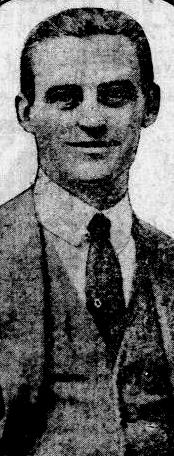
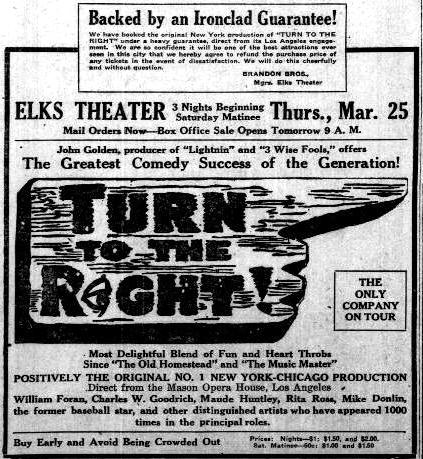
While appearing on stage in a play called “Turn to the Right” at the Elks Theater in Phoenix in 1920, Donlin, six years removed from the major leagues, talked to a reporter from The Arizona Republican about the differences between his old and new careers:

Donlin

             Donlin

“‘Mr. Donlin which do you like best, baseball or the stage?’  It wasn’t necessary for him to answer that question with mere words.  The shrug of almost disdain for his present profession answered it eloquently.

“‘Well you can’t play ball all your life,’ he answered.  ‘I messed around in vaudeville, you know how an athlete can always do that, and when I got ready to quit I naturally headed for the stage.  It’s a good life that that, and of course playing ball is a lot easier especially as far as making mistakes is concerned.  On the stage if you make a mistake, some one will cover it up for you and no one is the wiser, but when you are in a ball game and you pull a boner, look out, someone is going to land on you hard and you don’t have much comeback.

“I could have stayed in baseball if I had desired.  Could have been there yet coaching the youngsters, but sooner or later I would be done and when you are done in that game you are through and that’s all there is to it.  There is nothing left for you to do.  But now I have a permanent proposition and can string along as long as I am able to totter across the boards.”

While in Phoenix, Donlin took part in a baseball game, playing for the Elks Theater team against a local industrial league team.  Donlin told the reporter:

“There’s one good game of ball left in everyone.  I don’t dare go out and practice.  If I did I wouldn’t be able to play, but I;ll last through that game and show them all I can still lean on the pill occasionally.”

The paper didn’t report the result of the game.

Advertisement for "Turn to the Right" at the Elks Theater in Phoenix

Advertisement for “Turn to the Right” at the Elks Theater in Phoenix

Lost Advertisements–PM Whiskey, “Rube Waddell, The One-Man Ball Team”

2 Oct

waddellad

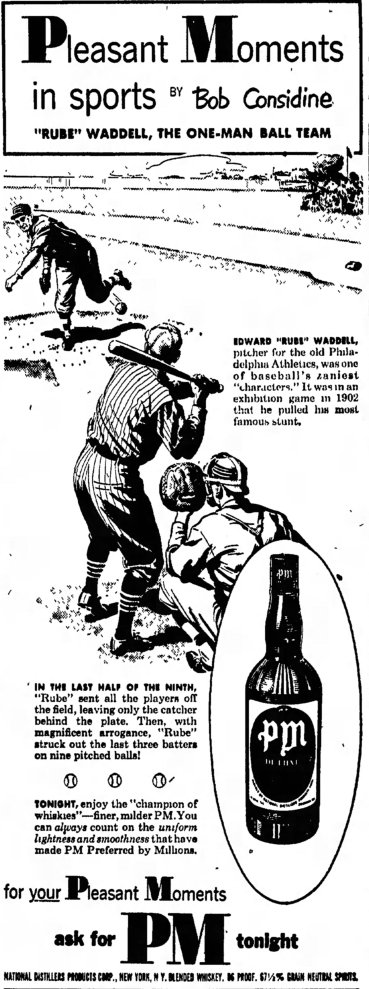
A 1951 advertisement for PM De Luxe Blended Whiskey–part of a series of ads featuring “Pleasant Moments in Sports,” stories from Bob Considine, co-author with Babe Ruth of the “The Babe Ruth Story.”

This one features an oft-told Rube Waddell legend:

“Edward ‘Rube’ Waddell, pitcher for the old Philadelphia Athletics, was one of baseball’s zaniest ‘characters.’  It was in an exhibition game in 1902 that he pulled his most famous stunt.

“In the last half of the ninth, ‘Rube’ sent all his players off the field, leaving only the catcher behind the plate. Then with magnificent arrogance, ‘Rube’ struck out the last three batters on  nine pitched balls.”

As with all Waddell stories, there was some truth and a good deal of embellishment in Considine’s account.  While the contemporary coverage of the game differs on some aspects of the performance, they all agree that Waddell pitched to just one batter after members of the team left the field in the ninth inning.

The game in question was played in 1903 at Steelton, Pennsylvania against that town’s YMCA team. The Athletics won easily, 10 to 2, and Waddell pitched the eighth and ninth innings for Philadelphia.

The Philadelphia Inquirer said:

“Waddell was the entertaining feature of the match, and in the last inning called in all the infielders after two men were out.”

The Harrisburg Daily Independent, which provided more in-depth coverage of the game, said:

“Rube Waddell was in all his glory at Steelton yesterday and his funny antics before and during the game were well worth the price of admission.”

The paper said before the game Waddell entertained the fans chasing “flies in the hills until he was perspiring,” and spent part of the early innings taking a “nap in his private carriage which carried him from (Harrisburg) to Steelton.”
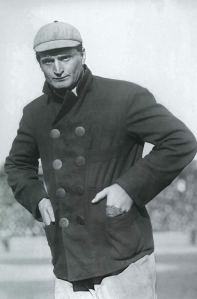
rube

Waddell

As for his time on the mound, the paper said Waddell struck out the first two batters he faced in the eighth, then after getting two strikes on the third batter, named “Irish” McManigal:

“(W)hen he pitched the third ball (he) remarked, ‘Take your seat.’ ‘Irish,’ however, surprised the Rube and rapped out a pretty single to center field.”

Waddell gave up another hit in the eighth and the YMCA scored a run.

“The next inning Rutherford hit to Waddell and the Rube did a cake walk to first base to catch Rutherford.  Berry then hit to Monte Cross, but he threw wild to first and Berry reached third base.  Then the Reuben settled down and struck Lawlor out.”

The Daily Independent said Waddell did not call in the fielders, but instead, on their own:

“The Athletic players behind Waddell left the field and with a man on third base he and (Ossee) Schreck (Schrecongost) were left to put out the side.

“The Rube did not know his teammates had deserted him and when told to look around by Schreck he discovered the fact.  Then to make more complete the comedy Schreckengost [sic] sat down and the Rube struck out Albright while the crowd howled with merriment.”

The Harrisburg Telegraph provided a third set of contemporaneous “facts:”

“In the last inning when two men were out all the Athletics left the field except Waddell, Powers and L. Cross.”

The paper likely misidentified Schrecongost as Michael “Doc” Powers–Schrecongost had replaced him behind the plate in the eighth, and Lave Cross had already left the game–so the player who stayed on the field might have been shortstop Monte Cross.  The Telegraph also added another detail missing in the other reports:

“(Waddell) gave the batter three balls and the crowd was wild, but their last hope faded rapidly away as Rube put three fine ones over the plate and the striker was out.”
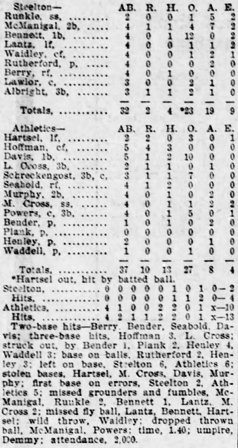
The Box Score

The Box Score

Considine likely cribbed his version from Harry Grayson, the sports editor of The Newspaper Enterprise Association syndicate.  Grayson told the three-batters-nine-pitches story several times throughout the forties, and that legend stuck.


Lost Advertisements–Larry McLean for Sweet Caporal

25 Sep

mclean

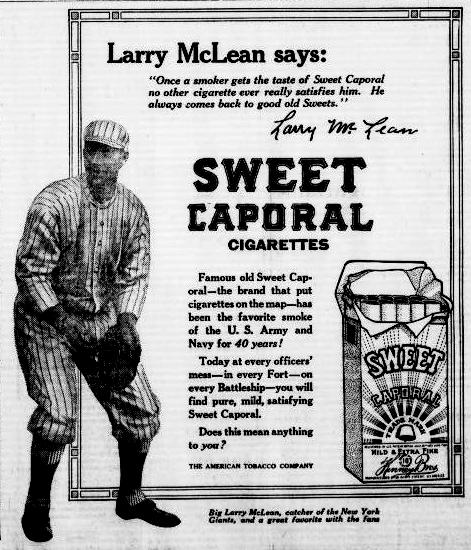
A 1914 Sweet Caporal Cigarette advertisement featuring New York Giants catcher Larry McLean “a great favorite of the fans:”

“Once a smoker gets the taste of Sweet Caporal no other cigarette ever really satisfies him.  He always comes back to good old Sweets.”

McLean wore out his welcome in New York and ended his major league career the following season when he fought with Manager John McGraw, and McGraw’s right-hand man, “Sinister Dick” Kinsella in the lobby of the Buckingham Hotel in St. Louis.

It was hardly the first controversy for McLean, who battled–albeit not physically–with every manager he played for during his 13-year-career.  Sam Crane, the sports writer and former infielder, summed up McLean well in a 1910 article for “Pearson’s Magazine:”

“Larry McLean, of the Cincinnati Reds, as a mere mechanical catcher is hard to beat.  He has a splendid arm and can throw like a streak.  Larry is too, perhaps, the best batting catcher in either league, but his erratic habits make it impossible to place any confidence in him.”

Larry McLean

                                  Larry McLean

A year earlier, in May, McLean had deserted the Reds during an East Coast trip and was “suspended indefinitely” by Manager Clark Griffith, who told The Cincinnati Enquirer:

“When you have a man who is liable to run out at the first call of the wild, you are in an uncertain position all the time. I am perfectly free to say that I might not take McLean back on the team at all, and certainly not until he shows me that he means business.”

McLean was back in the lineup within days, and as he did throughout his career, pledged to a reporter from The Cincinnati Times-Star that he would “(C)onduct himself properly from now on.”

It was a pledge McLean made and broke several times throughout his career which ended at age 33.  He would be dead six years later, the result of a fight in a Boston bar.


Lost Advertisements–“162,859 Excited Fans”

7 Sep

mecca

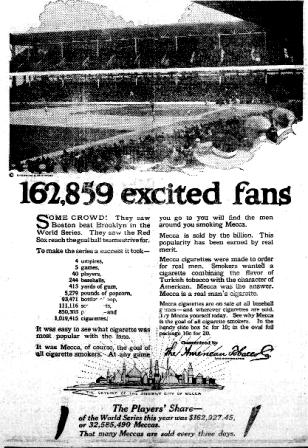
An advertisement for Mecca Cigarettes that appeared shortly after the 1916 World Series:

162,859 Excited Fans

“Some Crowd!  They saw Boston beat Brooklyn in the World Series.  They saw the Red Sox reach the goal ball teams strive for.”

The Red Sox won the series 4 games to 1–Babe Ruth won one, a 14-inning complete game, and Ernie Shore won two, the first and fifth games.

Babe Ruth and Ernie Shore

          Babe Ruth and Ernie Shore

“To make the series a success it took–

4 umpires,

5 games,

40 players

244 baseball,

413 yards of gum,

5,279 pounds of popcorn,

93,471 bottles of pop,

111,116 score cards,

850,303 peanuts–and

1,019,415 cigarettes…

The Players’ Share–of the World Series this year was $162,927.45, or 32,585,490 Meccas.

That many Meccas are sold every three days.”

Winners shares for the Red Sox were $3,910.26, the Robins losing shares were $2,834.82.

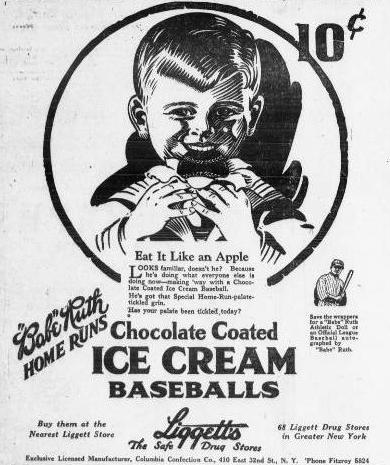
Lost Advertisements–“Babe Ruth Home Runs”

4 Sep

ruthbbs

By 1922, Babe Ruth‘s name and image were used to sell dozens of products.  The above ad was for “Babe Ruth Home Runes Chocolate Covered Ice Baseballs.,” with the suggestion to “Eat it like an apple.”

“Save the wrappers for a ‘Babe’ Ruth Athletic Doll or an Official League Baseball autographed by ‘Babe’ Ruth.”

The ice cream was available at 68 New York area Liggett’s, “The Safe Drug Stores,” locations.

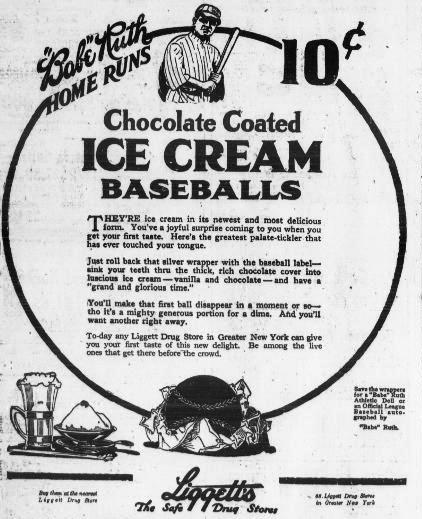
Below, is a second “Home Runs” ad featuring Ruth:

babeic


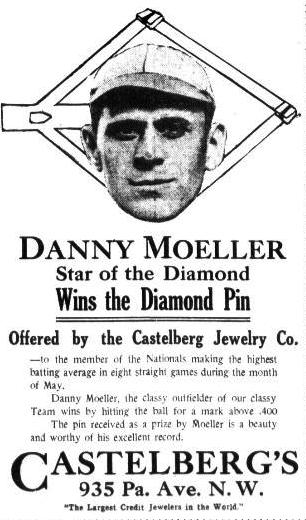
Lost Advertisements–Danny Moeller Star of the Diamond

19 Aug

danny

A 1912 advertisement for Castelberg’s Jewelry Company in Washington D.C., featuring Senators right fielder Danny Moeller:

Danny Moeller

Star of the Diamond

Wins the Diamond Pin

On May 1, the jewelry store announced a contest in The Washington Times:

“Beginning today the sluggers begin their battle for the handsome ruby-diamond stick pin offered by the Castelberg Jewelry Company to the batsman of the local outfit who leads with the willow for the month of May…to win the prize a player must participate in at least eight games.”

Throughout the month, the paper kept readers informed with updates of the standings.

Moeller and third baseman Eddie Foster led most of the way.  Moeller, who hit .276 for the season, his .414 during May to win the contest.  Foster was second at .380–he hit .285 for the year.  Clyde Milan (.320), Clarence “Tillie” Walker (.300), and Eddie Ainsmith (.282) followed.

“Danny Moeller, the classy outfielder of our classy team wins by batting the ball for a mark above .400

“The pin received as a prize by Moeller is a beauty and worthy of his excellent work.”

Moeller’s best season was in 1912.  He hit just .243 over seven big league seasons but was a fan favorite for his toughness.

Moeller

Moeller

The Times gave readers an example of his toughness during a game with the Philadelphia Athletics two years later in May of 1914:

“In sliding into second base in the fourth Moeller dislocated his left shoulder and it looked as though he might be out for some time.

“The player walked to the bench with the fin hanging limp and asked (trainer) Mike Martin to help him out.  Martin took one yank, the affected member popped back to its proper place, and Moeller sprinted back onto the field and onto second base.  It was an evidence of the gameness of which those who know Moeller realize.”

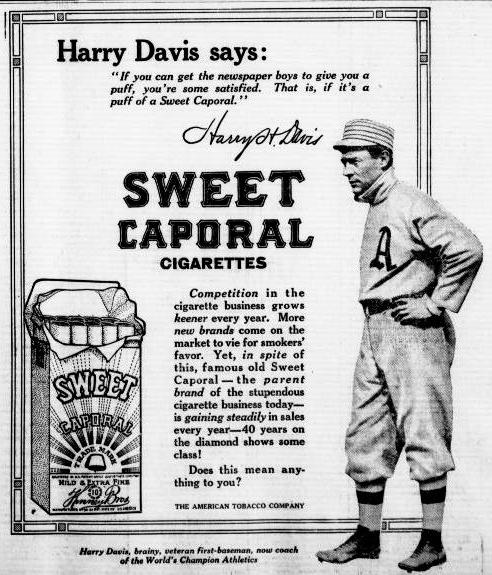
Lost Advertisements–Harry Davis for Sweet Caporal

17 Jul

harrydavis

A 1914 advertisement for Sweet Caporal Cigarettes featuring Philadelphia Athletics Coach–sometimes referred to as the team’s “Assistant Manager” after their 1913 World Championship– Harry Davis:

Harry Davis says:

“If you can get the newspaper boys to give you a puff, you’re some satisfied.  That is if it’s a puff of Sweet Caporal.”


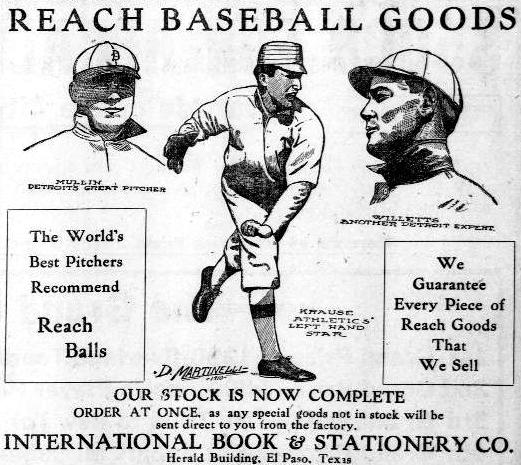
Lost Advertisements–“The World’s Best Pitchers Recommend…”

8 Jul

adreach

A 1910 advertisement for Reach Baseball Goods  “The World’s Best Pitchers Recommend Reach Balls”–from International Book & Stationary Co. in El Paso, Texas.  The ad features “Detroit’s Great Pitcher,” George Mullin, “Another Detroit Expert,” Ed Willett (Misspelled Willetts in the ad), and “Athletics’ Left Hand Star,” Harry Krause.

In 1909, the 20-year-old Krause, who had been 1-1 in four appearances with the Athletics in 1908, became the talk of baseball when he opened the season with 10 straight victories–including six shutouts.  A San Francisco native who played under Hal Chase and was a teammate of Hall of Famer Harry Hooper at St. Mary’s College, Krause was asked by The Oakland Tribune what led to success:

“That’s easy.  A capable manager in Connie Mack, one of the best pitching tutors in the world in Ed Plank, fairly good control on my part and lots of luck.”

The Tribune‘s scouting report on Krause:

“He has a good curve, but many pitchers in the league have a better one.  He has speed, but any number of American League twirlers have more smoke than he.  However, there are very few twirlers, whether right or left-handers, who can equal him in control of the ball.

“He doesn’t appear to have much to the opposing batters when they first face him, but when the game is over they wonder how it came to pass that he let them down with three or four hits and no runs.”

Harry Krause

Harry Krause

On July 18 his luck ran out, Krause dropped his first game of the season, an 11-inning, 5 to 4 loss to the St. Louis Browns.

He went just 8-7 (with one shutout) the rest of the season, but led the league with a 1.39 ERA.

He appeared in only 55 more games over three seasons, winning 17 and losing 20, before a sore arm ended his major league career at age 23.

He finished the 1912 season in the American Association with the Toledo Mud Hens, then returned to California and pitched for 15 seasons in the Pacific Coast League (with a one-season detour to the western League), where he won 230 games.

Lost Advertisements–The Big Train for Coca-Cola

12 Jun

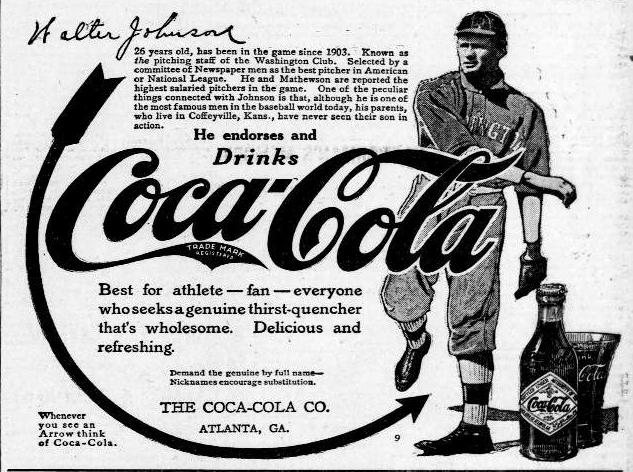
bigtrainA 1915 advertisement for Coca-Cola featuring Walter Johnson.

“26 years old (Johnson was 27 when the ad appeared, but fact-checking was a bit loose in ads of the era)  has been in the game since 1903, Selected by a committee of newspaper men as the best pitcher in American or National League.  He and Mathewson are reported the highest salaried pitchers in the game.  One of the peculiar things connected with Johnson is that, although he is one of the most famous men in the world today, his parents, who live in Coffeyville, Kans. have never seen their son in action.”