Tag Archives: Lost Advertisements

Lost Advertisements–Jimmy Austin for Farmers and Merchants Bank

7 Nov

austin


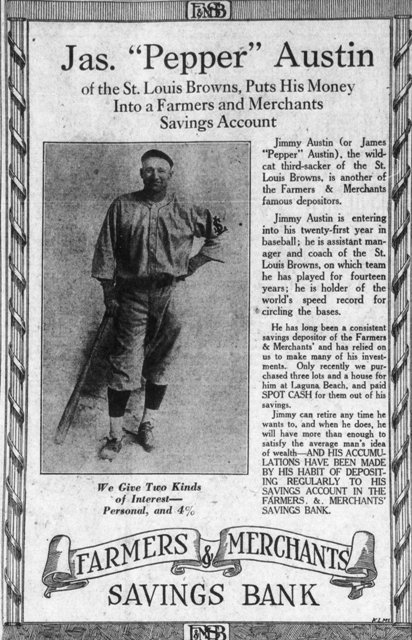
A 1924 advertisement for Southern California-based Farmers & Merchants Bank featuring Jimmy Austin:

Jimmy Austin (or James “Pepper” Austin), the wild-cat third-sacker of the St. Louis Browns, is another of Farmers & Merchants famous depositors.

Jimmy Austin is entering into his twenty-first year in baseball; he is assistant manager and coach of the St. Louis Browns, on which team he has played for fourteen years; he is holder of the world’s speed record for circling the bases.

He has long been a consistent savings depositor of the Farmers & Merchants’ and has relied on us to make many of his investments.  Only recently we purchased three lots and a house for him at Laguna Beach and paid Spot Cash for them out of his savings.

Jimmy can retire anytime he wants to, and when he does, he will have more than enough to satisfy the average man’s idea of wealth–And his accumulations have been made by his habit of depositing regularly to his savings account in the Farmers  Merchants Bank

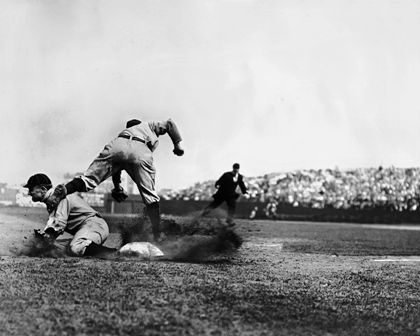
Austin is probably best known for being the third baseman in the famous 1909 Charles Conlon photograph of Ty Cobb sliding.

Conlon's 1909 photograph

Conlon’s 1909 photograph

In 1930 Conlon–then a proofreader for The New York Telegram–told  the story of how he came to capture what the paper called “the greatest baseball action picture ever taken.”

“Cobb was running wild on the bases that year, and the Tigers were fighting for a pennant.  I used to spend a lot of time down near third base chatting with Jimmy Austin who was a good friend of mine.

“Ty had worked his way down to second that day and the batter was trying to bunt.  As the pitcher’s arm went back to throw the ball Cobb sped for third.  Austin backed into the bag for the throw and Cobb hurled himself into the dirt, spikes flying.

“My first thought was that my friend Austin was going to be cut down by the Georgian.  I stood there motionless with my box in my hand.  I saw a blur of arms and legs through a screen of flying dirt It was a bright day and I could see Cobb’s lips grimly parted and the sun glinting off his clenched teeth.

“Austin never got his hands on the catcher’s throw.  He was knocked over.  He wasn’t hurt, however, and I was relieved because we were pretty good friends.

“Then I began to wonder if by any chance I had snapped the play.  I couldn’t remember, but I decided to change plates anyway.  It was lucky that I did, because when I printed up my stuff that night, there was the whole thing, as plain as day.”


Lost Advertisements–George Gibson for Coca-Cola

13 Oct

gibsoncoke

Pittsburgh Pirates Catcher George Gibson was coming off one of the most impressive seasons ever–he caught in 134 straight games and a total of 150 for the World Series Champions–when this advertisement appeared:

George Gibson of the Pittsburgh Nationals

(Champions of the World)

led the league as a catcher with a percentage of .983 and caught more games than any other catcher last year.  He writes us that he is enthusiastic about Coca-Cola.  You, too, will like Coca-Cola, because it relieves fatigue, refreshes, quenches the thirst and is absolutely wholesome.

The Coca-Cola Company wanted to attribute Gibson’s iron man performance in 1909 to his choice of beverage, but before the season Gibson, from his home in London, Ontario wrote to Barney Dreyfuss, Pirates president and told him about his secret for getting in shape for the campaign.  The Pittsburgh Dispatch printed the letter:

I had a letter from (Pirate outfielder John) Chief Wilson the other day.  All he writes about is hunting.  He says the quails are so thick down where he is (Bertram, Texas) that you have to cut a path through them when you go hunting.  Nothing like that up here.  I have seen a lone jack rabbit this season and I have been chasing him to keep in condition, but to date I have not captured him.  He is the limit for speed.  One jump and he lands in the next town.  He would make a good trainer.  If I can catch him alive I will take him to Hot Springs and let the boys get in condition by chasing him.”

Lost Advertisements— “The Baseball Curver”

11 Jul

Less than twenty years after the introduction of the curveball entrepreneurs found a way to separate people who wanted to throw a curveball from their money.

In 1888 ads began to appear in newspapers from Joseph H. Burns of Cleveland:

“Can you throw a baseball?  If so, fifteen minutes practice with the Baseball Curver will enable you to pitch all the Curves as well as any Professional pitcher.  Sent postpaid on receipt of 75 cents”

1888 Baseball Curver advertisment

1888 Baseball Curver advertisement

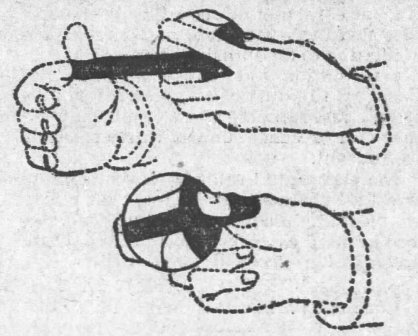
Burns applied for a patent which was awarded in December of 1890; several newspapers ran a wire service story about the patent:

“The ‘delivery of a baseball so that the batsman shall be deceived into ‘striking out’ has been made the subject of much study by expert pitchers, and a device is here illustrated for giving the ball the ‘curve’ which is especially effective.  It consists of an elastic strap having a thumb-loop at one end and connected at its opposite end to a segment of a sphere, the latter being shaped to receive a section of the ball.”

Burns' patented "Curver"

Burns’ patented “Curver”

Burns’ invention was not the last “Curver.”

In 1907 advertisements appeared for a “New Idea,” “Baseball Curver,” offered by the Curver Co., of Omaha  which called theirs the:

“Greatest invention in baseball since the discovery of the curve.  It is so small the batsman cannot see it and they all wonder where those awful curves come from.  It imparts a rapid whirling motion to the ball thus causing a wide curve.  Fits either hand and does not interfere with catching or throwing.”

The “New Idea” Curver was a bargain compared to the version introduced two decades earlier.  It was 25 cents and came with “a large 64-page book of ‘Out Door Sports’ containing the 1907 rules for baseball.”  Three Curvers and three and three books were 50 cents.

The "New Idea," 1907

The “New Idea,” 1907

A patent for this version of the “Baseball Curver” was awarded in 1909 to Wilbur Ward Winquest of Nebraska.

Wilbur Winquest's patented "Curver"

Wilbur Winquest’s patented “Curver”

In 1912 another “Baseball Curver,’ the creation of another Nebraska inventor, Ralph Wilson Jones, was featured in the pages of “Scientific American:”

“Mr. Jones provides means in this case readily attachable to the hand for causing a ball to curve when thrown from the hand.  A vacuum cup is held in position by a band made of a size to fit a finger, but is preferably made of a size to fit two or more fingers so that the cup may be shifted or adjusted  nicely to any point for giving a great or small curve, or various kinds of curves.”

Ralph Jones' "Curver" as featured in "Scientific American"

Ralph Jones’ “Curver” as featured in “Scientific American”

Jones was also awarded a patent the same year.  It is unclear whether he ever marketed his invention.

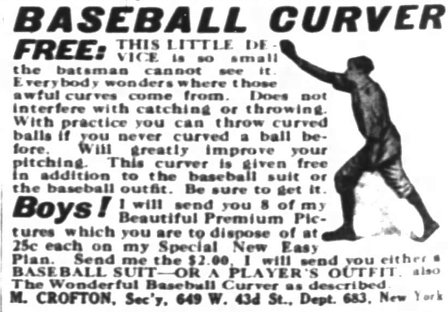
Another “Baseball Curver” was advertised in newspapers in 1913—it is unknown whether it is Jones’ invention, or a different version—by M. Crofton of New York, as a premium for selling, at 25 cents each, “8 of my Beautiful Premium Pictures.”  Children would receive the “Curver” as well as a “Baseball Suit—Or a Player’s Outfit,” after returning the two dollars earned from the sale of the pictures.

1913 "Baseball Curver" advertisement

1913 “Baseball Curver” advertisement

One final advertisement appeared in many papers in 1917; the ARDEA novelty company of Stamford, Connecticut offered said their version “Fits the hand, cannot be seen.”  The 1917 “Curver” was sold for 10 cents, or thee for 25 cents.

???????????????????????????????

1917 Baseball Curver

Lost Advertisements–“Lajoie Endorses Heptol Splits”

9 May

lajoieheptol

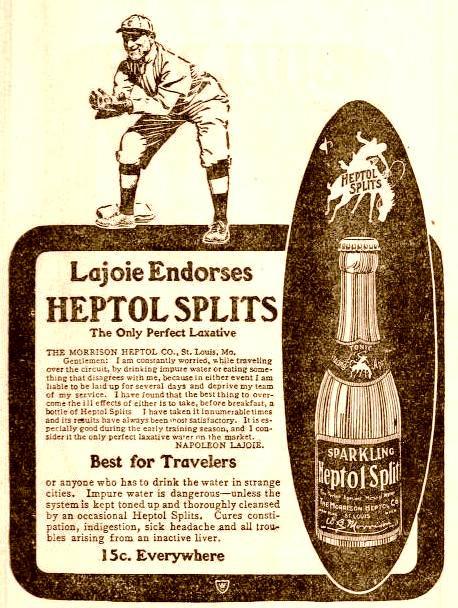
Cleveland Naps second baseman Napoleon Lajoie appeared in as many advertisements as any of his contemporaries during his career, including one for a “sparkling laxative.” This is a 1906 advertisement for Heptol Splits “The only perfect Laxative.”

“Gentlemen:  I am constantly worried, while traveling over the circuit, by drinking impure water or eating something that disagrees with me, because in either event I am liable to be laid up for several days and deprive my team of my service.  I have found that the best thing to overcome the ill effects of either, is to take, before breakfast, a bottle of Heptol Splits.  I have taken it innumerable times and its results have always been most satisfactory.  It is especially good during the early training season, and I consider it the only perfect laxative water on the market.”

The image of the cowboy on the bronco used for Heptol Splits’ logo was created by artist Charles Marion Russell.

Lajoie’s endorsement does not appear to have done much good for the brand which appears to have disappeared from drug store shelves within a couple of years.

A version of the advertisement appeared in the inaugural, 1906 edition of Napoleon Lajoie’s Official Base Ball Guide— an attempt  to compete with the Spalding and Reach Guides.

The 1906 Lajoie Guide

The 1906 Lajoie Guide


The Cleveland Press said upon the publication of the 1906 guide:

“”Lajoie’s Guide is especially interesting because it is the first work of this kind that has ever been attempted by a ball player while still in active service on the diamond…Lajoie is the champion batsman of the world and a great authority on the national game.  His book should find a ready sale.”

When Lajoie’s Guide ceased publication after the 1908 edition The Press said:

“After two years as editor of the American League Publishing Company, getting out the Lajoie Guide, he declares the others are too strong for competition, and only farm life for him in the winter months from now on.”

Lost Advertisements–The Biggest Baseball Offer Ever Made

25 Apr


billysullivan

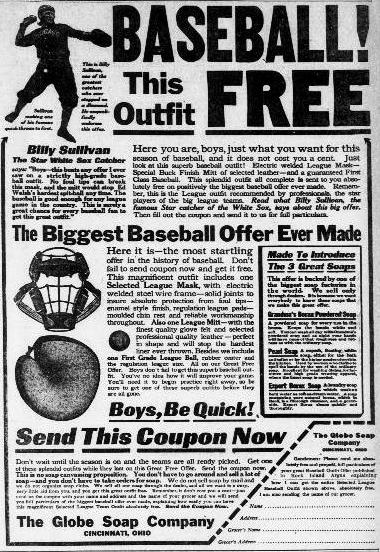
A 1912 advertisement for Globe Soap featuring Billy Sullivan of the Chicago White Sox:

Baseball

This Outfit Free

“This is Billy Sullivan, one of the greatest catchers who ever stepped on a diamond.  He unequally endorses this offer.

“Billy Sullivan The Star White Sox Catcher says: ‘Boys—this beats any offer I ever saw on a strictly high-grade baseball outfit.  No foul tips can break this mask, and the mitt would stop Ed Walsh’s hardest spit-ball any time.  The baseball is good enough for any league game in the country.  This is surely a great chance for every baseball fan to get this great outfit.’

“Here you are, boys, just what you want for this season of baseball, and it does not cost you a cent.  Just look at this superb baseball outfit!  Electric welded league mask—Special Buck Finish Mitt of selected leather—and a guaranteed First Class Baseball.  This splendid outfit all complete is sent to you absolutely free on positively the biggest baseball offer ever made.  Remember, this is the League outfit recommended by professionals, the star players of the big league teams.  Read what Billy Sullivan, the famous Star catcher of the White Sox, say about this big offer.”

The ad was a little vague about just what was required to get the “outfit.”

Send the coupon now.  this is no soap canvassing proposition.  You don’t have to go around and sell a lot of soap–and you don’t have to take orders for soap.  We do not sell soap by mail and we do not organize soap clubs.  We sell our soap through the dealer, and all we want is a very, very little aid from you and you get this great outfit free.

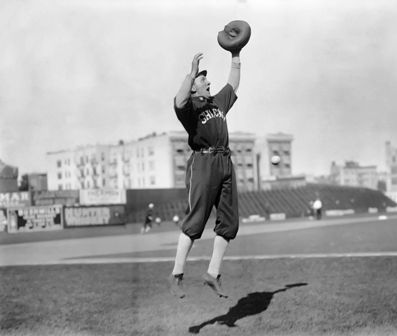
The 1912 season was the last for the oft-injured Sullivan (aside from single game appearances in 1914 and 16).  Before the season he told reporters he expected to catch at least half the team’s games, but ended up appearing in just 41 games after an April collar-bone injury resulted in the bulk of the early-season work going to Walt Kuhn and Bruno Block.  In August Block was sent to Milwaukee as part of a package for 19-year-old Ray “Cracker” Schalk and Sullivan became a White Sox coach, tutoring the future Hall-of Famer Schalk throughout the 1913 and ’14 seasons.

Billy Sullivan

Billy Sullivan

Sullivan is likely most famous for having caught three of 11 balls tossed from the Washington Monument on August 24, 1910–two months later he opted out of a challenge to catch ” a baseball dropped from an aeroplane sailing at 1,000 feet,”  according to The Associated Press Sullivan said he “still desires to play baseball a few years more…(and) might as well try to stop a bullet as to be on the receiving end of one from an aeroplane.”

Lost Advertisements–“Big Ed” Walsh No-Hitter, Old Underoof Whiskey

7 Mar

walshnohitter

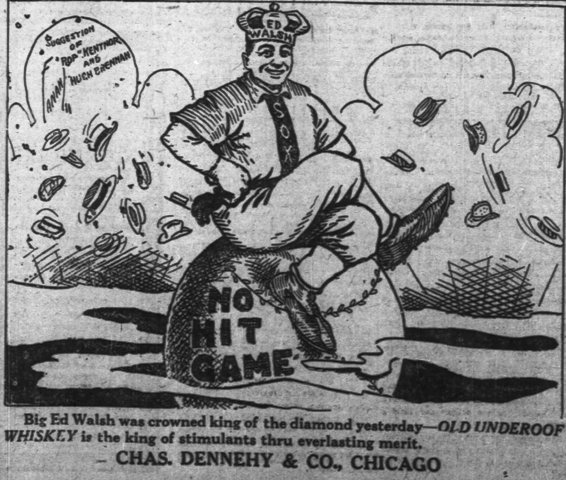
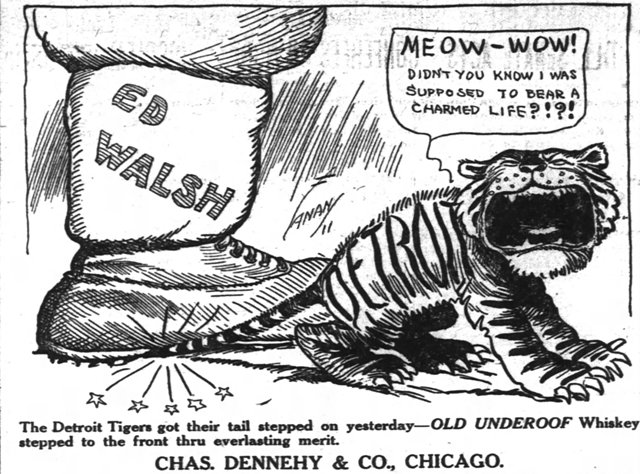
A 1911 advertisement for Old Underoof Whiskey which appeared in Chicago News papers the day after Edward Augustine “Big Ed” Walsh threw his first nine-inning no-hitter (Walsh gave up no hits in a 5-inning 8 to 1 victory over the New York Highlanders on May 26, 1907).  Walsh had also thrown five one-hitters, including one two weeks earlier against the Detroit Tigers.

Old Underoof commemorated that effort as well:

walshonehitter

The Chicago Inter Ocean said of the no-hitter:

“Never in His long and brilliant career in the box has Big Ed shone as he did on the hill in yesterday’s game.”

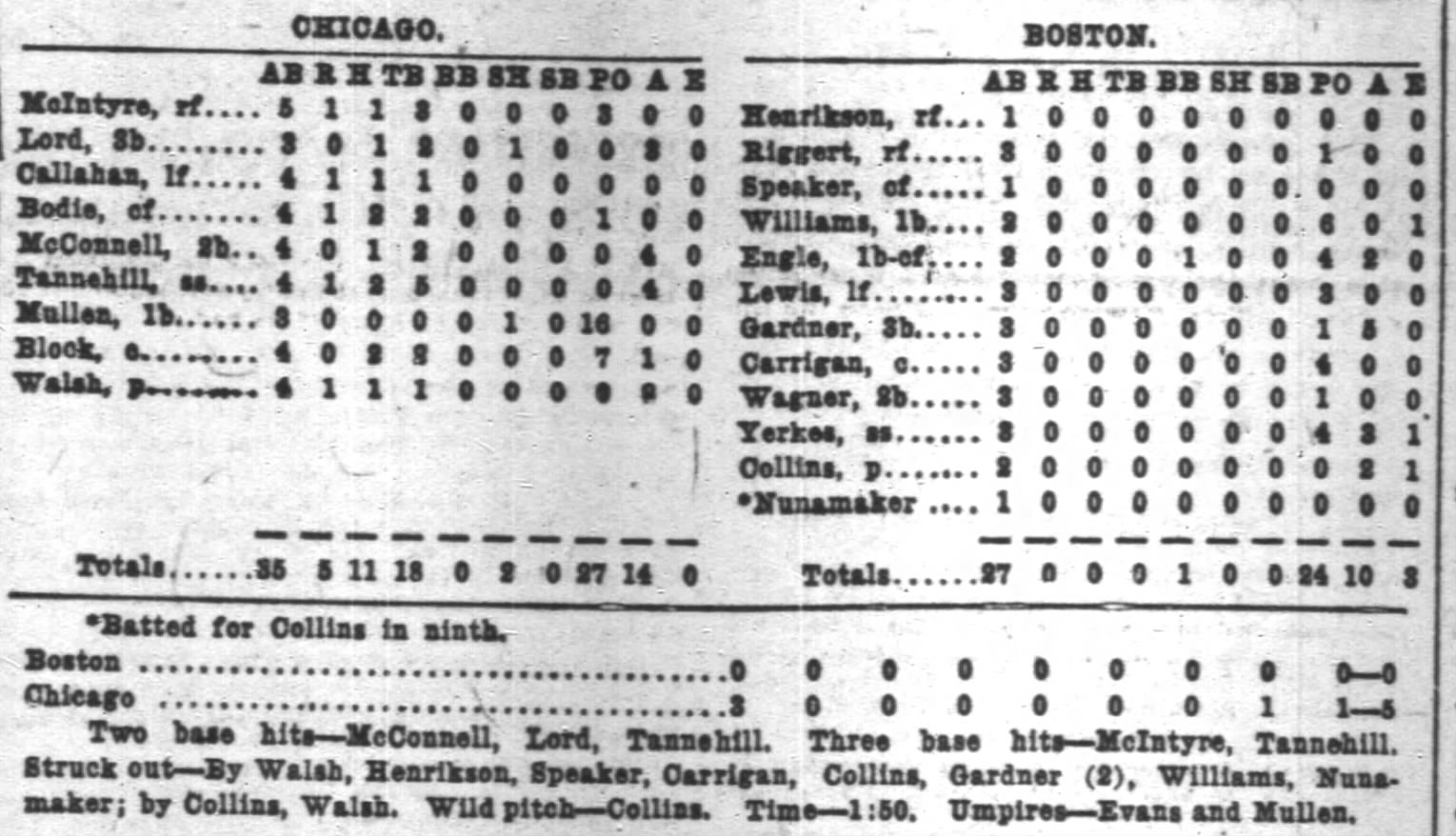
Walsh faced only 27 Boston Red Sox batters, but gave up a fourth inning walk to Clyde Engle.  The Inter Ocean said umpire Billy Evans’ call that led to the walk was “questionable.”  And that two plays helped preserve the  spitballer’s no-hitter:

“(T)here were two times when the monarch of all he expectorated nearly lost his charm.  Once the ball was driven out right over the second sack.  Lee Tannehill rushed back, scooped it up and threw out the runner easily.  Lee must have had a margin of at least three-eighths of an inch in his favor.  Another time Ping Bodie saved Ed’s dinner dishes by rushing in with the greatest burst of speed at his command and licking up the ball a little above his ankles.”

The other incident of note in the game took place in the third inning when Tannehill hit a line drive to right center field in the third inning, The Chicago Tribune said Red Sox center fielder Tris Speaker and right fielder Olaf  Henriksen came together “in a terrific collision” which knocked both unconscious and out of the game.  Henriksen got the worst of it, and was briefly hospitalized with a broken rib and injured ankle.  Speaker “was first to recover and emerged from the accident with a severe shaking up and a lame shoulder.”

The box score

The box score

Walsh came one batter away from joining Cy Young and Addie Joss as the only two modern era pitchers to that point to throw a perfect game–Joss’ perfect game was against the White Sox in 1908, Walsh was pitching for Chicago and only gave up one hit and struck out 15 in the loss.

Ed Walsh circa 1904

Ed Walsh,  circa 1904

Walsh was 27-18 with a 2.22 ERA in 1911, leading the league with 255 strikeouts, in a league-leading  368 and two-thirds innings.  The Hall of Famer pitched until 1917 compiling a 195-126 record and 1.82 ERA.

He supported making the spitball legal again after the pitch was banned after the 1920 season.  The Associated Press quoted him in his 1959 obituary:

“Everything else favors the hitters.  Ball Parks are smaller and baseballs are livelier.  They’ve practically got the pitchers working in straitjackets.  Bah!  They still allow the knuckle ball and that is three times as hard to control.”

Irwin Howe

3 Feb

irwinhowebb


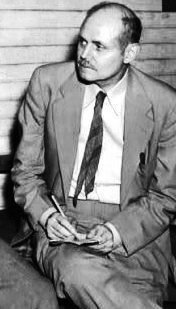
Irwin M. Howe founded Howe News Service in Chicago in 1910, published an annual record book and served as the primary statistician for several minor leagues, including the Western and the Three-I leagues.

After the 1911 season American League Secretary Robert McRoy, who was responsible for compiling statistics, left the league office to become an executive with the Boston Red Sox.  President Ban Johnson named Howe the league’s statistician; he served in that capacity until his death in 1934.
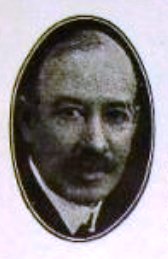
Irwin Howe

Irwin Howe

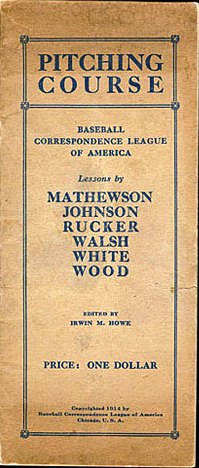
Howe leveraged his position with the American League.  He became the official statistician of several more leagues, including the American Association and the Federal League, wrote a nationally syndicated column called “Pennant Winning Plays,” became editor of the annual “Wilson Baseball Record and Rule Book,” and published an instructional pamphlet for kids.

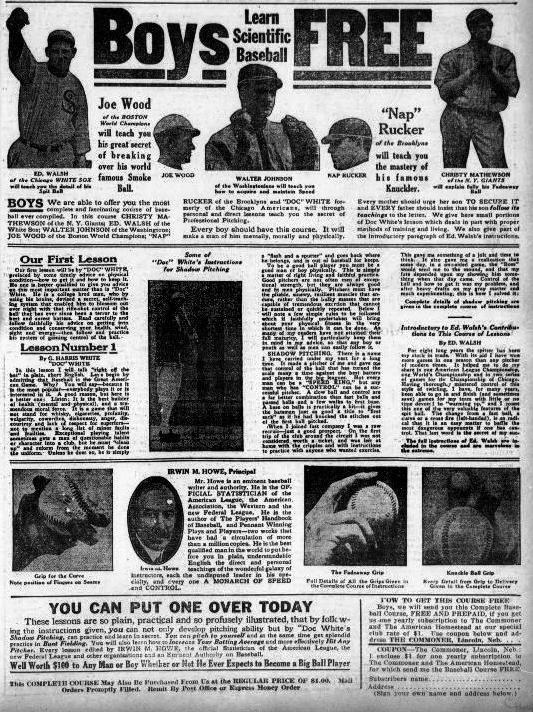
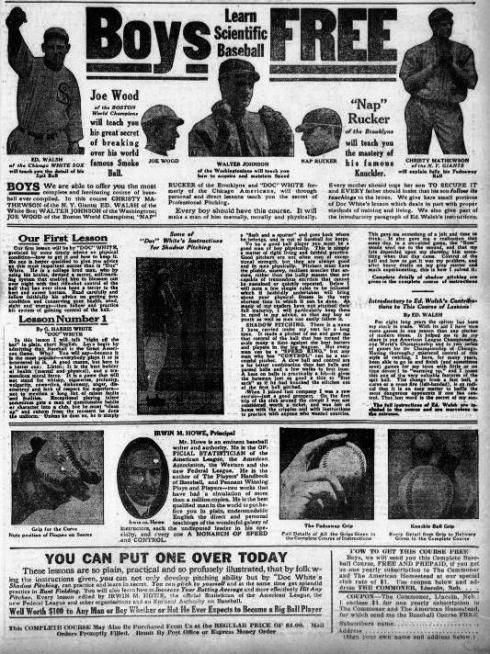
The ad from 1914 pictured above is for Howe’s 48-page “Pitching Course,” which he called “A correspondence school for baseball.” The pamphlets sold for one dollar, but were also offered by many small newspapers across the country for free to children who signed up subscribers (the pictured ad is from The Commoner, the Lincoln, Nebraska newspaper published by William Jennings Bryan).

Boys Learn Scientific Baseball Free

Ed Walsh of the Chicago White Sox will teach you the detail of his Spit Ball

Joe Wood of the Boston World Champions (1912) will teach you his great secret of breaking over his world famous Smoke Ball

Walter Johnson of the Washingtonians will teach you how to acquire and maintain speed

“Nap” Rucker of the Brooklyns will teach you the mastery of his famous knuckler

Christy Mathewson of the N.Y. Giants will explain fully his Fadeawy Ball

These lessons are so plain, practical and so profusely illustrated, that by following the instructions given, you can not only develop pitching ability…You will also learn to Increase Your Batting Average and more effectively Hit Any Pitcher.  Every lesson edited by Irwin M. Howe, the official statistician of the American League, the new Federal League and there organizations and an Eminent Authority on Baseball.

The pamphlet also included a lesson from Guy Harris “Doc” White of the Chicago White Sox “which deals in part with proper methods of training and living.”

Howe claimed his one dollar pamphlet was “Well worth $100 to any man or boy whether or not he ever expects to become a big ball player.”
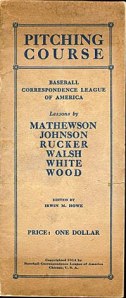
Howe's pamphlet

Howe’s pamphlet

Perhaps Howe’s most famous contribution to baseball was certifying Ty Cobb as a .400 hitter in 1922.

On a rainy day in New York (years later in his book “Baseball as I Have Known It,” Fred Lieb said the game took place in August—contemporary newspaper accounts say it was May 15), Cobb beat out a ground ball hit to Yankee shortstop Everett Scott.  John Kieran of The New York Tribune (he was later a columnist with The New York Times) was the official scorer.  He charged Scott with an error.

Fred Lieb of The New York Telegram, who was compiling The Associated Press (AP) box score for the game, credited Cobb with a hit.  Lieb said “Considering the soggy field and Cobb’s speed, I gave it a hit.”
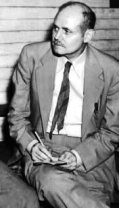
Fred Lieb

Fred Lieb

Howe’s habit was to rely upon The AP box score that appeared in the Chicago newspapers while awaiting the arrival of the “official” box score by mail.

When compiling the final averages at the end of the season Howe chose to accept Lieb’s scoring of the game rather than Kieran’s, and released a statement with the season’s final statistics:

 “I noted that the averages reached from my official scoring sheets had Cobb hitting .3995 (actually .3992).  With the unofficial averages giving him .401, I felt how can we deprive this great player of a third .400 average over a fractional point.”

Ban Johnson approved Howe’s decision.  Lieb, as president of the Baseball Writers Association of America’s (BBWAA) New York chapter was put in the uncomfortable position of attempting to repudiate his own scoring judgment.  He argued that the Kieran’s “official” score should be accepted, and said in a statement:

“Obviously, when there was a difference of opinion between the two scorers, the official and not the unofficial decision, should have been accepted.  There would be no further need for members of the Baseball Writers Association serving as official scorers if they were regulated to a secondary position.”

In a letter to Lieb, Ban Johnson said the “official” box score “was plainly in error in one other particular” besides the Cobb “hit” and “I requested a report of the official score of the game of May 15.  Mr. Howe had previously made a careful investigation of all facts surrounding the scoring.”  Johnson also chided Lieb asking “Are we to believe that you reversed your judgment at this late date?”

The 1923 “Wilson Record and Rule Book”–edited by Howe–contained an asterisk next to Cobb’s .401 average and noted that it was “not recognized” by the BBWAA—Howe was secretary of the association’s Chicago chapter.

The asterisk eventually disappeared, and Ty Cobb, thanks to Howe’s decision,  remains a .400 hitter for the 1922 season.

Lost Advertisements–Old Underoof–White Sox, Cubs and “The Battle of the Century”

27 Jan

oldunderroof1910jj


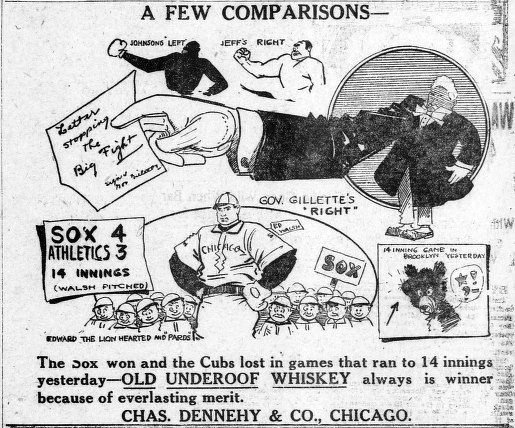
An advertisement for Old Underoof Whiskey from June 16, 1910–“A Few Comparisons.”  Most of the Old Underoof ads were exclusively about baseball, but this one also mentions the biggest sports story of that week.  California Governor James Norris Gillett  (the ad misspelled it “Gillette”) had just issued an order to stop the Jack Johnson vs Jim Jeffries “Battle of the Century,” scheduled for July 4 in San Francisco.  The San Francisco Chronicle said that despite $300,000 worth of tickets having been sold, and the construction of a new stadium for the bout being nearly completed, Gillett bowed to “Pleas to the governor to stop the fight.”  The San Francisco Church Federation was the most vocal opponent to the fight.

On the same day, the Chicago White Sox and Cubs both played 14 innings.

The seventh place White Sox, behind a complete game from “Big Ed” Walsh defeated the Philadelphia Athletics 4 to 3; he also drove in the winning run with one out in the fourteenth.

The first place Cubs lost 3 to 2.  Eros Bolivar “Cy” Barger pitched a complete game for the Brooklyn Superbas, and like Walsh, drove in the winning run with one out in the fourteenth.

The fight was moved to Reno, Nevada and Johnson won by TKO in the 15th round.

The White Sox finished in sixth place with a 68-85 record.  Walsh was 18-20 and led the American League with a 1.27 ERA

The Cubs remained in first place and won the National League pennant by 13 games.  The Athletics beat them four games to one in the World Series.


Lost Advertisements–Do You Want To Know The Baseball Scores?

2 Jan

baseballscores

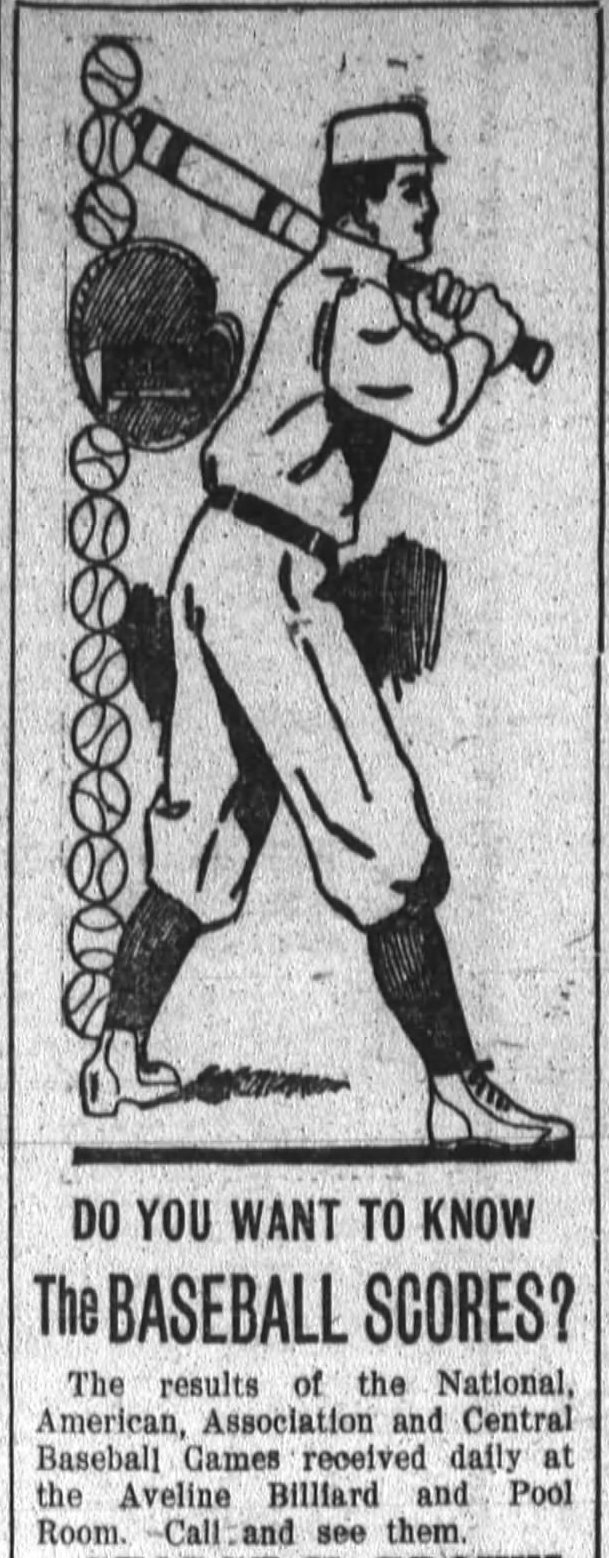
A 1908 advertisement for the Aveline Billiard and Pool Room in Fort Wayne, Indiana: “The results of the National, American, Association and Central Baseball Games received daily.”

Lost Advertisements–Mike Martin’s Liniment

27 Dec

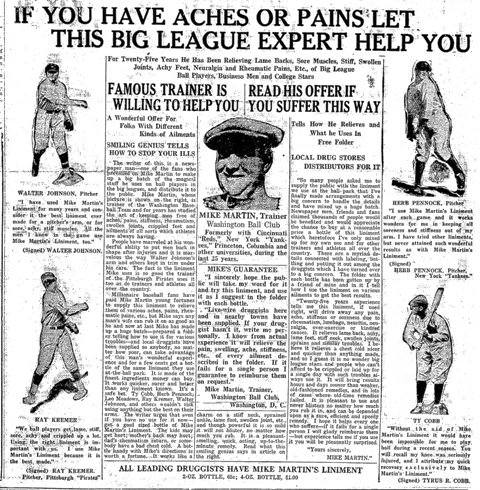
martinlinMike Martin spent 40 years with the Washington Senators as a trainer and scout; he was one of baseball’s first full-time trainers.  Martin was working as the athletic trainer at Columbia University when Clark Griffith hired him to work with the New York Highlanders, he followed Griffith to Cincinnati and then finally to Washington.

Martin began marketing the liniment he used on Walter Johnson and the rest of the Senators staff in the 1920s.  This 1925 ad featured testimonials from his good friend, Senator pitcher Walter Johnson, Herb Pennock of the Yankees, Ray Kremer of the Pirates and Ty Cobb (who rarely met a “cure” he couldn’t endorse):

“I have used mike Martin’s Liniment for many years and consider it the best liniment ever made for a pitcher’s arm, or for sore, achy, stiff muscles.  All the men i know in the game use Mike Martin’s Liniment too.”

(Signed) Walter Johnson

“I use Mike Martin’s Liniment after each game and it works wonders for me in keeping all soreness and stiffness out of my arm.  I have tried other liniments, but never attained such wonderful results as with Mike Martin’s Liniment.”

(Signed) Herb Pennock 

“We ball players get lame, stiff, sore, achy and crippled a lot.  Using the right liniment is important with us.  I use Mike Martin’s Liniment because it is the best made.”

(Signed) Ray Kremer

“Without the aid of Mike Martin’s Liniment it would have been impossible for me to play ball during the recent season.  You will recall my knee was seriously injured, and I attribute my quick recovery exclusively to Mike Martin’s Liniment.”

(Signed) Tyrus R. Cobb

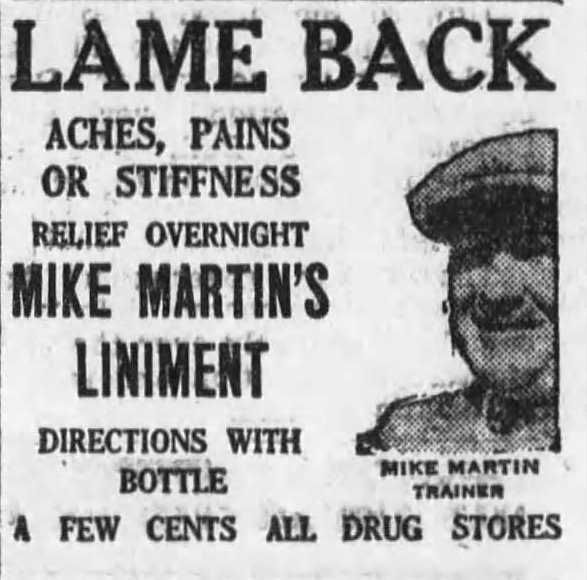
mikemartin1930

1930 advertisement

Martin remained the Washington trainer until 1946 when Griffith made him a scout.  He was still working for the Senators, and his liniment was still a popular product, in June of 1952 when the 67-year-old Martin was killed in a traffic accident near his Maryland home while driving to Griffith Stadium.