Tag Archives: Louisville Colonels

Tragic Exits 3

23 Mar

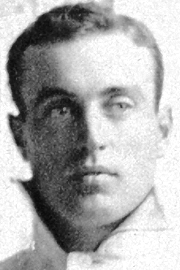
Eddie Meade

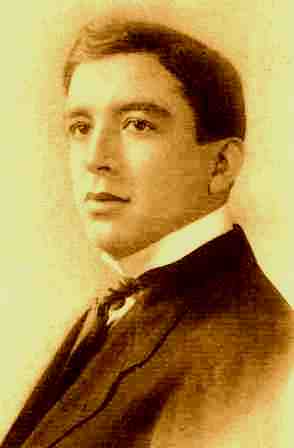
Edward “Eddie” Meade appeared headed to the big leagues.  After beginning the 1926 season with the Kinston Eagles in the Virginia League, the 24-year-old left-hander was acquired at midseason by the St. Paul Saints of the American Association and posted a 12-7 record with a 3.40 ERA in 22 games.

Meade began the 1927 season with a 6-0 shutout of the Louisville Colonels on April 17.  The same week he recorded his first victory, The Associated Press said he was about to become a member of the defending American League champions:

“The Yankees talked of possible reinforcements in the shape of Eddie Meade, of St. Paul, called the best young pitcher in the American Association.”

Eddie Meade

Eddie Meade

During the same week, Meade became ill; although the nature of the illness was never disclosed.  Eight days later he started a game with the Columbus Senators but was pulled after giving up six runs in the fifth inning of 9 to 8 loss.  Five days later he pitched in relief against Louisville, but The Minneapolis Journal said he lasted less than an inning due to his “impaired physical condition.”

When the Saints left Minnesota for a series in Kansas City on May 16, Meade stayed behind.  The following evening Meade checked into St. Paul’s Boardman Hotel and shot himself to death.

The day after his suicide, The Journal said, “it was learned today that Meade was slated to go to the New York Yankees in the fall.”

St. Paul Manager Nick Allen told The Associated Press:

“He was one of the hardest working youngsters we ever had on the club and the outlook for his future was bright, as he had only two years in baseball.  The only motive he could have had for such action would be mental depression.  He was not married.  The nature of his illness was no cause for alarm, but he apparently believed it otherwise.”

Tommy Coates

Thomas A. “Tommy” Coates was born in Omro, Wisconsin on February 18, 1886 (Baseball Reference lists his middle initial as “O” but birth and death records  list it as “A”).

After starring, along with his older brother Hiram, on Omro High School’s undefeated baseball team in 1901—The Omro Herald called the team “possibly the best in the state”—Coates played industrial league and semi-pro ball in Central and Northern Wisconsin.

After playing in Rhinelander, Wisconsin in 1908, The Oshkosh Northwestern said:

“Coates had lots of confidence in himself, and during the winter months the Omro boy came to the city one day and sought out “Pink” Hawley. Hawley agreed to give him a trial.”

Emerson Pink Hawley, a Wisconsin native who pitched in the major leagues for a decade, was the manager of the Oshkosh Indians in the Wisconsin-Illinois League.
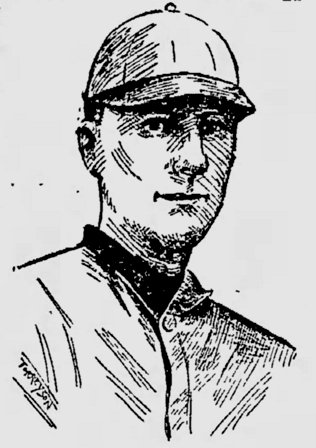
Tommy Coates

Tommy Coates

 “Coates came to this city from his home at Omro (for his tryout).  He donned baseball togs and he ‘made good’ from the start.”

Coates, who The Northwestern said  was “tall (and) built something like the great Ty Cobb,” became the Indians starting left fielder one week into the season and went on to lead  the team with a .299 batting average (he hit .002 better than his 19-year-old teammate Heinie Groh).

In September, The Sporting News reported that with just one season of professional experience, Coates “Looks good to Connie Mack,” and was drafted by the Philadelphia Athletics. He was the only member of the Indians drafted by a big league club in 1909.

At season’s end in September, Coates, with an invitation to train with Mack’s club in the spring, spent most of his time hunting.

On October 11 Coates was in a row-boat with a friend, hunting in a marsh near Omro.  The friend told The Omro Herald:

“Tom saw a mud hen rise up on the right hand side.  He turned about quickly and took hold of his gun which was at his left side and pulled it toward him…I turned about as soon as I heard the shot, and to my horror saw Tom lunge forward.”

Coates accidentally discharged his gun, shooting himself in the left eye.

Twelve days after the Oshkosh Indians received a $300 check from Connie Mack—his draft price—Coates was dead.

The Northwestern said:

“He was quiet and unassuming. After making a sensational play in the field or batting out the hit that won the game…the Oshkosh fans could not induce Coates to doff his hat.  He would return to the bench with face covered with blushes.”

[…]

“His more ardent admirers were confident he would make good in the American League, and one of their first thoughts upon hearing of the unfortunate accident, was the promising career he had before him.”

“I guess I am Rotten”

24 Nov

It was in doubt where Pete “The Gladiator” Browning would play in 1892.

There is no record of exactly how he parted ways with the Cincinnati Reds—Released by the Pittsburgh Pirates, Browning hit .343 for the Reds in 55 games in 1891 after signing with the club on June 29—but, by January of 1892 there were a steady stream of rumors about where he would sign.

Pete Browning

Pete Browning

Speculation included the Baltimore Orioles and St. Louis Browns, but Browning opted to return home to Louisville, and signed with the Colonels—he was released again after an early spring salary dispute, but signed a new contract with the team a week into the season.

Browning returned Louisville with much fanfare.  The Courier-Journal said, after he contributed two singles and two sacrifice hits in a 7 to 2 victory over the Chicago Colts:

“Prodigal Pete…walked out—‘Prods’ do not return in carriages—to his old home in left field at Eclipse Park yesterday afternoon, where he had spent a happy, happy youth before the false adulation of the outer world called the Gladiator away.”

After am 11-3 start, the Colonels were returning to form, and were beginning to look like the ninth place team with a 63-89 record they would be at season’s end.

To make matters worse, “Prodigal Pete” struggled after his first game, hitting just .247—94 points less than his career average—in 21 games.

Browning explained his sump to Harry Weldon of The Cincinnati Enquirer:

“’I guess I am rotten. I guess I ought to be out of the business,’ said Pietro Gladiator Browning, as he walked on the field.  ‘Old Gladdy ain’t to his speed yet, but he’s hitting ‘em, and hitting ‘em good, but not as good as he will hit ‘em though, cause he’s got the catarrh, and is stopped up in the head.  When you’re stopped up your ‘lamps’ ain’t right.  Wait until the sun gets hot and the catarrh leaves the old hoss.  Then the pitchers will have to look out.  Will I lead the league in hitting?  Why not?  Look out for me.  None of ‘em are getting away from me in the outfield.  Did you read about me going up in the seats and pulling down a fly that saved the game?  I can do it right along.  None of them big stars, Jim) McAleer, Curt Welch or any of the rest of them fellows have the best of old Pete on fly balls.  The old boy is still ready money, and worth one hundred cents on the dollar.”

Within days the Colonels gave up on the Gladiator and handed him his release on May 18.

For a time Browning got his “lamps’ right again.  After signing with the Reds again, he hit .303 the rest of 1892.  He returned to Louisville in 1893 and hit .355 in part-time role.

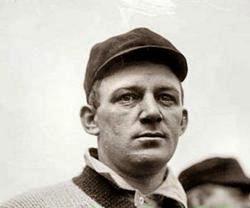
Bad Bill Eagan

6 Oct

William “Bad Bill” Eagan was just 35-years-old when he died from tuberculosis in 1905, but many people didn’t believe it when the news was first reported. The hard-living Eagan’s demise had been predicted and reported several times. In 1901, the year after his professional career ended, The Fort Wayne Sentinel said:

“’Bad Bill’ Eagan who died two or three times last year, is running a poker room in Detroit. Eagan dies on the average of three times a year and is about due for the first of this year’s series. Eagan captained and played first base for Youngstown before his second demise last season.”

Bad Bill

Bad Bill

In 1899 Connie Mack told The Philadelphia North American:

“Eagan would be one of the best second basemen in the business if he would keep in condition.”

He quickly wore out his welcome during all three of his brief stints in the big leagues. The first, with the St. Louis Browns in the American Association in 1891, ended, according to The Syracuse Standard after an incident with team owner Chris von der Ahe:

“(Eagan) was a jolly fellow and not afraid of discipline. The Browns got on a train at St. Louis to come East…von der Ahe’s nasal organ was rather large and red for its age and ‘Bad Bill’ determined to have some sport.

“Walking up to his employer, he caught the nose between his fingers, and said: ‘Say, Chris, how much did it cost to color that?’

“The owner of the cerise nose was furious with rage. He released Eagan at once. The train was ninety miles east of St. Louis, and at von der Ahe’s order the conductor put the nose twirler off the train.”

Two years later Eagan joined ‘Cap’ Anson’s Chicago Colts. Hugh Fullerton told the story of how he wore out his welcome there after just six games:

“Anson was a quick thinker on the ball field, but once he released the best second baseman that ever wore a suit for thinking a little quicker than anybody else on the nine.

“The second baseman in question was “Bad Bill’ Eagan. Everybody who remembers ‘Bad Bill’ will admit his supremacy on the second bag. When the play we celebrate came up there was a base runner on second. Chicago was one run to the good, and it was in the last half of the ninth inning.

(Bill) Dahlen was playing third base for Chicago. The man hit a sharp liner down to second. ‘Bad Bill’ started for it and at the same instant the man started for third base.

Bill Dahlen

Bill Dahlen

“The liner was a clipper and the ball struck ‘Bad Bill’s’ hands and bounded out. It struck the ground ten feet away, with ‘Bill’ right after it. Once he got his hands on it and without stopping to look where he was throwing. ‘Bill’ let the ball fly to third base.

“Most ball players after fumbling the ball would have tossed it to the pitcher or thrown it home if, after looking around, they saw that the base runner had started to try to score.

“In this case the base runner, after touching third, went on for twenty feet and then stopped for an instant to see what had become of the ball. He saw it coming straight as a die for third base, and went back there like a flash. But the ball beat him by ten feet. Unfortunately for the game, and also for “Bad Bill,’ Dahlen had taken it for granted that Eagan would throw the ball to the home plate, and was not looking for it to be thrown to him. Consequently the ball went by him, going within four inches of his nose, and striking the grand stand far behind.

“The result was that both base runners got safely home before Dahlen recovered himself and the ball, and the game was lost to Chicago.

“Anson was furious and immediately after the game gave ‘Bad Bill’ his release for making that throw. As a matter of fact, it was the best possible play under the circumstances, and Dahlen, rather than “Bad Bill’ was to blame for it not coming out as planned. If ‘Dal’ had thought as quickly as ‘Bill’ the game might have been settled right then and there.”

Eagan received one more trial with a major league team in 1898. He started the season on the bench for the Pittsburgh Pirates, but was given the opportunity to start when regular second baseman Dick Padden left the team over a dispute with Manager Bill Watkins in May.

Eagan hit .328, but committed 10 errors in 19 games. He was sold to Louisville Colonels on June 5. The Louisville Courier-Journal said:

“He is a clever fielder, a fair batsman, extremely aggressive and absolutely fearless (and will) certainly strengthen the team in one of its weakest spots.”

But he never appeared in a game for Colonels. The following day The Courier-Journal said the deal was off, and Manager Fred Clarke would only say, via telegram:

“Called deal for Eagan off for good reasons.”

The Colonels passed on Eagan despite being a team badly in need of a regular second baseman—Clarke tried nine different men there during the season, and his primary second baseman, Heine Smith hit .190 and committed 16 errors in 26 games.

Eagan finished the 1898 season with the Eastern League’s Syracuse Stars, where he had played from 1894 to 1897. He finished the year of 1898 in jail in his native Camden New Jersey.

That story Wednesday

“Go Back to Old Kentucky”

26 Sep

On June 29, 1897 “Cap” Anson’s Chicago Colts defeated Fred Clarke’s Louisville Colonels by scoring more runs than any team has ever scored in a single game.  The Chicago Tribune said:

“Game is a farce and everybody has a good time except the Colonels.”

The Chicago Inter Ocean said:

“Chicago exterminates Bourbons to the tune of 36 to 7.”

The Louisville Courier-Journal headline put it simply:

“Awful work.”

The Colts scored at least one run in each inning, collected 30 hits, and Louisville committed nine errors.

The Colonels finished in 11th place with a 52-78 record in 1897

The Colonels finished in 11th place with a 52-78 record in 1897

One Chicago fan memorialized the contest with a song, which The Courier-Journal shared with their readers.  The song, said the paper, was “a parody on the song ‘She Was Bred in Old Kentucky;”

Go Back to Old Kentucky

While talking one summer’s day,

With a friend not far away,

About a baseball game

That was coming off that day,

The Colonels and the Colts

Were going to take the holts

On the Diamond Field

And battle for the game.

A man, Fred Clarke, by name,

Young, but who had won great fame,

Had come out to play

With the Kentucky boys.

He had reason to be sad,

For Louisville was bad,

When a hobo in the crowd

Rose up and said:

Chorus

Go back to old Kentucky,

Here the meadow grass is green;

You’re a lot of dub ball-players,

You’re the worst I ever seen,

Go back to old Kentucky

And consider yourself lucky

You got off as light as you did.

Oh! His heeding of advice,

He would not listen to him twice,

And the grounds that day he did go;

There was Clarke and (Charlie) Dexter too,

The game began at half-past two,

And their places in the field they took;

Ritchie was at second base,

With the ball he tried to race.

The ball bounded

And caught him in the eye;

And Clarke fancied he could trace

A little swelling on his face.

As he sat down a lobster in the crowd cried:

(Repeat Chorus)

“Richie” was Ebenezer “Abbie” Johnson, who was occasionally called “Richie” in the press; Johnson was playing second base during the third inning when a ball hit by Anson—The Tribune called it “a viciously driven ball”– took a bad hop and “smashed Johnson in the eye, almost knocking it out.”

Abbie Johnson

Abbie Johnson

The game also included, in the fifth inning, an incident The Tribune called “probably the most ludicrous situation ever seen on a league diamond.”

The Colts led 16 to 1 at the beginning of the inning.  After loading the bases and scoring two runs, catcher Tim Donahue fouled out, and third baseman Bill Everitt grounded out; Jim Connor, the Colts second baseman appeared to score from third on the play, but, The Tribune said:

“When the players all came off the field the fact only two were out became known.  After much searching through his brain pan for and excuse (Umpire Jack) Sheridan took the tally away from Connor and called him out for ‘Cutting third base.’”

Perhaps the first, and only, time a player was called out for “cutting” the base he left from; Sheridan’s call also made for one of the most interesting notations included within a box score.

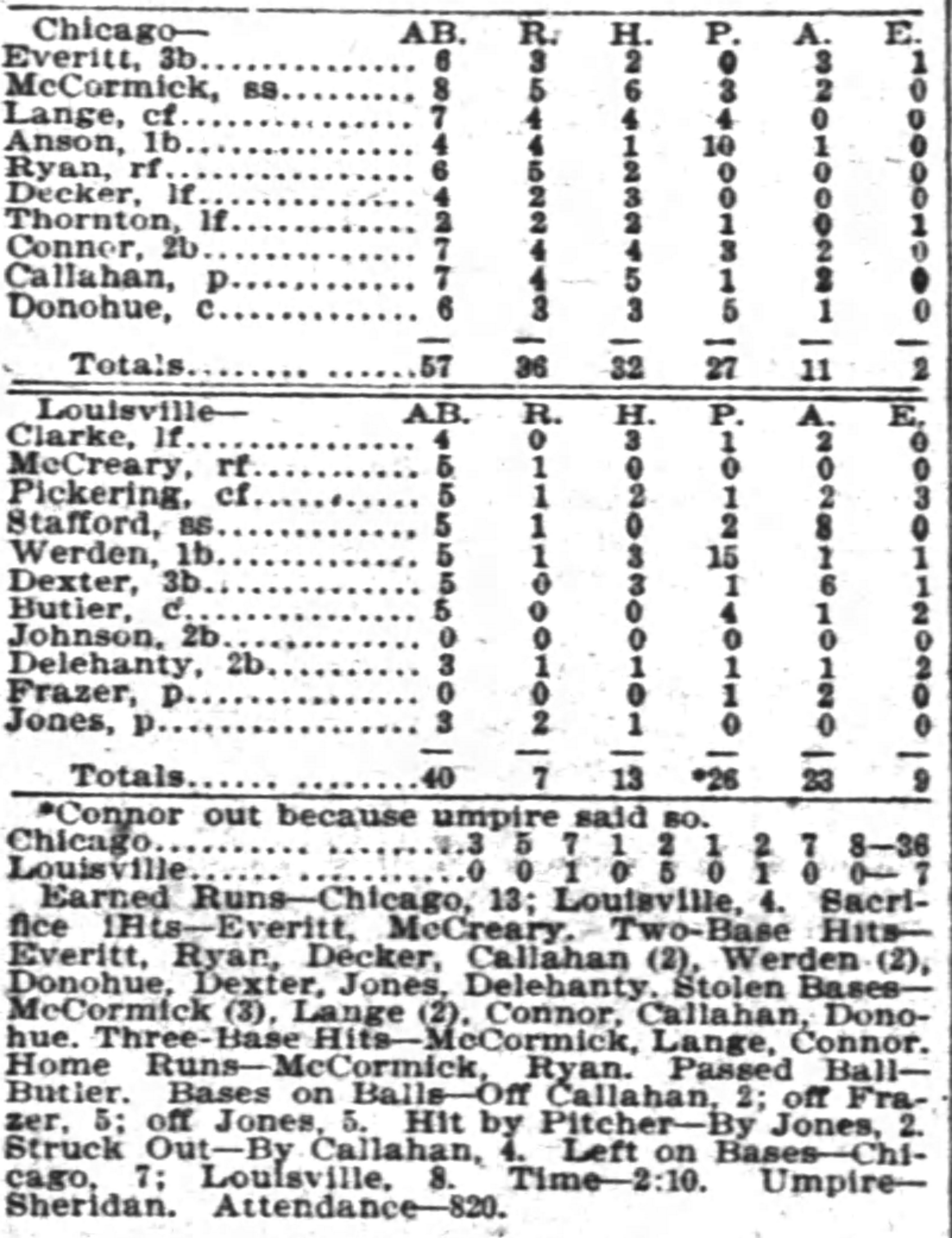
The Tribune box score included the note: “Connor called out.  No reason assigned.”  The Inter Ocean went with the more sarcastic:  “Connor out because umpire said so.”

The Tribune Box Sore


The Inter Ocean Box Score

The Inter Ocean Box Score


30 runs or more have only been scored by one team in a single game nine times—eight of them were before 1900—and Chicago is responsible for four; the other three games were in 1876, 1883 and 1883.

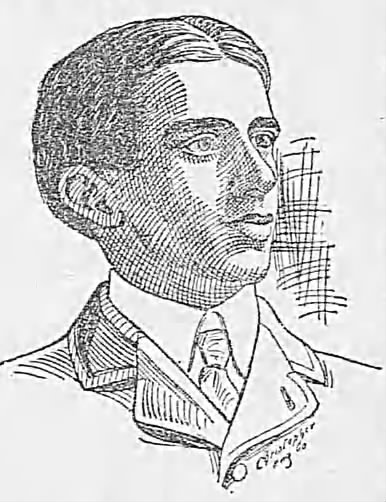
“The Poet-Pitcher”

17 Sep

Edward Benninghaus Kenna came from a prominent West Virginia Family; his father, John Edward Kenna was a United States Senator.  Another West Virginia Senator, William Edwin Chilton was often referred to as Kenna’s uncle—he was his father’s former law partner and best friend, but they were not related.

Edward B. Kenna, circa 1900

Edward B. Kenna,1900

He was, according to The Kansas City Star:

“(A)n unusually well-educated young man,.  He spent four years at Mount St. Mary’s College and was graduated there in 1898.  His post graduate course of one year was taken at Georgetown University, and the following three years he spent at West Virginia University, studying law.”

Kenna played football and baseball at all three schools—and coached both sports at Richmond College in 1900, the same season he made his professional debut with the Toledo Mud Hens in the Interstate League.

He was also a poet who had two anthologies of his poems published and was later the editor of The Charleston Gazette.  While most current sources say his nickname was “The Pitching Poet,” during his lifetime he was nearly always referred to by the slightly less lyrical “The Poet-Pitcher.”

Despite his education, and pedigree, The Star said:

“Seeing Kenna on the ball field one would not think that he was the possessor of so many distinctions.  He does not attempt to hold himself aloof from his teammates, but on the contrary is one of the most energetic (players) in the pursuit of victory and when not in the pitcher’s box is on the coacher’s line haranguing the opposing players and urging the members of his own team to their best efforts.  Coaching is one of his hobbies and he is particularly successful at this line of work.  He finds special enjoyment in ‘kidding’ the bleacher element…He says that base ball is not an uplifting pursuit either morally or intellectually, but is an enjoyable one.”

He pitched two games in the major leagues—with the Philadelphia Athletics in 1902–but said the two most interesting games of his career were back-to-back starts in 1904 while he was a member of the Denver Grizzlies in the Western League.

When Kenna joined the Louisville Colonels in the following season, The Louisville Times told the story of the games—both against the Des Moines Prohibitionists:

“(He) was touched up for nineteen safe hits, and yet his opponents failed to get a runner over the pan.  In one inning he was hit for a triple, a double and three singles, and still his opponents failed to get a man home.

“The first batter up hit for a triple, but was nailed trying to stretch it into a homer.  The next man doubled down the left field line, but was afterward caught off second by the poet.  The next three batters hit safely, and then Kenna got down to work and fanned the next batter with the bases full.

“Two days later Kenna was sent in against the same team.  For eight innings he did great work (allowing no hits) and his teammates made but one error.  He had perfect control and during this period gave only one base on balls.  The Denver team managed to get one runner across the pan, which looked as good as a hundred when the ninth inning was about to close.  The bard fanned the first two batter, but the third reached first on a fluke (a second error).  Then (Bob) Ganley, who is now with Pittsburgh, stepped to the plate and drove out a home run, which won the game.  Only one hit was made off his delivery, and yet Kenna lost the contest by one score.”

He was 16-13 for the Colonels in 1905 when, on September 1, he and seven other members of the team were injured in Kansas City when an electric trolley car crashed into the wagon they were riding  to the ballpark.  Kenna was the most seriously injured, and  reportedly suffered broken bones in his right (pitching) hand, a fractured left arm, a concussion, broken nose and an eye injury.  The Kansas City Star said he was listed in serious condition at a local hospital.  Despite the extent of his injuries—which ended his season– Kenna sent a telegram to family members in Washington D.C., saying simply

“Nothing serious; strained arm.  Don’t worry.  Ed.”

He never fully recovered.  He returned to Louisville in 1906, and struggled, finishing the season 12-21, but he hit .325 in 166 at bats.  Given his new found success as a hitter—his best previously recorded average was .225—Kenna decided he was through as a pitcher:

The Louisville Times said:

“Kenna announces that from now on he will be an outfielder, and he hopes (team President George) Tebeau will play him in right field on the Louisville team next season.  Kenna is simply tired of pitching.”

The Colonels accommodated him, but he struggled at the plate and was released in July after hitting just .143.

Edward Kenna, circa 1910

Edward Kenna, circa 1910

Kenna returned to West Virginia, newspapers, and poetry.  About the time his book “Songs of the Open Air, and Other Poems” was published in early 1912, he left his job at the paper, and went to Florida to attempt to recover from what was described simply as “a heart condition.”  He died in Florida on March 22.

Sporting Life said of the thirty four-year-old’s funeral in Charleston:

“(It) was one of the largest ever seen here.  All races and creeds showed their deep grief for this beloved man.”

Kenna’s younger brother John Edward Kenna Jr. was also a right-handed pitcher; he was 15-6 for the Chattanooga Lookouts in the South Atlantic League in 1909 and 7-7 with the Worcester Busters in the New England League in 1910—also born in Charleston on January 6, 1883, he died there on May 5, 1956.

Wagner’s Mysterious Bat

20 Aug

In 1911 Honus Wagner hit .334, it was his thirteenth straight season hitting better than .320, but he still wondered how much better he could have hit if he had the opportunity to regularly use a bat he once found in Ohio.  He told the story to William A. Phelon in The Cincinnati Times-Star:

Honus Wagner

Honus Wagner

“There was never yet a perfect bat, and I don’t suppose there ever can be.  Not while the shape has to remain perfectly round and fouls can slip off the curving surface, and not while the material breaks just as you are administering a sure home run with the bases full.  I have had bats break when I met the ball fair and square—break deliberately, after months of faithful service—and a feeble grounder would go trickling off the treacherous stick when the force I put into the wallop had spelled at least three bases.”

Wagner said, “bats are strange and moody things,” and that he understood why Pete Browning “used to talk to his bats and credit them with human understanding.”

Pete Browning

Pete Browning

He said he had “handled one that was almost perfection” during 1898, his first full season with the Louisville Colonels.  The team was playing an exhibition game “against some small club in an Ohio river city,” and the Colonels’ bats had already been shipped to their next stop:

“We figured, of course that we would borrow bats from the locals, but we didn’t need to.

“On arriving at the local ball park we found some urchins knocking flies.  One of the kids was using a curious looking bat, long, finely shaped and of a peculiar red-brown color.  I took it from the youngster, examined it, and found that, while it was very heavy, that it balanced nicely in the hand.  I slipped the boy half a dollar for the loan of his bat, and we started the game with the red stick and three or four others of the ordinary pattern which had been scared up by admiring natives.

“We never used the ordinary bats.  That red stick proved to be the proper medicine.  Of course there wasn’t any big league team against us, but the pitcher was one who was destined to be a mighty star in the after years, and he had something that day, believe me.”

Wagner did not say who the pitcher was, but said it didn’t matter how good he was:

“The least tap with that red bat and the ball whirred out in the field like a bullet.  There was spring and a texture to the wood that gave incomparable hitting power.  Tap a fast ball with that bat and it would go for two bases.  Meet a curve and you could send it to the bleachers.  With that bat a man who ordinarily hit .200 would be a .300 hitter, easy, and I blush to estimate the record I could have made therewith.”

Wagner said he and his teammates had “about twenty-eight long hits” during the game, and he asked the boy about the bat’s origin:

“(H)e explained that he had laboriously turned the wood to proper shape himself, and that it was originally the leg of an old-fashioned, broken-down table that his grandfather possessed.  It was some strange oriental wood, something like mahogany, but much heavier and of firmer grain…When the game ended I turned to find the boy, intending to hand him good money for that bat, but the kid was gone.  Apparently afraid we intended to steal his bat…I never saw the boy again, and although I twice played games in that town years after, he never came near the park.  The mysterious bat, brimful of hits, vanished the same afternoon it first appeared and its equal has never been discovered.”

“The Game was not Exactly ‘On the Square’”

21 Mar

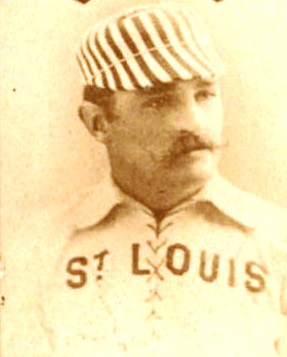
After the 1886 season, Jim Hart brought a team composed of members of his Louisville Colonels and other American Association players west.  The team played their way out towards California, winning twenty games against minor league, semi-pro and “picked nines.”

Jim Hart

Jim Hart

They finally lost their first game of the tour in San Francisco on December 26 to the Haverlys of the California League.  Dave Foutz, who had won 41 games for the champion St. Louis Browns pitched for Hart’s club.  Foutz allowed three runs on four hits in the first inning then shut out San Francisco on one hit the rest of the way, but Pete Meegan of the Haverlys held the American Association players to just two runs.

Pete Meegan

Pete Meegan

The San Francisco Morning Call said that Foutz who was “rather superstitious” and tried to “have a lemon in his possession whenever he steps on the diamond,” attributed the loss to the fact that the he had purchased a lemon “but was careless and did not put it in the pocket of his uniform.”

After the loss, Hart’s team defeated every California League team, including a Foutz one-hitter against the San Francisco Pioneers.

Dave Foutz

Dave Foutz

On January 23, with some of his players injured, Hart added three local players to his roster for a game with a “picked nine’ of local players in Alameda.  The game was tied 4 to 4 after seven innings, but Foutz gave up two in the seventh and four in the eighth and lost 10 to 4. The San Francisco Chronicle said:

“A large crowd was in attendance at the Alameda Baseball Grounds yesterday to witness the game between the Louisvilles and a picked nine of California players… the impression of many of the spectators was that the game was not exactly ‘on the square’…The cause of suspicion was as to the fairness of the game was caused by the appearance among the spectators of men well known at baseball games offering large odds against the Louisvilles.  At about the seventh inning these men were offering odds of twenty to one against a team that has hitherto been almost invincible.”

The Morning Call headline said simply:

“Hippodrome!”

There was no doubt, said the paper, that the game had been “pre-arranged” and “made up for the picked nine to win.”

In St. Louis there was more concern that Foutz had “broken down,” having given up fourteen hits rather than speculation that he might have thrown a game.  The Globe-Democrat said:

“Regarding the reported break down of Foutz in California… (Manager Charles) Comiskey received a letter from Foutz in which he denied that he had broken down, and said he was as good as ever.”

No one reported whether the pitcher had carried a lemon into the contest.

The evidence of a fix consisted of the activity of the gamblers, Foutz’ performance in the seventh nd eight innings, and an alleged conversation between Louisville’s second baseman Joseph “Reddy” Mack and Ed Morris the pitcher for the “picked nine.” Discussing how the result of the lightly attended game would improve attendance at the next game Louisville was scheduled to play in Alameda two days later.

reddymack

Reddy Mack

Jim Hart was indignant and wrote letters to West Coast papers denying that anyone on his team could have been involved:

“I wish to say that I have made the fullest and most searching investigation and can find no foundation for the charges.  Not one of my men wagered a dime.”

Hart blamed the loss on the “weakened condition” of his team and noted that three local players filled in with his squad for the game.  The players he “brought out here all enjoy national reputations, and they could not afford to hazard their good names for the small amount of gain there would be for them.”

In another letter, written to The Sporting Life, Hart attacked the credibility of the unnamed writer of the article in The Morning Call:

“(I)t was not much of a surprise to in the issue of a sensational morning journal last Monday the flaming headline ‘Hippodrome!’  The journal referred to, I understand, instructs its reporters and correspondents in the following language—‘Make your articles sensational even at the expense of the truth,’ and the young man who wrote the article under the above referred-to head line was evidently closely following instructions…What the young man who wrote the article don’t [sic] know about baseball would make a very large book.”

Hart went on to detail his additional complaints with “the young man” from The Morning Call, but as with his letters to West Coast newspapers, he never addressed the allegations regarding the abrupt changes in the odds offered on the game, and instead of asserting that “Not one of my men wagered a dime,” as he said in the earlier letters, the letter in The Sporting Life said:

“I have investigated the whole matter religiously, and if any of the boys were implicated in any way, they are too smart for me to find out.”

The California League conducted the only official” investigation into the allegations; that inquiry was limited to determining if any of their players were involved in any wrongdoing and according to The Chronicle, simply determined that no California League players “had anything to do with it or were cognizant of it,” and made no statement regarding whether there was evidence of a fixed game.

The Chronicle evidently didn’t think the case was closed and said:

“If Foutz, Mack or (Hubert) Hub Collins expect to come out here again, they must arise and explain to the entire satisfaction” of the league president.

The Louisville team wrapped up the tour in early February; Hart resigned his position and relinquished his interest in the team in order to take over the operation of the Milwaukee Cream Citys in the Northwestern League.  Mack and Collins returned to Louisville, Foutz headed to St. Louis and another 19th Century allegation of dishonest play disappeared into the ether.

“Mr. Borchers has Merely made Excuses.”

12 Feb

After two arrests and a season-long suspension in 1889, and another arrest and stints with four teams in 1890, George Borchers seemed to have settled down.

The San Francisco Chronicle said in January of 1891 that he was “taking excellent care of himself and will be ready to play winning ball.”

George Borchers

George Borchers

From 1891 through 1893 he pitched in the Pacific Northwest and California League’s and seems to have stayed sober and out of jail.

He was essentially a .500 pitcher, with less than average control; when he was with the Los Angeles Angels in 1893 he walked 210 batters, hit 24 and had 17 wild pitches.

The Los Angeles Herald regularly noted Borchers’ wildness.  In his first appearance for the Angels in April of ’93 he walked six and hit two batters in the first inning, yielding four runs, and was removed in the second after another walk and two more hit batsmen.  After a 21-12 May victory against Stockton the paper said:  “Borchers did himself proud, allowing 13 men to walk to first base, 12 for base on balls and one for being hit.  How the Angels managed to win with him in the box is a marvel.”

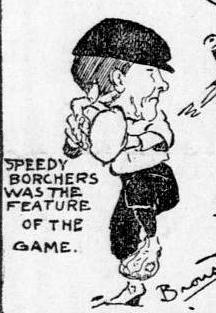
From 1894 through the 1896 season he was a baseball nomad, playing for nine teams in six leagues, including a single, disastrous final major league appearance with the Louisville Colonels in May of 1895—he started a game against the Brooklyn Grooms, lasting just two-thirds of an inning, giving up a hit, three walks, a wild pitch and two runs—earning the loss as the Colonels went down 11 to 0.

Caricature of Borchers from The San Francisco Call

Caricature of Borchers from The San Francisco Call

Borchers was out of organized baseball in 1897 and it’s unclear what he was doing and where he was doing it, but he resurfaced the in 1898 as a minor league team owner.  The Pacific Northwest League, which folded after the 1896 season, was resurrected as a four-team circuit organized by Dan Dugdale and William Works.  Dugdale took the Seattle franchise; Works took Tacoma, a Spokane “newspaperman” named Hutchinson took that town’s team, and George Borchers was awarded the Portland club.

The league struggled, and Borchers was stripped of his franchise in early July.  The Tacoma Daily News explained the problem:

“George Borchers is beginning to look upon matters of baseball in a new light.  The (league) is holding an inquest on his official corpse this afternoon, sitting in Portland.  The chief is not to figure any longer as manager of the Portland baseball team…The trouble has all arisen over Borchers’ treatment of his men.  He has not distributed cash since the opening of the season and as he is still short on the amount due the league will be displaced…Mr. Borchers has merely made excuses.”

Borchers returned to California and appeared in games for three Pacific Coast League teams during the remainder of the season: Santa Cruz, Stockton and Watsonville.

Borchers would continue, on and off, as a player until 1903—including a season as player/manager with the California League’s San Jose Brewers in 1899.  But in 1901 he made headlines when he became embroiled in a scandal.


Borchers was pitching for the Oakland Commuters in the California League, and failed to show up for a game he was scheduled to pitch on May 1.  The San Francisco Call said:

“George Borchers, the star pitcher of the Oakland baseball nine, has disappeared…None of the missing player’s close friends in baseball circles can explain why he decamped so suddenly nor where the absent ballplayer has gone.”

“Some of the Oakland players are injecting a bit of romance into the story, the names of some of the fair enthusiasts of Golden Gate being introduced as the possible cause for the handsome pitcher’s sudden leave taking.  But none seem to be able to tell with certainty the story that he has fallen victim to the charms of some fair one.”

The plot thickened the following day when Oakland owner J. Cal Ewing hired a private detective to track the missing pitcher, and an angry father went public.

J. Cal Ewing

J. Cal Ewing

While Ewing’s investigator hunted, an Oakland real estate developer named Don Miller told The San Jose Evening News his daughter Grace had disappeared:

“(Miller) is convinced that she has gone with the ballplayer.  Neither Borchers, who has a wife in Portland, not Miss Miller has been seen since last Monday, when they boarded an eastward-bound train.”

Miller told the paper:

“I am endeavoring to locate them now, and if I ever find the man who has broken up my home he’ll need nothing but a coffin.  I’ll find them yet.”

After a week, he turned up in Ogden, Utah, pitching for that town’s club in the Inter-Mountain League.  The Santa Cruz Evening Sentinel said:

“He says he left simply to better his position and justifies his action on the ground that the California League takes players who skip out on other leagues and the local players are in competition with them all the time.  He thinks he had the right to skip out likewise and better his position.  He claims the reason he left secretly was because he feared Ewing would cause him trouble.

“He was worried over the account that he had left with Miss Grace Miller, but denied it.”

The paper noted that while Borchers wife remained in Portland, he had received two train tickets from the Ogden club.

Eventually, the truth came out.  Borchers returned to California to secure a divorce from his wife and married the former Miss Miller.  He spent 1902 playing and managing for a team in Salt Lake City, and managing a bowling alley there.

The second Mrs. Borchers became ill in November of 1902 and died two weeks later from peritonitis.

His last scandal behind him, Borchers married again and operated a large dairy in Sacramento until his death in 1938.


“Perhaps the most Superstitious Class of People”

31 Jan

In 1886 The San Francisco Chronicle said of contemporary baseball players:

“With all the enlightenment of civilization superstition still holds potent sway.  Perhaps the most superstitious class of people to be met today in the United States, aside from gamblers and actors, are baseball players and worshipers of the game, whose faith in “mascots” and jonahs” as influences for good or bad luck is almost if not fully as strong as their belief in religion itself.”

Jim Hart, in San Francisco with his Louisville Colonels, told the paper about some of the specific superstitions which influenced the 19th Century ballplayer:

“The St. Louis Browns have their club house at home just off from right field, and whenever the bell rings for the practice preceding each game the whole nine form into line in front of their house and then walk abreast to first base, where they disperse and take their positions.  This is invariably done under the belief that it insures good luck.  Bill Gleason too, the famous shortstop, always walks astride of the foul chalk line to third base before going to his place on the diamond.  He has never once failed to do it in the whole five years he has been playing baseball.”

Bill Gleason

Bill Gleason

“Why there’s (Albert “Doc”) Bushong, the catcher of the St. Louis Browns.  He’s got a pair of gloves that are so dilapidated that even the patches are patched.  He wouldn’t part with those gloves, though, for a ten-acre lot.  He thinks as mascots they are infallible.  (Walter Henry) Porter, the pitcher of the Brooklyns , also has a red sleeveless jacket  or shirt which he has worn regularly for more than two years.  It doesn’t match the uniform of the club, but he wears it anyhow, for he sincerely believes that if he laid the shirt aside the game would be lost.

“(Pete) Browning, our center fielder and the crack batter in the league, is the greatest fanatic on mascots, I reckon, of anybody in the business.  He did not come out with us this time.  He got out of whack during the summer and I sent him to the springs to recuperate.  He returned home before we came out here, but I thought it best to leave him behind.  Well, Browning has a practice of always walking over and touching one foot on third bag when going from field to bat, or vice versa.  A stack of twenties as high as that house wouldn’t be inducement enough for Browning to refrain from carrying out this program every time he plays, he’s got so much faith in it, you know.  To show you how earnest he is in this respect, I’ll relate a short anecdote about him which occurred last summer.  It may amuse you.  Browning has a pretty good idea of himself as a ballplayer, and it rather hurt him to be sent off from us, even if it was to the springs” (Browning was in such poor physical condition in July of 1886—The Cincinnati Enquirer said “it is doubtful if he appears on the diamond again.”– that he was sent to the springs in French Lick, Indiana for a month).

Hart said the rest of the Louisville team let Browning know they did just fine without him in the lineup, including their best road trip of the season, when they won 8 of 12 games:

“The rest of the boys naturally joshed him a good deal about it, and gleefully referred to their splendid record while he was away. ’Yes,’ replied Browning, driven to desperation, ‘but I was touching third bag every day, or you couldn’t have done it.’  It seems ridiculous, doesn’t it?  It’s true, nevertheless, for I found out afterwards that he had marked out a diamond just back of the hotel at the springs, and on the days that we were booked to play he would go out to his field and soberly go through his regular ceremony of touching third bag.”

Pete Browning

Pete Browning

Hart claimed he was an exception, “I’m not very superstitious,” he said, but he conceded “I hear and see so much of these things that hang me if I don’t almost believe in them myself sometimes.”   As an example, he told the story of arriving at the ballpark during a losing streak:

“I went into the club-room with a new white plug hat on my head.  Everybody jumped up at once and shouted, ‘A mascot! A mascot! Our luck will change now, sure.’ We did meet with rather better success after that, and the hat naturally got the credit for it.  Four or five weeks later I exchanged my white hat for a black mackinaw, and, my Lord! You should have heard those fellows kick.  They said I was a jonah and we’d lose the next game, and by thunder, we did, too.”

“Each Club has its own Particular Omens”

29 Jan

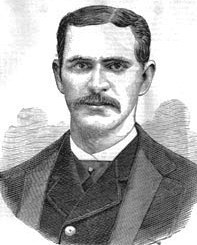
James Aristotle “Jim” Hart gave one of the earliest interviews on the superstitions of ballplayers.

Hart sold his interest in the Louisville Colonels of the American Association before the 1887 season—he was an original investor in the team in 1882 and managed the club in 1885 and ’86—and bought controlling interest in the Milwaukee Cream Cities in the Northwestern League.

James Hart, 1886

James Hart, 1886


Before he left the Colonels, Hart accompanied the team on a tour of the  West Coast in December of 1886, and talked to a reporter from The San Francisco Chronicle:

“Why my dear fellow you have no idea to what ridiculous extremes most ball players allow their superstitious inclinations to carry them.  It’s a wonder to me that none of you newspaper men have ever written them up.”

Hart said “Each club has its own particular omens, you know there are four or five favorite beliefs which are held in general esteem by all.  In the East the boys always go to the grounds on the day of the game in hacks, and if they should win they go next time in the same carriages if they can get them, but anyway by the same route, around the same corners and along the same streets.  Should fortune prove averse and defeat be their lot another route is chosen next time and different carriages selected.  To meet a funeral procession on the way to the ball grounds it is also considered good luck, but should their driver be so rash as to cross the road and break through the line of mourners’ carriages I verily believe the boys would murder him.  It is considered such a bad omen that the boys would remain on one side of street all day rather than cross the line.”

“To meet a cross-eyed person is the worst kind of luck.  The only antidote for it is to turn around immediately and spit over your left shoulder before you speak.  It’s kind of amusing sometimes to see half a dozen or so fellows suddenly whirl around altogether like pivot machines and spit over their shoulders while walking quietly along the street, and without saying a word, too.  It was done here on Market Street a few days ago by some of my boys, and I guess the people must have thought then either drunk or crazy.  Another good mascot is to have a dog run across the diamond either just before or during a game.   The Pittsburgh team carried a dog around with it all last season that had run across the field early in the summer.  It didn’t matter that the poor brute had no tail, and was all over sores and all that, he was a mascot just the same and the boys were proud of him.  I reckon there has never been a dog so handsomely treated as that one was.”

“One of the greatest jonahs we have is to commence packing up the bats before the game is finished.  No matter how the score stands at the time, your luck is sure to flop right over and give the victory to the other side.  To illustrate it to you more clearly, I will relate an incident that occurred to our nine early last season at home (the game was actually played August 16, 1885).  We were playing a match game with the Pittsburgh team.  Luck went clear against us all day, and at the beginning of the ninth inning the Pittsburghs (Alleghenys) had ten runs to our five.  It seemed an utter impossibility to catch up that difference in one inning, and I can tell you we felt pretty blue.  Victory looked so sure for the Pittsburghs that Pete Meegan, an extra man belonging to that team, who was sitting on the bench, begin packing up the bats when the last inning was commenced.  You may not believe it, but it’s an actual fact and a matter of record; our luck changed from that instant (Louisville won 11-10).  Manager (Horace) Phillips of the Pittsburghs was crazy with rage, but he didn’t blame any of his players.  He could have murdered Meegan though for bringing on a jonah by packing up those bats before the game had finished. I don’t remember very clearly, but I think Meegan got let out subsequently.  At any rate he was fined heavily for his offense (Meegan never played in the major leagues after 1885; whether he was “let out” by Phillips because of this incident or his 14-20 record in two American Association seasons is unknown).

Pittsburgh Alleghenys Manager Horace Phillips

Pittsburgh Alleghenys Manager Horace Phillips

Another funny idea we’ve got is to pick out a saloon we think to be lucky, and drink a glass of beer there on the day of the game and have the glass set on one side for us.  If we win, then we go to that saloon every day after and drink out beer out of the same glass.  Of course if our luck should change then we try another saloon.  This don’t apply to every nine, because some of them are not allowed to drink at all during the season, under penalty of a heavy fine.  In addition to these things, some clubs belonging to the league are called jonah clubs.  That is, there are some clubs against which it is useless for us to attempt to play.  It doesn’t make any difference whether we consider our own the best team or not, they are jonahs and we can’t beat them.  Loss of confidence has a great deal to do with it, I suppose.”

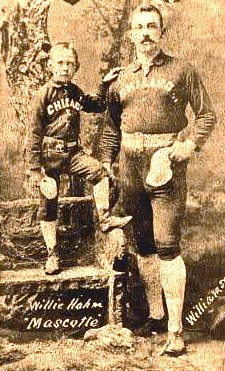
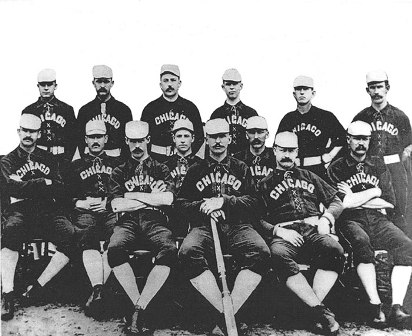
“The Chicagos’ mascot for the past three seasons has been a little boy in short clothes named Willie Hahn.  The tiny fellow is just able to talk and always sits on the bench during the game.  The Chicagos have the greatest confidence in him as a promoter of success and make a great fuss over him.  Two seasons ago, when the Chicagos won the championship of the league, they hired an open landau upon their return home, put Master Willies in it, bedecked him with flowers and wreaths and hauled him all over the city by hand.  It was a regular triumphal march, you bet. “

Willie Hahn, Chicago White Stockings mascot with Ned Williamson

Willie Hahn, Chicago White Stockings mascot with Ned Williamson

Hart said Willie Hahn, who was white, was unusual.  Most of the teams had black mascots and the players rubbed their heads before batting:

“Sometimes the black boy is kept in a closed hack during the game to prevent contamination from other hands.  The kid then has to duck his head out of the carriage window when the boys want to rub it.”

Hart said the Pittsburgh Alleghenys kept a seat in the stands open for an old black woman “Just before the game commenced the boys would invariably look up to see if old aunty was in her place, and if by chance, she was not there they would lose heart, say the game was ‘jonahed,’ and in all probability, lose it.”  He said the Alleghenys also had two sets of uniform pants “one pair white and the other blue.  One color would be worn so long as the club was successful.”

More from Hart on Friday.