Tag Archives: National League

“The Deterioration in the Morale of the Players”

10 Jun

The Chicago Tribune had had enough:

“The deterioration in the morale of the players has been followed by deterioration in that of the spectators.  The latter relish the obscene profanity and the slugging exploits of the hulking brutes of the baseball field.”

The Tribune provided an “account of the more disgraceful of the many rows witnessed by spectators of baseball games,” during the just-ended 1899 season:

“May 2—Row at Pittsburgh—St. Louis game.  (Frank) Bowerman was put out of the game.  (Jack) O’Connor was taken off the field by the police, and the crowd chased umpires (Tom) Burns and (William) Smith.

May 19—Umpire Burns put (Giants’ William “Kid”) Gleason out of the game at St. Louis.  Gleason’s protest was so strong Burns forfeited the game to St. Louis.

June 1—Row on the grounds at Washington.

June 16—After a long wrangle and continued rowing on the field at New York.  Umpire Burns forfeited the game to Brooklyn.

June 16—(Fred) Clarke and (Clarence “Cupid”) Childs fight on the field in Louisville.

June 27—Rowdy action of players caused the crowd at the Pittsburgh game to mob umpire (James “Chippy”) McGarr.

July 18—(Tommy) Corcoran slugged (John) McGraw at Baltimore after being first attacked, and his action started a riot.

July 26—(Emerson “Pink”) Hawley, (Fred) Tenney, and (Hugh) Duffy engaged in a game of fisticuffs at Cincinnati.

Aug 16—(Oliver “Patsy”) Tebeau, McGraw and (George “Candy”) LaChance fought at Baltimore

Aug 18—Riot at Baltimore game started by (Tim) Donahue throwing a handful of dirt at (Steve) Brodie’s face.

Sept 1—Childs and Aleck Smith fight on the field in Louisville.

Sept 7—Riots at St. Louis and Brooklyn.

Sept 15—Clarke taken off Philadelphia grounds by police.

Sept 16—Chicago players jerked (Ed) Swartwood around the diamond because he called the game in the eighth inning on account of darkness.

Oct 9—(George “Win”) Mercer assaulted (Al) Mannassau at Washington.

Oct 14—(Jimmy) Scheckard assaulted umpire (John) Hunt, refused to retire, and Hunt forfeited the game to Brooklyn.”

Cupid Childs, repeat offender
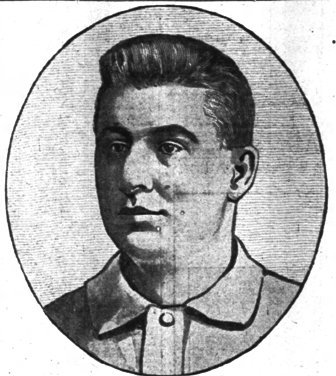
Cupid Childs, repeat offender

Al Mannassau, assaulted by Win Mercer in Washington

Al Mannassau, assaulted by Win Mercer in Washington

In addition to the fans, The Tribune blamed team owners:

 “For the multifarious minor acts of blackguardism and rowdyism of which the hired men of the club owners were guilty there is no room.  It is sufficient to say that they, like the graver offenses mentioned above, did not wound the feelings or jar on the nerves of the proprietors of these baseball roughs.  Those proprietors seem to have come to the conclusion that audiences like these ruffianly interludes.”

Like hundreds of predictions before and thousands more to come over the years, The Tribune saw dire consequences for baseball given the current state of the game:

“There was a time when Chicagoans went to see the games of the Chicago club because they had a feeling of proprietorship in that organization.  That day is over.  Men do not go to see games out of local pride, nor do they go to see fine playing.  They go to listen to the language of the slums and to witness the horseplay and brutalities of the players or performers.  When these have lost their attractions professional baseball will disappear. “
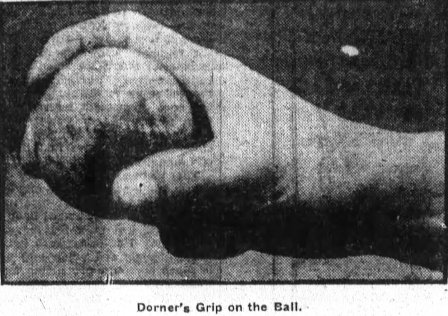
Gus Dorner’s Spitball

7 Jun

dorner1 dorner2

Augustus “Gus” Dorner suddenly became a successful pitcher in 1904.  He had brief trials with Cleveland in the American League in 1902 and ’03, he was 6-6 and control was a problem; on May 23, 1903, walked 11 batters in a game against the Philadelphia Athletics.  He finished the 1903 season with the Columbus Senators in the American Association posting a 7-7 record.

The next two seasons in Columbus Dorner was 18-10, and 29-8.  The Fort Wayne Daily News said:

“The big German attributes his success to condition, control, study of the batsman and mastery of the spitball.”

Dorner said, “I use the spitball a great deal.”  As a result of his new pitch he said:

“(I) have not had the slightest trouble with my arm this year.  I have worked hard to get control and perfect the spit ball.”

The magic was short-lived.  Dorner earned a return to the big leagues in 1906 but was a combined 8-26 with the Cincinnati Reds and Boston Beaneaters.  Overall he was 29-62 in parts of four seasons with Boston.

Gus Dorner

Gus Dorner

He didn’t fare much better in the minor leagues, going 25-29 his last three seasons as a professional.  After his release from Boston in May of 1909, he finished the season with the American Association’s Kansas City Blues with a 9-18 record.  The last two years of his career were spent with the Wilkes-Barre Barons in the New York State League and the Harrisburg Senators in the Tri-State League.

“A Man Can’t Play Ball When He ain’t Getting no Money for it”

29 May

In January of 1890 Louis Rogers Browning, Pete, “the Gladiator,” the biggest star, even if no longer the best player, of the 27-111 Louisville Colonels of the American Association, jumped to the Cleveland Infants in the Players League.

Browning, illiterate, alcoholic, superstitious, and nearly deaf as a result of an untreatable ear condition, had quickly become popular among his hometown fans—despite being called out for on-field drunkenness as early as 1882 by The Louisville Courier-Journal.

Browning had won two American Association batting titles (1882, 1885), but had slipped to .313 in 1888 and .256 in 1889 playing in 99 and 83 games.

The New York Sun said the signing caused a “sensation” in Louisville despite that:

“(I)t has been said for two years that he had lost his usefulness by reason of his  defective eyesight and intemperate habits.”

Browning’s “defective eyesight” was said to be the result of his belief that stating into the sun would improve his “lamps.”

Pete Browning

Pete Browning

The Sun said Browning provided a “funny explanation” (all grammar errors are from the original text) for leaving his hometown to sign with Cleveland:

“I have been waiting for this chance for four years.  They ain’t treated me right here since 1886.  I used to play great ball for ‘em till they put the screws on me so hard, then I just quit.  I don’t mean that I didn’t play honest ball, but I just got discouraged and couldn’t do it.  A man can’t play ball when he ain’t getting no money for it.  I tell yer they have been socking it to me ever since 1886.  I’ve been fined so heavy that my salary ain’t ever been over $1,000, when I could have been making $2,000 and $3,000 from other clubs.  Newspapers have done me up so that people in the East have thought I was no more good.”

Browning said that after financially troubled owner Mordecai Davidson turned the Louisville franchise over to the American Association in July of 1889, and the league secured new, local ownership, he thought his situation would improve.

“They said my peeps was out of condition and I couldn’t hit a balloon.  Well, you ought to a ‘seed me line ‘em out.  They couldn’t put the ball nowhere I couldn’t get ‘em.  I played the game of my life.  I knocked the cover off the ball right along.  When I come home (from a road trip in August) I thought they would meet with a brass band.  Well I got a letter from (the Colonels new management) sayin’ I was laid off.  The papers said I had been drinkin’ when I hadn’t touched a drop for months.  They wouldn’t give old Pete a chance.”

In the fall of 1889 Browning played for a team in Knoxville, Tennessee, The Sporting Life’s “Louisville correspondent” said he had stayed out of trouble:

 “I understand that Pete’s conduct while recently with the Knoxville Club was quite exemplary, and tat be drank nothing but water.  Since his return to Louisville he has behaved himself in the same manner. Pete, however, always had a strange way of keeping sober during the winter and getting drunk in the spring when it was time to play ball.”

Browning told The Sun that his performance in Knoxville had earned him several offers from other teams, that he was in great shape, and that Louisville management was to blame for a lot of his problems:

“I give you my word of honor I haven’t touched a drop of anything for seven months.  I know that I have gone wrong sometimes, but if they had come to me an’ talked to me like gentlemen, I’d a done anything for ‘em: but they don’t do it, an’ they run off to the papers with another story of old Pete bein’s on a tear.  That just made me worse.  Do you think I’ve got no feelin’s left?

“Well I’m goin’ away, an’ you just watch me.  Talk about my peeps, there was never nothin’ the matter ‘em.  It was my nerve that was weak…Pete knows his biz, and he’ll get a chance someday.  An’ he has.  Keep an eye on me this season.”

Presumably Browning’s “peeps” were not completely ruined yet by his staring into the sun; he hit .373 and won the Players League’s only batting championship.

He would play through the 1894 season, compiling a lifetime .341 average.  The sad story of Browning’s post-baseball life and his death in Louisville in 1905 are well documented elsewhere.

Jim Lillie

28 May

The Sporting Life described Jim Lillie as “one of the most sensational of right fielders,” and “the rival of Mike (King) Kelly in the position.”  The New Haven Register said he earned his nickname “grasshopper”  as a result of his “agility in the outfield.”

His career was brief, and his short post-baseball life was tragic.

The 21-year-old Connecticut native was said to have been discovered by “Orator Jim” O’Rourke “on the lots and commons of New Haven.”  He played his first professional game on May 17, 1883 with the Buffalo Bisons in the National League.  Lillie appeared in 50 games, hitting .234. In November his hometown newspaper, The New Haven Register, got his position wrong (saying he was used primarily as a catcher—he caught in two games), but said “his record was highly credible,” and that he had already signed for the 1884 season.

Jim Lillie

Jim Lillie

Lillie spent two more seasons in Buffalo; leading the team in games played both seasons.  In 1884 he led National League outfielders with 41 assists; his 40 errors also led the league.  He committed 33 errors the following season; he hit .223 and .249 for the Bisons.  When the team disbanded after the 1885 season, his contract was assigned by the National League to the Kansas City Cowboys, who had been admitted to the league on a trial basis.

He had, for him, a typical season in the field: 30 errors (third in league), 30 assists (second) and 199 putouts (third).  He also had one of the all-time worst performances at the plate; hitting .175 in 426 at bats, with only nine extra base hits (all doubles), he finished the season with 82 total bases—for identical .197 on base and slugging percentages.

The 30-91 Cowboys were dissolved in February of 1887, with the players being sold to the league.

Lillie remained in Kansas City, and had the best season of his career with the Cowboys, now in the Western League.  He also met an 18-year-old woman named Nellie O’Shea, the daughter of a wealthy Kansas City contractor and said The Kansas City Star, “a young lady highly spoken of.”

Lillie, playing primarily in left field, hit .369; a hitter’s haven, the Western League leader, Jimmy Macullar hit .464, and Lillie’s average was good for 34th best in the league.

On December 29, 1887 Lillie married Nellie O’Shea.

He joined the Fort Worth Panthers in the Texas League around June 1 of 1888, but left the team in less than two weeks.  The Dallas Morning News said he was released, The New Haven Register said he left Texas to be with his wife and go to work for his father-in-law, “(Lillie) promised her to settle down,” and planned on returning to baseball for the 1889 season.

He never had the chance to return to the game.  On September 10, 1888, the Lillie’s child was stillborn.  Two days later, a fire broke out in their home.  The Associated Press said:

“(Nellie) was making preparations for supper when the accident occurred…She had moved the gasoline stove too near the cooking stove and in filling the reservoir with gasoline some of it became ignited.  The flames at once enveloped her…(Lillie) entered at that moment or (she) would have been burned to death…Lillie did not notice his own condition until after he had summoned  a physician.”

Mrs. Lillie lingered for nearly three weeks before dying of her injuries on October 4.  Lillie, who had attempted to remove his wife’s burning clothes, had his hands burned “down to the bone,” and initial reports said he’d have to have some of his fingers amputated.  There’s no record of how well his hands recovered, but he never played baseball again.

He stayed in Kansas City and according to The Kansas City Star “managed (Nellie’s) estate.”  Within two years he would contract typhoid fever, and he died November 9, 1890.  The Star said his last words were to a friend at his bedside:

“I am afraid, Charlie, it is three strikes and out.”

Memorial Day—Major League Baseball’s First World War Casualty

27 May

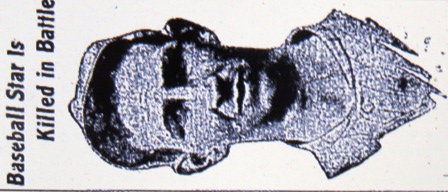
By the time he enlisted in the United States Army in July of 1917, Edward Leslie “Harvard Eddie” Grant had retired from baseball to practice law in Boston.

He attended Harvard, but only played baseball as a freshman; he was declared ineligible after being paid for playing with a semi-pro team.  After that Grant played intramural baseball at Harvard and played with Northeastern outlaw teams during the summer.

In 1905 Grant made his Major League debut when the visiting Cleveland Naps recruited him to fill in for two games at second base for Hall of Famer Napoleon Lajoie against the Boston Americans—he was 3 for 8 and made one error.

He was with the Jersey City Skeeters in the Eastern League in 1906, hitting .322, which earned him a contract with the Philadelphia Phillies.  He would spend the next nine seasons in the National League, also playing for the Cincinnati Reds and New York Giants.  Grant was never a star, but he was popular with fans and the press.  The New York Times said:

“He was a handy utility player and could fill in any position on the infield.  While never a heavy batsman, he was skillful fielder and a smart baserunner.”

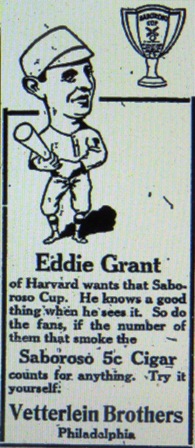
1910 Advertisement for the  Vetterlein Brothers Cigar Company; the Saboroso Cup mentioned in the ad was presented to the phillies or Athletics player with the highest batting average.

1910 Advertisement for the Vetterlein Brothers Cigar Company; the Saboroso Cup mentioned in the ad was presented to the Phillies or Athletics player with the highest batting average.

Grant was among the first wave of prominent athletes to join the military, making his enlistment news.  A wire service article under the headline “Eddie Grant Joins Uncle Sam’s League” appeared in numerous papers across the country.

On October 5 1918, he would become the first Major League player to be killed during World War I, The Associated Press said:

“Captain Edward Grant, former third baseman of the New York National League Club, and attached to the 307th Infantry, was killed by a shell when leading a unit to the aid of the famous ‘Lost Battalion.’

“The battalion was surrounded for five days in the Argonne Forest and Captain Grant was killed in one of the attempts to reach it.”

Grant was originally buried in the Argonne Forest, and his body was later moved to the Meuse-Argonne American Cemetery.

Chicago’s Lakefront Park 1878–The First Game

23 May

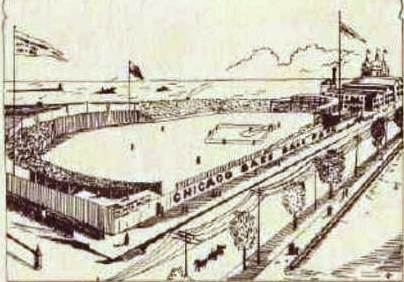
The Chicago White Stockings left Twenty-Third Street Park and relocated to Lake Front Park near the corner of Michigan Avenue and Randolph Street.  The old Union Baseball Grounds had stood at the same spot, but was destroyed in the Great Fire of 1871.

Lakefront Park

Lakefront Park

The ballpark opened on May 14, 1878 with a 3:45 pm “game between the Indianapolis nine (Blues) and the home nine.”  The Chicago Inter Ocean said:

“Although the day was very chilly and exceedingly unpleasant for out-door sports, fully 2,500 people assembled to witness the game and listen to a very ‘queer’ band, provided by President (William) Hulbert to officiate at the opening and funeral services of his white-hosed boys.”

——

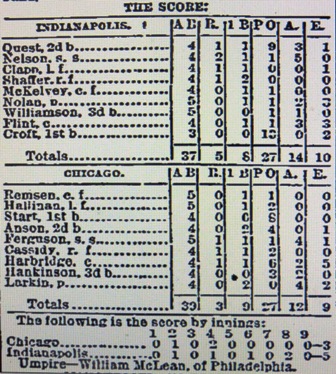
“The game was not particularly interesting except from the fact that from the first inning until the twenty-seventh man had been retired it was extremely doubtful which club would win.  The play of (Joe) Quest of the Indianapolis (sic) was by far the most brilliant of the game.  He covered the position of second base with greater ease and accuracy than any player that has been seen for many a day.  He won the game for his club by a very clever double play in the ninth inning.  The game stood 3 to 5 in favor of Indianapolis with one man out and all the bases full.  (Jimmy) Hallinan came to the bat and hit a high ball to the right of second base which Quest succeeded in catching, and by very fast running reached the base before (Terry) Larkin

Edward “The Only” Nolan got the victory for Indianapolis but “did not particularly distinguish himself in the field,” making three errors.

Of the White Stockings, The Inter Ocean said:

(Frank) Hankinson played third without an error, and received very (sic) deserved applause for a number of excellent plays.  Hallinan was brilliant in the left field, and (Cap) Anson was remarkably stupid at second.”

None of the newspaper accounts of the game elaborated on Anson’s play at second.

The Inter Ocean did elaborate on Hulbert’s band:

“(T)he dismal music furnished by the band appeared to affect almost to tears the Chicago ball-players.  Another game will be played tomorrow afternoon at the same hour, and a far different result is expected.  There will be no band.”

The Box Score

The Box Score

The White Stockings would go on to win three straight National League Championships 1880-82) at Lakefront Park (sometimes referred to as Lakeshore Park).  The ballpark was expanded after the 1882 season and remained the White Stockings’ home until they moved to West Side Park in 1885.

Things I Learned on the Way to Looking Up Other Things #4

22 May

A Ballplayers Hands

Joe Ardner played second base in the National League for the Cleveland Blues in 1884 and the Cleveland Spiders in 1890; he played another 12 years in the minors.  In 1888 he was with the Kansas City Blues in Western League and provided the following explanation of the care and maintenance of an infielder’s hands:

“A ballplayer’s hands should not be hard, they should be soft.  When my hands are in perfect condition they are almost as soft as a lady’s.  Hard hands on a ballplayer will crack and get sore, but when the skin is pliable and tough there is little danger of the hands bruising, cracking or puffing.  Some folks imagine a ballplayer’s hands to be as hard as a board, but they are wrong.”

Joe Ardner

Joe Ardner

They have realized that the Umpire is Almost Human

National League President Harry Clay Pulliam was very pleased with how civilized his league had become by 1908.  In an interview with The Chicago Tribune he said:

“The game is getting cleaner all the time.  Why, I’ve only suspended about half a dozen men this year, to about forty last year, and I want to say that the players are trying harder to keep the game clean…They have realized that the umpires are almost human.  It’s business with the player now, and they’re banking instead of boozing…It’s a grand game, clean, wholesome, and it’s the spirit of contest that gives it its virility.  Civic pride is another vital adjunct to it.  Every town likes to have its own team a winner.  Sort of local pride or another form of patriotism, I call it.”

Harry Pulliam--National League President

Harry Pulliam–National League President

Soo League Night Games

The Copper Country Soo League was recognized as a league for the first time by the National Association of Professional Baseball Leagues in 1905; its last season in operation.  The four-team league located in Michigan’s Upper Peninsula was made up of mining towns along the Soo Line Railroad: the Calumet Aristocrats, the Sault Ste. Marie Soos, the Hancock Infants and the Lake Linden Lakers.

Nearly no records or roster information survives, other than that three future Major Leaguers played in the league: Donie Bush and Fred Luderus played for Sault Ste. Marie and Pat Paige played for Calumet.

In an effort to boost sagging attendance in June, the league first  attempted to merge with the Northern League, and when that effort failed announced a scheduling change.

The Duluth News-Tribune said:

“An innovation…will be introduced by managers of the clubs comprising the Copper Country Soo League.  Owing to the peculiar conditions which exist in some of the cities, it has been decided to play some of the games after supper as an experiment as it is believed the attendance will be larger.”

The Chicago Tribune‘s Hugh Fullerton said:

“(I)n the copper country baseball depends on miners for support…the plan proved quite a success…The miners would come out of their shift at 6 o’clock, the games were called at 6:30 and finished about 8:30 at twilight.  There were few games called by darkness.”

While the move helped three of the teams at the gate, the Sault Ste. Marie Soos failed to draw fans and disbanded late in August.

Calumet won the championship, and along with Hancock and Lake Linden  merged with the Northern league to form the Northern-Copper Country League–Calumet won the league’s first championship in 1906, playing a schedule of day games.


Future Phillies star Fred Luderus was a 19-year-old rookie with the Sault Ste. Marie Soos

Future Phillies star Fred Luderus was a 19-year-old rookie with the Sault Ste. Marie Soos

Erastus Wiman’s Trophy

20 May

A trophy presented to the 1886 American Association Champions was created as a peace-offering to heal bitter feelings in the wake of one of professional baseball’s early controversies.

Erastus Wiman was a former Canadian journalist who had become a railroad, ferry and entertainment magnate on Staten Island.  Wiman, who promoted Buffalo Bill’s Wild West show and a circus at his Staten Island Amusement Company, wanted to add baseball, at the adjacent St. George Cricket Grounds, to the entertainment offerings on the island in order to increase commuter traffic.


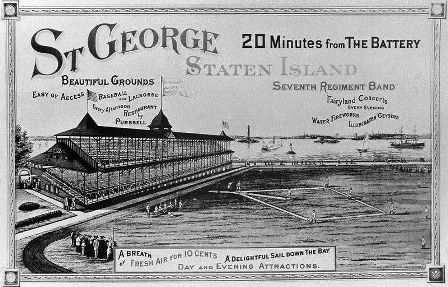
The St. George Cricket Grounds--home of the 1886-87 Metropolitans. The Giants would play a handful of home games there in 1889.

The St. George Cricket Grounds–home of the 1886-87 Metropolitans. The Giants would play a handful of home games there in 1889.

In December of 1885 he purchased the American Association New York Metropolitans from John Day for $25,000; Day also owned the New York Giants in the National League.

The other American Association owners claimed the sale was merely a scheme to take the Mets out of Manhattan and thus weaken the Association, and immediately expelled the team and began making arrangements to assign the team’s players to other organizations.

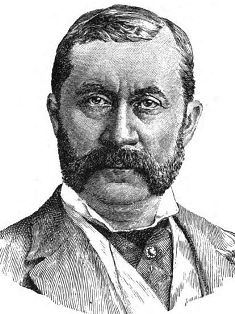
Erasmus Wiman

Erasmus Wiman

Wiman went to court in Philadelphia and was granted an injunction.  His new players stood with him and agreed not to seek contracts with other teams until the issue was resolved, and George F. Williams, the general manager of his company, accused American Association owners of being the schemers, telling The New York Times:

“The real motive was a scheme on the part of Charles Byrne, of the Brooklyn club.  He knew that a strong club on Staten Island would lessen the attendance at Washington Park, in Brooklyn, and besides this he was anxious to secure two of players (first baseman Dave) Orr and (outfielder James “Chief”) Roseman…the only way in which to gain his point was to act in concert with others who are also anxious to get the services of some of our men.”

Later in the month, Judge Martin Russell Thayer ruled that there was no merit to the American  Associations’ expulsion of the Mets, The Times said:

“(Thayer) sent the ‘Mets’ all the way around the bases, and landed them safely home in the association, there to stay as long as the organization holds together as an aggregation of baseball clubs.”

Despite the victory in court, bad feelings between Wiman and the other owners remained throughout the winter and spring.

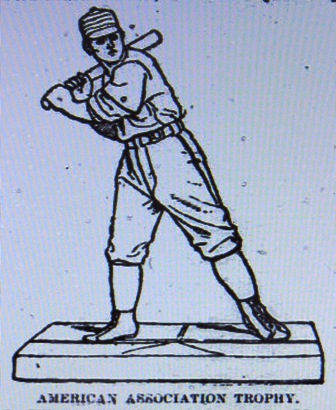
In April Wiman announced that he had ordered a trophy, described by The Sporting Life as “solid silver, 26 inches high, representing a batsman in position to bat a pitched ball. The whole will be enclosed in plate glass case.”

Newspaper drawing of Wiman's Trophy

Newspaper drawing of Wiman’s Trophy

Various reports put the trophy’s value between $1,000 and $2,000.

According to a wire service article that ran in several papers across the country, Wiman ordered the trophy for two reasons:

“(F)irst, to show that he had no ill feelings towards the members of the association because of the bitter legal fight which he encountered on entering it, and second, as a stimulant to extraordinary exertion by the various clubs in order that they might possess so valuable a work of art.”

Wiman’s Metropolitans would never have any hope of winning his trophy.  They finished in 7th place in 1886 and 1887, never drew well on Staten Island, and disbanded at the end of the ’87 season.

Brooklyn’s Charles Byrne got the last laugh; he purchased the team’s remaining assets to protect his territorial control and acquired seven Mets players, including Orr, Darby O’Brien and Paul Radford, who helped lead the team to a second place finish in 1888.  O’Brien, Brooklyn’s captain, would lead the team to a championship in 1889

Wiman would quickly fall upon hard times.  By 1893, the man who was reputed to have been worth between $2 and $3 million, was nearly broke.  In 1894, he was arrested for forgery and embezzlement, and according to The Times “was locked up in the tombs (NYC’s House of Detention).”  Wiman was found guilty, but the conviction was reversed.

The Times said that despite attempts to start businesses “He never recovered his ability to engage successfully in business after these reverses…and he died a poor man”

There are no references to the trophy after an 1886 mention in The Sporting Life that it was presented to the St. Louis Browns.

Lost Advertisements—Old Underoof Whiskey, 1910 Chicago Cubs

17 May

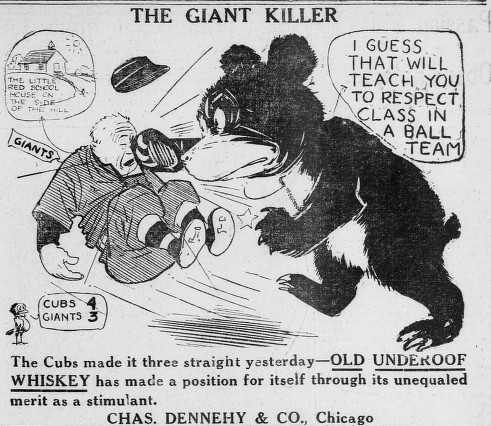
oldunderoof1910cubsgiants

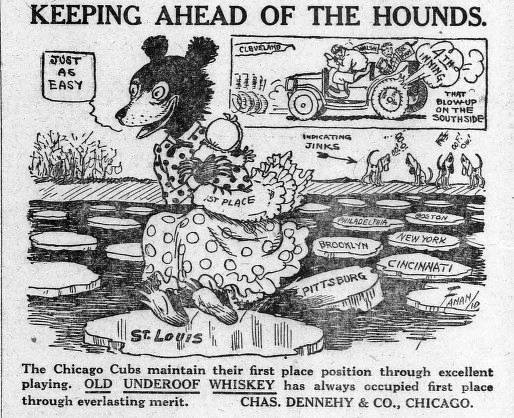
Two 1910 advertisements for Old Underoof Whiskey which appeared in The Chicago Daily News.

The ad above appeared in the paper on May 12.  The Cubs had just won their third straight game from the New York Giants, beating Rube Marquard,  4-3, to improve their record to 11-8.

 Hugh Fullerton wrote in The Chicago Examiner, that the Cubs, “chewed $10,999.98 of beauty out of the wry-necked, knock-kneed, cross-eyed and left-handed $11,000 beauty Marquard.”  The Giants pitcher had earned the nickname in 1908 when New York paid that amount to the Indianapolis Indians for the 21-year-old pitcher.  Through 1910, Marquard was a struggling pitcher with a 9-18 record who had all of baseball questioning the Giants purchase.  The next three seasons Marquard would win 24, 26 and 23 games, helping to lead the Giants to three straight National League Championships.

The one below is from June 27.  The Cubs had beaten the St. Louis Cardinals the previous day 3-2; scoring the winning run in the bottom of the sixth on a double steal, pulled off by catcher Johnny Kling and centerfielder “Circus” Solly Hofman.  It was the team’s twelfth victory in the last fifteen games and gave the Cubs a 4 1/2 game lead over the second place New York Giants.

The Cubs would run away with the pennant, 13 games ahead of New York.

oldunderoof19101stplacecubs

1876 Salaries

14 May

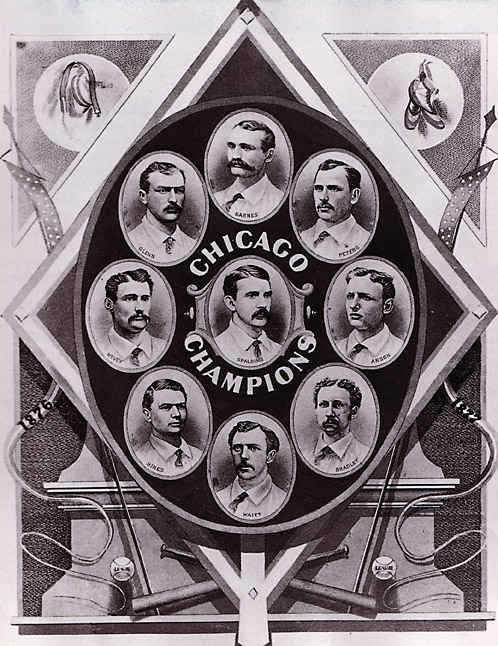
In July of 1876, The Brooklyn Argus published the salaries of the two highest paid teams in the newly formed National League; many of these have never appeared in any of the collections of early baseball salaries.

According to the article, the highest paid player was Chicago White Stockings pitcher Albert Goodwill Spalding who “as pitcher and manager, receives $3,000 for the year, with $1,000 bonus for producing the secession from the Hub (Boston) to Chicago.”  (The 1950 book “100 Years of Baseball,” by Lee Allen said Spalding earned $3,500 and a $500 bonus for the season).

A.G. Spalding, highest paid in National League

A.G. Spalding, highest paid in National League

The three players Spalding brought with him from the Boston Red Stockings in the National Association, Catcher James “Deacon” White, first baseman Cal McVey and second baseman Ross Barnes were all paid $2,500.  The two players signed away from the Philadelphia Athletics, third baseman Adrian “Cap” Anson and outfielder Bob Addy received $2,200 and $1,500 respectively.

Outfielder Paul Hines earned 1.800, utility player Fred Andrus was paid 1,000, and the remaining members of the first National League Champions, shortstop John Peters and outfielders John Glenn and Oscar Bielaski were made $1500 each.

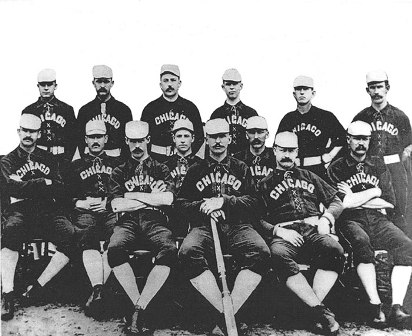
Chicago White Stockings, 1876 National League Champions--and highest salaried team.

Chicago White Stockings, 1876 National League Champions–and highest salaried team.

Harry Wright’s Boston Red Stockings filled the vacancies of White and Barnes with 18-year-old Lew Brown and 21-year-old John Morrill who The Argus said received “between 800 to 1000 dollars each.”

Manager Wright, who only appeared in one game, and his brother George were the highest paid members of the Boston club at $2,500 each.  Andy Leonard, who played second and outfield was paid $2,000.  Two other notable players on the Red Stockings, Hall of Famer “Orator Jim” O’Rourke and Tim Murnane received “between fifteen hundred and eighteen hundred dollars.”

According to The Argus, the White Stockings payroll of $21,500 topped the league, with Boston’s total of 18,000.