Tag Archives: National League

The Pursuit of Elmer Foster

9 Sep

Elmer Ellsworth Foster was the talk of the Northwestern League in 1887.

His career as a pitcher had lasted just one season; in 1884, while pitching for the St. Paul Apostles, he snapped a bone in his arm while throwing a pitch.

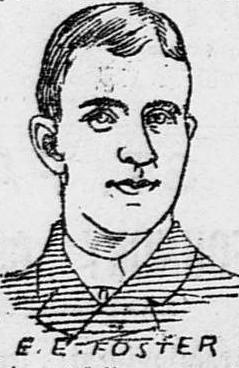
Elmer Foster, 1887

            Elmer Foster, 1887

After he recovered, he returned the following year as an outfielder and second baseman with Haverhill in the Eastern New England League and hit .309.

The following spring, The Sporting Life’s Haverhill correspondent said the New York Metropolitans “have taken Elmer Foster from us.”

Hitting just .184 and, as The Sporting Life put it “reckless at the bat,” Foster went back to Haverhill in August.

In 1887, he returned to Minnesota, this time as centerfielder for the Minneapolis Millers.  The club was owned by his brother Robert Owen Foster, a successful dealer of musical instruments, who with his partner J. E. Whitcomb, had taken over operations of the Millers in January.

The Northwestern League of 1887 was a hitter’s paradise owing mostly to the single-season experiments with the four-strike rule and walks counted as hits—nineteen players with at least 350 at-bats hit better than .350—and Foster led with a .415 average and 17 home runs.   While his performance with the bat was noted, he received an equal amount of publicity for his great fielding.

Throughout the season, Minnesota newspapers reported that Foster’s contract would be sold to a major league team—the Indianapolis Hoosiers were the most frequently mentioned—but the deal never materialized.

When the season ended, The Philadelphia Times said Foster was in high demand:

“During the past week agents from nearly every League and Association (club) have been to Minneapolis to secure (Foster) for next season.  (Horace) Phillips of Pittsburgh; (Gus) Schmelz of Cincinnati; Ted Sullivan, agent for Washington; (Emery “Moxie”) Hengel agent for Detroit; (Charlie Hazen) Morton, agent for (A.G.) Spalding, and agents for the Brooklyn, Metropolitan, and Baltimore Clubs have tried to get him.

(John) Day, of New York, sent him this message:  ‘Multrie on the way to Minneapolis.  Make no promise until you see him.’  Boston also wired him for his terms.  (Horace) Fogel of Indianapolis arrived one night and had Foster in tow all the next day.  The bidding of all these clubs has been going on briskly, until now he is offered exorbitant figures by all the clubs.”

Foster called the fight for services a “circus;” it also turned into a controversy, with two teams claiming to have signed him.  The Saint Paul Globe said:

“The circus he speaks of is a curious one, but he is sublimely unmindful of the part he took in it.  The rules of the baseball covenant prohibit the signing of players until Oct. 20…Manager Fogel of Indianapolis approached Foster before that time and made a verbal contract with him, but Manager (Jim) Mutrie, of New York, took him out to Delano (Minnesota), and after midnight  (on the 20th) got his signature.”

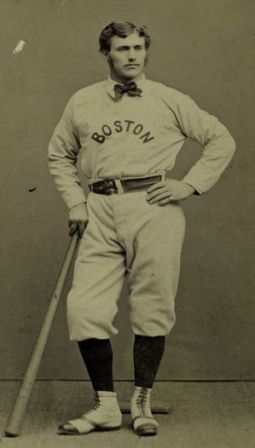
Jim Mutrie

                       Jim Mutrie

Years later, Ted Sullivan, who was perusing Foster on behalf of his Washington Nationals, described Mutrie’s method to sign Foster as a kidnapping:

“Jim Mutrie of New York (Giants) grabbed the great fielder Foster on the streets of Minneapolis…bound and gagged him, threw him into a cab and brought him ten minutes out of the city, held him there and dined and wined him until midnight…then compelled him to take $1000 advance money and a contract of $4500 (various other sources put Foster’s salary at $2400, and $4000).”

Foster, it turned out, didn’t simply have a “verbal contract” with Fogel and Indianapolis when he disappeared with Mutrie, but had, as The Sporting News said, accepted “a draft for $100,” from Fogel at the time the two agreed to terms.  Fogel and Indianapolis owner John T. Brush told The Indianapolis News and The Indianapolis Times that there was “a written agreement” between Foster and the club.

Foster’s wife gave birth to a daughter during the height of the controversy.  He told The Globe:

“If she had been a boy I would have named him Mutrie Fogel, in memory of the baseball managers I have been having a circus with.”

In the end, Indianapolis acknowledged that the agreement with Foster, whether written or verbal, was entered into three days before the legal signing date of October 20 and National League President Nick Young awarded Foster to the Giants.

Foster never had success at the plate during his brief major league career; he hit just .187 in 386 at-bats over parts of five seasons.  But Mutrie called him “(O)ne of the best fielders in the country,” and Sullivan said of Foster’s time in the National League, “(H)e was a wonderful fielder in that league.”

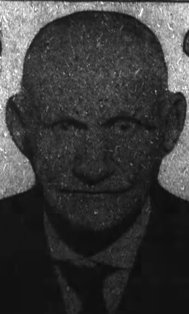
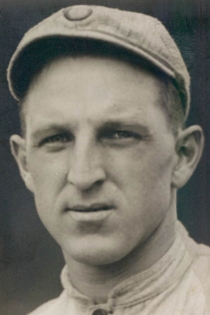
Elmer Foster

      Elmer Foster

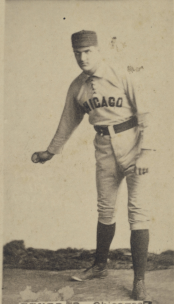
After he was released by the Giants, he played 31 games with the Chicago Colts in 1890 and ’91, but his brief stay with the club allowed his name to live on with fans long after his career ended.  One of the favorite subjects of Chicago sportswriter Hugh Fullerton, who called him “The rowdy of the rowdies,” Foster’s name was a staple of Fullerton’s stories for three decades after his career ended.

“The Sock on the jaw ended the game and their Friendship”

2 Sep

In June of 1922, Seventy-two-year-old Cal McVey was still working; more than 40 years after his final game with the Cincinnati Reds, he was a night watchman at a San Francisco lumber company.

A reporter from The San Francisco Call and Post called him to let him know the National League had just voted him a monthly pension.

“It was welcome news to the old-timer.  Jobs have been more and more infrequent and difficult to hold…Rheumatism and other ills of advancing age have meant weeks in the hospital…The idea of a benefit for the veteran had been suggested and abandoned, for the name ‘Cal McVey’ carried little significance to the bulk of 1922 fans.”

A benefit game on McVey’s behalf between two military teams held in 1919 at San Francisco’s Recreation Park had drawn a very small crowd.

The paper said

“(T)he league will only be doing what is partially due a man who was one of the real founders of organized baseball and one who did his full share toward keeping the game out of the clutches of the gamblers.”

McVey had been “approached” while playing for the Boston Red Stockings.

“This gambler was a friend of Cal and the two were playing billiards one day in Boston when the proposition was made…(McVey hit the gambler) so hard on the jaw that he forgot all about baseball and everything else for awhile…The sock on the jaw ended the game and their friendship.”

Cal McVey

                   Cal McVey

The Call and Post claimed McVey left major league baseball behind while still in his prime at the age of 30 partly as a result of his disdain for gamblers.  After the 1879 season, McVey, then manager of the Reds came to the West Coast with the team for a series of games with the Chicago White Stockings and local teams:

“Cal suspected two men on his team of being too friendly with gamblers.  But he could not prove anything on them, nor could he get the owner of the club to fire them (and) he was disgusted that fall because his team did not win the pennant when he thought it had the class to do so.”

After finishing in second place in 1878, the Reds added shortstop Ross Barnes and had high expectations for the 1879 season—McVey replaced Deacon White as manager in June—they finished the year 43-37 (34-28 under McVey) in fifth place.

McVey “took a flyer” on an investment in a mine while in California and The paper said he was “unlucky enough” to have quickly made a $3500 profit—he earned $2000 with the Reds that season.

“That settled it.  No more baseball for him (not entirely, McVey did play in the California and Pacific Leagues in 1880 and played with some independent teams in the mid-1880s). He was cut out for a mining broker.  He sold his stuff in Cincinnati and moved to San Francisco.”

McVey was successful in San Francisco until the 1906 earthquake and resulting fires:

“Cal was running a cigar store at Third and Folsom Streets…His wife (Abbey) was hurt in the disaster and, after a lingering illness of two tears, she died.  Cal says the light of his life went out when his wife died.”

After the loss of his wife and business, McVey worked a series of jobs.  In 1913, a wire service report said he had been “crippled” in a mine explosion in Nevada and friends in California asked many of his former teammates to help him financially.

It is unclear how incapacitated McVey was from the accident, in 1919 he was healthy enough to travel to Cincinnati for the World Series, but by 1922, when the National League granted his pension, McVey was nearly destitute and in poor health.  He told the reporter who called him with the news he “was proud today that the National League had ‘remembered an old fellow like me.’”

McVey 1922

                  McVey 1922

McVey died in San Francisco four years later.

“He fell off the Face of the Earth”

28 Aug

Charles Hazen Morton could run.  When he was playing shortstop and managing the Akron Independents in 1881 The Louisville Courier-Journal said:

“Morton, shortstop with the Akrons, can run like a deer.  It is probably that no one in the country can beat him for fifty yards.”

Morton’s major league career in the National League and American Association was unspectacular; he hit less than .200 with the Pittsburgh Alleghenys and St. Louis Brown Stockings in 1882, and the Toledo Blue Stockings and Detroit Wolverines in 1884 and ’85, he also managed Toledo and Detroit–Moses Fleetwood Walker and his brother Welday Wilberforce Walker played for Morton with the Blue Stockings.  He also managed the 1890 Toledo Maumees; Toledo’s only other season as a major league city.

Morton continued to manage minor league and independent teams through 1899.

After five years away from baseball he was the driving force in organizing several independent teams in Ohio and Pennsylvania into the eight-team Ohio-Pennsylvania League.  He was named president.

For two seasons, the league ran smoothly.  So smoothly that, according to The Akron Beacon Journal he was being aggressively pursued by owners in the Central League to assume the presidency of that league during the summer of 1906.  Morton chose to stay put.

As smoothly as things ran for two seasons, the tide turned badly in 1907.  Attendance was down all season and several franchises were on the verge of bankruptcy, and four teams wanted to leave the league entirely.  The Cleveland Plain Dealer said:

“Four O and P League clubs want a new league; four do not.  Four assert they will retire from baseball rather than be associated with the other four.  The league is deadlocked.  Neither side will give in.”

The Youngstown Vindicator said, “There seems to be no question that President Charles H. Morton will have strong opposition.”  Despite efforts to unseat Morton, he was narrowly reelected president of the league.

Ultimately, four teams did leave to form the Ohio State League.  But Morton told Sporting Life at the beginning of 1908 that he had managed to bring in four new clubs and was confident for the future of the O and P despite rumors that the league was in financial disarray:

“No, I do not think this is going to be a disastrous campaign.  The money stringency may hurt the crowds to a certain extent, yet people in this section of Ohio differ little from their brothers in other parts of the country. The germ of baseball Is not sporadic.”

He predicted that attendance would increase.

It didn’t, and things never got better for Morton.  After the 1908 season, it appeared all but certain he would be removed as president.

In December, two days before the league meeting was to begin in Pittsburgh, Morton abruptly canceled it.  A new meeting was scheduled for January in Cleveland and Morton’s fate seemed to be sealed.

On January 12 he traveled to Cleveland with representatives from the Canton Watchmakers and Akron Champs, likely his last two supporters.  But when the meeting was called to order Morton was nowhere to be found.  Samuel Wright, who had managed the Youngstown Champs the previous season, was elected president.

The Youngstown Vindicator said:

“He fell off the face of the earth so far as anybody knows.”

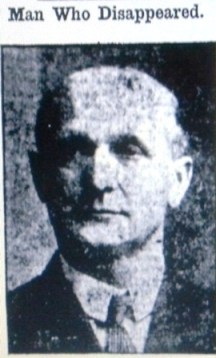
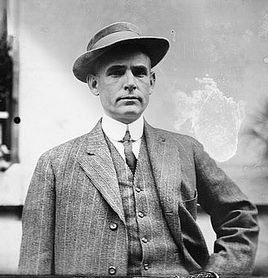
Charles Hazen Morton

Charles Hazen Morton

Some speculated he had run.

He disappeared with $2500 of the league’s money.  As days dragged into weeks there was no sign of Morton.

The Chicago Tribune said his friends were concerned that he had “done away with himself,” despondent over his pending removal as president.

The Marion Star said, “It is feared he has been thugged.”

The Pittsburgh Press advanced a conspiracy theory.  Under the headline “See Deep Plot in Morton’s Absence.”  The paper claimed  the Canton and Akron clubs realizing that he would be ousted had conspired with the president to have him disappear so, “Wright while really elected is far from president (of the league).”

But there was no conspiracy, Morton had really disappeared and remained missing for more than two months.

On March 16 he resurfaced.  Morton was found “wandering aimlessly” on Wabash Avenue in Chicago, near his brother’s home.  The Akron Beacon Journal said he was diagnosed with “Acute dementia (and) his mind is now a blank.”

The only clues where Morton had been for more than two months, were papers in his pockets which indicated he had been in Mexico and Texas and, The Beacon Journal said, “He mutters incoherently about Corpus Christi.”

He recovered enough to return to Akron by August of 1909.  His brother reimbursed the league $1500 that was not recovered after he was found.

Morton faded into obscurity after his return to Akron.  There was no follow-up to his story.  None of the many questions about his disappearance were ever answered.  And whatever happened in Corpus Christi died with him in 1921.


“He is a Model for the Young Ballplayer to Emulate”

21 Aug

March of 1916 was a bad month for “Prince Hal” Chase.

According to The International News Service, Chase, who spent the winter in San Jose, California playing for the Maxwells—a team sponsored by the automobile company–was “the last of the stars” of the defunct Federal League who had still not signed with a professional team.
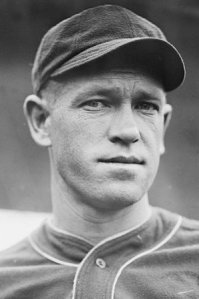
Hal Chase

                          Hal Chase

It got worse when he was arrested for failure to pay alimony and support to his ex-wife Nellie and their son Hal Jr.

He was released on $2000 bond, and it is unclear whether the case was ever fully adjudicated. After his release, Chase continued playing with the Maxwells and working out with Harry Wolverton‘s San Francisco Seals while rumors of who he would play for during the regular season were advanced on a daily basis.

The strongest rumors were that Chase would go to the New York Giants in a deal which would include Fred Merkle, who would be displaced at first base, going to the Chicago White Sox, the team Chase jumped to join the Federal League.

The Pittsburgh Post-Gazette said the deal was eventually foiled by Pirates Manager Jimmy “Nixey” Callahan, who “refuse(d) to waive.”

At the same time the papers in Cincinnati said Chase would be joining the Reds while West Coast papers said he might stay in California and join the Seals.

The Cincinnati Enquirer said Reds’ Manager Charles “Buck” Herzog “vigorously denied,” that Chase would join his club and said he would stick with Frederick “Fritz” Mollwitz at first base.
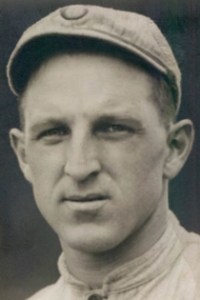
Buck Herzog

                     Buck Herzog

Herzog was even more forceful in his denial in The Cincinnati Times-Star:

“I wouldn’t have Chase at the camp.  Mollwitz is a very much better player, and he won’t jump when he is most needed.”

An even stronger indictment of Chase came from Detroit Tigers Manager Hugh Jennings, who told The Detroit News:

“As a player, there is nobody who can touch Chase for holding down first base.”

Jennings went on to note Chase’s intelligence, speed, and “superb” fielding:

“Yet for all his ability I would not have him on my club, and I do not believe any other major league manager will take a chance on him.  He will not heed training rules and has a demoralizing influence on the younger players.”
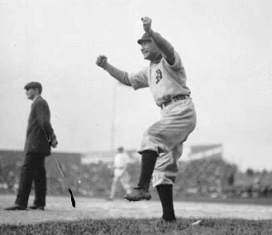
Tiger Manager Hugh Jennings

Tiger Manager Hugh Jennings

Jennings said while Chase managed the New York Highlanders in 1910 and ’11, led his team “astray,” instead of “trying to keep his players straight.”

Perhaps most damaging, Jennings said Chase was a source of dissent on the clubs he played for:

“One of his favorite stunts is to go around telling on man what another is supposed to have said about him, with the result that in a very short time he has the fellows pulling in all directions  instead of working together.  He is apt to take a dislike to the manager and work against him with the players until the whole squad is sore and will not give the sort of work that it is paid for.”

Jennings, whose team finished second in 1915 with George Burns at first base, said:

“The Tigers would win the pennant beyond question with a player of Hal’s ability on first this season, but I wouldn’t risk introducing a man who had such a bad disposition.  I believe that we can accomplish better results by having harmony on the squad, even if we have to get along with a first baseman with less talent.”

Despite the negative press, and over the objection of Herzog, the Reds purchased Chase’s contract from the defunct Buffalo Blues on April 6.

The New York Times lauded the move and defended Chase against his detractors.  The paper said “His failure with the New York Americans was due to petty controversies and rebellion against the club’s discipline,” and “(W)hen he is at his best there is not a player in the major leagues who is more spectacular than ‘Prince Hal.’”

Chase initially balked at reporting to Cincinnati, telling The San Francisco Chronicle “I haven’t made up my mind…it is possible that I would prefer to remain in California, even if there is no chance to play ball.”

Six days later, while his new team opened the season, Chase was on a train to Cincinnati.  The Associated Press said he agreed to join the Reds after receiving “word from Cincinnati that his entire contract with the Federal League, which calls for a salary of $8,000 a year, has been taken over,” by the Reds.

When Chase arrived in Cincinnati on April 15, the Reds had won three straight after losing their opener, and Mollwitz had played well at first base with five hits in 13 at-bats and just one error.

According to Frederick Bushnell “Jack” Ryder–college football star and Ohio State football coach turned sportswriter–of The Enquirer, Herzog had no intention of putting Chase in the game April 16:

“Herzog had little thought of playing him, as Fritz Mollwitz was putting up a bang-up game and hitting better than any member of the club,” until “Mollwitz made a bad mental mistake in the third inning.”

After Umpire Hank O’Day called a strike on Mollwitz, “the youngster allowed his tongue to slip,” and was ejected.
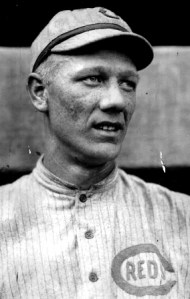
Fritz Mollwitz

                 Fritz Mollwitz

Chase came to bat with an 0-2 count and doubled off of Pirates pitcher Frank Miller, stole third, and after catcher Tommy Clark walked “(Chase) caused an upheaval in the stands by scoring on (a) double steal with Clark.”

Chase also wowed the crowd in the ninth.  After making “a nice stop” on Max Carey’s hard ground ball over first base and with pitcher Fred Toney unable to cover first in time, Chase dove “headforemost to first base to make a putout on the fleet Carey.”

In all, he played 98 games at first base, 25 in the outfield, and 16 at second base, he also hit a league-leading and career-high .329.

While the Reds struggled, Chase was wildly popular in Cincinnati.  The Enquirer’s Ryder was possibly his biggest fan—the writer raved about Chase’s performance in the outfield, his adjustment to playing second base, and his consistent bat.

While Chase thrived, Herzog, who had a contentious relationship with Reds’ owner August Herrmann, exacerbated by the signing of Chase against his wishes, began to unravel as the season progressed.  On May 30, he was hit in the head and knocked unconscious, by a throw from catcher Ivey Wingo during pregame warm-ups.  While he recovered physically, he became increasingly frustrated by the club’s performance.  On July 5—with a 29-40 record– he announced that he would retire at the end of the season when his contract expired.  He told The Times-Star:

“It would be a great blow to my pride to continue as a player, after being a manager for three years.”

The following day it was reported that the Chicago Cubs and New York Giants were interested in acquiring Herzog.  Within a week, it was reported that Herzog was heading to New York in a trade that would bring Christy Mathewson to Cincinnati to manage.  The negotiations continued over several days but floundered.  The Cubs reentered the picture—Owner Charles Weeghman told The Chicago Daily News “I brought the bankroll along…and I’ll get Herzog so quick I’ll make (the Reds) eyes pop.”  He later told the paper he offered “$25,000 and an outfielder” for Herzog.

At the same time The Brooklyn Daily Eagle said the Dodgers were after Herzog, and The Pittsburgh Post said the Pirates were in pursuit as well.

The pressure got to Herzog who held himself out of the lineup of July 17, The Enquirer said:

“The managerial situation is worrying Herzie, who had expected by this time to be cavorting at the third corner for the giddy Giants.  With the deal held off for various reasons, the Red leader is naturally a bit anxious.”

Herzog’s destination was unclear, but it was clear he would be gone.  With Mathewson seeming to be out of the picture, rumors persisted—fueled by Ryder of The Enquirer and William A. Phelon in The Times-Star—that Chase would be the new manager.

On July 20, Ivey Wingo managed the team to a doubleheader split with the Philadelphia Phillies, and the papers reported on Herzog’s successor:

The Enquirer ran Chase’s picture under the headline “Reds’ New Manager,” although they hedged in another headline which said he would “probably” be named.

The Times-Star said “Hermann has decided to allow Hal Chase to manage the team for the remainder of the season, and for this reason he does not want Mathewson.”

They were both wrong.

Within hours of the papers hitting the streets, a trade involving three future Hall of Famers was agreed to.  Herzog, along with catcher Wade “Red” Killefer went to New York for Mathewson, Edd Roush, and Bill McKechnie.  Mathewson was immediately named manager.
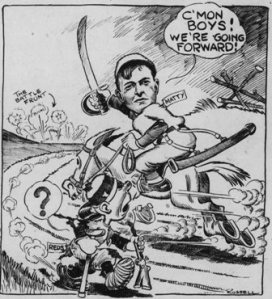
Cartoon accompanying the announcement of Mathewson's appointment.

          Cartoon which accompanied the announcement of Mathewson’s appointment.

Ryder said in The Enquirer that “Chase was greeted with a great round of applause” when he stepped to the plate for the first time on July 20:

“The fans at that time did not know of President Herrmann’s change of mind with regard to Matty, and they thought Chase was the new leader of the team.  The universal and hearty applause showed how popular the star third-sacker has become in this town.”

The Chase story is well-known; two years later Mathewson would suspend him, charge him with “indifferent playing.”  With Mathewson in Europe when the charges were heard by National League President John Heydler that winter, three Reds teammates, and Giants Manager Pol Perritt testified Chase had thrown games.

But in October of 1916 Chase appeared to have repaired his reputation, and his difficult March appeared to be far behind him.  In a season wrap-up, The Enquirer–there was no byline on the article, but it was likely the work of Ryder–published a glowing profile of the National League’s leading hitter and the man who nearly became the Reds’ manager:

“What has become of all the talk about Chase being a bad actor, a disorganizer, a former of cliques and a knocker of managers?  All gone to the discard.  Chase has not only played brilliant ball for the reds all season, but he has been loyal to the club and the managers.  He worked hard for Herzog and equally hard for Matty.  He has been a wonderful fellow on the club.  Chase is modest and does not seek notoriety or approbation…He played game after game in midseason when he was so badly crippled with a Charley horse that he could scarcely walk.  When Manager Herzog wanted to make an outfielder out of him he went to the garden and played sensational ball…Later in the season he filled in for several games at second base, a difficult position for a left-hand thrower, but he put up great ball there.  He is a natural ballplayer of the highest class, and with it all a perfect gentleman, both on and off the field.”

The profile concluded with this assessment of the man who would become synonymous with the baseball’s greatest sins:

“Chase has been a great man for the Reds, and there is many a manager of today who wishes that he had got in ahead of the Cincinnati club in signing him.  He is the smartest ballplayer and the quickest thinker in the National League today.  He is a model for the young ballplayer to emulate, because he is a real artist in his profession.”

Griff’s Invention

5 Aug

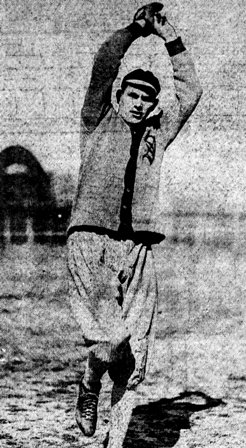
Bob “Buster” Bescher arrived in Cincinnati a right-handed hitter.  In 1909, he led the National League with 54 stolen bases but hit just .240.

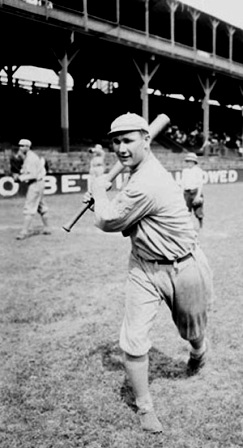
Bescher

Bescher

Bescher’s manager, Clark Griffith would compare him to Ty Cobb in an interview with Harry Salsinger of The Detroit News:

“If Bescher could hit he would probably set a pace for base-stealing that would never be equaled…Bescher gets away like Cobb, and his success lies mostly in getting away.  He is running in his first few steps.  He has a great pair of limbs and is in stride at the jump.  He is lightning fast.”

The Cincinnati Enquirer said:

“Bescher is a big, strong fellow, naturally left-handed, who was, unfortunately, coached to bat right-handed when he was a kid.”

Griffith set out to change that before the 1910 season.  In January, The Enquirer said:

“A device for batting practice was shipped to Bob Bescher at his home in London (Ohio) by Manager Griffith yesterday.  The arrangement was constructed according to Griff’s order, and it was designed to give Buster practice in batting left-handed before he goes South with the club six weeks or so hence.”

Clark Griffith

Clark Griffith

The paper described Griffith’s invention:

“The device consists of a ball of regulation size, but fitted with an extra cover, to which stout rubber cords are attached, one on each side.  One of the cords is to be fastened to the floor and the other to the ceiling, allowing the ball to swing loosely at about the height of the batter’s waist.  When the ball is struck with a bat, the flexible cord allows it to swing several yards and it returns with great force, coming back at about the speed of a pitched ball.  Then it is time for Buster to get busy with the club and soak it out again.”

A diagram of Griffith's invention.

A diagram of Griffith’s invention.

The Enquirer said Griffith hoped Bescher would add “30 or 40 points” to his average batting left-handed.

“He is the best base runner in the National League…Griff has sent him instructions to hit only left-handed with the new machine, and he hopes that Bob will be a regular Ty Cobb when he reports in March.”

Bescher batted almost exclusively left-handed during spring training in Hot Springs, Arkansas and became a switch-hitter that season, and seems to have benefitted from Griffith’s invention—but never became a “regular Ty Cobb.”

He improved his average to .250 in 1910 and again led the league with 70 stolen bases.  The next two seasons he hit .275 and a career-high .281, leading the league with 81 and 67 steals.

Bescher

Bescher

In 1913, Bescher slowed, hitting just .258 and stealing 38 bases.  He bounced from the New York Giants to the St. Louis Cardinals and Cleveland Indians over the next five seasons, never hitting better than .270 or stealing more than 39 bases.  He played minor league ball through the 1925 season.

“Stars for A’s, Pep for Phils—In Negro Ranks”

13 Jul

The push to integrate baseball in the late 1930s and early 1940s came most frequently from the black press and American Socialists, but occasionally a white voice would call for the color line to be broken.

In May of 1940, with both Philadelphia teams struggling and headed towards last place finishes (Phillies 50-103, and Athletics 54-100), The Philadelphia Record made the case under the headline:

Stars for A’s, Pep for Phils—In Negro Ranks

“Experienced players are available who could strengthen the A’s shaky pitching staff and give the Phils the batting punch they need.  These players could make potential champions out of any of the other also-rans in either major league.”

[…]

“But they are Negroes, and organized baseball says they can’t come in.”

The previous season, Phillies Manager James Thompson “Doc” Prothro, a Memphis native, told The Pittsburgh Courier he would welcome players from the Negro Leagues on his club:

“I certainly would, if given the opportunity to sign up a good Negro ball player.  I need good players, and if I ran across a colored boy who could make the grade I wouldn’t hesitate signing him.”

Doc Prothro

Doc Prothro

The Courier’s Wendell Smith said that when the Phillies manager made the statement:

“Prothro draped his right arm across our shoulders and we walked along, as though to assure us he realized the unfairness of the major league color line.  It seemed he wanted to convince us that he was against it as much as we were.”

Wendell Smith

Wendell Smith

Now as Prothro and the Phillies headed towards their second straight 100 loss season, one of Philadelphia’s daily papers agreed that it was time:

“In all baseball law there is not a single line barring colored players from the game.  Several major league managers have said they would jump at the chance to sign the best of them.  Some owners have declared they would vote to admit them.

“But no vote ever is taken on the subject.  No manager or owner dares defy the Jim Crow tradition which in the past has been the most inflexible unwritten law in the game.”

Most importantly, the paper said, the “unwritten law” had left a key group out of the decision:

“No one seems to have consulted the fans…There is an even chance—and a whole lot more—that a few thousand fans who have been staying away from the A’s and the Phils might turn out to see what (Satchel) Paige and (Josh) Gibson and a few more like them, might do in the major leagues.”

The Record never followed up on their call to integrate.  The issue was forgotten in Philadelphia.  As both teams limped to their last place finishes the fans that were never consulted on the issue stayed away in droves. The Athletics drew 432,135—sixth out of eight American League teams.  The Phillies had the worst attendance in the major leagues, just 207,177.

“He is a $900 Man”

6 Jul

Frank Leonardo Hough had a major conflict of interest. While sports editor for The Philadelphia Inquirer, he also held a 12.5% interest in the Philadelphia Athletics from the club’s inaugural season until 1912—he also served as the team secretary for several seasons while working at the paper. Another Philadelphia sports writer, Sam Jones of The Associated Press also held a 12.5% interest in the team.

Frank L. Hough

Frank L. Hough

Perhaps it was Hough’s close association with an American League team that made him one of the most vocal advocates for the rights of current and former National League players while the leagues battled for stars.

In 1902, he told his readers the story of how William “Bill” Duggleby, who jumped from the Phillies to the Athletics after the 1901 season, was treated—Hough said he was, “Human Chattel”–while a member of the Phillies:

“These are the facts:

“William Duggleby, pitcher played with the Auburn Club, of the New York State League, during the season of 1897. In the fall of that year, he was drafted by the Philadelphia Ball Club.”

According to Hough, Duggleby was offered $900 for the season, a $25 raise from his salary in Auburn.

Hough pitched just nine games for the Phillies in 1898 and, “was farmed or rented,” to minor league clubs for the remainder of 1898 and in 1899 and 1900.

“Thus it will be seen that although he was under the absolute control of the Philadelphia Club from 1897, he played only a few games in the season of 1898 with that organization. He had no control over his own services. He could not even say where he would play, or where he would not play. That matter was determined by the treasurer of the Philadelphia Ball Club.”

William Duggleby

William Duggleby

Hough noted that while Duggleby, “developed considerable skill,” and had three good seasons in the Eastern League (12-11, 22-16, 17-10) drawing considerable interest from a “half dozen” major league teams, he only received $900 from the Phillies each season:

“The clubs that rented Duggleby did not know him in the financial end of the transaction at all.

“Had Duggleby the right to sign wherever he could have made the best bargain he would have undoubtedly received at least $1800 a season for his services—just twice as much as received under the White Slave system of the National League.”

Hough said Duggleby likely only had six to 10 years total earning power and “lost three years in which he should have received a salary somewhere commensurate to his ability.”

That, however, said Hough, was not the worst of it. In 1900, Duggleby was with the Toronto Canucks, who paid the Phillies, “$225 per month for his services,” while Duggleby was paid just $150 a month.

“No convict from a Texas or Georgia penitentiary was ever rented or leased to break stone on a quarry or repair roadways in colder blood than was Duggleby to the Toronto Club.

“If Duggleby was not a white slave in a free country, what in the name of all that is fair was he?…Of course, Duggleby did not have to wear ball and chain—that might have interfered with his playing ability. But he had no more control over his actions than would the most hardened criminal consigned to the quarries.”

Just days after Hough made the case for Duggleby’s victimhood—and after he appeared in just two games for the Athletics— the pitcher returned to the Phillies. Said to have been paid $3250 by the Athletics, Duggleby accepted a $2400 contract with the Phillies. He told Sporting Life:

“There was no great reason for my going with the American League in the first place, but after I had given my word to go with Connie Mack’s team I did not feel like breaking it. Then came the decision in the (Napoleon) Lajoie case, and a notice from Manager (Bill) Shettsline to report to him or meet with the same fate as Lajoie. I went to see Shetts at once and asked him if the club really intended to proceed against all players that were under reserve. He assured me that they would. Well, under the circumstances I saw nothing for me to do but go back to the National.”

Hough’s tone changed considerably after Duggleby left the Athletics; in addition to his paper referring to the pitcher in a headline as a “Vertebraeless Youth,” he said:

“Without awaiting the outcome of the efforts to be made today to secure an appeal (in the Lajoie case)… (Duggleby) runs to cover like a frightened hound…Evidently the treasurer of the Philadelphia Ball Club sized up Duggleby right in the first place. He is a $900 man.”

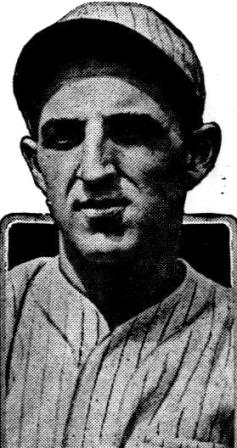
Duggleby, who posted a 20-12 record for the Phillies in 1901, only had one winning season after (18-17 in 1905). He pitched in the major leagues until 1907.

Duggleby had one other distinction: During his initial trial with the Phillies in 1898, he hit a grand slam in his first major league at-bat on April 21–for 70 years he remained the only player to hit a grand slam in his first game until Bobby Bonds hit one during his debut (his third at-bat) on June 25, 1968; Jeremy Hermida equaled the feat in his first major league at-bat in 2005.

Hough remained a stockholder and officer with the Athletics while simultaneously reporting on baseball for The Inquirer, until he sold his interest to Connie Mack in 1912. He was the paper’s sports editor until his death the following year. (While Hough’s middle name was said to be Leonardo throughout his life, his Pennsylvania death certificate lists it as Lewis)

“It smacks of Old-fashioned Common Sense”

26 Jun

For more than a century, major league baseball has looked for ways to increase hitting.  Or, as Bozeman Bulger of The New York World put it in 1917

“Overhauling the rules of baseball to make it harder for the pitcher and more of a joy ride for the boys who wield the ash has always been a favorite winter pastime.”

Burger said former pitcher and current National League President John Tener was “(C)onvinced that the public wants more hitting.”

John Tener

John Tener

Tener and others shared their ideas for rule changes with Bulger on the eve of the meeting of the rules committee.

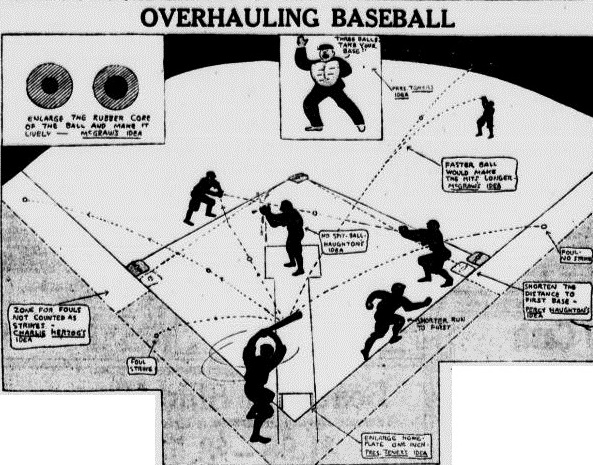
“Tener proposes making the home plate larger and at the same time allowing a batter to take his base on three balls instead of four.”

[…]

“Then comes Charlie (Buck) Herzog (of the New York Giants) with a suggestion, perhaps the most interesting of all.  It is the outpost of a real imagination that is comprehensive. Before announcing his plan, Herzog calls attention to the injustice of calling strikes on very hard hit line drives that fall foul by inches.  To all intents and purposes, those are real scientific hits, and the fact that luck causes them to fall foul should not act upon the batter as a penalty.  In other words, he is being severely punished for really doing scientific work. Herzog suggests, therefore, that a zone be described along those two foul lines between third and the fence and between first and the ground limits.  This zone should be at least ten feet in width, and any ball hit therein is not to be called a foul.  At the same time, it is not to be called a safe hit.  In other words, the batter loses his hit by bad luck, but it relieves him of an unjust penalty.”

Buck Herzog

Buck Herzog

Incredibly, Bulger completely endorsed Herzog’s proposed rules change and claimed, “Every ballplayer in America” would agree, because “It smacks of old-fashioned common sense.”

Another rule change was proposed by Percy Duncan Haughton.  Haughton, a long-time college football coach (Cornell and Harvard), and Harvard baseball coach in 1915 (he also played both sports at Harvard) had become a part-owner of the Boston Braves in 1916.  Bulger said:

“Mr. Haughton’s scheme has not been taken very seriously by those who were studying these problems while he was still a football player, but there is a real satisfaction in finding a new magnate so much interested in the sport.  The President of the Braves proposes that the distance from third to home and from home to first be lessened by several inches.  It might help the batter a little, but an extreme change like that would be pecking at the one fundamental of the game that has stood all tests.”

The most practical suggestion came from Giants Manager John McGraw, who proposed that no rules be changed, but advocated a more lively ball.

Bulger, however, was sure some rules would change:

“(T)he powers that be appear to be intent upon really turning out a new model.”

The New York World's rendering of the proposed changes.

The New York World’s rendering of the proposed changes.

When the meetings at the Waldorf Astoria in New York ended two weeks later, Jack Veiock of the Hearst Newspapers International News Service said:

“(I)t was confidently expected that the members of the rules committee would get together and make a few alterations in the baseball code as it stands today.

“But the rules committee did nothing of the kind  The wise old heads who are in control of baseball are satisfied with the rules.”


“Probably the ‘Boniest’ Bonehead Play Ever”

22 Jun

While some of the details changed in subsequent tellings, this story stayed substantially the same from when it was first presented in a column by sports writer William A. in 1913, until the final published version in 1957 in The New Orleans Times-Picayune.  One version called it, “Probably the ‘boniest’ bonehead play ever”

The story was told by and told about lefty Evan “Rube” Evans.  Born on April 28, 1890, in Sebring, Ohio, Evans was a career minor league pitcher who, when the story first appeared, seemed to be headed to the big leagues. 

Rube Evans

Rube Evans

The tall–he was reported by various sources as anywhere from 6′ 2″ to 6′ 4″–began his professional career with the Dallas Giants in the Texas League in 1910; he was 15-12 for the pennant winners, but The Dallas Morning News said he didn’t “take baseball seriously” until the following year, when he was 18-16 for the Giants:

“Before that, it seemed, the big, husky flinger looked at playing baseball something in the light of a joke.  Last season, though he came back into the game with a different viewpoint. He seemed to realize that ball playing was a man-sized business.”

After his 1911 performance, Evans’ contract was purchased by the New York Giants, and he joined the team for spring training in Marlin, Texas in 1912.  The Morning News said if he maintained his new found focus “and works as hard as he knows how to work he ought to stick.”

Evans quickly impressed the Giants with a pitch “takes a most freakish break,” according to The Washington Times:

“Rube Evans, the Giants left-handed recruit pitcher from Dallas, surprised bot Manager (John) McGraw and Coach Robby (Wilbert Robinson) by showing them a curve that is entirely new to the big league…The ball is delivered in exactly the same manner as the spitball, but he does not moisten it.”

The paper did not elaborate on how Evans’ “dry spitter” was different from versions reported on during previous seasons–including the one thrown by Christy Mathewson of the Giants–but according to The New York World, “McGraw says he will try and teach it to Rube Marquard.”

Despite his “dry spitter,” Evans failed to make the team and was returned to Dallas where he posted a 22-12 record for the Giants.

In 1913, he joined the New Orleans Pelicans in the Southern Association but appeared to be headed to the Cleveland Naps before he threw a pitch in the regular season for the Pelicans.  In March, Evans shut down the Detroit Tigers 3 to 1 on five hits and followed that up with a four-hitter (and 3 to 1 victory) against the Naps.

The Cleveland Press said, “(Naps Manager Joe) Birmingham plans to cut down his squad considerably.  It is said recruits (Hugh) Peddy, (Pete) Shields and (Ward) McDowell will be left here in trade for one good pitcher, probably Southpaw Rube Evans.”

With Evans apparently on the verge of joining the Naps, the story of his “bonehead” play was told by Phelon, then repeated widely:

“(Evans) has one curious habit—a trait which has aroused much wonder on the part of every manager under whom the southpaw has been toiling.  When given an order by his manager or captain, Mr. Evans always stops, cocks his ears, and demands a repetition of the directions.  Naturally he is first taken for a simp, or bonehead, but when further acquaintance with him shows that he is a gentleman of intelligence and high mentality, the field leaders are muchly puzzled.

“’I always want my orders repeated,’ quoth Mr. Evans, ‘so that I will never again make such an error.”

(The 1913 version of the story, which quotes Evans,  places the incident in McKeesport, Pennsylvania, some later versions say it happened in 1913 with the Pelicans, still others say it was in Portland, Oregon; however, the original publication predates Evans’ time on the West Coast which did not begin until May of 1914).

Evans said he had pitched into the ninth inning when the opposing team put a runner on third with one out, when his manager told him if the other team attempted a squeeze play to “bean him.”  Evans said:

“’I knew no more what a squeeze play was than the man in the moon, but my orders rang in my ears as I started winding up.  Just as a swung up my arm, the fellow on third tore for the plate…I took careful aim at the oncoming runner, and pickled him with a fine shot to the back of the cranium.  Three seconds later the crowd was coming towards me with roars of fury, and I got over the back fence just in time.

“’Well how was I to know that I should have hit the batter and not the runner?  Ever since I have insisted on duplicate orders, so that I would know just what to do.’”

His acquisition by Cleveland never materialized and he had a disappointing 12-15 record in 1913, in a season split between New Orleans and the Birmingham Barons.

It is also in question whether Phelon’s characterization of Evans as a “gentleman of intelligence and high mentality,” was entirely accurate given his inability to stick with clubs who were impressed with physical abilities.  After his second chance to pitch in the majors didn’t materialize, the remainder his of career was marked by long stretches of mediocrity, charges of bad behavior and comparisons to another left-handed “Rube.”

In August of 1913, he was suspended for the remainder of the season by the Birmingham Barons for, according to The Birmingham Post-Herald, “Failure to keep in condition.”  The Sporting Life’s Chandler Richter called him “Erratic,” The Oakland Tribune said he was”Eccentric,” a wire service retelling of the “beanball” story from 1915 said he “earned a nationwide reputation as a ‘squirrel,” another called him “the real eccentric,” when compared to Rube Waddell.

The other left-handed Rube

The other left-handed Rube

His two-year tenure with the Portland Beavers in the Pacific Coast League (PCL) began when he wore out his welcome in New Orleans in May of 1914 and was sold to the Beavers.  It was particularly rocky.  The Spokane Daily Chronicle said Evans and Beavers manager Walter “Judge” McCredie “got along like a pair of strange bulldogs.” He was suspended at least once, again for the euphemistic “failure to be in proper condition,” and gave up a game-winning home run to Jack Ness of the Oakland Oaks when he accidently threw a pitch over the plate while attempting to intentionally walk Ness.  At the close of the 1915 season, Portland let him go for what The Portland Oregonian called “His inability to take care of himself.” Of his 9-22 record the paper said:

“Rube ran into gobs of adversity.”

After leaving Portland, Evans played parts of three seasons for the Salt Lake City Bees in the PCL–in 1917 he was 21-9, but when McCredie was named manager of the Bees in 1918, Evans time with the team was nearly over.  Before the season, The Oregonian said, “Evans did not take kindly to the idea of having to take orders” from his former manager and was threatening to jump the club.  He finally did jump in June after appearing in 14 games and posting a 3-8 record.

Evans went to Portland and finished the 1918 season in the semi-pro Shipyards League, The Oregon Daily Journal said upon his arrival:

“Rube Evans was through at Salt Lake and McCredie was probably saved the trouble of wearying his hand by writing out Rube’s release, when Rube left.”

In 1919, he played for the Rupert franchise in the semi-pro Southern Idaho League; while successful, his reliance on the emery ball for his success didn’t make him friends.  The Twin Falls Times said:

“When Rube Evans lugged the emery ball into the S.I.L. he failed to do anything beneficial to the league.  Rube will win a few more games for the Rupert club, but he has lowered the standard of sport in the league.”

Evans had one more season in professional baseball, posting a 10-7 record with the Regina Senators in the Western Canada League in 1920.  In an August 15 doubleheader against the Edmonton Eskimos Evans was ejected for arguing with the umpire while facing the second batter of the first game; he came back to lead the Senators to 5 to 3 victory in the second game, giving up two runs in 7 2/3 innings, and hitting a three-run home run in the sixth.

Rube Evans

Rube Evans

After the 1920 season, he returned to Ohio and spent the next decade playing semi-pro baseball there and in Western Pennsylvania.  His last headlines came in 1924 when he pitched six innings for the Sharon (PA) Elks team in an exhibition game against the New York Yankees.  The Elks lost 10-8, Babe Ruth went 2-4 with a double for the Yankees.

Evans’ playing days ended in Akron, Ohio.  He pitched for and managed the Goodyear Tire and Rubber Company team, and stayed on with the company as a rubber worker.  He died on January 30, 1950.

A clue to some of Evans’  erratic behavior is contained in his death certificate.  The pitcher spent the last three and a half years of his life in Ohio’s Cambridge State Hospital; his cause of death was listed as “General Paresis,’ brought on by syphilis.

A shorter version of this post appeared on June 3, 2013

Lost Pictures–Roger Bresnahan and Toy

19 Jun

bresnahanandtoy


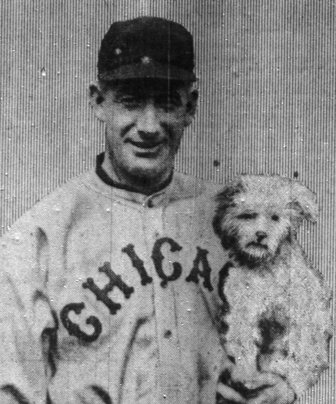
The Chicago Cubs were 14 games over .500 and in second place, just two a half games behind the New York Giants on July 25, 1914.  The team lost 14 of their next 17 and wound up in fourth place.  (the Giants finished second to the Boston Braves).  At the end of the season, first-year Manager Hank O’Day was let go by the Cubs and returned to umpiring.  Catcher Roger Bresnahan was named as O’Day’s replacement.

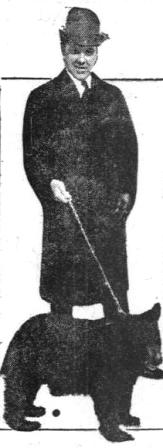
Later in the off-season, there was another drama taking place off the field.  It involved Clara Maduro:

In December, The Chicago Daily News said:

“Because the female of the species is more deadly than the male, Clara Maduro, the brown bear mascot of the Cubs, must die.  The wee cub, which fans saw drinking milk from a bottle or eating ice cream cones at the West Side park last summer, has grown to giant proportions, and while of a pleasant disposition is inclined to break loose at times. Hence, Clara will be executed New Year’s Day.”

A month earlier, The Chicago Tribune reported:

“‘There’s a woman being strangled at Wood and Taylor Streets,’ was the message received by Desk Sergeant Comstock of the Warren Avenue station last night.  ‘Send a lot of policemen.’

“The patrol wagon with a number of detectives was sent to the location, which proved to be on the west side of the National League ballpark.

“A loud howling was heard from the inside, and upon investigation it was found the bear mascot of the Cub team, which had been locked in a cage in the team’s quarters had broken its chains and was roaming about.”

After an outpouring of outrage and concern from Chicagoans, The Daily News reported that Clara Maduro “has been saved through the protest that followed the announcement.”  The bear was initially placed with a local saloon owner named Joe Biggio; later reports said the bear went to the Lincoln Park Zoo.

With Clara out, it was determined that a bear cub mascot was not the best idea for 1915.  So in March, the team introduced their new mascot, Toy.

The Tribune said:

“‘Toy,’ the 1915 Cub mascot is a canine of high degree and more likely to become a permanent fixture than the baby bear which grew so big and developed such a crabbed disposition that he [sic] had to be discarded last fall.  ‘Toy’ used to be the mascot and assistant caddie of a feminine golf expert who was a visitor at Tampa during the Cubs stay there and who became such an ardent baseball fan that she bestowed her pet on the team when the Cubs departed for the north.”

The Cubs started the season strong and led the National League until mid-July, but the team faltered badly and ended the season in fourth place with a 71-82 record.

Toy did not “become a permanent fixture;” when Charles Weeghman bought the team after the 1915 season he replaced both Bresnahan and Toy.

Weeghman did not learn from the past and introduced the Cubs new mascot in November.  A bear cub whose mother was killed during a Wisconsin hunting trip, was presented to the team by the hunter, either a state senator named Albert J. Olson or Cubs stockholder J. Ogden Armour–newspapers reported both, but the bear’s name, Joa, would suggest the latter.

It is unknown what became of Toy.

Weeghman introduces Toy's replacement

Weeghman introduces Toy’s replacement