Tag Archives: New York Giants

“’Amos, old Boy, don’t Forget the left foot Racket.’

12 Dec

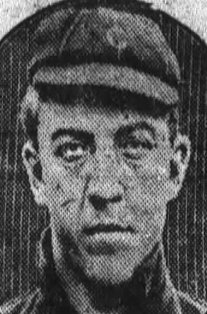
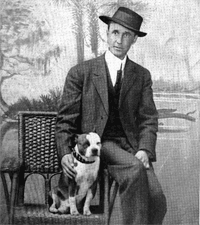
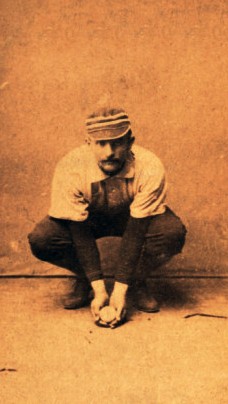
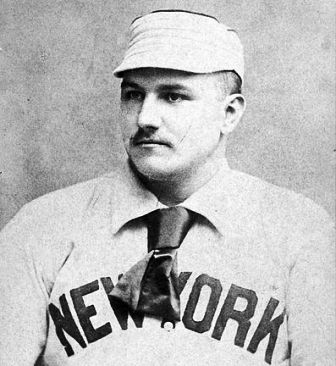
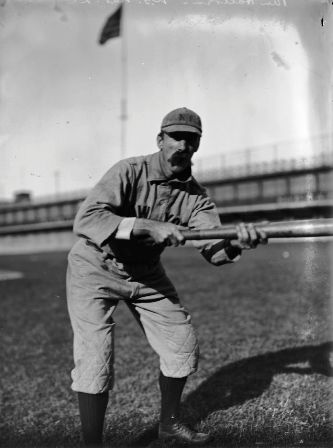
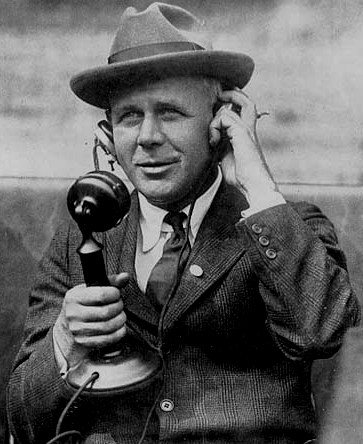
Long after “Dasher” Troy’s last professional game in 1888, he remained a good source of quotes for sportswriters; at the Polo Grounds, or after 1900, at his Manhattan tavern.
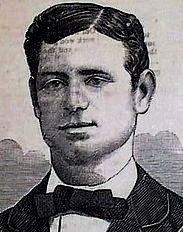
Dasher Troy

Dasher Troy

When he wrote a series of columns for “Baseball Magazine” in 1915 the magazine said about him:

“There was a day when John (Dasher) Troy was one of the bright lights of the diamond.  Advancing age has long since driven him from his favorite haunts. But, though, as he admits, he has “had his day and that day is a long time past,” still he has ‘seen more baseball games than any other player in the country,’ and remained throughout a close student and observer of the game.”

And, humility was not his strong suit.

Four years before he was given credit for fixing Hughie Jennings broken nose, Troy took credit for another player’s success.

After Amos Rusie’s great 1894 season—36-13, 2.78 ERA–Troy told The New York Sun:

“Very few people know just what made the big pitcher so effective last season, but can explain it… (Rusie) had a wrinkle last season that was of my own invention…I had noticed that every League batsman, barring one or two like (Ed) Delehanty(Dan) Brouthers, and a few more, stepped back from the plate whenever Amos pitched a fast ball.  So I went to the big fellow one day and said:

“’Amos, when you see a batter’s left foot—providing he is a right-handed hitter—move back a trifle, just drive that fast straight ball or your outshoot, over the outside corner of the plate, and you’ll find how easy it is to fool these ducks.  Just try it and see if I ain’t right.’

Amos Rusie

Amos Rusie

“Well, Amos did just as I told him the next game he pitched, and he was laughing in his sleeve.  The minute he saw a batter’s left foot move back, he grinned all over.  Then he let ‘er go.  The ball whistled like a small cyclone up to and over the outside corner of the plate, and the batter made such a wild stab at it that the crowd roared.  But nobody knew what the wrinkle was.

“By and by, when I saw that Amos had mastered the trick to perfection, I thought it was time to gamble a little on it.  So I just took a seat back of the home plate among a lot of know-alls and watched the batter’s feet closely.  Whenever I saw a left foot move back I just took out my coin and yelled:

“’Three to one this duck doesn’t make a hit!’

“There were lots of fellows around me who would take up the short end, and as a result I had a good thing on hand right along.  But the cinch came when the Bostons came over here on August 31 to play off a tie game with the New Yorks.  There were nearly 20,000 people on the Polo Grounds, and Amos was slated to pitch.  He was as fit as a fiddle, and just before the battle began I leaned over the grandstand and whispered to him:

“’Amos, old boy, don’t forget the left foot racket.’

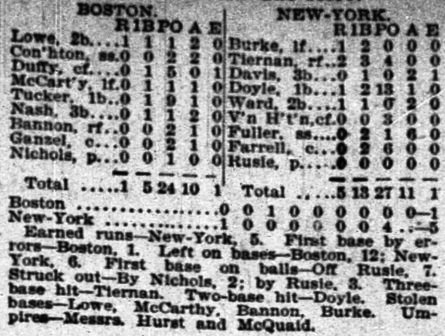
“He said, ‘All right,’ and then he began his work.  Every one of the Bostons stepped back from the plate—even (Hugh) Duffy, (Tommy) McCarthy and (Tommy) Tucker.  Amos just grinned, and sent that ball over the corner until the champions were blinded.   Laid three to one against each Boston batter and during the entire game the champs made but five scattered singles.”

The Box Score
The Box Score

Twenty years later, in one of the columns he wrote for “Baseball Magazine,” Troy again took credit for Rusie’s performance in the Boston game, but embellished the details further:

“There were a lot of my friends there that day trying to show me, so they said how much I knew about the game. So I thought I would take a look at my old friend, Amos Rusie, who was pitching for the Giants.  He never had more speed, and his inshoot was working fine on the inside corner of the plate… I sent one of my workmen down to Amos on the players’ bench with a note.   In this note I told him not to pitch his inshoot, that nearly every one of the Boston Club was pulling his left foot back from the plate, and that the batter could not hit a ball out of the diamond if he would put them low and over the plate.

“Hugh Duffy was the first man up for the next inning, and he hit a slow grounder to the first baseman; the second batter hitting to the second baseman, and the third to the third baseman. When Amos was walking to the bench he looked up toward the bar on the grandstand, which was behind the catcher at the back of the stand, and he had a big broad smile on his face. Any player who pulled his left foot back, or left-hander who pulled his right foot back, never hit Amos very hard after that.”

There’s no record of Rusie having credited Troy as the reason for his greatest season.

Troy remained a popular figure in New York baseball circles, and a popular story teller, until his death in 1938.
 

“Either they think that Everybody is Gullible, or else they are Weak Mentally themselves”

19 Nov

Until a broken ankle in 1902 slowed him, George Van Haltren was one of baseball’s best leadoff hitters; a .316 hitter with 2544 hits during his 17 seasons.   After a disappointing 1903–.257 in  84 games—his major league career was over, and he went home to the West Coast where he spent six seasons in the Pacific Coast League (PCL).

George Van Haltren

George Van Haltren

A member of the Seattle Siwashes during his first year in the PCL, Van Haltren was asked by The Oakland Tribune—the paper called him “an ultra-scientific batsman,” to share his expertise:

“Every ball player occasionally meets other players who call themselves ‘place hitters.’  The assertions of the majority of these players are such that either they think that everybody is gullible, or else they are weak mentally themselves.  They tell you they ‘can put the ball where they please,’ and that ‘it is easy when you know how.’

“Never take any stock in such twaddle.  These place-hitters would be just the men to have around when the ‘fans’ are calling on the home team to ‘hit ‘em where the fielders ain’t!’  But when it comes to delivering the goods, I have noticed, they are generally short.

“As a matter of fact, the batter often tries to hit to a certain field, and sometimes he is successful, but no man can give a guarantee when he goes up that the ball he hits will take any special direction.  If place-hitting could be carried out to the fine point that some players say they have it, they would be able to hit safely every time they came up.

“To the young player I would say: Don’t get in the habit of planting your feet on the ground and not moving them until you have swung at the ball.  Get a stride and advance a little toward the ball as you hit.  Do not step too far and accustom your eyes and hands to the change such a step makes.  Learn to hit squarely every ball that passes over any part of the plate between the knee and shoulder, and devote the most practice to what you are weakest on.

“Learn to think and act quickly and to keep your head at all times.  In a contest do not always do the same thing under the same circumstances.  Give your opponents a surprise whenever you possibly can.”

By the time he arrived on the West Coast, Van Haltren was no longer able to give his opponents “a surprise” as often as he could before the ankle injury; he hit .270 for Seattle in 1904, he played five seasons with the Oakland Oaks, hitting .255 before retiring in 1909.

Van Haltren died in 1945 without ever drawing serious Hall of Fame consideration.  A good argument for his enshrinement can be found here.

“The Annual Spring Typhoon has Blown up Again”

10 Nov

In 1906, despite being, on paper, the best team in the American League, the Cleveland Naps finished in third place, five games behind the Chicago White Sox.  The club had three twenty game winners—Addie Joss, Bob Rhoads, and Otto Hess—and four regulars who  hit better than .300—Napoleon Lajoie, William “Bunk” Congalton, Elmer Flick and Claude Rossman,

As the 1907 season approached, Grantland Rice, of The Cleveland News said the team was now a victim of the success of individual players:

“The annual spring typhoon has blown up again—only a bit worse than ever.  In nearly every big league camp well-known athletes are breaking into loud roars over the pay question, and there promises to be quite a batch of trouble before the storm is cleared away.  In this respect Cleveland heads the list, although Napland owners have one of the highest salary lists in the game.  Up to date Joss, Rhoads, (Terry) Turner and Congalton have balked, while neither Flick nor Hess have returned a signed contract.”

Grantland Rice

Grantland Rice

Rice said the club’s negotiations with Joss and Rhoads were at an impasse, and “just how it will end is a matter of uncertainty.”  The news of the team’s trouble signing their stars led Rice to a discussion of “just how much a major leaguer is supposed to receive for his work each season.”

“When a youngster breaks in he is never given less, or at least rarely so, than he received in his minor league berth.  His pay is boosted the greater part of the time, so the average debutante’s pay roll ranges closely around $1,800 providing he is recognized as a first class man.

“If he delivers the goods his first year out he can figure on about $2,000 or $2,200 for his next season, and then if he becomes established as a regular, his income should be somewhere in the immediate vicinity of $2,500.

“From this point upward it all depends on their rankings as stars.  You hear considerable about $5,000 contracts and better, but as a matter of cold, clammy fact, but few athletes draw over $3,000 or $3,500 at best.

“In the epoch of war salaries $3,500 or $4,000 was a fairly common figure—but no more.

“A high grade slabman along the order of Joss, Rhoads (Nick) Altrock, etc…will rake in about $3,000 now.  In his weekly letter in a Toledo paper (The News-Bee), Joss stated that he was offered $3,000 for his season’s work, but that he demanded more—just how much he didn’t say.

“George Stone drew $3,000 or there abouts last season and now that he has fought his way to the premiership in the School of Slugs he demands $5,000, at which figure Mr. (Jimmy) McAleer balks strenuously.  (Johnny) Kling also asks for $5,000, which sum Charley Murphy says he will not receive.

“From this list we jump to the drawing cards of the game such as Lajoie, (Honus) Wagner, (Wee Willie) Keeler, (Christy) Mathewson, etc…

“Lajoie’s figures range somewhere above $8,000 and something shy of the $9,000 mark.

“Wagner is supposed to draw $5,000 for his work.

“If reports sent out from New York are true, Keeler’s yearly ante is close to $6,000, while Mathewson draws in about the same.

Hal Chase won’t miss $3,500 very far.

“But the high-priced teams are not pennant winners by a jug full.

(Charles) Comiskey and (Connie) Mack hew closer to the line than any others in Ban Johnson’s circle, and yet these two have won more pennants than all the rest put together.  In fact, they’ve gotten away with all but the two which Boston nailed.

“Mack had one of the cheapest, if not the cheapest team in the American League through 1905, the last year he copped the pennant.  Comiskey’s world champions of 1906 were far below Cleveland, New York or even Boston, from the salary standpoint.

“It looks funny to figure the cellar champions of a league paid more than the holders of the world’s title, but if all the figures were given out, the White Sox payroll would loom up under Boston’s to a certainty.

“The full salary cost of running a big league club varies from $40,000 to $50,000, or maybe $55,000 a year.

“A set of figures somewhere between $45,000 and $50,000 would probably hit at the higher average.

“There was a time when Boston’s payroll was close to $70,000 and (Clark) Griffith’s was only a notch below—but this golden era for the ballplayer has passed.”

According to The Washington Post, Joss had earned $3,2000 in 1906 ($2,700 and a $500 bonus), the biography, “Addie Joss:  King of Pitchers,” said he was paid $4,000 in 1907—Joss, who was 21-9 with a 1.72 ERA in 1906, followed that up with a league leading 27 wins (against 11 loses, with a 1.83 ERA) in 1907.

Addie Joss

Addie Joss

Fellow twenty game winners Rhoads and Hess both saw their production slip (15-14, 6-6), and only two regulars—Flick .302 and Lajoie .301—hit better than .300, and the team’s batting average slipped 28 points from the previous seasons.

The Naps finished fourth in 1907.

Things I Learned on the Way to Looking up other Things #12

3 Nov

The Cost of Superstitions, 1913

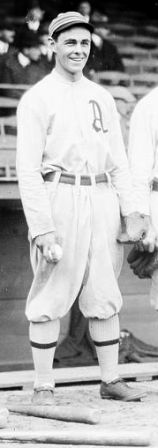
John Phalen “Stuffy” McInnis his .324 and drove in 90 runs for the 1913 Philadelphia Athletics, but the first baseman hit just .118—2 for 17—during the World Series.

Stuffy McInnis

Stuffy McInnis

The Washington Post told how one superstition among the athletics players might have contributed to McInnis’ slump:

“Those boys believe that they can change the luck at a crucial moment by hurling their bats in the air and letting them fall where they will.  Probably you fans have often seen them do it.  They also believe that they can keep up their good luck by continuing this practice.

“During the first game, in which (Frank “Home Run”) Baker hit a home run, the Athletics started tossing their bats the minute the ball was hit.  As the bats came down Stuffy McGinnis couldn’t get out of the way in time and one of them struck him in the ankle, causing a painful bruise.  He limped to first base and for a while (Connie) Mack was afraid he couldn’t go on with the game.”

Despite McInnis’ slump, the Athletics beat the Giants four games to one.

The Case against the Spitball, 1905

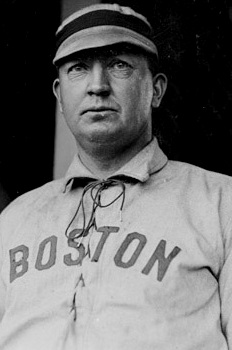
Baseball’s greatest pitcher hated the games most controversial pitch.  In 1905 Denton True “Cy” Young was quoted in The Sporting Life saying it wouldn’t be long before the pitch disappeared entirely:

“I don’t think the ‘spit ball’ is going to cut a much a figure as was thought early in the season.  Many of the pitchers that were using it at the start of the campaign have cut it now, and from now on the twirlers that use it will be dropping it one by one.  I used it against Philadelphia and Washington and had it working nicely, but it hurt my arm and I have cut it altogether.  An old pitcher like myself has no business using it at all.”

Cy Young

Cy Young

Young said the pitch injured his forearm and said he was not alone.  He claimed Jack Chesbro, George Mullin, (Guy) “Doc” White all received similar injuries.   And Washington’s Case Patten, who a year earlier so loved the pitch The St. Louis Republic said he was often “giving the ball a shower bath preparatory to flinging,” was now saying the pitch “lamed his arm.”

Young said even for those who weren’t injured, the spitter would ultimately lead to pitchers losing “control of his curve ball and his fast ones.”

While Chesbro disagreed with Young’s claim that his arm problems were the result of throwing spitballs, his effectiveness diminished greatly after the injury.

Young’s prediction of the demise of the pitch was premature.  At the time of his statement, Chicago White Sox pitcher “Big Ed” Walsh was perfecting the pitch, which he learned from teammate Elmer Stricklett—who had also been instrumental in Chesbro’s use of the spitter.   Walsh started throwing the spitball regularly in 1906.

Ed Walsh circa

Ed Walsh circa

A month before his death, on his 78th birthday and bed-ridden, Walsh remained an advocate for the pitch Cy Young detested.  He told a reporter for The Associated Press:

“I admire the pitchers today who throw the pitch.  Some people call ‘em cheaters.  They’re not.  They’re just guys doing everything they can to win.”

Wahoo Sam’s Scouting Report, 1914

Coming off of the New York Giants off-season world tour with the Chicago White Sox, the consensus opinion seemed to be that Giants Manager John McGraw did not make a mistake in signing Jim Thorpe, the world’s greatest all-around athlete, to a three-year contract worth–depending on the source—from $5,000 to $6,500 per season.  Many doubted Thorpe’s prospects after he hit just .143 in 19 games for the Giants in 1913.

Jim Thorpe

Jim Thorpe

But, not to worry, said McGraw:

“All Thorpe needed was every day action, instead of idleness, although of course sitting on the bench all summer gave him a chance to learn lots of things that will stand him in good stead later on.”

The baseball world generally agreed with McGraw’s assessment.

Hugh Fullerton predicted Thorpe would be “the most sensational baseball player of 1914.”

Damon Runyon declared Thorpe was “now a star.”

Gustave (G.W.) Axelson, Sports Editor of The Chicago Record-Herald, who traveled with the teams, said of Thorpe’s development during the trip:

“The fans in the United States will see an entirely different kind of player when Thorpe Lines up for the season. “

White Sox pitcher Joe Benz, who played against Thorpe on the tour, agreed saying Thorpe “improved greatly” and would be of “great assistance to the Giants,” in 1914.

But, “Wahoo” Sam Crawford, the Detroit Tigers outfielder who traveled with the tour as a member of the White Sox disagreed with all the glowing accounts of Thorpe’s progress.  The Detroit Times said:

“Thorpe’s speed is all that commends him, according to Sam.  He is not a particularly good fielder, and he cannot hit.  He is not a natural hitter at all, but he gives the bat a little upward chop as he swings at the ball in a way that Crawford never saw any man do before.

“Furthermore Thorpe doesn’t seem to have that baseball instinct that is so necessary for a big league player, say Crawford.  He is a very chesty fellow for a man who has yet to prove that he is of big league caliber, is the assertion made by Wahoo Sam.”

Sam Crawford

Sam Crawford

Crawford’s assessment was the most accurate.  Despite the fanfare that accompanied Thorpe’s return from the tour, Thorpe was never better than a mediocre outfielder (career .951 fielding percentage) and he hit just .252 over parts of nine major league seasons.

“Women have been the cause of Ruin of more Good Clubs than Anything Else”

17 Oct

In 1907 Hugh Fullerton wrote in The Chicago Herald about the outside influences that he felt did the most damage to a ballclub:

Hugh Fullerton

Hugh Fullerton

“There are dozens of things that happen to keep a team from landing a pennant about which the general public is entirely ignorant and which never can be explained clearly.

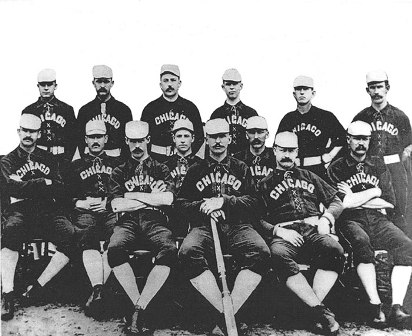
“For instance, one of the mysteries of baseball was the breaking up of the famous White Stockings team.

“Hundreds and thousands of people cursed the management of the Chicagos for selling off star players and wrecking the club—and few ever knew why it was.  The management felt worse over it than the fans possibly could feel—but it was inevitable.  A scandal in the club concerning two members and the wife of one of them started the trouble.  Threats to kill each other were made—and the disruption of the club became absolutely necessary.  The sale of (Mike “King”) Kelly (1887) and (John) Clarkson (1888) was the beginning –and after a time all parties to the scandal were let out—and Chicago was given a decade of losing clubs.”

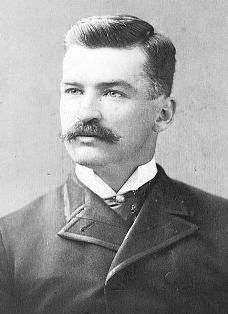
Mike "King" Kelly

Mike “King” Kelly

He claimed the reason for the breakup of the White Stockings was a common one.

“Women have been the cause of ruin of more good clubs than anything else.  They need not necessarily be bad women.  There was one club in the old twelve-club National League which, for two years, was knocked out of all chances of winning merely because the wife of one of the players was an inveterate gossip.  She knew everything that went on in the club and retained it until she had half the players up in arms against each other.

“One of the best manager s in the country today frowns upon all women and his players, under his direction, forbid their wives to mention the subject of baseball to each other.  The result is that there is the best feeling in the club.  Almost every member of the team is married, their wives meet socially at all times—and baseball is tabooed by common consent.

“I know a catcher, one of the toughest, hardiest fellows in the business, who nearly was ruined as a catcher by the women of the club.  He was so strong and tough that you couldn’t have dented him with an ax, but one day he split his hand a little bit.  He thought nothing of it, and was ready to catch the next day when the women got to pitying him and telling him he ought to take good care of it.  When he left the grounds he had tied up the injured place with a rag—and was all right.  By the next morning he was ready to go to the hospital—and he did lay off for two weeks, all because the women made a martyr of him.”

But, according to Fullerton, there was something almost as bad for a baseball team as women:

“Horse racing, however, has ruined almost as many clubs as women have.  Once a team gets interested in horse racing, and so far as winning goes, it might as well disband.

“One of the greatest troubles in the present New York National League team is the devotion of some of the players to the racing game.  (John) McGraw himself has been so successful at it that baseball has become sort of a side issue.  Many of his players have followed his example, and the result is they think more of horse racing than of baseball.

“Racing did more to wreck (Ned) Hanlon’s championship Brooklyn team than any other thing.  The Washington Park grounds are so close to the Brighton and Sheepshead tracks that players could see two or three races before the game.  Eventually baseball was forgotten and the conversation in the clubhouse dwelt only on horse racing.

(Cap) Anson had a crowd of horse race fans for several years, and the result on the work of the team was something frightful.  They talked horse racing even on the field, and had the telegraph operators throwing out messages telling what horses had won.”

And, he said, gambling in general had been detrimental to the Giants during the years Andrew Freedman owned the club (1895-1902):

“There always was a crap game or a poker game in the clubhouse, and the stakes were so high that bitter feeling was endangered.”

While Fullerton, for the most part, avoided naming names, he did single out one former Chicago manager, who had died five years earlier, for presiding over teams that were “ruined” by gambling:

“The Chicago team the second year under Tom Burns (1899) was wrecked by the same sort of deal, the manager setting a bad example in that respect.  Burns also was charged by the Pittsburgh owners with ruining their club, when he was manager (1892), by permitting and encouraging gambling.”

Tom Burns

Tom Burns

“This Fellow has about as much Judgment of Balls and Strikes as a Six-year-old Kid”

10 Sep

Umpire baiting was an art form for managers like John McGraw.  In 1906 Tim Murnane wrote in The Boston Globe about the way McGraw, and his players, intimidated a first-year umpire named John Conway during a game between the New York Giants and Boston Beaneaters.

On May 1 the Giants had defeated the Beaneaters 7 to 5, and according to Murnane:

“I was very much interested with the tactics of the Giants in a game here, when they found the clever Irvin Young in the box, and knew it would take extra work to defeat the local team.

“Umpire Conway was behind the bat in this game, and the New York boys went after the young umpire from the first ball pitched until the last man went out.  Conway was consistently giving Young the small end of the decisions on balls and strikes, and yet the New York men tried to make it appear that he was giving them a terrible roast.  The Giants worked like sailors, never letting up;  in fact, their good work with the stick and on the bases was commendable in every way, and what they were saying to the umpire could only be heard in the front seats, and perhaps that was a good thing for the game.”

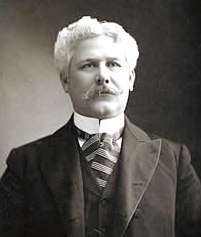
Tim Murnane

Tim Murnane

Murnane said the actions of the Giants were reminiscent of those of McGraw and other members of the Baltimore Orioles in the 1890s, but “this time it was umpire and not their fellow players,” who were the target:

“As each man passed the umpire they would make some remark, until finally (Dan) McGann, (Roger) Bresnahan and McGraw were put out of the grounds by Conway.  Note the four names, all of Celtic origin, every man out for a salary, the umpire doing his best to please, and doing it certainly in a fair way to the visitors, and yet the trio must be doing something for effect, perhaps to give the umpire something to think of when he went to New York, or perhaps to affect his work in the next game.  There was an object in the uncalled-for nagging.  The result was that Pitcher Young was actually affected, and put up a weak all-round game as the contest went along, the Giants finally winning out as a result of his poor work.”

The Giants doubled-down on their harassment of Conway after the game was over.  Murnane said Fred Knowles, the Giants Secretary,

“(I)nformed me that the New York players complained of Conway’s breath, saying that he had been drinking and was under the influence of liquor during the game.  What are the honest facts?  A friend of mine at the same hotel with Conway and Bob Emslie (the other umpire) told me that he was with the umpires the night before, as well as that morning, and heard them refuse to take a drink of any kind.  I was speaking to Conway just before the game, and took pains to note if he had been drinking, and I can say positively that he had not.”

Murnane’s comments are curious, given that he said Knowles informed him of the accusation after the game, yet he claims he “took pains” to confirm whether Conway was drinking before the game began.

“Now, doesn’t it seem unfair to pass around cold-blooded lies about an umpire doing his duty, to a management who naturally listens to stories of this kind, and then tries to make it easy for players?  I could forgive every act of the New York men, as they are out for blood, and are fine ballplayers, but I must pass up players who will try to harm a good, honest fellow, for Conway is a good umpire and had the nerve to pick the big fellows out, and no two men in the business need the call-downs that McGann and Bresnahan do.”

Murnane’s Boston colleague, Jacob Charles Morse of The Herald, called the Giants actions “reprehensible,” but said the umpire was partially to blame:

“Had Conway started in at the very first a lot of trouble might have been obviated, but it was not until he had allowed the New Yorks to kick at strikes and decisions, to leave their places, something strictly forbidden by the rules, and to bellow like bulls.  Bresnahan could be heard all over the field telling the umpire to ‘get out.’  Early in the game a bunch gathered around the umpire without the least expostulation, and went back to their places when the seemingly felt like it.”

Despite McGraw, McGann and Bresnahan receiving three-game suspensions for their actions, Morse said “The penalty imposed for the actions of the individuals was ridiculously light; not at all commensurate with the gravity of the offense.”

Things did not get any easier for Conway.

He had another run-in with the Giants at the end of June which resulted in another McGraw ejection.

He was also assaulted by two different St. Louis Cardinals; William “Spike” Shannon in June, and Mike Grady in August.  The August incident, during a game in Boston, required police to escort Conway from the field and resulted in a three game suspension for Grady.

Mike Grady had two altercations with Conway

Mike Grady had two altercations with Conway

After a second incident with Grady; this time in Pittsburgh on September 4, The Pittsburgh Press took the side of the Cardinals catcher, and harshly criticised Conway:

 “Umpire Conway officiated the game at Exposition Park yesterday afternoon.  To be more exact, a man named Conway attempted to imitate a real umpire, but the attempt was a failure…this fellow has about as much judgment of balls and strikes as a six-year-old kid, and he makes some of the weirdest mistakes ever seen.  To make matters worse, Conway thinks he is funny and laughs at his poor decisions…The Press never condones umpire baiting, but Conway called one strike on Grady that was not within two feet of the plate, and it is little wonder indeed that Michael was exasperated.

“It is to be hoped that Conway’s career as an umpire in the National League will end with the present season.  There are a score more competent men umpiring in the minor leagues today.  Conway is not fit for the position he occupies.  He takes trouble with him wherever he goes, owing to his inefficiency.”

National League President Harry Pulliam apparently agreed; Conway was not retained for the 1907 season.

He joined the Eastern League in 1907, but trouble continued to follow him.  In June he was assaulted by Toronto Maple Leafs second baseman Tim Flood—which resulted in Flood serving 10 days in jail.

Tim Flood

Tim Flood


Less than a week later, after the Jersey City Skeeters scored a run in the ninth inning to beat the Newark Sailors 2 to 1, Conway was attacked by fans in Newark’s Wiedenmayer Park.  The New York Times said:

 “A mob waited after the game until Umpire Conway left the dressing room on the grounds for the train, and when he appeared in the street the mob hooted, hissed and threw mud at him.”

He was escorted to the train station by “a squad of policemen.”

Just weeks into the 1908 season Conway decided he had enough, and resigned.  The Sporting Life said he “quit umpiring to go into business.”

Conway never worked a professional game again, although he worked several Ivy League games before giving it up all together in 1910.  He died in Massachusetts in 1932–the same year McGraw, too ill to continue baiting umpires, resigned as manager of the Giants.

“The Dream of an Ardent Baseball Fan and Admirer brought to Realization”

8 Sep

The Associated Press (AP) reported the same day that Hall of Famer Joe McGinnity was released by the New York Giants that he, along with a partner had purchased an Eastern League franchise, the Newark Indians, for $50,000—more than $1.3 million in current dollars.

Joe McGinnity

Joe McGinnity

The following month, The AP told how McGinnity and his co-owner, Chicago businessman Henry Clay Smith, came to be partners:

“There is an interesting story connected with the deal whereby Joe McGinnity and H.C. Smith of Chicago purchased the Newark club of the Eastern League, which reveals the identity of Mr. Smith and portrays the rise of a penniless man to a millionaire, who remained true to his first love in the baseball world.

“H.C. Smith is now a leading member of a Chicago manufacturing company, was station agent for the Chicago & Alton Railroad at Auburn, a little town south of Springfield, IL., working on a modest salary, with nothing better in view, 12 years ago…it was in those days that he learned to admire McGinnity as a ballplayer.

“That was the time when McGinnity earned the sobriquet of ‘Iron Man.’ He would work six days a week, pitching for country teams all over central Illinois, and on Sunday he would go to Springfield and play with the Springfield team.”

One of McGinnity’s teammates on that semi-pro team in Springfield was Dick Kinsella, who would become a minor league magnate and confidant of John McGraw:

“(Kinsella) remembers the connection between H.C. Smith and Joe McGinnity in the olden days.

“Smith was one of Joe’s staunchest and most consistent admirers, and from the time he first knew him until the present day, his admiration has not abated.  In 1895 Smith left Auburn and went to Chicago, where he became engaged in the brokerage business, at which he prospered.  Later he became connected with his present company, gradually working his way to the top, until he was a man of wealth.

“Learning that the New York Giants were going to release McGinnity, Smith at once arranged with Joe to get hold of some team, for which Smith would furnish the money.  The result was the purchase of the Newark club, the dream of an ardent baseball fan and admirer brought to realization, and a home assured the famous Joe McGinnity, all through the regard, which a station agent in a country town felt for a ballplayer whom he considered the best he had ever known.”

McGinnity

McGinnity

The 38-year-old McGinnity started 46 games and posted a 29-16 record with a 1.66 ERA for the 2nd place Indians during his first season as co-owner and team president.

Harry Wolverton, who had been hired as manager by the previous ownership was retained by McGinnity and Smith.

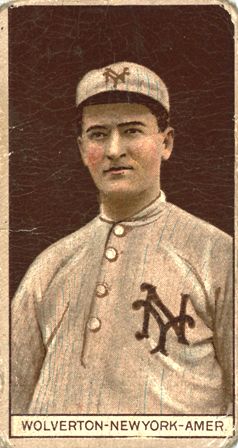
Harry Wolverton

Harry Wolverton


There are several versions of the story of how McGinnity came to replace Wolverton as manager late in the season—some say Wolverton was let go for trying to remove McGinnity from a game, others say Wolverton took another position.  The real story, based on contemporaneous accounts in The Newark Evening News, was simply that Wolverton was injured before the team’s final road trip, and McGinnity took over.  In the winter of 1909 Wolverton purchased his release and McGinnity became the team’s full-time manager.

McGinnity and Smith owned the Newark Tigers through the 1912 season.  McGinnity managed the team to a second place finish in 1910 and a seventh place finish in 1911.  The team joined the International League in 1912 and finished third.

McGinnity won 87 games and lost 64 in 151 starts during his four seasons in Newark.

He and Smith sold their shares in the club after the 1913 season.

Matty and the Federal League

3 Sep

Despite the controversy during 1913 over ghost-written articles appearing under the bylines of major league players, Christy Mathewson continued to  “write” articles that were distributed to newspapers by the “Wheeler Syndicate.”  The Wheeler Syndicate was the creation of John Neville Wheeler, a reporter for The New York Herald, and widely known to be the writer of Mathewson’s articles.

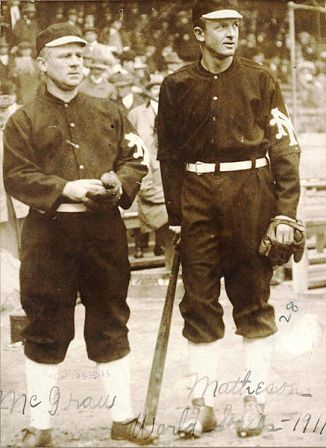
Christy Mathewson with John McGraw

Christy Mathewson with John McGraw

Shortly before the beginning of the 1914 season, Mathewson “wrote’ a story about the outlaw Federal League, and the attempt the nascent league’s president made to secure his services:

“Until I had definitely signed with the Giants again, I made no comment on the Federal League or the offer of that organization to me.  In fact, there was nothing definite in the way of an offer until I received a telegram from President (James A.) Gilmore a few hours after putting my signature to a National league contract…The proposition came out of a clear sky and was unexpected.  I have learned since that the Federals believed I was signed up all winter and that it was not until a New York newspaperman happened to mention the fact to Gilmore.”

James A. Gilmore

James A. Gilmore

A New York reporter (likely Wheeler) told Mathewson how Gilmore came to find out he wasn’t yet signed:

“’We were sitting around the Waldorf late one night, fanning and discussing the Federal League, when one of the boys said to Gilmore: “’Why don’t you make Matty an offer and get some publicity out of it anyway?

“’He’s signed isn’t he?’ asked Mr. Gilmore.

“’No more than I am.  His contract expired last season, and he has not signed the new one yet.’

“’Gilmore at once left the party and sent a telegram to you.  Then he announced his action to us newspaper men, and the story appeared in the papers the next day.’”

At the time of the offer, Mathewson was asked by a reporter from The Los Angeles Examiner whether he would consider joining the Federal League, and said, “he would consider the offer.”  He now claimed, “all the time I knew I would not desert the New York club which had practically made me in baseball.”

Mathewson also took the opportunity to deny another rumor; that he was in California working on behalf of National and American League franchises to help them protect their players from the Federal League said:

“I saw several reports in the newspapers during the winter and early spring months that I was the agent of organized baseball on the Coast and that I had been busy counterbalancing the bids of the Federal League agents for the players spending the winter there.  As a matter of fact, I kept clear of both baseball on the diamond and the politics of baseball last winter because I did not care to have it on my mind.   Was having too much fun playing golf, and it is not in my province as merely a player to try to influence others to take certain steps which some day they might regret and then blame me for their mistakes”

Mathewson used his former teammate, catcher Art Wilson, as an example of how he had not given any players advice about accepting Federal League offers—Wilson had jumped from the Giants to the Chicago Feds during the winter:

“(Wilson) received a big offer to go with the Federals with the promise of a large piece of advance money.  Wilson has been pining for the chance to work regularly with a big league club for two or three years now and was weary of sitting on the bench, absorbing information in this position about how it is done in the majors.  As I said in a previous article, Wilson even asked (Manager John) McGraw to transfer him to a minor league team this season so that he could have an opportunity to work daily.  Now, if the Federal League turns out to be a big success, and if I had advised Wilson to refuse its offer and stick with the Giants, he might have said to me some day:

“’Well, I took your advice and am still sitting on the bench.  If I had gone with the Feds, I might have been a star now.’”

Art Wilson

Art Wilson

The move did result in additional playing time for Wilson.  From the time he joined the Giants in 1908 until he jumped to the Feds, he had appeared in just 231 games over six seasons.  In 1914 and ’15 he appeared in 233 Federal League games, hitting .291 and .305.

Mathewson, who had been paid $9,000 by the Giants in 1913, would not reveal how much he was paid by the Giants for 1914: “It is at the request of the New York club that I do not state the terms.”  He did, however, say exactly what he was offered by Gilmore to jump.  He said after not responding to the initial telegram from the Federal League president—a telegram that did not mention terms–he received a second:

“’Newspaper reports state you do not take Federal League offer seriously.  Get acquainted with the Federal League officials and be convinced we are not four flushing.  I will give you $65,000 for three years service as manager of a Federal League club–$15,000 advance money.  If satisfactory, meet me at the Waldorf Thursday, at my expense.  Wire answer Chicago.’”

Mathewson said he “was torn with regret” for refusing the offer that would have more than doubled his salary.

“It would be like leaving home if I were to pass up the Giants now.  I don’t think I would feel right in any other uniform.”

Mathewson said “the Federals have been spending money very liberally,” but placed the credit for the success the league had in inducing players to jump with Joe Tinker.  Tinker had jumped the Cincinnati Reds to join the Chicago Feds as player-manager.  Mathewson said:

“At first there was little confidence in the backers of the new organization until Joe Tinker jumped…The ball players had faith in Tinker because he is rated as one of the shrewdest in the business.  If the Federal League lives and goes through, Joe should get credit for it, because he is the man who has collected practically all the players for it.”

Joe Tinker

Joe Tinker

Both 33-years-old Mathewson (24-13 3.00 ERA) and Tinker (hit .256 in 126 games and led the Chi-Feds to a second place finish) had their last productive seasons in 1914.

Mathewson continued to “write” articles for the Wheeler Syndicate until 1916 when Wheeler sold the operation to the McClure newspapers.  Almost immediately after the sale, Wheeler formed the Bell Syndicate, and occasional articles under Mathewson’s byline were distributed by Bell through 1919.

Big Six versus The Hoosier Thunderbolt

6 Aug

Christy Mathewson had only pitched five full seasons when Sam Crane of The New York Journal said in January of 1906 “there is a great diversity of opinion” regarding whether Mathewson or Amos Rusie was the better pitcher.

Crane said “Old-time lovers of the game” said Rusie, “The Hoosier Thunderbolt”, whose career ended in 1901 after being traded to Cincinnati for “Big Six” Mathewson,  was the best ever, “and refuse to acknowledge that the young college man who won the world’s championship so easily last fall…is his superior.”   While, “the younger generation of enthusiasts say there was never but one Mathewson and point to his wonderful record to prove their point.”

Amos Rusie

Amos Rusie

Crane said two famous New York baseball figures—and future Hall of Famers– disagreed on the point:

George Davis, the crack shortstop of the Chicago White Sox, and one of the best players who ever wore ‘New York’ across his shirt front, met Clark Griffith, manager of the Yankees (Crane was one of the earliest to call the then “Highlanders” the “Yankees”), yesterday at the headquarters of the New York American club, and argued over the much mooted questions of pitching superiority between the two crack box artists.  Both Davis and Griffith agreed that Mathewson and Rusie were two of the best, but differed as to which was entitles to the premier position.”

Davis thought Mathewson was better.

“Both have excelled all other Boxmen.  I have never batted against Matty in a game, but I have met his curves in practice and I want to say that he has just as good control of the ball as Rusie.  Matty’s most effective ball is a straight drop, but his speed is a great factor as well as a wonderfully controlled slow ball.  He uses his forearm and elbow and winds up in such a manner that a batsman is sure to be puzzled.  Rusie, on the other hand, depended on an out drop, which he controlled with remarkable skill, in addition to his fast ball; but he had very little preliminary motion and used his shoulder almost exclusively.  Rusie probably had the better physique, but in head work and vitality Mathewson outclasses the big Hoosier.”

Christy Mathewson with John McGraw

Christy Mathewson with John McGraw

Griffith disagreed:

“Rusie in his prime was the best twirler that ever stepped into the box.  His curves, speed and control were the best assortment I ever looked at, and no pitcher has ever approached him in class since he made his departure from baseball.”

Crane cast the deciding vote, declaring:

“Rusie never had a peep in with Mathewson as a box artist.  Rusie relied mostly on brute strength until his arm began to show symptoms of crystallizing, then he accumulated a good slow ball; but for head work, pure good judgment, with a delivery or series of deliveries to back up his well-balanced brain, Mathewson is superior to any pitcher who ever wore shoe plates.”

Crane’s analysis was prescient.

Rusie’s greatness is undisputed—his speed was primary reason for moving the pitching distance from 50‘ to 60’ 6”—but his best days were behind him before he turned 24-years-old.  His season-long holdout in 1896 and the arm injury that effectively ended his career at 27 after the 1898 season (except for three games he pitched for the Cincinnati Reds in 1901) make him one of baseball’s great “what ifs?”  He still finished his career 246-174, and was elected to the Hall of Fame in 1977.

Mathewson won twenty games for nine straight seasons after Crane declared him “superior to any pitcher.   He finished 373-188 and was part of the Hall of Fame’s first induction class.

Sam Crane on International Baseball

30 Jul

Samuel Newhall “Sam” Crane, like Tim Murnane, turned to sports writing after his career on the field ended.  His involvement in a scandal might have contributed to his departure from the diamond—but contrary to oft-repeated stories it was not the direct result.

Sam Crane

Sam Crane

Crane was named as a respondent in a Scranton, Pennsylvania divorce in 1889—a prominent Scranton businessman named Edwin Fraunfelter (some contemporary newspapers incorrectly said “Travenfelter”) charged that Crane had stolen his wife, and $1500.  Crane had played for the Scranton Miners in 1887 and ’88 and departed the city with Fraunfelter’s wife Hattie in 1889, relocating to New York.  Crane and Hattie Fraunfelter were returned to Scranton to face trial for the theft.

In October of 1889, they were acquitted.  The Philadelphia Times said the two were released and Mr. Fraunfelter was ordered to pay the court costs, and “The congratulations which were showered on the second baseman and the woman made a scene in the courtroom.”

Despite the scandal the New York Giants (twice) and the Pittsburgh Alleghenys were happy to sign Crane in 1890.  The end of his career was more of a result of the 36-year-old’s .179 batting average and diminishing fielding skills—twelve errors in 103 total chances at second base–and, of course, he probably wouldn’t have found himself in Scranton in 1887 and ’88 had his career not already been on a downward trajectory.

Crane immediately went to work for The New York Press upon his retirement and remained one of the most respected sports writers in the country.  He edited the “Reach Guide” from 1902 until his death in 1926.

In 1905 Crane, then with The New York Journal, wrote about the boom in International baseball on the eve of the visit of the Waseda University baseball team:

“The Japanese are nothing if not progressive, and even with their country in the throes of a disastrous war (The Russo-Japanese War) they have found time to devote attention to our national game.”

Crane said the Waseda visit would:

“(M)ark a red letter day in the history of the game,  It will be a sensational era in the life of the sport, and in fact, that of all athletic sports.”

Japan was not alone in embracing the game:

“Baseball is also flourishing in South Africa.  The Transvaal Leader, a progressive newspaper, has taken up the sport and publishes full scores of the games and the records of the players.

“There is a South African baseball association and the players of the different teams can hit the ball, even if they have not yet attained the accuracy and agility in fielding their American cousins have reached.  According to The Leader, out of thirty-seven batsmen who figure in the official  record from July 1 to October 8, twenty-three of them batted over .300…A batter named Suter of the Wanderers was the Lajoie of the league, and he made our own ‘Larruping Larry’s’ record of .381 look like a bush league mark.  Suter’s batting percentage was .535.

“The second batter to Suter was Hotchkiss, also of the Wanderers, who walloped out a base hit every other time at bat, making his average .500…Wonder what the Africans would do with ‘Rube’ Waddell and the Chesbro ‘spit ball?’”

As evidence that the South Africans had “grasped the American style of reporting games” Crane gave an example from a recent edition of The Leader:

“’The diamond was very hard, and, as a consequence, the ball frequently wore whiskers, as some infielders can testify.’”

Crane expressed surprise that baseball had taken such a “stronghold” in an “English possession”  like South Africa:

“Britons, wherever found, look upon the great American game as a direct infringement on the sporting rights as established by cricket.

“’It is only an offshoot of our rounders,’ they are wont to say, and that ancient game is about on the level of ‘one old cat’ and ‘barnball.’

“Englishmen are extremely conservative about their sports, especially of cricket, which is considered their national game, and in their own stanch little island they have always pooh-poohed baseball.  But when the Briton gets away from home influences he becomes an ardent admirer of the American game and is loud in his praise of the sharp fielding it develops.

“In Canada, South Africa and Australia, where there is more hustling, and time is more valuable than in the staid old mother country, the quick action, liveliness and all around hustling of baseball that give a result in a couple of hours, is fast becoming more popular with the colonials than cricket, that requires as many days to arrive at a decision.

“Great strides have been made in baseball in the Sandwich (Hawaiian) Islands.  Honolulu is the headquarters just now, but the game is fast spreading to other localities.  The game has been played in the Sandwich Islands for many years, but it was not until the United States was given possession that it flourished.”

Crane mentioned that his late brother Charles–who died in 1900, and incidentally, married his brother Sam’s ex-wife who Sam divorced before leaving Scranton with Mrs. Fraunfelter) had been the catcher on the team representing the naval vessel the USS Vandalia and frequently played games against teams in Hawaii and Samoa during the 1880s:

“The natives took to the game very quickly and soon learned to enjoy it.  They welcomed every arrival of the Vandalia with loud demonstrations of joy, and there was a general holiday whenever a game was to be played.”

Crane predicted that baseball would continue to flourish in the islands, and throughout Asia, noting that a Chinese player “plays third base on the leading club, and has the reputation of being the best player in the whole league.”

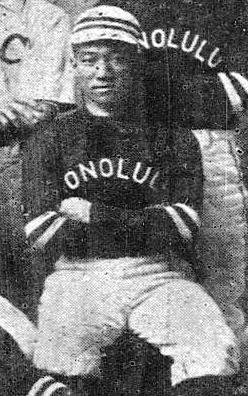
He was likely referring to 20-year-old Charles En Sue Pung, a teammate of Barney Joy’s on the Honolulu Athletic Club team who was also one of Hawaii’s best track athletes.  Pung was rumored to be joining Joy when the pitcher signed with the San Francisco Seals in the Pacific Coast League in 1907, and in 1908 there were brief rumors in the press that Chicago Cubs Manager Frank Chance wanted to sign the Chinese third baseman—neither materialized, and he remained in Hawaii.

Charles En Sue Pung

Charles En Sue Pung

Crane said the growth of the game internationally would be endless; he said the introduction of the game in the Philippines was a prime example:

“(T)here are several enclosed grounds in Manila to which are attracted big crowds…I know they can learn to play the game, for when the (New York) Giants were in Savannah (Georgia) for practice last spring a team of soldiers from a nearby fort played an exhibition game with the Giants.”

Crane said the team was accompanied by “a young Filipino, who, while he did not play on the soldier team, practiced with them and showed surprising proficiency… (The) youth knew all the points of the game as well as Henry Chadwick.”

For Crane, that was enough to declare that “in short order” the Philippines would adopt the game as had, and would, “all people that are blessed with real red blood and progressive.”