Tag Archives: New York Giants

“As an Actor? Well—”

23 Dec

The Indianapolis News said

“Mike Donlin is in the city again and he is a real actor this time.  Two years ago Mike paid Indianapolis a visit, or rather he trailed behind his wife, who theatrically, is Mabel Hite and who at the time was the leading woman in the musical comedy, “A Knight for a Day.”  On that occasion Mike remained behind the wings out of sight of the audience or put in the time while waiting for the performance to end talking baseball or otherwise entertaining friends in the lobby…But all is different now.  Mike is a real actor this time and he trails after his wife’s skirts no longer.”

Michael Joseph “Turkey Mike” Donlin had just arrived in Indianapolis in February of 1909 while touring with his one-act play “Stealing Home,” in which Hite also appeared.  His made his previous visit while sitting out the 1907 season after a contract dispute with new York Giants owner John T. Brush and traveling the country with Hite.

He returned to the Giants in 1908 and hit .334, finishing second to Pittsburgh’s Honus Wagner (.354).  But Donlin caught the acting bug while traveling with Hite, and upon embarking on the national tour in October of 1908 he told reporters:

“There is something about the footlights that always appealed to me.  I like this show game mighty well and baseball won’t keep me forever.”

Donlin received mixed reviews throughout the tour, but it was successful enough to keep him on the road and  away from baseball until 1911.
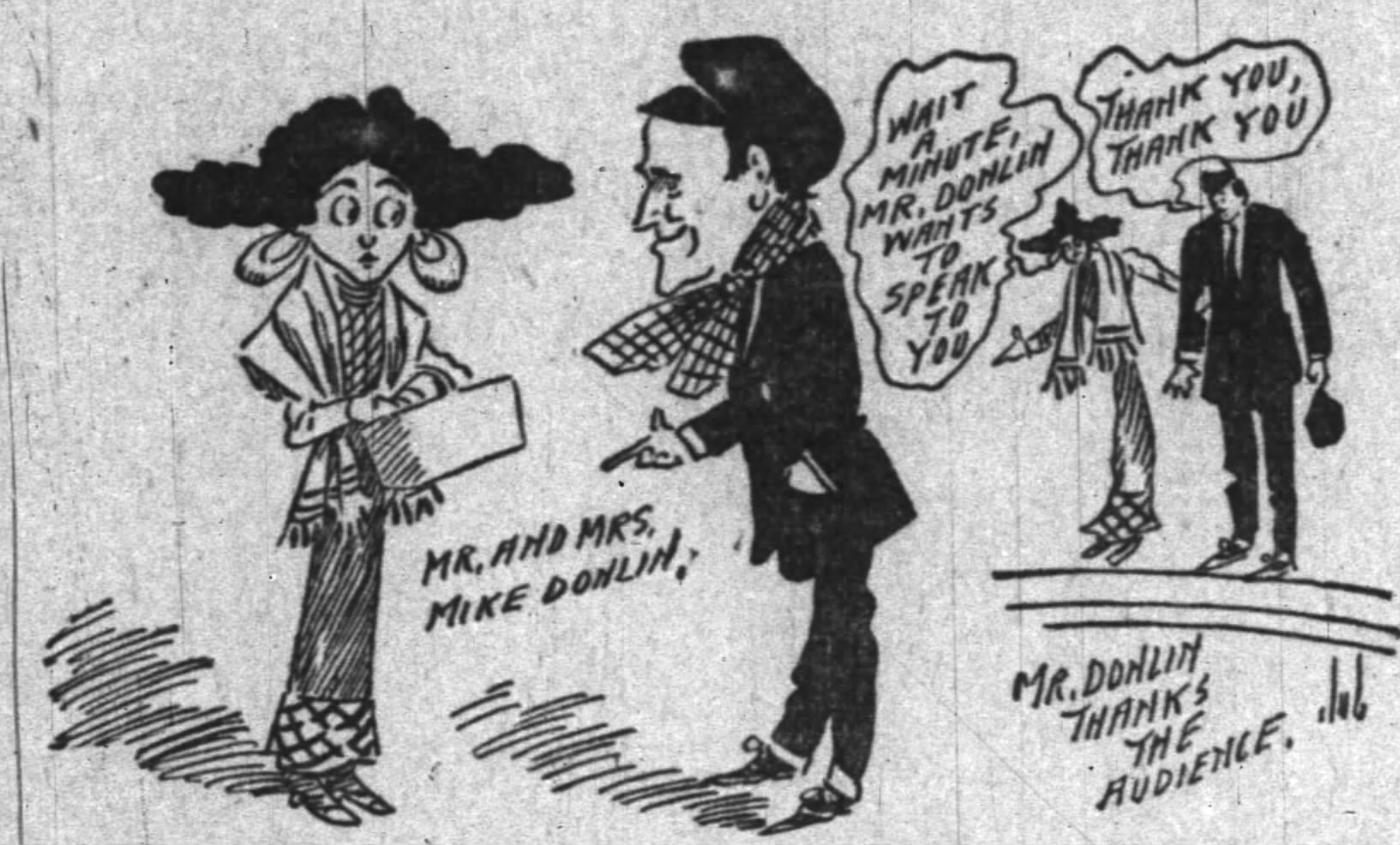
Cartoon of Donlin and Mabel Hite, 1909

Cartoon of Donlin and Mabel Hite, 1909

The following day, after his Indianapolis debut was completed, The News provided probably the most colorful review of his show—likely more colorful than the show itself:

“Once upon a time a certain walloper of the sphere had a hunch to go forth into the provinces and connect with the long green.

“And this man was Mique and he was of the tribe of Donlin.

“And it was that Mique had a helpmate, indeed, and her name was Mabel, and she was of the tribe of Hite.

“Her patience was that of Job and she taught Mike to make a few steps, how to face the multitudes and to say ‘Back to the bush leagues for you.’

“Then, lo and behold, he was of the clan of Irving, Mansfield, Mantell and ‘Bertha the Sewing Machine Girl.’

“Many persons were injured in the rush to see him and the dough came in so rapidly that the calf that tried to swallow it choked to death.

“Then, indeed, did Mique rejoice and his cup of happiness was filled to overflowing.  Even more so than on the day he socked the horse hide far beyond the reach of the hated cub in left-field and loped home to receive a box of Flora De Tar Ropes, a big bouquet and an order for a ten-pound box of dog leg.

“And now, flushed with triumph, the hero of many rag-chewing matches with the umpire and scorched by the spotlight in which he shines so brightly, Mique is in our midst.

“Even so.

“And the other half of the sketch is here, too, and she sings…very prettily and dances gracefully.  Mique also dances, but his movements are not what might be termed poetry in motion.

“Great is Mique.

“As a ball player?  Yes.

“As an actor? Well—

“Curtain.

“’Stealing Home,’ the Donlin skit has to do with the national game, of course.  Donlin is supposed to be putting it all over the Pittsburgers, but is put out of the game for ragging with the umpire.  His wife learns of it when she calls up to get the score.  A moment later he enters the room and then there is ball talk galore during which she chides him for getting no hits, while Hans Wagner gets five.  Donlin shows her how he called the umpire down and the sketch ends, following Mrs. Donlin’s song, with a few dancing steps in which she is assisted by Donlin.”

"Sliding Home" advertisement. Grand Theater, Indianapolis.
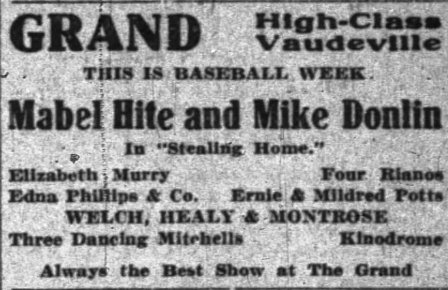
“Sliding Home” advertisement. Grand Theater, Indianapolis.

By the spring of 1911 “Stealing Home had run it’s course.  Donlin, in need of money and with no acting prospects, returned to baseball; he played with the  Giants, Boston Rustlers and Pittsburgh Pirates in 1911 and ’12 (retired again in 1913) and returned to the Giants for 1914.

Twenty-nine-year-old Mabel Hite died of cancer in 1912.

When Donlin retired again, for good this time, he returned to the stage, then the screen–with the help of his friend, actor John Barrymore.  He appeared in more than 50 films, mostly in smaller roles.  Donlin married actress Rita Ross in 1914, and died in 1933.

“The fans make us the ‘goat’ for Everything”

21 Nov

Chicago Orphans Manager Tom Burns suspended pitcher Bill Phyle without pay in August of 1899, even after Burns was replaced by Tom Loftus, Phyle remained in limbo.

Tom Loftus

Tom Loftus

In January Hugh Fullerton said in The Chicago Tribune that Loftus “probably will give him a chance.”  But in early February The Chicago Inter Ocean said even though Phyle had met with team President James Hart nothing had been resolved.  Phyle told the paper he was offered a contract but was “in no hurry to sign.”

Phyle finally signed at the end of the February, but The Tribune said Chicago would most likely trade him “although Loftus thinks highly of him.”

The team trained in West Baden Springs, Indiana, where according to The Tribune Phyle was “sarcastically called ‘Lucky,’ because of his proverbial hard luck, (he) rarely escapes a day without being hurt.”  He also managed to alienate his new manager.

After several days of poor weather in Indiana, Loftus decided to take the team further south, to Selma, Alabama on March 18.  According to The Tribune Phyle was not on the train:

“Phyle may not be with the team in Selma.  He left Friday (March 16), announcing he was going to see the fights in Chicago.  Manager Loftus hunted up the pitcher before he departed and told him it was a bad plan to start the year in such a manner.  Phyle then said he was ill and was making the journey in order to consult a physician in Chicago.”

Phyle did return from Chicago (where he claimed he had an unspecified operation), and joined the team on the trip south.  Upon his return he continued to suffer a series of illnesses and injuries, which included a bad reaction to a vaccination and a being hit in the knee with a thrown bat, both of which kept him inactive for several days.

Phyle was left in Chicago when the team opened the season in Cincinnati, and his imminent trade or release was speculated upon nearly daily in the Chicago press; he was finally traded to the Kansas City Blues in the American League with Sam Dungan and Bill Everitt for John Ganzel on May 18.  Phyle refused to report to Kansas City and spent the season playing for Chicago City League teams and a semi-pro team in DeKalb County, Illinois.  He was also a regular attendee at Chicago’s boxing venues and was said to own a piece of featherweight contender Eddie Santry.

Phyle returned to the National League in 1901 posting a 7-10 record for the New York Giants.  In 1902 he went to the California League as an infielder and never pitched again.  After his controversial exit from Memphis in 1903—and the aftermath—he continued to play until 1909.

Phyle worked as a boxing referee and as an umpire for more than 20 years in the Canadian, Eastern and Pacific Coast and International  Leagues, and was involved in two final controversies.

Bill Phyle, 1913

Bill Phyle, 1913

In 1920 a grand jury was impaneled in Los Angeles to investigate charges of game fixing in the Pacific Coast League.  Players Harl Maggert, William “Babe” Borton, Bill Rumler and Gene Dale were implicated.  While all criminal charges were eventually dismissed, the four were banned from baseball in 1921.

Phyle was called to testify in front of the grand jury, and said umpires were often blamed when players were crooked:

“The fans make us the ‘goat’ for everything that goes on during the ball game.  How many times we have suffered to suit the whims of a ballplayer who might have been working with the gamblers will never be known.  They just slough us around, call us whatever names they please and yell murder when we happen to fire them out of the game or have them suspended.

“An umpire should have the same authority as a referee has in the prize-ring.  If he believes a ballplayer isn’t giving his best toward the game, he ought to have the privilege of ousting him without taking the manager into confidence.”

In July of 1923 Phyle was working an International League game between the Baltimore Orioles and Rochester Tribe.  Phyle called a Rochester runner safe at first, then immediately reversed his decision.  He was dismissed the following day by league President John Conway Toole.

As a result of the dismissal, four other umpires resigned in sympathy.  Toole, who was attending the game, claimed he had not released him because of the blown call, but because Phyle had failed to work a double hitter he was assigned to earlier in the month.   The decision was upheld, and within three days the four other umpires withdrew their resignation.

Phyle ended his career back in the Pacific Coast League in 1926, and died in Los Angeles in 1953.

Burns “Put the Punishment on Phyle”

20 Nov

After holding out over a temperance clause the Chicago Orphans added to his contract, Bill Phyle finally signed in late March of 1899.  He reported to spring training in New Mexico anywhere from 10 to 30 pounds overweight (depending on the source) and struggled all season to regain the form he showed the previous season.

On April 17 he was beaten 8-0 by the Louisville Colonels in first start.

On April 25 he lost 3-2 to the St. Louis Perfectos.  The Chicago Tribune said “Phyle gave away the game by distributing bases on balls in just the spots where timely hits followed and transformed the favors into tallies that gave the victory.”

William Phelon, The Chicago Daily News baseball writer, disagreed.  He said Phyle’s “work was of sterling quality.”

Regardless, Chicago Manager Tom Burns didn’t give Phyle another opportunity to pitch for more than a month.

Phelon said it was a mistake for Burns to not use Phyle.  The Chicago Inter Ocean said after the team lost seven of nine games in May “it is passing strange that young Phyle is not given a chance.  On last year’s form Phyle is as good as, if not better than (Jack) Taylor.  The paper called Phyle’s performance in the St. Louis game “gilt-edged” and blamed the loss on “comrades that gave the victory to the enemy.”

Finally, on May 28 Phyle pitched again.   He lost 4 to 3 to the Washington Senators; he gave up three runs on five straight hits with two outs in the ninth.

He lost again on June 1, 7-1 to the Philadelphia Phillies.  Phelon’s opinion of the pitcher was unchanged, and said the losses were simply bad luck:

“Phyle has now lost four straight games.  It is Phyle’s luck to be stuck in whenever the other pitchers have won about three straight, and the team is just about unavoidably due to lose.”

On June 5 Phyle did his best pitching of the season–a victory he is not credited with in the record books.

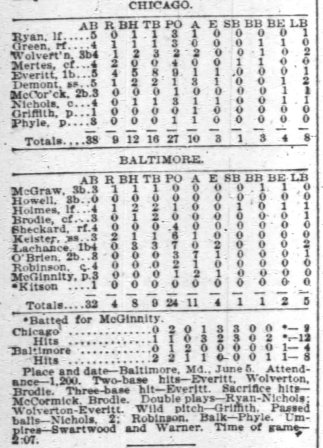
With the Orphans trailing the Baltimore Orioles 3 to 2 in the third inning, pitcher Clark Griffith was ejected for arguing a called ball.  The Chicago Tribune said:

“It was a queer game.  Phyle pitched after Griffith had been benched…holding the Orioles helpless.”

Chicago won 9 to 4.  And while the Chicago newspapers credited the victory to Phyle, the record books do not.

Box score for June 5 game.  Phyle relieved Clark Griffith in the 3rd inning.

Box score for June 5 game. Phyle relieved Clark Griffith in the 3rd inning.

Phyle became ill later the same week, (some sources said it was recurring malaria), a week later he fell off a bicycle and missed two more weeks.  When he returned to the team on June 22, the Boston Beaneaters beat him 5 to 1.

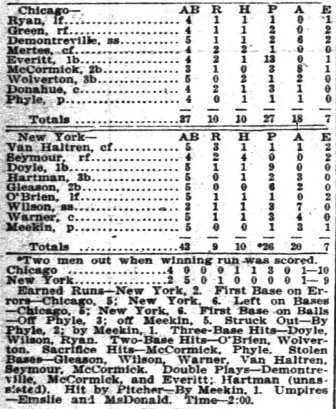
He was credited with his first “official” win on July 1—a game The Inter Ocean called “a comedy of errors,” and a “depressing exhibition.”   He beat the New York Giants 10 to 9, allowing 10 hits and giving up seven runs in the first two innings.  Each team committed seven errors.

Box score of Bill Phyle's only "official" victory of 1899.

Box score of Bill Phyle’s only “official” victory of 1899.

Chicago went into a slump that would last for the rest of the season; after Phyle’s July 1 win the team was 38-24, in third place, and went 37-49 the rest of the way finishing eighth.

Phyle lost again on July 9 and July 24, and rumors began to circulate that he would be released or traded back to Charlie Comiskey’s St. Paul Saints.

On August 6 Phyle lost 10 to 9 to the Cleveland Spiders.  One week later while the team was on the road, The Inter Ocean reported that he “was sent home by manager Burns.”

The Tribune called Phyle “the scapegoat” and said he and three unnamed teammates  “celebrated after beating a horse race at Washington and Manager Burns, to call a halt, put the punishment on Phyle.

Phelon wrote in The Daily News:

“When the club started for Philadelphia he was told to go home ‘You are through young man, go back to Chicago,’ said Burns, and Phyle went back.  He went back in a rage too, and says he will tell (team president) Jim Hart a lot of things. He says that he has been held up to public derision as a drunkard, all season, and that Burns plays favorites, allowing his friends to jag up as much as they wish and turning all the trouble on others.”

Phelon remained supportive of the pitcher in The Daily News, but in The Sporting Life he reported that Phyle, a former boxer, had deserted the team in early August to go to “St. Louis to see a prize fight, and was not on hand when sorely needed.”

While the relationship between Hart and Burns was strained, and Burns would be replaced at season’s end, Phyle’s complaints went nowhere with the team president and he was suspended without pay.

Ten days after Phyle was suspended Phelon reported that the Baltimore Orioles had offered to trade for or buy Phyle,” (John) McGraw has taken quite a fancy to the young pitcher.”  Hart refused to make a deal.

Phyle never pitched for Chicago again, he is credited with a 1-8 record and 4.20 ERA.

The last Bill Phyle chapter—tomorrow.

Bowerman by TKO

5 Nov

“The Popular Magazine,” a literary magazine that billed itself as a “magazine for men and women who like to read about men,” was published by Street & Smith from 1903 until 1931.

In 1904, the magazine told the story of a fight the previous season involving New York Giants catcher Frank Bowerman.

Frank Bowerman

Frank Bowerman

Bowerman was not kept by Fred Clarke when the Pirates and Louisville Colonels merged after the 1899 season; his contract was assigned to the  Giants.  Apparently some bad blood remained into 1903, and according to the magazine, Giants manager John McGraw used Bowerman’s grudge and some comments made by Clarke to try to light a fire under his team:

“When the Giants were in Pittsburgh (on June 1) last season McGraw noticed that there was bad feeling in the team.  The men stood in little knots in the hotel corridor glowering at other players; they rode to the field in a bus without exchanging a word; the preliminary practice, usually so brilliant, was dull and lifeless.  This worried McGraw.”

John McGraw

John McGraw

The article said McGraw had figured out the cause a few days later in Chicago; Bowerman had sat in the grandstand for that June 1 game, being unable to play due to an injured thumb.  Jack Warner caught Christy Mathewson that day.  What McGraw discovered was that Clarke said Bowerman was overheard criticizing Warner’s work behind the plate, blaming his teammate for one of the two runs scored off of Mathewson:

“This, of course, was tantamount to Bowerman’s asserting his superiority over Warner, a boast that ballplayers are rarely guilty of.”

McGraw cornered Bowerman who insisted Clarke had told “the meanest lie that ever was told, and I told Jack Warner so, but he don’t believe it.”  McGraw told him to keep quiet about it until the Pirates visited New York on June 26.

“(McGraw) proceeded to reinject that esprit de corps by a measure so drastic that it horrified ball patrons all over the country, who, however, thought it merely an incident of the brutality of ballplayers.  Instead of that, it was a well-planned scheme of a crafty general.”

When the Pirates arrived at the Polo Grounds on the morning of the 26th, McGraw took Bowerman aside:

“’Frank, have you got a good right swing?’  The Michigan Lumberman smiled grimly and clenched a fist knotted and as hard as Hercules’ war club.  ‘Well, it’s up to you, then,’ advised McGraw, “to put life in the team. Don’t lose any time.’ Bowerman understood.

“”’I’d like to speak to you a minute,’ he said to Clarke, as the Pittsburgh captain was passing through the gate on his way to the clubhouse.  They went into the stuffy box office; where there was hardly room to swing a cat.  Three times Bowerman demanded an explanation, offering to bring McGraw and Warner in as witnesses…Clarke went down three times and finally admitted he had enough…The Giants played that day, to use the expression of a rooter, as though they were ‘fighting their weight in wildcats.’  Bowerman and Warner coached each other with pet names, and walked lovingly from the victorious field arm in arm, while Fred Clarke was buying a pound of raw beef.”

Fred Clarke

Fred Clarke

“The Popular Magazine” story added an element that differed from the coverage in New York and Pittsburgh newspapers—while each town pointed fingers at the other (in Pittsburgh Bowerman was an out of control thug, while in New York, Clarke got what he deserved for stirring up trouble) no one else suggested that McGraw engineered the fight to motivate his club against the first place Pirates.

The Giants weren’t able to catch Pittsburgh, finishing in second place six and a half games behind the Pirates.

National League President Harry Pulliam initially announced that there would be no punishment for either player because the fight did not take place on the field, three weeks later, under pressure from Pirates owner Barney Dreyfuss, Pulliam fined Bowerman $100.

Adventures in Barnstorming—“Their Conduct was Disgraceful”

30 Oct

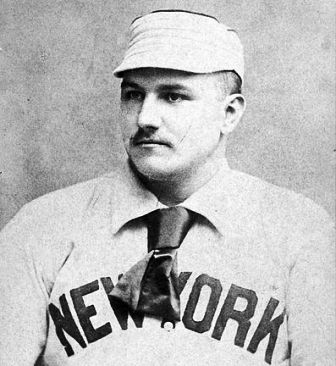
After the 1887 season John Montgomery Ward was celebrating his marriage to one of the most popular actresses of the era, Helen Dauvray, by touring the South playing exhibition games with the New York Giants–primarily made up of New York players but also included Mike “King” Kelly (who also brought his wife Agnes) of the Boston Beaneaters and Jerry Denny of Indianapolis Hoosiers.

John Montgomery Ward

John Montgomery Ward

The team arrived in New Orleans on October 29 and was greeted with a reception at the St. Charles Hotel.

The first game against the Southern League’s New Orleans Pelicans was played the next day at Sportsmen’s Park in front of 6000 fans.  New York’s Tim Keefe held the Pelicans to just two ninth-inning runs, in a 7-2 victory.   Ward had three hits.

The New Orleans Times-Picayune said:

“It was far from an ideal day for ball playing, for the weather was almost freezing and the wind blew in cutting blasts.  But those who admire baseball in this city were undeterred.”

The following day the Pelicans managed an 8-inning 4-4 tie:

“(The Pelicans) put up a game that would have done credit to any aggregation, and the only excuse for their not having bounced the Giants, was the fact that (Bill) Geiss and (Ed) Cartwright made inexcusable errors at the commencement that let in two runs.”

The Times-Picayune left out a large part of what happened that day.

Two days later the whole story appeared in papers across the country, The New York Times said:

“(S)everal members of the New York Baseball club were intoxicated when they entered the grounds to play with the New Orleans nine on Monday last.  Their conduct was disgraceful, and (Pelicans) Secretary (Maurice) Kaufman called on a police officer to eject them from the grounds.”

A wire report from New Orleans, that appeared in The Chicago Daily News said:

“There are several men in the New Yorks who have been drinking freely ever since they arrived in the city, and were not of course, in condition to play ball.”

Giants’ catcher William “Buck” Ewing, and Jerry Denny were identified as drunken players, but it was King Kelly who was most often singled out.  The wire report said when police attempted to arrest a drunken fan who had accompanied the players to the ballpark:

“Kelly jumped into the stand and tried to prevent the arrest, claiming the man was a friend of his…During the entire game the unseemly exhibition was kept up.  At one time Kelly climbed into the stand and drank beer with his friends, while the other men of the nine had already taken positions in the field to begin an inning.”

King Kelly

King Kelly

During the game Ward “took his wife from the grounds, and placing her in a carriage, sent her to the St. Charles Hotel, because of the disgraceful exhibition of some of the players.”

The game scheduled for November 2 was cancelled and The New York Times said the tour would be disbanded.

By the end of the week all parties were trying to downplay the incident.  Ward said members of the club “misbehaved in no way,” and instead said the cancellation was because it was discovered that Pelicans players had received $5 each for the games, and the Giants players only received $3.  The Pelicans and The Times-Picayune had a revised version of the events:

“The whole story is that a couple of the members met too many friends with tempting ways and reached the field in no condition to play ball.  The majority of the visitors were all right and were heartily ashamed of the conduct of their comrades.”

The paper said that the “New Yorks are in good trim again, however and at their own request a game was arranged for (November 4).”

The Giants won that game 5 to 3—New York catcher Buck Ewing pitched a complete game for the Giants (he pitched 47 innings during his major league career, with a 2-3 record and 3.45 ERA), beating the Pelicans best pitcher John Ewing.  Only 500 fans attended the game.

The series ended on November 6 with the Giants winning two games; a 3-1 morning game with “a very small crowd,” and an evening game in front of more than 6000 won by the Giants 5-4.

While the rest of the Giants continued on to Texas, Ward returned to New York for meetings to negotiate the recognition of the Brotherhood of Professional Baseball Players by the National League.  He rejoined the team on the West Coast later that month for a six-week barnstorming tour.

The Ward/ Dauvray marriage went about as well as the honeymoon in New Orleans—their divorce just six-years later was a very public, scandalous affair.  Ward, who was accused of being a serial philanderer, was actually barred from ever remarrying during Dauvray’s lifetime as part of the divorce decree.  He was able to get the ruling reversed in 1903 and remarried.

“Fear of the Black List has Stopped Many a Crooked Player from Jumping”

9 Sep

For a brief period in the mid1890s, George Jouett Meekin was considered among the top pitchers in the game; he might never have had the opportunity, but for what The Sporting Life called “The disastrous effects of Chairman Young’s somersault.”

Jouett Meekin

Jouett Meekin

 John Montgomery Ward, Meekin’s manager with the New York Giants, said he was, along with Amos Rusie, Tim Keefe, John Clarkson and Kid Nichols, the “most marvelous pitchers as ever lived.”

Charles “Duke” Farrell, who caught Meekin and Rusie with the Giants, said:

“Sometime, it seemed to me that (Meekin) was actually faster…Rusie’s speed struck the glove with a bruising deadening, heavy shock, and Meekin’s fastest gave a sharp, sudden sting.”

But in 1891 Meekin was a 24-year-old pitcher in his third season with the St. Paul Apostles in the Western Association. The New Albany, Indiana native became a well-known amateur player across the Ohio River in Louisville before signing his first professional contract with the Apostles in 1889.  His sub .500 winning percentage was not enough to keep the American Association’s eighth place Louisville Colonels, from inducing Meekin to jump his contract with St. Paul.

In June Meekin jumped; at the same time third baseman Harry Raymond jumped to Colonels from the Western League’s Lincoln Rustlers.

The National Board of Control, created after the 1890 season as part of the “peace agreement” between the National League and The American Association after the collapse of the Players League, to arbitrate contract disputes, acted quickly.  Board Chairman (and National League President) Nick Young announced that Meekin and Raymond would be “forever ineligible to play with or against a National Agreement club.”  The statement, signed by Young, also said:

“This order or any other that may hereafter be made for the same cause, will never be modified or revoked during the existence of the present board, whose term of office will not expire for five years.”

The move was applauded by the press and no less a figure than “the father of baseball,” Henry Chadwick, who called Raymond and Meekin part of a “venal cabal” of jumping players.

Despite the promise that the order would “never be modified or revoked,” Young did just that.  Within weeks of issuing the order, both players were reinstated.

The backlash was swift.

The Cleveland Plain Dealer called the reversal “nauseating.”  The Cincinnati Times-Star said it was “one of the greatest mistakes ever made.”  The Milwaukee Evening Wisconsin said Young and the board chose to “toss the National Agreement into the fire.”

nickyoungpix

Nick Young

James Edward Sullivan, founder of the Amateur Athletic Union (AAU) said the reinstatement of the “arch-culprits” Meekin and Raymond “was the worst in the history.”  He predicted dire consequences as a result:

“Heretofore the fear of the black list has stopped many a crooked player from jumping or doing dishonest work.  But from now on it will be different.  A precedent has been formed.”

Raymond jumped back to Lincoln, taking Colonels’ pitcher Phillip “Red” Ehret with him to the Rustlers.  Meekin remained with Louisville and moved to the National League with the Colonels the following season.

Meekin had a 10-year big league career as a result of Young’s reversal.

From 1891-93, Meekin was 29-51 with Louisville and the Washington Senators and was traded to the Giants (along with Duke Farrell) before the 1894 season.  He was 33-9, and fellow Indiana native Amos Rusie was 36-13, for the 2nd place Giants.  Meekin had two complete game victories in the Giants four game sweep of the first-place Baltimore Orioles in the Temple Cup series (Rusie won the other two games).

The New York Evening Journal called Meekin “Old Reliable,” and said, “He can push ‘em up to the plate in any old style, and is factor with the stick.”  The pitcher hit .276 with 29 RBI in 183 at bats in 1894 (including hitting 3 triples in a game on July 4) and was a career .243 hitter.

Meekin won 102 more games (including 26, and 20 win seasons in 1896 and ’97), but as O. P. Caylor said in The New York Herald he suffered from “a lack of control.”  Meekin walked 1056 batters and struck out only 901 in more than 2600 innings, he also hit 89 batters; in 1898, he broke Hughie Jennings nose with a pitch.

After posting a 16-18 record for the seventh place Giants in 1898, Meekin, along with Rusie, and second baseman William “Kid” Gleason, were blamed by New York owner Andrew Freeman for the team’s disappointing finish.  Freeman told reporters:

“Meekin, Rusie and Gleason will be either sold or traded.  We do not want them.  I’m going to break up cliques in the team even if I have to get rid of every man.  There must be harmony.  Without it we can’t win games.  We have too many men who are simply playing for their salaries and do not seem to care whether they win or not.”

Rusie had injured his arm late in the season and sat out the next two years.  Meekin and Gleason, despite Freedman’s promise, returned to the Giants for the 1899 season.  The team finished in tenth place, and Meekin struggled with a 5-11 record.

He was sold to the Boston Beaneaters in August for a reported $5000, although it was commonly assumed that the Giants received much less, or simply “loaned” Meekin to Boston for the stretch run; a charge made by Brooklyn Superbas manager Ned Hanlon.  Although Hanlon’s charges have become “fact” in countless books and articles over the years, several newspapers, including The Pittsburgh Press refuted Hanlon’s story:

“All that talk and fuss about Freedman giving Jouett Meekin to Boston in order to help that team win the pennant and thus get even with Brooklyn is nonsense.  The truth of the matter is that Freedman thought Meekin’s days as a pitcher were over, and he offered him to the Pittsburgh club, but President (William) Kerr thought the same way and did not take him.  At the time Boston’s pitching corps was in bad shape and manager (Frank) Selee took a chance on the big fellow.  There was no underhand dealing in the matter at all.”

Meekin was 7-6 with a 2.83 ERA for Boston, but the team finished second to Brooklyn.  He was released by Boston before the 1900 season and pitched just two games with the Pittsburgh Pirates before being released again in July.  He finished the season with the Grand Rapids Furniture Makers in the Western Association and spent 1902 in the Southern Association with the Memphis Egyptians.

Meekin returned home to New Albany, Indiana, where, in 1910, according to The Trenton True American “his earnings from baseball are well invested in real estate.”

Meekin slipped into relative obscurity by the time he died in 1944.

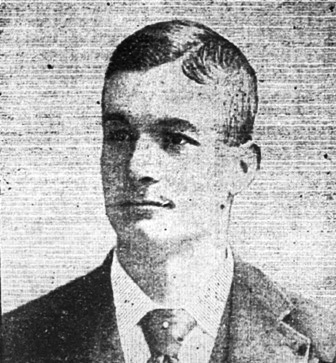
The original picture that appeared with this post–now below–was misidentified as Jouett Meekin in this blog and by The Louisville courier-Journal in 1897.  According to Mark Fimoff co-chair SABR Pictorial History Committee, the picture was actually Lave Cross.  

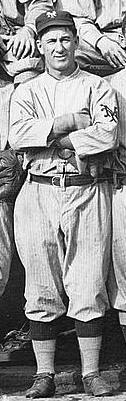
Lave Cross--picture earlier misidentified as Jouett Meekin.

Lave Cross–picture earlier misidentified as Jouett Meekin.

“A Great deal of foolish Sympathy was wasted on Rusie”

5 Sep

Hank O’Day, pitcher and Hall of Fame umpire, said Amos Rusie was the greatest pitcher ever:

“Amos is the greatest pitcher the country ever saw. Why, Rusie had more speed in his curve ball than any pitcher I ever saw before, or have ever since seen, has in his straight fast ones.  Rusie was a wonder—that’s all there is to it.  I was behind the plate one day when one of Rusie’s  fast incurves hit Hughey Jennings…the ball hit Jennings squarely in the temple, and he fell as though shot by a ball from a Winchester rifle.  I caught him in my arms as he toppled backwards—and he was out of his head for three days.” (Contemporary reports of the incident said Jennings actually finished the game, but later lost consciousness for four days)

O’Day was also on the field when Rusie blew out his arm in 1898; Rusie threw to first to pick-off Chicago Orphans outfielder Bill Lange and “his arm cracked like a pistol’s shot.”  In 1940 Lange told his version of the story to The Portland Oregonian:

“Amos Rusie, I don’t know of any better one and I never played against any other one as good.  He had great control, as well as everything else a pitcher should have.  But my base stealing got him.  He worried over it.  I guess he lost sleep over it.  Anyway, one day he showed up on the field and said he had developed a new way to catch me off of first without turning his body.  I was anxious to see what he had, and he caught me off of first.  But—and it was a mighty large but—in doing so Rusie threw his arm out.  And never could pitch in his old form again.”

Amos Rusie

Amos Rusie

Rusie, with a dead arm, became a benchmark, an oddity, and a cautionary tale.

He posted a 246-173 record before the injury; after sitting out all of 1899 and 1900 he was traded to the Cincinnati Reds for Christy Mathewson, appeared in three games, was 0-1 with an 8.59 ERA, and his career was over.

In the decade between 1898 and 1908 The Sporting Life christened “the next Rusie,” or “another Rusie” no less than 20 times; scores more were given the same title by newspapers across the country.  Most like Cecil Ferguson (career 29-46), Davey Dunkle (17-30), Cowboy Jones (25-34), and Whitey Guese (1-4) were busts.  The three best were Orval Overall (108-71), who was called the “next Rusie” more than anyone else; Ed Reulbach (182-106), and Hall of Famer Ed Walsh (195-126).

During that same decade there were regular, small items in newspapers about Rusie’s post National League life.  Shortly after his release from the Reds in June of 1901 papers reported that Rusie, “who commanded a salary of many thousands of dollars, is now working as day laborer at $1.50 a day.”   The pitcher told a reporter “This shows I am not afraid to work, but it’s an awful comedown in salary.”

The Dallas Morning News pulled no punches in their assessment of his plight:

“The dismal afterclap to the brilliant career of a once-famous ballplayer whose name was a household word in balldom…reckless wastefulness in financial matters and a total disregard for physical care brought Rusie to his present deplorable condition when he should have been in his prime, for the big fellow is barely 30 now.”

In 1903 it was reported that Rusie had joined the Vincennes (IN) Alices in the Kitty League.  While no statistics survive, he appears to have stayed with the team for most of the summer.  The Detroit Free Press said he was “playing for a salary of $75 per month.”

After the 1903 season he went to work in a lumber yard, and the regular reports on his activities as a “low-wage laborer” appeared regularly in newspapers.  The items became such a regular feature that The Associated Press, in a short story about the Philadelphia Athletics’ eccentric and troubled Rube Waddell in 1904 said:

“Rube has run the gamut of foolishness.  He is in his prime but a few more years of such lack of sense as he displayed last season will send him to the wood pile or coal heap and he will, like Amos Rusie, be occupying two inches in the has-been columns every spring.”

There were multiple reports that Rusie was coming back as a pitcher for the 1906 season.  The rumors started in September of 1905 when Rusie attended an exhibition game in Vincennes between the Alices and the Chicago Cubs.  The Philadelphia Inquirer said of the news:

“If you don’t know the tremendous importance of this announcement you are no baseball fan.”

Not everyone agreed that Rusie returning to baseball would be a good thing.  A report from The News Special Service, which appeared in many Midwest papers said:

“His habits were none of the best, and he rapidly deteriorated in efficiency as an athlete.  He refused to pitch one whole season because he had been fined by the New York (Giants) management for being intoxicated and abusing his wife.  A great deal of foolish sympathy was wasted about that time on Rusie, but he was entitled to nothing except what he received, and some who knew the circumstances thought stricter disciplinary methods would not have been amiss.”

Rusie didn’t sign a contract that spring; and two other rumors that John McGraw had sent him a letter inviting him to spring training with the Giants and that he would return to the Kitty League didn’t materialize either.

But Rusie did make the news again in June.  A man named Gabe Watson was collecting mussels in the Wabash River when his boat when his boat overturned.  The Evansville Courier said Rusie pulled the drowning man from the river.

The nearly annual reports of “Rusie’s return” ended after 1906, but Rusie’s many career, and life changes continued as newspaper copy for the next twenty years.

When pearls were discovered in the Wabash River’s mussels, Rusie became a pearl diver.  Two years later he was in Weiser, Idaho, serving a 10-day sentence for public drunkenness.  In 1910 he was in Olney, Illinois working in a glass factory.  The following year he moved to Seattle, Washington.  For the next decade served as an umpire for a couple of Northwestern League games, worked as a ticket taker and groundskeeper at Yesler Way Park and Dugdale Field, home of the Seattle Giants, and also worked as a steam fitter.  Rusie went to jail at least once while in Seattle, and remained a big enough name that when he was injured by a falling pipe in 1913, it made newspapers throughout the country.

In 1921 Rusie became another in the long line of former players hired by the New York Giants at the behest of John McGraw.  According to newspaper reports McGraw offered the former pitcher a “job for life” as a “deputy superintendent” at the Polo Grounds.  Interest in Rusie’s career was renewed, and the pitcher was regularly interviewed for the next couple of years, reminiscing about his career and about how he’d like to have had the opportunity to pitch to Babe Ruth.

Unlike most of the former players who McGraw found work for at the Polo Grounds, Rusie did not stay for the rest of his life; he returned to Auburn, Washington in 1929 and bought a farm, where he remained for the rest of his life.  He was badly injured in a car accident in July of 1934—The Seattle Daily Times said Rusie’s vehicle overturned and he sustained a concussion and broken ribs.

While he received less attention after being incapacitated after the car accident, Rusie was still mentioned frequently in the press until his death in 1942; contrary to oft-repeated fiction that he died in obscurity.  And his obituary appeared in hundreds of papers across the country in December of 1942.  It wasn’t until the post WWII area that Rusie stopped being a household name, which led to his final comeback in the 1970s; Rusie was inducted into the Hall of Fame 34 years after his death.

“And they Started Hitting like Demons”

4 Sep

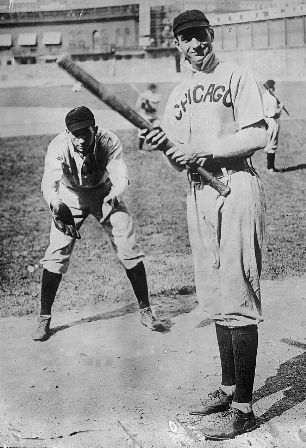
Arthur “Artie” “Circus Solly” Hofman was one of the best utility men in baseball, and a member of four Chicago Cubs teams that went to the World Series.  When he was traded to the Pittsburgh Pirates in May of 1912, Bill Bailey of The Chicago American told a story about Hofman, baseball bats and why baseball players are superstitious about them:

“Some fans might think that Artie can hit with most any old stick that comes along, but he himself is very exacting about the one he picks out before he goes up to the plate.  There is always a great line of bats laying out in front of the players bench during a game.  Most of them are special makes of the big sporting goods companies and most of them are expensive products.”

Bailey said during the 1911 season the Cubs were mired in a mid-season hitting slump:

“And Hofman conceived an idea.  He was wandering through a department store in town when he saw a couple of bats on display.  They weren’t anything like the kind the Cubs had been using. “

Circus Solly Hofman

Circus Solly Hofman

Told the bats cost twenty-five cents each Hofman bought dozens of the bats and had them delivered to the West Side Grounds:

“Hofman took one himself and distributed the rest among his teammates…Every man in the lineup used one of Hofman’s bats that afternoon.  And they started hitting like demons.  Naturally they continued using the cheap bats. And they went on a batting rampage that lasted for a long time.  Everybody was slugging the ball.  When things like that happen, is it any wonder that the players have their superstitions about bats?”

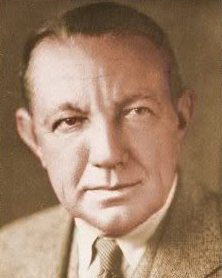
“Bill Bailey” was the pen name of Bill Veeck Sr., who would become vice-president of the Cubs in 1917, and president of the club in 1919.  He, of course, was also the father of Cleveland Indians, St. Louis Browns and Chicago White Sox owner Bill Veeck.

Bill Veeck Sr./"Bill Bailey"

Bill Veeck Sr./”Bill Bailey”

Hofman’s greatest claim to fame was being the Cubs centerfielder on September 23, 1908.  He fielded Al Bridwell’s single that scored Harry “Moose” McCormick, seemingly giving the New York Giants a 2 to 1 victory.  It was  Hofman, according to umpire Hank O’Day, who realized that Fred Merkle of the Giants, who had been on first base,  failed to touch second before leaving the field.  “Merkle’s Boner” remains baseball’s most famous base running blunder.

“Figures of your kind are Pathetic”

13 Aug

John McGraw made news for an “innovation” in 1909.  The Associated Press said:

“McGraw has adopted an innovation in baseball which will appeal to fandom throughout the National league circuit and probably prevent (Fred) Merkle and others from running to the clubhouse before they ‘touch second.’ The innovation is the signing of the once famous player Arlie Latham as coach for the base runners.”

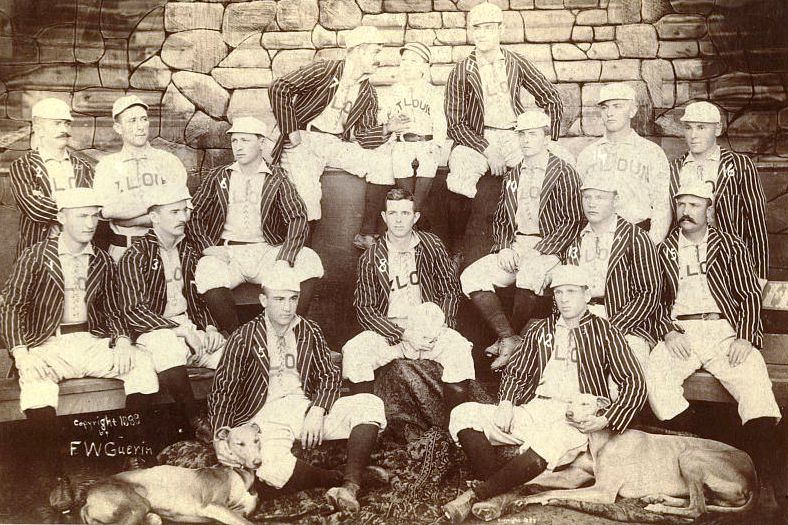
Arlie Latham, top center, facing team mascot, with 1888 American Association champion St. Louis Browns

Arlie Latham, top center, facing team mascot, with 1888 American Association champion St. Louis Browns

Walter Arlington “Arlie” Latham, was “particularly known for his humor” in the 1880s and 90s.  Primarily a third baseman with the St. Louis Browns in the American Association, the Chicago Pirates in the Players League and the Cincinnati Reds in the National League, Latham was nicknamed “The Freshest Man on Earth.”

The Associated Press said Latham:

“(B)rought much enjoyment to spectators of the Cincinnati club’s games and the Reds kept Latham a long while after he deteriorated as a player because of his drawing power as a comedian and humorist.

“Latham will don the uniform of the Giants and take his place in the coacher’s box while the Giants are at bat and between coaching the baserunner and batsmen and ‘getting the goat’ of the opposing pitchers will furnish an interesting sidelight to the New York games.”

Things did not go smoothly when Latham joined the team.  During spring training in Marlin, Texas Latham and McGraw were returning to their rooms at the Arlington Hotel when Giants outfielder James “Cy” Seymour, according to The St. Louis Post Dispatch, “knocked him down, and then bit him on the cheek.”  The article said McGraw and Latham did not know the “reason (Latham) was attacked,” but McGraw announced that Seymour was given his unconditional release.  McGraw said:

“Seymour is done with the New York club, and that goes.  It was the worst thing I ever saw pulled off.  Nothing like that can go on the New York club.”

Despite what he said McGraw did not release Seymour; the outfielder was suspended for the first week of the regular season, and The Dallas Morning News said McGraw made Seymour pay “his own expenses in Texas after the unpleasant episode.”

Arlie Latham, New York Giants coach

Arlie Latham, New York Giants coach

Latham was often criticized for his antics and even more often for the quality of his work as a coach, which became such a running joke that The New York Times said after the Giants had beaten the Cardinals in a September 1910 game:

“Arlie Latham’s team won it with their eyes shut, 11 to 3.  Latham’s coaching was invaluable yesterday.  He advised the players to touch every base and this tip won the game for them.”

The Sporting Life said:

“(Latham) undoubtedly lost a lot of games by bad coaching.  He got so unreliable that in a tight pinch McGraw would shift him from third to first and take the third line himself.”

The Sporting Life also said that Latham served as McGraw’s spy;  a position that would later be filled by another colorful McGraw coach, Dick Kinsella.

Giants outfielder Fred Snodgrass told Lawrence Ritter in “The Glory of their Times,” that Latham “was probably the worst third base coach who ever lived.”

It looked like the end of the line for baseball’s first full-time coach after the 1910 season.  The New York Herald said Latham “will not wear a Giant uniform next season,” and:

“He may amuse old timers, who remember him as a great ball player with (Charlie) Comiskey’s St. Louis Browns, but the new generation of fans seems to regard his efforts with disfavor.”

Despite the criticisms and predictions of his impending firing, Latham was back with Giants in 1911.  After the Giants pennant winning season Latham again joined the Giants for spring training in Texas in 1912, but in March, according to The Associated Press:

“(Latham) was carried as one of the twenty-five men permitted on the payroll.  McGraw did not want to let Latham go, but needed the place on the payroll for a real player.”

While McGraw didn’t want to lose his coach, most of baseball thought the end of Latham’s coaching career was a good thing; but even the New York press was not as harsh in their assessment of Latham as was Ed Remley, the baseball writer for The Fort Worth Star-Telegram:

“Arlie Latham has passed.

“May he rest in peace, for he is truly dead…Arlie has been called the fool of baseball and with much justice.  He was not the fool in any modern sense but more like the professional jesters who were kept in the courts of kings in the middle ages.

“Today, reading descriptions of the position of the court jesters, their crude horseplay jokes, we are not filled with laughter but with pity…The crude vassals of a former generation thought the brutal jokes of the court fool were funny; the bleacherites of today laugh at Arlie Latham pretending an engrossing interest in a game which he cannot even play himself…Vale, Latham—You have our sympathy, but we are not really sorry you are gone.  Figures of your kind are pathetic and pathos has nothing to do with baseball.”

Latham was next heard from when he accepted a coaching position with Patrick “Patsy” Flaherty’s Lynn Fighters in the New England League; that job only lasted until June.  Latham managed to run afoul of the entire Lynn team.  The Associated Press said he was forced to resign because “Players thought he was after manager Flaherty’s job and threatened to go on strike unless he was dismissed.”

Latham finished the 1914 season as an umpire in the Massachusetts and Rhode Island based Colonial League.  He did not return the following season, and in May of 1915 The Pittsburgh Press reported under the headline “Arlie Latham Has Quit The Diamond for All Time Now,” that he had found a new line of work; operating a deli in the Washington Heights neighborhood in Manhattan:

“He declares that as a delicatessener he is batting only .106 at present, but that when he gets properly warmed up and learns how to shave 15 ½ ounces of ham for a pound he will hit with the best of them in the delicatessen league.”

By 1917 Latham was in Europe, for the last act of his baseball career.  From 1917 to 1923 he lived in London and organized baseball leagues for military personnel.  The highlight of his stay was the July 4, 1918 game between the Army and Navy teams.  Latham served as umpire and greeted the most important dignitary at the game, King George V.  The Associated Press said:

“It had been planned to have the king throw out the first ball, but this was abandoned because of the netting in front of the royal box, so the king brought the ball out on the field and handed it to the umpire.  One of the balls used was autographed by the king with an American fountain pen and mailed tonight to President Wilson as a souvenir. “

Arlie Latham, front row center, with army team in London, 1918

Arlie Latham, front row center, with army team in London, 1918

After returning to the States, Latham first returned to the deli, then later was hired to work in the press box at the Polo Grounds, he remained a fixture at the New York ballpark until his death at age 92 in 1952.

As a result of outliving his critics and becoming one of the last surviving links to the 19th Century game by the time of his death, memories had faded about the “pathetic” figure of Latham, and only the image as  “baseball’s clown prince” remained.

Things I Learned on the Way to Looking up Other Things #5

8 Aug

Johnny Evers “Ardent Worshipper of Hoodoo Lore”

Edward Lyell Fox was a war correspondent in World War I; after the war he was accused of taking money to write stories favorable to the German government.  Before that he wrote extensively about baseball for several American magazines.

In 1910, writing for “The Columbian Magazine”, Fox interviewed Johnny Evers of the Chicago Cubs about the “almost unbelievable efforts made by ballplayers to offset what they firmly believe to be ‘hoodoos.’”

Evers was one of the most superstitious players in the game, “an ardent worshipper of voodoo lore,” according to Fox, and Evers said the Cubs “are more superstitious than any team in the big leagues,” and that manager Frank Chance “is one of the most ardent respecters of diamond ‘hoodoos.’”

It’s not certain that Evers’ claim that “most players firmly believe in,” the superstitious he listed for Fox, but it’s clear he believed them:

 “If any inning is favorable to a player, he will try to lay his glove down on the same spot where he had placed it the inning before.

“While going to different parks in cars, the sight of a funeral cortege is always regarded as an ill omen.”

Evers also said the sight of a handicapped person was also an “ill omen…unless you toss him a coin.”

On the other hand Evers said a wagon load of empty barrels was a sign of good luck.

Johnny Evers,

Johnny Evers,


“Too much of a Good Thing”

Even in baseball’s infancy that were critics that said the popularity of the game was “too much of a good thing.”

In September of 1865 The Philadelphia Inquirer editorialized:

 “Let us take, for instance, the base ball (sic) pastime, which is now assuming the proportions of a violent and widespread mania.”

The culprit, according to the editorial, was the athletic club teams that were growing in popularity and  no longer “satisfied with a game or two a week.”

 “(S)ome of these associations devote, three, four or five days at a time to their games; that they are not satisfied with playing on their own grounds for their own benefit and amusement, but that they thirst for popular applause, and are rapidly transforming their members into professional athletes…They issue their challenges, and hotly contend for mastery with clubs belonging to other cities.”

 The Inquirer did predict one aspect of baseball’s new popularity:

 “It can be easily seen that this spirit must soon lead on to gambling. So far the only prize of the base ball and cricket matches has been a ball or some implement of the game, but private wagers have undoubtedly been laid upon the playing of certain clubs, and money has changed hands upon results.”

The Enquirer was also concerned that the game defied “common sense” because “during the heats of summer violent bodily exercise should be avoided; but upon this subject common sense and the base ball mania seem to be sadly at variance.”

The editorial concluded that “the young men,” make sure “they do not depreciate themselves to the level of prize fighters or jockeys, who expend their vim on horse races and matches made for money.”

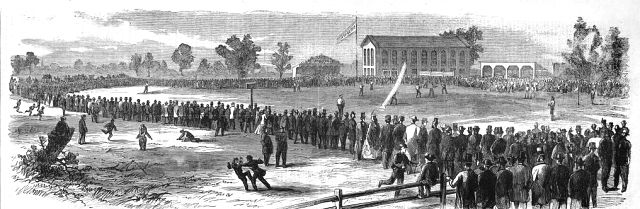
Athletic of Philadelphia versus Atlantic of Brooklyn, in Philadelphia October 30, 1865--"a violent and widespread mania."

Athletic of Philadelphia versus Atlantic of Brooklyn, in Philadelphia October 30, 1865–“a violent and widespread mania.”


Odds, 1896

Early in 1896 The New York Sun reported on “an early development of interest.”  A local bookmaker had issued odds on the 1896 National League race:

“He lays odds of 3 to 1 against Baltimore finishing first; 7 to 2 against Cleveland and Boston;  4 to 1 Philadelphia and New York; 7 to 1 Chicago; 8 to 1 Brooklyn and Pittsburgh; 15 to 1 Cincinnati; 40 to 1 Louisville; 100 to 1 Washington, while (Christian Friedrich “Chris”) von der Ahe’s outfit (St. Louis) is the extreme outsider on the list.  Any lover of the German band can wager any amount and “write his own ticket.”

The final standings:

1. Baltimore Orioles

2. Cleveland Spiders

3. Cincinnati Reds

4. Boston Beaneaters

5. Chicago Colts

6. Pittsburgh Pirates

7. New York Giants

8. Philadelphia Phillies

9. Washington Senators

10. Brooklyn Bridegrooms

11. St. Louis Browns

12.  Louisville Colonels

1896 Orioles, 3 to 1 favorites, won the National League Championship.

1896 Orioles, 3 to 1 favorites, won the National League Championship.