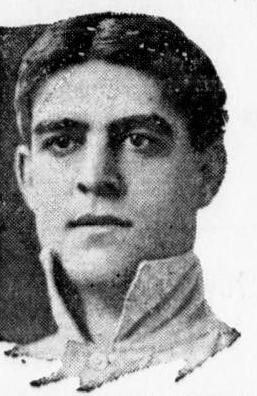
Tag Archives: Tris Speaker

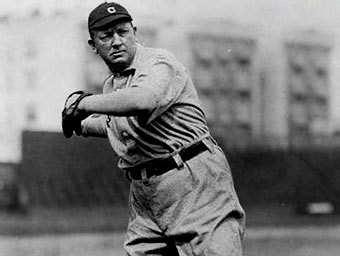
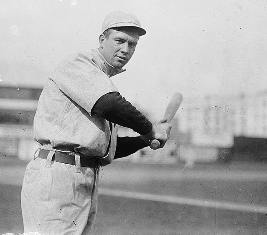
Lost Advertisements-Tris Speaker and Larry Doyle, Lewis 66

20 Jan

1913whiskey

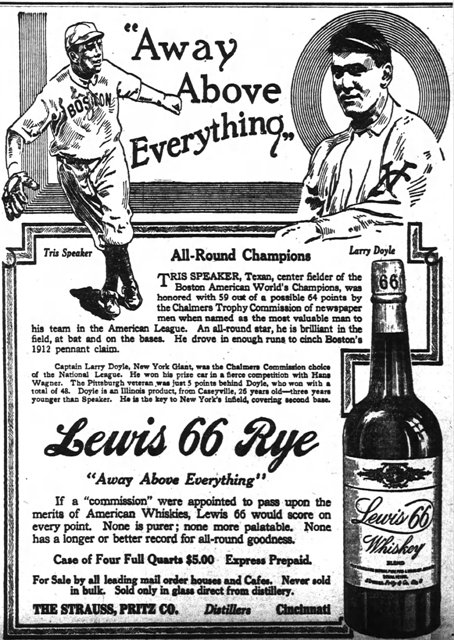
A 1913 advertisement for Lewis 66 Rye Whiskey from The Strauss, Pritz Company, a Cincinnati-based distiller featuring Tris Speaker and Larry Doyle:

“Tris Speaker, Texan, center fielder of the Boston American World’s Champions, was honored with 59 out of a possible 64 points by the Chalmers Trophy Commission of newspaper men when named as the most valuable man to his team in the American League.  An all-round star, he is brilliant in the field, at bat, and on the bases.  He drove in enough runs to cinch Boston’s 1912 pennant claim.

Captain Larry Doyle, New York Giant, was the Chalmers choice of the National League.  He won his prize car in a fierce competition with Hans Wagner.  The Pittsburgh veteran was just 5 points behind Doyle, who won with a total of 48.  Doyle is an Illinois product, from Caseyville, 26 years old–three years younger than Speaker.  He is the key to New York’s infield, covering second base.”

Larry Doyle

Larry Doyle

The cars–each a 1913 Chalmers 36– were presented before World Series games at each player’s home ballpark by company president Hugh Chalmers.  Former Cincinnati sportswriter turned advertising executive and chairman of the Chalmers Commission, Ren Mulford introduced the automobile executive at the Polo Grounds for Doyle’s presentation, and said:

Ren Mulford

Ren Mulford

“What (Sir Thomas) Lipton is to Yachting, and what (William Kissam) Vanderbilt is to automobile road racing, Hugh Chalmers is to baseball.  The Chalmers trophy is now a recognized baseball classic.”

The “recognized baseball classic” was discontinued after the 1914 season.


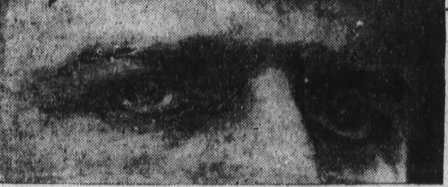
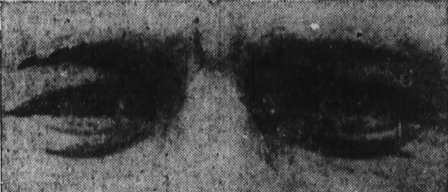
Lost Pictures–The Best Eyes in Baseball

4 Dec

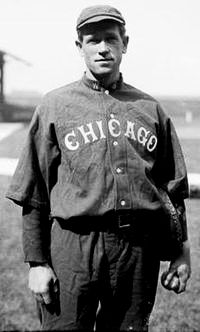
eyeszimmerman

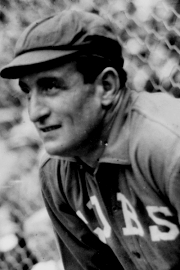
eyesdaubert

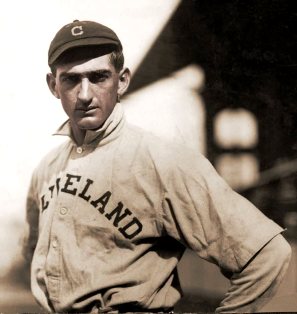
eysspeaker

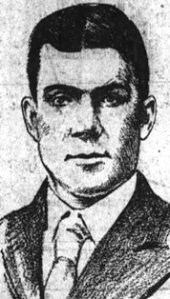
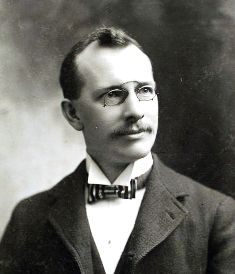
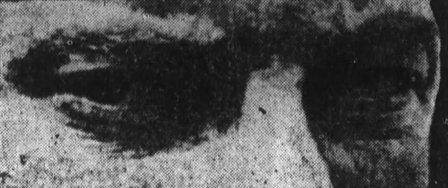
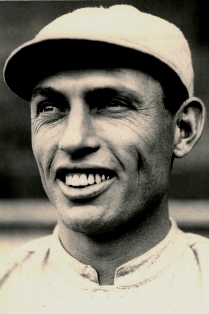
Above, three sets of eyes, 1916.

Harold “Speed” Johnson of The Chicago Herald said:

“It’s the eye and not the wallop that counts in the national Pastime.  Some eyes are more durable than others.  Larry Lajoie possesses such a pair; so does Hans Wagner, Terry Turner, Tris Speaker, Jake Daubert, Frank Schulte, Larry Doyle, Heine Zimmerman, Tyrus Cobb, Joe Jackson and Bill Hinchman.”

Johnson informed his readers that “Most of these birds refrain from reading during the offseason, thereby sparing their eyes.”

As for the three sets pictured above, Jonson said:

“Heine Zimmerman is another notable example of the batter who possesses the keen optics.  He eccentric third sacker of the Chicago Cubs, when at peace with the world, is one the greatest natural sluggers of all time.  His eyes never have troubled him but his temperament frequently has caused him to slump, swinging frantically at any old pitch.  Right now Heinie is seeing in exceptionally good form as witness his average of .336 for 48 combats.”

[…]

“There is nothing wrong with Jake Daubert’s glims as a slant at the latest averages will indicate…His heavy cannonading has been a principal factor in the upward climb of the Robins…For a pair of eyes that have been in use as long as Jake’s in the big set they’re holding out famously.”

[…]

 “Nine seasons of big league milling haven’ dulled the lamps of Tristram Speaker who right now is going better than he did in his banner years with the Boston Red Sox.  Not only is the big Texan rattling fences  at Dunn Field, Cleveland, where for seven years he averaged .381 on visits with the Bostonese, but he is keeping up his terrific pace abroad.”

Zimmerman’s temperament caught up with him again.  He wore out his welcome in Chicago in August of 1916, was traded to the New York Giants and finished the season with a .286 average.

Daubert’s eyes held out.  He hit .316 and led Brooklyn to the National League pennant.

Speaker kept hitting at Dunn Field and everywhere else, finishing the season with a major league-leading .386 average.

Things I Learned on the Way to Looking Up Other Things #16

21 Oct

Pirates Slump, 1921

The first place Pittsburgh Pirates were preparing for a doubleheader with the New York Giants on August 24, 1921, when the team took time out to pose for a photo.  The Pittsburgh Leader said:

“Someone happened to mention, as the photographer moved away, that for a whole team to watch the little birdie at once was a jinx.”

The team promptly went out and dropped the doubleheader, then lost three more to the Giants.  The paper said of the five straight losses:

“It doesn’t prove the jinx exists.  But it does prove that to imbue a man or a team of men, with the idea that they can’t win a ballgame generally means that they won’t win.  For their pep and enthusiasm has been stolen.”

The Pirates finished second, four games behind the Giants.

Anson’s All-Time Team, 1918

While visiting St. Paul, Minnesota in the summer of 1918, Cap Anson was asked by a reporter for The Associated Press to name his all-time all-star team.  The reporter said the team was most “notable for including in its makeup not one” current player:

"Cap" Anson

                        “Cap” Anson

“According to Captain Anson, at  least four outfielders of old times are better than (Ty) Cobb or (Tris) Speaker and (John) Clarkson, (Amos) Rusie, and (Jim) McCormick, he thinks were better pitchers than (Grover Cleveland)  Alexander  or (Walter) Johnson.  His line-up would be:

Catchers—William “Buck” Ewing and Mike “King” Kelly

Pitchers—Amos Rusie, John Clarkson, and Jim McCormick

First Base—Captain Anson, himself

Second Base—Fred Pfeffer

Third Base—Ned Williamson

Shortstop—Ross Barnes

Outfielders—Bill Lange, George Gore, Jimmy Ryan and Hugh Duffy

Cy Young’s Five Rules, 1907

Forty-year-old Cy Young won 21 games for the Boston Americans in 1907 and his longevity became a popular topic of newspaper copy until he pitched his final major league game four years later.

Cy Young

                                             Cy Young

During that 1907 season he gave a reporter for The Boston Post his advice for young players:

“(T)o the young player who seeks his advice about getting in condition and being able to stay in the game as long as the veteran himself, Cy lays down a few simple rules, which are as follows:

  1.  Live a temperate life
  2. Don’t abuse yourself if you want to attain success
  3. Don’t try to bait the umpires; abusing the arbitrators does a player no good and harms him in the eyes of the umpires, players and public in general
  4. Play the game for all you are worth at all times
  5. Render faithful service to your employers

Regarding his “rule” about umpires, Young said:

“What’s the use in kicking?  The umpire won’t change his decision, and kicking will give him another chance to get back at you for your silly abuse.”

“A Knocking Umpire had Attempted to keep Speaker back”

11 Sep

Jesse Doak Roberts was a prominent figure in Texas baseball.  He was the two-time president of the Texas League (1904-’06 and 1920-’29), and had an ownership stake and managed clubs in the Texas and North Texas Leagues.

Jesse Doak Roberts

Jesse Doak Roberts, circa 1929

In 1911, the then owner of the Houston Buffaloes gave The Houston Chronicle his version of how Tris Speaker ended up in Boston:

“I want to tell you the story of the force that endeavored to act against the rise of Speaker—a force that did not succeed, but which cost me $700 in purchase money, and it was a knocking umpire.

“When Speaker was going at his best in his last year in this league (1906), I had made arrangements with Charlie Comiskey to purchase Tris for $1500…the deal was almost closed.”

Roberts said he was approached “by a (Texas) League umpire,” during a late-season game in Austin who, he claimed, demanded “a commission” for recommending Speaker:

“I told him that I had never asked an umpire to sell one of my players and would not—that I would prefer that they would not recommend any of them…I must have angered him, for he knocked the greatest Lone Star player to Comiskey (later) I got a draft from the Old Roman: ‘We can’t use Speaker.’

(George) Huff, then scouting for Boston, was in town.  He came around to see me and asked what I would take for Speaker.  I told him $1500.  He said that was too much for a class C player—that he would give me $500.”

Roberts said he then tried to sell Speaker to the St. Louis Browns (the biography “Tris Speaker: The Rough and Tumble Life of a Baseball Legend” said Roberts had attempted to sell Speaker to St. Louis earlier that season)

“I refused to accept (Huff’s) offer and wired (Jimmy) McAleer at St. Louis.  I told him I would sell him Speaker under a positive guarantee that he would make good.”

Tris Speaker "hardest hit"

                                 Tris Speaker 

Roberts said McAleer never responded and he “finally made an agreement to sell the boy for $800 cash,’ to Boston.

“A knocking umpire had attempted to keep Speaker back and had kept us from getting the difference between Comiskey’s price if $1500 and Boston’s of $800. And the White Sox lost a great player.”

Roberts never named the umpire who he said cost him $700.

Murphy’s “Billion Dollar Team”

17 Aug

“Money will not buy a pennant winner;” so said William George “Billy” Murphy, the sports editor of The St. Louis Star.  In 1914, he set out to select a team that not even “John D. Rockefeller… (With) all his wealth could buy a club that would win a World’s championship from the one we have picked…The Billion Dollar Team.”

Murphy said:

“You fans of towns that have never won a flag, how would you feel to wake up some morning and find that Dame Fortune had so arranged matters that this club had suddenly been picked to represent your fair city.”

Jimmy Archer, catcher

Behind the plate he acknowledged “There are many who would doubtless pick (John) Chief Meyers…but considering the Indian’s slowness of foot and propensity for clogging up the bases and stealing when the bags are full, we must remark we cannot see the “Chief” for a minute with Jimmy Archer, who, although not so good a hitter, is faster, a quicker thinker, greater fielder and better pegger.”

Jimmy Archer

Jimmy Archer

Murphy was in the minority questioning the baseball intelligence of Meyers, who was widely considered one of the most intelligent and articulate players of his era.  He also rated Ray Schalk and Wally Schang as superior, saying:

“In the writer’s humble opinion they are much more valuable men to their team than Meyers.”

Walter Johnson, pitcher

“There will hardly be a dissenting vote cast against Walter Johnson.  Unquestionably he is the greatest of all the pitchers.

(Charles Chief) Bender and (Christy) Mathewson are also great—great when they should show class—in championship games.  Every nerve, every fiber of their brains, every muscle necessary to their craft, is at its best when big games are being fought.

“Wonderful as they are, we must pick Johnson, who also has class and is game to the core.”

Hal Chase, first base

“For first base, there is only Hal Chase.  He is a great hitter, marvelous fielder, can run the sacks, and is a brilliant tactician.

(John) ‘Stuffy’ McInnis, Jake Daubert, Eddie Konetchy, Fred Merkle, and Jack (Dots) Miller are all stars, but they are ‘also rans’ in the class with Prince Hal of the White Sox.”

Prince Hal of the White Sox

Prince Hal of the White Sox

Eddie Collins, second base

“At second base, Eddie Collins in the potentate.  Johnny Evers, Larry Doyle, and Larry Lajoie occupy seats in the second sackers’ hall of fame, but Collins rules over the roost.”

Honus Wagner, shortstop

“At short, notwithstanding his age, the palm goes to Hans Wagner.  Taken all in all he is still the greatest man at the position in the game.  He can do everything and does it better than any of his contemporaries.  When will we look upon his like again?”

Frank Baker, third base

“At third base, there is that wonderful silent son of swat, Frank Baker, the conqueror of the wonderful Mathewson and Richard (Rube) Marquard.”

Joe Jackson, right field

“In right field we have Joe Jackson, the young Southerner with the Cleveland club.  He is one of the greatest batsmen in the game today and is a fielder and base runner of unusual ability.”

Joe Jackson

Joe Jackson

Ty Cobb, center field

“In center, there is Tyrus Raymond Cobb, the Royston, Georgia marvel, who is the greatest player baseball has ever known.”

Tris Speaker, left field

“And in left field, there is Tris Speaker of the Boston Red Sox—second only to Cobb.”

Grantland Rice’s “All-Time All-Star Round up”

10 Aug

In December of 1917, thirty-eight-year-old sportswriter Grantland Rice of The New York Tribune enlisted in the army–he spent fourteen months in Europe.  Before he left he laid out the case, over two weeks, for an all-time all-star team in the pages of the paper:

“As we expect to be held to a restricted output very shortly, due to the exigencies and demands of the artillery game, this seemed to be a fairly fitting period to unfold the results.”

Grantland Rice

Grantland Rice

Rice said the selections were “not solely from our own limited observation, extending over a period of some eighteen or twenty years,” but included input from players, managers and sportswriters, including  “such veterans” as Frank Bancroft and Clark Griffith, and baseball writers Joe Vila of The New York Sun, Bill Hanna of The New York Herald and Sam Crane, the former major league infielder turned sportswriter of The New York Journal.

Rice said only one of the nine selections “(S)eems to rest in doubt.  The others were almost unanimously backed.”

The selections:

Pitcher:  Christy Mathewson

A. G. Spalding, John (Montgomery) Ward, Larry Corcoran, Charley Radbourn, John Clarkson, (Thomas) Toad Ramsey, Tim Keefe, Bill Hoffer, Amos Rusie, (Mordecai) Miner Brown, Addie Joss, Ed Walsh–the array is almost endless.

“In the matter of physical stamina, Cy Young has outclassed the field.  Cy won more games than almost any others ever pitched.

“(But) For all the pitching mixtures and ingredients, stamina, steadiness, brilliancy, brains, control, speed, curves, coolness, courage, is generally agreed that no man has ever yet surpassed Christy Mathewson…there has never been another who had more brains or as fine control.”


[…]

“It might be argued that Radbourn or (Walter) Johnson or (Grover Cleveland) Alexander was a greater pitcher than Mathewson.

But we’ll string with Matty against the field.”

Radbourn was the second choice.  Bancroft said:

“Radbourn was more like Mathewson than any pitcher I ever saw.  I mean by that, that like Matty, he depended largely upon brains and courage and control, like Matty he had fine speed and the rest of it.  Radbourn was a great pitcher, the best of the old school beyond any doubt.”

Catcher:  William “Buck” Ewing

“Here we come to a long array—Frank (Silver) Flint, Charley Bennett, (Charles “Chief”) Zimmer, (James “Deacon”) McGuire, (Wilbert) Robinson, (Marty) Bergen(Johnny) Kling, (Roger) Bresnahan and various others.

“But the bulk of the votes went to Buck Ewing.”

Buck Ewing

Buck Ewing

[…]

“Wherein did Ewing excel?

“He was a great mechanical catcher.  He had a wonderful arm and no man was surer of the bat…he had a keen brain, uncanny judgment, and those who worked with him say that he had no rival at diagnosing the  weakness of opposing batsman, or at handling his pitchers with rare skill.”

Kling was the second choice:

“Kling was fairly close…a fine thrower, hard hitter, and brilliant strategist…But as brilliant as Kling was over a span of years, we found no one who placed him over the immortal Buck.”

1B Fred Tenney

First Base was the one position with “the greatest difference of opinion,” among Rice and the others:

“From Charlie Comiskey to George Sisler is a long gap—and in that gap it seems that no one man has ever risen to undisputed heights… There are logical arguments to be offered that Hal Chase or Frank Chance should displace Fred Tenney at first.

But in the way of batting and fielding records Tenney wins….Of the present array, George Sisler is the one who has the best chance of replacing Tenney.”

2B Eddie Collins

 “There was no great argument about second base.

“The vote was almost unanimous.

“From the days of Ross Barnes, a great hitter and a good second baseman on through 1917, the game has known many stars.  But for all-around ability the game has known but one Eddie Collins.”

Rice said the competition was between Collins, Napoleon Lajoie and Johnny Evers:

“Of these Lajoie was the greatest hitter and most graceful workman.

“Of these Evers was the greatest fighter and the more eternally mentally alert.

“But for batting and base running, fielding skill, speed and the entire combination, Collins was voted on top.”

 SS Honus Wagner

“Here, with possibly one exception, is the easiest pick of the lot.  The game has been replete with star shortstops with George Wright in 1875 to (Walter “Rabbit”) Maranville, (George “Buck”) Weaver…There were (Jack) Glasscock and (John Montgomery) Ward, (Hardy) Richards0n, (Hugh) Jennings, (Herman)Long, (Joe) Tinker and (Jack) Barry.

“But there has been only one Hans Wagner.”

Honus Wagner

Honus Wagner

Jennings and Long were rated second and third,  “But, with the entire list  considered there is no question but that Wagner stands at the top.”

3B Jimmy Collins

Rice said:

“From the days of (Ned) Williamson(Jerry) Denny, and (Ezra) Sutton, over thirty years ago, great third basemen have only appeared at widely separated intervals.

“There have been fewer great third basemen in baseball than at any other position, for there have been periods when five or six years would pass without an undoubted star.”

The final decision came down to “John McGraw vs. Jimmy Collins.”  McGraw was “a great hitter, a fine bunter and a star base runner,” while “Collins was a marvel and a marvel over a long stretch…he was good enough to carve out a .330 or a .340 clip (and) when it came to infield play at third he certainly had no superior…So taking his combined fielding and batting ability against that of McGraw and Collins wins the place.  McGraw was a trifle his superior on the attack. But as a fielder there was no great comparison, Collins leading by a number of strides.”


OF Ty Cobb

“The supply here is overwhelming…Yet the remarkable part is that when we offered our selection to a jury of old players, managers and veteran scribes there was hardly a dissenting vote.”

[…]

“Number one answers itself.  A man who can lead the league nine years in succession at bat.

“A man who can lead his league at bat in ten out of eleven seasons.

“A man who can run up the record for base hits and runs scored in a year—also runs driven in.

“Well, the name Ty Cobb answers the rest of it.”

OF Tris Speaker

 “The man who gives Cobb the hardest battle is Tris Speaker.  Veteran observers like Clark Griffith all say that Speaker is the greatest defensive outfielder baseball has ever exploited…Speaker can cover more ground before a ball is pitched than any man.  And if he guesses incorrectly, which he seldom does, he can go a mile to retrieve his error in judgment…And to this impressive defensive strength must be added the fact he is a powerful hitter, not only a normal .350 man, but one who can tear the hide off the ball for extra bases.”

Tris Speaker "hardest hit"

Tris Speaker 

OF “Wee Willie” Keeler

Mike Kelly and Joe KelleyJimmy Sheckard and Fred Clarke—the slugging (Ed) Delehanty—the rare Bill LangeBilly Hamilton.

“The remaining list is a great one, but how can Wee Willie Keeler be put aside?

“Ask Joe Kelley, or John McGraw, or others who played with Keeler and who remember his work.

“Keeler was one of the most scientific batsmen that ever chopped a timely single over third or first…And Keeler was also a great defensive outfielder, a fine ground coverer—a great thrower—a star in every department of play.

“Mike Kelly was a marvel, more of an all-around sensation, but those who watched the work of both figure Keeler on top.”

Rice said of the nine selections:

“The above is the verdict arrived at after discussions with managers, players and writers who have seen a big section of the long parade, and who are therefore able to compare the stars of today with the best men of forgotten years.

“Out of the thousands of fine players who have made up the roll call of the game since 1870 it would seem impossible to pick nine men and award them the olive wreath.  In several instances the margin among three or four is slight.

“But as far a s deductions, observations, records and opinions go, the cast named isn’t very far away from an all-time all-star round up, picked for ability, stamina, brains, aggressiveness and team value.

“If it doesn’t stick, just what name from above could you drop?”

“Baseball is far behind Golf in its Self-analysis”

1 Jun

During the Chicago Cubs disappointing fifth place finish, with a 67-89 record in 1916, the team hit just .239.

When Manager Joe Tinker was replaced by Fred Mitchell, team owner Charles Weeghman announced that golfer Charles “Chick” Evans, who in 1916 became the first to win the U.S. Amateur and U.S. Open in the same year, would be accompanying the team on their spring training trip to Pasadena, California.

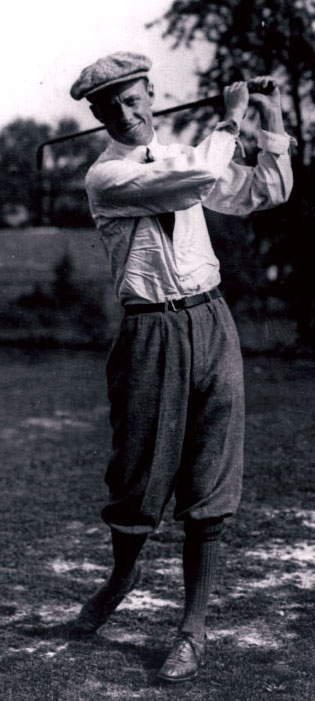
Chick Evans

Chick Evans

Weeghman told The Chicago Day Book’s Mark Shields that Evans would teach the hitters “a golf follow through” intended “to increase the batting of the regulars.  Shields said Weeghman “Points to (Frank) Schulte, (Heine) Zimmerman and (Tris) Speaker as strong hitters who use a golf style.”

Weeghman told The Associated Press (AP):

“There is form in the driving of a golf ball, but there is none in driving a baseball.  Applying the form of golf to baseball was responsible for the wonderful driving power of Frank Schulte and Heine Zimmerman.”

The Cubs’ owner allowed that Schulte knew nothing about golf, but said “(H)e unconsciously used the same swing.”

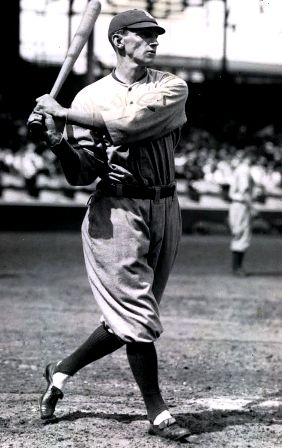
Frank Schulte's swing

Frank Schulte’s swing

Weeghman said the golfer would not be paid for services in order to maintain his amateur standing.

Evans told The Chicago Daily News that “the batsmen don’t have the knowledge of stance, grip and manner of swinging that the more successful golfers possess. “

He told The International News Service that he had considered a career in baseball:

“Chick says that he might have become a baseball player after having pitched a no-hit game for his high school (Evanston Academy).”

Evans claimed “a torn ligament at the shoulder” derailed his plans.

The response to the Cubs’ plan was immediate.

The Daily News said:

“Chick Evans is going to teach the Cubs how to bat, thereby accomplishing something no one else even considered possible.”

Rabbit Maranville told The AP the story was “a funny one,” and that he was sure that the decision to bring in Evans was strictly Weeghman’s, and likely not endorsed by the Cubs’ new manager:

“Doesn’t seem to me as if (Fred) Mitchell is responsible for that stunt.  I guess it’s being wished on him.

“In baseball the batter needs courage.  He does not know when the pitcher is going to slip a notch in his control…Courage is the big asset in batting, and with all the respect in the world to golf, where is there any great courage needed in driving the golf ball?”

While John Brinsley “J.B.”  Sheridan, the sports editor of The St. Louis Globe-Democrat, said ballplayers may derive some benefit from a golfer’s advice:

“Baseball is far behind golf in its self-analysis.  The keen minds of many generations of Scotch students have been devoted to the science of golf.  So far, no keen analytical mind has been given to baseball.  Men who do know the game are usually inarticulate and cannot tell what they know.”

Sheridan outlined how golf in general, and Evans in particular, could help:

“Drawing back the club or the bat slowly is most important.  If the striking implement is drawn back too quickly or with a jerk, the player is thrown off balance and his eye is put out of focus.

“It is notable that the great hitters, Speaker, Joe Jackson, Eddie Collins and others carry their bats well behind them and do not draw back quickly.”

Additionally, Sheridan said other “golf maxims will help” hitters, including:

“Hit off the (front) foot.  Keep your eye on the ball.  Do not hit too hard.  Follow through.”

Weeghman’s plan was finally shelved shortly before the team departed for the West Coast.  The Daily News said the United States Golf Association (USGA) could strip Evans of his amateur standing:

“If Evans uses his ability as a golfer to aid him in attempting to instruct ballplayers how to swing their bats, it appears that he will take a long chance.”

Charles Weeghman

Charles Weeghman

Evans was in California at the same time as the Cubs in March, and although newspapers had announced he would accompany the team “over the Sante Fe” railroad on the trip, it is unclear whether he actually traveled with the team.  The AP said he “stayed far away” from the Cubs’ practices in order to not run afoul of the USGA, but one paragraph in The  Chicago Tribune the day after the club’s first practice in Pasadena was rained out, likely exposed the Cubs’ owner’s real intention for wanting Evans in California:

“(The rain) did not keep Prexy Weeghman from tackling Chick Evans in a golf match.  They had played only twelve of the eighteen holes when the mist became so active it stopped the contest.  At the finish, the score stood $11 to $1 in favor of the national amateur champion.”

The Cubs posted a slightly improved 74-80 record, but once again finished in fifth place.  Whether the lack of instruction from Chick Evans was a factor or not, the team’s batting average was .239; identical to their 1916 average.

Lost Pictures–Tris Speaker and Laddie Boy’s Brother

10 Apr

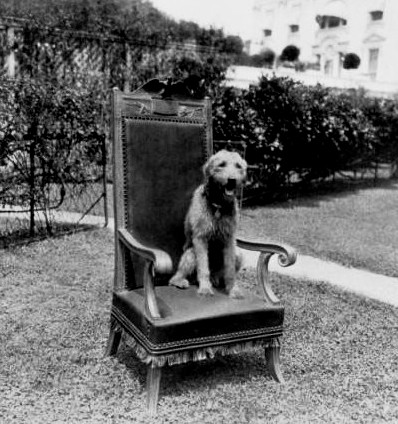
trisIn 1921, the most famous dog in the world was Laddie Boy; the Airedale Terrier was the first celebrated Presidential Dog.  Laddie Boy was presented to President Warren G. Harding on March 5, 1921–the day after his inauguration–by a Toledo, Ohio breeder–his father  was an international champion Airedale named Tintern Tip-Top.

Laddie Boy had his own chair at Harding’s cabinet meetings, “wrote” articles about his life at the White House, and after Harding’s death a statue of Laddie Boy–paid for with donations collected by newsboys across the country–was commissioned and displayed at the Smithsonian Institution.

laddieboy

Laddie Boy poses on the White House lawn in his chair.

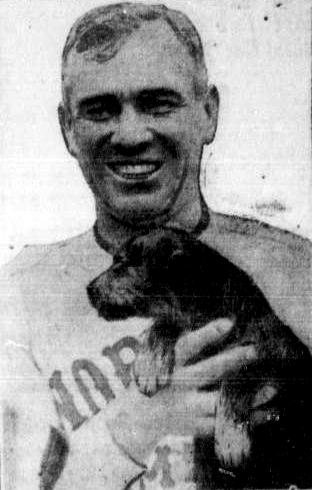
Nearly two months after Laddie Boy went to the White House, one of his lesser-known brothers was presented to Player-Manager Tris Speaker of the defending World Series Champion Cleveland Indians on opening day of the 1921 season.

Speaker became a fan of the breed and later bought Airedales from another Ohio breeder, Walter Lingo.  Lingo, to promote his breeding business–Oorang Kennel Company–hired another one of his customers, Jim Thorpe, and together they organized the Oorang Indians National Football League franchise.

Jim Thorpe--Airedale fan

Jim Thorpe–Airedale fan

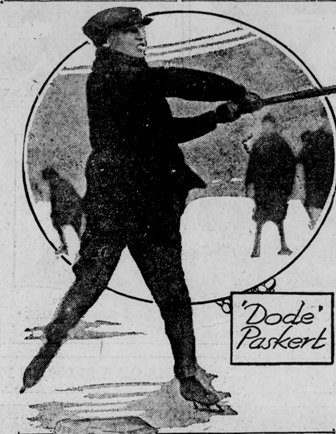
Lost Pictures: Dode Paskert Plays Ice Baseball

20 Feb

dode

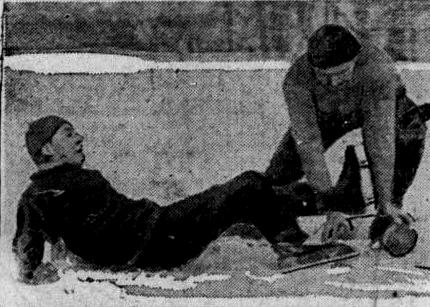
Ice Baseball made its first appearance in the winter of 1866 when the Athletic Baseball Club of Philadelphia played a game on ice against a “picked nine’ comprised of other local baseball teams.  Games were played occasionally over the next 50 years, but the game never caught on.

That changed briefly the winter following the 1919 season when the game, along with Ice Boxing, became a sensation in Cleveland.  The Cleveland Press said the biggest star among the “many ice baseball clubs” was Chicago Cubs centerfielder, and Cleveland native,  George “Dode” Paskert “an expert skater (who) says the exercise he is getting is going to put him about a month ahead” of his teammates.

Unidentified Ice Baseball players in 1920 photo.

Unidentified Ice Baseball players in 1920 photo.

The paper said Cleveland Indians players Bill Wambsganss and Jack Graney played, and that Ray Chapman, the Indians second baseman,  and William “Pickles” Dillhoefer, catcher for St. Louis Cardinals would be joining teams.

Indians Manager Tris Speaker umpired at least one game.

Like every other short-term Ice Baseball craze, the game quickly faded in Cleveland.

Dode Paskert

Dode Paskert

As for Paskert, after a horrible 1919 season–.196 in 88 games–the 38-year-old seems to have benefitted from his “extra exercise.”  He hit .279 in 139 games in his final full season in the major leagues.


Franz Hosp

19 May

Franz Philip Hosp Jr. was born in Cincinnati in 1884 (some records, including cemetery documents and his grave say 1883).  His father was a well-known landscape architect and horticulturist who moved the family to Riverside, California in 1888.

The elder Hosp was responsible for many projects in the Southwest and Southern California; he is probably most famous for his landscaping of Victoria Avenue in Riverside, which remains a tourist attraction and is listed on the National Register of Historic Places, and for planting the gardens at the El Tovar Hotel in Grand Canyon National Park.

The family also ran a successful nursery in Oceanside, California  and Hosp worked with his father while playing baseball in the San Diego area.
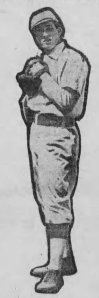
Franz Hosp

Franz Hosp, 1909

In December 1906 he pitched for the San Diego Pickwicks (sponsored by San Diego’s Pickwick Theater) of the California Winter League.  Hosp quickly caught the eye of West Coast professional teams; according to The Los Angeles Times he had a streak of thirty-one scoreless innings that winter and “fanned as many as eighteen men in a single game.”

The Los Angeles Herald said two teams, The Butte Miners and the Seattle Siwashes of the Northwestern League, had already “tried hard to secure his services,” when he pitched against the Los Angeles Angels of the Pacific Coast League (PCL) in a February exhibition game in San Diego.

The Associated Press said the game

 “(W)as the first time in which he allowed as many as seven hits, and after doing, he took a brace and fanned out an equal number of Los Angeles’ best artists, with the result being that the Angels’ manager (Henry ”Hen”  Berry) lost no time in annexing Hosp to his own aggregation.”

Hosp said he chose to play with Los Angeles so he could continue working at the family business in Oceanside.

The pitcher was a popular member of the Angels.  The Los Angeles Herald said:

“Pitcher Franz Hosp is not only one of the best twirlers in the coast league, but he is also one of the most genial boys who ever donned a baseball uniform.  Hosp has forgotten more baseball, young as he is, than many of the swell headed players who roar at decisions have ever learned.”

The Times said of Hosp, who also played second base and shortstop:

“His work in the field and at the bat is equal to his performance in the box making him one of the best all-around men in the business.”

Hosp was 12-7 with a 2.73 ERA for the PCL champion Angels in 1907; he also played 13 games in the infield, hitting just .105.
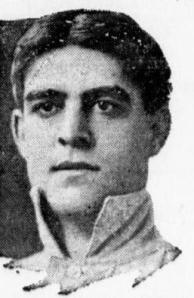
franzhosppix

Franz Hosp

The following season Hosp (22-14 2.02), William “Dolly” Gray (26-11, 2.12), and Walter “Judge” Nagle (24-10, 1.94) led the Angels to another league championship.  On July 26 he had the most embarrassing moment of his career during a game with the San Francisco Seals.  The San Francisco Chronicle said:

“Hosp of the Angels established a unique and startling record yesterday afternoon, one that bids to stand a long time in baseball circles.  Not only did he literally pitch the game away, but in one inning—the fourth—he walked six men and hit two more, forcing in five runs across the plate without a hit by the Seals.  Not a ball was hit out of the diamond.”

(Just more than a year later, August 28, 1909, Hosp’s former teammate Dolly Gray, now a 30-year-old rookie with the Washington Senators, set the major league record by walking eight Chicago White Sox batters in one inning).

Hosp was 16-14 in August of 1909 when he was signed by the Cincinnati Reds for 1910.  Within a week he hurt his arm and did not pitch again for the remainder of the season.

By the spring of 1910 there were conflicting reports about the condition of Hosp’s arm.

The Times reported that according to Angels pitcher Andy Briswalter:

“Franz Hosp, whose clever pitching resulted in his purchase by the Cincinnati Reds, may never play ball again.”

The Herald said Hosp:

“(D)enied with considerable indignation the story purporting to be an interview with Andy Briswalter.  According to this story, Hosp’s arm was said to be in such condition that he might never play ball again.  While Hosp was overworked last season, when his sensational work with the Seraphs resulted in his being purchased by the Cincinnati Reds, he stated that he never felt better and that the rest of the past winter overcame any inconvenience or ill effects.  Hosp says he hasn’t seen Briswalter in six months.”

Hosp joined the Reds in Hot Springs, Arkansas, and was first tried in the outfield.  The Cincinnati Enquirer said after his debut:

(Ward) Miller and (George “Dode”) Paskert will have a dangerous rival for the right field job in the person of Franz Hosp, the recruit from the coast, who was signed as a pitcher but will try out as a fielder…He is a right-hand hitter, a good-sized, well-built fellow, and meets the ball square on the nose.  He came to bat five times; made a double and two clean singles…He showed a lot of speed on the bases and appears to be a kid who will bear watching.”

When finally given a chance to pitch, against the Boston Red Sox on March 25, after two scoreless innings, he gave up four singles and doubles to Harry Lord and Tris Speaker, in the third, resulting in three runs and was lifted for a pinch hitter the following inning.

Hosp was also tried in the infield where he “has made a fine impression.”  But it wasn’t enough to stick with the Reds.

The Herald reported in early May:

“Franz Hosp, one of the best pitchers who ever worked in the Coast League and who was released to Los Angeles by Cincinnati almost ten days ago because his pitching arm is kafluey for a time is warming up with the Angels every day and Hen Berry thinks he will get back into pitching form again soon.  He is a crack infielder too, and a heavy sticker, so it is dollars to cents that he will not be idle long.”

Hosp made his mound debut for the Angels on May 20; he pitched a complete game, losing 5 to 3.  The Herald said:

“Hosp showed excellent form for a pitcher who has been out of the game as long as he, and with a weak and sore arm, and he should be able get back to his best form with a little patience and careful slab work until his arm is ripe again.”

The paper was wrong, the extent of Hosp’s activity as a pitcher after that game was four innings in three games over the next year and a half.

Hosp was released by the Angels on June 15, along with Briswalter, who The Times claimed four months earlier had said  Hosp’s arm was shot; Briswalter had not recovered from a hip injury sustained during the 1909 season, he developed Tuberculosis of the injured bone and died in 1912.
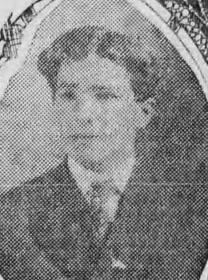
Andy Briswalter

Andy Briswalter


Hosp continued to play for a decade.

Within weeks he was signed to play shortstop for the Vernon Tigers.   He hit just .240 for the Tigers, but The (Portland) Oregonian called him “a nifty fielder.”

Hosp became the team’s regular shortstop, through their move to Venice, California.  He hit .261 in 1911, and 1912, .255 in 1913, and then slipped to .208 in 1914.  He was released before the 1915 season and played for the Wichita Witches in the Western League.  He returned briefly to the PCL at the end of 1915, but was released by the Oakland Oaks prior to the 1916 season.  He returned to the PCL in 1918, playing for four teams over the next three seasons, ending his career after 56 games with the Salt Lake City Gulls in 1920.
Hosp returned to Southern California where he played and managed for semi-pro and industrial league teams and lived in Los Angeles.

On June 30, 1928 he was killed in a car accident on Coast Highway (US 101) 16 miles north of Oceanside.