Tag Archives: Ty Cobb

“Cobb is Essentially an Individual Player”

29 Feb

In February of 1913, The Associated Press (AP) reported that Detroit Tigers second baseman Oscar “Ossie” Vitt had requested a raise from owner Frank Navin.  The AP said:

“Navin wrote Vitt that he was more than satisfied with his work last year, and would be ordinarily glad to increase his salary, but owing to the necessity of meeting the demands of (Ty) Cobb for $15,000.”

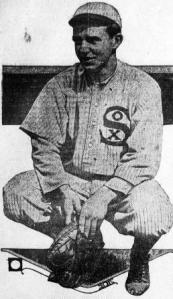
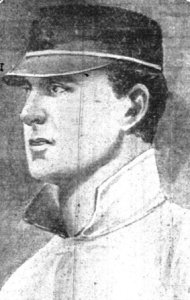
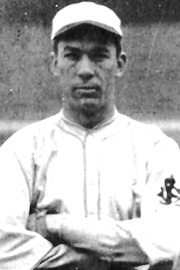
Ossie Vitt

Vitt

The Detroit Free Press disputed The AP’s, and Vitt’s account:

“Mr. Vitt did receive a letter from Mr. Navin, and this letter did pointedly refuse to add anything to the Vitt emoluments for 1913.  So far the story from the golden West is true.  But the reasons given  Oscar for not granting him an increase had nothing whatever to do with Mr. Cobb, nor was the star athlete’s name even mentioned.  Vitt was informed that he is mighty lucky to receive a contract for 1913 with as much money mentioned as the document recently sent him calls for.”

Whether Vitt believed Cobb was responsible for his lack of a raise is unknown, but he did take the opportunity 10 months later to take a swipe at Cobb in the pages of his hometown paper, The San Francisco Call.  Vitt wrote an article for the paper about the best player he had seen:

“I am picking the man who does most to win games for the club he represents.  That man is unquestionably Eddie Collins…Here is one player who is willing to sacrifice all personal gain to help his club.  When he is on the field it is the Athletics he is trying to help, and not Eddie Collins.”


Collins
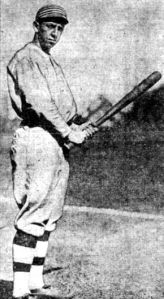
Collins

Vitt said:

“Collins is great whether he is playing the defensive or offensive.

“In few departments of the game is he excelled.  He is a brilliant fielder, who thinks quickly, and he makes but few mistakes.  At the bat he has few superiors.  He has a wonderful eye, and when he hits the ball he meets it fairly, usually sending it away from the plate on a line for a clean drive.  He can lay down a bunt with equal skill, and it is hard to figure him when he faces a pitcher.

“The point that I admire in Collins is the fact that he never plays to the grandstand.  He adopts the play that will help his club and not the one that will win him applause from the spectators… I don’t think there is another player in the game today who wins as many games for his club than this fellow Collins.”

After lavishing praise on Philadelphia’s Collins, Vitt said of his teammate:

“Cobb is a remarkable ballplayer. I have been with him for two seasons, and while I consider him greater than Collins in many respects, I do not think he is as valuable to a club as Collin… His spectacular style of play is popular with the fans, and while the Tigers were rather lowly in the pennant race, they were good drawing cards, because the crowds would go out to see Cobb bat and steal bases.

Cobb

Cobb

“If Cobb would play the game like Collins I think he would be the greatest of them all, but he does not.  Cobb is essentially an individual player.  He is unlike Collins in this respect.  However, the fans like to see Cobb, and they must be pleased.”
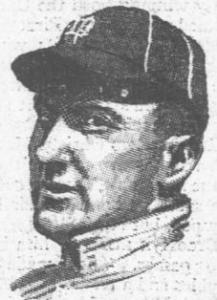
While Vitt equivocated, calling his teammate an “individual player,” while at the same time putting, at least, some of the blame for it on the fans who “must be pleased,” he took his biggest swipe at his teammate in another passage without ever naming him:

“You take a great player like Collins, who is so sincere in his work, and he naturally becomes a prime favorite with the other members of the club, because of his efforts to help them.  He gets them all in that stride, and I attribute (Connie) Mack’s success to that reason.”

Cobb’s only public reply came weeks later in The Detroit News:

“I think Vitt might help the team if he would accumulate a little better individual average and not attack his fellow players.”

Vitt hit .243 over seven seasons in Detroit.  He and Cobb remained teammates through the 1918 season.
“Excited and Nervous Players are Easy to Beat”

22 Feb

Ty Cobb shared his base running philosophy with writer Frank Menke in 1921, as part of a series of “As told to” articles for the King Features Syndicate.  Menke said of Cobb’s revelations:

Frank Menke

Frank Menke

“While it is of the most vital interest to youngsters, it also furnishes splendid reading for the adult fan, for it details the methods which Cobb used to reach baseball greatness”

Cobb’s view of base running seems appropriate for his personality:

“Keep in mind that when you are on bases you are fighting practically alone against nine men.  Every player on the other team is there for the purpose of killing you off before you can advance further.  You are faced by desperate odds, and the only chance you have for success is increasing watchfulness and alertness in taking advantage of every advancement chance that comes to you”

He was also clear about who owned the base paths:

“The baselines belong to the runner.  The baseman has no right to block your way.  According to the rules, you are justified in sliding into any baseman who tried to bar you progress illegitimately.  But don’t play dirty baseball.  Never run into a baseman unless it’s absolutely necessary.”

cobbconlon

Cobb stressed the importance of knowing four things every time he reached base: whether the catcher had a strong arm, the pitcher’s ability to hold a runner, the “trickiness” of the first baseman and how good each infielder was at taking throws and tagging base runners:

“You learn those things by observation.  Utilize every minute on the bench in studying the other players.  Learn what they can do—and what they can’t do—by watching them.  Then, when your time comes to run the bases, you’ll be ‘smarted’ up.”

[…]

“Upon arriving at first, it is usually a splendid thing to bluff a steal immediately.  That will enable you to learn whether the shortstop or the second baseman will cover the bag.  You can use that knowledge to your advantage when you are sliding into the bag… While on the bases, always keep yourself facing the man with the ball.  Maintain a position so that when the ball goes into play, you can advance to the next bag, or dart back to your own, as may be necessary, without an iota of lost motion.

“Worry the opposing infield—and especially the pitcher.  Keep racing back and forth.  Get a tantalizing distance off your bag but never too far so that you can’t get back in safely. Bluff steals. That helps to rattle the pitcher—and that’s what one of your chief aims should be.  Get the other fellows excited, and as nervous as possible.  Remember that excited and nervous players are easy to beat.”

[…]

“Hesitation in base running is fatal.  Once you make up your mind to steal and the signal has been passed to your mates, don’t hesitate.  If you hesitate, all is lost.  For hesitation loses you a second or so and the difference between a putout and a successful steal usually in less than a second of time.”

He also provided sliding tips:

“Practice feet-first sliding…You’ll need to slide practically every time you attempt to steal.  Try short slides first, while running only at a moderate speed.  Then try longer ones.  As you acquire the knack of successful long slides from slow runs, increase your running speed.  As you increase your speed, go back first of all to the short slide and gradually work up to the long slide from a full-speed run.

“When hitting the dirt, aim to land on the side of your leg, with most of the weight and impact upon the fleshiest part of the upper hip.  Keep your legs rigid. Otherwise, they may double over and break.

cobb3


“Protect your arm when sliding.  Keep it clear of the underside of your body.  Otherwise, they may double up under the body and be broken or seriously injured…Never try to slide between a baseman’s legs unless it is absolutely necessary.  He spreads his legs for the main purpose of trapping you as you come in.  Try to hit the bag on one or the other side of him.

“Having reached your base in safety, get up quickly.  Don’t loiter.  Be ready to shoot for the next base.  How do you know—unless you are on your feet and watching—that the baseman hasn’t muffed the ball or that the catcher hasn’t thrown wildly to the outfield?”

In the end, Cobb was making the case for his style of play at the dawn of baseball’s new age:

“Keep your brain at work…Take chances but not foolhardy ones…Keep your eyes open—be alert—always.  Never fail to take advantage of the other fellow’s misplay…They win ballgames.  A run made on an error isn’t as spectacular as a home run.  But it counts as much in the total.”

Ray Schalk on “Baseball Brains”

1 Feb

After the Chicago White Sox defeated the New York Giants in the 1917 World Series, Sox catcher Ray “Cracker” Schalk took to the pages of “Baseball Magazine” with his opinion of statistics:

Ray Schalk

Ray Schalk

“Offhand I would say that fielding averages are pretty bad, pitchers’ averages rather punk, batting averages merely fair.  But the worst of all are catchers’ averages.

“How are you going to tell a good catcher?  By his batting average?  By his fielding average?  By the runs he scores?  Of course all these things are important.  But they haven’t any direct connection with good, bad or indifferent catching as such.  A catcher may or may not be a good batter or base runner.  And whatever his hitting or run getting ability he may be a great or mediocre catcher.”

Schalk said it was “easy…from the records” to determine an outfielder or shortstop’s ability:

“But a man might be the best catcher the world ever saw or the worst, and there would be no way under heaven to gain that information from the season’s statistics.

“First of all, a catcher must have baseball brains.  It isn’t enough to say brains; you must add the adjective ‘baseball’ to describe what you mean.”

Schalk noted that many of his contemporaries were educated:

“I admit this is the day of the college player in baseball.  I admit that the better education a man has, other things being equal, the better ball player he will be.  But he might know a lot of philosophy or Greek literature and be a frost on foul flies.  Ty Cobb has the ideal baseball brains.  But Ty isn’t a college man.  On the other hand I used to play in the minors with a graduate of a well-known university who was a brilliant scholar and a good natural athlete.  But he was positively the limit in playing baseball.  He would do the most incomprehensible things.  In fact, he was impossible.

Hans Wagner and Nap Lajoie are not college men, have not enjoyed as liberal an education, perhaps, as most of the rest of us.  But if any medical laboratory wants a sample of a real baseball brain, let him open negotiations with the Dutchman or the Frenchman for the use of his skull when he is thru with it.

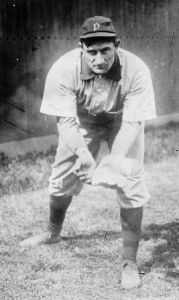
Honus Wagner

Honus Wagner

“I believe there are fellows with a natural born instinct to play baseball.  They invariably do the right thing at the right time.  That is what I mean by baseball brains.  Furthermore, such a brain must above all act quickly.  There are many thousands of people, even in the stands, who understand good baseball and could dope out the proper thing for a fielder or a batter to do under given conditions.  But that isn’t enough.  The man with a baseball brain must not only do the right thing but he must do it instantly.  It is quickness of thought quite as much as correctness which marks the star player.  Hal Chase and Ty Cobb are scintillating examples of quick thought on the diamond.”

And, said Schalk, “quick thought” was most important behind the plate:

“Now the catcher, above all men, must have a good baseball brain.  Most of his work, the most important part of his work, is hidden from the spectators’ eye.  The man in the stands can seldom follow what is going on in the catcher’s brain.  But the catcher, much more than the pitcher, holds the game in the hollow of his hand.  The catcher, much more than the pitcher, is the keystone of the baseball arch.”

The man who thought statistics didn’t have “any direct connection” to a catcher’s value made it into the Hall of Fame in 1955.  He has the lowest career average (.253) among enshrined catchers.

“Soldiers ‘Over There’ Sore on Baseball Players”

25 Jan

In August of 1918 Harry “Moose” McCormick returned to the United States from the front lines in France—he served in the 42nd Infantry, The Rainbow Division, and according to The Washington Herald “has been in the front line trenches for nearly six months.”

Moose McCormick

Moose McCormick

The former outfielder-pinch hitter, who played his final big league game with the New York Giants in 1913, was at the Polo Grounds to watch the Giants sweep a doubleheader from the Boston Braves, and he came to deliver a message; one that had come repeatedly from the general public, but not yet from someone within baseball.

McCormick told reporters that while baseball was hugely popular among the troops in Europe, the major leagues were not.  The Washington Times said, under the headline:

Soldiers ‘Over There’ Sore on Baseball Players

“It may surprise the professional ball players of the United States to know that the American soldiers now fighting in France do not hold them in high esteem; that they do not scramble for news of how the big league races are going, and that they do not care whether (Ty) Cobb, and (Tris) Speaker, and (Frank) Baker are hitting .300 or 3,000.

“The fact that the ball players aren’t hitting in the big, big game across the water is the reason for this feeling.”

The Washington Times said McCormick, then a Lieutenant, “who had just returned from the shell-swept front,” and was in the states “under orders, the nature of which is secret.”

There were various reports as to why McCormick had returned.

The New York Globe said he had come home with “Wound Chevrons on his arm,” having received the badge after being “Mussed up considerably by a German shell.”  The New York Tribune said he had been “Invalided home” suffering from “Shell shock.”  The New York World said he returned with “A hacking cough caused by gas.”

McCormick told reporters:

“The feeling among the boys over there seems generally to be that the ball players haven’t acted on the level.  The soldiers feel that there has been too much evasion, too much hanging back, too much side stepping by the ball players when other men, just as good, have given up paying places and gone into the big game.  That seems to them the ONLY thing for real men just now.

“The boys are generally incensed over the statements they read to the effect that ball players have sought work in munitions plants and shipyards, where they can keep playing ball.  They regard that as ducking, as a sort of dodging of the issue.”

McCormick said, so complete was the disgust with baseball that “Stars and Stripes, the soldiers’ paper, has stopped printing the big league scores and standings.  That, it seems to me, ought to make baseball men, both players and owners, wake up.”

He said the men at the front were still “interested in baseball,” and “like to play ball,” but were having trouble getting enough baseballs:

Baseball game with members of the Twenty-eighth Division, Three Hundred and Second U.S. supply train in France

US Soldiers play in France

Governor (John) Tener sent me two every week, and they were worth their weight in gold.  The soldiers get plenty of chance to play it themselves.  They don’t take any interest in men playing it here anymore.”

McCormick, who would be promoted to the rank of captain by the war’s end, concluded that the consensus at the front was that America’s game had failed the country:

“The talk of the soldiers is that the ball players should have volunteered in a body and made up one big organization and gone into the country’s service to fight right at the start.  That would have been a great thing to do.”

Lost Advertisements–Ty Cobb, Lewis 66 Rye

11 Dec

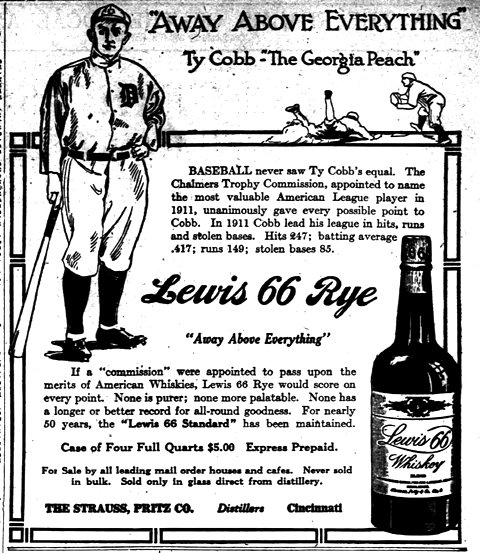
cobblewis66

A 1912 advertisement for Lewis 66 Rye Whiskey from The Strauss, Pritz Company, a Cincinnati-based distiller:

“Away Above Everything”

Ty Cobb–‘The Georgia Peach’

“Baseball never saw Ty Cobb‘s equal.  The Chalmers Trophy Commission, appointed to name the most valuable American League player in 1911, unanimously gave every possible point to Cobb (he received all eight first-place votes–the commission consisted on one sportswriter from each league city).  In 1911, Cobb led his league in hits, runs, and stolen bases.  Hits 247; batting average .417; runs 149, stolen bases 85 [sic 248; .420; 147, 83].”

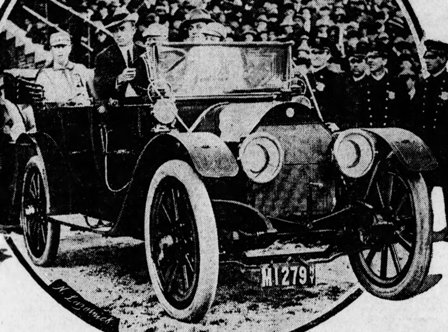
Cobb was presented with a Chalmers “36” at Shibe Park in Philadelphia on October 24, 1911, before game four of the World Series. Jack Ryder, covering the series for The Cincinnati Enquirer said of the presentation:

“President (John T.) Brush of the Giants declined to allow this ceremony at the Polo Grounds, so it was pulled off very quietly here this afternoon…The event took place 10 minutes before the game and was coldly ignored by the Giants though the Athletics took a keen interest in it and several of them had their pictures taken with Cobb. Ty now has three cars, but he says this one is much the best of the lot, and he expects to drive it to his home in Georgia as soon as the series is over.”

Cobb in his Chalmers at Shibe Park

Cobb in his Chalmers at Shibe Park

While Cobb was the unanimous choice of the eight-man commission, the second place finisher in the American League received a more valuable car.

The Chicago Inter Ocean said Chicago White Sox fans, unhappy that pitcher “Big Ed” Walsh finished second to Cobb, “Undertook to raise a fund to purchase an automobile,” for him.

But, said the paper, the fans:

“(F)ound themselves confronted with a dilemma–they had too much money in the fund to buy a duplicate of the Chalmers touring cars presented to Ty Cobb and (National League winner, Chicago Cubs outfielder) Frank Schulte.”

Two days before Cobb received his Chalmers in Philadelphia, Walsh was presented with his car before a charity game at Comiskey Park.

Ed Walsh

Ed Walsh

No Chicago newspaper reported the make and model.  The Daily News called it “A handsome automobile.”  The Inter Ocean said it was “A $4,000 automobile,” and The Tribune said simply that he had received an “(A)utomobile subscribed for by the fandom of the city.”  The Examiner also failed to mention the type of car Walsh received but said the Cubs’ Schulte “gave $25” to the fund.

According to The Tribune, Walsh promised to “‘(L)earn how to run it before spring,’ and the stands cheered loyally.”

Lost Pictures–The Best Eyes in Baseball

4 Dec

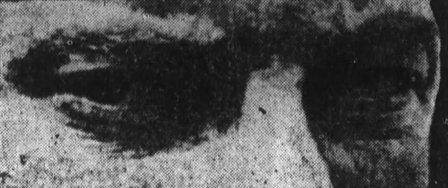
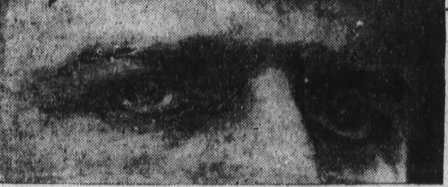
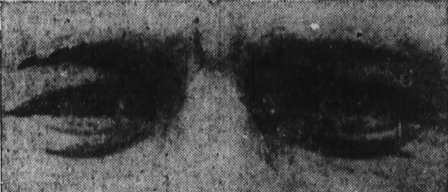
eyeszimmerman

eyesdaubert

eysspeaker

Above, three sets of eyes, 1916.

Harold “Speed” Johnson of The Chicago Herald said:

“It’s the eye and not the wallop that counts in the national Pastime.  Some eyes are more durable than others.  Larry Lajoie possesses such a pair; so does Hans Wagner, Terry Turner, Tris Speaker, Jake Daubert, Frank Schulte, Larry Doyle, Heine Zimmerman, Tyrus Cobb, Joe Jackson and Bill Hinchman.”

Johnson informed his readers that “Most of these birds refrain from reading during the offseason, thereby sparing their eyes.”

As for the three sets pictured above, Jonson said:

“Heine Zimmerman is another notable example of the batter who possesses the keen optics.  He eccentric third sacker of the Chicago Cubs, when at peace with the world, is one the greatest natural sluggers of all time.  His eyes never have troubled him but his temperament frequently has caused him to slump, swinging frantically at any old pitch.  Right now Heinie is seeing in exceptionally good form as witness his average of .336 for 48 combats.”

[…]

“There is nothing wrong with Jake Daubert’s glims as a slant at the latest averages will indicate…His heavy cannonading has been a principal factor in the upward climb of the Robins…For a pair of eyes that have been in use as long as Jake’s in the big set they’re holding out famously.”

[…]

 “Nine seasons of big league milling haven’ dulled the lamps of Tristram Speaker who right now is going better than he did in his banner years with the Boston Red Sox.  Not only is the big Texan rattling fences  at Dunn Field, Cleveland, where for seven years he averaged .381 on visits with the Bostonese, but he is keeping up his terrific pace abroad.”

Zimmerman’s temperament caught up with him again.  He wore out his welcome in Chicago in August of 1916, was traded to the New York Giants and finished the season with a .286 average.

Daubert’s eyes held out.  He hit .316 and led Brooklyn to the National League pennant.

Speaker kept hitting at Dunn Field and everywhere else, finishing the season with a major league-leading .386 average.

“Ty Cobb, You Acted like a Quitter”

30 Nov

During his nearly two months on the West Coast in the fall of 1920, Ty Cobb was almost universally greeted by large, enthusiastic, and adoring crowds.

Cobb

Cobb

The one exception was late in the tour, on Thanksgiving Day, at Sodality Park in San Jose, where he was roundly booed.  The San Jose Evening News said:

“Of  Ty Cobb let it be written in the chronicles of San Jose: He came and saw and acted like a big baby.”

In the fifth inning, Frank Juney, the San Jose pitcher, struck Cobb out.  In the eighth inning, with his All-Stars losing, Cobb, according to The Oakland Tribune “(R)efused to leave the bench” to take his turn at bat.  The paper said:

“At the start of the game, stated local players, Cobb was informed that Juney was an emery ball pitcher and was asked if the ball should be barred.  ‘Anything would be alright’ he stated with a smile.  The first time up he got a two-base hit but in his next effort he fanned and was panned by the crowd.”

During the game, he also drew jeers from the crowd when he misplayed a single into a four-base error in the sixth inning.

Cobb left the ballpark before the game was over.  His All-Stars lost 7 to 2.

The Evening News wasn’t through:

“Your true hero must, after brief sulking, step out and slay hector and drag him around the walls of Troy two or three times. But Cobb didn’t have it in him to do it…(He) stuck out his under lip, was very properly booed by the fans, and then stalked out of the arena with the jeering fans standing up to watch the baby walk out of the nursery.”

[…]

“He saw that our local bushers were in grave danger of beating his team and he wanted to seize a chance to get out from under…The fans were cheated after Cobb did the baby rattle stunt, too.  Instead of making a stand-up fight against our bushers and showing us what live wires could do, the Cobb aggregation put a comedian in the box and let the locals run away with the game. (Nick) Altrock, the comedian, was all right, too.  He at least didn’t act like a sour prune left out to spoil after the historic rain that drenched the crop a couple of years ago.  But the fans wanted to see a little baseball, and they were entitled to it.

Altrock, the Comiedian

Altrock, the Comedian

“Ty Cobb, you acted like a quitter, like a bum sport, like a big baby, or like a commercial-minded calculator who couldn’t stand up and take a licking.  Whichever thing it was, or all four, it’s too bad.  The fans were out to enjoy you and admire you, and they couldn’t help hissing and booing you before you finished your performance.  Try to do better next time, and be at least as full of sand and grit as some little Sunday school teacher who sticks to the job of teaching about loaves and fishes even though she has a splitting headache.

“You see, Ty Cobb, we Americans don’t mind if you commit murder or eat snails or commit little crimes like that; but we simply can’t tolerate a who doesn’t know how to be a good sport.  The fans will still admire you, and will try to forgive you.  But don’t do such a childish thing again.”

Not to be outdone, The San Jose Mercury suggested crookedness on top of cowardice:

“It is whispered that Ty’s manager had requested Juney to lay the ball down the center for the Detroit player in order to make the big fellow look good, but Juney could not see it that way, and was out to win for San Jose and was working all players, Ty Cobb included…(Cobb) is looked upon as the peer of all ball players and is termed the Georgia Peach…down in Georgia they don’t know the difference between peaches and lemons.”

Three days after the San Jose game, Cobb’s tour came to its scheduled end.

Lost Advertisements–Ty Cobb in San Francisco

27 Nov

cobbad

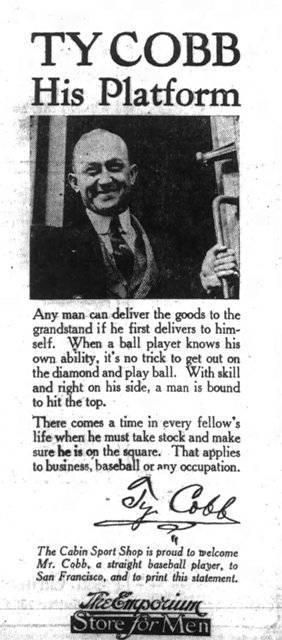
A 1920 advertisement that appeared in The San Francisco Call for The Emporium, a local department store, welcoming Ty Cobb.  He was on a nearly two-month barnstorming tour of the West Coast.

The ad included a quote from Cobb:

“Any man can deliver the goods to the grandstand if he first delivers to himself.  When a ballplayer knows his own ability, it’s no trick to get out on the diamond and play ball.  With skill and right on his side, a man is bound to hit the top.

“There comes a time in every fellow’s life when he must take stock and make sure he is on the square.  That applies to business, baseball or any occupation.”

The ad said Cobb was “A straight ballplayer.”  The integrity of the game and Cobb’s personal integrity were discussed regularly during his tour; he arrived in San Francisco on October 16, six days before a Cook County, Illinois grand jury handed down indictments against eight members of the Chicago White Sox.

In welcoming Cobb to the city, San Francisco Mayor James “Sunny Jim” Rolph said:

“You are welcome, Mr. Cobb because you typify the best in baseball.  This fight to clean baseball started in San Francisco, and I want you to know we in the West are in the fight to the finish.

“There will always be a welcome for you and all clean ballplayers, and for the other kind, no place in America should want them.”

Cobb’s “All-Stars,” a team that included Nick Altrock and Willie Kamm and other major leaguers and well-known Coast players,  drew large crowds and Cobb also appeared in front of school groups and civic organizations.

During a speech to the Press Club of San Francisco, Cobb told the crowd that the former player he had been told was the best ever was in the audience:

“I have always been told that San Francisco is the home of the best ballplayer ever in the game.  I refer to Bill Lange who is here today.”

He remained on the West Coast until November 28.

On his final day in California, a wet afternoon in Oakland,  the 33-year-old Cobb competed against 23-year-old Francis “Lefty” O’Doul in the days “field events.”  The San Francisco Chronicle said:

“O’Doul beat Cobb in the bunt and run contest.  Lefty went around the bases in 14 4/5 seconds while Cobb took 15 seconds to make the trip. The time was fast considering the heavy track.”

Cobb was nearly universally cheered during his West Coast tour.  The one exception, on Monday.

Things I Learned on the Way to Looking Up Other Things #16

21 Oct

Pirates Slump, 1921

The first place Pittsburgh Pirates were preparing for a doubleheader with the New York Giants on August 24, 1921, when the team took time out to pose for a photo.  The Pittsburgh Leader said:

“Someone happened to mention, as the photographer moved away, that for a whole team to watch the little birdie at once was a jinx.”

The team promptly went out and dropped the doubleheader, then lost three more to the Giants.  The paper said of the five straight losses:

“It doesn’t prove the jinx exists.  But it does prove that to imbue a man or a team of men, with the idea that they can’t win a ballgame generally means that they won’t win.  For their pep and enthusiasm has been stolen.”

The Pirates finished second, four games behind the Giants.

Anson’s All-Time Team, 1918

While visiting St. Paul, Minnesota in the summer of 1918, Cap Anson was asked by a reporter for The Associated Press to name his all-time all-star team.  The reporter said the team was most “notable for including in its makeup not one” current player:

"Cap" Anson

                        “Cap” Anson

“According to Captain Anson, at  least four outfielders of old times are better than (Ty) Cobb or (Tris) Speaker and (John) Clarkson, (Amos) Rusie, and (Jim) McCormick, he thinks were better pitchers than (Grover Cleveland)  Alexander  or (Walter) Johnson.  His line-up would be:

Catchers—William “Buck” Ewing and Mike “King” Kelly

Pitchers—Amos Rusie, John Clarkson, and Jim McCormick

First Base—Captain Anson, himself

Second Base—Fred Pfeffer

Third Base—Ned Williamson

Shortstop—Ross Barnes

Outfielders—Bill Lange, George Gore, Jimmy Ryan and Hugh Duffy

Cy Young’s Five Rules, 1907

Forty-year-old Cy Young won 21 games for the Boston Americans in 1907 and his longevity became a popular topic of newspaper copy until he pitched his final major league game four years later.

Cy Young

                                             Cy Young

During that 1907 season he gave a reporter for The Boston Post his advice for young players:

“(T)o the young player who seeks his advice about getting in condition and being able to stay in the game as long as the veteran himself, Cy lays down a few simple rules, which are as follows:

  1.  Live a temperate life
  2. Don’t abuse yourself if you want to attain success
  3. Don’t try to bait the umpires; abusing the arbitrators does a player no good and harms him in the eyes of the umpires, players and public in general
  4. Play the game for all you are worth at all times
  5. Render faithful service to your employers

Regarding his “rule” about umpires, Young said:

“What’s the use in kicking?  The umpire won’t change his decision, and kicking will give him another chance to get back at you for your silly abuse.”

Armando Marsans’ Tall Tale

19 Oct

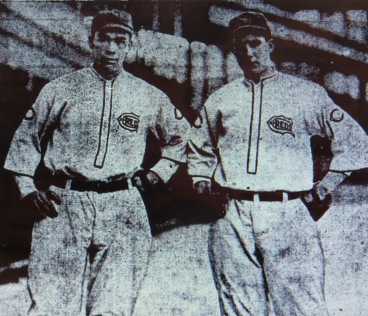
Baseball writers were fascinated by every utterance of the Cincinnati Reds’ two Cuban players, Armando Marsans and Rafael Almeida.  Marsans was the more popular—and more successful—of the two.   He was also the product of well-to-do background.

marsansandalmeida

                           Marsans and Almeida

William A. Phelon of The Cincinnati Times-Star illustrated the cultural difference between the Reds’ two Cuban players:

“(S)omeone asked Almeida and Marsans if they wouldn’t like tickets to a grand opera.  ‘Si, si, accented Marsans, delightedly.  I love grand opera—eet ees fines’ of all entertainment for a gentleman.’

‘I thank you much,” negatived Almeida, “but I care not to go.  To me, grand opera eet sound like de screech of de beeg tomcat, and about so much sensible.’”

Perhaps made up on his own, perhaps captivated by the erudite Marsans, perhaps in on the joke—it wasn’t always clear when Phelon was in on the joke—he quoted Marsans spinning a tale of a Cuban legend in his column in 1912:

“I have seen all the great ballplayers of the present time.  I have been in post-season series against (Napoleon) Lajoie and (Joe) Jackson and have made trips just to see Ty Cobb.  They are wonderful ballplayers, but I give you my word that the greatest I ever looked upon was an Indian named Canella, and popularly called Cinnamon.

“Canella was of a strange Indian race that is supposed to be extinct—the Sibboneys [sic Ciboney] of Cuba, who populated the island when the Spaniards came.  The historians and scientific books all say that they are extinct, and it would doubtless be so, if it were not for the fact that they still live in eastern Cuba and have a little city of their own.  They are tall men with ancient Greek faces—nothing but the color of the Indian to make resemble such men and (John “Chief”) Meyers and (Charles “Chief”) Bender—and they are an athletic people, more agile and active by far than we.  Baseball is their own pet diversion, and Canella, known as Cinnamon, was the greatest of them all.

“Canella, who cannot be over 27 even now, came out a few years ago, and at once became the marvel of eastern Cuba.  He was a pitcher, and a star on the slab, but he was also a batsman, lightening base runner, and clever outfielder.  The records of six years ago show Canella, in some 60 games hit .446 and stole 55 bases.  Havana’s best clubs went up against him and found him invincible while he turned the tide of the closest games with his own batting.

“Canella received no offers from the big American leagues, They took it for granted he was a light colored negro, and when his friends explained that he was an Indian the Americans laughed and said ‘There are no Indians in Cuba—the Spaniards killed them all 400 years ago.’

Armando Marsans

Armando Marsans

“So Canella kept right on playing in Cuba, and he seemed to improve each succeeding season.  At least he became so terrible that even the Havana and Almendares clubs sought excuses to avoid meeting him, and the weaker clubs would face him and get shut out every time.  Finally, some influential Cubans managed to make an American magnate understand that Canella was no Negro, and all was arranged for his tryout in the coming spring.  And then came the news that Canella’s arm was gone, and he could never pitch again.

“It seems that the Indians of Sibboney [sic] still practice the games of their forefathers, and of their favorite sports which is throwing the javelin,  Coming home for a visit, Canella saw the young men of the tribe practicing the spear throw.  Laughingly, he said ‘It is many years since I have done thix—let me try.’ And picking up a slender spear, he hurled it with all his might—and something went snap, crack, in his upper arm as he let go of the javelin.  The arm, so long accustomed to throwing the baseball, gave way when he tried to throw the spear, and never since has Canella been able to throw a ball from the pitching slab as far as the catcher.  It was a shame because Cinnamon Canella was the greatest pitcher, the finest batter, and the fastest base runner that I have ever gazed upon.”