Tag Archives: World Series

“Evans, who, at the Least, is Incompetent”

2 Dec

William George “Billy” Evans was nicknamed “The Boy Umpire” when he was hired by the American League at the age of 22.  After 21 seasons  he became a front office executive, working for the Cleveland Indians, Boston Red Sox and Detroit Tigers; he was also president of the Southern Association, authored two baseball books and in 1973, 17 years after his death, was elected to the Baseball Hall of Fame.

Billy Evans

Billy Evans

But during his first season as an umpire, 1906, he was not held in high esteem in Chicago.

On September 10 the White Sox were in second place, a game behind the New York Highlanders.  The Sox trailed the Tigers 2 to 1 in the 9th inning.  Chicago shortstop George Davis laid down a bunt and was called out at first by Evans.  Every Chicago paper said Evans beat the throw by “at least a step.”

The call precipitated a near riot.  The Chicago Tribune said:

“Instantly a shower of bottles from the first base bleachers drove the umpire, coacher, and players away from the vicinity of the base.”

After the next two batters were retired:

“Evans walked off the field amid another volley of bottle from the third base stand.”

The Tribune and The Chicago Inter Ocean said Evans and fellow umpire Tommy Connolly were mobbed by fans as they attempted to leave the ballpark with a police escort.  Both papers said “one or two blows” from fans connected with the umpire during his retreat.

The Inter Ocean said, “Evans has been the most heartily reviled arbiter that ever worked in any league.”

The Tribune said two weeks earlier Evans cost the Sox a game in Philadelphia.  After Chicago scored two runs in the top of the sixth inning to take a 5 to 4 lead, Evans “let the Athletics take advantage of his inexperience,” and stopped the game on account of rain with two men out in the bottom of the inning.  The Inter Ocean said, “(Sox Manager Fielder) Jones and (second baseman Frank) Isbell nearly came to blows with the umpire and members of the Athletic team.”

After a half hour, the game was called and the score reverted back to the end of the 5th inning, giving Philadelphia a 4 to 3 victory.

The next day, September 11, the Sox played the St. Louis Browns at South Side Park.  Evans worked the game along with Jack Sheridan.  The newspapers said Sox owner Charles Comiskey had discontinued the sale of “bottled goods” at the park that day.

The Browns won 7 to 3, and the Chicago press put much of the blame for the loss on the rookie umpire.

The Tribune said:

President (Ban) Johnson’s persistence in sending Evans, who, at the least, is incompetent, is giving baseball a black eye in Chicago.  Half the crowd believes the charges that Evans is working under instructions from Johnson to beat Chicago.  These charges undoubtedly are founded on mere prejudice, yet, had Evans been under instructions and trying to beat Chicago, he could not have done better than he did yesterday.”

The Inter Ocean said the Browns “were aided and abetted by Umpire Evans, the boy wonder…Why Ban Johnson insists upon sending the joke to officiate at important games is more than any sane man can see.”

But the Evans’ most ardent critic was William A. Phelon, sports editor of The Chicago Journal:

“Umpire Evans is the worst that ever yet came down this or any other pike in the history of the modern universe…And Ban says he is the best in the game.  We are not selfish and we are willing to let some other city endure him.  We can get over the shock of his removal.  If he doesn’t move he may have a statue down on the lake front, a statue 200 feet high made of bottles.  Give us liberty, give us death, give us any old thing, but, by the snakes of old Ireland, give us an umpire!”

Phelon also said Evans “seems to be a gentlemanly individual, whose place in life is evidently a long ways from the profession of umpiring.”
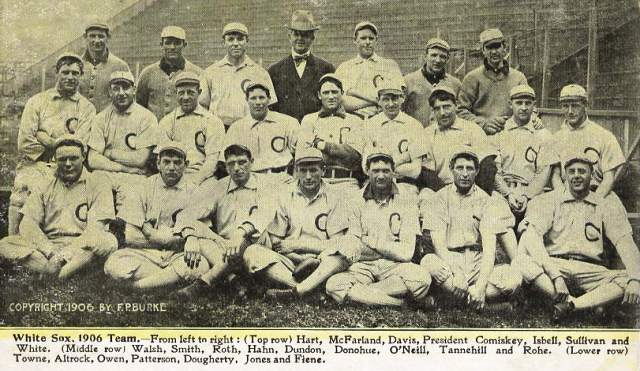
1906 White Sox

Despite the blame heaped on the young umpire in the press, the White Sox went 17-7 the rest of the season and won the pennant by three games.  They went on to beat the Chicago Cubs 4 games to 2 in the World Series.

Things got better for Evans as well.  He worked his first World Series in 1909—the youngest umpire to do so– and participated in five more from 1912 to 1923.  He was the third umpire to be elected to the Hall of Fame; Connolly and Bill Klem were the first two.
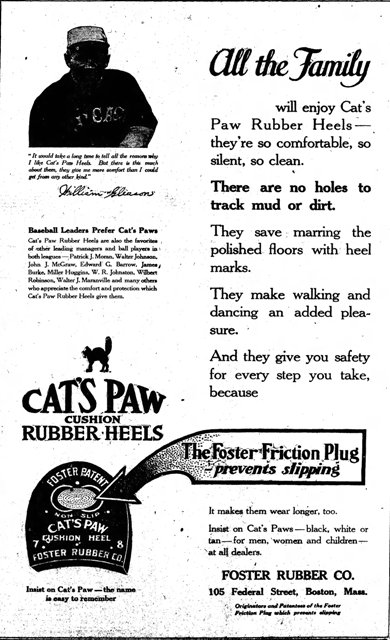
Lost Advertisements–“Kid” Gleason for Cat’s Paw Rubber Heels

22 Nov

cat'spawA 1920 advertisement featuring William “Kid” Gleason, manager of the defending American League Champion Chicago White Sox–the ad appeared in July, two months before the first grand jury was convened to investigate the 1919 World Series.

“It would take a long time to tell all the reasons why I like the Cat’s Paw Heels.  But there is this much about them, they give me more comfort than I could get from any other brand.”  William Gleason

Baseball Leaders Prefer Cat’s Paws

Cat’s Paw Rubber Heels are also the favorites of other leading managers and ball players in both leagues–Patrick J. Moran, Walter Johnson, John J. McGraw, Edward G. Barrow, James Burke, Miller Huggins, W.R. Johnston, Wilbert Robinson, Walter J. Maranville and many others who appreciate the comfort and protection which Cat’s Paw Rubber Heels give them.

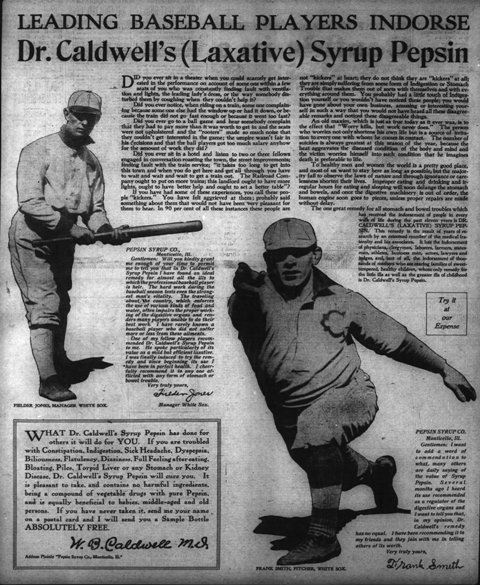
Lost Advertisements–Leading Baseball Players Indorse

27 Sep

caldwell's


A 1904 advertisement for Dr. Caldwell’s Laxative Syrup Pepsin Company in Monticello, Illinois featuring Fielder Jones and Frank Smith.

Fielder Jones:

“I have found an ideal remedy for almost all of the ills to which the professional baseball player is heir.  The hard work during the baseball season tests even the strongest man’s vitality.”

Frank Smith:

“Dr. Caldwell’s remedy has no equal.”

In 1904 Jones replaced James “Nixey” Callahan as manager of the Chicago White Sox after 42 games.  He led the team to a third place finish.  The White Sox finished second in 1905 and his “Hitless Wonders” won the 1906 American League pennant and defeated the heavily favored Chicago Cubs 4 games to 2 in the World Series.

Frank “Piano Mover” Smith won 104 games for the White Sox between 1904 and 1910, including two 20-win seasons.

Dr. Caldwell’s Pepsin Syrup Company remained in business until 1985.


“Pitchers Should be Taught how to Sleep”

24 Sep

Edward Tilden Siever had a theory about one of the greatest dangers facing pitchers:  how they sleep.

Edward Siever

Edward Siever

The Kansas native did not begin playing professionally until he was 24-years-old in 1899, and was 18-14 as a rookie with the Detroit Tigers two years later.  He injured his arm that season, had a sub .500 record the next three seasons with the Tigers and St. Louis Browns, and went to the American Association with the Minneapolis Millers in 1905. 

Siever’s arm recovered sufficiently to post a 23-11 record with the Millers and was purchased by the Tigers the following spring; he was 14-11 in 1906.

He was having the best season of his career in 1907; finishing with an 18-11 record and a 2.16 ERA for the American League Champion Tigers.  It was during that season that he told The Detroit Times about his theory:

“Pitchers should be taught how to sleep.  Don’t laugh, I mean that More than one good pitcher has lost his arm because he did not know how to sleep correctly.”

Siever claimed that fellow Kansan, St. Louis Cardinal pitcher Charlie “Dusty” Rhodes, missed much of 1906 with a bad arm brought on by the manner in which he slept:

“(Rhodes) used to rest his head on it when he was sleeping.  It deadened the muscles…No ballplayer should ever rest his head on his arms when he is sleeping.  It’s more dangerous than the average young man imagines.  Many a ball player loses his whip and doesn’t know how to account for it.  I’ll bet that’s the real reason in many a case.”

Charlie "Dusty" Rhodes

Charlie “Dusty” Rhodes

The Chicago Cubs defeated Siever in his only World Series appearance in 1907, and after a 2-6 start in 1908 he was sold to the Indianapolis Indians in the American Association; he pitched three more seasons in the minor leagues. 

He remained a popular figure in Detroit and worked for the city’s public works department until he died of a heart attack in 1920.

Lost Advertisements–His Big Bat Brings the Bingles

20 Sep

dannymurphyad

A 1910 ad for Kellogg’s Toasted Corn Flakes featuring Philadelphia Athletics outfielder Danny Murphy.

“Speaking of bingles, here’s one of the longest hitting swatters in the game.”

Kellogg’s boxes featured a “new baseball game found printed on every package:”

“For Danny has tried it, and fell down–and this is what he said: ‘The only thing I miss in the home runs.’  But he still sticks at it, for it’s the wildest, newest, biggest fun creator of the age.”

Murphy hit .400 and drove in nine runs during the Athletics four games to one victory over the Chicago Cubs in the 1910 World Series.


Lost Advertisements–Athletics/Cubs 1910 World Series

13 Sep

1910ws2

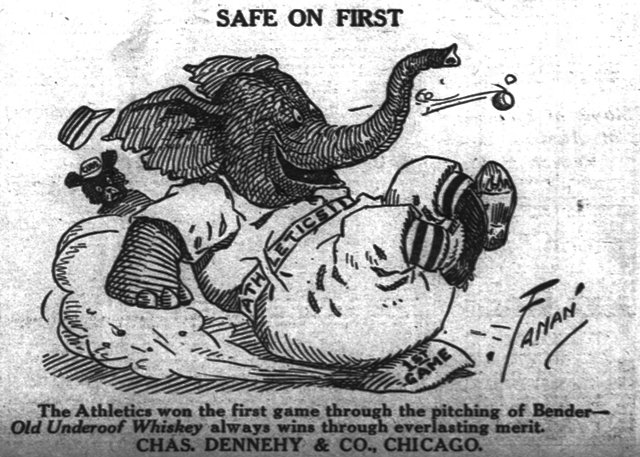
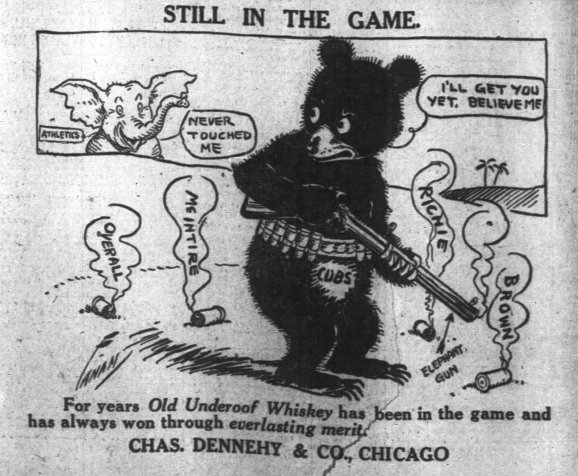
Three advertisements for Old Underoof Whiskey that appeared in Chicago during the 1910 World Series between the Cubs and the Philadelphia Athletics.  The first “Safe On First,”  above, appeared after Charles “Chief” Bender beat the Cubs 4 to 1, giving up only three hits in game one.  The second “Still In The Game,” below, appeared before game three.  The bear is holding as “elephant gun” with four spent shells on the ground–(Orval) Overall, (Harry) McIntire, (Lew) Richie, and (Mordecai) Brown–the four pitchers who gave up 13 runs to the Athletics and the first two games.


The final one, bottom, “No They are Not Dead” appeared before game four.  The Cubs, down 3 games to 0 beat the Athletics 4 to 3 in 10 innings, Brown relieved Leonard “King” Cole in the ninth and got the decision over Bender.  The following day Jack Coombs beat the Cubs and Brown 7 to 2 to take the series four games to one.


1910ws3


1910wscubs

Lost Advertisements–Connie Mack Day in Cleveland

6 Sep

???????????????????????????????

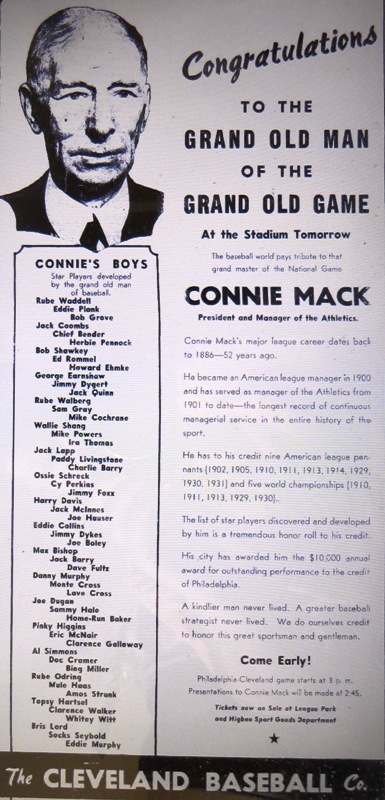
A 1938 Advertisement printed in Cleveland newspapers for Connie Mack Day.

The Philadelphia Athletics manager was honored on June 19 in front of 20,000 fans at Cleveland Stadium.  The ad listed every “star player developed by the grand old man of baseball.”

The baseball world pays tribute to that grand master of the National Game

Connie Mack

President and Manager of the Athletics

Connie Mack’s major league career dates back to 1886–52 years ago.

He became an American League manager in 1900 and had served as manager of the Athletics from 1901 to date–the longest record of continuous managerial service in the entire history of the sport.

He has to his credit nine American League pennants (1902, 1905, 1910, 1911, 1913, 1914, 1929, 1930, 1931) and five world championships (1910, 1911, 1913, 1929, 1930).

The list of star players discovered and developed by him is a tremendous honor roll to his credit.

His city has awarded him the $10,000 annual award for outstanding performance to the credit of Philadelphia.

A kindlier man never lived.  A greater baseball strategist never lived.  We do ourselves credit to honor this great sportsman and gentleman.

The Cleveland Plain Dealer said Mack was presented with “a handsomely bound leather book in which were the signatures of every person in organized baseball from Judge Kenesaw Mountain Landis down to the greenest rookie in the West Texas-New Mexico League.”  Cleveland’s baseball writers also presented Mack with an engraved gold pencil.

The Plain Dealer and The Cleveland News both noted that when Mack addressed the crowd he added an “n” to Indians president Alva Bradley’s first name; The Plain Dealer said:

“Mr. Mack always had a tough time with names of his friends and players.  For years he has called ‘Lefty’ Grove ‘Groves’ and Lou Gehrig “Garridge.’ In fact he never has attempted to call his second baseman, (Dario) Lodigiani, anything but ‘Lodi’ for this season.”

The league-leading Indians beat Mack’s Athletics 5 to 4.

“And they Started Hitting like Demons”

4 Sep

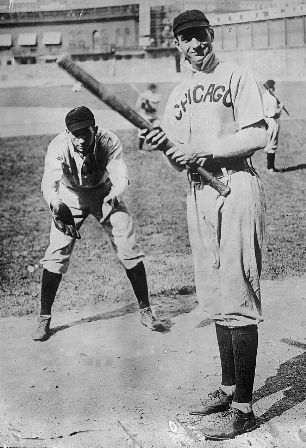
Arthur “Artie” “Circus Solly” Hofman was one of the best utility men in baseball, and a member of four Chicago Cubs teams that went to the World Series.  When he was traded to the Pittsburgh Pirates in May of 1912, Bill Bailey of The Chicago American told a story about Hofman, baseball bats and why baseball players are superstitious about them:

“Some fans might think that Artie can hit with most any old stick that comes along, but he himself is very exacting about the one he picks out before he goes up to the plate.  There is always a great line of bats laying out in front of the players bench during a game.  Most of them are special makes of the big sporting goods companies and most of them are expensive products.”

Bailey said during the 1911 season the Cubs were mired in a mid-season hitting slump:

“And Hofman conceived an idea.  He was wandering through a department store in town when he saw a couple of bats on display.  They weren’t anything like the kind the Cubs had been using. “

Circus Solly Hofman

Circus Solly Hofman

Told the bats cost twenty-five cents each Hofman bought dozens of the bats and had them delivered to the West Side Grounds:

“Hofman took one himself and distributed the rest among his teammates…Every man in the lineup used one of Hofman’s bats that afternoon.  And they started hitting like demons.  Naturally they continued using the cheap bats. And they went on a batting rampage that lasted for a long time.  Everybody was slugging the ball.  When things like that happen, is it any wonder that the players have their superstitions about bats?”

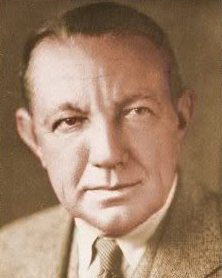
“Bill Bailey” was the pen name of Bill Veeck Sr., who would become vice-president of the Cubs in 1917, and president of the club in 1919.  He, of course, was also the father of Cleveland Indians, St. Louis Browns and Chicago White Sox owner Bill Veeck.

Bill Veeck Sr./"Bill Bailey"

Bill Veeck Sr./”Bill Bailey”

Hofman’s greatest claim to fame was being the Cubs centerfielder on September 23, 1908.  He fielded Al Bridwell’s single that scored Harry “Moose” McCormick, seemingly giving the New York Giants a 2 to 1 victory.  It was  Hofman, according to umpire Hank O’Day, who realized that Fred Merkle of the Giants, who had been on first base,  failed to touch second before leaving the field.  “Merkle’s Boner” remains baseball’s most famous base running blunder.

“We are beginning to have a Very Active Doubt as to the Value of Professional Baseball in American Life”

29 Aug

Coming on the heels of the fallout from the Black Sox scandal, The Chicago Tribune announced a change in editorial policy three weeks after “Shoeless” Joe Jackson, Eddie Cicotte, Oscar “Happy” Felsch., Claude “Lefty” Williams, Arnold “Chick” Gandil, George “Buck” Weaver, Fred McMullin, and Charles “Swede” Risberg were acquitted of conspiring to fix the 1919 World Series.

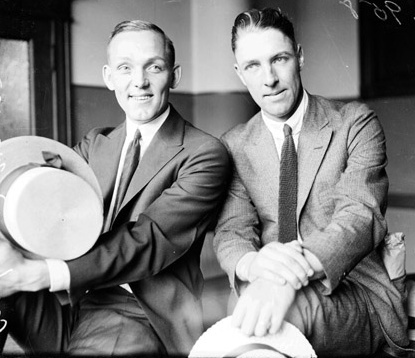
Buck Weaver and Swede Risberg during the trial

Buck Weaver and Swede Risberg during the trial

The paper said:

The Tribune has begun to use the compressor on professional baseball stories. The baseball reporters write them well, but we are getting a little tired of the subject. We are beginning to have a very active doubt as to the value of professional baseball in American life.”

The paper said baseball received a “black eye which jury verdicts did not whiten.”

The Tribune said they would place a greater emphasis on coverage of amateur sports which “produce sound citizenry.”  Professional baseball was also making Americans soft:

“The majority of spectators get only eye and mouth exercise.  We have conceded that the professional game stimulated the youngsters and that they played with more earnestness on the lots because they admired Babe Ruth.  We still admit that professional baseball is a stimulus to boys, but journalism has overfed it with space.  The Tribune is down to about a half column now for games in which the home teams play, which is justified parochialism, and to a bare statement of vital statistics regarding the other clubs.  That is enough.”

Other newspapers applauded the policy; surprisingly most didn’t cite corruption in baseball as the reason, but the rather, as The Baltimore Sun said because professional sports only provide “vicarious exercise.”  The Louisville Courier-Journal said watching baseball was even a threat to manhood:

“Two hours of inactivity in the grand stand or bleachers is not productive of muscle or sinew.  The same amount of time spent in tennis, golf, swimming or any number of games would be infinitely better for American manhood.”

Others found the new policy foolish.  The Portland Oregonian said:

The Chicago Tribune, which is regarded by its management, and doubtless by many of its readers, as the world’s greatest newspaper, has decided to blue-pencil professional baseball…The theory on which the sport page is built is that the public is entitled to what it wants…Telling the readers of sports that they should want something else, and will be given that something, is a decided innovation.”

The Duluth News-Tribune said facetiously:

“The fact that both teams (the Cubs and White Sox) are near tail-enders may not have anything to do with it.”

Then there was The Idaho Statesman which said The Tribune’s policy was a “meritorious undertaking,” but didn’t go far enough:

“There are a world of other professional sports not half as white as the Black Sox, that might come under the publicity axe with resulting good to the public…Horseracing is professional and it has produced a fine crop of crooks—more than baseball in its blackest days could possibly yield.  Our own so-called wild west sports have been placed in the professional class and everybody knows they are largely fake.  Wrestling hasn’t the whitest record in the world and prize fighting is anything but a Sunday school game.  Nobody ever got very much exercise out of any of these sports, except the participants and we are not sure that our citizenship is any sounder for having witnessed them.  The Tribune isn’t through with its job as we view the situation.”

The most prescient response was from The Montgomery (AL) Advertiser:

“We expect to see The Tribune gradually slipping back to its old ways.”

Ten days after the original policy was announced The Tribune declared victory, and revealed their real motive:

“An encouraging sign is the changing attitude of the press toward highly commercialized sport. The papers are coming to the conclusion they have been giving away millions of dollars’ worth of advertising to boost box office receipts for promoters who have no special regard for the public.”

But within weeks the “The World’s Greatest Newspaper” had, as The Advertiser predicted, begun “slipping back” to the way baseball had previously been covered.  By the beginning of the 1922 season, notwithstanding the lingering effects of the game’s greatest scandal, or no indication that Americans were getting any more exercise, baseball stories in The Tribune looked no different than stories that appeared before August of 1921.

“Good day—Double Crosser”

30 Jul

Hap Myers’ abrupt exit from the Boston Braves was never fully explained; the Boston press said he simply didn’t get along with manager George Stallings, Myers said it was because of his activities as one of the leaders of baseball’s most recent labor movement.

"Hap" Myers

“Hap” Myers

Two articles from The Associated Press about George Stallings that appeared after the braves won the World Series might have shed some light on the relationship between the two—one mentioned an incident that took place during a game, and the other had to do with Stallings’ well-known and strange superstitions.

The first article was about “a game played in Boston in the summer of 1913,” (box scores indicate it was most likely, the second game of a double-header with the Cincinnati Reds on July 22).

“Two men were out and the Braves had a man on first and another on second…A long hit would either tie the score or win the game.  ‘Hap’ let the first one pass—and bunted the second.  He was thrown out by at least 10 feet and the game was over.  The Braves had lost.

“’Hap’ in terror over a possible rebuke…escaped into the clubhouse.  Stallings was there, enshrouded in deepest gloom.  Baseball never knew a harder loser that Stallings.  But Stallings never said a word to Myers then, and Myers ducked out.

“The next morning found Stallings at Myers’ home.  Myers had just gotten up.”

When Myers answered the door, Stallings asked him why he had bunted with two on and two out.  Myers told his manager that he thought he’s “double-cross the other fellows…catch ‘em asleep.”

Stalling blew up at the first baseman:

“Well, let me tell you this Myers, if you ever again try any of that ‘double-crossing’ stuff there’ll be a funeral in this particular neighborhood.  Good day—double crosser.”

The second article said that during a losing streak in June of 1913 the superstitious Stallings blamed the “jinx” on a colorful necktie Myers wore—the only tie the first baseman owned.  According to the article, Stallings told his equally superstitious owner James Gaffney:

“That necktie of his—that horrible looking sight, that drapes down from his collar.  No wonder we can’t win.  No wonder we are jinxed.  That necktie would hoodoo anybody.”

The story said Stallings stole the tie from Myers, and after the Braves won the following day told Gaffney:

 “Told you so, didn’t I?”

The Boston Globe told a slightly different version of the story in 1931 in an article about Stallings.

By the time these stories were published, Myers was in his second season with the Brooklyn Tip-Tops in the Federal League.  He hit a disappointing .220 in 1914, but stole 43 bases.  In 1915 he hit .287 and was suspended for several days in June after he and Chicago Whales player-manager Joe Tinker “exchanged blows.”

"Hap" Myers Brooklyn Tip-Tops

“Hap” Myers Brooklyn Tip-Tops

When the Federal League folded Myers returned home to California and signed a contract with the San Francisco Seals, who already had veteran William “Chick” Autry at first.  When Myers arrived in San Francisco, The San Jose Mercury News said:

“The fight for the job will be a battle which will be watched with more than passing interest by San Jose fans, for most of them remember Myers as an elongated youngster who wielded a ferocious bat when he first broke into professional ball in this city.”

Myers hurt his arm and the battle never took place; he only appeared in three games, and was hitless in two at bats.  He would never play organized baseball again.

Where Myers spent the remainder of the 1916 season is unknown; The Mercury-News said he went to Ray, Arizona to join the Tri-Copper League, but no reference to Myers can be found in league statistics—whether he played in Arizona or not, he did spend time in the Southwest that year.

In November of 1916 Myers and two other men were arrested in Los Angeles on a warrant from El Paso, Texas.  The Associated Press said Myers was “wanted by the El Paso Police on a charge of highway robbery…one resident (was robbed of) a $1500 diamond ring and $48 in cash, and another resident, a diamond ring valued at $325,”

In January of 1917, when the trial took place, highway robbery was punishable by death in Texas.

On January 23 Myers and his co-defendants were acquitted.

Myers, now a free man, remained in the Southwest and went to work as a metallurgist with a copper mining company in Grant County, New Mexico.

In 1918 the 31-year-old Myers enlisted in the military; joining Company B of the Field Signal Battalion at Camp Lewis, Washington.   He played baseball at Camp Lewis and in France with the United States Army—among Myers teammates were professional players Ten Million, “Coaster Joe” Connolly, Howard Mundorff and Charlie Schmutz.

After returning from France Myers worked as an insurance adjuster in Seattle and later in automobile financing back in his hometown of San Francisco.

“The elongated first baseman” died in San Francisco in 1967 at age 80.