Archive | February, 2013

Veeck and Paige–a third time?

27 Feb

In 1959, when Bill Veeck purchased the White Sox rumors swirled in Chicago that the Sox owner was planning on having Satchel Paige start on Opening Day. Later, as the Sox were making a run for their first American League Pennant in 40 years the rumors resurfaced that the ageless Paige would join the White Sox for the Pennant run.

???????????????????????????????

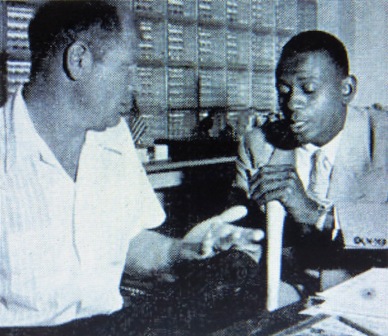
Bill Veeck and Satchel Paige, 1959

Paige, who had played for Veeck with the Cleveland Indians and St. Louis Browns, had spent 1956-59 with the Miami Marlins in the International League, winning 31 games. He had returned to barnstorming with the Cuban Giants and Indianapolis Clowns in 1959, but it was reported he was looking for another chance in the Major Leagues, and in June it began to be reported again that Paige would be joining the Sox.

A United Press International story in July said that Veeck had “sent Paige two new Chicago White Sox uniforms,” and quoted Paige:

 “If they want me they’d have to pay me big money.  I’m not going back for nothing.”

Whether it was ever a serious discussion, or simply two famous showmen milking rumors for the maximum publicity will never be known, but Veeck and Paige let the rumors swirl well into August before Veeck finally put them to rest, telling Jet Magazine:

“We’re not giving any thought to hiring him.  I’m very fond of LeRoy and I see him whenever he’s in town.  I gave him the uniforms because we’re old friend and for no other reason.”

And with that White Sox fans missed the chance to see the pitcher who Veeck called “The best righthander baseball has ever known,” pitch for the 1959 Pennant winners.

Lost Advertisements–A Message to Every Ballplayer from Babe Ruth

26 Feb

???????????????????????????????


“You’ve got to hand it to this Reach crowd.  When I told them what I figured was needed in major league mitts and gloves–I knew they’d do a good job of making them.  But I didn’t know how good till I saw the gloves they turned out.

“I stuck my hand in the different models. And they are great.  Big and roomy, like you need, yet fitting just right.  I bent and twisted my hand and fingers, and these gloves moved as natural and easy as an old shoe.  When a new glove does that–you can take it from me, it’s a real glove.

“And how these gloves snare the ball.  A specially formed pocket does the trick, Reach tells me.  Whatever it is, any ball that smacks into one of these gloves sure does stick.

“I’m ready to recommend them to any fellow who plays ball–in the field, on the bases, or back of the bat.  They got a pretty low price on them, too, for major league glove.”

Babe Ruth


Monte Irvin Turns 94 Today

25 Feb

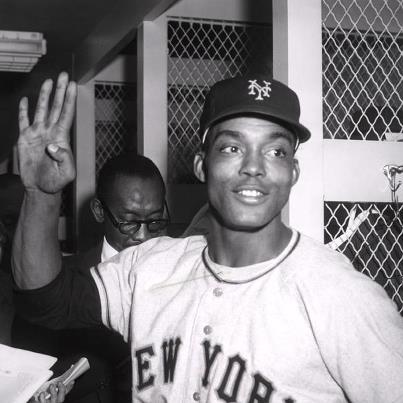
Montford Merrill “Monte” Irvin was born on this date in 1919.

monte

“If a person has good intentions in his heart and wants to do the right thing, then there are certain ways that any obstacle can be overcome. I was very fortunate to have the kind of parents that I had, who believed in doing the right thing, and always tried to be honest, trustworthy, and forthright.”–Monte Irvin, from “Nice Guys Finish First–The Autobiography of Monte Irvin (with James A. Riley)

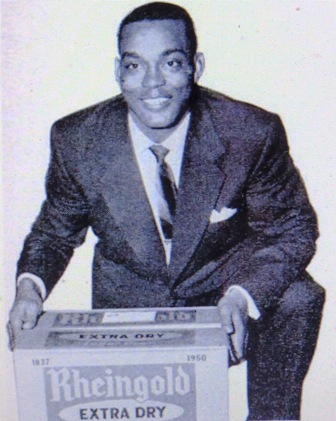
Irvin worked as a salesman for Rheingold Beer during the off season.

Irvin worked as a salesman for Rheingold Beer during the off season.

Lost Advertisements–Wear the “big league” supporter–Used and Endorsed by the New York Yankees

22 Feb

???????????????????????????????

“Bill Abstein Denies he is a Bonehead”

20 Feb

Pittsburgh Pirate owner Barney Dreyfuss and manager Fred Clarke felt all they needed to win a World Series was a first baseman.  Since winning the National League Pennant with Kitty Bransfield in 1903, only one Pirate first baseman hit better than .260 (Del Howard .292 in 1905).

In 1908 the Pirates finished second with four different first basemen, Harry Swacina, Alan Storke, Jim Kane and Warren Gill; none played more than 50 games, none hit better than .258 and they combined for 29 errors.

The man who took over in 1909, and was with the Pirates for their World Series victory, might have preferred to have never been given the job.

Bill Abstein had played eight games at second base and in the outfield for the Pirates in 1906, before returning to minors.

-Abstein had put up respectable, but by no means spectacular, numbers with the Shreveport Pirates in the Southern Association and Providence Grays in the Eastern League from 1906 to 1908—but as early as August of 1908 The Pittsburgh Press said he was the answer to the Pirates problem at first base:

“Fred Clarke is very eager to secure Bill Abstein from Providence.  Bill is rated the best first baseman in the Eastern League, and he would no doubt strengthen the Pirates where they are weak.”

When Abstein joined the Pirates before the 1909 season The Press said:

“The acquisition of bill Abstein has rounded our infield nicely.  He’s the best first baseman we have had in years and he certainly fits in nicely.”
???????????????????????????????

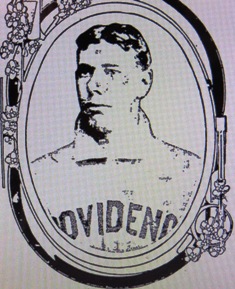
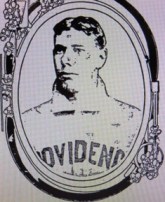
Abstein, Providence 1908

In a letter sent to Dreyfuss with his contract, Abstein told the Pirate owner:

“Fred Clarke will not have to worry about a first baseman after he sees this big German hustling around the bag.”

In keeping with his career performance, Abstein had a respectable season for the pirates.  He hit .260 and drove in 70 runs.  His 27 errors were only a slight improvement over 1908’s first baseman by committee.

The Pirates won 110 games and won the National League Pennant by six and half games over the Chicago Cubs and met the Detroit Tigers in the World Series.  The series would be the beginning of the end of Abstein’s Major League career.
09pirates

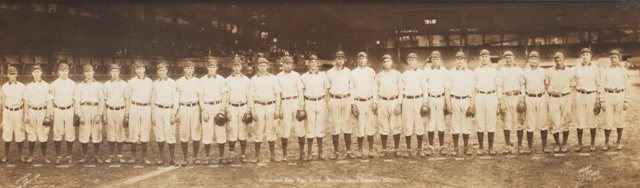
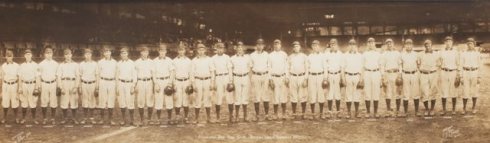
1909 World Champion Pittsburgh Pirates, Abstein 11th from left.

Abstein struggled at the plate (6 for 29 with nine strikeouts) and in the field (5 errors total, 2 each in games 3 and 4).  The Pirates won the series in seven games, but despite the victory, Abstein quickly became the subject of ridicule in Pittsburgh.

An Associated Press article after the series said:

“During the games with Detroit Abstein appeared to forget all that he knew about base ball.  He ran the bases foolishly, made a number of costly errors, failed to hit and disobeyed orders.  In fact, his playing was worse than that of any other man on either team.  The other Pirates, seeing that Abstein was the ‘goat’ for the combination, kept up the cry against him…Before the series was ended many of the Pirates shunned Abstein and it was reported he would be traded.”

The Pittsburgh Press was less generous:

“Bill Abstein denies he is a bonehead and says baseball is largely a case of ‘if-you-can-get-away-with-it,’ well it’s a cinch that Bill couldn’t in the National League.”

The Pirates were unable to trade Abstein and finally put him on waivers.  He was claimed by his hometown St. Louis Browns.

Even though the Pirates had actually won the Worlds Series and even though Abstein was gone, that didn’t mean the Pirates, and The Pittsburgh Press, wouldn’t continue to pile on.

Barney Dreyfuss told The Associated Press shortly after Abstein was claimed by St. Louis:

“We have discarded the weakest offensive player we had—Abstein—and hope to improve the team by doing so.”

Dreyfuss also claimed:

“Fred (Clarke) told me as early as last June that we should get someone else for Abstein’s place in 1910, as Bill mixed up the team’s plays too frequently.”

The Pittsburgh Leader said:

“(Abstein) had deplorable batting weaknesses which the opposing pitchers were certain to fathom in time.”

The Pittsburgh Press was even less generous:

“Bill Abstein is reported to be making a hit with the Browns by his work in the spring practice.  Just wait about three months friends, before declaring Bonehead Bill a wonder.”

When the Pirates sold pitcher Vic Willis the St. Louis Cardinals in February of 1910, newspapers reported that Willis and Abstein had “engaged in a bitter fight,” during the series.

Abstein quickly wore out his welcome in his own hometown of St. Louis.  Abstein made 11 errors in 23 games at first base and hit .149; he was released on June 2, 1910.  It appears Abstein was no more popular with Browns Manager Jack O’Connor than he was in Pittsburgh.  O’Connor was quoted in The St. Louis Times in May:

“How did Abstein get away with it last year?  How could he make plays like he has been making for me and get away with it all year for Pittsburgh?  I never dreamed that some of the plays made by him were even possible.”

His Major League career over, Abstein returned to the minor leagues for seven seasons.  He had one above average year with the Los Angeles Angels in the Pacific Coast League in 1914; in 202 games he hit .308, with 234 hits and 40 doubles.

Abstein moved on, Pittsburgh apparently did not.  For years, Pittsburgh newspapers took every opportunity to take a shot at the first baseman.  In 1915 The Pittsburgh Press, in an article about the revolving door the Pirates still had at first base–in the five post-Abstein seasons, the Pirates had four different starting first baseman–(emphasis theirs):

“No one will ever forget the way Bill did NOT play the bag in the Worlds Series.  In fact, Bill did NOT play the bag all the time he was stationed there.”

Pittsburgh finally seemed to move on by the time they won their next world Championship in 1925.  Abstein died in St. Louis in 1940.

Lost Advertisements–Louisville Slugger, New Finish…Adds Punch to Hits

19 Feb

???????????????????????????????


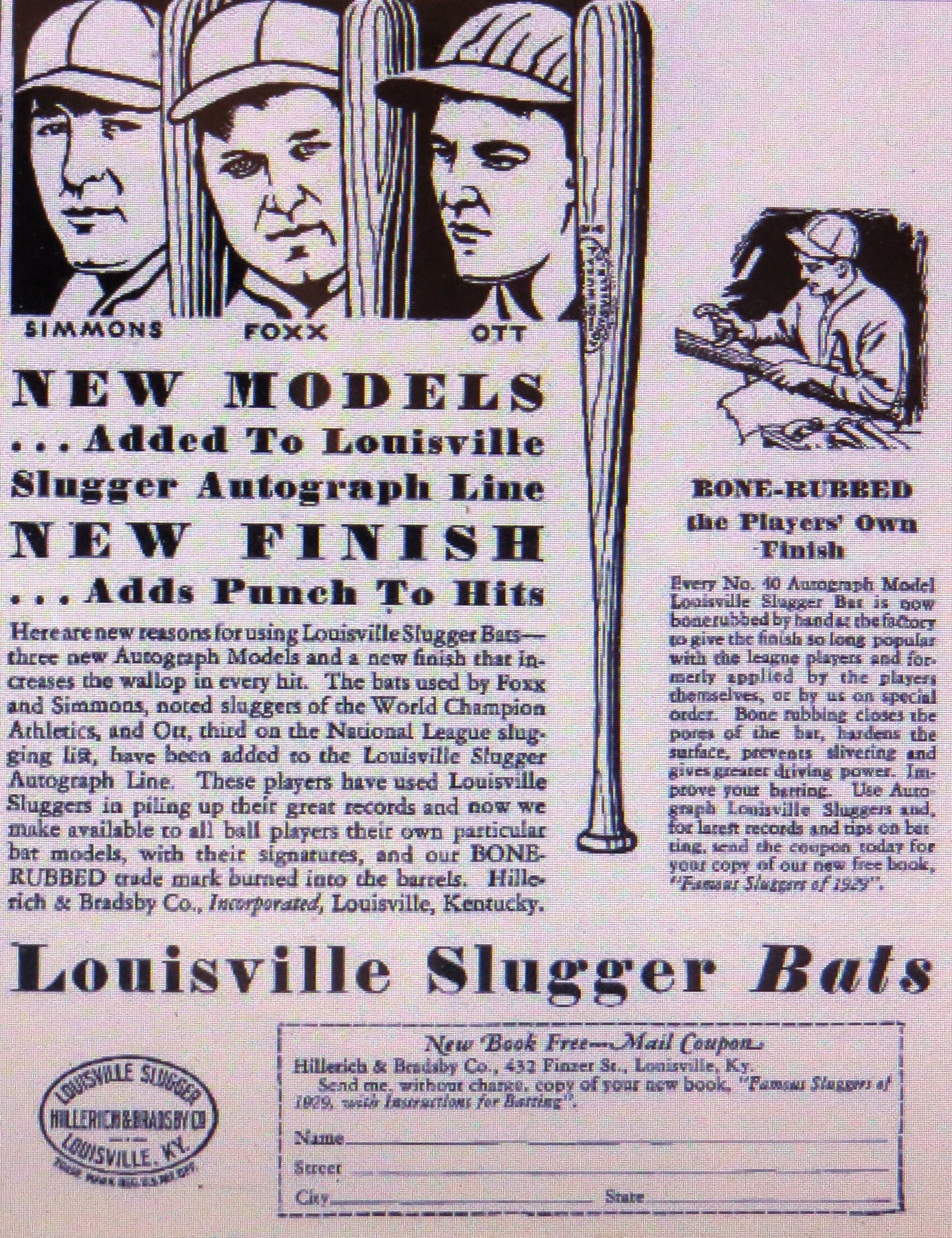
April 1930 advertisement for Louisville Slugger, featuring Hall of Famers Al Simmons, Jimmy Foxx and Mel Ott.

“Here are new reasons for using Louisville Slugger Bats–three new Autograph Models and a new finish that increases the Wallop in every hit.  The bats used by Foxx and Simmons, noted sluggers of the World Champion Athletics, and Ott, third on the National League sluggers list, have been added to the Louisville Slugger Autograph Line.  These players have used Louisville Sluggers in piling up their great records and now we make available to all ballplayers their own particular bat models, with their signatures, and our BONE-RUBBED trademark burned into the barrels”


Filling in the Blanks—Eastman, Huntington 1913

18 Feb

Baseball Reference lists “Eastman” as a player with the 1913 Huntington Blue Sox in the Ohio State League— he quickly became one of the biggest baseball stories in the spring of 1913, and just as quickly disappeared from the game.

George A. Eastman was born in South Dakota.  In 1862 his grandfather was one of the 284 Santee Sioux warriors who participated in the  Dakota War and  had their death sentences commuted by Abraham Lincoln—38 others were hanged in Mankato, Minnesota.

His father John Eastman was a farmer and Presbyterian minister in Flandreau, South Dakota and his uncle, Dr. Charles Alexander Eastman was a prominent writer, nationally known lecturer and activist.

Exactly when Eastman began playing baseball is unclear, but in 1912 he played on a semi-pro team in Sisseton, South Dakota with former Pittsburgh Pirate pitcher Homer Hillebrand.  According to The Pittsburgh Gazette-Times Hillebrand “Considered him very promising material,” and recommended Eastman to Pirate manager Fred Clarke, the paper said “Clarke says Indian players are the style, and the Pittsburgh club will be in style.”

George Eastman in Hot Springs, 1913

George Eastman in Hot Springs, 1913

When Eastman joined the Pirates in Hot Springs, Arkansas, The Gazette-Times, who of course dubbed him “Chief,” said:

“Eastman is a well built fellow, from the baseball standpoint.  He is 5 feet 10 ½ inches tall, weighs 150 pounds and is very fast.”

The paper said Eastman’s preacher father “does not know much about baseball, and does not think very well of it as a profession.”

A shortstop, Eastman quickly became the source of great interest in Hot Springs.  The Associated Press said even the Pirates best player took notice:

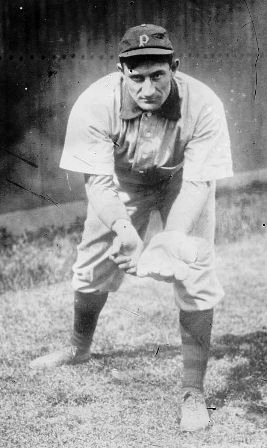
“Honus Wagner has taken more than a passing interest in the Indian Chief Eastman.  (Wagner) isn’t given to indulging in extravagant statements and when he says a recruit is a ‘mighty good ballplayer’ it means something…and he added that “chief throws like Mickey Doolan (Doolin) and fields just like Jack Miller.”

Honus Wagner

Honus Wagner

The Associated Press said:

“(A) Sioux Indian is burning up things around short field at Hot Springs with the Pittsburgh Pirates and Fred Clarke probably will retain him as an understudy to Hans Wagner.”

The Sporting Life thought he was bound for stardom:

“The Pittsburgh players are very enthusiastic over George Eastman, the Sioux Indian player, now being tried out at short. They say that he is a wonderful natural ball player, including hitting ability. They say he is sure of a place on the team, as he can play most any position and can ‘outhit Larry Lajoie.’

Despite the fanfare, Eastman did not make the team and was released to the Steubenville Stubs of the Interstate League.  It’s unclear whether Eastman ever appeared in a game with Steubenville, and was returned to the Pirates in early May; he was then sent to Huntington for the remainder of the 1913 season.

Eastman hit .210 in 57 games for Huntington.  There is an Eastman who appeared in 18 games in the Central League in 1914, but there’s no evidence that it’s George Eastman, who is never mentioned in connection with professional baseball again.

In fact, the trail for Eastman goes cold from the end of the 1913 until 1937 when he became the first tribal president of the Flandreau Santee Sioux Tribe.  He served seven terms as tribal president before his death in 1954.

George Eastman, circa 1937

George Eastman, circa 1937

Ty Cobb, Joe Jackson, Harry Hooper and Quackery

15 Feb

Baseball history is full of stories of products that have been routinely used in the belief they give players an edge.  Some, like steroids and amphetamines have obvious benefits; others like Power Balance bracelets provide none.

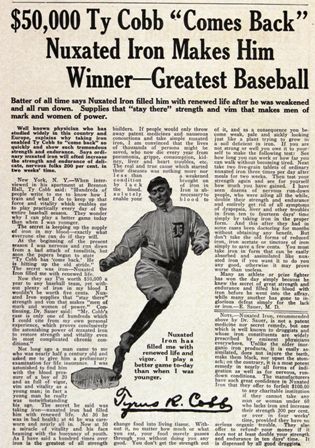
In 1916 advertisements began to appear in newspapers and magazines across the country for a new miracle drug from DAE Health Laboratories in Detroit: Nuxated Iron.

An ad featuring Ty Cobb said “Greatest Baseball Batter of all time says Nuxated Iron filled him with renewed life after he was weakened and all run down.”

Cobb said in the advertisement:

“At the beginning of the present season I was nervous and run down from a bad attack of tonsillitis, but soon the papers began to state ‘Ty Cobb has come back, he is hitting up the old stride.’ The secret was iron—Nuxated Iron filled me with renewed life.

“Now they say I’m worth $50,000 a year to any baseball team.”

cobbnux

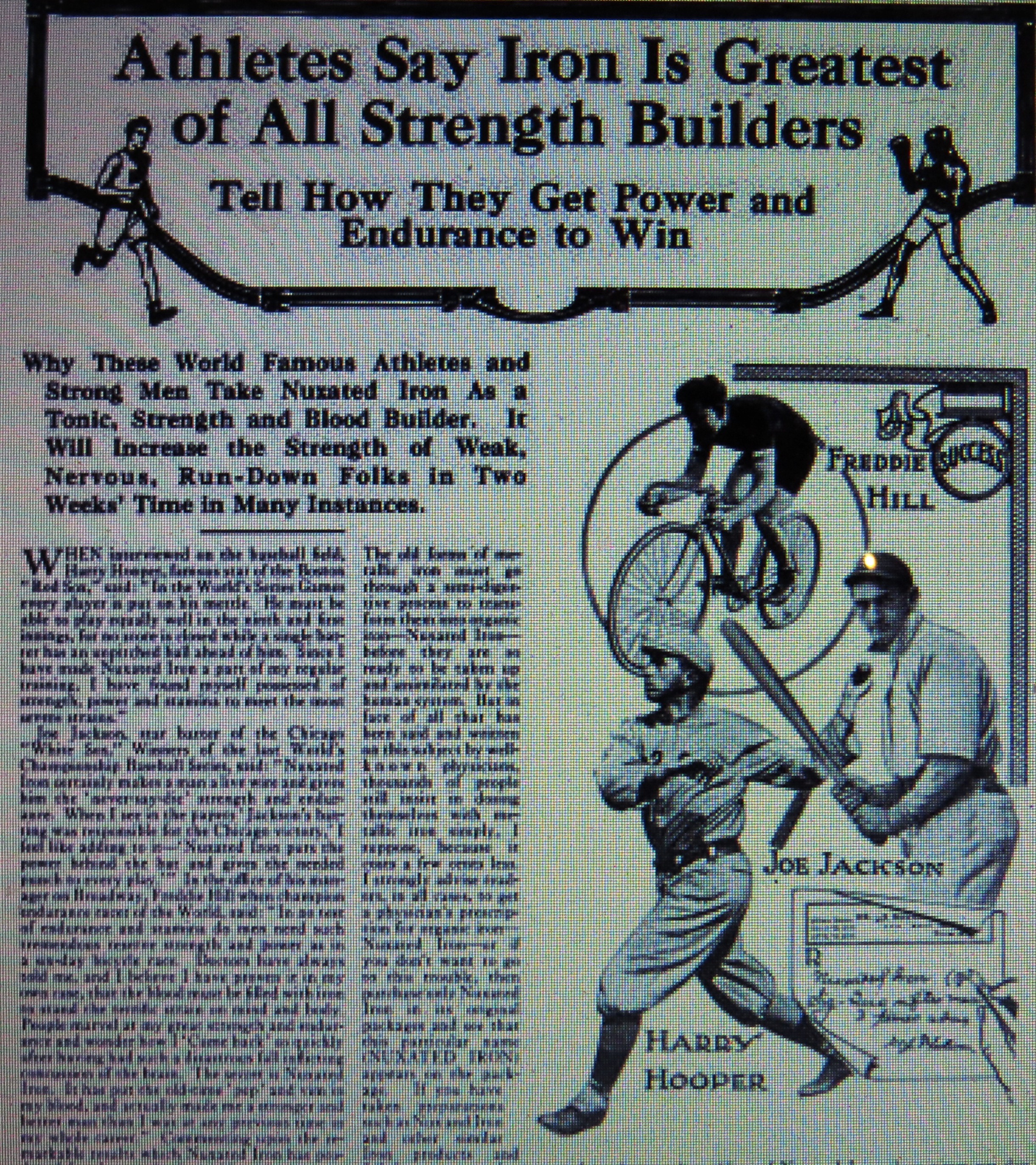
Other ads for Nuxated Iron began to appear, featuring boxer Jess Willard, cyclist Freddie Hill and baseball stars Harry Hooper and Joe Jackson.  Hooper said:

“Since I have made Nuxated Iron a part of my regular training, I have found myself possessed of strength, power and stamina to meet the most severe strains.”

Jackson said:

Nuxated Iron certainly makes a man a live wire and gives him the ‘never-say-die strength and endurance.”

The illiterate Jackson added: “When I see in the papers ‘Jackson’s batting was responsible for the Chicago victory,” I feel like adding to it—‘Nuxated Iron puts the power behind the bat and gives the needed punch to every play.’”

???????????????????????????????

The Journal of the American Medical Association took notice of the Nuxated Iron ad campaign and in October of 1916 had this to say about the “miracle drug:”

“Newspapers whose advertising ethics are still in the formative stage have, for some months past, been singing—at so much a song—the praised of “Nuxated Iron.”  The public has been that this nostrum is what makes Ty Cobb, “the greatest baseball batter of all time,” a “winner” and is what helped Jess Willard “to whip Frank Moran” besides being the “untold secret” of Willard’s “great triumph over jack Johnson.”

All that DAE would say about the ingredients were:

“Formula—The valuable blood, nerve force and tissue building properties of this preparation are due to organic iron in the form of ferrum peptonate in combination with nux vomica (strychnine) phosphoglycerate and other valuable ingredients.

But alas, The AMA Journal was not impressed with the claims made by Nuxated Iron’s endorsements:

“The Journal felt that it owed it to the public to find out just how much iron and nux vomica there were in ‘Nuxated Iron.’  Packages of the nostrum…were subjected to analysis.”

What the analysis found was that the formula that made Ty Cobb a “winner,” offered no health benefits:

“There is only one-twenty-fifth of a grain of iron in each ‘Nuxated Iron’ tablet, while the amount of nux vomica…is practically negligible…In a dollar bottle of ‘Nuxated Iron’ the purchaser gets, according to our analysis, less than 2 ½ grams of iron; in 100 Blaud’s Pills, which can be purchased at any drug store for from 50 to 75 cents, there are 48 grains of iron.”

To sum up their analysis The Journal called the claims made by Nuxated Iron “the sheerest advertising buncombe.”

Contemporary sources said Cobb earned as much as $1000 for his endorsement of Nuxated Iron; there is no record of what Hooper or Jackson were paid, but all three disappeared as paid spokesmen for the product by early 1917.

Nuxated Iron stayed on the market, and stayed in the crosshairs of the AMA until at least 1921.  But by then, the company no longer used baseball players to sing their players.

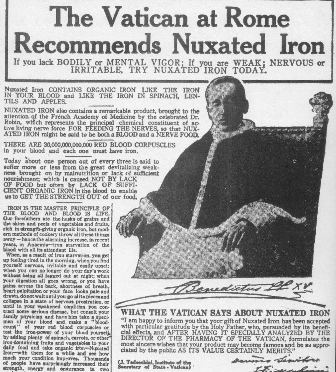
The 1921 ad campaign for Nuxated Iron sought a higher authority to promote the product’s benefits, and featured a picture of Pope Benedict XV under the headline:

“The Vatican at Rome Recommends Nuxated Iron.”

pope

Lost Advertisements: “Boys, the Great Sisler will teach you to play ball!”

14 Feb

???????????????????????????????

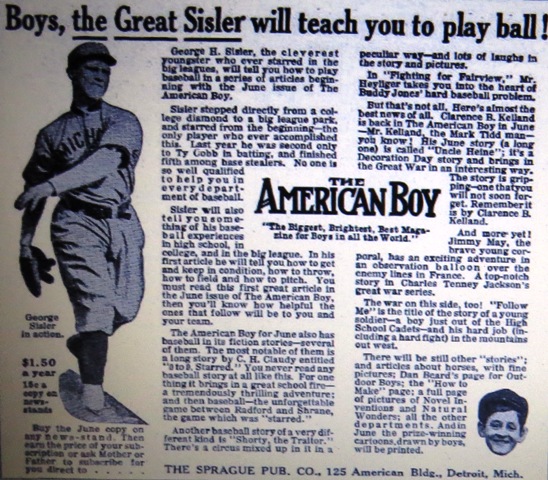
A 1918 advertisement for the June issue of The American Boy magazine featuring Hall of Famer George Sisler; at the time the magazine had a circulation of nearly 300,000 and was the most popular magazine for boys in the United States.

“George H. Sisler, the cleverest youngster who ever starred in the big leagues, will tell you how to play baseball in a series of articles beginning with the June issue of The American Boy.

“In his first article he will tell you how to get and keep in condition, how to throw, how to field and how to pitch.  You must read this first great article in the June issue of The American Boy, then you’ll know how helpful the ones that follow will be to you and your team.”

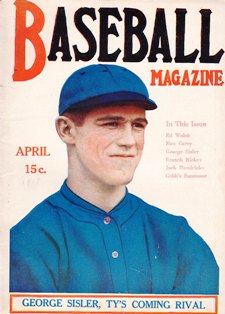
also from 1918, Sisler on the Cover of Baseball Magazine

Also from 1918, Sisler on the Cover of Baseball Magazine

“Greatest Baseball Game Ever Contested”

13 Feb

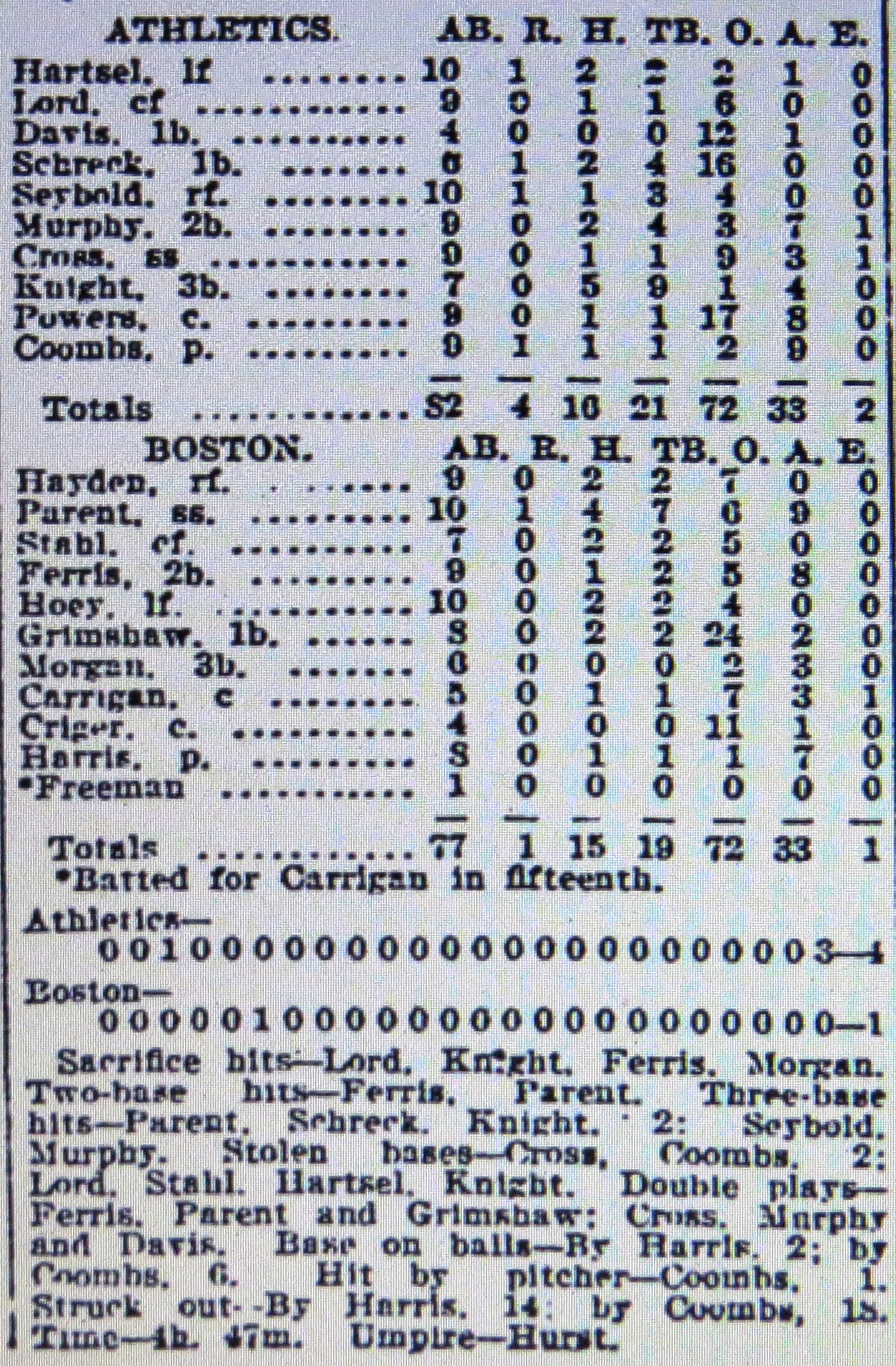
The Philadelphia Record headline called it the “Greatest Baseball Game Ever Contested, “ the September 1, 1906 game at Boston’s Huntington Avenue Grounds between the Philadelphia Athletics and the Boston Americans:

“What will go down in history as the most remarkable ball game ever played in a major league lasted 4 hours and 47 minutes to-day, and the champion Athletics beat the Bostons 4 to 1 in 24 innings.  It was a heart-breaking struggle all through, and to the astonishment of 18,000 people who saw the contest, the pitchers hung on until the last gun was fired.”

Rookie Jack Coombs pitched for Philadelphia, Joe Harris was on the mound for Boston.

Philadelphia scored a run in the third inning; Boston tied the game in the sixth:

“After that plenty of opportunities were offered, but owing to fast fielding and good pitching neither side could cross the plate.

“In the twenty-fourth, when darkness was fast covering the field, (Topsy) Hartsell led off with a single.  (Bris) Lord struck out, but Hartsell stole second…Shreck (Ossee Schrecongost) sent him home with a single over second.”

The Athletics added two more Runs as “The immense crowd filled out around the field.”

Coombs closed the Americans out in the twenty-fourth and “was cheered to an echo, some of the fans wanting to carry him on their shoulders from the field.”

The box score:

???????????????????????????????

“It was well that the game was concluded as it was, for it was too dark to go another inning, and the crowd began to murmur that the light was too dim when the last round began.  But the players themselves interposed no objection, for they were all deeply anxious to fight it out.”

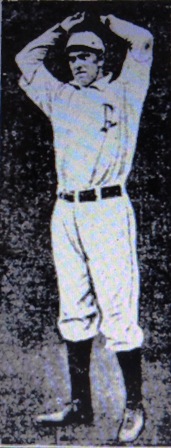
Jack Coombs, 1906

Jack Coombs, 1906

Coombs would go on to a long career, highlighted by a 31-9 record, and three more wins over the Chicago Cubs in the World Series for the champion Athletics in 1910; overall he was 5-0 in World Series play.  He also pitched for the Brooklyn Robins and Detroit Tigers.

Harris is one of the ultimate hard-luck pitchers in the history of baseball.  He ended the 1906 season with a 2-21 record (the Americans were shut out 8 times when he pitched).  His Major League career was over after he went 0-7 in 1907; Harris ended his career with a 3-30 record.