Archive | May, 2013

Lost Advertisements—Old Underoof Whiskey, 1910 Chicago Cubs

17 May

oldunderoof1910cubsgiants

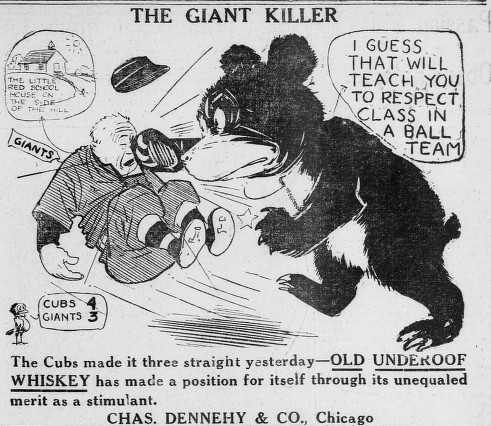
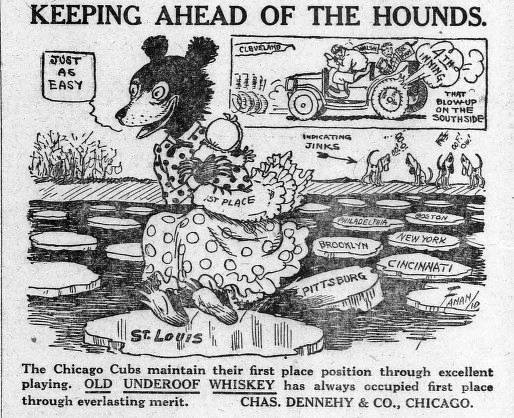
Two 1910 advertisements for Old Underoof Whiskey which appeared in The Chicago Daily News.

The ad above appeared in the paper on May 12.  The Cubs had just won their third straight game from the New York Giants, beating Rube Marquard,  4-3, to improve their record to 11-8.

 Hugh Fullerton wrote in The Chicago Examiner, that the Cubs, “chewed $10,999.98 of beauty out of the wry-necked, knock-kneed, cross-eyed and left-handed $11,000 beauty Marquard.”  The Giants pitcher had earned the nickname in 1908 when New York paid that amount to the Indianapolis Indians for the 21-year-old pitcher.  Through 1910, Marquard was a struggling pitcher with a 9-18 record who had all of baseball questioning the Giants purchase.  The next three seasons Marquard would win 24, 26 and 23 games, helping to lead the Giants to three straight National League Championships.

The one below is from June 27.  The Cubs had beaten the St. Louis Cardinals the previous day 3-2; scoring the winning run in the bottom of the sixth on a double steal, pulled off by catcher Johnny Kling and centerfielder “Circus” Solly Hofman.  It was the team’s twelfth victory in the last fifteen games and gave the Cubs a 4 1/2 game lead over the second place New York Giants.

The Cubs would run away with the pennant, 13 games ahead of New York.

oldunderoof19101stplacecubs

“The Worst Bone Play Ever Made in Baseball”

16 May

The Pacific Coast League pioneer and all-star self-promoter Mique Fisher spent his later years as a near-constant source of material for west Coast sports writers.

In 1937 William Lair Hill Gregory, who wrote for The Portland Oregonian for nearly 60 years wrote about a play in 1904 that Fisher called “the worst bone play ever made in baseball;” it involved pitcher James Marcellin St. Vrain, and happened when Fisher was managing the Tacoma Tigers to a pennant; winning both halves of the 1904 Pacific Coast League season:

“On the Tigers was a southpaw pitcher named Jimmy St. Vrain.  In a close game one day, St. Vrain singled and with two outs was on second.  The batter lashed a line drive out of the shortstop’s reach, but right over St. Vrain’s head.

“’What did that left-hander do when he should have been scoring the winning run,’ complains Mique, ‘but reach up and catch the ball! Of course he was out…hit by a batted ball.’”

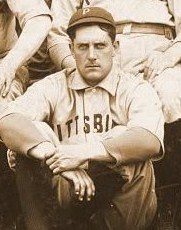
Jim St. Vrain

Jim St. Vrain

St. Vrain is also known for another boneheaded play alleged to have happened during his brief, 12-game career as a pitcher for the Chicago Orphans.  The story was first told The Detroit Free Press in 1906 by Tigers outfielder Davy Jones, who had been St. Vrain’s teammate in Chicago; Jones later told the same story to Lawrence Ritter in the great baseball book “The Glory of Their Times.”  The version in the book—aided by another 50-years of telling the story, and more colorful—is included below.

 “He was a left-handed pitcher and a right-handed batter. But an absolutely terrible hitter — never even got a loud foul off anybody.

“Well, one day we were playing the Pittsburgh Pirates and Jimmy was pitching for us. The first two times he went up to bat that day he looked simply awful. So when he came back after striking out the second time Frank Selee, our manager, said, “Jimmy, you’re a left-handed pitcher, why don’t you turn around and bat from the left side, too? Why not try it?”

“Actually, Frank was half-kidding, but Jimmy took him seriously. So the next time he went up he batted left-handed. Turned around and stood on the opposite side of the plate from where he was used to, you know.  And darned if he didn’t actually hit the ball. He tapped a slow roller down to Honus Wagner at shortstop and took off as fast as he could go … but instead of running to first base, he headed for third!

“Oh, my God! What bedlam!  Everybody yelling and screaming at poor Jimmy as he raced to third base, head down, spikes flying, determined to get there ahead of the throw. Later on, Honus told us that as a matter of fact, he almost did throw the ball to third.

“‘I’m standing there with the ball in my hand,” Honus said, looking at this guy running from home to third, and for an instant there I swear I didn’t know where to throw the damn ball. And when I finally did throw to first, I wasn’t at all sure it was the right thing to do!'”

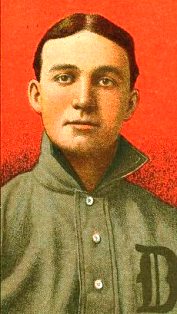
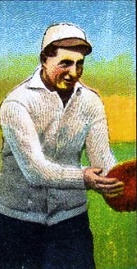
Davy Jones

Davy Jones

Jot Goar

15 May

Joshua Mercer “Jot” Goar had one good minor league season.

Born in 1870 in New Lisbon, Indian, Goar’s early career is mostly unknown, although he appears to have pitched for the Muncie club in the Indiana State League in 1890 and for a variety of semi-pro teams in that state during the early 90s.  In one version of a story I told in January (“Remarkable Baseball Stunt”), “Baseball Magazine” identified Goar as the pitcher who gave up six hits in one inning without a run scoring in an Indiana State League game versus Anderson.

Goar was signed by the Toledo Swamp Angels in the Western League in 1895 (the team would relocate to Terre Haute, Indiana during the season).  While his numbers don’t look impressive, 13-19 with a 3.38 ERA and 345 hits in 288 innings, Goar was called “The best twirler in the Western League,” by The Sporting Life, and quickly became a highly sought after prospect.  Goar also hit .273 as a part-time outfielder.

His manager Denny Long told Indiana papers that Cap Anson “offered him a neat sum,” to sell Goar to Chicago.  Instead, the pitcher was purchased by the Pittsburgh Pirates; The Anderson Herald said Pittsburgh paid $3,200 for Goar:

“Jot Goar, considered the greatest find in the Western League this year…is looked upon to be one of (the Pirates) mainstays for next year.”

Gore joined Connie Mack’s Pirates in Hot Springs, Arkansas in the spring of ’96 and made the team; he made his debut with the team on April 18, pitching in relief in a 7-2 victory over the Louisville Colonels.  Gore struggled in three games with the Bucs, he allowed 25 earned runs on 36 hits and eight walks in 13 1/3 innings, losing his only decision, and was sold to the Grand Rapids Rippers in the Western League on May.

Jot_Goar

Jot Goar

No statistics survive for Goar’s 1896 season in Grand Rapids, but a mention of Goar in The New York American two years later said he had “deserted Grand Rapids,” at some point during the season.  Goar joined the Indianapolis Indians in 1897, and with a 25-9 record and a 1.39 ERA led the Indians to the Western League championship.  Goar was again highly sought after and his contract was purchased by the Cincinnati Reds.

Goar spent the winter refusing to sign a contract along with Frank “Noodles” Hahn, who had also pitched in Western League in 1897; the Cincinnati Enquirer said both players were asking for $1,800.  Goar finally signed in February, but the salary he settled upon was not reported, The Mansfield Daily Shield said:

 “Jot Goar has signed his Cincinnati contract and expects to play good ball this season.”

In March The Sporting News said:

“Jot Goar is showing more speed than any of the Reds pitchers.”

Goar did not live up to the expectations.  He hurt his arm in his first and only appearance; a two-inning mop up in an 11-5 loss to the Pirates, giving up, four hits, three runs, two earned, and a walk.

Pittsburgh Sports writer John Henry Gruber said Goar went to Reds manager Buck Ewing after the game “and at his own request was laid off until such time as he could get in shape.”

Goar returned to Indiana and for the remainder of 1898 and all of ’99 he managed and played first base for an independent team in his hometown in New Lisbon, that fall his team took part in a ballpark riot.  The Indiana State Journal said:

“The game of baseball between the Shamrock and Jot Goar teams on the Hagerstown grounds Sunday broke out in a riot.  Fists, clubs and stones were freely used and practically everyone who attended received some kind of injury.  The trouble arose over a decision of the umpire, who was Councilman John Geisler of Hagerstown.”

Gore began pitching again 1900 for the Indianapolis Hoosiers in the American League posting a 7-2 record in 10 games; he also played for the Western Association Hoosiers the following year, but there are no surviving records.

Goar returned again to New Lisbon, vowing that his pro career was not over, and accepted the position of postmaster and opened a general store while continuing to play for the local team. In 1904, The Sporting Life noted that he was still pitching in Indiana:

“Jot Goar, the old Cincinnati and Toledo pitcher, was doing things with the Connersville, Indiana team this season.  He pitched seven games for that club, six of which he won, the other being a 12-inning tie.  Only five runs were scored in the seven games, and he struck out seventy batters or an average of 10 a game.”

Goar gave up baseball after 1906.  He accidentally shot himself in the arm while hunting in 1907, and his general store burned to the ground, the 1911 “Reach Guide” said:

 “His place of business was completely ruined by a disastrous fire, which practically destroyed the business section of (New Lisbon).”

He rebuilt the store which he operated until 1921; Jot Goar died in 1947 at 77.

1876 Salaries

14 May

In July of 1876, The Brooklyn Argus published the salaries of the two highest paid teams in the newly formed National League; many of these have never appeared in any of the collections of early baseball salaries.

According to the article, the highest paid player was Chicago White Stockings pitcher Albert Goodwill Spalding who “as pitcher and manager, receives $3,000 for the year, with $1,000 bonus for producing the secession from the Hub (Boston) to Chicago.”  (The 1950 book “100 Years of Baseball,” by Lee Allen said Spalding earned $3,500 and a $500 bonus for the season).

A.G. Spalding, highest paid in National League

A.G. Spalding, highest paid in National League

The three players Spalding brought with him from the Boston Red Stockings in the National Association, Catcher James “Deacon” White, first baseman Cal McVey and second baseman Ross Barnes were all paid $2,500.  The two players signed away from the Philadelphia Athletics, third baseman Adrian “Cap” Anson and outfielder Bob Addy received $2,200 and $1,500 respectively.

Outfielder Paul Hines earned 1.800, utility player Fred Andrus was paid 1,000, and the remaining members of the first National League Champions, shortstop John Peters and outfielders John Glenn and Oscar Bielaski were made $1500 each.

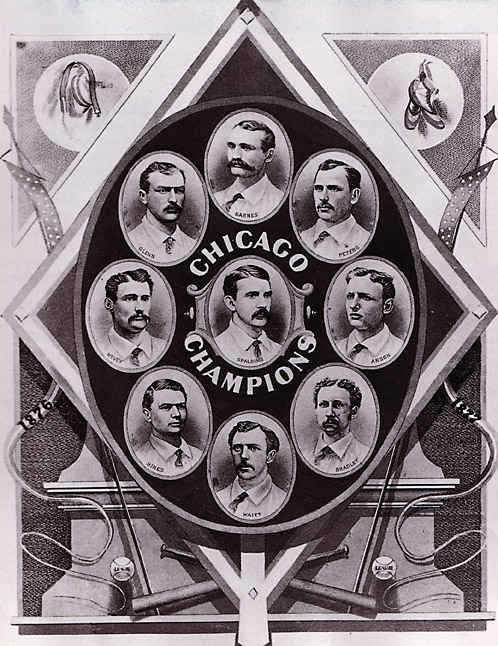
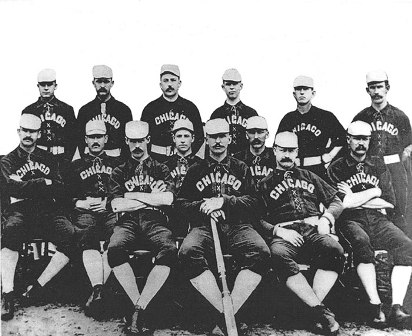
Chicago White Stockings, 1876 National League Champions--and highest salaried team.

Chicago White Stockings, 1876 National League Champions–and highest salaried team.

Harry Wright’s Boston Red Stockings filled the vacancies of White and Barnes with 18-year-old Lew Brown and 21-year-old John Morrill who The Argus said received “between 800 to 1000 dollars each.”

Manager Wright, who only appeared in one game, and his brother George were the highest paid members of the Boston club at $2,500 each.  Andy Leonard, who played second and outfield was paid $2,000.  Two other notable players on the Red Stockings, Hall of Famer “Orator Jim” O’Rourke and Tim Murnane received “between fifteen hundred and eighteen hundred dollars.”

According to The Argus, the White Stockings payroll of $21,500 topped the league, with Boston’s total of 18,000.

Crazy Schmit Stories

13 May

Fred “Crazy” Schmit was widely considered to be the first pitcher to keep a “book” on hitters, it was mostly attributed to his poor memory, and the pitcher kept an actual book in his pocket listing the weakness of each hitter.  The earliest reference to Schmit’s book was in The Sporting Life in 1894, but the story was repeated in newspapers for the next thirty years, usually as a story told by John McGraw or Hughie Jennings.

The article said Schmit kept:

“(A)n account of the weakness at bat of his opponents, setting them down in a small book, which he always carried with him on the diamond…One day when he had the Chicagos as opponents (it was the season that Captain Anson led the League in batting), Anson came to the bat. “Crazy” Schmit looked at the big first baseman, then went down into his pocket, and, taking out his book, read “Anson, base on balls.”

Over the years the story changed—the batter was sometimes Elmer Flick, Nap Lajoie, Ty Cobb, Honus Wagner, Tris Speaker, and as Jennings said in 1926, “Every good hitter since Anson’s day, but Anson is the player whose weakness was reported to be a base on balls.”

"Cap" Anson

“Cap” Anson

Jennings also claimed that during the 1890s as part of a prank by teammates aboard a ferry, Schmit’s suitcase, with his book inside, fell overboard, and said:

“Schmit was a losing pitcher from that time on.  He won a few games but lost a great many more…The bottom of Hudson River held his ‘pitching arm.’”

Pitcher turned sports cartoonist Al Demaree said Schmit “used to warm up with an old water-soaked ball that weighed several pounds—at a distance of 75 feet, and not the regulation 60 feet from his catcher.”

Al Demaree's Schmit cartoon--as with most references to the pitcher, his name is spelled incorrectly

Al Demaree’s Schmit cartoon–as with most references to the pitcher, his name is spelled incorrectly

After his final game with the Baltimore Orioles in 1901, Schmit continued to play with semi-professional and quasi-professional teams for more than a decade.  His antics continued to make the papers.

In 1906 Schmit joined Jim “Nixey” Callahan’s Logan Squares in the Chicago City League.  The Sporting News’ Revere Rodgers told a story (complete with Schmit speaking in a comic German accent) about the team going to Joliet, Illinois for a game:

“(The Logan Squares) knew the umpire was a ‘homer’—a man who couldn’t see a close decision without giving his team the best of it.  He stopped before the grandstand, hat in hand, and announced (the batteries)…’Crazy’ Schmit was right behind him and when (the umpire) finished Schmit took off his cap and making a sweeping bow said: ‘Laties and schentlmen, der umpire for der game today vill be Mister Miller of Joliet and he vill as usual slightly favor der home glub mit his decision.”

According to The Chicago Tribune’s Hugh Fullerton Schmit was deeply disappointed at the end of the 1906 season when Callahan did not allow him to pitch in the Logan Squares victories against the World Champion White Sox, and National League Champion Cubs.

Schmit continued to play in the Midwest and also did some scouting for John McGraw’s New York Giants.  A story that appeared in The Duluth News-Tribune said Schmit pitched a few games for the Fond du Lac in the Wisconsin-Illinois League (Schmit’s name does not appear on any Fond du Lac roster in either of the two years the other player mentioned in the story was with the team (1909, 1911)so the story may be apocryphal):

“Along about the seventh inning, with Rockford leading by 6 to 4 the first man up got on.  Schmit pitched out three times in an attempt to get the runner going down to second base, but the runner made no attempt to purloin the sack.  With the count three and nothing on the batter he grooved the next one, only to have the batter lean on it and drive it over the left field fence for a homerun.

“After the runners had circled the bases the umpire threw up another ball.  Schmit took it, shook his head and walked over to Bobby Lynch, who was playing third base…and said to him ‘Say, Bobby, no wonder I can’t beat these fellows.  I won’t pitch against them any longer.  I quit right now.  They don’t know how to play baseball and yet they are leading in this league.  The runner that was on first base just let me waste three balls and yet he does not attempt to steal; then when I put one over for the batter who has three balls and no strikes, he hits it.  Tell me, how can a man of my intelligence and baseball knowledge pitch a game of baseball against such boneheads and unscientific playing of the game?”

“Crazy” Smith died in Chicago in 1940.

Crazy Schmit in Cleveland

10 May

Crazy Schmit pitched for the Cleveland Spiders in 1899; compiling a 2-17 with a 5.86 ERA for the 20-134 last place team (in Schmit’s defense the 1899 Spiders were one of the worst teams in history, losing 24 straight at one point, and Schmit’s ERA was a half of a run better than the team ERA).

The pitcher had grown tired of his nickname “Crazy,” and of references to his behavior as “tacky.”  After being called both by The Cincinnati Enquirer in August, he responded:

“I have stood this sort of thing just about long enough.  I am neither tacky nor crazy, and without wanting to throw any flowers at myself, I will make the statement that there is not another left-handed pitcher in the business who used as good judgment when pitching as I do.

“Furthermore, I am the only left-hander in the business who has an effective slow ball.  Some of these ten-thousand-dollar beauties and phenoms look like thirty cents to me.  I can also swell up and say that I threw the Phillies down this year.  I beat that hard-hitting gang by a score of 6 to 2.”

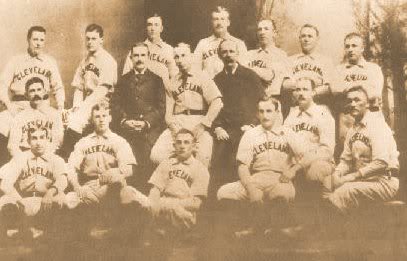
1899 Cleveland Spiders--finished 20-134

1899 Cleveland Spiders–finished 20-134

Within weeks Schmit was let go by Cleveland;  The Baltimore American reported on the release of the former and future Oriole:

“Pitcher Schmit, that queer and original baseball character, was yesterday given his ten days’ notice of release by the Cleveland club management and afterward notified that he had been fined for insubordination.”

The American quoted Schmit:

“I was released I suppose because it had been reported that I was not doing my best to win and because the owners were displeased with me for several accidents that happened to me.  I missed the train in Chicago, and while I was riding into Cincinnati from one of the suburbs with a young lady who may one day be Mrs. Schmit, lightning struck the trolley wire and I missed the train again.  I guess that is why I was fined.  They wished to make an example of me.  I do not mind the release, as I can easily get another and better position, but I hate that $50 fine, because my salary is not quite as high as that of some bank presidents.”

Despite his release and his record, Schmit still considered himself a great pitcher, blamed his career statistics on the teams he played with, and the more he spoke the more valuable he became as a player:

“I have in my career pitched for fourteen tail-end clubs and I am done with them.  Unless I can pitch for some club that can win a game occasionally I will stop pitching ball.  The longer I pitch the more stuck I am on myself as a pitcher.  I have pitched good ball for Cleveland, but who could win with six and eight errors behind him, and misplays that are far worse than errors and that go as hit.

“I am the most popular player on the circuit and the only man who knows how to coach as a science.  If some of these managers knew something of the theatrical business they would wire on and advertise I am to pitch a certain game.  When it is known I am to pitch I have often brought enough into the box office in a single game to pay my whole salary for the season several times over.  We played before 14,000 people in Chicago and of that number fully 5,000 came to see me.”

Schmitt did not “easily get another or better position” in 1899 or 1900—he sat out the remainder of 1899 and spent 1900 in the Interstate and New York State Leagues.  Schmit opened the season at 2-3 in five games with the Columbus Senators before being released; there are no surviving records for his New York State League games with the team that split the season between Elmira and Oswego.  The next season John McGraw would give him a chance to pitch in the American League.

More Crazy Schmit next week.

Crazy Schmit

9 May

In 1913, Giants manager John McGraw, wrote an article that ran in newspapers across the country, in which he made the case that baseball had “practically eliminated the ‘bad actor,’” citing the World Series and the development of the game as a business as the primary factors.

McGraw said many of the players of his day “had paths worn from the ballpark to some favorite saloon and back to the grounds.”  McGraw singled out one player in particular to make his point.

Frederick “Crazy” Schmit pitched for parts of five seasons for five different American and National League teams from 1890-1901, posting a career record of 7-36.  (Schmit’s name was almost universally misspelled by contemporary newspapers–the misspellings have been corrected in quotes that reference him).

Crazy Schmit

Crazy Schmit

McGraw wrote (and likely embellished) about Schmit, who was his teammate in 1892 and ’93 and who he managed in 1901 with the Baltimore Orioles:

  “(W)e had a pitcher named Schmit generally and aptly called ‘Crazy’ Schmit.  His habits were nothing for a temperance society lecturer to dwell upon as an example…I called (Schmit) into a corner the day before the first game (of a series with the Cleveland Blues) and told him that I wanted him to pitch the next afternoon and asked him to get into good shape.  He said he would be out there with everything on the ball.  That was one thing about him—he never knocked his own ability.

“But Schmit’s notion of preparations did not coincide with mine.  I learned afterwards that he went directly from my lecture to his favorite loafing place and remained there telling his friends what he would do to Cleveland the next day.”

McGraw claimed that Schmit fell down on the mound (there’s no contemporary report o confirm it) and:

“Those were the days of quick action, so I rushed into the box from third base where I was playing, sore enough to do anything.

‘Get out of here.’  I yelled at him ‘You are released.’

“He laboriously regained his feet, and with ludicrous dignity walked out of the pitcher’s box and toward the exit of the park.  As he left he whirled on me and exclaimed dramatically: ‘I go to tell the world that the great Schmit has been released.”

McGraw said the pitcher only made it as far as the same tavern he had been at the day before, “and we had to send his clothes to him.”

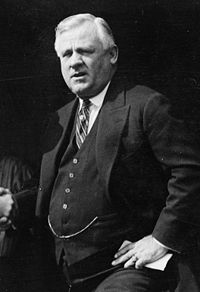
John McGraw

John McGraw

McGraw wrote that before he released Schmit he used a tactic he later tried with “Bugs” Raymond; withholding money from the pitcher to keep him from spending it on liquor:

“After a time I began to miss baseballs in great numbers from the clubhouse and my suspicions were aroused, so I followed Schmit when he left the grounds one night…Schmit proceeded to a corner and mounted a soapbox which he produced from the bushes nearby, and then he pulled five or six league balls, partly used, out of his pocket and began to auction them off as ‘genueen leeg balls.’  For some of them he got as high as $5 apiece.  Or rather, he received $5 for the first one, and then I interrupted him and took the rest away.”

Schmit was released by the Orioles on June 10, 1901; he continued to pitch in semi-pro and outlaw leagues for more than a decade and worked as a scout–for the New York Giants, managed by John McGraw.

Another “Crazy” Schmit story tomorrow.

Lost Advertisements–“Zim Says It’s a Hit”

8 May

zimmermansaftyrazor

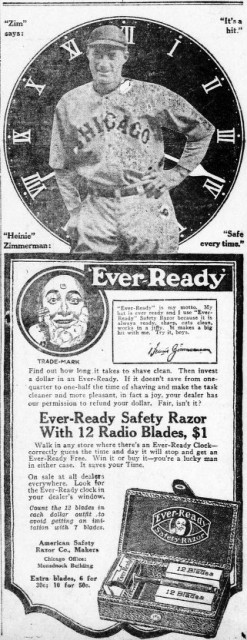
A 1912 advertisement for Ever-Ready Safety Razor featuring Chicago Cubs star Henry “Heinie” Zimmerman.

“Ever-Ready is my motto.  My bat is ever-ready and I use “Ever-Ready” Safety Razor because it is always ready, sharp, cuts clean, works in a jiffy.  It makes a bit hit with me.  Try it boys.”

The 1917 World Series, which the White Sox won 4 games to 2, was the low point of Zimmerman’s career.  Now playing for the Giants, the former Cub had once said: “I’d rather play in hell than in Comiskey Park.”  White Sox fans did not let him forget it.  Called “The sassiest and most ill-tempered player in the game,” by a wire service article before the series which also said, “Can you imagine what he will endure when the W.S. takes place?”

He did endure a lot.  Zimmerman was jeered by Sox fans throughout the series.  He hit .120, committed three errors, and was undeservedly blamed for a botched rundown when Rube Benton and Walter Holke failed to cover the plate, and the Sox’ fleet second baseman Eddie Collins beat the slower Zimmerman in a footrace home, scoring the winning run in game 6.

“Mique” Fisher 2

7 May

On October 12, 1906, with the World Series between the Chicago White Sox and Chicago Cubs deadlocked at two games apiece, August “Garry” Herrmann, President of the National Commission, received a telegram from Fresno, California:

“Fresno will give $25,000 guarantee; guarantee 40,000 fans and sunshine for deciding game of World Series.

–Mike Fisher”

Fisher said the offer to bring the series and Fresno native Frank Chance to town was backed by “the businessmen here.”

It is doubtful Herrmann took the offer seriously, and it’s probably just as doubtful that Fisher took it seriously, but it was picked up by newspapers across the country, and Fisher enjoyed the publicity.

It was a last bit of publicity before his career in organized baseball ended.  Later in the month he was dismissed as manager of the Fresno Raisin Eaters, and the team was dropped from the Pacific Coast League (PCL) the following spring.

Within weeks Fisher had moved on to a new project; he announced that he was in the process of forming a team to travel to Hawaii.  The San Francisco Call said “It will be the first American ball team to make the trip across the Pacific in a little over nineteen years,” since Spalding’s world tour.

In conjunction with Jesse Woods, a Honolulu promoter, Fisher organized a tour of the Hawaiian Islands with a team of PCL stars.

Mike Fisher

Mike Fisher

Upon his return, Fisher got more ink on the West Coast, when he headed to Nevada with Charlie Irwin of the San Francisco Seals; the two met with businessmen in the mining towns of Goldfield and Tonopah to discuss forming a professional league—Fisher told The San Jose Mercury News that he was now “against organized baseball,” and if he got involved in the league “it will be an outlaw organization.”

Fisher chose not to get involved in the new league, but immediately went to work on an even more ambitious tour than the 1907 Honolulu trip.

With the sponsorship of the Reach Sporting Goods Company, Fisher would accompany a group of stars to China, Japan and the Philippines.  Early publicity promised the travelers would include Ty Cobb, Hal Chase, and Frank Chance.

When the ship set sail in November of 1908 those three stars were not on board, but “several hundred fans and friends” were present when the steamer China left the port in San Francisco to see the group off.  The team was substantially the same as the one that toured Hawaii the previous year—an aggregation of PCL stars and a few National and American League players– and consisted of: Jim Delahanty, George Hildebrand, Bill Burns, Pat Flaherty, Jack Bliss, Babe Danzig, Harry McArdle, Nick Williams, Joe Curtis, Heine Heitmuller, Jack Graney and Bill “Brick” Devereaux.

Despite the failure to land Cobb, Chase or Chance for the tour, the West Coast press applauded Fisher for even attempting the trip, The Call said:

“The undertaking which he has fathered and which is so successfully underway at the present time is a big proposition.  With the single exception of the around-the-world trip of the A.G. Spaldings years ago, nothing on as big a scale as this has ever been attempted.  To take a team of American baseball players over a journey that will total 10,000 miles before they return, to play games in China, Japan, Manila and Honolulu is something that two or three years ago would have been laughed at as an impossibility.”

The tour lasted more than three months, with the team barnstorming through Japan, China, the Philippines and Hawaii, playing local and US Service member teams.  Though reports varied, the team played between twenty and thirty games, and lost no more than four.

While they drew large crowds throughout the trip, the newspapers back home reported that the tour was a financial disaster; when the players arrived back in San Francisco on February 15, 1909 aboard the Tenyo Maru, Fisher responded to the reports:

“I hear that it has been said that the trip was a financial frost.  Well, anybody who says that is a liar.  We broke even in Japan and made money in Manila and Honolulu.  I am satisfied with the trip.”

Fisher didn’t mention the financial results in China; likely because that leg of the tour was a disaster financially.  Years later he would tell a story about the team’s experience there, complete with his usual exaggerations:

“In one game we played in Canton we had 150,000 people inside, and as the gatemen had been instructed to accept Chinese money it required the combined efforts of the entire team to tote the money up to the hotel.  A special staff of accountants was busy all night totaling it up and in the morning we discovered we had $46.15.”

Fisher promised to take a team to Australia the following year.  The trip never took place; instead Fisher purchased a Seattle dance hall called the Dreamland, and quickly became the target of the pious women of the city.  Early in 1910 Fisher was indicted by “The King County grand jury, as a direct result of the activity of the Women’s Clubs,” for violating liquor laws, allowing “unescorted women” into his dance hall, and other assorted charges.  A special prosecutor, Justice William Henry White, one of the most respected jurists in Washington State, was appointed to prosecute Fisher and other club owners targeted by the women.

Ever the promoter, Fisher used the indictment to promote his dance hall and rally public support.  After the indictment was handed down Fisher sponsored a “Sermon in the Dreamland rink.”  According to The Seattle Times, Fisher engaged Reverend Frank Herthum, who “has liberal ideas about amusements.”

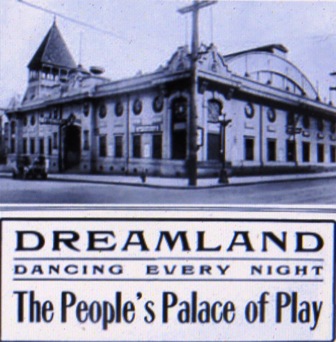
Mike Fisher's Dreamland Dancehall, Seattle

Mike Fisher’s Dreamland Dance Hall, Seattle

Herthum preached, and Fisher presented a free vaudeville show.  The paper said Fisher had stirred up a “protest against the effort to close the dance hall without having provided a substitute where clerks, servant girls and employees in the shops may pass an evening to their liking.”  At the same time The Times noted that the prosecutor was becoming impatient with the women who brought the charges because they continually promised to provide evidence that “has not yet come to light.”  The charges were quietly dismissed within weeks.

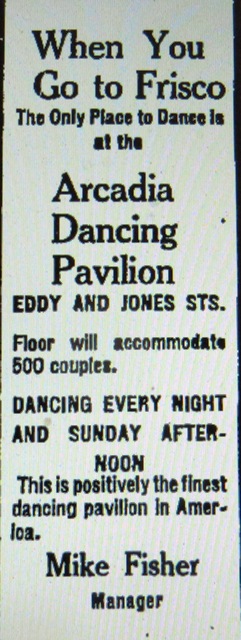
Fisher left Seattle sometime in 1911 and began operating the Arcadia Dance Hall in San Francisco.

Advertisement for Fisher's Arcadia Dancing Pavilion.

Advertisement for Fisher’s Arcadia Dancing Pavilion.

In January of 1917 Fisher made headlines in California when he announced that he was directing an effort to restart the California State League, which had folded after the 1915 season.  He said he would have clubs in Sacramento, Fresno, Stockton and San Jose.  Within two weeks Fisher abandoned the plan.  The San Jose Mercury News was not surprised:

“Mr. Fisher, the wonderful getter of publicity, has his publicity and is through.  Probably he has done wonders for his dance emporium or whatever it is he runs.”

The following year the San Francisco Seals of the Pacific Coast League came on the market; the first name reported as a potential buyer was Mike Fisher.  Fisher again got his headlines, but it was his old friend Charlie Graham who got the team.  Graham, and a group of investors purchased the Seals and the former catcher was installed as manager.
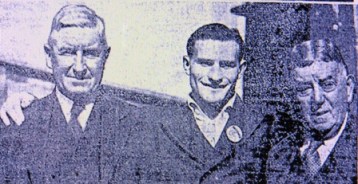
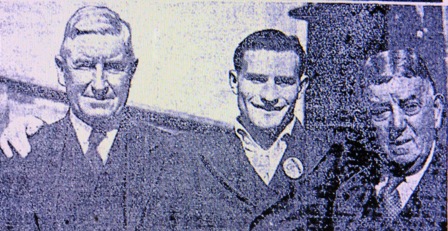
Charlie Graham, left, Mique Fisher, right, with World Middleweight Champion and actor Freddie Steele.

Charlie Graham, left, Mique Fisher, right, with World Middleweight Champion and actor Freddie Steele.

With his friend in charge The Mercury News said Fisher became a fixture “around the San Francisco ballpark ever since Graham bought in on the Seals in 1918,” he would remain a fixture at Recreation Park, and later at Seals Stadium for more than 20 years , and continued to provide copy for West Coast s sports writer

As a result of his friendship with Graham, who recommended he get the honor, 77-year-old Fisher was selected to travel to Cooperstown to represent the PCL at baseball’s centennial celebration in 1939.  The man who so loved seeing his name in the paper  received headlines one more time, when he died in San Francisco on June 6, 1943.

“Mique” Fisher and the PCL

6 May

Michael Angelo “Mique” Fisher is one of the forgotten pioneers of the Pacific Coast League (PCL).  Fisher had no given middle name, but adopted the name Angelo “after the famed painter he admired.”

Born in New York City in 1862, Fisher’s family relocated to Sacramento, California shortly after the end of the Civil War.  Fisher was a semi-pro outfielder with teams in San Francisco, Oakland and Sacramento, and in 1884-85 played for the San Francisco Haverlys in the California League.  Sometime later in the decade he joined the Sacramento police force.

Fisher’s only connection with baseball from 1885 until he was nearly 40-tears-old was as a fan and as a friend of a young catcher named Charlie Graham who had played at Santa Clara University and in the California League.

In 1902 Detective Captain Fisher made a career change.

The Sacramento Gilt Edges in the California League were owned by a local businessman named Arthur Beebe.  Beebe, according to The Sporting Life “incurred the displeasure of his associates in the league owing to his continual kicking against the umpires appointed by President (James T.) Moran.”

At a league meeting in February the franchise was taken away from Beebe and awarded to Fisher.  The San Francisco Call said Beebe blamed the move on San Francisco owner Henry Harris, who he said “is backing Mike Fisher.”

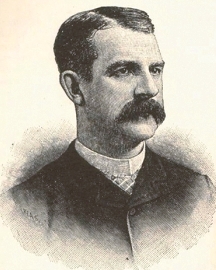
Michael Angelo “Mique” Fisher, circa 1905

Michael Angelo “Mique” Fisher, circa 1905

There’s no contemporary reference to why Harris preferred Fisher to Beebe, but within a year Harris would spearhead the effort to expand the California League to the Pacific Northwest—forming the PCL, and might simply have wished to pack the league with allies for the planned expansion.

The new Sacramento owner’s first move was to sign Charlie Graham, who played for Harris in San Francisco in 1901; Graham was named captain.  The Gilt Edges got off to a horrible start, but according to The Sporting Life “managed to replace the weak ones with men that worried other clubs at all stages, and finally crawled up into the .400 class.”

In December of 1902 The Seattle Times reported that Harris’ scheme was official:

“The California League will be known next year as the Pacific Coast League.  It will expand and take in Seattle and Portland.”

The Los Angeles Angels won the first PCL championship, but it was another Los Angeles team that caused the most excitement for Fisher and Sacramento in 1903.

In March three of Fisher’s players, Win Cutter, Charles Doyle and George Hildebrand jumped to the Los Angeles team, in the newly formed Pacific National League—they were said to have been recruited by former teammate Elmer Stricklett.  Hildebrand agreed to return, but Fisher took action as the other two prepared to board a train for L.A.  The San Francisco Call said:

“There was a sensational scene at the railway depot this afternoon, when Michael Fisher, manager of the Sacramento baseball nine, appeared with a police officer armed with warrants and caused Cutter and Doyle, two of the start players, to be placed under arrest on charges of obtaining money under false pretenses.”

The players were held in jail until they agreed to return to Fisher’s club, and the charges were dropped.

After the 1903 season Fisher relocated the franchise to Tacoma, Washington; the move brought better geographical balance to the league, and gave the PCL a foothold in a city that had just been vacated by the rival Pacific National League.

Charlie Graham remained team captain and the pitching staff was improved with the addition of Jim St. Vrain and Orval Overall.  Fisher’s Tacoma Tigers took the pennant, winning both halves of the split season schedule.

Charlie Graham

Charlie Graham

it was Graham, not Fisher, who was generally given credit for the success of the team.  As The Portland Oregonian later said:

“Mique Fisher in the strict sense of the term never was a great manager.  In a general way he knew baseball, but as a master of the fine points of the game as it should be played he was not up to the big thing…It was Graham who taught the players how to play the game.”

The paper did concede that Fisher was a good players’ manager:

“His players liked him and worked hard for him and that always helped a whole lot.”

Other tended to dismiss Fisher, The Spokane Daily Chronicle called him:

“The man who has acted as the original blast furnace for the hot air factory.”

Fisher not only had his baseball acumen questioned, but the move to Tacoma turned out to be disastrous from a business standpoint. The Oregonian said the Tigers won in 1904 despite “little enthusiasm,” from the city of Tacoma.  Fisher also began to run afoul of his investors, according to The Daily Chronicle:

“It is no secret  the stockholders have been losing money and blame for that is laid on the manager.”

The 1905 Tigers started strong, winning the first half—again playing to small, indifferent crowds, then fell apart in the second half, finishing last.  The Tigers were badly beaten five games to one in a postseason series by the Los Angeles Angels.

In September of 1905, Fisher announced that a six-game series with the Oakland Oaks would be played in Spokane, Washington, giving rise to rumors that the team would relocate there the following season.  The rumor also stirred up a conflict with the Northwestern League, who laid claim to Spokane and took their case to the National Commission.

Fisher initially denied that the team had designs on Spokane, but in October he this telegram to The Spokane Chronicle:

“To Sporting Editor…Spokane has been awarded to the Coast League by the National Commission.”

The San Francisco Bulletin said the league needed to abandon Tacoma and:

“It certainly seems that the admission of Spokane is the only logical course for the league to pursue.”

Logic did not win out.  By November Fisher had negotiated a deal to move the team to Fresno, California, a town with roughly one-third the population of Spokane—the PCL made it official in January of 1906 that the Tacoma Tigers would become the Fresno Raisin Eaters.

Fisher had owned a half interest in the team in Tacoma, he gave up his ownership stake in Fresno and signed a three-year contract with the club.

It turned out to be another bad decision.

Fisher, for the first time, managed a team without Charlie Graham by his side.  The catcher started the season with the Boston Americans (his only big league season), but left the team in May to return to San Francisco a month after the 1906 earthquake—various sources attributed his departure to being homesick, wanting to be near family, or to attend to his wife who was ill; in any case he never returned east and signed with the Sacramento Cordovas in the California League in August.

Fresno was a last place team from wire-to-wire, finishing with a winning percentage well below .400.

The new ownership fired Fisher, who eventually sued the team to recover $500 he said he was promised if terminated before his three-year contract expired.  He never collected the $500 and told reporters:

I was gypped out of the franchise.”

Wallace “Happy Hogan” Bray was named to succeed Fisher as manager, but Fresno was dropped from the PCL after the Seattle Siwashes withdrew from the league, in order to maintain an even number of teams.

Fisher’s managerial career was over, but his baseball career was not; more on that tomorrow.