Archive | Uncategorized RSS feed for this section

Baseball and Evolution, 1887

11 May

In 1887, 28-years after the publication of Charles Darwin’s “On the Origin of Species,The San Francisco Chronicle declared:

“The modern game of baseball is one of the most convincing proofs of the doctrine of evolution.  All the leading features of that theory—natural selection, differentiation of species and the survival of the fittest—are admirably illustrated in the game of baseball as played at present.  It is admitted that baseball originated with the game of town ball, or rounders, and some future Darwin of the diamond field may publish ponderous folios to exhibit the various steps by which the childish game of rounders developed into the scientific sport now so popular.”

Charles Darwin
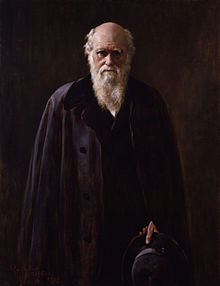
Charles Darwin

That evolution, said the paper, was also seen in the popularity of the game:

“The permanence of baseball as a game is now firmly established.  It has grown into the affections of sport-loving Americans as thoroughly and absolutely as cricket is the object of English admiration.  As evidence of this it is stated that on Decoration Day 96,000 people attended three games of baseball in and near New York City.”

bb

Despite the popularity of the game, the paper noted there was some pushback against “scientific baseball:”

“The most unfavorable criticism which has passed upon the present game is that it has become a ‘battery game;’ that is, all the playing is done by the pitcher and catcher.  The object of late years has been to keep the score of runs down, and to that end the rules have been framed in the interest of the pitcher and catcher…and scores of one to one and one to nothing have not been uncommon.  Now this is very scientific, but the people who pay their money to see baseball played have become tired of it and want to see the field have something to do.  They want to see more batting and base running and larger scores.”

grays1

The Chronicle said, in order to increase offense, “The National League and American Association, appreciating this state of things has recently adopted some new rules.”  Among the rules instituted for the 1887 season were the reduction of the pitcher’s box to 5 ½ feet by 4 feet, five balls rather than six for a base on balls, and four “called strikes” for a strikeout:

“The opinions of expert players as to the effect of the new rules differ, although most agree that the game will be of more interest to the spectators and will draw better and the gate money be increased, a question of interest to all the clubs except the purely amateur ones. “

Whatever the result of rule changes, this further evolution and the game’s “manly qualities” were reasons baseball had earned its place in American culture:

“It would be hard to find a sport which brings into play the manly qualities of wind and muscle to greater advantage than baseball.  No one but a skilled athlete can play the game successfully, and training men for a baseball campaign has become almost as much a science as training them for a boat race or a foot race.  Eye and nerve, lungs and heart, legs and stomach must all be capable of doing their duty and doing it well to make a good baseball player.  There is generalship too, in the game, and many matches are won by superior skill, even though handicapped by inferior strength.  The game well deserves its title of the national game, and bids fair to excite more interest and attention year by year.”
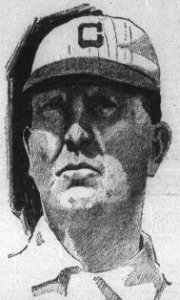
“Old Cy Young”

9 May

George S. Applegarth had a varied career as a journalist for papers in Buffalo, Philadelphia, Pittsburgh and New York.  He covered sports, wrote humor columns, reported on WWI from the front lines in Europe, and wrote poetry.

He published two “sequels” to Ernest Thayer‘s “Casey at the Bat” in his 1918 book “Pep: The Red Book of Sports for Red-Blooded Readers.”  Both poems are from the point of view of the pitcher—who he named Jake Weinerkraut, and who was a frequent character in his baseball poems—“The Man Who Struck Out Casey,” is Weinerkraut’s account of the game, and in “Why Casey Fanned,” the pitcher tells how he used his glass eye to blind Casey before the final pitch.

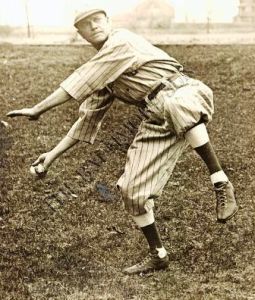
In May of 1912, Cy Young, battling arm problems, left the Boston Braves; the 45-year-old spent the first month of the season with the club having not thrown a pitch.  His career over, Applegarth honored the all-time win leader in The Pittsburgh Gazette-Times:

Cy Young

Cy Young

Old Cy Young

Old Cy Young!  How the very name

Breathes of the zest of the baseball game,

Conjuring pictures of crowded stands,

Echoing voices and clapping hands;

Players striving with might and main,

Moments burdened with stress and strain,

Nerves as tense as a whipcord strung,

And right in the heart of it,

Parcel and part of it—

Old Cy Young.

Old Cy Young!  How men grown gray

Smile as they read that name today;

Smile when they see that sturdy frame

Looming still in the good old game,

Years roll back and they feel once more,

Thrills and throbs of the days of yore;

Tales come leaping to many a tongue,

Telling the fame of him,

Lauding the name of him—

Old Cy Young.

Old Cy Young!  What a name forsooth!

Yet a paradox that tells the truth;

Old in the annals of baseball fame,

Young as the day when he entered the game;

Old in the measure of full success,

Young in the spirit of youthfulness,

Long may the praise of his deeds be sung,

Here’s to good health to him,

Long life and wealth to him—

Old Cy Young

Wendell Smith’s “Talent Hunt”

6 May

With Negro League baseball reeling from the effects of integrated professional baseball and years of disorganization, Wendell Smith and The Pittsburgh Courier set out to inject some life back into it.

Wendell Smith

Wendell Smith

A banner headline in the May 15, 1948, edition announced:

Courier Launches Talent Hunt

Smith did not spare the hyperbole in his explanation of the details:

The Pittsburgh Courier introduces this week the greatest scouting system ever devised in the history of baseball…It stretches from coast-to-coast and every foreign country in which this great newspaper circulates.”

Smith said the paper would pay $100 to any reader who recommended a player “Who is assigned to a professional ballclub and makes the grade.”

He said the “(S)couting system—which is even greater than those conducted by the major league club,” sought players “not to exceed 21,” who “may be of any race or nationality.”  The paper would then “conduct a thorough investigation of the candidate.”

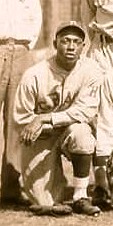
That “thorough investigation” would be conducted by some of the biggest names in Negro League baseball recruited as “Official Scouts” to vet the candidates.  They were Oscar Charleston, Ted Page, Dizzy Dismukes, Frank Duncan, Vic Harris, Winfield Welch, George Scales and Tex Burnett.

Vic Harris with the 1930 Homestead Grays.

Vic Harris 

Smith said of the paper’s “Scouts;”

“They will see these boys pay and send in a report to The Courier sports department.  If the scout’s report indicates the boy is a potential big leaguer, he will be immediately sent to a professional team for a trial.”

Smith promised every reader of the paper:

“(Y)ou automatically become an ‘ivory-hunter,’ a ‘bird dog,’ a real, honest-to-goodness baseball scout.”

The “Talent Hunt” had the enthusiastic support of Negro League magnates as well—despite having been the frequent targets of Smith’s and The Courier’s ire.

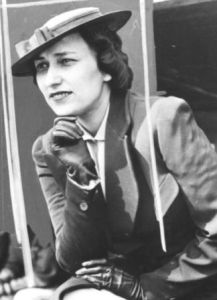
Effa Manley, Newark Eagles owner, said, “It will be a life saver for Negro baseball.”

Effa Manley

Effa Manley

Dr. John Johnson—an Episcopal minister in his second year as president of the Negro National League said, “(W)e are now going to discover more players than ever before.”

Negro American League President Dr. John B. Martin said, “It will help every team in baseball.”

Smith reminded readers:

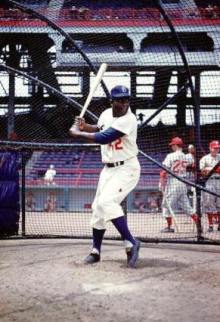
“(Jackie Robinson) was recommended to Branch Rickey, owner of the Brooklyn Dodgers, by The Pittsburgh Courier…Some pace there is another Robinson and The Courier and its many readers are determined to find him!”

Jackie Robinson

Jackie Robinson

The following week, Smith told readers:

“Letters are rolling in from New York City, Chicago, Detroit, and Los Angeles.  But the little towns are sending names of hopefuls too.  Everybody wants to be a scout!”

At the end of May, The Courier announced another addition to the Official Scouts: Elmer C. “Pop” Turner.  Nearly forgotten today, Turner was a football and baseball star at West Virginia State University—also Smith’s alma mater.  He played for several Negro League teams in the late 20s and early 30s, became a Negro National League umpire in the late 30s and early 40s, and coached baseball and football at North Carolina College at Durham—now known as North Carolina Central University.

By June 5, Smith promised:

“Someone is going to be one hundred dollars richer, and some young ballplayer is going to be a thousand times happier by virtue of The Pittsburgh Courier’s new ‘Talent Hunt’ campaign… (It) is in full swing and letters are pouring in from all over the country.”

The following week, the paper said, under the headline:

Twinkle, Twinkle, Little Star…He’ll bring you $100!

“All you have to do is find a likely prospect (and) send his name and address and other information you wish to Wendell Smith…This ‘Talent Hunt’ program is designed to uncover the ‘Stars of Tomorrow.”

The article said they were scouting “more than 200 young players” recommended by readers.

After that June 12 article, there was never another word written about the “Talent Hunt.”  Not by Wendell Smith, not by The Courier.  The promotion, which could have provided much-needed publicity and enthusiasm for the moribund Negro Leagues, disappeared without a trace; without so much as a mention.

Smith spent the remainder of the 1948 season covering major league baseball; and The Courier’s coverage of the Negro Leagues was greatly reduced from previous seasons, and nonexistent some weeks.

The only passing reference Smith made to the “Talent Hunt” came almost four months after the abrupt disappearance of the promotion.  It was in his column, under the headline:

Hard to Find Negro Baseball Talent

“Branch Rickey proved with Jackie Robinson that there’s gold in Negro players, and Bill Veeck of Cleveland substantiated that proof with Satchel Paige and Larry Doby…So major league scouts are scouring the country sides looking for Negro prospects, while the owners sit back and wait, envisioning record-breaking crowds in the future if their ‘bird dogs’ find a sepia star in the hinterlands.

But, said Smith:

“The scouts are out there snooping around like Scotland Yard detectives looking for talent, but having a difficult job uncovering it.”

Smith then listed several past Negro League players who should have had the opportunity to play in the major leagues, and said:

“Unfortunately, there aren’t such players around today.  That’s why there won’t be a large number of Negro players in the majors for some time to come.  They just can’t be found and were going to have to wait until the kids playing in the sandlots around the country develop.”

Smith’s pessimistic assessment of the state of “Negro baseball talent,” was likely the result of the paper’s failed promotion, as players continued to be scouted and signed without the help of the readers of The Courier.

“Its Existence is a Blot on the Statue of Liberty”

4 May

For two decades, Wendell Smith of The Pittsburgh Courier was at the forefront of the battle for the integration of professional baseball.  He called segregated baseball:

“(T)he great American tragedy!  Its existence is a blot on the Statue of Liberty, the American Flag, the Constitution, and all this great land stands for.”

Wendell Smith

Wendell Smith

For Smith, the “American tragedy” was exacerbated by the fact that he felt the players and fans were further harmed because while the quality of Negro League baseball on the field was of the same quality as that of their white brethren, the off-field operations were not.

In 1943, Smith said he hoped “(F)or the day when we can actually say there is such a thing as organized Negro baseball…Schedules are not respected, trades are made without the knowledge of the league officials, players are fined but the fines are seldom paid; and no one seems to know what players are ineligible and what players are eligible in the leagues.  It is a messy system.”

That same year, when Negro American President Dr. John B. Martin—a Memphis dentist who also owned the Chicago American Giants with his brother– said he was told by Kennesaw Mountain Landis that “Negro baseball will never get on a firm footing until a commissioner is appointed and a sound treasury built up.”

Smith responded:

“The sports scribes of the Negro press have been yelping to the high heavens for years for a real boss in Negro baseball.”

In 1946, when Baseball Commissioner A.B. “Happy” Chandler told the Negro League magnates to “Get your house in order,” The Courier story—which contained no byline but was likely written by Smith—said Chandler had told “Negro baseball the same thing everybody else has been telling it for five years.”

And, when the magnates said in response they were willing to improve the organizational structure of the Negro American and National League, Smith said in his column:

“It is significant to note, dear reader, that this concern is not motivated by a desire to improve the status of the Negro player, but simply to protect their own selfish interests.”

Of the Negro League magnates, he said:

“The truth of the matter is this:  Few, if any, of the owners in Negro baseball, are sincerely interested in the advancement of the Negro player, or what it means in respect to the Negro race as a whole.  They’ll deny that, of course, and shout to the highest heavens that racial progress comes first and baseball next.  But actually, the preservation of their shaky, littered, infested, segregated baseball domicile comes first, last, and always.”

Later in the column, he accused the owners of caring for nothing except:

“(T)he perpetuation of the ‘slave trade’ they had developed via the channels of segregated baseball.”

Smith felt integration was not only critical for the “advancement of the Negro player” and “the race as a whole,” but also critical to the Negro Leagues themselves.

In response to a letter written by Hubert Ballentine, an outfielder for the semi-pro East St. Louis Colts, which echoed the sentiments of many claiming integration would be the death knell of the Negro Leagues, Smith said:

“Negro baseball cannot be a success without major league cooperation.  Proof of that contention exists right today.  Our players receive salaries that the average big league player would scorn.  Our players receive less money per month than players in the class ‘B’ minor leagues… (I) believe that anything done by the majors to improve the status of Negro players will prove beneficial and advantageous to Negro baseball in every way.”

Smith held onto that belief through the signing and debut of Jackie Robinson, believing an organized Negro League could “(L)ine up with the majors and serve as recruiting grounds.”

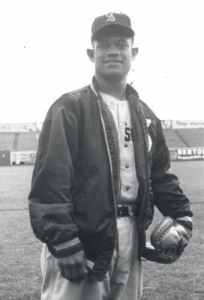
Much of his hope for a long-term place for the Negro Leagues in organized baseball was lost in January of 1948, after the San Diego Padres of the Pacific Coast League, signed 22-year-old Chicago American Giants catcher John Ritchey, who had won the Negro American League batting title in 1947.

John Ritchey

John Ritchey

Dr. John B. Martin—the American Giants owner and Negro American League President—protested the signing to Commissioner Chandler, claiming San Diego “had stolen Richey.”

Smith picked up the story:

“(Martin) demanded an investigation.

“But before Chandler could go to work on the case, he asked Martin to send him a duplicate of Richey’s contract for the past season…when Martin searched through his files—or whatever in the word he uses to keep such important documents—there was no contract to be found.  He then called in Candy Jim Taylor, manager of the club.  ‘I want Richey’s contract for last season,’ he said.  ‘I need to send it to Chandler.’

“Taylor raised his eyebrows in surprise. ‘I don’t have his contract,’ he said.  ‘You’re the owner and you sign the ball players.”

Taylor had not.

“Martin had to write Chandler to tell him he could not find Richey’s contract.  ‘But,’ he wrote, ‘he’s still my property.  He played on my club all last year.’

“The commissioner must have rolled in the aisle when he learned of this laxity on the part of the president of the Negro American League.  Obviously, he has been operating his club on an Amos ‘n’ Andy basis.

“Chandler then wrote to Martin: ‘The Executive Council of Baseball would want to handle, with the most careful ethics the cases of organized baseball taking players from the Negro Leagues.  At present , I am somewhat  at a loss to know how we can hold one of our minor league clubs responsible for the violation of an alleged contract when the contract itself cannot be found, and when apparently those responsible for obtaining the contract are uncertain whether or not the ever did obtain it.’”

Smith noted that Kansas City Monarchs owner J.L. Wilkinson made the same “robbery” claim when the Brooklyn Dodgers signed Robinson:

“But like Martin, he was unable to produce a bonafide contract with Robinson’s name on it.  That too, we’ll call an oversight.”

Those “oversights” said Smith, not integration of professional baseball, were what had cost the owners.

But, ever the optimist, Smith made one last effort to save Negro Baseball, with a plan that had it been successful,  could be the pitch for a reality show.  That story, coming up Friday


Things I Learned on the Way to Looking Up Other Things, Bill Joyce Edition

2 May

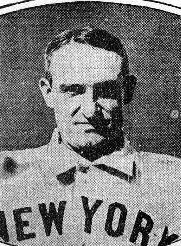
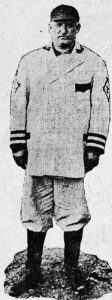
Scrappy” Bill Joyce’s managerial career ended badly.  In 1898, the player-manager was fired by New York Giants owner Andrew Freedman and replaced by Cap Anson—only to return as manager for the remainder of the season after Anson failed to turn the seventh place club around.  The turmoil took its toll on Joyce; after four straight .300 plus seasons, he hit just .258 in 1898.

Although just 32, and despite numerous reports of his imminent return to the Giants—or several other teams, including the St. Louis Browns, Washington Senators, and Cleveland Spiders— as a player or manager persisted for the next several years, he never played or managed another major league game.

He returned to his hometown, St. Louis, and opened a bar with Patsy Tebeau, and then later ran his own establishment after the two dissolved their partnership.  And, perhaps because of the way his career ended, and because of his inability to ever again secure an on-field job, he never stopped talking baseball, and became a popular source for sportswriters.

Scrappy Bill Joyce

Scrappy Bill Joyce

The Superstitious Jesse Burkett

Joyce told The Boston Globe in 1905 that “Ball Payers are a superstitious lot,” and that Jesse Burkett was among the most superstitious.

He said Burkett had one day received a tip at the racetrack on a horse that did not come in.

“After the race Jesse made one of his characteristic snaring, sarcastic remarks (to the tipster), who whirled around, and, knowing Jesse’s susceptibility to superstition said: ‘I’ll put the Spanish curse on you for a week.’

“The next day Burkett failed to get a hit and muffed a fly.  The next day he booted a grounder and struck out twice.  That night he sent for (the man).

“The racetrack man came down to the Lindell Hotel (in St. Louis), where Jesse was stopping.”

The man accompanied Burkett, who “was as serious as if he was making his will” to his room:

“(Burkett) unwrapped a package lying on a dresser and taking out a beautiful silk cravat said:

“’George, I’ll give you this ascot–it cost me $2—if you’ take off the Spanish curse.  I can’t make a hit while it is on.’”

The man snapped his fingers and said:

“’It’s off.’

“’Here is the tie,’ said Jess.”

According to Joyce:

“(T)he next day  Jesse made three hits.”

Joyce’s Tavern

In 1910, his tavern was located at 215 North Sixth Street in St. Louis.  But his love of taking baseball nearly cost him the business.

In August of 1910, The St. Louis Republic said:

“’Scrappy’ Bill Joyce, former captain of the New York Giants, and Washington’s old third baseman, forfeited his saloon license today because he kept open until 1 AM, Sunday, July 24, while holding a ‘fanning bee’ with (New York Giants Manager) John McGraw and Sam Crane, a New York sporting writer.”

Joyce testified in front of the city’s excise commission that no drinks were served after midnight, “All he and the two guests did until the policeman arrived was talk baseball.”

Later that month, The St. Louis Post-Dispatch said, Crane, the former infielder, then writing for The New York Journal, and McGraw, both came back to St. Louis and met personally with the excise commissioner, Henry S. Caufield—who would later serve as governor of Missouri—and said the incident was “primarily their fault,” while both backing up Joyce’s assertion that no drinks were consumed after midnight.  As a result of their efforts, Joyce was allowed to keep his license.

“Told in a Man’s Way by a lot of Men”

While continuing to operate his tavern in St. Louis, Joyce finally got back into professional baseball.

In 1911, he became owner and manager of the Missoula (Montana) franchise in the newly formed Union Association.  But by August The Salt Lake City Tribune said he had been stripped of the franchise “for nonpayment of salaries.”  He later did  some scouting for the Federal League’s St. Louis Terriers.  While assessing current players, Joyce came to the conclusion shared by many of his 19th Century brethren. He told The St. Louis Globe-Democrat:

Bill Joyce, 1911

Bill Joyce, 1911

“Baseball today is not what it should be.  The players do not try to learn the fine points of the game as in the days of old, but simply try to get by.  They content themselves if they get a couple of hits every afternoon and pay an errorless game.  The first thing they do each morning is to get the papers and look at the hit and error columns.”

It was, of course, nothing like it was during his career—when the game was more scientific:

“When I was playing ball there was not a move made on the field that did not cause everyone on the opposing team to mention something about it.  All were trying to figure why it had been done and to watch and see what the result would be.  That move could never be pulled again without everyone on our bench knowing just what was going to happen.

“I feel sure that the same conditions do not prevail today.  The boys go out to the plate, take a slam at the ball, pray that they’ll get a hit and just et it go at that.  They are not fighting as in the days of old.”

And the way they behaved after a loss:

“Who ever heard of a gang of ballplayers, after losing a game, going into the clubhouse and singing at the top of their voices?  That’s what happens every day after the game at the present time.  Immediately after the last man is out the players make a dash for the clubhouse, the ‘quartet’ hits up a song and the whole squad joins in.

“In my days, the players went into the clubhouse after a losing game with murder in their hearts.  They would have thrown any guy out on his neck if they even suspected him of intentions of singing.  In my days the man who was responsible for having lost a game was told in a man’s way by a lot of men what a rotten ballplayer he really was.  Generally, he was told to go back to carrying the hod or to the police force.  It makes me weep to think of the men of the old days who played the game and the boys of today.  It is positively a shame and they are getting big money for it, too.”

Lost Advertisements–Ty Cobb ‘The American Boy”

29 Apr

cobbamericanboy1921

A 1921 advertisement for “The American Boy.”  “The Biggest, Brightest, Best Magazine for boys in all the world.”

The magazine was published from 1899-1941, and at one point had a circulation of nearly 300,000.

The May issue, on sale for .25 at newsstands, featured Ty Cobb:

How Ty Cobb put new thrills in baseball!

“The, bulliest, most inspiring story of the year; the kind that will set your blood tingling and boost your enthusiasm!  Complete with splendid action photographs of Cobb.”

[…]

“Read Cobb’s experiences: how he has blazed a path to greater baseball; how his new standard is being felt in every department of the game.

“Read about the batters Cobb had t beat; how he used his brains at the plate and conquered his fear of southpaws; how he used his brains in base running;  the story of his greatest play; his lightning thinking and running;  how he fooled the fielders;  his nine ways to side; ‘picking up a fly,’ one of Cobb’s great tricks.

“Every line will delight you!”

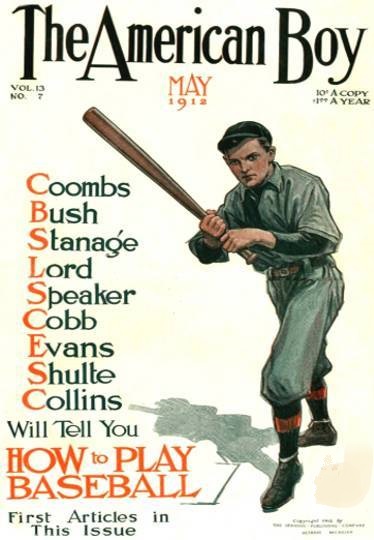
It appears that no copies of the May 1921 edition are still available.  Below is anther example of a baseball cover from “The American Boy” in 1912:

amboy1912

Baseball Wives, 1911

27 Apr

The Chicago Inter Ocean sent a reporter—a female reporter named Lois Willoughby—to get to know:

“The feminine element (that) is a silent factor in baseball of no mean importance.  It exerts a wonderful influence on the game…The women who preside over homes of West Side Players.”

The Chicago Cubs wives of 1911:

“The wives of members of the Chicago National League baseball team are always at the games.  They are thirty-third-degree fans—all but Mrs. (Nellie) Ed Reulbach…who is quite indifferent to the sport, and who wouldn’t know a base hit from a double play.”

As for the other wives of the defending National League Champions:

“They are comely, intelligent, charming women.  They know everything about the game.  They appreciate the value of every play.  They watch the contest with unflagging interest.  They cheer their husbands on to victory…Through ups and downs, they maintain unbounded enthusiasm and unfaltering faith in the Cubs.  They show it the only way they can by their daily presence in the grandstand.”

Manager Frank Chance’s wife, the former Edythe Pancake, attended every game:

“She may come at the last moment, accompanied by her Boston Bull pup, but she is generally comfortably settled for the afternoon before the game is called.  This beautiful woman, with golden hair and blue eyes, shares her husband’s enthusiasm in baseball.

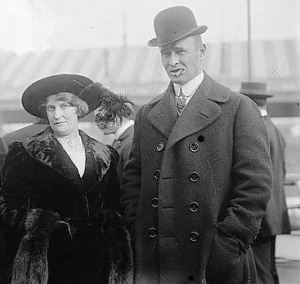
Edyth and Frank Chance

Edyth and Frank Chance

“’Do I come every day?’ she asked as though she could not have heard the question right.  ‘Why, of course, I do.  I wouldn’t miss a game for anything.  I think baseball is the greatest sport there is.  It is a profession now and an honorable one, at that. Every year it is exacting men of higher standards…Baseball is such a clean, healthful sport that I should think it would appeal to everyone.”

Jimmy Sheckard’s wife Sarah Jane said:

“I think Mr. Sheckard is the best left fielder in existence.  And he ought to be. Jimmy plays baseball, reads baseball, talks baseball and lives baseball…Baseball is the best profession and cleanest sport.  I don’t worry about the future.  With good health and good discipline, a man ought to get along all right anywhere.”

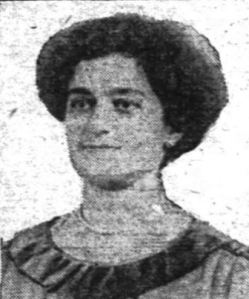
mrssheckard

Sarah Jane Sheckard

Ruby Tinker declared her husband the “greatest shortstop in the world,” and said:

“I never saw Joe on the diamond until after we were married.  I have watched him make many fine plays.  I think the best one was the day following his reinstatement this year (Chance suspended Tinker for “the remainder of the season” citing “gross indifference, on August 5—two days later he was back in the lineup) when he played against (Christy) Mathewson and got four hits.”

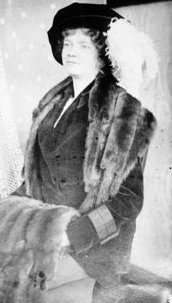
Ruby Tinker

Ruby Tinker

She said her life revolved around baseball “from morning until night,” and during the off-season as well:

“Joe goes into vaudeville in the winter and gives baseball talks with pictures.  I go with him as an ‘assisting artist,’ which means that I stand in the wings and prompt him…The winter spectators are just as enthusiastic as the summer ones.”

Of those who considered baseball a less than honorable profession, she said:

“They don’t know what they’re talking about.  Baseball is a good profession, a good sport, and good fun.”

Helen Evers insisted that despite reports there were no bad feelings among the 1911 team:

“The Cubs are a fine lot of men.  There seems to be perfect harmony this year, and they do good team work.”

As for her husband’s well-known difficult personality, she said:

“He has the reputation for being ‘crabby’ at times.  Perhaps he is, but that’s what put him where he is.”

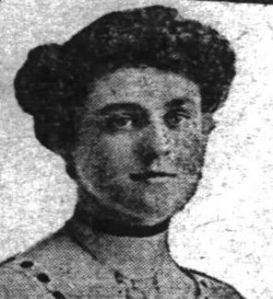
mrsevers

Helen Evers

Helen Evers noted one of Johnny’s other personality quirks:

“But when the jinx gets him!  If you don’t know about the jinx you can’t understand how serious it is.  I believe most of the players are superstitious, and they have enough to make them so. I always hope he won’t see a funeral on the way to the game.  That’s a sure sign of bad luck…there are scores of hoodoos and a baseball hoodoo seems hard to break.  One of the good signs is a wagon load of empty barrels.  I’m sure I would never know when they are empty.  These things probably count for nothing, but they seem to affect the nerves of the players.”

Back to Mrs. Reulbach who while not entirely against the sport, expressed her basic disdain for her husband’s chosen career:

“As a wholesome sport, I think baseball has no equal…But as a profession, it does not appeal to me. It is only for a few years at the most and the fascination of the game must make other professions  or lines of business seem dull and monotonous.”

And while conceding the Reulbach’s years in baseball had been “pleasant and profitable” she said:

“I trust Eddie Reulbach Jr. will not be a professional baseball player.”

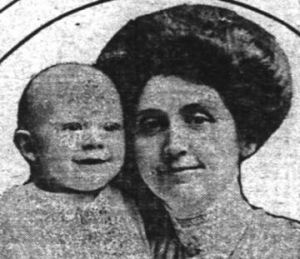
Nelly Reulbach with Ed Jr.

Nelly Reulbach with Ed Jr.

Ed Reulbach Jr., then 2-years-old, suffered from a variety of illnesses throughout his short life and died in 1931.

Willoughby concluded that as the 1911 National League race wound down:

“Hoping against hope, these faithful women have seen the pennant slipping farther and farther away from them.”

The Cubs lost the pennant to the Giants by 7 ½ games.

“A Great deal of Ingenuity is required in Making a Baseball”

25 Apr

In 1883, The New York Journal told readers about the business of making baseballs

“A reporter of this paper called upon Peck & Snyder (the New York-based sporting goods company) for information as to the extent of the trade and the amount of money invested in the business during the season.”

The paper concluded that “fully 5,000,000 baseballs would be manufactured” that year in the United States.

The representative of the company told the paper:

“About $12 per dozen for good balls; some are to be had for less, but these are the balls used by professional players…A great deal of ingenuity is required in making a baseball, and a great deal of science has got to be brought into play to make them perfect.

“In the center is a fine round piece of Para gum, which is covered by fine stocking yarn.  This is first stretched by machinery to its tension.  Then it is wound by hand so tight as to resemble a solid piece of material.  The winding is done by single strands at a time, which makes it compact.  A round white yarn is then put in and the whole covered with a plastic rubber cement.  When this becomes hard it preserves the spherical form of the ball and prevents the inside from shifting when the ball is struck by the bat.  More yarn is put over this cement and finally, the cover is added.  The covering is generally of a thin horsehide, as cow or goat skin becomes wrinkled and wears loose after a little knocking about. The sewing is done by hand, catgut being used instead of thread.”

Peck & Snyder "New" Professional Dead Ball, 1876

Peck & Snyder “New” Professional Dead Ball, 1876

After describing the composition of the ball, he explained the manufacturing process:

“Before the ball is completed it has to go through many hands, as no one man makes it from beginning to the end.  One does the winding; then another fits the cover over it, but few become proficient in the art of sewing on the cover.”

The process was time-consuming.  The representative of Peck & Snyder said:

“A dozen good workmen ought to be able to turn out twenty-five dozen balls in a day, and for this they get good wages.”

A circa 1877 advertisement.

A circa 1877 advertisement.

He also said his company’s process was superior to their competitors because of the materials they :

“Some of the manufacturers put carpet listing in the balls (rather than yarn), but this can be easily detected when the batting begins.  This is only done in cheap balls, such as used by the boys.  These are made in cups which revolve by fast-moving machinery. The insides are made of scraps of leather and rubber; then carpet listing is woven around the ball. It takes about ten minutes to turn out one of those balls complete.”

As for the amount of money spent on baseball equipment in 1883, the  company told The Journal:

“You may safely state that fully $5,000,000 will be spent on balls alone.  Then there is a large amount of money spent in bats, belts, hats and in fact for general outfit of baseball players… (overall) $10,000,000 is invested in baseball paraphernalia.”

Peck and Snyder was sold to A.G. Spalding and Bros. in 1894.

Lost Advertisements–“Walter Johnson says…”

22 Apr

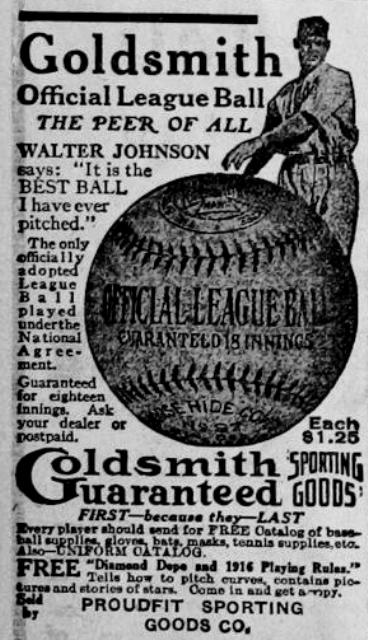
goldsmithbb

A 1916 advertisement for the Goldsmith Official League Ball:

The Peer of All

“Walter Johnson says: ‘It is the best Ball I have ever pitched.’

“The only officially adopted League Ball played under the NAtional Agreement.

“Guaranteed for eighteen innings.”

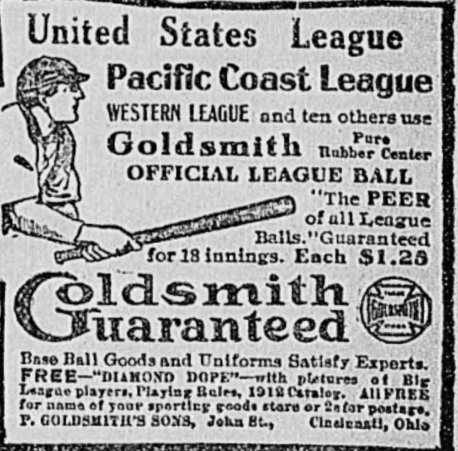
The 18-inning guarantee and mentions of the leagues which had adopted the ball for use were a staple of Goldsmith’s advertising, like the one below from 1912, announcing that the ball would be used in the United States, Pacific Coast, and Western Leagues:

goldsmith1912

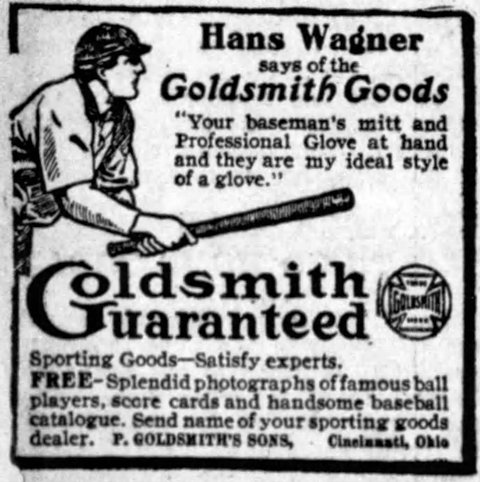
The 1912 ad used the same image–that of Honus Wagner–that appeared in the company’s 1911 sporting goods ad, which quoted Wagner: “Your baseman’s mitt and Professional Glove at hand and they are my ideal style of a glove.”

goldsmithwagner

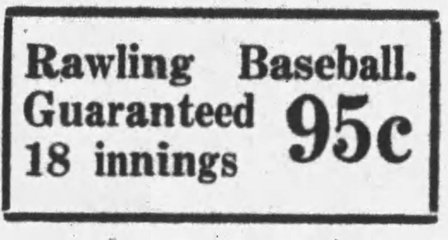
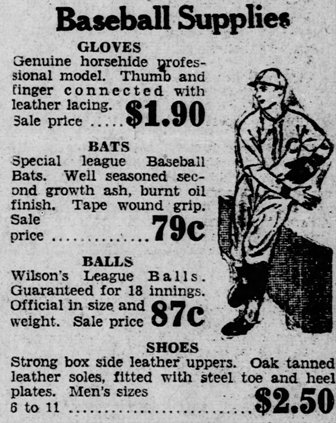
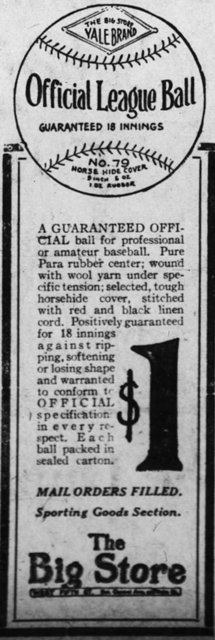
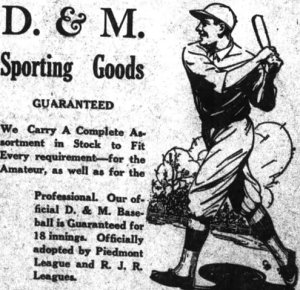
By the 1920s, the 18-inning guarantee became generic throughout the sporting goods world

rawlings wilson yaleball

dm

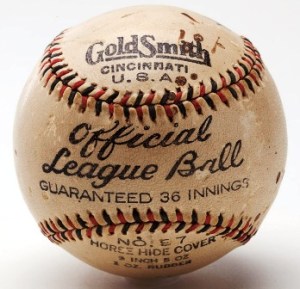
Not to be outdone, the Goldsmith ball of the 1930s was “Guaranteed for 36 Innings:”

goldsmith30s

“It is a Pure, Clean, Wholesome Game”

20 Apr

Billy Sunday took time out from saving souls in the Pacific Northwest in 1909, to talk baseball with a reporter from The Washington Post sent to cover the evangelist’s month-long revival in Spokane:

“I wouldn’t take $1 million dollars for my professional baseball experience.  I am proud I made good and that I was one of the best of them in my day.”

Billy Sunday

Billy Sunday

Sunday then went to bat for the unquestioned integrity of the game:

“Baseball is the one sport in this country upon which the gamblers have not been able to get their crooked claws.

“There isn’t the same disgrace attached to a professional baseball player that attends other professional athletes.  The gambler tried for 30 years to get control, but the men behind the game have stood firm and true.  Baseball has stood the test.  It is a pure, clean, wholesome game, and there is no disgrace to any man today for playing professional baseball.”

Sunday also said that after he “converted in 1886,” he discovered that:

“The club owners, the fans generally, and the players themselves will respect a man all the more for living a clean, honest life.”

While he said he rarely had time anymore to attend games, Sunday said he continued to follow the game closely and read the sports page every day.

Asked to name his all-time team, Sunday said:

“I would put (Cap) Anson on first base and make him captain, and I would have to find a place for Mike Kelly and John ClarksonGeorge Gore, Charlie Bennett, Kid Nichols, Amos Rusie, John Ward, Clark Griffith and others were all good men.”

Sunday returned his attention to his “Idol,” Anson:

“For every day in the season, for every occasion that might arise, I believe old Cap Anson was the best batsman the game ever knew.  Just look at that grand record of his…He could hit anything.  He used an extremely heavy bat…it used to do our hearts good to hear the crack when old ‘Cap’ Anson met the ball squarely.”

Sunday's "idol" "Cap" Anson

Sunday’s “idol” “Cap” Anson

The preacher then told the reporter about his career:

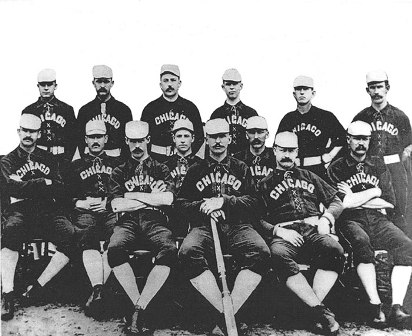
“My first professional contract (in 1883 with the Chicago White Stockings) called for $60 a month.  That was a windfall for me in those days, too.  When I quit baseball (in 1890) my salary was $500 a month.  The first two years I only got in a few games and was used more as a utility man.

“As a batter I averaged from .240 to .275 (Sunday’s averages actually ranged from .222 to .291) and that was fair in those days.”

Billy Sunday

Billy Sunday

He also recounted the visit received after he secured his release from the Philadelphia Phillies in 1890 in order to take a position with the Y.M.C.A. in Chicago:

“(On the day the release was announced) I was leading a class in a men’s noonday meeting in the Chicago Y.M.C.A., when Jim Hart, president of the Chicago club, walked in, and after the meeting laid down a contract on that old pulpit.  It called for seven month’s salary at $500 a month, with one month’s salary in advance.

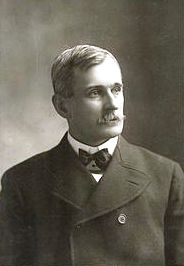
Jim Hart

Jim Hart

“Thirty-five hundred dollars and me almost broke with a wife and a baby to support.  It was a horrible temptation, especially since I loved to play baseball.  The next morning I sent Mr. Hart my refusal of his terms.  I accepted a position for the year with the Y.M.C.A. at $83 a month.”

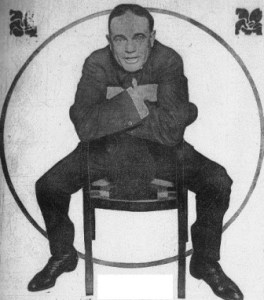
At the peak of his career as an evangelist in the early teens, it was reported that Sunday earned around $800 per day from the pulpit—roughly the annual salary of the average American worker.