“Fatty Weakened and Portland scored four runs”

24 Jan

Walter “Judge” McCredie went ahead with the scheduled spring series in California between his Portland Beavers and the Chicago American Giants despite criticism from Pacific Coast League (PCL) President Allan T. Baum and other league executives.

Much of the concern was the result of the Negro League team beating the Beavers four out of five games in the spring of 1913.

The results of the 1914 series were much different.  Foster, and most of the rest of the pitching staff were injured, and catcher Bruce Petway missed most of the games with a bad ankle.

The series began in Santa Maria with an 11-inning 8 to 8 tie.  “Smokey” Joe Williams, of the New York Lincoln Giants joined Rube Foster’s club for the series.  The Beavers pounded him for 14 hits.

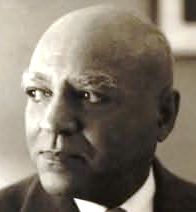
"Smokey" Joe Williams

“Smokey” Joe Williams

Portland won the second game in Santa Maria 5 to 0.  Harry Krause (who would win 22 games for Portland in 1914) shut out the American Giants on eight hits; Lee Wade struck out 9, but allowed 11 hits and took the loss.  The Portland Oregonian said Krause’s:

“Southpaw slants and spitballs stood the Negro Giants, of Chicago, on their heads.”

The series moved to Santa Cruz.

Portland beat “Smokey” Joe Williams again in game 3; 6 to 2.  The Santa Cruz Evening News said Williams “Had a nice curve, plenty of speed, but was a little wild.”  The American Giants loaded the bases with two outs in the ninth, but 19-year-old rookie Elmer Hanson struck out pinch hitter Frank Duncan to end the game.

Watsonville was the site of the fourth, and final, game.

The Santa Cruz Evening News said while McCredie and Foster made the trip together to Watsonville, McCredie asked which pitcher Foster was starting the next day:

“Foster replied that he did not know, as all were ailing, one way or another.

“McCredie suggested that he (Foster) pitch.  Foster said that he would pitch if McCredie would play, and an agreement was made.”

McCredie’s last season as a regular was 1909.  After playing in 61 games in 1910, he had appeared in just eight games from 1911-1913.

“(McCredie and Foster) appeared on the ball field in uniform and the Portlanders went to bat first, big Foster began to pitch and retired the side…Then it was that McCredie got cold feet.

“He refused to carry out his side of the agreement to play, and all coaxing and teasing and jibes from  both teams could not feaze him.”

Foster pitched five innings of one-hit ball, but in the sixth “Fatty weakened and Portland scored four runs.”
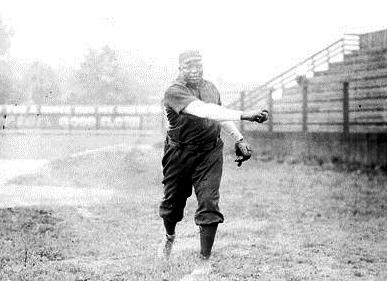
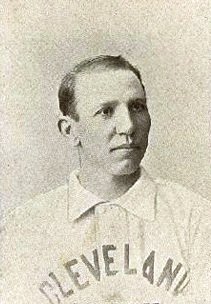
Rube Foster

Rube Foster

After the final game The Oregonian said:

“Perhaps it was taking unfair advantage, but in the recent Beaver-Negro series the Portland Coasters knew in advance nearly everything the twirlers tossed up the plate.

(James) Hi West and (Irv) Higginbotham were out on the coaching line every game stealing the catcher’s signs.”

The American Giants salvaged their West Coast trip in their series against Nick Williams’ Portland Colts. They won the opener on March 28 in Santa Rosa 6 to 0 behind a “Smokey” Joe Williams no-hitter.  Williams struck out nine of Portland’s  Northwestern Leaguers.  The Oregonian said:

“Williams, a tall, rakish looking mulatto (Williams’ mother was a member of the Comanche nation) set the Colts down without a hit or a run.”

The American Giants committed two errors, including one by third baseman Bill Francis.  The paper said:

(Duke) Whitt rolled one infield grounder toward third that might have been construed a safety, but the scorers graciously agreed to swallow race prejudices.  It was scored as an error.”

The series then went to Chico, California, and Medford and Grants Pass, Oregon, before finishing in Portland.

The Colts only managed one victory, beating the Giants 9 to 8 in Medford.  Although the colts won the game The Oregonian said the highlights were two long home runs hit by American Giants shortstop John Henry “Pop” Lloyd, including “one of the longest hits ever seen on the local field.”
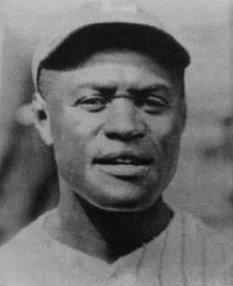
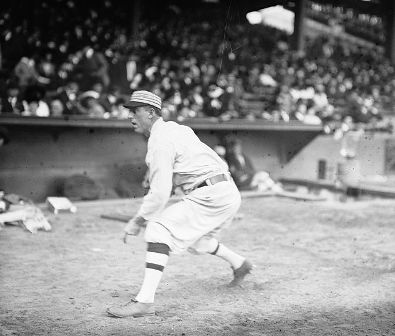
John Henry lloyd

John Henry Lloyd

The American Giants continued the spring tradition of traveling west to play Portland teams through the 1916 season.

Walter “Judge” McCredie later created some doubt that playing Foster’s team was simply a business relationship and not an expression of his opinion of the color line in baseball.  When he was criticised by PCL executives in 1914 he said: “the games are nothing more or less than training affairs.”  Later that season his attempt to sign a Hawaiian player of Chinese decent named Lang Akana was thwarted by PCL officials and his own players who threatened to revolt. In 1915 McCredie was quoted in The Chicago Defender:

“I don’t think the color of the skin ought to be a barrier in baseball…If I had my say the Afro-American would be welcome inside the fold.  I would like to have two such ball players as Petway and Lloyd of the Chicago Colored Giants who play out here every spring.  I think Lloyd is another Hans Wagner around shortstop and Petway is one of the greatest catchers in the world.”

It wouldn’t be until 1917 that a Chinese player would play professional baseball.
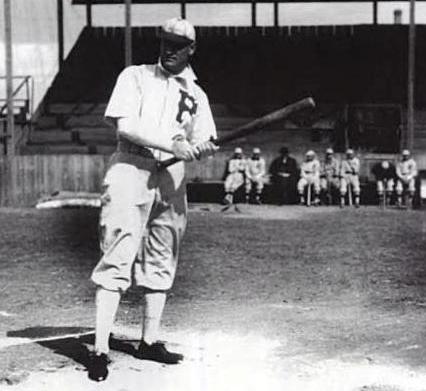
The Color Line and the PCL

22 Jan

In the spring of 1913 Walter “Judge” McCredie brought Rube Foster’s Chicago American Giants to the West Coast to play five games against his Portland Beavers of the Pacific Coast League (PCL).  The American Giants won four of the games and also split a two-game series against Nick Williams’ Portland Colts of the Northwestern League.

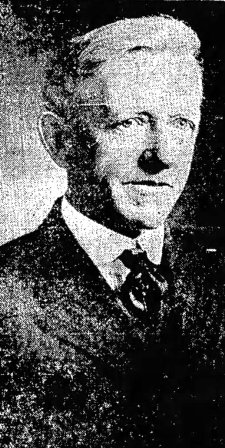
Walter "Judge" McCredie

Walter “Judge” McCredie

When McCredie made arrangements with Foster for the American Giants to return west in 1914 it created a stir in the PCL.  Joe Murphy of The San Francisco Call wrote:

“Some of the magnates and officials of the Pacific Coast League are bitterly opposed to Manager Walter McCredie’s plan of playing a series of games with the Chicago Giants, an aggregation of colored ball players.  The Beavers played the colored tossers during their training trip last season and were badly beaten by them.”

Murphy said “no official action can be taken against McCredie to prevent his team engaging in games with the dusky tossers,” but said several prominent PCL figures “do not mince any words” regarding the games.

Dan Long, who had managed the San Francisco Seals from 1908 through 1912, was now a West Coast scout for the Chicago White Sox and booked the team’s 1914 spring games in California.  Long said he turned down a request for the Sox to play the American Giants:

“Colored players are barred in organized baseball, and I can see no reason why white players should even meet them in exhibition games, if they are barred by the baseball powers.  Baseball is a sport that must be elevated, and it is up to the managers and players to keep it free from criticism.

“I never arranged or played in any games with colored players, and I doubt Mr. (Charles) Comiskey, owner of the White Sox, would allow his team to play with the colored men.”

James Calvin “Cal” Ewing, the owner of the San Francisco Seals, who was one of the PCL’s founders and a former president of the league, was equally as outspoken:

“If I were a player working for McCredie, and he asked me to go out and play against these colored fellows, I would refuse to do it for him.

“There are two classes I bar from playing on my ball park—colored tossers and bloomer girls.  They will never use any park I control.”

Cal Ewing

Cal Ewing

Allan T. Baum, entering his third season as the PCL’s president said he was against the games, but was powerless to act because the games were played outside of the league’s regular season:

“I have no jurisdiction in the matter, but my sentiments are strongly against it.  I am sure that there is not another manager in the league who would consider playing with the Chicago Giants.”

Lester Aglar Walton, managing editor of the East Coast’s largest circulation black newspaper, The New York Age, responded to “the vicious article” from the West Coast:

“Joe Murphy, in an heroic effort to start needless agitation relative to the drawing of the color line in organized ball, does a journalistic stunt which, while humorous for the absurdities contained therein, is a curious document for the lamentable ignorance which this writer and other show on the subject.”

Walton said the color line was borne solely out of fear:

“The cowardly practice of using the color prejudice subterfuge as a cloak to hide the white man’s fear in open competition with the colored man in various avenues of endeavor will someday lose its effectiveness.  The truth of the matter is some white managers and players are not opposed to playing colored teams solely on account of color, for if their aversion was based purely on color the Indian would not be permitted to join organized baseball, nor would teams of the two major leagues journey every winter to Cuba to engage in games with native players, many of whom are as black as the ace of spades.”

“Manager Walter McCredie is the only game white man in the Pacific Coast League.  He is not afraid to permit his team to meet a strong colored nine and fight it out on the diamond.  There would not be a word of complaint today about the beavers and Giants playing a series of exhibition games had not the colored team given undisputed evidence of its supremacy last spring.”

Lester Aglar Watson

Lester Aglar Watson

McCredie claimed he wasn’t making a social statement.

He told The Portland Oregonian he needed to schedule the games in order to compete with teams like San Francisco in the regular season.  The Seals, he said, were preparing for the season by playing the White Sox, and taking in between $15,000 and $20,000 in the process:

“Yet they rave because I book the Beavers for four or five games against the Negroes, although they furnish the only stiff opposition available.

“It is to laugh.  Likewise the statement that playing against the Negroes hurts baseball.  It might, were we to consider them on an equal footing because of the strong race prejudice that exists here on the Coast. But the games are nothing more or less than training affairs.”

Despite the objections, Foster and his team arrived on the West Coast in March of 1914.

The rest of the story on Friday

“Zimmer was not to be frightened.”

20 Jan

On March 28, 1907 the New York Giants took the field against the Philadelphia Athletics in the second game of a five-game exhibition series at New Orleans’ Athletic Park.

The umpire was new.  Charles Louis “Chief’ Zimmer, after a 19-year career a major league catcher had tried his hand at managing in 1906.  His Little Rock Travelers finished last in the Southern Association with a 40-98 record.

Chief Zimmer

Chief Zimmer

The Atlanta Constitution said:

“Zimmer underestimated the strength of the league, and brought men into it who did not have the goods to deliver.”

After Zimmer was dismissed by Little Rock he joined the Southern Association’s umpire staff.

The Giants/Athletics series would be among his first games as a professional umpire.

The Giants won the first game 4 to 3.  The Giants scored two runs with two outs in the bottom of the ninth off Jack Coombs for the victory.  The Philadelphia Inquirer said:

“Zimmer umpired a god game… (but) the rowdy element in the Giants broke loose frequently, and the Chief had many disputed with some of the men.”

The second game did not go as well.  The Inquirer said:

“The Giants were the first at bat, and the first two men were retired. (Art) Devlin and (Cy) Seymour then signaled safely to the outfield, each moving up a base on (Rube) Oldring’s throw…(Frank) Bowerman was then up to the bat.  (Eddie) Plank soon had two strikes and one ball on him.”

With a one and two count the Giants claimed Plank balked when he threw to third and picked Devlin off.  Zimmer said he didn’t.  Roger Bresnahan and Mike Donlin, coaching at first and third, “rushed at Zimmer from the coaching lines and a wordy war ensued.”  Manager John McGraw came out of the dugout and ‘a half hour was consumed in ‘beefing.’”

Eddie Plank

Eddie Plank

Zimmer finally ordered McGraw back to the bench and:

“Play was about to start again when a remark made by McGraw caused Zimmer to order McGraw off the grounds.  The New York manager refused to go, and a lively tilt between him and Zimmer took place, the entire New York gang surrounding the “Chief” in an effort to bulldoze him.  But Zimmer was not to be frightened.”

New Orleans police officers came out on the field as Zimmer declared the game a forfeit after a half inning.

McGraw said his team would not play in the game scheduled two days later if Zimmer was the umpire.  The Inquirer said Athletics Captain Harry Davis “informed McGraw that inasmuch as the giants had turned down Zimmer as the umpire the series might as well be called off.”  New Orleans Pelicans owner Charlie Frank also threatened to bar the Giants from Athletic Park.

On March 30 McGraw arrived at Athletic Park with only nine players consisting of “nearly all the youngsters in camp.”

With both teams on the field, Zimmer approached the Giants dugout and asked for the team’s lineup and was told the Giants would not play if he were not replaced as umpire.  Zimmer announced that the Giants had again forfeited and the Giants left the ballpark.  Frank’s New Orleans Pelicans took their place and pitcher Mark “Moxie” Manuel defeated the Athletics and Rube Waddell 4 to 2.

Waddell--lost to the New Orleans Pelicans

Rube Waddell–lost to the New Orleans Pelicans

The series was over.

Before the Giants left New Orleans that evening, McGraw confronted Thomas Shibe, business manager of the Athletics and son of team president Ben Shibe, in the lobby of the St. Charles Hotel.  The Inquirer said:

“Manager McGraw backed up the entire New York team, insulted Thomas Shibe…by calling him vile names.  McGraw alleged that Tom had informed several persons that he had heard McGraw using insulting language to Umpire Zimmer… pursuing the same cowardly tactics which have made him famous over all the base ball circuit (McGraw)did not keep within reach of Shibe.  He kept well within the group of rowdies which make up his team, and thus being forfeited from any attack from Tom, naturally was as brave as a lion.”

The paper said McGraw disappeared from the scene as soon as members of the Athletics arrived in the lobby.

Frank Leonardo Hough, baseball writer for The Inquirer, took McGraw to task for his actions, and charged the New York press with allowing McGraw and Giants’ management to intimidate them out of “writing the truth” about the team:

“The press of no other city in the Union would stand for the tactics employed by the Giants.  Such a condition of affairs would be impossible in Boston or in Philadelphia.  There are any number of thoroughly equipped baseball reporters in New York City—reporters who know the game from A to Z, who, if permitted to write the game as they see it, would be the peers of any bunch of critics the country over.  But, unfortunately they are under an awful handicap.  Let them criticize the Giants to the latter’s disadvantage and their occupation is gone.  They will be made to feel the displeasure of the august heads of the Giants by being debarred from the Polo Grounds.

“Now and then a paper will stand by its representative, but only in rare cases.  Charley Dryden, Sam Crane, Joe Vila, Eddie Hurst and numerous others were barred from the grounds.”

Hough said some reporters “stand on their manhood, and take up other fields of newspaper endeavors. But the majority of them, less favored perhaps, cannot afford to fight with the bread and butter, and consequently they are compelled to go along, glossing over the Giants’ bad breaks or bad playing as lightly as possible, while others crook the pregnant hinges of the knee until they become almost hunchbacked and ignore everything and anything that might reflect upon the Giants.  That is the reason why the New Yorkers are the best uninformed baseball public in the country.”

No disciplinary action was taken against McGraw; Giants owner John T. Brush was said to have reimbursed Charlie Frank for $1,000 in lost revenue. The Giants finished in fourth place in 1907, the Athletics third, as the Chicago Cubs ran away with the National League pennant, beating the second place Pittsburgh Pirates by 17 games.

Hough continued to write about baseball for The Inquirer despite being an investor in the Athletics (Hough and Sam “Butch” Jones of The Associated Press each held a 12 ½ percent stake in the team beginning in 1901—Jones became a full-time Athletics employee in 1906, Hough remained a sportswriter during the twelve years he held his stock).  He sold his stake to Connie Mack in 1912 and died in 1913.

Chief Zimmer’s tenure as an umpire did not improve much after his first experience in New Orleans.  He opened the season as a member of the Southern association staff, but on July 9 announced his resignation.  His final game was on July 13 in Nashville.

Ovie, Oh, Ovie

17 Jan

Arm trouble ended Orval Overall’s career early.  When he left baseball for the first time after the 1910 season he had a 104-66 record, won 20 games twice, and went to the World Series four times with the Chicago Cubs (3-1 in eight appearances).

orvie

Orval Overall

After a visit to John D. “Bonesetter” Reese, a self-trained Youngstown, Ohio-based practitioner of alternative medicine, who while popular among many of the era’s major stars, was condemned by medical professionals.  Despite being “healed,” Overall was unable to come to terms with the Cubs and sat out the 1911 season.

Remaining in his native California, Overall worked at the gold mine he owned with Cubs teammate Mordecai “Three Finger” Brown in Three Rivers and pitched for Stockton team in the “outlaw” California League.  His success in California during the fall of 1911 gave the Chicago press hope he would return to the Cubs in 1912.  The Chicago Inter Ocean said:

“Orval Overall’s arm seems to get better every time he pitches a game.  Last week the former Cub whom Manager (Frank) Chance is trying to persuade to return to the West Side team struck out seventeen men twirling against the All-Sacramento team for Cy Moreing’s Stockton outlaws.”

Later in the fall Overall hurt his arm again.  He returned to “Bonesetter” Reese in December and told The Youngstown Vindicator he was finished with organized baseball, and would “Confine himself to his mining business and with occasional independent ball.”

Overall pitched a few games for a semi-pro team in Visalia; thirty minutes from his mine.

Orville Overall

Orville Overall

In February of 1913, he petitioned the National Commission to reinstate him and declare him a free agent because the Cubs “omitted to send him a contract” in 1912.  The commission granted his reinstatement but returned him to the Cubs.

Overall pitched in just 11 games, with a 4-5 record and .3.31 ERA; he was released to the San Francisco Seals in the Pacific Coast League (PCL) in early August.

Overall’s return to the West Coast was an event, and Seals fans even attempted to tell the club when the popular pitcher should make his first start.  The San Francisco Chronicle said:

“Orval Overall, the famous California pitcher, who built up such a reputation with the Chicago Cubs, will pitch for San Francisco today against Venice (Tigers).  A petition signed by sixty Seal fans was sent to (Manager) Del Howard yesterday, with the request that Overall’s first appearance be billed for Sunday afternoon.”

Howard chose to start Overall the day before the fans requested, nevertheless, the game drew a crowd of nearly 10,000 and The Chronicle said: “they gave him a reception long to be remembered.”

Overall gave up five runs, and was lifted in the ninth inning for a pinch hitter.  The Seals lost 8-5 in 11 innings.  He ended the season 8-9 with a 2.14 ERA.

At the end of the 1913 season, Overall announced his retirement.  San Francisco fans were not convinced and said The Chronicle said he “was being counted upon to be one of the mainstays in the box.” But chose to take a job with Maier Brewing Company “in the South” (Venice, CA—still a separate city from Los Angeles at the time.  The Maier family also owned the PCL’s Venice Tigers).  San Francisco fans were not convinced, and there was speculation for the next four months that Overall would return.

Reporter L. W. Nelson, The San Francisco Call’s resident poet composed a verse to try to coax the pitcher back:

Ovie, Oh, Ovie

Ovie, oh, Ovie, come home to us now,

For the season is soon to begin,

And we need you, yes, badly, to show the folks how

The Seals, when they have you, can win!

Ovie, oh, Ovie, sign up with us quick,

Put your name on the contract from Cal,

For we know you can make all others looks sick,

If you pitch for our Seal crew, old pal!

Ovie, we know it is your fondest dream

To work down in Venice for Maier,

Midst the Milwaukee water, the lager and steam—

We know you would like it down there!

Ovie, oh, Ovie, sign up to play ball,

And don’t try your beer selling skill,

For the job in the brew’ry won’t help us at all,

But your pitching most certainly will!

(“Cal” was Seals owner James Calvin Ewing)

As late as March 1914 Overall hinted that he might return, but the pleas and the poem did not sway him.

He left the beer business after a year to manage his family’s large lemon and orange growing operation near Visalia, which would make him quite wealthy.  He became a banker and dabbled in politics and competitive trap shooting.  He died in 1947.

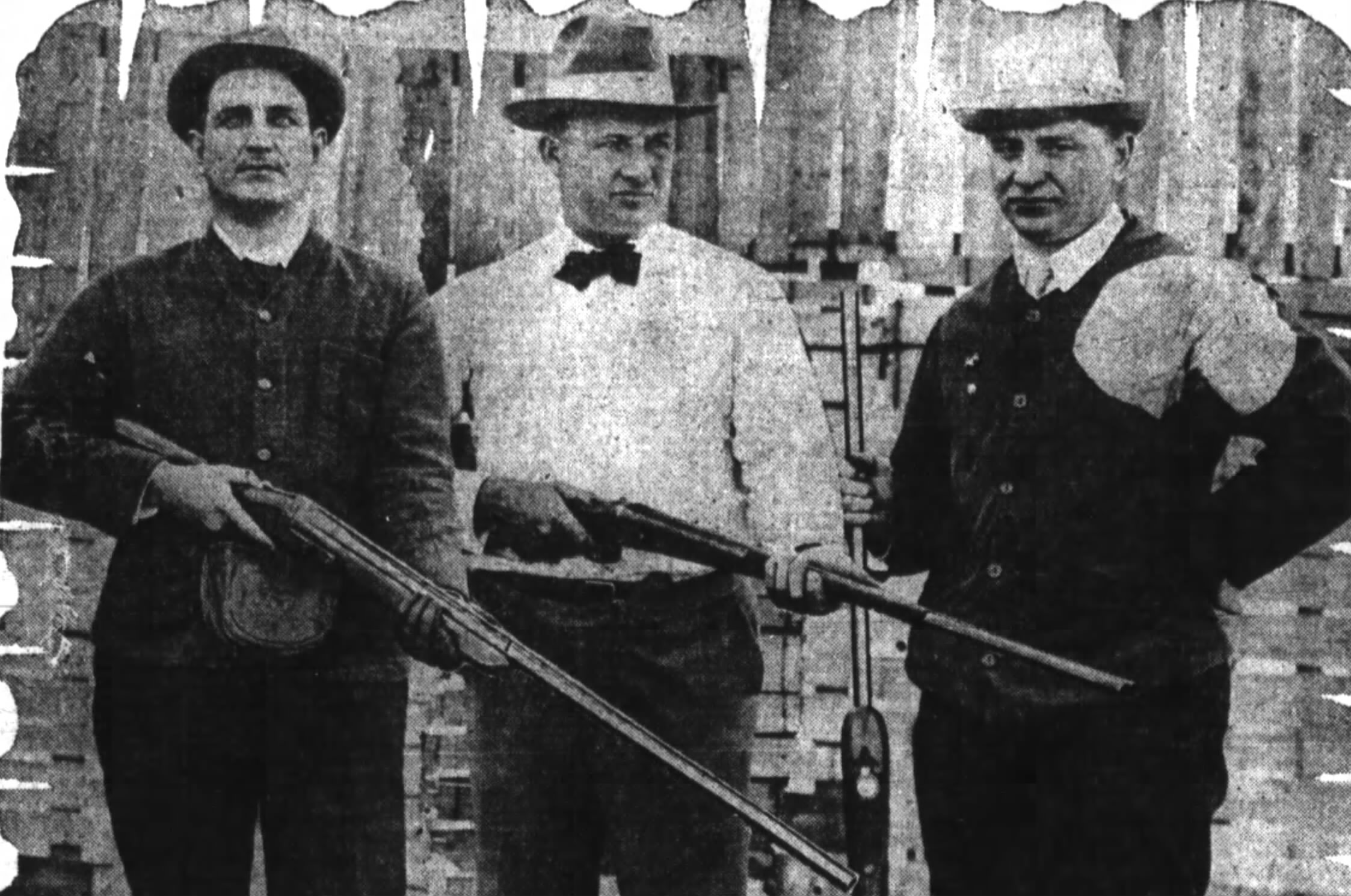
Overall (center) was president of the California-Nevada Trap Shooters Association (1918)

Overall (center) was president of the California-Nevada Trap Shooters Association (1918)

“Sunday was not a ‘real’ Ball Player”

15 Jan

Fred Pfeffer, a member of the Chicago White Stockings “Stonewall Infield” in the 1880s, became the proprietor of a number of popular saloons in Chicago.  He opened Pfeffer’s Theater Court Buffet on State Street in 1911; the tavern, located in the alley between the Majestic and  McVicker’s Theaters, was a popular meeting place for athletes, vaudeville performers and newspaper reporters.

Fred Pfeffer

Fred Pfeffer

In 1912 Harvey Woodruff of The Chicago Tribune was present when Pfeffer and Jimmy Ryan held forth on some of their teammates:

Billy Sunday was the only successful ‘made’ ball player I ever heard of in the history of baseball.  Not a man on our team except (Cap) Anson had any confidence in Sunday when he joined the club (in 1883), nor for a long time afterward, for that matter.  Anson liked Sunday because he was like lightning in getting to first base.  Sunday was not a great hitter.  He could scarcely be called a great fielder, but he was the fastest man of his time in legging it down to first base.  My, how he could run!  But after Billy was on first I would sooner have had Anson there, and none of us accused Anse of being the best base runner of his time.  We thought Billy was too daring.

“But Anson insisted Sunday would make a ball player.  So he was taught to bat, to field, and to run bases.  Anson spent more time with him than with all the rest of us put together.  What skill Sunday attained was developed.  Most of us finally admitted that Anson’s judgment was justified, but others on the team retained to the last their opinion that Sunday was not a ‘real’ ball player.

“Those who obstinately kept that opinion might have been influenced in part by prejudice, for those were times when team discipline was not as severe as now, and Sunday chose his companions.”

Billy Sunday

Billy Sunday

Pfeffer told The Tribune reporter that Ned Williamson had the best arm he had seen.

While playing as an amateur in his native Louisville in 1881 Pfeffer had “won a gold medal, which is still in his possession for throwing a ball 400 feet.”  After joining the White Stockings he participated in a throwing contest at Chicago’s Lake Front Park “and threw the ball 399 feet and six inches.”  He was beaten by six inches by Williamson.

The mention of Williamson’s arm strength reminded Ryan of “an incident of the trip around the world taken by the White Stockings” after the 1888 season:

“Following one of the exhibitions in England, some native cricketers were holding a competition in throwing a cricket ball.  A crowd circled the field beyond the range of the throws, taking a keen interest in the sport.  Williamson, who had not allowed his baseball duties to prevent his enjoyment at a nearby pub, watched the proceedings for a time with growing impatience.

“Finally, swaggering up to the circle, Williamson said: ‘Let me take that ball for a minute.’ Then, scarcely setting himself for the effort, he hurled the ball.  It soared clear over the heads of the crowd on the outskirts. “

Ryan claimed no one knew exactly how far Williamson’s throw traveled because “everyone was so surprised (by the distance of his throw) no attempt was made even to recover the ball.”

Ned Williamson with White stockings mascot

Ned Williamson with White stockings mascot

The subject next turned to bunting.  Pfeffer said

“We knew the bunt, but seldom practiced it.  Those were the days when long hits were wanted, and the play would not have been popular.  We more often played a variation of what is known now as the hit and run.  It seems to me there were more players who could hit to right field then.

“I often have been asked whether all the great hitters of that time were swingers who clasped their bats at the end of the handle.  I do not recall that we held our bats any differently from the players of today.  Some held it near the end and some did what you now call ‘choking it.’ I think, perhaps the proportion of chop hitters was less then, for everyone liked to see long drives.”

Pfeffer continued entertaining patrons and reporters at the Theater Court Buffet until the passage of the Eighteenth Amendment put him out of business—his obituary said he sold “bar and all” for $1.50.  Pfeffer died in Chicago in 1932.

“Three or four Men who looked like Wonders in the Big Leagues Disappeared”

13 Jan

In 1912 The Cincinnati Times- Star‘s Sports Editor William A. Phelon questioned why professional baseball had not become integrated:

“The prejudice against the Negro ballplayer is a strange and a deep-rooted thing in baseball circles, and all through the country, little leagues and big, from Maine to Mexico, the prejudice holds sway.  The African is barred from the places where the Indian is royally welcome and the athlete of negro blood must not presume to mingle in white baseball society.

“Strange to say, the white ball players, even the haughty southerners like (Ty) Cobb and (George) Suggs will gladly play games against Cuban clubs, composed mostly of black men.  They will play exhibition games against Negro teams, treating the black men with the utmost cordiality and fairness, but will not tolerate Negros in their own crowds or in the white clubs of the same circuits.”

Phelon said Moses Fleetwood “Fleet” Walker’s short stay with the Toledo Blue Stockings demonstrated that even the most bigoted of teammates could manage to work with a good player—even if they treated him unreasonably:

 “Formerly there were a few clever Negro ball players in the big leagues, one of the best being Walker, a black catcher who was as good behind the bat as any white man of his time.  It was said of Walker that when he was catching Tony Mullane, the latter refused to stand for a Negro giving him battery signs.  Walker then agreed to work without a battery sign of any kind, and the battery of Mullane and Walker proved one of the most successful of the season.”

Walker and James “Deacon” McGuire were the team’s two primary catchers, each playing 41 games behind the plate.  Mullane was 36-26 in 67 games (the team was 10-32 in games Mullane did not figure in the decision).

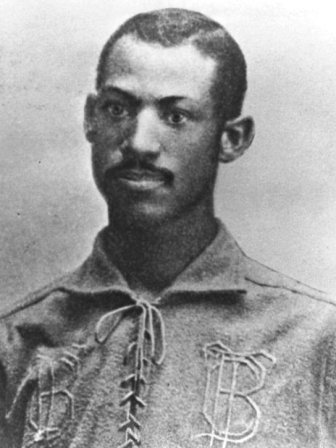
Moses Fleetwood Walker

Moses Fleetwood Walker

Thirty-five years later Mullane told The New York Age that Walker was the “best catcher I ever worked with.” He said:

“I disliked a Negro and whenever I had to pitch to him I used to pitch anything I wanted without looking at his signals.  One day he signaled me for a curve and I shot a fast ball at him.  He caught it and walked down to me.

“’Mr. Mullane,’ he said, ‘I’ll catch you without signals, but I won’t catch you if you are going to cross me when I give you signal.’

“And all the rest of that season he caught me and caught anything I pitched without knowing what was coming.”

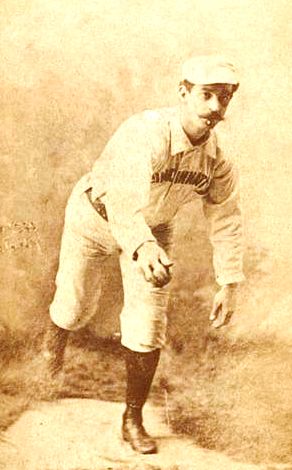
tonymullane

Tony Mullane

Phelon also suggested that more than one player since Walker had managed to pass for a short period of time before being found out:

 “Now and then a Negro man has slipped over the bars, passing himself off as a suntanned white man or Indian, but sooner or later he has been unmasked and quietly vanished from the game, doubtless to turn up under some different name, with one of the strong Negro teams that tour the country.

“Three or four men who, for a little while, looked like wonders in the big leagues disappeared in that way and to this day fans marvel why such clever athletes should have quit and left no word behind.  Some of these players were so near white that they fooled the Northern athletes completely, but almost every ball club now contains two or three sons of Dixie, and you can barely deceive them on a Negro.”

Phelon also told the story of a first baseman who “broke into one of the major clubs, and he was a corker.  He could hit and run and field like a demon.”  He claimed that during a game in Washington a Virginia congressman recognized the player as a “black scoundrel” trying to pass as white, thus ending his career.

Unfortunately, Phelon left no clues about the players he claimed briefly “slipped over the bars” and there’s no way to verify whether his claims were legitimate or simply apocrypha indented to make a point.

The idea of players “passing” has intrigued historians.  Claims have been made about several players, including George Treadway and George Herman “Babe” Ruth.  None have been verified.

“William J. Bryan was a Ballplayer”

10 Jan

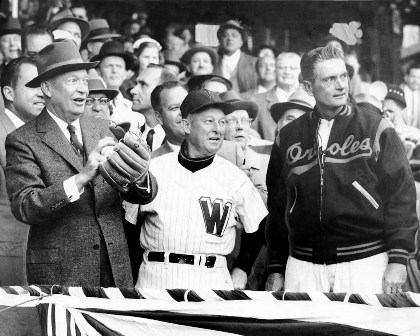
It’s fairly certain that claims of President Abraham Lincoln playing baseball were fabricated years after the fact, and the debate is ongoing over whether President Dwight Eisenhower appeared in a handful of games for the Junction City Soldiers in the Central Kansas League in 1911.

President Eisenhower at the 1957 American League opener in Washington--with Senator  Manager Chuch Dreesen and Baltimore Orioles Manager Paul Richards

President Eisenhower at the 1957 American League opener in Washington–with Senator Manager Chuck Dressen and Baltimore Orioles Manager Paul Richards

During William Jennings Bryan’s second of three campaigns for the presidency his prowess as an amateur player made the news.

Bryan received the Democratic nomination in 1900 t0 challenge President William McKinley who had defeated him in 1896.

In the weeks before the election an article, which first appeared in The St. Louis Republic, told of Bryan’s connection to the national pastime:

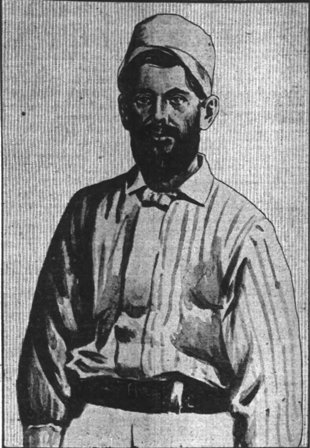
“That William J. Bryan was a ballplayer way back in the ‘80s when he commenced the practice of law in Jacksonville, Illinois, would probably have not been known, at least not authenticated, were it not for a telltale photograph.”

The picture was in the possession of a Denver businessman named John Springer, the nephew of former Illinois Congressman William McKendree Springer.  Springer said when Bryan became an attorney and moved to Jacksonville in 1883 he became part of a ballclub comprised of local attorneys from 1884 until he moved to Lincoln, Nebraska in 1887:

“The day the picture was taken, Mr. Springer recalls that the club of which Bryan was pitcher and himself catcher, had been victorious over a team made up of the best players among the town store clerks.  He also recalls that victory was pulled out of defeat in the ninth inning by Bryan’s home run hit.

“’I remember the incident perfectly,’ said Mr. Springer.  ‘The score was 18 to 20 against us, for we were not in the habit of playing 1 to 0 games in those days.  There were two men on bases when Bryan came to the bat.  Bryan was not the sturdy built man those days that he is now, but the way he swung his bat on the first ball pitched over the plate was a surprise to all the players, and the 500 or 600 spectators who viewed the game from a point of vantage along the first and third base lines, and the foul ground back f the catcher.  Bryan knocked the ball clear over the center fielder’s head, and into another lot in the distant back ground.  Around the bases he went driving two other men ahead of him and the game was won.  Bryan played with as much determination and enthusiasm as he has shown in his political career.  He was looked on as a good amateur pitcher in those days, and often after the game my swollen hands attested the speed he had.”

Springer said Bryan wore a beard in the 1880s because it gave him “a more elderly and dignified appearance…it can hardly be said that the picture resembles Mr. Bryan as he looks today, it is he, however, as he appeared in a baseball uniform along with the rest of us in 1884.”

William Jennings Bryan in baseball uniform 1884.

William Jennings Bryan in baseball uniform 1884.

Bryan’s connection with baseball failed to help him at the polls.  McKinley was reelected in November.

McKinley missed his own appointment with baseball immortality during his time in office.

Bryan was the Democratic nominee one more time, in 1908, and was defeated by William Howard Taft, who began the tradition of the president throwing out the first ball of the season.

“Apperious is a high-toned Man”

8 Jan

After igniting a controversy in Vermont’s Northern League in 1905 when he refused (as he had in college in 1903) to appear on the field with William Clarence Matthews, Sam Apperious returned to Alabama in 1906.

He played centerfield for the Montgomery Senators in the Southern Association.  The Washington Post said in March “it is said that Connie Mack has arranged to try him out with the Athletics next fall.”

Sam Apperious

Sam Apperious

The Atlanta Journal said he was in Alabama, and not the big leagues, by choice:

“Apperious is a high-toned man, a graduate of Georgetown, and plays ball for his home town because he likes the game.  He is not in the strict sense a professional, for he declines to go the big league, where he could easily get a much larger salary.”

In Montgomery Apperious became part of the biggest controversy of the Southern Association’s 1906 season—the league had no shortage of controversies each season.

It started with a fly ball to Apperious in an otherwise uneventful 9-0, June 10 victory over Charlie Frank’s Pelicans in New Orleans.  The Journal said:

“It sailed so high in the air that Apperious, who caught it, concealed under his shirt and gave it Manager (Dominic) Mullaney.  When cut open (the following day in the presence of Shreveport Pirates Manager Bob Gilks) it was found to be wrapped in rubber.”

Charlie Frank

Charlie Frank

Five days later the Atlanta Crackers were in New Orleans when, in the eighth inning after home runs by Pelicans’ William O’Brien and Mark “Moxey” Manuel,  Atlanta second baseman and captain, Adolph Otto “Dutch” Jordan suspected something was wrong with the balls.  The Atlanta Constitution said:

“(After Manuel’s home run) The ball was lost and new one was thrown out by the umpire, but before (Joe) Rickert, the next batter could go to the plate, Jordan picked up the ball and said he would not play, that the balls had rubber in them and that his men were being robbed…Jordan tried to purloin one of the balls, and only gave it up after he had been arrested by a half dozen policemen.”

Jordan was charged with petit larceny and released on $100 bond.  The ball taken from him was reported to be in the possession of the New Orleans Police.  Days later the Montgomery team gave the ball Apperious had kept to Southern Association President,  William Kavanaugh.  A full investigation was promised.

The Journal called for immediate action:

“Kavanaugh may be making investigations quietly and he may intend to act later, but what seems most in order just now is the suspension of the man who is said to be responsible for all the trouble in the Crescent City.  The actions of Charlie Frank in causing the arrest of Otto Jordan and his being taken in a patrol wagon through the streets of the city in a uniform of Atlanta, is a disgrace and the mere thought given it the more repugnant it becomes to all decent people.

“It was a disgusting and uncalled for act and was done to cover up the outrageous contact of the man who put the rubber balls into the game.”

By the end of the week, Apperious denied that the ball opened in Shreveport was the ball he caught in New Orleans while Mullaney and the Montgomery club dropped their request for an investigation of Charlie Frank and the rubber balls.

On June 23 the Crackers mascot, a four-year-old goat named Yaarab (shared with the Atlanta fire department) died suddenly.  A tongue-in-cheek article in The Constitution said: “when the news was flashed over the wires that Mullaney was another of Frank’s right-hand men, the goat betook himself to a bed of straw and curled up and bid his firemen friends a last farewell.”

Yaarab in happier times

Yaarab in happier times

Once Apperious and Mullaney withdrew their allegations, the scandal went the way of most of the annual scandals in the league; in early August The Sporting Life said President Kavanaugh declared the charges “entirely unfounded.”

Apperious appeared in 137 games for Montgomery in 1906 and hit .251.  The Constitution called him “The fastest outfielder in the South.”  The Montgomery Advertiser said he was “one of the best all-around ballplayers in the South.”

He only appeared in 24 more games.  Early in the 1907 season, The Advertiser said he was “suffering with water on the knee.”  Unable to recover from the injury, Apperious was released by Montgomery in June.

Apperious would never play again; he married and moved to Louisville, Kentucky.

The man who refused to take the field with William Clarence Matthews and the Cuban X Giants lived to see baseball integrated.  He died in 1962.  There is no record of him ever speaking to a reporter about his actions in Washington and Vermont.

A final note: The Washington Herald reported before the 1908 college baseball season that for the first time since 1904 Harvard would be playing Georgetown:

“When Sam Apperious was captain of the varsity nine Harvard insisted on playing a negro against the Blue and Gray, and Apperious viewed the game from the bench.  This brought about a severance of athletic relations, but the old wounds have healed and the Crimson will play at Georgetown field on April 25.”

The game ended in a 2-2 tie after 10 innings.

Samuel H. Apperious

6 Jan

Samuel H. “Sam” Apperious (incorrectly identified as William Apperious  on Baseball Reference and other sources) led two separate boycotts that contributed to keeping William Clarence Matthews out of organized baseball—four decades before Jackie Robinson broke the color barrier.

Apperious was born in Montgomery, Alabama; fellow Alabamian Matthews was born in Selma (some contemporaneous accounts wrongly claimed both were born in Selma).

The wealthy Apperious attended Georgetown University.  Matthews, after studying, and playing baseball and football, at Tuskegee Institute and Phillips Andover, enrolled at Harvard University.

Apperious was part of Georgetown teams (1900-1904) that sent several players to the big leagues, including Leon “Doc” Martell, James “Hub” Hart, Charles Moran, and Art Devlin.  Apperious, who was first a catcher and later a center fielder, was considered one of the team’s best prospects.

In 1903, the Boston press reported that Boston Americans manager Jimmy Collins, in need of a second catcher, “tried to get Sam Apperious, of Georgetown, but he declined to enter the professional ranks.”  The following year The Sporting Life said among college players, Apperious was “the hardest-hitting outfielder of them all.”

Sam Apperious

Sam Apperious

Matthews played shortstop at Harvard and received equally as glowing reports.  Samuel McClure’s “Outing” magazine, a monthly sports publication, said Matthews was the best shortstop in college baseball each year from 1903 through 1905.  The Boston Post said he was “the best infielder” in Harvard’s history—this included teammate Eddie Grant who went on to a 10-year big league career.

Apperious and Matthews met for the first time on April 18, 1903.  When the Harvard team arrived in Washington D.C. for a game, Apperious, the Georgetown captain, refused to play.  The Associated Press said in addition to Apperious’ boycott “There were some wild demonstrations of displeasure at the Negros’ appearance in the field but Matthews won the crowd by his brilliant plays.”

The Colored American said:

“Mr. Apperious is no doubt feeling pretty mean, that is, if he is capable of such a sensation.  His want of hospitality, his conspicuous rudeness and their absolute futility must be subjects of unpleasant recollections to him.”

The paper noted that Apperious’ name “indicates his un-American traits,” and said after Matthews demonstrated his talent, several of the other Georgetown players “grew ashamed of their conduct and acclaimed Matthews as heartily as they had sneered at him, but this foreign importation was not sure enough of his own status to imperil it in a contest of brawn and skill with a colored gentleman.”

Harvard won the game 8 to 0.  Apperious would also choose to sit out two additional games against Harvard (one later that season and one in 1904) which led to a short rift between the schools, and a suspension of scheduled games.

In 1905, Apperious was appointed Graduate Coach of the Georgetown team.  He summed up his coaching philosophy to The Washington Times:

“In short the choice of men must be wholly on the man’s worth for the position for which he is trying.”

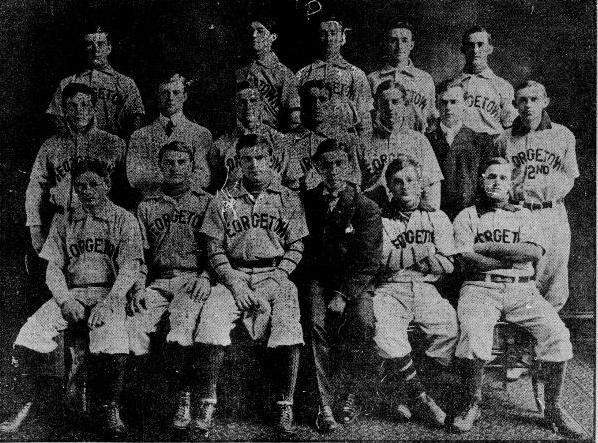
1905 Georgetown baseball team. Apperious is second from left in the center row

1905 Georgetown baseball team. Apperious is second from left in the center row

Later that year Apperious failed to apply his philosophy to Matthews.

In the summer of 1905 Apperious went to Vermont, as he had the previous summer, to play in the state’s “outlaw” Northern League—the league was notorious for having multiple college players performing under assumed names to retain their eligibility.  Apperious played both seasons for the Montpelier-Barre club (known in the local press as the Inter-Cities or Hyphens).

During his first summer in Vermont,  Apperious had raised some eyebrows on July 21, 1904, when he did not participate in an exhibition game between the Inter-Cities and the barnstorming Cuban X Giants.  The Bennington Evening Banner said the “Southerner refused to play against the colored team.”

Matthews joined the Burlington club at the end of June 1905 to immediate controversy.  The Montpelier Argus said a pitcher named Smith “from the south” had left the team as a result, and Apperious made it known he would not play on the same field as Matthews.  When the Burlington club arrived in Barre for a July game with the Inter-Cities, Apperious made good on his threat and watched the game from the bleachers.

Apperious was condemned in the Vermont press:

The Newport Express and Standard:

“(Matthews) may be his equal in every respect: not only in intelligence, but in performing the part of a gentleman as well.  Certainly so in this instance, so far as Mr. Apperious  is concerned, the much aggrieved white individual in this case…Mr. Apperious had better retire to those places where peonage is still in practice—where he can still vent his spite on the Negro as his little, narrow-minded, measly soul desires.”

The St. Albans Messenger:

“If Apperious wants to show his loyalty to and affection for his native Southland, which is a commendable thing in any man, he could do it better by helping his generation t forget some rank nonsense that used to pass for ultra-refinement and chivalry.”

The Poultney Journal:

“(Apperious) Hails from a state where the best citizens” burn people alive…Good chap.  Too good to play ball with a graduate of Harvard college.  If he goes to heaven will want a box stall all to himself.  Scat! Vermont has no use for him—believes in the doctrine “all men were created free and equal.” Apperious is as good as a colored man—if he behaves himself as well.  Better wash and go South.”

  The Wilmington Times:

“Vermonters like to see good, clean ball, and they are not fussy as to the color of the player who can deliver.”

One of the few exceptions in Vermont was The Montpelier Argus which said Apperious was simply following his “traditions, sentiments and interests,” and “it is rank foolishness to expect everyone to bend to our ideas.”

Apperious also found support from The Washington Post which said: “The college players in the Vermont League (sic) are following the lead of Sam Apperious in ‘cutting’ Negro Matthews.”

The paper also repeated an allegation that Matthews “had played (professional) summer ball every year since he entered Harvard.”  While Matthews had played four seasons on the baseball team and graduated from Harvard, The Post, with no evidence, alleged Harvard “dropped Matthews,” because of the allegations.

Despite Apperious’ refusal to play against him, and reports throughout the season that, as The Boston Globe said,  some opponents were “laying for “ Matthews and he “had been spiked several times,” he completed the season with Burlington. But after a quick start (.314 through 14 games) his average dropped off to .248.

There were rumors in the Boston press that summer that Matthews might become a member of the National League’s Boston Beaneaters, but he never played professional baseball after his controversial season in Vermont and his second run-in with Sam Apperious.

Matthews became an attorney, was actively involved in politics and served as legal counsel for Black Nationalist leader Marcus Garvey.  He died in 1928.

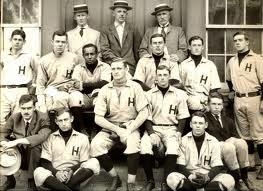
William Clarence Matthews with Harvard Baseball Team

William Clarence Matthews with Harvard Baseball Team

The rest of Apperious’ story on Wednesday.


Lost Team Photos–1903 New York Highlanders

3 Jan

1903NY

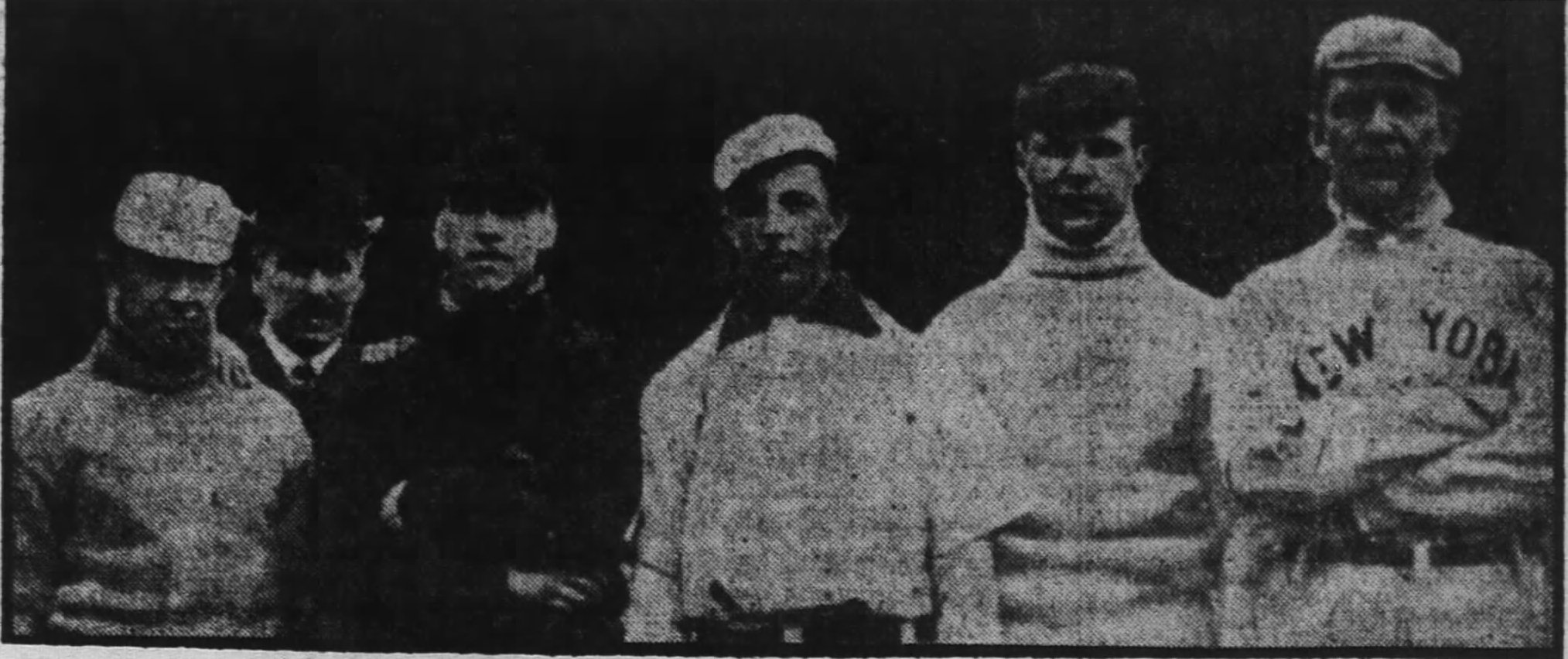
Five members of the first New York Highlanders team and a New York sportswriter photographed at Atlanta’s Piedmont Park in March of 1903. The financially failing Baltimore Orioles franchise was transferred to New York for the 1903 season.

From left: William “Wee Willie” Keeler (RF), James “Gym” Bagley of The New York Evening Mail, Harry Howell (P), William “Wid” Conroy (3B), Monte Beville (C), and John Ganzel (1B).

Atlanta Was thrilled to host the team.  The Atlanta Constitution said on the morning the team was due to arrive:

“The hearts of the local fans will be made glad today by the arrival of the New York American baseball team, for this afternoon on there will be something doing at the park.

“Manager Clark Griffith will have charge of the team, and will bring them in with him this afternoon on the Southern’s No. 27 from Washington, which is due in the city at 3:55 o’clock.

“The aggregation is nothing less than a bunch of stars.”

Large crowds came out to Piedmont Park for the team’s morning and afternoon practices and for the Highlanders first spring game on March 26 against the Atlanta Crackers.

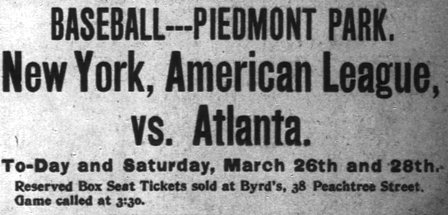
advertisement for the 1903 New York Highlanders spring games with the Atlanta Crackers

Advertisement for the 1903 New York Highlanders spring games with the Atlanta Crackers


Griffith’s team finished fourth in the American League with a record of 72-62.