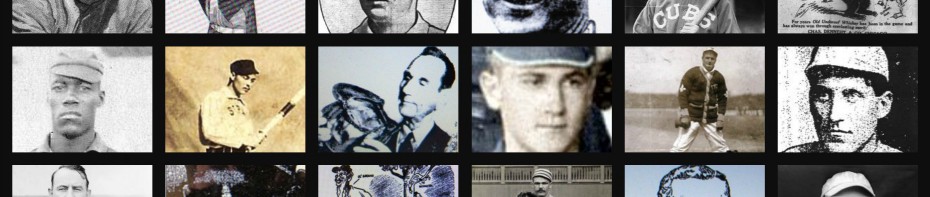
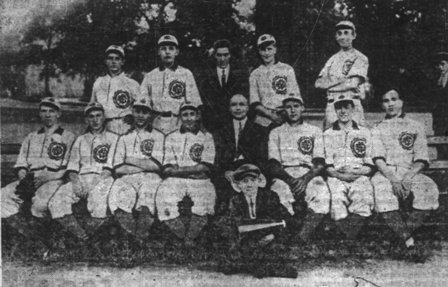
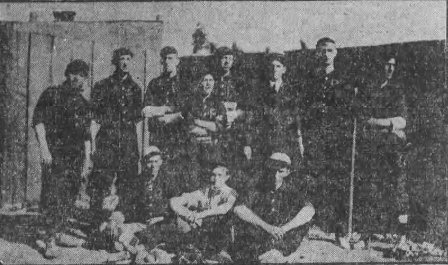
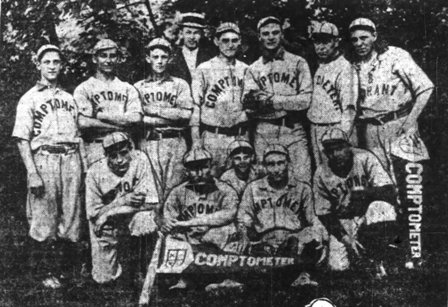
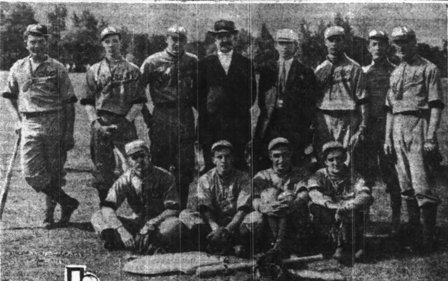
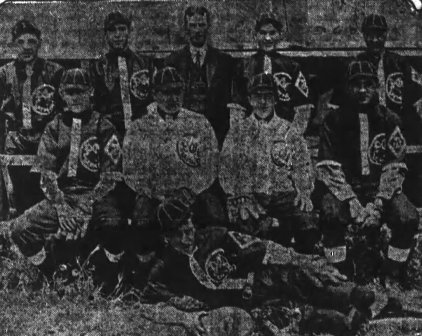
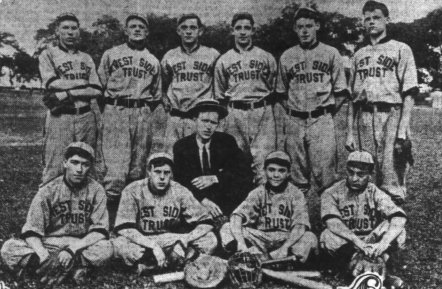
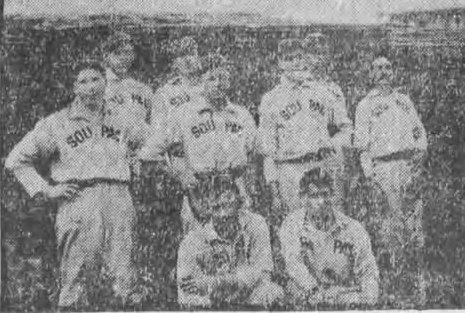
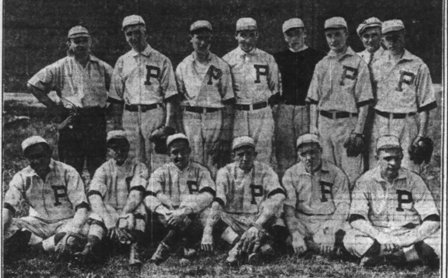
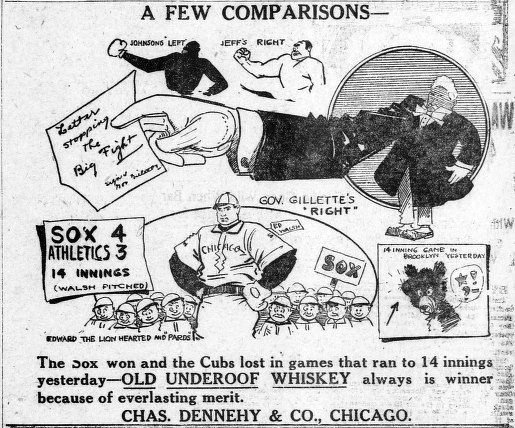
During the first two decades of the 20th Century hundreds of amateur and semi-pro teams operated across the country. Below are photos of several teams from 1908-1913:

Felt & Tarrant Comptometer Company–Chicago
During the first two decades of the 20th Century hundreds of amateur and semi-pro teams operated across the country. Below are photos of several teams from 1908-1913:

Felt & Tarrant Comptometer Company–Chicago
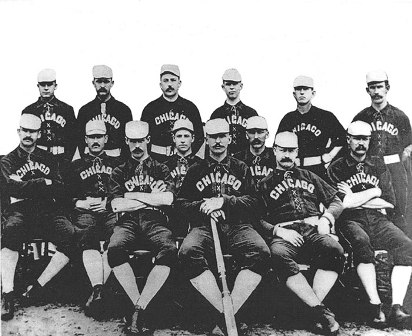
On the eve of the 1879 season The Chicago Times endorsed an innovation about to be introduced by the Chicago White Stockings:
“The management of the Chicago Club has very wisely decided that the skinny white uniform with tips of blue, in which it has dressed its men from time immemorial, is not the best of its kind; that good taste dictates higher colors for the field, something that will bring out, instead of dwarfing the muscular development of its wearer. The result of the consultations over the matter has been the adoption of something which has merit of novelty about it, at least, and, at the first blush, there seems to be no reason why it should not produce a pretty effect on the field.”
The Times noted that three years earlier, the White Stockings had worn individually colored caps in order to make it either for fans to identify the players. The move “for some unknown reason was discarded” at the end of the 1876 season.
“The present change is in the same line, except that it goes further and applies the principle to the entire uniform. The customary white flannel will be used for the body of the dress. In this respect they will all be alike; but each man will be furnished with an individual color to finish it with, including cap, neck-tie, belt and a band some three inches wide around the thickest part of the calf. The colors have been selected, and Spalding Bros. are now at work upon the uniforms.”
The 1879 Chicago roster by color:
Silver Flint: Blue
Terry Larkin: Brown
“Cap” Anson: Grey
Joe Quest: Black and yellow
John Peters: Green
Frank Hankinson: Scarlet
Abner Dalrymple: White
George “Orator” Shafer: Red and black
George Gore: Blue and white
Bill Harbridge: Red and white
The move was taunted in at least one National League city–The Syracuse Courier derisively referred to the team as the “Chicago Rainbows.”
The Times said “Cap” Anson was in favor of the new uniforms and “says there’s luck in it.”
The paper agreed with Anson’s assessment:
“The individual caps won in 1876. Since then they have been discarded, and Chicago hasn’t been able to win anything.”
Anson’s “luck” didn’t hold in 1879. The White Stockings were in first place from Opening Day until August 1, then Anson became ill in July and eventually left the team which went 5-12 the rest of the season under Silver Flint, and finished in fourth place.
The uniforms disappeared and Anson returned for the 1880 season. When the team took the field for the opener The Chicago Tribune said:
“The Chicagos appeared for the first time in their regular League uniform for this year, with all-white stockings that are a marked improvement over the many-colored rings of last year.”
The San Francisco Chronicle said in January of 1891 that he was “taking excellent care of himself and will be ready to play winning ball.”
From 1891 through 1893 he pitched in the Pacific Northwest and California League’s and seems to have stayed sober and out of jail.
He was essentially a .500 pitcher, with less than average control; when he was with the Los Angeles Angels in 1893 he walked 210 batters, hit 24 and had 17 wild pitches.
The Los Angeles Herald regularly noted Borchers’ wildness. In his first appearance for the Angels in April of ’93 he walked six and hit two batters in the first inning, yielding four runs, and was removed in the second after another walk and two more hit batsmen. After a 21-12 May victory against Stockton the paper said: “Borchers did himself proud, allowing 13 men to walk to first base, 12 for base on balls and one for being hit. How the Angels managed to win with him in the box is a marvel.”
From 1894 through the 1896 season he was a baseball nomad, playing for nine teams in six leagues, including a single, disastrous final major league appearance with the Louisville Colonels in May of 1895—he started a game against the Brooklyn Grooms, lasting just two-thirds of an inning, giving up a hit, three walks, a wild pitch and two runs—earning the loss as the Colonels went down 11 to 0.
Borchers was out of organized baseball in 1897 and it’s unclear what he was doing and where he was doing it, but he resurfaced the in 1898 as a minor league team owner. The Pacific Northwest League, which folded after the 1896 season, was resurrected as a four-team circuit organized by Dan Dugdale and William Works. Dugdale took the Seattle franchise; Works took Tacoma, a Spokane “newspaperman” named Hutchinson took that town’s team, and George Borchers was awarded the Portland club.
The league struggled, and Borchers was stripped of his franchise in early July. The Tacoma Daily News explained the problem:
“George Borchers is beginning to look upon matters of baseball in a new light. The (league) is holding an inquest on his official corpse this afternoon, sitting in Portland. The chief is not to figure any longer as manager of the Portland baseball team…The trouble has all arisen over Borchers’ treatment of his men. He has not distributed cash since the opening of the season and as he is still short on the amount due the league will be displaced…Mr. Borchers has merely made excuses.”
Borchers returned to California and appeared in games for three Pacific Coast League teams during the remainder of the season: Santa Cruz, Stockton and Watsonville.
Borchers would continue, on and off, as a player until 1903—including a season as player/manager with the California League’s San Jose Brewers in 1899. But in 1901 he made headlines when he became embroiled in a scandal.
Borchers was pitching for the Oakland Commuters in the California League, and failed to show up for a game he was scheduled to pitch on May 1. The San Francisco Call said:
“George Borchers, the star pitcher of the Oakland baseball nine, has disappeared…None of the missing player’s close friends in baseball circles can explain why he decamped so suddenly nor where the absent ballplayer has gone.”
—
“Some of the Oakland players are injecting a bit of romance into the story, the names of some of the fair enthusiasts of Golden Gate being introduced as the possible cause for the handsome pitcher’s sudden leave taking. But none seem to be able to tell with certainty the story that he has fallen victim to the charms of some fair one.”
The plot thickened the following day when Oakland owner J. Cal Ewing hired a private detective to track the missing pitcher, and an angry father went public.
While Ewing’s investigator hunted, an Oakland real estate developer named Don Miller told The San Jose Evening News his daughter Grace had disappeared:
“(Miller) is convinced that she has gone with the ballplayer. Neither Borchers, who has a wife in Portland, not Miss Miller has been seen since last Monday, when they boarded an eastward-bound train.”
Miller told the paper:
“I am endeavoring to locate them now, and if I ever find the man who has broken up my home he’ll need nothing but a coffin. I’ll find them yet.”
After a week, he turned up in Ogden, Utah, pitching for that town’s club in the Inter-Mountain League. The Santa Cruz Evening Sentinel said:
“He says he left simply to better his position and justifies his action on the ground that the California League takes players who skip out on other leagues and the local players are in competition with them all the time. He thinks he had the right to skip out likewise and better his position. He claims the reason he left secretly was because he feared Ewing would cause him trouble.
“He was worried over the account that he had left with Miss Grace Miller, but denied it.”
The paper noted that while Borchers wife remained in Portland, he had received two train tickets from the Ogden club.
Eventually, the truth came out. Borchers returned to California to secure a divorce from his wife and married the former Miss Miller. He spent 1902 playing and managing for a team in Salt Lake City, and managing a bowling alley there.
The second Mrs. Borchers became ill in November of 1902 and died two weeks later from peritonitis.
His last scandal behind him, Borchers married again and operated a large dairy in Sacramento until his death in 1938.
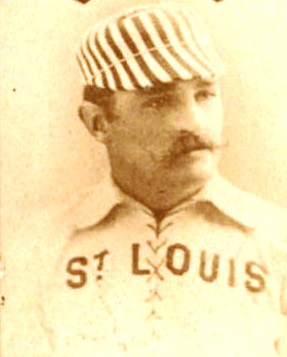
After defeating the Boston Beaneaters and “Old Hoss” Radbourn in his major league debut, George Borchers returned to the mound five days later in Chicago and beat the Philadelphia Quakers and William “Kid” Gleason 7 to 4.
With two wins in two starts the 19-year-old Borchers was, according to The New York Evening World, one of the most sought after players in the National League:
“There are several league clubs who would like to get hold of Borchers, the latest Chicago wonder, the only thing in the way of his acquisition is the $10,000 (the White Stockings were asking).”
Chicago probably should have sold Borchers while there was interest. He injured his arm sometime in June, missed most of July, and according to White Stockings Manager “Cap” Anson “lacks the heart to stand heavy punishment.”
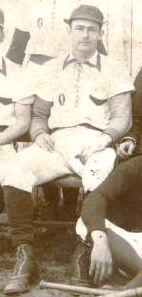
After his fast start, Borchers was just 4-4 in 10 starts when Chicago released him and Chicago’s other 19-year-old “phenom” Willard “Grasshopper” Mains (1-1 in 2 games) on September 6.
The Chicago Tribune said Borchers was on his way to Cincinnati to play for the Red Stockings, “he has plenty on speed and good curves, and it will not be surprising if he makes a success in the American Association.”
After the Cincinnati deal failed to materialize, Borchers accepted $100 in advance money to join the Stockton franchise in the California League. After receiving the money he never showed up in Stockton.
No less a figure than the “Father of Baseball,” Henry Chadwick held out hope that Borchers would eventually be a successful pitcher:
“There is a chance that a first-class pitcher, who played in the Chicago team last season, is going to reform the bad habits which led to his release by Captain Anson in August (sic) last. I refer to Borchers. (John Montgomery) Ward told me that Borchers was a very promising pitcher, and had he kept himself straight be would undoubtedly have made his mark. I learn that be is going to try and recover his lost ground, and if be shows the possession of the moral courage to reform, and the intelligence to keep temperate, he will yet find his way to fame and fortune. Show yourself a man, Borchers, and leave boozing to the weak fools of the fraternity who indulge in it at the cost of a fair name and of pecuniary independence.”
Borchers didn’t appear ready to “reform.” Between the 1888 and ’89 season, according to The San Francisco Chronicle, he signed a contract to play for the Canton Nadjys in the Tri-State League, receiving $100 in advance money and also signed a contract with that Kansas City Cowboys in the American Association, receiving a $300 advance.
In February of ’89 Borchers was awarded to Canton. Kansas City offered to purchase his contract. Canton Manager William Harrington said in The Sporting Life that “Borchers will play in Canton or not at all.”
Borchers left for California.
Upon arriving in Sacramento Borchers was arrested as a result of the Stockton contract. The Los Angeles Herald said:
“George Borchers, the well-known baseball player, was arrested this afternoon on a warrant from Stockton, charging him with having received money by false pretenses.”
Borchers pleaded guilty and paid a fine in March. In April he attempted to sign with the Sacramento Altas. The San Jose Evening News said:
“Sacramento being in need of a pitcher, induced Borchers to agree to play there and asked the Stockton Club to allow him to do so. This President Campbell (of Stockton) refused and the league directors have sustained the action.”
The California League ruled Borchers ineligible for the season.
With too much time on his hands, Borchers couldn’t stay out of trouble. The Associated Press reported on June 27:
“Shortly after 11 o’clock tonight a barn belonging to Mrs. Borchers, mother of George Borchers, the well-known baseball pitcher, was destroyed by fire, causing a loss of nearly $1000. When the Fire Department arrived on the scene George Borchers tried to prevent the firemen from fighting the flames. He was drunk and very boisterous. Finally Chief Engineer O’Meara ordered his arrest. When two officers took him in custody he fought desperately, and had to be handcuffed and placed in a wagon before he could be got to prison.”
The story said Borchers, who “has been loafing about town (Sacramento) for several months, drinking heavily” had made threats that he’d burn down the barn because his mother would not give him any more money. Mrs. Borchers had “recently expended a large sum of money to get him out of trouble at Stockton.”
Whether his mother paid his way out of this or not is unknown, but the charges against Borchers went away, and he spent the remainder of the 1889 baseball season pitching for a semi-pro team in Merced, California.
He returned to the California League on March 23, 1890 when he pitched for Stockton in the season opener against the Haverlys at San Francisco’s Haight Street Grounds. Borchers and Stockton lost 11 to 5.
His time in the league would be short.
In Early May he began complaining of a sore arm; The San Francisco Call said that “Borchers is known to have received an offer from the New York Brotherhood (Players League) Club and the Stockton directors think he’s playing for his release.”
On May 11 Borchers, according to The Sacramento Bee arrived at the ballpark in Stockton, on horseback and “extremely drunk.” Catcher/Manager Mike DePangher sent Borchers home. Borchers instead went on a bender that ended the following evening in a Stockton restaurant where he was arrested for being drunk and disorderly.
The Call said:
“If he took this means to sever his connection with the Stockton Club and join the Brotherhood, he not only brought disgrace in more sense than one upon himself, but has probably ruined his chance of an Eastern engagement.”
Borchers was fined $10 in court, the Stockton club fined him $100 and suspended him for the remainder of the season and sold his contract to Portland in the Pacific Northwest League–but not before the Sacramento Senators attempted to use him in a game. The Call said Stockton protested:
“(Sacramento) Manager (George) Ziegler thought it best not to play him. When George was informed that he was not to play he good-naturedly said: ‘All right, old man,’ and then added, ‘One suspension, one release, all in two weeks.’”
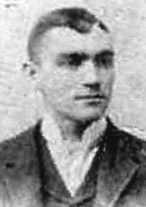
On June 1 he won his first start for Portland, beating Spokane 7 to 6. The Oregonian said “Borchers pitched a splendid game for the Portlands.”
Borchers split the remainder of the season between Portland and Spokane, compiling a 14-14 record with a 1.44 ERA. When the Pacific Northwest League season ended Borchers returned home to play in the California League again; The Sacramento Record-Union printed a letter from his manager at Spokane, William “Kid” Peeples:
“Borchers has been pitching ball out of sight, and has not tasted a drop of liquor while up north. He says he is going to stay straight, and finish the season with the Sacramentos. He will have all the California boys guessing, as he did here.”
The San Francisco Call said Borchers was “a dismal disappointment” after he lost his first two starts for the second place Senators—both losses were against the league-leading San Francisco Haverlys. San Francisco Manager Mike Finn filed a protest with the league, claiming Borchers should be declared ineligible because he was still on the reserve list of the Spokane club.
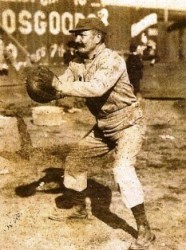
In his third start Borchers allowed Stockton to score three runs in the first inning on five walks and a wild pitch, but settled down and won 7 to 6. He beat Stockton again three days later, 15 to 10. The Record-Union criticized all four of his performances and said he had reverted to “his old ways.”
The 21-year-old finished the 1890 season with a 2-2 record for the second place Senators; San Francisco won the championship. At the end of the season the California League upheld Finn’s protest over Borchers and fined Sacramento $500.
The rest of the George Borchers story on Wednesday.
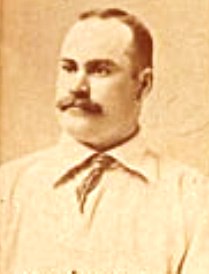
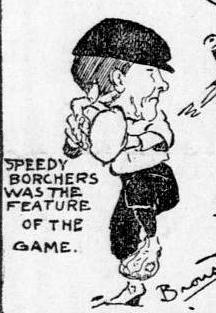
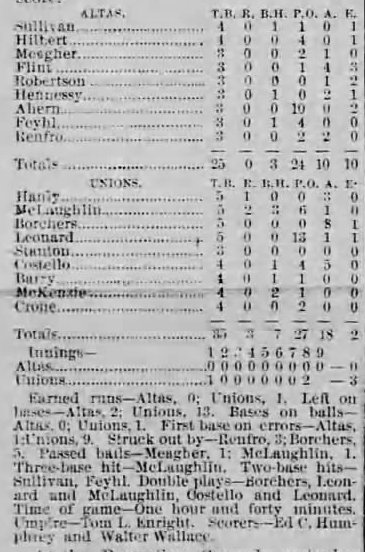
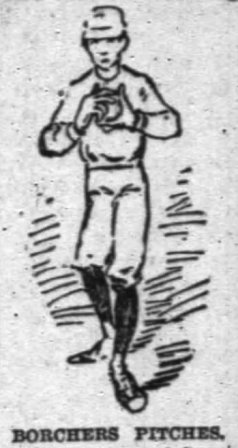
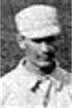
George Bernard “Chief” Borchers was a West Coast phenom. The Sacramento native was so good as a 16-year-old in 1885 that the town’s two professional teams battled for his services. After pitching half the season for one club, The Sacramento Record-Union said:
“George Borchers, heretofore pitcher for the Alta Baseball Club, has resigned his position in that club and will hereafter pitch for the Unions.”
He played for the California League’s Sacramento Altas in 1886 and the Oakland Greenhood & Morans in the same league in 1887. The Sporting Life said of him:
“Borchers is possessed of Herculean strength, great endurance, and is a heavy batsman.”
The Sacramento Bee said Borchers “would soon rank as one of best pitchers on the coast,” if he got “command of the ball and his temper.”
Before the 1888 season the 19-year-old became the subject of a bidding war. He pitched several games against the New York Giants during John Montgomery Ward’s barnstorming/honeymoon tour of the West Coast in the winter of 1887.
Ward told New York reporters that Borchers was the best pitcher in the California League. The Sporting Life called him “Ward’s especial favorite,” and “Ward’s find.” By January The Boston Post said he turned down an offer from the Beaneaters, The San Francisco Chronicle said he rejected the Detroit Wolverines, and The Philadelphia Times said “(Athletics Manager Bill) Sharsig is hopeful to sign Borchers.” The Times also said Ward’s Giants had made an offer but:
“The young man wanted a mortgage on Central Park and a large chunk of Coney Island.”
The San Francisco Chronicle said Borchers came from a wealthy family (his father owned a brewery) and were “opposed to his playing ball.”
Whatever the reason, Borchers opened the 1888 season with the Greenhood & Morans. He pitched at least four games for Oakland before it was announced on May 2 that the 19-year-old had signed a major league contract. The Chronicle said:
“The baseball world was thrown into a state of excitement yesterday when the press dispatches made the unexpected announcement that George Borchers prize pitcher of the Greenhood & Moran club, had been signed to pitch for the Chicagos.”
The paper said when White Stockings President Al Spalding sent a telegram to Borchers asking his terms, the pitcher, “treated the telegram as more of a joke than anything else, and in the spirit of fun telegraphed back” asking for $3000, with a $500 advance.
“He never dreamed of receiving a favorable answer, and his surprise can well be imagined when a few hours later the answer came accepting his terms.”
Despite being what The Chronicle claimed was the “largest salary ever paid to a California player in the East,” Borchers immediately regretted the agreement:
“He says he does not feel much like leaving here and would like to back out if he could, but, knowing that he is legally bound by his act, he will of course stand by it.”
The pitcher arrived in Chicago on May 13 to great fanfare. The Chicago Tribune said “if he equals the reports of his ability that precede him, the team will be as nearly invincible as it is possible for a baseball organization to be.”
White Stockings shortstop Ned Williamson, who batted against Borchers on a West Coast trip, compared him to another California pitcher who made his big league debut at age 19:
“He pitched more like Charley Sweeney than any other man I ever saw, and Sweeney was as good as any that ever stepped in the box.”
Borchers made his debut on May 18. The Chicago Inter Ocean said:
“Another wonder has been discovered and the Chicago Ball Club has it. The wonder is George Borchers, the California pitcher. He was put in the box to pitch for the Chicagos yesterday against the Bostons in the closing game of the series. The result is manifest in the score—13 to 0…Borchers was made the hero of the hour. He has come to stay, and his work yesterday is a guarantee of his ability to keep his place.”
The Chicago Tribune was more subdued than The Inter Ocean:
“(Borchers) has an easy delivery. Good curves and great speed, but his command of the ball remains to be determined. Yesterday he was wild. Three wild pitches were charged to him, and with a less active and reliable man than (Tom) Daly behind the bat more would have been recorded. Those that got by Daly were extremely wild. Still he was effective.”
The game, played in the rain at West Side Park, in what The Chicago Daily News called “practically a swamp,” was called after five innings.
The papers couldn’t agree on the attendance either–The Inter Ocean said it was 3000, The Tribune, 1500 and The Daily News 2000.
Borchers allowed just three hits and beat Charles “Old Hoss” Radbourn in his first major league game.
Things went downhill from there; the rest of Borchers’ story on Monday.
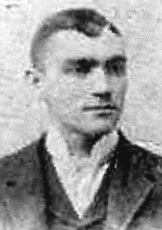
Emil Michael “Em” Gross was one of the best hitting (.295) and worst fielding (233 errors) catchers of the 19th Century during five major league seasons between 1879 and 1884. The Chicago Tribune’s Hugh Fullerton, no stranger to hyperbole, called Gross “perhaps the heaviest hitting catcher that ever donned a glove.”
Gross, a Chicago native, didn’t need baseball in order to earn a living. In 1884, when he played with his hometown team, the Browns, in the Union Association (the team relocated to Pittsburgh in August), The Chicago Daily News said he “owns $50,000 worth of real estate in Chicago.”
Gross’ professional career came to an end after the 1884 season, but he played one more year for a Chicago semi-pro team called the Heavyweights. The Tribune said of the team:
“While they do not count a man who weighs less than 200 pounds, they have some great baseball talent.”
Fullerton is responsible for the story that was most often told about Gross’ career in the years before his death in 1921.
Like many of Fullerton’s stories, the first telling appeared more than a decade after the fact and contained vague details, little corroboration and was likely apocryphal.
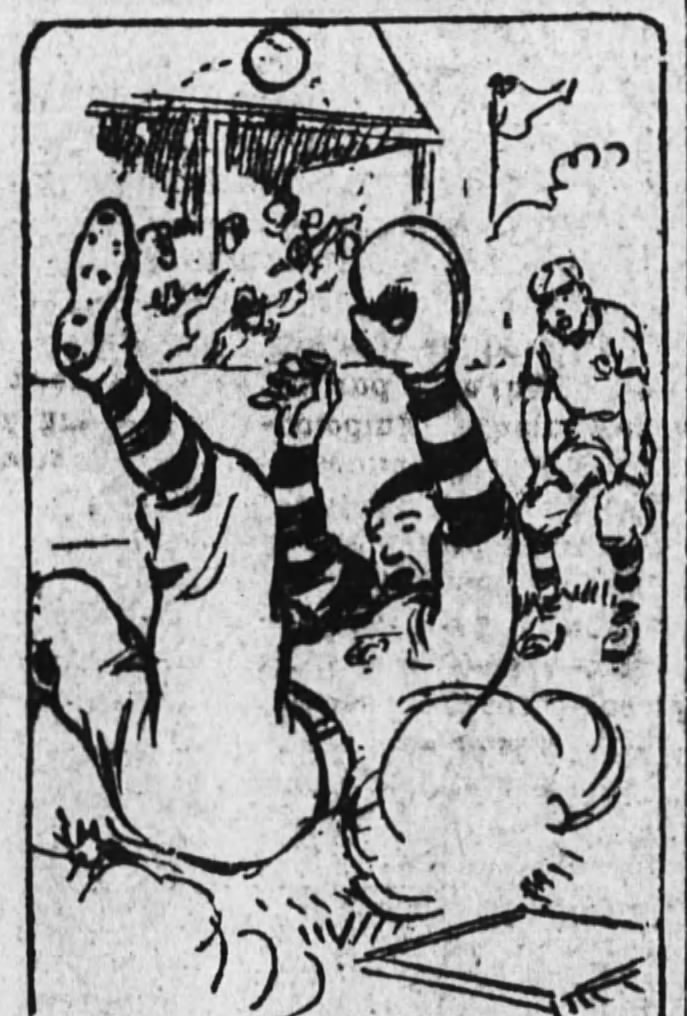
This one made its first appearance in a Fullerton column in 1907. He said Gross’ biggest weakness “was in catching foul flies. He tried for everything in sight, ran circles around the ball and sometimes speared it, but he never felt at ease when one of those tall, twisting fouls went up.”
The columnist claimed the story was “vouched for by two old ballplayers who watched it come off:”
“(Gross) was catching in Providence one day when a Philadelphia batter poked up a fly that looked 50 feet high. There was a wind blowing and the ball began to twist around in circles, with Em doing a merry-go-rounder under it. Finally, seeing that it was escaping he made a desperate effort to turn quickly and fell flat on his back. To his amazement he discovered that, for perhaps the first time in his career, he was under the ball which was descending like a shot straight toward his nose.
“Instinctively he threw up his feet and hands to protect his face. The ball struck the sole of his shoe, bounded up into the air, and, as it fell again, Em reached out and caught it.
“And the next morning the Providence papers had the nerve to say he did it on purpose.”
Fullerton continued to retell the story, with minor alterations, after he left The Tribune to join The Chicago Record-Herald, then The Chicago Examiner and The Tribune repeated the story several times over the years, with no byline, as well.
Gross was an important man in Chicago during the years Fullerton’s story circulated. He owned several properties in the city, including two hotels, and his nephew, Fred A. Busse, was mayor of Chicago from 1907-1911.
Gross was known to help former baseball players in need; The Examiner called him “a refuge in time of trouble for all the old timers.” When it was reported in 1907 that Joe Quest, a former National League, and American Association infielder, was “near death” from tuberculosis in Georgia, he was living on, and managing a plantation owned by Gross—Quest survived and lived until 1924.
Gross told a story to Fullerton, then at The Examiner, about his attempt to help another player, William Henry “Bollicky Bill” Taylor during the 1890s.
“Taylor made an entre into Chicago without cash or credit and immediately swarmed upon Em and renewed old friendships. That was in November and along about midnight Em made the discovery that his friend had no money nor any place to sleep. So he wrote a note to the manager of his hotels saying, ‘Take care of my friend Mr. Taylor, and give him what he needs.’ Em didn’t see ‘Bollicky’ again, but early in March his manager called him in the phone and inquired; ‘Say, how long do you want me to take care of your friend?’
“’What friend ‘inquired Em, who had forgotten all about it.
“Why the fellow you sent here with a note.’
“’Bollicky’ had wintered there and kept out of the path of his host, and when Em got through laughing, he ‘phoned back:
“Keep him as long as he has the nerve to stay.”
Gross never confirmed whether or not he made the catch Fullerton claimed he did. He died in Eagle River, Wisconsin in 1921.
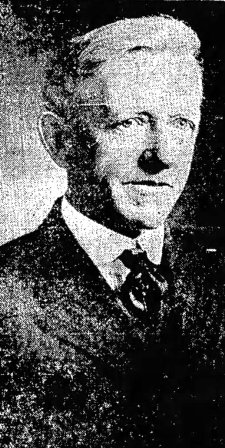
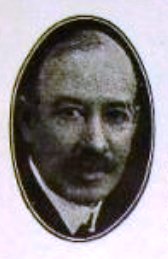
Irwin M. Howe founded Howe News Service in Chicago in 1910, published an annual record book and served as the primary statistician for several minor leagues, including the Western and the Three-I leagues.
After the 1911 season American League Secretary Robert McRoy, who was responsible for compiling statistics, left the league office to become an executive with the Boston Red Sox. President Ban Johnson named Howe the league’s statistician; he served in that capacity until his death in 1934.
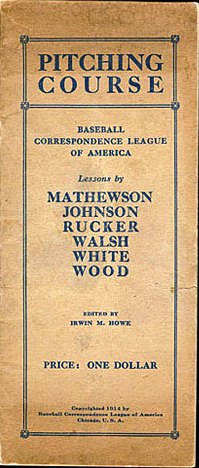
Howe leveraged his position with the American League. He became the official statistician of several more leagues, including the American Association and the Federal League, wrote a nationally syndicated column called “Pennant Winning Plays,” became editor of the annual “Wilson Baseball Record and Rule Book,” and published an instructional pamphlet for kids.
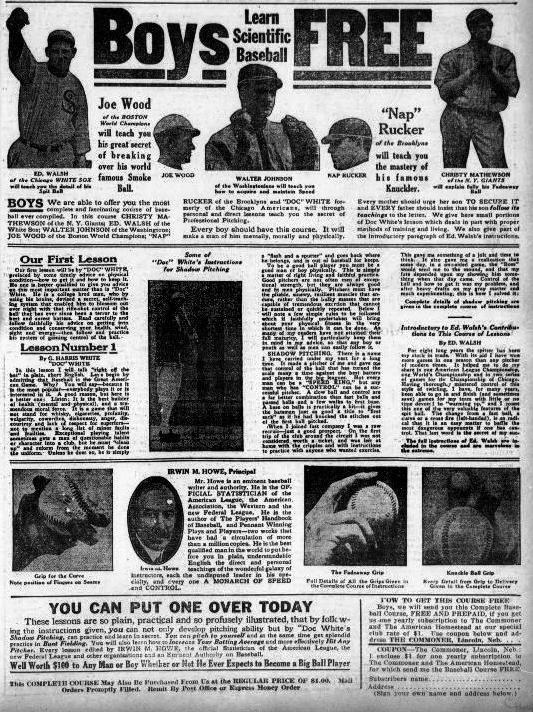
The ad from 1914 pictured above is for Howe’s 48-page “Pitching Course,” which he called “A correspondence school for baseball.” The pamphlets sold for one dollar, but were also offered by many small newspapers across the country for free to children who signed up subscribers (the pictured ad is from The Commoner, the Lincoln, Nebraska newspaper published by William Jennings Bryan).
Boys Learn Scientific Baseball Free
Ed Walsh of the Chicago White Sox will teach you the detail of his Spit Ball
Joe Wood of the Boston World Champions (1912) will teach you his great secret of breaking over his world famous Smoke Ball
Walter Johnson of the Washingtonians will teach you how to acquire and maintain speed
“Nap” Rucker of the Brooklyns will teach you the mastery of his famous knuckler
Christy Mathewson of the N.Y. Giants will explain fully his Fadeawy Ball
These lessons are so plain, practical and so profusely illustrated, that by following the instructions given, you can not only develop pitching ability…You will also learn to Increase Your Batting Average and more effectively Hit Any Pitcher. Every lesson edited by Irwin M. Howe, the official statistician of the American League, the new Federal League and there organizations and an Eminent Authority on Baseball.
The pamphlet also included a lesson from Guy Harris “Doc” White of the Chicago White Sox “which deals in part with proper methods of training and living.”
Howe claimed his one dollar pamphlet was “Well worth $100 to any man or boy whether or not he ever expects to become a big ball player.”
Perhaps Howe’s most famous contribution to baseball was certifying Ty Cobb as a .400 hitter in 1922.
On a rainy day in New York (years later in his book “Baseball as I Have Known It,” Fred Lieb said the game took place in August—contemporary newspaper accounts say it was May 15), Cobb beat out a ground ball hit to Yankee shortstop Everett Scott. John Kieran of The New York Tribune (he was later a columnist with The New York Times) was the official scorer. He charged Scott with an error.
Fred Lieb of The New York Telegram, who was compiling The Associated Press (AP) box score for the game, credited Cobb with a hit. Lieb said “Considering the soggy field and Cobb’s speed, I gave it a hit.”
Howe’s habit was to rely upon The AP box score that appeared in the Chicago newspapers while awaiting the arrival of the “official” box score by mail.
When compiling the final averages at the end of the season Howe chose to accept Lieb’s scoring of the game rather than Kieran’s, and released a statement with the season’s final statistics:
“I noted that the averages reached from my official scoring sheets had Cobb hitting .3995 (actually .3992). With the unofficial averages giving him .401, I felt how can we deprive this great player of a third .400 average over a fractional point.”
Ban Johnson approved Howe’s decision. Lieb, as president of the Baseball Writers Association of America’s (BBWAA) New York chapter was put in the uncomfortable position of attempting to repudiate his own scoring judgment. He argued that the Kieran’s “official” score should be accepted, and said in a statement:
“Obviously, when there was a difference of opinion between the two scorers, the official and not the unofficial decision, should have been accepted. There would be no further need for members of the Baseball Writers Association serving as official scorers if they were regulated to a secondary position.”
In a letter to Lieb, Ban Johnson said the “official” box score “was plainly in error in one other particular” besides the Cobb “hit” and “I requested a report of the official score of the game of May 15. Mr. Howe had previously made a careful investigation of all facts surrounding the scoring.” Johnson also chided Lieb asking “Are we to believe that you reversed your judgment at this late date?”
The 1923 “Wilson Record and Rule Book”–edited by Howe–contained an asterisk next to Cobb’s .401 average and noted that it was “not recognized” by the BBWAA—Howe was secretary of the association’s Chicago chapter.
The asterisk eventually disappeared, and Ty Cobb, thanks to Howe’s decision, remains a .400 hitter for the 1922 season.
In 1886 The San Francisco Chronicle said of contemporary baseball players:
“With all the enlightenment of civilization superstition still holds potent sway. Perhaps the most superstitious class of people to be met today in the United States, aside from gamblers and actors, are baseball players and worshipers of the game, whose faith in “mascots” and jonahs” as influences for good or bad luck is almost if not fully as strong as their belief in religion itself.”
Jim Hart, in San Francisco with his Louisville Colonels, told the paper about some of the specific superstitions which influenced the 19th Century ballplayer:
“The St. Louis Browns have their club house at home just off from right field, and whenever the bell rings for the practice preceding each game the whole nine form into line in front of their house and then walk abreast to first base, where they disperse and take their positions. This is invariably done under the belief that it insures good luck. Bill Gleason too, the famous shortstop, always walks astride of the foul chalk line to third base before going to his place on the diamond. He has never once failed to do it in the whole five years he has been playing baseball.”
—
“Why there’s (Albert “Doc”) Bushong, the catcher of the St. Louis Browns. He’s got a pair of gloves that are so dilapidated that even the patches are patched. He wouldn’t part with those gloves, though, for a ten-acre lot. He thinks as mascots they are infallible. (Walter Henry) Porter, the pitcher of the Brooklyns , also has a red sleeveless jacket or shirt which he has worn regularly for more than two years. It doesn’t match the uniform of the club, but he wears it anyhow, for he sincerely believes that if he laid the shirt aside the game would be lost.
“(Pete) Browning, our center fielder and the crack batter in the league, is the greatest fanatic on mascots, I reckon, of anybody in the business. He did not come out with us this time. He got out of whack during the summer and I sent him to the springs to recuperate. He returned home before we came out here, but I thought it best to leave him behind. Well, Browning has a practice of always walking over and touching one foot on third bag when going from field to bat, or vice versa. A stack of twenties as high as that house wouldn’t be inducement enough for Browning to refrain from carrying out this program every time he plays, he’s got so much faith in it, you know. To show you how earnest he is in this respect, I’ll relate a short anecdote about him which occurred last summer. It may amuse you. Browning has a pretty good idea of himself as a ballplayer, and it rather hurt him to be sent off from us, even if it was to the springs” (Browning was in such poor physical condition in July of 1886—The Cincinnati Enquirer said “it is doubtful if he appears on the diamond again.”– that he was sent to the springs in French Lick, Indiana for a month).
Hart said the rest of the Louisville team let Browning know they did just fine without him in the lineup, including their best road trip of the season, when they won 8 of 12 games:
“The rest of the boys naturally joshed him a good deal about it, and gleefully referred to their splendid record while he was away. ’Yes,’ replied Browning, driven to desperation, ‘but I was touching third bag every day, or you couldn’t have done it.’ It seems ridiculous, doesn’t it? It’s true, nevertheless, for I found out afterwards that he had marked out a diamond just back of the hotel at the springs, and on the days that we were booked to play he would go out to his field and soberly go through his regular ceremony of touching third bag.”
Hart claimed he was an exception, “I’m not very superstitious,” he said, but he conceded “I hear and see so much of these things that hang me if I don’t almost believe in them myself sometimes.” As an example, he told the story of arriving at the ballpark during a losing streak:
“I went into the club-room with a new white plug hat on my head. Everybody jumped up at once and shouted, ‘A mascot! A mascot! Our luck will change now, sure.’ We did meet with rather better success after that, and the hat naturally got the credit for it. Four or five weeks later I exchanged my white hat for a black mackinaw, and, my Lord! You should have heard those fellows kick. They said I was a jonah and we’d lose the next game, and by thunder, we did, too.”
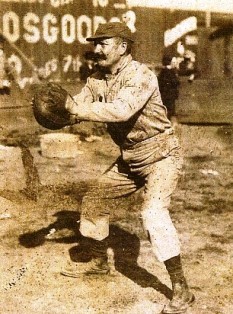
James Aristotle “Jim” Hart gave one of the earliest interviews on the superstitions of ballplayers.
Hart sold his interest in the Louisville Colonels of the American Association before the 1887 season—he was an original investor in the team in 1882 and managed the club in 1885 and ’86—and bought controlling interest in the Milwaukee Cream Cities in the Northwestern League.
Before he left the Colonels, Hart accompanied the team on a tour of the West Coast in December of 1886, and talked to a reporter from The San Francisco Chronicle:
“Why my dear fellow you have no idea to what ridiculous extremes most ball players allow their superstitious inclinations to carry them. It’s a wonder to me that none of you newspaper men have ever written them up.”
Hart said “Each club has its own particular omens, you know there are four or five favorite beliefs which are held in general esteem by all. In the East the boys always go to the grounds on the day of the game in hacks, and if they should win they go next time in the same carriages if they can get them, but anyway by the same route, around the same corners and along the same streets. Should fortune prove averse and defeat be their lot another route is chosen next time and different carriages selected. To meet a funeral procession on the way to the ball grounds it is also considered good luck, but should their driver be so rash as to cross the road and break through the line of mourners’ carriages I verily believe the boys would murder him. It is considered such a bad omen that the boys would remain on one side of street all day rather than cross the line.”
—
“To meet a cross-eyed person is the worst kind of luck. The only antidote for it is to turn around immediately and spit over your left shoulder before you speak. It’s kind of amusing sometimes to see half a dozen or so fellows suddenly whirl around altogether like pivot machines and spit over their shoulders while walking quietly along the street, and without saying a word, too. It was done here on Market Street a few days ago by some of my boys, and I guess the people must have thought then either drunk or crazy. Another good mascot is to have a dog run across the diamond either just before or during a game. The Pittsburgh team carried a dog around with it all last season that had run across the field early in the summer. It didn’t matter that the poor brute had no tail, and was all over sores and all that, he was a mascot just the same and the boys were proud of him. I reckon there has never been a dog so handsomely treated as that one was.”
“One of the greatest jonahs we have is to commence packing up the bats before the game is finished. No matter how the score stands at the time, your luck is sure to flop right over and give the victory to the other side. To illustrate it to you more clearly, I will relate an incident that occurred to our nine early last season at home (the game was actually played August 16, 1885). We were playing a match game with the Pittsburgh team. Luck went clear against us all day, and at the beginning of the ninth inning the Pittsburghs (Alleghenys) had ten runs to our five. It seemed an utter impossibility to catch up that difference in one inning, and I can tell you we felt pretty blue. Victory looked so sure for the Pittsburghs that Pete Meegan, an extra man belonging to that team, who was sitting on the bench, begin packing up the bats when the last inning was commenced. You may not believe it, but it’s an actual fact and a matter of record; our luck changed from that instant (Louisville won 11-10). Manager (Horace) Phillips of the Pittsburghs was crazy with rage, but he didn’t blame any of his players. He could have murdered Meegan though for bringing on a jonah by packing up those bats before the game had finished. I don’t remember very clearly, but I think Meegan got let out subsequently. At any rate he was fined heavily for his offense (Meegan never played in the major leagues after 1885; whether he was “let out” by Phillips because of this incident or his 14-20 record in two American Association seasons is unknown).
Another funny idea we’ve got is to pick out a saloon we think to be lucky, and drink a glass of beer there on the day of the game and have the glass set on one side for us. If we win, then we go to that saloon every day after and drink out beer out of the same glass. Of course if our luck should change then we try another saloon. This don’t apply to every nine, because some of them are not allowed to drink at all during the season, under penalty of a heavy fine. In addition to these things, some clubs belonging to the league are called jonah clubs. That is, there are some clubs against which it is useless for us to attempt to play. It doesn’t make any difference whether we consider our own the best team or not, they are jonahs and we can’t beat them. Loss of confidence has a great deal to do with it, I suppose.”
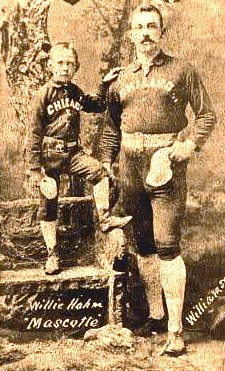
“The Chicagos’ mascot for the past three seasons has been a little boy in short clothes named Willie Hahn. The tiny fellow is just able to talk and always sits on the bench during the game. The Chicagos have the greatest confidence in him as a promoter of success and make a great fuss over him. Two seasons ago, when the Chicagos won the championship of the league, they hired an open landau upon their return home, put Master Willies in it, bedecked him with flowers and wreaths and hauled him all over the city by hand. It was a regular triumphal march, you bet. “
Hart said Willie Hahn, who was white, was unusual. Most of the teams had black mascots and the players rubbed their heads before batting:
“Sometimes the black boy is kept in a closed hack during the game to prevent contamination from other hands. The kid then has to duck his head out of the carriage window when the boys want to rub it.”
Hart said the Pittsburgh Alleghenys kept a seat in the stands open for an old black woman “Just before the game commenced the boys would invariably look up to see if old aunty was in her place, and if by chance, she was not there they would lose heart, say the game was ‘jonahed,’ and in all probability, lose it.” He said the Alleghenys also had two sets of uniform pants “one pair white and the other blue. One color would be worn so long as the club was successful.”
More from Hart on Friday.