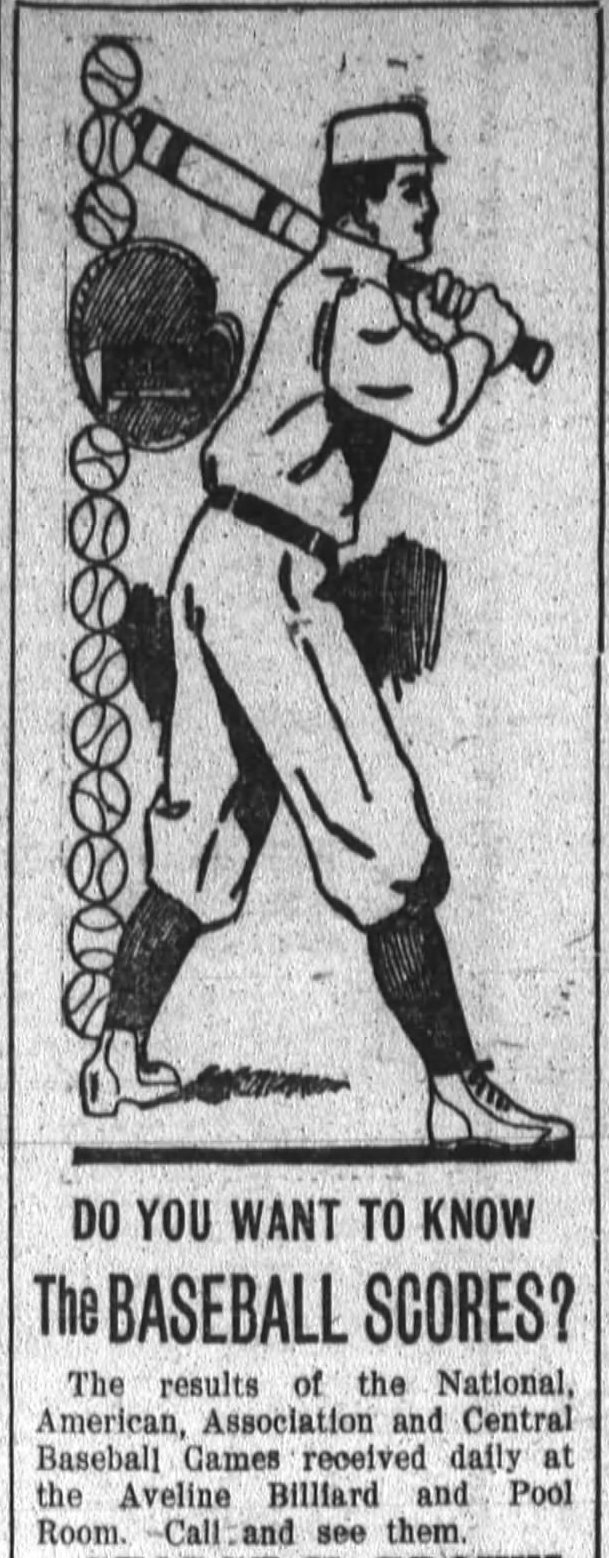
A 1908 advertisement for the Aveline Billiard and Pool Room in Fort Wayne, Indiana: “The results of the National, American, Association and Central Baseball Games received daily.”
A 1908 advertisement for the Aveline Billiard and Pool Room in Fort Wayne, Indiana: “The results of the National, American, Association and Central Baseball Games received daily.”
After almost a year and a half of five posts per week (369 to date), I will be cutting back to three posts per week beginning January 6.
Thank you everyone for commenting or emailing with your input, suggestions, corrections and kind words. And thank you for continuing to check in throughout 2014.

A rare photo of 1904 Chicago White Sox. Standing left to right: George Davis (SS), Guy “Doc” White (P), Roy Patterson (P), Gus Dundon (2B), Lee Tannehill (3B), Jimmy “Nixey” Callahan (MGR and LF), Frank Isbell (INF), John “Jiggs” Donahue (1B), Danny Green (RF), Nick Altrock (P), and Ed McFarland (C). Kneeling: Fielder Jones (CF), Billy Sullivan (C) and James “Ducky” Holmes (OF).
Jones replaced Callahan as manager shortly after this picture was taken. The Sox finished in 3rd place with an 89-65 record, improved to 2nd the following season and won the American League pennant, and beat the Chicago Cubs in the Worlds Series in 1906.
In April of 1889, the Washington Nationals were preparing to open the season at home against the Philadelphia Quakers.
The Washington Critic editorialized about the fortunes of the local team:
“As is proper, the National Capital has a club competing for the pennant, which indicates championship in the national game, but unfortunately, this club has never yet succeeded in winning the coveted emblem. The ‘Senators,’ as a facetious country has dubbed out baseball players, are engaged usually in a desperate struggle to keep from taking place near the tail end of the league at the tail end of the season, and if the Goddess of Liberty on the dome of the Capitol has any local pride she must weep at what she has seen happen in the park a few blocks north of her. She has observed the home club walloped all over the grounds and has been humiliated beyond endurance.”
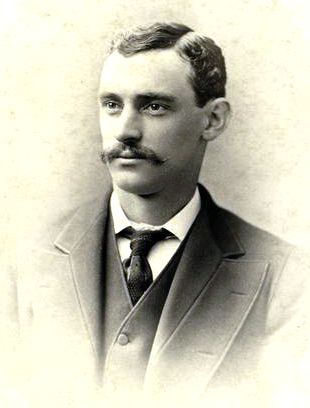
The Nationals had been members of the National League for three underachieving season; 28-92 in 1886 (eighth place), 46-76 in 1887 (seventh place), and 48-86 in 1888 (eighth place). John Morrill would open the 1889 season as the team’s fifth manager:
John Morrill
“There is a prospect of better baseball fortunes for Washington in the season opening today. There are, up to date at least, no dissensions in the club, and a stalwart and resolute group are prepared to do battle for the pennant. They may not win the trophy, but it is tolerably certain that they will give a good account of themselves, and that when ‘Senators’ are referred to in terms of opprobrium , reference will be had to those belonging to that club ‘where wealth accumulates and men decay,’ rather than to our baseball team.”
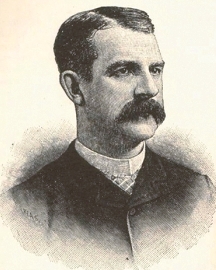
There would be no “prospect of better baseball fortunes’ for Washington. The Nationals lost the opener to Philadelphia, then lost seven more. In July, John Morrill, who had led the team to a 13-38 record and was hitting .185, was replaced as manager and released. Arthur Irwin did better (but only slightly better) at the helm. The team went 28-45 the rest of the way, finishing in eighth place with a 41-83 record. The team disbanded at the end of the season.

Arthur Irwin
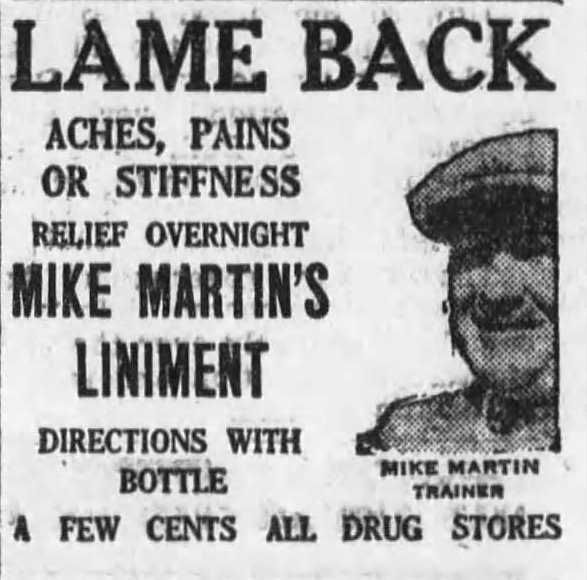
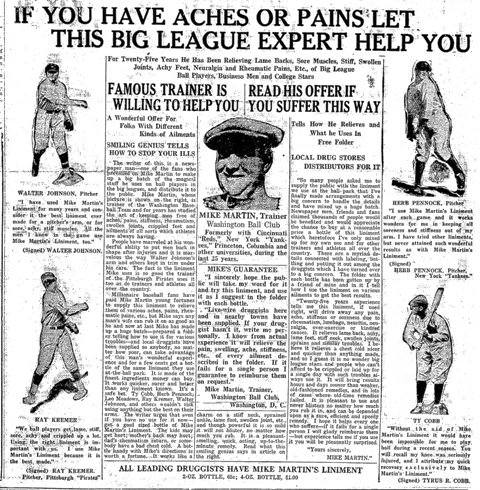 Mike Martin spent 40 years with the Washington Senators as a trainer and scout; he was one of baseball’s first full-time trainers. Martin was working as the athletic trainer at Columbia University when Clark Griffith hired him to work with the New York Highlanders, he followed Griffith to Cincinnati and then finally to Washington.
Martin began marketing the liniment he used on Walter Johnson and the rest of the Senators staff in the 1920s. This 1925 ad featured testimonials from his good friend, Senator pitcher Walter Johnson, Herb Pennock of the Yankees, Ray Kremer of the Pirates and Ty Cobb (who rarely met a “cure” he couldn’t endorse):
“I have used mike Martin’s Liniment for many years and consider it the best liniment ever made for a pitcher’s arm, or for sore, achy, stiff muscles. All the men i know in the game use Mike Martin’s Liniment too.”
(Signed) Walter Johnson
“I use Mike Martin’s Liniment after each game and it works wonders for me in keeping all soreness and stiffness out of my arm. I have tried other liniments, but never attained such wonderful results as with Mike Martin’s Liniment.”
(Signed) Herb Pennock
“We ball players get lame, stiff, sore, achy and crippled a lot. Using the right liniment is important with us. I use Mike Martin’s Liniment because it is the best made.”
(Signed) Ray Kremer
“Without the aid of Mike Martin’s Liniment it would have been impossible for me to play ball during the recent season. You will recall my knee was seriously injured, and I attribute my quick recovery exclusively to Mike Martin’s Liniment.”
(Signed) Tyrus R. Cobb
1930 advertisement
Martin remained the Washington trainer until 1946 when Griffith made him a scout. He was still working for the Senators, and his liniment was still a popular product, in June of 1952 when the 67-year-old Martin was killed in a traffic accident near his Maryland home while driving to Griffith Stadium.
On August 20, 1888 Adrian Constantine “Cap” Anson and his Chicago White Stockings were set to begin a three-game series with the Pittsburgh Pirates. Chicago was in second place, six and a half games behind the New York Giants.
Anson’s club had been in first place for most of the season, but relinquished the lead to the Giants after dropping eight of nine games at the end of July.
After sweeping two games from the Giants in New York earlier that week, Anson said he had just improved his team by signing pitcher John Tener, who was playing for the East End Athletic Club in Pittsburgh, for a reported $2500 for the remainder of the season. He also spoke to a reporter from The New York Times:
“Mr. Anson is inclined to think that New York will ‘take a tumble,’ and if it occurs soon the Giants’ chances of closing the season at the top of the pile are woefully thin.”
Another New York paper, The World, was determined to not let Anson forget his prediction.
Three days after he made the comment, The World said Anson and Giants Manager Jim Mutrie had bet a $100 suit on the National League race, and:
“(Anson) has been busily engaged in predicting a tumble for the Giants. Jim says that tumble is not coming.”
Within a week the White Stockings had dropped to eight games behind the Giants. The World said:
“Anson’s prophecies much resemble the boomerang. He swore Mutrie’s men would take a tumble, and his own men are fast getting there themselves.”
The paper also taunted Anson with a front-page cartoon:
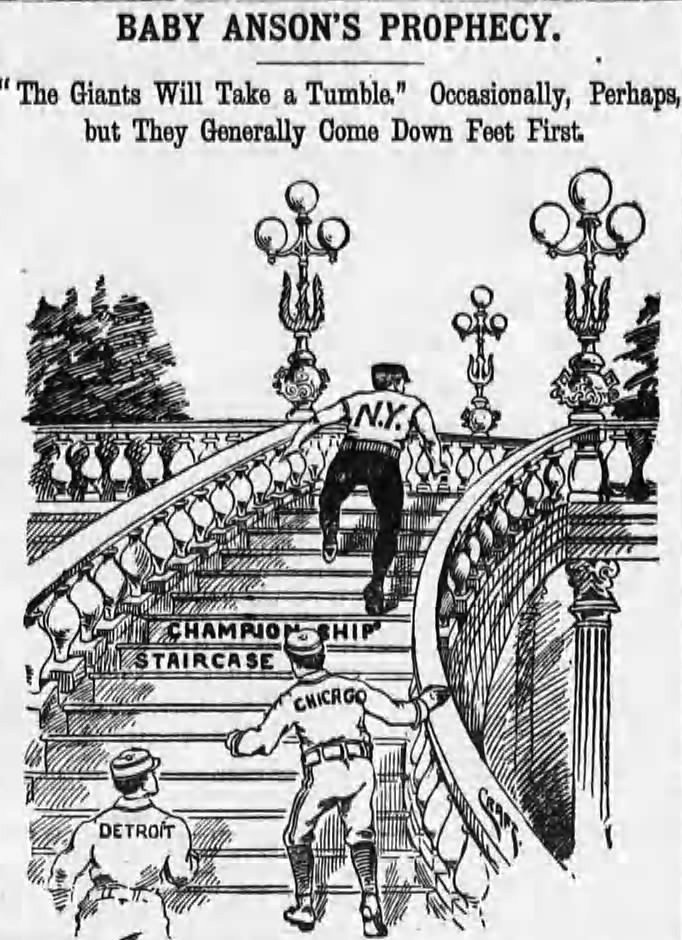
The taunting continued. After Chicago lost 14 to 0 to the Indianapolis Hoosiers on August 31:
“Did Brother Anson notice anything falling in Indianapolis yesterday?”
Another front-page cartoon on September 6:
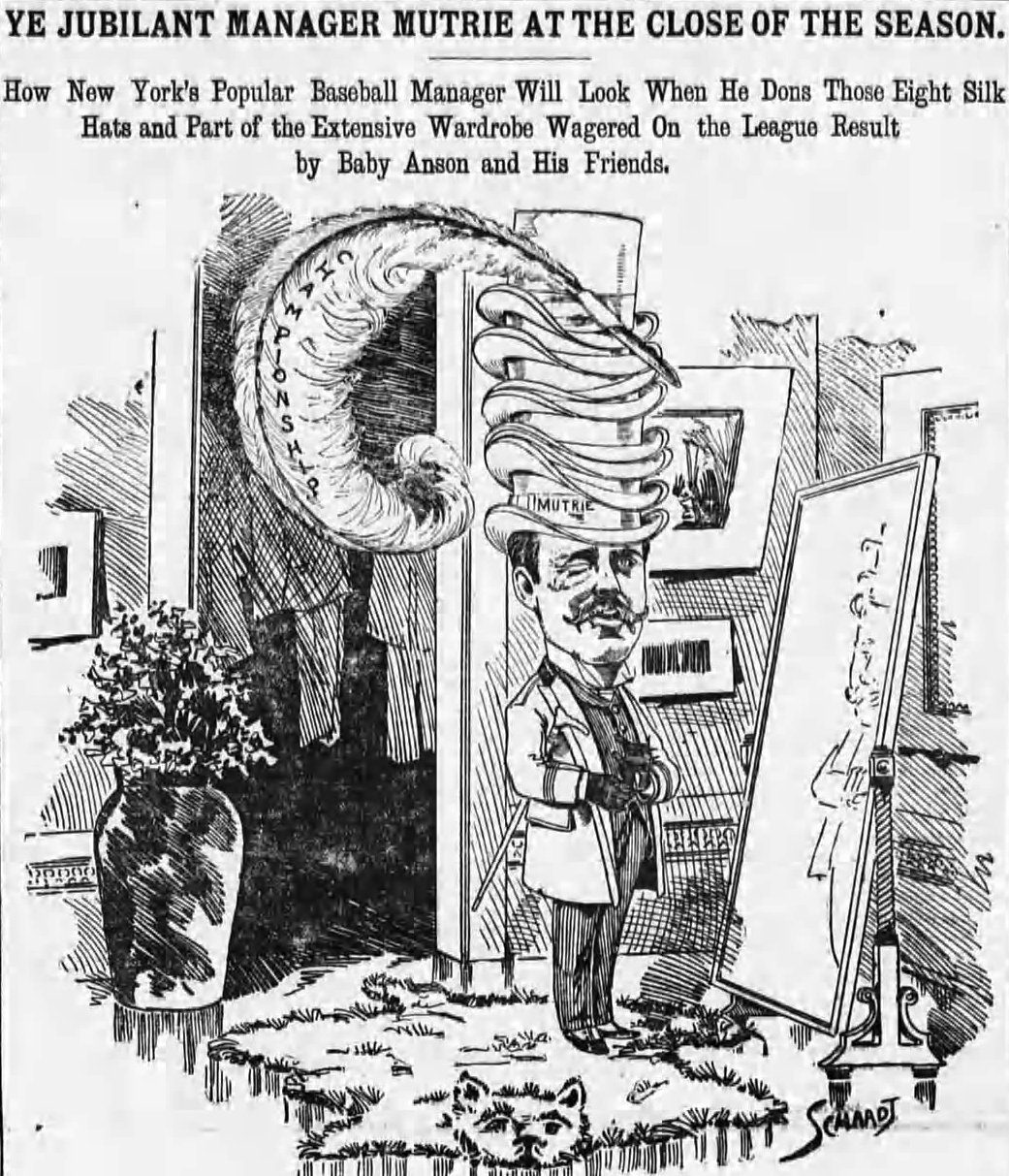
A week later, after the Colts took three straight from the Giants in Chicago, and cut the New York lead to five and a half games, The World attributed it to “Two new men for Anson’s team;” umpires Phil Powers and Charles Daniels. The Giants managed win the fourth game of the series 7 to 3; the paper said Giant pitcher Tim Keefe was “too much for Anson and the umpires.”
Chicago never got within six and a half games again. On September 27 the Giants shut out the Washington Nationals, putting New York nine games ahead of the idle White Stockings. The World declared the race over on the next day’s front page:
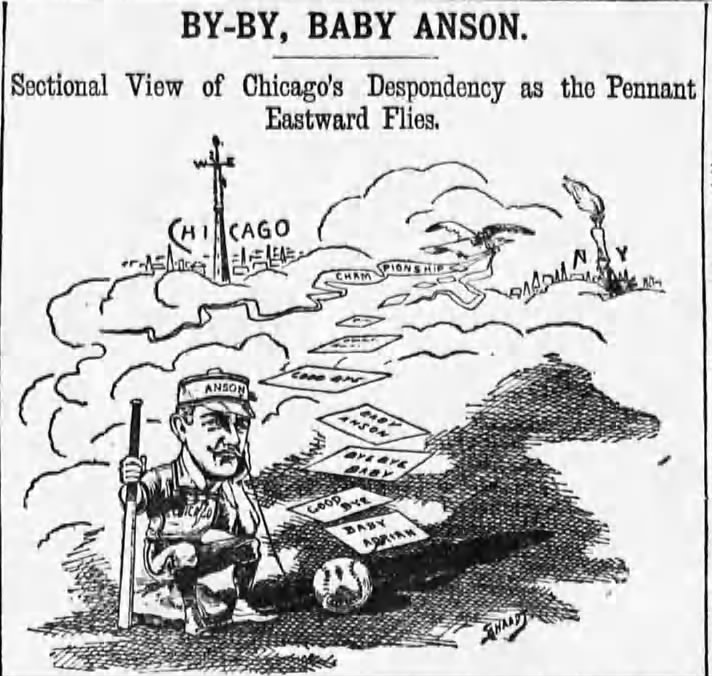
All was finally forgiven on October 10. The Giants had won the pennant, and Anson, on an off day before his club’s final two games of the season in Philadelphia, came to the Polo Grounds and met with Mutrie:
“(Anson) gave Mutrie a check for $100, in payment for the suit of clothes won by the latter. The two then clasped hands over a similar bet for the next season—that is, each betting his club would beat the other out.. Anson then cordially congratulated his successful rival upon the winning of the pennant, and stated his belief that New York would surely win the World’s Championship.”
The Giants beat Charlie Comiskey’s American Association champion St. Louis Browns six games to four.
Anson’s White Stockings won five National League championships between 1880 and 1886, he managed Chicago for another decade after the 1888 season; he never won another pennant.
Tener, the pitcher signed by Chicago in August posted a 7-5 record with a 2.74 ERA. He played one more season in Chicago and finished his career in 1890 with the Pittsburgh Burghers in the Player’s League. Tener later became a member of the United States Congress (1909-1911) and Governor of Pennsylvania (1911-1915), and served as President of the National League.
Mutrie’s Giants repeated as champions in 1889 (and he presumably claimed another $100 suit from Anson), he managed the team through the 1891 season.
In 1883 “Northwestern Lumberman” magazine wrote about Albert Spalding’s bat manufacturing operation in Hastings, Michigan:
“Ash is the staple bat wood. The ash bat is universally preferred and used by professional players, and given the best satisfaction. In the matter of weight, strength and durability, bats of that wood seem best adapted to the wants of the batter. A proportion of fancy, and necessarily higher-priced, bats are made of cherry. Including the different woods and various sizes, there are twenty-two styles of bats made for the trade, ranging in price at retail from ten cents for a juvenile article up to $1.50 for an aesthetic cherry bat.”
Albert Spalding
The article said Spalding’s Hastings plant would use roughly 350,000 feet of ash, 250,000 feet of basswood and 50,000 feet of cherry, resulting in an output of “25,000 dozen,” or 300,000 baseball bats.
“The best kind of lumber is required in making good bats, and the stocks of the raw material are kept two years in advance, in order to have them thoroughly dried. Kiln drying is avoided, principally on account of the waste entailed by the method.”
The magazine said the “casual observer” might believe “there was considerable money in making bats,’ but:
“A man might find there was less profit than seemed to be the case. The lumber must be good, and must be carried for considerable time, while it requires good machinery and careful workmanship on as nice a job as turning out a first-class bat.”
The bat business (and sporting goods in general) was very profitable for Spalding; he left an estate of more than $2 million dollars when he died in 1915.
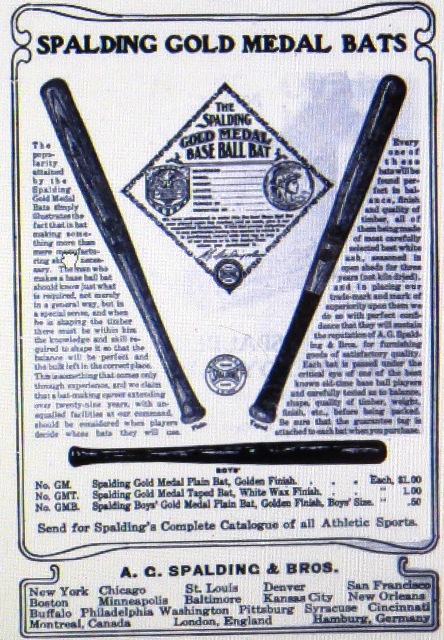
Spalding bat advertisement circa 1905
The Indianapolis News said
“Mike Donlin is in the city again and he is a real actor this time. Two years ago Mike paid Indianapolis a visit, or rather he trailed behind his wife, who theatrically, is Mabel Hite and who at the time was the leading woman in the musical comedy, “A Knight for a Day.” On that occasion Mike remained behind the wings out of sight of the audience or put in the time while waiting for the performance to end talking baseball or otherwise entertaining friends in the lobby…But all is different now. Mike is a real actor this time and he trails after his wife’s skirts no longer.”
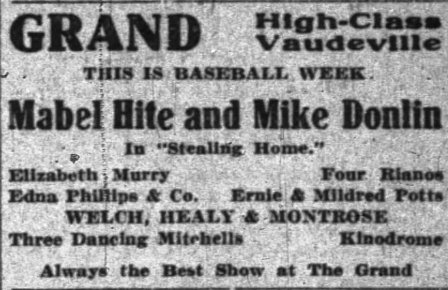
Michael Joseph “Turkey Mike” Donlin had just arrived in Indianapolis in February of 1909 while touring with his one-act play “Stealing Home,” in which Hite also appeared. His made his previous visit while sitting out the 1907 season after a contract dispute with new York Giants owner John T. Brush and traveling the country with Hite.
He returned to the Giants in 1908 and hit .334, finishing second to Pittsburgh’s Honus Wagner (.354). But Donlin caught the acting bug while traveling with Hite, and upon embarking on the national tour in October of 1908 he told reporters:
“There is something about the footlights that always appealed to me. I like this show game mighty well and baseball won’t keep me forever.”
Donlin received mixed reviews throughout the tour, but it was successful enough to keep him on the road and away from baseball until 1911.
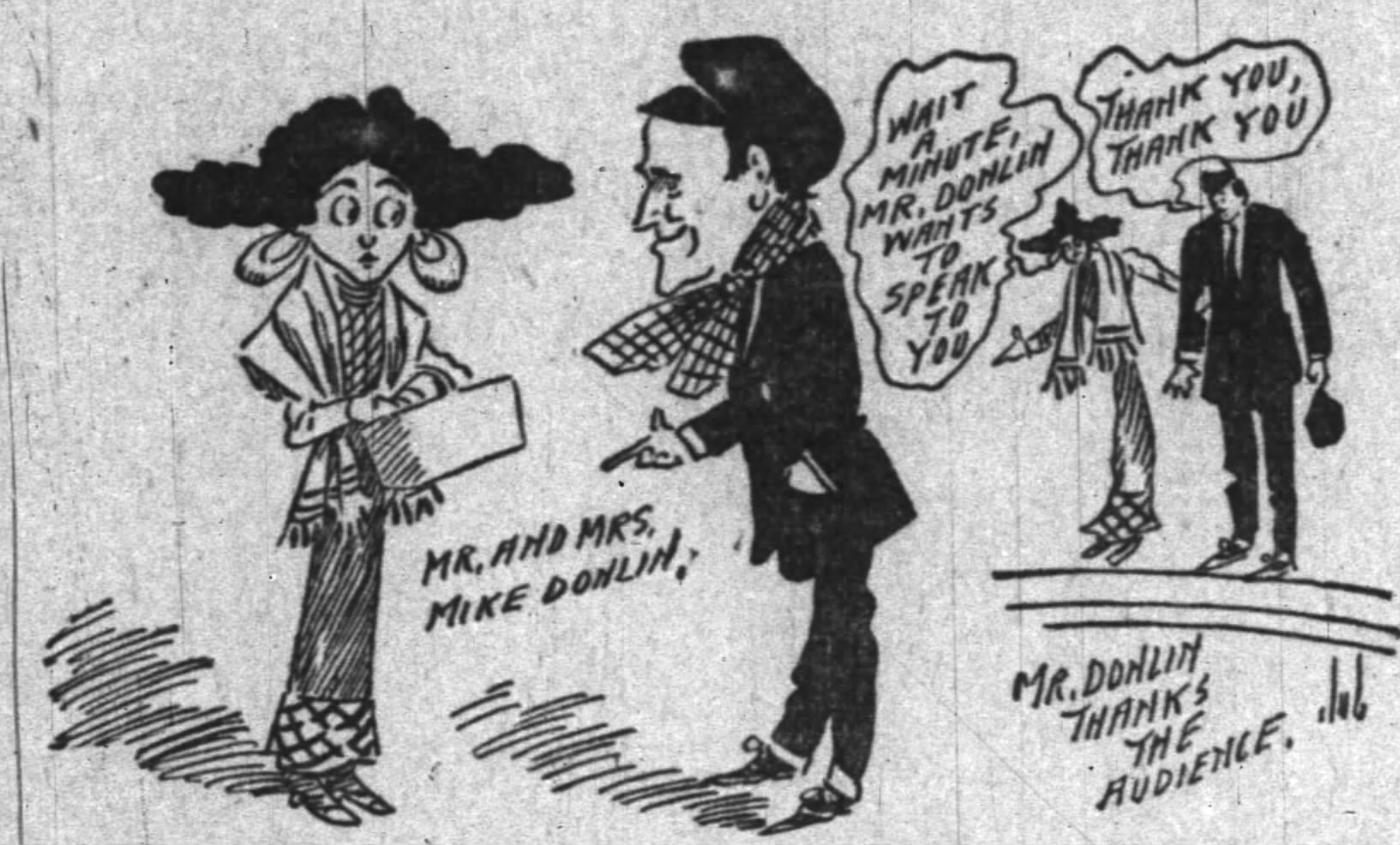
Cartoon of Donlin and Mabel Hite, 1909
The following day, after his Indianapolis debut was completed, The News provided probably the most colorful review of his show—likely more colorful than the show itself:
“Once upon a time a certain walloper of the sphere had a hunch to go forth into the provinces and connect with the long green.
“And this man was Mique and he was of the tribe of Donlin.
“And it was that Mique had a helpmate, indeed, and her name was Mabel, and she was of the tribe of Hite.
“Her patience was that of Job and she taught Mike to make a few steps, how to face the multitudes and to say ‘Back to the bush leagues for you.’
“Then, lo and behold, he was of the clan of Irving, Mansfield, Mantell and ‘Bertha the Sewing Machine Girl.’
“Many persons were injured in the rush to see him and the dough came in so rapidly that the calf that tried to swallow it choked to death.
“Then, indeed, did Mique rejoice and his cup of happiness was filled to overflowing. Even more so than on the day he socked the horse hide far beyond the reach of the hated cub in left-field and loped home to receive a box of Flora De Tar Ropes, a big bouquet and an order for a ten-pound box of dog leg.
“And now, flushed with triumph, the hero of many rag-chewing matches with the umpire and scorched by the spotlight in which he shines so brightly, Mique is in our midst.
“Even so.
“And the other half of the sketch is here, too, and she sings…very prettily and dances gracefully. Mique also dances, but his movements are not what might be termed poetry in motion.
“Great is Mique.
“As a ball player? Yes.
“As an actor? Well—
“Curtain.
“’Stealing Home,’ the Donlin skit has to do with the national game, of course. Donlin is supposed to be putting it all over the Pittsburgers, but is put out of the game for ragging with the umpire. His wife learns of it when she calls up to get the score. A moment later he enters the room and then there is ball talk galore during which she chides him for getting no hits, while Hans Wagner gets five. Donlin shows her how he called the umpire down and the sketch ends, following Mrs. Donlin’s song, with a few dancing steps in which she is assisted by Donlin.”
“Sliding Home” advertisement. Grand Theater, Indianapolis.
By the spring of 1911 “Stealing Home had run it’s course. Donlin, in need of money and with no acting prospects, returned to baseball; he played with the Giants, Boston Rustlers and Pittsburgh Pirates in 1911 and ’12 (retired again in 1913) and returned to the Giants for 1914.
Twenty-nine-year-old Mabel Hite died of cancer in 1912.
When Donlin retired again, for good this time, he returned to the stage, then the screen–with the help of his friend, actor John Barrymore. He appeared in more than 50 films, mostly in smaller roles. Donlin married actress Rita Ross in 1914, and died in 1933.
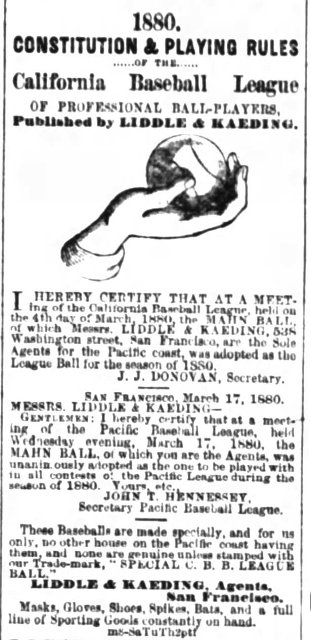 An 1880 advertisement for Liddle & Kaeding, a San Francisco sporting goods company. In addition to being the publishers of the California League’s Constitution and rules, the company was the West Coast distributor of the official baseball for both the California and Pacific Leagues; the Mahn “double-cover” ball, developed by Louis Mahn in Massachusetts.
“At a meeting of the California Baseball League… the Mahn Ball of which Messers. Liddle & Kaeding…are the sole agents for the Pacific coast was adopted as the League Ball for the season of 1880.”
J. J. Donovan, Secretary
“At a meeting of the Pacific Baseball League…the Mahn Ball, of which you are the Agents, was unanimously adopted as the one to be played with in all contests of the Pacific league during the season of 1880.
John T. Hennessy, Secretary Pacific Baseball League
“These Baseballs are made specially, and for us only, no other house on the Pacific coast having them, and none are genuine unless stamped with out trademark, ‘SPECIAL C.B.B. LEAGUE BALL.'”
Henry Chadwick is called by many “The Father of Baseball.” Is Hall of Fame plaque calls him “Baseball’s preeminent pioneer.” Chadwick is credited with creating the box score and writing baseball’s first rule book. He was also a sportswriter for more than 50 years. In 1880 he wrote an article for The New York Clipper about what qualities teams should looks for in the players they sign. O.P. Caylor of The Cincinnati Enquirer said Chadwick “Never wrote more truth in so little space:”
“In the first place, what a manager must avoid is the engagement of players is the habit of indulging in intoxicating liquors. Such men are demoralizing agents in any team in which they allowed to play, as the experience of 1879, especially in the League arena, fully proved. Not only is a drunken professional his own enemy, but his presence in a team is also necessarily destructive of its morals. In fact, temperate habits among professional ball players are more essential to success than is any special skill they may possess in playing their several positions; for a poor player who is a temperate man and earnest in his work is more serviceable than any man who is a fine player can be who is under the influence of drinking habits.
“Secondly, quick-tempered, passionate men are unfit to be in a nine made up to play for the side. Hot temper is not only opposed to clear judgment, but it entirely prevents a man under its influence from playing for the side. Such men, when they ‘get their mad up’ at anything, do not hesitate a moment to indulge their spite at a brother player at the cost of even the loss of the match.
Henry Chadwick
“Thirdly, in making up a team for carrying out this policy, you must avoid putting players in it who have any ambitious views for preferment, such as a desire to be made captain of the nine or manager of the team. It is impossible for such men to play for the side. They are so busy in organizing cliques against the powers that be, and in maneuvering for the desired place, that they think of little else, and they play the game only with this one object in view. This has always been a cause of difficulty in teams in which there are two or more ex-captains or ex-managers. The player who has once tasted the fruit of authority is rarely amenable to control when occupying a subordinate position unless it be under some ruler whom he knows to be his superior as a captain or manager. Ex-captains or ex-managers might serve under Harry Wright, for instance, but they would be restive under the rule of a less experienced and capable man.
“Fourthly, players who have an “itching palm’ should be avoided in the make-up of a team selected for carrying out the policy of playing for the side. Men of this class are always (on the alert) for opportunities to do a little outside business in a quiet way which will help to increase their pecuniary receipts of the season.
“Fifthly, the longer players are kept in the service of one club the more they may be relied upon to play for the side, as a general rule; and it is not an unfair conclusion to arrive at that that player who is ready to leave the service of a good club at the temptation of the offer of a couple of hundred dollars a year more salary, is a man whose heart is not in his work sufficiently to make him a good player for his side. In fact, this club feeling—that is, a feeling of special interest in the success of his club outside of any interested motive of a more personal nature—is one of the foundation stones of the policy of playing for the side. Players who possess none of this kind of feeling are of that class who are ready to exclaim ‘I don’t care a snap for the club; I go in to play my best for my record, and if this helps to win games, well and good; but you bet I ain’t a-going to spoil my average just to win a match for no club in the league. That’s the kind of a player I am, and don’t you forget it.’”
Please consider a small Paypal donation to help fund my next research trip. Thank you.