“He Would let a Fast one hit him Square in the Chest”

11 Sep

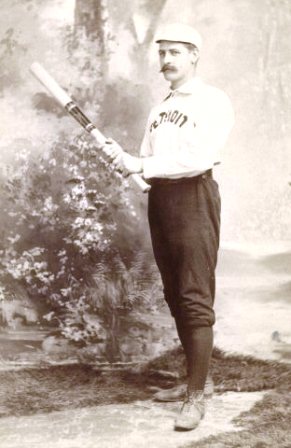
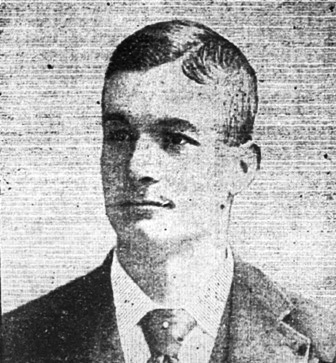
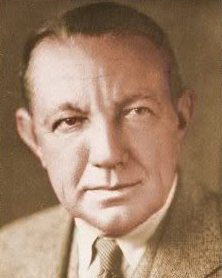
Charlie Bennett was one of the best catchers of the 1880s, and is credited with inventing the chest protector.  Bennett always gave the credit for the invention to his wife. The Detroit Free Press told the story in the 1914:

“It was a constant source of worry to Mrs. Bennett to watch her husband being made a target for the speed merchants of thirty years ago.  And she fully realized the pressing necessity of some kind of armor to prevent the hot shot sent through by these speedy slabmen from caving in a rib or two which belonged to her better half.

“So she and her hubby proceeded to contrive some means of saving the aforementioned ribs.  After much deep thinking and considerable labor they gradually shaped out something that had a faint resemblance to the protector worn today.  A crude but very substantial shield was made by sewing strips of cork of a good thickness in between heavy bed ticking material.   After much hard work and many dove like spats they had it ready for trial.  Charlie didn’t have the nerve to wear it outside his shirt for fear of the fans roasting him about being chicken-hearted, so he wore it under his baseball shirt.”

Charlie Bennett

Charlie Bennett

The article said after Bennett began wearing the protector in games sometimes “he would let a fast one hit him square in the chest.  The ball would rebound back almost to the pitcher, much to the amazement of the fans and players, who weren’t on to the hidden cause.”

Bennett’s career came to an end after the 1893 season.  While taking a train with former Boston Beaneaters teammate John Clarkson for a hunting trip, Bennett slipped while getting off a moving train to speak to a friend, when the train began moving he tried to climb back aboard, slipped and fell under the wheels.  Bennett lost his left leg at the ankle and his right at the knee.

Johnny Evers, in his book “Touching Second: Science of Baseball” written in 1910 with Hugh Fullerton, told a story about Bennett watching a game years after his accident:

 “He was watching a game at Detroit when a young base runner, trying to steal second, slid straight at the baseman, who was reaching to take a high throw.  The baseman blocked him with one leg, caught the ball and touched the runner out. “’I could have beaten that myself,’ muttered Bennett in disgust. “’Without legs, Charlie?’ inquired a friend. “Yes—without legs,’  Snorted Bennett angrily, ‘for I would have had brains enough not to slide where he could block my feet.’”

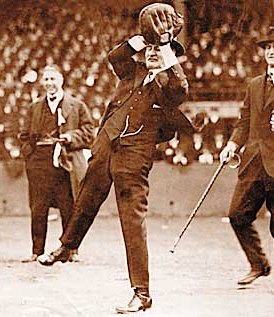
Charlie Bennett threw out the first pitch at every Detroit Opening Day from 1896-1926...he died in February of 1927.

Charlie Bennett threw out the first pitch at every Detroit Opening Day from 1896-1926…he died in February of 1927.

“Base Ball has cured more Cases of Insanity than any other Outdoor Sport or Amusement”

10 Sep

A small item in The Sporting Life in 1905, although vague on details, highlighted a growing trend in the first decade of the 20th Century, fielding amateur baseball teams made up of mentally ill patients:

 “Score another point in favor of the greatest of sports, base ball.  Dr. Harmon, superintendent of a famed insane asylum near New York has discovered that playing base ball has cured more cases of insanity than any other outdoor sport or amusement. The other day the trustees wanted to till all the soil belonging to the asylum, but Dr. Harmon insisted on enough ground being left intact for a base ball park. “This game has worked wonders in many cases of insanity,” said Dr. Harmon, “in that it gives these unfortunates healthful exercise and diverts their minds from the channels into which their maladies have sunk them.”

The “asylum near New York” mentioned was probably The Buffalo State Hospital,  “Dr. Harmon” was most likely Frank W. Harmon, who was not from New York, but rather superintendent of Cincinnati’s Longview Hospital, a facility that was well-known for strong teams.  They were two of many state and private asylums throughout the country to have teams; many participated in amateur leagues and received regular coverage in the local press.

The baseball team from The Government Hospital for the Insane in Washington D.C. circa 1909 (now St. Elizabeths Hospital)

The baseball team from The Government Hospital for the Insane in Washington D.C. circa 1909 (now St. Elizabeths Hospital)

The idea wasn’t entirely new; in 1890, The New York Times reported that the State Hospital in Middletown, New York considered “indulging in the national game,” the “best and most exhilarating” outdoor activity for patients.  But by 1905, the trend had exploded.

One team, from the Northern Indiana Hospital for the Insane, in Logansport, issued a challenge “to play any similar team in the United States.”    The challenge received a great deal of coverage in Midwest papers, and included the claim that the team’s star pitcher was “a young man committed from South Bend who was one of the most noted players in the Central League.”

The player was not named  but was probably Homer Tobias, who had posted a 2-0 record for the South Bend Greens in 1908.  In April of 1909, Tobias, who The Sporting Life said “was expected to be a star member,” of the team disappeared for several days and was eventually located and committed at Logansport.  He never played professionally again.

William O. Krohn, a former University of Illinois Psychology professor who left the school to become a physician at the Kankakee State Hospital used baseball as a treatment for patients.  One of his assistants was a former University of Illinois student named Francis Xavier “Big Jeff” Pfeffer, who worked with the doctor when he wasn’t pitching for the Chicago Cubs and Boston Beaneaters.

"Big Jeff" Pfeffer

“Big Jeff” Pfeffer

In a 1911 article in The Warsaw (IN) Daily Union, Krohn said:

“You might say without departing from the literal truth that baseball makes the insane sane and the sane insane.  At least the sane often give manifestations of violent insanity while the insane seem rational while under the influence of baseball.”

“Fear of the Black List has Stopped Many a Crooked Player from Jumping”

9 Sep

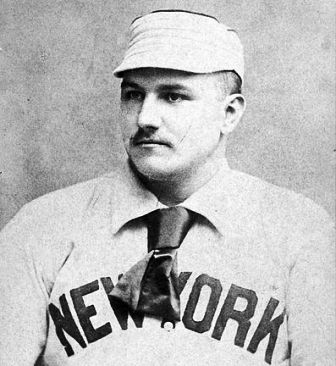
For a brief period in the mid1890s, George Jouett Meekin was considered among the top pitchers in the game; he might never have had the opportunity, but for what The Sporting Life called “The disastrous effects of Chairman Young’s somersault.”
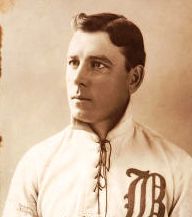
Jouett Meekin

Jouett Meekin

 John Montgomery Ward, Meekin’s manager with the New York Giants, said he was, along with Amos Rusie, Tim Keefe, John Clarkson and Kid Nichols, the “most marvelous pitchers as ever lived.”

Charles “Duke” Farrell, who caught Meekin and Rusie with the Giants, said:

“Sometime, it seemed to me that (Meekin) was actually faster…Rusie’s speed struck the glove with a bruising deadening, heavy shock, and Meekin’s fastest gave a sharp, sudden sting.”

But in 1891 Meekin was a 24-year-old pitcher in his third season with the St. Paul Apostles in the Western Association. The New Albany, Indiana native became a well-known amateur player across the Ohio River in Louisville before signing his first professional contract with the Apostles in 1889.  His sub .500 winning percentage was not enough to keep the American Association’s eighth place Louisville Colonels, from inducing Meekin to jump his contract with St. Paul.

In June Meekin jumped; at the same time third baseman Harry Raymond jumped to Colonels from the Western League’s Lincoln Rustlers.

The National Board of Control, created after the 1890 season as part of the “peace agreement” between the National League and The American Association after the collapse of the Players League, to arbitrate contract disputes, acted quickly.  Board Chairman (and National League President) Nick Young announced that Meekin and Raymond would be “forever ineligible to play with or against a National Agreement club.”  The statement, signed by Young, also said:

“This order or any other that may hereafter be made for the same cause, will never be modified or revoked during the existence of the present board, whose term of office will not expire for five years.”

The move was applauded by the press and no less a figure than “the father of baseball,” Henry Chadwick, who called Raymond and Meekin part of a “venal cabal” of jumping players.

Despite the promise that the order would “never be modified or revoked,” Young did just that.  Within weeks of issuing the order, both players were reinstated.

The backlash was swift.

The Cleveland Plain Dealer called the reversal “nauseating.”  The Cincinnati Times-Star said it was “one of the greatest mistakes ever made.”  The Milwaukee Evening Wisconsin said Young and the board chose to “toss the National Agreement into the fire.”
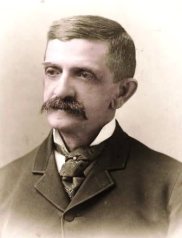
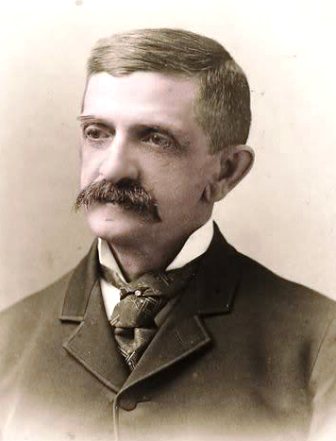
nickyoungpix

Nick Young

James Edward Sullivan, founder of the Amateur Athletic Union (AAU) said the reinstatement of the “arch-culprits” Meekin and Raymond “was the worst in the history.”  He predicted dire consequences as a result:

“Heretofore the fear of the black list has stopped many a crooked player from jumping or doing dishonest work.  But from now on it will be different.  A precedent has been formed.”

Raymond jumped back to Lincoln, taking Colonels’ pitcher Phillip “Red” Ehret with him to the Rustlers.  Meekin remained with Louisville and moved to the National League with the Colonels the following season.

Meekin had a 10-year big league career as a result of Young’s reversal.

From 1891-93, Meekin was 29-51 with Louisville and the Washington Senators and was traded to the Giants (along with Duke Farrell) before the 1894 season.  He was 33-9, and fellow Indiana native Amos Rusie was 36-13, for the 2nd place Giants.  Meekin had two complete game victories in the Giants four game sweep of the first-place Baltimore Orioles in the Temple Cup series (Rusie won the other two games).

The New York Evening Journal called Meekin “Old Reliable,” and said, “He can push ‘em up to the plate in any old style, and is factor with the stick.”  The pitcher hit .276 with 29 RBI in 183 at bats in 1894 (including hitting 3 triples in a game on July 4) and was a career .243 hitter.

Meekin won 102 more games (including 26, and 20 win seasons in 1896 and ’97), but as O. P. Caylor said in The New York Herald he suffered from “a lack of control.”  Meekin walked 1056 batters and struck out only 901 in more than 2600 innings, he also hit 89 batters; in 1898, he broke Hughie Jennings nose with a pitch.

After posting a 16-18 record for the seventh place Giants in 1898, Meekin, along with Rusie, and second baseman William “Kid” Gleason, were blamed by New York owner Andrew Freeman for the team’s disappointing finish.  Freeman told reporters:

“Meekin, Rusie and Gleason will be either sold or traded.  We do not want them.  I’m going to break up cliques in the team even if I have to get rid of every man.  There must be harmony.  Without it we can’t win games.  We have too many men who are simply playing for their salaries and do not seem to care whether they win or not.”

Rusie had injured his arm late in the season and sat out the next two years.  Meekin and Gleason, despite Freedman’s promise, returned to the Giants for the 1899 season.  The team finished in tenth place, and Meekin struggled with a 5-11 record.

He was sold to the Boston Beaneaters in August for a reported $5000, although it was commonly assumed that the Giants received much less, or simply “loaned” Meekin to Boston for the stretch run; a charge made by Brooklyn Superbas manager Ned Hanlon.  Although Hanlon’s charges have become “fact” in countless books and articles over the years, several newspapers, including The Pittsburgh Press refuted Hanlon’s story:

“All that talk and fuss about Freedman giving Jouett Meekin to Boston in order to help that team win the pennant and thus get even with Brooklyn is nonsense.  The truth of the matter is that Freedman thought Meekin’s days as a pitcher were over, and he offered him to the Pittsburgh club, but President (William) Kerr thought the same way and did not take him.  At the time Boston’s pitching corps was in bad shape and manager (Frank) Selee took a chance on the big fellow.  There was no underhand dealing in the matter at all.”

Meekin was 7-6 with a 2.83 ERA for Boston, but the team finished second to Brooklyn.  He was released by Boston before the 1900 season and pitched just two games with the Pittsburgh Pirates before being released again in July.  He finished the season with the Grand Rapids Furniture Makers in the Western Association and spent 1902 in the Southern Association with the Memphis Egyptians.

Meekin returned home to New Albany, Indiana, where, in 1910, according to The Trenton True American “his earnings from baseball are well invested in real estate.”

Meekin slipped into relative obscurity by the time he died in 1944.

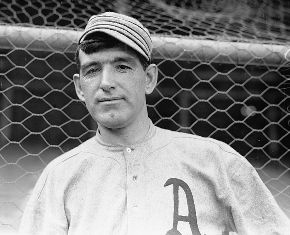
The original picture that appeared with this post–now below–was misidentified as Jouett Meekin in this blog and by The Louisville courier-Journal in 1897.  According to Mark Fimoff co-chair SABR Pictorial History Committee, the picture was actually Lave Cross.  
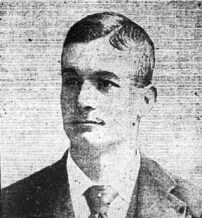
Lave Cross--picture earlier misidentified as Jouett Meekin.

Lave Cross–picture earlier misidentified as Jouett Meekin.

Lost Advertisements–Connie Mack Day in Cleveland

6 Sep

???????????????????????????????

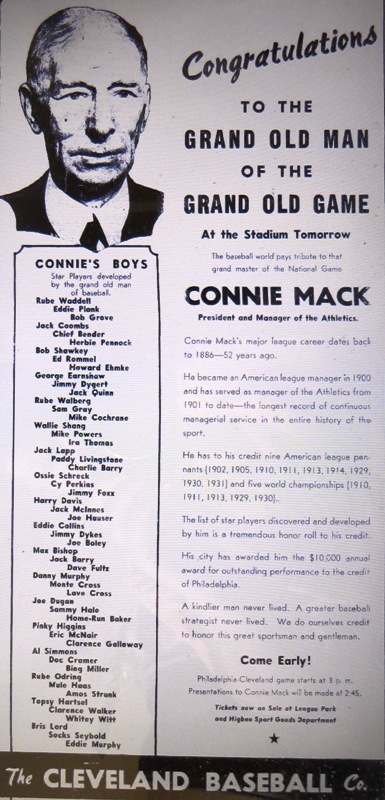
A 1938 Advertisement printed in Cleveland newspapers for Connie Mack Day.

The Philadelphia Athletics manager was honored on June 19 in front of 20,000 fans at Cleveland Stadium.  The ad listed every “star player developed by the grand old man of baseball.”

The baseball world pays tribute to that grand master of the National Game

Connie Mack

President and Manager of the Athletics

Connie Mack’s major league career dates back to 1886–52 years ago.

He became an American League manager in 1900 and had served as manager of the Athletics from 1901 to date–the longest record of continuous managerial service in the entire history of the sport.

He has to his credit nine American League pennants (1902, 1905, 1910, 1911, 1913, 1914, 1929, 1930, 1931) and five world championships (1910, 1911, 1913, 1929, 1930).

The list of star players discovered and developed by him is a tremendous honor roll to his credit.

His city has awarded him the $10,000 annual award for outstanding performance to the credit of Philadelphia.

A kindlier man never lived.  A greater baseball strategist never lived.  We do ourselves credit to honor this great sportsman and gentleman.

The Cleveland Plain Dealer said Mack was presented with “a handsomely bound leather book in which were the signatures of every person in organized baseball from Judge Kenesaw Mountain Landis down to the greenest rookie in the West Texas-New Mexico League.”  Cleveland’s baseball writers also presented Mack with an engraved gold pencil.

The Plain Dealer and The Cleveland News both noted that when Mack addressed the crowd he added an “n” to Indians president Alva Bradley’s first name; The Plain Dealer said:

“Mr. Mack always had a tough time with names of his friends and players.  For years he has called ‘Lefty’ Grove ‘Groves’ and Lou Gehrig “Garridge.’ In fact he never has attempted to call his second baseman, (Dario) Lodigiani, anything but ‘Lodi’ for this season.”

The league-leading Indians beat Mack’s Athletics 5 to 4.

“A Great deal of foolish Sympathy was wasted on Rusie”

5 Sep

Hank O’Day, pitcher and Hall of Fame umpire, said Amos Rusie was the greatest pitcher ever:

“Amos is the greatest pitcher the country ever saw. Why, Rusie had more speed in his curve ball than any pitcher I ever saw before, or have ever since seen, has in his straight fast ones.  Rusie was a wonder—that’s all there is to it.  I was behind the plate one day when one of Rusie’s  fast incurves hit Hughey Jennings…the ball hit Jennings squarely in the temple, and he fell as though shot by a ball from a Winchester rifle.  I caught him in my arms as he toppled backwards—and he was out of his head for three days.” (Contemporary reports of the incident said Jennings actually finished the game, but later lost consciousness for four days)

O’Day was also on the field when Rusie blew out his arm in 1898; Rusie threw to first to pick-off Chicago Orphans outfielder Bill Lange and “his arm cracked like a pistol’s shot.”  In 1940 Lange told his version of the story to The Portland Oregonian:

“Amos Rusie, I don’t know of any better one and I never played against any other one as good.  He had great control, as well as everything else a pitcher should have.  But my base stealing got him.  He worried over it.  I guess he lost sleep over it.  Anyway, one day he showed up on the field and said he had developed a new way to catch me off of first without turning his body.  I was anxious to see what he had, and he caught me off of first.  But—and it was a mighty large but—in doing so Rusie threw his arm out.  And never could pitch in his old form again.”

Amos Rusie

Amos Rusie

Rusie, with a dead arm, became a benchmark, an oddity, and a cautionary tale.

He posted a 246-173 record before the injury; after sitting out all of 1899 and 1900 he was traded to the Cincinnati Reds for Christy Mathewson, appeared in three games, was 0-1 with an 8.59 ERA, and his career was over.

In the decade between 1898 and 1908 The Sporting Life christened “the next Rusie,” or “another Rusie” no less than 20 times; scores more were given the same title by newspapers across the country.  Most like Cecil Ferguson (career 29-46), Davey Dunkle (17-30), Cowboy Jones (25-34), and Whitey Guese (1-4) were busts.  The three best were Orval Overall (108-71), who was called the “next Rusie” more than anyone else; Ed Reulbach (182-106), and Hall of Famer Ed Walsh (195-126).

During that same decade there were regular, small items in newspapers about Rusie’s post National League life.  Shortly after his release from the Reds in June of 1901 papers reported that Rusie, “who commanded a salary of many thousands of dollars, is now working as day laborer at $1.50 a day.”   The pitcher told a reporter “This shows I am not afraid to work, but it’s an awful comedown in salary.”

The Dallas Morning News pulled no punches in their assessment of his plight:

“The dismal afterclap to the brilliant career of a once-famous ballplayer whose name was a household word in balldom…reckless wastefulness in financial matters and a total disregard for physical care brought Rusie to his present deplorable condition when he should have been in his prime, for the big fellow is barely 30 now.”

In 1903 it was reported that Rusie had joined the Vincennes (IN) Alices in the Kitty League.  While no statistics survive, he appears to have stayed with the team for most of the summer.  The Detroit Free Press said he was “playing for a salary of $75 per month.”

After the 1903 season he went to work in a lumber yard, and the regular reports on his activities as a “low-wage laborer” appeared regularly in newspapers.  The items became such a regular feature that The Associated Press, in a short story about the Philadelphia Athletics’ eccentric and troubled Rube Waddell in 1904 said:

“Rube has run the gamut of foolishness.  He is in his prime but a few more years of such lack of sense as he displayed last season will send him to the wood pile or coal heap and he will, like Amos Rusie, be occupying two inches in the has-been columns every spring.”

There were multiple reports that Rusie was coming back as a pitcher for the 1906 season.  The rumors started in September of 1905 when Rusie attended an exhibition game in Vincennes between the Alices and the Chicago Cubs.  The Philadelphia Inquirer said of the news:

“If you don’t know the tremendous importance of this announcement you are no baseball fan.”

Not everyone agreed that Rusie returning to baseball would be a good thing.  A report from The News Special Service, which appeared in many Midwest papers said:

“His habits were none of the best, and he rapidly deteriorated in efficiency as an athlete.  He refused to pitch one whole season because he had been fined by the New York (Giants) management for being intoxicated and abusing his wife.  A great deal of foolish sympathy was wasted about that time on Rusie, but he was entitled to nothing except what he received, and some who knew the circumstances thought stricter disciplinary methods would not have been amiss.”

Rusie didn’t sign a contract that spring; and two other rumors that John McGraw had sent him a letter inviting him to spring training with the Giants and that he would return to the Kitty League didn’t materialize either.

But Rusie did make the news again in June.  A man named Gabe Watson was collecting mussels in the Wabash River when his boat when his boat overturned.  The Evansville Courier said Rusie pulled the drowning man from the river.

The nearly annual reports of “Rusie’s return” ended after 1906, but Rusie’s many career, and life changes continued as newspaper copy for the next twenty years.

When pearls were discovered in the Wabash River’s mussels, Rusie became a pearl diver.  Two years later he was in Weiser, Idaho, serving a 10-day sentence for public drunkenness.  In 1910 he was in Olney, Illinois working in a glass factory.  The following year he moved to Seattle, Washington.  For the next decade served as an umpire for a couple of Northwestern League games, worked as a ticket taker and groundskeeper at Yesler Way Park and Dugdale Field, home of the Seattle Giants, and also worked as a steam fitter.  Rusie went to jail at least once while in Seattle, and remained a big enough name that when he was injured by a falling pipe in 1913, it made newspapers throughout the country.

In 1921 Rusie became another in the long line of former players hired by the New York Giants at the behest of John McGraw.  According to newspaper reports McGraw offered the former pitcher a “job for life” as a “deputy superintendent” at the Polo Grounds.  Interest in Rusie’s career was renewed, and the pitcher was regularly interviewed for the next couple of years, reminiscing about his career and about how he’d like to have had the opportunity to pitch to Babe Ruth.

Unlike most of the former players who McGraw found work for at the Polo Grounds, Rusie did not stay for the rest of his life; he returned to Auburn, Washington in 1929 and bought a farm, where he remained for the rest of his life.  He was badly injured in a car accident in July of 1934—The Seattle Daily Times said Rusie’s vehicle overturned and he sustained a concussion and broken ribs.

While he received less attention after being incapacitated after the car accident, Rusie was still mentioned frequently in the press until his death in 1942; contrary to oft-repeated fiction that he died in obscurity.  And his obituary appeared in hundreds of papers across the country in December of 1942.  It wasn’t until the post WWII area that Rusie stopped being a household name, which led to his final comeback in the 1970s; Rusie was inducted into the Hall of Fame 34 years after his death.

“And they Started Hitting like Demons”

4 Sep

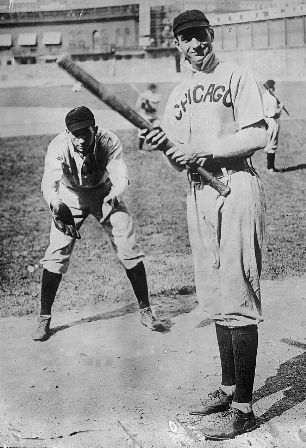
Arthur “Artie” “Circus Solly” Hofman was one of the best utility men in baseball, and a member of four Chicago Cubs teams that went to the World Series.  When he was traded to the Pittsburgh Pirates in May of 1912, Bill Bailey of The Chicago American told a story about Hofman, baseball bats and why baseball players are superstitious about them:

“Some fans might think that Artie can hit with most any old stick that comes along, but he himself is very exacting about the one he picks out before he goes up to the plate.  There is always a great line of bats laying out in front of the players bench during a game.  Most of them are special makes of the big sporting goods companies and most of them are expensive products.”

Bailey said during the 1911 season the Cubs were mired in a mid-season hitting slump:

“And Hofman conceived an idea.  He was wandering through a department store in town when he saw a couple of bats on display.  They weren’t anything like the kind the Cubs had been using. “

Circus Solly Hofman

Circus Solly Hofman

Told the bats cost twenty-five cents each Hofman bought dozens of the bats and had them delivered to the West Side Grounds:

“Hofman took one himself and distributed the rest among his teammates…Every man in the lineup used one of Hofman’s bats that afternoon.  And they started hitting like demons.  Naturally they continued using the cheap bats. And they went on a batting rampage that lasted for a long time.  Everybody was slugging the ball.  When things like that happen, is it any wonder that the players have their superstitions about bats?”

“Bill Bailey” was the pen name of Bill Veeck Sr., who would become vice-president of the Cubs in 1917, and president of the club in 1919.  He, of course, was also the father of Cleveland Indians, St. Louis Browns and Chicago White Sox owner Bill Veeck.

Bill Veeck Sr./"Bill Bailey"

Bill Veeck Sr./”Bill Bailey”

Hofman’s greatest claim to fame was being the Cubs centerfielder on September 23, 1908.  He fielded Al Bridwell’s single that scored Harry “Moose” McCormick, seemingly giving the New York Giants a 2 to 1 victory.  It was  Hofman, according to umpire Hank O’Day, who realized that Fred Merkle of the Giants, who had been on first base,  failed to touch second before leaving the field.  “Merkle’s Boner” remains baseball’s most famous base running blunder.

“Chief” Bender’s Catcher

3 Sep

Umpire Billy Evans, in one of his syndicated newspaper columns in the fall of 1910, said: “Most every ball player is more or less superstitious, but the pitchers, I believe, are more susceptible to beliefs uncanny than any of the other diamond athletes.”

Evans singled out Charles “Chief” Bender, who had just completed a 23-5 season with a 1.58 ERA for the World Champion Philadelphia Athletics, as one of the most “susceptible.”

Chief Bender

Chief Bender

According to Evans, Bender preferred throwing to catcher Ira Thomas over the team’s other two catchers Jack Lapp and Paddy Livingston:

“Bender has won lots of games with other catchers doing the receiving, but he never seems quite so steady as when Thomas is paired up with him.”

Evans said the preference extended to warming up as well:

“While there are scores and scores of pitchers who have their favorite catchers, still they are content to let one of the other receivers warm them up between innings, but not so with the Chief.  When Bender starts a game he absolutely refuses to throw to anyone other than Thomas.

“It is often the case that when the side is retired, the catcher happens to be a base runner.  Naturally much time is consumed by him in hurrying from the base he occupied to the bench to get his mask, glove and protector, and then back to the plate.  It is customary for most managers under such circumstances, to send one of the other catchers up to the plate to keep the pitcher warmed up.  I have seen Bender refuse at least a dozen times during the past summer to warm up with one of the Athletics other than Thomas.  He waits for Ira and takes a chance on getting cold in preference to putting the “jinx” on himself by tossing the ball to someone else.”

Bender's favorite catcher Ira Thomas

Bender’s favorite catcher Ira Thomas

The feeling was mutual.  In a 1911 article in The Pittsburgh Press, Thomas, who in addition to Bender also caught Jack Coombs (31-9, 1.30 ERA), Cy Morgan (18-12, 1.55 ERA), and Eddie Plank (16-10, 2.01 ERA) in 1910, said of Bender:

“I don’t take my hat off to…any other pitcher when Chief Bender is around.  He is a wonder of wonders.  No one can show me where there is a better pitcher in general.

“Bender has everything a pitcher needs and in a series of seven games he is almost invincible.”

Thomas remained with the Athletics organization for another 40 years as a coach, minor league manager and scout; he finished his scouting career with the Yankees, retiring in 1956.  He died in 1958.

Bender left Philadelphia in 1914 when he jump the Athletics for the Federal League; he returned to the Athletics organization in the 1930s.  He died in 1954.

Bender and Thomas shared a baseball card--the 1912 T202 Hassan Triple Folder

Bender and Thomas shared a baseball card–the 1912 T202 Hassan Triple Folder

The two remained close for the rest of their lives and often appeared together at baseball banquets.  One story Bender always told; the “greatest thrill” of his career, his May 12, 1910 no-hitter against the Cleveland Naps (this version was related in The Trenton Evening Times in 1936).  With two outs in the ninth Cleveland’s Elmer Flick hit a pop-up in front of home plate, the ball initially popped out of Thomas’ mitt before he secured it for the final out:

“Watching Ira juggle that ball and then hold it was my greatest thrill.”

Happy Labor Day

2 Sep
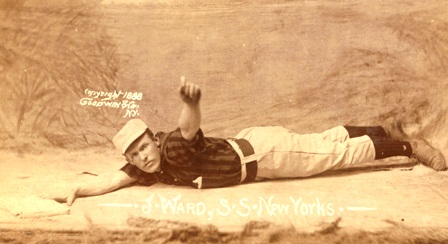
John Montgomery Ward

John Montgomery Ward

John Montgomery Ward spearheaded the movement to create baseball’s first union.  He invoked the recent memory of slavery in his article entitled “Is the Base Ball Player a Chattel?” in “Lippincott’s Monthly Magazine,” in August of 1887:

“Like a fugitive slave law, the reserve rule denies him a harbor or a livelihood, and carries him back, bound and shackled, to the club from which he attempted to escape.”

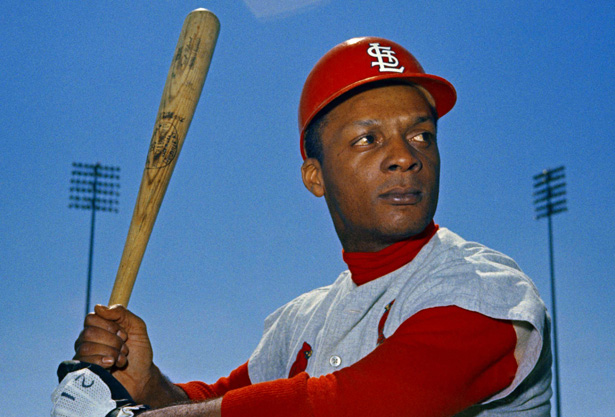
Curt Flood

Curt Flood sat out the 1970 season, refusing to report to the Philadelphia Phillies after being traded by the St. Louis Cardinals.  He challenged baseball’s reserve clause all the way to the United States Supreme Court.  Despite losing his challenge in 1972, Flood’s case was a major factor in the elimination of the reserve clause.

“I’m a human being I’m not a piece of property. I am not a consignment of goods.”

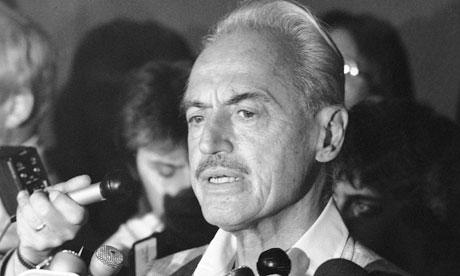
Marvin Miller

Marvin Miller

As Executive Director of the Major League Baseball Players Association from 1966 to 1982, Marvin Miller transformed the players union from a toothless entity to one of the nation’s strongest unions.  Jim Bouton, quoted by National Public Radio in 2009:

“If not for politics, so obvious to everyone, Marvin would have been voted in (to the Hall of Fame) years ago. Instead of pointing to the sky, today’s players should be pointing to Marvin Miller.”

Lost Advertisements–Germany Schaefer for Coca-Cola

30 Aug

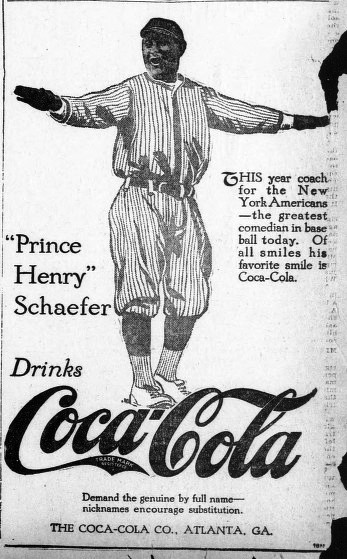
schaefercoke


Another 1916 Coca-Cola advertisement featuring another new member of the New York Yankees, coach Herman “Germany,” “The Prince” Schaefer.

This year coach for the New York Americans–the greatest comedian in baseball today.  Of all smiles his favorite smile in Coca-Cola.

The 40-year-old Schaefer was purchased by the Yankees from the Newark Pepper of the Federal League when the Feds folded after the 1915 season.  Used almost entirely as a coach, he appeared in only one game and went 0 for 1 at the plate.  He was released by the Yankees in September.


“We are beginning to have a Very Active Doubt as to the Value of Professional Baseball in American Life”

29 Aug

Coming on the heels of the fallout from the Black Sox scandal, The Chicago Tribune announced a change in editorial policy three weeks after “Shoeless” Joe Jackson, Eddie Cicotte, Oscar “Happy” Felsch., Claude “Lefty” Williams, Arnold “Chick” Gandil, George “Buck” Weaver, Fred McMullin, and Charles “Swede” Risberg were acquitted of conspiring to fix the 1919 World Series.

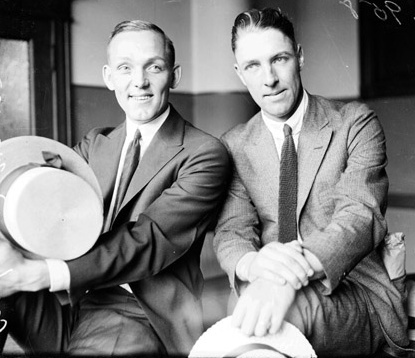
Buck Weaver and Swede Risberg during the trial

Buck Weaver and Swede Risberg during the trial

The paper said:

The Tribune has begun to use the compressor on professional baseball stories. The baseball reporters write them well, but we are getting a little tired of the subject. We are beginning to have a very active doubt as to the value of professional baseball in American life.”

The paper said baseball received a “black eye which jury verdicts did not whiten.”

The Tribune said they would place a greater emphasis on coverage of amateur sports which “produce sound citizenry.”  Professional baseball was also making Americans soft:

“The majority of spectators get only eye and mouth exercise.  We have conceded that the professional game stimulated the youngsters and that they played with more earnestness on the lots because they admired Babe Ruth.  We still admit that professional baseball is a stimulus to boys, but journalism has overfed it with space.  The Tribune is down to about a half column now for games in which the home teams play, which is justified parochialism, and to a bare statement of vital statistics regarding the other clubs.  That is enough.”

Other newspapers applauded the policy; surprisingly most didn’t cite corruption in baseball as the reason, but the rather, as The Baltimore Sun said because professional sports only provide “vicarious exercise.”  The Louisville Courier-Journal said watching baseball was even a threat to manhood:

“Two hours of inactivity in the grand stand or bleachers is not productive of muscle or sinew.  The same amount of time spent in tennis, golf, swimming or any number of games would be infinitely better for American manhood.”

Others found the new policy foolish.  The Portland Oregonian said:

The Chicago Tribune, which is regarded by its management, and doubtless by many of its readers, as the world’s greatest newspaper, has decided to blue-pencil professional baseball…The theory on which the sport page is built is that the public is entitled to what it wants…Telling the readers of sports that they should want something else, and will be given that something, is a decided innovation.”

The Duluth News-Tribune said facetiously:

“The fact that both teams (the Cubs and White Sox) are near tail-enders may not have anything to do with it.”

Then there was The Idaho Statesman which said The Tribune’s policy was a “meritorious undertaking,” but didn’t go far enough:

“There are a world of other professional sports not half as white as the Black Sox, that might come under the publicity axe with resulting good to the public…Horseracing is professional and it has produced a fine crop of crooks—more than baseball in its blackest days could possibly yield.  Our own so-called wild west sports have been placed in the professional class and everybody knows they are largely fake.  Wrestling hasn’t the whitest record in the world and prize fighting is anything but a Sunday school game.  Nobody ever got very much exercise out of any of these sports, except the participants and we are not sure that our citizenship is any sounder for having witnessed them.  The Tribune isn’t through with its job as we view the situation.”

The most prescient response was from The Montgomery (AL) Advertiser:

“We expect to see The Tribune gradually slipping back to its old ways.”

Ten days after the original policy was announced The Tribune declared victory, and revealed their real motive:

“An encouraging sign is the changing attitude of the press toward highly commercialized sport. The papers are coming to the conclusion they have been giving away millions of dollars’ worth of advertising to boost box office receipts for promoters who have no special regard for the public.”

But within weeks the “The World’s Greatest Newspaper” had, as The Advertiser predicted, begun “slipping back” to the way baseball had previously been covered.  By the beginning of the 1922 season, notwithstanding the lingering effects of the game’s greatest scandal, or no indication that Americans were getting any more exercise, baseball stories in The Tribune looked no different than stories that appeared before August of 1921.