Tag Archives: A. G. Spalding

Albert Spalding on Superstitions

18 Dec

During a game in September of 1882 against the Worcester Ruby Legs, Albert Spalding, Chicago White Stockings President, sat “in the reporters’ stand” at Lakefront Park with a sportswriter from The Chicago Herald:

“The Worcesters had gained a run in the fourth inning, but the home team had been successfully retired for five straight innings.  The Chicagos were playing their best, but ‘luck was dead against them.’”

At that point Chicago outfielder Abner Dalrymple came to where the White Stockings’ president was seated and said:

“’Mr. Spalding, will you move other in some other chair?  That was the seat Harry Wright occupied during the games we had with his club.’  Spalding laughed, but hurried out of his place to a chair further down the line.  The home team made three runs in that inning and won—five to one.”

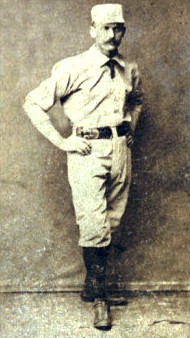
Abner Dalrymple

Abner Dalrymple

The reporter later asked Spalding about whether all players were superstitious:

“(A)nd he proceeded to explain some of the incidents and conditions supposed to influence the play.

“The players as surely believe that ducks or geese on the home ground presage defeat for that team as they do that an umpire can materially add to the discomfort of a nine,  Dalrymple had great belief that Spalding in Harry Wright’s seat would throw all the bad luck imaginable on the Chicago side.”

The Herald said when the second place Providence Grays came to Chicago that same month, the White Stockings “thought that by donning their old tri-colored caps…they would defeat them, and sure enough, they won three straight games.”

Spalding said it wasn’t limited to his own team:

“(Worcester) Captain (Arthur) Irwin always spits on the coin he tosses up for a choice of position in a game.  Jack Rowe (of the Buffalo Bisons) pulls the little finger of his right hand for luck, and all sorts of chance omens are seized upon by a club for indications of the great triumph they would like to win…(Terry) Larkin, now of the ‘Mets’ (the New York Metropolitans of the League Alliance), had an idea that he would get hurt some time for playing on Friday, and sure enough, in a game one year ago with a college team, he was struck with a ball in the stomach nd was so badly injured that his life was despaired of for a time.”

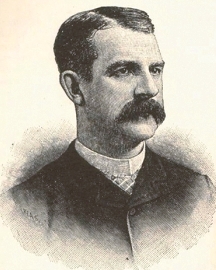
A.G. Spalding

A.G. Spalding

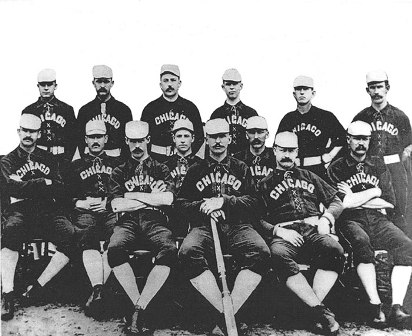
The 1882 White Stockings, due more to talent than superstition, won their third straight National League pennant beating Providence by three games.

Harry Wright Returns to Cincinnati

17 Dec

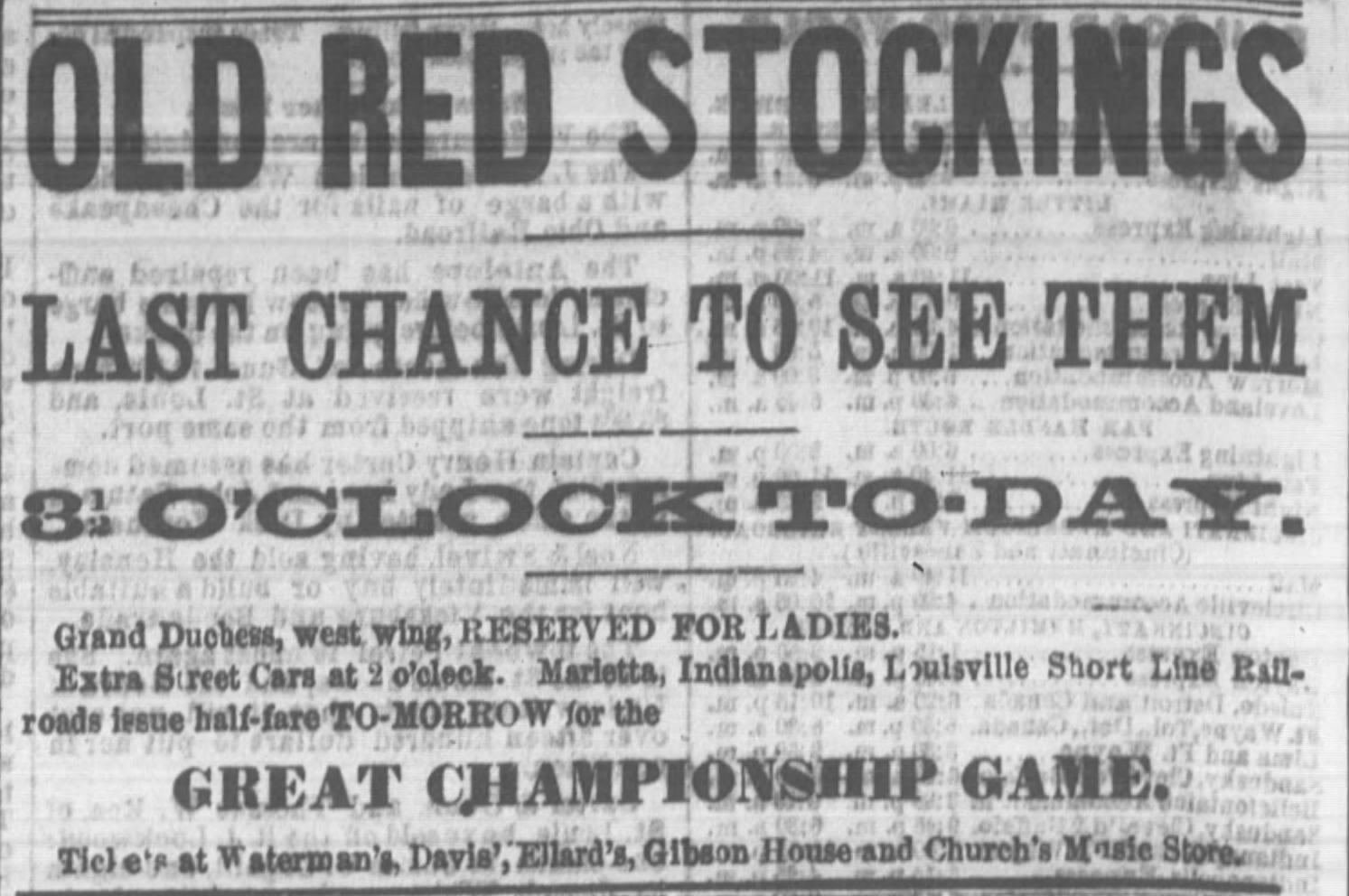
In 1871, Harry Wright took several of his Red Stockings players, as well as the team name, moved to Boston and joined the newly formed National Association.  Wright’s exit from Cincinnati was contentious, but despite that he was invited back for an exhibition game in July between his former team and a “picked nine” consisting of the members of Wright’s current team and the Washington Olympics.

Advertisement for the July 3, 1871 game

Advertisement for the July 3, 1871, game

The Cincinnati Enquirer said the two thousand people in attendance indicated “that the interest in base-ball is not dead in this city, but only needs the stimulus of first-class games to awaken it to renewed life.”

The paper said:

“The old Reds did not have the services of George Wright (who was injured), and did not play with the skill characteristic of them in 1868-’69, which may have been due to fact that there was nothing at stake than gate money.”

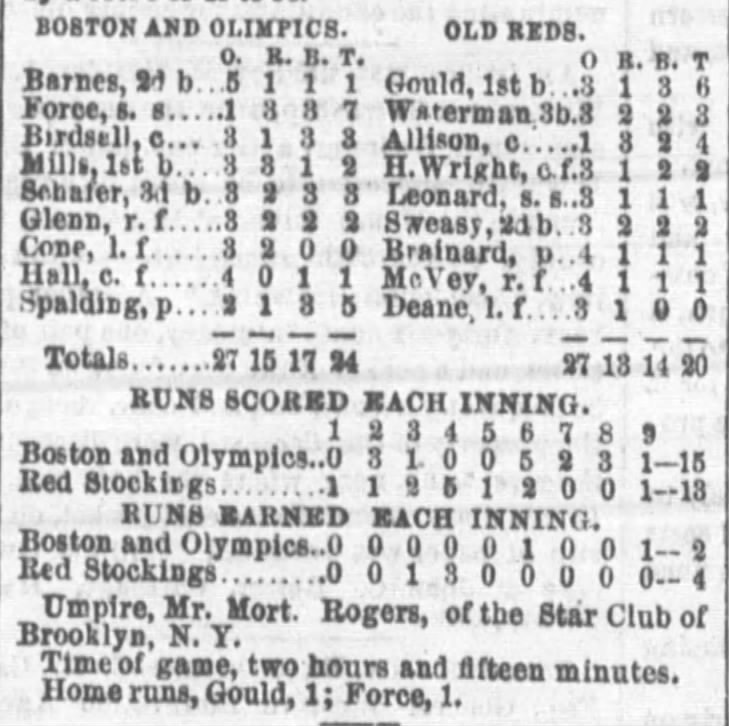
Albert Spalding pitched for the “picked nine” and beat Wright’s club, with Asa Brainard pitching, 15-13. The Enquirer said former Cincinnati players Cal McVey and Charlie Gould, who both joined Wright in Boston, “have improved in their batting powers.”

Wright’s team led 10 to 4 through five innings, but the opponents posted a five-run sixth which included a home run by Davy Force and added two in the seventh and three in the eighth.

The box score

The box score

One sign that all might not have yet been forgiven in Cincinnati:  while Harry Wright was listed in the box score and the inning-by-inning recap of the game, The Enquirer didn’t use his full name in any of the game advertisements or articles.

Professional baseball returned to Cincinnati in 1876 when the reds became an inaugural member of the National league.

Al Reach

12 Dec

Alfred James “Al” Reach opened his first sporting goods store in Philadelphia in 1874 while playing for the Athletics in the National Association.  Within a decade he had built a hugely successfully business, began publishing “Reach’s Official Baseball Guide,” and established a National league franchise in Philadelphia.

In May of 1886 Reach talked to The Philadelphia Times about “one of the great industries of Philadelphia in the sporting line.”

“Men, women and children are employed in making base balls.  The cheaper ones are made by a press with leather shavings on the inside.  The body is wrapped with cotton and covered with leather.  The covering is done by hand.  The best balls—the ones in use by the American Base Ball Association—are a solid piece of Para rubber on the inside, covered with worsted yarn and then with an outside covering of horse-hide.  Men do this covering.  They are mostly harness-makers, yet they have to broken into the work, for even a good harness-maker may be a poor hand at covering and sewing a ball properly.”

Al Reach

Al Reach

Reach said the company had orders for “five hundred dozen, or six million, balls already for this season,” and the company was “two hundred thousand dozen behind” filling the orders:

“We have had the factory running until ten o’clock at night all winter.  Base balls sell from 5 cents to $1.25 apiece…Three-fifths of all the balls used in the country are made in Philadelphia.”

—–

“Base ball bats are made of willow, spruce and first and second-growth ash.  The latter wood makes the best bet.  They are sold at fifty, sixty and seventy-five cents each.  There are about sixty thousand bats used every season.  Our orders already indicate that we will dispose of at least fifteen thousand of the best quality.”

Reach said the company employed “upwards of five hundred persons.”

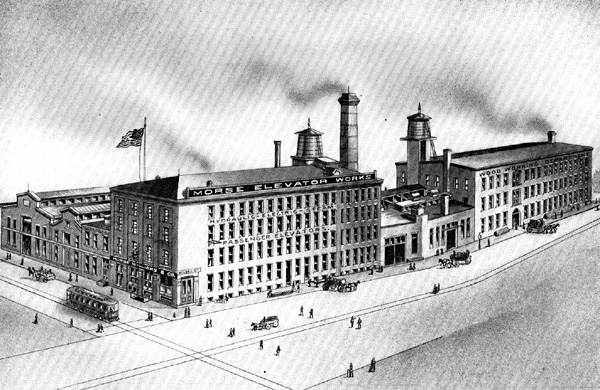
Reach's main factory in 1886 at Frankford Avenue and Wildey Street in Philadelphia---The Martin Landenberger Hosiery Mill Complex/Morse Elevator Works Building

Reach’s main factory in 1886 at Frankford Avenue and Wildey Street in Philadelphia–The Martin Landenberger Hosiery Mill Complex/Morse Elevator Works Building

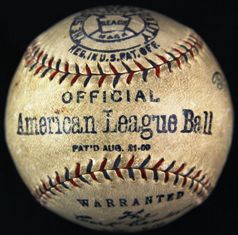
By the end of the decade Reach’s company was purchased by A.G. Spalding, with Reach staying on as an executive and the company continued to produce equipment with the Reach name, including the official American League baseball, which was used through the 1976 season.

Reach maintained controlling interest in the Phillies until 1899 and died in 1928.  He left an estate worth more than $1 million.

Reach Official American League ball 1920s

Reach Official American League ball 1920s

“Clark Griffith nearly Ended the Life of William Phyle”

19 Nov

Bill Phyle was expelled from baseball after failing to back up his allegations that the 1903 Southern Association pennant race was fixed—four years earlier he had an even more eventful season.

Phyle started his career as a pitcher; he was 18-9 in 1897, and 21-21 in 1898 for the St. Paul Saints when he was traded to the Chicago Orphans for Frank Isbell.

Bill Phyle

Bill Phyle

He appeared in three September games, winning two with a 0.78 ERA, and was expected to contribute the following season.

In March of 1899 Phyle failed to report to Hudson Hot Springs, New Mexico to join manager Tom Burns and Orphans for spring training.

The Chicago Tribune said the pitcher had refused to sign his contract:

“It is asserted on good authority that pitcher Phyle has refused so far to sign a Chicago contract owing to the insertion of a temperance clause in the document…Phyle objects strenuously to the temperance contract which has been offered to him.  He has asserted positively within the last three weeks that he would never sign such an agreement.”

The Tribune said the contract clause wasn’t the only issue that might keep Phyle from playing in Chicago in 1899; the pitcher had, inadvertently, alienated Burns and team president James Hart the previous September:

“Phyle was unfortunate in his entry into the major league in incurring the displeasure of the Chicago president and manager.  There is a peculiar story connected with the affair.  Last year some members of the Chicago team believed that someone was carrying reports to Hart and Burns regarding the conversations of the players concerning their opinions of the heads of the club.  One night in Washington some of the men put up a job on the man they suspected in order to find out if their suspicions were correct.    In the presence of the man in question they made unflattering remarks regarding the president and manager of the club, and Phyle, being an innocent party to the plot, listened, approved some of the statements quoted as facts, and also took up the discussion.  It is asserted the conversation was carried to President Hart and Manager Burns.  At any rate, Phyle has been in disfavor since that time.”

The Tribune said Phyle was the only player who was given a contract that included a temperance clause.

With the situation at an impasse, Charlie Comiskey, Phyle’s manager in St. Paul, intervened.  The Chicago Inter Ocean said Comiskey, who called Phyle “one of the most promising youngsters” in baseball, sent a “tersely worded” telegram to the pitcher who “decided to sign the Chicago contract temperance clause and all.”

Phyle reported to Hudson Hot Springs ten pounds overweight on March 21.

Three days later he went duck hunting with teammates Clark Griffith, Bill Lange, Jack Taylor and Jimmy Callahan at A.G. Spalding’s New Mexico ranch.  The Inter Ocean said of the trip:

“A bullet from a Winchester rifle in the hands of Clark Griffith nearly ended the life of William Phyle, the promising young pitcher of the Chicago ball team.”

Clark Griffith

Clark Griffith

Phyle, unbeknownst to Griffith, remained in the group’s boat while Griffith fired on a flock of ducks flying near the boat:

“Griffith pulled the trigger and a ball tore its way through the stem of the boat…The ball carried in a direct line over the young pitcher’s head, and could not have missed him by more than six inches.”

Phyle was shaken, but unhurt, while “Griffith’s nerves received such a shock that he was weak and almost prostrated for some time after.”

Things didn’t get much better for Phyle after his near-death experience—tomorrow.

Lost Advertisements — “The Spalding”

1 Nov

thespalding

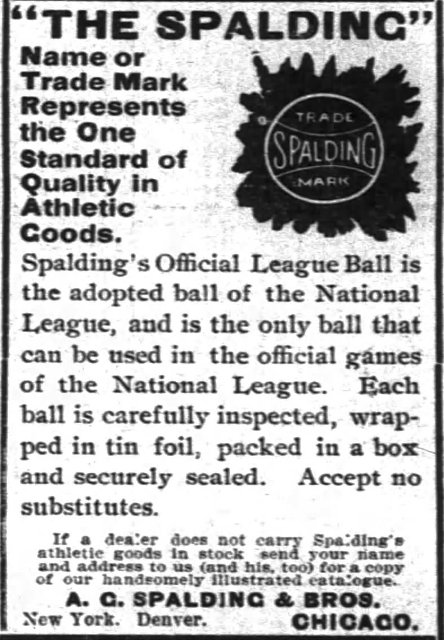
An advertisement from 1899 for the official ball of the National League:

“The Spalding” Name or Trademark Represents the one Standard of Quality in Athletic Goods

“Spalding’s Official League Ball is the adopted ball of the National League, and is the only ball that can be used in the official games of the National league.  Each ball is carefully inspected, wrapped in tin foil, packed in a box and securely sealed.  Accept no substitutions.”

“The President of the League is the Supply Department”

31 Oct

Sixty to 75 balls are used on average in every Major League game (90 must be on hand)—and estimates are that between 115,000 and 160,000 balls are used each season.  How does this compare to the number of baseballs used during the 1890s?

In 1897 The Louisville Courier-Journal reported near the end of August that National League President Nick Young said league teams had used “400 dozen (4800) balls for the season,” up to that point.

Nick Young

Nick Young

Balls were stored at Young’s home in Washington D.C.’s Mount Pleasant neighborhood.  He said:

“The public, perhaps, are unaware of the method employed by the League in circulating the balls among the twelve clubs.  The average patron of the game is under the impression that the balls are sent direct from the factory, but, as a matter of fact, the clubs are obliged to order their stock of spheres through me.  By the terms of the article of agreement and the contract with the manufacturer, the President of the League is the supply department.”

“I was debating today over my stock of balls in store at my home at Mount Pleasant, and decided that I had enough balls in stock to last the remainder of the season.  If am right in my guess, the twelve teams in the big league will use about 480 dozen (5760) balls this season, which makes an average of 40 dozen (480) per club.

“I have noticed that since the present pitching distance became a rule, more balls have been used than under the old rule, and I should infer that the five-foot impost placed on the pitcher four years ago has boomed the trade for Al Spalding, who supplies the league with balls…Of course I can’t account for the increase in foul flies that are sent over the stand, and that result in losing the balls, but the fact remains that more balls are used under the new rule.”

Young said he couldn’t explain why exactly more balls were being used because of the increased pitching distance:

“Perhaps the batsmen hit at the ball too soon or too late to connect for a safe hit, and their effort to make a safety resulted in a foul fly.”

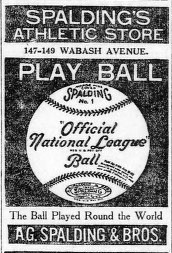
Spalding advertisement from 1890s

Spalding advertisement from 1890s

Ball clubs would wire Young when they needed additional balls:

“Every ball is weighed before shipment to the club.  Each club stand the expense of the balls ordered by its manager or owner, and this season the League will have paid out about $6,000 for the sphere of horsehide, or an average of $500 per club, which is quite an item of expenditure for this necessary tool of the trade.”

Lost Advertisements–Ready! Lajoie Baseball Guide

25 Oct

lajoieguide

Above is a 1906 advertisement for an Atlanta hardware store offering the inaugural edition of “Napoleon Lajoie‘s Baseball Guide.”  The Lajoie Guide was intended to compete with the well established Spalding and Reach Guides, and sold for 10 cents, but despite Lajoie’s popularity the guide failed to catch on and was only published for three years.

In addition to the standard recap of professional baseball leagues across the country, and many photos, the Lajoie guide included a significant amount of information specific to its name sake.  An advertisement for the Cincinnati-based Queen City Tobacco Company said:

Lajoie Chews Red Devil Tobacco

Ask him if he don’t

reddevil

Grantland Rice wrote for the guide, and the first edition included a Rice-penned poem called “For Lajoie’s in Town:”

We’ve gazed on Mr. Roosevelt,

Who rules this whole wide land.

We’ve looked at Carrie Nation, 

And shook Jim Corbett’s hand

We’ve eaten bread with Robert Fitz

And chummed with George Tebeau.

We’ve drank out beer with Mr. Schlitz.

Great notable we know.

We’ve interviewed Friend Morgan,

Thrown talk at old John D.

We’ve opened wine with Sullivan

And seen Prince Hennery.

King Edward is a bosom pal,

Langtry our school-day girl.

Dick Croker smiles in our face,

We’ll give Boss Fame a whirl

*     *     *     *     *     *     *     *

Around the shrine of heroes

There’s little we’ve not seen.

We’ve talked to all, both great and small,

Of high and lowly mien.

But this group pales beneath the looks

Of one of far renown.

Hats off!The greatest comes today,

For Lajoie’s in town.

T. Roosevelt’s backed off the boards,

A plater is king Ed.

Langtry a chorus lady now,

The others are all dead.

For Lajoie, pride of several leagues!

Lajoie, the mighty man!

Lajoie, his bat and fielding glove

Knocks out the wholes blamed clan.

The 1906 Lajoie Guide

The 1906 Lajoie Guide

“A Game before the Kings and Many Nobles”

24 Oct

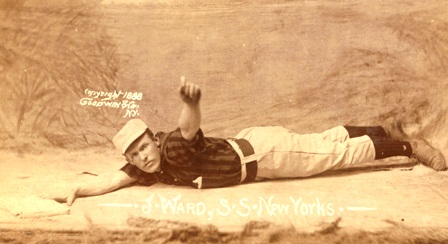
While traveling around the world as a member of A. G. Spalding’s 1888-1889 world tour, John Montgomery Ward wrote a series of dispatches for The New York World.  On February 23, 1889 the team played in Rome:

“In the picturesque Piazzi di Siena of the grounds of the Villa Borghese today the American baseball teams played a highly exciting game.  This is one of the favorite resorts of Roman citizens.  Never before in all my experience on the diamond have I seen so many distinguished persons among the crowd of baseball spectators as were in attendance here this afternoon.  The nobility was out in all its glory, and in there center stood his Majesty King Humbert.  He was dressed in a civilian’s suit and apparently enjoyed the sport. “

King Humbert "enjoyed the sport"

King Humbert “apparently enjoyed the sport”

Ward listed every member of the royal party and other “Roman princely families” who were present at the game.

“Nearly all the local literary and artistic celebrities were in the unprecedented royal and papal assemblage, and the applause at times would have stirred the heart of the most enthusiastic admirer of the American national game.  The last time the Piazzi di Siena was used was on the occasion of the marriage of the King’s brother, when the celebration was held on these magnificent grounds.

“The day was beautiful and the players were in fine condition.  During the preliminary practice the crowd of 5000 people was simply amazed at the skill displayed by the boys in batting, throwing and catching the ball.  The game itself was extremely well played, and resulted 3 to 2 in favor of Chicago.   The batting was lively, but nothing could pass the fielders, who played with remarkable energy.”

John Montgomery Ward

John Montgomery Ward

On the day of the game in Rome Ward said the players received word that National league owners were instituting the Brush Salary Classification Plan; a system developed by Indianapolis Hoosiers owner John Tomlinson Brush,  which rated players and placed them into five categories, each with a capped salary.  The Brush Plan, along with the Reserve Clause, would be the major impetus for the formation of the Players League:

“I interviewed every one of the men on the subject.  The scheme, as it is now understood by us, is regarded as a great mistake.  President Spalding, Captain Anson and Ned Hanlon concur in this opinion and say the plan is impossible and will not last long.”

Another issue that rankled players in Rome was the news that National League owners were demanding that the players return to the states by April 1 to prepare for the 1889 season; Ward said of the demands:

“From letter received by various members of the All-American team it is evident that certain managers are endeavoring to force the players to report for duty by April 1st.  For the information of these magnanimous gentlemen I will say that every player in the party will play the trip out.”

The All-Americans returned on April 6.

“Eighteen Thousand Dollars Squandered by Chicago”

22 Aug

Almost 50 years after he helped to organize the Chicago White Stockings Jimmy Wood told the story of the team’s founding to Hearst Newspapers sports writer Frank G. Menke in a series of articles.

Wood said he read an ad in a New York newspaper in late 1869, seeking to “form a team to represent Chicago and to defeat the Cincinnati Red Stockings.”  Wood said:

“Chicago wasn’t such a wonderfully large city then and it was doing everything possible to boom the town.  And it was jealous of Cincinnati because of the great publicity Cincinnati had gained through the medium of its 1869 ball team which had won 56 out of its 57 games.”

Wood, along with Tom Foley, who had placed the ad, (not to be confused with Thomas James “Tom” Foley, who played outfield for the White Stockings in 1871) set out together to build a team.

Wood called it the most difficult task of his life, attempting to sign players for “a team that had as its ultimate purpose the beating of the Reds in a three-game series.”

The press was ready to call the entire operation a failure in January—a point never referred to in Wood and Menke’s “historical” account.  The Chicago Tribune declared:

“We are not to have a first-class base ball club.  That is the long and short of it.  The thing has fizzled.”

The Tribune cited Wood and Foley’s “bungling inefficiency” as the reason Chicago should not expect much from the undertaking.

The 1870 article was at odds with wood’s nearly 50-year-old recollection that the problem of securing players was because of fear of taking on the Red Stockings:

“Scores of desirable players throughout the country applied for engagement, but delay after delay ensued…in short, everything was done precisely as it should not have been done, and the result is a total failure.  A base-ball club may, and probably will, be selected and announced within the next few weeks; but it will not be a nine capable of worsting all other clubs.”

Even Wood acknowledged that he might not have handled the process of securing players particularly well; he gave more than $1200 out of his pocket to players only to find out “some of those players had squandered their first advance money in drinking or gambling, they came for more, threatening to jump their contracts if we didn’t ‘come through.’”

Despite the slow the start, and doubts about whether or not it would be possible to put together a competitive team, Wood and Foley completed the roster that spring when they signed Bill Craver and William “Cherokee” Fisher away from the Troy Haymakers—although Fisher never played for the team.

Even The Tribune was on board; lauding Chicago’s newly formed “$18,000 team.”   The $18,000 White Stockings roster in addition to Wood and Craver, consisted of Ned Cuthbert, Charlie Hodes, Michael (Bub) McAtee, Levi Meyerle, Ed PinkhamFred Treacey, Marshall King, and William “Clipper” Flynn—a number of Chicago amateurs also filled in with the team throughout the 1870 season.
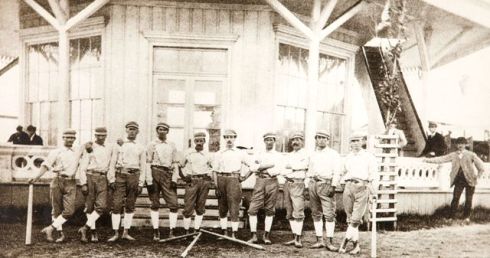
The 1870 White Stockings: Ned Cuthbert, Fred Treacey, Charlie Hodes, Bill Craver, Charlie Hodes, Levi Meyerle,Bob McAtee, , Marshall King, and William “Clipper” Flynn

The 1870 White Stockings: Ned Cuthbert, Fred Treacey, Charlie Hodes, Levi Meyerle, Ed Pinkham, Jimmy Wood, Bub McAtee, Bill Craver, Marshall King, and William “Clipper” Flynn
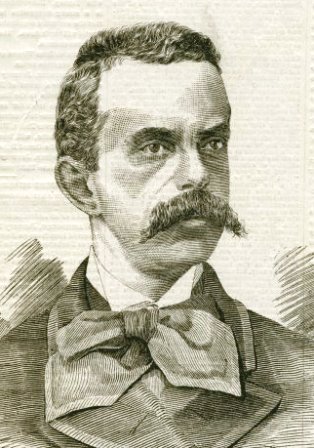
In May, the White Stockings arrived in New Orleans for a training trip.  Many books and articles credit Wood with being “the father” of spring training as a result of this trip; most cite Al Spink of The Sporting News as the source.  Most fail to mention that the Red Stockings trained in New Orleans at the same time that season, and even Wood didn’t take credit for being first.  Wood said in 1916 that his was “the second Southern trip ever undertaken by a ball club.”  The Atlantics of Brooklyn had made a similar trip in 1868, which included stops in New Orleans, Mobile, and Savannah.

Wood said the team won all of their games against New Orleans opponents—the Lone Stars, Pelicans, Robert E. Lee’s, and Southerns—“by overwhelming scores.”  He also claimed they defeated “the Memphis team, champions of Tennessee 157-1—and Foley was very angry because we had permitted the southerners to score their lone tally!”

The team played what Wood called their “first real game,” against Al Spalding and the Forest Citys in Rockford, Illinois and despite the Rockford fans backing “their team heavily in the betting…we swamped them.”

According to Wood, he and Foley shut the team down due to injuries “along about June 4th when I found that my ailing quartet was not convalescing very rapidly, I canceled all our remaining June and July games and stayed in Chicago.”

His 1916 recollection seems to be faulty here as well, as records indicate that the White Stockings played several games in June and July against amateur and professional clubs, including the season’s biggest disappointment for the team.

On July 6 the overconfident White Stockings lost 13-4 to the New York Mutuals, who had recently lost several games.  The New York Herald headline taunted:

Eighteen Thousand Dollars Squandered by Chicago

“With ‘hearts as light as the wind blows’ and feeling as happy as ‘big sunflowers’ the White Stockings crossed over to Williamsburg yesterday, there to teach the Mutuals of New York what a six months residence in Chicago could do in the art of base ball playing.  Never did a more confident party enter a ball field than the ‘nine’ created by Chicago…On the other hand, the Mutuals crossed over alarmed somewhat at the confidence of their opponents, and reflecting over their many defeats of late, denied not a syllable uttered.  They were quiet, reticent, in fact, and dressed for the fray as one might roll himself in a shroud preparatory to decapitation.  Underneath all of this, however, there was a determined will.”

On July 26, the Mutuals would beat Chicago again, this time on their home field, at the Dexter Park Racetrack at 47th and Halsted.  The Herald again taunted Chicago, calling the 9 to 0 victory “The Worst Whipping on Record.”

Despite the records indicating a fairly complete schedule during June and July, Wood, speaking in 1916 said “About August 4 we resumed our schedule and played out the season, winning all of our games from the resumption in August until the end.  And then came the grand climax of the year—the task for which we had been preparing ourselves; the battle with the Cincinnati Red Stockings.”

Wood’s memory was again at odds with the facts.  The White Stockings lost, at least, one August game at home, a 14 to 7 defeat at the hands of Spalding’s Forest Citys.

The story of Wood’s “grand climax of the year;” the Red Stockings series, coming up on Monday.

“He must either admit that he sold yesterday’s game or acknowledge that he cannot play ball”

20 Aug

Heading into the 1875 season Chicago White Stockings manager Jimmy Wood was confident about his team’s chances.  The Chicago Tribune said:

“(Wood) says the men are strictly temperate, are all first-class ball players, and will enter the field without any of the petty jealousies and ill-feelings that weakened the nine last year.”

The St. Louis Democrat also printed “private” comments Wood made maligning the abilities of the Brown Stockings in comparison to his team.

Jimmy Wood

Jimmy Wood

Unfortunately for Wood the decline of the White Stockings began even before opening day.

The first blow to the team was what became known as “the Davy Force” case.  Force signed a contract to return to the White Stockings for the 1875 season on September 18, 1874; unfortunately for Chicago he also signed a contract to play for the Philadelphia athletics on December 5.  The Sporting News described the adjudication of the Force case:

“(In December) the matter was brought up and the judiciary committee (of the National Association) awarded Force to the Chicago club…At the spring meeting of the Association, held in Philadelphia, the Athletic club got in its political work.  Mr.(Charles) Sperling, of Philadelphia, was elected president of the Association, and he appointed a new judiciary committee which reversed the ruling of the old committee.”

The arbitrary nature of the new ruling—that Chicago did not have the right to sign Force for 1875 before the end of the 1874 season—enraged White Stocking President William Hulbert, and was one of the many complaints about how the National Association operated that led to the organization of the National League the following season.

With Force gone, Wood chose Dick Higham to be the team captain.  The 23-year-old Higham had played for the Baltimore Canaries and New York Mutuals, and Wood described him as “one of the surest and heaviest batters in the country, has experience and is a first-class base-runner. “  That perception of Higham quickly changed in Chicago.

Dick Higham

Dick Higham

Despite starting the season with an 11-2 record, the White Stockings were never going to catch the first place Boston Red Stockings, who won their first 26 games, and as the losing began team morale suffered.

As the team struggled, blame fell to Higham from fans, the press, and management.  The Tribune went so far as to question his integrity:

“It is not a pleasant thing to say of any ballplayer that his being left out of a nine increase interest of a game, but this is true of Higham; and yet he is one of the best players in the country when he wants to be…It may be Higham’s fault, or his misfortune, that he is suspected of purposely losing games.”

By the end of June Scott Hastings had replaced Higham as catcher (he was moved to second base) and he was stripped of his captaincy, which was given to outfielder John Glenn.

The Chicago Inter-Ocean had defended Higham in July declaring that there was “no tangible evidence” for the “charges…bandied about the streets,” but that would change by August after an 8 to 4 loss to the Athletics during which Higham “let balls go by him without attempting to stop them” and made two throwing errors:

“Higham’s play in yesterday’s game has caused some very ugly rumors to be circulated, in which he predominates as the leading character.  His play in the eighth inning was something extraordinary, and it was quite evident he did not want to save the Chicagos from defeat.  Many are fearless in asserting that he sold the game, and base their accusation on a circumstance that seems very plausible.  Probably Higham can explain what he was doing with a Chicago character at Pratt’s billiard hall waiting for the pool selling, and when he found out there was none what point he gave his companion when they both went to Foley’s and there bought pools on the Athletics.  Many persons, who claim to know, boldly assert that Higham was in partnership in the investments. ..He must either admit that he sold yesterday’s game or acknowledge that he cannot play ball.  In either case the Chicago management can easily do without him. “

The Tribune said the directors of the White Stockings had offered a $500 reward for evidence that any player had been “tampered with,” in any way:

“This offer is meant to cover proof that a player has received money to sell a game, or has promised to help lose a game with a view to profit.  The directors will not insist on absolute proof, such as the law would require, but will pay the reward named for evidence that will convince any fair man of the guilt of the accused party.”

It was never reported whether the reward was given to anyone, or if anyone made an effort to claim it.

On August 20 the White Stockings released Higham; as a result The Inter-Ocean said, “(T)he patrons of the game have begun to think more favorably of the nine, and generally remark that now they can witness an honest game.”

Higham finished the season with the New York Mutuals.  His unpleasant months in Chicago were not the first or last time his integrity was questioned.  While with the Mutuals in 1874 there were allegations that he had been involved in throwing a game against Chicago, and In 1882, Higham, while serving as a National League umpire, was dismissed for what The New York Times called, “’crookedness’ in his decisions in games between the Detroit and other clubs.”

During the drama over Higham, The Inter-Ocean also reported that utility infielder Joe Miller, who was slated to replace Higham at second base “had some misunderstanding,” with Wood and his “connection with the Chicago nine was severed.”

With the team mired in sixth place, and the former team captain chased out-of-town under a cloud of suspicion, it wasn’t surprising when the local papers started to predict the end of the line for the manager.

The Inter-Ocean not only said that the White Stockings would likely relieve Wood of his duties at the end of the year “attributable to his leniency to the players, which is truly a part of bad management,” but correctly speculated  “(Boston Red Stockings pitcher Albert)  Spalding will be the manager,” in 1876.

There’s one more chapter in the story of the 1875 White Stockings—tomorrow.