Tag Archives: American League

“This whole Trouble, Disgraceful to be sure, may be Blamed directly on Jack Sheridan”

14 Mar

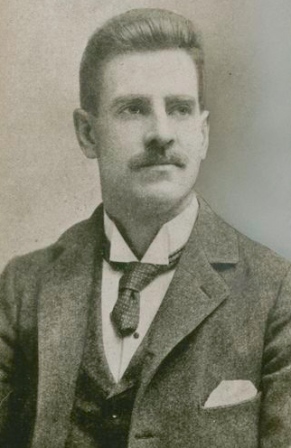
On April 7, 1901, The San Francisco Call reported that John F. “Jack” Sheridan had accepted an offer from President Ban Johnson to continue working as an umpire in the American League—which operated as a minor league the previous season.  The paper said “The National League also made a bid for his services.  He will receive $400 a month and expenses.”  It was said to be “the largest salary ever paid to an umpire.”

Sheridan was a former player, a second baseman and outfielder, who played for several San Francisco teams in the California League, including stints with the Haverlys from 1883-85.  He went East in 1885 and appeared in six games for the Chattanooga Lookouts in the Southern league, and that same season began working as an umpire.
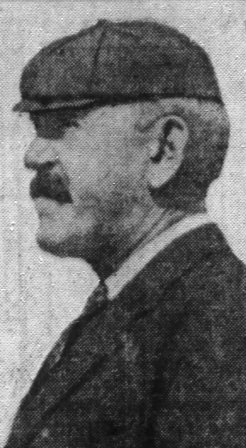
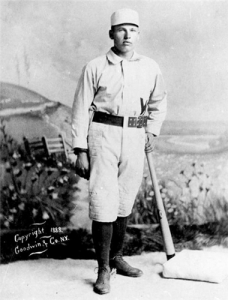
sheridanpix

Jack Sheridan

Years later, Mique Fisher, long-time California and Pacific Coast League manager and executive told The (Spokane) Spokesman-Review that Sheridan was signed by the Lookouts after he “sold himself to Chattanooga through a glowing personal description of his own ability,” but Fisher said:

 “Sheridan couldn’t field a ball with a fish net or hit one with a tennis racket.  When the Chattanooga manager saw Sheridan in action, he swore out a warrant charging him with obtaining money fraudulently.  Sheridan had to work out the expense advance in a cigarette factory.”

He worked as an umpire in the Southern League (1885, ‘93), the California League (1886-89, ’91), the Players League (1890), the National League (1892, ’96-97), and the Western/American League (1894-95, 1898-1900).

The best-paid umpire in the game, who was also a San Jose undertaker during the off-season, traveled from his California home to Chicago in early April of 1901, but a detour in Missouri nearly cost him his job.

The Chicago Tribune said Sheridan left the train “and was taken into custody on account of his strange actions.”  The Fort Wayne Sentinel said among the “strange actions” Sheridan “donned his uniform and started to umpire an imaginary game in the middle of the street.”

Johnson sent fellow American League Umpire “Pongo” Joe Cantillon to Missouri to get Sheridan released and accompany him to Chicago.  Sheridan was admitted to St. Elizabeth Hospital.  The Tribune said he was suffering from “nervous prostration,’ while The Cincinnati Enquirer said the league president said Sheridan was “on a protracted drunk.”

The day after he was admitted to the hospital two friends were given permission to take Sheridan out for a walk, The Chicago Inter Ocean said:

“As they reached Milwaukee Avenue and Division Street, a (street) car whirled by, and Sheridan swung himself on the rear coach.  His friends yelled in vain to the conductor to stop the train, and lost sight of Sheridan.

“They at once notified the police department to look out for Sheridan…Detective Fitzgerald found Sheridan wandering aimlessly on Jackson Boulevard near Wabash…Sheridan did not know where he was, nor could he tell where he had been since escaping from his friends.”

As Sheridan waited to appear in court to determine whether he was insane, newspapers speculated that Johnson would replace the umpire with either former player Warren “Hick” Carpenter or former Western and National League umpire Al Manassau—Manassau was appointed to the American League staff two days before the season began.

Before he could be adjudicated insane Sheridan made a miraculous recovery just one week into the season.  The San Jose Evening News said:

“Mrs. Sheridan, the mother of Jack Sheridan, the noted baseball umpire, has received a telegram from her son, who is in Chicago, stating that he has fully recovered from his derangement and that he could now continue with his contract.”

Sheridan was back on the field before the month of April of over.  He was competent, served as the American League umpires “chief of staff,”  and umpired in four World Series (1905, 07, 08 and 10); he was also selected, along with National League umpire Bill Klem, to join the Chicago White Sox and New York Giants on their world tour after the 1913 season.

But he also demonstrated erratic behavior for the rest of his career.

Just a month after returning to the field The Sporting Life said “Sheridan became frantic and ran up and down the field like a crazy man,” after a disputed call at home plate in the bottom of the ninth of a May 31 game in Detroit between the Tigers and Baltimore Orioles, which led to Sheridan awarding the game to the Tigers by forfeit.

The Sporting Life’s Baltimore correspondent said Sheridan was “held by President Johnson as a competent man,” despite his “habits.”

He resigned on at least three occasions.  After the 1905 and 07 seasons he said he was retiring to return to San Jose and become a full-time undertaker, only to return the following spring and in June of 1910, he abruptly quit minutes before a game in Washington, but returned within several weeks.

When Sheridan again took the field The Washington Post said he would “establish a precedent, as he will be the only major league umpire wearing glasses.”

Sheridan was also arrested in October of 1907 after a barroom brawl that began over a dispute over $120.  The Associated Press said when police searched Sheridan he was carrying $2700.  He was released from jail the following day after being fined $10.

On July 30, 1914, Sheridan called Ray Morgan of the Washington Senators out on a close play at first base in Detroit.  The Washington Post said Morgan, who had slid, “came up with a handful of dirt and threw it on the ground at Sheridan’s feet…Sheridan evidently thought that Morgan intended to hit him, and did not even give the National’s second sacker time to put up his guard, but whaled away at his smaller opponent.”
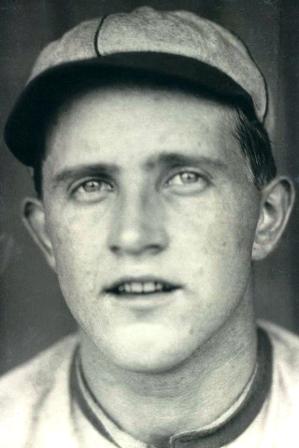
Ray Morgan

Ray Morgan

Morgan punched Sheridan, and after both dugouts emptied, Sheridan was also punched by Washington’s Eddie Ainsmith.  The disturbance spilled over to the stands with a few Washington players, including Morgan and Ainsmith, taking on Detroit fans before police restored order.

The Post said:

“This whole trouble, disgraceful to be sure, may be blamed directly on Jack Sheridan, the umpire, who has been at fault so many times this year.  In the first place Sheridan has threatened to beat up several of the Washington players.  Sheridan told (David “Mutt”) Williams and (Joe) Engel that he would punch them in the nose, the same as he had Morgan, if they did not do as he told them.”

Ban Johnson never took action against Sheridan for the incident in Detroit, but Morgan and Ainsmith drew suspensions from the league.

On August 1, 1914, The Associated Press reported that “The baseball players fraternity intends to take steps to have Umpire Jack Sheridan retired from service on grounds of incompetence.”

The incident, and dust up on August 12 with Jack Fournier of the White Sox inspired a poem from The Chicago Tribune’s Ring Lardner:

Making Night Hideous

Oft in the stilly night,

Ere slumber’s chain has bound me

Fond memory brings the sight

Of athletes crowding round me;

The scowls, the sneers

Of Jack Fourniers

And Morgans strike my vision;

I hear the barks

And rude remarks

That greet each close decision.

Thus in the stilly night,

Ere slumber’s chain has bound me,

I sometimes get tight up and fight

The chairs and tables round me.

At the end of the 1914 season, Sheridan returned to California.  On October 31 The Associated Press reported that Sheridan would not be returning as an umpire:

“Sheridan will probably be retained as a sort of supervisor of umpires, spending his time roaming around the circuit.”

Just three days later Sheridan died of heart failure in San Jose at age 62—he was said to have suffered sunstroke during an August game and never fully recovered.  Ban Johnson supported him to the end; just weeks before the umpire died the American League president told a reporter:

“I sincerely doubt if the baseball game will ever know another Jack Sheridan.  He had all of the virtues of other arbiters, and none of their mistakes.”
Things I Learned on the Way to Looking up other Things #6

12 Mar

Umpiring “Revolutionized”

The Chicago Inter Ocean reported that an “innovation in baseball” would be introduced during the second game of a September 9 double header at Chicago’s South Side Park between the White Sox and the Boston Americans.

“The astonishing feat, an apparent impossibility, will be accomplished by the use of colors, and the inventor, George W. Hancock, expects the umpiring business to be almost revolutionized.”

hancock

George W. Hancock

Hancock was the inventor of indoor baseball in 1887; the game that evolved into softball.

“(Umpire) Jack Sheridan will wear a red sleeve on his right arm and a white one on his left claw.  For a strike he will wave the right arm, and for a ball the left one and the flash of the colors can be seen by people seated so far away that the voice even of Sheridan, the human bullfrog, would be inaudible.”

The “innovation” would likely have benefited one player, the popular center fielder of the White Sox, William Ellsworth “Dummy” Hoy, who was deaf.  But no mention was made of Hoy in the description of Hancock’s plan.

Hoy

Hoy

The “astonishing feat” turned out to be so insignificant that The Inter Ocean failed to even mention it in the summary of the double-header which the Sox swept.  Hoy did not appear in either game.  George W. Hancock’s plan was never mentioned again.

Luminous Ball

Another innovation that promised to revolutionize the game that never came to be was the luminous ball.  The Reading Times reported on the process in 1885:

“Charles Shelton, the leading druggist of Bridgeport, has discovered a compound which, when applied to a baseball, renders that object luminous.  One of the drawbacks of playing baseball at night under the electric light is the inability to see the ball when thrown or batted into the air with the black night background of sky behind it.  By saturating it with Mr. Shelton’s compound the ball while in motion is luminous.  At rest it does not retain any light.  The illuminating ball retains its meteoric irritation for 45 minutes.”

There is no record of Mr. Shelton’s invention ever being used in a professional game.

What’s a Dog Worth?

As part of the Federal League’s antitrust lawsuit against the American and National League’s affidavits were submitted from players detailing how organized baseball controlled the destiny and salary of player.  Mordecai “Three Finger” Brown, who jumped from the Cincinnati Reds to sign with the Federal League’s St. Louis Terriers, swore in his filing that players, on at least two occasions, had been traded for dogs.

William A. Phelon, of The Cincinnati Times-Star and “Baseball Magazine,” said:

“This thing of trading dogs for ball players—as outlined in the Federal affidavits—should be put upon a sane and sensible basis.”

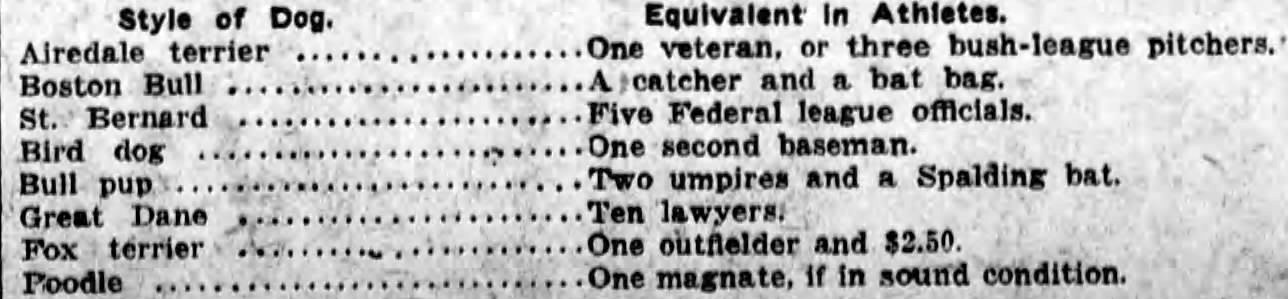
Phelon provided a “definite standard and a set of unit values” for baseball to follow:

phelondogs

McMullin’s Long Route to the Plate

Before Fred McMullin became the least famous of the eight members of 1919 Chicago White Sox who were banned from organized ball for life, he was a popular player on the West Coast.

Fred McMullin

Fred McMullin

The (Portland) Oregonian told a story that was purported to have taken place when McMullin was a member of the Tacoma Tigers in the Northwestern League in a game with the Seattle Giants:

“He came in from third on a dead run and made a slide for the plate.  McMullin knew he didn’t touch it, but he was afraid to slide back, as the catcher had the ball in his hand.  The umpire also knew he didn’t score, but he said nothing, for that was none of his business.

“Fred dusted off his uniform and stalked nonchalantly to the bench.  A couple of Seattle players yelled for a decision.

“‘He wasn’t safe, was he?’ demanded (Walt) Cadman, who was catching for Seattle.

“The umpire shook his head no.  At that Cadman, holding the ball in his hand, dashed over to the Tacoma bench to tag McMullin.  Fred waited until he almost reached him and then slid to the other end of the bench.

“Cadman followed him, and as he did s slipped in some mud and fell to his knees.  McMullin leaped up from the bench, dashed for the plate and touched it.  The umpire called him safe.”


Rube and Ossee

10 Mar

Connie Mack’s Philadelphia Athletics were expected to repeat as American League champions in 1906.  The 1905 team won 92 games, finishing two games ahead of the Chicago White Sox, and lost to the New York Giants in the World Series.

The 1906 Athletics were in first place as late as August 11, but faded to fourth, losing 33 of their last 52 games and finishing 12 games behind the champion White Sox.

Much of the blame for the poor finish was directed at Rube Waddell.

Rube Waddell

Rube Waddell

Waddell, 27-10 in ’05, dropped to 15-17 after fracturing his thumb in May of ’06.   The Philadelphia Inquirer said he was driving a rented carriage, “At Twenty-second Street and Ridge Avenue he became involved is a collision with a delivery wagon…he turned his horse quick to avoid the wagon, and when he found that the wagon was sure to hit the carriage he jumped and landed on his thumb.”  He sat for two weeks and never found his form from the previous season.

Waddell’s recovery was slowed, it was suspected, because of his off-field habits.  The general opinion of the fans and press was summed up by The Wilkes-Barre Times which said:

“Waddell has refused to appreciate that the modern ballplayer positively must keep in condition and ‘deliver the goods.’  The famous Mike Kelly could spend a $100 bill the night before playing a championship game and not report the next day.  It was regarded in those days as a joke.  That day has gone by.”

Waddell’s personal catcher, Ossee Schreckengost—Schreck—was also blamed for the collapse.  Schreck was sent home by Mack for the remainder of the season on September 22.  During a series in St. Louis he failed to return to the team hotel after a night out with “some German friends.”  Schreck said:

“Mack told me to pack up and go home.  That’s all there is to it.  We did not have any argument.

“Mack wants to try out a lot of juveniles this trip.  I do not think he is sore at me, and do not think I stand suspended.”

The Philadelphia Inquirer disagreed:

“For the good of the cause, Ossie [sic] Schreckengost was sent home by Manager Mack tonight suspended for the rest of the season.

“Schreck has not taken care of himself this year (as) an athlete should, and to his shortcomings more than anything else Manager Mack attributes the slump of the team in mid-season.  To Schreck St. Louis is the most attractive town on the circuit.  Yesterday he succumbed to its blandishments.”

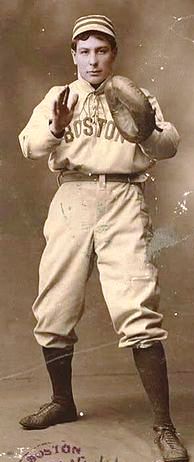
Ossee Schrecongost

Ossee Schrecongost

Either as a result of their drinking, the fact they were said to have “tanked” the Athletics season, or both, The Washington Post suggested that “Waddell and Schreck should be dubbed the tank battery.”

The battery mates and road roommates were sent their contracts for 1907.  Waddell was threatened with a pay cut if he didn’t stay in shape.  He quickly signed.

Mack is quoted by many sources over the years saying Schreck refused to sign his contract until Waddell agreed to no longer eat crackers in the double beds they shared on the road.

It is generally considered an apocryphal story invented by Mack years later—and often even said to have happened before the 1904 or ’05 seasons rather than 1907.

But, the story was not the invention of Mack.  There was actually a letter purported to be written by Schreck “from his home in Cleveland” (it is not known who actually wrote the letter), and reprinted in several newspapers between the 1906 and ’07 seasons:

“Dear Connie:  This is not a touch for any advance, or an increase in salary, but something much more serious, and as it won’t be long before the Athletics start south for spring practice, I am going to ask you to put Waddell under another charge this year.

“While I did not mind Rube bringing mocking birds and a reptile or two into our sleeping apartments down south, I do object to his habit of eating crackers in bed.  This Rube does nightly.  Not a single night last spring did Waddell retire without his south paw containing a dozen crackers, many of them resembling animals.

“By the time Rube, or Eddie, as he wishes to be called in southland, had got outside of these crackers, I was in anything but a sleepy mood, due in a measure to his crunching of the crackers.  It did not seem to interfere with Eddie.  He would turn over and go to sleep at once when through.

“Had it stopped here, all would have been lovely.  It didn’t however, and the natural result was that the bed was full of crumbs.  This had been going on for years, and frequently have I welcomed a night on the road with an upper berth, so as to escape Waddell and his crumbs.

“This complaint may seem trivial to you, after your varied experiences with Rube, but I can assure you that the crumbs that came from those crackers were anything but ‘crumbs of comfort’ for your humble servant.  In closing, I would like to suggest that if you can put a clause in Waddell’s contract that he is not to eat crackers in bed during the season of 1907.  I am sure Waddell and I will continue to be real good friends as of yore.  Yours truly, Ossee Schreck

“P.S.—I wish all of the boys, and of course this takes in you, a happy new year.  Am doing light training.  O.S.”

Whether or not the “cracker clause” was inserted in Waddell’s contract, the Rube/Ossee battery was together for all but four of Waddell’s 33 starts in 1907, but the relationship between “the real good friend’s of yore” began to deteriorate that season;  likely because Schreck had cut back his drinking considerably, while Waddell continued to be Waddell.

Despite a 19-13 record for the second place Athletics in 1907 Waddell had become a distraction and more trouble than he was worth.   The Inquirer said he was sold to the St. Louis Browns after “Ruben made himself objectionable to his club mates, and for the good of the club’s future Manager Mack concluded that it would be the part of wisdom to let him out.”  Waddell was 33-29 in parts of three seasons in St. Louis.

Schreck remained in Philadelphia until September of 1908 when he was sold to the Chicago White Sox, his big league career was over at the end of that season, after eight games with Chicago.

The two old teammates died just three months apart in 1914, Waddell was 37, and Schreck was 39.  The Inquirer said:

“’Thuh batt’ries for today: for Philadelphia, Waddell and Schreck!’  It has lo these many days been but a memory, and now there is only memory left of the famous diamond combination.  They flashed in dazzling brilliancy across the baseball horizon and disappeared as quickly as they came.  And both died old young.”

The Tribune’s First All-Star Team

21 Feb

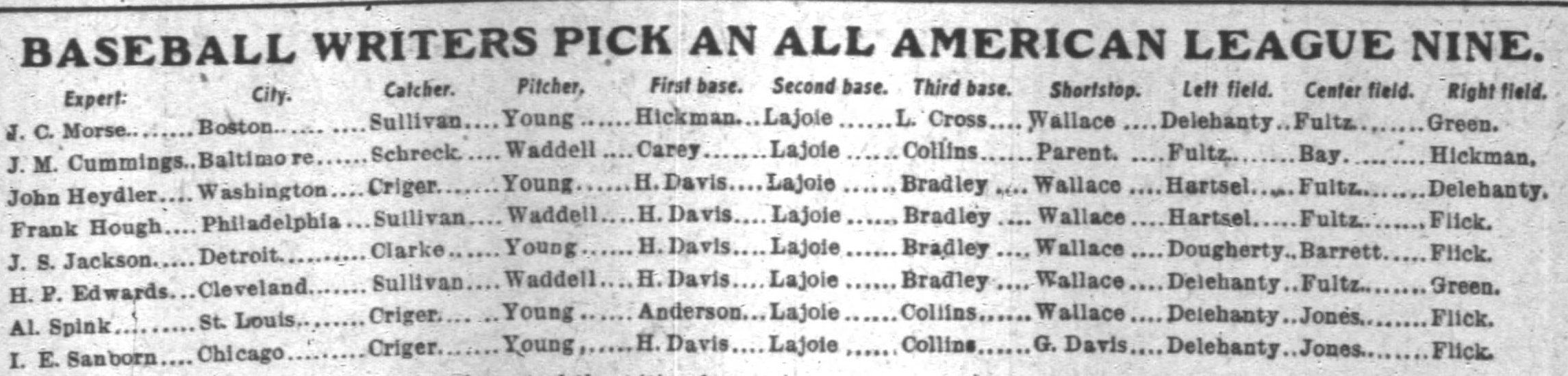
In 1933 The Chicago Tribune underwrote the first All-Star game, created by Arch Ward, the  paper’s sports editor,  to coincide with the Century of Progress World’s Fair—more than 30 years earlier The Tribune published one of the earliest  sportswriter selected “all-star teams.”

Near the end of the 1902 season, The Tribune polled sportswriters from American League cities to pick “An all American League Nine.” (No similar poll was done for the National League)

The writers polled:

Jacob Charles Morse—The Boston Herald

Joseph M. Cummings—The Baltimore News

John Arnold HeydlerThe Washington Post

Frank Leonardo HoughThe Philadelphia Inquirer

Joseph Samuel Jackson—The Detroit Free Press

Henry P. Edwards—The Cleveland Plain Dealer

Alfred Henry SpinkThe St. Louis World

Irving E. (Sy) Sanborn—The Chicago Tribune

The only unanimous choice was Cleveland Bronchos second baseman Napoleon Lajoie—Lajoie appeared in just 86 games, but hit .379.

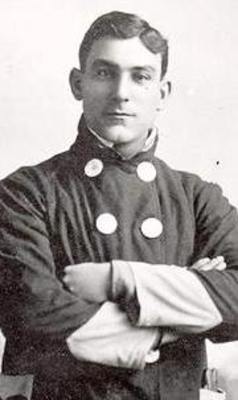
Napoleon Lajoie --the only unanimous choice

Napoleon Lajoie –the only unanimous choice

The most disagreement was behind the plate; four different catchers received votes:  Billy Sullivan of the Chicago White Sox and Lou Criger of the Boston Americans received three votes each;  Freeman Ossee Schrecongost who played 18 games with Cleveland and 79 with the Philadelphia Athletics, and William “Boileryard” Clarke of the Washington Senators each received one vote.

Cy Young of Boston led pitchers with five votes, with Philadelphia’s Rube Waddell being the choice of the other three.

Four first basemen were also chosen, but Harry Davis of the Philadelphia Athletics was the consensus choice with five votes.  Cleveland’s Charlie “Piano Legs” Hickman, Washington’s George “Scoops” Carey, and “Honest John” Anderson of the St. Louis Browns all received one vote.

Cleveland’s Bill Bradley edged Boston’s Jimmy Collins four to three, with Philadelphia’s Lafayette “Lave” Cross getting the remaining vote.

Bobby Wallace of St. Louis was the shortstop consensus with six votes, Boston’s Freddy Parent and Chicago’s George Davis received one vote each.

Booby Wallace, the choice at shortstop

Bobby Wallace, the choice at shortstop

Washington’s Ed Delehanty got four votes in left field, Philadelphia’s Tully “Topsy” Hartsell two; one vote each went to Boston rookie Patsy Dougherty and Philadelphia’s Dave Fultz (who played center field)

With or without his vote as a left fielder, Fultz was the consensus in center field.  He received four votes at that position; Chicago’s Fielder Jones got two votes, Jimmy Barrett, the only Detroit Tiger to make the list received a single vote (from Joseph Samuel Jackson of Detroit) and Harry “Deerfoot” Bay of Cleveland received one vote.

Jimmy Barrett, the only Tiger

Jimmy Barrett, the only Tiger

Right field included a couple more out of position players, Charlie Hickman picked up one vote despite being primarily a first baseman and playing just 27 games in the outfield in 1902.  Delehanty, almost exclusively a left fielder in 1902, received one vote in right.  Elmer Flick of Cleveland was the consensus with four votes.  Danny Green of Chicago received two votes.

The Results

The Results

The 1902 effort was not repeated by the paper.

Irwin Howe

3 Feb

irwinhowebb


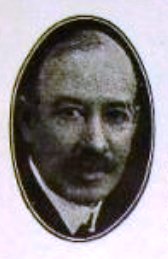
Irwin M. Howe founded Howe News Service in Chicago in 1910, published an annual record book and served as the primary statistician for several minor leagues, including the Western and the Three-I leagues.

After the 1911 season American League Secretary Robert McRoy, who was responsible for compiling statistics, left the league office to become an executive with the Boston Red Sox.  President Ban Johnson named Howe the league’s statistician; he served in that capacity until his death in 1934.

Irwin Howe

Irwin Howe

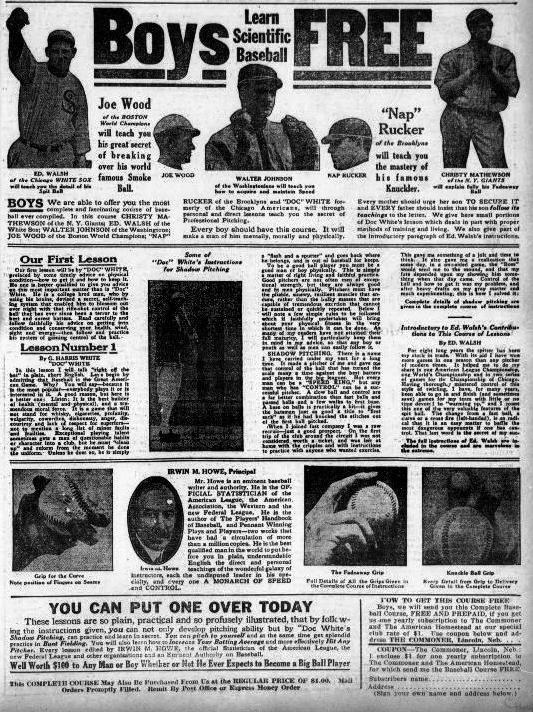
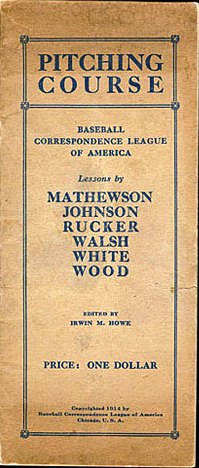
Howe leveraged his position with the American League.  He became the official statistician of several more leagues, including the American Association and the Federal League, wrote a nationally syndicated column called “Pennant Winning Plays,” became editor of the annual “Wilson Baseball Record and Rule Book,” and published an instructional pamphlet for kids.

The ad from 1914 pictured above is for Howe’s 48-page “Pitching Course,” which he called “A correspondence school for baseball.” The pamphlets sold for one dollar, but were also offered by many small newspapers across the country for free to children who signed up subscribers (the pictured ad is from The Commoner, the Lincoln, Nebraska newspaper published by William Jennings Bryan).

Boys Learn Scientific Baseball Free

Ed Walsh of the Chicago White Sox will teach you the detail of his Spit Ball

Joe Wood of the Boston World Champions (1912) will teach you his great secret of breaking over his world famous Smoke Ball

Walter Johnson of the Washingtonians will teach you how to acquire and maintain speed

“Nap” Rucker of the Brooklyns will teach you the mastery of his famous knuckler

Christy Mathewson of the N.Y. Giants will explain fully his Fadeawy Ball

These lessons are so plain, practical and so profusely illustrated, that by following the instructions given, you can not only develop pitching ability…You will also learn to Increase Your Batting Average and more effectively Hit Any Pitcher.  Every lesson edited by Irwin M. Howe, the official statistician of the American League, the new Federal League and there organizations and an Eminent Authority on Baseball.

The pamphlet also included a lesson from Guy Harris “Doc” White of the Chicago White Sox “which deals in part with proper methods of training and living.”

Howe claimed his one dollar pamphlet was “Well worth $100 to any man or boy whether or not he ever expects to become a big ball player.”

Howe's pamphlet

Howe’s pamphlet

Perhaps Howe’s most famous contribution to baseball was certifying Ty Cobb as a .400 hitter in 1922.

On a rainy day in New York (years later in his book “Baseball as I Have Known It,” Fred Lieb said the game took place in August—contemporary newspaper accounts say it was May 15), Cobb beat out a ground ball hit to Yankee shortstop Everett Scott.  John Kieran of The New York Tribune (he was later a columnist with The New York Times) was the official scorer.  He charged Scott with an error.

Fred Lieb of The New York Telegram, who was compiling The Associated Press (AP) box score for the game, credited Cobb with a hit.  Lieb said “Considering the soggy field and Cobb’s speed, I gave it a hit.”

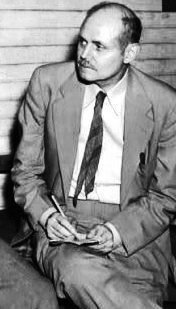
Fred Lieb

Fred Lieb

Howe’s habit was to rely upon The AP box score that appeared in the Chicago newspapers while awaiting the arrival of the “official” box score by mail.

When compiling the final averages at the end of the season Howe chose to accept Lieb’s scoring of the game rather than Kieran’s, and released a statement with the season’s final statistics:

 “I noted that the averages reached from my official scoring sheets had Cobb hitting .3995 (actually .3992).  With the unofficial averages giving him .401, I felt how can we deprive this great player of a third .400 average over a fractional point.”

Ban Johnson approved Howe’s decision.  Lieb, as president of the Baseball Writers Association of America’s (BBWAA) New York chapter was put in the uncomfortable position of attempting to repudiate his own scoring judgment.  He argued that the Kieran’s “official” score should be accepted, and said in a statement:

“Obviously, when there was a difference of opinion between the two scorers, the official and not the unofficial decision, should have been accepted.  There would be no further need for members of the Baseball Writers Association serving as official scorers if they were regulated to a secondary position.”

In a letter to Lieb, Ban Johnson said the “official” box score “was plainly in error in one other particular” besides the Cobb “hit” and “I requested a report of the official score of the game of May 15.  Mr. Howe had previously made a careful investigation of all facts surrounding the scoring.”  Johnson also chided Lieb asking “Are we to believe that you reversed your judgment at this late date?”

The 1923 “Wilson Record and Rule Book”–edited by Howe–contained an asterisk next to Cobb’s .401 average and noted that it was “not recognized” by the BBWAA—Howe was secretary of the association’s Chicago chapter.

The asterisk eventually disappeared, and Ty Cobb, thanks to Howe’s decision,  remains a .400 hitter for the 1922 season.

Lost Advertisements–Old Underoof–White Sox, Cubs and “The Battle of the Century”

27 Jan

oldunderroof1910jj


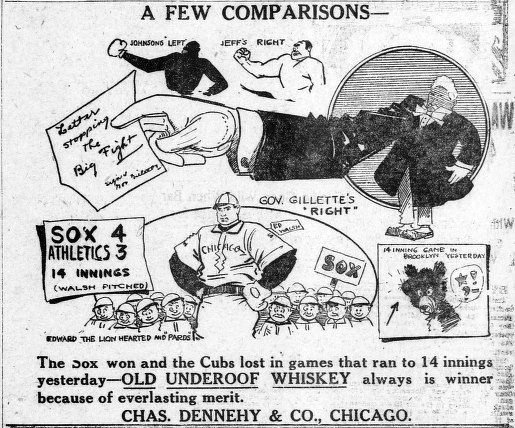
An advertisement for Old Underoof Whiskey from June 16, 1910–“A Few Comparisons.”  Most of the Old Underoof ads were exclusively about baseball, but this one also mentions the biggest sports story of that week.  California Governor James Norris Gillett  (the ad misspelled it “Gillette”) had just issued an order to stop the Jack Johnson vs Jim Jeffries “Battle of the Century,” scheduled for July 4 in San Francisco.  The San Francisco Chronicle said that despite $300,000 worth of tickets having been sold, and the construction of a new stadium for the bout being nearly completed, Gillett bowed to “Pleas to the governor to stop the fight.”  The San Francisco Church Federation was the most vocal opponent to the fight.

On the same day, the Chicago White Sox and Cubs both played 14 innings.

The seventh place White Sox, behind a complete game from “Big Ed” Walsh defeated the Philadelphia Athletics 4 to 3; he also drove in the winning run with one out in the fourteenth.

The first place Cubs lost 3 to 2.  Eros Bolivar “Cy” Barger pitched a complete game for the Brooklyn Superbas, and like Walsh, drove in the winning run with one out in the fourteenth.

The fight was moved to Reno, Nevada and Johnson won by TKO in the 15th round.

The White Sox finished in sixth place with a 68-85 record.  Walsh was 18-20 and led the American League with a 1.27 ERA

The Cubs remained in first place and won the National League pennant by 13 games.  The Athletics beat them four games to one in the World Series.


Samuel H. Apperious

6 Jan

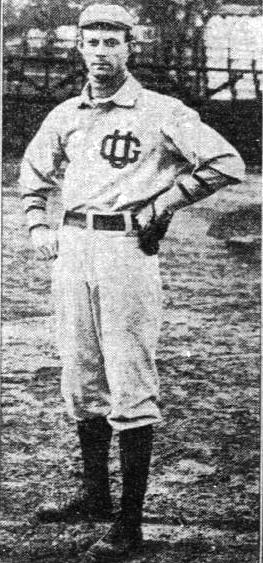
Samuel H. “Sam” Apperious (incorrectly identified as William Apperious  on Baseball Reference and other sources) led two separate boycotts that contributed to keeping William Clarence Matthews out of organized baseball—four decades before Jackie Robinson broke the color barrier.

Apperious was born in Montgomery, Alabama; fellow Alabamian Matthews was born in Selma (some contemporaneous accounts wrongly claimed both were born in Selma).

The wealthy Apperious attended Georgetown University.  Matthews, after studying, and playing baseball and football, at Tuskegee Institute and Phillips Andover, enrolled at Harvard University.

Apperious was part of Georgetown teams (1900-1904) that sent several players to the big leagues, including Leon “Doc” Martell, James “Hub” Hart, Charles Moran, and Art Devlin.  Apperious, who was first a catcher and later a center fielder, was considered one of the team’s best prospects.

In 1903, the Boston press reported that Boston Americans manager Jimmy Collins, in need of a second catcher, “tried to get Sam Apperious, of Georgetown, but he declined to enter the professional ranks.”  The following year The Sporting Life said among college players, Apperious was “the hardest-hitting outfielder of them all.”

Sam Apperious

Sam Apperious

Matthews played shortstop at Harvard and received equally as glowing reports.  Samuel McClure’s “Outing” magazine, a monthly sports publication, said Matthews was the best shortstop in college baseball each year from 1903 through 1905.  The Boston Post said he was “the best infielder” in Harvard’s history—this included teammate Eddie Grant who went on to a 10-year big league career.

Apperious and Matthews met for the first time on April 18, 1903.  When the Harvard team arrived in Washington D.C. for a game, Apperious, the Georgetown captain, refused to play.  The Associated Press said in addition to Apperious’ boycott “There were some wild demonstrations of displeasure at the Negros’ appearance in the field but Matthews won the crowd by his brilliant plays.”

The Colored American said:

“Mr. Apperious is no doubt feeling pretty mean, that is, if he is capable of such a sensation.  His want of hospitality, his conspicuous rudeness and their absolute futility must be subjects of unpleasant recollections to him.”

The paper noted that Apperious’ name “indicates his un-American traits,” and said after Matthews demonstrated his talent, several of the other Georgetown players “grew ashamed of their conduct and acclaimed Matthews as heartily as they had sneered at him, but this foreign importation was not sure enough of his own status to imperil it in a contest of brawn and skill with a colored gentleman.”

Harvard won the game 8 to 0.  Apperious would also choose to sit out two additional games against Harvard (one later that season and one in 1904) which led to a short rift between the schools, and a suspension of scheduled games.

In 1905, Apperious was appointed Graduate Coach of the Georgetown team.  He summed up his coaching philosophy to The Washington Times:

“In short the choice of men must be wholly on the man’s worth for the position for which he is trying.”

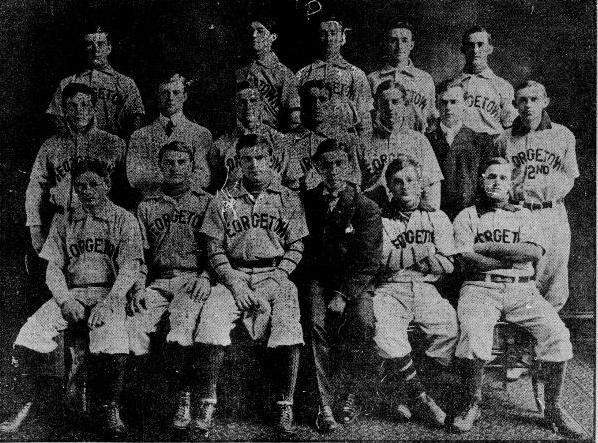
1905 Georgetown baseball team. Apperious is second from left in the center row

1905 Georgetown baseball team. Apperious is second from left in the center row

Later that year Apperious failed to apply his philosophy to Matthews.

In the summer of 1905 Apperious went to Vermont, as he had the previous summer, to play in the state’s “outlaw” Northern League—the league was notorious for having multiple college players performing under assumed names to retain their eligibility.  Apperious played both seasons for the Montpelier-Barre club (known in the local press as the Inter-Cities or Hyphens).

During his first summer in Vermont,  Apperious had raised some eyebrows on July 21, 1904, when he did not participate in an exhibition game between the Inter-Cities and the barnstorming Cuban X Giants.  The Bennington Evening Banner said the “Southerner refused to play against the colored team.”

Matthews joined the Burlington club at the end of June 1905 to immediate controversy.  The Montpelier Argus said a pitcher named Smith “from the south” had left the team as a result, and Apperious made it known he would not play on the same field as Matthews.  When the Burlington club arrived in Barre for a July game with the Inter-Cities, Apperious made good on his threat and watched the game from the bleachers.

Apperious was condemned in the Vermont press:

The Newport Express and Standard:

“(Matthews) may be his equal in every respect: not only in intelligence, but in performing the part of a gentleman as well.  Certainly so in this instance, so far as Mr. Apperious  is concerned, the much aggrieved white individual in this case…Mr. Apperious had better retire to those places where peonage is still in practice—where he can still vent his spite on the Negro as his little, narrow-minded, measly soul desires.”

The St. Albans Messenger:

“If Apperious wants to show his loyalty to and affection for his native Southland, which is a commendable thing in any man, he could do it better by helping his generation t forget some rank nonsense that used to pass for ultra-refinement and chivalry.”

The Poultney Journal:

“(Apperious) Hails from a state where the best citizens” burn people alive…Good chap.  Too good to play ball with a graduate of Harvard college.  If he goes to heaven will want a box stall all to himself.  Scat! Vermont has no use for him—believes in the doctrine “all men were created free and equal.” Apperious is as good as a colored man—if he behaves himself as well.  Better wash and go South.”

  The Wilmington Times:

“Vermonters like to see good, clean ball, and they are not fussy as to the color of the player who can deliver.”

One of the few exceptions in Vermont was The Montpelier Argus which said Apperious was simply following his “traditions, sentiments and interests,” and “it is rank foolishness to expect everyone to bend to our ideas.”

Apperious also found support from The Washington Post which said: “The college players in the Vermont League (sic) are following the lead of Sam Apperious in ‘cutting’ Negro Matthews.”

The paper also repeated an allegation that Matthews “had played (professional) summer ball every year since he entered Harvard.”  While Matthews had played four seasons on the baseball team and graduated from Harvard, The Post, with no evidence, alleged Harvard “dropped Matthews,” because of the allegations.

Despite Apperious’ refusal to play against him, and reports throughout the season that, as The Boston Globe said,  some opponents were “laying for “ Matthews and he “had been spiked several times,” he completed the season with Burlington. But after a quick start (.314 through 14 games) his average dropped off to .248.

There were rumors in the Boston press that summer that Matthews might become a member of the National League’s Boston Beaneaters, but he never played professional baseball after his controversial season in Vermont and his second run-in with Sam Apperious.

Matthews became an attorney, was actively involved in politics and served as legal counsel for Black Nationalist leader Marcus Garvey.  He died in 1928.

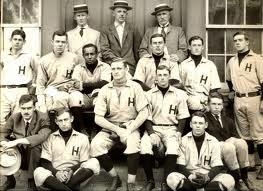
William Clarence Matthews with Harvard Baseball Team

William Clarence Matthews with Harvard Baseball Team

The rest of Apperious’ story on Wednesday.


Lost Team Photos–1903 New York Highlanders

3 Jan

1903NY

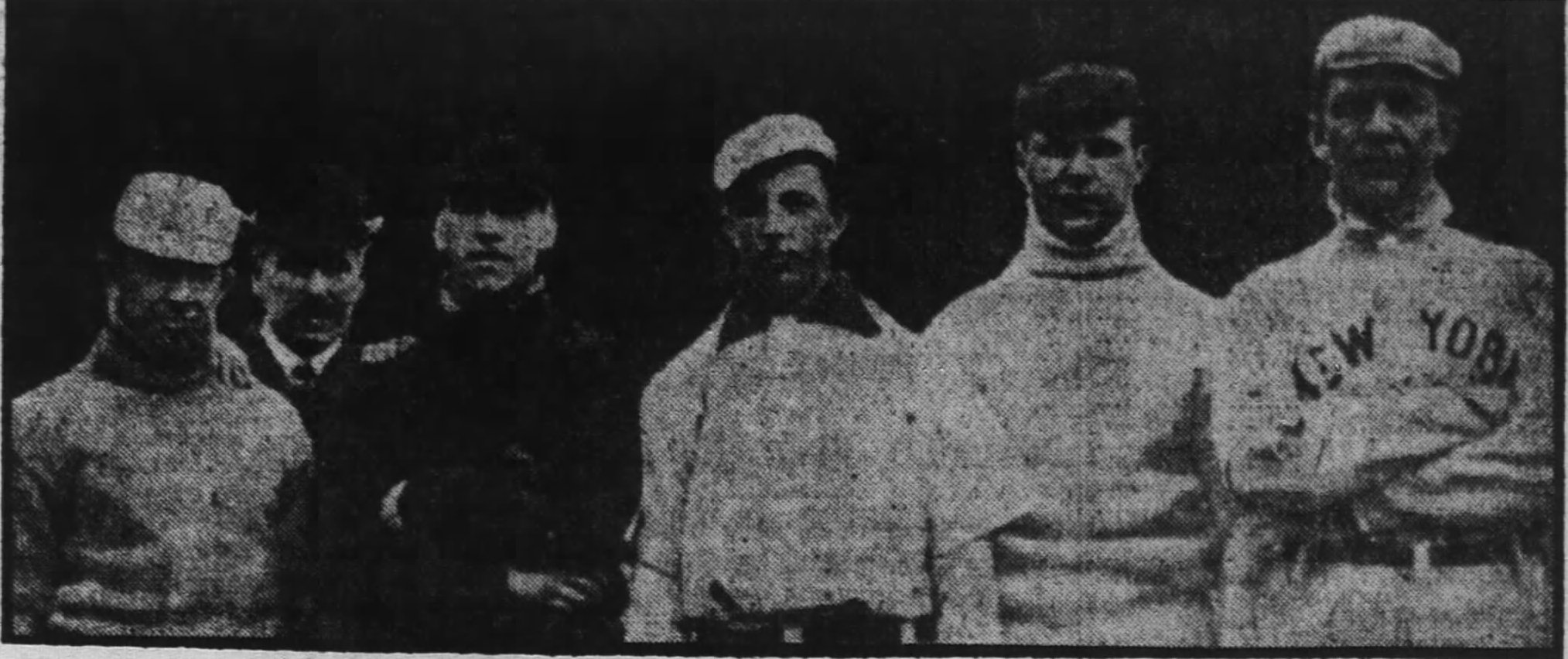
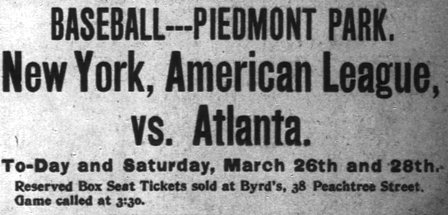
Five members of the first New York Highlanders team and a New York sportswriter photographed at Atlanta’s Piedmont Park in March of 1903. The financially failing Baltimore Orioles franchise was transferred to New York for the 1903 season.

From left: William “Wee Willie” Keeler (RF), James “Gym” Bagley of The New York Evening Mail, Harry Howell (P), William “Wid” Conroy (3B), Monte Beville (C), and John Ganzel (1B).

Atlanta Was thrilled to host the team.  The Atlanta Constitution said on the morning the team was due to arrive:

“The hearts of the local fans will be made glad today by the arrival of the New York American baseball team, for this afternoon on there will be something doing at the park.

“Manager Clark Griffith will have charge of the team, and will bring them in with him this afternoon on the Southern’s No. 27 from Washington, which is due in the city at 3:55 o’clock.

“The aggregation is nothing less than a bunch of stars.”

Large crowds came out to Piedmont Park for the team’s morning and afternoon practices and for the Highlanders first spring game on March 26 against the Atlanta Crackers.

advertisement for the 1903 New York Highlanders spring games with the Atlanta Crackers

Advertisement for the 1903 New York Highlanders spring games with the Atlanta Crackers


Griffith’s team finished fourth in the American League with a record of 72-62.

Lost Advertisements–Do You Want To Know The Baseball Scores?

2 Jan

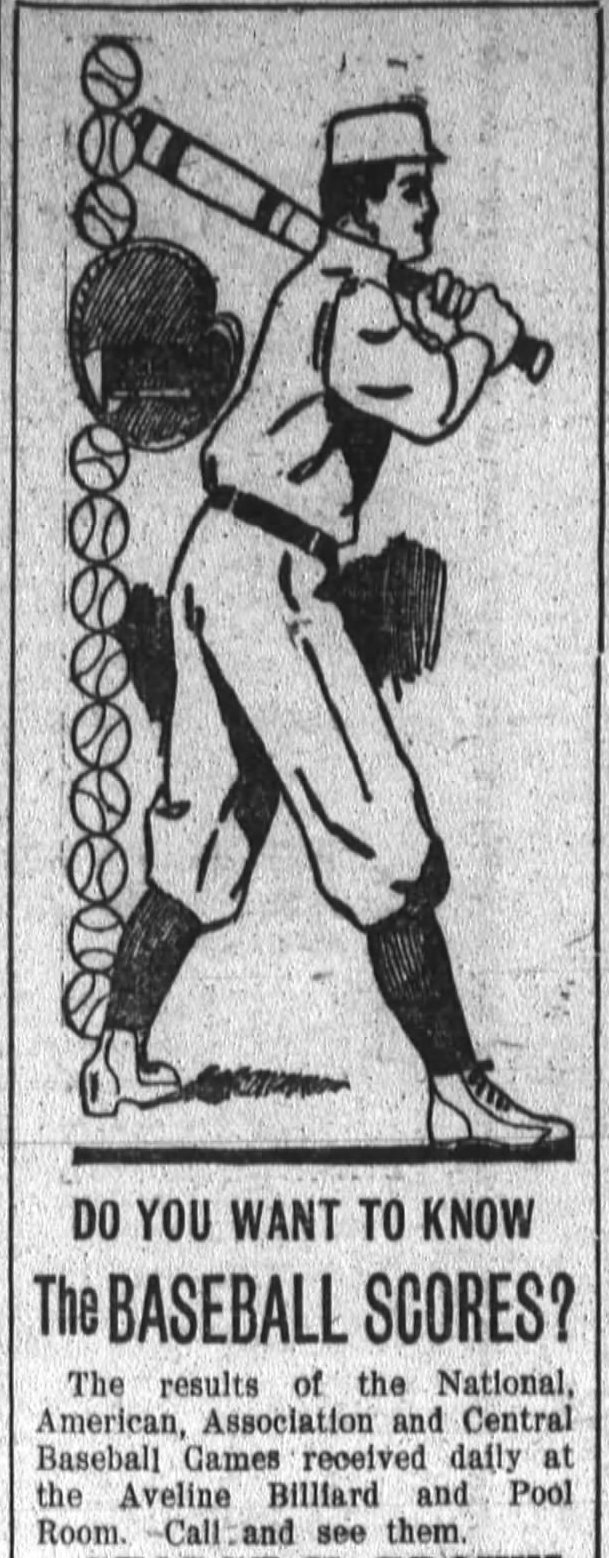
baseballscores

A 1908 advertisement for the Aveline Billiard and Pool Room in Fort Wayne, Indiana: “The results of the National, American, Association and Central Baseball Games received daily.”

Al Reach

12 Dec

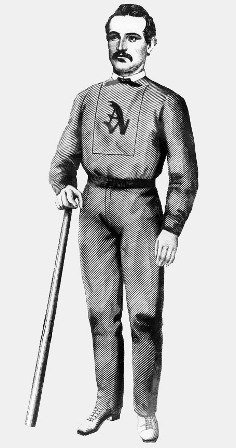
Alfred James “Al” Reach opened his first sporting goods store in Philadelphia in 1874 while playing for the Athletics in the National Association.  Within a decade he had built a hugely successfully business, began publishing “Reach’s Official Baseball Guide,” and established a National league franchise in Philadelphia.

In May of 1886 Reach talked to The Philadelphia Times about “one of the great industries of Philadelphia in the sporting line.”

“Men, women and children are employed in making base balls.  The cheaper ones are made by a press with leather shavings on the inside.  The body is wrapped with cotton and covered with leather.  The covering is done by hand.  The best balls—the ones in use by the American Base Ball Association—are a solid piece of Para rubber on the inside, covered with worsted yarn and then with an outside covering of horse-hide.  Men do this covering.  They are mostly harness-makers, yet they have to broken into the work, for even a good harness-maker may be a poor hand at covering and sewing a ball properly.”

Al Reach

Al Reach

Reach said the company had orders for “five hundred dozen, or six million, balls already for this season,” and the company was “two hundred thousand dozen behind” filling the orders:

“We have had the factory running until ten o’clock at night all winter.  Base balls sell from 5 cents to $1.25 apiece…Three-fifths of all the balls used in the country are made in Philadelphia.”

—–

“Base ball bats are made of willow, spruce and first and second-growth ash.  The latter wood makes the best bet.  They are sold at fifty, sixty and seventy-five cents each.  There are about sixty thousand bats used every season.  Our orders already indicate that we will dispose of at least fifteen thousand of the best quality.”

Reach said the company employed “upwards of five hundred persons.”

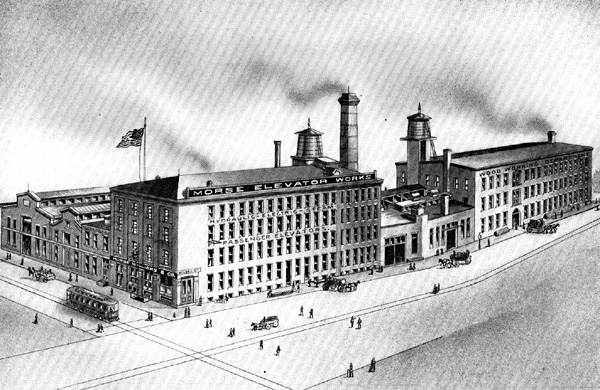
Reach's main factory in 1886 at Frankford Avenue and Wildey Street in Philadelphia---The Martin Landenberger Hosiery Mill Complex/Morse Elevator Works Building

Reach’s main factory in 1886 at Frankford Avenue and Wildey Street in Philadelphia–The Martin Landenberger Hosiery Mill Complex/Morse Elevator Works Building

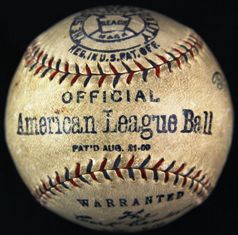
By the end of the decade Reach’s company was purchased by A.G. Spalding, with Reach staying on as an executive and the company continued to produce equipment with the Reach name, including the official American League baseball, which was used through the 1976 season.

Reach maintained controlling interest in the Phillies until 1899 and died in 1928.  He left an estate worth more than $1 million.

Reach Official American League ball 1920s

Reach Official American League ball 1920s