Tag Archives: American League

“Evans, who, at the Least, is Incompetent”

2 Dec

William George “Billy” Evans was nicknamed “The Boy Umpire” when he was hired by the American League at the age of 22.  After 21 seasons  he became a front office executive, working for the Cleveland Indians, Boston Red Sox and Detroit Tigers; he was also president of the Southern Association, authored two baseball books and in 1973, 17 years after his death, was elected to the Baseball Hall of Fame.

Billy Evans

Billy Evans

But during his first season as an umpire, 1906, he was not held in high esteem in Chicago.

On September 10 the White Sox were in second place, a game behind the New York Highlanders.  The Sox trailed the Tigers 2 to 1 in the 9th inning.  Chicago shortstop George Davis laid down a bunt and was called out at first by Evans.  Every Chicago paper said Evans beat the throw by “at least a step.”

The call precipitated a near riot.  The Chicago Tribune said:

“Instantly a shower of bottles from the first base bleachers drove the umpire, coacher, and players away from the vicinity of the base.”

After the next two batters were retired:

“Evans walked off the field amid another volley of bottle from the third base stand.”

The Tribune and The Chicago Inter Ocean said Evans and fellow umpire Tommy Connolly were mobbed by fans as they attempted to leave the ballpark with a police escort.  Both papers said “one or two blows” from fans connected with the umpire during his retreat.

The Inter Ocean said, “Evans has been the most heartily reviled arbiter that ever worked in any league.”

The Tribune said two weeks earlier Evans cost the Sox a game in Philadelphia.  After Chicago scored two runs in the top of the sixth inning to take a 5 to 4 lead, Evans “let the Athletics take advantage of his inexperience,” and stopped the game on account of rain with two men out in the bottom of the inning.  The Inter Ocean said, “(Sox Manager Fielder) Jones and (second baseman Frank) Isbell nearly came to blows with the umpire and members of the Athletic team.”

After a half hour, the game was called and the score reverted back to the end of the 5th inning, giving Philadelphia a 4 to 3 victory.

The next day, September 11, the Sox played the St. Louis Browns at South Side Park.  Evans worked the game along with Jack Sheridan.  The newspapers said Sox owner Charles Comiskey had discontinued the sale of “bottled goods” at the park that day.

The Browns won 7 to 3, and the Chicago press put much of the blame for the loss on the rookie umpire.

The Tribune said:

President (Ban) Johnson’s persistence in sending Evans, who, at the least, is incompetent, is giving baseball a black eye in Chicago.  Half the crowd believes the charges that Evans is working under instructions from Johnson to beat Chicago.  These charges undoubtedly are founded on mere prejudice, yet, had Evans been under instructions and trying to beat Chicago, he could not have done better than he did yesterday.”

The Inter Ocean said the Browns “were aided and abetted by Umpire Evans, the boy wonder…Why Ban Johnson insists upon sending the joke to officiate at important games is more than any sane man can see.”

But the Evans’ most ardent critic was William A. Phelon, sports editor of The Chicago Journal:

“Umpire Evans is the worst that ever yet came down this or any other pike in the history of the modern universe…And Ban says he is the best in the game.  We are not selfish and we are willing to let some other city endure him.  We can get over the shock of his removal.  If he doesn’t move he may have a statue down on the lake front, a statue 200 feet high made of bottles.  Give us liberty, give us death, give us any old thing, but, by the snakes of old Ireland, give us an umpire!”

Phelon also said Evans “seems to be a gentlemanly individual, whose place in life is evidently a long ways from the profession of umpiring.”
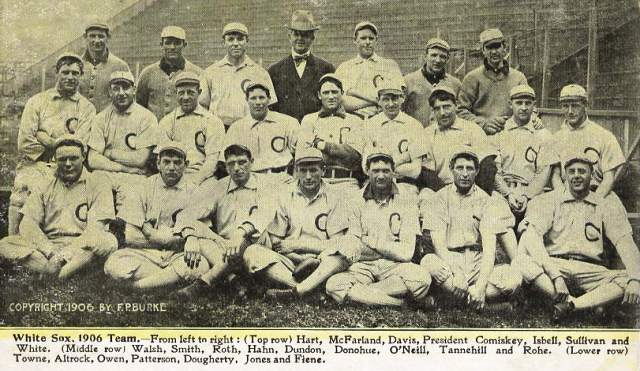
1906 White Sox

Despite the blame heaped on the young umpire in the press, the White Sox went 17-7 the rest of the season and won the pennant by three games.  They went on to beat the Chicago Cubs 4 games to 2 in the World Series.

Things got better for Evans as well.  He worked his first World Series in 1909—the youngest umpire to do so– and participated in five more from 1912 to 1923.  He was the third umpire to be elected to the Hall of Fame; Connolly and Bill Klem were the first two.
Lost Advertisements–“Kid” Gleason for Cat’s Paw Rubber Heels

22 Nov

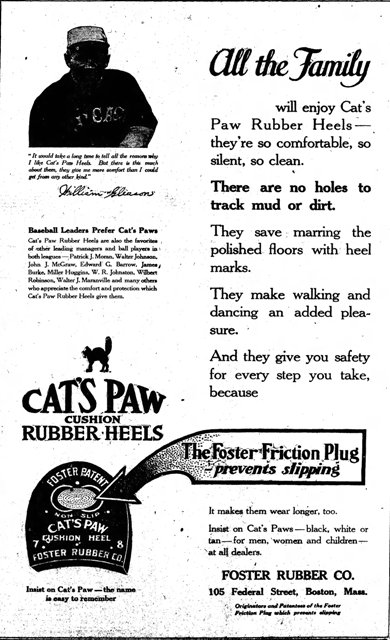
cat'spawA 1920 advertisement featuring William “Kid” Gleason, manager of the defending American League Champion Chicago White Sox–the ad appeared in July, two months before the first grand jury was convened to investigate the 1919 World Series.

“It would take a long time to tell all the reasons why I like the Cat’s Paw Heels.  But there is this much about them, they give me more comfort than I could get from any other brand.”  William Gleason

Baseball Leaders Prefer Cat’s Paws

Cat’s Paw Rubber Heels are also the favorites of other leading managers and ball players in both leagues–Patrick J. Moran, Walter Johnson, John J. McGraw, Edward G. Barrow, James Burke, Miller Huggins, W.R. Johnston, Wilbert Robinson, Walter J. Maranville and many others who appreciate the comfort and protection which Cat’s Paw Rubber Heels give them.

“The fans make us the ‘goat’ for Everything”

21 Nov

Chicago Orphans Manager Tom Burns suspended pitcher Bill Phyle without pay in August of 1899, even after Burns was replaced by Tom Loftus, Phyle remained in limbo.

Tom Loftus

Tom Loftus

In January Hugh Fullerton said in The Chicago Tribune that Loftus “probably will give him a chance.”  But in early February The Chicago Inter Ocean said even though Phyle had met with team President James Hart nothing had been resolved.  Phyle told the paper he was offered a contract but was “in no hurry to sign.”

Phyle finally signed at the end of the February, but The Tribune said Chicago would most likely trade him “although Loftus thinks highly of him.”

The team trained in West Baden Springs, Indiana, where according to The Tribune Phyle was “sarcastically called ‘Lucky,’ because of his proverbial hard luck, (he) rarely escapes a day without being hurt.”  He also managed to alienate his new manager.

After several days of poor weather in Indiana, Loftus decided to take the team further south, to Selma, Alabama on March 18.  According to The Tribune Phyle was not on the train:

“Phyle may not be with the team in Selma.  He left Friday (March 16), announcing he was going to see the fights in Chicago.  Manager Loftus hunted up the pitcher before he departed and told him it was a bad plan to start the year in such a manner.  Phyle then said he was ill and was making the journey in order to consult a physician in Chicago.”

Phyle did return from Chicago (where he claimed he had an unspecified operation), and joined the team on the trip south.  Upon his return he continued to suffer a series of illnesses and injuries, which included a bad reaction to a vaccination and a being hit in the knee with a thrown bat, both of which kept him inactive for several days.

Phyle was left in Chicago when the team opened the season in Cincinnati, and his imminent trade or release was speculated upon nearly daily in the Chicago press; he was finally traded to the Kansas City Blues in the American League with Sam Dungan and Bill Everitt for John Ganzel on May 18.  Phyle refused to report to Kansas City and spent the season playing for Chicago City League teams and a semi-pro team in DeKalb County, Illinois.  He was also a regular attendee at Chicago’s boxing venues and was said to own a piece of featherweight contender Eddie Santry.

Phyle returned to the National League in 1901 posting a 7-10 record for the New York Giants.  In 1902 he went to the California League as an infielder and never pitched again.  After his controversial exit from Memphis in 1903—and the aftermath—he continued to play until 1909.

Phyle worked as a boxing referee and as an umpire for more than 20 years in the Canadian, Eastern and Pacific Coast and International  Leagues, and was involved in two final controversies.

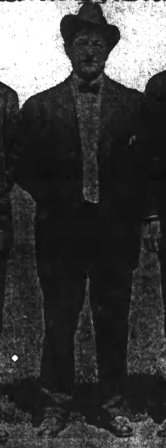
Bill Phyle, 1913

Bill Phyle, 1913

In 1920 a grand jury was impaneled in Los Angeles to investigate charges of game fixing in the Pacific Coast League.  Players Harl Maggert, William “Babe” Borton, Bill Rumler and Gene Dale were implicated.  While all criminal charges were eventually dismissed, the four were banned from baseball in 1921.

Phyle was called to testify in front of the grand jury, and said umpires were often blamed when players were crooked:

“The fans make us the ‘goat’ for everything that goes on during the ball game.  How many times we have suffered to suit the whims of a ballplayer who might have been working with the gamblers will never be known.  They just slough us around, call us whatever names they please and yell murder when we happen to fire them out of the game or have them suspended.

“An umpire should have the same authority as a referee has in the prize-ring.  If he believes a ballplayer isn’t giving his best toward the game, he ought to have the privilege of ousting him without taking the manager into confidence.”

In July of 1923 Phyle was working an International League game between the Baltimore Orioles and Rochester Tribe.  Phyle called a Rochester runner safe at first, then immediately reversed his decision.  He was dismissed the following day by league President John Conway Toole.

As a result of the dismissal, four other umpires resigned in sympathy.  Toole, who was attending the game, claimed he had not released him because of the blown call, but because Phyle had failed to work a double hitter he was assigned to earlier in the month.   The decision was upheld, and within three days the four other umpires withdrew their resignation.

Phyle ended his career back in the Pacific Coast League in 1926, and died in Los Angeles in 1953.

Burns “Put the Punishment on Phyle”

20 Nov

After holding out over a temperance clause the Chicago Orphans added to his contract, Bill Phyle finally signed in late March of 1899.  He reported to spring training in New Mexico anywhere from 10 to 30 pounds overweight (depending on the source) and struggled all season to regain the form he showed the previous season.

On April 17 he was beaten 8-0 by the Louisville Colonels in first start.

On April 25 he lost 3-2 to the St. Louis Perfectos.  The Chicago Tribune said “Phyle gave away the game by distributing bases on balls in just the spots where timely hits followed and transformed the favors into tallies that gave the victory.”

William Phelon, The Chicago Daily News baseball writer, disagreed.  He said Phyle’s “work was of sterling quality.”

Regardless, Chicago Manager Tom Burns didn’t give Phyle another opportunity to pitch for more than a month.

Phelon said it was a mistake for Burns to not use Phyle.  The Chicago Inter Ocean said after the team lost seven of nine games in May “it is passing strange that young Phyle is not given a chance.  On last year’s form Phyle is as good as, if not better than (Jack) Taylor.  The paper called Phyle’s performance in the St. Louis game “gilt-edged” and blamed the loss on “comrades that gave the victory to the enemy.”

Finally, on May 28 Phyle pitched again.   He lost 4 to 3 to the Washington Senators; he gave up three runs on five straight hits with two outs in the ninth.

He lost again on June 1, 7-1 to the Philadelphia Phillies.  Phelon’s opinion of the pitcher was unchanged, and said the losses were simply bad luck:

“Phyle has now lost four straight games.  It is Phyle’s luck to be stuck in whenever the other pitchers have won about three straight, and the team is just about unavoidably due to lose.”

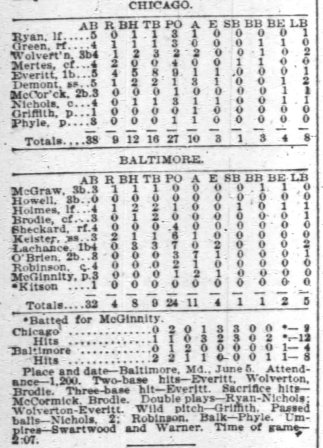
On June 5 Phyle did his best pitching of the season–a victory he is not credited with in the record books.

With the Orphans trailing the Baltimore Orioles 3 to 2 in the third inning, pitcher Clark Griffith was ejected for arguing a called ball.  The Chicago Tribune said:

“It was a queer game.  Phyle pitched after Griffith had been benched…holding the Orioles helpless.”

Chicago won 9 to 4.  And while the Chicago newspapers credited the victory to Phyle, the record books do not.

Box score for June 5 game.  Phyle relieved Clark Griffith in the 3rd inning.

Box score for June 5 game. Phyle relieved Clark Griffith in the 3rd inning.

Phyle became ill later the same week, (some sources said it was recurring malaria), a week later he fell off a bicycle and missed two more weeks.  When he returned to the team on June 22, the Boston Beaneaters beat him 5 to 1.

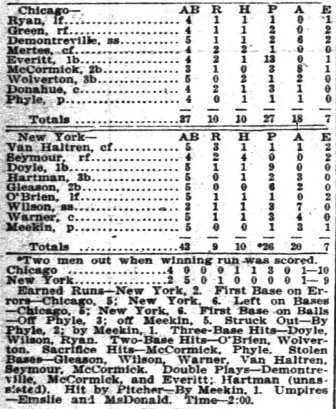
He was credited with his first “official” win on July 1—a game The Inter Ocean called “a comedy of errors,” and a “depressing exhibition.”   He beat the New York Giants 10 to 9, allowing 10 hits and giving up seven runs in the first two innings.  Each team committed seven errors.

Box score of Bill Phyle's only "official" victory of 1899.

Box score of Bill Phyle’s only “official” victory of 1899.

Chicago went into a slump that would last for the rest of the season; after Phyle’s July 1 win the team was 38-24, in third place, and went 37-49 the rest of the way finishing eighth.

Phyle lost again on July 9 and July 24, and rumors began to circulate that he would be released or traded back to Charlie Comiskey’s St. Paul Saints.

On August 6 Phyle lost 10 to 9 to the Cleveland Spiders.  One week later while the team was on the road, The Inter Ocean reported that he “was sent home by manager Burns.”

The Tribune called Phyle “the scapegoat” and said he and three unnamed teammates  “celebrated after beating a horse race at Washington and Manager Burns, to call a halt, put the punishment on Phyle.

Phelon wrote in The Daily News:

“When the club started for Philadelphia he was told to go home ‘You are through young man, go back to Chicago,’ said Burns, and Phyle went back.  He went back in a rage too, and says he will tell (team president) Jim Hart a lot of things. He says that he has been held up to public derision as a drunkard, all season, and that Burns plays favorites, allowing his friends to jag up as much as they wish and turning all the trouble on others.”

Phelon remained supportive of the pitcher in The Daily News, but in The Sporting Life he reported that Phyle, a former boxer, had deserted the team in early August to go to “St. Louis to see a prize fight, and was not on hand when sorely needed.”

While the relationship between Hart and Burns was strained, and Burns would be replaced at season’s end, Phyle’s complaints went nowhere with the team president and he was suspended without pay.

Ten days after Phyle was suspended Phelon reported that the Baltimore Orioles had offered to trade for or buy Phyle,” (John) McGraw has taken quite a fancy to the young pitcher.”  Hart refused to make a deal.

Phyle never pitched for Chicago again, he is credited with a 1-8 record and 4.20 ERA.

The last Bill Phyle chapter—tomorrow.

“I’d be Perfectly Willing to Split with Uncle Sam”

14 Nov

In 1915, The Chicago Eagle reported on the difficulty the government was having “getting at the facts,” in order to collect income taxes from ballplayers after the passage of the 16th Amendment two years earlier.   But the paper predicted that  players in the three major leagues “will pay into the internal revenue department something like $5,000 in income tax.”  Five thousand dollars total.

“But for the fact that 50 per cent of the players in the American, National and Federal leagues are married and thereby permitted to claim an exemption of $4,000 in salary, the sum exacted by the government would be considerably greater.”

The Eagle said there were approximately 300 players in the three leagues who earned more than $3000 per season and were subject to pay income tax, but half of those were exempt because they were married and could claim an exemption up to $4,000.

“(T)here are about 200 who earn more than $4,000.  There are close to 100 who draw more than $5,000 and 50 whose contracts call for amounts ranging between $6,000 and $10,000.  There are less than a dozen who make more than that.  The notable ones are Eddie Collins, Ty Cobb, Tris Speaker, Walter Johnson and a few managers.  (John) McGraw is reputed to make $25,000 in salary.”

Tris Speaker was “the hardest hit” bachelor.  At a salary of $15,000 Speaker was taxed on $12,000 and paid income taxes for the year totaling $120.

Tris Speaker "hardest hit"

Tris Speaker “hardest hit”

Frank “Home Run” Baker of the Philadelphia athletics, who earned between $8,000 and $9,000, and was sitting out the 1915 season in a salary dispute said regarding his teammate Eddie Collins, who earned $15,000:

“Still, if they raise mine up to that of Eddie Collins I’ll be perfectly willing to split with Uncle Sam.”

Frank "Home Run" Baker, "willing to split with Uncle Sam"

Frank “Home Run” Baker, “willing to split with Uncle Sam”

“Johnson can Hit the Ball as far as Anybody”

14 Oct

After Hal Chase replaced George Stallings as manager of the New York Highlanders, Otis “Ote” Johnson was given another opportunity to play for the team.

Highlanders’ second baseman Frank LaPorte and third baseman Jimmy Austin were traded to the St. Louis Browns for third baseman Roy Hartzell.  Chase said he’d move shortstop John Knight to second and playing Johnson at shortstop.

The Sporting Life quoted Chase saying he planned to play Johnson at short “for his batting,” but noted that Johnson “only batted .223 in the fast Eastern League last season.”

Otis "Ote" Johnson

Otis “Ote” Johnson

New York scout Arthur Irwin agreed with Chase that the team needed Johnson’s bat in the lineup, and told The New York Globe:

“Johnson can hit the ball as far as anybody, and what is more he can hit often.”

The New York Herald said:

“Johnson is a beautiful fielder as well as a good hitter, and it is Chase’s intention to have him take the shortstop job.”

That’s where Johnson was on Opening Day, a 2 to 1 victory over the defending World Champion Philadelphia Athletics; Johnson batted seventh, went 0 for two with a walk and a sacrifice, and scored a run.

After sweeping Philadelphia in three games, New York split a four game series with the Washington Senators.

The Washington Herald said New York’s new shortstop “sure looked good, he fielded his position in fine shape,” and “keeps the infield alive with his funny remarks.”

A month after the season began The Indianapolis News said Johnson was “called home (to Muncie, Indiana) by the serious illness of his mother.”  Three days later the paper said he returned to New York “his mother’s condition having considerably improved.”  Within a week of his return the New York papers reported that Johnson had filed for divorce from his wife.

Less than two weeks later Johnson lost his starting job; Knight moved to short and Earle Gardner played second base.

Ote Johnson

Ote Johnson 1911

The San Francisco Chronicle said of the former Pacific Coast League star:

“Ote Johnson has been benched for his weak hitting.  He put up a star game in the field…but Ote did not respond with the hitting which featured his work when he was with Portland.”

Three days after he was benched Johnson left the team again to finalize his divorce.  After returning Johnson became New York’s primary utility infielder until he fell out of favor with Hal Chase.  The manager had been criticised as the team slumped for, as The Globe said “utterly lacking in the qualities for successful management.”

By August the team was fourteen games out of first place and The Herald said:

“Hal Chase, who has been very lenient with his players, is drawing the string tighter.”

The paper said Johnson “has been suspended without pay for violating the club’s rule of discipline.”  It was never revealed what rule was violated, but Johnson was suspended for about a week.  Johnson also hurt his throwing arm in August, further limiting his playing time.

Many in the New York press questioned Chase’s ability as a manager; Wilton Simpson Farnsworth of The New York Evening Journal was the exception.  Farnsworth said of Chase, when the team was 13 games back in August:

“Hal Chase, the game’s greatest first baseman, has made good as manager of the new York Yankees…Knockers claim that poor management is keeping the Yanks down, but forget it! A bad break in luck plus innumerable injuries is the cause.”

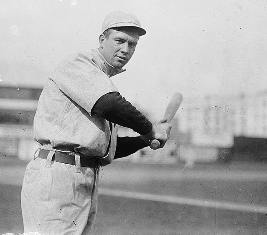
Hal Chase

Hal Chase

Regardless of the reasons, 1910’s second place team was limping to a sixth place finish. Chase resigned as manager in November.  Johnson hit just .234 and committed 31 errors in just 65 games.  He was released to the Rochester Hustlers in the International league in December.

Johnson spent just one season in Rochester; he hit .268 and got married; after the season his contract was sold to the Binghamton Bingoes in the New York State League (NYSL).  Johnson protested the pay cut his Binghamton contract called for, and initially threatened to jump to the PCL, he eventually signed a contract and became popular with fans.  He hit the Bingoes first home run of the 1913 season and was awarded with a free daily shave from a local barber and fan named Billy McCann.

He played most of the next three seasons in the NYSL—with the exception of 45-games with the St. Paul Apostles in the American Association at the beginning of the 1914 season.

After playing for the Elmira Colonels in 1915 Johnson recommended two players to his friend Walter “Judge” McCredie on the Portland Beavers—his teammate, pitcher Frank Caporal, and Syracuse Stars first baseman Owen Quinn—and it appeared the 31-year-old Johnson might be heading back to Portland where he remained very popular.

On November 9 Johnson went hunting with friend in Binghamton.  The (Portland) Oregonian said:

“Ote Johnson, famous ‘Home Run’ Ote of the Portland Pacific Coast team of 1907, 1908 and 1909, is dead…It seems Johnson, in company with a party of friends, went forth in search of game and while chasing a wounded fox stumbled and fell, both barrels of the shotgun he was carrying discharged into his abdomen.

“To the older generation of Portland fans Johnson will be remembered for his prowess in poling out long bingles.  He was one of the longest hitters that ever wore the livery of a Coast League club.  Some are prone to argue that he eclipsed the performances of (Frank) Ping Bodie and Harry Heilman, who are now the long-swat stars of the circuit.  Johnson also had a peculiar throw from third that will be remembered–He had a perfect underhand throw and was a wonder at handling bunts.”

He was buried in Johnson City, New York–his pallbearers included several players: Mike Roach, Charles Hartman, Mike Konnick, and William Fischer,

Lost Advertisements–Connie Mack Day in Cleveland

6 Sep

???????????????????????????????

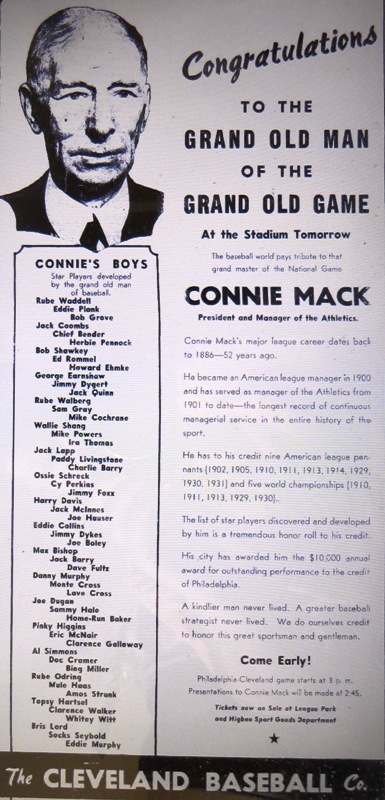
A 1938 Advertisement printed in Cleveland newspapers for Connie Mack Day.

The Philadelphia Athletics manager was honored on June 19 in front of 20,000 fans at Cleveland Stadium.  The ad listed every “star player developed by the grand old man of baseball.”

The baseball world pays tribute to that grand master of the National Game

Connie Mack

President and Manager of the Athletics

Connie Mack’s major league career dates back to 1886–52 years ago.

He became an American League manager in 1900 and had served as manager of the Athletics from 1901 to date–the longest record of continuous managerial service in the entire history of the sport.

He has to his credit nine American League pennants (1902, 1905, 1910, 1911, 1913, 1914, 1929, 1930, 1931) and five world championships (1910, 1911, 1913, 1929, 1930).

The list of star players discovered and developed by him is a tremendous honor roll to his credit.

His city has awarded him the $10,000 annual award for outstanding performance to the credit of Philadelphia.

A kindlier man never lived.  A greater baseball strategist never lived.  We do ourselves credit to honor this great sportsman and gentleman.

The Cleveland Plain Dealer said Mack was presented with “a handsomely bound leather book in which were the signatures of every person in organized baseball from Judge Kenesaw Mountain Landis down to the greenest rookie in the West Texas-New Mexico League.”  Cleveland’s baseball writers also presented Mack with an engraved gold pencil.

The Plain Dealer and The Cleveland News both noted that when Mack addressed the crowd he added an “n” to Indians president Alva Bradley’s first name; The Plain Dealer said:

“Mr. Mack always had a tough time with names of his friends and players.  For years he has called ‘Lefty’ Grove ‘Groves’ and Lou Gehrig “Garridge.’ In fact he never has attempted to call his second baseman, (Dario) Lodigiani, anything but ‘Lodi’ for this season.”

The league-leading Indians beat Mack’s Athletics 5 to 4.

Lost Advertisements–Germany Schaefer for Coca-Cola

30 Aug

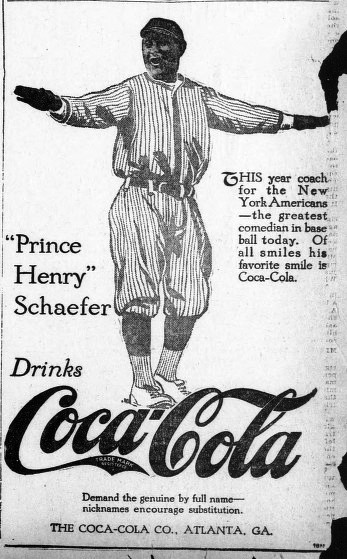
schaefercoke


Another 1916 Coca-Cola advertisement featuring another new member of the New York Yankees, coach Herman “Germany,” “The Prince” Schaefer.

This year coach for the New York Americans–the greatest comedian in baseball today.  Of all smiles his favorite smile in Coca-Cola.

The 40-year-old Schaefer was purchased by the Yankees from the Newark Pepper of the Federal League when the Feds folded after the 1915 season.  Used almost entirely as a coach, he appeared in only one game and went 0 for 1 at the plate.  He was released by the Yankees in September.


Lost Advertisements–Edelweiss Beer–“Slide, you rummy, Slide”

9 Aug

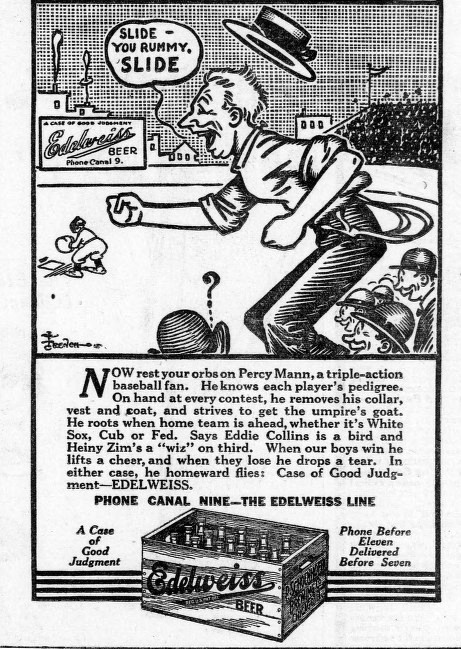
Edelweiss


A 1915 advertisement for Edelweiss Beer which appeared in Chicago newspapers.

“Now rest your orbs on Percy Mann, a triple-action baseball fan.  He knows each player’s pedigree.  On hand at every contest, he removes his collar, vest and coat, and strives to get the umpire’s goat.  He roots when home team is ahead, whether it’s White Sox, Cubs, or Fed.  Says Eddie Collins is a bird and Heiny Zim‘s a ‘wiz’ on third.  When our boys win he lifts a cheer, and when they lose he drops a tear.  In either case, he homeward flies:  Case of Good Judgment–Edelweiss”

“The Disappearing Oakland Infielder”

7 Aug

James Ernest “Jimmy” Frick began his career with the Iola Gasbags in the Missouri Valley League in 1904, hitting .331 in 106 games.  While Frick began the 1905 season with the Oklahoma City Mets in the Western Association, a “C” level league, press reports said he could have played at a higher level and The Sporting Life said St. Louis Cardinals, Hall of Famer pitcher Charles “Kid” Nichols “cannot understand why Jimmy Frick of Oklahoma City persists in hiding out it the bushes when he can make good in fast company.”

Frick was hitting above .300 in July when he was sold to the Seattle Siwashes in the Pacific Coast League; he hit .252 in 18 games until August 18 when The Associated Press said Frick “disappeared mysteriously.”

Four days later The Seattle Star said Frick who “was very popular” with local fans had jumped the Siwashes and rejoined Oklahoma City having been promised “$1000 and a chance to manage the team next year.”

Whether the reported deal was actually promised to Frick is unknown.  While he returned to Oklahoma City he never joined the Mets and finished the season with the Wichita Jobbers.

At the end of the 1905 season multiple teams laid claim to him.  The Associated Press said:

“The case of J. Frick who was claimed by Indianapolis, Wichita, Seattle and Oklahoma City was referred to Secretary (John) Farrell (of the National Association).”

In February of 1906 Frick was awarded to Wichita then immediately traded to the Toronto Maple Leafs in the Eastern League.  He spent the next five and a half years in the Eastern League with Toronto, the Baltimore Orioles and the Newark Indians.

On July 16, 1910, while with Baltimore, Frick was hit in the head with a pitch.  In August The Sporting Life said he had not yet returned to the lineup:

 “(Frick) is in a bad way in this city, as the result of being hit on the head by a pitched ball during the last home series of the Birds. Although the accident happened at least three weeks ago, Frick’s head is still in bad condition, his face is swollen and dizziness seizes him on the slightest provocation. It is doubtful if Frick will play again this season.”

He did return at the tail end of the season, but only appeared in a few games.  In 1911 he was sold to Newark, and after hitting just .200 in 28 games he was sold to the Troy Trojans in the New York State League.

Jimmy Frick

Jimmy Frick

Before the 1912 season, Harry Wolverton, third baseman and manager of the Oakland Oaks in the Pacific Coast League, was named manager of the New York Highlanders in the American League.  Oakland hired Bayard “Bud” Sharpe to manage the team; one of his first moves was to purchase Frick from Troy to fill the void Wolverton left at third.

By March 7 The Associated Press said Sharpe was “somewhat exercised about infielder Frick.”  The new third baseman had arrived in Oakland by train several days earlier, but had not arrived at the Oaks training camp in Livermore, California and had not been heard from him.  Sharpe showed up the following day, but it was reported he had spent several days in an Oakland hospital—it was not reported why he was hospitalized.

Frick began the season as the Oaks starting third baseman, but after hurting his foot in April, August “Gus” Hetling filled in and Frick never returned to the regular lineup.

On September 17, with Oakland in a battle for the pennant with the Vernon Tigers, the team was in Los Angeles when Frick, according to The Associated Press left his room at the Hotel Rosslyn and “dropped from sight.”

The Los Angeles Examiner said the Oakland team and the Los Angeles Police Department had looked for Frick for more than a week and found no sign of the infielder.  The Associated Press said “all of Frick’s haunts have been searched,” and that the disappearance “may hurt Oakland in their fight for the pennant, as he is considered the best utility infielder on the team.”

Herb McFarlin, Secretary of the Oaks, said:

“Frick has always been a steady player, not inclined to drink or run around.  He always has been absolutely dependable.”

On October 4 The Associated Press said “the disappearing Oakland infielder” had been found by his wife:

“He had been ill in a Los Angeles Hospital, assuming an alias so that he would not be bothered.”

As with his spring disappearance there was no mention as to why Frick was in the hospital.

On October 5 he was with the Oaks in Portland for a game with the Beavers, he did not play, but was “out on the coaching line rooting for his team.”

Frick was with the team on October 27 when they took both games of a double-header in Los Angeles; Vernon won both games of a doubleheader from Portland, and Oakland took the pennant with a winning percentage of .591 to Vernon’s .587.

Frick saw little action in the final weeks of the season, his replacement Hetling hit .297 and was awarded a Chalmers Automobile as the league’s most valuable player.

Gus Hetling, Frick's replacement at third

Gus Hetling, Frick’s replacement at third

Frick and his wife went to Portland at the end of the season, and in late November planned to leave for Oklahoma City where they owned a farm.  On November 20 Mrs. Frick went to pick up tickets for the trip, when she returned home, she found Jimmy Frick dead.  He committed suicide by drinking carbolic acid. (Baseball Reference incorrectly lists his date of death as November 18),

The Portland Oregonian said Frick had been “ill and despondent,” and said he was suffering from “brain fever.”  (Brain fever is an antiquated and vague term used for inflammation of the brain).

None of the stories about Frick’s suicide and “brain fever” mentioned the severe injury he had received when he was hit in the head in 1910, so  it’s impossible to determine whether it contributed to the erratic behavior that year, hospital stays, or death of the disappearing Oakland infielder.”