Tag Archives: Chicago Cubs

Lost Advertisements–Leading Baseball Players Indorse

27 Sep

caldwell's


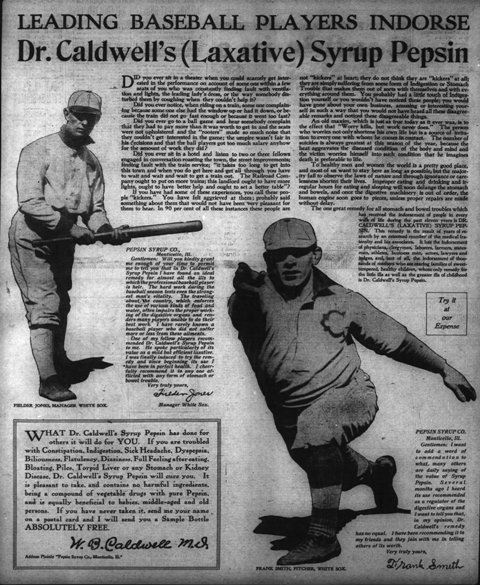
A 1904 advertisement for Dr. Caldwell’s Laxative Syrup Pepsin Company in Monticello, Illinois featuring Fielder Jones and Frank Smith.

Fielder Jones:

“I have found an ideal remedy for almost all of the ills to which the professional baseball player is heir.  The hard work during the baseball season tests even the strongest man’s vitality.”

Frank Smith:

“Dr. Caldwell’s remedy has no equal.”

In 1904 Jones replaced James “Nixey” Callahan as manager of the Chicago White Sox after 42 games.  He led the team to a third place finish.  The White Sox finished second in 1905 and his “Hitless Wonders” won the 1906 American League pennant and defeated the heavily favored Chicago Cubs 4 games to 2 in the World Series.

Frank “Piano Mover” Smith won 104 games for the White Sox between 1904 and 1910, including two 20-win seasons.

Dr. Caldwell’s Pepsin Syrup Company remained in business until 1985.


“Pitchers Should be Taught how to Sleep”

24 Sep

Edward Tilden Siever had a theory about one of the greatest dangers facing pitchers:  how they sleep.

Edward Siever

Edward Siever

The Kansas native did not begin playing professionally until he was 24-years-old in 1899, and was 18-14 as a rookie with the Detroit Tigers two years later.  He injured his arm that season, had a sub .500 record the next three seasons with the Tigers and St. Louis Browns, and went to the American Association with the Minneapolis Millers in 1905. 

Siever’s arm recovered sufficiently to post a 23-11 record with the Millers and was purchased by the Tigers the following spring; he was 14-11 in 1906.

He was having the best season of his career in 1907; finishing with an 18-11 record and a 2.16 ERA for the American League Champion Tigers.  It was during that season that he told The Detroit Times about his theory:

“Pitchers should be taught how to sleep.  Don’t laugh, I mean that More than one good pitcher has lost his arm because he did not know how to sleep correctly.”

Siever claimed that fellow Kansan, St. Louis Cardinal pitcher Charlie “Dusty” Rhodes, missed much of 1906 with a bad arm brought on by the manner in which he slept:

“(Rhodes) used to rest his head on it when he was sleeping.  It deadened the muscles…No ballplayer should ever rest his head on his arms when he is sleeping.  It’s more dangerous than the average young man imagines.  Many a ball player loses his whip and doesn’t know how to account for it.  I’ll bet that’s the real reason in many a case.”

Charlie "Dusty" Rhodes

Charlie “Dusty” Rhodes

The Chicago Cubs defeated Siever in his only World Series appearance in 1907, and after a 2-6 start in 1908 he was sold to the Indianapolis Indians in the American Association; he pitched three more seasons in the minor leagues. 

He remained a popular figure in Detroit and worked for the city’s public works department until he died of a heart attack in 1920.

Lost Advertisements–His Big Bat Brings the Bingles

20 Sep

dannymurphyad

A 1910 ad for Kellogg’s Toasted Corn Flakes featuring Philadelphia Athletics outfielder Danny Murphy.

“Speaking of bingles, here’s one of the longest hitting swatters in the game.”

Kellogg’s boxes featured a “new baseball game found printed on every package:”

“For Danny has tried it, and fell down–and this is what he said: ‘The only thing I miss in the home runs.’  But he still sticks at it, for it’s the wildest, newest, biggest fun creator of the age.”

Murphy hit .400 and drove in nine runs during the Athletics four games to one victory over the Chicago Cubs in the 1910 World Series.


Lost Advertisements–Athletics/Cubs 1910 World Series

13 Sep

1910ws2

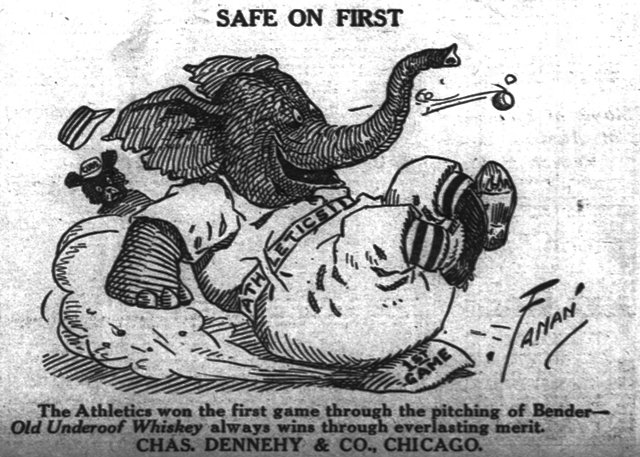
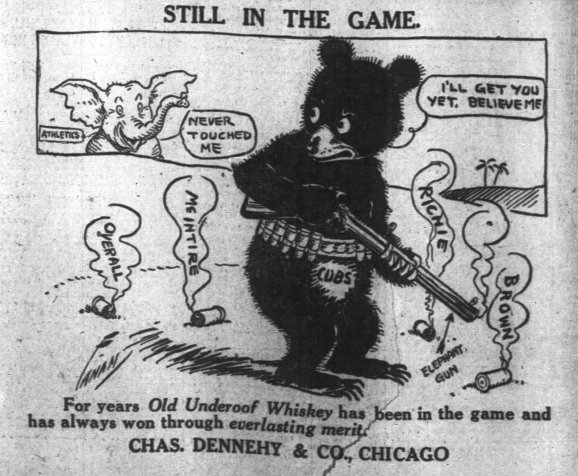
Three advertisements for Old Underoof Whiskey that appeared in Chicago during the 1910 World Series between the Cubs and the Philadelphia Athletics.  The first “Safe On First,”  above, appeared after Charles “Chief” Bender beat the Cubs 4 to 1, giving up only three hits in game one.  The second “Still In The Game,” below, appeared before game three.  The bear is holding as “elephant gun” with four spent shells on the ground–(Orval) Overall, (Harry) McIntire, (Lew) Richie, and (Mordecai) Brown–the four pitchers who gave up 13 runs to the Athletics and the first two games.


The final one, bottom, “No They are Not Dead” appeared before game four.  The Cubs, down 3 games to 0 beat the Athletics 4 to 3 in 10 innings, Brown relieved Leonard “King” Cole in the ninth and got the decision over Bender.  The following day Jack Coombs beat the Cubs and Brown 7 to 2 to take the series four games to one.


1910ws3


1910wscubs

“Base Ball has cured more Cases of Insanity than any other Outdoor Sport or Amusement”

10 Sep

A small item in The Sporting Life in 1905, although vague on details, highlighted a growing trend in the first decade of the 20th Century, fielding amateur baseball teams made up of mentally ill patients:

 “Score another point in favor of the greatest of sports, base ball.  Dr. Harmon, superintendent of a famed insane asylum near New York has discovered that playing base ball has cured more cases of insanity than any other outdoor sport or amusement. The other day the trustees wanted to till all the soil belonging to the asylum, but Dr. Harmon insisted on enough ground being left intact for a base ball park. “This game has worked wonders in many cases of insanity,” said Dr. Harmon, “in that it gives these unfortunates healthful exercise and diverts their minds from the channels into which their maladies have sunk them.”

The “asylum near New York” mentioned was probably The Buffalo State Hospital,  “Dr. Harmon” was most likely Frank W. Harmon, who was not from New York, but rather superintendent of Cincinnati’s Longview Hospital, a facility that was well-known for strong teams.  They were two of many state and private asylums throughout the country to have teams; many participated in amateur leagues and received regular coverage in the local press.

The baseball team from The Government Hospital for the Insane in Washington D.C. circa 1909 (now St. Elizabeths Hospital)

The baseball team from The Government Hospital for the Insane in Washington D.C. circa 1909 (now St. Elizabeths Hospital)

The idea wasn’t entirely new; in 1890, The New York Times reported that the State Hospital in Middletown, New York considered “indulging in the national game,” the “best and most exhilarating” outdoor activity for patients.  But by 1905, the trend had exploded.

One team, from the Northern Indiana Hospital for the Insane, in Logansport, issued a challenge “to play any similar team in the United States.”    The challenge received a great deal of coverage in Midwest papers, and included the claim that the team’s star pitcher was “a young man committed from South Bend who was one of the most noted players in the Central League.”

The player was not named  but was probably Homer Tobias, who had posted a 2-0 record for the South Bend Greens in 1908.  In April of 1909, Tobias, who The Sporting Life said “was expected to be a star member,” of the team disappeared for several days and was eventually located and committed at Logansport.  He never played professionally again.

William O. Krohn, a former University of Illinois Psychology professor who left the school to become a physician at the Kankakee State Hospital used baseball as a treatment for patients.  One of his assistants was a former University of Illinois student named Francis Xavier “Big Jeff” Pfeffer, who worked with the doctor when he wasn’t pitching for the Chicago Cubs and Boston Beaneaters.

"Big Jeff" Pfeffer

“Big Jeff” Pfeffer

In a 1911 article in The Warsaw (IN) Daily Union, Krohn said:

“You might say without departing from the literal truth that baseball makes the insane sane and the sane insane.  At least the sane often give manifestations of violent insanity while the insane seem rational while under the influence of baseball.”

“A Great deal of foolish Sympathy was wasted on Rusie”

5 Sep

Hank O’Day, pitcher and Hall of Fame umpire, said Amos Rusie was the greatest pitcher ever:

“Amos is the greatest pitcher the country ever saw. Why, Rusie had more speed in his curve ball than any pitcher I ever saw before, or have ever since seen, has in his straight fast ones.  Rusie was a wonder—that’s all there is to it.  I was behind the plate one day when one of Rusie’s  fast incurves hit Hughey Jennings…the ball hit Jennings squarely in the temple, and he fell as though shot by a ball from a Winchester rifle.  I caught him in my arms as he toppled backwards—and he was out of his head for three days.” (Contemporary reports of the incident said Jennings actually finished the game, but later lost consciousness for four days)

O’Day was also on the field when Rusie blew out his arm in 1898; Rusie threw to first to pick-off Chicago Orphans outfielder Bill Lange and “his arm cracked like a pistol’s shot.”  In 1940 Lange told his version of the story to The Portland Oregonian:

“Amos Rusie, I don’t know of any better one and I never played against any other one as good.  He had great control, as well as everything else a pitcher should have.  But my base stealing got him.  He worried over it.  I guess he lost sleep over it.  Anyway, one day he showed up on the field and said he had developed a new way to catch me off of first without turning his body.  I was anxious to see what he had, and he caught me off of first.  But—and it was a mighty large but—in doing so Rusie threw his arm out.  And never could pitch in his old form again.”
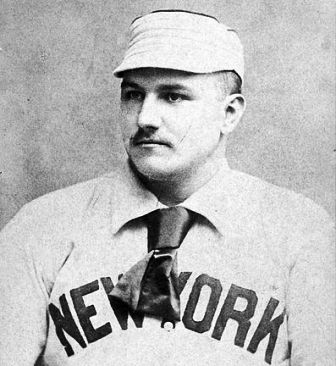
Amos Rusie

Amos Rusie

Rusie, with a dead arm, became a benchmark, an oddity, and a cautionary tale.

He posted a 246-173 record before the injury; after sitting out all of 1899 and 1900 he was traded to the Cincinnati Reds for Christy Mathewson, appeared in three games, was 0-1 with an 8.59 ERA, and his career was over.

In the decade between 1898 and 1908 The Sporting Life christened “the next Rusie,” or “another Rusie” no less than 20 times; scores more were given the same title by newspapers across the country.  Most like Cecil Ferguson (career 29-46), Davey Dunkle (17-30), Cowboy Jones (25-34), and Whitey Guese (1-4) were busts.  The three best were Orval Overall (108-71), who was called the “next Rusie” more than anyone else; Ed Reulbach (182-106), and Hall of Famer Ed Walsh (195-126).

During that same decade there were regular, small items in newspapers about Rusie’s post National League life.  Shortly after his release from the Reds in June of 1901 papers reported that Rusie, “who commanded a salary of many thousands of dollars, is now working as day laborer at $1.50 a day.”   The pitcher told a reporter “This shows I am not afraid to work, but it’s an awful comedown in salary.”

The Dallas Morning News pulled no punches in their assessment of his plight:

“The dismal afterclap to the brilliant career of a once-famous ballplayer whose name was a household word in balldom…reckless wastefulness in financial matters and a total disregard for physical care brought Rusie to his present deplorable condition when he should have been in his prime, for the big fellow is barely 30 now.”

In 1903 it was reported that Rusie had joined the Vincennes (IN) Alices in the Kitty League.  While no statistics survive, he appears to have stayed with the team for most of the summer.  The Detroit Free Press said he was “playing for a salary of $75 per month.”

After the 1903 season he went to work in a lumber yard, and the regular reports on his activities as a “low-wage laborer” appeared regularly in newspapers.  The items became such a regular feature that The Associated Press, in a short story about the Philadelphia Athletics’ eccentric and troubled Rube Waddell in 1904 said:

“Rube has run the gamut of foolishness.  He is in his prime but a few more years of such lack of sense as he displayed last season will send him to the wood pile or coal heap and he will, like Amos Rusie, be occupying two inches in the has-been columns every spring.”

There were multiple reports that Rusie was coming back as a pitcher for the 1906 season.  The rumors started in September of 1905 when Rusie attended an exhibition game in Vincennes between the Alices and the Chicago Cubs.  The Philadelphia Inquirer said of the news:

“If you don’t know the tremendous importance of this announcement you are no baseball fan.”

Not everyone agreed that Rusie returning to baseball would be a good thing.  A report from The News Special Service, which appeared in many Midwest papers said:

“His habits were none of the best, and he rapidly deteriorated in efficiency as an athlete.  He refused to pitch one whole season because he had been fined by the New York (Giants) management for being intoxicated and abusing his wife.  A great deal of foolish sympathy was wasted about that time on Rusie, but he was entitled to nothing except what he received, and some who knew the circumstances thought stricter disciplinary methods would not have been amiss.”

Rusie didn’t sign a contract that spring; and two other rumors that John McGraw had sent him a letter inviting him to spring training with the Giants and that he would return to the Kitty League didn’t materialize either.

But Rusie did make the news again in June.  A man named Gabe Watson was collecting mussels in the Wabash River when his boat when his boat overturned.  The Evansville Courier said Rusie pulled the drowning man from the river.

The nearly annual reports of “Rusie’s return” ended after 1906, but Rusie’s many career, and life changes continued as newspaper copy for the next twenty years.

When pearls were discovered in the Wabash River’s mussels, Rusie became a pearl diver.  Two years later he was in Weiser, Idaho, serving a 10-day sentence for public drunkenness.  In 1910 he was in Olney, Illinois working in a glass factory.  The following year he moved to Seattle, Washington.  For the next decade served as an umpire for a couple of Northwestern League games, worked as a ticket taker and groundskeeper at Yesler Way Park and Dugdale Field, home of the Seattle Giants, and also worked as a steam fitter.  Rusie went to jail at least once while in Seattle, and remained a big enough name that when he was injured by a falling pipe in 1913, it made newspapers throughout the country.

In 1921 Rusie became another in the long line of former players hired by the New York Giants at the behest of John McGraw.  According to newspaper reports McGraw offered the former pitcher a “job for life” as a “deputy superintendent” at the Polo Grounds.  Interest in Rusie’s career was renewed, and the pitcher was regularly interviewed for the next couple of years, reminiscing about his career and about how he’d like to have had the opportunity to pitch to Babe Ruth.

Unlike most of the former players who McGraw found work for at the Polo Grounds, Rusie did not stay for the rest of his life; he returned to Auburn, Washington in 1929 and bought a farm, where he remained for the rest of his life.  He was badly injured in a car accident in July of 1934—The Seattle Daily Times said Rusie’s vehicle overturned and he sustained a concussion and broken ribs.

While he received less attention after being incapacitated after the car accident, Rusie was still mentioned frequently in the press until his death in 1942; contrary to oft-repeated fiction that he died in obscurity.  And his obituary appeared in hundreds of papers across the country in December of 1942.  It wasn’t until the post WWII area that Rusie stopped being a household name, which led to his final comeback in the 1970s; Rusie was inducted into the Hall of Fame 34 years after his death.

“And they Started Hitting like Demons”

4 Sep

Arthur “Artie” “Circus Solly” Hofman was one of the best utility men in baseball, and a member of four Chicago Cubs teams that went to the World Series.  When he was traded to the Pittsburgh Pirates in May of 1912, Bill Bailey of The Chicago American told a story about Hofman, baseball bats and why baseball players are superstitious about them:

“Some fans might think that Artie can hit with most any old stick that comes along, but he himself is very exacting about the one he picks out before he goes up to the plate.  There is always a great line of bats laying out in front of the players bench during a game.  Most of them are special makes of the big sporting goods companies and most of them are expensive products.”

Bailey said during the 1911 season the Cubs were mired in a mid-season hitting slump:

“And Hofman conceived an idea.  He was wandering through a department store in town when he saw a couple of bats on display.  They weren’t anything like the kind the Cubs had been using. “

Circus Solly Hofman

Circus Solly Hofman

Told the bats cost twenty-five cents each Hofman bought dozens of the bats and had them delivered to the West Side Grounds:

“Hofman took one himself and distributed the rest among his teammates…Every man in the lineup used one of Hofman’s bats that afternoon.  And they started hitting like demons.  Naturally they continued using the cheap bats. And they went on a batting rampage that lasted for a long time.  Everybody was slugging the ball.  When things like that happen, is it any wonder that the players have their superstitions about bats?”

“Bill Bailey” was the pen name of Bill Veeck Sr., who would become vice-president of the Cubs in 1917, and president of the club in 1919.  He, of course, was also the father of Cleveland Indians, St. Louis Browns and Chicago White Sox owner Bill Veeck.

Bill Veeck Sr./"Bill Bailey"

Bill Veeck Sr./”Bill Bailey”

Hofman’s greatest claim to fame was being the Cubs centerfielder on September 23, 1908.  He fielded Al Bridwell’s single that scored Harry “Moose” McCormick, seemingly giving the New York Giants a 2 to 1 victory.  It was  Hofman, according to umpire Hank O’Day, who realized that Fred Merkle of the Giants, who had been on first base,  failed to touch second before leaving the field.  “Merkle’s Boner” remains baseball’s most famous base running blunder.

“We are beginning to have a Very Active Doubt as to the Value of Professional Baseball in American Life”

29 Aug

Coming on the heels of the fallout from the Black Sox scandal, The Chicago Tribune announced a change in editorial policy three weeks after “Shoeless” Joe Jackson, Eddie Cicotte, Oscar “Happy” Felsch., Claude “Lefty” Williams, Arnold “Chick” Gandil, George “Buck” Weaver, Fred McMullin, and Charles “Swede” Risberg were acquitted of conspiring to fix the 1919 World Series.

Buck Weaver and Swede Risberg during the trial

Buck Weaver and Swede Risberg during the trial

The paper said:

The Tribune has begun to use the compressor on professional baseball stories. The baseball reporters write them well, but we are getting a little tired of the subject. We are beginning to have a very active doubt as to the value of professional baseball in American life.”

The paper said baseball received a “black eye which jury verdicts did not whiten.”

The Tribune said they would place a greater emphasis on coverage of amateur sports which “produce sound citizenry.”  Professional baseball was also making Americans soft:

“The majority of spectators get only eye and mouth exercise.  We have conceded that the professional game stimulated the youngsters and that they played with more earnestness on the lots because they admired Babe Ruth.  We still admit that professional baseball is a stimulus to boys, but journalism has overfed it with space.  The Tribune is down to about a half column now for games in which the home teams play, which is justified parochialism, and to a bare statement of vital statistics regarding the other clubs.  That is enough.”

Other newspapers applauded the policy; surprisingly most didn’t cite corruption in baseball as the reason, but the rather, as The Baltimore Sun said because professional sports only provide “vicarious exercise.”  The Louisville Courier-Journal said watching baseball was even a threat to manhood:

“Two hours of inactivity in the grand stand or bleachers is not productive of muscle or sinew.  The same amount of time spent in tennis, golf, swimming or any number of games would be infinitely better for American manhood.”

Others found the new policy foolish.  The Portland Oregonian said:

The Chicago Tribune, which is regarded by its management, and doubtless by many of its readers, as the world’s greatest newspaper, has decided to blue-pencil professional baseball…The theory on which the sport page is built is that the public is entitled to what it wants…Telling the readers of sports that they should want something else, and will be given that something, is a decided innovation.”

The Duluth News-Tribune said facetiously:

“The fact that both teams (the Cubs and White Sox) are near tail-enders may not have anything to do with it.”

Then there was The Idaho Statesman which said The Tribune’s policy was a “meritorious undertaking,” but didn’t go far enough:

“There are a world of other professional sports not half as white as the Black Sox, that might come under the publicity axe with resulting good to the public…Horseracing is professional and it has produced a fine crop of crooks—more than baseball in its blackest days could possibly yield.  Our own so-called wild west sports have been placed in the professional class and everybody knows they are largely fake.  Wrestling hasn’t the whitest record in the world and prize fighting is anything but a Sunday school game.  Nobody ever got very much exercise out of any of these sports, except the participants and we are not sure that our citizenship is any sounder for having witnessed them.  The Tribune isn’t through with its job as we view the situation.”

The most prescient response was from The Montgomery (AL) Advertiser:

“We expect to see The Tribune gradually slipping back to its old ways.”

Ten days after the original policy was announced The Tribune declared victory, and revealed their real motive:

“An encouraging sign is the changing attitude of the press toward highly commercialized sport. The papers are coming to the conclusion they have been giving away millions of dollars’ worth of advertising to boost box office receipts for promoters who have no special regard for the public.”

But within weeks the “The World’s Greatest Newspaper” had, as The Advertiser predicted, begun “slipping back” to the way baseball had previously been covered.  By the beginning of the 1922 season, notwithstanding the lingering effects of the game’s greatest scandal, or no indication that Americans were getting any more exercise, baseball stories in The Tribune looked no different than stories that appeared before August of 1921.

Lost Advertisements–Edelweiss Beer–“Slide, you rummy, Slide”

9 Aug

Edelweiss


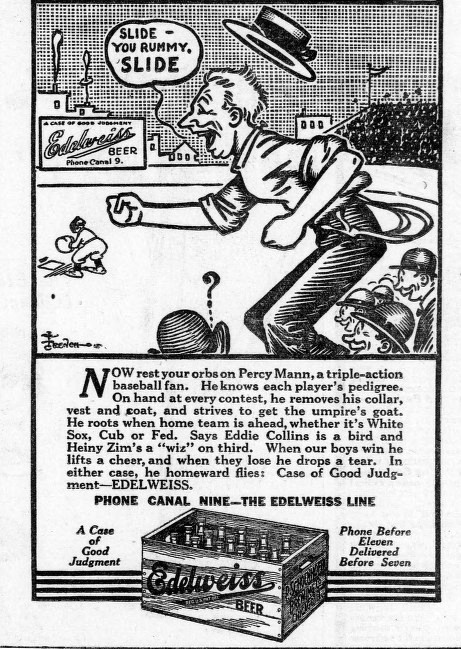
A 1915 advertisement for Edelweiss Beer which appeared in Chicago newspapers.

“Now rest your orbs on Percy Mann, a triple-action baseball fan.  He knows each player’s pedigree.  On hand at every contest, he removes his collar, vest and coat, and strives to get the umpire’s goat.  He roots when home team is ahead, whether it’s White Sox, Cubs, or Fed.  Says Eddie Collins is a bird and Heiny Zim‘s a ‘wiz’ on third.  When our boys win he lifts a cheer, and when they lose he drops a tear.  In either case, he homeward flies:  Case of Good Judgment–Edelweiss”

Things I Learned on the Way to Looking up Other Things #5

8 Aug

Johnny Evers “Ardent Worshipper of Hoodoo Lore”

Edward Lyell Fox was a war correspondent in World War I; after the war he was accused of taking money to write stories favorable to the German government.  Before that he wrote extensively about baseball for several American magazines.

In 1910, writing for “The Columbian Magazine”, Fox interviewed Johnny Evers of the Chicago Cubs about the “almost unbelievable efforts made by ballplayers to offset what they firmly believe to be ‘hoodoos.’”

Evers was one of the most superstitious players in the game, “an ardent worshipper of voodoo lore,” according to Fox, and Evers said the Cubs “are more superstitious than any team in the big leagues,” and that manager Frank Chance “is one of the most ardent respecters of diamond ‘hoodoos.’”

It’s not certain that Evers’ claim that “most players firmly believe in,” the superstitious he listed for Fox, but it’s clear he believed them:

 “If any inning is favorable to a player, he will try to lay his glove down on the same spot where he had placed it the inning before.

“While going to different parks in cars, the sight of a funeral cortege is always regarded as an ill omen.”

Evers also said the sight of a handicapped person was also an “ill omen…unless you toss him a coin.”

On the other hand Evers said a wagon load of empty barrels was a sign of good luck.

Johnny Evers,

Johnny Evers,


“Too much of a Good Thing”

Even in baseball’s infancy that were critics that said the popularity of the game was “too much of a good thing.”

In September of 1865 The Philadelphia Inquirer editorialized:

 “Let us take, for instance, the base ball (sic) pastime, which is now assuming the proportions of a violent and widespread mania.”

The culprit, according to the editorial, was the athletic club teams that were growing in popularity and  no longer “satisfied with a game or two a week.”

 “(S)ome of these associations devote, three, four or five days at a time to their games; that they are not satisfied with playing on their own grounds for their own benefit and amusement, but that they thirst for popular applause, and are rapidly transforming their members into professional athletes…They issue their challenges, and hotly contend for mastery with clubs belonging to other cities.”

 The Inquirer did predict one aspect of baseball’s new popularity:

 “It can be easily seen that this spirit must soon lead on to gambling. So far the only prize of the base ball and cricket matches has been a ball or some implement of the game, but private wagers have undoubtedly been laid upon the playing of certain clubs, and money has changed hands upon results.”

The Enquirer was also concerned that the game defied “common sense” because “during the heats of summer violent bodily exercise should be avoided; but upon this subject common sense and the base ball mania seem to be sadly at variance.”

The editorial concluded that “the young men,” make sure “they do not depreciate themselves to the level of prize fighters or jockeys, who expend their vim on horse races and matches made for money.”

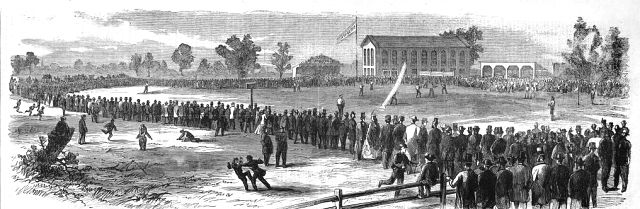
Athletic of Philadelphia versus Atlantic of Brooklyn, in Philadelphia October 30, 1865--"a violent and widespread mania."

Athletic of Philadelphia versus Atlantic of Brooklyn, in Philadelphia October 30, 1865–“a violent and widespread mania.”


Odds, 1896

Early in 1896 The New York Sun reported on “an early development of interest.”  A local bookmaker had issued odds on the 1896 National League race:

“He lays odds of 3 to 1 against Baltimore finishing first; 7 to 2 against Cleveland and Boston;  4 to 1 Philadelphia and New York; 7 to 1 Chicago; 8 to 1 Brooklyn and Pittsburgh; 15 to 1 Cincinnati; 40 to 1 Louisville; 100 to 1 Washington, while (Christian Friedrich “Chris”) von der Ahe’s outfit (St. Louis) is the extreme outsider on the list.  Any lover of the German band can wager any amount and “write his own ticket.”

The final standings:

1. Baltimore Orioles

2. Cleveland Spiders

3. Cincinnati Reds

4. Boston Beaneaters

5. Chicago Colts

6. Pittsburgh Pirates

7. New York Giants

8. Philadelphia Phillies

9. Washington Senators

10. Brooklyn Bridegrooms

11. St. Louis Browns

12.  Louisville Colonels

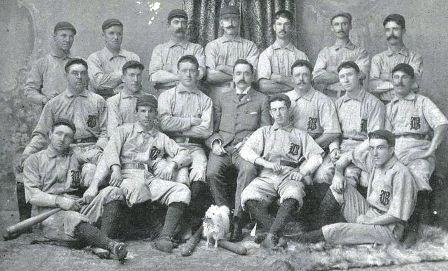
1896 Orioles, 3 to 1 favorites, won the National League Championship.

1896 Orioles, 3 to 1 favorites, won the National League Championship.