Tag Archives: Chicago Cubs

Lost Advertisements–Old Underoof Whiskey, Cubs and White Sox

2 Aug

OO62010


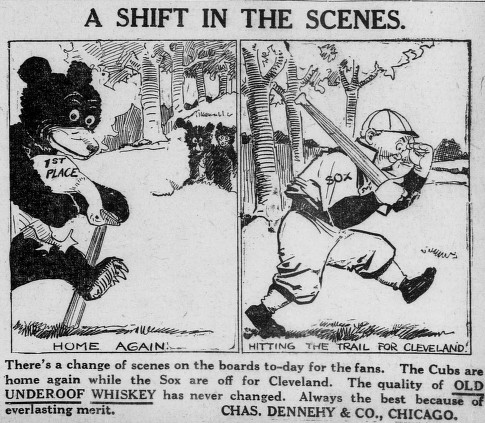
Two more 1910 advertisements for Old Underoof Whiskey featuring the Chicago Cubs and White Sox; these appeared in The Chicago Daily News and The Chicago Examiner.

The one above “A Shift in the Scenes” is from June 20, 1910.  The Cubs were returning home after a 10-4 road trip which put them 4 ½ games ahead of the second place New York Giants, while the struggling, seventh place White Sox were heading to Cleveland for a six game series.

The one below “It’s a Rocky Road to Pennantville” appeared just 10 days later.  The Cubs, who had won four straight games after the first ad appeared, just lost five of seven to the Pittsburgh Pirates, St. Louis Cardinals and Cincinnati Reds, cutting their lead over the Giants to a game and a half.

The White Sox would continue to struggle; they finished the season 68-85.  The Cubs would run away with the pennant, beating the Giants by 13 games.

OO63010

“Is the Best the Game has Known”

23 Jul

Joining the Boston Braves for the 1914 season provided second baseman Johnny Evers with the opportunity to appear in one more World Series, and gave him the chance to take a very public swipe at one of his most famous former teammates, shortstop Joe Tinker.

In December of 1912 the Chicago Cubs traded Tinker to the Cincinnati Reds, and depending on which version of the story was to believed, Tinker and Evers had not spoken a word to one another for either five or six years.

Johnny Evers

Johnny Evers

Tinker said the two stopped talking in 1908 after Evers jumped in a horse-drawn cab leaving Tinker and other teammates behind before an exhibition game in Indiana leading to an on-field fight between the two later that day; Evers said a year earlier Tinker initiated the bad blood between the two by throwing a ball so hard to the second baseman on a force play that it injured his finger.

Evers said years later:

“I yelled to him, you so-and-so. He laughed. That’s the last word we had for-well, I just don’t know how long.”

The 1914 Braves got off to a horrible 4-18 start, and were still in eighth place on July 18, but surged to second place by August 10, winning 18 of 21 games.  By September 2 the Braves had first place to themselves, and ended up running away with the pennant, beating the second place New York Giants by 10 ½ games, and sweeping Connie Mack’s Philadelphia Athletics in the World Series.

Evers, named Boston’s captain by manager George Stallings, led National League second basemen in fielding; hit .279 for the season, and .438 in the World Series.  Evers received baseball’s last “Chalmers Award,” a forerunner of the Most Valuable Player Award, which was presented from 1911-1914.  The award was sponsored by the Chalmers Motor Car Company and was presented to Evers along with a new car.

The runner-up for the Chalmers Award was Evers’ teammate, shortstop Walter James Vincent “Rabbit” Maranville.  Maranville, Evers and first baseman Charles “Butch” Schmidt were an excellent double-play combination throughout the season; Evers participated in a career-high 73 twin killings, more than he’s ever turned in a season with Tinker and Frank Chance.

Years later Maranville said of Evers:

“It was just Death Valley, whoever hit a ball down our way.  Evers with his brains taught me more baseball than I ever dreamed about.  He was psychic.  He could sense where a player was going to hit if the pitcher threw the ball where he was supposed to.”

Two days after the Braves won the World Series; Evers took the opportunity to take a swipe at his former teammate Tinker.  Evers told William Peet, sportswriter for The Boston Post that:

“(Maranville’s) the best shortstop the game has ever known.

“Better than Joe Tinker; your old side partner?

“Yes, he’s better than Tinker.”

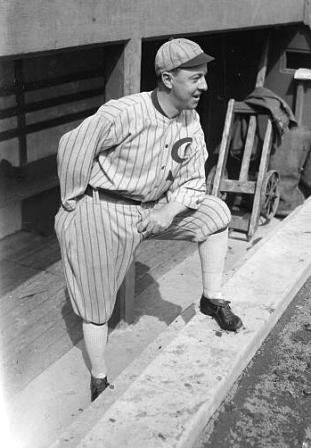
Joe Tinker

Joe Tinker

Peet sad:

“Evers has been given credit for making Maranville the great player he has shown himself to be this season, but Johnny declares this s untrue, stating that Maranville learned the game and all its fine points unaided.”

Peet said Evers’ claim that Maranville “is a greater shortstop than Tinker is about the highest praise anyone can shower on the peppery little chap who was such a prominent factor n the Braves’ victory.”

Rabbit Maranville

Rabbit Maranville

Evers and Peet failed to mention where Honus Wagner would be ranked if Maranville was, in fact, “the best shortstop the game has ever known.”

No response from Tinker was recorded.

Evers and Tinker would not speak again for another decade.  In 1924, the two finally spoke when they were summoned to California by Chance, their former teammate and manager, who was dying.

Tinker, Evers and Chance

Tinker, Evers and Chance

Tinker, Evers and Chance were inducted into the Hall of Fame together in 1946 by the veterans committee; Maranville was elected by the Baseball Writers Association of America in 1954.

“I Object to Being Made a Freak.”

17 Jul

In 1913 American League President Ban Johnson set out to put an end to the practice the Baseball Writers Association called “A growing Evil,” ghost-written articles appearing under the by-lines of famous ballplayers.

William Peet of The Washington Herald revealed the identities of the ghost writers in March of 1913; Gerhard “Roger” Tidden of The New York World had been the man responsible for articles bearing the name of Ty Cobb, but Tidden died just three months after the revelation.   While the practice waned after 1913, Cobb remained defiant, and continued “authoring” a syndicated column for the next several years.

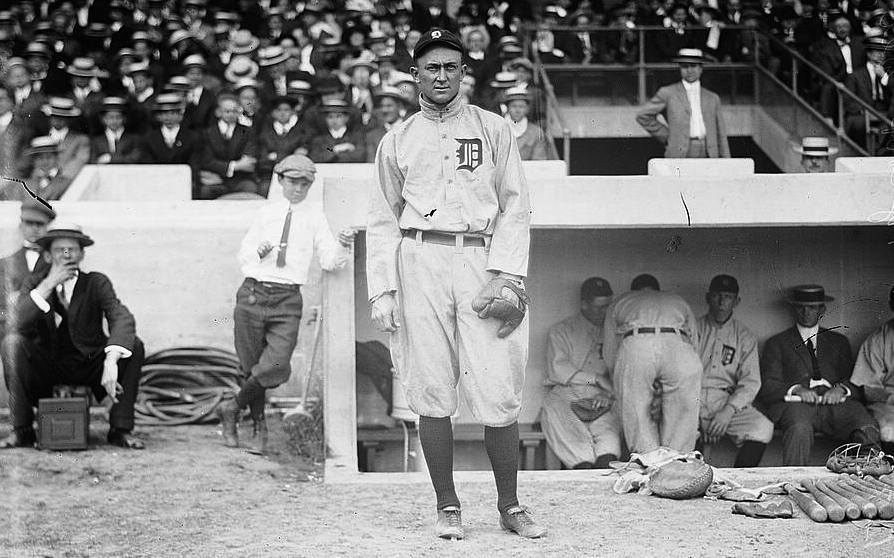
Ty Cobb

Ty Cobb

Cobb’s articles, for the most part, steered clear of trouble with the league president, but the assertions he made about the Chicago White Sox and manager Clarence “Pants” Rowland in June of 1915 caused a major stir.

Cobb said:

“Battery signal stealing, which has been the cause of several scandals in big league baseball threatens to make more trouble this season if anyone is able to prove what is generally suspected about one of the American League clubs.

“I will not mention the name of the organization which has been accused by the opposing players…because I couldn’t present any proof.”

Cobb then went on for seven paragraphs trying to present proof, and provided enough hints to make it clear he was talking about the White Sox.

Cobb’s said

 “The team I have in mind has won almost all its home games…It looks mighty funny, though, the way this club could hit at home and the feeble manner in which it has been swatting on the road and almost all of the Tigers will take an oath that something out-of-the-way is coming off.”

Chicago, through 49 games, was in first place; 22-8 at home and 9-10 on the road.  Detroit was in second place a game back.  If he left any doubt Cobb said later in the column when discussing the American League pennant race in general:

“The White Sox, who burned up things at home, have not been doing so well on the road.”

Everyone, including American League President Ban Johnson, assumed Cobb was talking about the Sox.  Johnson said:

 “(Cobb) must prove the charges, or I will keep him from playing baseball.  If any man in the American League makes a charge of dishonesty and refuses to back up his charge with the absolute evidence, that man will have to get out of the game.”

The White Sox were less concerned; The Chicago Tribune said the charges made Sox players “grin,” and Rowland told reporters:

“I suppose we had out tipping instruments planted in the Polo Grounds when we made nineteen hits in New York the other day.”

Clarence "Pants" Rowland

Clarence “Pants” Rowland

In his next column Cobb issued a non-denial denial and at the same time openly, and loudly, defied Johnson:

“I made no specific charge against the White Sox…What I did say was that a strong rumor of sharp practice was abroad, and I reiterate that statement right here.”

___

“Mr. Johnson even went to the extreme of saying that he would drive me out of baseball.  He hasn’t done this yet and I expect to stay around for a few more days.  If the league president is willing to pay the salary that my three-year contract calls for, I will be perfectly willing to take a vacation at that, for I have long wanted to do a number of things that baseball interferes with.”

Cobb reiterated the charges and offered no evidence, but said he was justified in making the claims because his manager might have believed them:

“(Tigers) Manager (Hughie) Jennings thought the report sufficiently serious to detail one of our players for plain clothes duty in the bleachers, and he also wrote Manager (Bill) Donovan of New York, telling him of a warning we had received and cautioning him to be on the lookout.  So you see the signal tipping report was not a creature of my own imagination, but a matter of sufficient seriousness to warrant an investigation by our manager in his official capacity.”

Cobb’s only bit of backtracking was to say that if “it should be proved the White Sox tried signal stealing it would be without the knowledge of Mr. (Charles) Comiskey.”  Cobb said Comiskey “wouldn’t countenance anything of this sort for a moment.”

Cobb took one last swing at Ban Johnson, charging the league president with giving “sensational interviews” about him to get “the people excited artificially. If this is Mr. Johnson’s idea, I wish he would abandon it.  I object to being made a freak.”

If there was any doubt whether the American League’s star player or the league president wielded more power, it became obvious within a week.

Johnson, who The Associated Press said “long has been opposed to players permitting their name to be used over baseball stories,” decided not only had Cobb not written the columns, but claimed “a Detroit newspaperman” made up the allegations “out of whole cloth,” and incredibly said that Cobb had “no knowledge,” of the columns despite Cobb being quoted by numerous sources discussing the charges.

Ban Johnson

Ban Johnson

Hugh Fullerton of The Chicago Examiner summed it up best:

“We are rather surprised each morning upon picking up our newspaper to discover that Ty Cobb is still making two-base hits, two steals and catching a few flies instead of being driven out of baseball by (Ban) Johnson.  By the way how did Johnson get into baseball?”

As quickly as Johnson backed down, the charges went away.  Despite the strong start the White Sox faded, and continued to fade even after the acquisition of “Shoeless Joe” Jackson on August 21, finishing third, nine and a half games behind the pennant-winning Boston Red Sox and seven games behind the Tigers.

Cobb led the league for the ninth straight season, hitting .369.

The one legacy from the brief 1915 controversy seems to be Cobb’s dislike of Rowland, who later became a scout for the Tigers.  In his 1984 book “Ty Cobb,” Charles C. Alexander said Cobb only agreed to manage the Tigers before the 1921 season because he was told:

 “Pants Rowland, whom Cobb considered an incompetent fraud, might very well get it and Cobb would have to play for him.”

Rowland, who remained in baseball until 1959 as a manager, scout and executive with the Los Angeles Angels in the Pacific Coast League and Chicago Cubs in the National League, appears to have also held a grudge.   Up until his death at age 90 in 1969, Rowland often said two of his former players, Jackson and Eddie Collins were better than Cobb.

 In 1953 at the Old Timers Baseball Association of Chicago Banquet Rowland said “I wouldn’t have traded (Collins) for Cobb.  What made him greater than Cobb was that he inspired the entire ball club.  Ty was an individualist.  He was interested only in Cobb.”

Rowland called Jackson the “greatest natural hitter,’ he ever saw, and said Ted Williams, not Cobb, was the only player “of the same make-up.”

Charles Murphy’s Last Stand

16 Jul

The National League had almost completely rid themselves of Charles Webb Murphy in 1914; the owner who had ongoing feuds with nearly every other league magnate, league officials, umpires, and many of his own players, had sold his interest in the Chicago Cubs to his financial benefactor Charles Phelps Taft.

Murphy returned to his home in Wilmington, Ohio; his only connection to the National League was his part ownership of the Baker Bowl, the home of the Philadelphia Phillies.  Murphy’s other ballpark ownership stake was in Chicago’s West Side Grounds, but that investment had lost most of its value after Taft sold the Cubs to Charles Weeghman, who moved the team to his ballpark on the North Side.  The Cubs former home field was used for amateur and semi-pro games, even  Buffalo Bill’s Wild West Show, but the park was not making Murphy money.

William Wrigley Jr., and his brothers were minority investors in the team in 1916, but Weeghman began struggling financially almost as soon as he bought the team, and the Wrigley brothers began buying Weeghman’s stock.

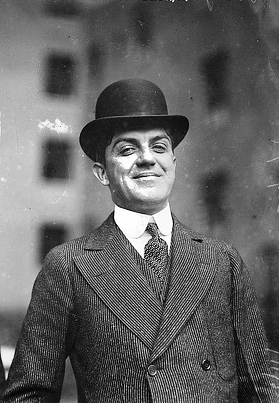
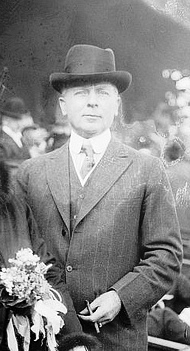
Charles Weeghman

Charles Weeghman

Between the 1918 and ’19 seasons the Wrigley’s acquired controlling interest in the Cubs.  (Some recent sources say Wrigley did not have controlling interest until 1921, but numerous contemporaneous sources said the Wrigley family had control of the team before the 1919 season began).

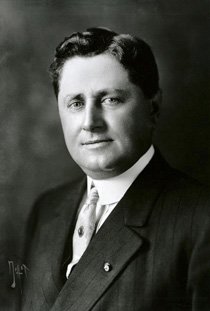
William Wrigley Jr.

William Wrigley Jr.

In February of 1919 Joe Vila, sports editor of The New York Sun wrote a story that said the Cubs were moving out of Weeghman Park and back to the West Side Grounds:

“National League men are gratified to learn that there will be a change of ball parks in Chicago, probably before the championship season opens on April 23.  The Cubs who have occupied the grounds of the defunct Chicago fed on the North Side since 1916, are preparing to return to their old home, West Side Park, which still is the property of Charles Webb Murphy and, presumably Charles P Taft.  The North Side plant never could accommodate more than 18,000 spectators, sitting and standing, whereas as many as 30,000 attended games at West Side Park in the days when Frank Chance had a world’s championship ball club.  Last fall the Cubs played their world’s title games with the Red Sox in Chicago at the home of the White Sox for the reason that the former Chifed arena was too small.”

Vila said Murphy saw an opportunity in the new ownership arrangement:

“Naturally, with an eye to business, Murphy promptly suggested to the Wrigley’s, who control the Cubs stock, the transfer of the Cubs…The Wrigley’s, who know little or nothing about practical baseball methods, regard Murphy as an oracle and there isn’t  a doubt that they will accept his suggestion.”

westsidegrounds

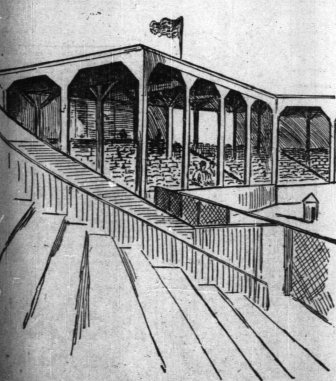
The Grandstand at West Side Grounds

It’s unclear whether the move, for which Vila said “there isn’t a doubt,” was ever even a possibility; it seems just as likely it was a story planted by Murphy.  Vila’s description of the ousted Cubs owner would suggest, at the very least, that Murphy had a sympathetic ear with The Sun sports editor:

“Murphy is one of the smartest men in baseball…When Murphy was president and of the Cubs the club didn’t have a losing year financially…In other words the Cubs under Murphy were tremendously successful.”

Vila also blames the Horace Fogel incident for all of “Murphy’s unpopularity that led to his retirement,” Not mentioning Murphy’s numerous feuds.

The Wrigley’s did not end up accepting Murphy’s suggestion, and the team remained at Weeghman Field, renamed Cubs Park before the 1920 season, and finally Wrigley Field before the 1926 season.

Murphy’s last stand having failed, he had his ballpark torn down in 1920.

It wasn’t until 1927 that the seating capacity at Wrigley Field finally surpassed that of the west Side Grounds.

“The Story of the Story Fogel Wrote”

9 Jul

The day before Philadelphia Phillies president and owner Horace Fogel was banned from baseball by his fellow National League magnates, one of the witnesses in the case against him said Fogel was being “used” by the “instigator” of the story that appeared in The Chicago Evening Post, and contributed to the action taken by the National League.

The charge seemed to confirm a rumor that swirled around the Fogel case for months; that the Philadelphia Phillies owner was acting on behalf of Cubs owner Charles W. Murphy.

Under the headline, “The Story of the Story Fogel Wrote,” William S. Forman, sports editor of The Evening Post wrote:

“Charles W. Murphy authorized me to tell Fogel that Murphy had suggested writing the story.  On this representation Fogel wrote it and signed it.  He sent it to Murphy, who read it before I ever saw it.  It came to me from Murphy’s office; and if Murphy had not approved the story it never would have been published.  The man who is morally responsible for that article and the charges it contained is Murphy himself, and I have Fogel’s own word for it that he wrote it simply “to help Murphy fight his battles” with the National League.

“It is not the first time Murphy has made Fogel the goat.  Previously Murphy had sent me another article signed by Fogel and told me Fogel had writing it, and wanted it published…Months afterward I learned that Murphy himself had writing it and Fogel had merely signed it because he was requested to do so by the Cubs’ President.  It was a defense of Murphy who had been criticised…by a Chicago baseball writer.”
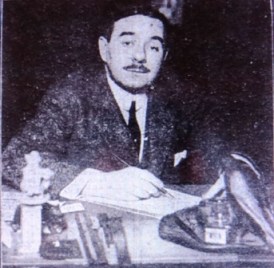
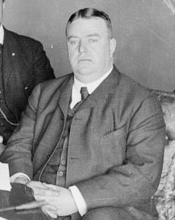
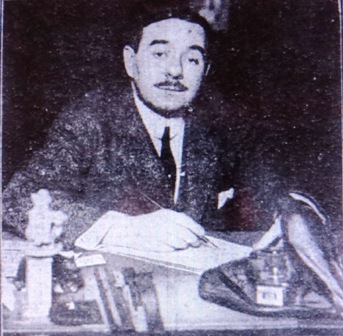
Charles Webb Murphy

Charles Webb Murphy

Murphy, who spent his entire National League career engaged in countless feuds with fellow owners, players, managers, umpires and writers, denied the charge and said Forman was motivated to tell the story as a result of one of Murphy’s other feuds, telling reporters:

“This is a lot of rubbish; why I hardly know this man Forman, but I can guess readily that his paper is sore because we let Frank Chance go.  His paper thinks that by pounding me it will make a hit with Chicago fans, but it will find it is mistaken.“

The Associated Press said the other league owners were not buying Murphy’s explanation:

“(I)t is claimed that every magnate expects charges will be brought against (Murphy) by President (Thomas) Lynch and he may go the way of Fogel if the test votes to date are any criterion.”

Despite the rumors and the “test votes,” Murphy said “the suggestion that charges will be brought against me is all rubbish.”

Murphy was correct.  Despite the evidence, and despite his ongoing feuds with the league president and at least half of the National League magnates, charges were never brought by the league.

Murphy had another feud-filled, stormy year in Chicago in 1913.  After the season The Associated Press said:

“For the first time since the problem of pushing Charles W. Murphy out of the National League received serious consideration there is smooth working machinery ready to grip the club president and move him to a seat beside Horace Fogel. “

While a deal was being made to get Murphy out of the National League, Damon Runyon said:

“We grant you that Charles Webb Murphy should be thrown out of baseball, if only to quiet the beating pulse, and lave the fevered brow of Chicago, but we do not go to be o’ nights with a dull anger smoldering in our in’ards and we do not get up o’ mornings low in mind and spirits and feeling that out existence is is blackened and posterity besmirched because Charles Webb Murphy is still around.  We know that when they throw him out, as they doubtless will throw him out, there will be someone else ready to take his place as official Bugaboo, for there must be a Bugaboo in baseball, else we might have no baseball.”

Eventually it was agreed that Charles Phelps Taft would purchase Webb’s interest in the Cubs, and he resigned as team president in February of 1914; although it was unclear just how much the sale netted him.  Murphy said he owned 53 percent of the team’s stock and that the sale was for more than $500,000.  Frank Chance, Mordecai Brown, and others claimed Murphy “Never owned more than fifteen or twenty percent of the club stock.”

But the transaction with Taft would not be the end of Murphy.

Murphy was still owned part of the Cubs’ West Side Grounds and Philadelphia’s Baker Bowl, home of the Phillies.  In addition it was reported at the close of the 1914 season that Murphy held a mortgage on the Cubs stock, and claimed to own a controlling interest in the Philadelphia Phillies.

The Chicago Examiner said:

“Charles W. Murphy, who everybody supposes was ‘kicked out’ of baseball last spring, is not out at all, but very much in…He practically admits it himself when he does not deny controlling Cub stock , and asserts that he may take over the Philadelphia club before long… (National League President John Tener) declared some months ago that Murphy was out of the National League, now admits that Murphy may own some stock that he does not know about.

“Murphy says openly that he is Tener’s landlord, meaning that Tener is a stockholder in the Phillies and that the Phillies owe Murphy plenty of rent for their grounds.”

The Examiner said Murphy was interfering with the negotiations to sell the Cubs to Charles Weeghman, and at the same time was owed a lump sum payment of more than $100,000 by the other Phillies investors; if the payment was not received “at the stated time Murphy will foreclose and take possession of the Phillies.”

In The Philadelphia Inquirer, Phillies President William F. Baker quickly denied Murphy’s assertion that the former Cubs owner was in a position to take possession of his ballclub and that Tener ever owned stock in the team:

“It is true that Murphy and Mr. Taft own the Philadelphia ballpark, which the club has leased for a long time. But that does not alter the fact that Murphy is in no way interested in the club’s affairs…I intend to call the attention of the National League to this matter for the purpose of stopping Murphy for all time.”
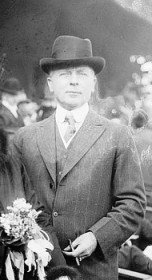
William F. Baker

William F. Baker

By late December of 1914 Murphy was finally out of the National League for good.

As for whether Murphy was forced of baseball or left of his own accord, several recent sources point to a self-serving article Murphy wrote in “Baseball Magazine” in 1919 as evidence that he was not forced out.  Murphy, while acknowledging that Tener “was not ‘crazy’ about me,” Murphy said:

“No force was required. Despite that fact I read every once in a while that I was forced out of baseball–knocked down the back steps, as it were, and kicked into the yards behind… I sold out to Mr. Charles P. Taft and without force, but for what every other thing of value is obtained–a price. Imagine a man being forced to take $500,000 for a baseball franchise.”

Given that the $500,000 figure, while repeated credulously in countless books and articles in the last 100 years, has never been confirmed (it’s fairly certain that most of Murphy’s stake in the Cubs strictly on paper and was, in fact, Taft money, making Chance and Brown’s speculation on the value more realistic), and that Murphy conveniently left out his attempts to insert himself in the operations of two team the year after “no force was required” to remove him from the game, his protestations should be taken at face value.  Although he retained his interest in the Baker Bowl, he was never actively involved in the operations of a team again.

Murphy, who started his professional life as a sportswriter (for Taft’s Cincinnati Enquirer), managed to remain involved in baseball by writing articles about the game for “Baseball Magazine,” many, like the one quoted above, focused on restoring his reputation.

Murphy returned to Wilmington, Ohio where he financed the construction of the Murphy Theater, a landmark that still stands.  He eventually returned to Chicago where he died in 1931.  The Associated Press said he left “An estate estimated at nearly $3,000,000,” his stake in the Baker Bowl and the ownership of the theater being his largest assets.

Murphy made one last pitch to get back in the game–next week.

“Said–Tinker to Evers to Chance”

5 Jul

???????????????????????????????

Franklin Pierce Adams’ famous poem “Baseball’s Sad Lexicon” appeared in The New York Evening Mail in 1910 and immortalized Chicago Cubs shortstop Joe Tinker, second baseman Johnny Evers and first baseman Frank Chance—within three years, the above cartoon appeared in newspapers along with a new, less well-known, poem written by Adams’ colleague at The Evening Mail, James P. Sinnott.

By 1913, baseball fans became aware that Tinker and Evers had barely spoken to each other since 1905, and the rivalry among the three exploded in public.  The former teammates, now all managers, Tinker with the Cincinnati Reds, Evers with the Cubs, and Chance, the recently deposed Cubs manager, with the New York Yankees.

In February Chance told reporters that Tinker was a better player than Evers; Evers responded and accused Tinker of trying to “tamper” with pitcher Larry Cheney and other members of the Cubs, as for Chance he said:

“I do not know whether Chance is jealous of my getting the position of leader, and I do not like to think so, but from the remarks he is making, I am forced to.”

By March, Hugh Fullerton said in The Chicago Examiner that Evers was unable to control his players; he said “Chance could whip any man on (the) team—Evers can’t,” and predicted a fourth place finish for the Cubs (they finished third).  Tinker’s Reds finished seventh in the National League; Chance’s Yankees were seventh in the American.

Sinnott’s poem appeared at the end of September:

“A Manager’s life is tough!

Said Tinker to Evers to Chance—

‘A manager’s road is rough!’

Said Tinker to Evers to Chance—

‘Here are we three, a lookin’ on

The big world’s series game,

In which we once were principals,

In which we gained our fame’

‘A manager’s life is no cinch!’

Said Tinker to Evers to Chance—

I’d almost as soon be Lynch!’

Said Tinker to Evers to Chance.”

“Lynch” was Thomas Lynch, who was about to be replaced as president of the National League.

It would not be until 1924, shortly before Chance’s death that the three reconciled.  Chance had been hired to manage the Chicago White Sox, but became too ill and returned home to California; he was replaced by Evers.

Chance summoned his former teammates to California that spring, where the three spent several days together.  Chance died in September.  Tinker, Evers and Chance, were inducted into the Hall of Fame together in 1946.

Tinker, Evers and Chance

Tinker, Evers and Chance

A Thousand Words–Joe Tinker

1 Jul

Quick hits Monday through Friday this week for the holiday–regular items will return next week.

joetinkerkids

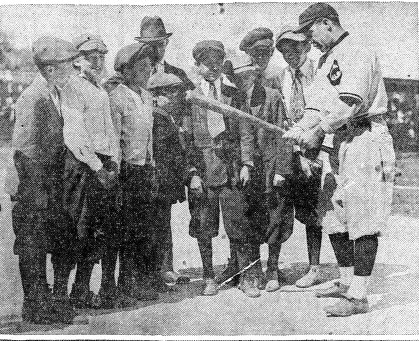
Joe Tinker, manager of the Chicago Cubs shows boys from the Chicago Schools Baseball League the finer of points of hitting before a July 1916 game with the Boston Braves.

Tinker returned to the Cubs in 1916 after having managed the Chicago Whales to the Federal League pennant the year before.  Whales owner Charles Weeghman purchased the Cubs after the Federal League folded and installed Tinker as manager.  Chicago fans had high expectation for Tinker’s team, because in addition to the manager, Weeghman brought most of the key players from the Federal champions to the Cubs.  But after a 9-17 record in July.  Rumors began to swirl that Weeghman would replace Tinker as manager after the Cubs owner traded for catcher Art Wilson on July 29; Wilson had been a Weeghman favorite when he caught for the Whales.

In August, Tinker blamed the Cubs disappointing season on third baseman Heinie  Zimmerman, telling The Chicago Daily News:

“Zimmerman is no good to the ball team.  he does not take any interest in his work and does not care whether the club wins or loses.  He did not report for practice yesterday and on other days is always the last one out for work.  Most of the players feel he does not belong on the team.  He is killing the harmony we had and that is why I would prefer to dispose of him.  He won’t play ball and does not use any judgment and with a man like that a flag cannot be won.”

Tinker survived the season, Zimmerman did not.  He was traded to the New York Giants on July 28.

The Cubs finished in 5th place, 67-86.  Tinker was let go after the season, he was not replaced by Wilson, as rumored, but instead by Fred Mitchell, who after a fifth place in 1917 led the Cubs to the National League pennant in 1918.

Tinker managed, and was a part owner, of  the Columbus Senators in the American Association in 1917 and ’18.

“A Baseball with a Mystery Attached to it”

13 Jun

The Chicago Tribune’s Hugh Fullerton claimed that somewhere at Chicago’s West Side Grounds, home of the Cubs, “if it has not decayed, there is a baseball with a mystery attached to it.”

Hugh Fullerton

Hugh Fullerton

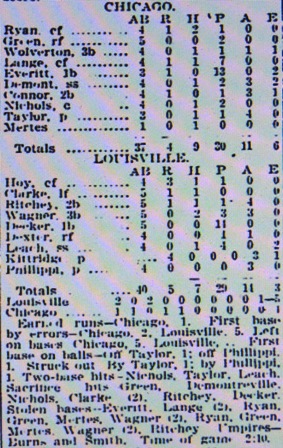
The incident took place on May 11, 1899 “in the middle of a hot game between Louisville (Colonels) and Chicago…this ball disappeared—and as far as anyone knows never yet has been found.”

Fullerton said:

“The score was 4 to 4 in the seventh inning, with Chicago at bat, when Arthur Nichols, the little catcher, came up with one man out. He whanged into the ball and drove it safe to right.  Charlie Dexter threw to second and Nichols slid safe just as the ball arrived.  Tommy Leach was covering second base, and as Nichols slid he lost sight of the ball.  He said it struck his forearm and fell to the ground, and when he started to pick it up it wasn’t there.  He thought it was under Nichols and waited until the runner arose. The ball was not there.

“Nichols waited and held the base, fearing the ball was hidden and he would be tagged out. (Claude) Ritchey and Leach were busy hunting for it.  Everybody joined in.  Still Nichols feared a trick and stuck to the bag.  After five minutes umpire (William) Smith, who was working on the bases, called the Louisville players down, and after accusing them of hiding the ball threw a new one into play.  Chicago kicked and Nichols was ordered to run home.  He ran, but Smith sent him back to second and ordered play begun with a new ball.”

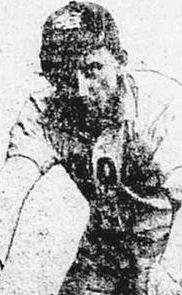
Art Nichols

Art Nichols

Pitcher Jack Taylor singled to right, and Nichols was thrown out at home plate by Dexter.  Louisville went on to win the game 5-4 in ten innings.

Fullerton said:

“Leach, Nichols and Ritchey, the only men near the ball, vowed they never saw it.  What really became of it no one seems to know.”

The Box Score

The Box Score

Lost Advertisements—Old Underoof Whiskey, 1910 Chicago Cubs

17 May

oldunderoof1910cubsgiants

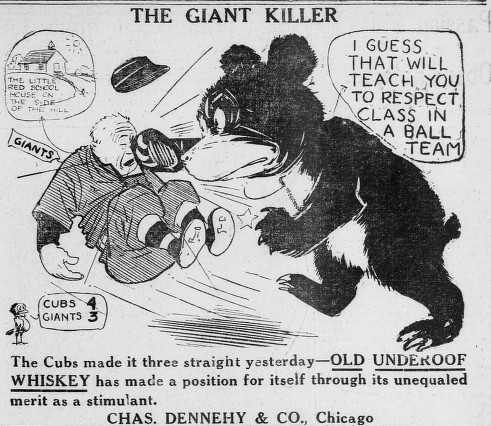
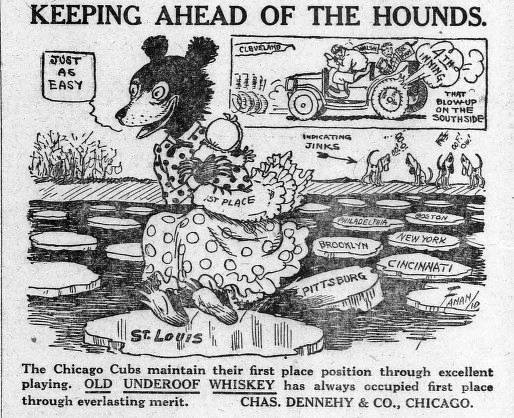
Two 1910 advertisements for Old Underoof Whiskey which appeared in The Chicago Daily News.

The ad above appeared in the paper on May 12.  The Cubs had just won their third straight game from the New York Giants, beating Rube Marquard,  4-3, to improve their record to 11-8.

 Hugh Fullerton wrote in The Chicago Examiner, that the Cubs, “chewed $10,999.98 of beauty out of the wry-necked, knock-kneed, cross-eyed and left-handed $11,000 beauty Marquard.”  The Giants pitcher had earned the nickname in 1908 when New York paid that amount to the Indianapolis Indians for the 21-year-old pitcher.  Through 1910, Marquard was a struggling pitcher with a 9-18 record who had all of baseball questioning the Giants purchase.  The next three seasons Marquard would win 24, 26 and 23 games, helping to lead the Giants to three straight National League Championships.

The one below is from June 27.  The Cubs had beaten the St. Louis Cardinals the previous day 3-2; scoring the winning run in the bottom of the sixth on a double steal, pulled off by catcher Johnny Kling and centerfielder “Circus” Solly Hofman.  It was the team’s twelfth victory in the last fifteen games and gave the Cubs a 4 1/2 game lead over the second place New York Giants.

The Cubs would run away with the pennant, 13 games ahead of New York.

oldunderoof19101stplacecubs

Crazy Schmit Stories

13 May

Fred “Crazy” Schmit was widely considered to be the first pitcher to keep a “book” on hitters, it was mostly attributed to his poor memory, and the pitcher kept an actual book in his pocket listing the weakness of each hitter.  The earliest reference to Schmit’s book was in The Sporting Life in 1894, but the story was repeated in newspapers for the next thirty years, usually as a story told by John McGraw or Hughie Jennings.

The article said Schmit kept:

“(A)n account of the weakness at bat of his opponents, setting them down in a small book, which he always carried with him on the diamond…One day when he had the Chicagos as opponents (it was the season that Captain Anson led the League in batting), Anson came to the bat. “Crazy” Schmit looked at the big first baseman, then went down into his pocket, and, taking out his book, read “Anson, base on balls.”

Over the years the story changed—the batter was sometimes Elmer Flick, Nap Lajoie, Ty Cobb, Honus Wagner, Tris Speaker, and as Jennings said in 1926, “Every good hitter since Anson’s day, but Anson is the player whose weakness was reported to be a base on balls.”

"Cap" Anson

“Cap” Anson

Jennings also claimed that during the 1890s as part of a prank by teammates aboard a ferry, Schmit’s suitcase, with his book inside, fell overboard, and said:

“Schmit was a losing pitcher from that time on.  He won a few games but lost a great many more…The bottom of Hudson River held his ‘pitching arm.’”

Pitcher turned sports cartoonist Al Demaree said Schmit “used to warm up with an old water-soaked ball that weighed several pounds—at a distance of 75 feet, and not the regulation 60 feet from his catcher.”

Al Demaree's Schmit cartoon--as with most references to the pitcher, his name is spelled incorrectly

Al Demaree’s Schmit cartoon–as with most references to the pitcher, his name is spelled incorrectly

After his final game with the Baltimore Orioles in 1901, Schmit continued to play with semi-professional and quasi-professional teams for more than a decade.  His antics continued to make the papers.

In 1906 Schmit joined Jim “Nixey” Callahan’s Logan Squares in the Chicago City League.  The Sporting News’ Revere Rodgers told a story (complete with Schmit speaking in a comic German accent) about the team going to Joliet, Illinois for a game:

“(The Logan Squares) knew the umpire was a ‘homer’—a man who couldn’t see a close decision without giving his team the best of it.  He stopped before the grandstand, hat in hand, and announced (the batteries)…’Crazy’ Schmit was right behind him and when (the umpire) finished Schmit took off his cap and making a sweeping bow said: ‘Laties and schentlmen, der umpire for der game today vill be Mister Miller of Joliet and he vill as usual slightly favor der home glub mit his decision.”

According to The Chicago Tribune’s Hugh Fullerton Schmit was deeply disappointed at the end of the 1906 season when Callahan did not allow him to pitch in the Logan Squares victories against the World Champion White Sox, and National League Champion Cubs.

Schmit continued to play in the Midwest and also did some scouting for John McGraw’s New York Giants.  A story that appeared in The Duluth News-Tribune said Schmit pitched a few games for the Fond du Lac in the Wisconsin-Illinois League (Schmit’s name does not appear on any Fond du Lac roster in either of the two years the other player mentioned in the story was with the team (1909, 1911)so the story may be apocryphal):

“Along about the seventh inning, with Rockford leading by 6 to 4 the first man up got on.  Schmit pitched out three times in an attempt to get the runner going down to second base, but the runner made no attempt to purloin the sack.  With the count three and nothing on the batter he grooved the next one, only to have the batter lean on it and drive it over the left field fence for a homerun.

“After the runners had circled the bases the umpire threw up another ball.  Schmit took it, shook his head and walked over to Bobby Lynch, who was playing third base…and said to him ‘Say, Bobby, no wonder I can’t beat these fellows.  I won’t pitch against them any longer.  I quit right now.  They don’t know how to play baseball and yet they are leading in this league.  The runner that was on first base just let me waste three balls and yet he does not attempt to steal; then when I put one over for the batter who has three balls and no strikes, he hits it.  Tell me, how can a man of my intelligence and baseball knowledge pitch a game of baseball against such boneheads and unscientific playing of the game?”

“Crazy” Smith died in Chicago in 1940.