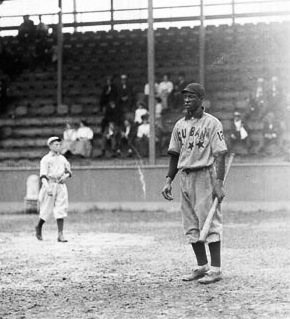
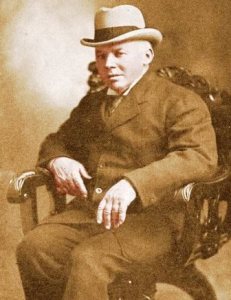
Tag Archives: Chicago Cubs

“Playing the Third Base is Pretty much of a Gamble”

22 Jun

In May of 1911, Chicago Cubs second baseman Johnny Evers suffered a mental breakdown—The Chicago Daily News said that in a letter to club President Charles Webb Murphy:

“Evers complains that his nerves are completely gone.  He is unable to remain on his feet for 10 minutes at a time and the attack is so severe that it has caused large swellings about his face.”

Evers rejoined the team in June, but his condition required another five-week absence from the team in July and August, resulting in him being limited to just 46 games, including 11 at third base—he had previously played the position just three times during his career.
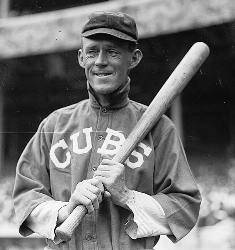
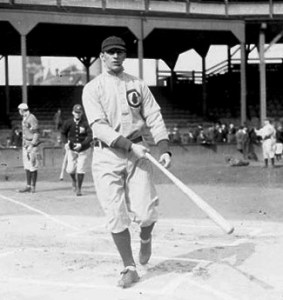
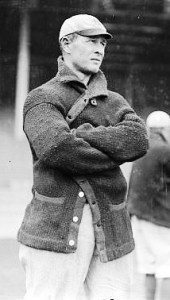
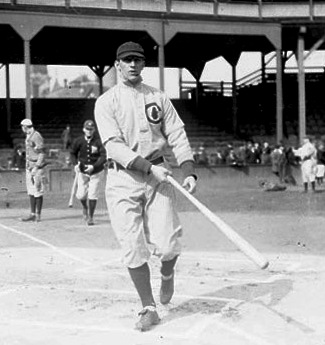
Johnny Evers

Johnny Evers

Late in the season he talked to a reporter from The Chicago Evening Post about playing third:

“Right now it strikes me that there is more luck in playing third base.  You get them or you don’t.  I mean by that the hot shots. When one of those line drives or swift bounders comes at you the isn’t time to play the ball.  You leap and knock the ball down if you can.  If it isn’t right at you it is past you so quickly that you can’t get a square crack at it.”

“Playing the third base is pretty much of a gamble.  If the ball happens to be hit right at you then you get it.  Otherwise, there is nothing doing.”

Evers compared it to his usual position at second base:

“Down on second, it is different.  There you have to play the ball, come in or go back.  That’s one condition which makes the play at third more difficult than at second.

“There is a whole lot more inside baseball at second then there is at third. You play in for a bunt or you play deep.  There is no moving to right or to left.  When you are at second you have more opportunities. You study the batter and you play him accordingly.  Maybe you take a step or two nearer second or a step or two nearer first.

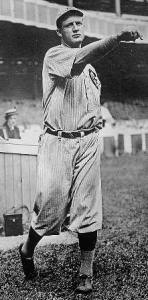
Johnny Evers,

Evers

“Nothing like that at third.  You play in for a bunt or you play back for a clout.

“When it comes to throwing, third base is by far more difficult than second…And the difficulty is not in making the throw so much as it is that a man scarcely has enough to do to keep his arm in shape.  It is this which makes it so much easier for a man to injure his arm playing third.  We’ll say that he goes six or seven innings without a ball being hit to him.  In the eighth or ninth he grabs the ball and checks it to first.  The chances of injuring his arm on a play like that are greater…Down at second base, a man probably handled the ball 20 times.”
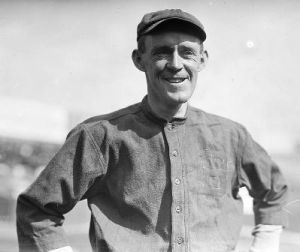
In the end, he was not ready for a permanent switch:

“After playing both positions it is my opinion that second base overshadows third as a place for inside baseball.  There is where a man has opportunities of applying his knowledge of batters.  It is the position where he can play the ball as well as the batter.  At third a man attempts to stab a fierce drive.  If he succeeds all well and good, and if he doesn’t, he can turn and watch the outfielder chase it.  It’s hit or miss.”

Evers never mastered third base; he made three errors in 31 chances during those 11 games in 1911—and committed eight errors in 61 total chances in the 21 games he played at third throughout his career, an .869 fielding percentage at the position.

In 1912, fully recovered–he told reports he “felt nothing from his breakdown,” Evers appeared in 143 games, and had his best season at the plate, hitting .341.


Lost Advertisements–Spalding’s 1908

20 Jun

asspaldingguide1908

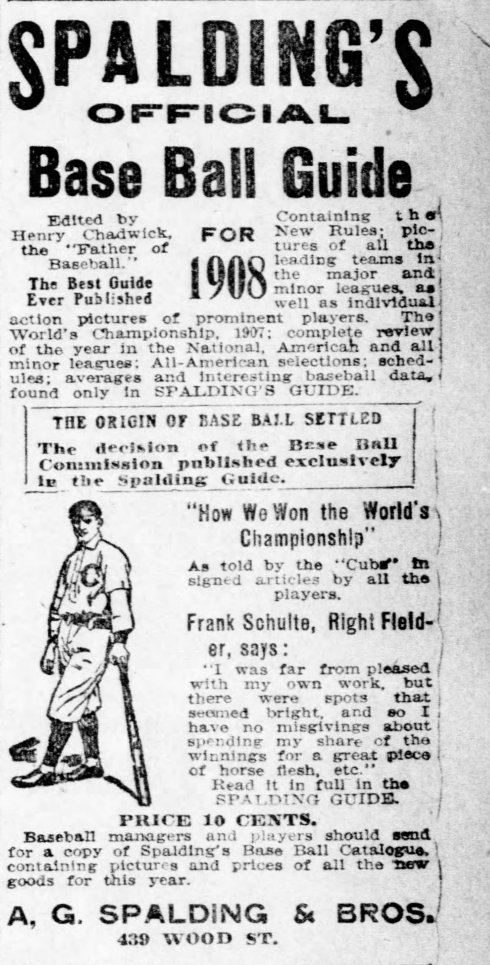
“Spalding’s Official Base Ball Guide,” 1908 advertisement.

“Edited by Henry Chadwick, the ‘Father of Baseball.’

“The best Guide Ever Published

“Containing the New Rules; pictures of all the leading teams in the major and minor leagues, as well as individual action pictures of prominent players.  The World’s Championship, 1907; complete review of the year in the National, American and all minor leagues.  All-American selections;  schedules; averages and interesting baseball data, found only in Spalding’s Guide.”

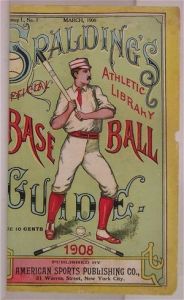
The 1908 Spalding Guide

The 1908 Spalding Guide

The 1908 edition also promised:

“The origin of base ball settled” with the guide’s “exclusive” publication of the Mills Commission report.

The guide also included interviews with the members of the 1907 Chicago Cubs, on “How we Won the World’s Championship.”

The ad featured part of the interview with right fielder Frank Schulte, who used his World Series money to buy a racehorse:

“I was far from pleased with my own work, but there were spots that seemed bright, and so I have no misgivings about spending my share of the winnings for a great piece of horse-flesh…”

Frank Schulte

Frank Schulte

Other comments from members of the Cubs that appeared in the guide included:

Joe Tinker—“We failed to see that brilliancy that the American League boasted of, and when the good old West side machine got under way, it seldom failed.”

Orval Overall—“I expected a harder time with the Tigers.”

Orville Overall

Orville Overall

Mordecai  Brown—“Never more confident of victory in my life.  I almost made a hit in my three times at bat.

Jack Pfiester (who won game two 3 to 1 while giving up 10 hits)—“After the two base hits in the first inning, I knew by some overpowering sense that I could not explain that I would be successful.”

Baseball Wives, 1911

27 Apr

The Chicago Inter Ocean sent a reporter—a female reporter named Lois Willoughby—to get to know:

“The feminine element (that) is a silent factor in baseball of no mean importance.  It exerts a wonderful influence on the game…The women who preside over homes of West Side Players.”

The Chicago Cubs wives of 1911:

“The wives of members of the Chicago National League baseball team are always at the games.  They are thirty-third-degree fans—all but Mrs. (Nellie) Ed Reulbach…who is quite indifferent to the sport, and who wouldn’t know a base hit from a double play.”

As for the other wives of the defending National League Champions:

“They are comely, intelligent, charming women.  They know everything about the game.  They appreciate the value of every play.  They watch the contest with unflagging interest.  They cheer their husbands on to victory…Through ups and downs, they maintain unbounded enthusiasm and unfaltering faith in the Cubs.  They show it the only way they can by their daily presence in the grandstand.”

Manager Frank Chance’s wife, the former Edythe Pancake, attended every game:

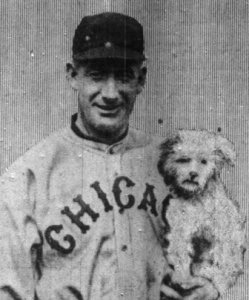
“She may come at the last moment, accompanied by her Boston Bull pup, but she is generally comfortably settled for the afternoon before the game is called.  This beautiful woman, with golden hair and blue eyes, shares her husband’s enthusiasm in baseball.

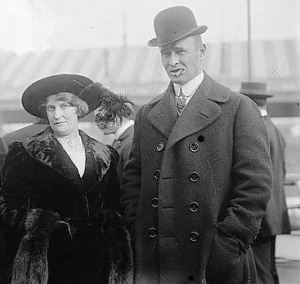
Edyth and Frank Chance

Edyth and Frank Chance

“’Do I come every day?’ she asked as though she could not have heard the question right.  ‘Why, of course, I do.  I wouldn’t miss a game for anything.  I think baseball is the greatest sport there is.  It is a profession now and an honorable one, at that. Every year it is exacting men of higher standards…Baseball is such a clean, healthful sport that I should think it would appeal to everyone.”

Jimmy Sheckard’s wife Sarah Jane said:

“I think Mr. Sheckard is the best left fielder in existence.  And he ought to be. Jimmy plays baseball, reads baseball, talks baseball and lives baseball…Baseball is the best profession and cleanest sport.  I don’t worry about the future.  With good health and good discipline, a man ought to get along all right anywhere.”

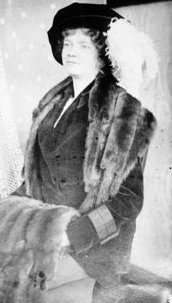
mrssheckard

Sarah Jane Sheckard

Ruby Tinker declared her husband the “greatest shortstop in the world,” and said:

“I never saw Joe on the diamond until after we were married.  I have watched him make many fine plays.  I think the best one was the day following his reinstatement this year (Chance suspended Tinker for “the remainder of the season” citing “gross indifference, on August 5—two days later he was back in the lineup) when he played against (Christy) Mathewson and got four hits.”

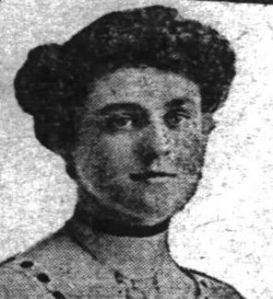
Ruby Tinker

Ruby Tinker

She said her life revolved around baseball “from morning until night,” and during the off-season as well:

“Joe goes into vaudeville in the winter and gives baseball talks with pictures.  I go with him as an ‘assisting artist,’ which means that I stand in the wings and prompt him…The winter spectators are just as enthusiastic as the summer ones.”

Of those who considered baseball a less than honorable profession, she said:

“They don’t know what they’re talking about.  Baseball is a good profession, a good sport, and good fun.”

Helen Evers insisted that despite reports there were no bad feelings among the 1911 team:

“The Cubs are a fine lot of men.  There seems to be perfect harmony this year, and they do good team work.”

As for her husband’s well-known difficult personality, she said:

“He has the reputation for being ‘crabby’ at times.  Perhaps he is, but that’s what put him where he is.”

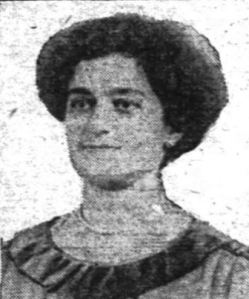
mrsevers

Helen Evers

Helen Evers noted one of Johnny’s other personality quirks:

“But when the jinx gets him!  If you don’t know about the jinx you can’t understand how serious it is.  I believe most of the players are superstitious, and they have enough to make them so. I always hope he won’t see a funeral on the way to the game.  That’s a sure sign of bad luck…there are scores of hoodoos and a baseball hoodoo seems hard to break.  One of the good signs is a wagon load of empty barrels.  I’m sure I would never know when they are empty.  These things probably count for nothing, but they seem to affect the nerves of the players.”

Back to Mrs. Reulbach who while not entirely against the sport, expressed her basic disdain for her husband’s chosen career:

“As a wholesome sport, I think baseball has no equal…But as a profession, it does not appeal to me. It is only for a few years at the most and the fascination of the game must make other professions  or lines of business seem dull and monotonous.”

And while conceding the Reulbach’s years in baseball had been “pleasant and profitable” she said:

“I trust Eddie Reulbach Jr. will not be a professional baseball player.”

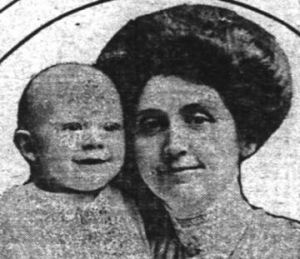
Nelly Reulbach with Ed Jr.

Nelly Reulbach with Ed Jr.

Ed Reulbach Jr., then 2-years-old, suffered from a variety of illnesses throughout his short life and died in 1931.

Willoughby concluded that as the 1911 National League race wound down:

“Hoping against hope, these faithful women have seen the pennant slipping farther and farther away from them.”

The Cubs lost the pennant to the Giants by 7 ½ games.

“One of the Biggest Jokes of Baseball”

16 Mar

Hugh Fullerton of The Chicago Examiner had decried spring training as an “Annual display of foolishness” in 1914.  Four years later, he was convinced the First World War had been its death knell:

“One of the biggest jokes of baseball will be eliminated to a great degree when the game is resumed, and one of the most fruitful sources of publicity will be cut down to the essentials.  The spring training trip as an institution practically will cease to be.  No longer will team be taken on long, expensive junkets South and West to ‘train’ for the season.”

Fullerton said “The thing has been overdone,” and claimed that players and owners alike were against the practice continuing.

“The expenses will be heavier than ever before and long junkets would cost too much.  But even greater than these, the next generation of professional ballplayers will be workers.  They will work all winter instead of striving to live on the cheers saved up from the preceding season.  They will not have time to spend five or six weeks loitering in the South, and further, they will report to their teams in better condition than they usually have been.”

He conceded that pitcher and catchers might be “sent somewhere” for a couple of weeks, but declared:

“(The) spring barnstorming era is ended.”

While Fullerton remained adamant that spring training was a useless waste of time and money, he did say:

“But what a lot of fun will be missed…In the spring, the teams always have with them the ‘nuts’ and peculiar characters that the scouts have a habit of discovering.  Sometimes I suspect those fellows dig up ‘bugs’ merely for their advertising value or else the minor league managers have a way of selling all their eccentrics to the big leagues.”

He said of traveling with the Chicago Cubs in Mississippi:

“We had one back in the early part of this century who beat almost all records.  He joined the club with two trunks, one partly filled with clothes and the other containing six one gallon bottles of ‘strength medicine’ which his mother had concocted.  It was made of boneset, hops, mullein, tincture of iron, garlic, asafetida, sulphur and rotgut whiskey.”

Fullerton then told the story of when the unnamed (or apocryphal) player arrived at the ballpark the following day:

“That fellow was suspicious.  He reached the practice grounds at Vicksburg, looked around cautiously, scratched a hole in the sand and buried his diamond ring.  Then he filled his pipe, lighted it and started to practice.  Pretty soon (Manager Frank) Chance yelled at him to get back of the bat and warm up the (batting practice pitchers).  He adjusted his mask, stuck the pipe through the wires and went to work.  That finished his major league career.”

Frank Chance

Frank Chance

Fullerton said Chicago’s 1898 training camp with Manager Tom Burns was “Probably the strangest” a team had ever chosen, and the one that convinced him spring training trips weren’t necessary:

Tom Burns

Tom Burns

“Hudson (New Mexico) consists of one of the finest hot springs in the world, a wide-porched, one-story hotel called Casa del Consuelo  and it is five miles from the railroad and twenty-five from Silver City.”

Fullerton said because of the terrain, and the lack of a suitable location to play:

“The team made one effort to play ball and gave up, and yet, after three weeks of horseback riding, hunting, and mountain climbing, and with only tossing the ball as practice, it was the best conditioned team I ever saw open a season.”

While Chicago might have started the season as the “best-conditioned team” Fullerton had ever seen, and won five of their first six games, they finished the season in fourth place, 17 ½ games behind the Boston Beaneaters.

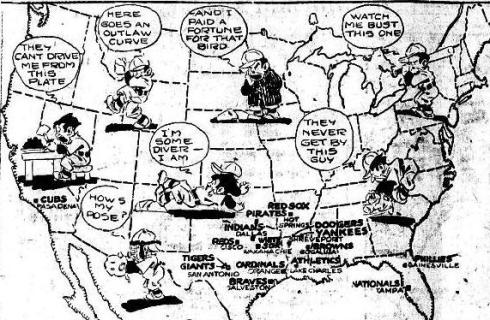
The 1921 map of spring training locations shows how quickly Fullerton was proven wrong:

1921stmap

Things I Learned on the Way to Looking Up Other Things #18

7 Mar

Tener on Anson

In 1917, John Tener wrote an article in “Baseball Magazine” about Cap Anson, his former manager with the Chicago White Stockings.

John Tener

John Tener

The former pitcher and outfielder, who went on to serve in the United States Congress and as Governor of Pennsylvania, and who in 1917 was president of the National League said:

“Pop Anson was the Greatest Batter who ever lived.  You may look up his record, compare it with others and draw your own conclusions.  When I say this I am well aware of the claims of Ed Delehanty, Hans Wagner and many other great hitters.  I give them all due credit, but in my opinion, Anson was the greatest of them all.

"Cap" Anson

Anson

“He was, first of all, a free hitter. He loved batting…He had that true eye which enabled him to hit the ball squarely on the nose.  His hits were line drives.  They were solid smashes with the full force of his muscular shoulders behind them.”

[…]

“He was an excellent judge of the precise fraction of a second that he needed to swing that heavy bat of his against the best the pitcher could offer.  He didn’t exactly place his hits, but he contrived to drive the ball behind the base runner about where he wanted to drive it…He was big and strong and heavy.  Some hitters of the present day fatten their averages by their nimbleness in reaching first.  Anson drove the ball solidly into the outfield and took his time in going to first.”

Conte on Mendez

Jose Pepe Conte was a well-known sportswriter in Havana, Cuba. Frank Menke of Heart Newspaper’s International News Service (INS) said of him:

Jose Pepe Conte

Jose Pepe Conte

“Pepe is a fellow who knows heaps and heaps about ancient history, European customs, chemistry, baseball and prize fighting.”

The Pittsburgh Press called him:

“(A) Cuban newspaperman, political personage, and unearther of baseball talent.”

In 1912, the INS distributed an article Conte wrote about the pitcher he thought was the best ever:

“American baseball fans can talk all they want about their (Chief) Benders, (Christy) Mathewsons, (Ed) Walshes and (Mordecai) Browns, but down in our country we have a pitcher that none of the best batters in the country can touch. This is the famous Black Tornado, (Jose) Mendez.  Talk about speed.  Why, when he cuts loose at his hardest clip the ball bounces out of the catcher’s mitt Talk about speed, Mendez has to pitch most of the time without curves because we haven’t a catcher who can hold him.  To make things better, Mendez can bat like (Ty) Cobb.  He has won his own games on various occasions with smashes over the fences for home runs.  He weighs about 154 pounds and is a little fellow.”

Jose Mendez

Jose Mendez

[…]

“No one has been found who can hold him when he really extends himself.  He has shown his skill in the past when he has faced the best batters of the Cubs and Detroit teams when those teams were champions, and when the Athletics went there last year.  Mendez has more curves than any pitcher in America, and if some inventive genius could produce a whitening process whereby we could get the fellow into the big leagues he could win a pennant for either tail-end team in either league.”

Sullivan on Comiskey

In his book, “The National Game,” Al Spink said Ted Sullivan was “the best judge of a ball player in America, the man of widest vision in the baseball world, who predicted much for the National game years ago, and whose predictions have all come true.”

Ted Sullivan

Ted Sullivan

Sullivan was a player, manager, executive, and in 1921, he wrote a series of articles for The Washington Times called “The Best of my Sport Reminiscences.”  He said of Charles Comiskey, who he was crediting with “discovering” at St. Mary’s College in Kansas:

Charles Comiskey

Charles Comiskey

“As a player, Comiskey was easily the best first baseman of his time…His intuition in defining the thoughts of his opponents and making his play accordingly placed him head and shoulders over any man that played that position before or after.

“Comiskey was with John Ward and King Kelly one of the greatest of base runners.  I do not mean dress parade base running, either, merely to show the crowd he could run.  Comiskey’s base running was done at a place in the game when it meant victory for his side.  He was far from being the machine batter that Anson, Roger Connor and some others were; but as a run-getter, which means the combination of hitting, waiting, bunting and running, he outclassed all others.  Jack Doyle, when in his prime with Baltimore and New York, was the nearest approach to Comiskey in brainwork.  There are no others.”

Things I Learned on the Way to Looking Up Other Things #17

10 Feb

Honus Wagner on Integration, 1939

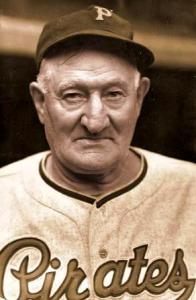
As part of a series of articles on the long overdue need to integrate major league baseball, Wendell Smith of The Pittsburgh Courier interviewed many of baseball’s biggest names.  One of the most vocal proponents was Honus Wagner.

Wagner

Wagner

The then 65-year-old Pittsburgh Pirates coach told Smith:

“Most of the great Negro players I played against have passed on, but I remember many of them well.

Rube Foster was one of the greatest pitchers of all time.  He was the smartest pitcher I have ever seen in all my years of baseball.

“Another great player was John Henry Lloyd.  They called him ‘The Black Wagner’ and I was always anxious to see him play.

“Well, one day I had an opportunity to go see him play.  After I saw him I felt honored that they should name such a great ballplayer after me, honored.”

Rube Foster

Rube Foster

Wagner said the “Homestead Grays had some of the best ballplayers I have ever seen.”

John Henry lloyd

John Henry lloyd

Although he misidentified one of them as “lefty,” Wagner also said of William Oscar Owens, a pitcher and outfielder for the Grays and several other clubs:

“He was a great pitcher and one of the best hitters I have ever seen.”

More recently, Wagner said Oscar CharlestonJasper “Jap” Washington, Satchel Paige and Josh Gibson “could have made the grade easily had they been accepted.”

Wagner concluded:

“Yes, down through the years, I have seen any number of Negro players who should have been in big league baseball.”


Uniform Criticism, 1923

The Decatur (IL) Herald found the state of baseball uniforms worthy of an editorial in March of 1923:

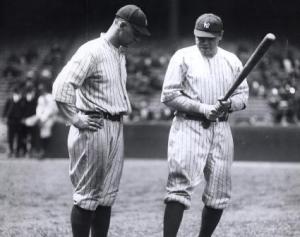
“Pictures of baseball players in training reveal that the season of 1923 has brought no marked change in the style of uniform.  It is quite as baggy and unbecoming as ever.

“Baseball players refer to their costumes as ‘monkey suits,’ a term that is supposed to establish some sort of connection with the cut of the affairs worn by the little animals that pick up the organ grinder’s pennies.  However, that may be, no sensible man imagines that his uniform accentuates his good looks.  It is purely a utility costume and smartness has no place in it.”

ruthandgehrig

Lou Gehrig and Babe Ruth in their “baggy and unbecoming” 1923 uniforms


The paper was most concerned about the uniform’s tendency to make players look foolish and appear to be out of shape:

“A collarless blouse with an awkward length sleeve bags at the belt in a way to emphasize abdominal prominence instead of athletic trimness about the loins.  Loose knickerbockers gathered at the knee resemble the khaki uniforms of the Spanish-American War period in their voluminousness and wrinkles…A cap fitting close about the head and bringing ears into striking relief is the climatic feature of this make-up.

“Underneath this covering of dirty gray or brown there are doubtless lithe limbs and well developed muscles, but the spectator doesn’t see them.  The baseball costume doubtless serves its purpose, it fails lamentably to make the wearer look like an athlete.”

No Women Allowed, 1912

Coming out of the 1912 winter meetings in Chicago, The New York Globe said:

“Nothing doing for suffragettes in the American League!  Not even if they march to the meeting.  They may be making great progress in their cause, but there will not be any Mrs. Brittons in the Ban Johnson organization.”

“Mrs. Britton” was Helene Hathaway Britton, who became owner of the St. Louis Cardinals after the death of her uncle Stanley Robison.

Helene Hathaway Britton with children Marie and Frank

Helene Hathaway Britton with children Marie and Frank

 “A decision was reached that no woman can own a club or even attend an American League meeting.  According to the owners it was a good decision, as they did not want to get into the same mess of trouble which the National League has encountered since one of its clubs fell into the hands of a woman.  Which shows the American League is constantly being benefitted by the experience of the National.”

The “trouble” referred to tension between Britton and Manager Roger Bresnahan, who she had given a five-year contract before the 1912 season.  The two feuded after the team struggled and Britton rejected numerous overtures from Bresnahan to buy the team.  She eventually fired the manager and a very public battle ensued.  Sinister “Dick” Kinsella, who along with Bill Armour comprised the Cardinals’ scouting staff, resigned claiming Bresnahan was “Not treated right.” Armour remained with the club and a settlement was finally reached when Bresnahan was named manager of the Chicago Cubs.

bresnahanandtoy

Bresnahan moved on to the Cubs

One American League owner told The Globe:

“I think it will benefit our league to keep the women out of baseball.  It is almost impossible to do so, but we must keep them out of baseball.  A woman owning a ballclub is about the limit, and the American League made a great move when they decided to bar female magnates.  Votes for the women may be alright, and we do not blame them for battling for them, but it would be a terrible thing to have them in baseball as owners.  It would mean the ruining of the game.”

Grace Comiskey, who became owner of the Chicago White Sox after the death of her husband John Louis Comiskey in 1939–she was forced to go to court to get control of the club from The First National Bank of Chicago; as trustees of the estate, the bank wanted to sell the team because there was no specific instruction in the will that his widow should take control.

She became the American League’s first woman owner.

The game appears not to have been “ruined” during her tenure.

Frank Schulte, “How I Win”

4 Jan

Chicago Cubs outfielder Frank Schulte told journalist Joseph B. Bowles “How I Win,” as part of a syndicated series of articles in the spring of 1910. Schulte, who owned and raced standardbred horses, compared baseball to harness racing:

“First, you have to have the horse, and next the driver that can get the best out of him, and is the best judge of speed and pace.  I try to lay back and let them trot their heads off then go to the whip down the stretch and finish strong.  Of course, I get set down for a bad ride in one or two heats each season.

“I don’t get excited about these ball games.  If they beat me today, I know there’ll be another game tomorrow, and if a fellow can keep up the old confidence he’ll come along somewhere. Every horse is allowed one break in a heat, if it isn’t too long, and still can win. In a race a fellow oughtn’t go to the whip too soon, and it’s the same in baseball.”

Frank Schulte

Frank Schulte

Schulte addressed criticisms about his low-key demeanor on the field, which led some to question his dedication:

“Lots of people think I don’t like this game because I don’t get excited, but the fact is I want to win just as much as anyone does, only it affects me differently. I try to keep thinking and waiting until some of the excitable fellows swing wide from the rail, then I make a drive for the pole and come through on the inside…A team out there in the front running their heads off and working themselves out oughtn’t to discourage a team that is trailing along and doing pretty well.  I just say: ‘Old boy, we may never get up where you are, but you’ll come back to where we are,’ and keep plugging along.”

[…]

“The only way I know how to win a game is to get the hit when it is needed and to make the throw when you have to, wasting as little effort as possible and saving up strength for the time when it is necessary.  I try not to wear myself down early in the season, and to come strong toward the finish, when games count more, and to drive harder in games that are important than in others, and to ease  up and save myself after a game is safely won;  that is not to take the chances in easy games I would take in hard ones.”

Schulte said “a fellow ought to be able to take a philosophical view,” of the game:

“Keeping cool and thinking helps a lot…If I strike out three times, I come back to the bench and say: ‘Old boy, you keep pitching that way to me and I’ll claw one pretty soon.’  And then maybe I get hold of the ball good just when it helps the most, instead of getting discouraged or worried.  And when one of those fellows who want to run themselves to death and tire out before a game is over, and reduce to shadow before the season ends, yells: ‘I got it, I got it!’ I say, ‘Take it, I’ll trot back. Then when I have to be I’m fresh.”

Lost Advertisements–Cubs, White Sox and Whales Endorse Steele’s Game of Baseball

18 Dec

steeles

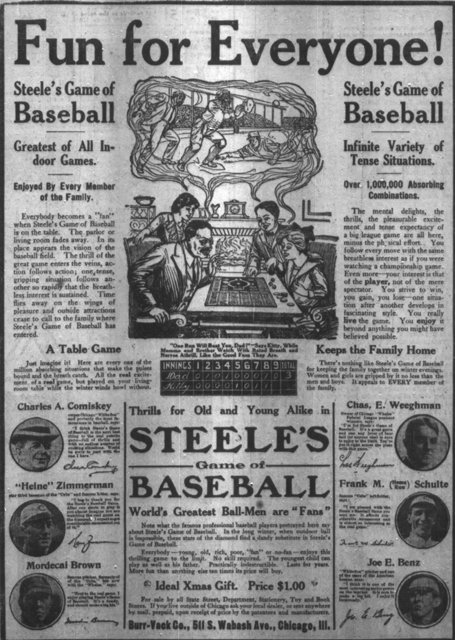
A 1915 advertisement for Steele’s Game of Baseball, a table-top game which claimed to have “Over 1,000,000 absorbing combinations,” and promised that the player would “enjoy it beyond anything you might have believed possible:”

Greatest of All Indoor Games

“Everybody becomes a ‘fan’ when Steele’s Game of Baseball in on the table.  The parlor or living room fades away.  In its place appears the vision of the baseball field.  The thrill of the great game enters the veins, action follows action; one tense, gripping situation follows another so rapidly that the breathless interest is sustained.  Time flies away on the wings of pleasure and outside attractions cease to call to the family where Steele’s Game of Baseball has entered.”

The game was produced by the Burr-Vack Company, a Chicago-based office supply dealer, and received glowing endorsements from members of the city’s three teams:

World’s Greatest Ball-Men are “Fans

Charles A. Comiskey owner Chicago ‘White Sox’ and probably the most famous man in baseball, says: ‘I think Steele’s Game of Baseball is the next best thing to the real outside game–full of thrills and with an endless number of exciting situations.  Would be sorry to part with the one I have.’

“‘Heine’ Zimmerman third baseman of the ‘Cubs’ and famous hitter says: ‘I  beg to thank you for the Steele’s Baseball Game.  After one starts to play it you almost imagine you are watching the real game on the diamond.  I expect to get considerable amusement out of it.’

Mordecai Brown famous pitcher, formerly of the ‘Cubs’ but now with the ‘Whales’ says: ‘Next to the real game, I enjoy playing Steele’s Game of Baseball.It’s a dandy and should make a big hit.’

Chas. E. Weeghman owner of Chicago ‘Whales’ Federal League pennant winners says, ‘I’m for Steele’s Game of Baseball.  It’s a great game and one any lover of baseball (or anyone else) is sure to enjoy to the limit.  You’ve put it right across the plate with this game.’

Frank M. (Home Run) Schulte famous ‘Cubs’ left fielder says: ‘I am pleased with the Steele’s Baseball Game you sent me.  It affords considerable amusement and is almost as interesting as the real game.”

Joe Benz ‘White Sox’ pitcher and one of the stars of the American League, says, ‘I think it is one of the most interesting parlor games on the market.  It is sure to make a big hit. I enjoy it immensely.'”

[…]

“Note what the famous professional baseball players portrayed here say about Steele’s Game of Baseball.  In the long winter, when outdoor ball is impossible, these stars of the diamond find a dandy substitute in Steele’s Game of Baseball.”

Despite the endorsements, the “Ideal Xmas Gift,” which cost one dollar and was “For sale by all State Street, Department, Stationary, Toy, and Book stores,” appears to have quickly disappeared–there are no mentions of the game in newspapers after 1915.

Lost Pictures–The Best Eyes in Baseball

4 Dec

eyeszimmerman

eyesdaubert

eysspeaker

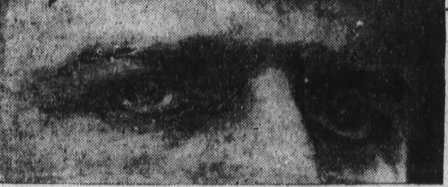
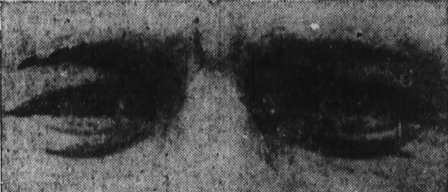
Above, three sets of eyes, 1916.

Harold “Speed” Johnson of The Chicago Herald said:

“It’s the eye and not the wallop that counts in the national Pastime.  Some eyes are more durable than others.  Larry Lajoie possesses such a pair; so does Hans Wagner, Terry Turner, Tris Speaker, Jake Daubert, Frank Schulte, Larry Doyle, Heine Zimmerman, Tyrus Cobb, Joe Jackson and Bill Hinchman.”

Johnson informed his readers that “Most of these birds refrain from reading during the offseason, thereby sparing their eyes.”

As for the three sets pictured above, Jonson said:

“Heine Zimmerman is another notable example of the batter who possesses the keen optics.  He eccentric third sacker of the Chicago Cubs, when at peace with the world, is one the greatest natural sluggers of all time.  His eyes never have troubled him but his temperament frequently has caused him to slump, swinging frantically at any old pitch.  Right now Heinie is seeing in exceptionally good form as witness his average of .336 for 48 combats.”

[…]

“There is nothing wrong with Jake Daubert’s glims as a slant at the latest averages will indicate…His heavy cannonading has been a principal factor in the upward climb of the Robins…For a pair of eyes that have been in use as long as Jake’s in the big set they’re holding out famously.”

[…]

 “Nine seasons of big league milling haven’ dulled the lamps of Tristram Speaker who right now is going better than he did in his banner years with the Boston Red Sox.  Not only is the big Texan rattling fences  at Dunn Field, Cleveland, where for seven years he averaged .381 on visits with the Bostonese, but he is keeping up his terrific pace abroad.”

Zimmerman’s temperament caught up with him again.  He wore out his welcome in Chicago in August of 1916, was traded to the New York Giants and finished the season with a .286 average.

Daubert’s eyes held out.  He hit .316 and led Brooklyn to the National League pennant.

Speaker kept hitting at Dunn Field and everywhere else, finishing the season with a major league-leading .386 average.

“Loved Baseball More than He Feared Death”

2 Dec

Robert William “Bob” Osgood was told by doctors that he couldn’t play high school baseball because of a heart ailment.  He was also told he wouldn’t live long.

According to The Associated Press, he begged his parents for a chance to play and “(T)he youth’s parents thought it better that Bob’s playing be supervised and permission was granted.”  By his senior year in 1946, was named to several Massachusetts All-State teams.

After graduation, Osgood signed with the Chicago Cubs.  His older brother Charles was then playing in the Cubs organization after appearing in one game as a pitcher for the Brooklyn Dodgers in 1944 as a 17-year-old.

Charles Osgood

Charles Osgood


Bob hit .280 in 25 at-bats split between the Cubs’ North Carolina and Appalachian League teams.

No official records exist for Bob Osgood after that, but he was a member of the Visalia Cubs in 1947.

He was assigned to the Springfield Cubs in the New England League in 1948 but missed most of spring training when he was hospitalized with the flu.  On May 7, 1948, Bob Osgood became a member of the Marion Cubs in the Ohio-Indiana League; he was sent to Marion from Springfield after the club’s manager/catcher Lew “Zeke” Bekeza broke a bone in his hand.

Osgood appeared in two games behind the plate; he hit .500 with five singles in ten at-bats.

On May 11, 1948, Osgood was sitting on the bench with teammates during a rain delay in Richmond, Indiana.  The Marion Star said:

“Osgood, a catcher who played his first game for the Cubs last Sunday, collapsed and died in the Cubs’ dugout…The heart attack came as the Cubs team took shelter from a rain storm…At 8:03 p.m. after more than an hour of artificial respiration (two doctors) declared the boy dead.”

His manager, Bezeka told the paper “Osgood had not looked well in his few days with the Cubs and had a blue coloring to his face.”

A postscript:

 According to Jack Durant of The Associated Press,  former Reds and Dodgers catcher Clyde Sukeforth, a Dodger scout,  was in the stands and “Seeing the commotion around the bench, rushed out the stands to the dugout,” upon arriving “He knelt beside the boy who loved baseball more than he feared death and when he looked into the stilled features, well he knew who it was—Bobby Osgood, his own nephew.”

Clyde Sukeforth

A shorter version of this post appeared on August 17, 2012.