Tag Archives: Chicago White Sox

Things I Learned on the Way to Looking Up Other Things #19

23 Mar

“Strikes Never got a Pitcher Anything,” 1911

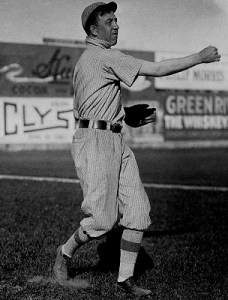
Two days before he collapsed on the field in Chattanooga, Tennessee on April 3, 1911 (and died 11 days later) Addie Joss spoke about pitching with a reporter for the final time.

Joss and the Cleveland Naps were in New Orleans when he told The Associated Press:

“Every time I fool a batter and he misses the ball I feel disappointed.

“Strikes never got a pitcher anything.  Strikeouts don’t win baseball games and increase a man’s salary.  It’s the man who wins games who gets the credit.

Addie Joss

Addie Joss

“What I have said may sound heretical.  But just think it over for a moment, and you will see why a pitcher should want the batter to connect when he is outguessed.

“When the pitcher outguesses the batter the batter is off his balance.  The chances are ten to one he hits at the ball in a half-hearted way.  The chances are twenty to one that if he does connect he will be an easy out.

“Now when that fellow strikes and misses don’t you see that the pitcher must start all over again?  The last strike is just as hard to get as the first one.  When a man misses a ball on which he has been fooled it is just like having an entirely new turn at bat.”
“In the Second Inning, things began to Happen,” 1909

William “Dolly” Gray was a 30-year-old rookie with the Senators in 1909; he came to Washington after pitching seven years for the Los Angeles Angels in the Pacific Coast League compiling a 117-65 record.  That season he set a record which still stands: the most walks in an inning.
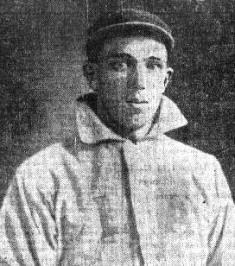
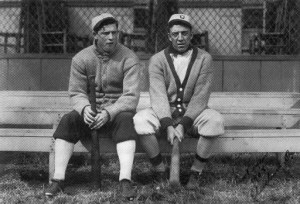
Dolly Gray

Dolly Gray

In 1923, in his syndicated column, Umpire Billy Evans called the game in which it happened, “The weirdest game I have ever seen.”

Evans said of the August 28, 1909, game:

“Gray allowed only one hit—a very questionable one—yet he was beaten 6 to 4. Not an error was made by his supporting cast…I umpired the game, and can recall the happenings of the unusual game as vividly as if they were just being staged.”

[…]

“In the second inning, things began to happen.  Pat Dougherty led off with a high bounder to Bob Unglaub, playing first base for Washington.  Unglaub jumped after it, the ball struck the top of his glove and was deflected into right field.  It was scored as a hit, but I have always thought that Unglaub should have easily handled the ball.

After Dougherty had reached first base, Gray developed a streak of wildness—the most unusual streak I have ever seen.  He walked seven men in succession, forcing in five runs.  The count was three and two on practically every batter.  A couple of outs and another base on balls were responsible for the sixth run of the inning.

Joe Cantillon, managing the Washington club, was short on pitchers at the time and let Gray take his medicine.  In the next inning Gray recovered control and for the rest of the game held the Sox runless and hitless.  Washington staged several rallies and Chicago had a hard time winning 6 to 4…Gray, who really pitched a no-hit game, was beaten…That game stands out in my memory as the most peculiar ball game I ever worked.”

The Box Score
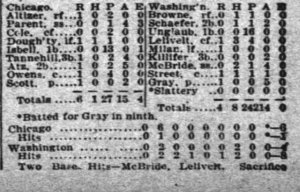
The Box Score

Gray walked 69 batters in the other 217 innings he pitched in 1909.  His hard luck that day in August of 1909 extended for the duration of his short big league career; in three seasons with the Senators he posted a 3.52 ERA and was 15-51.

Meyers’ “Gnarled and Broken” Hand

Like all catchers of his era, John “Chief” Meyers’ hands were, as The New York Tribune described them “gnarled and broken.”

But the paper said he had found a cure after being drafted into the marines in November of 1918:

“(At Paris Island, Meyers) hands toyed with a Springfield, and when he swung the bat in the bi-weekly baseball games on the sand diamond at the great Marine Corps Training Station, where there is no fence, the horsehide pellet generally soared well out into the sea.

Chief Meyers

Chief Meyers

“Meyers says that his marine training has done wonders for him and that it has made him good for many more seasons behind the bat.”
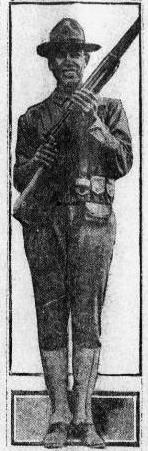
After his discharge, the 38-year-old Meyers played just one more season, with the New Haven Weissmen in the Eastern League, hitting .301.
 

Addie Joss on Spring Training

21 Mar

From 1906 until his death in 1911, Cleveland Naps pitcher Addie Joss moonlighted as a sportswriter for The Toledo News-Bee and The Cleveland Press.

addiejoss

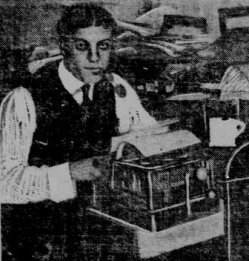
Joss at the typewriter

Shortly before departing for the Naps’ camp in Macon, Georgia in 1908, Joss gave readers an insider’s view of spring training:

“About the first thing players do when they receive orders to report at a certain place, is to dig up paraphernalia.  Shoes and gloves are saturated in oil or Vaseline to soften the leather and prepare them for the work in sight.”

After his “two or three days…flying southward” on a train, and one day “getting settled,” he said:

“If the weather permits (a player) witnesses his first practice.

“Usually, the first hour or two is spent in tossing the ball around to get limbered up.  Then the manager calls upon one of the twirlers, usually a youngster, to toss up a few slow ones.

“Half an hour’s batting and the men assume their positions on the field. “

Addie Joss

Joss

After a half hour of fielding practice:

“(T)he men hike back to the hotel.  This routine is observed for the first few days, or until arms and legs become accustomed to the unusual exercise. “

Joss said veteran players usually “take it easy” for the first week unless he needs to shed a few pounds:

“If a man is overweight he will rid himself of superfluous flesh by various means.  Some run around the park each morning and afternoon.  Others chase flies until they seem ready to drop from exhaustion.“

Joss said there was no better “means to get into shape” than fielding ground balls:

“It not only loosens and toughens the muscles but gives the individual fielding practice.

“A stranger to this sort of training will be surprised at the good accomplished.  It brings every muscle into play and puts a man into splendid condition in a couple of weeks.”

Attempts were made, he said, to find new ways to keep players interested:

“Last spring, one trainer introduced an association football into camp, and the players found the diversion beneficial.  It produced generous perspiration and took the stiffness out of sore bodies. “

Next, a few “hotly contested” intersquad games between “regulars and colts,” are played, followed by:

“(T)hree games a week…played by the big league club with the organization from the town in which they are training.  This produces the teamwork so necessary.”

Off the field, Joss said it was critical that the team had a good “rubber:”

“An important factor is the trainer, and the team possessing a good handler finds the work much easier.  After 15 minutes in the hands of an expert rubber, a player whose arms and legs were so lame they could scarcely be lifted leaves the room feeling fine and fit.”

Finally, Joss, who was known as a well-mannered, family man—Ed Walsh, who pitched against him the day Joss threw his perfect game beating the Chicago White Sox 1 to 0 in 1908, told The Chicago Inter Ocean after his death that he was “One of the best men I ever met on or off the ball field–” assured readers that no one was misbehaving during the spring:

Walsh and "One of the best men he ever met..."

Walsh and “One of the best men” he ever met

“The players have little time to themselves off the field, and are usually so tired when night comes that they are willing to sit around the hotel until bedtime.”

Clark Griffith, “How I Win”

14 Mar

In 1910, Cincinnati Reds Manager Clark Griffith spoke to journalist Joseph B. Bowles for one of  a series of syndicated articles in which baseball’s biggest stars described “How I Win.”

“If a fellow is going to cut any ice he needs ice picks and the first way for a manager to win is to get men who can deliver, and men intelligent enough to take care of themselves.

“My theories in regard to what constitutes a winner are the only ones, and I use them in instructing my players what to do.  I used them in pitching, and they worked out, and I believe any player will succeed if he follows them.”

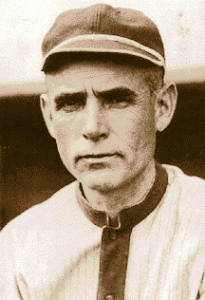
Clark Griffith

Clark Griffith

Griffith said baseball was “Ninety-nine and fifteen sixteenths” courage and nerve:

“It is more than that—it is what ballplayers call ‘guts’—which is courage with aggressive confidence behind it…The first thing to do to win baseball games is to go after anyone who does not wear a uniform that looks like yours, and go after him hard.  Hand every opposing player anything that will make him weaken or show the yellow.  Anytime I can convince my men that they are going to win and the other fellows that they are going to lose, I’ll win a pennant.”

He believed his confidence could successfully intimidate opponents:

“The best system of winning games is to tell the other fellow that you are going to beat him.  Tell it to him before the game starts and tell him in a way that will convince him.  You cannot convince him unless you believe it yourself.  I keep telling them all the time, and I believe it myself until the game is over and sometimes even then.”

Griffith said what he wanted most was for his players to:

“Take chances; any chance to gain an inch of ground or a base…Go after the game with intelligence and force every point as hard as possible…The player who takes chances of hurting himself seldom hurts either himself or his opponent and he will make a weak opponent run away.  More players get hurt stopping up on their feet and giving up before they are touched than are damaged in sliding to bases.”

He said that aggressiveness should also be directed at umpires:

“Then claim every point and claim it quick.  Holler.  ‘No, no’ real quick and beat the umpire to it on every close play a la (Johnny) Evers.  The umpire may be perfectly honest and square but on a close play the fellow who yells quickest is much more likely to get the decision.  I do not believe in fighting umpires or nagging at them.  I believe in yelling quickly.  Yelling quickly beats yelling loud all to pieces.  It is not cheating a bit, but simply protecting yourself on close plays not so much to get the decision yourself as to keep the other fellow from getting it.”

Griffith led the Chicago White Sox to the inaugural American League pennant during his first season as a manager in 1901.  And despite not winning one since, was very confident about his “theories” for success:

“These things, taken together with a little good pitching and perhaps one star pitcher, will win any pennant if carried out correctly and persistently, regardless almost of the mechanical ability of the players on the team.”

In the end, Griffith was unable “to win any pennant.”

His Reds teams in 1910 and 1911 were both sub .500 clubs and finished in fifth and sixth place.  He joined the Washington Senators in 1912, and finally with “one star pitcher’ he managed the team to two-second place finishes (1912-13), but did not win a pennant there either.  He stepped down as manager after the 1920 season to devote himself full time to his ownership duties.

One Star Pitcher

One Star Pitcher

He ended his managerial career with a 1491-1367 record over 20 seasons.

“You got away with Something that time, Buck”

2 Mar

It will be reviewable by instant replay this season, but in 1914 the “Neighborhood Play” had no name, and its use by one American Leaguer was a big story.

The Chicago Daily News said:

“There is a story going around the circuit which undertakes to show how Buck Weaver, the White Sox shortstop, fooled all the umpires…Buck’s long suit was acting as pivot on a double play, taking the ball from the second baseman.”

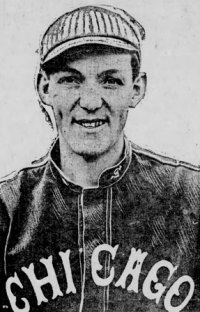
buckweaver

Buck Weaver

The paper said when Weaver joined the Sox in 1912, he “noticed that he was often failing,” to turn double plays.

“He lay awaken nights figuring how he could increase his speed in pulling off (double plays), and finally decided that if he could not get the batter no one could, as he was the owner of as strong a whip as any shortstop in the land.

“The solution of the puzzle came to him by accident.  In dashing to second to take a throw from (Morrie) Rath he overstepped the bag and was a stride closer to first than usual when he got the ball.  Instead of stepping back and touching the sack, he made the throw to first base and, much to his surprise, the umpire called both men out.”

When Weaver returned to the dugout, Manager Jimmy “Nixey” Callahan said:

“’You got away with something that time, Buck.’”

Weaver told his manager:

“’I was a whole stride over second when I got the ball.  But say, I could away with it by accident, what’s the matter with trying to pull it off right along when the man at bat is fast and likely to beat me out if I wait for the throw? I can save a quarter of a second or so by going over the bag.’”

The paper said Callahan encouraged him to try it.

“And Buck did.  He worked the trick successfully against the Naps six or seven times, twice in one game with (George) Hildebrand umpiring the bases.

“’He worked it on us several times,’ said Jim McAleer, formerly of the Red Sox, while Clark Griffith admits that Washington suffered the same fate.

“Even Connie Mack was forced to murmur, and when Connie Mack kicks, something must be wrong, and possibly as a result of the protest of the manager of the world’s champions, the umpires will watch Mr. Weaver more carefully this year when he is acting as pivot man in the double play.”

After 1913, when he participated in a career-high 73 double plays, Weaver never played as many games at shortstop, so it’s unknown whether umpires, in fact, watched him “more carefully” when  he attempted the Neighborhood play.

“A Good Ballplayer must be Temperamental”

15 Feb


Idah McGlone Gibson was the most famous female journalist of the early 20th Century; in addition to publishing several books, she wrote for the syndicated Newspaper Enterprise Association, The Chicago Tribune, The Los Angeles Evening Herald, and The Toledo Blade.

idahmgibson

Idah McGlone Gibson

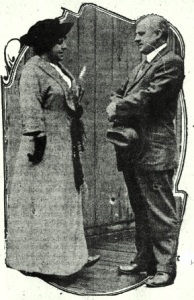
She also interviewed New York Giants Manager John McGraw twice, five years apart.

Their first meeting took place in New York shortly before the end of the Giants’ pennant-winning 1912 season.  McGlone told her readers:

“McGraw is surrounded by more ‘buffers’ to keep the public from him that Maude Adams (a notoriously press-shy actress), who is never interviewed, and that’s going some.

mcgrawgibson

Gibson and McGraw in 1912

“Neither his telephone number nor his home address is obtainable unless you reach one of his close friends, and at the Polo Grounds. he is never on view until you have passed all the police force and plain-clothes men.”

McGlone said former Giant turned New York attorney, John Montgomery Ward provided her with an introduction to McGraw.

“It was after the game that I saw the Giants’ manager, well-groomed, well-dressed, well-mannered. McGraw was evidently at peace with himself and the world…He is the most serious ballplayer I ever talked to.  He seldom smiles, and told me that he put one on to order when he had his picture taken with me.”

Gibson asked how McGraw thought the Giants would fare in the World Series against the Boston Red Sox:

“Of course, we are going into the game to win, not because of any glory attached to it, but because it is our business.  However, I feel that I shall be able to live through the winter if we lose the world’s championship.  I am not able to get up that high-water mark enthusiasm which exhilarates the fans to whom the game is a pleasure and not a business.”

She also asked McGraw about the biggest source of gossip surrounding his ballclub; the relationship between Rube Marquard, his 26-game winning pitcher and vaudeville star Shirley Kellogg—during August and September several newspapers published erroneous reports from Marquard’s mother that the couple had married:

“’Indeed, I don’t know whether he is married or not,’ he answered suavely, but his brown eyes narrowed and his lips came together firmly.  ‘You know I have nothing to do with the private lives of my men.’

“Marquard’s name and love affairs, however, did not bring a rosy glow to the manager’s face, and I imagine McGraw has helped make the course of true love run a little crooked, as ‘the Rube’ has lost the jump to his fast ball since his reported marriage.”

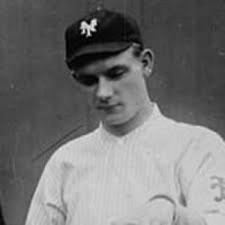
Rube Marquard

Rube Marquard


McGraw touted his other pitchers, telling Gibson that the greatest pitching performance “he had ever seen was in training camp last spring” when Jeff Tesreau and Al Demaree faced each other for 12 scoreless innings in an intersquad game in Texas.

Despite her fondness for McGraw, Gibson told her readers they “may trust a women’s intuition” and correctly predicted the Red Sox would win the World Series.

Gibson met McGraw five years later during a September series in Cincinnati, with the Giants on their way to another National League pennant. She said:

“I hope I have changed as little as he has in that time.

“His hair, the Irish hair that turns white early, has grown just a bit more optimistic—that is all.

“’Twenty-nine years is a long time to be in the game,’ he said as his eyes wandered over the field—‘longer than most of those boys can count their entire lives.’”

Gibson asked about temperamental players:

“In my nearly three decades of baseball I have learned one thing thoroughly—a good ballplayer must be temperamental, just as an artist, a musician, or a writer must have temperament.”

Gibson asked how he makes “a man’s temperament,” benefit the team:

“’By ignoring it,’ he answered.  ‘I must make every man think he has no temperament, even while making him use that most desirable quality in a ballplayer to its fullest capacity.’”

McGraw refused to say which player on the team was the most temperamental, but offered to tell who was the least.  Gibson said:

“’(Christy) Mathewson, I interrupted.’

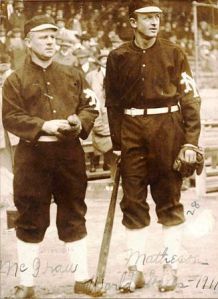
“’Yes, Mathewson is always to be depended upon.  When he knows a thing is to be done he just does it.  Some men play best when a team is winning and some play best when spurred by defeat.  A baseball manager must not only be a good picker, but he must study each man individually and handle all differently.’

“’At the end of a season with a winning team you have to be more than ever on your guard.  Every man is a bundle of nerves, drawn taut.  At this time every little prejudice, every little idiosyncrasy, every little vein of superstition is laid bare and raw.  You get to know your men better then than at any other time during the season.’”

Christy Mathewson with John McGraw

McGraw and Mathewson

Gibson asked if the best ballplayers came from a particular nationality.  McGraw said:

“’I cannot answer that.  I think perhaps the Irish are the quickest thinkers and the readiest to take a fighting chance, but I would not like a team made up entirely of Irish.  You must have temperaments like the German to ballast the Irish.  Truly I think a winning ball team must be a melting pot of all nationalities.  This year there are more Germans among the Giants than any other nationality and they are just as temperamental as any other but they don’t show it in just the same way.’”

Gibson did not make a prediction about the World Series as she had done five years before; McGraw’s temperamental Giants were beaten four games to two by the Chicago White Sox.

Things I Learned on the Way to Looking Up Other Things #17

10 Feb

Honus Wagner on Integration, 1939

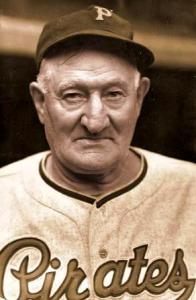
As part of a series of articles on the long overdue need to integrate major league baseball, Wendell Smith of The Pittsburgh Courier interviewed many of baseball’s biggest names.  One of the most vocal proponents was Honus Wagner.

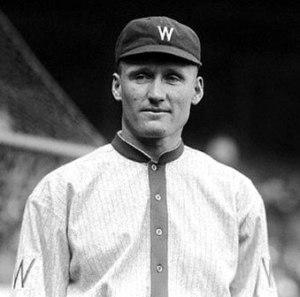
Wagner

Wagner

The then 65-year-old Pittsburgh Pirates coach told Smith:

“Most of the great Negro players I played against have passed on, but I remember many of them well.

Rube Foster was one of the greatest pitchers of all time.  He was the smartest pitcher I have ever seen in all my years of baseball.

“Another great player was John Henry Lloyd.  They called him ‘The Black Wagner’ and I was always anxious to see him play.

“Well, one day I had an opportunity to go see him play.  After I saw him I felt honored that they should name such a great ballplayer after me, honored.”

Rube Foster

Rube Foster

Wagner said the “Homestead Grays had some of the best ballplayers I have ever seen.”

John Henry lloyd

John Henry lloyd

Although he misidentified one of them as “lefty,” Wagner also said of William Oscar Owens, a pitcher and outfielder for the Grays and several other clubs:

“He was a great pitcher and one of the best hitters I have ever seen.”

More recently, Wagner said Oscar CharlestonJasper “Jap” Washington, Satchel Paige and Josh Gibson “could have made the grade easily had they been accepted.”

Wagner concluded:

“Yes, down through the years, I have seen any number of Negro players who should have been in big league baseball.”


Uniform Criticism, 1923

The Decatur (IL) Herald found the state of baseball uniforms worthy of an editorial in March of 1923:

“Pictures of baseball players in training reveal that the season of 1923 has brought no marked change in the style of uniform.  It is quite as baggy and unbecoming as ever.

“Baseball players refer to their costumes as ‘monkey suits,’ a term that is supposed to establish some sort of connection with the cut of the affairs worn by the little animals that pick up the organ grinder’s pennies.  However, that may be, no sensible man imagines that his uniform accentuates his good looks.  It is purely a utility costume and smartness has no place in it.”

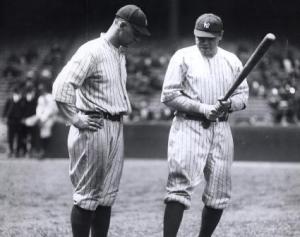
ruthandgehrig

Lou Gehrig and Babe Ruth in their “baggy and unbecoming” 1923 uniforms


The paper was most concerned about the uniform’s tendency to make players look foolish and appear to be out of shape:

“A collarless blouse with an awkward length sleeve bags at the belt in a way to emphasize abdominal prominence instead of athletic trimness about the loins.  Loose knickerbockers gathered at the knee resemble the khaki uniforms of the Spanish-American War period in their voluminousness and wrinkles…A cap fitting close about the head and bringing ears into striking relief is the climatic feature of this make-up.

“Underneath this covering of dirty gray or brown there are doubtless lithe limbs and well developed muscles, but the spectator doesn’t see them.  The baseball costume doubtless serves its purpose, it fails lamentably to make the wearer look like an athlete.”

No Women Allowed, 1912

Coming out of the 1912 winter meetings in Chicago, The New York Globe said:

“Nothing doing for suffragettes in the American League!  Not even if they march to the meeting.  They may be making great progress in their cause, but there will not be any Mrs. Brittons in the Ban Johnson organization.”

“Mrs. Britton” was Helene Hathaway Britton, who became owner of the St. Louis Cardinals after the death of her uncle Stanley Robison.

Helene Hathaway Britton with children Marie and Frank

Helene Hathaway Britton with children Marie and Frank

 “A decision was reached that no woman can own a club or even attend an American League meeting.  According to the owners it was a good decision, as they did not want to get into the same mess of trouble which the National League has encountered since one of its clubs fell into the hands of a woman.  Which shows the American League is constantly being benefitted by the experience of the National.”

The “trouble” referred to tension between Britton and Manager Roger Bresnahan, who she had given a five-year contract before the 1912 season.  The two feuded after the team struggled and Britton rejected numerous overtures from Bresnahan to buy the team.  She eventually fired the manager and a very public battle ensued.  Sinister “Dick” Kinsella, who along with Bill Armour comprised the Cardinals’ scouting staff, resigned claiming Bresnahan was “Not treated right.” Armour remained with the club and a settlement was finally reached when Bresnahan was named manager of the Chicago Cubs.

bresnahanandtoy

Bresnahan moved on to the Cubs

One American League owner told The Globe:

“I think it will benefit our league to keep the women out of baseball.  It is almost impossible to do so, but we must keep them out of baseball.  A woman owning a ballclub is about the limit, and the American League made a great move when they decided to bar female magnates.  Votes for the women may be alright, and we do not blame them for battling for them, but it would be a terrible thing to have them in baseball as owners.  It would mean the ruining of the game.”

Grace Comiskey, who became owner of the Chicago White Sox after the death of her husband John Louis Comiskey in 1939–she was forced to go to court to get control of the club from The First National Bank of Chicago; as trustees of the estate, the bank wanted to sell the team because there was no specific instruction in the will that his widow should take control.

She became the American League’s first woman owner.

The game appears not to have been “ruined” during her tenure.

Lost Advertisements–Anheuser-Busch, Washington Senators

5 Feb


ab1910sox

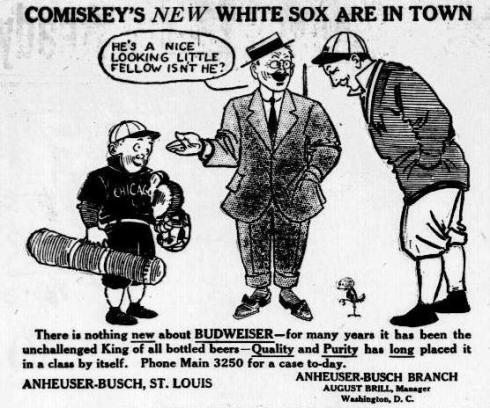
In 1910, a series of Anheuser-Busch ads  appeared in several Washington D.C. papers. The ad above appeared when the Chicago White Sox faced the Senators in early May:

Comiskey’s New White Sox are in Town

The headline referred to Charles Comiskey‘s shakeup of his team, which included the appointment of Hugh Duffy as manager, and a new starting infield; first baseman Chick Gandil, second baseman Rollie Zeider, and shortstop Lena Blackburne, and Billy Purtell at third.

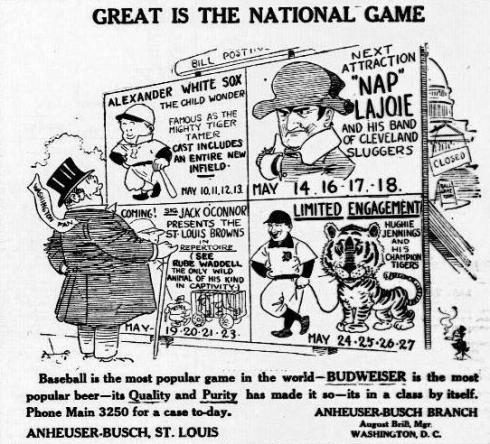
An advertisement later that week featured caricatures of Napoleon Lajoie and Hughie Jennings, and described Rube Waddell as “The only wild animal of his kind in captivity:”

ab1910nap

The ads were similar in style and content to those for Old Underoof Whiskey that appeared in Chicago papers during the same period–all advertised upcoming games, commented on the behavior of fans and players, and chronicled the year’s pennant races–with one exception.

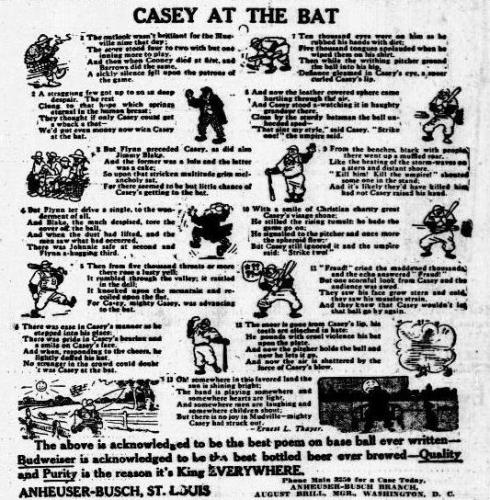
A July ad featured the full text, with illustrations, of Ernest Thayer’s “Casey at the Bat:”

ab1910casey

They only appeared for one season.


Ray Schalk on “Baseball Brains”

1 Feb

After the Chicago White Sox defeated the New York Giants in the 1917 World Series, Sox catcher Ray “Cracker” Schalk took to the pages of “Baseball Magazine” with his opinion of statistics:

Ray Schalk

Ray Schalk

“Offhand I would say that fielding averages are pretty bad, pitchers’ averages rather punk, batting averages merely fair.  But the worst of all are catchers’ averages.

“How are you going to tell a good catcher?  By his batting average?  By his fielding average?  By the runs he scores?  Of course all these things are important.  But they haven’t any direct connection with good, bad or indifferent catching as such.  A catcher may or may not be a good batter or base runner.  And whatever his hitting or run getting ability he may be a great or mediocre catcher.”

Schalk said it was “easy…from the records” to determine an outfielder or shortstop’s ability:

“But a man might be the best catcher the world ever saw or the worst, and there would be no way under heaven to gain that information from the season’s statistics.

“First of all, a catcher must have baseball brains.  It isn’t enough to say brains; you must add the adjective ‘baseball’ to describe what you mean.”

Schalk noted that many of his contemporaries were educated:

“I admit this is the day of the college player in baseball.  I admit that the better education a man has, other things being equal, the better ball player he will be.  But he might know a lot of philosophy or Greek literature and be a frost on foul flies.  Ty Cobb has the ideal baseball brains.  But Ty isn’t a college man.  On the other hand I used to play in the minors with a graduate of a well-known university who was a brilliant scholar and a good natural athlete.  But he was positively the limit in playing baseball.  He would do the most incomprehensible things.  In fact, he was impossible.

Hans Wagner and Nap Lajoie are not college men, have not enjoyed as liberal an education, perhaps, as most of the rest of us.  But if any medical laboratory wants a sample of a real baseball brain, let him open negotiations with the Dutchman or the Frenchman for the use of his skull when he is thru with it.

Honus Wagner

Honus Wagner

“I believe there are fellows with a natural born instinct to play baseball.  They invariably do the right thing at the right time.  That is what I mean by baseball brains.  Furthermore, such a brain must above all act quickly.  There are many thousands of people, even in the stands, who understand good baseball and could dope out the proper thing for a fielder or a batter to do under given conditions.  But that isn’t enough.  The man with a baseball brain must not only do the right thing but he must do it instantly.  It is quickness of thought quite as much as correctness which marks the star player.  Hal Chase and Ty Cobb are scintillating examples of quick thought on the diamond.”

And, said Schalk, “quick thought” was most important behind the plate:

“Now the catcher, above all men, must have a good baseball brain.  Most of his work, the most important part of his work, is hidden from the spectators’ eye.  The man in the stands can seldom follow what is going on in the catcher’s brain.  But the catcher, much more than the pitcher, holds the game in the hollow of his hand.  The catcher, much more than the pitcher, is the keystone of the baseball arch.”

The man who thought statistics didn’t have “any direct connection” to a catcher’s value made it into the Hall of Fame in 1955.  He has the lowest career average (.253) among enshrined catchers.

Lost Advertisements–Cubs, White Sox and Whales Endorse Steele’s Game of Baseball

18 Dec

steeles

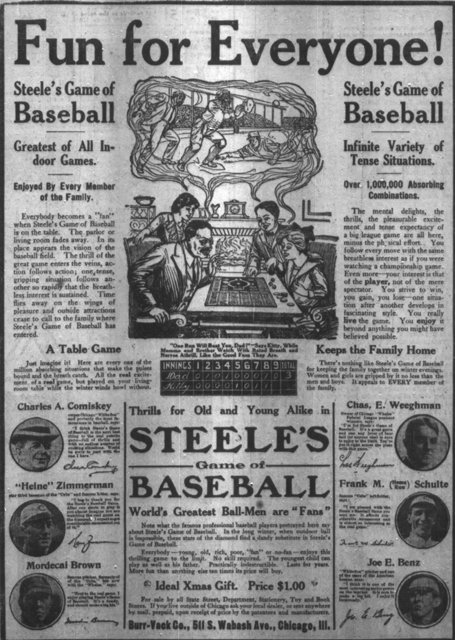
A 1915 advertisement for Steele’s Game of Baseball, a table-top game which claimed to have “Over 1,000,000 absorbing combinations,” and promised that the player would “enjoy it beyond anything you might have believed possible:”

Greatest of All Indoor Games

“Everybody becomes a ‘fan’ when Steele’s Game of Baseball in on the table.  The parlor or living room fades away.  In its place appears the vision of the baseball field.  The thrill of the great game enters the veins, action follows action; one tense, gripping situation follows another so rapidly that the breathless interest is sustained.  Time flies away on the wings of pleasure and outside attractions cease to call to the family where Steele’s Game of Baseball has entered.”

The game was produced by the Burr-Vack Company, a Chicago-based office supply dealer, and received glowing endorsements from members of the city’s three teams:

World’s Greatest Ball-Men are “Fans

Charles A. Comiskey owner Chicago ‘White Sox’ and probably the most famous man in baseball, says: ‘I think Steele’s Game of Baseball is the next best thing to the real outside game–full of thrills and with an endless number of exciting situations.  Would be sorry to part with the one I have.’

“‘Heine’ Zimmerman third baseman of the ‘Cubs’ and famous hitter says: ‘I  beg to thank you for the Steele’s Baseball Game.  After one starts to play it you almost imagine you are watching the real game on the diamond.  I expect to get considerable amusement out of it.’

Mordecai Brown famous pitcher, formerly of the ‘Cubs’ but now with the ‘Whales’ says: ‘Next to the real game, I enjoy playing Steele’s Game of Baseball.It’s a dandy and should make a big hit.’

Chas. E. Weeghman owner of Chicago ‘Whales’ Federal League pennant winners says, ‘I’m for Steele’s Game of Baseball.  It’s a great game and one any lover of baseball (or anyone else) is sure to enjoy to the limit.  You’ve put it right across the plate with this game.’

Frank M. (Home Run) Schulte famous ‘Cubs’ left fielder says: ‘I am pleased with the Steele’s Baseball Game you sent me.  It affords considerable amusement and is almost as interesting as the real game.”

Joe Benz ‘White Sox’ pitcher and one of the stars of the American League, says, ‘I think it is one of the most interesting parlor games on the market.  It is sure to make a big hit. I enjoy it immensely.'”

[…]

“Note what the famous professional baseball players portrayed here say about Steele’s Game of Baseball.  In the long winter, when outdoor ball is impossible, these stars of the diamond find a dandy substitute in Steele’s Game of Baseball.”

Despite the endorsements, the “Ideal Xmas Gift,” which cost one dollar and was “For sale by all State Street, Department, Stationary, Toy, and Book stores,” appears to have quickly disappeared–there are no mentions of the game in newspapers after 1915.

Lost Advertisements–Ty Cobb, Lewis 66 Rye

11 Dec

cobblewis66

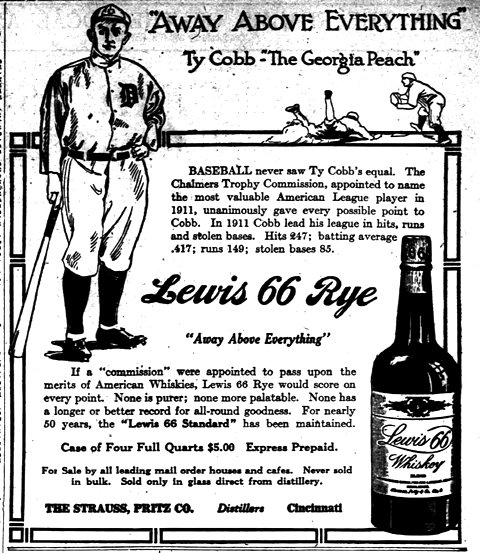
A 1912 advertisement for Lewis 66 Rye Whiskey from The Strauss, Pritz Company, a Cincinnati-based distiller:

“Away Above Everything”

Ty Cobb–‘The Georgia Peach’

“Baseball never saw Ty Cobb‘s equal.  The Chalmers Trophy Commission, appointed to name the most valuable American League player in 1911, unanimously gave every possible point to Cobb (he received all eight first-place votes–the commission consisted on one sportswriter from each league city).  In 1911, Cobb led his league in hits, runs, and stolen bases.  Hits 247; batting average .417; runs 149, stolen bases 85 [sic 248; .420; 147, 83].”

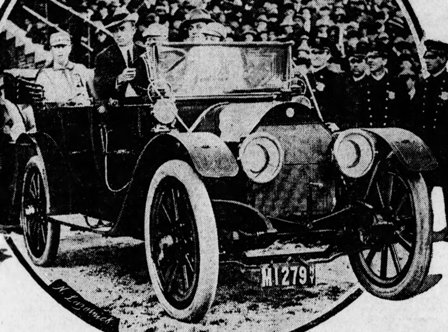
Cobb was presented with a Chalmers “36” at Shibe Park in Philadelphia on October 24, 1911, before game four of the World Series. Jack Ryder, covering the series for The Cincinnati Enquirer said of the presentation:

“President (John T.) Brush of the Giants declined to allow this ceremony at the Polo Grounds, so it was pulled off very quietly here this afternoon…The event took place 10 minutes before the game and was coldly ignored by the Giants though the Athletics took a keen interest in it and several of them had their pictures taken with Cobb. Ty now has three cars, but he says this one is much the best of the lot, and he expects to drive it to his home in Georgia as soon as the series is over.”

Cobb in his Chalmers at Shibe Park

Cobb in his Chalmers at Shibe Park

While Cobb was the unanimous choice of the eight-man commission, the second place finisher in the American League received a more valuable car.

The Chicago Inter Ocean said Chicago White Sox fans, unhappy that pitcher “Big Ed” Walsh finished second to Cobb, “Undertook to raise a fund to purchase an automobile,” for him.

But, said the paper, the fans:

“(F)ound themselves confronted with a dilemma–they had too much money in the fund to buy a duplicate of the Chalmers touring cars presented to Ty Cobb and (National League winner, Chicago Cubs outfielder) Frank Schulte.”

Two days before Cobb received his Chalmers in Philadelphia, Walsh was presented with his car before a charity game at Comiskey Park.

Ed Walsh

Ed Walsh

No Chicago newspaper reported the make and model.  The Daily News called it “A handsome automobile.”  The Inter Ocean said it was “A $4,000 automobile,” and The Tribune said simply that he had received an “(A)utomobile subscribed for by the fandom of the city.”  The Examiner also failed to mention the type of car Walsh received but said the Cubs’ Schulte “gave $25” to the fund.

According to The Tribune, Walsh promised to “‘(L)earn how to run it before spring,’ and the stands cheered loyally.”