Tag Archives: Chicago White Stockings

“Pitcher Geiss No Good”

3 Jun

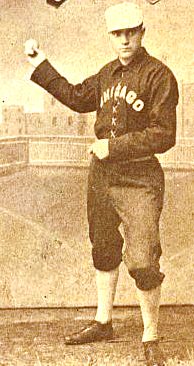
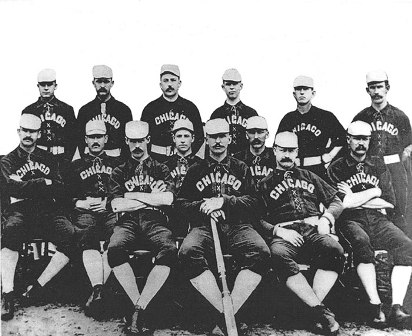
Emil August Geiss pitched one game in 1887 for Cap Anson’s Chicago White Stockings; it was his only Major League game as a pitcher (he later played two games in the infield).

The Chicago Tribune reported that Geiss was signed by the White Stockings “at a salary of $250 month.”  Geiss had been blacklisted the previous season for failing to report to the St. Paul Freezers in the Northwestern League after signing with that club.  The paper said, “It cost $200 to get him reinstated (The Sporting Life said it was $600).”

Geiss’ performance on May 18 was less than memorable.  He gave up 11 runs, eight earned, and 17 hits in an 11-4 loss to the Washington Senators.

The Chicago Tribune headline the following day summed up Geiss’ performance:

Pitcher Geiss No Good

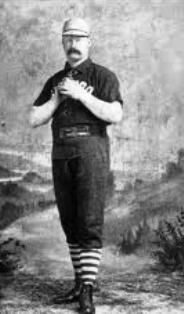
Emil Geiss

The headline in The Chicago Inter Ocean was no kinder:

Geiss Is No Good.  A New Pitcher Tried by the Chicagos at Washington with Disastrous Results

The paper said Anson, who sat out, “watched the game from the players’ bench, a look of disgust deepening on his face every inning widened, and fairly turned his back on the unfortunate Whites.”

Geiss briefly redeemed himself when filling in for Anson on June 15 against the Indianapolis Hoosiers. The Tribune said:

“Geiss played first base in first-class style. He accepted eleven chances with no errors.At the bat he struck out twice and made one hit.”

Their opinion changed one week later when he played in place of Fred Pfeffer at second and  made three errors on seven total chances and was 0 for 5 at the plate.

The Tribune said:

“If Geiss is capable of no better work that he did yesterday he should not be allowed to again don the uniform of the Chicago nine.  A man who plays as he did is a positive menace to the success of the club.”

At the end of June, Geiss was released and finished the season in the Chicago City League.

An additional note about Geiss, and it’s a confusing note:

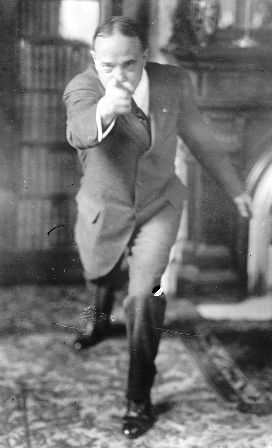
The remainder of his career is a bit vague and complicated.  His brother was William Geiss, who had two brief major league stints and a long minor league career during which he sometimes played under the name of Emil Geis (one “s”), further complicated because Emil Geiss’ Cook County, Illinois death certificate lists him as “Emil Geis.”

Emil pitched for the London Tecumsehs in the International League in 1888 and ’89.  He was the subject of a dispute between London and New Orleans in the Southern League over his rights—an arbitrator ruled that Emil was the property of London; at the same time William was with New Orleans, so we know it was Emil with London.

After a seven-year absence from professional ball, Baseball Reference has Emil hitting .402 in 41 games split between Bloomington in the Western Interstate League and Ottumwa in the Eastern Iowa League in 1895.

It seems likely, and contemporary reports indicate that it was actually William, playing under the name Emil Geiss (sometimes Geis) who put up those numbers in 1895–this conclusion is also supported by the fact that Emil, who had joined the Chicago Police Department in 1891 was still a member a force in 1895.

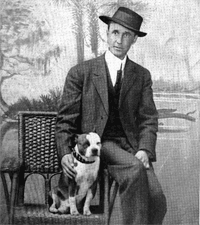
William Geiss

William Geiss

Both brothers died in Chicago, Emil on October 4, 1911, and William on September 18, 1924.  Both are buried at Saint Boniface Cemetery in Chicago.


“The Chicago players began to Kick Vigorously”

26 Jan

The Chicago White Stockings arrived in Detroit on the evening of June 18, 1886 with a mission.  The Detroit Wolverines had won their first 18 home games, and threatened the record of 21 set by Chicago eight seasons earlier.

The Chicago Tribune said on the morning of the game a delegation of nearly 200 Chicago fans, led by team President Albert Spalding, arrived by train.  The Chicago Tribune said:

“Out of the car doors piled the delegation from the windy city, each man bearing a new broom with a placard strapped across the straw end announcing the arrival of the ‘Record Breakers.’”

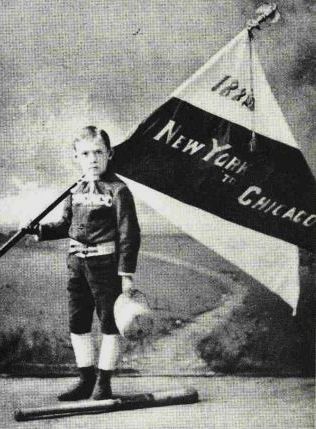
The Chicago players, along with team mascot Willie Hahn, met the group at the train:

“(T)he Chicago players and their mascot marched down the platform and placed themselves at the head of the double column of visiting Chicagoans that had formed at the depot, and then with their brooms elevated, the delegation marched out of the depot…The odd looking procession, extending nearly two squares, attracted a vast amount of attention.”

The delegation marched to the team’s hotel, the Russell House, until it was time to leave for Detroit’s Recreation Park at 3 PM.

With Hahn, and the players again in the lead, the delegation marched to the ballpark.

The Chicago Inter Ocean described the team’s arrival:

“The Chicagos were escorted to the ground by a band, and entered the field behind little Willie Hahn, who carried an immense broom on which were the words ‘Our Mascot.’”

Willie Hahn

Willie Hahn

Not to be outdone, the Wolverines had quickly recruited their own mascot for the game.  The Inter Ocean said:

“The Detroits entered the grounds behind a little fellow almost the same size of Willie Hahn, and were received with cheer after cheer.”

The Wolverines mascot was “young Charlie Gallagher,” a local boy “said to have been born with teeth, and is guaranteed to posses all the magic charms of a genuine mascot.”

Charles “Lady” Baldwin pitched for Detroit, and Jim McCormick for Chicago.  Both pitchers gave up four runs through five innings.  Then, said The Tribune:

“Not a run to either side did the sixth, seventh, or eighth innings yield.  The Whites did not once get further than second in these three innings.  (Sam) Crane and (Charlie) Bennett for the home team alone reached third.

“Now (in the eighth inning) came the misfortune to which many a Detroiter attributes the defeat of their team.  Bennett had caught his usually brilliant game without an error…(Fred) Pfeffer was at bat and struck one of those wicked fouls that have so often proved terrors to catchers.  The ball caught the crack catcher upon the tip of the middle finger of his right hand, and almost tore it from the joint.  Bennett bore the pain like a man, tried to brace up and go on, but he soon saw the folly of such an undertaking and withdrew.”

Shortstop Jack Rowe moved behind the plate to replace Bennett, and the following inning, with a runner on second and no out,  a foul off the bat of George Gore struck Rowe’s finger ”jerking the member out of joint, besides splitting it badly.”

Detroit then tried to stall in order to have the game called on account of darkness

(Charlie) Ganzel, the Detroits’ remaining catcher, was then sent for.  A long delay followed.  The delay was so long that the Chicago players began to kick vigorously.  ‘The man will not put on his uniform,’ said (Cap) Anson to (Umpire John) Gaffney.”

Ganzel finally took the field “after twenty-five minutes’ delay.”  Gore singled, moving McCormick to third, then Ganzel allowed a passed ball, and Chicago won 5 to 4.

“The scene that followed can scarcely be described, and the delight of the Chicago delegation bordered upon wildness, and was in strong contrast to the blue faces of the great crowd of Detroiters that filed out of the grounds.  Brooms were waved with increased enthusiasm by the Chicago contingent on the road back to the hotel.”

Detroit won the two remaining games in the series and increased their lead over the second place White Stockings to three and a half games.  They stayed in first place until August 26—Chicago took over the league lead and never relinquished it, winning the National League pennant by two and half games.

Hahn remained the White Stockings mascot until 1888. Charlie Gallagher was never heard from again.

“Boys of ’76”

5 Jan

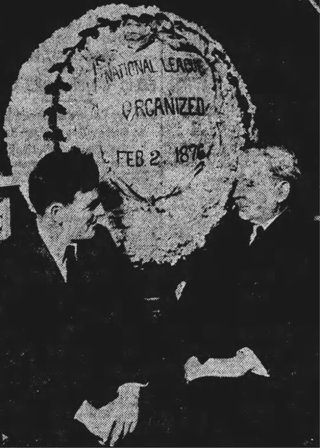
On February, 2, 1925, The National League magnates “paused in (their) schedule deliberations” to honor the league’s past, and kick-off the diamond Jubilee celebration.

Thomas Stevens Rice, of The Brooklyn Eagle said:

“In the very same rooms in which it was organized on Feb. 2, 1876, the National League of Professional Baseball Clubs met again yesterday.  These rooms are in what is now called the Broadway Central Hotel, then called the Grand Central Hotel.”

The Associated Press said:

“In the same room in which Morgan G. Bulkeley, of Hartford, Conn., was elected the first president of the National League, the baseball men, paid tribute to the character and courage of those pioneers a half century ago.”

Dozens of dignitaries were on hand, including, John McGraw, Christy Mathewson, John Montgomery Ward, and Governor John Tener

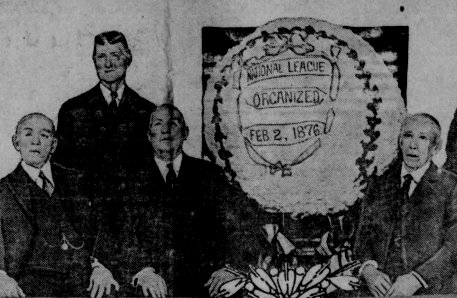
But, the stars that day were six of the surviving players who appeared during the league’s inaugural season:

George Washington Bradley, 72, who won 45 games for the St. Louis Brown Stockings; John “Jack” Manning, 71, who hit .264 and won 18 games as an outfielder and pitcher for the Boston Red Stockings; Alonzo “Lon” Knight, 71, an outfielder and pitcher for the Philadelphia Athletics in 1876 and hit .250 and won 10 games, and three members of the Hartford Dark Blues, Tommy Bond, 68, a 31-game winner; Tom York, 74, who played leftfield and hit .259, and John “Jack” Burdock, 72, an infielder who hit. 259. Also present was the only surviving umpire from the 1876 season–Calvin J. Stambaugh.

Calvin Stambaugh, right, the last surviving umpire from 1876 and Frank Wilson, a national League umpire from 1923 until his death in 1928.

Calvin Stambaugh, right, the last surviving umpire from 1876 and Frank Wilson, a national League umpire from 1923 until his death in 1928.

Other surviving 1876 players, including George Wright and and Al Reach cited “advancing age” for their inability to attend.

feb21925pix

Seated from left: York, Bradley, and Manning. Standing: Bond.

 Bozeman Bulger of The New York World said, in relating a conversation between too of the attendees, the event was notable for another reason as well:

“(S)everal of us younger men, moving over closer, discovered a contradiction of a tradition long cherished, that old-timers never could admit any improvement in the game or in the quality of the players.

“‘Have you seen this young fellow, Babe Ruth?’ Bradley asked of Manning.

“‘Yes, indeed,’ admitted Mr. Manning, ‘and don’t let anybody tell you that we ever had a man who could hit a ball as hard as that boy.  I doubt if there will ever be another one.'”

Bulger said the “Boys of ’76” also talked about how they “fought crookedness when a salary of $1,800 a year was considered big pay for a star.”  Bradley, who after baseball became a Philadelphia police officer, said:

“‘Oh, we had crooked fellows following us around back in ’76.  They pretended to make heroes out of us and would hang around the hotels.’

“‘One day Mr. (Chicago White Stockings President, William) Hulbert, a very learned man, advised me to keep away from these men.  He explained how they could ruin a boy and lead others into temptation . I was often approached, but thanks to that wise counsel, I kept myself straight, and I thank God for it today.  It’s worth a lot to me to look you younger men in the eye and feel that in turning the game over to you, we gave you something that was honorable.  It’s up to the players to keep it honorable.”

Tom York summed up his feelings about the game in 1876:

“‘Say, do you remember how proud we used to be after winning a game, when we walked home still wearing our uniform and carrying a bat–and the kids following us?  Ball players–all except Babe Ruth–miss that nowadays.”


bondmanning

Bond and Manning talk pitching at the Golden Jubilee kickoff event in 1925.


Pfeffer on Kelly

31 Dec

When Mike “King” Kelly died in 1894, Fred Pfeffer his teammate with the White Stockings from 1883-1886 eulogized him in The Chicago Times:

“He played by intuition, by instinct. Signs were not part of his equipment.  Most infielders use signals.  Kelly and I never had one.  We never tried them.  He was alive to every contingency which could come up in a ball game.  His wonderful powers of perception enabled him to protect every angle of the game and he would do so.  I studied Kel and got so close to him mentally that I knew just what he was liable to do and was always prepared to back him up.

Mike "King" Kelly

Mike “King” Kelly

“He was the creator and the father of more original fine points than any man who ever stood behind a mask.  At the bat, on the base lines, in the coacher’s box, wherever you put Kelly, he was per se, a king.  His strongest playing point was that he was always ready.  He could take advantage of a misplay which others wouldn’t see until afterward.  He was a marvel at base running.  By that I do not mean that he had any extraordinary speed, but he out generaled, if I may use the term, the men who were chasing him.  He could cut the base and do it in such a manner that he would get away with it.

Fred Pfeffer

Fred Pfeffer

“He played the umpire as intelligently as he did the opposing nine.  He would make a friend of him, engage his confidence, and in various ways get the best of close decisions.

“He was never guilty of dirty ball playing.”

“This kind of Argument is the Veriest kind of Twaddle”

1 Dec

After just one season in the National League—a 24-36 record and a fifth place finish in 1878–the Indianapolis Blues disbanded.  Four members of the Blues joined the Chicago White Stockings—Silver Flint, Joe Quest, Ned Williamson, and Orator Shafer.
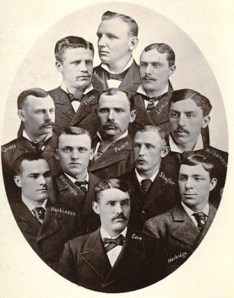
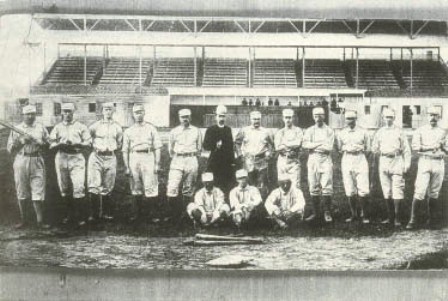
The 1879 White Stockings

The 1879 White Stockings

The White Stockings had been a disappointment in 1878, finishing in fourth place with a 30-30 record under Manager Bob Ferguson.  President A.G. Spalding, who had named Ferguson as his successor when he retired from the field, announced that first baseman “Cap” Anson would replace Ferguson for 1879.

The changes gave the Chicago press high hopes for 1879.

But, The Cincinnati Enquirer did not agree.  The paper said while the Chicago club was “greatly strengthened where it was very weak,” they would still finish no better than fourth place unless they were “properly managed.”  Boston Red Stockings Manager “Harry Wright could take this team and run it up to second place at least.”

In January The Enquirer implied that in addition to questionable management, Chicago’s new players were going to be a detriment:

“A prominent baseball official of Boston, in a private letter written recently, sententiously remarks: ‘Look out for the Indianapolis element in the Chicago Club next year.’  There’s a text for everybody’s thoughts.”

The Chicago Tribune quickly fired back with an article under the headline:

“Harmony” vs. Energy

 “There has been a great deal said at one time and another concerning ‘harmony’ in nines, and those who had the most to say on the subject contended that it was an essential point to be carefully looked after in the formation of any club which hoped for success on the diamond field.  Now The Tribune does not wish to set itself up in opposition to the judgment of men who have made baseball and the management of those who play it a study and a business venture, but it does say that many of them have harped so long upon this matter of ‘harmony’ that it has become a kind of second nature, whereby their judgment has been sadly warped.  Of late a paragraph, started in Cincinnati, has been going the rounds, in which the general public is solemnly warned to ‘look out for the Indianapolis element in the Chicago Club’ during 1879.

“Now the President and Manager of the Chicago Club are probably about as astute and far-seeing as any in the business and in view of this fact and reflection on their judgment or sagacity is in bad taste, and the parties who make ill-advised criticisms on the course of any club in hiring men, are very apt to undergo the unpleasant experience of persons not brought up in New Zealand who indulge in the pastime of throwing boomerangs; their weapons may come back and inflict considerable damage on those who threw them.  Whether or not the White stocking nine of next season will be a ‘harmonious’ one, it is doubtful if anybody knows, and still more doubtful if anybody cares.

“At the risk of being howled at by several papers, the baseball columns which are presided over by young men whose practical ignorance of the game is exceeded only by their ability to construct tables which not even themselves can understand when printed.”

One of the “Young men” referred to was The Enquirer’s sports Editor Oliver Perry “O.P.” Caylor.
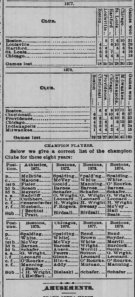
One of O.P. Caylor's tables "which not even themselves can understand when printed.”

One of O.P. Caylor’s tables “which not even themselves can understand when printed.”

The Tribune will say that the question of whether or not the Chicago nine of next season ‘harmonizes’ will probably make very little difference with its play.  Some of the men who enjoy the reputation of being first-class kickers and disorganizers are nevertheless very handy individuals to have around when a base hit or good field play in wanted.  Without intending either to arouse the wrath or flatter the vanity of the very amiable and stalwart young man, Anson, it may be said that his reputation as an experienced and prolonged kicker is one that any man might be proud of; but, in spite of those who preach that harmony is everything, he is acknowledged to be one of the best and most useful ball-players in the country.  (Cal) McVey, of the Cincinnatis, can also make quite a conspicuous kick, even when not specially called upon to do so; still he is a good ball-player.

Lip Pike is a disorganizer of the first water, but last season, when he used to hoist a ball out among the freight cars on the lake shore, people who were presumed to know a good player yelled themselves hoarse in his praise.  The list could be extended indefinitely, but such action is not necessary.  Those who organize nines on the basis of ‘harmony’ alone will never grow rich at the baseball business.  It is not possible to get together nine men who could travel around the country eating, sleeping, and playing ball together that would never get out of tune.  Nine angels could not do it, much less nine mortals, subject to the little idiosyncrasies that human nature is afflicted with. “

The Tribune likely assumed the “prominent baseball official of Boston,” was Manager Harry Wright, and next turned its attention to him, his brother, and his championship teams.

“Harry Wright has always been the prophet whom the ‘harmony’ men delighted to honor, and the success of the Cincinnati and Boston Clubs under his management has been laid entirely to the dove-like dispositions of the men engaged by him.  This kind of argument is the veriest kind of twaddle, and the history of the Boston Club proves the truth of this assertion.  George Wright and Tommy Beals went many a day without the interchange of a friendly word, and George and (Charlie) Gould did the same thing.  For one whole season Ross Barnes and Gould never exchanged a word, and glared at each other like opposing game chickens, but the Boston’s won the pennant that year (1872—National Association) all the same harmony or no harmony.

“Other instances of like character could be adduced were there any necessity therefore, but these, from the fountain head of ‘harmony,’ will suffice.  If a club wins the championship it will be because its men play ball, not because they are ‘goody-goody’ boys.  Your man who gets hot at something during a game, and then relieves his feelings by making a two or three base hit, is much more valuable than one who, although possessed of a Sunday-school temperament at all times, manifests a decided aversion to reaching first base., when the occupancy of that particular bag of sawdust would be of some value to the men who pay him high wages for playing ball.”
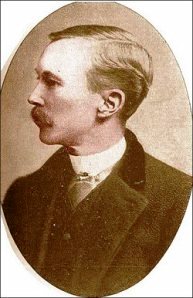
O.P. Caylor

O.P. Caylor

Caylor would not let the insult to him and to Harry and George Wright, go unchallenged:

The Chicago Tribune published some strange statements against the argument that in harmony there was always strength.  To prove that harmony was not always necessary to create strength in a baseball club, the writer made bold to say among other things that Tommy Beales [sic] when a member of the Boston Club, went many a day without the interchange of a friendly word with George Wright, and that the same feeling existed between George and Gould.  The writer knew from the first these statements were fiction, but in order to crush the fallacious argument our reporter left it to George Wright himself for an answer.  The letter is before us from which we quote, though we half suspect George would demur to its publication out of modesty if he knew it. “

Wright wrote to Caylor:

“(The Tribune) said Tommy Beales [sic] and I went many a day without the interchange of a friendly word, and that Gould and I did the same thing.  While they were with the Boston nine they were about my best friends.  Most of the time Beales [sic] boarded at my house, while Charley and I roomed together on trips.  I think the reporter was wrong in his argument against ‘Harmony’ as it was the great cause of the Boston Club’s success.  The credit for this mostly belonged to Captain Harry Wright.”
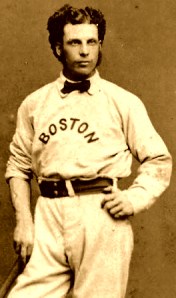
George Wright

George Wright

Although it appears Wright spelled the name of his good friend Tommy Beals incorrectly, he got the spelling right 12 months later when he named his son—tennis Hall of Fame member –Beals Wright after his former teammate.

The Tribune allowed Wright, and Caylor, the last word, and dropped the dialogue regarding “harmony.”

Despite Caylor’s prediction, the White Stockings, under Manager Cap Anson, led the National League from opening Day through August 15.  Anson became ill during July, and as his performance slipped, so did the team’s fortunes.

Suffering from what The Tribune called “an acute affection of the liver…that had sadly impaired his strength and capacity for play,” Anson left the club on August 26 with a 41-21 record, in second place, just a game and a half back.

With Silver Flint serving as manager, and without Anson’s bat—he led the team with a .317 average—the White Stockings were 5-12 in the last 17 games, and a fourth place finish.

Harry Wright’s Boston Red Stockings finished second; his team, winners of the previous two National League championships lost some of the “harmony” that made them winners when his brother George Wright and Jim O’Rourke signed with the Providence Grays.  George Wright, in his only season as a manager, led the Grays to the 1879 National League championship.

“The Farce of the Season”

26 Nov

In November of 1885 Topeka, Kansas was scandalized by a baseball game.

The Daily Capital said:

“A social game of baseball, whether the contestants are skilled professionals of ambitious amateurs, is always a matter of some interest and pleasure both to the participants and the spectators; but a sensational exhibition, such as was witnessed at the fairgrounds yesterday afternoon, is another and quite a different thing.  The fact that it attracted a crowd of several hundred men and boys does not divest the spectacle of its questionable character, and it is surprising that an outfit of this kind should receive such substantial encouragement in a city like Topeka, where a claim to ordinary civilization is advanced and where the spires of nearly a hundred churches cast their shadows upon an enlightened and progressive people.”

The Daily Commonwealth was more succinct:

“The farce of the season was the game of baseball played yesterday afternoon.”

The cause of the outrage was “The Fairies of the Field,” a traveling female team.

The Daily Commonwealth noted that the team arrived in Topeka on a “Sante Fe train, traveling in a special car, painted red, perhaps because their advent into a town causes the town to assume that color.”

Neither of the Topeka papers were impressed with the ball-playing ability of the visitors, who faced a “picked nine” of local male amateurs and semi-pro players.

The Daily Capital:

“The nine females who formed the principal attraction were awkward and scrawny and had no knowledge whatever of the national game they were abusing.”

The Daily Commonwealth:

“The ‘belles’ can’t throw any better than any other woman can, and can hit a ball with about as much force as a ten year old boy.”

The Daily Capital didn’t bother to disclose the final score, “The details of the game are not worthy of extended notice.” The Daily Commonwealth gave the final score, but attributed the Fairies’ 19 to 7 victory in the four-inning game to “assistance” from the umpire, and the generousness of “The home nine (who) gave them every opportunity to make runs.”

Despite the reception in Topeka, the team was popular and performed to large crowds the previous year at the World’s Fair in New Orleans, then spent the summer and early fall of 1895 barnstorming across the Midwest.  The Fairies were generally received with more respect and enthusiasm than what they faced in Topeka, but the reviews of their skills varied.

The Minneapolis Tribune gave the team a glowing notice after a game in August of 1885 “attended by 700 men and eight women,” and said:

“The Fairies of the Field were in fine form and flitted coyly over the luxuriant sward as blithe and chipper as a Mayday butterfly.”

The paper said one of the Fairies—Genevieve McAllister—“wields the willow after the style of Jim O’Rourke,” and Clara Corcoran, who played third base was said to be the niece of Chicago White Stockings pitcher Larry Corcoran.”  The Tribune said of the team’s pitcher:

“Miss Royalston—“the expert and lady-like pitcher of the visitors…formerly lived at Detroit, and learned the art from the study of (Frederick “Dupee”) Shaw, the wizard.  She takes a graceful three-lap pirouette on the left toe, and while the batsman is dazzled by the rapidity with which the stripes on her polonaise fly by, the ball comes out from somewhere and the umpire calls a strike.”

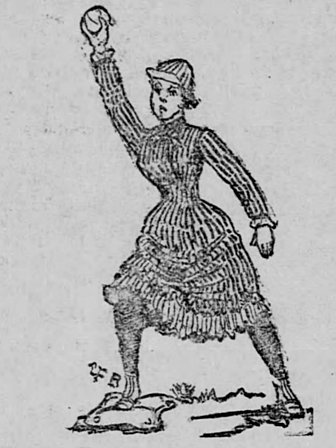
The St. Paul Globe's rendering of one of the 'Fairies.'

The St. Paul Globe’s rendering of one of the ‘Fairies.’

The Fairies defeated the Minneapolis men 8 to 7.

The St. Paul Globe said after a loss at Stillwater, Minnesota “witnessed by a crowd of 1,200 or 1,300 persons,” composed of “Every profession in Stillwater, excepting the clergy, from street urchin to the capitalist, was represented.”

The Globe said of the visitors:

“The girls, seven brunettes and two blondes, were attired in red hose, plaid dresses reaching to the knee, red caps and slippers.  All wore belts, and two or three black jerseys, and were powdered and panted like ballet fairies.”

But the St. Paul paper was not as impressed with the Fairies as their counterparts in Minneapolis, summing up their performance in Stillwell:

“They can’t play ball a little bit.”

When 1,500 turned out for a game in St. Paul, The Globe was equally unimpressed:

“Four innings were played, the score being 14 to 4 in favor of the picked nine, who could have made it 44 to 4 if they chose.  At the close of the fourth inning the manager called, ‘Game! Grab your bases,’ which each basewoman did and the fairies vanished, leaving behind the most disgusted audience that ever went to see a game of baseball.”

Handbills that promoted the team’s appearances read “Have never been here before, may never come again.”

True to the advertisements the Fairies of the Field disbanded shortly after their ‘farce’ in Topeka, and never came again.

A “King” Kelly Story

17 Nov

In 1905, Elmer Ellsworth Bates of The Cleveland Press told a story about how the game had changed over the past two decades.

Ellsworth said that during the 1880s he witnessed an incident at the Café in Cleveland’s Weddell House Hotel involving Mike “King” Kelly.  Bates said he was with umpire “Honest John” Gaffney when Kelly came in:

Mike "King" Kelly

Mike “King” Kelly

“(T)he swing doors flew open and about half of the players of the Chicago team—Kelly in the lead—marched in.  The game between Cleveland and Chicago that day had been a stormy one, and Gaffney had assessed fines right and left.

“Kelly had been the chief offender.  Drawing at first a $5 penalty for disputing a decision, he had called Gaffney names at $5 or $10 a name until he owed the National League $50.  Kelly had left the ballpark vowing he would attend to Gaffney later.  I expected trouble when Kelly came in, for it wasn’t his first visit to that part of the hotel that night.

“’Hello, Gaf,’ Mike shouted, as he saw the umpire.  ‘Have a drink—you and your handsome friend.’

“’Much obliged Kel’ said Gaffney: ‘I’m not drinking today.’

“’Say Gaf,’ Kelly went on, ‘how much did you soak me today.’

“’An even $50,’ replied Gaffney, very quietly.

John Gaffney

John Gaffney

“’Reported it to the boss yet?’

“Not yet,’ was the reply.

“’Tell you what I’ll do,’ said Kelly, grabbing up the dice box.  I’ll shake you to see whether it’s $100 or nothing.’

“Gaffney started to walk away.

“’Come on, Gaf, be game,’ the other players called.

“So he came back.

“’Horses?’ asked Gaffney.

“Nope,’ said Kelly.  ‘One throw.’

“Gaffney spilled out aces and fours.  Kelly turned the box bottom side up, and, lifting it again, disclosed three fives.

“All right,’ said Gaffney, ‘the fine don’t go.’

“’Come on there, fellers,’ shouted Kel, starting for the door, ‘let’s go out and spend that $50.’”

“Women have been the cause of Ruin of more Good Clubs than Anything Else”

17 Oct

In 1907 Hugh Fullerton wrote in The Chicago Herald about the outside influences that he felt did the most damage to a ballclub:

Hugh Fullerton

Hugh Fullerton

“There are dozens of things that happen to keep a team from landing a pennant about which the general public is entirely ignorant and which never can be explained clearly.

“For instance, one of the mysteries of baseball was the breaking up of the famous White Stockings team.

“Hundreds and thousands of people cursed the management of the Chicagos for selling off star players and wrecking the club—and few ever knew why it was.  The management felt worse over it than the fans possibly could feel—but it was inevitable.  A scandal in the club concerning two members and the wife of one of them started the trouble.  Threats to kill each other were made—and the disruption of the club became absolutely necessary.  The sale of (Mike “King”) Kelly (1887) and (John) Clarkson (1888) was the beginning –and after a time all parties to the scandal were let out—and Chicago was given a decade of losing clubs.”

Mike "King" Kelly

Mike “King” Kelly

He claimed the reason for the breakup of the White Stockings was a common one.

“Women have been the cause of ruin of more good clubs than anything else.  They need not necessarily be bad women.  There was one club in the old twelve-club National League which, for two years, was knocked out of all chances of winning merely because the wife of one of the players was an inveterate gossip.  She knew everything that went on in the club and retained it until she had half the players up in arms against each other.

“One of the best manager s in the country today frowns upon all women and his players, under his direction, forbid their wives to mention the subject of baseball to each other.  The result is that there is the best feeling in the club.  Almost every member of the team is married, their wives meet socially at all times—and baseball is tabooed by common consent.

“I know a catcher, one of the toughest, hardiest fellows in the business, who nearly was ruined as a catcher by the women of the club.  He was so strong and tough that you couldn’t have dented him with an ax, but one day he split his hand a little bit.  He thought nothing of it, and was ready to catch the next day when the women got to pitying him and telling him he ought to take good care of it.  When he left the grounds he had tied up the injured place with a rag—and was all right.  By the next morning he was ready to go to the hospital—and he did lay off for two weeks, all because the women made a martyr of him.”

But, according to Fullerton, there was something almost as bad for a baseball team as women:

“Horse racing, however, has ruined almost as many clubs as women have.  Once a team gets interested in horse racing, and so far as winning goes, it might as well disband.

“One of the greatest troubles in the present New York National League team is the devotion of some of the players to the racing game.  (John) McGraw himself has been so successful at it that baseball has become sort of a side issue.  Many of his players have followed his example, and the result is they think more of horse racing than of baseball.

“Racing did more to wreck (Ned) Hanlon’s championship Brooklyn team than any other thing.  The Washington Park grounds are so close to the Brighton and Sheepshead tracks that players could see two or three races before the game.  Eventually baseball was forgotten and the conversation in the clubhouse dwelt only on horse racing.

(Cap) Anson had a crowd of horse race fans for several years, and the result on the work of the team was something frightful.  They talked horse racing even on the field, and had the telegraph operators throwing out messages telling what horses had won.”

And, he said, gambling in general had been detrimental to the Giants during the years Andrew Freedman owned the club (1895-1902):

“There always was a crap game or a poker game in the clubhouse, and the stakes were so high that bitter feeling was endangered.”

While Fullerton, for the most part, avoided naming names, he did single out one former Chicago manager, who had died five years earlier, for presiding over teams that were “ruined” by gambling:

“The Chicago team the second year under Tom Burns (1899) was wrecked by the same sort of deal, the manager setting a bad example in that respect.  Burns also was charged by the Pittsburgh owners with ruining their club, when he was manager (1892), by permitting and encouraging gambling.”

Tom Burns

Tom Burns

Things I Learned on the Way to Looking up other Things #11

22 Sep

Floto on Baseball’s Most Powerful Men

Otto Clement Floto was one of the more colorful sportswriters of the late nineteenth and early twentieth century’s.  The Denver Post’s Woody Paige said of the man who was once worked for that paper:

“In the early 1900s Floto was The Denver Post’s sports editor and a drunk, barely literate, loud-mouthed columnist–sounds like a description of that guy in my mirror–who didn’t believe in punctuation marks, wrote about fights he secretly promoted on the side, got into shouting matches with legendary Wild West gunman–turned Denver sportswriter–Bat Masterson.”

Otto Floto

Otto Floto

Floto, in 1910, provided readers of The Post with his unvarnished opinion of baseball’s most powerful figures:

John T. Brush—The smartest man in baseball, but vindictive.

Garry Herrmann—Smart, but no backbone; the last man to him has him.

Ban Johnson—Bluffs a great deal and makes it stick.  Likes to talk.

Charles Comiskey—Shrewd as can be.

Connie Mack—Shrewd and clever; knows the game better than anyone.

Charles Murphy—A hard fighter, but backs up at times.

George Tebeau—More nerve than any other man in baseball, very shrewd.

Barney Dreyfus—Smart, but always following, never leading.

As for John McGraw, Floto allowed that the Giants’ manager was “Pretty wise,” but attributed his success to the fact that he “has lots of money to work worth.”

Too Much Money for Players, 1884

The Cleveland Herald was not happy when pitcher Jim McCormick jumped his contract with the Cleveland Blues in the National League to the Union Association’s Cincinnati franchise.  Although teammates Jack Glasscock and Charles “Fatty” Briody also jumped to Cincinnati, the paper saved most their anger for the first big leaguer to have been born in Scotland.

Jim McCormick

Jim McCormick

The paper noted that McCormick, who was paid $2500 by the Blues, had received a $1,000 bonus to jump:

“(A) total of $3,500 for joining the Cincinnati Unions to play the remainder of the season.  This is equal to $1750 a month, which again divided makes $437.50 a week.  Now McCormick will not play oftener than three times a week which makes his wages $145.83 per day for working days.  The game will average about two hours each, so that he receives for his actual work no less than $72.91 an hour, or over $1.21 a minute for work done.  If he was not playing ball he would probably be tending bar in some saloon at $12 a week.”

McCormick was 21-3 with a 1.54 ERA in 24 games and helped pitch the “Outlaw Reds” to a second place finish in the struggling Union Association.  After the Association collapsed was assigned to the Providence Grays, then was sold to the Chicago White Stockings.  From July of 1885 through the 1886 season McCormick was teamed with his boyhood friend Mike “King” Kelly—the two grew up together in Paterson, New Jersey and were dubbed “the Jersey Battery” by the Chicago press—and posted a 51-15 record during the season and a half in Chicago, including a run of 16 straight wins in ‘86.

He ended his career with a 265-214 record and returned home to run his bar.  In 1912 John McGraw was quoted in The Sporting Life calling McCormick “the greatest pitcher of his day.”

The pitcher who The Herald said would otherwise be a $12 a week bartender also used some of the money he made jumping from Cleveland in 1884 the following year to purchase a tavern in Paterson.

Not Enough Money for Owners, 1885

In 1885 J. Edward “Ned” Allen was president of the defending National League Champions –and winners of baseball’s first World Series—the Providence Grays.  He told The New York Sun that baseball was no longer a profitable proposition:

“The time was when a man who put his money into a club was quite sure of coming out more or less ahead, but that is past.  When the National League had control of all the best players in the country a few years ago, and had no opposition, salaries were low, and a player who received $1,500 for his season’s work did well.  In 1881, when the American Association was organized in opposition to the league, the players’ salaries at once began to go up, as each side tried to outbid the other.  When the two organizations formed what is known as the National Agreement the clubs retained their players at the same salaries.

“Several other associations were then organized in different parts of the country and were admitted under the protection of the National Agreement.   This served to make good ball-players, especially pitchers, scarce, and forced salaries up still higher, until at the present time a first-class pitcher will not look at a manager for less than $3,500 for a season.  (“Old Hoss”) Radbourn of last year’s Providence Club received the largest amount of money that has ever been paid to a ball-player.  His wonderful pitching, which won the championship for the club, cost about $5,000 (Baseball Reference says Radbourn earned between $2,800 and $3,000 in 1884), as did the work of two pitchers and received the pay of two.

The Providence Grays--Champions and unprofitable

The Providence Grays–Champions and unprofitable

“Some of the salaries which base-ball players will get next season are; (Jim) O’Rourke, (Joe) Gerhardt, (Buck) Ewing and (John Montgomery) Ward of the New York Club, $3,000 each.  (Tony) Mullane was to have played for the Cincinnati Club for $4,000 (Mullane was suspended for signing with Cincinnati after first agreeing to a contract with the St. Louis Browns).  (Fred) Dunlap has a contract with the new League club in St. Louis for $3,400.  These are only a few of the higher prices paid, while the number of men who get from $2,000 to $3,000 is large.  At these prices a club with a team costing only from $15,000 to $20,000 is lucky, but it has not much chance of winning a championship.  To this expense must be added the ground rent, the salaries of gate-keepers, and the traveling expenses, which will be as much more.

“As a high-priced club the New York Gothams leads, while the (New York) Metropolitans are nearly as expensive.  The income of these two clubs last year was nearly $130,000, yet the Metropolitans lost money and the New York Club (Gothams) was only a little ahead.  The first year the Metropolitans were in the field(1883) their salary list was light, as were their traveling expenses, and at the end of the season they were $50,000 ahead.”

The Grays disbanded after the 1885 season.

“Lord, if you ever Helped a Mortal Man, help me get that Ball”

29 Aug

Outfielder turned evangelist Billy Sunday spent a month during 1902 traveling through the small towns of East Central Indiana, preaching in the small towns that rose as a result of the natural gas boom.

Billy Sunday

Billy Sunday, ballplayer

A reporter for The Philadelphia Press spent time with Sunday during the tour, and the paper ran a story that the evangelist told at every stop—about how “prayer saved a game of baseball.”

Sunday said it happened during 1886—Sunday at various times said he was “saved” in 1886 or 1887– when he was playing for the Chicago White Stockings.  The first place White Stockings were playing the second place Detroit Wolverines in a September series:

“The last half of the ninth inning was being played,” says the ex-ball player.  “Two men were out, and Detroit, with Charley Bennett at bat, had one man on second and another on third.  He had two strikes on him and three balls called, when he fell on a ball with terrific force.  It started for the clubhouse.  Benches had been placed in the field for spectators, and as I saw the ball sailing through my section of the air I realized I was going over the crowd, and I called: ‘Get out of the way!’  The crowd opened, and as I ran and leaped those benches I said one of the swiftest prayers that was ever offered.

“It was, ‘Lord, if you ever helped a mortal man, help me get that ball.’  I went over the benches as though wings were carrying me up.  I threw out my hand while in the air, and the ball struck and stuck.  The game was ours.  Though the deduction is hardly orthodox, I am sure the Lord helped me catch that ball, and it was my first great lesson in prayer.  Al Johnson, brother of the present mayor of Cleveland, ran up to me and handed me a ten-dollar bill.  ‘Buy a new hat Bill,’ said he.  ‘That catch won me $1,500.”

The White Stockings went on to win the National League championship over Detroit by two and half games.

Sunday’s stories earned him thousands of followers, and scores of critics—among the religious and non-religious.

Billy Sunday, evangelist

Billy Sunday, evangelist

A 1915 article—during the height of Sunday’s popularity– in “The Congregationalist and Christian World,” the magazine of the National Association of Congregational Christian Churches said:

“He has grave faults.  He is intolerant; his language is often violent, impatient and unkind.  He is a fighter of the types that asks and gives no quarter.  I saw him do and say things that seemed to me ridiculous and I disapprove of many things I reason to believe he has said and done.  I could make out a pretty strong case against him on the facts I have at my command.  But after we have said all that, we have before us a preacher whom I believe to be honest and earnest…He says ‘If I talked the same and acted the same as the other fellows do I wouldn’t get more people to listen to me than they get.’  With the crowd before him he wins their confidence, makes them his friends and delivers the message that is in his heart.  He talks plain, blunt language, tinged with the vernacular of the sporting crowd and that all who follow our great national game are accustomed to use.”