Tag Archives: Cincinnati Reds

Lost Advertisements–“A Pennant Winning Nine!!

8 Apr

1910reds

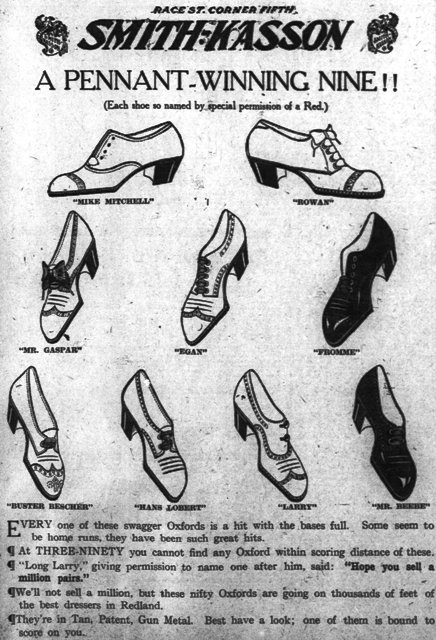
A 1910 advertisement for Smith-Kasson Shoes in Cincinnati.

“Each shoe so named by special permission of a Red”

The shoe lineup included the “Mike Mitchell,” the “Rowan,” for pitcher Jack Rowan, the “Mr. Gaspar,” “Mr. Beebe,” and “Fromme” for pitchers Harry Gaspar and Art Fromme.  The “Egan,” for 2nd baseman Dick Egan, outfielder Bob Bescher was immortalized with the “Buster Bescher,” the “Hans Lobert” for third baseman Hans Lobert, and simply “Larry” for catcher Larry McLean.

"Buster Bescher"

“Buster Bescher”

“Every one of these swagger Oxfords is a hit with the bases full.  Some seem to be home runs they have been such great hits.

“At Three-Ninety, you cannot find any Oxford within scoring distance of these.

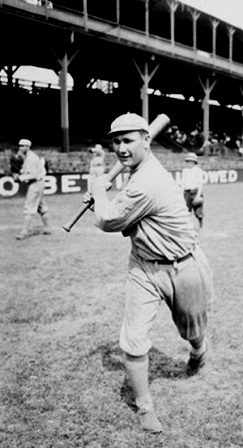
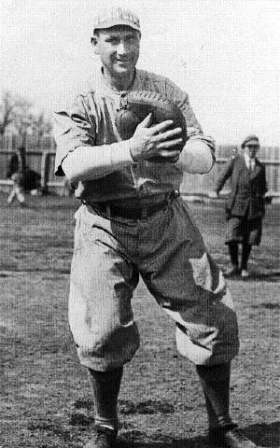
“Long Larry (McLean), giving permission to name one after him said, ‘Hope you sell a million pairs.’

Long Larry

Long Larry

“We’ll not sell a million, but these nifty Oxfords are going on thousands of feet of the best dressers in Redland.

“They’re in Tan, Patent, (and)  Gun Metal.  Best have a look, one of them is bound to score on you.”

It’s unknown how well the line of shoes fared;  their namesakes, stylish Oxfords and all, limped to a 75-79, fifth place finish.

Clark Griffith, “How I Win”

14 Mar

In 1910, Cincinnati Reds Manager Clark Griffith spoke to journalist Joseph B. Bowles for one of  a series of syndicated articles in which baseball’s biggest stars described “How I Win.”

“If a fellow is going to cut any ice he needs ice picks and the first way for a manager to win is to get men who can deliver, and men intelligent enough to take care of themselves.

“My theories in regard to what constitutes a winner are the only ones, and I use them in instructing my players what to do.  I used them in pitching, and they worked out, and I believe any player will succeed if he follows them.”

Clark Griffith

Clark Griffith

Griffith said baseball was “Ninety-nine and fifteen sixteenths” courage and nerve:

“It is more than that—it is what ballplayers call ‘guts’—which is courage with aggressive confidence behind it…The first thing to do to win baseball games is to go after anyone who does not wear a uniform that looks like yours, and go after him hard.  Hand every opposing player anything that will make him weaken or show the yellow.  Anytime I can convince my men that they are going to win and the other fellows that they are going to lose, I’ll win a pennant.”

He believed his confidence could successfully intimidate opponents:

“The best system of winning games is to tell the other fellow that you are going to beat him.  Tell it to him before the game starts and tell him in a way that will convince him.  You cannot convince him unless you believe it yourself.  I keep telling them all the time, and I believe it myself until the game is over and sometimes even then.”

Griffith said what he wanted most was for his players to:

“Take chances; any chance to gain an inch of ground or a base…Go after the game with intelligence and force every point as hard as possible…The player who takes chances of hurting himself seldom hurts either himself or his opponent and he will make a weak opponent run away.  More players get hurt stopping up on their feet and giving up before they are touched than are damaged in sliding to bases.”

He said that aggressiveness should also be directed at umpires:

“Then claim every point and claim it quick.  Holler.  ‘No, no’ real quick and beat the umpire to it on every close play a la (Johnny) Evers.  The umpire may be perfectly honest and square but on a close play the fellow who yells quickest is much more likely to get the decision.  I do not believe in fighting umpires or nagging at them.  I believe in yelling quickly.  Yelling quickly beats yelling loud all to pieces.  It is not cheating a bit, but simply protecting yourself on close plays not so much to get the decision yourself as to keep the other fellow from getting it.”

Griffith led the Chicago White Sox to the inaugural American League pennant during his first season as a manager in 1901.  And despite not winning one since, was very confident about his “theories” for success:

“These things, taken together with a little good pitching and perhaps one star pitcher, will win any pennant if carried out correctly and persistently, regardless almost of the mechanical ability of the players on the team.”

In the end, Griffith was unable “to win any pennant.”

His Reds teams in 1910 and 1911 were both sub .500 clubs and finished in fifth and sixth place.  He joined the Washington Senators in 1912, and finally with “one star pitcher’ he managed the team to two-second place finishes (1912-13), but did not win a pennant there either.  He stepped down as manager after the 1920 season to devote himself full time to his ownership duties.

One Star Pitcher

One Star Pitcher

He ended his managerial career with a 1491-1367 record over 20 seasons.

Lost Advertisements–Heinie Groh for Sweet Caporal

4 Mar

grohsweetcaporal

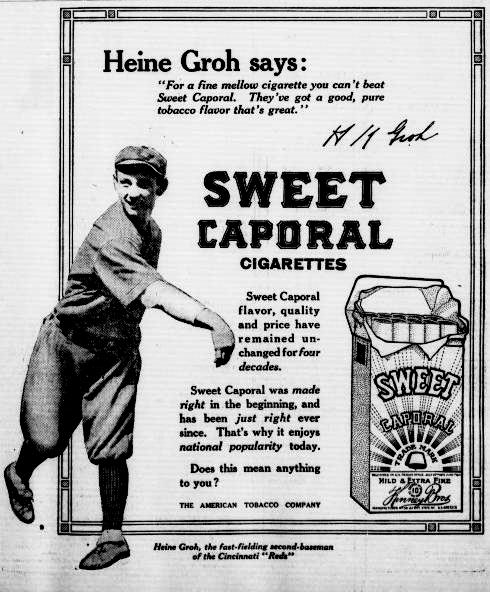
A 1914 Sweet Caporal advertisement featuring Heine [sic] Groh–the company didn’t spend a great deal of time checking the spelling of the names of their endorsers.

“For a fine, mellow cigarette you can’t beat Sweet Caporal.  They’ve got a good, pure tobacco flavor that’s great.”

The salary dispute that culminated with Groh’s trade from the Cincinnati Reds to the New York Giants after the 1921 season had been ongoing since at least 1917 and earned him the title “last of the holdout kings” from The Washington Herald.

His 1920 holdout was, according to Groh, inspired by his wife Marguerite, who also spoke to the press on her husband’s behalf as the dispute ground on into March.

The Cincinnati Times-Star said while speaking at a “local banquet,” Groh told the audience:

“We were sitting in a vaudeville show not long ago and were listening to the thunderous applause being accorded a couple of high salaried dancers.

“My wife touched my arm.  ‘Do you see how they are being praised now?’ she asked. ‘But what will happen to them in a few years when their legs start to go bad?  They’ll get asked to leave won’t they? That’s why they’re so high-priced now.  Let that be a lesson to you.’

“So right then and there Mrs. Groh made me promise that I would not sign a Reds contract until I got my figures…When my wife says sign, I’ll sign and not a minute before.”

Groh

Groh

Marguerite Groh was more direct when she spoke to the paper:

“I don’t care if all the other players sign, and if Heinie can’t do anything better next summer than work in the garden I think he should continue holding out for what he wants.

“We both believe Heinie has been underpaid for several seasons.  This is the year in which we can afford to be independent, and I am urging Heinie to continue his fight to get what he believes he is entitled to.

“It is not a question of how much Heinie can make in some other business. We both know the Reds are willing to pay him more than he will make if he does not sign at the club’s terms.

“But we will be perfectly able to get through the year without any baseball income if the Reds don’t meet Heinie’s terms, and they’ll have to do it if he is to play for them.”

After the Reds left for Miami, Florida without Groh on March 5, The Associated Press said:

“Heinie Groh, or rather Mrs. Heinie Groh, is still among the holdouts in baseball.  There is lurking suspicion that Heinie would like to end the controversy and join his teammates in the South, but Mrs. Groh absolutely refuses to let him go unless (Reds owner August) Garry Herrmann offers her little Heinie more money.”

Four days later Groh agreed to terms, The Cincinnati Enquirer said the Reds “Would not state the amount” of the contract, but said Groh had asked for $12,500 and the team had originally offered $10,000.

During Groh’s long holdout the following year, Mrs. Groh’s opinion was never reported.


“Frank Chance Stands Forth as the Biggest Individual Failure”

21 Dec

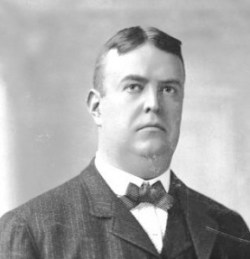
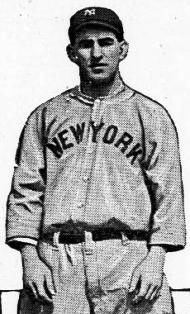
It was widely assumed that American League President “Ban” Johnson had a hand in the transactions that resulted in Frank Chance coming to New York to manage the Yankees in 1913—Chance was claimed off waivers by the Cincinnati Reds in November of 1912, then waived again and claimed by the Yankees a month later.

Ban Johnson

Ban Johnson

William A. Phelon, the sports editor at The Cincinnati Times-Star noted “(T)he strange fact that all the clubs in the older league permitted him to depart without putting in a claim,” as evidence of the fix being in.  And, in “Ban Johnson: Czar of Baseball,” author Eugene Murdock said “Johnson masterminded a series of intricate maneuvers,” to bring “The Peerless leader” to New York.

Chance’s arrival in New York was heralded as a turning point for the franchise, and he made no effort to downplay his confidence.  On January 9, 1913, The Associated Press reported that chance told Yankees owner Frank Farrell:

“I will win the pennant for you before I get through in New York. That may sound like a bold statement to make at this time, but I ask you to remember my promise.”

Frank Chance

Frank Chance

Despite the maneuvers on Chance’s behalf and Chance’s own confidence, he failed miserably in New York. The club finished seventh with a 57-94 record in 1913. The following season, the team was 60-74 when Chance resigned.   The resignation came after a tumultuous season which included charges by Chance that the team’s failures were largely the result of scout Arthur Irwin’s failure to sign decent players.  He also secured a guarantee of his 1915 salary from Farrell before he resigned.

Two months after Chance’s exit, the man who “masterminded” the moves that brought him to New York, unleashed his wrath on the former manager to Ed Bang of The Cleveland News:

“You can say for me that Frank Chance stands forth as the biggest individual failure in the history of the American League.  That’s the sum and substance of what B. B. Johnson, president of the American League said a short time since when “The Peerless Leader” came up for discussion, ‘and what’s more, you can write a story to that effect and quote me as strong as you’d like,’ Ban continued.

“President Johnson had great hopes of Chance molding a winner in New York, and when, after almost two years as the leader of the Yankees, he quit a dismal failure, the blow all but floored Ban for the count.  The American League has always played second fiddle to the Giants in New York, and Ban and other American Leaguers figured that Chance was the man to bring about a change in the condition of affairs.”

Bang said Johnson took Chance’s failure “to heart,” because he believed he “made a ten-strike” for the league when Chance came to New York.  Johnson told him:

“’Chance had the material in New York and I think any other man would have made a success og the venture,’ said Ban.  ‘Surely no one could have done any worse.  Of all the players that were on the New York roster in 1913 and 1914, and there were any number of likely looking recruits, Chance failed to develop even one man of class.  Why, it was an outrage.’

“’And then when he made up his mind that he was a failure, or at least when he was ready to step down and out he had the unmitigated nerve to ask for pay for services that he had not performed.  That surely was gall, to say the least.”

Johnson finished by comparing Chance unfavorably with the Yankees’ 23-year-old captain who replaced him and guided the team to a 10-10 finish:

“’Why, Roger Peckinpaugh, youth though he is, displayed far more class as manager of the Yankees in the short time he was at the helm than Frank Chance ever did.”

peckinpaugh2

Roger Peckinpaugh

Irwin left the Yankees in January of 1915 when Farrell and his partner William Devery sold the team to Jacob Rupert and Cap Huston.  Peckinpaugh remained captain but was replaced as manager by Bill Donovan, who guided the Yankees for three seasons–a fifth, a fourth and a sixth-place finish with an overall record of 220-239.

“Loved Baseball More than He Feared Death”

2 Dec

Robert William “Bob” Osgood was told by doctors that he couldn’t play high school baseball because of a heart ailment.  He was also told he wouldn’t live long.

According to The Associated Press, he begged his parents for a chance to play and “(T)he youth’s parents thought it better that Bob’s playing be supervised and permission was granted.”  By his senior year in 1946, was named to several Massachusetts All-State teams.

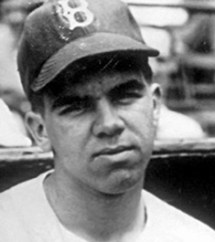
After graduation, Osgood signed with the Chicago Cubs.  His older brother Charles was then playing in the Cubs organization after appearing in one game as a pitcher for the Brooklyn Dodgers in 1944 as a 17-year-old.

Charles Osgood

Charles Osgood


Bob hit .280 in 25 at-bats split between the Cubs’ North Carolina and Appalachian League teams.

No official records exist for Bob Osgood after that, but he was a member of the Visalia Cubs in 1947.

He was assigned to the Springfield Cubs in the New England League in 1948 but missed most of spring training when he was hospitalized with the flu.  On May 7, 1948, Bob Osgood became a member of the Marion Cubs in the Ohio-Indiana League; he was sent to Marion from Springfield after the club’s manager/catcher Lew “Zeke” Bekeza broke a bone in his hand.

Osgood appeared in two games behind the plate; he hit .500 with five singles in ten at-bats.

On May 11, 1948, Osgood was sitting on the bench with teammates during a rain delay in Richmond, Indiana.  The Marion Star said:

“Osgood, a catcher who played his first game for the Cubs last Sunday, collapsed and died in the Cubs’ dugout…The heart attack came as the Cubs team took shelter from a rain storm…At 8:03 p.m. after more than an hour of artificial respiration (two doctors) declared the boy dead.”

His manager, Bezeka told the paper “Osgood had not looked well in his few days with the Cubs and had a blue coloring to his face.”

A postscript:

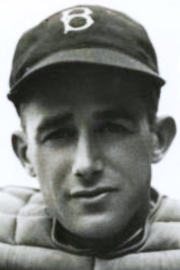
 According to Jack Durant of The Associated Press,  former Reds and Dodgers catcher Clyde Sukeforth, a Dodger scout,  was in the stands and “Seeing the commotion around the bench, rushed out the stands to the dugout,” upon arriving “He knelt beside the boy who loved baseball more than he feared death and when he looked into the stilled features, well he knew who it was—Bobby Osgood, his own nephew.”

Clyde Sukeforth

A shorter version of this post appeared on August 17, 2012.

Armando Marsans’ Tall Tale

19 Oct

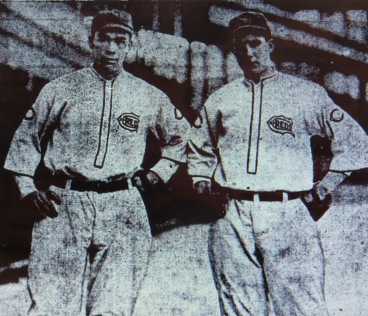
Baseball writers were fascinated by every utterance of the Cincinnati Reds’ two Cuban players, Armando Marsans and Rafael Almeida.  Marsans was the more popular—and more successful—of the two.   He was also the product of well-to-do background.

marsansandalmeida

                           Marsans and Almeida

William A. Phelon of The Cincinnati Times-Star illustrated the cultural difference between the Reds’ two Cuban players:

“(S)omeone asked Almeida and Marsans if they wouldn’t like tickets to a grand opera.  ‘Si, si, accented Marsans, delightedly.  I love grand opera—eet ees fines’ of all entertainment for a gentleman.’

‘I thank you much,” negatived Almeida, “but I care not to go.  To me, grand opera eet sound like de screech of de beeg tomcat, and about so much sensible.’”

Perhaps made up on his own, perhaps captivated by the erudite Marsans, perhaps in on the joke—it wasn’t always clear when Phelon was in on the joke—he quoted Marsans spinning a tale of a Cuban legend in his column in 1912:

“I have seen all the great ballplayers of the present time.  I have been in post-season series against (Napoleon) Lajoie and (Joe) Jackson and have made trips just to see Ty Cobb.  They are wonderful ballplayers, but I give you my word that the greatest I ever looked upon was an Indian named Canella, and popularly called Cinnamon.

“Canella was of a strange Indian race that is supposed to be extinct—the Sibboneys [sic Ciboney] of Cuba, who populated the island when the Spaniards came.  The historians and scientific books all say that they are extinct, and it would doubtless be so, if it were not for the fact that they still live in eastern Cuba and have a little city of their own.  They are tall men with ancient Greek faces—nothing but the color of the Indian to make resemble such men and (John “Chief”) Meyers and (Charles “Chief”) Bender—and they are an athletic people, more agile and active by far than we.  Baseball is their own pet diversion, and Canella, known as Cinnamon, was the greatest of them all.

“Canella, who cannot be over 27 even now, came out a few years ago, and at once became the marvel of eastern Cuba.  He was a pitcher, and a star on the slab, but he was also a batsman, lightening base runner, and clever outfielder.  The records of six years ago show Canella, in some 60 games hit .446 and stole 55 bases.  Havana’s best clubs went up against him and found him invincible while he turned the tide of the closest games with his own batting.

“Canella received no offers from the big American leagues, They took it for granted he was a light colored negro, and when his friends explained that he was an Indian the Americans laughed and said ‘There are no Indians in Cuba—the Spaniards killed them all 400 years ago.’

Armando Marsans

Armando Marsans

“So Canella kept right on playing in Cuba, and he seemed to improve each succeeding season.  At least he became so terrible that even the Havana and Almendares clubs sought excuses to avoid meeting him, and the weaker clubs would face him and get shut out every time.  Finally, some influential Cubans managed to make an American magnate understand that Canella was no Negro, and all was arranged for his tryout in the coming spring.  And then came the news that Canella’s arm was gone, and he could never pitch again.

“It seems that the Indians of Sibboney [sic] still practice the games of their forefathers, and of their favorite sports which is throwing the javelin,  Coming home for a visit, Canella saw the young men of the tribe practicing the spear throw.  Laughingly, he said ‘It is many years since I have done thix—let me try.’ And picking up a slender spear, he hurled it with all his might—and something went snap, crack, in his upper arm as he let go of the javelin.  The arm, so long accustomed to throwing the baseball, gave way when he tried to throw the spear, and never since has Canella been able to throw a ball from the pitching slab as far as the catcher.  It was a shame because Cinnamon Canella was the greatest pitcher, the finest batter, and the fastest base runner that I have ever gazed upon.”

Lost Advertisements–Larry McLean for Sweet Caporal

25 Sep

mclean

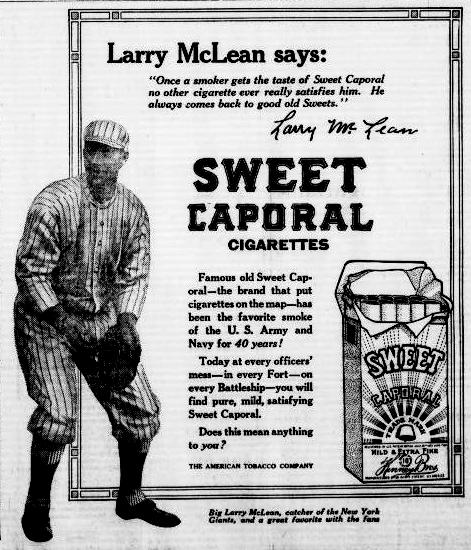
A 1914 Sweet Caporal Cigarette advertisement featuring New York Giants catcher Larry McLean “a great favorite of the fans:”

“Once a smoker gets the taste of Sweet Caporal no other cigarette ever really satisfies him.  He always comes back to good old Sweets.”

McLean wore out his welcome in New York and ended his major league career the following season when he fought with Manager John McGraw, and McGraw’s right-hand man, “Sinister Dick” Kinsella in the lobby of the Buckingham Hotel in St. Louis.

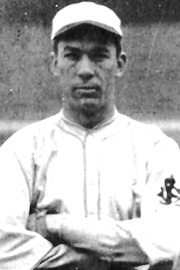
It was hardly the first controversy for McLean, who battled–albeit not physically–with every manager he played for during his 13-year-career.  Sam Crane, the sports writer and former infielder, summed up McLean well in a 1910 article for “Pearson’s Magazine:”

“Larry McLean, of the Cincinnati Reds, as a mere mechanical catcher is hard to beat.  He has a splendid arm and can throw like a streak.  Larry is too, perhaps, the best batting catcher in either league, but his erratic habits make it impossible to place any confidence in him.”

Larry McLean

                                  Larry McLean

A year earlier, in May, McLean had deserted the Reds during an East Coast trip and was “suspended indefinitely” by Manager Clark Griffith, who told The Cincinnati Enquirer:

“When you have a man who is liable to run out at the first call of the wild, you are in an uncertain position all the time. I am perfectly free to say that I might not take McLean back on the team at all, and certainly not until he shows me that he means business.”

McLean was back in the lineup within days, and as he did throughout his career, pledged to a reporter from The Cincinnati Times-Star that he would “(C)onduct himself properly from now on.”

It was a pledge McLean made and broke several times throughout his career which ended at age 33.  He would be dead six years later, the result of a fight in a Boston bar.


The Pursuit of Elmer Foster

9 Sep

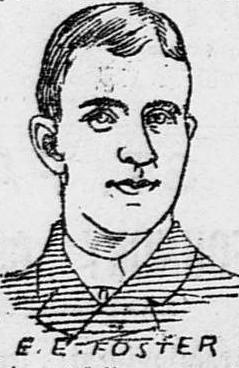
Elmer Ellsworth Foster was the talk of the Northwestern League in 1887.

His career as a pitcher had lasted just one season; in 1884, while pitching for the St. Paul Apostles, he snapped a bone in his arm while throwing a pitch.

Elmer Foster, 1887

            Elmer Foster, 1887

After he recovered, he returned the following year as an outfielder and second baseman with Haverhill in the Eastern New England League and hit .309.

The following spring, The Sporting Life’s Haverhill correspondent said the New York Metropolitans “have taken Elmer Foster from us.”

Hitting just .184 and, as The Sporting Life put it “reckless at the bat,” Foster went back to Haverhill in August.

In 1887, he returned to Minnesota, this time as centerfielder for the Minneapolis Millers.  The club was owned by his brother Robert Owen Foster, a successful dealer of musical instruments, who with his partner J. E. Whitcomb, had taken over operations of the Millers in January.

The Northwestern League of 1887 was a hitter’s paradise owing mostly to the single-season experiments with the four-strike rule and walks counted as hits—nineteen players with at least 350 at-bats hit better than .350—and Foster led with a .415 average and 17 home runs.   While his performance with the bat was noted, he received an equal amount of publicity for his great fielding.

Throughout the season, Minnesota newspapers reported that Foster’s contract would be sold to a major league team—the Indianapolis Hoosiers were the most frequently mentioned—but the deal never materialized.

When the season ended, The Philadelphia Times said Foster was in high demand:

“During the past week agents from nearly every League and Association (club) have been to Minneapolis to secure (Foster) for next season.  (Horace) Phillips of Pittsburgh; (Gus) Schmelz of Cincinnati; Ted Sullivan, agent for Washington; (Emery “Moxie”) Hengel agent for Detroit; (Charlie Hazen) Morton, agent for (A.G.) Spalding, and agents for the Brooklyn, Metropolitan, and Baltimore Clubs have tried to get him.

(John) Day, of New York, sent him this message:  ‘Multrie on the way to Minneapolis.  Make no promise until you see him.’  Boston also wired him for his terms.  (Horace) Fogel of Indianapolis arrived one night and had Foster in tow all the next day.  The bidding of all these clubs has been going on briskly, until now he is offered exorbitant figures by all the clubs.”

Foster called the fight for services a “circus;” it also turned into a controversy, with two teams claiming to have signed him.  The Saint Paul Globe said:

“The circus he speaks of is a curious one, but he is sublimely unmindful of the part he took in it.  The rules of the baseball covenant prohibit the signing of players until Oct. 20…Manager Fogel of Indianapolis approached Foster before that time and made a verbal contract with him, but Manager (Jim) Mutrie, of New York, took him out to Delano (Minnesota), and after midnight  (on the 20th) got his signature.”

Jim Mutrie

                       Jim Mutrie

Years later, Ted Sullivan, who was perusing Foster on behalf of his Washington Nationals, described Mutrie’s method to sign Foster as a kidnapping:

“Jim Mutrie of New York (Giants) grabbed the great fielder Foster on the streets of Minneapolis…bound and gagged him, threw him into a cab and brought him ten minutes out of the city, held him there and dined and wined him until midnight…then compelled him to take $1000 advance money and a contract of $4500 (various other sources put Foster’s salary at $2400, and $4000).”

Foster, it turned out, didn’t simply have a “verbal contract” with Fogel and Indianapolis when he disappeared with Mutrie, but had, as The Sporting News said, accepted “a draft for $100,” from Fogel at the time the two agreed to terms.  Fogel and Indianapolis owner John T. Brush told The Indianapolis News and The Indianapolis Times that there was “a written agreement” between Foster and the club.

Foster’s wife gave birth to a daughter during the height of the controversy.  He told The Globe:

“If she had been a boy I would have named him Mutrie Fogel, in memory of the baseball managers I have been having a circus with.”

In the end, Indianapolis acknowledged that the agreement with Foster, whether written or verbal, was entered into three days before the legal signing date of October 20 and National League President Nick Young awarded Foster to the Giants.

Foster never had success at the plate during his brief major league career; he hit just .187 in 386 at-bats over parts of five seasons.  But Mutrie called him “(O)ne of the best fielders in the country,” and Sullivan said of Foster’s time in the National League, “(H)e was a wonderful fielder in that league.”

Elmer Foster

      Elmer Foster

After he was released by the Giants, he played 31 games with the Chicago Colts in 1890 and ’91, but his brief stay with the club allowed his name to live on with fans long after his career ended.  One of the favorite subjects of Chicago sportswriter Hugh Fullerton, who called him “The rowdy of the rowdies,” Foster’s name was a staple of Fullerton’s stories for three decades after his career ended.

“The Sock on the jaw ended the game and their Friendship”

2 Sep

In June of 1922, Seventy-two-year-old Cal McVey was still working; more than 40 years after his final game with the Cincinnati Reds, he was a night watchman at a San Francisco lumber company.

A reporter from The San Francisco Call and Post called him to let him know the National League had just voted him a monthly pension.

“It was welcome news to the old-timer.  Jobs have been more and more infrequent and difficult to hold…Rheumatism and other ills of advancing age have meant weeks in the hospital…The idea of a benefit for the veteran had been suggested and abandoned, for the name ‘Cal McVey’ carried little significance to the bulk of 1922 fans.”

A benefit game on McVey’s behalf between two military teams held in 1919 at San Francisco’s Recreation Park had drawn a very small crowd.

The paper said

“(T)he league will only be doing what is partially due a man who was one of the real founders of organized baseball and one who did his full share toward keeping the game out of the clutches of the gamblers.”

McVey had been “approached” while playing for the Boston Red Stockings.

“This gambler was a friend of Cal and the two were playing billiards one day in Boston when the proposition was made…(McVey hit the gambler) so hard on the jaw that he forgot all about baseball and everything else for awhile…The sock on the jaw ended the game and their friendship.”

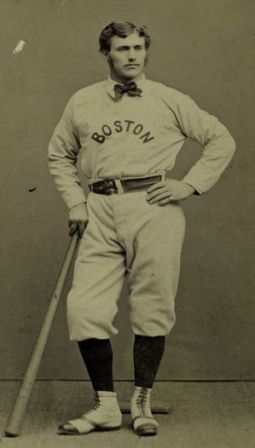
Cal McVey

                   Cal McVey

The Call and Post claimed McVey left major league baseball behind while still in his prime at the age of 30 partly as a result of his disdain for gamblers.  After the 1879 season, McVey, then manager of the Reds came to the West Coast with the team for a series of games with the Chicago White Stockings and local teams:

“Cal suspected two men on his team of being too friendly with gamblers.  But he could not prove anything on them, nor could he get the owner of the club to fire them (and) he was disgusted that fall because his team did not win the pennant when he thought it had the class to do so.”

After finishing in second place in 1878, the Reds added shortstop Ross Barnes and had high expectations for the 1879 season—McVey replaced Deacon White as manager in June—they finished the year 43-37 (34-28 under McVey) in fifth place.

McVey “took a flyer” on an investment in a mine while in California and The paper said he was “unlucky enough” to have quickly made a $3500 profit—he earned $2000 with the Reds that season.

“That settled it.  No more baseball for him (not entirely, McVey did play in the California and Pacific Leagues in 1880 and played with some independent teams in the mid-1880s). He was cut out for a mining broker.  He sold his stuff in Cincinnati and moved to San Francisco.”

McVey was successful in San Francisco until the 1906 earthquake and resulting fires:

“Cal was running a cigar store at Third and Folsom Streets…His wife (Abbey) was hurt in the disaster and, after a lingering illness of two tears, she died.  Cal says the light of his life went out when his wife died.”

After the loss of his wife and business, McVey worked a series of jobs.  In 1913, a wire service report said he had been “crippled” in a mine explosion in Nevada and friends in California asked many of his former teammates to help him financially.

It is unclear how incapacitated McVey was from the accident, in 1919 he was healthy enough to travel to Cincinnati for the World Series, but by 1922, when the National League granted his pension, McVey was nearly destitute and in poor health.  He told the reporter who called him with the news he “was proud today that the National League had ‘remembered an old fellow like me.’”

McVey 1922

                  McVey 1922

McVey died in San Francisco four years later.

“He is a Model for the Young Ballplayer to Emulate”

21 Aug

March of 1916 was a bad month for “Prince Hal” Chase.

According to The International News Service, Chase, who spent the winter in San Jose, California playing for the Maxwells—a team sponsored by the automobile company–was “the last of the stars” of the defunct Federal League who had still not signed with a professional team.
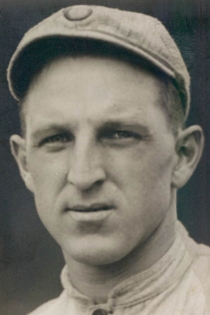
Hal Chase

                          Hal Chase

It got worse when he was arrested for failure to pay alimony and support to his ex-wife Nellie and their son Hal Jr.

He was released on $2000 bond, and it is unclear whether the case was ever fully adjudicated. After his release, Chase continued playing with the Maxwells and working out with Harry Wolverton‘s San Francisco Seals while rumors of who he would play for during the regular season were advanced on a daily basis.

The strongest rumors were that Chase would go to the New York Giants in a deal which would include Fred Merkle, who would be displaced at first base, going to the Chicago White Sox, the team Chase jumped to join the Federal League.

The Pittsburgh Post-Gazette said the deal was eventually foiled by Pirates Manager Jimmy “Nixey” Callahan, who “refuse(d) to waive.”

At the same time the papers in Cincinnati said Chase would be joining the Reds while West Coast papers said he might stay in California and join the Seals.

The Cincinnati Enquirer said Reds’ Manager Charles “Buck” Herzog “vigorously denied,” that Chase would join his club and said he would stick with Frederick “Fritz” Mollwitz at first base.
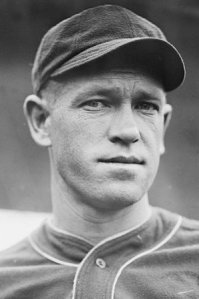
Buck Herzog

                     Buck Herzog

Herzog was even more forceful in his denial in The Cincinnati Times-Star:

“I wouldn’t have Chase at the camp.  Mollwitz is a very much better player, and he won’t jump when he is most needed.”

An even stronger indictment of Chase came from Detroit Tigers Manager Hugh Jennings, who told The Detroit News:

“As a player, there is nobody who can touch Chase for holding down first base.”

Jennings went on to note Chase’s intelligence, speed, and “superb” fielding:

“Yet for all his ability I would not have him on my club, and I do not believe any other major league manager will take a chance on him.  He will not heed training rules and has a demoralizing influence on the younger players.”
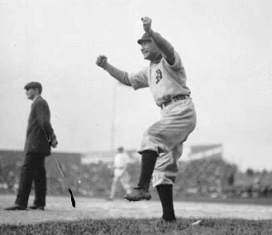
Tiger Manager Hugh Jennings

Tiger Manager Hugh Jennings

Jennings said while Chase managed the New York Highlanders in 1910 and ’11, led his team “astray,” instead of “trying to keep his players straight.”

Perhaps most damaging, Jennings said Chase was a source of dissent on the clubs he played for:

“One of his favorite stunts is to go around telling on man what another is supposed to have said about him, with the result that in a very short time he has the fellows pulling in all directions  instead of working together.  He is apt to take a dislike to the manager and work against him with the players until the whole squad is sore and will not give the sort of work that it is paid for.”

Jennings, whose team finished second in 1915 with George Burns at first base, said:

“The Tigers would win the pennant beyond question with a player of Hal’s ability on first this season, but I wouldn’t risk introducing a man who had such a bad disposition.  I believe that we can accomplish better results by having harmony on the squad, even if we have to get along with a first baseman with less talent.”

Despite the negative press, and over the objection of Herzog, the Reds purchased Chase’s contract from the defunct Buffalo Blues on April 6.

The New York Times lauded the move and defended Chase against his detractors.  The paper said “His failure with the New York Americans was due to petty controversies and rebellion against the club’s discipline,” and “(W)hen he is at his best there is not a player in the major leagues who is more spectacular than ‘Prince Hal.’”

Chase initially balked at reporting to Cincinnati, telling The San Francisco Chronicle “I haven’t made up my mind…it is possible that I would prefer to remain in California, even if there is no chance to play ball.”

Six days later, while his new team opened the season, Chase was on a train to Cincinnati.  The Associated Press said he agreed to join the Reds after receiving “word from Cincinnati that his entire contract with the Federal League, which calls for a salary of $8,000 a year, has been taken over,” by the Reds.

When Chase arrived in Cincinnati on April 15, the Reds had won three straight after losing their opener, and Mollwitz had played well at first base with five hits in 13 at-bats and just one error.

According to Frederick Bushnell “Jack” Ryder–college football star and Ohio State football coach turned sportswriter–of The Enquirer, Herzog had no intention of putting Chase in the game April 16:

“Herzog had little thought of playing him, as Fritz Mollwitz was putting up a bang-up game and hitting better than any member of the club,” until “Mollwitz made a bad mental mistake in the third inning.”

After Umpire Hank O’Day called a strike on Mollwitz, “the youngster allowed his tongue to slip,” and was ejected.
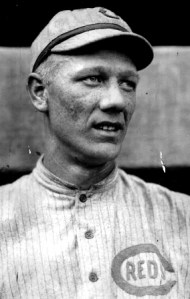
Fritz Mollwitz

                 Fritz Mollwitz

Chase came to bat with an 0-2 count and doubled off of Pirates pitcher Frank Miller, stole third, and after catcher Tommy Clark walked “(Chase) caused an upheaval in the stands by scoring on (a) double steal with Clark.”

Chase also wowed the crowd in the ninth.  After making “a nice stop” on Max Carey’s hard ground ball over first base and with pitcher Fred Toney unable to cover first in time, Chase dove “headforemost to first base to make a putout on the fleet Carey.”

In all, he played 98 games at first base, 25 in the outfield, and 16 at second base, he also hit a league-leading and career-high .329.

While the Reds struggled, Chase was wildly popular in Cincinnati.  The Enquirer’s Ryder was possibly his biggest fan—the writer raved about Chase’s performance in the outfield, his adjustment to playing second base, and his consistent bat.

While Chase thrived, Herzog, who had a contentious relationship with Reds’ owner August Herrmann, exacerbated by the signing of Chase against his wishes, began to unravel as the season progressed.  On May 30, he was hit in the head and knocked unconscious, by a throw from catcher Ivey Wingo during pregame warm-ups.  While he recovered physically, he became increasingly frustrated by the club’s performance.  On July 5—with a 29-40 record– he announced that he would retire at the end of the season when his contract expired.  He told The Times-Star:

“It would be a great blow to my pride to continue as a player, after being a manager for three years.”

The following day it was reported that the Chicago Cubs and New York Giants were interested in acquiring Herzog.  Within a week, it was reported that Herzog was heading to New York in a trade that would bring Christy Mathewson to Cincinnati to manage.  The negotiations continued over several days but floundered.  The Cubs reentered the picture—Owner Charles Weeghman told The Chicago Daily News “I brought the bankroll along…and I’ll get Herzog so quick I’ll make (the Reds) eyes pop.”  He later told the paper he offered “$25,000 and an outfielder” for Herzog.

At the same time The Brooklyn Daily Eagle said the Dodgers were after Herzog, and The Pittsburgh Post said the Pirates were in pursuit as well.

The pressure got to Herzog who held himself out of the lineup of July 17, The Enquirer said:

“The managerial situation is worrying Herzie, who had expected by this time to be cavorting at the third corner for the giddy Giants.  With the deal held off for various reasons, the Red leader is naturally a bit anxious.”

Herzog’s destination was unclear, but it was clear he would be gone.  With Mathewson seeming to be out of the picture, rumors persisted—fueled by Ryder of The Enquirer and William A. Phelon in The Times-Star—that Chase would be the new manager.

On July 20, Ivey Wingo managed the team to a doubleheader split with the Philadelphia Phillies, and the papers reported on Herzog’s successor:

The Enquirer ran Chase’s picture under the headline “Reds’ New Manager,” although they hedged in another headline which said he would “probably” be named.

The Times-Star said “Hermann has decided to allow Hal Chase to manage the team for the remainder of the season, and for this reason he does not want Mathewson.”

They were both wrong.

Within hours of the papers hitting the streets, a trade involving three future Hall of Famers was agreed to.  Herzog, along with catcher Wade “Red” Killefer went to New York for Mathewson, Edd Roush, and Bill McKechnie.  Mathewson was immediately named manager.
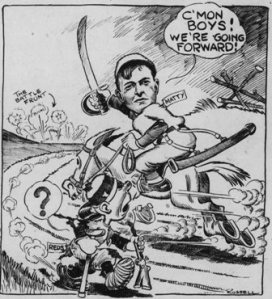
Cartoon accompanying the announcement of Mathewson's appointment.

          Cartoon which accompanied the announcement of Mathewson’s appointment.

Ryder said in The Enquirer that “Chase was greeted with a great round of applause” when he stepped to the plate for the first time on July 20:

“The fans at that time did not know of President Herrmann’s change of mind with regard to Matty, and they thought Chase was the new leader of the team.  The universal and hearty applause showed how popular the star third-sacker has become in this town.”

The Chase story is well-known; two years later Mathewson would suspend him, charge him with “indifferent playing.”  With Mathewson in Europe when the charges were heard by National League President John Heydler that winter, three Reds teammates, and Giants Manager Pol Perritt testified Chase had thrown games.

But in October of 1916 Chase appeared to have repaired his reputation, and his difficult March appeared to be far behind him.  In a season wrap-up, The Enquirer–there was no byline on the article, but it was likely the work of Ryder–published a glowing profile of the National League’s leading hitter and the man who nearly became the Reds’ manager:

“What has become of all the talk about Chase being a bad actor, a disorganizer, a former of cliques and a knocker of managers?  All gone to the discard.  Chase has not only played brilliant ball for the reds all season, but he has been loyal to the club and the managers.  He worked hard for Herzog and equally hard for Matty.  He has been a wonderful fellow on the club.  Chase is modest and does not seek notoriety or approbation…He played game after game in midseason when he was so badly crippled with a Charley horse that he could scarcely walk.  When Manager Herzog wanted to make an outfielder out of him he went to the garden and played sensational ball…Later in the season he filled in for several games at second base, a difficult position for a left-hand thrower, but he put up great ball there.  He is a natural ballplayer of the highest class, and with it all a perfect gentleman, both on and off the field.”

The profile concluded with this assessment of the man who would become synonymous with the baseball’s greatest sins:

“Chase has been a great man for the Reds, and there is many a manager of today who wishes that he had got in ahead of the Cincinnati club in signing him.  He is the smartest ballplayer and the quickest thinker in the National League today.  He is a model for the young ballplayer to emulate, because he is a real artist in his profession.”