Tag Archives: Cleveland Indians

Buddy Ryan

15 Oct

During the 1912 season pitcher Bob Groom was having what would be the best season of his career; he was 24-13 with a 2.62 ERA for the Washington Senators.

His former teammate John “Buddy” Ryan was hitting .271 during his first season with the Cleveland Naps.

Groom and Ryan had been teammates with the Portland Beavers in the Pacific Coast League (PCL) in 1908. Ryan claimed that while they played together Groom had nearly quit baseball.  According to The (Portland) Oregonian:

“(Groom) was a most sensitive fellow.  One day we were playing San Francisco and had them 4 to 1 in the sixth inning, when Groom became a trifle wild , Mac (Walter “Judge” McCredie) jerked him after he had filled the bases with none out.  Bobby did not like it and he threw off his glove angrily and walked to the bench made as a wet hen.

According to Ryan, when Groom reached the bench he told McCredie he was through with the “blamed old club” and was going home.  All three San Francisco runners scored, tying the game.  The following inning:

“We got the bases full and (Otis) Ote Johnson up, when Groom ambled dejectedly out of the clubhouse, carrying his little grip with all of his baseball togs and stuff in it.  He got about as far as third base when Ote landed on one for one of those long triples of his, and Bobby forgot about quitting the club and going home, for he threw his cap, grip and everything in the air and yelled ‘Come on you Swede boy, it’s good for three.’ We won the game and Bobby never said a word about going home.”

Bob Groom
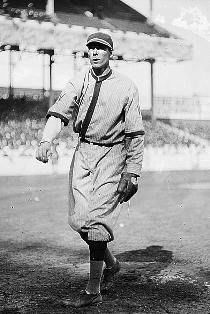
Bob Groom

Bob Groom remained in the big leagues through the 1918 season, compiling a 119-150 record with Washington, the St. Louis Brown, Cleveland Indians and St. Louis Terriers in the Federal League.

Buddy Ryan spent just two seasons in the major leagues, hitting .282 as Cleveland’s fourth outfielder in 1912 and 1913.  He returned to the Pacific Coast League and became one of the league’s most popular figures for the next twenty years.
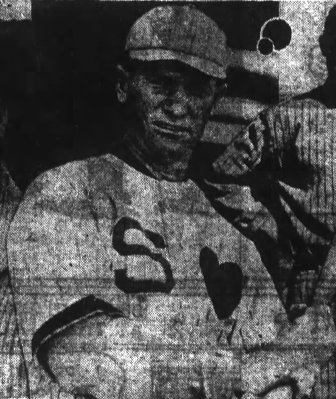
buddyryan1

Buddy Ryan

His unusual wedding made headlines in 1915:

“John F. (Buddy) Ryan, one of the best-known and popular baseball stars on the Coast, was arrested early yesterday morning on a charge of immorality preferred by Deputy District Attorney Richard Ceich. At 2:08 PM he was married by Municipal Judge Stevenson to Miss Ruby Winters and the charge was dismissed.

“Miss Winters, who was at first held as a witness against the ballplayer, has been living with him for nearly 10 years, according to her statement, and has been known as Mrs. Ryan.  She said yesterday that she had asked Buddy to marry her several times.”

Failing that, she had him arrested:

“With Ed Kennedy (Ryan’s former Portland teammate and county jailer), as best man, the two were wedded in the Municipal Courtroom yesterday afternoon.  The bride wept for several minutes following the ceremony.  Mr. and Mrs. Ryan left last night for the training camp of the new Salt Lake Coast League team.”

Ryan had his best season in Salt Lake City in 1915, hitting .340 for the Bees.  That winter he had an emergency appendectomy and developed an infection, the newspaper headlines said his condition was grave: The San Francisco Chronicle said he was “In Very Bad Shape,” The San Bernardino News said “Buddy Ryan Near Death.”

Ryan recovered in time to return to the Bees for the beginning of the 1916 season.  He hit better than .300 the next three seasons, and after the completion of the PCL’s war-shortened 1918 season he played for and managed a team in Seattle’s Puget Sound “Shipyard League.”

He sat out the 1919 season and returned to the PCL in 1920—the rest of his story tomorrow.
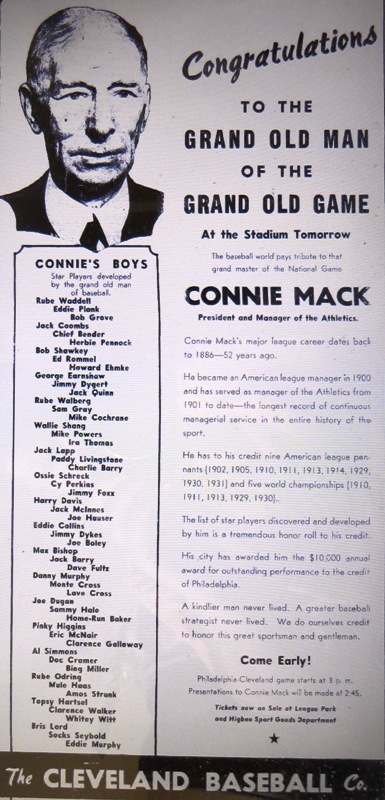
Lost Advertisements–Connie Mack Day in Cleveland

6 Sep

???????????????????????????????

A 1938 Advertisement printed in Cleveland newspapers for Connie Mack Day.

The Philadelphia Athletics manager was honored on June 19 in front of 20,000 fans at Cleveland Stadium.  The ad listed every “star player developed by the grand old man of baseball.”

The baseball world pays tribute to that grand master of the National Game

Connie Mack

President and Manager of the Athletics

Connie Mack’s major league career dates back to 1886–52 years ago.

He became an American League manager in 1900 and had served as manager of the Athletics from 1901 to date–the longest record of continuous managerial service in the entire history of the sport.

He has to his credit nine American League pennants (1902, 1905, 1910, 1911, 1913, 1914, 1929, 1930, 1931) and five world championships (1910, 1911, 1913, 1929, 1930).

The list of star players discovered and developed by him is a tremendous honor roll to his credit.

His city has awarded him the $10,000 annual award for outstanding performance to the credit of Philadelphia.

A kindlier man never lived.  A greater baseball strategist never lived.  We do ourselves credit to honor this great sportsman and gentleman.

The Cleveland Plain Dealer said Mack was presented with “a handsomely bound leather book in which were the signatures of every person in organized baseball from Judge Kenesaw Mountain Landis down to the greenest rookie in the West Texas-New Mexico League.”  Cleveland’s baseball writers also presented Mack with an engraved gold pencil.

The Plain Dealer and The Cleveland News both noted that when Mack addressed the crowd he added an “n” to Indians president Alva Bradley’s first name; The Plain Dealer said:

“Mr. Mack always had a tough time with names of his friends and players.  For years he has called ‘Lefty’ Grove ‘Groves’ and Lou Gehrig “Garridge.’ In fact he never has attempted to call his second baseman, (Dario) Lodigiani, anything but ‘Lodi’ for this season.”

The league-leading Indians beat Mack’s Athletics 5 to 4.

“And they Started Hitting like Demons”

4 Sep

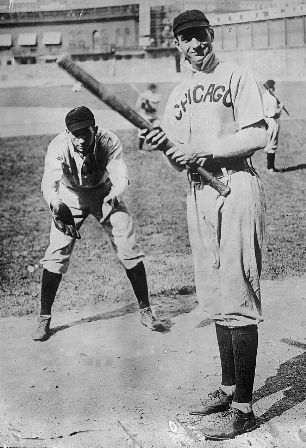
Arthur “Artie” “Circus Solly” Hofman was one of the best utility men in baseball, and a member of four Chicago Cubs teams that went to the World Series.  When he was traded to the Pittsburgh Pirates in May of 1912, Bill Bailey of The Chicago American told a story about Hofman, baseball bats and why baseball players are superstitious about them:

“Some fans might think that Artie can hit with most any old stick that comes along, but he himself is very exacting about the one he picks out before he goes up to the plate.  There is always a great line of bats laying out in front of the players bench during a game.  Most of them are special makes of the big sporting goods companies and most of them are expensive products.”

Bailey said during the 1911 season the Cubs were mired in a mid-season hitting slump:

“And Hofman conceived an idea.  He was wandering through a department store in town when he saw a couple of bats on display.  They weren’t anything like the kind the Cubs had been using. “

Circus Solly Hofman

Circus Solly Hofman

Told the bats cost twenty-five cents each Hofman bought dozens of the bats and had them delivered to the West Side Grounds:

“Hofman took one himself and distributed the rest among his teammates…Every man in the lineup used one of Hofman’s bats that afternoon.  And they started hitting like demons.  Naturally they continued using the cheap bats. And they went on a batting rampage that lasted for a long time.  Everybody was slugging the ball.  When things like that happen, is it any wonder that the players have their superstitions about bats?”

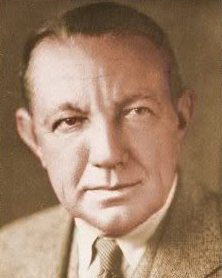
“Bill Bailey” was the pen name of Bill Veeck Sr., who would become vice-president of the Cubs in 1917, and president of the club in 1919.  He, of course, was also the father of Cleveland Indians, St. Louis Browns and Chicago White Sox owner Bill Veeck.

Bill Veeck Sr./"Bill Bailey"

Bill Veeck Sr./”Bill Bailey”

Hofman’s greatest claim to fame was being the Cubs centerfielder on September 23, 1908.  He fielded Al Bridwell’s single that scored Harry “Moose” McCormick, seemingly giving the New York Giants a 2 to 1 victory.  It was  Hofman, according to umpire Hank O’Day, who realized that Fred Merkle of the Giants, who had been on first base,  failed to touch second before leaving the field.  “Merkle’s Boner” remains baseball’s most famous base running blunder.

Lost Advertisements–Old Underoof Whiskey, Cubs and White Sox

2 Aug

OO62010


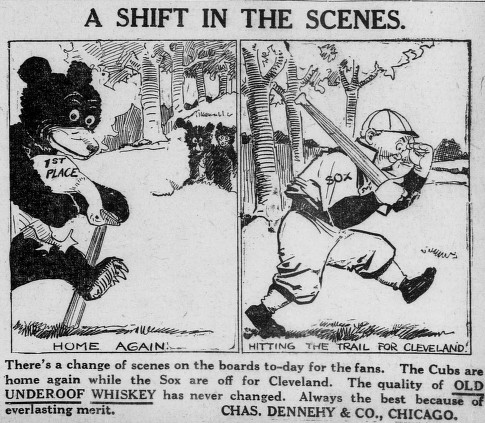
Two more 1910 advertisements for Old Underoof Whiskey featuring the Chicago Cubs and White Sox; these appeared in The Chicago Daily News and The Chicago Examiner.

The one above “A Shift in the Scenes” is from June 20, 1910.  The Cubs were returning home after a 10-4 road trip which put them 4 ½ games ahead of the second place New York Giants, while the struggling, seventh place White Sox were heading to Cleveland for a six game series.

The one below “It’s a Rocky Road to Pennantville” appeared just 10 days later.  The Cubs, who had won four straight games after the first ad appeared, just lost five of seven to the Pittsburgh Pirates, St. Louis Cardinals and Cincinnati Reds, cutting their lead over the Giants to a game and a half.

The White Sox would continue to struggle; they finished the season 68-85.  The Cubs would run away with the pennant, beating the Giants by 13 games.

OO63010

Luke Easter, Sausage King

31 May

???????????????????????????????

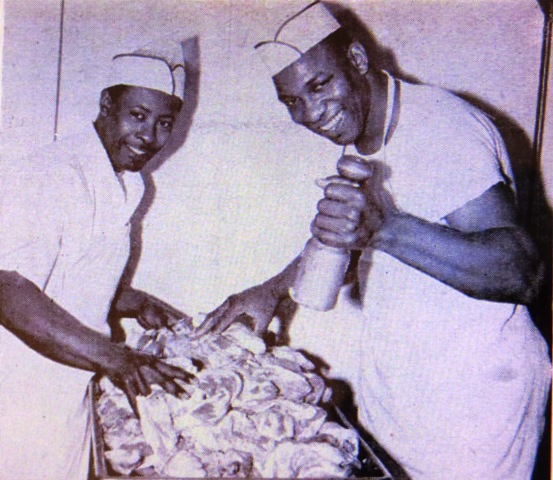
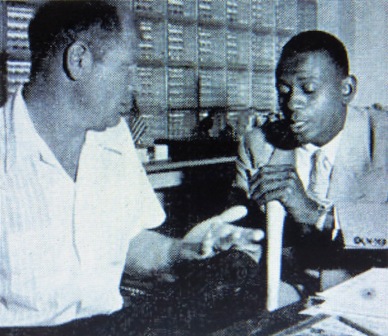
Between the 1952 and ’53 season, Cleveland Indians first baseman Luke Easter (r) went into the sausage business with his brother-in-law Raymond Cash (l).  The business, Ray’s Sausage still operates in Cleveland.  In a Jet Magazine article  Easter said they only managed to sell 20 pounds their first week, but by January of 1953 they were selling 2,300 pounds a day.  The article said Easter had “taken out a license to place his sausage on sale” at Indians games.  He said:

“I can make this business go by hitting lots of home runs (but) even if our sausage makes a million dollars I won’t quit baseball, I’ll stay in baseball as long as I can walk.”

During the fourth game of the 1953 season Easter was hit by a pitch, breaking a bone in his foot, as a result the 37-year-old, who had hit 31 home runs with 97 RBIs in 127 games the previous season, dropped to 7 and 31 in 68 games;  his career with the Indians ended after only 6 games in 1954.  But while Easter didn’t hit “lots of home runs” in Cleveland after starting the company, he did stay in baseball for almost “as long as (he could) walk.”

Playing primarily in the International League with the Buffalo Bisons and Rochester Red Wings, Easter remained in baseball until 1964, hitting more than 235 homes runs.

Easter was killed in a hold up in Cleveland in 1979.  The Cleveland Plain Dealer editorialized the day after his death:

“For all of his huge size and great strength, Luke Easter was a gentle man.  It is a contradiction to the way in which he lived that his life should be ended violently.

“He had courage.  He played first base for the Cleveland Indians from 1949 to 1954, a time when it was far from easy to be a black athlete in the major leagues…He was shot dead yesterday at age 63, victim of a cowardly attack from ambush outside a bank office .

“It is a wound to the community.  Luke Easter, athlete and gentleman, will be missed.”

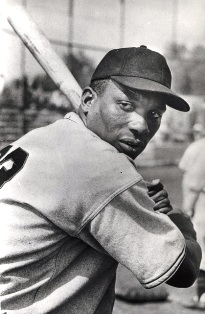
Luke Easter, 1949

Luke Easter, 1949

McCloskey, Mays and Hair Color

12 Mar

Carl Mays is best known for being the pitcher who hit Cleveland Indians shortstop Ray Chapman with a pitch, resulting in the only hit by pitch death of a Major League player. In fifteen seasons he posted a 208-126 record with a 2.92 ERA.

Five years before he became infamous for Chapman’s death, Mays became embroiled in a strange feud with former National League manager John James McCloskey; the dispute was over hair color.

Carl Mays

Carl Mays

In December of 1914, McCloskey was a well-respected figure in baseball, credited with being the “father” of the original Texas League in 1888, he had spent five seasons as manager of the Louisville Colonels and St. Louis Cardinals in the National League, and another 23 as a minor league manager and owner.

Mays was coming off a 24-8 season for the Providence Grays in the international League, and while called up to the Red Sox in the closing weeks of the season had not yet appeared in a big league game.

The controversy originated when Charles “Toby” Fullerton, a pitcher for the Seattle Giants in the Northwestern League was quoted in an article that appeared in The Pittsburgh Press and several other papers about pitcher “Seattle Bill” James, who had just led the Boston Braves to a World Championship. Fullerton said when he and James were teammates in Seattle in 1912, manager Shad Barry had, “condemned the youngster for being a blond,” he then was quoted saying McCloskey also, “has no use in the world for blonde ball players.”

“Seattle Bill” James

The strange, silly, throwaway quote should have been the end of it, but it was apparently serious enough for McCloskey to issue a long denial from his home in Louisville, Kentucky. The full-page letter McCloskey wrote appeared in more newspapers than the original story, and read in part:

“Let me say, I have been accused of every crime in the calendar, but this is too much.”

McCloskey claimed the “rumor” originated when he was managing the Milwaukee Brewers in the American Association in 1910. Outfielder Rube DeGroff played for McCloskey (incidentally, Shad Barry was also a member of the team), and according to McCloskey:

“We were playing in Kansas City, we were behind…and made a big rally that came near giving us the game. The bases were full in the last inning, with two men out, when the big, blonde and good-natured Rube DeGroff, who was a splendid all-around player and life of the club, came to bat with the bases full and struck out. I was sore over losing the game and made the remark that I never saw a cotton-top who ever made good in a pinch.”

McCloskey said he also believed anything Barry might have said to or about James was certainly a joke, and closed with a final defense:

“In fact, in my humble opinion, I think the blonde has a shade over the brunette. But why the color of a man’s hair should have anything to do with his ability as a ball player is a mystery to me, and I hope this explanation will put an end to these silly rumors.”

It didn’t.

Within days Carl Mays weighed in, claiming that he had twice been rejected for an opportunity to pitch for McCloskey’s Ogden Canners in the Union Association because he was blond.

Mays said:

“McCloskey is a liar pure and simple…In 1912, when I was on my way to Boise to try out for the Boise team; I stopped off at Ogden, thinking possibly owner McCloskey might give me a trial. I met him downtown in a billiard parlor and went up and introduced myself.

“McCloskey looked me over carefully, like a horse-trader examining a piece of horseflesh, and then suddenly espied my blond hair. ‘No,’ said he coolly, ‘I don’t want you. In fact I wouldn’t have you around the ranch. I don’t want any blonds in my camp.’”

Mays also claimed that later in 1912 while compiling a 22-9 record for the Boise Irrigators in the Western Tri-State League; he was nearly sold to McCloskey’s pitching-strapped Ogden Canners until:

“One of the Ogden players happened to mention the fact that he was the same blond-haired fellow who had asked for a job earlier.”

According to Mays, McCloskey said:

“’Deal is off. Send that white-haired guy over here and I’ll kill him.’”

The story stuck with McCloskey for more than 20 years. A 1916 story in The Providence Tribune said:

“Scouts all over the country know McCloskey and never did one in his employ recommend a light-haired ballplayer…His peculiarity was well-known, and he knew that no one would have the temerity to recommend to him a blond or light-haired ballplayer. “

The black-haired John McCloskey

The black-haired John McCloskey

In 1934, The Milwaukee Journal called McCloskey, “one grizzled veteran who frowned on blond athletes.”

The article quoted E. Lee Keyser, a long-time minor league executive, who said when McCloskey managed Butte, “One of (McCloskey’s) players was an Indian outfielder whose hair was black,” the player struck out in a critical situation. According to Keyser, when the unnamed player returned to the clubhouse later, McCloskey grabbed his hair and said: “I just want to know if you’re wearing a wig. You hit like a blond.”

McCloskey managed in the minor leagues until he was 70-years-old, he died eight years later in 1940.

Veeck and Paige–a third time?

27 Feb

In 1959, when Bill Veeck purchased the White Sox rumors swirled in Chicago that the Sox owner was planning on having Satchel Paige start on Opening Day. Later, as the Sox were making a run for their first American League Pennant in 40 years the rumors resurfaced that the ageless Paige would join the White Sox for the Pennant run.

???????????????????????????????

Bill Veeck and Satchel Paige, 1959

Paige, who had played for Veeck with the Cleveland Indians and St. Louis Browns, had spent 1956-59 with the Miami Marlins in the International League, winning 31 games. He had returned to barnstorming with the Cuban Giants and Indianapolis Clowns in 1959, but it was reported he was looking for another chance in the Major Leagues, and in June it began to be reported again that Paige would be joining the Sox.

A United Press International story in July said that Veeck had “sent Paige two new Chicago White Sox uniforms,” and quoted Paige:

 “If they want me they’d have to pay me big money.  I’m not going back for nothing.”

Whether it was ever a serious discussion, or simply two famous showmen milking rumors for the maximum publicity will never be known, but Veeck and Paige let the rumors swirl well into August before Veeck finally put them to rest, telling Jet Magazine:

“We’re not giving any thought to hiring him.  I’m very fond of LeRoy and I see him whenever he’s in town.  I gave him the uniforms because we’re old friend and for no other reason.”

And with that White Sox fans missed the chance to see the pitcher who Veeck called “The best righthander baseball has ever known,” pitch for the 1959 Pennant winners.

Gaines and Raines

12 Feb

???????????????????????????????

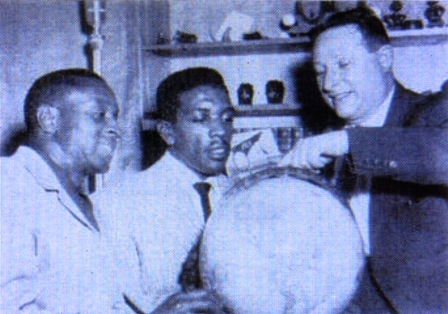
Two of the early foreign players—or gaijin—and the third and fourth African-Americans to sign to play baseball in Japan pose with the man who negotiated their contracts in 1953: Jonas Gaines, left and Larry Raines with Abe Saperstein of Harlem Globetrotters fame.

gaines

Jonas Gaines

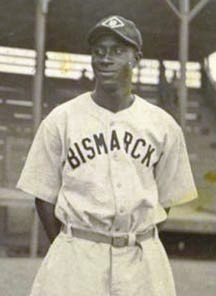
Gaines, born in either 1914 or ’15 depending on the source, was nearing the end of a long career; a graduate of Southern University, he played semi-pro ball in North Dakota then began his professional career with the Newark Eagles in 1937, went to the Baltimore  Elite giants in 1938 and appeared in five East-West All-Star games.  Gaines served in the US Army in WWII and  finished his Negro League career with the Philadelphia Stars in 1950.  He spent 1951 and ’52 with the Minot Mallards in the Manitoba-Dakota (Man-Dak) League.

He spent one season in Japan with the Hankyu Braves in the Pacific League, where he was teammates with Raines.  The Braves third gaijin was another former Negro League player, John Britton.  Britton and Jimmy Newberry were the first two African-American players in Japan, having signed together in 1952.  Newberry, like Gaines, left after one season.

Gaines returned to the states in 1954 and led the Pampa Oilers, champions of the West Texas-New Mexico League, with 18 wins.  He finished his career with the Carlsbad Potashes in the Southwestern League in 1957. He died in his native Louisiana in 1998.

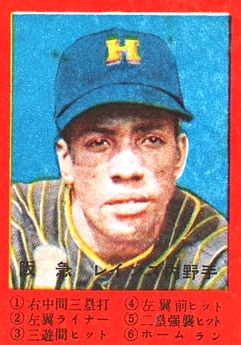
Larry Raines, Japanese baseball card

Larry Raines, Japanese baseball card

Raines was a twenty-two-year-old infielder for the Chicago American Giants and hit .298 in 1952.  Saperstein, who helped engineer the deal that brought Britton and Newberry to Japan, negotiated the contracts for Gaines and Raines, who according to Jet Magazine were paid $1000 a month by the Braves.

Raines quickly became a star in Japan, leading the Pacific League with 61 stolen bases in 1953; he led the league with a .337 batting average, 96 runs and 184 hits, he also finished second in RBI’s in 1954.

Raines returned to the states and signed with the Cleveland Indians in 1955.  After two seasons in the minor leagues, he played in 96 games for the Indians in 1957.  He appeared in nine games with Cleveland in 1958 and played in the minor leagues until 1961.  Raines returned to Japan in 1962, playing one more season with the Braves.  He died in Michigan in 1978.

Moriarty and Cobb

5 Feb

While the Detroit Tigers captain “jinx” almost cost George Moriarty his captaincy in 1912, he was also nearly traded to the Cleveland Naps in December of 1911.  The reason given for the Tiger’s desire to trade Moriarty was an alleged fight with Tigers star Ty Cobb.

Whether the fight actually took place is questionable, and an oft-told story about Cobb and Moriarty that grew out of the fight rumor is almost certainly untrue.

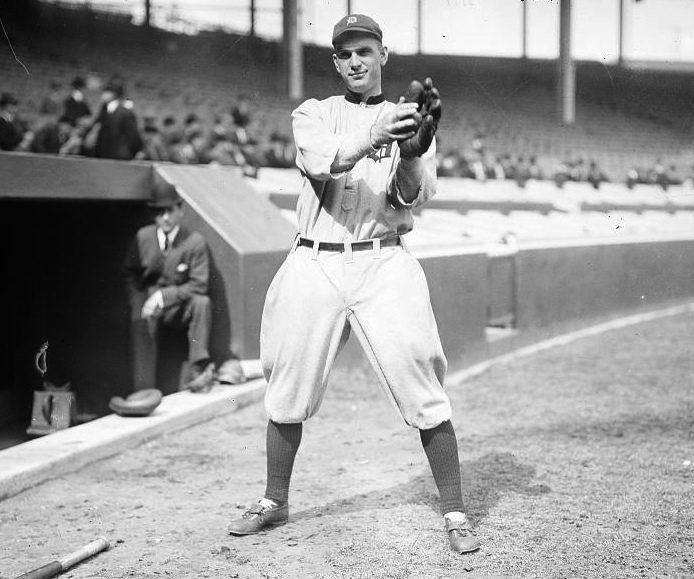
George Moriarty

George Moriarty

In December of 1911, The Associated Press reported the “Real reason for proposed trading of Moriarty.” The wire service said:

 “A battle royal between George Moriarty and Tyrus Cobb one day late in the season of 1911, is the reason why Detroit now wishes to dispose of the star third sacker.  Moriarty and Cobb started their argument upon the field at Detroit, and followed it up with an angry controversy at the club office.  Finally Cobb grabbed a bat and threatened to hit the big third baseman.  The latter armed himself in a similar manner, and they started to beat each other up.”

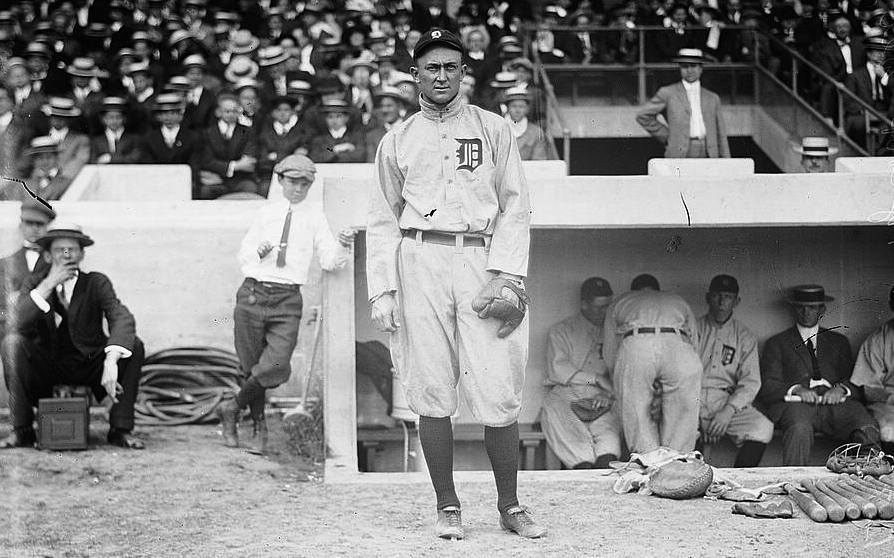
Ty Cobb

Ty Cobb

The story said the fight was broken up by teammates, and “Cobb then issued his ultimatum which was that he would not play with the Tigers if Moriarty was on the team, unless Moriarty apologized to him.”

Within days, both players and Tigers management denied that there had been any fight.  Cobb said:

“There has been a lot of talk that Moriarty and I almost had a fight in the clubhouse last season.  George and I are the best of friends.  We roomed together in the spring and were on the friendliest terms throughout the season.  The story that I put it up to (Tigers owner Frank) Navin to sell or trade George is a fabrication.  In the first place I had no grounds for such action, and in the second place I wouldn’t take such a step if I did have.  I wouldn’t put the Detroit club in a compromising position.”

While the story of a fight was told and retold over the next twenty years, Cobb and Moriarty always denied it happened.

The story that is still included in nearly every mention of Moriarty is that as he and Cobb were preparing to fight, Moriarty said “A fellow like you needs a bat to even things up when fighting an Irishman.”

The quote first appeared in a 1932 column by New York World-Telegram sportswriter Joe Williams when, as an American League umpire, Moriarty’s reputation as a fighter was renewed.  The Associated Press said after a double-header sweep by the Cleveland Indians, Chicago White Sox catcher

Charlie Berry followed the umpire into the runway of the clubhouse, accusing him of ‘missing’ a third strike on Earl Averill just before the Indian broke up the second game with a ninth-inning triple.

“Berry challenged Moriarty to a fight…Milt Gaston, Chicago pitcher, advanced himself.  The umpire felled Gaston…Then Berry, Frank Grube and Lew Fonseca rushed Moriarty, beating him until he was rescued by the Indians.”

In response to mentions of a fight with Cobb in the reports of the 1932 fight, Moriarty renewed his denial of a fight with Cobb, a denial he had also made in 1927 when he replaced Cobb as Detroit manager:

“Say anything else you like about me, but don’t spread the report that Ty and I fought.  We were roommates, and while we may have disagreed we never came to blows.”

Cobb and Moriarity relished their reputations as fighters, the fact that both continued to deny they fought long after it mattered would indicate that they often retold story is more wishful thinking than fact.

One more bit of trivia about Moriarity:  His grandson Michael Moriarty starred as Henry Wiggen in one of the greatest baseball movies, “Bang the Drum Slowly” with Robert De Niro.

Moriarty and De Niro in "Bang the Drum Slowly"

Moriarty and De Niro in “Bang the Drum Slowly”

The Man who Dried up Memphis

4 Jan

Finis Albert “Fin” Wilson had a brief, unsuccessful Major League career.  After four minor league seasons—two with the Knoxville Reds in the Appalachian League and two with the New Orleans Pelicans in the Southern Association—and a brief spring trial with the Cleveland Indians, Wilson signed a contract to play with the Brooklyn Tip-Tops in the Federal League in September of 1914.

Appearing in two games that September, Wilson went 0-1 with a 7.71 ERA.  Despite a respectable 3.78 ERA in 1915, Wilson‘s Major League career was over after a 1-8 season for the Tip-Tops.

Wilson signed with the Atlanta Crackers in the Southern Association in 1916, but became sick in April and missed most of the first half of the season.  He returned to the team in July and ended the season with a 4-6 record.

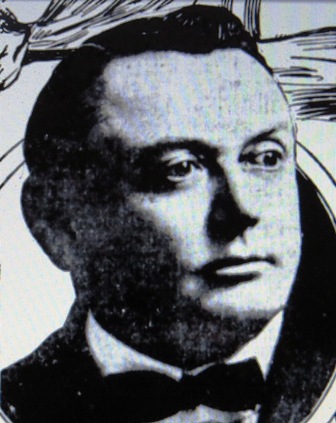
Finis Wilson 1914

Finis Wilson 1914

He returned home to Greensburg. Kentucky and served two terms in the Kentucky General Assembly.  In 1928 he was appointed as a federal prohibition administrator in Memphis, Tennessee, primarily responsible for stopping the transportation of illegal liquor on the Mississippi River.

Wilson was very popular in Atlanta because while pitching for New Orleans in 1913 he beat the Mobile Sea Gulls on the last day of the 1913 season securing the championship for the Crackers and shortly after his appointment he was the subject of a glowing profile in The Atlanta Constitution:

“In an office at the custom-house here in old Shelby County with the Mississippi meandering by just outside the window I found the man who won the 1913 pennant for the Atlanta Crackers. Finis E. Wilson, who left a bank presidency in Kentucky to battle Shelby county bootleggers, does not look like the young left-handed pitcher who gave the greatest exhibition of courage the Southern Association ever saw. His hair is gray now and he looks positively genial.”

He was on the front line of the government’s battle with moonshiners.  In one raid Wilson, according to The Associated Press he:

 “Dried Memphis up… (Wilson) directed the greatest cleanup Memphis ever experienced…more than 150 persons were arrested and confiscated 1,500 gallons of whiskey, 800 gallons of wine and 20,000 quarts of home-brew.

In another raid two of Wilson’s boats were bombed as agents destroyed 1300 gallons of liquor and arrested six men.  Wilson told The Associated Press:

“If it’s war the moonshiners want it’s war they’ll get.”

And it was a war; 16 agents were killed and 183 were injured in 1928 and ’29 alone; and while corruption among agents was widespread, it appears that no agents under Wilson were charged with any wrongdoing.

Wilson left government service sometime after the repeal of the Volstead Act in 1933, and died in Coral Gables, Florida in 1959.

Finis Wilson circa 1930

Finis Wilson circa 1930