Tag Archives: Frank Chance

“A Pork Jinx on the Club”

4 Mar

To mark the Oakland Oaks 1916 home opener, J. Cal Ewing, generally known as “The Godfather of the Pacific Coast League” presented Oakland Manager Harold “Rowdy” Elliott with a gift:  The Oakland Tribune said:

“Ewing gave to the Oaks a mascot in the shape of a real ‘rooter,’ a yearling pig, which was kept on the players’ bench throughout the game.”

The Oaks cruised to a 10-2 victory over the Portland Beavers in front 15,000 enthusiastic Oakland fans, and the superstitious among the ball club and their fans attributed the win to “Margaret,” the new mascot.

The Oaks played well in April, and were in first place until the end of the month, but by mid May they were 16-21, fifth place in the six-team league—and it was noticed that no one had seen “Margaret” for some time.
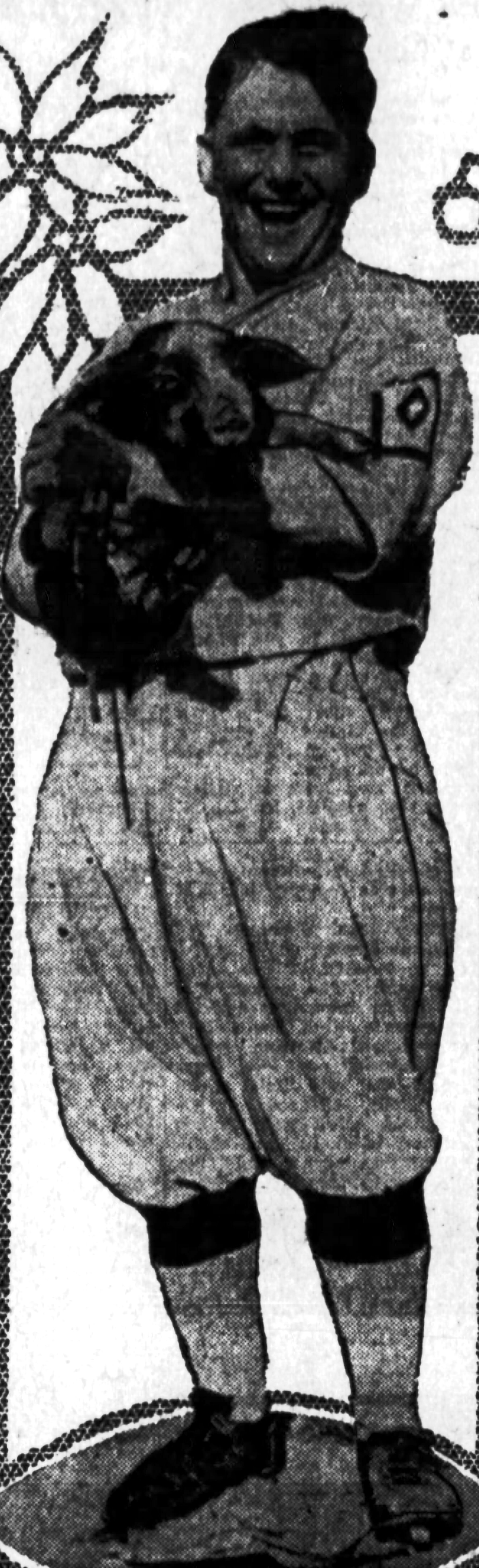
Rowdy Elliott with Margaret

Rowdy Elliott with Margaret

The Tribune was convinced the disappearance of the pig was responsible for the team’s decline:

“Suffering Pigs!  A Pork Jinx on the club!…The wrathful shade of a female porker is responsible for the Oaks’ slump.  Maggie the Pig was compelled to shuffle all her porcine coil to the accompaniment of roast apples and cranberry sauce, which is no nice way to treat an emblem of Good Fortune.”

The paper also noted that the club’s secretary also worked as a cook, and Ewing should have “had sense enough” to take that into account before presenting the team with a pig.

And, the paper composed a poem:

O Maggie, dear, and did ye hear

   The news that’s goin’ round?

The Oaks are losing day by day

   And soon they won’t be found.

They’ve ingestion badly.

   And they’re looking for the hook

They can’t play ball at all, at all

   Since you went to the cook.

It became a bit of a scandal.

The Oaks quickly denied that the pig had been eaten:

“They say the trouble is that they haven’t eaten her pigship.  Margaret was given to the ground keeper to preserve, and that personage refuses to produce the pig.”

Rowdy Elliott was quick to tell The Tribune the reason for the club’s slump had nothing to do with the team mascot.  He said the blame was clearly the result of another team’s mascot:

“Elliott says the Oaks’ slump can be attributed to no less a personage than Erasmus Pinckney Johnson.”

Johnson was the mascot for Frank Chance’s Los Angeles Angels—The Los Angeles Times said the young African American boy had been found, on Chance’s orders, in late April in order to break a week-long losing streak. The Times routinely described “the good luck charm” in the most racist terms.

Part of the “luck” Johnson brought was derived from rubbing the young mascot’s head.  Elliott claimed during the Oaks’ last series in Los Angeles he had rubbed the Johnson’s head “the wrong way.”

“Since that moment Rowdy has had little luck, winning only two games out of the last fourteen played.  Erasmus hasn’t been doing much for the Angles of late, for Chance’s crew has been in a slump, but he has at least succeeded in wrecking the Oakland club.”

Frank Chance
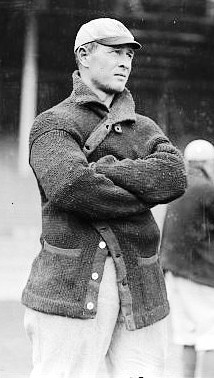
Frank Chance

So desperate were the Oakland fans for answers that The Tribune enlisted two prominent fans, an Alameda County Circuit Court judge and a local doctor to do a “psychological study of the team.”

“Judge Wells…has come to the conclusion that the team has worked itself into a jinx, and needs the aid of the pig mascot they had in the opening game to pull them through.  Dr. Halsey agrees that hits, pitching fielding and psychology and all may have something to do with it, but the real reason, according to the doctor, is that the boys are suffering from a nervous breakdown that followed shortly after seeing such an enormous crowd at the opening game.”

Things quickly got worse for the Oaks. Elliott was suspended for several days for throwing a ball at umpire Jack Doyle, and the team continued to lose in June, and then for the rest of the season.

At the end of July Elliott was sold to the Chicago Cubs, George “Del” Howard, who had purchased the club during the season, replaced him as the Oaks’ manager.

Oakland finished 1916 in last place with a 73-136 record.  Chance’s Angels overcame their May slump and easily won the championship with a 119-79 record.

Margaret the pig was never heard from again.
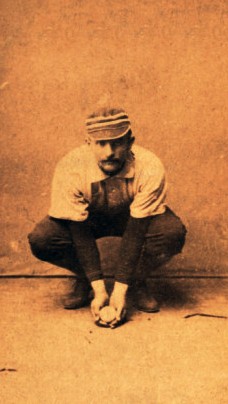
Sam Crane on International Baseball

30 Jul

Samuel Newhall “Sam” Crane, like Tim Murnane, turned to sports writing after his career on the field ended.  His involvement in a scandal might have contributed to his departure from the diamond—but contrary to oft-repeated stories it was not the direct result.

Sam Crane

Sam Crane

Crane was named as a respondent in a Scranton, Pennsylvania divorce in 1889—a prominent Scranton businessman named Edwin Fraunfelter (some contemporary newspapers incorrectly said “Travenfelter”) charged that Crane had stolen his wife, and $1500.  Crane had played for the Scranton Miners in 1887 and ’88 and departed the city with Fraunfelter’s wife Hattie in 1889, relocating to New York.  Crane and Hattie Fraunfelter were returned to Scranton to face trial for the theft.

In October of 1889, they were acquitted.  The Philadelphia Times said the two were released and Mr. Fraunfelter was ordered to pay the court costs, and “The congratulations which were showered on the second baseman and the woman made a scene in the courtroom.”

Despite the scandal the New York Giants (twice) and the Pittsburgh Alleghenys were happy to sign Crane in 1890.  The end of his career was more of a result of the 36-year-old’s .179 batting average and diminishing fielding skills—twelve errors in 103 total chances at second base–and, of course, he probably wouldn’t have found himself in Scranton in 1887 and ’88 had his career not already been on a downward trajectory.

Crane immediately went to work for The New York Press upon his retirement and remained one of the most respected sports writers in the country.  He edited the “Reach Guide” from 1902 until his death in 1926.

In 1905 Crane, then with The New York Journal, wrote about the boom in International baseball on the eve of the visit of the Waseda University baseball team:

“The Japanese are nothing if not progressive, and even with their country in the throes of a disastrous war (The Russo-Japanese War) they have found time to devote attention to our national game.”

Crane said the Waseda visit would:

“(M)ark a red letter day in the history of the game,  It will be a sensational era in the life of the sport, and in fact, that of all athletic sports.”

Japan was not alone in embracing the game:

“Baseball is also flourishing in South Africa.  The Transvaal Leader, a progressive newspaper, has taken up the sport and publishes full scores of the games and the records of the players.

“There is a South African baseball association and the players of the different teams can hit the ball, even if they have not yet attained the accuracy and agility in fielding their American cousins have reached.  According to The Leader, out of thirty-seven batsmen who figure in the official  record from July 1 to October 8, twenty-three of them batted over .300…A batter named Suter of the Wanderers was the Lajoie of the league, and he made our own ‘Larruping Larry’s’ record of .381 look like a bush league mark.  Suter’s batting percentage was .535.

“The second batter to Suter was Hotchkiss, also of the Wanderers, who walloped out a base hit every other time at bat, making his average .500…Wonder what the Africans would do with ‘Rube’ Waddell and the Chesbro ‘spit ball?’”

As evidence that the South Africans had “grasped the American style of reporting games” Crane gave an example from a recent edition of The Leader:

“’The diamond was very hard, and, as a consequence, the ball frequently wore whiskers, as some infielders can testify.’”

Crane expressed surprise that baseball had taken such a “stronghold” in an “English possession”  like South Africa:

“Britons, wherever found, look upon the great American game as a direct infringement on the sporting rights as established by cricket.

“’It is only an offshoot of our rounders,’ they are wont to say, and that ancient game is about on the level of ‘one old cat’ and ‘barnball.’

“Englishmen are extremely conservative about their sports, especially of cricket, which is considered their national game, and in their own stanch little island they have always pooh-poohed baseball.  But when the Briton gets away from home influences he becomes an ardent admirer of the American game and is loud in his praise of the sharp fielding it develops.

“In Canada, South Africa and Australia, where there is more hustling, and time is more valuable than in the staid old mother country, the quick action, liveliness and all around hustling of baseball that give a result in a couple of hours, is fast becoming more popular with the colonials than cricket, that requires as many days to arrive at a decision.

“Great strides have been made in baseball in the Sandwich (Hawaiian) Islands.  Honolulu is the headquarters just now, but the game is fast spreading to other localities.  The game has been played in the Sandwich Islands for many years, but it was not until the United States was given possession that it flourished.”

Crane mentioned that his late brother Charles–who died in 1900, and incidentally, married his brother Sam’s ex-wife who Sam divorced before leaving Scranton with Mrs. Fraunfelter) had been the catcher on the team representing the naval vessel the USS Vandalia and frequently played games against teams in Hawaii and Samoa during the 1880s:

“The natives took to the game very quickly and soon learned to enjoy it.  They welcomed every arrival of the Vandalia with loud demonstrations of joy, and there was a general holiday whenever a game was to be played.”

Crane predicted that baseball would continue to flourish in the islands, and throughout Asia, noting that a Chinese player “plays third base on the leading club, and has the reputation of being the best player in the whole league.”

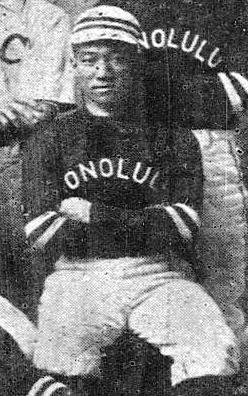
He was likely referring to 20-year-old Charles En Sue Pung, a teammate of Barney Joy’s on the Honolulu Athletic Club team who was also one of Hawaii’s best track athletes.  Pung was rumored to be joining Joy when the pitcher signed with the San Francisco Seals in the Pacific Coast League in 1907, and in 1908 there were brief rumors in the press that Chicago Cubs Manager Frank Chance wanted to sign the Chinese third baseman—neither materialized, and he remained in Hawaii.

Charles En Sue Pung

Charles En Sue Pung

Crane said the growth of the game internationally would be endless; he said the introduction of the game in the Philippines was a prime example:

“(T)here are several enclosed grounds in Manila to which are attracted big crowds…I know they can learn to play the game, for when the (New York) Giants were in Savannah (Georgia) for practice last spring a team of soldiers from a nearby fort played an exhibition game with the Giants.”

Crane said the team was accompanied by “a young Filipino, who, while he did not play on the soldier team, practiced with them and showed surprising proficiency… (The) youth knew all the points of the game as well as Henry Chadwick.”

For Crane, that was enough to declare that “in short order” the Philippines would adopt the game as had, and would, “all people that are blessed with real red blood and progressive.”

“Father isn’t Disappointed because I took up Dancing”

4 Apr

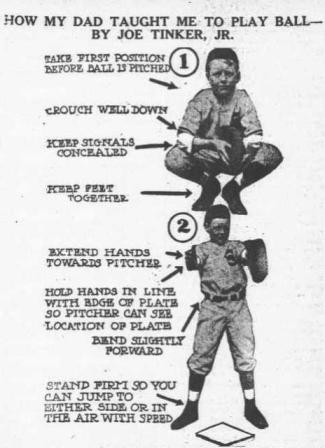
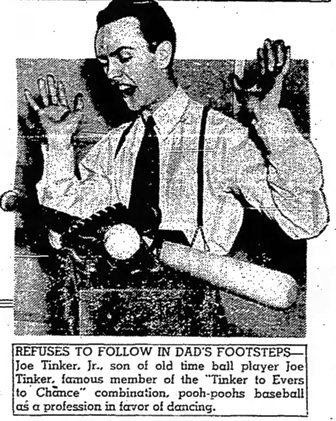
In the spring of 1916 Joe Tinker Jr., ten-year-old son of Chicago Cubs Manager Joe Tinker “wrote” a series of articles that appeared in newspapers across the country.  Tinker’s articles provided tips for playing each position:

“To be a winning pitcher you must have control…The best way to gain control is to get another boy to get in position as a batter then pitch to him.  Don’t throw at a stationary target.”

“(Catchers) Stand up close to the batter and don’t lose your head if the pitcher becomes wild.  Try to steady him with a cheerful line of talk.  Practice every spare moment.”

“Stand close to the plate when batting.  Don’t lose your nerve if the pitcher tries to bean you. Some fellows like to choke their bats or grip the handles about four inches from the end.  My father don’t approve of the style…Don’t argue with the umpire.  If you are hot-headed you hurt your chances to connect with cool-headed pitching.”

“Learn to start in a jiffy.  That is the first point emphasized by my dad in teaching me to run bases.”

“Playing short offers many chances for individual star plays and the work of a good man will have a great effect on the score card.”

Photos of Joe Tinker Jr. demonstrating what his dad taught him

Photos of Joe Tinker Jr. demonstrating what his dad taught him

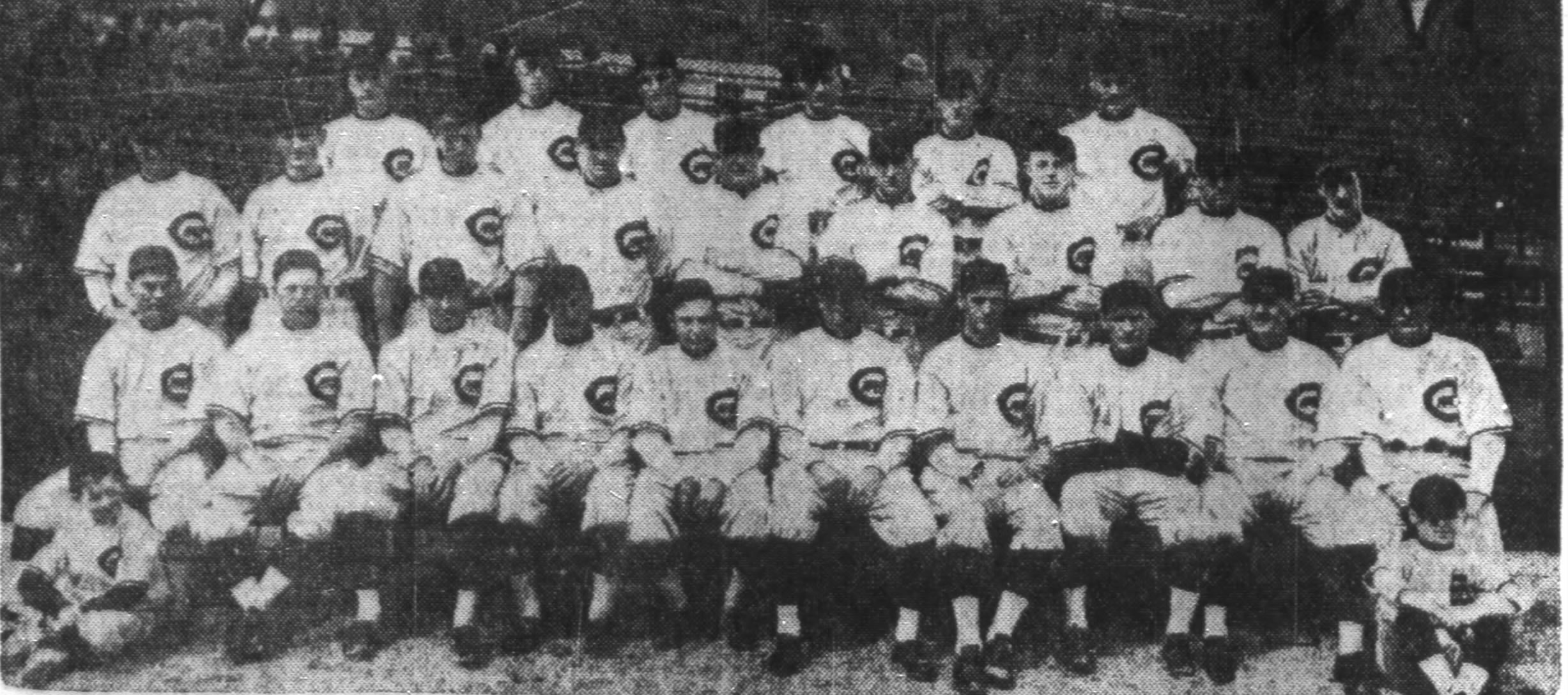
Joe Tinker Jr. and his younger brother Roland were the Cubs mascots during their father’s season as manager in 1916.  In 1924 Chicago newspapers reported that Tinker Jr. was headed to the University of Illinois to play baseball for Coach Carl Lundgren, the former Cub pitcher.  There is no record of Tinker ever playing at the school.

1916 Chicago Cubs.  Joe Tinker Jr. seated right, Roland Tinker seated left.

1916 Chicago Cubs. Joe Tinker Jr. seated right, Roland Tinker seated left.

Younger brother Roland played for two seasons in the Florida State League.

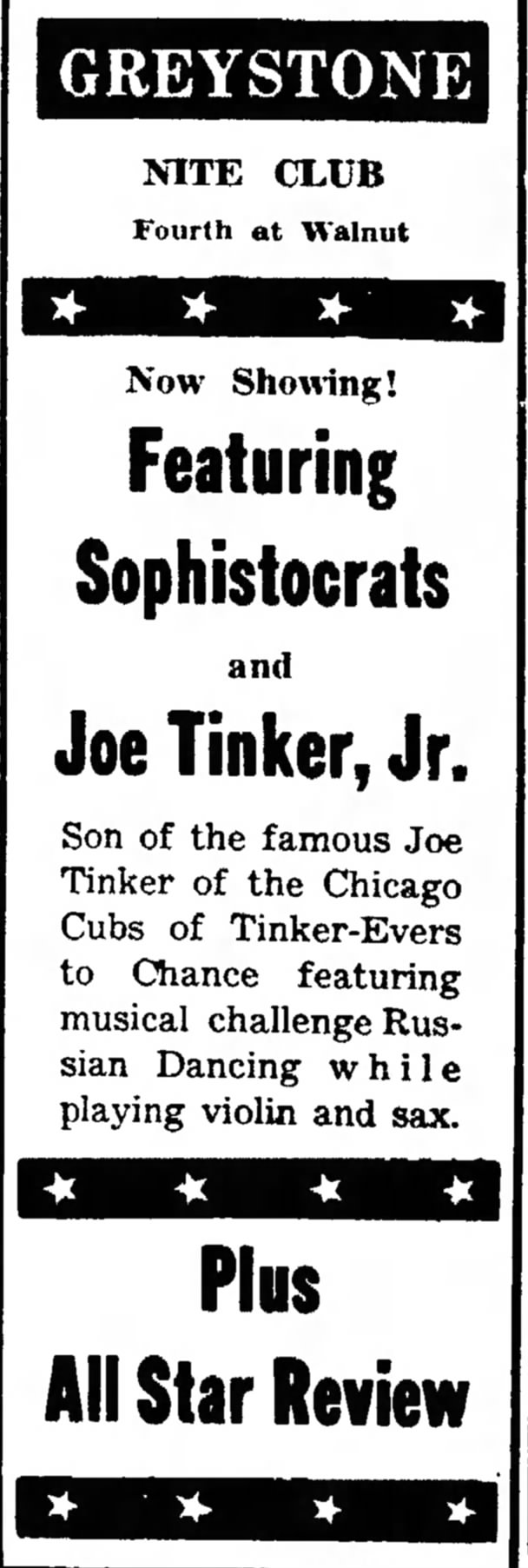
In 1938 newspapers reported that Joe Tinker Jr. had become a dancer with a vaudeville group called the Sophistocrats.  Tinker Jr. told reporters:

“Father isn’t disappointed because I took up dancing.  In fact he approves.”

It’s unclear whether “Joe Tinker Jr.” was actually Joe Tinker Jr.  The newspaper articles all said he was 22-years-old.  Joe Tinker Jr. would have been in his thirties; however his brother William Jay Tinker would have been 22 in 1938.


joetinkerjrdance


joetinkerjr1938

When Joe Tinker was elected to the Hall of Fame he compiled his all-time team for Ernest Lanigan, then curator of the Hall:

Pitchers: Mordecai Brown, Grover Cleveland Alexander, Christy Mathewson and Ed Walsh

Catchers: Johnny Kling and Roger Bresnahan

First Base: Frank Chance

Second Base: Eddie Collins

Third Base: Harry Steinfeldt

Shortstop: Honus Wagner

Outfield: Artie “Solly’ Hofman, Ty Cobb, Fred Clarke, and Sam Crawford.

Though he named several Cubs, Tinker did not include his former teammate Johnny Evers.  In 1914 Evers had famously slighted Tinker, with whom he was engaged with in a long-term feud, after Evers and his Boston Braves teammates won the World Series. William Peet wrote in The Boston Post :

“(Walter “Rabbit” Maranville’s) the best shortstop the game has ever known.

“Better than Joe Tinker; your old side partner?

“Yes, he’s better than Tinker.”

While the two finally broke their silence at Frank Chance’s deathbed in 1924, they never reconciled.

Evers died in 1947, Tinker in 1948.

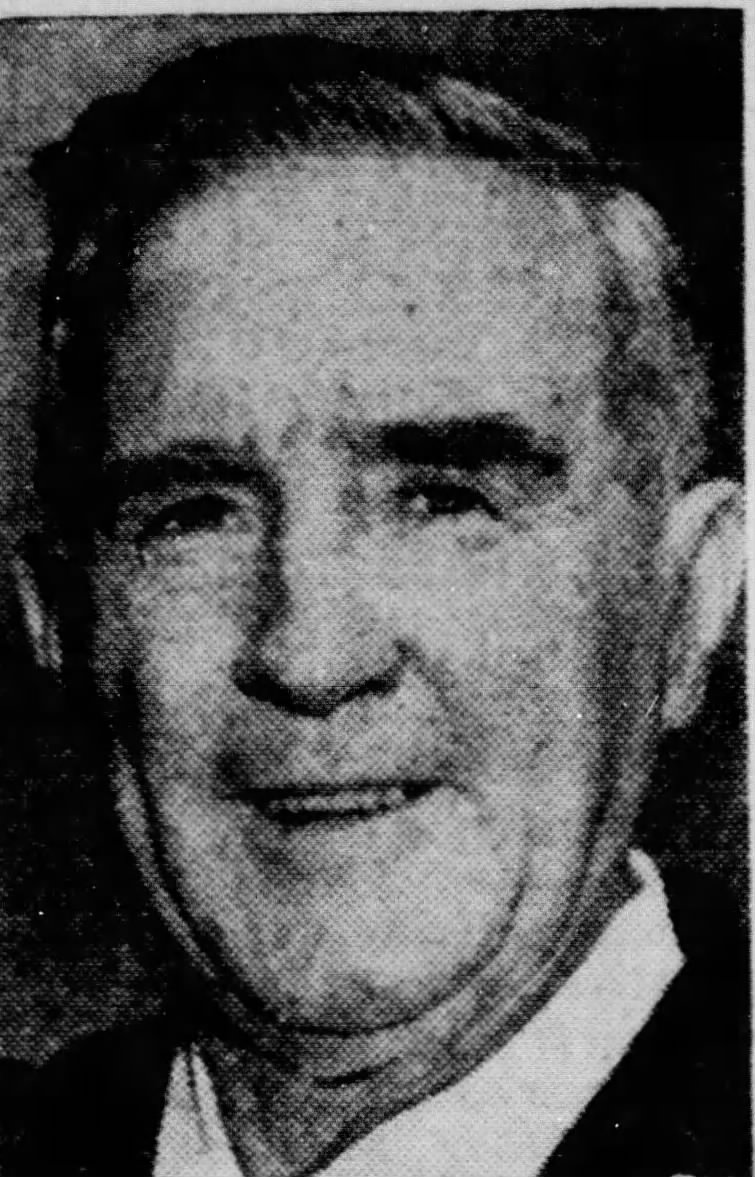
Joe Tinker circa 1946

Joe Tinker circa 1946

Joe Tinker Jr. died in 1981, Roland “Rollie” Tinker died in 1980, and William Tinker died in 1996.


Lost Advertisements–Opening Day, 1911

28 Mar

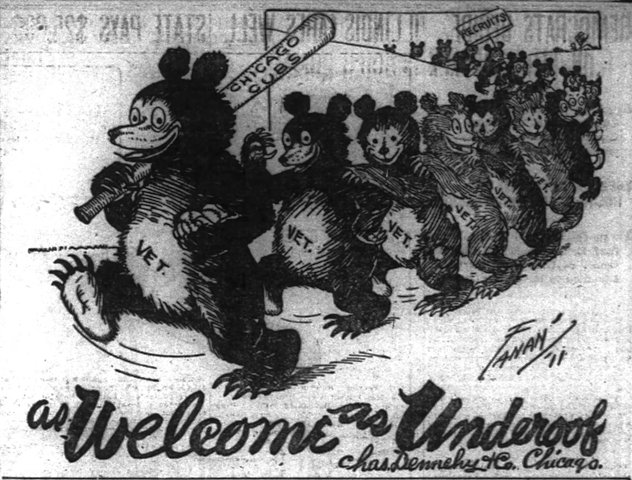
1911openingday

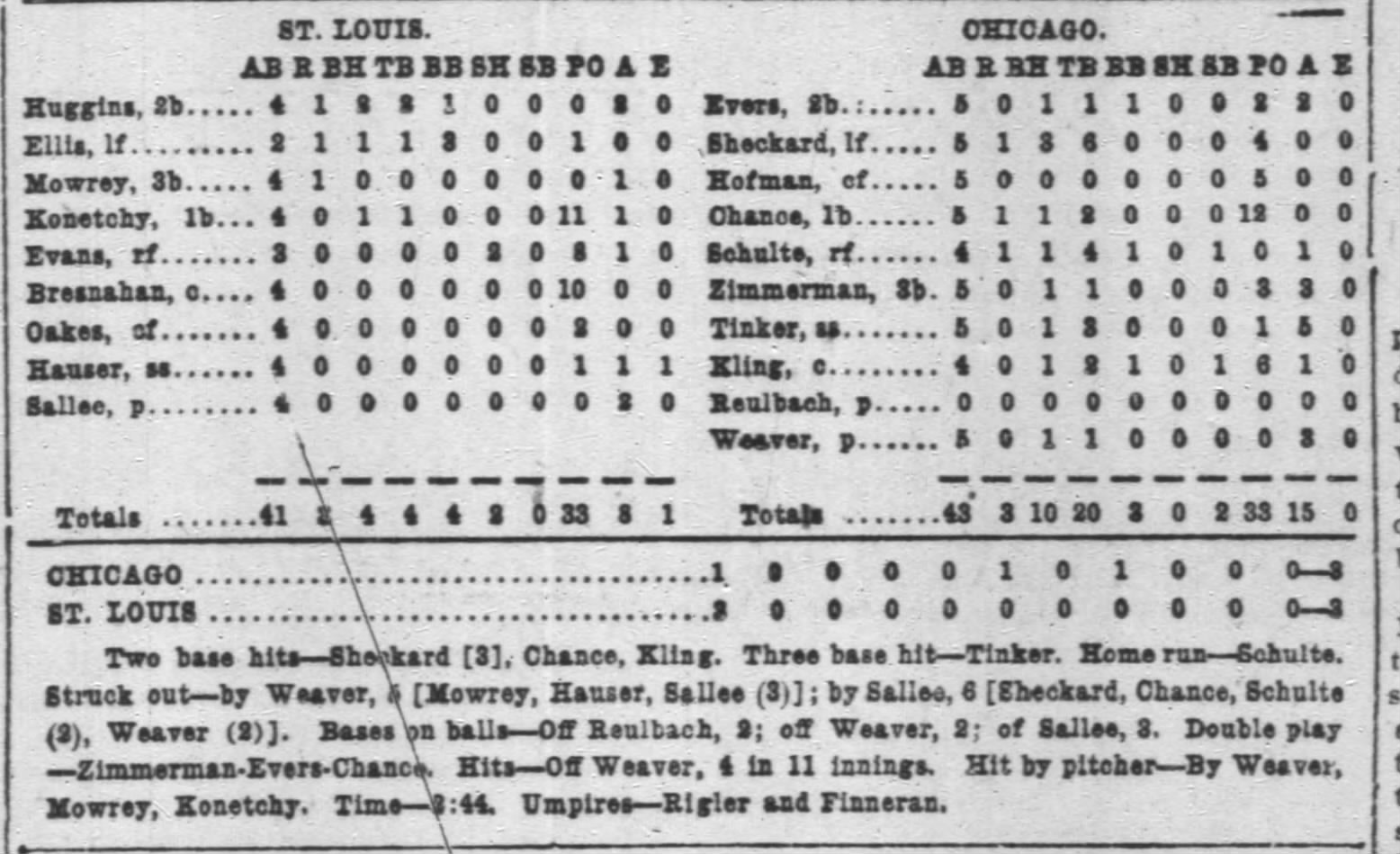
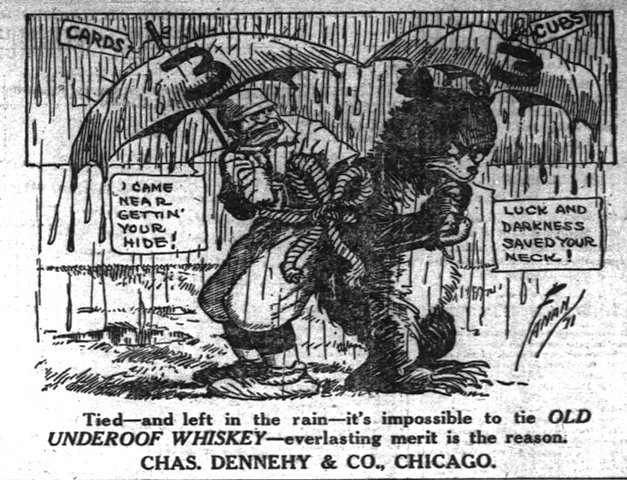
The above advertisement for Charles Dennehy Company, distributor of Old Underoof Whiskey,  appeared in The Chicago Inter Ocean on Opening Day, April 12, 1911.  The defending National League Champion Cubs met the St. Louis Cardinals at Chicago’s West Side Grounds.

The Chicago Tribune said:

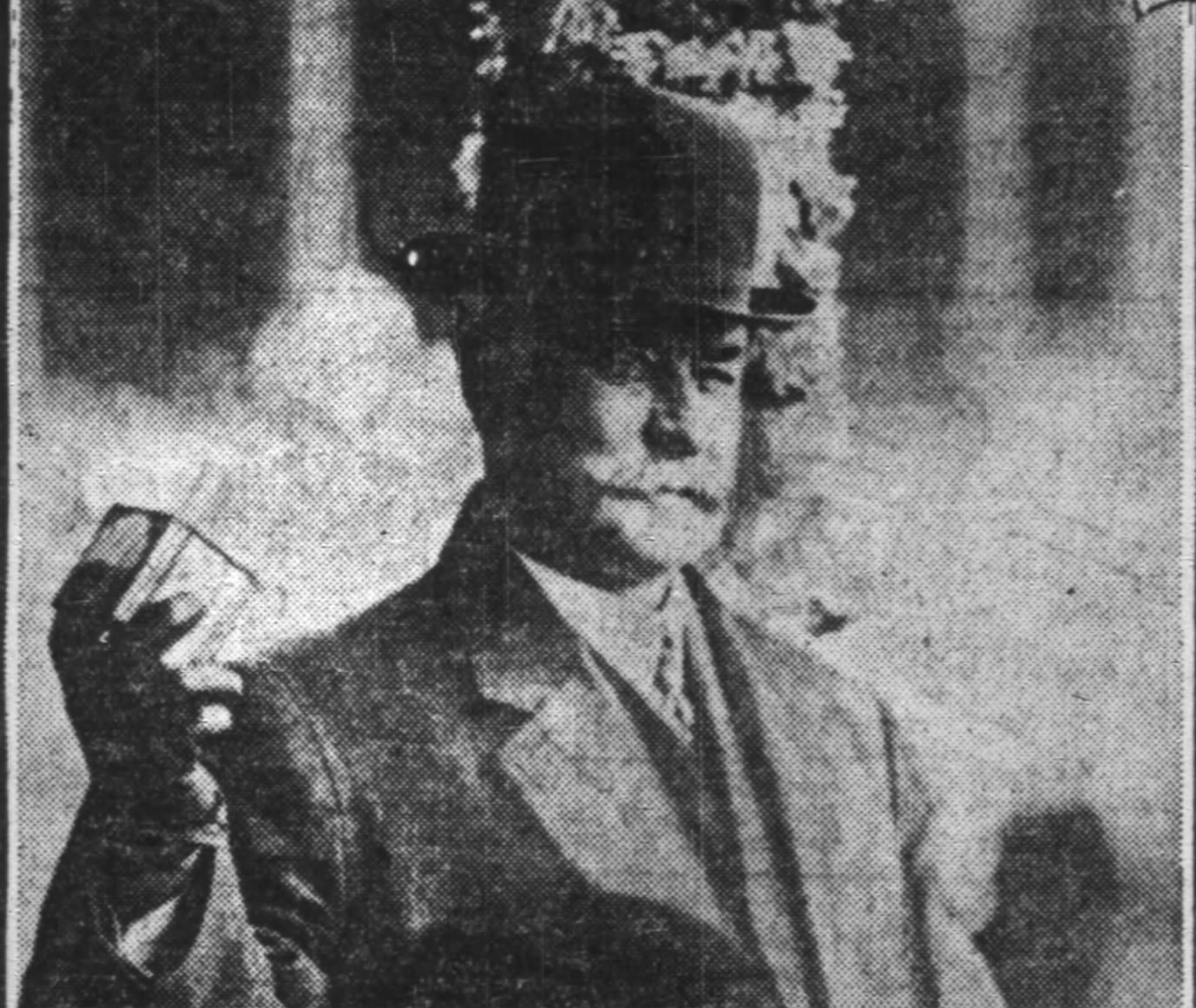
“Threatening clouds and misty atmosphere did not prevent the baseball public from of Chicago turning out for the opening.  There was almost a parkful [sic] of people there before the teams had begun their preliminary practice.  A brass band livened things up before the game started, and between innings a novelty in opening features was the presence of a woman who stood on the roof of the players’ bench and sang popular songs.  Mayor Elect Carter H. Harrison Jr.  from an upper box tossed out the ball that started the contest.  The entire park was draped with American flags.”

Carter Harrison at 1911 Cubs opener

Carter Harrison at 1911 Cubs opener

The game was called after 11 innings.  The Inter Ocean said:

“Sometime, somewhere there may be such an opening game as was played at the West Side grounds yesterday when the thirty-sixth season of the National League was introduced with a 3 to 3 tie by the Chicago Cubs and the St. Louis Cardinals, but never again will a seventh position club of the season before hang the hoodoo on the league champions as Roger Bresnahan‘s crew did the trick on the Peerless Leader’s squad…It was a sin and a shame.”

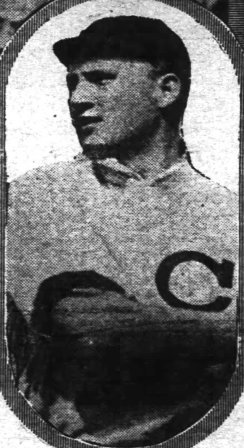
Frank Chance, "The Peerless Leader"

Frank Chance, “The Peerless Leader”

The Cardinals scored three runs in the first; starter Ed Reulbach–The Inter Ocean said he “was one wild critter–was pulled by Manager Frank Chance after throwing 10 straight balls to open the game, and was replaced by Orlie Weaver who finished the game.

The Tribune said the tie was the result of two “grievous errors of the mind.”

The first happened when Cubs third baseman Heinie Zimmerman fielded Bresnahan’s first-inning ground ball with runners on second and third:  “All Heine needed to do was toss the ball to the plate and one runner would have been caught, but he heaved to first base instead and the man coming from third (Mike Mowrey) scored, after he had actually stopped running.”

The other “grievous error” was made by second baseman Johnny Evers “incredible as it may seem, for Johnny is often talked of as the brainiest man on the team.”  Evers tried to score from first on Jimmy Sheckard‘s double in the first inning.  Cardinals first baseman Ed Konetchy took the relay throw and “there are none in the National League who can throw harder and  with greater accuracy”  Evers was thrown out by “ten feet” at the plate.

The Tribune said Chance “knows now that he acted against his better judgment in putting Ed Reulbach in to pitch the first game of the season.”  Reulbach had only appeared in 24 games in 1910 and was recovering from diphtheria (some recent references say Reulbach missed part of 1910 because his son had diphtheria–but several contemporaneous accounts say he suffered from the bacterial infection as well).

The box score

The box score


The Cubs went on to win 92 games in 1911, but finished in second place, seven and a half games behind the New York Giants.  The Cardinals finished fifth at 75-74.

Reulbach was 16-9 with a 2.96 ERA, but continued to struggle with control all season, walking 103 batters in 221 and 2/3 innings.

Below is another Old Underoof advertisement that appeared in The Chicago Examiner:

1911openingday2

Ovie, Oh, Ovie

17 Jan

Arm trouble ended Orval Overall’s career early.  When he left baseball for the first time after the 1910 season he had a 104-66 record, won 20 games twice, and went to the World Series four times with the Chicago Cubs (3-1 in eight appearances).

orvie

Orval Overall

After a visit to John D. “Bonesetter” Reese, a self-trained Youngstown, Ohio-based practitioner of alternative medicine, who while popular among many of the era’s major stars, was condemned by medical professionals.  Despite being “healed,” Overall was unable to come to terms with the Cubs and sat out the 1911 season.

Remaining in his native California, Overall worked at the gold mine he owned with Cubs teammate Mordecai “Three Finger” Brown in Three Rivers and pitched for Stockton team in the “outlaw” California League.  His success in California during the fall of 1911 gave the Chicago press hope he would return to the Cubs in 1912.  The Chicago Inter Ocean said:

“Orval Overall’s arm seems to get better every time he pitches a game.  Last week the former Cub whom Manager (Frank) Chance is trying to persuade to return to the West Side team struck out seventeen men twirling against the All-Sacramento team for Cy Moreing’s Stockton outlaws.”

Later in the fall Overall hurt his arm again.  He returned to “Bonesetter” Reese in December and told The Youngstown Vindicator he was finished with organized baseball, and would “Confine himself to his mining business and with occasional independent ball.”

Overall pitched a few games for a semi-pro team in Visalia; thirty minutes from his mine.

Orville Overall

Orville Overall

In February of 1913, he petitioned the National Commission to reinstate him and declare him a free agent because the Cubs “omitted to send him a contract” in 1912.  The commission granted his reinstatement but returned him to the Cubs.

Overall pitched in just 11 games, with a 4-5 record and .3.31 ERA; he was released to the San Francisco Seals in the Pacific Coast League (PCL) in early August.

Overall’s return to the West Coast was an event, and Seals fans even attempted to tell the club when the popular pitcher should make his first start.  The San Francisco Chronicle said:

“Orval Overall, the famous California pitcher, who built up such a reputation with the Chicago Cubs, will pitch for San Francisco today against Venice (Tigers).  A petition signed by sixty Seal fans was sent to (Manager) Del Howard yesterday, with the request that Overall’s first appearance be billed for Sunday afternoon.”

Howard chose to start Overall the day before the fans requested, nevertheless, the game drew a crowd of nearly 10,000 and The Chronicle said: “they gave him a reception long to be remembered.”

Overall gave up five runs, and was lifted in the ninth inning for a pinch hitter.  The Seals lost 8-5 in 11 innings.  He ended the season 8-9 with a 2.14 ERA.

At the end of the 1913 season, Overall announced his retirement.  San Francisco fans were not convinced and said The Chronicle said he “was being counted upon to be one of the mainstays in the box.” But chose to take a job with Maier Brewing Company “in the South” (Venice, CA—still a separate city from Los Angeles at the time.  The Maier family also owned the PCL’s Venice Tigers).  San Francisco fans were not convinced, and there was speculation for the next four months that Overall would return.

Reporter L. W. Nelson, The San Francisco Call’s resident poet composed a verse to try to coax the pitcher back:

Ovie, Oh, Ovie

Ovie, oh, Ovie, come home to us now,

For the season is soon to begin,

And we need you, yes, badly, to show the folks how

The Seals, when they have you, can win!

Ovie, oh, Ovie, sign up with us quick,

Put your name on the contract from Cal,

For we know you can make all others looks sick,

If you pitch for our Seal crew, old pal!

Ovie, we know it is your fondest dream

To work down in Venice for Maier,

Midst the Milwaukee water, the lager and steam—

We know you would like it down there!

Ovie, oh, Ovie, sign up to play ball,

And don’t try your beer selling skill,

For the job in the brew’ry won’t help us at all,

But your pitching most certainly will!

(“Cal” was Seals owner James Calvin Ewing)

As late as March 1914 Overall hinted that he might return, but the pleas and the poem did not sway him.

He left the beer business after a year to manage his family’s large lemon and orange growing operation near Visalia, which would make him quite wealthy.  He became a banker and dabbled in politics and competitive trap shooting.  He died in 1947.

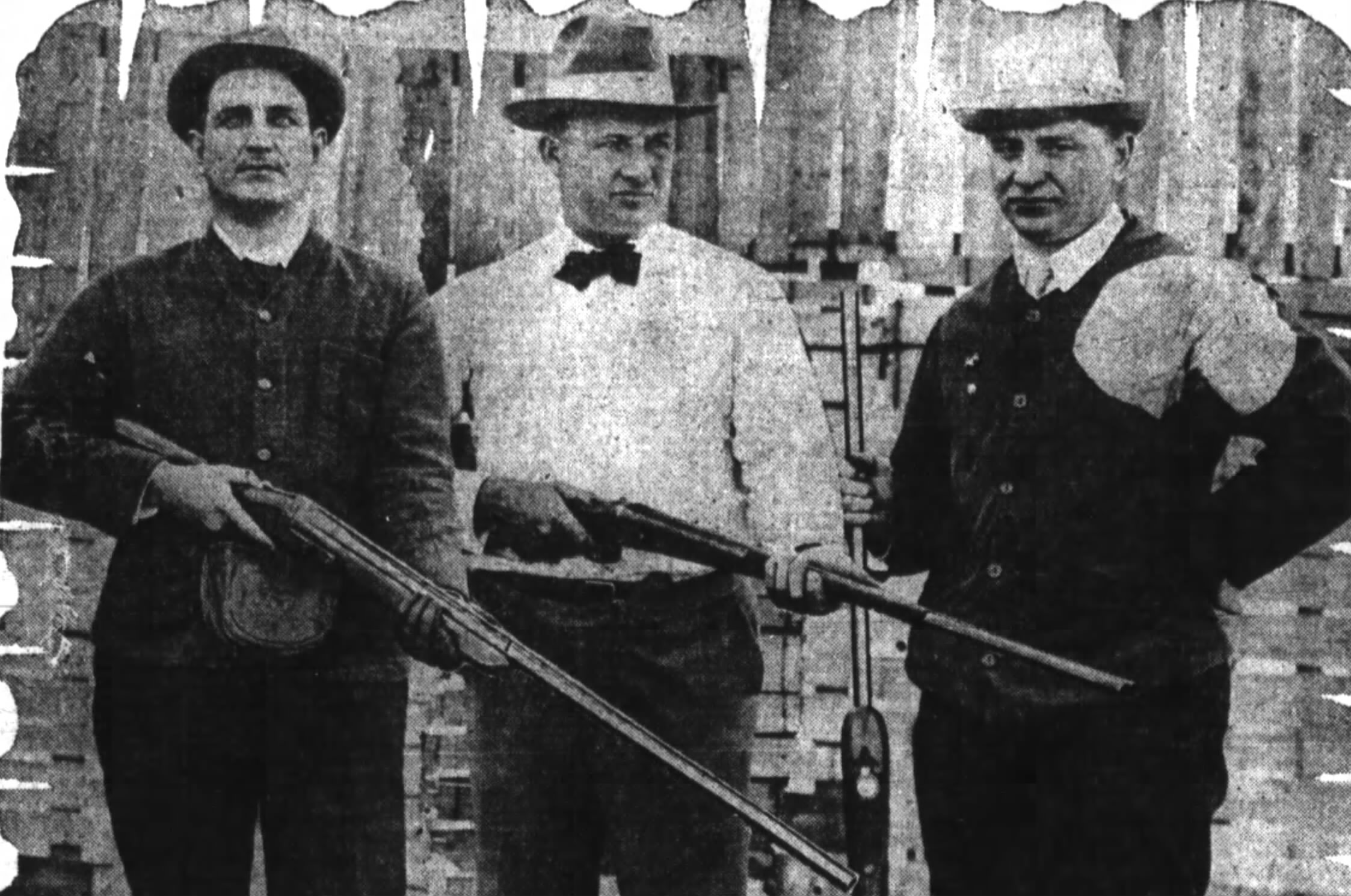
Overall (center) was president of the California-Nevada Trap Shooters Association (1918)

Overall (center) was president of the California-Nevada Trap Shooters Association (1918)

Frank Chance’s first Concussion

23 Oct

By 1912 Hall of Famer Frank Chance had been hit in the head so many times by pitches that he had developed blood clots on his brain and left the Cubs near the end of the season for surgery, and left him deaf in one ear.

Frank Chance

Frank Chance

Chance, who was known to crowd the plate, was hit by pitches 137 times during his big league career; on May 30 1904 he was hit five times in a double-header—one of which rendered him unconscious– with the Cincinnati Reds.

It appears his plate-crowding ways, and his propensity for being beaned, predated his professional career.  In April of 1894 the 17-year-old was catching for a team in his hometown of Fresno, California against a team in nearby Visalia.  The Sacramento Record-Union said:

“Frank Chance, Fresno’s catcher, was hit on the head by Charles Button, Visalia’s pitcher, in baseball game this afternoon.  Chance was knocked senseless, and believed to have suffered concussion of the brain.  He regained consciousness and vomited freely, and is better.  The outcome of the accident is mere conjecture.”

Four years later Chance began his professional career as a catcher for the Fresno franchise in the Pacific Coast league.

Lost Advertisements–“The Man Who Led the National League”

18 Oct

chancecoke

A  Coca-Cola advertisement that appeared before the 1910 season featuring Chicago Cubs first baseman/manager Frank Chance:

“The man who lead the National League –first basemen, with a percentage of .994.”

In 1909 Chance committed six errors, with 947 total chances in 92 games.

“You may use my name as one of your many customers who have derived benefits from drinking Coca-Cola.”

Things I Learned on the Way to Looking up Other Things #5

8 Aug

Johnny Evers “Ardent Worshipper of Hoodoo Lore”

Edward Lyell Fox was a war correspondent in World War I; after the war he was accused of taking money to write stories favorable to the German government.  Before that he wrote extensively about baseball for several American magazines.

In 1910, writing for “The Columbian Magazine”, Fox interviewed Johnny Evers of the Chicago Cubs about the “almost unbelievable efforts made by ballplayers to offset what they firmly believe to be ‘hoodoos.’”

Evers was one of the most superstitious players in the game, “an ardent worshipper of voodoo lore,” according to Fox, and Evers said the Cubs “are more superstitious than any team in the big leagues,” and that manager Frank Chance “is one of the most ardent respecters of diamond ‘hoodoos.’”

It’s not certain that Evers’ claim that “most players firmly believe in,” the superstitious he listed for Fox, but it’s clear he believed them:

 “If any inning is favorable to a player, he will try to lay his glove down on the same spot where he had placed it the inning before.

“While going to different parks in cars, the sight of a funeral cortege is always regarded as an ill omen.”

Evers also said the sight of a handicapped person was also an “ill omen…unless you toss him a coin.”

On the other hand Evers said a wagon load of empty barrels was a sign of good luck.

Johnny Evers,

Johnny Evers,


“Too much of a Good Thing”

Even in baseball’s infancy that were critics that said the popularity of the game was “too much of a good thing.”

In September of 1865 The Philadelphia Inquirer editorialized:

 “Let us take, for instance, the base ball (sic) pastime, which is now assuming the proportions of a violent and widespread mania.”

The culprit, according to the editorial, was the athletic club teams that were growing in popularity and  no longer “satisfied with a game or two a week.”

 “(S)ome of these associations devote, three, four or five days at a time to their games; that they are not satisfied with playing on their own grounds for their own benefit and amusement, but that they thirst for popular applause, and are rapidly transforming their members into professional athletes…They issue their challenges, and hotly contend for mastery with clubs belonging to other cities.”

 The Inquirer did predict one aspect of baseball’s new popularity:

 “It can be easily seen that this spirit must soon lead on to gambling. So far the only prize of the base ball and cricket matches has been a ball or some implement of the game, but private wagers have undoubtedly been laid upon the playing of certain clubs, and money has changed hands upon results.”

The Enquirer was also concerned that the game defied “common sense” because “during the heats of summer violent bodily exercise should be avoided; but upon this subject common sense and the base ball mania seem to be sadly at variance.”

The editorial concluded that “the young men,” make sure “they do not depreciate themselves to the level of prize fighters or jockeys, who expend their vim on horse races and matches made for money.”

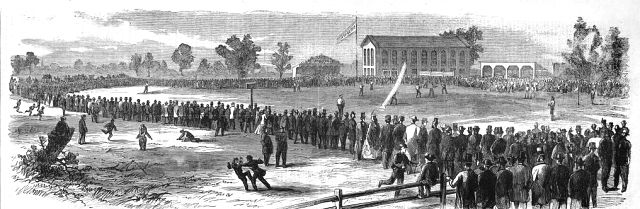
Athletic of Philadelphia versus Atlantic of Brooklyn, in Philadelphia October 30, 1865--"a violent and widespread mania."

Athletic of Philadelphia versus Atlantic of Brooklyn, in Philadelphia October 30, 1865–“a violent and widespread mania.”


Odds, 1896

Early in 1896 The New York Sun reported on “an early development of interest.”  A local bookmaker had issued odds on the 1896 National League race:

“He lays odds of 3 to 1 against Baltimore finishing first; 7 to 2 against Cleveland and Boston;  4 to 1 Philadelphia and New York; 7 to 1 Chicago; 8 to 1 Brooklyn and Pittsburgh; 15 to 1 Cincinnati; 40 to 1 Louisville; 100 to 1 Washington, while (Christian Friedrich “Chris”) von der Ahe’s outfit (St. Louis) is the extreme outsider on the list.  Any lover of the German band can wager any amount and “write his own ticket.”

The final standings:

1. Baltimore Orioles

2. Cleveland Spiders

3. Cincinnati Reds

4. Boston Beaneaters

5. Chicago Colts

6. Pittsburgh Pirates

7. New York Giants

8. Philadelphia Phillies

9. Washington Senators

10. Brooklyn Bridegrooms

11. St. Louis Browns

12.  Louisville Colonels

1896 Orioles, 3 to 1 favorites, won the National League Championship.

1896 Orioles, 3 to 1 favorites, won the National League Championship.

“Another Phil Pitcher was Sacrificed on the altar of a Futile Attack”

6 Aug

When George Chalmers returned from Cuba with the Philadelphia Phillies in November of 1911 he wasn’t the same pitcher.

After pitching the first game of the series against Almendares and the great Cuban pitcher Jose Mendez, Chalmers saw little action in the final eight games.

While training in Hot Springs, Arkansas in the spring of 1912 it became clear that Chalmers’ shoulder was in bad shape.  The Philadelphia Inquirer said he was sent from Hot Springs to Youngstown, Ohio to “visit ‘Bonesetter’ Reese.” (John D. Reese was a Welsh-born “practitioner of alternative medicine.” The  “self trained”  Reese was, according to The Pittsburgh Press, visited by many of baseball’s biggest stars, including Frank Chance, Ty Cobb, Honus Wagner, and John McGraw.  At the same time he was condemned by Ohio physicians who said there was no evidence of Reese “curing a single case where there was actual fracture or displacement of bone.”)

The famous “Bonesetter” was unable to do anything for Chalmers.  The Wilkes-Barre Times-Leader said in April:

“It is reported on good authority that Chalmers, one of the Phillies star pitchers, will be unable to deliver the goods this season owing to the condition of his pitching arm.”

As a result of the injury Chalmers only appeared in 12 games in 1912, with a 3-4 record, and didn’t pitch at all from July 5 until September 4.   At the end of the season Phillies owner Horace Fogel, who would soon find himself chased out of the game, used Chalmers’ injury to suggest a change in how pitchers were paid.  According to The Philadelphia Bulletin:Ho

“Horace wants to employ pitchers on the percentage basis, paying them so much per game—no game, no pay.

“The Phillies President conceived the idea after he had figured that it had cost him an average of $800 per game for the few games pitched by George Chalmers during the present season.”

Phillies team photo from George Chalmers personal collection--appears to be the 1912 team.

Team photo from George Chalmers’ personal collection

The $800 per game figure was clearly wrong—Chalmers would have not earned anywhere near $9600 for the 1912 season (Christy Mathewson made between $8000 and $9000), Chalmers and “Pete” Alexander both probably made less than $3000.  It is doubtful Fogel’s plan would have gone anywhere had he remained president of the Phillies.

The following season was no better; with no improvement to the injured shoulder, Chalmers appeared in 26 games, 15 as a starter, and was 3-10 with 4.81 ERA.  It got so bad that after a loss near the end of the season The Wilkes-Barre Times-Leader said:

“Our old friend ‘Dut’ Chalmers got another trimming yesterday.  It has gotten to be such a regular thing for Chalmers to be beaten that he doesn’t mind it anymore.”

Two of the Phillies best pitchers in 1913, Tom Seaton (27-12), and Addison “Ad” Brennan (14-12) jumped to the Federal League, making Chalmers and his injured shoulder even more critical to the Phillies hopes for 1914.

In March The Philadelphia Inquirer said Chalmers had spent the winter in Hot Springs rehabilitating his shoulder and appeared “to be in splendid shape,” when he reported to spring training in Wilmington, North Carolina, and “(Charles “Red”) Dooin is thanking his lucky stars that Chalmers is in camp.”

The season turned out to be Chalmers’ worst.  He pitched in three games, losing all three with an ERA of 5.50, and he Phillies released him on June 22.  The Inquirer said his shoulder had never healed and attributed the injury to “rheumatism and a misplaced muscle.”

George "Dut" Chalmers

George “Dut” Chalmers

The Pittsburgh Press said:

“The frailty of baseball life and the quickness with which a career in the big show may be ruined are shown again in the case of George Chalmers…Chalmers may recover and come back some time, but it is doubtful, and his going marks the untimely end of a career that promised to be one of the most brilliant in baseball pitching history.”

According to The Inquirer, he was not yet ready for the end:

“Chalmers…had mighty little money, about $400 in all, and his best friends advised him to stick the little old four hundred into some good business and forget baseball…Good doctors had told George that his arm was gone.  Other pitchers, real friends of the Phillies star, had told him the same thing…Then he heard of a specialist in New York who had done a great job on another pitcher’s arm which had seemed to be gone (no articles mentioned the name of the specialist or the other pitcher).”

With his arm seemingly better, Chalmers was invited to spring training with John McGraw’s New York Giants in Marlin, Texas.  The New York Mail said “he looked good at Marlin,” but the Giants let him go before the season began.  On April 20 he was signed again by the Phillies, and sent out to pitch the next day.  The Inquirer said:

 “George Chalmers, once a Philly discard and lately spurned by the Giants, with whom he trained during the spring trip to the Southland, was the hero of today’s festive occasion for Philadelphia.  Chalmers had been without a big league contract and he was signed by (manager Pat) Moran only yesterday.  But he gave him a quick trial by shunting him at the Giants, and he showed his gratitude to the Quaker boss by pitching the best game of his career.”

Chalmers gave up only two hits and beat the Giants 6-1.

As the Phillies fifth starter in 1915 he was 8-9 with a 2.48 ERA, appearing in 26 games.  Jack Kofoed, a sportswriter for The Philadelphia Record said in “Baseball Magazine”that Chalmers’ record did not reflect how well he pitched:

“Throughout the season Chalmers twirled splendid ball, but played in tougher luck than any man on the Philly staff.  Had fate been as kind to him as to Al Demaree (14-11 3.05 ERA) , for instance, he would have won twice the number of games he did.  But the Phillies played more weird ball behind him than in back of any man on the staff.”

The Phillies won the National League pennant, and met the Boston Red Sox in the World Series.  With Philadelphia down two games to one, Chalmers was Moran’s choice to pitch game four in Boston.

Facing Ernie Shore, who won 19 games for the Red Sox, Chalmers pitched well, but lost 2-1 (the same score of Philadelphia’s losses Geo 2 and 3); The Inquirer said:

“Another Phil pitcher was sacrificed on the altar of a futile attack…through the futile efforts of his companions to obtain for him even the slender margin that was all he required.”

The Red Sox beat the Phillies four games to one.

In November of 1915 several Pennsylvania papers said Chalmers had used his “World Series coin as a matrimonial nest egg.”

The following season was his last.  The shoulder injury returned and the Phillies only used Chalmers in 12 games, he was 1-4 with a 3.19 ERA.  He did not appear in a game after August 7, and was released at the end of the season.  After an unsuccessful attempt to catch on with the Kansas City Blues in the American Association in 1917 Chalmers career was over before his 29th birthday.

In the waning days of his career, The Wilkes-Barre Times-Leader said:

“’Dut,’ as George is called by his playmates is a fine, upstanding, intelligent young fellow, with all the sturdy Scotch virtues as well as a Scotch burr in his speech, and whether or not he lasts in baseball he is very likely to be successful in life.”

Chalmers retired to New York and died in the Bronx in 1960.

Special thanks to Karen Weiss, George Chalmers’ great niece, for generously providing copies of photos from Mr. Chalmers’ scrapbook.

“Is the Best the Game has Known”

23 Jul

Joining the Boston Braves for the 1914 season provided second baseman Johnny Evers with the opportunity to appear in one more World Series, and gave him the chance to take a very public swipe at one of his most famous former teammates, shortstop Joe Tinker.

In December of 1912 the Chicago Cubs traded Tinker to the Cincinnati Reds, and depending on which version of the story was to believed, Tinker and Evers had not spoken a word to one another for either five or six years.

Johnny Evers

Johnny Evers

Tinker said the two stopped talking in 1908 after Evers jumped in a horse-drawn cab leaving Tinker and other teammates behind before an exhibition game in Indiana leading to an on-field fight between the two later that day; Evers said a year earlier Tinker initiated the bad blood between the two by throwing a ball so hard to the second baseman on a force play that it injured his finger.

Evers said years later:

“I yelled to him, you so-and-so. He laughed. That’s the last word we had for-well, I just don’t know how long.”

The 1914 Braves got off to a horrible 4-18 start, and were still in eighth place on July 18, but surged to second place by August 10, winning 18 of 21 games.  By September 2 the Braves had first place to themselves, and ended up running away with the pennant, beating the second place New York Giants by 10 ½ games, and sweeping Connie Mack’s Philadelphia Athletics in the World Series.

Evers, named Boston’s captain by manager George Stallings, led National League second basemen in fielding; hit .279 for the season, and .438 in the World Series.  Evers received baseball’s last “Chalmers Award,” a forerunner of the Most Valuable Player Award, which was presented from 1911-1914.  The award was sponsored by the Chalmers Motor Car Company and was presented to Evers along with a new car.

The runner-up for the Chalmers Award was Evers’ teammate, shortstop Walter James Vincent “Rabbit” Maranville.  Maranville, Evers and first baseman Charles “Butch” Schmidt were an excellent double-play combination throughout the season; Evers participated in a career-high 73 twin killings, more than he’s ever turned in a season with Tinker and Frank Chance.

Years later Maranville said of Evers:

“It was just Death Valley, whoever hit a ball down our way.  Evers with his brains taught me more baseball than I ever dreamed about.  He was psychic.  He could sense where a player was going to hit if the pitcher threw the ball where he was supposed to.”

Two days after the Braves won the World Series; Evers took the opportunity to take a swipe at his former teammate Tinker.  Evers told William Peet, sportswriter for The Boston Post that:

“(Maranville’s) the best shortstop the game has ever known.

“Better than Joe Tinker; your old side partner?

“Yes, he’s better than Tinker.”

Joe Tinker

Joe Tinker

Peet sad:

“Evers has been given credit for making Maranville the great player he has shown himself to be this season, but Johnny declares this s untrue, stating that Maranville learned the game and all its fine points unaided.”

Peet said Evers’ claim that Maranville “is a greater shortstop than Tinker is about the highest praise anyone can shower on the peppery little chap who was such a prominent factor n the Braves’ victory.”

Rabbit Maranville

Rabbit Maranville

Evers and Peet failed to mention where Honus Wagner would be ranked if Maranville was, in fact, “the best shortstop the game has ever known.”

No response from Tinker was recorded.

Evers and Tinker would not speak again for another decade.  In 1924, the two finally spoke when they were summoned to California by Chance, their former teammate and manager, who was dying.

Tinker, Evers and Chance

Tinker, Evers and Chance

Tinker, Evers and Chance were inducted into the Hall of Fame together in 1946 by the veterans committee; Maranville was elected by the Baseball Writers Association of America in 1954.